Nuclear-armed North Korea tests long range missile.
Nuclear-armed North Korea tests long range missile, Canberra Weekly, January 30, 2022 Nuclear-armed North Korea has conducted what would be its largest missile test since 2017, sending a suspected intermediate-range ballistic missile soaring into space and sparking condemnation from the United States and its allies.
South Korea’s Joint Chiefs of Staff reported that a projectile believed to be a single ballistic missile was launched about 7.52am on Sunday from North Korea’s Jagang Province towards the ocean off its east coast.
South Korea’s National Security Council, which convened a rare emergency meeting presided over by President Moon Jae-in, said the test involved an intermediate-range ballistic missile (IRBM), which North Korea has not tested since 2017.
Map shows the horrible impact a nuclear bomb would have on Coventry
 |

Map shows the horrible impact a nuclear bomb would have on Coventry
We used NUKEMAP to find out the effects nuclear bombs would have on Coventry, Coventry Live, ByJaspreet Kaur, 30 Jan 22, t’s a chilling thought – but have you ever wondered what would happen if a nuclear bomb was suddenly detonated in Coventry as part of an attack on the UK?
CoventryLive has used specialist research to find out what would happen if a nuclear bomb hit the city.
The website NUKEMAP calculates the effects of the detonation of a nuclear bomb. And although of course none has ever hit the UK before, they were used to terrible effect in Japan at the end of the Second World War.
And of course our city faced dreadful destruction in Nazi bombing raids.
The website that now looks into the horrifying impact a nuclear disaster could have was created by Alex Wellerstein, a historian of science who specialises in the history of nuclear weapons and nuclear secrecy.
He created Nukemap in February 2012, and it has been used by over 25 million people globally since its launch.
In one experiment, we looked at what happened if ‘Davy Crockett’ detonated in our city – one of the smallest nuclear bombs ever built in the United States……………
all-in-all the impact of the smallest US bomb is very bad in real terms, but relatively small for a nuclear attack. Wr then looked at a much larger bomb.
And chillingly, the ‘Gadget’ bomb was found to have a much more awful impact.
If detonated in Coventry city centre this particular bomb would cause thermal radiation to several Coventry areas, including Earlsdon , Cheylsmore , Ball Hill and Daimler Green .
It would also cause moderate blast damage to areas further afield, such as Radford , Coundon , Whitley and Styvechale .
In total, the number of estimated injuries would rise significantly to 48,060 with 23,900 estimated fatalities. Which is terrifying.
The test may seem arid – but the threat of nuclear war hung over the world for decades during the Cold War.
There are still around 3,750 active nuclear warheads and nearly 14,000 total nuclear warheads in the world today…………………………… https://www.coventrytelegraph.net/news/map-shows-horrible-impact-nuclear-22918995
Russia proposes US returns American nuclear weapons from NATO countries close to Russia

Russia proposes US returns American nuclear weapons from NATO countries stateside https://tass.com/politics/1394065
According to Vladimir Yermakov, “currently there are about 200 American nuclear air bombs of the B61 family” in five non-nuclear NATO countries
MOSCOW, January 27. /TASS/. Moscow proposed to Washington to return all American nuclear weapons from NATO countries to US territory in the context of reviewing security guarantees, Director of the Russian Foreign Ministry’s Department for Nonproliferation and Arms Control Vladimir Yermakov said in an interview with TASS.
“We insist that NATO’s ‘joint nuclear missions’ should be stopped immediately, all the American nuclear weapons be returned to US national territory and the infrastructure that allows their rapid deployment should be eliminated. This aspect is one of the elements of the package of measures proposed by us to Washington in the context of considering the issues of security guarantees,” he said.
According to the diplomat, “currently there are about 200 American nuclear air bombs of the B61 family” in five non-nuclear NATO countries. Thus, the alliance is capable of rapidly deploying nuclear weapons able to reach strategic targets on Russian territory. “[NATO countries] also retain the infrastructure ensuring rapid deployment of these [nuclear] weapons capable of reaching Russian territory and striking a wide range of targets, including strategic ones,” he pointed out.
At the same time, NATO engages non-nuclear countries in training for using American nuclear weapons against Russia. “Interaction between NATO member countries in joint nuclear planning is underway. NATO ‘joint nuclear missions’ take place with non-nuclear alliance members involved in training on the use of American nuclear weapons against us,” the diplomat stressed.
He noted that the US is modernizing its nuclear arsenal with a view of the increased applicability of such weapons in real conditions, above all, in Europe. “As for modernization, the US is consistently implementing a campaign on the renovation of practically all the components of the nuclear arsenal. The B61 air bombs in their newest B61-12 modification will have a decreased or variable yield but increased precision. This raises the question, which containment scenarios justify such ‘calibration?’ This clearly means betting on a ‘higher applicability’ of such weapons under real conditions, first of all, in Europe,” the diplomat stated.
On December 17, 2021, the Russian Foreign Ministry published draft agreements between Moscow and Washington on security guarantees and the measures of ensuring the security of Russia and NATO member states. The proposed measures include guarantees that NATO will not advance eastward, including the accession of Ukraine and other countries into the alliance, as well as the non-deployment of serious offensive weapons, including nuclear ones. On January 26, the US and NATO submitted to Russia their written response to Moscow’s proposal on security guarantees.
NATO practices nuclear missile sorties near borders of the Russia-Belarus Union

NATO practices nuclear missile sorties near Union State borders — Belarus’ security chief
A breach of international norms and elementary rules of good neighborly relations by neighboring countries is already turning into an alarming trend, Alexander Volfovich stated
MINSK, January 28. /TASS/. The NATO Air Force is practicing sorties with cruise missiles, including with nuclear warheads, near the borders of the Russia-Belarus Union State, State Secretary of the Belarusian Security Council Alexander Volfovich said on Friday.
“The head of state drew attention to intensified flights by US strategic bombers near the borders of the Union State,” the BelTA news agency quoted Volfovich as saying.
“In our assessments, this means that the NATO Air Force is practicing employing cruise missiles, including those with nuclear warheads,” he said…………….. https://tass.com/defense/1394647
”All options on the table” to punish Moscow -could bring about a nuclear conflict.
Repeated assertions that “all options are on the table” to punish Moscow should it reinvade Ukraine are seen as particularly troubling.
“In the nuclear age, ‘all options on the table’ in a conflict involving nuclear powers could be understood to mean the potential use of nuclear weapons, even if that wasn’t the intention in this instance,
Nuclear fears mount as Ukraine crisis deepens,
Officials and experts are warning that a Russian invasion could inadvertently trigger a nuclear exchange with the U.S. Politico By BRYAN BENDER, 01/27/2022, As Russian troops bear down on Ukraine and the United States prepares its own military buildup in Eastern Europe, concerns are growing across the ideological spectrum that the standoff could inadvertently escalate into the unthinkable: nuclear war.
President Joe Biden has insisted that he will not use American forces to directly defend Ukrainian territory against a possible Russian invasion. But that is no guarantee that the two sides won’t come to blows.
The world’s two largest nuclear powers could even stumble into nuclear confrontation if the situation spins out of control, current and former officials and experts on both sides of the Atlantic worry.
“At the point you unleash war in the modern environment, the one thing that is certain is the law of unintended consequences,” Des Browne, a member of the British Parliament and a former secretary of state for defense, told POLITICO. “If you are talking about a nuclear-armed environment, which is already fragile … then you are living in an environment [where] things could escalate quite quickly, by accident or miscalculation.”
“Nobody thinks any of these weapons are going to be used deliberately, but miscalculation is a significant chance,” added Browne, who chairs the Euro-Atlantic Security Leadership Group.
It’s a concern shared by current and former nuclear security officials who usually don’t agree on much — from disarmament advocates to nuclear hawks.
“I think the Ukraine conflict is demonstrating that the nuclear escalation scenario we’re worried about is not out of sight,” said Patty-Jane Geller, an expert on nuclear strategy at the hawkish Heritage Foundation.
Last week, the Bulletin of the Atomic Scientists cited the Ukraine conflict as contributing to its decision to keep the “Doomsday Clock” at 100 seconds to midnight, an indication of how close it assesses that the human race is to potential self-annihilation.
“Ukraine remains a potential flashpoint, and Russian troop deployments to the Ukrainian border heighten day-to-day tension,” it noted in citing the threat of a nuclear conflict.
A primary concern, according to Geller and others, is Russia’s arsenal of thousands of battlefield nuclear weapons, which are central to its military strategy.
“The Russians have something like 4,000 [tactical nuclear weapons] and they have an ‘escalate to win’ nuclear doctrine, which says ‘we use nuclear weapons first if the conventional conflict starts to spin out of our favor,’” said a former senior GOP government official who still works on nuclear security issues.
One Russian diplomat last month went so far as to publicly threaten the deployment of tactical nuclear weapons in the crisis.
The weapons have a lower “yield” than traditional atomic bombs and are designed to be used against conventional forces in battle. But they still have enormous explosive power and are considered particularly destabilizing to deterrent strategy.
The United States has reportedly been flying dedicated spy missions over in recent weeks to determine if Russia has deployed any of its tactical nuclear weapons along the border with Ukraine.
There’s also concern among Russian nuclear experts about the potential that the Ukraine crisis could escalate, according to former U.S. Ambassador Richard Burt, who negotiated arms control treaties with the Soviet Union…………
The situation is exacerbated by the growing number of U.S., NATO, and Russian military forces in close proximity, Burt said.
“One thing I think is useful to remember is people are not just putting their forces on alert in and around Ukraine, but you’ve got nuclear-capable naval forces in the Black Sea and in the Mediterranean,” he said. “In the Baltic Sea there also has been an intensification of activity as well. You have a lot more aircraft flying overflights.”………….
Others have taken issue with American rhetoric that they see as sowing unnecessary confusion about what military options might be under consideration to prevent a Russian invasion of Ukraine.
Repeated assertions that “all options are on the table” to punish Moscow should it reinvade Ukraine are seen as particularly troubling.
“In the nuclear age, ‘all options on the table’ in a conflict involving nuclear powers could be understood to mean the potential use of nuclear weapons, even if that wasn’t the intention in this instance,” two leading arms control advocates wrote last week.…..https://www.politico.com/news/2022/01/27/nuclear-fears-mount-ukraine-crisis-deepens-00003088
Nuclear-Testing ‘Downwinders’ Speak about History and Fear
Nuclear-Testing ‘Downwinders’ Speak about History and Fear. An archival project aims to document the experiences of people who suffered from U.S. nuclear weapons testing, Scientific American , By Sarah Scoles on January 27, 2022 When Sandra Evans Walsh was growing up in Parowan, Utah, her class would sometimes trek outside to a row of trees. They were about to watch history in the making, the teacher would tell them. The kids would then stare as an orange shroud spread across the sky. “I remember the clouds coming over our town and writing our names in the dust,” she said in an interview with Justin Sorensen, a geographical information systems (GIS) specialist at the University of Utah’s J. Willard Marriott Library.
That dust had traveled around 200 miles, all the way from what is now called the Nevada National Security Site, where scientists once tested nuclear weapons. Between 1945 and 1962, U.S. researchers detonated around 200 bombs aboveground—100 of them in Nevada. Fallout from the nuclear tests—radioactive particles that were swept into the atmosphere and fell back down to the earth—found their way into crops and livestock, whose radioactivity humans took on when they consumed milk, meat and produce. Fallout takes many different chemical forms, one of which is iodine-131: an isotope, or version, of iodine that has the usual 53 protons but 78 neutrons instead of the standard 74. Inside the body, the thyroid gland will absorb iodine-131, which eventually decays to produce radiation that can cause thyroid cancer and other problems.
People, such as Walsh, who lived “downwind” of nuclear development and open-air explosions are now called “downwinders.” Mary Dickson, another downwinder, told Sorensen and one of his colleagues that she thought the attitude toward those in Utah who were affected by nuclear testing was, “you know, ‘They were Mormons and cowboys and Indians—who cares?’ In general, she added, “they test where they think there are populations that don’t matter.”
Sorensen and his team spoke to both women and dozens of other people for a project called the Downwinders of Utah Archive. Hosted by the J. Willard Marriott Library, the archive is an attempt to qualify, quantify and make accessible people’s experiences of, and effects from, the American legacy of nuclear weapons testing. In 2011 the Senate unanimously designated January 27 as the National Day of Remembrance for Downwinders. “The downwinders paid a high price for the development of a nuclear weapons program for the benefit of the United States,” stated the resolution establishing the designation.
But when the tests were conducted, no one had done the research necessary to truly calculate what that price would be. Wanting to understand the potential link between regional health issues and fallout from nuclear tests, the National Cancer Institute (NCI) undertook a study on Americans exposed to iodine-131 from the Nevada tests. The results were released in 1997 in a report entitled “Estimated Exposures and Thyroid Doses Received by the American People from Iodine-131 in Fallout following Nevada Atmospheric Nuclear Bomb Tests.” It was this document that first led Sorensen to the archival project. “We were just kind of wondering, originally, ‘What does this data look like if you put it on a map?’” he says, “because a spreadsheet doesn’t really tell you a lot.” Sorensen’s background is in GIS and cartography, so he took the NCI’s fallout data and overlaid them onto his home state. “It just really grew from there,” he says. “We started seeing there’s a story to be told.”……………………..
Although no single illness can be conclusively tied to a test-site cause, investigations by the United Nations Scientific Committee on the Effects of Atomic Radiation and the International Physicians for the Prevention of Nuclear War and the Institute for Energy and Environmental Research, among others, have established links between radiation exposure and cancer occurrence. In the early 2000s a report by NCI and the Centers for Disease Control and Prevention estimated that fallout could have led to around 11,000 excess deaths. The NCI has also created a calculator that allows users to calculate their thyroid dose and risk of developing thyroid cancer from fallout. “We can’t know any individual’s cancer was caused by radioactivity,” explains Scott Williams, former executive director of HEAL Utah, a nonprofit advocacy group focused on the environment and public health, “but we do know that some people’s cancer risk was increased by radioactivity.”
Since 1990 the federal government has offered some recompense to downwinders and others affected by nuclear testing through the Radiation Exposure Compensation Act (RECA). Set to expire this summer unless a bill is passed to renew (and expand) it, RECA pays downwinders, test participants and uranium workers between $50,000 and $100,000—if they have specific ailments and can prove (with decades-old evidence that is sometimes hard to come by) they were in the wrong place at the wrong time. “We left a burden on unwitting citizens across the country without ever informing them,” Williams says. “We need to do the honorable thing and own the problem and not create these problems again.”
The Downwinders of Utah Archive is always expanding, and though Sorensen paused interviews during the pandemic, he plans to light the fuse again soon. He also hopes to expand the project to other Western states to preserve their history, too.
Making sure that information remains accessible is part of the point of the Downwinders of Utah Archive. The day of remembrance is, in its own way, an isotope of that openness. “Those kind of markers are really important…,” Dickson told Sorensen and his colleague. “Otherwise, you know, time marches on, and it’s like dipping a big spoon in the water. The rest of the water just fills in, and it’s like it was never there.”
This reporting was supported by the International Women’s Media Foundation’s Howard G Buffett Fund for Women Journalists. https://www.scientificamerican.com/article/nuclear-testing-downwinders-speak-about-history-and-fear/
Momentum building for nuclear ban treaty, with hopes that Japan will participate
Advocates of nuclear ban treaty try to build momentum for change, Koyama Shoko, NHK General Bureau for Europe Correspondent, Yoshida Mayu, 28 Jan 22 ”………………………….. The agreement entered into force on January 22, 2021, after securing 50 ratifications. That number has risen to 59 now, though it includes none of the countries that possess the weapons.
Delegates from states that are party to the treaty plan to hold a first meeting from March 22 to 24 in Vienna, although the schedule may change due to the COVID-19 pandemic. In addition, nine countries have notified the United Nations they will attend as observers. Some NATO members, including Germany and Norway, say they may attend too.
The chair hopes Japan will participate
The head of the Austrian Foreign Ministry’s disarmament department, Alexander Kmentt, will preside over the meeting, which he says will be “crucial in setting the future direction for the new treaty.”
Kmentt said support for victims of the weapons was one of the major items on the agenda, so he is hoping Japan will participate, as the only country to have experienced nuclear attacks.
“Whether or not to participate is for the Japanese government to decide,” he said. “But I hope that many states that have yet to ratify the TPNW will come to the meeting as observers.”
Hibakusha played a crucial role in the treaty
Elayne Whyte Gomez is a Costa Rican diplomat who was the chair of the negotiating conference for the prohibition treaty.
One of her first moves was to open the debate up to civil participation, allowing people not connected to governments or international organizations to attend the conference. She says the survivors of the Hiroshima and Nagasaki bombings, known as hibakusha, played a critical role in this process.
Let me put it this way, it’ll be very hard for me to envision that the treaty that prohibits nuclear weapons could have been achieved without the voices and the living testimonials of the survivors.”
International tensions heightening nuclear risk……….
Beatrice Fihn, Executive Director of the International Campaign to Abolish Nuclear Weapons (ICAN), an organization that played a major role in putting the prohibition treaty together, says the two agreements should not be considered mutually exclusive.
It’s just not true that the TPNW weakens the NPT,” she says, “and they are perfectly fine to coexist. The NPT is doing fine. The TPNW doesn’t harm the NPT. The only thing that harms their NPT is that the nuclear armed states refuse to implement the disarmament obligations, and that has nothing to do with the TPNW. Now that has to do with a nuclear armed state. So when the UK government increases their nuclear arsenal, there is a direct violation of the NPT. That’s harmful. When China increases its nuclear arsenals, it’s a direct violation of the NPT and it’s harming and undermining the NPT.”
Citizen activists have crucial role to play
ICAN has been urging nuclear-weapon states that have not ratified the prohibition treaty to attend the meeting in Vienna in March………..
Japanese youth play their part
In Japan, the hibakusha are inspiring some young people to get involved in the nuclear abolition movement…….. https://www3.nhk.or.jp/nhkworld/en/news/backstories/1879/
Full scale war in Ukraine? With its 15 nuclear reactors – no more Ukraine, no more Europe

Ukraine diplomat sees little chance of war ‘in country with 15 nuclear reactors’ https://www.euractiv.com/section/global-europe/news/ukraine-diplomat-sees-little-chance-of-war-in-country-with-15-nuclear-reactors/
EURACTIV.com with Reuters, 26 Jan 22, Ukraine is committed to seeking a diplomatic solution to the current tension with Russia, its ambassador to Japan, Sergiy Korsunsky, said on Wednesday (26 January), adding that he saw little chance of all-out war, although there might be smaller conflicts.
nuclear reactors would bring about a devastating regional impact on Europe.
“I believe that full-scale war is very, very, very difficult to expect, but we may see more localised conflict,” Korsunsky told a news conference in the Japanese capital Tokyo.
If war is going to happen, that will be the first ever in the history of mankind, war against a country which has on its territory 15 nuclear reactors, which has 30,000 km of gas and oil pipelines, full with gas and oil,” said Korsunsky.
“If all these infrastructure is destroyed, there is no more Ukraine. But this is just one consequence. There is no more central Europe and probably western Europe would be affected, too.”
An accident at the Chernobyl reactor, located in what is now Ukraine, spewed tonnes of nuclear waste into the atmosphere in 1986, spreading radioactivity across swathes of the continent and causing a spike in cancers in the more immediate region.
Russia’s Ambassador to Australia, Alexey Pavlovsky, said on Wednesday that Russia did not plan to invade Ukraine.
We don’t intend to invade at all,” Pavlovsky told Australian Broadcasting Corporation radio.
“Our troops on the border…These troops are not a threat, they are a warning. A warning to Ukraine’s rulers not to attempt any reckless military adventure,” he said.
As to the sanctions, I think that by now everybody should understand that it is not the language which should be used when talking to Russia. The sanctions just don’t work.”
The threat of nuclear winter hangs over our warming planet
The threat of nuclear winter hangs over our warming planet, Pearls and Irritations By Andrew GliksonJan 26, 2022 Even a limited nuclear war would inject enough smoke and dust into the atmosphere to threaten the survival of our species.
The impact of the Cretaceous-Paleocene asteroid 66 million years ago released enough dust and debris to cloud large parts of the planet, causing the mass extinction of some 80 per cent of animal species. When Turco et al. (1983) and Carl Sagan (1983) warned the world about the climatic effects of a nuclear war, they pointed out that the amount of carbon stored in a large city was sufficient to release enough aerosols, smoke, soot and dust to block sunlight over large regions, leading to a widespread failure of crops and extensive starvation.
The current nuclear arsenals of the United States and Russia could potentially inject 150 teragrams of soot from fires ignited by nuclear explosions into the upper troposphere and lower stratosphere (Coupe et al., 2019), lasting for a period of 10 years or longer, followed by a period of intense radioactive radiation over large areas.
Even a “limited” nuclear war, such as between India and Pakistan, would release enough aerosols to affect large regions, killing millions or billions through starvation. As stated by Robock et al. (2007):
“The casualties from the direct effects of blast, radioactivity, and fires resulting from the massive use of nuclear weapons by the superpowers would be so catastrophic … the ensuing nuclear winter would produce famine for billions of people far from the target zones.”
With the global arsenal of nuclear warheads at around 13,000 – 90 per cent of which are held by Russia and the US – a regional conflict such as in Ukraine or Taiwan would threaten to spill worldwide. As the clock of atomic scientists is set at 100 seconds to doomsday, the rising probability of an intended or inadvertent nuclear war, against the background of rising global warming, indicates an hour of truth for our species – a choice between the defence of life on earth and global suicide……………………. https://johnmenadue.com/the-threat-of-nuclear-winter-hangs-over-our-warming-planet/
Democrats urge Biden to keep pledge to limit nuclear weapons

Democrats urge Biden to keep pledge to limit nuclear weapons, https://www.theguardian.com/world/2022/jan/26/biden-democrats-white-house-nuclear-weapons Julian Borger in WashingtonThu 27 Jan 2022
Letter by 55 senators and members of Congress comes amid reports Biden will make only minor changes to nuclear posture review
Leading Democrats have written to Joe Biden appealing to him to stick to his promise to reduce the US reliance on nuclear weapons for its defence and to revive arms control.
The letter, signed by 55 senators and representatives, was sent on Wednesday while the White House was making final decisions on the US nuclear posture review (NPR), amid reports that Biden will make only minor adjustments to the vast nuclear modernisation plans inherited from his predecessors.
“Your NPR represents a once-in-a-generation opportunity to ensure that US nuclear doctrine reflects your recognition that a nuclear war cannot be won and must never be fought,” the letter said
During the election campaign, Biden said the US “does not need new nuclear weapons” and pledged that his administration would “work to maintain a strong, credible deterrent while reducing our reliance and excessive expenditure on nuclear weapons”.
The campaign also said it would make deterring and responding to a nuclear attack the sole purpose of the US nuclear arsenal. The current nuclear posture envisages its potential use against a range of threats, including an overwhelming cyber-attack.
Despite Biden’s campaign rhetoric, an advocate for restraint in nuclear weapon modernisation and arms control was removed last year from her Pentagon post overseeing the drafting of the NPR, after a campaign against her by hawks in the defence department and in Congress.
The draft NPR produced by the Pentagon is believed to be a conservative document, endorsing the existing modernisation plans, expected to cost well over $1tn.
Meanwhile, allies led by France have lobbied the Biden administration not to introduce a “sole purpose” policy, concerned about the global pressure it would bring on them to change their own doctrines. The White House insists that the president will have the last word in shaping the policy.
The Democrats behind the letter urged Biden to make the “sole purpose” policy part of the NPR and to scrap two new weapon variants introduced by Trump: a low-yield warhead for Trident missiles, and a planned nuclear sea-launched cruise missile, saying the moves “would further signal that the United States believes that deterrence, not war-fighting, is the sole purpose of nuclear weapons”.
Your forthcoming NPR should reflect your administration’s views, not embrace President Trump’s nuclear weapons programs,” the letter said. It was written by the two leading voices in the Senate for arms control, Ed Markey and Jeff Merkley, and their co-chairs of the Nuclear Weapons and Arms Control Working Group from the House, Donald Beyer and John Garamendi.
Failure to change the status quo would fuel a cold war-style arms race with Russia and China, the letter warned, arguing: “A clean break with President Trump’s policies can send a strong signal to Russia and China that the United States believes restraint and nuclear arms reduction are measures of a country’s great power status, not nuclear weapons overkill.”
Rockets Destroy Ozone and Cause Climate Change – Aerospace Programs’ Deadly Impacts to the Earth.
| |||

Rockets Destroy Ozone and Cause Climate Change – Aerospace Programs’ Deadly Impacts to the Earth https://www.globalresearch.ca/rockets-destroy-ozone-and-cause-climate-change-aerospace-programs-deadly-impacts-to-the-earth/5767944By Nina BeetyGlobal Research, January 24, 2022 Since its beginnings, the space industry has used PR, Hollywood, and a parade of stars to carve itself into the public psyche, including targeting children. Aerospace costs have been largely ignored or hidden, but these costs are serious and accelerating.
The ozone layer in the sky continues to deteriorate despite international action such as the ban on CFCs. The Antarctic ozone hole is becoming permanent year-round, and the soothing green and blue on NASA’s maps actually signifies low ozone levels.1 The aerospace industry is a major factor in this problem. Dallas etal. (2020): [O]zone depletion is one of the largest environmental concerns surrounding rocket launches from Earth.”2 Why?
1. Rockets’ radical emissions cause immediate, almost total ozone destruction for hundreds of square miles and which lasts days.3
2. Rockets’ exhaust and pollutants introduced into the stratosphere persist there and react with and destroy ozone over the long term.4
3. The sun creates the ozone layer by changing oxygen into ozone in the stratosphere. But rockets put pollutants such as exhaust, water vapor, black carbon, and fuel components such as alumina into the stratosphere, blocking the sun’s rays. This reduces the sun’s creation of ozone, reducing ozone layer repair and replenishment. The long-lived rocket byproducts persist in the stratosphere for 3-5 years,5 and accumulate with every rocket launch, decreasing ozone regeneration with each launch.6
4. The shockwave of de-orbitting debris, satellites, and rockets creates nitric oxide which destroys ozone.7
There is no environmental oversight. Researchers including Martin Ross, Darin Toohey, and James Vedda have repeatedly warned the industry,8 but the industry and governments are escalating space funding and programs instead.
Prior to 2021, 2000 satellites were in orbit around the Earth. Then in 2021, 2800 satellites were launched — more than doubling the total in just one year.9 However, the FCC has approved 17,270 low-earth-orbit (LEO) satellites. 65,912 more LEO applications are pending. Governments and private companies plan an additional 30,947+. Rwanda has applied to the ITU for a staggering 327,320 satellites (Firstenberg, 2022). These numbers don’t include systems fewer than five satellites, geostationary, or medium earth orbit (MEO) satellites, or rockets into space.
These programs will acceleratingly destroy the ozone layer which is essential to protect the Earth and life.10 NASA discovered in 2007 that UV-C and UV-B were already reaching the Earth and failed to act.11 UV radiation is having lethal effects on species now.
LEO satellites are very short-lived, lasting 5-7 years; the U.S. military plans 3-year duration satellites. These LEOs need frequent replacement via rocket launch.
Aleksandr Dunayev of the Russian Space Agency said in 1991: “About 300 launches of the [space] shuttle each year would be a catastrophe, and the ozone layer would be completely destroyed.”12
Science author Arthur Firstenberg says: “In 2021, there were 146 orbital rocket launches to put 1,800 satellites into space. At that rate, to maintain and continually replace 100,000 low-earth-orbit satellites, which have a lifespan of five years, would require more than 1,600 rocket launches per year, or more than four every day, forever into the future.”13 That’s over five times the amount to totally destroy the ozone layer.
The long-lived rocket pollution in the stratosphere also traps Earth’s natural and human-made heat under a rapidly thickening blanket, preventing the heat from venting into space. This will increasingly raise Earth’s temperature.14 This has nothing to do with carbon or methane. However, the increased heat will release methane stored in permafrost and formerly ice-covered regions, and this methane will poison Earth.
These satellite systems are largely intended for 4G/5G global Wi-Fi, military warfighting, and the Internet of Things. They exponentially increase RF-EMF radiation levels in the atmosphere and on Earth. This radiation damages health and causes environmental damage. It damages neurology, DNA, cell membranes, the brain, cognition, learning, memory, immunity, reproduction and fertility, blood, and mitochondria, dysregulates hormones, the blood-brain barrier, and sleep cycles, and causes cancer, stroke, heart attacks, and oxidative stress.15
It disrupts wildlife’s ability to navigate and orient by Earth’s natural EMF fields. Bees, insects, and birds are particularly vulnerable.16 The U.S. Department of Interior warned in 2014 about the devastating impacts to birds from this radiation.17 In 2020, a 5G military/SpaceX “live fire” drill killed up to millions of birds in the Southwest.18 Western governments and the FCC ignore the substantial research showing devastating impacts.
What a disaster.

Another problem: dead spacecraft and debris are rapidly accumulating in the sky, creating collision hazards for other rockets, satellites, and the space stations.19 Every collision creates more debris, leading to more collisions. Unstoppable chain-reaction collisions – Kessler Syndrome — are inevitable. It is increasingly difficult to navigate through these debris fields.
High rates of satellite failure leave dead, unmaneuverable satellites in orbit. The new large constellations will dramatically worsen this problem.20
All of this debris, computers, electronic and chemical waste, radioactive elements, weapons, dead satellites, rocket parts, and dust come down. Aerospace officials and agencies, including the FCC,21 talk nonsense about “disposal” via “safe” de-orbitting and vaporization, as if the waste simply disappears.
The reality is that de-orbitting and vaporization create new problems — exploding burning debris, aerosolizing toxins, metals, paints, fuels, and other chemicals. They fall into the lower atmosphere to pollute the soil, ocean, waters, and air we breathe. “Vaporized” means it explodes into tiny particles and dust.
With these large constellations of short lifespan, increasing failures, and launch rocket debris, a barrage of debris and fall-out and increasing atmospheric dust are just beginning.
All of this debris burns at very hot temperatures as it re-enters the atmosphere, with big and little chunks landing everywhere.22 Exponential increases in fall-out increases the risk for fires, injuries, deaths, and property damage. A large chunk of space debris fell into a Michigan family’s yard and just missed hitting anyone.23 Hot debris fell in Chile last year causing fires.24 A Russian satellite that was supposed to stay in orbit for ten thousand years fell out of orbit this month and possibly landed in the Pacific Ocean.25
In 2020, the FCC proposed an “acceptable” casualty rate of 1 in 10,000 from falling satellites and rockets.26 The FCC also discussed liability and indemnity. However, any liability depends on debris being attributable to a company or government. Otherwise, injured parties would likely have limited or no recourse.
Direct land, air, and ocean pollution from dumping, rocket liftoffs, launch pad runoff and accidents, is another terrible problem.27
No one is discussing this.
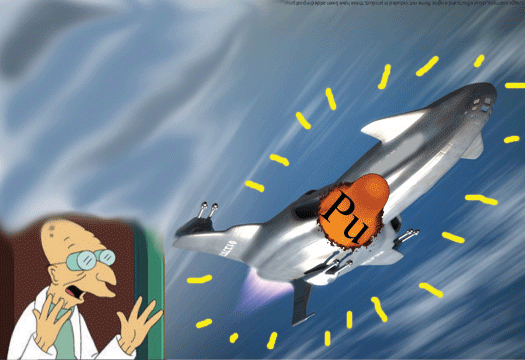
The US also wants to put nuclear power into space 28 — reactors in the sky — and awarded a major contract to a team that includes GE, the company which engineered the flawed Fukushima reactors.29 Rockets can explode at launch, malfunction after launch, or fail to reach orbit. This last happened with SNAP 9-A in 1964. As a result, 2.1 pounds of plutonium-238 “vaporized in the atmosphere and spread worldwide… Dr. John Goffman …concluded that the dispersed deadly plutonium-238 was a leading cause of the increase in cancers around the world today.”30 There have been other space nuclear accidents. Officials don’t seem to care.
The militarization of the atmosphere, space, and the moon risk World War III — another problem. 5G in space will control weapons systems on Earth and in the ocean, 31 including military sonar already responsible for killing hundreds of thousands of dolphins, whales, and other marine animals.32

The militarization of the atmosphere, space, and the moon risk World War III — another problem. 5G in space will control weapons systems on Earth and in the ocean, 31 including military sonar already responsible for killing hundreds of thousands of dolphins, whales, and other marine animals.32
Elon Musk/SpaceX in partnership with the US government has endangered Chinese astronauts by getting too close to their space station.33 Musk is the same man who advocates nuking Mars and saying the U.S. can coup whatever country it wants for rare earth minerals such as lithium.34 The military and its contractors are not guided by responsible, calm leaders. The worst is already happening.

Add to that accelerating plans to exploit, extract, militarize, and privatize the sovereign moon which stabilizes Earth’s rotation and climates, creates the tides, and is essential to all life, as I detailed in my previous article.35 Who’s protecting the moon and the Earth?
Military conquest, profiteering through extraction, mining, tourism, and exploitation are the main goals driving the expenditure of public monies and private investment, not pretty space pictures or neutral, scientific “exploration”. The plutonium ecocide of Saturn by the space industry via the Cassini probe should have been a wakeup call to pull the plug on NASA and the aerospace industry before more planets are destroyed including the Earth.
Subsidizing this industry has caused a brain drain into its high-paying jobs, neglecting and hampering work on Earth’s urgent problems. And the aerospace industry has siphoned off billions in public funds that could fund solutions, while causing expensive environmental problems to be dealt with “later”. The $10 billion dollar Webb telescope is one recent example. Decisionmakers are dashing headlong toward the mirage of a new Gold Rush.
It’s time to strip back the curtain and reveal the protected astronauts, aerospace moguls, and rocket scientists. They are not heroes. They are destroying the Earth. The joy rides of William Shatner and Jeff Bezos were sickening.
Those who want to stop climate change and protect the ozone layer must halt the space programs including space tourism and military programs.
Those who would protect the environment must stop these programs and do it now.
This is common sense. This is about Earth protection. This is about growing up.
Stop the rockets. Defund the space programs. Protect the Earth now.
Militarized Dolphins Protect Almost a Quarter of the US Nuclear Stockpile
Militarized Dolphins Protect Almost a Quarter of the US Nuclear Stockpile, Military.com | By Blake Stilwell 24 Jan 22,
Situated just 20 miles from Seattle, Naval Base Kitsap houses America’s most powerful and secret deterrents, a weapon that is the first line of defense for U.S. national security: U.S. Navy dolphins.
Since 1967, the Navy has been training dolphins and sea lions (and probably other marine life) for military applications such as mine clearing, force protection and recovery missions. The U.S. Navy Marine Mammal Program deployed military dolphins as early as the Vietnam War and as recently as the 2003 U.S.-led invasion of Iraq.
When protecting harbors and ships from mines, as they do at Naval Base Kitsap, the dolphins use their extraordinary biological sonar to detect hazards beneath the surface, whether tethered to the sea floor or buried beneath sediment.
If a mine or other weapon is detected, the dolphin returns to its handler, who gives the animal a buoy to mark the location of the device on the surface. Passing ships know to avoid these markers while Navy explosives ordnance disposal divers neutralize the threat below.
For protection against enemy divers, dolphins will swim up to the infiltrator, bump into them and place a buoy device on their back or a limb using their mouth. The buoy then drags the outed diver to the surface for easy capture. When trained sea lions perform the same maneuver, they use a kind of handcuff with their mouths to attach the buoy………………. https://www.military.com/history/militarized-dolphins-protect-almost-quarter-of-us-nuclear-stockpile.html
Voices for a World Free of Nuclear Weapons
Voices for a World Free of Nuclear Weapons
Nominations are open for the Third Annual Gorbachev/Shultz, Voices Youth Award 2022, NEWS PROVIDED BY Voices for a World Free of Nuclear Weapons
SAN FRANCISCO, Jan. 24, 2022 /PRNewswire/ — The Voices for a World Free of Nuclear Weapons Third Annual Voices Youth Award will be given to a youth who, or organization which, has pioneered or been part of exemplary programs and actions to engage youth in the local, regional or global movement to abolish nuclear weapons. The award honors the legacy of former U.S.S.R. President Mikhail Gorbachev and former U.S.A. Secretary of State George Shultz in their efforts for nuclear disarmament
This past year, Sahil Shah was selected winner of the second Voices Youth Award 2021 in recognition of his outstanding efforts to help abolish nuclear weapons. Sahil is a Policy Fellow at the European Leadership Network (ELN) and leads the organization’s efforts to stabilize and strengthen nuclear and regional security diplomacy with Iran and its neighbors. To learn more about Sahil’s work visit www.voices-uri.org/youth-award…………………………..
Submissions for nominations must be received by June 30, 2022, 5:00 PM, PST. The winner will be announced on August 6, 2022, in coordination with the yearly commemoration of the bombings of Hiroshima and Nagasaki, Japan.
Voices for a World Free of Nuclear Weapons is part of United Religions Initiative (URI) the largest grassroots interfaith network in the world: building bridges through working together on practical projects that enhance civil communities and understanding between people of different religious and cultural traditions. URI has consultative status with the United Nations Economic and Social Council. At present URI has 1,091 Cooperation Circles in 111 countries with over one million members and yearly impacts over 50 million people globally.
Contact: Julie Schelling
P: 347.719.1518
Email: 328187@email4pr.com https://www.prnewswire.com/news-releases/voices-for-a-world-free-of-nuclear-weapons-301466013.html
UKRAINE CRISIS: US ‘Toolboxes’ Are Empty

January 22, 2022 The toolbox is empty. Russia knows this. Biden knows this. Blinken knows this. CNN knows this. The only ones who aren’t aware of this are the American people, says Scott Ritter. By Scott Ritter, Special to Consortium News U.S. Secretary of State Antony Blinken met with his Russian counterpart, Sergei Lavrov, in a hastily scheduled, 90-minute summit in Geneva yesterday, after which both sides lauded the meeting as worthwhile because it kept the door open for a diplomatic resolution to the ongoing crisis in Ukraine. What “keeping the door open” entails, however, represents two completely different realities.
For Blinken, the important thing appears to be process, continuing a dialogue which, by its very essence, creates the impression of progress, with progress being measured in increments of time, as opposed to results.
A results-oriented outcome was not in the books for Blinken and his entourage; the U.S. was supposed to submit a written response to Russia’s demands for security guarantees as spelled out in a pair of draft treaties presented to the U.S. and NATO in December. Instead, Blinken told Lavrov the written submission would be provided next week.
In the meantime, Blinken primed the pump of expected outcomes by highlighting the possibility of future negotiations that addressed Russian concerns (on a reciprocal basis) regarding intermediate-range missiles and NATO military exercises.
But under no circumstances, Blinken said, would the U.S. be responding to Russian demands against NATO expanding to Ukraine and Georgia, and for the redeployment of NATO forces inside the territory of NATO as it existed in 1997.
……………….Blinken’s restatement of a position he has pontificated on incessantly for more than a month now was not done for the benefit of Lavrov and the Russian government, but rather for an American and European audience which had been left scratching their collective heads over comments made the day before by President Joe Biden which suggested that the U.S. had a range of options it would consider depending on the size of a Russian incursion.
…………………………………… the lack of an agreed-upon strategy on how to deal with a Russian incursion/invasion of Ukraine was an open secret for everyone except the U.S. and European publics, who being fed a line of horse manure to assuage domestic political concerns over being seen as surrendering to Russian demands.
…………………………. Blinken has indicated that the U.S. has a toolbox filled with options that will deliver “massive consequences” to Russia should Russia invade Ukraine. These “tools” include military options, such as the reinforcement of NATO’s eastern flank with additional U.S. troops, and economic options, such as shutting down the NordStream 2 pipeline and cutting Russia off from the SWIFT banking system. All these options, Blinken notes, have the undivided support of U.S. European allies and partners.
………… There’s only one problem—the toolbox, it turns out, is empty.
While the Pentagon is reportedly working on a series of military options to reinforce the existing U.S. military presence in eastern Europe, the actual implementation of these options would neither be timely nor even possible. One option is to move forces already in Europe; the U.S. Army maintains one heavy armored brigade in Europe on a rotational basis and has a light armored vehicle brigade and an artillery brigade stationed in Germany. Along with some helicopter and logistics support, that’s it.
Flooding these units into Poland would be for display purposes only—they represent an unsustainable combat force that would be destroyed within hours, if not days, in any large-scale ground combat against a Russian threat.
………………………. In short, there is no viable military option, and Biden knows this.
…………………………………………. Propaganda About ‘Propaganda’
One of the great ironies of the current crisis is that, on the eve of the Blinken-Lavrov meeting in Geneva, the U.S. State Department published a report on Russian propaganda, decrying the role played by state-funded outlets such as RT and Sputnik in shaping public opinion in the United States and the West (in the interest of full disclosure, RT is one of the outlets that I write for.)
The fact that the State Department would publish such a report on the eve of a meeting which is all about propagating the big lie—that the U.S. has a plan for deterring “irresponsible Russian aggression”—while ignoring the hard truth: this is a crisis derived solely from the irresponsible policies of the U.S. and NATO over the past 30 years.
While a compliant mainstream American media unthinkingly repeated every warning and threat issued by Biden and Blinken to Russia over the course of the past few days, the Russian position has been largely ignored. Here’s a reminder of where Russia stands on its demands for security guarantees: “We are talking about the withdrawal of foreign forces, equipment, and weapons, as well as taking other steps to return to the set-up we had in 1997 in non-NATO countries,” the Russian Foreign Ministry declared in a bulletin published after the Lavrov-Blinken meeting. “This includes Bulgaria and Romania.”
The toolbox is empty. Russia knows this. Biden knows this. Blinken knows this. CNN knows this. The only ones who aren’t aware of this are the American people.
The consequences of a U.S. rejection of Russia’s demands will more than likely be war.
If you think the American people are ready to bear the burden of a war with Russia, think again.
Scott Ritter is a former U.S. Marine Corps intelligence officer who served in the former Soviet Union implementing arms control treaties, in the Persian Gulf during Operation Desert Storm, and in Iraq overseeing the disarmament of WMD. https://consortiumnews.com/2022/01/22/ukraine-crisis-us-toolboxes-are-empty/
How France greenwashes nuclear weapons

President Macron has announced investment of one billion euros in research and construction of small modular reactors (SMRs). SMRs are small nuclear reactors that are to be used primarily for submarine propulsion and thus for military purposes in distant theatres of war
Behind the planned modernisation of French nuclear power, allegedly to ensure cheaper electricity, nestles the agenda of its nuclear weapons programme. For years now, the state has imposed the exorbitant costs of its civilian-military nuclear industry on the French public.
France plans to modernise its nuclear power – allegedly to insure cheaper and greener electricity. Yet behind it nestles a nuclear weapons agenda https://www.ips-journal.eu/topics/foreign-and-security-policy/how-france-greenwashes-nuclear-weapons-5668/ 23 Jan 22,
At the turn of the year, France assumed the presidency of the Council of the European Union. And last week, the EU defence ministers met informally to talk about the Common Security and Defence Policy (CSDP). Among other issues, they discussed nuclear security and nuclear deterrence strategies.
In recent years, the French president has been a strong advocate of nuclear power. Historically, France’s independent development of nuclear technology for atomic weapons has been an important source of national pride. Since the 1990s, however, nuclear power has been declining as a consequence of the Chernobyl disaster. Annual reports by Mycle Schneider, an international consultant on energy and nuclear policy, show that this is a part of a global trend. Nevertheless, France continues to be a tireless advocate of this technology.
Nuclear answers for green energy and weapons
On 1 January 2022, a draft regulation of the European Commission classified the investment in nuclear energy and natural gas as sustainable. This concerns billions of euros in financial support in the so-called EU Taxonomy. Emmanuel Macron was keen to acquire a ‘Green Label’ for nuclear energy. France’s real interests concerning nuclear energy emerged clearly in a speech Macron delivered on a visit to Framatome’s Le Creusot facility in 2020: ‘Without civilian nuclear energy there is no military use of this technology – and without military use there is no civilian nuclear energy’. In a nutshell, this means that without a cutting-edge nuclear industry France cannot continue to expand and modernise its nuclear weapons arsenal. This remains true for all nuclear weapons states.
At present, these states are upgrading their arsenals. Russia and the United States are procuring new delivery systems – such as hypersonic missiles – that will be able to deliver their nuclear bombs much more quickly and accurately, leaving the enemy with no time to defend themselves. Thus, a new nuclear arms race has begun.
The US think tank Atlantic Council is quite open about how crucial it regards civilian use of nuclear power to be for national security policy: the civilian US nuclear industry is a U.S. strategic asset of vital importance for US national security. Similar formulations can be found in the speeches of other presidents of nuclear weapons states. Its civilian nuclear complex costs the United States at least USD 42.4bn a year. The International Campaign to Abolish Nuclear Weapons (ICAN) claims that all nuclear weapons states together invest over USD 100bn a year in their nuclear weapons arsenals.
France, too, wants to join in the ongoing technological development in other nuclear weapons states for quite some time. President Macron has announced investment of one billion euros in research and construction of small modular reactors (SMRs). SMRs are small nuclear reactors that are to be used primarily for submarine propulsion and thus for military purposes in distant theatres of war. The new Hunter class submarines underline France’s great-power ambitions. This needs to be understood against the background of the collapsed submarine deal with Australia. Last year Australia announced that it was cancelling its contract to buy French diesel submarines in favour of US and UK nuclear technology.
Flexible submarine-based nuclear weapons systems have major strategic importance for all nuclear weapons states. They have the capability of going for up to three months without surfacing. They can cover great distances at high speeds undetected and surface almost wherever they want around the globe. They are capable of launching up to 20 missiles, each with a dozen individual guided warheads. All this plays a key role in the nuclear weapons doctrine of the five ‘official’ nuclear weapons states, the United States, the United Kingdom, Russia, France, and China. At the same time, the possession of this technology underpins these countries’ great-power status. France, like the other nuclear weapons states, is keen to consolidate its status.
Exposing the French agenda
The first meeting of EU defence ministers under the French Council Presidency was held on 12–13 January 2022 in Brest. This is where France’s sea-based nuclear weapons are stationed, making this a clear demonstration of its military power. As early as his 2020 speech in Le Creusot, the French President confirmed his country’s military ambitions: ‘the nuclear industry will remain the cornerstone of our strategic autonomy. It affects every aspect of deterrence, powering our nuclear submarines, submarines for launching ballistic missiles, and powering our nuclear aircraft carriers.’
Nuclear power and nuclear sharing are controversial in the European Union. Austria and Luxembourg have sharply criticised the EU Taxonomy. At the same time, there has been a multilateral UN treaty banning weapons of mass destruction since the Treaty on the Prohibition of Nuclear Weapons of 22 January 2021.
Behind the planned modernisation of French nuclear power, allegedly to ensure cheaper electricity, nestles the agenda of its nuclear weapons programme. For years now, the state has imposed the exorbitant costs of its civilian-military nuclear industry on the French public. The costs of building the pressurised water reactor in Flamanville, for example, ran to €19.4bn. Ultimately, electricity customers and investors subsidise military applications with ‘climate-saving nuclear power’.
In any case, as France takes over the EU Council Presidency it is now perfectly placed to promote the civilian-military use of nuclear energy and a European security and defence strategy based on the doctrine of nuclear deterrence.
1 This Month





PLEASE OPPOSE HR 8255 AND S.3639 – bills would accelerate satellite deployment, with no environmental review or safeguards – https://ncstd5li.quorum.us/campaign/169331/
To see nuclear-related stories in greater depth and intensity – go to https://nuclearinformation.wordpress.com
-
Archives
- October 2026 (39)
- September 2026 (339)
- August 2026 (330)
- July 2026 (355)
- June 2026 (287)
- May 2026 (306)
- April 2026 (356)
- March 2026 (251)
- February 2026 (267)
- January 2026 (308)
- December 2025 (358)
- November 2025 (359)
-
Categories
- 1
- 1 NUCLEAR ISSUES
- business and costs
- climate change
- culture and arts
- ENERGY
- environment
- health
- history
- indigenous issues
- Legal
- marketing of nuclear
- media
- opposition to nuclear
- PERSONAL STORIES
- politics
- politics international
- Religion and ethics
- safety
- secrets,lies and civil liberties
- spinbuster
- technology
- Uranium
- wastes
- weapons and war
- Women
- 2 WORLD
- ACTION
- AFRICA
- Atrocities
- AUSTRALIA
- Christina's notes
- Christina's themes
- culture and arts
- Events
- Fuk 2022
- Fuk 2023
- Fukushima 2017
- Fukushima 2018
- fukushima 2019
- Fukushima 2020
- Fukushima 2021
- general
- global warming
- Humour (God we need it)
- Nuclear
- RARE EARTHS
- Reference
- resources – print
- Resources -audiovicual
- Weekly Newsletter
- World
- World Nuclear
- YouTube
-
RSS
Entries RSS
Comments RSS

