India’s Nuclear Weapons Could Kill Millions Of People- a matter of pride?

What’s a few million dead. compared to national pride?
India’s Nuclear Weapons Could Kill Millions Of People, Caleb Larson, 7 Feb 22, India might be the nuclear weapons state many military analysts forget about. Nonetheless, New Delhi could start a nuclear war within just mere minutes: India’s indigenously developed technology—and a lot of Russian hardware and help—all keep Pakistan and China at bay.
No First Use. An NFU policy essentially constitutes a promise, backed by a survivable nuclear arsenal, to only use nuclear weapons in response to a nuclear attack,” explained a Carnegie publication. “The logic is simple and effective: you don’t nuke me, and I won’t nuke you. India and China both have declared no-first-use policies, whereas Pakistan and the United States, among others, do not rule out the first use of nuclear weapons in a conflict.”
Despite India’s formidable nuclear arsenal, India had since 2003 maintained it will not use said weapons of mass destruction first, but strictly in a retaliatory manner for deterrence.
However, 2019, India called their no first use policy into question when Indian Defense Minister Rajnath Singh said that “Till today, our nuclear policy is ‘no first use’. What happens in future depends on the circumstances.” This curious statement is perhaps an example of deliberate strategic ambiguity.
Triad
India maintains a nuclear triad—that is a three-pronged nuclear weapon delivery system that utilizes a diverse array of means for delivering nuclear payload on target. New Delhi has air-launched nuclear missiles, land-based nuclear missiles, and most recently submarine-launched missiles………………. https://www.19fortyfive.com/2022/02/indias-nuclear-weapons-could-kill-millions-of-people/
Can Space Tourism Co-exist with Space being turned into a War Zone?
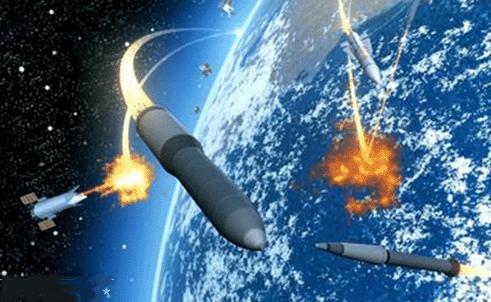
Can Space Tourism Co-exist with Space being turned into a War Zone?, By Karl Grossman, Space 4 Peace, Presented at the Space Tourism: Legal Dimensions Conference, 29 January 2022
The push to turn space into a war zone could spell goodbye to space tourism. The space tourism drive that is underway, led by billionaires Jeff Bezos with his Blue Origin company, Richard Branson and his Virgin Galactic, and Elon Musk and his SpaceX operation, is seen as only a start. As Dylan Taylor wrote in 2021 on www.space.com in an article headed “The Future of space tourism,” it’s a “a growing market expected to be worth at least $3 billion by 2030.” Space.com identified Taylor as an “entrepreneur, investor and philanthropist” and “cofounding patron of the Commercial Spaceflight Federation.” https://www.space.com/future-of-space-tourism-op-ed……………………………
Meanwhile, there’s the push, led by the United States, to turn space into a war zone—and this, despite the Outer Space Treaty of 1967 that sets space aside for peaceful purposes.
As then U.S. President Donald Trump declared in 2018 as he advocated for formation of a U.S. Space Force, “it is not enough to merely have an American presence in space. We must have American dominance in space.” https://www.space.com/40921-trump-space-traffic-policy-american-leadership.html
The following year, he signed the National Defense Authorization Act of 2020 establishing the Space Force as the sixth branch of U.S. armed forces and said: “Space is the world’s newest warfighting domain.” The Space Force, Trump said, would “help” the U.S. “control the ultimate high ground.” https://www.space.com/trump-creates-space-force-2020-defense-bill.html
Then, at the unveiling of a Space Force flag at the White House, Trump said: “Space is going to be…the future, both in terms of defense and offense.” https://www.nbcnews.com/news/us-news/trump-unveils-space-force-flag-ceremony-says-space-future-n1208021
Trump’s successor, U.S. President Joe Biden, has not rolled back the U.S. Space Force………………….
As to the impacts of war in space, Bruce Gagnon, coordinator of the Global Network Against Weapons and Nuclear Power in Space, in an interview in 2021 related the projection of the late Edgar Mitchell, in 1971 the sixth U.S. astronaut to walk on the moon. https://www.youtube.com/watch?v=ow8c7LbPvuI&feature=youtu.be
Gagnon said:
In 1989 during one of our campaigns against NASA plutonium launches [NASA’s launching of plutonium-powered space probes], we had a rally at the Kennedy Space Center in Florida, and our keynote speaker that day was Apollo astronaut Edgar Mitchell, one of the moonwalkers. And he came and said if there is one war in space, it’ll be the one and the only. He said because we will create so much space debris or space junk from all the destroyed satellites and things like that in space that there would literally be a minefield encircling the planet – he called it a piranha-laced river—and we would not be able to get through. A rocket would not be able to get off this Earth through that minefield. So, it’s insane to think about having a war in space.
Gagnon has also spoken of how space warfare would “mean activity on Earth below would immediately shut down—cell phones, ATM machines, cable TV, traffic lights, weather prediction and more—all hooked up to satellites, would be lost. Modern society would go dark.” https://www.counterpunch.org/2019/12/18/the-very-bad-space-force-deal/
Also pointing to the generation of space debris resulting from warfare in space was Alexander Chanock in section titled “Problems With Weaponizing Space” in an article published in 2013 in Journal of Air Law and Commerce titled “The Problems and Potential Solutions Related to the Emergence of Space Weapons in the 2lst Century.” https://scholar.smu.edu/cgi/viewcontent.cgi?article=1327&context=jalc
Chanock, then a candidate for a law degree, now a legislative counsel in the U.S. House of Representatives, wrote that a major problem “is the amount of space debris that space weapons would produce….The fear is that destroying in space could generate extremely dangerous debris with a long orbital life.”
Chanock quoted Dr. Joel Primack, professor of physics and astrophysics at the University of California, Santa Cruz, and “one of the premier experts on space debris, noted Chanock, as saying “the weaponization of space would make the debris problem much worse, and even one war in space could encase the entire planet in a shell of whizzing debris that would thereafter make space near the Earth highly hazardous for peaceful as well as military purposes.”……………………
U.S. interest in war in space has deep roots: back to the former Nazi rocket scientists and engineers brought to the U.S. from Germany after World War II under the U.S.’s Operation Paperclip. They ended up at the U.S. Army’s Redstone Arsenal in Huntsville, Alabama—to use “their technological expertise to help create the U.S. space and weapons program,” wrote Jack Manno, a professor of environmental studies at the State University of New York College of Environmental Science & Forestry, in his 1984 book Arming the Heavens: The Hidden Military Agenda for Space, 1945-1995. https://www.abebooks.com/9780396082118/Arming-heavens-hidden-military-agenda-0396082114/plp
“Many of the early space war schemes were dreamt up by scientists working for the German military, scientists who brought their rockets and their ideas to America after the war,” he wrote. Many of these scientists and engineers “later rose to positions of power in the U.S. military, NASA, and the aerospace industry.” Among them were “Wernher von Braun and his V-2 colleagues” who began “working on rockets for the U.S. Army,” and at the Army’s Redstone Arsenal “were given the task of producing an intermediate range ballistic range missile to carry battlefield atomic weapons up to 200 miles. The Germans produced a modified V-2 renamed the Redstone….Huntsville became a major center of U.S. space military activities.”
Manno told the story of former German Major General Walter Dornberger, who had been in charge of the entire Nazi rocket program, and how he “in 1947 as a consultant to the U.S Air Force and adviser to the Department of Defense…wrote a planning paper for his new employers. He proposed a system of hundreds of nuclear-armed satellites all orbiting at different altitudes and angles, each capable or reentering the atmosphere on command from Earth to proceed to its target. The Air Force began early work on Dornberger’s idea under the acronym NABS (Nuclear Armed Bombardment Satellites).”……………………………………..
This is pessimistic forecast need not be. The Outer Space Treaty of 1967 was—and is—a visionary documentary. “Let Us Beat Our Swords Into Plowshares” is the title of a statue by Evgeniy Vutetich in the sculpture garden of the UN in New York. It is based on the Book of Isaiah and its call that nations “shall beat their swords into plowshares and their spears into pruning hooks; nation shall not lift up sword against nation, neither shall they learn war any more.”
War on Earth is terrible enough. It must not be brought up to the heavens.
This will take continued take political will and international pressure—to preserve and extend the Outer Space Treaty of 1967 and its setting aside space for peaceful purposes. Especially in the United States, this will require action at the grassroots because the two major political parties in the U.S. have joined in a bellicose stance on space, supporting it becoming a war zone. Every year, the grassroots organization Global Network Against Weapons and Nuclear Power in Space, founded in Washington, D.C. in 1991 and the leading group internationally challenging the weaponization of space, holds a “Keep Space For Peace Week” with actions around the world. Meanwhile, there are nations around the globe that have, unlike the U.S., adopted a peaceful stance—as reflected in their support for the proposed PAROS treaty.
We must, indeed, keep space for peace.
Can space tourism co-exist with space being turned into a war zone? The answer is no.
And with a shooting war in space, it will not only space tourism that would be kissed goodbye. http://space4peace.org/can-space-tourism-co-exist-with-space-being-turned-into-a-war-zone/
As Ukraine Crisis Raises Specter of Nuclear War, Veterans Call for Disarmament and Peace.
As Ukraine Crisis Raises Specter of Nuclear War, Veterans Call for Disarmament and Peace, https://www.laprogressive.com/veterans-call-for-disarmament/ Gerry Condon, 5 Feb 22, The US/NATO showdown with Russia over Ukraine is a stark reminder of how close the world is to a possible nuclear war. The one-sided reporting in the U.S. media, with little historical context, is what we see whenever the U.S. is getting ready to go to war. The lack of any meaningful opposition in Congress, even from supposed progressive Democrats, is alarming. Are there no adults in the room?
Is President Biden a captive of the neocons and their patrons in the weapons-of-mass-destruction industry? Is the tail wagging the dog? No wonder the Bulletin of Atomic Scientists is maintaining its Doomsday Clock at only 100 seconds from midnight.
We can hope that quiet diplomacy taking place in the background will overshadow the stubborn public refusal to acknowledge Russia’s understandable security concerns. Can you imagine the U.S. response if Russia was positioning missile systems and troops in Canada or Mexico?
Given that the U.S. and Russia possess the lion’s share of nuclear weapons – over 6,000 each – the world will breathe a collective sigh of relief if war is avoided. But how long before the next crisis? Is the world really safer with nuclear “deterrence” (aka “mutually assured destruction”)?
The Pentagon is currently putting its finishing touches on the Biden Administration’s Nuclear Posture Review. Rumors are that it will not reflect President Biden’s stated goal of reducing the role of nuclear weapons in U.S. security defense strategy. It will not call for the U.S. to adopt a policy of No First Use of nuclear weapons. It will not call for the U.S. to sign the UN Treaty on the Prohibition of Nuclear Weapons. It will not call on the U.S. to adhere to its obligations under the 1970 Nuclear Nonproliferation Treaty, which require it to negotiate in good faith to reduce and eventual eliminate all nuclear weapons.
Veterans For Peace has therefore stepped up to provide its own Nuclear Posture Review, one that abandons the policy of full spectrum dominance and replaces it with full spectrum cooperation.
“Veterans are all too familiar with the horrible costs of war,” says retired Marine Corps Major Ken Mayers, who serves on the Board of Veterans For Peace. “It is appropriate that military veterans are standing up for nuclear disarmament and peace.”
The Veterans For Peace document reviews the U.S. posture toward each of the nuclear-armed states, plus Iran, which has no nuclear weapons. The veterans call on the U.S. to take immediate steps to reduce the risk of accidental nuclear war, such as implementing a No First Use policy and taking nuclear missiles off hair trigger alert. It calls on the U.S. to sign the UN Treaty on the Prohibition of Nuclear Weapons.
“If the United States takes the first steps toward eliminating nuclear weapons, other nuclear-armed states will follow,” says Ken Mayers of Veterans For Peace. “This is the kind of leadership that the people of the world want to see today.”
The Veterans For Peace Nuclear Posture Review contains sixteen specific proposals for reducing the risk of nuclear war and building momentum for nuclear disarmament. Veterans For Peace is sending it to President Biden, to Vice President Kamala Harris, and to every Member of Congress.
The current crisis over Ukraine demonstrates what a dangerously unstable world we are living in today. The elimination of nuclear weapons must go hand-in-hand with non-intervention in the internal affairs of other nations, as called for in the UN Charter. If we prioritize mutual respect among all peoples, we can survive the current crisis and avoid a future war that could literally destroy human civilization.
Kazakhstan calls on CANWFZ states parties to join Treaty on Prohibition of Nuclear Weapons

Kazakhstan calls on CANWFZ states parties to join Treaty on Prohibition of Nuclear Weapons https://www.inform.kz/en/kazakhstan-calls-on-canwfz-states-parties-to-join-treaty-on-prohibition-of-nuclear-weapons_a3895288 4 February 2022
NUR-SULTAN. KAZINFORM – The Deputy Minister of Foreign Affairs of Kazakhstan, Akan Rakhmetullin, held a meeting with the ambassadors of the States Parties to the Treaty on a Nuclear-Weapon-Free Zone in Central Asia (CAWFZ Treaty), accredited in Nur-Sultan, Kazinform has learnt from the press service of the Kazakh Foreign Affairs Ministry.
During the meeting, the Kazakh diplomat, taking into account the existing relations of friendship and brotherhood, called on the partners from the Nuclear-Weapon-Free zone in Central Asia to become parties to the Treaty on the Prohibition of Nuclear Weapons (TPNW) and thereby make a significant contribution to strengthening international security.
Rakhmetullin noted that participants of Nuclear-Weapon-Free zones around the world are at the forefront of the nuclear disarmament process. He stressed that the main goals and objectives of establishing Nuclear-Weapon-Free zones are in line with the spirit and principles of the TPNW. Moreover, the obligations that a State Party to the TPNW must undertake are already being fulfilled by the participants in the CANWFZ. Thus, a State Party to the CANWFZ Treaty can join the TPNW without undertaking additional substantive obligations. This is evidenced by a comparative analysis prepared by the International Campaign to Abolish Nuclear Weapons (ICAN).
Kazakhstan, as a staunch supporter of nuclear disarmament, took an active part in the United Nations conference to negotiate a legally binding instrument to prohibit nuclear weapons, leading towards their total elimination. Today, our country, together with other parties to the Treaty under the chairmanship of Austria, is preparing for the First Meeting of the States Parties to the TPNW in Vienna. At the initiative of Kazakhstan and Kiribati, as the countries most affected by nuclear tests, a working paper on positive obligations under the TPNW providing for measures to rehabilitate the population and the environment exposed to radiation contamination after nuclear tests was developed and supported by the presiding party.
On January 22, 2021, the Treaty on the Prohibition of Nuclear Weapons (TPNW) entered into force. On March 2, 2018, Kazakhstan signed the TPNW, becoming the 57th country to sign this historic document. On August 29, 2019, Kazakhstan handed over the instrument of ratification of the TPNW to the depositary – the UN Secretary General. Our country is the first and so far the only State Party of the CANWFZ that has joined the TPNW.
North Korea isn’t going to give up nuclear weapons, but that’s not a crisis
Dyer: North Korea isn’t going to give up nuclear weapons, but that’s not a crisis https://lfpress.com/opinion/columnists/dyer-north-korea-isnt-going-to-give-up-nuclear-weapons-but-thats-not-a-crisis Gwynne Dyer Postmedia News, Feb 04, 2022 “They want to have a deterrence system that is like a scorpion’s tail,” said Prof. Kim Dong Yup, a former South Korean naval commander. “North Korea’s main purpose is not to attack but to defend themselves.” They want a “diversified deterrent capability,” adds Kim — and who could blame them?
North Korea’s missile tests are a welcome distraction from the daily warnings of an imminent Russian invasion of Ukraine, and even less likely to end in a war. North Korea test-fired seven different missiles in a month, U.S. President Joe Biden retaliated with more sanctions against Kim Jong-un’s hermit state, and everybody got their war horses out for a brisk trot around the track.
The reality, however, is nobody in a position of authority is in the least excited by this little back-and-forth.
The media speculate about whether North Korea’s tests are meant to influence the upcoming South Korean elections or to lure Biden into a Trump-style summit, but the likeliest motive is just what Prof. Kim said it is: a desire to demonstrate the efficiency of North Korea’s missiles. You know, the ones that carry North Korea’s nuclear weapons.
Pyongyang hasn’t tested any nuclear weapons since 2017, but it is believed to have 50 to 60 warheads. Neither has it test-launched its intercontinental ballistic missiles (the ones that can reach anywhere in the United States) since then. The January tests were of hypersonic missiles, intermediate-range missiles, cruise missiles and similar hardware.
Most of those missiles can probably carry nuclear warheads, but only as far as South Korea or Japan, America’s local allies. It’s a formidable investment for a small, quite poor country, but it’s not that extravagant when you consider all these nukes are intended to deter the United States.
No American diplomat or military officer will admit publicly that North Korea’s fear of an American nuclear attack is justified, but the more intelligent ones realize the rules of nuclear deterrence are the same for democratic superpowers and dwarf tyrannies. If your enemy has nuclear weapons, then to be safe you must have them, too.
From the perspective of Pyongyang, American nuclear weapons are a mortal threat, and nobody can persuade the North Korean regime they would never be used against it unless it attacked first. Americans wouldn’t forgo nuclear weapons if China and Russia made such promises, nor would they take America’s word for it. Too much is at stake to take a chance.
This is the universal dilemma of nuclear weapons. North Korea has just as much right to worry about it as the United States, and it will never give its nukes up so long as the confrontation in the Korean peninsula persists (71 years and counting).
Any meetings between U.S. and North Korean diplomats or leaders will be driven by North Korea’s perpetual desire to end UN and U.S. trade sanctions and/or America’s futile quest to get Kim to agree to unilateral nuclear disarmament. Neither is going to happen, but there is no crisis either.
The North Korean regime is vicious, but it is not crazy. A reasonably stable cold peace has prevailed in the peninsula since the end of the Korean War in 1953, guaranteed since the first North Korean nuclear test in 2006 by mutual nuclear deterrence between the U.S. and North Korea. There’s no urgent need to fix it.
The United States cannot bring itself to publicly acknowledge this fact, but the Pentagon and the State Department privately accept it is the long established reality of the U.S.-N.K. relationship.
“They very much understand the significance of moving up the ladder on range,” a senior Biden administration official said on Sunday, implicitly recognizing the North Koreans had not tested any new missiles capable of striking the American homeland.
There really is a mutual understanding. They just can’t talk about it.
America’s military leaders reassure their staff ”We will win a nuclear war!”

US defense to its workforce: Nuclear war can be won, Bulletin of the Atomic Scientists, By Alan Kaptanoglu, Stewart Prager | February 2, 2022 Ronald Reagan and Mikhail Gorbachev once said that “a nuclear war cannot be won and must never be fought,” and five major nuclear weapon states, including the United States, repeated this statement earlier this year. Yet many in the US defense establishment—the military, government, think tanks, and industry—promote the perception that a nuclear war can be won and fought.
Moreover, they do so in a voice that is influential, respected, well-funded, and treated with deference. The US defense leadership’s methodical messaging to its workforce helps shape the views of this massive, multi-sector constituency that includes advocates, future leaders, and decision makers. It advances a view of nuclear weapon policies that intensifies and accelerates the new nuclear arms race forming between the United States, China, and Russia.
The 23-chapter Guide to Nuclear Deterrence in the Age of Great Power Competition provides an excellent and representative case study for examining this critical messaging. This guide is published by the Louisiana Tech Research Institute, which provides support for the US Air Force Global Strike Command. It is written by nuclear arms experts for the approximately 30,000 members of the US Air Force Global Strike Command and the “700,000 total force airmen who engage in the profession of arms.”
All of the authors have direct or indirect connections with the nuclear weapons complex or associated think tanks, and several of the authors have held senior positions with the Air Force Global Strike Command, US Strategic Command, and other national security agencies in the US government. The guide’s messaging is comprehensive but dangerously skewed.
The guide centers around a new reality—the aggressive development of nuclear arms by Russia and China that is intensifying a new Cold War. Nuclear arms treaties—an important tool for limiting arms races—are brushed aside as functionally pointless since, according to the guide, Russia will cheat and China won’t come to the bargaining table. In one passage, the guide claims “it is unlikely that these countries would be foolish enough to engage in a strategic arms race with the United States, and, if they do, they will lose.” Yet much of the remainder of the document analyzes all the ways in which China and Russia are advancing their capabilities beyond US capabilities. These threatening developments are then used to justify the rapid and expensive modernization of the US nuclear weapon complex, while many historic nuclear arms agreements wither away, including the Anti-Ballistic Missile Treaty, Intermediate-range Nuclear Forces Treaty, and the Iran nuclear deal.
What follows are some of the misrepresentations, an omission, and a questionable policy in the guide:
Misrepresentation: A nuclear war can be fought and won. That the US military considers scenarios under which nuclear deterrence fails is unsurprising. But in the event of limited nuclear war, the United States has plans in place to “beat” its adversaries. …………………
Omission: The reality of nuclear war. In this more-than-400 page guide, only three pages are devoted to a rather anodyne description of the devastating harms of nuclear weapons. ………..
The guide does not mention the well-documented human toll of the bombings of Hiroshima and Nagasaki. The guide does not discuss the full horrors of the “day after” a nuclear exchange. Nor does it address the potentially civilization-ending effects of climate change and nuclear winter from the resulting firestorms. …………………
Misrepresentation: Nuclear weapons keep the peace. The guide credits nuclear weapons and US nuclear superiority with the era of “long peace”—the absence of major wars between superpowers since 1945. As such, it posits that, the more US nuclear weapons, the better………………
The guide does not note that the world came very close to a potentially catastrophic nuclear exchange during the Cuban Missile Crisis. It singularly portrays US nuclear weapons as a benefit for humankind.
Misrepresentation: Nuclear weapon mistakes and accidents never happen. Indeed, the guide does not mention the many well-documented false-alarms and close calls of nuclear detonation from technical or human error that could have led to catastrophe. It does not acknowledge the dangers posed by the imperfect humans who control the nuclear weapons and infrastructure. It does not mention that intercontinental ballistic missile (ICBM) crew members were caught cheating on exams or that the Joint Chiefs’ of Staff unanimously recommended an invasion of Cuba during the missile crisis. Nor is there mention of the harms caused by nuclear testing to many communities.
The guide portrays the United States as if it is in perfect control of its nuclear weapons operations.
Questionable policy: A nuclear triad is necessary. The guide argues strenuously that the United States would be less secure without all three legs of its nuclear triad consisting of warhead-equipped submarines, aircraft, and land-based missiles…………………
Lastly, this scenario assumes that NATO allies would not bother to use any of their several hundred nuclear warheads after an adversary destroys a significant portion of the US homeland.
The guide dismisses critiques of the ICBM force, including the accompanying launch-on-warning and use-them-or-lose-them postures that increase the danger of accidental nuclear war.
The authors seek perpetual US nuclear superiority. They dismiss the option of minimal deterrence—keeping only a minimal complement of nuclear weapons primarily to provide a second-strike capability—as not viable. According to the guide, the United States must not only possess a second-strike capability but the potential to fight and win a limited nuclear war against any adversary. ……………..
To be clear, the authors are considering a scenario in which at least several hundred nuclear weapons have been used on both the US and adversary’s homeland. Hundreds of millions of people are likely dead, modern civilization might have collapsed, and nuclear winter might soon starve another few billion people. What exactly is worth bargaining for in this scenario?
Finally, the guide notes that “[t]he United States has never been content with a mere second-strike capability.” In this context, “[t]he United States” appears to refer primarily to US military and government institutions; the majority of the US public favors a minimal deterrence policy, and an overwhelming majority support the phasing out of ICBMs, according to a recent poll.
……………. defense messaging justifies a vigorous and expanding nuclear arms force, exceptionalizes the United States, and blames downsides on Russia and China. If service members received more thoughtful messaging about nuclear deterrence and preparedness, their efforts to think critically might help them understand—in the profound ways that Reagan and Gorbachev once understood—that “a nuclear war cannot be won and must never be fought.” https://thebulletin.org/2022/02/us-defense-to-its-workforce-nuclear-war-can-be-won/
Raytheon and Lockheed Martin boast to investors that Ukraine-Russia crisis is a boon for their business

The statements come from leaders of an industry that exerts tremendous influence in Washington, employing an average of 700 lobbyists per year over the past five years, or more than one lobbyist per member of Congress, according to Brown University’s Costs of War project.
Everyone in D.C. knows that weapons manufacturers are helping skew U.S. policy towards militarism
WEAPONS COMPANIES BOAST UKRAINE-RUSSIA TENSIONS ARE BOON FOR BUSINESS , Popular Resistance, By Sarah Lazare, In These Times., January 31, 2022
In Calls With Investors, Raytheon And Lockheed Martin Boasted That The Worsening Conflict Is Helping Profits.As the United States weighs more involvement in the growing conflict between Ukraine and Russia, some of the largest weapons companies in the world — Raytheon and Lockheed Martin — are openly telling their investors that tensions between the countries are good for business. And General Dynamics, meanwhile, is boasting about the past returns the company has seen as a result of such disputes.
The statements come as the U.S. government escalates arms shipments to Ukraine, among them the Javelin missiles that are a joint venture between Raytheon and Lockheed Martin. House Democrats, meanwhile, are trying to quickly push through a bill that would significantly increase U.S. military assistance to Ukraine, and impose new sanctions on Russia.
Anti-war campaigners warn that U.S. escalation, amid renewed tensions between Ukraine and Russia, could bring dire consequences, and spill into a much larger and more protracted war. “As we are shipping advanced weaponry to the Ukrainian military, the Biden administration has signaled that U.S. military advisors will continue to stay in the country,” Cavan Kharrazian, progressive foreign policy campaigner for the advocacy organization Demand Progress, tells In These Times. “Who will most likely set up and teach the Ukrainian army how to use these weapons systems? The U.S. military.”
Among those openly discussing the boon to profits is Raytheon CEO Greg Hayes. During a January 25 appearance on CNBC’s “Squawk on the Street,” he was asked, “Do we have anything that would make it so if you inserted 8,000 American soldiers into Ukraine, they can stop 103,000 Russian soldiers?”
In his reply, Hayes touted the role the company could play in arming U.S. allies. “Obviously we have some defensive weapons systems that we could supply which could be helpful, like the patriot missile system.” He went on to add, “We’ve got the technologies to help in these engagements, whether it’s patriot systems, some of the radar systems.”………
If it sounds like Hayes is using mounting tensions as an advertising opportunity for his company, this may not be far fetched. On a January 25 earnings call (which was noted on Twitter by Nick Cleveland-Stout of the Quincy Institute), Hayes included “tensions in Eastern Europe” among the factors that Raytheon stands to benefit from. He said: “We just have to look to last week where we saw the drone attack in the UAE, which have attacked some of their other facilities. And of course, the tensions in Eastern Europe, the tensions in the South China Sea, all of those things are putting pressure on some of the defense spending over there. So I fully expect we’re going to see some benefit from it.”
Raytheon isn’t alone in its projections. Among those noting the likely boost to profits is Jim Taiclet, the chairman, president and CEO of Lockheed Martin. In a January 25 earnings call, he told investors, “If you look at the evolving threat level and the approach that some countries are taking, including North Korea, Iran and through some of its proxies in Yemen and elsewhere, and especially Russia today, these days, and China, there’s renewed great power competition that does include national defense and threats to it.”
This “great power competition,” he suggested to investors, bodes more business for the company. Taiclet says, “And the history of the United States is when those environments evolve, that we do not sit by and just watch it happen. So I can’t talk to a number, but I do think, and I’m concerned personally that the threat is advancing, and we need to be able to meet it.”
The statements come from leaders of an industry that exerts tremendous influence in Washington, employing an average of 700 lobbyists per year over the past five years, or more than one lobbyist per member of Congress, according to Brown University’s Costs of War project.
Everyone in D.C. knows that weapons manufacturers are helping skew U.S. policy towards militarism, but they usually try to be less obvious,” Erik Sperling, executive director of Just Foreign Policy, an anti-war organization, told In These Times. “They are cashing in on tensions over Ukraine as the U.S. pours weapons into the region.”……..
Everyone in D.C. knows that weapons manufacturers are helping skew U.S. policy towards militarism, but they usually try to be less obvious,” Erik Sperling, executive director of Just Foreign Policy, an anti-war organization, told In These Times. “They are cashing in on tensions over Ukraine as the U.S. pours weapons into the region.”
But Kharrazian warns, “While it may not be profitable for arms manufacturers, engagement in good-faith, realistic diplomacy is what will benefit the region as a whole and mitigate unnecessary and potentially catastrophic conflict.” https://popularresistance.org/top-weapons-companies-boast-ukraine-russia-tensions-are-a-boon-for-business/
Time to start stopping the wars: No war in Ukraine, then no war anywhere.

United for Peace and Justice Jan 29, 2022 ,
The Ukraine crisis intensifies, with no clear path to resolution. A military confrontation between the United States and Russia, the world’s most heavily armed nuclear nations, could spell disaster.
It is time for the people of the world to cry Enough! No more war threats, no more War! The peace movement must be a global people’s movement, aligned with the policies of no government.
The governments of the United States and its allies bear responsibility for refusing to include the post-Soviet Russian government in security arrangements that would allow it to feel secure within its borders. After the Cold War, Russia’s government sought a European security order in which it could be a full participant. Russia also relied on assurances from the United States government and its allies that NATO would not be expanded to the East.
Instead, the government of the U.S. and its NATO allies pursued a far more confrontational course, expanding NATO to include former Soviet republics and Warsaw Pact countries, and leaving open the possibility of membership for Georgia and Ukraine, moves which would extend the alliance right up to Russia’s borders. It was against this background that the 2014 overthrow of Ukraine’s government occurred, leaving Russia with a government backed by Western powers on its doorstep. Followed swiftly by Russia’s occupation of Crimea and the revolt of two regions in Ukraine’s East, the crisis devolved into a complex proxy war in the breakaway regions, with forces supported by Russia facing a Ukraine military receiving varying degrees of support from the government of the United States and its NATO allies.
The people of Ukraine have borne the brunt of all this. In eight years of fighting, 14,000 Ukrainian soldiers and noncombatants have been killed, and over 1.5 million displaced. Russia also likely has suffered combat casualties in Ukraine, although the numbers are unknown. The society and infrastructure of Ukraine’s East have been badly damaged by eight years of fighting.
And now the people of Ukraine find themselves at the center of a renewed and broader crisis, one that could draw the militaries of the United States, its NATO allies and Russia into direct conflict. The Russian government has deployed a significant part of its land forces towards Ukraine’s borders. At the same time it is making demands for a sweeping renegotiation of Europe’s security arrangements, including a significant rollback of NATO. The United States and NATO have for the most part rejected those demands, offering instead negotiations on a narrower range of arms control and confidence-building measures, and refusing to place any limits on further NATO expansion.
The United States government and some of its NATO partners are increasing weapons shipments to Ukraine. The U.S. also is placing military forces on alert for rapid deployment to Europe. Russia, the United States, and NATO all are conducting significant naval exercises in the waters in and around Europe. It must be emphasized that Russia and the United States together hold over 90% of the world’s nuclear weapons, and a wider war in Europe could involve four out of the original five nuclear-armed states……………………
Immediately:
–We call on the government of the United States to be willing to negotiate with any and all states without conditions. Its “security” policies have played a significant role in bringing Europe, and the world, to the brink of disaster…………………………..
And then we call for:
— Reversal of NATO decisions to expand rapid reaction forces and supporting infrastructure in Eastern Europe.
–Termination of U.S. programs to deploy U.S. ballistic missile defenses in Europe.
–Removal of U.S. nuclear weapons from Europe………………………….. http://www.unitedforpeace.org/2022/01/29/time-to-start-stopping-the-wars-no-war-in-ukraine-then-no-war-anywhere/?link_id=3&can_id=4dd9fe2dc5f0ed4a2c5e977ca86d9acb&source=email-time-to-start-stopping-the-wars-no-war-in-ukraine-then-no-war-anywhere&email_referrer=email_1428162&email_subject=time-to-start-stopping-the-wars-no-war-in-ukraine-then-no-war-anywhere
How giving AI bots control over nuclear weapons could spark World War III

New York Post By Anthony Blair, The Sun, February 2, 2022
Giving artificial intelligence control over nuclear weapons could trigger an apocalyptic conflict, a leading expert has warned.
As AI takes a greater role in the control of devastating weaponry, so the chances of technology making a mistake and sparking World War III increase.
These include the USA’s B-21 nuclear bomber, China’s AI hypersonic missiles, and Russia’s Poseidon nuclear drone.
Writing for the Bulletin of the Atomic Scientists, expert Zachary Kellenborn, a Policy Fellow at the Schar School of Policy and Government, warned: “If artificial intelligences controlled nuclear weapons, all of us could be dead.”
He went on: “Militaries are increasingly incorporating autonomous functions into weapons systems,” adding that “there is no guarantee that some military won’t put AI in charge of nuclear launches.”
Kellenborn, who describes himself as a US Army “Mad Scientist”, explained that “error” is the biggest problem with autonomous nuclear weapons.
He said: “In the real world, data may be biased or incomplete in all sorts of ways.”
Kellenborn added: “In a nuclear weapons context, a government may have little data about adversary military platforms; existing data may be structurally biased, by, for example, relying on satellite imagery; or data may not account for obvious, expected variations such as imagery taken during foggy, rainy, or overcast weather.”
Training a nuclear weapons AI program also poses a major challenge, as nukes have, thankfully, only been used twice in history in Hiroshima and Nagasaki, meaning any system would struggle to learn.
Despite these concerns, a number of AI military systems, including nuclear weapons, are already in place around the world.
Dead Hand
In recent years, Russia has also upgraded its so-called “Doomsday device”, known as “Dead Hand”.
This final line of defense in a nuclear war would fire every Russian nuke at once, guaranteeing total destruction of the enemy.
First developed during the Cold War, it is believed to have been given an AI upgrade over the past few years.
In 2018, nuclear disarmament expert Dr. Bruce Blair told the Daily Star Online he believes the system, known as “Perimeter”, is “vulnerable to cyber attack” which could prove catastrophic.
Dead hand systems are meant to provide a backup in case a state’s nuclear command authority is killed or otherwise disrupted.
US military experts Adam Lowther and Curtis McGuffin claimed in a 2019 article that the US should consider “an automated strategic response system based on artificial intelligence”.
Poseidon Nuclear Drone
In May 2018, Vladimir Putin launched Russia’s underwater nuclear drone, which experts warned could trigger 300ft tsunamis.
The Poseidon nuclear drone, due to be finished by 2027, is designed to wipe out enemy naval bases with two megatons of nuclear power.
Described by US Navy documents as an “Intercontinental Nuclear-Powered Nuclear-Armed Autonomous Torpedo”, or an “autonomous undersea vehicle” by the Congressional Research Service, it is intended to be used as a second-strike weapon in the event of a nuclear conflict.
The big unanswered question over Poseidon is; what can it do autonomously…………………..
B21 Bomber
The US has launched a $550 million remotely-piloted bomber that can fire nukes and hide from enemy missiles.
In 2020, the US Air Force’s B-21 stealth plane was unveiled, the first new US bomber in more than 30 years.
Not only can it be piloted remotely, but it can also fly itself using artificial intelligence to pick out targets and avoid detection with no human output.
Although the military insists a human operator will always make the final call on whether or not to hit a target, information about the aircraft has been slow at getting out.
AI fighter pilots & hypersonic missiles
Last year, China bragged its AI fighter pilots were “better than humans” and shot down their non-AI counterparts in simulated dogfights……..
Last year, China claimed its AI-controlled hypersonic missiles can hit targets with 10 times as much accuracy as a human-controlled missile.,,,,,,,
Checkmate AI warplane
In 2021, Russia unveiled a new AI stealth fighter jet – while also making a dig at the Royal Navy.
The 1,500mph aircraft called Checkmate was launched at a Russian airshow by a delighted Vladimir Putin.
One ad for the autonomous plane – which can hide from its enemies – featured a picture of the Royal Navy’s HMS Defender in the jet’s sights with the caption: “See You”.
The world has already come close to devastating nuclear war which was only prevented by human involvement.
On September 27, 1983, Soviet soldier Stanislav Petrov was an on-duty officer at a secret command center south of Moscow when a chilling alarm went off.
It signaled that the United States had launched intercontinental ballistic missiles carrying nuclear warheads.
Faced with an impossible choice – report the alarm and potentially start WWIII or bank on it being a false alarm – Petrov chose the latter.
He later said: “I categorically refused to be guilty of starting World War III.”

Kellenberg said that Petrov made a human choice not to trust the automated launch detection system, explaining: “The computer was wrong; Petrov was right. The false signals came from the early warning system mistaking the sun’s reflection off the clouds for missiles.
“But if Petrov had been a machine, programmed to respond automatically when confidence was sufficiently high, that error would have started a nuclear war.”
He added: “There is no guarantee that some military won’t put AI in charge of nuclear launches; international law doesn’t specify that there should always be a ‘Petrov’ guarding the button. That’s something that should change, soon.” https://nypost.com/2022/02/02/how-giving-ai-bots-control-over-nuclear-weapons-could-spark-world-war-iii/
UK preparing for ‘exo-atmospheric nuclear attack’ as greatest threat in space war, government report warns
UK preparing for ‘exo-atmospheric nuclear attack’ as greatest threat in space war, government report warns
Such an event would be a ‘permanent kill’ scenario worse than any electronic weapons or orbital anti-satellite weapons, a new report states, Adam Smith Independent 2 Feb 22,
The government says space will be a key future battlefield with the most dangerous threat being a “exo-atmospheric nuclear attack”.
In a report from the Ministry of Defence, the government body described such an event as a “permanent kill” scenario; this would be vastly more dangerous than either electronic warfare, laser dazzling, cyber attacks, or orbital ASATs (anti-satellite weapons)………… (registered readers only) https://www.independent.co.uk/space/atmospheric-nuclear-attack-space-war-government-b2005990.html
Give Nuclear Exposure Victims a Break
Those who become sick as a result of work in the nuclear weapons manufacturing and testing industry are eligible for health care benefits and compensation from those two federal programs: the Radiation Exposure Compensation Program (RECP) and the Energy Employees Occupational Illness Compensation Program (EEOICP).
Give Nuclear Exposure Victims a Break https://progressive.org/op-eds/give-nuclear-victims-break-stephens-220202/
My experience working with nuclear weapons and uranium workers has shown me that we must continue to provide essential benefits to workers and their survivors.
BY R. HUGH STEPHENS, FEBRUARY 2, 2022 Every month or so, my law office will get a call from the spouse of a nuclear weapons or uranium worker who has been diagnosed with terminal cancer. We help file a claim for the worker with the Department of Justice or the Department of Labor, both of which run a compensation program.
Typically, these claims can be handled in a matter of weeks. Modest compensation provided through these programs provide help with medical bills and certain other financial obligations.
Most people don’t realize that these programs exist, or even that our nuclear weapons system affects so many people across the country.
Originally known as the Manhattan Project, the U.S. nuclear weapons program in 1945 produced its first nuclear blast, the Trinity Test, in Alamogordo, New Mexico. But the impact of this testing has not been limited by either time or geography. Every day, downwinders, on-site participants, uranium miners, millers and ore transporters are diagnosed with cancers, pulmonary fibrosis and other serious illnesses from exposures that happened decades ago. Even today, nuclear weapons workers are being made ill at facilities across the country.
Those who become sick as a result of work in the nuclear weapons manufacturing and testing industry are eligible for health care benefits and compensation from those two federal programs: the Radiation Exposure Compensation Program (RECP) and the Energy Employees Occupational Illness Compensation Program (EEOICP).
The programs, not unlike the Veterans Affairs program that provides benefits for U.S. soldiers, provide vital benefits to workers who have borne the brunt of the physical and financial toll imposed by the nation’s nuclear weapons program.
Currently pending bills would extend the RECP and allow on-site participants and downwinders to receive medical care for their accepted conditions under the EEOICP. This would make their claims more similar to the other beneficiaries, including uranium miners, millers and ore transporters, thereby eliminating a flaw in the RECP that prevents on-site participants throughout the country and downwinders in the southwest from receiving the same medical benefits as uranium miners, millers, and ore transporters receive.
Without action from Congress and the president, RECA will expire in July of this year. One path forward is a set of bipartisan bills introduced by Representative Leger Fernandez (H.R. 5338) and Senator Mike Crapo (S.2798). These bills extend and make important improvements to these compensation programs.
My experience working with nuclear weapons and uranium workers has shown me that these programs continue to provide essential benefits to workers and their survivors, whose lives have been disrupted by participation in the nuclear weapons program. Both of these programs should be extended and improved.
We owe that, at least, to those who have sacrificed their health in the service of the nation’s nuclear ambitions.
Israel Simulated Attack On Iran’s Nuclear Facilities In Recent Drills
Israel Simulated Attack On Iran’s Nuclear Facilities In Recent Drills
The Israel Air Force has held a drill to simulate an attack on Iran’s nuclear facilities with dozens of warplanes, as tensions remain high in the region.
According to an unsourced report by Israel’s public broadcaster Kan news on Tuesday, the classified military exercise was held some two weeks ago, with a US Air Force officer in attendance.
The drills that took place over the Mediterranean included various scenarios such as mid-air refueling, long-range strikes, and different responses to anti-aircraft missiles……………… https://www.iranintl.com/en/202202021753
After the hibakusha: the future of Japan’s anti-nuclear movement

After the hibakusha: the future of Japan’s anti-nuclear movement https://www3.nhk.or.jp/nhkworld/en/news/backstories/1870/
Yoshida Mayu, NHK World Correspondent, 31 Jan 22, Activists calling for the abolition of nuclear weapons have long relied on the powerful testimonies of atomic bomb survivors, or hibakusha, to grow their movement. But with ever fewer people to offer that testimony, both the hibakusha and activists know those days are running out. NHK World’s Yoshida Mayu speaks to different generations who have a common goal: a world without nuclear weapons.
Hellish memories
Oka Nobuko was in Nagasaki on August 9, 1945, the day the US dropped an atomic bomb on the city. For most of her life, she avoided talking about her experiences as the memories were too painful.
Last year she finally broke her silence to deliver a speech at the annual ceremony commemorating the date of the bombing.
“When I stood up, I was immediately knocked down and I lost consciousness,” she recounted. “When I woke up, I didn’t know where I was. Pieces of shattered glass were lodged in my body.”
Oka was a 16-year-old nursing student at the time and helped treat other victims at a first aid center.
“No treatment was possible in a lot of these cases,” she said. “There was flesh dangling from exposed bone. Some people jumped off buildings to kill themselves because they couldn’t endure the pain any longer.”
She described the scenes as “hellish” and said she suffered severe headaches every time the memories returned. For this reason, she always avoided going to the area where the first aid center was located.
Time to speak
In a letter to a close friend three years ago, Oka wrote of her worries that her memories and those of other hibakusha would soon be gone.
“The hibakusha are getting older and someday all of us will be gone,” she wrote.
Estimates put the number of living hibakusha at around 127,000, with an average age of 83.This sense that time was running out is what motivated Oka to finally share her story last August.
“We, the hibakusha, will continue to share our experiences and call for the abolition of nuclear weapons. We will fight for peace.”
Last November, three months after giving her speech, Oka died at the age of 93.
Inspiring other hibakusha Fukuda Hakaru, a 90-year-old Nagasaki hibakusha, says hearing Oka speak inspired him to share his own story. He wrote her a letter, saying how much her courage had moved him.
Fukuda had gone to the first aid center Oka was working at to get medicine for his father, who was severely injured in the blast.
“I can still hear the screams of the patients,” he says. “Doctors and nurses were running around to help them. It was a painful sight. It is very hard for me to talk about what I saw. The medical workers were the ones who saw up close the inhumanity of the atomic bombs.”
Fukuda was 14 at the time. He did not suffer any serious injuries, but his father, who was working close to ground zero, died a month later.”I’ll never forget how I felt. I had to pick up his remains after the cremation, but I have no idea how I managed. The world needs to know that this is the kind of pain that an atomic bomb causes. It cannot be allowed to happen again.”
Fukuda says he long felt he had a duty to share his story but avoided doing so because he was worried about the anti-hibakusha discrimination he and his family might face.
Many survivors and their families have had to deal with prejudice and discrimination over the years. Initially, little was known about the effects of radiation exposure, and some people incorrectly regarded it as contagious. The social stigma was especially serious when it came to marriage or work.
“The hibakusha continue to suffer today,” says Fukuda. “That’s yet another reason why we need to make sure this never happens again.”
Preserving Oka’s message
In December, a group of university students from Nagasaki hosted a virtual conference about the experiences of the hibakusha, speaking to high school classes about the stories they had heard from survivors.
One of these students was Kaji Misato, who spent a lot of time with Oka during her final days.
“Oka was with her mother and brother at the time of the bombing,” Kaji said at the event. “As she stood up, she realized she was covered in blood.”Kaji spoke to Oka four times last year and recorded five hours of conversation. She said it was an eye-opening experience.
“The atomic bombing always felt like something in the past,” Kaji says. “But after hearing her story, I started to feel a greater sense of attachment. She told us the war had robbed her of her youth and she wanted peace so the same thing didn’t happen with the youth of today.”Every year on August 9, a siren rings out across the city at 11:02 AM, the exact time the atomic bomb exploded. Residents stop what they are doing to observe a minute of silence. But when Kaji visited the city center last year, she was shocked to see how few people were actually paying their respects.
About a month later, Oka was diagnosed with terminal cancer. Kaji met with her shortly after.
“She told me she was worried that once all the hibakusha are gone, their memories would fade as well,” Kaji says.
She took her words to heart and decided to share what she told her with people even younger. The high school students who attended the virtual session said it was an insightful experience.”Her vivid memories made me feel the horror of the atomic bomb,” said one student.
“We cannot take peace for granted,” said another. “We have to take care of the people who are close to us.”
This year promises to be a crucial one for the abolition movement. State parties to the UN nuclear weapons ban treaty are planning to hold their first meeting to try to agree on specific actions. In the meantime, young campaigners like Kaji are ensuring that the stories from those who witnessed the horrors of 1945 are documented and heard.
In 2022, compensation funds for the nuclear-affected ”Downwinders” are due to expire

Funds for those impacted by nuclear weapons tests set to expire in 2022 https://www.thedenverchannel.com/news/national/funds-for-those-impacted-by-nuclear-weapons-tests-set-to-expire-in-2022 By: Bo Evans, , Feb 01, 2022
Raymond Harbert may not have the words to describe it.
“It is really hard to relay all the feelings you get from one of those megaton tests,”
But he never forgot the details of the detonation of a nuclear bomb well.
“If you can imagine, 40 miles away, and you can feel the heat when it arrives. It arrives at a separate time. It’s a prickly heat, and then the pressure wave coming—the brightness. The feeling when they finally say, you can take your glasses off. Those are memories that will stick with me for the rest of my life,” said Harbert.
In this 2005 interview conducted by the University of Nevada Las Vegas, Harbert lays out an experience shared by thousands of Americans exposed to radiation from nuclear weapons tests between 1945 and 1962.
The fallout has lasted for decades.
“People don’t realize over 200 above-ground tests were done between 1945 and 1962, and an additional 900+ were done after that below ground. Which exposed Nevadans, people in Utah, Arizona, Colorado, places that were downwind of these tests to fallout,” said Dr. Laura Shaw.
Shaw works with the Nevada Radiation Exposure Screening & Education Program or RESEP at UNLV to provide medical services and cancer screening to people who are known as downwinders.
We review their history, we look at their medications, we offer additional screenings that include colon cancer screening, lung imaging, labs that screen for diabetes, anemia, cholesterol, so we do a lot,” said Shaw.
It’s all paid for by the Radiation Exposure Compensation Act or RECA. The law was passed in 1990. The fund is set to expire in July 2022.
“These people have another 30, 40 years, hopefully, to live that were potentially exposed, so we need this program much, much longer,” said Shaw.
Some in Congress are attempting to extend and expand the fund.
“Tragically, for some, it is already too late. We’ve lost Idahoans Sheri Garmin, Teresa Valberg, and Srgt. 1st Class Paul Cooper to Cancer,” said Sen. Mark Crapo, (R) Idaho, in a congressional hearing.
The Radiation Exposure Compensation Act Amendments of 2021 have been introduced in both the House and Senate and have been referred to committees.
Dr. Shaw remains hopeful it will pass.
“Cancer is still going to happen. These people are going to develop problems associated with their previous exposure. Cancer can happen years later, and it’s not going to pay any attention to any deadlines,” she said.
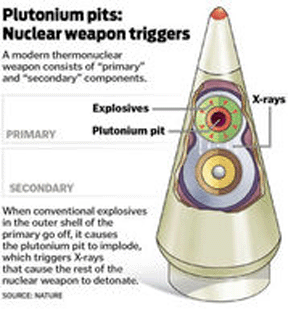
Nuclear weapons plutonium pits development planned for Los Alamos National Laboratory, but there’s strong opposition on safety grounds.
 | |||
Nuclear weapons development coming soon to Los Alamos National Laboratory amid safety concerns https://www.currentargus.com/story/news/local/2022/01/29/los-alamos-national-lab-prepares-nuclear-weapons-development/6562490001/, Adrian Hedden, Carlsbad Current-Argus
A main component of nuclear weapons was poised to be built in New Mexico after federal regulators granted approval for a plan to prepare Los Alamos National Laboratory (LANL) for the work.
The National Nuclear Security Administration (NNSA), an arm of the U.S. Department of Energy, announced earlier this month it approved LANL’s project to prepare areas of the lab to be used in plutonium pit production – a project known as LAP4.
Plutonium pits are hollow spheres of plutonium that when compressed using explosives cause a nuclear detonation, per a DOE report.
The pits were first used in the 1940s during the Manhattan Project, the report read, used to detonate atomic bombs tested at the Trinity Site in south-central New Mexico and then in the bomb dropped on Nagasaki in Japan – largely credited with ending World War II.
Since the war ended, Los Alamos’ pit production was limited to research purposes, and from 2007 to 2011 the lab produced pits to replace those in 31 warheads carried on U.S. military submarines.
Between 1952 and 1989, most of the plutonium pits in the U.S. were generated at the Rocky Flats Plant near Denver amid the Cold War with a peak nuclear stockpile of 31,225 weapons outfitted with the pits reported in 1967, read the report.
Rocky Flats was shut down in 1989, and after concerns that the pits produced since the 1980s or earlier would begin to deteriorate over time, Los Alamos was called to make new ones.
The DOE called on Los Alamos to increase efforts at the lab to produce 30 pits a year by 2026, and the Savannah River Site in South Carolina was tasked with producing 50 pits annually by 2030.
That means that by that year, the U.S. would be producing 80 pits per year.
But to prepare LANL for the work, a project to remove existing equipment and glove boxes was needed to make way for pit manufacturing equipment.
That work was intended to begin this spring via a project known as the Decontamination and Decommissioning Subproject, the first of five operations to get the site ready.
equipment and infrastructure needed to safely manufacture pits for the nuclear stockpile,” said Summer Jones, NNSA assistant deputy administrator for production modernization at LANL.
“LAP4 is a complex, challenging endeavor, and getting the approval to begin the D&D subproject is a big step toward restoring this important capability.”
Opponents call for environmental review of plutonium operations
The effort to resume producing plutonium pits and thus nuclear weapons at the New Mexico lab and in South Carolina as met with controversy from government officials and watchdog groups in both states opposing the projects.
Santa Fe City Councilors passed a resolution last year calling for a “site-wide” environmental impact statement to be conducted and any safety issued be resolved and certified by the federal government before pit production was increased.
“The Governing Body (Santa Fe City Council) requests that the National Nuclear Security Administration suspend any planned expanded plutonium pit production until all nuclear safety issues are resolved, as certified by the independent Defense Nuclear Facilities Safety Board,” read the resolution.
Nuclear Watch New Mexico and Savannah River Site Watch subsequently in June 2021 filed a lawsuit in U.S. District Court for the District of South Carolina’s Aiken Division against the DOE and NNSA, arguing pit production should not be increased until site-wide environmental analysis were conducted at both facilities.
“The drastic expansion of plutonium pit production and the utilization of more than one facility to undertake this production are substantial changes from the Defendants’ long-standing approach of producing a limited number of pits at only one facility,” the suit read.
The suit argued the increased pit production was not only intended for replacing existing warheads but to develop a new warhead known as the W87-1.
This project was developed with proper environmental analysis, the suit read, or proper planning for where associated nuclear waste would be disposed of.
“The drastic expansion of plutonium pit production and the utilization of more than one facility to undertake this production are substantial changes from the Defendants’ long-standing approach of producing a limited number of pits at only one facility,” read the suit.
In southeastern New Mexico is the Waste Isolation Pilot Plant (WIPP), a repository for low-level transuranic (TRU) nuclear waste – clothing materials and equipment irradiated during nuclear activities.
But the litigants argued WIPP was already at limited capacity and its current permit with the New Mexico Environment Department (NMED) specified the repository would have to cease waste disposal by 2024 and begin the decommissioning process.
The DOE last year submitted a permit renewal application to NMED that removed the 2024 closure date, leaving WIPP’s lifetime largely open ended.
Still, the suit alleged the DOE failed to address the need for waste disposal.
“As a National Academy of Sciences has concluded, the WIPP is already oversubscribed for future waste from multiple sites and will overextend its capacity from this increase in TRU production from the pit project and other DOE projects set to generate large amounts of TRU waste,” read the suit.
“The Defendants have failed to meaningfully address this critical waste disposal question.”
1 This Month





PLEASE OPPOSE HR 8255 AND S.3639 – bills would accelerate satellite deployment, with no environmental review or safeguards – https://ncstd5li.quorum.us/campaign/169331/
To see nuclear-related stories in greater depth and intensity – go to https://nuclearinformation.wordpress.com
-
Archives
- October 2026 (39)
- September 2026 (339)
- August 2026 (330)
- July 2026 (355)
- June 2026 (287)
- May 2026 (306)
- April 2026 (356)
- March 2026 (251)
- February 2026 (267)
- January 2026 (308)
- December 2025 (358)
- November 2025 (359)
-
Categories
- 1
- 1 NUCLEAR ISSUES
- business and costs
- climate change
- culture and arts
- ENERGY
- environment
- health
- history
- indigenous issues
- Legal
- marketing of nuclear
- media
- opposition to nuclear
- PERSONAL STORIES
- politics
- politics international
- Religion and ethics
- safety
- secrets,lies and civil liberties
- spinbuster
- technology
- Uranium
- wastes
- weapons and war
- Women
- 2 WORLD
- ACTION
- AFRICA
- Atrocities
- AUSTRALIA
- Christina's notes
- Christina's themes
- culture and arts
- Events
- Fuk 2022
- Fuk 2023
- Fukushima 2017
- Fukushima 2018
- fukushima 2019
- Fukushima 2020
- Fukushima 2021
- general
- global warming
- Humour (God we need it)
- Nuclear
- RARE EARTHS
- Reference
- resources – print
- Resources -audiovicual
- Weekly Newsletter
- World
- World Nuclear
- YouTube
-
RSS
Entries RSS
Comments RSS

