Elon Musk’s satellites for the war in Ukraine
From CNGNN Italy, 29 May 22, Elon Musk, the richest man in the world whose wealth nearly doubled in the two pandemic years, offered $ 44 billion to buy Twitter, which he says would become “the platform for free speech across the country world“. Elon Musk owns SpaceX, an aerospace company based in California.
SpaceX makes rockets and satellites to build Starlink, a broadband Internet system that once is completed will cover the entire world. SpaceX has so far put 2,500 satellites into orbit with rockets carrying 50 satellites at a time and plans to place 42,000 Starlink satellites in low orbit occupying 80% of this space.
Starlink was presented as a commercial satellite system but has fundamental military applications. In fact, satellites in low orbit transmit signals at a much higher speed than those in geosynchronous orbit around the equator. The US Army and Air Force fund and test Starlink to use its military capabilities. For example, last March, the US Air Force reported that conventional and nuclear dual-capacity F-35A fighters had carried out data transmission using Start link satellites at speed 30 times faster than traditional connections.SpaceX’s Starlink satellites are already being used by the Ukrainian military to guide drones, artillery shells, and missiles into Russian positions. This is confirmed by General Dickinson, head of the US Space Command, who declared to the Senate that “Elon Musk’s Starlink demonstrates in Ukraine what the mega-constellations of satellites can do“. Elon Musk’s SpaceX is part of the group of ten largest commercial satellite operators collaborating with US Space Command at the Vandenberg military space base in California.
”Commercial” nuclear power in space? – it’s all about weapons and war.
US military wants to demonstrate new nuclear power systems in space by 2027,By Elizabeth Howell , Space.com , 29 May 22,
That’s just one year after DARPA plans to test out its own nuclear power prototypes.Add the Defense Innovation Unit to a growing list of U.S. government organizations furthering their work in nuclear power in pace.
The organization, which seeks to get the military ready to use emergent commercial products, announced two prototype contracts on May 17 “to demonstrate the next generation of nuclear propulsion and power capability for spacecraft.” The ultimate aim is an orbital flight demonstration in 2027, DIU officials said in a statement(opens in new tab).
The contracts went to two companies, Ultra Safe Nuclear and Avalanche Energy, to demonstrate nuclear propulsion and power capabilities for small spacecraft that would operate in cislunar (Earth-moon) space. (The values of the contracts were not disclosed in the release.)
It’s part of the U.S. military’s pressing focus on cislunar activities to keep an eye on commercial and government activities that will ramp up there in the coming decades, including the international NASA-led Artemis program that seeks to put people on the moon in the 2020s………………………… https://www.space.com/nuclear-power-propulsion-space-defense-innovation-unit-contracts
When Henry Kissinger gives advice on ending the Ukraine conflict, the West should listen

The sooner those who are feeding the current chaos can clue into Kissinger’s advice, the better off we’ll all be in mitigating the inevitable subsequent diplomatic, economic, and political hangover
The realpolitik veteran schools today’s ideologues, but they won’t like the lesson
https://www.rt.com/op-ed/authors/rachel-marsden/ Rachel Marsden is a columnist, political strategist, and host of independently produced talk-shows in French and English. rachelmarsden.com 27 May 11, The ideologues who dominate today’s Western foreign policy establishment are largely responsible for escalating tensions with Russia to the point of military conflict in Ukraine. And now the grandmaster of realpolitik — that is, foreign relations shaped by pragmatism and on-the-ground truth rather than wishful thinking — has just delivered a rhetorical blow to NATO’s ambitions over Ukraine.
Henry Kissinger, the Nixon-era US secretary of state and a living legend of international politics, celebrates his 99th birthday this week. On Monday, he took to the stage via videoconference at the annual World Economic Forum in Davos, Switzerland, to offer his advice for resolving the Ukraine conflict.
“Parties should be brought to peace talks within the next two months. Ukraine should’ve been a bridge between Europe and Russia, but now, as the relationships are reshaped, we may enter a space where the dividing line is redrawn and Russia is entirely isolated,” Kissinger said in a conversation with WEF founder and executive chairman Klaus Schwab.
Isolating Russia from Europe seems to be the goal of engaging Moscow in a war of attrition by arming and backing Ukrainian fighters to effectively serve as NATO proxies. This would also explain why Washington is so highly invested in the conflict, both financially and ideologically.
An EU-Ukraine-Russia axis would be competitive with Beijing and Washington on the global playing field. But the Atlantist leaders in Brussels and their assorted Russophobic allies have privileged dated Cold War ideology over the long-term political and economic interests of their own citizens, who would be best served by a normalization of relations and increased cooperation right across the European continent.
“We are facing a situation now where Russia could alienate itself completely from Europe and seek a permanent alliance elsewhere,” Kissinger said. “This may lead to Cold War-like diplomatic distances, which will set us back decades. We should strive for long-term peace.” By far, the most likely scenario is even greater Russian rapprochement with China.
The end result could be a stronger military-industrial bloc in competition with the US for economic and political influence worldwide and a loss of clout for the EU, which would simply be reduced to a less influential partner of Washington’s, with less autonomy than it would have enjoyed had it not subordinated all of its interests to Washington and had instead maintained a more independent and balanced position.
Kissinger’s decades of experience in global affairs at the highest level as an advisor to heads of state, governments, and multinational corporations, and as an advocate of pragmatic solutions to sticky global problems, all give weight to his advice for any global crisis.
Recipient of the Nobel Peace Prize for his role in negotiating an end to the bloody Vietnam War with the North Vietnamese during the administration of Republican President Richard Nixon, Kissinger served as both secretary of state and national security advisor to the former US leader. Prior to that, he served as an advisor to Democratic President John F. Kennedy. If he’s urging a rapid resolution to the conflict in Ukraine, it’s informed by his professional experience. Perhaps he sees shades of Vietnam in Ukraine?
Kissinger’s solution for ending the territorial disputes between Russia and Ukraine is unlikely to please the current American foreign policy establishment. “Ideally, the dividing line should be a return to the status quo ante. Pursuing the war beyond that point will not be about the freedom of Ukraine, but a new war against Russia itself,” Kissinger said, with the “status quo ante” referring to leaving Crimea, Lugansk, and Donetsk under Russia’s control.
Once the “most admired man in America”, according to Gallup polls from 1973, 1974, and 1975, in the wake of peace in Vietnam, Kissinger has often wandered off Washington’s beaten foreign policy path. He laid out the first blueprint for cooperation between the US and China. He also opposed NATO’s bombing of Yugoslavia under former President Bill Clinton. “The rejection of long-range strategy explains how it was possible to slide into the Kosovo conflict without adequate consideration of all its implications—especially the visceral reaction of almost all nations of the world against the new NATO doctrine of humanitarian intervention,” Kissinger wrote in a Newsweek article in 1999.
Kissinger’s remarks accurately foreshadowed the military interventions of NATO member nations elsewhere under humanitarian pretexts — such as Syria, Libya, and now against Russia via Ukraine — for the ultimate purpose of regime change. He equally predicted why, despite rampant promotion and spinning of these Western wars, so much opposition to them nonetheless exists. Although attention spans and news cycles may have shortened since Kissinger’s diplomatic heyday, some people can still grasp that ideologically driven conflicts can engender long-term negative systemic repercussions that more than outweigh whatever short-term satisfaction may be derived from sparking an ideologically driven conflict.
The sooner those who are feeding the current chaos can clue into Kissinger’s advice, the better off we’ll all be in mitigating the inevitable subsequent diplomatic, economic, and political hangover.
Col. Richard Black — U.S. Leading World to Nuclear War
Video: Col. Richard Black — U.S. Leading World to Nuclear War, The International Schiller Institute, 27 May 22, Mike Billington with Executive Intelligence Review interviews Col. Richard Black (ret.).
(Ed. First a lengthy discussion on ColBlack’s military background, and his analysis of the history of the First –war in Syria)
”……………………… BLACK: …… the United States has a strategic policy of using proxies to engage in war. ………
a highly secretive CIA special activities center—these are kind of the James Bond guys of the Central Intelligence Agency, total Machiavellian; they will do anything, there’s no it’s no holds barred with these guys.
…………throughout you see this Machiavellian approach, where we use unlimited force and violence. And at the same time, we control the global media, to where we erase all discussions of what’s truly happening. So, to the man or the woman in the street, they think things are fine. Everything is being done for altruistic reasons, but it’s not……………………
BILLINGTON: Part of your military service was as a JAG officer, and for a period of time, you were the Army’s head of the criminal law division at the Pentagon. And in that light, what do you see as of how these Caesar sanctions—how would you look at those from the perspective of international law and military law?
BLACK: Well, now, I was not the international law expert. I was the criminal law expert. But I would say that making war on a civilian population is a crime of grave significance in the law of war.
………………… When we fight these wars, we have no limits on the cruelty and the inhumanity that we’re prepared to impose on the people, making them suffer, so that somehow that will translate into overthrowing the government, and perhaps taking their oil, taking their resources.
BILLINGTON: Clearly, the policy against Russia today, by the current administration.
BLACK: Yes. Yes. You know, Russia is, perhaps more blessed with natural resources than any other nation on Earth. They are a major producer of grain, of oil, of aluminum, of fertilizers, of an immense number of things that tie into the whole global economy. And no doubt there are people who look at this and say, “if we could somehow break up Russia itself, there will be fortunes made, to where trillionaires will be made by the dozens.” And there’s some attraction to that. Certainly you’ve seen some of this taking place already, with foreign interests taking over Ukraine, and taking their vast resources.
But, we began a drive towards Russia, almost immediately after the Soviet Union dissolved in 1991. The Soviet Union dissolved, the Warsaw Pact dissolved. And unfortunately, one of the great tragedies of history is that we failed to dissolve NATO. The sole purpose of NATO was to defend against the Soviet Union. The Soviet Union no longer existed. NATO went toe toe with the Warsaw Pact. The Warsaw Pact was gone; it no longer existed. There was no purpose in NATO’s continuing to exist. However, we retained it, and it could not exist unless it had an enemy. Russia was desperate to become part of the West.
BILLINGTON: So, the U.S. and U.K. position on the war in Ukraine, just over these last few weeks has now become not only supporting the war, but victory at all costs. This has been declared by Defense Secretary Austin and others. And they are pumping in huge quantities of not only defensive but offensive military weaponry to the Kyiv regime. What do you see as the consequence of this policy?
BLACK: I think one thing that it will do is it will ensure that a tremendous number of innocent Ukrainian soldiers will die needlessly. A lot of Russian soldiers will die needlessly. These are kids. You know, kids go off to war. I went off to war as a kid. You think your country, right or wrong, everything they’re doing is fine. It just it breaks my heart, when I look at the faces of young Russian boys, who have been who have been gunned down—in some cases very criminally by Ukrainian forces. And likewise, I see Ukrainian young men, who are being slaughtered on the battlefield.
We don’t care! The United States and NATO, we do not care how many Ukrainians die. Not civilians, not women, not children, not soldiers. We do not care. It’s become a great football game. You know, we’ve got our team. They’ve got their team, rah rah. We want to get the biggest score and run it up. And, you know, we don’t care how many how many of our players get crippled on the playing field, as long as we win.
Now, we are shipping fantastic quantities of weapons, and it’s caused the stock of Raytheon, which creates missiles, and Northrop Grumman, which creates aircraft and missiles, all of these defense industries have become tremendously bloated with tax dollars. I don’t think it’s ultimately going to change the outcome. I think that Russia will prevail. The Ukrainians are in a very awkward strategic position in the East.
But if you look at the way that this unfolded, President Putin made a desperate effort to stop the march towards war back in December of 2021. He went so far as to put specific written proposals on the table with NATO, peace proposals to defuse what was coming about. Because at this point, Ukraine was massing troops to attack the Donbas. And so, he was trying to head this off. He didn’t want war. And NATO just blew it off, just dismissed it; never took it seriously, never went into serious negotiations.
At that point, Putin seeing that armed Ukrainians, with weapons to kill Russian troops were literally on their borders, decided he had to strike first. Now, you could see, that this was not this was not some preplanned attack. This was not like Hitler’s attack into Poland, where the standard rule of thumb, is that you always have a 3-to-1 advantage when you are the attacker. You have to mass three times as many tanks and artillery and planes and men, as the other side has. In fact, when Russia went in, they went in with what they had, what they could cobble together on short notice. And they were outnumbered by the Ukrainian forces. The Ukrainian forces had about 250,000. The Russians had perhaps 160,000. So instead of having three times as many, they actually had fewer troops than the Ukrainians. But they were forced to attack, to try to preempt the battle that was looming, where the Ukrainians had massed these forces against the Donbas.
Now, the Donbas is adjacent to Russia. It is a portion of Ukraine that did not join with the revolutionary government that conducted the coup in 2014 and overthrew the government of Ukraine. They refused to become a part of the new revolutionary government of Ukraine. And so they declared their independence. And Ukraine had massed this enormous army to attack against the Donbas. And so Russia was forced to go in to preempt that planned attack by Ukraine. And you could see that Russia very much hoped that they could conduct this special operation without unduly causing casualties for the Ukrainians, because they think of the Ukrainians, or at least they did think of the Ukrainians as brother Slavs; that they wanted to have good relations. But there is a famous picture with a Russian tank, that had been stopped by a gathering of maybe 40 civilians who just walked out in the road and blocked the road and the tank stopped. I can tell you, in Vietnam, if we had had a bunch of people who stood in the way of an American tank, going through, that tank would not have slowed down, in the slightest! It wouldn’t honk the horn, it wouldn’t have done anything; wouldn’t have fired a warning shot. It would have just gone on. And I think that’s more typical—I’m not I’m not criticizing the Americans. I was there and I was fighting, and I probably would have would have driven the tank straight through myself.
But what I’m saying is that the rules of engagement for the Russians were very, very cautious. They didn’t want to create a great deal of hatred and animosity. The Russians did not go in—they did not bomb the electrical system, the media systems, the water systems, the bridges and so forth. They tried to retain the infrastructure of Ukraine in good shape because they wanted it to get back. They just wanted this to be over with and get back to normal. It didn’t work. The Ukrainians, the resistance was unexpectedly hard. The Ukrainian soldiers fought with great, great valor, great heroism. And. And so now the game has been upped and it’s become much more serious.
But it is amazing to look and to see that Russia dominates the air. They haven’t knocked out the train systems. They haven’t knocked out power plants. They haven’t knocked out so many things. They’ve never bombed the buildings in the center of Kyiv, the capital of Ukraine; they haven’t bombed the buildings where the parliament meets. They’ve been incredibly reserved about these things, hoping against hope that peace could be achieved.
But I don’t think I don’t think Ukraine has anything to do with the decision about peace or war. I think the decision about peace or war is made in Washington, D.C. As long as we want the war to continue, we will fight that war, using Ukrainians as proxies, and we will fight it to the last Ukrainian death.
BILLINGTON: How do you project the potential of a war breaking out directly between the United States and Russia? And what would that be like?
……………………. We need to recognize the risk of playing these games of chicken. Where, for example, the Turkish media just published an article saying that at Mariupol, where there was a great siege, that the Russians ultimately won. The one area they haven’t taken over is this tremendous steel plant. There are a lot of Ukrainian soldiers who are holed up there. And now it has come to light that apparently there are 50 French senior officers, who are trapped in that steel plant along with the Ukrainians. The French soldiers have been on the ground fighting, directing the battle. And this was kept under wraps, ultra-secret, because of the French elections that just occurred. Had the French people known that there were a large number of French officers trapped and probably going to die in that steel plant, the elections would have gone the other way: Marine Le Pen would have won. And so it was very important that for the entire deep state, that it not come to light that these French officers were there.
……………… And you can see we’re taking these very reckless actions, and each time we sort of up the ante—I happen to be a Republican—but we have two Republican U.S. senators who have said that, “well, we might just need to use nuclear weapons against Russia.” That is insane. I think it’s important that people begin to discuss what a thermonuclear war would mean.
Now, we need to understand, we think, “oh, we’re big, and we’re bad, and we have all this stuff.” Russia is roughly comparable to the United States in nuclear power. They have hypersonic missiles, that we do not have. They can absolutely evade any timely detection, and they can fire missiles from Russia and reach San Francisco, Los Angeles, Chicago, Detroit, Baltimore, Washington, D.C., New York City.
And if you think about just Virginia, where I happen to live, if there were a nuclear war—and keep in mind, they also have a very large and effective fleet of nuclear submarines that lie off the coast of the United States. They have a great number of nuclear-tipped missiles, and they can evade any defenses we have. So just in Virginia, if you look at it, all of Northern Virginia would be essentially annihilated. There would hardly be any human life remaining in Loudoun County, Prince William County, Fairfax County, Arlington, Alexandria. The Pentagon lies in in Arlington County: The Pentagon would simply be a glowing mass of molten sand. There would be no human life there. And there would be no human life for many miles around it. Just across the Potomac, the nation’s capital, there would be no life remaining in the nation’s capital. The Capitol building would disappear forever. All of the monuments, all of these glorious things—nothing would remain.
If you go to the coast of Virginia, you have the Norfolk Naval Shipyard, you have the Port of Norfolk. You have you have the greatest accumulation of naval power on the face of the Earth. This is where we park all of our aircraft carriers, our nuclear submarines, all of those things. There would be nothing remaining. There would be nothing remaining of any of those shipping industries there.
And you can carry this on. You talk about New York City, probably New York City itself, not only would everybody be killed, but it would probably be impossible for people to inhabit New York City for hundreds of years afterwards. But not only would it cease to be a place of vibrant human life, but probably going out for maybe half a millennium, it would not recover any sort of civilization.
We need to understand the gravity of what we’re doing. Perhaps if it were a matter of life and death for the United States, what happens in Ukraine, that would be one thing. Certainly when the Soviet Union put missiles in Cuba, that targeted the United States, that was worth taking the risk, because it was right on our border and it threatened us. And it was it was a battle worth fighting for and a risk worth taking. The Russians are in this in exactly the mirror image of that situation, because for them, the life of Russia depends on stopping NATO from advancing further right into Ukraine, right to their borders. They cannot afford not to fight this war. They cannot afford not to win this war.
So I think, toying with this constant escalation in a war that, really, in a place that has no significance to Americans—Ukraine is meaningless to Americans; it has no impact on our day-to-day lives. And yet we’re playing this reckless game that risks the lives of all people in the United States and Western Europe for nothing! Just absolutely for nothing! …………………………………………………….. https://schillerinstitute.com/blog/2022/04/26/video-col-richard-black-u-s-leading-world-to-nuclear-war/
No credibility in the way that the Ukraine war is being reported – says Colonel Richard Black (ret)

Video: Col. Richard Black — U.S. Leading World to Nuclear War, The International Schiller Institute, 27 May 22, Mike Billington with Executive Intelligence Review interviews Col. Richard Black (ret.).
”…………………………..BILLINGTON: Many flag grade officers certainly understand the consequences that you just described in a rather hair-raising way. Why is it that, while there are some generals speaking out in Italy, in France, in Germany, warning that we are pursuing a course that could lead to nuclear war, why are there not such voices from flag grade officers—retired, perhaps—saying what you’re saying here today?
BLACK: You know, there’s been a tremendous deterioration in the quality of flag officers………. we now have “yes men.” These are not people whose principal devotion is to the United States and its people. Their principal devotion is to their careers and their ability to network with other military officers upon retirement. There’s a very strong network that can place military generals into think tanks, where they promote war, into organizations like Raytheon and Northrop Grumman, and all of these defense operations, where they can get on boards and things like that. So there’s quite a personal price that you pay for saying, “Hey, stop. War is not in the interests of the American people.” If we had a better quality of individual, we would have people with the courage who would say, “I don’t care what it costs me personally.” But it is very difficult to get into the senior ranks, if you are an individual guided by principle, and patriotism, and devotion to the people of this nation. That’s just not how it works. And at some point, we need a President who will go in and shake the tree, and bring a lot of these people falling down from it, because they’re dangerous. They’re very dangerous to America.
………………. Just like I asked what’s keeping the generals from speaking out, why, and what will it take, to get Americans to recognize that we can and must sit down with Russians, and with Chinese, and with all other nations and establish a true, just world based on the dignity of man and the right to development and security?
………. at this point, the media have been so totally censored and so biased that the American people really don’t have a perception of the need for anything of that sort. It’s going to be difficult.
………… The idea that somehow we have this enormously just cause, it doesn’t strike a great deal of the world that it is just, and much of the world does not accept the latest propaganda about war crimes: this thing about Bucha. That’s probably the most prominent of all the war crimes discussions.
And what was Bucha? There was a film taken of a vehicle driving down the road in Bucha, which had been recaptured from the Russians. And every hundred feet or so there was some person with his hands, zip tied behind his back, and he’d been killed. It was not announced until four days after the Ukrainians had retaken Bucha.
Now, we knew almost nothing about it. We actually didn’t even have proof that people had been killed. But assuming they had, we didn’t know where they had been killed. We did not know who they were. We did not know who killed them. We did not know why they were killed. No one could provide an adequate motive for the Russians to have killed them. The Russians held Bucha for a month. If they were going to kill them, why didn’t they kill them during that month? And if you’re going to slaughter a bunch of people, wouldn’t they all be in one place and wouldn’t you gun them all down there? Why would they be distributed along a roadside, a mile along the way? It makes no sense!
What we do know is that four days after the mayor of Bucha joyously announced that the city was liberated, four days after the Ukrainian army had moved in, and their special propaganda arm of the Ukrainian military were there, all of a sudden there were these dead people on the road. How come they weren’t there when the Russians were there? How come they only appeared after the Russians were gone?
If I were looking at it as simply a standard criminal case, and I was talking to Criminal Investigation Division or the FBI, or military police or something, I’d say, “OK, the first thing, let’s take a look at the Ukrainians.” My guess would be, and you start with a hunch when you’re investigating a crime—my hunch is that the Ukrainians killed off these people after they moved in, and after they looked around, and said, “OK, who was friendly towards the Russian troops while the Russians were here? We’re going to execute them.” That would be my guess. Because I don’t see any motive for the Russians to have just killed a few people on their way out of town.
And nobody questions this, because the corporate media are so monolithic. We know for a fact, from the mouth of the head of a Ukrainian hospital, the guy who ran the hospital, he boasted that he had given strict orders to all of his doctors, that when wounded Russian POWs, when casualties were brought in, they were to be castrated. Now, this is a horrific war crime, admitted from the mouth of the hospital administrator, and the Ukrainian government said, “we’ll kind of look into that,” Like it’s no big thing. I can’t think of a more horrific, horrific war crime, ever. Where did you hear about it, on ABC and MSNBC and CNN and FOX News? Not a whisper. And yet the proof is undeniable. We had another clip where there was a POW gathering point, where the Ukrainians would bring POWs to a central point for processing—and this is about a seven-minute video—and the Ukrainian soldiers simply gunned them all down.
And they had probably 30 of these wounded Russian soldiers lying on the ground, some of them clearly dying from their wounds. Some of them, they put plastic bags over their heads. Now, these are these are guys who are laying there, sometimes fatally wounded with their hands zip-tied behind their backs, and they’ve got plastic bags over their heads, making it difficult to breathe. And because they can’t raise their hands, they can’t take the bags off, so that they can breathe. At the end of the video, the Ukrainians bring in a van, and there are three unwounded Russian POWs. Without the slightest thought or hesitation, as the three come off, and their hands are bound behind their backs, they gunned down two of them, right on camera and they fall over. And the third one gets on his knees, and begs that they won’t hurt him. And then they gun him down! These are crimes. And these were not refuted by the Ukrainian government. But you’d never even know that they occurred! So far, I will tell you that the only proven—I’m not saying that there aren’t war crimes happening on both sides. I’m just telling you, that the only ones where I have seen, fairly irrefutable proof of war crimes, have been on the Ukrainian side.
Now, often you hear it said, well, the Russians have destroyed this or destroyed that. Well, I’ve got to tell you, you go back to the wars that we fought when we invaded Iraq, the “Shock and Awe,” we destroyed virtually everything in Iraq, everything of significance. We bombed military and civilian targets without much discrimination. The coalition flew 100,000 sorties in 42 days. You compare that to the Russians, who have only flown 8,000 sorties in about the same period of time. 100,000 American sorties versus 8,000, in about the same time. I think the Russians have tended to be more selective. Whereas we went out — the philosophy of Shock and Awe is that you destroy everything that is needed to sustain human life and for a city to function. You knock out the water supply, the electrical supply, the heat, the oil, the gasoline; so that you knock out all of the major bridges. And then you just continue to destroy everything.
So it’s really ironic. And keep in mind, Iraq is a relatively small country. Ukraine is a huge country. 100,000 sorties in 42 days, 8,000 sorties in about the same time. A tremendous difference in violence between what we did in Iraq, and what they have done in Ukraine. So there’s simply no credibility when you actually get down to the facts and you look at the way that the war has been conducted…………… https://schillerinstitute.com/blog/2022/04/26/video-col-richard-black-u-s-leading-world-to-nuclear-war/
They’re Just Outright Telling Us That Peace In Ukraine Is Not An Option

Caitlin Johnstone, 25 May 22, US Senator Joe Manchin said at the World Economic Forum on Monday that he opposes any kind of peace agreement between Ukraine and Russia.
Manchin, who at the moment is one of the most powerful elected officials in Washington, added that only the complete forcible ejection of Russia from all of Ukraine is acceptable, that the war should ideally be used to remove Putin from power, and that he and the strategists he talks to see this war as an “opportunity”.
…………………………… Manchin’s comments fit in perfectly with what we know about the US-centralized empire’s real agendas in Ukraine.
Earlier this month Ukrainian media reported that UK Prime Minister Boris Johnson told the nation’s president Volodymyr Zelensky on behalf of NATO powers that “even if Ukraine is ready to sign some agreements on guarantees with Putin, they are not.”
Last month US Secretary of “Defense” Lloyd Austin acknowledged that the goal in this war is not peace in Ukraine or the mere military defeat of Russia but to actually weaken Russia as a nation…………
Last week The New York Times reported that the Biden administration is developing plans to “further choke Russia’s oil revenues with the long-term goal of destroying the country’s central role in the global energy economy.”
………… Two months ago Biden himself acknowledged what the real game is here with an open call for regime change, saying of Putin, “For God’s sake, this man cannot remain in power.”
Statements from the Biden administration in fact indicate that they expect this war to drag on for a long time, making it abundantly clear that a swift end to minimize the death and destruction is not just uninteresting but undesirable for the US empire.
This is not a proxy war with peace as an option anywhere within sight. It’s not about saving Ukrainian lives. It’s not even about beating Russia in Ukraine. It’s about achieving regime change in Moscow, no matter how many lives need to be destroyed in the process.
Peace is not on the menu. https://caitlinjohnstone.substack.com/p/theyre-just-outright-telling-us-that?s=w—
Are Americans Prepared To Fight A Nuclear War Over Taiwan?
1945, By Doug Bandow, 25 May 22,
The consequences of a U.S.-China war over Taiwan need to be understood: A president suffering from an occasional case of verbal diarrhea about political infighting is an embarrassment. A president repeating loose comments about international affairs is dangerous.
For the third time, President Joe Biden declared a new U.S. policy toward Taiwan, only to have his officials insist that nothing has changed. That might mollify the public, but other nations, especially the People’s Republic of China, aren’t fooled.
On his trip to East Asia, intended to convince friends and allies that Uncle Sam can walk and chew gum at the same time, the president’s statement roiled the region. When asked if he would defend Taiwan, he responded “yes,” adding that “it’s a commitment we made.” His words circled the globe at warp speed, appearing to yet again repudiate the policy of “strategic ambiguity,” by which Washington refused to clarify its position toward a Chinese attack on Taiwan.
Since the Carter administration dropped diplomatic ties with Taiwan, legally the Republic of China, and recognized the PRC, America’s defense ties with Taipei have been ambiguous. Washington retains unofficial diplomatic ties with the island state and is committed by law to sell the latter defensive weapons. However, Taiwan enjoys neither a defense treaty, as possessed by Japan and South Korea, nor any other formal military commitment. Making U.S. policy a straightforward “maybe.”
The Strategy of Strategic Ambiguity
In theory, the uncertainty and possibility of forfeiting U.S. support are supposed to deter Taipei from recklessly challenging Beijing. At the same time, the PRC is supposed to avoid taking military action, lest Washington decides to intervene. Voila, America achieves the best of both worlds. However, the opposite result also is possible. The Taiwanese might believe eight decades of cooperation in war and peace mean the U.S. would intervene on the former’s behalf. And the Chinese might decide that no rational American president would risk Los Angeles for Taipei.
In fact, strategic ambiguity looks like an excuse to avoid deciding. As long as policymakers need not give a clear yes or no, they need not clearly decide yes or no. And they can simply hope the contingency never arises.
China is Not Ambiguous About Reunification
However, this strategy is becoming increasingly untenable. There is no sign of an imminent Chinese military action, but noted by the Quincy Institute’s Michael Swaine: “this possibility cannot be discounted over the longer term if present trends continue.” Beijing’s patience appears to be diminishing:……………….
of the many possible lessons of Russia’s attack on Ukraine, the most important for Xi might be the importance of a quick victory.
……………………. Is America Ready for Strategic Clarity?
However, the American people should be consulted, starting now, Admitted Rep. Michael McCaul, ranking member of the House Foreign Affairs Committee. “I don’t know how many Americans would want to go to war over a tiny island they know nothing about,” he said. And if they fully understood the cost of defending Taiwan from China – the possibility of conventional defeat and nuclear disaster – they might firmly oppose doing so.
…………………………. Alas, fighting the PRC over Taiwan would be nothing like America’s recent military experience. Iraq and Afghanistan were cakewalks compared to high-intensity war against the well-armed and highly motivated People’s Liberation Army, generously stocked with missiles and an expanding nuclear arsenal. At its worst, air and naval combat between the U.S. and PRC would take Americans back to World War II’s Pacific war, which surely no one wants to relive, with a possible nuclear twist if such weapons were used against America.
And Beijing appears ready for war, if necessary, though that certainly is not its preference. …………………………………
In short, the American people could find themselves risking national bankruptcy and destruction to confront this one contingency: defending Taiwan from China.
The more than 23 million people of Taiwan deserve to set their own destinies. They have created a democratic policy, market economy, and vibrant society. However, risking their homeland is a high price for Americans to pay, too high. War with China means personnel killed, planes downed, ships sunk, and bases bombed. War with China also means the possibility of nuclear-tipped missiles hitting American cities. And even a U.S. victory likely would be transitory, as China could retreat and prepare for another round, rather like Germany between World Wars I and II.
Better to seek a regional modus vivendi, which ensures that Taipei eschews claims of independence and military relationships with other nations, while Beijing reduces military threats and affirms peaceful reunification.
Washington also should consider the lessons of Ukraine: arming and training Taiwanese forces, preparing global sanctions in response to an attack, and developing asymmetric military responses. The goal should be to put the greatest responsibility on Taiwan while raising the price more for China than for America.
The president’s inability to control his mouth is dangerous. Failing to consider the full consequences of war with China over Taiwan is worse. And expecting Americans to accept without debate the costs and risks of full-scale combat with the PRC is a political crime. The Biden administration should address all three issues before the Taiwan Strait becomes the world’s latest crisis. https://www.19fortyfive.com/2022/05/are-americans-prepared-to-fight-a-nuclear-war-over-taiwan/
Twenty-Two House Republicans Demand Accountability on Biden’s $40b War Spending

“The aid package approved by Congress provides unprecedented funding for a foreign conflict in which the United States is not fighting, while there have been no significant hearings or substantive briefings on the use of the money and weapons being provided at taxpayer expense.” The lawmakers raised the prospect of sophisticated weaponry falling into the hands of terrorist organizations, citing a documented history of illicit arms-trafficking within Ukraine, a market which is one of the largest in Europe:
A cohort of Republicans, part of the dissenting vote on Biden’s Ukraine war package, seeks oversight and specifics about the destination of U.S. money and weapons.
| Glenn Greenwald and Anthony Tobin, May 25 |
The House of Representatives, on May 10, approved President Biden’s $33 billion package for the war in Ukraine, and then, on its own initiative, added $7 billion on top of it. That brought the new war spending authorization to $40 billion, on top of the $14 billion already spent just 10 weeks into this war, which U.S. officials predict will last years, not months. The House vote in favor was 368-57. All 57 NO votes were from GOP House members. All House Democrats, including the Squad, voted YES.
A similar scene occurred when the Senate, “moving quickly and with little debate,” overwhelmingly approved the same war package. All eleven NO votes were from Senate Republicans. All Senate Democrats, including Sen. Bernie Sanders (I-VT), voted in favor, seemingly in direct contradiction to Sanders’ February 8 op-ed in The Guardian warning of the severe dangers of bipartisan escalation of the war. Efforts by Sen. Rand Paul (R-KY) to delay passage of the bill so that some safeguards and accountability measures could be included regarding where the money was going and for what purposes it would be used were met with scorn, particularly from Paul’s fellow Kentucky GOP Senator, Minority Leader Mitch McConnell, who condemned Paul as an “isolationist.” Following the Senate vote, a jet was used to fly the bill across the world to President Biden in South Korea, where he signed it into law.
But the lack of any safeguards over the destination of the money and weapons prompted close to two dozen House Republicans, led by Rep. Yvette Herrell (R-NM), to send a letter to the Biden White House on Monday demanding greater specificity and assurances about legal requirements on how weapons are used. The letter urges a public reckoning on the dangers of the U.S.’s bankrolling of the war in Ukraine: “We write today to express grave concern about the lack of oversight and accountability for the money and weapons recently approved by Congress for Ukraine,” it began.
“The aid package approved by Congress provides unprecedented funding for a foreign conflict in which the United States is not fighting, while there have been no significant hearings or substantive briefings on the use of the money and weapons being provided at taxpayer expense.” The lawmakers raised the prospect of sophisticated weaponry falling into the hands of terrorist organizations, citing a documented history of illicit arms-trafficking within Ukraine, a market which is one of the largest in Europe:
“According to a 2017 Small Arms Survey briefing on arms trafficking, over 300,000 small arms disappeared from Ukraine between 2013 and 2015 and only 13 percent were recovered. Criminal networks, corrupt officials, and underpaid military personnel can make a profitable business from the sale of arms from Ukrainian military stockpiles. For example, in 2019, the Ukrainian Security Service uncovered a plot by Ukrainian soldiers to sell 40 RGD-5 grenades, 15 grenade launchers, 30 grenade detonators, and 2,454 rounds of ammunition for 75,000 Ukrainian hryvnia or around $2,900.”
Indeed, the relentlessly war-supporting CNN last month acknowledged that “the US has few ways to track the substantial supply of anti-tank, anti-aircraft and other weaponry it has sent across the border into Ukraine.” Biden officials admitted the “risk that some of the shipments may ultimately end up in unexpected places.” ……………………… more https://greenwald.substack.com/p/twenty-two-house-republicans-demand?s=r
Nuclear tragedy in the Marshall Islands
The Bulletin, By Sally Clark | May 25, 2022, We were innocent 21-year-olds entering an organization called the Peace Corps in 1969……….. Young, naive Americans, we knew little about the area, other than, perhaps, fleeting thoughts that we might find the remains of Amelia Earhart or artifacts from her plane there……….
Our naivete began to diminish when we were told the Atomic Energy Commission was coming to check out the health of the children and adults and of course to give out candy and show a dated movie. We asked questions and learned about the nuclear test over Bikini and the fallout coming down over a neighboring island, whose residents thought it was snow. We were told that the Marshallese ran outside, allowing the fallout to land on their skin, with some children putting it to their eyes. Luckily many residents sensed danger and ran to the ocean, saving themselves from a future road of at least some fallout ailments.
As we spent more time in the islands, little by little more detailed stories emerged—of still births, high cancer rates, and other radiation-related health issues. Islanders had been moved from Bikini before nuclear tests were conducted; some of the explosions were so great that one of the small islands simply vaporized, leaving a deep cavern. Many Marshallese had to endure being relocated from their blessed atoll to Kili, an island in the middle of the ocean with no lagoon.
Over the years, more and more people spoke out about such atrocities and such disregard for the Marshallese, who were actually called “savages” by a US paper in the 50’s. My heart wept as I learned more information about the scope of nuclear testing in the Marshalls.
Between 1946 and 1958, the Marshall Islands region was the site of the testing of nuclear weapons equivalent to the explosive power of 1.6 Hiroshima bombs every day for 12 years—67 in all at the Bikini and Enewetak atolls—a fact that is impossible for me to comprehend.
A resolution is now in front of the Congress asking the United States to prioritize nuclear justice in its negotiations with the Marshall Islands on an extended Compact of Free Association between the countries. The resolution recognizes that the United States nuclear testing program and radioactive waste disposal, including not just contaminated debris from the Marshalls but also material transported from the Nevada Test Site, caused irreparable material and intangible harm to the people of the Marshall Islands.
We believe this harm continues to this day. Within this resolution is a call for an apology for what the United States did to the Marshallese and to raise awareness about the need for more action to undo this harm. US Rep. Katie Porter of California and senators Mazie Hirono of Hawaii and Edward Markey of Massachusetts are spearheading this effort, which would formally apologize for the US nuclear legacy in the Marshall Islands and raise public awareness of the issue. Please write or call your representatives and senators, asking them to support House Joint Resolution 73 and Senate Joint Resolution 40.
What happened in the islands is simply incomprehensible to me. The toll on the Marshallese and the environment is impossible for me to grasp. And I have another nagging thought: Why as Peace Corps volunteers were we not warned about the radioactive fallout and the social issues we were being dropped into? Of course, there’s the implication that we were being used as pawns to smooth the relationship between the Marshall Islands and the United States and to continue to have the islanders as our friends for strategic reasons.
Who makes these decisions to drop bombs on such beautiful, pristine islands? Who sends 20-year-olds into a potentially radioactive area without warning them? When can we as a human race honor peoples around the world and get out of building weapons and gaining lands for strategic reasons? Please stop. I’m sad and weep and write letters asking for an apology. So sad. Where is our soul? https://thebulletin.org/2022/05/nuclear-tragedy-in-the-marshall-islands/
Australia’s new Prime Minister backs the UN Nuclear Weapons Ban Treaty

https://icanw.org.au/new-prime-minister-backs-the-ban/?fbclid=IwAR0PloEtGAvJE3z3fK3Lvb01JmlIbIJ2MXeAoT4KBjIBe3AMTGretVOISV8 24 May 22, The election of the Albanese Labor Government heralds a new era in Australia’s approach to nuclear disarmament and non-proliferation. While the previous government shunned the UN Treaty on the Prohibition of Nuclear Weapons, the Australian Labor Party has committed to sign and ratify it in government. Recent polling demonstrates ¾ of the Australian public support this action.
Prime Minister Anthony Albanese is a long-term champion of nuclear disarmament and non-proliferation, inspired by his late mentor Tom Uren, a former Labor Minister who witnessed the atomic bombing of Nagasaki as a prisoner of war. In proposing the resolution committing to the treaty in 2018, he said the new policy is “Labor at its best” and that “nuclear disarmament is core business for any Labor government worth its name”. In 2016 Albanese launched the Tom Uren Memorial Fund with ICAN, and has spoken out in support of the treaty in parliament, at public events and demonstrations since its negotiation in 2017.
A majority of the new government members have signed the ICAN Parliamentary Pledge to work for Australia to sign and ratify the Treaty. It has been backed by two dozen unions, including the national peak body, the Australian Council of Trade Unions. The Victorian, Tasmanian, Australian Capital Territory, South Australian, Northern Territory and Western Australian Labor branches, as well as over 50 local branches have passed motions declaring their support and calling upon Australia to join the ban without delay. Many have called for signature and ratification to be completed in the first term of the new government.
Following a decision of the Australian Parliament, signature and ratification of the Treaty on the Prohibition of Nuclear Weapons can now proceed under the Albanese Labor Government.
In addition to the incumbent signatories of the ICAN Parliamentary Pledge, we are delighted to welcome the following new parliamentarians that have committed to work for Australia to sign and ratify the Treaty on the Prohibition of Nuclear Weapons:
Boothby, SA Louise Miller-Frost, Labor
Bennelong, NSW Jerome Laxale, Labor
Chisholm, VIC Carina Garland, Labor
Cunningham, NSW Alison Byrnes, Labor
Goldstein, VIC Zoe Daniel, Independent
Higgins, VIC Dr Michelle Ananda-Rajah, Labor
Hunter, NSW Daniel Repacholi, Labor
Kooyong, VIC Dr Monique Ryan, Independent
North Sydney, NSW Kylea Tink, Independent
Pearce, WA Tracey Roberts, Labor
Robertson, NSW Gordon Reid, Labor
Wentworth, NSW Allegra Spender, Independent
ENATE, ACT David Pocock, Independent
SENATE, QLD Penny Allman-Payne, Greens
SENATE, NSW David Shoebridge, Greens
SENATE, SA Barbara Pocock, Greens
SENATE, VIC Linda White, Labor
Asianization of NATO: China, Russia react to Biden visit — Anti-bellum
Global TimesMay 25, 2022 Tensions escalate in Korean Peninsula as QUAD summit shakes Asian stability The US and South Korea jointly fired two missiles on Wednesday in response to North Korea’s reported launch of three missiles, marking a further escalation of the Korean Peninsula situation as US President Joe Biden concluded his Asia trip to […]
Asianization of NATO: China, Russia react to Biden visit — Anti-bellum
War in Ukraine is getting complicated, and America isn’t ready — The New York Times

https://en.thepage.ua/politics/war-in-ukraine-is-getting-complicated-and-america-isnt-ready Author Valery Moiseev, 22 May 22,
The Senate passed a $40 billion emergency aid package for Ukraine, but with a small group of isolationist Republicans loudly criticizing the spending and the war entering a new and complicated phase, continued bipartisan support is not guaranteed. This is stated in an editorial published in The New York Times (NYT).
Avril Haines, the director of national intelligence, warned the Senate Armed Services Committee recently that the war in Ukraine could take “a more unpredictable and potentially escalatory trajectory”, with the increased likelihood that Russia could threaten to use nuclear weapons.
The newspaper also notes that there are many questions that President Biden has yet to answer for the American public.
Is the United States, for example, trying to help bring an end to “this conflict” (as the newspaper calls the war in Ukraine) through a settlement that would allow for a sovereign Ukraine and some kind of relationship between the United States and Russia? Or is the United States now trying to weaken Russia permanently? Has the administration’s goal shifted to destabilizing Putin or having him removed? Does the United States intend to hold Putin accountable as a war criminal? Or is the goal to try to avoid a wider war — and if so, how to achieve this?
Without clarity on these questions, the White House not only risks losing Americans’ interest in supporting Ukrainians — who continue to suffer the loss of lives and livelihoods — but also jeopardizes long-term peace and security on the European continent, the NYT says.
The authors of the article believe that Americans “have been galvanized by Ukraine’s suffering”, but popular support for a war far from U.S. shores will not continue indefinitely. Inflation is a much bigger issue for American voters, and problems in global food and energy markets are likely to intensify.
“It is tempting to see Ukraine’s stunning successes against Russia’s aggression as a sign that with sufficient American and European help, Ukraine is close to pushing Russia back to its positions before the invasion. But that is a dangerous assumption.”
The article says that Russia remains too strong, and Putin has invested too much personal prestige in the invasion to back down.
“Unrealistic expectations could draw the United States and NATO ever deeper into a costly, drawn-out war. Russia, however battered and inept, is still capable of inflicting untold destruction on Ukraine and is still a nuclear superpower with an aggrieved, volatile despot who has shown little inclination toward a negotiated settlement.”
The NYT says that it is the Ukrainians who must make the hard decisions: they are the ones fighting, dying and losing their homes to Russian aggression, and it is they who must decide what an end to the war might look like. “If the conflict does lead to real negotiations, it will be Ukrainian leaders who will have to make the painful territorial decisions that any compromise will demand.”
But as the war continues, “Biden should also make clear to President Volodymyr Zelenskyy and his people that there is a limit to how far the United States and NATO will confront Russia, and limits to the arms, money and political support they can muster. It is imperative that the Ukrainian government’s decisions be based on a realistic assessment of its means and how much more destruction Ukraine can sustain.”
Confronting this reality may be painful, but it is not appeasement, the NYT stresses. This is what governments are duty bound to do, not chase after an illusory “win.” Russia will be feeling the pain of isolation and debilitating economic sanctions for years to come, and Putin will go down in history as a butcher. The challenge now is to shake off the euphoria, stop the taunting and focus on defining and completing the mission.
Ukraine War Has No End in Sight

Ukraine’s current status as a wartime non-Nato ally has strengthened a long-held goal of the US and Nato of neutralizing Russia as a long-term military threat to Europe — in short, by transforming Ukraine’s military into a de facto Nato proxy.
As things stand, the best Russia can hope for is a permanent state of conflict with Ukraine — which would accomplish the US goal of “weakening” Russia.
Neither Russia nor Nato knows where and how escalation would end.
https://www.energyintel.com/00000180-d669-d410-aba9-f66dbd120000, Author Scott Ritter, Washington, May 18, 2022
Russia’s invasion of Ukraine is grinding its way toward its inevitable conclusion, namely Russian control over the Donbas region. But this will not end the conflict between Russia and Ukraine, which has expanded in scope and scale beyond the capabilities of the Russian military resources originally allocated. With no diplomatic off-ramp on the horizon, the war risks becoming a permanent state of conflict between Russia and Ukraine — with unknown consequences.
As the Ukraine conflict enters its third month, the Kremlin looks likely to achieve its major military objective of securing physical control over the eastern Donbas region. Peripheral territorial acquisition of the strategic southern city of Kherson, as well as a swath of territory connecting Crimea to the Donbas and the border of the Russian Federation, also looks likely.
While it seems clear that Ukraine will not be formally joining Nato any time soon, if ever, the reality is that the war has reforged the relationship between Ukraine and the trans-Atlantic alliance in a way that transforms the way the two entities work together. Ukraine’s current status as a wartime non-Nato ally has strengthened a long-held goal of the US and Nato of neutralizing Russia as a long-term military threat to Europe — in short, by transforming Ukraine’s military into a de facto Nato proxy.
Game Changer
Nato’s decision to arm Ukraine, combined with the willingness of several Nato nations to allow their territory to be used for training, has provided the Ukrainian military with the kind of strategic depth that was unimaginable when the war began on Feb. 24. The transition from supplying light anti-armor and anti-aircraft missiles to heavy weaponry such as artillery and armor has also enabled Ukraine to begin the process of reconstituting the heavy brigades that Russia is destroying in eastern Ukraine.
The creation of an impregnable Ukrainian strategic rear is a game changer. First and foremost, it provides Ukraine with the means to rearm, refit and re-equip its forces to Nato standards without fear of Russian intervention. This not only counters Russia’s stated military objective of “demilitarization” of Ukraine’s forces, but also steels the resolve of the Ukrainian government to reject any settlement that obliges them to embrace neutrality in perpetuity.
Russia’s efforts to disrupt the injection of Nato-provided supplies and material have proven haphazard at best. While warehouses containing military equipment have been identified and destroyed, Ukrainian units equipped with the latest US and Nato weapons are still appearing on the front lines. Likewise, while Russia has targeted Ukraine’s petroleum refining and storage capacity, the continued provision by Nato countries of refined petroleum products allows the Ukrainian military to remain mechanized. In short, while Russia will likely accomplish the objective of securing the Donbas and associated regions, unless it is willing to expand the scope and scale of its current interdiction efforts, it will not be able to bring to a successful conclusion its state of war with Ukraine.
Escalating Tensions
There currently is no identifiable diplomatic off-ramp for either Ukraine or Russia to end the conflict. Rather, all existing trends point to continued escalation. While Ukraine and Nato have constructed the strategic depth to allow Ukraine’s continued resistance, Russia’s current military configuration remains inadequate to the task of matching this mobilization. As things stand, the best Russia can hope for is a permanent state of conflict with Ukraine — which would accomplish the US goal of “weakening” Russia.
Add in expected pressures on Russia from Nato expansion in northern Europe (Finland and Sweden), and rising tensions involving Transnistria (a pro-Russian breakaway state between Ukraine and Moldova), and the current situation appears untenable for Russia without a broader mobilization of its military resources. While the outcome of any such action is impossible to predict, one thing is sure: Neither Russia nor Nato knows where and how such escalation would end.
Scott Ritter is a former US Marine Corps intelligence officer whose service over a 20-plus-year career included tours of duty in the former Soviet Union implementing arms control agreements, serving on the staff of US Gen. Norman Schwarzkopf during the Gulf War and later as a chief weapons inspector with the UN in Iraq from 1991-98.
Seismic Concerns at Los Angeles Nuclear Laboratory and Expanded Plutonium Pit Production
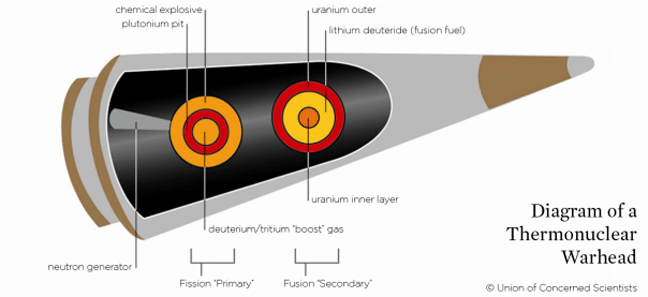
Seismic Concerns at LANL and Expanded Plutonium Pit Production http://nuclearactive.org/, May 19th, 2022, Ongoing Plutonium operations at Los Alamos National Laboratory’s Technical Area 55 are centered in the middle of the 36-square mile national nuclear weapons facility. LANL is the only U.S. facility with the capabilities to fabricate plutonium triggers, or the fissile pits, for nuclear weapons. However, Technical Area 55, or TA-55, is located within the complex Pajarito Fault Zone between two young, north – south running faults called the Guaje Mountain and Rendija Canyon faults. Visual evidence of faulting can be found in the canyons to the north of TA-55. http://nuclearactive.org/gilkeson/ see Seismic Documents.
The U.S. Department of Energy owns LANL. It has plans for expansion of all things plutonium-pit production at the Plutonium Facility and at least five new support buildings at TA-55. CCNS anticipates that DOE will continue its efforts to conceal and ignore the reality of the growing seismic threats of the young faults.
We witnessed similar efforts in the mid-2000s when DOE began to design a new super Walmart-sized Nuclear Facility within TA-55 next door to the Plutonium Facility. DOE was so bold as to dig into the volcanic tuff with heavy equipment to prepare a pad for future construction. http://www.nuclearactive.org/news/030510.html In the end, public opposition and escalating costs forced the cancellation of its plans. http://nuclearactive.org/livestreamed-nuclear-safety-board-hearing-on-february-21st-in-albuquerque/
Fabricating plutonium pits for nuclear weapons involves many steps – some using aqueous processes that result in water contaminated with radiation and hazardous materials. That water is treated across the street from the Plutonium Facility at the Radioactive Liquid Waste Treatment Facility and for decades was discharged through an industrial outfall into Effluent Canyon. Since November 2011, though, the treated water has been evaporated into the air at a mechanical evaporator.
In April, the Environmental Protection Agency renewed the five-year industrial permit for LANL to discharge through Outfall 051 into Effluent Canyon. https://www.epa.gov/nm/los-alamos-national-laboratory-lanl-industrial-wastewater-permit-final-npdes-permit-no-nm0028355
We note that on May 11th, CCNS, Honor Our Pueblo Existence, and the Albuquerque Veterans for Peace, Chapter No. 63, appealed the EPA decision to permit the outfall and five others to the Environmental Appeals Board. https://yosemite.epa.gov/oa/EAB_Web_Docket.nsf/f22b4b245fab46c6852570e6004df1bd/ba987f24df0c356085258837004f3dcd
Then on May 5th, the New Mexico Environment Department approved for the first time a ground water discharge permit for not only for the Radioactive Liquid Waste Treatment Facility, the outfall and Mechanical Evaporator, but for two large solar evaporative tanks, and a new low-level radioactive liquid waste treatment facility. In addition, DOE plans to build a liquid waste treatment facility for the transuranic plutonium liquid waste. https://www.env.nm.gov/public-notices/, go to Los Alamos County, and scroll down to DP-1132 where the draft permit is posted, but not the final permit.
These facilities are all in support of DOE’s plans for expanded plutonium pit production at LANL.
Five new plutonium buildings for Los Alamos National Laboratory, with the costly funding details rather obscure
Nuclear agency plans five new plutonium buildings at Los Alamos lab, Santa Fe New Mexican , By Scott Wyland swyland@sfnewmexican.com, May 18, 2022
As a further sign Los Alamos National Laboratory is inching toward its 2026 target for making 30 warhead triggers a year, nuclear security managers plan to construct five buildings in the lab’s plutonium complex over the next five years, in part to support that effort.
A new building would be funded annually, beginning in fiscal year 2023, with the aim of supporting production of the bomb cores, known as pits, and other plutonium operations, according to the National Nuclear Security Administration’s budget request for the coming year.
The total cost of the five buildings will be more than $240 million………………….
One critic of the lab’s pit production plans said each of the buildings was priced just under the $50 million threshold that would trigger a more rigorous congressional review.
That might allow the lab to change the office buildings into something else later for a different purpose, such as producing more pits, said Greg Mello, executive director of the Los Alamos Study Group.
“No one ever talked about these costs before,” Mello said. “We don’t think this is the end of the surprises. There are more surprises to come.”
The federal budget for plutonium operations has climbed steeply in recent years, both at the lab and at Savannah River Site in South Carolina, where officials hope to make an additional 50 pits yearly by the mid-2030s.
Under the U.S. Department of Energy’s draft budget, the lab’s plutonium modernization funding would climb to $1.56 billion in 2023 from the current year’s $1 billion, more than a 50 percent increase.
At the same time, the nuclear security agency, an Energy Department branch, has proposed funneling $700 million this coming year toward converting Savannah River Site into a pit factory. That’s a sizable jump from the $475 million spent for that purpose in the last budget cycle………………….
Jay Coghlan, executive director of Nuclear Watch New Mexico, said federal officials want the lab’s pit plant to be able to produce up to 80 pits for short periods.
He contends the lab is likely to use this “surge capacity” given the longer time it will take for Savannah River to begin production…………….. https://www.santafenewmexican.com/news/local_news/nuclear-agency-plans-five-new-plutonium-buildings-at-los-alamos-lab/article_48acffdc-d5fb-11ec-985e-5b26a02df8f5.html
1 This Month





PLEASE OPPOSE HR 8255 AND S.3639 – bills would accelerate satellite deployment, with no environmental review or safeguards – https://ncstd5li.quorum.us/campaign/169331/
To see nuclear-related stories in greater depth and intensity – go to https://nuclearinformation.wordpress.com
-
Archives
- October 2026 (29)
- September 2026 (339)
- August 2026 (330)
- July 2026 (355)
- June 2026 (287)
- May 2026 (306)
- April 2026 (356)
- March 2026 (251)
- February 2026 (267)
- January 2026 (308)
- December 2025 (358)
- November 2025 (359)
-
Categories
- 1
- 1 NUCLEAR ISSUES
- business and costs
- climate change
- culture and arts
- ENERGY
- environment
- health
- history
- indigenous issues
- Legal
- marketing of nuclear
- media
- opposition to nuclear
- PERSONAL STORIES
- politics
- politics international
- Religion and ethics
- safety
- secrets,lies and civil liberties
- spinbuster
- technology
- Uranium
- wastes
- weapons and war
- Women
- 2 WORLD
- ACTION
- AFRICA
- Atrocities
- AUSTRALIA
- Christina's notes
- Christina's themes
- culture and arts
- Events
- Fuk 2022
- Fuk 2023
- Fukushima 2017
- Fukushima 2018
- fukushima 2019
- Fukushima 2020
- Fukushima 2021
- general
- global warming
- Humour (God we need it)
- Nuclear
- RARE EARTHS
- Reference
- resources – print
- Resources -audiovicual
- Weekly Newsletter
- World
- World Nuclear
- YouTube
-
RSS
Entries RSS
Comments RSS

