Japanese youths at Vienna Nuclear Ban Treaty meeting, call for abolition of nuclear weapons
Japanese youths to call for abolition of nuclear weapons at Vienna meeting, https://www3.nhk.or.jp/nhkworld/en/news/20220612_14/ Fourteen Japanese youths plan to call for the abolition of nuclear weapons at the first meeting of signatories to the UN Treaty on the Prohibition of Nuclear Weapons in Vienna later this month.
In an online meeting on Sunday, Takahashi Yuta, a university student from Hiroshima, said the younger generation must take over from the atomic-bomb survivors, or hibakusha.
He said many young people will travel to the meeting in Vienna, and he wants to convey the hibakushas’ voices to the world.
Okuno Kako, another university student from Hiroshima, is also working on environmental
Okuno said if nuclear weapons are used, they would cause temperatures to fall globally. She added that nuclear tests and the production of nuclear weapons also adversely affect the environment.
She said she wants to appeal for the abolition of nuclear weapons from the viewpoint of both environmental protection and peace, although they may appear to be unrelated.
The students plan to explain the hibakushas’ experiences at events organized by non-governmental organizations, and to give speeches calling for the abolition of nuclear weapons.
They also hope to convey the hibakushas’ views to representatives of the signatory countries in Vienna.
Ukraine’s high casualty rate could bring war to tipping point

Ukraine is not short on bravery and determination. Western support is still in place, as shown by the UK announcement to supply a handful of – perhaps three – multiple rocket launchers this week, even if Kyiv said almost immediately it wanted many times more. But it is Russia’s forces that have found a way to advance in the Donbas, raising the question of whether the three-month war is at another turning point.
Ukraine’s high casualty rate could bring war to tipping point
Analysis: Kyiv’s fighting strength is stretched, yet Russia could now benefit from a pause in fighting, Guardian Dan Sabbagh in Kyiv 10 June 22, ”…………………… The sheer number – more than 20,000 casualties a month – raises questions about what state Ukraine’s army will be in if the war drags on into the autumn. The same is true for the Russians too, of course. But the invaders already control large chunks of Ukraine, and they can pause the fighting with the territorial upper hand.
……………………………………………..Western officials prefer not to discuss the impact of the war on the defenders, instead highlighting the problems for the Russians in their briefings. This week, one of those officials said their estimate was that the invaders had lost “15,000 to 20,000 dead”, out of an invasion force that was 150,000 or more. Yet despite this, Moscow’s army has still not lost its offensive capability.
But they chose not to provide similar estimates for Ukraine, which can create a lopsided impression that the Russians are faring worse. In fact, with an artillery overmatch of 10 or 15 to one, according to the Ukrainians, it may well be that the invaders’ casualty rate is far lower at the moment, because they are able to deal death from a greater distance to defenders who cannot see them.
Ammunition is certainly running short on the Ukrainian side, again by their own admission. Vadym Skibitsky, the deputy head of Ukraine’s military intelligence, has said Ukraine is using 5,000 to 6,000 artillery rounds a day, and has “almost used up” its stockpile of Soviet 152mm standard shells. It is now relying on Nato-standard 155mm howitzers; it is unclear how many of these it has.
Commanders have told the Guardian that Ukraine struggles for some basic equipment such as encrypted radios (where mobile phones work, it is not uncommon to rely on the secure Signal app instead) or advanced sights and optics of the types commonly used by western militaries.
Ukraine is not short on bravery and determination. Western support is still in place, as shown by the UK announcement to supply a handful of – perhaps three – multiple rocket launchers this week, even if Kyiv said almost immediately it wanted many times more. But it is Russia’s forces that have found a way to advance in the Donbas, raising the question of whether the three-month war is at another turning point. https://www.theguardian.com/world/2022/jun/10/ukraine-casualty-rate-russia-war-tipping-point
Nuclear Free Local Authorities (NFLA) join the call for UK to join the nuclear ban Treaty Summit
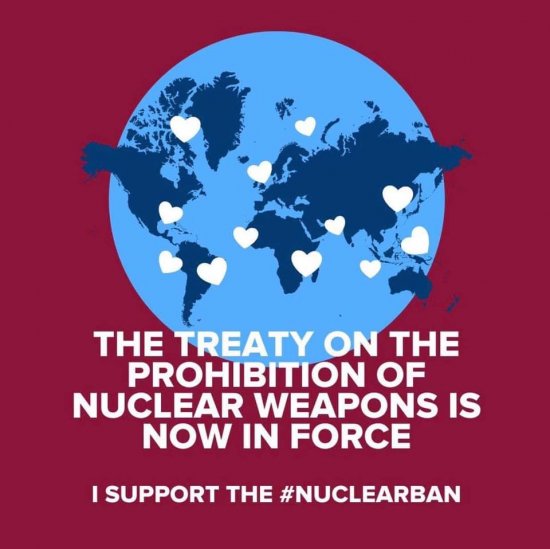
| The Nuclear Free Local Authorities have joined with campaign groups opposed to nuclear weapons in calling on the British Foreign Secretary to ensure that the UK is represented at the forthcoming nuclear treaty ban conference to be held later this month in Vienna. Sixty-one member states of the United Nations have so far signed and ratified the UN Treaty on the Prohibition of Nuclear Weapons, the first international law to prohibit the manufacture, stockpiling, transfer and use of nuclear weapons which entered force in January 2021. A further twenty-five states have signed the Treaty in readiness to ratify it. These member states will meet at the UN in Vienna between 21 – 23 June to discuss the progress so far in creating a nuclear weapons free world, and, in light of the recent conflict in Ukraine, the next best steps to get there. None of the world’s nuclear weapons states have so far engaged with the treaty, and the UK has steadfastly refused to recognise it, despite five of the states, including the UK, making a commitment as signatories to the Nuclear Non-Proliferation Treaty to work in ‘good faith’ to achieve global nuclear disarmament at the earliest possible date. Britain made this commitment as one of the first signatories to the NPT in 1968. NFLA 8th June 2022 https://www.nuclearpolicy.info/news/nuclear-free-local-authorities-join-call-for-uk-to-attend-nuclear-ban-summit/ |
The War Situation Has Developed Not Necessarily to Ukraine’s or the West’s Advantage But They Plan to Negotiate When They’ve Turned Things Around a Bit

naked capitalism, by Yves Smith,
ust because Russia has been slow and methodical about grinding up Ukraine’s army and materiel in Donbass does not mean that there’s reason to think Ukraine can turn its losses around with generous applications of Western funding, weapons, and hopium. And on the economic war front, even though Russia has taken a hit, it seems to be making surprisingly solid progress in adjusting, while conditions in the US and Europe look to be worsening, and at an accelerating rate.
Admittedly, the press, presumably reflecting the readings of military experts, has greatly reduced coverage of the conflict now that even generous applications of porcine maquillage can no longer hide that things are going from bad to worse for Ukraine. A very long established contact forwarded this message from a former senior US military official:
Just in from an Army Colonel in the building:
“Spoke to someone today who said that the Ukie basic training is 10 days and then off to the front. 65% casualty rates. At least double or more the losses of the Russians but you don’t hear anything about it.”
Recall that Scott Ritter, early on in his many detailed analysis, said that if one side was consistently inflicting casualties at a higher rate than the other, even at a ratio of say 1:1.2, the side with the lower losses would prevail.
Recall also that Ukraine has not made a single significant offensive since the war began. The most it has been able to achieve are small tactical gains that don’t amount to anything over time.
……………………………….. Truth be told, Western officials and the media are increasingly acknowledging that Ukraine can’t win this war, and therefore the two sides need to negotiate a peace. But to invoke a saying I heard in Venezuela, “They have changed their minds, but they have not changed their hearts.” The US and NATO have consumed so much Ukraine Kool-Aide that they are light-year away from what a realistic settlement would have to include. And that’s because they still can’t admit to themselves that Russia is wining, and at this rate, will have taken Odessa before Zelensky will even be willing to cede Donbass. For instance, look at this key statement from Joe Biden’s New York Times op-ed earlier this week:
We have moved quickly to send Ukraine a significant amount of weaponry and ammunition so it can fight on the battlefield and be in the strongest possible position at the negotiating table
Why should Ukraine keep fighting and losing more men and suffering more damage? Why not sue for peace now? Biden’s unstated assumption is that if the US pumps enough air into the leaking Ukraine balloon, it will be in a better position than it is now. That can come about only by taking territory back or by inflicting huge losses on the Russian side. In what universe is that a likely outcome?
There are also complicating factors on the Russian side. One is that the Russian population regards Putin as too dovish and would much rather have the Ukraine matter be as settled as it can be via this war. That argues for taking more territory, certainly the entire Black Sea coast, probably Kharkiv and perhaps even securing the Dneiper save perhaps hard by Kiev.
A second matter is that many of the “liberated” or expecting to be liberated territories seem to want to join Russia, and not be independent friendlies or part of a Novorossiya (this may be realism as well as romanticism; they are too small to go it alone). One reason for this expectation is that at least some members of the Donbass militias are continuing to fight for the Russian cause in neighboring oblasts, here Kherson.
Recall that Putin was not happy when the two breakaway republics declared independence in 2014, and he had to push them in the Minsk Accord negotiations to accept staying in Ukraine,……………………………………………..
the Guardian get credit for admitting that Russia is winning the economic war – and Putin is no closer to withdrawing troops. However, economic editor Larry Elliott’s contains a lot of hand wringing and falsehoods, like the claim that Putin “weaponized” food. But notice that his closing section calls only for “a deal” not a rollback of sanctions. And it’s the sanctions that are hurting the collective West:
If proof were needed that sanctions are not working, then President Joe Biden’s decision to supply Ukraine with advanced rocket systems provides it. The hope is that modern military technology from the US will achieve what energy bans and the seizure of Russian assets have so far failed to do: force Putin to withdraw his troops.
Complete defeat for Putin on the battlefield is one way the war could end, although as things stand that doesn’t appear all that likely. There are other possible outcomes. One is that the economic blockade eventually works, with ever-tougher sanctions forcing Russia to back down. Another is a negotiated settlement.
Putin is not going to surrender unconditionally, and the potential for severe collateral damage from the economic war is obvious: falling living standards in developed countries; famine, food riots and a debt crisis in the developing world.
The atrocities committed by Russian troops mean compromising with the Kremlin is currently hard to swallow, but economic reality suggests only one thing: sooner or later a deal will be struck.
Perhaps Elliott didn’t want to stick his neck out too far by saying ending at least some of the sanctions would be necessary. But the failure to call for that means that politicians with no skin in the game like Ursuala von der Leyen will continue trying to escalate. It doesn’t matter that it isn’t working. These officials have convinced themselves that eyepoking the evil Putin will bring down Russia. They need to heed the oracle’s warning to to Croesus: that if he attacked the Persians, he would destroy a great empire. That empire was his own. https://www.nakedcapitalism.com/2022/06/the-war-situation-has-developed-not-necessarily-to-ukraine-or-the-wests-advantage-but-they-plan-to-negotiate-when-theyve-turned-things-around-a-bit.html
Ukrainian victory not in the cards – former top US official
https://www.rt.com/russia/556701-ukraine-us-negotiations-zelensky/ The US and its allies should persuade Ukraine to negotiate with Russia, Hugh De Santis says . Ukraine won’t be able to win against Russia, and the US must persuade Kiev to negotiate with Moscow to end the conflict, Hugh De Santis, who oversaw NATO and arms control policy planning in the Reagan administration, has insisted.
Defeating the Russian forces on the battlefield and restoring Ukraine’s territorial integrity, including taking back Crimea, “would be condign punishment for Russia’s unprovoked invasion,” De Santis wrote in his opinion piece for The National Interest magazine on Saturday.
“But would it be worth the cost of more carnage in Ukraine, the possibility of a wider war in which chemical or tactical nuclear weapons might be used, further disruption of the world economy, and renewed European polarization?” he asked.
According to the former State Department official, the answer to that question is negative.
“A Ukrainian military victory is not in the cards, and a negotiated outcome is the only realistic goal,” he insisted.
Because of this, “the US and its allies must persuade Kiev to bring this war to an end, including by imposing limits on further military aid as leverage,” De Santis suggested.
Washington has been actively backing Kiev during the conflict, supplying it with weapons, funds and intelligence. In May, US President Joe Biden approved a $40 billion aid package for Ukraine.
President Volodymyr Zelensky and “his advocates in Eastern Europe and the Baltic states” should come to terms with the fact that Ukraine will become a neutral state and that it would have to hand over the Donbass and Crimea to Russia for the peace talks to be successful, he pointed out.
Current high-ranking US and EU officials have also recently identified negotiations as the preferred outcome of the conflict as Russian forces continue their steady advance in the Donbass.
Last week, the chairman of the US Joint Chiefs of Staff, General Mark Milley, said that “a negotiated outcome is a logical choice, but both sides have to come to that conclusion on their own.”
A few days before that, EU foreign policy chief Josep Borrell urged the bloc to increase deliveries of weapons to Ukraine and apply even more sanctions against Russia, but explained that it should be done to help Kiev strengthen its position in future peace talks with Moscow. Just over a month ago, Borrell was insisting that “this war must be won on the battlefield” by Ukraine.
Russia attacked its neighboring state in late February, following Kiev’s failure to implement the terms of the Minsk agreements, first signed in 2014, and Moscow’s eventual recognition of the Donbass republics of Donetsk and Lugansk. The German- and French-brokered protocols were designed to give the breakaway regions special status within the Ukrainian state.
The Kremlin has since demanded that Ukraine officially declare itself a neutral country that will never join the US-led NATO military bloc. Kiev insists the Russian offensive was completely unprovoked and has denied claims it was planning to retake the two republics by force.
EDITORIAL: Vienna meeting on the Treaty on the Prohibition of Nuclear Weapons -best chance for Japan to lead the way

Vienna meet best chance for Japan to make case for
nuclear abolition https://www.asahi.com/ajw/articles/14640066. June 8, 2022 Nuclear weapons must never be used. The international community must stand as one and make this plea. The urgency has never been greater than it is now.
As the only nation to have experienced atomic warfare, Japan’s mission is to lead the way.
The first meeting of the signatories to the Treaty on the Prohibition of Nuclear Weapons will be held in Vienna late this month against the backdrop of Russia’s war against Ukraine, which has escalated into a threat to use nuclear weapons.
The treaty categorically forbids all signatory nations to own, use or threaten to use nuclear weapons.
It went into force in January last year and has been ratified by more than 60 nations and regions.
The conference has been eagerly awaited as an opportunity to counter moves by the nuclear powers to expand their weapons arsenals and continue calls for a world without nuclear weapons.
All U.N. members are qualified to attend. Some have chosen to participate as observers, without having signed or ratified the nuclear ban treaty.
They include Germany and Norway, members of the North Atlantic Treaty Organization, as well as Sweden and Finland, which have announced they plan to join the military alliance.
Participating in discussions for the elimination of nuclear weapons does not conflict with remaining under the U.S. “nuclear umbrella.”
Observer nations intend to focus on long-term goals while dealing with the current Russian threat.
But the Japanese government has not changed its decision to sit out the conference, asserting there is no point in participating without engaging the nuclear powers in the process.
How will the international community regard the absence of Japan at this conference, given that it is the nation most familiar with the horrors that befell Hiroshima and Nagasaki?
We deplore the government’s stance.
Prime Minister Fumio Kishida, elected from Hiroshima, has stressed that background in projecting his political persona. He has appraised the nuclear ban treaty as “an important exit.”
We understand Kishida’s position of stressing the importance of Japan’s alliance with the United States.
But that stance must be all the more reason for him to seek Washington’s understanding and proudly attend the Vienna conference. That, we believe, is what “peace diplomacy” boils down to.
In the meantime, the government has appointed young anti-nuclear activists as “special youth envoys” and is sending them to the conference to convey the horrors of atomic bombing to the world.
Prime Minister Fumio Kishida, elected from Hiroshima, has stressed that background in projecting his political persona. He has appraised the nuclear ban treaty as “an important exit.”
We understand Kishida’s position of stressing the importance of Japan’s alliance with the United States.
But that stance must be all the more reason for him to seek Washington’s understanding and proudly attend the Vienna conference. That, we believe, is what “peace diplomacy” boils down to.
In the meantime, the government has appointed young anti-nuclear activists as “special youth envoys” and is sending them to the conference to convey the horrors of atomic bombing to the world.
We hope the delegation will remind the world firmly of the inhumanity of nuclear weapons.
During the Cold War, nuclear weapons were perceived as “the ultimate weapons that cannot be used.”
But since then, they have been reduced in size and become more readily available. Conspicuous moves have been made to lower the hurdle of their deployment. Fears of an accidental nuclear explosion have not evaporated.
How do we reconcile nuclear disarmament and arms control with initiatives for the abolition of nuclear weapons?
It will be a tough challenge, but we must keep striving to reach this goal.
–The Asahi Shimbun, June 8
UK Nuclear test veterans demand recognition at first meeting with Prime Minister
Boris Johnson was told about debilitating health issues suffered by servicemen and their descendants as a result of radiation exposure. Sophie Wingate 8 June 22
People affected by Britain’s atomic experiments have asked for formal recognition for nuclear test veterans in their first ever official meeting with a prime minister.
A group including a nuclear bomb test veteran, a widow and four descendants told Boris Johnson about their experiences of the tests and,,,,,,,,,,,, (Registered readers only_ https://www.independent.co.uk/news/uk/boris-johnson-people-joe-biden-christmas-island-rebecca-longbailey-b2096722.html
The unpalatable truth in Ukraine
“When you have eliminated the impossible, whatever remains, however improbable unpalatable, must be the truth.”
And when this final scenario comes to pass, who will have won the war in Ukraine?
Well, it won’t be Ukraine.
The Hill. BY ANDREW LATHAM, OPINION CONTRIBUTOR – 06/02/22 ”…………………………………… “When you have eliminated the impossible, whatever remains, however improbable, must be the truth.” – Sherlock Holmes – Sir Arthur Conan Doyle
And the truth is, once we have eliminated all the impossible scenarios, the least improbable outcome of the war in Ukraine is a Russian victory.
Note that I did not say such an outcome would be desirable. Russia’s inevitable victory is anything but. Nor did I say it would be total. The outcome of this war is going to fall far short of the Kremlin’s initial hopes and expectations. Nor, finally, did I say it would be without significant cost. Any conceivable Russian victory now will entail such a loss of blood and treasure that it will have to be judged Pyrrhic at best.
But it will be a victory nonetheless — and we in the West had better come to grips with that hard truth.
Let’s begin by eliminating the impossible.
The first unrealistic endgame is the reduction of Ukraine to a vassal state of the Russian empire. This would entail the kind of operation initially envisioned by the Kremlin: a quick decapitating military strike, the installation of a pro-Moscow regime in Kyiv and either the formal incorporation of Ukraine into the Russian Federation or its informal incorporation into a Russian sphere of influence (like Belarus).
While perhaps the initial objective of Russia’s “special military operation,” this outcome is now obviously an impossibility. ………………………………….
The second impossible scenario is the total defeat of the Russian military and the restoration of Ukraine to its pre-2014 borders. In this scenario, the Ukrainian military, having blunted the initial Russian offensive, launches a successful counter-offensive that ultimately drives the Russians not only out of the territories they captured in 2022 but out of the Donbas and Crimea as well. The resulting political dispensation would be an independent Ukraine restored to its internationally recognized borders and free to join NATO and/or associate with the European Union (EU) as it saw fit.
While advocated by many within and beyond Ukraine, this outcome is simply impossible. …………………………..
Indeed, there is no reason to believe that they will even be displaced from much of the territory they have seized along the coast of the Sea of Azov……………… despite the willful delusions of some and the idealistic hopes others, this outcome is simply impossible.
The third and final impossible scenario is a limited Ukrainian victory that would reverse all or most of the Russian gains since Feb. 24, 2022. In this scenario, while the Donbas and Crimea remain in Russian hands, all the territory captured by Russia since its recent re-invasion would be liberated by Ukrainian forces and restored to Ukrainian control.
While once viewed as a realistic outcome, by now it should be obvious that this is impossible. Just as Ukraine lacks the ability to liberate all its pre-2014 territory, it also lacks the ability to liberate the recently conquered territory in the Donbas or along the Azov coast. Unlike in the north of Ukraine, these territories are central to Russian interests in Ukraine and, as such, Russia simply will not withdraw from them as it withdrew from Kyiv earlier in the war. Nor will Ukrainian forces – themselves, it should be noted, suffering terrible attrition all along the battle front and growing weaker with each passing day – be strong enough to compel them to do so. No, like the previous two scenarios, this one is simply an impossibility.
And that leaves only one other conceivable outcome: a fragmented and partly dismembered Ukraine, neither fully part of the West nor entirely within the Russian sphere of influence. A Ukraine fragmented in that the whole of the Donbas and perhaps other territories will be left beyond Kyiv’s control; partly dismembered in that Crimea will remain part of Russia (at least in Russian eyes); and not fully part of the West in that it will not be free to join NATO or even to have a meaningful partnership with the EU. Simply put, this outcome is not only not impossible, it’s not even improbable.
And when this final scenario comes to pass, who will have won the war in Ukraine?
Well, it won’t be Ukraine. While such an outcome will satisfy the basic existential goals of Kyiv, it will be a far cry from the more maximalist ambitions expressed both before and after Feb. 24. No, when this scenario inevitably comes to pass, it will clearly be a defeat for Kyiv.
Similarly, such an outcome will not satisfy the maximalist ambitions of those in Moscow who thought that their initial thunder run would resolve the Ukraine issue once and for all. But it will satisfy the Kremlin’s most basic and fundamental geopolitical desideratum: a neutralized Ukraine beyond both the geopolitical ambit of NATO and the geoeconomic orbit of the EU. It will also “restore” Crimea to its rightful place in Russia. And finally, it will demonstrate that interfering in Russia’s natural sphere of influence is unwise. In these ways, when the impossible has been eliminated, the resulting outcome will clearly be a victory for Moscow.
………………..when it comes to thinking about the possible outcomes of the war in Ukraine, perhaps it ought to read something more like: “When you have eliminated the impossible, whatever remains, however improbable unpalatable, must be the truth.”
Andrew Latham is a professor of international relations at Macalester College in Saint Paul, Minn., and a non-resident fellow at Defense Priorities in Washington, D.C. Follow him on Twitter @aalatham. https://thehill.com/opinion/international/3509458-the-unpalatable-truth-in-ukraine/
ELON MUSK IS NOT A RENEGADE OUTSIDER – HE’S A MASSIVE PENTAGON CONTRACTOR

while the 50-year-old businessman presents himself as a maverick science genius – an act that has garnered him legions of fans around the world – a closer inspection of his career shows he earned his fortune in a much more orthodox manner. First by being born rich, then by striking it big as a dot-com billionaire, and finally, like so many others, by feeding from the enormous government trough.
Perhaps more seriously though, SpaceX’s close proximity to both the military and the national security state marks it out as a key cog in the machine of U.S. empire, allowing Washington to spy, bomb or coup whoever it wants.
ALAN MACLEOD, Mint Press News, MAY 31ST, 2022 ”………………………………………….. Musk has deliberately cultivated this image of himself: a real life Tony Stark figure who thinks for himself and is not part of the established order. But behind this carefully constructed façade, Musk is intimately connected to the U.S. national security state, serving as one of its most important business partners. Elon, in short, is no threat to the powerful, entrenched elite: he is one of them.
TO UKRAINE, WITH LOVE
Musk, whose estimated $230 billion fortune is more than twice the gross domestic product of Ukraine, has garnered a great deal of positive publicity for donating thousands of Starlink terminals to the country, helping its people come back online after fighting downed the internet in much of the country. Starlink is an internet service allowing those with terminals to connect to one of over 2,400 small satellites in low Earth orbit. Many of these satellites were launched by Musk’s SpaceX technologies company.
However, it soon transpired that there is far more than meets the eye with Musk’s extraordinary “donation.” In fact, the U.S. government quietly paid SpaceX top dollar to send their inventory to the warzone. USAID – a government anti-insurgency agency that has regularly functioned as a regime-change organization – is known to have put up the cash to purchase and deliver at least 1,330 of the terminals.
Starlink is not a mass-market solution. Each terminal – which is, in effect, a tiny, portable satellite dish – has a markedly limited range, and is useful only in hyper-local situations. Mykhailo Fedorov, Ukraine’s Minister of Digital Transformation, estimated that the 10,000 Starlink terminals were allowing around 150,000 people to stay online.
Such a small number of people using the devices raises eyebrows. Who is important enough to be given such a device? Surely only high-value individuals such as spies or military operatives. That the Starlinks are serving a military purpose is now beyond clear. Indeed, in a matter of weeks, Starlink has become a cornerstone of the Ukrainian military, allowing it to continue to target Russian forces via drones and other high-tech machinery dependent on an internet connection. One official told The Times of London that he “must” use Starlink to target enemy forces via thermal imaging.
Starlink is what changed the war in Ukraine’s favor. Russia went out of its way to blow up all our comms. Now they can’t. Starlink works under Katyusha fire, under artillery fire. It even works in Mariupol,” one Ukrainian soldier told journalist David Patrikarakos.
The reference to Mariupol alludes to the infamous Nazi group, the Azov Battalion, who have also reportedly been using Musk’s technology. Even in a subterranean cavern beneath Mariupol’s steelworks, Azov fighters were able to access the internet and communicate with the outside world, even doing video interviews from underground. In 2015, Congress attempted to add a provision to U.S. military aid to Ukraine stipulating that no support could go to Azov owing to their political ideology. That amendment was later removed at the behest of the Pentagon.
Dave Tremper, Director of Electronic Warfare at the Pentagon, sang SpaceX’s praises. “How they did that [keeping Ukrainian forces online] was eye-watering to me,” he said, adding that in the future the U.S. military “needs to be able to have that agility.”
ROCKETMAN
Such a statement is bound to get the attention of SpaceX chiefs, who have long profited from their lucrative relationship with the U.S. military. SpaceX relies largely on government contracts, there being almost no civilian demand for many of its products, especially its rocket launches.
Musk’s company has been awarded billions of dollars in contracts to launch spy satellites for espionage, drone warfare and other military uses. For example, in 2018, SpaceX was chosen to blast a $500 million Lockheed Martin GPS system into orbit. While Air Force spokesmen played up the civilian benefits of the launch, such as increased accuracy for GPS devices, it is clear that these devices play a key role in global surveillance and ongoing drone wars. SpaceX has also won contracts with the Air Force to deliver its command satellite into orbit, with the Space Development Agency to send tracking devices into space, and with the National Reconnaissance Office (NRO) to launch its spy satellites. These satellites are used by all of the “big five” surveillance agencies, including the CIA and the NSA.
Thus, in today’s world, where so much intelligence gathering and target acquisition is done via satellite technology, SpaceX has become every bit as important to the U.S. war machine as more well-known companies like Lockheed Martin and Boeing. Without Musk’s company, the U.S. would not be able to carry out such an invasive program of spying and drone warfare around the world. Indeed, China is growing increasingly wary of this power, and is being advised to develop anti-satellite technologies to counter SpaceX’s all-seeing eye. Yet Musk himself continues to benefit from a general perception that he is not part of the system.
From its origins in 2002, SpaceX has always been extremely close to the national security state, particularly the CIA. Perhaps the most crucial link is Mike Griffin, who, at the time, was the president and COO of In-Q-Tel, a CIA-funded venture capital firm that seeks to nurture and sponsor new companies that will work with the CIA and other security services, equipping them with cutting edge technology. The “Q” in its name is a reference to “Q” from the James Bond series – a creative inventor who supplies the spy with the latest in futuristic tech………………………..
While at NASA, Griffin brought Musk in for meetings and secured SpaceX’s big break. In 2006, NASA awarded the company a $396 million rocket development contract – a remarkable “gamble” in Griffin’s words, especially as it had never launched a rocket before. As National Geographic put it, SpaceX, “never would have gotten to where it is today without NASA.” And Griffin was essential to this development. Still, by 2008, SpaceX was again in dire straits, with Musk unable to make payroll. The company was saved by an unexpected $1.6 billion NASA contract for commercial cargo services. Thus, from its earliest days, SpaceX was nurtured by government agencies that saw the company as a potentially important source of technology.
NUKING MARS & BACKING COUPS
Like Henry Ford, Musk went into the automobile business, purchasing Tesla Motors in 2004. And also like Henry Ford, he has shared some rather controversial opinions. In 2019, for instance, he suggested that vaporizing Mars’ ice caps via a series of nuclear explosions could warm the planet sufficiently to support human life. If this was done, it would arguably not even be his worst crime against space. During a 2018 publicity stunt, he blasted a Tesla into outer space using a SpaceX rocket. However, he did not sterilize the vehicle before doing so, meaning it was covered in earthly bacteria – microorganisms that will likely be fatal to any alien life they encounter. In essence, the car is a biological weapon that could end life on any planet it encounters.
NUKING MARS & BACKING COUPS
Like Henry Ford, Musk went into the automobile business, purchasing Tesla Motors in 2004. And also like Henry Ford, he has shared some rather controversial opinions. In 2019, for instance, he suggested that vaporizing Mars’ ice caps via a series of nuclear explosions could warm the planet sufficiently to support human life. If this was done, it would arguably not even be his worst crime against space. During a 2018 publicity stunt, he blasted a Tesla into outer space using a SpaceX rocket. However, he did not sterilize the vehicle before doing so, meaning it was covered in earthly bacteria – microorganisms that will likely be fatal to any alien life they encounter. In essence, the car is a biological weapon that could end life on any planet it encounters.
Musk also attracted attention when he appeared to admit that he worked with the U.S. government to overthrow Bolivian President Evo Morales in 2019………………….. The new government quickly invited Musk for talks. When asked on Twitter point blank whether he was involved in Morales’ ouster, Musk responded, “We will coup whoever we want! Deal with it.”………………………..
WORLD’S RICHEST MAN, FUNDED BY TAXPAYERS
In addition to the billions in government contracts Musk’s companies have secured, they also have received similar numbers in public subsidies and incentives. Chief among these is Tesla, which benefits greatly from complex international rules around electric vehicle production. In a push to reduce carbon emissions, governments around the world have introduced a system of credits for green vehicles, whereby a certain percentage of each manufacturer’s output must be zero-emission vehicles. Tesla only produces electric cars, so easily meets the mark.
However, the system also allows Tesla to sell their excess credits to manufacturers who cannot meet these quotas. In a competitive market where each manufacturer needs to hit certain targets, these credits are worth their weight in gold, and net Tesla billions in profit every year. For example, between 2019 and 2021 alone, Stellantis, which owns the Chrysler, Fiat, Citroen and Peugeot brands, forked out nearly $2.5 billion to acquire Tesla U.S. and European green credits.
This bizarre and self-defeating system goes some way to explaining why Tesla is worth more by market cap than Toyota, Volkswagen, Mercedes-Benz, BMW, GM, Ford, Honda, Hyundai, Kia, and Volvo put together, despite not being even a top-15 car manufacturer in terms of units sold.
Musk’s company also received significant government backing in its early stages, receiving a $465 million low-interest loan from the Department of Energy in 2010, at a time when Tesla was on the rocks and its future was in doubt.
Like many giant companies, Tesla is able to play states off against each other, each job-hungry location bidding against the others to give the corporation as much free cash and tax incentives as possible. In 2020, for example, Austin gave Tesla more than $60 million in tax breaks to build a truck plant there.
This, however, was small fry in comparison to some of the deals Musk has signed. The State of New York handed Musk over $750 million, including $350 million in cash, in exchange for building a solar plant outside of Buffalo – a plant that Musk was bound to build somewhere in the United States. Meanwhile, Nevada signed an agreement with Tesla to build its Gigafactory near Reno. The included incentives mean that the car manufacturer could rake in nearly $1.3 billion in tax relief and tax credits. Between 2015 and 2018, Musk himself paid less than $70,000 in federal income taxes.
Therefore, while the 50-year-old businessman presents himself as a maverick science genius – an act that has garnered him legions of fans around the world – a closer inspection of his career shows he earned his fortune in a much more orthodox manner. First by being born rich, then by striking it big as a dot-com billionaire, and finally, like so many others, by feeding from the enormous government trough.
Perhaps more seriously though, SpaceX’s close proximity to both the military and the national security state marks it out as a key cog in the machine of U.S. empire, allowing Washington to spy, bomb or coup whoever it wants.
It is for this reason that so much of the hysteria, both positive and negative, over Musk’s ongoing purchase of Twitter is misplaced. Elon Musk is neither going to save nor destroy Twitter because he is not a crusading rebel challenging the establishment: he is an integral part of it. https://www.mintpressnews.com/elon-musk-not-renegade-outsider-cia-pentagon-contractor/280972/
The need for a negotiated settlement to end the Ukraine war – Western allies discuss this

senior Western officials — including US President Joe Biden — are emphasizing anew that even with advanced western weaponry, Ukraine’s prospects for peace will ultimately rest on diplomacy.
Western allies meeting regularly to game out potential framework for Ukraine ceasefire as war hits 100th day. By Natasha Bertrand, Katie Bo Lillis, Barbara Starr and Jeremy Herb, CNN, June 3, 2022,Washington (CNN)Staring down the prospect of an extended stalemate in Ukraine, the US and its allies are placing a renewed emphasis on the need for a negotiated settlement to end the war as the conflict grinds into its 100th day with no clear victory in sight for either side.
US officials have in recent weeks been meeting regularly with their British and European counterparts to discuss potential frameworks for a ceasefire and for ending the war through a negotiated settlement, multiple sources familiar with the talks told CNN. Among the topics has been a four-point framework proposed by Italy late last month. That framework involves Ukraine committing to neutrality with regard to NATO in exchange for some security guarantees, and negotiations between Ukraine and Russia on the future of Crimea and the Donbas region.
Ukraine is not directly involved in those discussions, despite the US commitment to “nothing about Ukraine without Ukraine.” US and Ukrainian officials said the US has not been pressuring Ukraine to commit to a certain plan or directly pushing them to sit down with the Russians.
Still, there is some confusion about what kind of framework the US would consider appropriate to bring to the Ukrainians for further discussion.
US Ambassador to the UN Linda Thomas Greenfield told reporters earlier this week that the Italian framework is “one of those initiatives that we certainly would love to see bring a conclusion to this horrific war and the horrific attacks on the Ukrainian people.” But two US officials told CNN that the US actually does not support the Italian proposal.
In any case, US and western officials tell CNN that there is a growing concern that if the Russians and Ukrainians don’t get back to the table and work out a deal, the war will drag on — potentially for years.
Subtle language shift
It’s not clear whether these discussions will translate into eventual settlement talks. The Biden administration still sees no real prospect for any diplomatic breakthroughs or ceasefires anytime soon and two NATO officials said that the western alliance sees little appetite to negotiate on the Ukrainian side — in part because Russia’s brutal bombing campaign and myriad human rights violations have destroyed public support for any concession to Russia.
Moscow has also showed little interest in serious talks, officials say. Right now, Ukraine remains focused on ensuring a decisive military victory in the east and the south in order to put themselves in a superior negotiating position, these sources said.
“We can propose all the plans we want, but unlikely Kyiv will go for anything that cedes territory at the moment,” according to one official.
The concern that the conflict could grind on indefinitely — with mounting costs — has been reflected in the subtle shift in language and messaging by US officials over the past several weeks.
In April, the US’ stated goal was for Russia to “fail,” a National Security Council spokesperson said at the time, and for the Russian military to be significantly “weakened” in the long term, as Defense Secretary Lloyd Austin proclaimed — comments that reflected optimism that Ukraine might be able to defeat Russia decisively on the battlefield after successfully defending Kyiv.
But as an effective stalemate has taken hold on the battlefield, with Russia making incremental gains in the east and Ukraine saying it is increasingly outgunned and outmanned, senior Western officials — including US President Joe Biden — are emphasizing anew that even with advanced western weaponry, Ukraine’s prospects for peace will ultimately rest on diplomacy.
“As President Volodymyr Zelensky of Ukraine has said, ultimately this war ‘will only definitively end through diplomacy,'” Biden wrote in a New York Times op-ed on Tuesday. “Every negotiation reflects the facts on the ground. We have moved quickly to send Ukraine a significant amount of weaponry and ammunition so it can fight on the battlefield and be in the strongest possible position at the negotiating table.”
The hope, officials said, is that the US can support Ukraine long enough to see it through to a peaceful settlement rather than a full capitulation……………………..
As the US looks to maintain its military and financial support for Ukraine and isolate Russia for as long as it takes to get to a peace agreement, a key strategy will be keeping the NATO alliance unified. But already, sources say, there are cracks appearing in NATO — Turkey is refusing to allow Sweden and Finland to move forward with joining the bloc, and diplomats had to carve out an exception for Hungary as part of Europe’s recent oil embargo against Russia.
There’s also the challenge of maintaining domestic support for funding Ukraine’s war. There’s been growing opposition among Donald Trump-aligned Republicans with each assistance vote that Congress has taken, one Democratic lawmaker noted. He added that there are concerns over how willing Congress will be in the future to fund a protracted conflict……………..https://edition.cnn.com/2022/06/03/politics/ukraine-100-days-western-allies-regular-meetings-potential-ceasefire/index.html
Arms sent to Ukraine will end up in criminal hands, says Interpol chief
Jürgen Stock urges members to cooperate on arms tracing as weapons will flood hidden economy when war ends,
Guardian, Kim Willsher, Thu 2 Jun 2022
Weapons sent to Ukraine after Russia’s invasion in February will end up in the global hidden economy and in the hands of criminals, the head of Interpol has said.
Jürgen Stock says once the conflict ends, a wave of guns and heavy arms will flood the international market and he urged Interpol’s member states, especially those supplying weapons, to cooperate on arms tracing.
“Once the guns fall silent [in Ukraine], the illegal weapons will come. We know this from many other theatres of conflict. The criminals are even now, as we speak, focusing on them,” Stock said.
“Criminal groups try to exploit these chaotic situations and the availability of weapons, even those used by the military and including heavy weapons. These will be available on the criminal market and will create a challenge. No country or region can deal with it in isolation because these groups operate at a global level.”
He added: “We can expect an influx of weapons in Europe and beyond. We should be alarmed and we have to expect these weapons to be trafficked not only to neighbouring countries but to other continents.”
He said Interpol urged members to use its database to help “track and trace” the weapons. “We are in contact with member countries to encourage them to use these tools. Criminals are interested in all kinds of weapons … basically any weapons that can be carried might be used for criminal purposes.”
Ukraine’s western allies have sent shipments of high-end military weapons to Ukraine since the Russian invasion more than three months ago. On Tuesday, the American president, Joe Biden, announced the US would supply Kyiv with advanced missile systems and munitions. After the US pulled out of Afghanistan in 2021, following 20 years of war, huge amounts of often highly sophisticated military equipment was left behind and fell into the hands of the Taliban.
Stock, the secretary general of the international policing organisation who was speaking to the Anglo-American Press Association in Paris, said the conflict in Ukraine had also led to a rise in large-scale fertiliser theft and an increase in counterfeit agrochemicals. There was also a huge rise in fuel theft. “These products have become more valuable,” he said……………………………………. https://www.theguardian.com/world/2022/jun/02/ukraine-weapons-end-up-criminal-hands-says-interpol-chief-jurgen-stock
Joe Biden’s huge move against Russia: ‘This is how nuclear war begins’

Yahoo News Australia and agencies, Thu, 2 June 2022
The US overnight has unveiled a new US$700 million package ($975 million) of sophisticated weapons for Ukraine in an urgent effort to prevent Russia from seizing the final swaths of land in the Donbas region.
But the most advanced rocket systems will take at least three weeks to reach the battlefront, raising questions of whether they will arrive in time to stop Russia’s slow but steady gains as the war inches closer to global catastrophe.
The Biden administration’s decision to send four medium-range rocket systems came after weeks of debate over whether the precision-guided weapons would provoke a strong military reaction from Russian President Vladimir Putin. It suggests the US believes it has zeroed in on what weapons deliveries are worth the risk…….
“The Ukrainians have given us assurances that they will not use these systems against targets on Russian territory,” Secretary of State Antony Blinken said Wednesday (local time).
“There is a strong trust bond between Ukraine and the United States.”
Nuclear war beings ‘one step at a time’
But not everyone has such faith in the latest decision by the US.
“The Ukrainians have given us assurances that they will not use these systems against targets on Russian territory,” Secretary of State Antony Blinken said Wednesday (local time).
“There is a strong trust bond between Ukraine and the United States.”
“This is a textbook example of how a nuclear war begins. One step at a time,” tweeted popular author Jim Rickards on Wednesday.
The Kremlin is also making threatening noises about the move. Kremlin spokesman Dmitry Peskov told reporters Wednesday the US is “deliberately and diligently pouring fuel on the fire.” He added that Russia doesn’t trust
Kyiv’s assurances that the multiple rocket launch systems supplied by the US will not be used to attack.
“In order to trust (someone), you need to have experience with situations when such promises were kept. Regretfully, there is no such experience whatsoever,” Peskov said.,……………….
The Pentagon would not say how many rockets it will provide to Ukraine, only that it is sending four of the truck-mounted HIMARS systems. The trucks each carry a container with six precision-guided rockets, which can travel about 70 kilometres……………… https://au.news.yahoo.com/joe-bidens-huge-move-against-russia-nuclear-war-223931012.html
Russia is winning the economic war – and Putin is no closer to withdrawing troops
Putin has rightly been condemned for “weaponising” food, but his willingness to do so should come as no surprise. From the start, the Russian president has been playing a long game, waiting for the international coalition against him to fragment. The Kremlin thinks Russia’s threshold for economic pain is higher than the west’s, and it is probably right about that
Guardian, Larry Elliott, 3 June 22,
The perverse effects of sanctions means rising fuel and food costs for the rest of the world – and fears are growing of a humanitarian catastrophe. Sooner or later, a deal must be made.
It is now three months since the west launched its economic war against Russia, and it is not going according to plan. On the contrary, things are going very badly indeed.
Sanctions were imposed on Vladimir Putin not because they were considered the best option, but because they were better than the other two available courses of action: doing nothing or getting involved militarily.
The first set of economic measures were introduced immediately after the invasion, when it was assumed Ukraine would capitulate within days. That didn’t happen, with the result that sanctions – while still incomplete – have gradually been intensified.
There is, though, no immediate sign of Russia pulling out of Ukraine and that’s hardly surprising, because the sanctions have had the perverse effect of driving up the cost of Russia’s oil and gas exports, massively boosting its trade balance and financing its war effort. In the first four months of 2022, Putin could boast a current account surplus of $96bn (£76bn) – more than treble the figure for the same period of 2021.
When the EU announced its partial ban on Russian oil exports earlier this week, the cost of crude oil on the global markets rose, providing the Kremlin with another financial windfall. Russia is finding no difficulty finding alternative markets for its energy, with exports of oil and gas to China in April up more than 50% year on year.
That’s not to say the sanctions are pain-free for Russia. The International Monetary Fund estimates the economy will shrink by 8.5% this year as imports from the west collapse. Russia has stockpiles of goods essential to keep its economy going, but over time they will be used up.
But Europe is only gradually weaning itself off its dependency on Russian energy, and so an immediate financial crisis for Putin has been averted. The rouble – courtesy of capital controls and a healthy trade surplus – is strong. The Kremlin has time to find alternative sources of spare parts and components from countries willing to circumvent western sanctions…………………
As a result of the war, western economies face a period of slow or negative growth and rising inflation – a return to the stagflation of the 1970s. Central banks – including the Bank of England – feel they have to respond to near double-digit inflation by raising interest rates. Unemployment is set to rise. Other European countries face the same problems, if not more so, since most of them are more dependent on Russian gas than is the UK.
The problems facing the world’s poorer countries are of a different order of magnitude. For some of them the issue is not stagflation, but starvation, as a result of wheat supplies from Ukraine’s Black Sea ports being blocked.
As David Beasley, the executive director of the World Food Programme put it: “Right now, Ukraine’s grain silos are full. At the same time, 44 million people around the world are marching towards starvation.”
………………….. Putin has rightly been condemned for “weaponising” food, but his willingness to do so should come as no surprise. From the start, the Russian president has been playing a long game, waiting for the international coalition against him to fragment. The Kremlin thinks Russia’s threshold for economic pain is higher than the west’s, and it is probably right about that……
The atrocities committed by Russian troops mean compromising with the Kremlin is currently hard to swallow, but economic reality suggests only one thing: sooner or later a deal will be struck.
- Larry Elliott is the Guardian’s economics editor https://www.theguardian.com/commentisfree/2022/jun/02/russia-economic-war-ukraine-food-fuel-price-vladimir-putin
Israel warns it could act against Iranian nuclear programme
Prime minister tells atomic energy agency chief that Tehran misleading world with ‘false information’
Irish Times, By Mark WeissFri Jun 3 202
Israel has warned that it reserves the right to act to prevent Iran obtaining a nuclear bomb if the international community fails to do so. …………
The talks took place ahead of Monday’s scheduled IAEA board of governors’ meeting, at which the US and the E3 — Britain, France and Germany — plan to push for the nuclear watchdog to rebuke Iran following a report by Mr Grossi that Iran has enough enriched uranium for a nuclear weapon and has not provided credible explanations for the IAEA’s findings of violations.
Iran has always insisted that its nuclear programme is peaceful and condemned the UN watchdog’s report as “not fair and balanced”, saying it “does not reflect the reality of the negotiations between Iran and the IAEA”.
“We will respond firmly and appropriately to any unconstructive action at the board of governors,” Iranian foreign ministry spokesman Saeed Khatibzadeh warned in a statement.

Iranian foreign minister Hossein Amirabdollahian said the IAEA head’s visit to Israel was in conflict with the agency’s impartiality, Iranian media reported.,,………
talks to revive the Joint Comprehensive Plan of Action were derailed after Russia invaded Ukraine and the decision by US president Joe Biden not to remove the Islamic Revolutionary Guard Corps from the state department’s list of foreign terrorist organisations.
Amid the ongoing uncertainty of reviving the Iran nuclear deal, Israel’s military has stepped up preparations to strike against Tehran’s nuclear facilities and on Friday concluded a wide-scale exercise, dubbed Chariots of Fire, simulating attacks against underground nuclear facilities and reacting to expected retaliation from Tehran and Iranian proxies in the region. https://www.irishtimes.com/world/middle-east/2022/06/03/israel-warns-it-could-act-against-iranian-nuclear-programme/
Iran: No one can remain silent on Zionist regime’s clandestine nuclear program
program, https://en.irna.ir/news/84777256/Iran-No-one-can-remain-silent-on-Zionist-regime-s-clandestine
“As one of the original signatories to NPT, Iran calls on all to beware of further erosion of the IAEA’s credibility,” Khatibzadeh tweeted.
He pointed out that as one of the original signatories to NPT, Iran calls on all to beware of further erosion of the IAEA’s credibility.
“No one can keep mum on Israel’s clandestine nuclear weapons program and then claim impartiality and talk about Iran’s peaceful nuclear activities,” Khatibzadeh added.
IAEA Director General Rafael Grossi arrived in occupied Palestinian lands on Thursday night for meeting with the Zionist officials.
Grossi’s visit of Israel comes after the destructive moves made by the Zionists to influence the western countries, and especially America to convince them not to revive the JCPOA.
1 This Month





PLEASE OPPOSE HR 8255 AND S.3639 – bills would accelerate satellite deployment, with no environmental review or safeguards – https://ncstd5li.quorum.us/campaign/169331/
To see nuclear-related stories in greater depth and intensity – go to https://nuclearinformation.wordpress.com
-
Archives
- October 2026 (29)
- September 2026 (339)
- August 2026 (330)
- July 2026 (355)
- June 2026 (287)
- May 2026 (306)
- April 2026 (356)
- March 2026 (251)
- February 2026 (267)
- January 2026 (308)
- December 2025 (358)
- November 2025 (359)
-
Categories
- 1
- 1 NUCLEAR ISSUES
- business and costs
- climate change
- culture and arts
- ENERGY
- environment
- health
- history
- indigenous issues
- Legal
- marketing of nuclear
- media
- opposition to nuclear
- PERSONAL STORIES
- politics
- politics international
- Religion and ethics
- safety
- secrets,lies and civil liberties
- spinbuster
- technology
- Uranium
- wastes
- weapons and war
- Women
- 2 WORLD
- ACTION
- AFRICA
- Atrocities
- AUSTRALIA
- Christina's notes
- Christina's themes
- culture and arts
- Events
- Fuk 2022
- Fuk 2023
- Fukushima 2017
- Fukushima 2018
- fukushima 2019
- Fukushima 2020
- Fukushima 2021
- general
- global warming
- Humour (God we need it)
- Nuclear
- RARE EARTHS
- Reference
- resources – print
- Resources -audiovicual
- Weekly Newsletter
- World
- World Nuclear
- YouTube
-
RSS
Entries RSS
Comments RSS

