Is nuclear disarmament possible?
Aljazeera, 2 August 22, “We are pushing closer and closer to that point where [nuclear weapons are] eventually going to be used, and we have to drastically change,” says Beatrice Fihn, the executive director of the International Campaign to Abolish Nuclear Weapons, ICAN.
“It is the nuclear-armed states, and it’s the nuclear-allied states in NATO, for example, that really have to lead this charge,” she says of the push for disarmament.
ICAN was awarded a Nobel Peace Prize for spearheading the 2017 Treaty on the Prohibition of Nuclear Weapons. Fihn says it is imperative for all countries to eliminate nuclear weapons, adding that the treaty is a “way of creating a revolution in this nuclear structure that we created”.
“The powerful have always lost their power when the majority has risen up and stood against it.” On UpFront, Marc Lamont Hill sits down with ICAN Executive Director Beatrice Fihn to discuss nuclear threats and the fight for global nuclear disarmament.
World one misstep from ‘nuclear annihilation’: UN chief
https://www.aljazeera.com/news/2022/8/1/un-chief-warns-world-is-one-step-from-nuclear-annihilation 2 Aug 22, Antonio Guterres sounds a global alarm at the opening of the meeting to review a landmark nuclear weapons treaty.
Nuclear threats emanating from the war in Ukraine as well as in Asia and the Middle East have put the world “one miscalculation away from nuclear annihilation”, the United Nations secretary-general said.
At the UN on Monday, Antonio Guterres issued the dire warning at the opening of a long-delayed meeting to review the landmark 50-year-old Non-Proliferation Treaty (NPT) aimed at preventing the spread of nuclear weapons and eventually achieving a nuclear-free world.
Guterres told many ministers, officials and diplomats gathered in the General Assembly Hall that the month-long review conference is taking place “at a time of nuclear danger not seen since the height of the Cold War”.
The meeting is “an opportunity to hammer out the measures that will help avoid certain disaster, and to put humanity on a new path towards a world free of nuclear weapons”, he said.
However, Guterres warned that “geopolitical weapons are reaching new highs” as almost 13,000 nuclear arms are in arsenals around the world and countries are seeking “false security” by spending hundreds of billions of dollars on “doomsday weapons”.
“We have been extraordinarily lucky so far. But luck is not a strategy. Nor is it a shield from geopolitical tensions boiling over into nuclear conflict,” the UN chief said………………………………………………
International Atomic Energy Agency (IAEA) Director-General Rafael Grossi said the Ukraine conflict is “so grave that the spectre of a potential nuclear confrontation, or accident, has raised its terrifying head again”.
Grossi warned that at the Zaporizhzhia nuclear plant, “the situation is becoming more perilous by the day”, and he urged all countries to help make possible his visit to the facility with a team of IAEA safety and security experts, saying his efforts for the past two months have been unsuccessful.
In force since 1970, the Non-Proliferation Treaty has the widest adherence of any arms control agreement with some 191 countries that are members.
Under its provisions, the five original nuclear powers – the United States, China, Russia (then the Soviet Union), Britain and France – agreed to negotiate towards eliminating their arsenals someday and nations without nuclear weapons promised not to acquire them in exchange for a guarantee to be able to develop nuclear energy for peaceful purposes.
India and Pakistan, which did not join the NPT, went on to develop nuclear weapons. So did North Korea, which ratified the pact but later announced it was withdrawing. Non-signatory Israel is believed to have a nuclear arsenal, but neither confirms nor denies it.
Beatrice Fihn, from the International Campaign to Abolish Nuclear Weapons, said the failure to fulfil legal commitments by nuclear powers and to work seriously on disarmament is concerning.
“If they don’t, countries like Iran might be very tempted in the future to develop nuclear weapons,” Fihn told Al Jazeera.
The UN meeting, which ends August 26, aims to generate a consensus on next steps, but expectations are low for substantial – if any – agreement. There were 133 speakers as of Monday plus dozens of side events.
The NPT’s five-year review was supposed to take place in 2020 when the world already faced plenty of crises, but was delayed because of the COVID-19 pandemic.
Israel, secretly having nuclear weapons, will not join the Nuclear Non Proliferation Treaty
Israel signals no change on nuclear policy as U.S. reaffirms anti-proliferation drive
By Dan Williams , JERUSALEM, Aug 1 (Reuters) – Israel signalled it would not change policy around its assumed nuclear arsenal on Monday as Washington affirmed a global treaty designed to roll back the spread of such weaponry.
The rare, if veiled, remarks by Prime Minister Yair Lapid came as countries party to the 1970 nuclear Non-Proliferation Treaty (NPT) met in New York for a periodic review conference.
Israel has not signed the voluntary NPT, which offers access to atomic energy in exchange for the forswearing of nuclear weaponry.
It has been leading regional calls for world powers to crack down on NPT-signatory Iran’s suspected use of civilian nuclear technologies as cover for military designs. Tehran denies wrongdoing.
Addressing the Israel Atomic Energy Commission, Lapid spoke of the country’s “defensive and offensive capabilities, and what is referred to in the foreign media as ‘other capabilities'”.
“These other capabilities keep us alive and will keep us alive as long as we and our children are here,” he said, according to a transcript from his office.
Under a decades-old ambiguity policy designed to deter surrounding enemies while avoiding provocations that can spur arms races, Israel neither confirms nor denies having nuclear weaponry.
Scholars believe it does, having acquired the first bomb in late 1966. Israeli journalists, circumscribed by military censorship, often refer cryptically to such capabilities or cite foreign media reporting on them………………
more https://www.reuters.com/world/middle-east/israel-signals-no-change-nuclear-policy-us-reaffirms-anti-proliferation-drive-2022-08-01/
No one can win a nuclear war: Putin
https://www.canberratimes.com.au/story/7843236/no-one-can-win-a-nuclear-war-putin/ 2 Aug 22, Russian President Vladimir Putin says there can be no winners in a nuclear war and no such war should ever be started.
The Kremlin leader made the comment in a letter to participants of a conference on the nuclear non-proliferation treaty (NPT), more than five months into his war on Ukraine.
“We proceed from the fact that there can be no winners in a nuclear war and it should never be unleashed, and we stand for equal and indivisible security for all members of the world community,” he said.
His words to the NPT forum appeared aimed at striking a reassuring note and portraying Russia as a responsible nuclear power.
They contrasted with earlier statements by Putin and other Russian politicians that have been interpreted in North America and Europe as implicit nuclear threats.
In a speech on February 24, as he launched the Russian invasion of Ukraine, Putin pointedly referred to Russia’s nuclear arsenal and warned outside powers that any attempt to interfere would “lead you to such consequences that you have never encountered in your history”.
Days later, he ordered Russia’s nuclear forces to be put on high alert.
The world is facing a level of danger from nuclear weapons not seen since the height of the Cold War, UN Secretary General Antonio Guterres said at the start of the NPT conference on Monday.
The NPT is subject to review every five years, and the 10th review was to have taken place in 2020 but was postponed on account of the pandemic.
CIA director William Burns said in April that given the setbacks Russia had suffered in Ukraine, “none of us can take lightly the threat posed by a potential resort to tactical nuclear weapons or low-yield nuclear weapons”.
Russia, whose military doctrine allows for the use of nuclear weapons in the event of an existential threat to the Russian state, has accused the US of leading a “proxy war” against it by arming Ukraine and imposing sanctions.
Earlier on Monday, a Russian foreign ministry source questioned the seriousness of comments by US President Joe Biden calling for talks on a nuclear arms control framework to replace a treaty expiring in 2026.
“Is this a serious statement or has the White House website been hacked?” a Russian foreign ministry source told Reuters.
A US airman who rescued film of A-bomb horrors is honoured at last
Guardian, Rory Carroll, @rorycarroll72, Sun 31 Jul 2022
Cameraman Daniel McGovern copied footage of Hiroshima and Nagasaki devastation to ensure lessons were learned
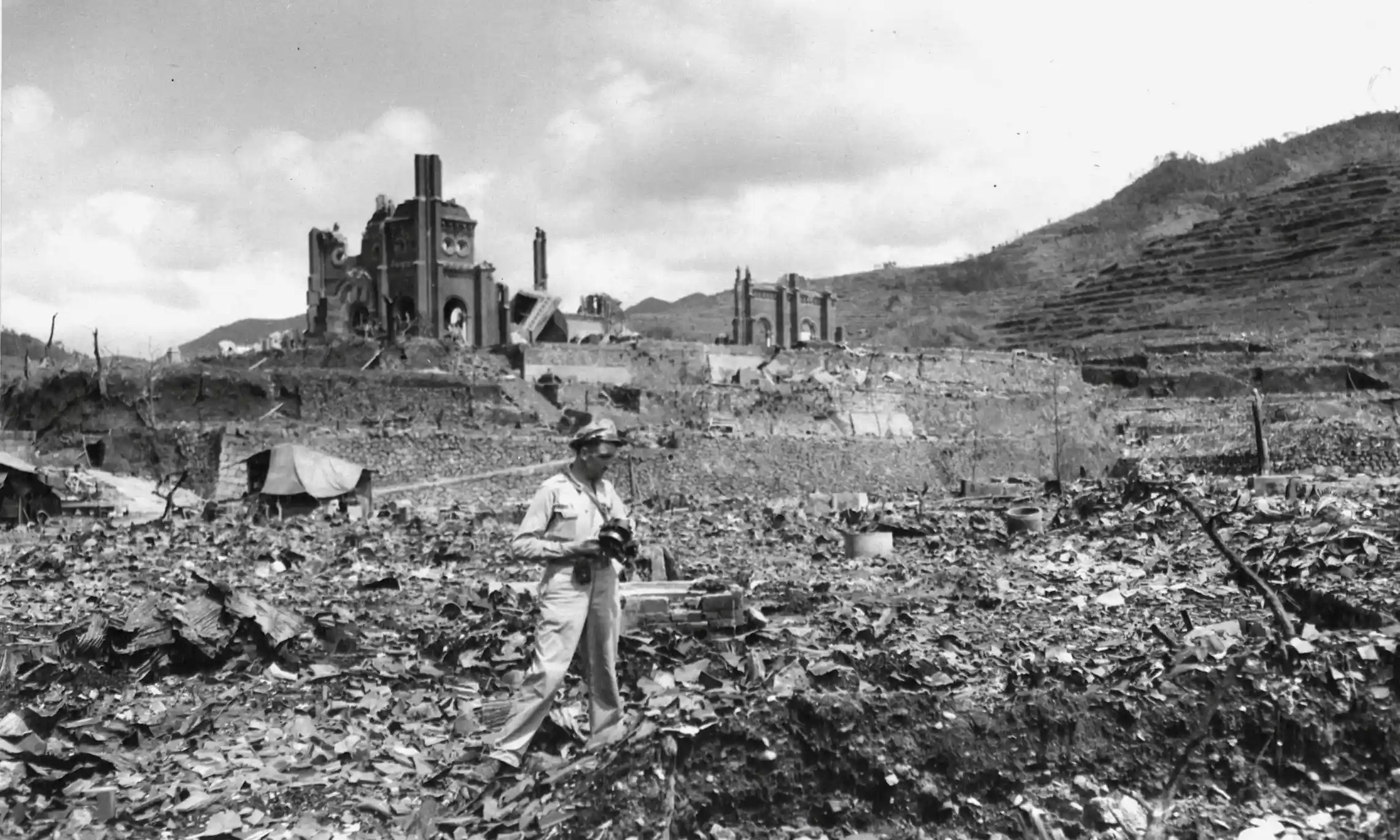
The photograph shows devastation in Nagasaki after the atomic bomb: a scorched wilderness where there was once a city. At its centre stands a lone man with a camera.
It was 9 September 1945 and Lt Daniel McGovern, a US Army Air Force cameraman, was documenting ground zero, the point directly below the bomb’s detonation four weeks earlier. Few would recognise McGovern, but the vision of apocalypse is familiar from documentary footage of Hiroshima and Nagasaki at the end of the second world war.
The footage will be shown again this week and next for the 77th anniversaries of the atomic bombings that obliterated the Japanese cities and showed the reality of nuclear war: blasted landscapes, burnt skeletons, radiation sickness.
But those haunting images might not exist were it not for McGovern. As part of the US Strategic Bombing Survey – which studied the impact of bombing – McGovern supervised Japanese and American camera crews in Hiroshima and Nagasaki. Back in the US, he saved the footage from suppression by making secret copies.
Only now, decades later, has his full story emerged. Joe McCabe, a journalist from McGovern’s native County Monaghan in Ireland, has pieced together his remarkable life in a biography, Rebels to Reels, published earlier this month after 20 years of research, including interviews with McGovern before his death in 2005………………………………………………….
The fields around Nagasaki were bleached white and the city looked as if a “massive anvil” had flattened it, he later told McCabe. At a ruined school he filmed the bodies of children amid piles of skulls. “Hundreds of kids had been sucked out through the windows. We were always finding bones.”
He filmed harrowing scenes at overwhelmed hospitals, including the agony of a 16-year-old boy named Sumiteru Taniguchi. “His whole back just looked like a bowl of bubbling tomatoes.”
Other patients had rashes, hair loss and bleeding from the nose and mouth – a mysterious malady later identified as radiation sickness.
McGovern also captured the phenomenon of people who had been atomised yet left shadows caused by radiant heat. The two atomic bombs are estimated to have killed more than 200,000 people.
McGovern’s teams amassed 100,000ft of colour footage and enlisted the help of a Japanese newsreel service, Nippon Eigasha, which had 26,000ft of black-and-white footage, much shot before the Americans had arrived. The Irishman helped edit the Japanese footage into a documentary called Effects of the Atomic Bomb on Hiroshima and Nagasaki, and planned to turn the colour footage into another one.
Authorities in Washington, however, classified the material as secret in 1946. “They didn’t want the American public seeing the horrors,” McGovern said. He discreetly made copies at the Pentagon. He stored one set at an air force motion picture depository in Dayton, Ohio, and kept another set himself.
Years passed – McGovern witnessed rocket tests and debunked theories of aliens at Roswell as “a load of crap” – and then in 1967 a US Congressional committee that included Robert Kennedy asked to see the atomic bomb footage. The material had been declassified but no one could find the originals. McGovern, by now a lieutenant colonel, directed the authorities to his copies.
In 1970 the general public got its first glimpse of some of the footage. It had been incorporated into a film called Hiroshima Nagasaki – August 1945 that premiered at New York’s Museum of Modern Art.
The auditorium was packed. At the end, no one made a sound. https://www.theguardian.com/world/2022/jul/31/us-airman-daniel-mcgovern-cameraman-hiroshima-nagasaki
UN Nuclear Review: A Prime Time to Stop the New Arms Race
The real solution to the threat of nuclear war is in plain sight, but still the powerful weapons makers and war profiteers refuse to yield.
https://medium.com/@codepink/un-nuclear-review-a-prime-time-to-stop-the-new-arms-race-6e3303aa0ccd By Marcy Winograd and Medea Benjamin, 31 July 22,
In the run-up to August’s United Nation’s 10th Annual Review of the landmark Nuclear Non-Proliferation Treaty (NPT), a review undertaken every five years, Secretary of State Antony Blinken’s State Department issued a surprising reaffirmation of the U.S. commitment to this treaty and the “ultimate goal of a world without nuclear weapons.”
The NPT, designed to “further the goal of achieving nuclear disarmament,” entered into force in 1970 and was extended indefinitely in 1995. It has now been signed by 191 nations, including the U.S. and Russia.
If only Blinken’s verbal support for the NPT was U.S. policy, as opposed to wishful thinking or trickery.
As treaty signatories and civil society representatives from around the world gather for a month in New York to evaluate the treaty’s implementation, the White House, Congress, and military contractors will move ahead on a near $2 trillion nuclear rearmament program euphemistically termed “nuclear modernization.”
Modernization is a kitchen upgrade. New touch-to-open cabinets. New LED recessed lighting.
It is not 600 new–instead of funeralized–intercontinental ballistic missiles (ICBM’s) on hair trigger alert to replace the Minuteman III in the midwest. Each of these “modern missiles” would span the length of a bowling lane with new warheads that are 20 times more powerful than the bombs that incinerated Hiroshima and Nagasaki.
Modernization is not a new sea-launched nuclear cruise missile that carries both conventional and nuclear warheads with the same radar profile to confuse “the enemy.”
Modernization is not 100 new stealth air-launched nuclear missiles like the B-21 Raider, also capable of carrying both conventional and nuclear weapons.
Ahh, but these nuclear weapons are just upgrades, not new systems, right?
Semantic back-flips aside, U.S. nuclear “modernization” means the development of new weapon systems with new nuclear warheads and a new arms race. What the State Department failed to mention in its reaffirmation of the NPT was that the U.S. nuclear rearmament program violates the spirit and intent of Article 6 of the NPT, which prohibits the pursuit of new nuclear weapons.
Instead of pursuing world peace and climate preservation for our children, US leaders are chasing a reckless foreign policy.
In April, the Wall Street Journal published a commentary titled “The U.S. should show it can win a nuclear war.”
More recently, the City of New York, home of the United Nations, released, however well-intentioned, a so-called public service announcement on how to survive a nuclear attack, referring to it as “the big one”, as though it were an earthquake. No mention was made of blinding flashes of light or widespread radiation that blisters the skin or immediate incineration. Instead, New Yorkers were instructed to get inside, stay inside and stay tuned. Tuned to what? Our fading heartbeats?
According to the International Committee to Abolish Nuclear Weapons (ICAN), a nuclear war between the US and Russia would lead to over 34-million dead and 57 million injured in the first few hours — and a dark subzero winter of famine and soot blocking the sun for those who survived.
No mention is made of this nightmare scenario, however, in the 2019 Joint Chiefs Nuclear Operations Publication (3–72), a Strangelovian document briefly released then deleted from the website of the Joint Chiefs of Staff. The vanishing unclassified document, preserved by the Federation of American Scientists, reflects the Pentagon’s delusional thinking that a nuclear war can be limited and won. Mark Milley, then Secretary of the Army, now Chair of the Joint Chiefs, signed off on the chilling statements below:
“A nuclear weapon could be brought into the campaign as a result of perceived failure in a conventional campaign, potential loss of control or regime, or to escalate the conflict to sue for peace on more-favorable terms.”
“Using nuclear weapons could create conditions for decisive results and the restoration of strategic stability …”
UN treaty signatories, along with NGO conference delegates, should use the month-long NPT operations review to speak truth to power.
First, they should speak out against the dangerous proxy war in Ukraine between the U.S./NATO and Russia that could lead to a nuclear confrontation. The delegates should denounce Russian President Vladmir Putin for ordering the invasion of Ukraine and call on all parties in the war to engage in a negotiated settlement.
One miscalculation, one moment of confusion, one intentional launch of a short-range nuclear warhead, followed by a retaliatory long-range nuclear weapon, could burn us alive and blanket the world in ash.
Delegates should also call on the United States and NATO to denuclearize Europe. This would entail removing US nuclear weapons from Belgium, the Netherlands, Germany, Italy and Turkey; scrapping plans to redeploy nuclear weapons to the United Kingdom, where for 14 years nuclear storage facilities rightfully have sat empty; and removing the provocative anti-ballistic missiles from Romania and Poland, both of which are perilously close to Russia’s border.
On the broader issue of disarmament, attendees at the UN meetings should shout “Come to your senses!” to the President Biden, Secretary of State Antony Blinken, National Security Advisor Jake Sullivan, Secretary of Defense Lloyd Austin and Chair of the Joint Chiefs of Staff Mark Milley for supporting nuclear rearmament. Delegates should denounce members of Congress who recently voted for the $840 billion dollar military budget that includes $30 billion as another down payment on the nuclear rearmament program.
Participants at the UN gathering could also call on President Biden to declassify his Nuclear Posture Review. Every administration is obligated by US law to release a new Nuclear Posture Review outlining the administration’s nuclear policy.
To date, Biden’s Nuclear Posture Review remains a secret.
Classified.
Declassifying the Review would allow the people of the United States, and the world, to know whether President Biden is committed to keeping his campaign promise of no first use of nuclear weapons and if he abides by the Joint Statement he signed with Putin in 2021 and the Joint Agreement he signed in 2022 with five nuclear weapons states, including Russia and China, committing the US to the NPT because “a nuclear war can never be won and must never be fought.”
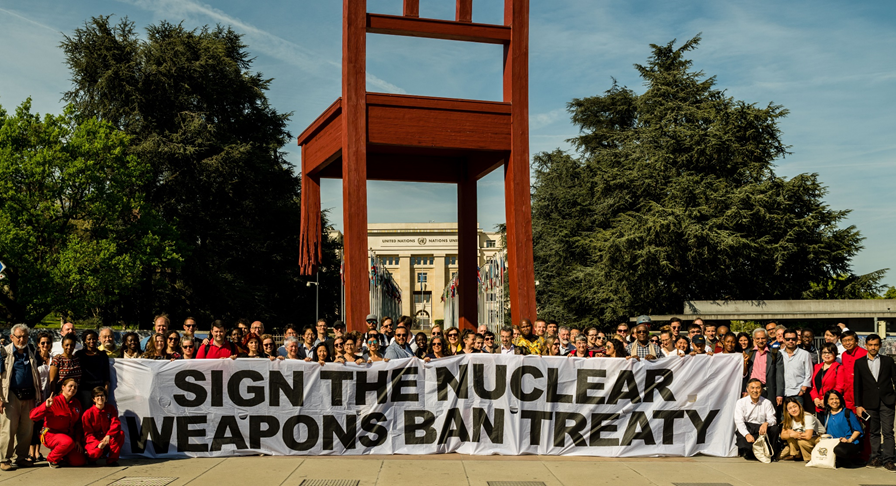
The real solution to the threat of nuclear war is in plain sight. It is the UN Treaty on the Prohibition of Nuclear Weapons, the first legally binding international agreement to comprehensively prohibit nuclear weapons. It was adopted in July 2017 and entered into force in January 2021, after it was ratified by 50 states. None of the nuclear states have signed it.
The NPT Review Conference is a golden opportunity for the participants, and the public in general, to call on all nations to sign the UN Treaty on the Prohibition of Nuclear Weapons and to once and for all embrace the Nuclear Non-Proliferation Treaty to, in the treaty’s words, “pursue negotiations in good faith on effective measures relating to cessation of the nuclear arms race at an early date and to nuclear disarmament.”
Take Action: Email the White House to demand President Biden’s Nuclear Posture Review be made public. Call your US Senators (202) 224–3121 to urge them to vote NO on the 2023 military budget or NDAA.
Marcy Winograd of Progressive Democrats of America served as a 2020 DNC Delegate for Bernie Sanders and co-founded the Progressive Caucus of the California Democratic Party. Coordinator of CODEPINKCONGRESS, Marcy spearheads Capitol Hill calling parties to mobilize co-sponsors and votes for peace and foreign policy legislation.
Medea Benjamin, co-founder of Global Exchange and CODEPINK: Women for Peace, is the author of the 2018 book, “Inside Iran: The Real History and Politics of the Islamic Republic of Iran.” Her previous books include: “Kingdom of the Unjust: Behind the U.S.-Saudi Connection” (2016); “Drone Warfare: Killing by Remote Control” (2013); “Don’t Be Afraid Gringo: A Honduran Woman Speaks from the Heart” (1989), and (with Jodie Evans) “Stop the Next War Now (Inner Ocean Action Guide)” (2005).
Ukraine War Hangs Over UN Meeting on Nuclear Treaty’s Legacy
VOA UNITED NATIONS 31 July 22, —
There was already plenty of trouble to talk about when a major U.N. meeting on the landmark Nuclear Nonproliferation Treaty was originally supposed to happen in 2020.
Now the pandemic-postponed conference finally starts Monday as Russia’s war in Ukraine has reanimated fears of nuclear confrontation and cranked up the urgency of trying to reinforce the 50-year-old treaty.

“It is a very, very difficult moment,” said Beatrice Fihn, the executive director of the Nobel Peace Prize-winning International Campaign to Abolish Nuclear Weapons.
Russia’s invasion, accompanied by ominous references to its nuclear arsenal, “is so significant for the treaty and really going to put a lot of pressure on this,” she said. “How governments react to the situation is going to shape future nuclear policy.”
The four-week meeting aims to generate a consensus on the next steps, but expectations are low for a substantial — if any — agreement……………………………
The events in Ukraine create a tricky choice for the upcoming conference, said Patricia Lewis, a former U.N. disarmament research official who is now at the international affairs think tank Chatham House in London.
“On the one hand, in order to support the treaty and what it stands for, governments will have to address Russia’s behavior and threats,” she said. “On the other hand, to do so risks dividing the treaty members.”
Another uncomfortable dynamic: The war has heightened some countries’ apprehensions about not having nuclear weapons, especially since Ukraine once housed but gave up a trove of Soviet nukes.
Ukraine is hardly the only hot topic.
North Korea appears to have been preparing recently for its first nuclear weapons test since 2017. And talks about reviving the deal meant to keep Iran from developing nukes are in limbo.
The U.S. and Russia have only one remaining treaty curtailing their nuclear weapons and have been developing new technologies. Britain last year raised a self-imposed cap on its stockpile. China says it’s modernizing — or, the U.S. claims, expanding — the world’s third-largest nuclear arsenal……………..
In recent years, frustration with the Nonproliferation Treaty catalyzed another pact that outright prohibits nuclear weapons. Ratified by more than 60 countries, it took effect last year, though without any nuclear-armed nations on board.
At a recent meeting in Vienna, participating countries condemned “any and all nuclear threats” and inked a lengthy plan that includes considering an international trust fund for people harmed by nuclear weapons.
Fihn, whose Geneva-based group campaigned for the nuclear ban treaty, hopes the vigor in Vienna serves as inspiration — or notice — for countries to make progress at the U.N. conference.
“If you don’t do it here,” she said, “we’re moving on without you elsewhere.” https://www.voanews.com/a/ukraine-war-hangs-over-un-meeting-on-nuclear-treaty-legacy/6681249.html
Nuclear Weapons Policies of Japan and South Korea Challenged
By Jaya Ramachandran, GENEVA (IDN)31 July 22, — The Basel Peace Office, in cooperation with other civil society organisations, has challenged the nuclear weapons policies of Japan and South Korea in the UN Human Rights Council, maintaining that these violate the Right to Life, a right enshrined in Article 6 of the International Covenant on Civil and Political Rights (ICCPR).
The two East Asian countries’ nuclear strategies have been called into question in reports submitted on July 14 as part of the Universal Periodic Review (UPR) of the obligations of Japan, South Korea and 12 other countries under human rights treaties. (See Submission on Japan and Submission on South Korea).
The submissions, presented at a time when Russia has made nuclear threats to the US and NATO if they intervene in the Russian invasion of Ukraine, underline the need to address the risks of nuclear deterrence policies. Besides, Russia is not the only country that possesses nuclear weapons and/or maintains options to initiate nuclear war………………
both Japan and South Korea are engaged in extended nuclear deterrence policies which involve the threat or use of US nuclear weapons on their behalf in an armed conflict. Both have also supported the option of first use of nuclear weapons on their behalf, even when the United States has been trying to step back from such a policy.
The Basel Peace Office and other civil society organisations argue that the extended nuclear deterrence policies of Japan and South Korea violate their human rights obligations, as is their lack of support for negotiations for comprehensive, global nuclear disarmament.
The submissions make several recommendations of policies the governments could take to conform to the Right to Life. These include adopting no-first-use policies and taking measures to phase out the role of nuclear weapons in their security doctrines.
This they could do by establishing a Northeast Asia Nuclear-Weapon-Free Zone and urging at the ongoing Non-Proliferation Treaty (NPT) Review Conference an agreement on the global elimination of nuclear weapons by 2045, the 75th anniversary of the NPT………………………..
more https://www.indepthnews.net/index.php/armaments/nuclear-weapons/5487-nuclear-weapons-policies-of-japan-and-south-korea-challenged
Kishida to call for nuke-free world in historic address at U.N. treaty conference
Japan Times, BY ERIC JOHNSTON, 31 July 22,
In a year in which nuclear disarmament hopes have been dented by not-so-subtle references by Russia to its own arsenal following its invasion of Ukraine, Prime Minister Fumio Kishida is set to make history as the first Japanese leader to address the United Nations’ nuclear nonproliferation treaty review conference, which begins in New York on Monday.
Kishida, who represents a district in Hiroshima, is expected to call for a world without nuclear weapons and for greater transparency among nuclear powers regarding their stockpiles and capabilities. His message will refer to Japan’s experience as the only country to have been attacked with an atomic bomb. The leader will also stress that all countries should neither use nuclear weapons nor threaten to use them.
Speaking to reporters in Tokyo on Friday, the prime minister said it was important to link the treaty’s ideals with current geopolitical realities.
“The debate on nuclear disarmament is atrophying,” Kishida said, and he announced he would present a plan at the conference that would hopefully serve as a roadmap toward reaching a world without nuclear weapons.
The prime minister sees Japan’s role at the nearly monthlong conference, which will focus on keeping the buildup of nuclear weapons under control, as one of helping to bridge the differences between nuclear powers and nonnuclear states. Kishida is hoping to promote talks between China and the United States on nuclear disarmament and arms control. He’s also expected to call on the international community to work toward North Korea’s denuclearization………………………….
more https://www.japantimes.co.jp/news/2022/07/31/national/nuclear-conference-kishida-speech/
For Warmongers It’s Always 1938: Notes From The Edge Of The Narrative Matrix
Hawks always say our geopolitical situation resembles that of 1938 so that any call for de-escalation, diplomacy or detente can be portrayed as “appeasement”. It’s never 1919, when the conditions which would give rise to World War Two were put in place, or any of the early 20th century years when the trajectory toward World War One could have easily been turned away from.
Our fetishization of World War Two has eclipsed from memory the fact that it was the single worst thing that ever happened on this planet. The trauma it inflicted upon our species still reverberates through our collective consciousness to this day, and avoiding it would have been objectively good.
Even if we fully espouse all the grandiose ego-stroking Anglo-American narratives about WWII, you don’t want to have a modern Churchill and FDR bravely standing against the forces of evil. What you want is for such a stand to be unnecessary, because the conflict was avoided.
But that’s not how you score political points in Washington and London. That’s not how you pull ratings as a news outlet. That’s not how you sell weapons as an arms manufacturer, and it’s not how you advance hegemonic agendas as an empire. That’s why peace doesn’t get a voice…………………………………..
So it looks like Ukraine has begun using US-made weapons to strike Russian territory. At a time when dangerous escalations between nuclear superpowers is an almost daily occurrence, this one stands head and shoulders above most of the others and deserves special attention. There are many, many potential scenarios which could spark a nuclear exchange, but the US/Ukraine/NATO alliance continually pursuing a line of attack into Russia is by far the most surefire way to get there. Let’s hope that option remains off the table.
❖……………………. Western powers aren’t censoring Russian media to protect our minds from Russian propaganda, they are censoring Russian media because it interferes with western propaganda.
If we were being told the truth about this war there wouldn’t be such a wildly unprecedented push to censor, intimidate, troll and silence anyone who asks if we’re being lied to…………………… https://caitlinjohnstone.substack.com/p/for-warmongers-its-always-1938-notes?utm_source=substack&utm_medium=email
Glascow City Council not informed when nuclear weapons convoys pass through city

Glasgow City Council ‘not informed’ when nuclear weapons convoy passes
through city. The convoys – which can contain as many as eight nuclear
warheads – pass through Glasgow on the M74 and M8 as they travel between
Atomic Weapons Establishment Burghfield near Reading and RNAD Coulport on
Loch Long.
Glasgow Live 27th July 2022
https://www.glasgowlive.co.uk/news/glasgow-news/glasgow-city-council-not-informed-24585579
Deterrencelessness: Nuclear threats neither credible nor viable
https://augustafreepress.com/deterrencelessness-nuclear-threats-neither-credible-nor-viable/ By John LaForge 25 July 22,
Threatening to make attacks with nuclear weapons is known as “deterrence” when the United States does it, but it’s called madness, blackmail, or “terrorism” if Russia, China, or North Korea does.
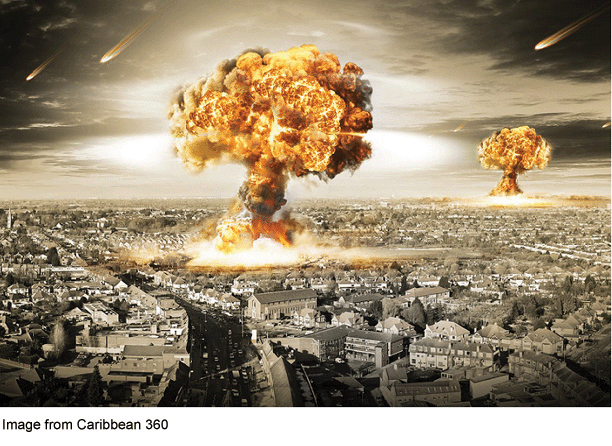
U.S. Air Force thermonuclear weapons, about 100-to-150 of them known as B61s, are stationed at two NATO bases in Italy, and at one NATO base each in Belgium, The Netherlands, Germany, and Turkey. These 170-kiloton H-bombs — 11 times the force of the Hiroshima bomb — are always described euphemistically as “theater” nuclear weapons, defensive ones that
are a “deterrent” to aggression.
Of course, Russian aggression in Ukraine has shown nuclear “deterrence” to be an expensive, destabilizing, terroristic fraud. That our high, holy, sacrosanct, and unquestionable arsenal of “deterrence” did not deter Russia on February 24, 2022 is dreadfully, painfully, catastrophically obvious. Yet the nakedness of the deterrent-less Emperor has hardly been acknowledged.
In the ghastly maw of ongoing war in Ukraine, the needless provocation of stationing U.S. thermonuclear B61 H-bombs at six NATO base’s facing Russia could hardly be more frightening. Then, as if to scream “fire” in the crowded auditorium, NATO’s ministers on June 30 issued their latest “Strategic Concept,” a public relations version of the alliance’s ongoing threat to wage indiscriminate, uncontrollable, and poisonous mass destruction using U.S., French and British nuclear warheads.
The Strategic Concept’s soothing, cotton candy version of NATO’s open embrace of nuclear terrorism is this: “NATO will take all necessary steps to ensure the credibility, effectiveness, safety and security of the nuclear deterrent mission.”
At the moment however, the B61 hydrogen bombs stationed at Germany’s Büchel air base cannot credibly be a part of the “mission” since they can’t be attached to Germany’s Tornado fighter jets. This is because the base’s runway is being rebuilt. Until 2026, Büchel’s 33rd Fighter-Bomber Wing of Tornado jets are based at the nearby Nörvenich air base.
For Kathrin Vogler, a Left Party member of the German Parliament in 2021, this is a chance to denuclearize Germany. The politician told the daily paper Rhein-Zeitung last year that “From June 2022 to February 2026, flight operations at Büchel Air Base will be largely discontinued and transferred to the Nörvenich military airfield…. This was confirmed to us by the German government in our minor inquiry. As far as we know, the 20 or so nuclear bombs stored at Büchel will remain there.”
This means that German nuclear sharing will effectively not take place for four years from 2022,” Volger told the paper.
“This exposes the argumentation of the German government, which repeatedly claims that nuclear sharing is an important part of NATO’s deterrence strategy. In fact, maintaining it and thus also the Büchel nuclear weapons site is pure symbolic politics, albeit with high risks for the population. Therefore: The suspension of nuclear sharing must become a phase-out, [and] now would be a good opportunity to do so,” Volger said last year.
Proven useless, nuclear weapons can now be discarded
The June 30 NATO “concept” says, “The fundamental purpose of NATO’s nuclear capability is to preserve peace, prevent coercion and deter aggression.”
As of February 24, 2022, NATO’s nuclear weapons arsenal’s “fundamental purpose” has been utterly delegitimized, politically pulverized, and militarily reduced to ashes. The alliance’s nuclear arsenal can finally be removed without any loss of face, much less any loss of security.
NATO’s latest “concept” accidentally acknowledges the uselessness of retaining nuclear weapons in its recognition that, “The strategic nuclear forces of the Alliance, particularly those of the United States, are the supreme guarantee of the security of the Alliance.”
This is the terrible farce of nuclearism. If nuclear weapon threats guaranteed any security at all, none of the tens of billions of Euro-dollars’ worth of military training, weapons, mercenaries, cyber warfare, or intelligence assistance that NATO partners and Russia are now pouring into Ukraine would be necessary.
Nuclear-armed alliances are a thing of the past which must be and now can be abolished. Under the auspices of the Treaty on the Prohibition of Nuclear Weapons, along with the Treaty on the Nonproliferation of Nuclear Weapons, international law provides a pathway, training wheels, guide rails and a motorcade — courtesy of the great majority of the world’s governments — to a world where conflict and even wars don’t endanger whole civilizations and the biological integrity of life on earth.
John LaForge, syndicated by PeaceVoice, is Co-director of Nukewatch, a peace and environmental justice group in Wisconsin, and is co-editor with Arianne Peterson of Nuclear Heartland, Revised: A Guide to the 450 Land-Based Missiles of the United States.
.
Russia accused of waging war out of working nuclear power plant in Ukraine
https://www.france24.com/en/europe/20220725-russia-accused-of-waging-war-out-of-working-nuclear-power-plant-in-ukraine Russian forces have reportedly been using the Zaporizhzhia nuclear power plant, near Nikopol in southern Ukraine, as a base to launch attacks, ramping up security concerns in surrounding areas.
The power plant in Ukraine is the largest in Europe and has been under Russian control since March. It is the only working nuclear power plant in history to be occupied by an invading army
Recent reports have noted shells being fired from the direction of Zaporizhzhia towards Ukrainian forces. “Ukrainian forces can’t shoot back in case they hit the plant,” a local told FRANCE 24’s Gulliver Cragg, reporting from Nikopol.
The Ukrainian nuclear energy agency, Enerhoatom, has also raised concerns about the risk of heavy military equipment and explosives being stored inside reactor buildings and military trucks parked in the reactor hall.
“The question is what happens if there’s a fire?” said Petro K., president of Enerhoatom. “It won’t be possible to put the fire out because these trucks block the firefighters’ access.”
At the same time, Russia has accused Ukrainian forces of risking a nuclear catastrophe with alleged military activity in the area. Ukrainian officials deny these claims, saying they are all too aware of the dangers and would not take such risks
Japan to push for nuclear arms reduction at NPT review conference
Kyodo News, 25 July 22, Tokyo,
Japan plans to push for a reduction in nuclear warheads and for world leaders to visit its two atomic-bombed cities at next month’s review conference on the Nuclear Non-proliferation Treaty, a special adviser to Japanese Prime Minister Fumio Kishida on the issue said Monday…………………………………… more https://english.kyodonews.net/news/2022/07/8d8074c2b80e-japan-to-push-for-nuclear-arms-reduction-at-npt-review-conference.html
British soldiers used as radiation guinea pigs in nuclear bomb tests in Australia
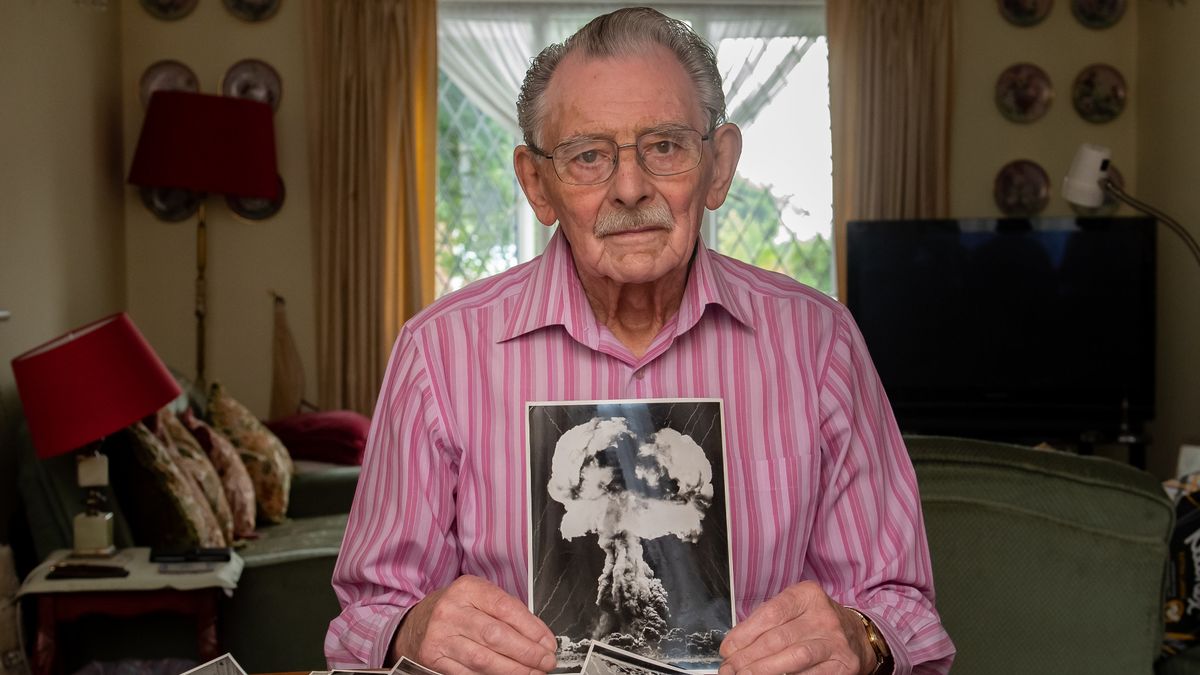
British veterans ‘ordered to march through smoking craters’ in nuclear bomb tests, Brian Tomlinson claims the state dumped him and his comrades, many of whom died from cancer after being used in a shocking human experiment,
https://www.mirror.co.uk/news/uk-news/british-veterans-ordered-march-through-27563987 Susie Boniface, Reporter, 24 Jul 2022,
A veteran of nuclear bomb tests has told how British servicemen were ordered to march through a smoking crater to find how radioactive it was.
Brian Tomlinson said he also had to dig out scientific instruments buried in the contaminated soil and revealed he was left with bleeding ulcers on his palms for two decades.
But he claims the state dumped him and his comrades, many of whom died from cancer in the years after they were used in a shocking human experiment in the Australian outback.
And Brian supports the Mirror’s campaign for a medal for heroes of the nuclear tests in the 50s.
“That place is still radioactive, it’s in the soil for a hell of a long time, so what chance does a human being have?” he said.
“A medal would get us a little bit of recognition for those who took part. It says you’re someone who’s been noticed and not discarded, which is how we’ve felt for so long.”
Last month, Boris Johnson became the first PM to meet veterans, and promised action before October’s 70th anniversary of the first test. His resignation threw it into doubt and campaigners are seeking reassurances from Rishi Sunak or Liz Truss that they will do the same.
Brian, now 85, was a sapper sent to Maralinga, South Australia, in 1957 to take part in Operation Antler, a series of three atomic bomb tests designed to help build the more powerful H-bomb.
His troop of Royal Engineers were blended with Australian soldiers, and 40 of them lived for a year inside the blast zone in canvas tents.
The main base, where scientists, top brass, and most troops stayed, was called Maralinga Village. Brian’s unit was 14 miles deeper into the testing grounds, at Roadside Camp. From there, it was just 9 miles to Ground Zero.
Brian, a 20-year-old corporal at the time, said: “Nobody told us what it was all about, or checked us for radiation, but every morning we went into the forward area.
We had pneumatic drills, and had to blast down through the soil. There was about 12 inches of earth, red dust, and below that was rock.”
For each of 3 blasts, the crew had to bury dozens of large steel containers 8ft square. Each had instruments inside to measure the explosion, with pipes protruding above ground level. Those closest to the bombs were sandbagged and concreted to protect them from the shockwave.
A few hours after each bomb, Brian and his crew – wearing only shorts, socks, boots and a hat – had to drive back in, remove the sandbags and concrete, and extract the instruments.
Scientists who went with them wore radiation suits and badges, but Brian said for the first two blasts he had neither.
He added: “After the third bomb, we were given little rubber boots, and a white overall, and a dose badge. We were told to walk through the crater. The mushroom cloud was still overhead. The wind had started to push it away. It was only a few hours after, not very long.”
The first two bombs, codenamed Tadje and Biak, were one kiloton and 6kts respectively.
But the third, Taranaki, was 25kts, as powerful as the weapon which destroyed Nagasaki in 1945.
Brian, of Yate, near Bristol, said: “As you approached the bomb site it was quite amazing, because it was like a bowling green. Everything was green and smooth. It was only when you were on it you realised the heat from the bomb had crystallised the earth underneath it. It was a crust of molten sand, like glass.
“The crater left there was huge. They told us to walk into that, down into the crater, and up the other side, and then check our meters to see how high the dose was.”
Brian said: “When it reached a certain point they told us to come out. It didn’t take long for it to reach that point. We weren’t told at the time what the dose was supposed to be. But it was just as bad as going through the centre of the bomb as soon as it had gone off.”
The first two bombs were detonated on top of 100ft-high towers built by the sappers, but desert sand was sucked into the fireball and fell to the ground as toxic fallout. The third bomb was tethered to barrage balloons 980ft up, supposedly minimising the risk.
But the size of the bomb, and perhaps the fact the same site was used for previous weapons tests, meant there was still fallout.
After they left the crater, Brian was taken to a decontamination area. The men’s clothes were stripped off and taken away, and the men were put through showers.
“We spent 5 or 6 minutes scrubbing away, then put ourselves in this meter, it was like standing on a weighing machine, and you push your hands through these bars to be tested. If a bell rang, you were still radioactive and had to go back in and scrub under your nails, everywhere, in your hair. I had to do it 3 times. They didn’t give us any more information.”
Documented safety measures at Maralinga included wire fences through which sand could easily be blown, and one wooden post barrier that Brian’s unit passed through each morning.
Brian was not checked for radiation while excavating amid the fallout, nor given long-term medical follow-ups. Six years later, he was medically discharged with a duodenal ulcer.
Radiation is known to cause problems with the lining of the gut, and earlier this year a government study reported nuclear test veterans were 20 per cent more likely than other servicemen to die from stomach cancer.
Brian said: “It wasn’t until later I started having skin problems. It would cover me from head to toes, rashes on my back, chest, legs, thighs. They used to come out on the palms of my hands.
“I’d get a little itchy blister in the centre of my palm, it would break and then spread over the fingers. I used to wear white cotton gloves to ease the pain and itching.
“The skin would go hard, then crack and bleed, and it would start all over again. I had that for 20 years, and no doctor could work out what it was.”
Today, cancer patients are warned radiotherapy using beta radiation can lead to radiodermatitis, which causes rashes, skin peeling, and ulceration. It is caused by the decay of isotopes, including plutonium and cobalt-60, both of which were in the Antler bombs.
Brian said: “I would have a constant itch, all over, and had to take cold showers just to stop the itching and have something of a normal life. I got depressed, to the point where I didn’t want to go and see the doctors because they just have me the same old medication and it never did me any good. Then one day, after 20 years, it just stopped, as suddenly as it came.”
Two decades after his discharge, Brian also had an operation to finally cure his ulcer. It involved cutting the vagus nerve, which controls digestion as well as carrying sensory information from the skin’s surface.
“I told all my consultants what was done to me out there in Maralinga, and asked if it was due to fallout. They all denied it,” said Brian. “Nobody’s ever done anything for us nuclear test veterans except withhold information from us.”
Campaigners have asked the Prime Minister for a medal and a service of national recognition at Westminster Abbey to mark the Plutonium Jubilee in 3 months’ time.
A spokesman for the MoD said it was grateful to veterans, and claimed they were well-monitored and protected. He added: “The Prime Minister met with veterans recently, and asked ministers to explore how their dedication can be recognised. We remain committed to considering any new evidence”
************************************************************************
For 40 years, the Mirror has campaigned for justice for the brave men who took part in Britain’s nuclear weapons tests.
The Ministry of Defence has fought back every step of the way.
We have told countless heartbreaking stories of grieving mums, children with deformities, men aged before their time and widows struggling to hold their families together, all while campaigning for recognition.
Two years ago we launched an appeal for a medal for the 1,500 survivors.
For the first time we were able to prove some were unwittingly used in experiments.
Our appeal was backed by then-Defence Secretary Gavin Williamson but his review foundered after he lost his job.
It had only six meetings in two years. They never asked to meet veterans. They never questioned the evidence.
Instead they asked for information from the MoD, which has a track record of denying what its own paperwork later proves.
And as our medal campaign gathered steam, civil servants simultaneously withdrew public documents from the National Archives.
Would anyone working in Whitehall today stay there, if 3 megatons of plutonium exploded south of the river?
The test veterans and their families will never stop fighting. The Mirror will never cease to demand they are heard.
Prime Minister, listen to them. Overturn this disgraceful decision.
1 This Month





PLEASE OPPOSE HR 8255 AND S.3639 – bills would accelerate satellite deployment, with no environmental review or safeguards – https://ncstd5li.quorum.us/campaign/169331/
To see nuclear-related stories in greater depth and intensity – go to https://nuclearinformation.wordpress.com
-
Archives
- October 2026 (29)
- September 2026 (339)
- August 2026 (330)
- July 2026 (355)
- June 2026 (287)
- May 2026 (306)
- April 2026 (356)
- March 2026 (251)
- February 2026 (267)
- January 2026 (308)
- December 2025 (358)
- November 2025 (359)
-
Categories
- 1
- 1 NUCLEAR ISSUES
- business and costs
- climate change
- culture and arts
- ENERGY
- environment
- health
- history
- indigenous issues
- Legal
- marketing of nuclear
- media
- opposition to nuclear
- PERSONAL STORIES
- politics
- politics international
- Religion and ethics
- safety
- secrets,lies and civil liberties
- spinbuster
- technology
- Uranium
- wastes
- weapons and war
- Women
- 2 WORLD
- ACTION
- AFRICA
- Atrocities
- AUSTRALIA
- Christina's notes
- Christina's themes
- culture and arts
- Events
- Fuk 2022
- Fuk 2023
- Fukushima 2017
- Fukushima 2018
- fukushima 2019
- Fukushima 2020
- Fukushima 2021
- general
- global warming
- Humour (God we need it)
- Nuclear
- RARE EARTHS
- Reference
- resources – print
- Resources -audiovicual
- Weekly Newsletter
- World
- World Nuclear
- YouTube
-
RSS
Entries RSS
Comments RSS

