70% of Western weapons sent to Ukraine don’t reach troops – CBS
Rt.com 8 Aug 22, Report suggests US appears to be repeating the mistakes of Afghanistan, Iraq, and Syria.
With the US and its allies pledging unprecedented levels of military support to Ukraine, a recent CBS News report suggested that only around 30% of the weapons sent by the West actually make it to the front lines. The report adds to ongoing rumors of waste, corruption, and black market profiteering.
The US has approved more than $54 billion of economic and military aid to Ukraine since February, while the UK has committed nearly $3 billion in military aid alone, and the EU has spent another $2.5 billion on arms for Kiev. An entire spectrum of equipment, from rifles and grenades to anti-tank missiles and multiple launch rocket systems have left the West’s armories for Ukraine, with most entering the country through Poland.
However, this rarely goes smoothly, CBS News revealed this week.
“All of this stuff goes across the border, and then something happens, kind of like 30% of it reaches its final destination,” Jonas Ohman, the founder of a Lithuania-based organization supplying the Ukrainian military, told the American network. Ohman said that getting the weapons to the troops involves navigating a complex network of “power lords, oligarchs [and] political players.”
The new CBS Reports documentary, “Arming Ukraine,” explores why much of the billions of dollars of military aid that the U.S. is sending to Ukraine doesn’t make it to the front lines: “Like 30% of it reaches its final destination.” Stream now: https://t.co/Ob7Y3EsWknpic.twitter.com/YgVbpYZkHn
— CBS News (@CBSNews) August 5, 2022
“There is really no information as to where they’re going at all,” Donatella Rovera, a senior crisis adviser with Amnesty International, told CBS. “What is really worrying is that some countries that are sending weapons do not seem to think that it is their responsibility to put in place a very robust oversight mechanism.”
Ukraine insists that it tracks each and every weapon that crosses its borders, with Yuri Sak, an adviser to Defense Minister Alexey Reznikov, telling the Financial Times last month that reports to the contrary “could be part of Russia’s information war to discourage international partners from providing Ukraine with weaponry.”
However, some officials in the West have sounded alarm bells. A US intelligence source told CNN in April that Washington has “almost zero” idea what happens to these arms, describing the shipments as dropping “into a big black hole” once they enter Ukraine. Canadian sources said last month that they have “no idea” where their weapons deliveries actually end up.
Europol has claimed that some of these weapons have ended up in the hands of organized crime groups in the EU, while the Russian government has warned that they are showing up in the Middle East. An investigation by RT in June found online marketplaces where sophisticated Western hardware – such as Javelin and NLAW anti-tank systems or Phoenix Ghost and Switchblade explosive drones – was apparently being sold for pennies on the dollar.
Ukraine is consistently ranked as one of the most corrupt countries in the world, scoring 122/180 on Transparency International’s 2021 ‘Corruption Perceptions Index’, where 180 represents the most corrupt and 0 the least.
In Washington, drawing attention to this corruption is frowned upon by both parties in Congress. Representative Victoria Spartz, a Ukrainian-born lawmaker, has reportedly been cautioned by her colleagues and the White House for suggesting that Congress should establish “proper oversight” of its weapons shipments due to the alleged corruption within Vladimir Zelensky’s government. ………………………. more https://www.rt.com/russia/560419-ukraine-weapons-lost-cbs/
Ukraine calls for demilitarised zone around the shelled Zaporizhzhia nuclear plant
International alarm over shelling attacks on Ukraine’s Zaporizhzhia nuclear complex has grown with Kyiv warning of a Chornobyl-style catastrophe and appealing for the area to be a demilitarised zone.
Key points:
- Ukraine and Russia have traded blame for attacks on the Zaporizhzhia plant
- Russia says it is ready to enable UN watchdog visit to the plant
- Twelve grain ships have left Ukrainian ports since last week
The United Nations chief called for UN nuclear inspectors to be given access to the plant as Kyiv and Moscow traded blame for the shelling.
“Any attack (on) a nuclear plant is a suicidal thing,” UN Secretary General Antonio Guterres said on Monday.
Petro Kotin, head of Ukraine’s state nuclear power company Energoatom, called for a team of peacekeepers to be deployed at the Zaporizhzhia site which is still run by Ukrainian technicians………………………………………………………. more https://www.abc.net.au/news/2022-08-09/ukraine-calls-for-demilitarised-zone-around-nuclear-plant/101313112
Russia and Ukraine accused each other of shelling Europe’s biggest nuclear power plant in the Zaporizhzhia region
Russia and Ukraine accused each other of shelling Europe’s biggest nuclear
power plant in the Zaporizhzhia region as the world on Saturday marked the
77th anniversary of the first atomic bomb attack in the Japanese city of
Hiroshima, with UN chief Antonio Guterres warning against nuclear arms
build-up amid fears of another such attack in the context of war in
Ukraine.
France24 6th Aug 2022
Chinese expert from Peace Centre points out America’s hypocrisy, double standards, on Nuclear Non Proliferation

the US, which has the largest and most advanced nuclear arsenal, plans to spend over $1 trillion to maintain and modernize its nuclear triad. Furthermore, Washington withdrew from the Anti-Ballistic Missile and the Intermediate-Range Nuclear Forces treaties successively. President Joe Biden stepped back from a campaign promise that the sole purpose of nuclear weapons should be to deter nuclear attacks. All these moves may result in nuclear proliferation globally.
under AUKUS, the US and the UK are anticipated to assist Australia to have nuclear-powered submarines, which has severely violated the principles of the NPT.
Root of the grave, urgent nuclear proliferation situation lies in US.
https://www.globaltimes.cn/page/202208/1272415.shtml By Global Times, Aug 07, 2022With the 10th Review Conference of the Parties to the Treaty on the Non-Proliferation of Nuclear Weapons (NPT) being held at the United Nations headquarters in New York from August 1 to 26, the issue of nuclear non-proliferation has once again become the focus of global attention.
Washington today doesn’t let go of any occasion that can be exploited to smear and contain China. A US representative on Thursday at the NPT Review Conference baselessly criticized China for accelerating the expansion of its nuclear arsenal. And the US side also accused China of not engaging in talks on new arms control framework. China has lashed out at the rhetoric.
“By making such groundless accusations, Washington wants to deflect blame, distract attention and shun US’ due responsibility in securing global nuclear safety. Washington hopes this way can constrain the improvement of its main competitor’s nuclear capabilities,” Su Hao, founding director of the Center for Strategic and Peace Studies at the China Foreign Affairs University, told the Global Times.
China has always kept the quantity and size of its armed forces at the minimum level necessary for maintaining national security. China’s nuclear strategy focuses on self-defense, and aims to ensure the strategic security of the country by deterring the potential threat or use of nuclear weapons by others against China. And China has never taken part and will never take part in any nuclear arms race. Washington’s rhetoric is totally irrational.
In fact, the country that has blatantly violated the nuclear non-proliferation agreement is the US. Chinese Ambassador for Disarmament Affairs Li Song on Friday blasted the US for its negative moves on disarmament. He told a committee meeting of 10th NPT Review Conference that Driven by the Cold War mentality, the US has been obsessed with major-power strategic competition and has sought absolute strategic advantage, strengthened military alliances, stirred up bloc confrontation on the eastern and western sides of the Eurasia continent, and pressed ahead with the forward deployment of nuclear missiles and other strategic forces.
The landscape on international security is deteriorating and the risk of nuclear proliferation is growing. The responsibility lies with the US.
The US-led NATO’s continuous eastern expansion triggered the military clash between Russia and Ukraine, with no sign of easing up to now. In the Asia-Pacific region, Washington has provoked China’s national security in a high-profile manner for several times, in an attempt to contain China. US House Speaker Nancy Pelosi’s visit to the island of Taiwan is the latest example, which has ramped up the cross-Straits tensions.
Meanwhile, the US, which has the largest and most advanced nuclear arsenal, plans to spend over $1 trillion to maintain and modernize its nuclear triad. Furthermore, Washington withdrew from the Anti-Ballistic Missile and the Intermediate-Range Nuclear Forces treaties successively. President Joe Biden stepped back from a campaign promise that the sole purpose of nuclear weapons should be to deter nuclear attacks. All these moves may result in nuclear proliferation globally.
According to Song Zhongping, a Chinese mainland military expert and TV commentator, the US has always adopted double standards on nuclear non-proliferation. As one of the first countries to call for a nuclear non-proliferation treaty, the US is constantly setting rules on the nuclear non-proliferation to deter other countries, especially its rivals, from developing nuclear capabilities. But ironically, the US itself does not abide by these treaties and rules at all. For example, under AUKUS, the US and the UK are anticipated to assist Australia to have nuclear-powered submarines, which has severely violated the principles of the NPT. The US should not always give the green light to itself and the red light to others on this issue, as such a practice will lead to nuclear proliferation and arms race.
The biggest crisis confronted by the nuclear non-proliferation mechanism is that because of US’ double standards, distrust among countries has been rising. As a result, an increasing number of countries do not believe in the restraint mechanism brought by the NPT. It can be concluded that the root of the grave and urgent nuclear proliferation situation lies in the US.
The US-led global governance mechanism is disabled in nuclear non-proliferation. “This is because this mechanism is a unilateral, selfish, narrow-minded, bloc-political governance, to serve the US in maintaining its global hegemony. Such a global governance system will only lead the international community more tense and turbulent,” noted Su.
“The nuclear non-proliferation advocated by the US is entirely out of its geopolitical consideration. Washington’s hegemonic mindset increases the difficulty of achieving true nuclear non-proliferation. The US must take the lead in implementing the NPT; otherwise, nuclear non-proliferation cannot become a reality,” said Song.
China has always advocated building a community with a shared future for mankind. Only if the international community, including the US, can consider the nuclear non-proliferation from this perspective will such a crucial international problem be addressed.
IAEA alarmed at danger to Zaporizhzhia nuclear plant as shelling continues in Ukraine war
The UN nuclear watchdog has called for an immediate end to all military
action near Ukraine’s Zaporizhzhia nuclear plant after it was hit by
shelling, causing one of the reactors to shut down and creating a “very
real risk of a nuclear disaster”. Rafael Mariano Grossi, director general
of the International Atomic Energy Agency, said he was “extremely
concerned” by reports of damage at the plant and called for IAEA experts
to be allowed to inspect the damage.
“I’m extremely concerned by the
shelling yesterday at Europe’s largest nuclear power plant, which
underlines the very real risk of a nuclear disaster that could threaten
public health and the environment in Ukraine and beyond,” he said. The
Ukrainian nuclear power company Energoatom said the attack had damaged a
power cable and forced one of the reactors to stop working, and that
“there are still risks of leaking hydrogen and radioactive substances,
and the risk of fire is also high”. The shelling “has caused a serious
risk for the safe operation of the plant”, Grossi said.
Observer 6th Aug 2022
Reuters 6th Aug 2022
USA hostility to China on yet another front
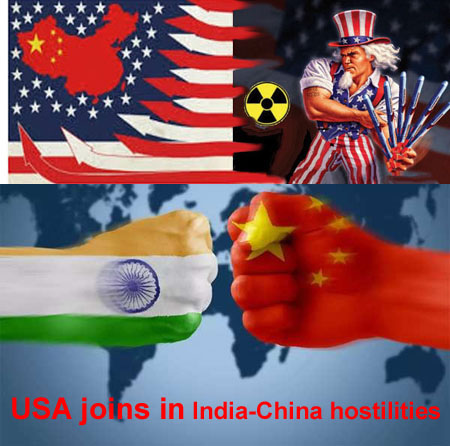
US to take part in military exercise near India’s disputed border with China
By Vedika Sud, Barbara Starr, Sahar Akbarzai and Kathleen Magramo, CNN
Updated 12:29 AM EDT, Sat August 06, 2022
(CNN)The United States is to take part in a joint military exercise with India less than 100 kilometers (62 miles) from the South Asian country’s disputed border with China.
The military drills will be held in mid-October at an altitude of 10,000 feet in Auli in the Indian state of Uttarakhand and will focus on high-altitude warfare training, according to a senior Indian Army officer with knowledge of the matter.
Auli is about 95 kilometers from the Line of Actual Control (LAC), an inhospitable piece of land where the disputed border between India and China is roughly demarcated.
The drills will take place as part of the 18th edition of an annual joint exercise known as “Yudh Abhyas” — or “War Practice”.
Relations between India and China have been strained since a bloody clash between their soldiers in the Himalayas in June 2020 left at least 20 Indian troops and four Chinese soldiers dead…………………….
Asked about the joint exercises, a US Department of Defense spokesperson told CNN that the partnership with India was “one of the most important elements of our shared vision for a free and open Indo-Pacific region.”…………..
Any military provocations between Indian and China could have grave consequences. Both have nuclear weapons……………. more https://amp.cnn.com/cnn/2022/08/06/india/india-us-military-exercise-line-of-actual-control-china-intl-hnk
Nuclear weapons will not bring peace or security, only dangers

We can honour the victims of Hiroshima and Nagasaki by supporting the prohibition treaty, says RAE STREET https://morningstaronline.co.uk/article/f/nuclear-weapons-will-not-bring-peace-or1 6 Aug, 22,
THIS is the month when we commemorate the fearful nuclear bombings of the people of Hiroshima and Nagasaki.
Alas, the myth is still put out that the bombs were dropped to end the second world war. That is not true.
By the time the bomb was ready for use, Japan was ready to surrender. As General Dwight D Eisenhower said, Japan was at that very moment seeking some way to surrender with minimum loss of face, and “it wasn’t necessary to hit them with that awful thing.”
Thus, the bomb on Hiroshima was dropped on August 6 before it was publicly stated that the Japanese had surrendered.
The Soviet Union entered the war in Asia on August 9. Later the same day, the US dropped a second bomb on Nagasaki.
We now know the horrors that nuclear bombs inflict. We have heard from the Hibaksha, the survivors. Now instead of heeding the survivors of those bombs, the Hibaksha, that nuclear weapons should be ended, governments across the world have developed more destructive nuclear bombs.
Britain, part of the US Trident submarine system, carries warheads on multiple missiles, with 15 times the power of the bomb used on Hiroshima.
Proponents of nuclear weapons, including the Nato military alliance, claim that they keep the peace and repeatedly talk of nuclear deterrents.
But the US has the largest nuclear arsenal in the world, and it did not stop the attack on the Twin Towers; nor did Trident stop terrorist attacks in Britain.
What is never mentioned is the death and destruction which has been brought about with the development of nuclear weapons, mainly on indigenous peoples.
This starts with the beginning of the cycle with uranium mining where native people in the US, in Canada, in Australia and the Congo, among others, have been forced into mining.
They and their families have suffered serious illness and even death. Above-ground testing has also brought suffering to native peoples.
After the French testing in the Pacific, mothers gave birth to “jellyfish” babies which died within a few hours. In the US above-ground testing meant that many of the “downwinders,” including the Western Shoshone, became seriously ill.
Although above-ground tests have now ended following the Comprehensive Test Ban Treaty, uranium mining has not ceased.
It continues except for Greenland where the Inuit, now in government, have banned uranium mining.
In 2022, with the war in Ukraine, we are now in more danger than ever before of a further use of nuclear weapons. If ever one of these highly destructive current bombs were exploded either by intent or accident, it would be a worldwide catastrophe.
There would be fires and radioactive fallout and fatal illnesses from acute radiation sickness, cancer and genetic damage which can be passed on to offspring.
At the same time, nuclear fireballs would send up enormous quantities of dust high into the atmosphere, blotting out the sun which would lead to nuclear winter.
And the contaminated ground would be unsuitable for food production leading to food shortages. In effect, if people had not died any other way, they would die of hunger.
Yet our current government not only supports the replacement of Trident but in the Integrated Defence Review increased the cap on Britain’s stockpile for 2025 from 180 to 260.
They even changed the scenario for nuclear use to “emerging technologies that could have a comparable impact,” possibly cyber-attacks but maybe some conventional weapons?
Starmer, once more making himself into a Tory by default, said via his shadow defence minister that Trident was “non-negotiable.”
Even the cost should have made him hesitate on this. It is estimated that the cost in public money — our money — will be £205 billion (and rising) to replace Trident.
And that when working people are struggling and across the world people starve; where we also urgently need funding for the transition from fossil fuels.
Nato too still holds a policy of first use of nuclear weapons and through the US, which has always dominated Nato policy, keeps “nuclear sharing,” weapons on the territory of five states: Belgium, Germany, Italy, the Netherlands and Turkey.
Without any public debate, we now know that nuclear bombs and nuclear capable aircraft are to be brought back to Lakenheath in Suffolk.
But the majority world wants nuclear disarmament. In January 2021, the UN-negotiated Treaty on the Prohibition of Nuclear Weapons came into force which now has 138 signatories — but not the Nato nuclear-armed states which were prevented by Nato.
Sixty-six states have now ratified the treaty. Our government and the Labour Party should be supporting the treaty because nuclear weapons will not bring peace or security, only dangers.
That way we would honour the memory of the victims of Hiroshima and Nagasaki. Our politicians should be looking at how to develop “common security,” putting funding and resources into dialogue and negotiation and respecting the security of everyone.
Hiroshima marks 77th anniversary of atomic bombing amid nuclear threat

By Reito Kaneko Kyodo News. 6 Aug 22, Hiroshima marked the 77th anniversary of its atomic bombing by the United States on Saturday, amid heightened concern in Japan and elsewhere over repeated Russian threats to resort to nuclear weapons amid the war in Ukraine.
Mayor Kazumi Matsui cautioned in a Peace Declaration at a memorial ceremony in the western city that even as civilian lives are being lost in the Russian aggression, reliance on nuclear deterrence is gaining momentum around the world.
“We must immediately render all nuclear buttons meaningless,” he said.
U.N. Secretary General Antonio Guterres was also present at the annual ceremony at the Peace Memorial Park near ground zero, becoming the first U.N. chief to attend since his predecessor Ban Ki Moon in 2010.
Prime Minister Fumio Kishida, who represents a constituency in Hiroshima, decried in his remarks the apparently declining momentum toward a world without nuclear weapons, calling on humanity not to repeat the tragedy of using nuclear weapons……………………………..
The combined number of officially recognized survivors of the two nuclear attacks, known as hibakusha, stood at 118,935 as of March, down 8,820 from a year earlier, the Ministry of Health, Labor and Welfare said. Their average age was 84.53. https://english.kyodonews.net/news/2022/08/5ad7cbefa68e-hiroshima-marks-77th-anniv-of-atomic-bombing-amid-nuclear-threat.html
Needles of Hope in the Ukraine War Haystack — Russian & Eurasian Politics

There recently have emerged small trends that demonstrate, first, that the hot heads are not completely in charge in the East or even in the West, and second, that there may be hope that both sides in the catastrophic Russo-Ukrainian war over NATO expansion can be ended some day in the not too distant future.…
Needles of Hope in the Ukraine War Haystack — Russian & Eurasian Politics
https://gordonhahn.com/2022/08/05/needles-of-hope-in-the-ukraine-war-haystack/ GORDON M. HAHN August 5, 2022,
There recently have emerged small trends that demonstrate, first, that the hot heads are not completely in charge in the East or even in the West, and second, that there may be hope that both sides in the catastrophic Russo-Ukrainian war over NATO expansion can be ended some day in the not too distant future.
First, Lithuania’s extremist attempt to draw a Russian overreaction and bring NATO into the war by setting up a blockade against Russian transport between the Russian ‘mainland’ and its exclave of Kaliningrad was avoided. Reasonable minds in the European Union cajoled Vilnius into abandoning the ban on rail transport, which far exceeds road transport, which remains closed.
Second, by way of Turkey’s mediation, Russia and Ukraine agreed to cooperate in getting Ukrainian grain out to the rest of the world through the Black Sea Fleet, which had been heavily mined by Kiev and largely sealed by the Russian navy. Ukraine will remove its mines, Russia will allow ships through, and ships arriving and returning to Ukraine’s port of Odessa will be searched for weapons.
Third, August 29th saw the renewal of official Russia-US contact in the form of a phone call between Russian Foreign Minister Sergei Lavrov and US Secretary of State Anthony Blinken in which a return to “quiet diplomacy” a discussion regarding the need for talks on prisoner exchanges between Washington, Moscow and presumably Kiev and its Donbass foes. This and any successful overall ceasefire talks in future will require American participation.
Fourth, Ukrainian President Volodomyr Zelenskiy and even more so his team, are looking increasingly desperate, and Russian Telegram channels have seen reports of chatter/rumors of Ukrainian military claims that Kiev will seek an end to the war in late August, because it lacks the fuel and food to get the army and population through the winter. Combine this with Russia’s grinding but successful war of attrition in the east and the likely failure of any Ukrainian offensive towards Kherson or a successful Russian offensive in south towards Mikolaiv and Odessa, and the stage could be set for the renewal of direct ceasefire and peace talks.
Finally, it is possible that the practice and psychological breakthrough of agreements on Kaliningrad, grain exports, and prisoner exchanges will facilitate the renewal of such talks as well as offer lessons on how best to conduct such talks so as to make agreement more possible.
On the other hand, the overall situation remains catastrophic, and it is August. We shall see.
Why Is There More Media Talk About Using Nuclear Weapons Than About Banning Them?
https://fair.org/uncategorized/why-is-there-more-media-talk-about-using-nuclear-weapons-than-about-banning-them/ KARL GROSSMAN, 5 Aug 22,
It’s of critical importance—indeed, existential importance—to the world: the Treaty on the Prohibition of Nuclear Weapons. And a coalition of peace organizations in the United States is charging that media are acting like the treaty “does not exist.”
The Nuclear Ban Treaty Collaborative is waging a campaign to encourage press coverage of the treaty, which, it argues, “provides the only pathway to a safe, secure future free of the nuclear threat” (Oak Ridge Environmental Peace Alliance Newsletter, 6/22).
In the words of the UN, the treaty is “a legally binding instrument to prohibit nuclear weapons, leading towards their total elimination.” It was adopted by the UN General Assembly—with 122 nations in favor—and opened for signature in 2017. It was entered into force in January 2021.
But its provisions only apply to nations which are party to it. Countries with nuclear weapons—including the United States, Russia and China—have not. Instead, “so far, they have refused, boycotted meetings, and even pressured countries not to sign on,” the Federation of American Scientists has noted (FAS, 1/22/09).
Media attention vital
Media attention is vital if the TPNW is to become a reality. But as the Oak Ridge Environmental Peace Alliance (OREPA), a member of the Collaborative, explained in its June newsletter:
The last time the New York Times mentioned the TPNW was October of 2020, when Honduras became the 50th nation to ratify the Treaty, triggering its Entry in Force. In all the coverage of nuclear weapons since then, including a surge since Vladimir Putin invaded Ukraine, the TPNW has not been mentioned once.
National Public Radio has had four significant reports about nuclear weapons in the last three months, including a seven minute report on Sunday, March 27. None of the reports mentioned the TPNW—the last time NPR mentioned it was in January 2021 when it reported on the Treaty’s entry into force, noting it was a significant treaty becoming international law. Since then, crickets.
CNN is marginally better. A search of the website for “nuclear weapons” turns up almost daily reports; but the Treaty on the Prohibition on Nuclear Weapons gets only one mention—an op-ed on May 3 from Ira Helfand, co-president of International Physicians for the Prevention of Nuclear War.
The Collaborative is calling for media to cover the treaty whenever reporting on the threat of nuclear weapons.
Plenty of nuclear talk
Ralph Hutchison, coordinator of OREPA, said in an interview:
What became alarming was that there was a revival of coverage of nuclear weapons after Vladimir Putin made his threat. In all those articles we seemed to be locked into Cold War thinking which ignores the reality that an alternative to “mutually assured destruction” exists: the Treaty for the Prohibition of Nuclear Weapons. And yet there was nothing.
Indeed, according to a search of the Nexis news database, US newspapers have mentioned “nuclear weapons” 5,243 times between February 24, when Putin began talking about their potential use in Russia’s invasion of Ukraine, and August 4. Only 43 of those times included a mention of the treaty; the great majority of these were letters to the editor or opinion columns.
This comes against the backdrop of the Bulletin of Atomic Scientists in 2020 moving its “Doomsday Clock” forward to 100 seconds to midnight, where it has remained through today. It defines midnight as “nuclear annihilation.” This was the closest to midnight the clock has been set at since it was created in 1947 (1/20/22).

“Let’s eliminate these weapons before they eliminate us,” said UN Secretary-General Antonio Guterres at the conclusion in June of a “Political Declaration and Action Plan” for implementation of the TPNW—“important steps,” he said, “toward our shared goal of a world free of nuclear weapons” (UN Press, 6/21/22).
Guterres went on:
Today, the terrifying lessons of Hiroshima and Nagasaki are fading from memory. The once‑unthinkable prospect of nuclear conflict is now back within the realm of possibility…. In a world rife with geopolitical tensions and mistrust, this is a recipe for annihilation.
We cannot allow the nuclear weapons wielded by a handful of states to jeopardize all life on our planet. We must stop knocking at doomsday’s door. The Treaty on the Prohibition of Nuclear Weapons is an important step towards the common aspiration of a world without nuclear weapons.
Can the atomic genie be put back in the bottle? Anything people have done, other people can undo. And the prospect of massive loss of life from nuclear destruction is the best of reasons.
There’s a precedent: the outlawing of chemical warfare after World War I, when its terrible impacts were horrifically demonstrated, killing 90,000. The Geneva Protocol of 1925 and the Chemicals Weapons Convention of 1933 outlawed chemical warfare, and to a large degree the prohibition has held.
As Pope Francis said on a visit to Nagasaki in 2019, in which he condemned the “unspeakable horror” of nuclear weapons: “A world without nuclear weapons is possible and necessary.”
To learn more about or join the Collaborative’s ongoing media activism campaign, please visit https://www.nuclearbantreaty.org/
The lost nuclear bombs that no one can find
The exception to this progress is, of course, nuclear submarines – and even today, there are near-misses.
For Lewis, the fascination with lost nuclear weapons isn’t the potential risks they pose now – it’s what they represent: the fragility of our seemingly sophisticated systems for handling dangerous inventions safely.
“I think we have this fantasy that the people who handle nuclear weapons are somehow different than all the other people we know, make fewer mistakes, or that they’re somehow smarter. But the reality is that the organisations that we have to handle nuclear weapons are like every other human organisation. They make mistakes. They’re imperfect,” says Lewis.
planes carrying nuclear bombs no longer fly around on regular training exercises. “Airborne alerts ended for reasons that must be obvious to us,” he says. “In the end, the decision was made that it was too dangerous.”
The exception to this progress is, of course, nuclear submarines – and even today, there are near-misses.
BBC By Zaria Gorvett, 5th August 2022,
It was a mild winter’s morning at the height of the Cold War.
On January 17, 1966, at around 10:30am, a Spanish shrimp fisherman watched a misshapen white parcel fall from the sky… and silently glide towards the Alboran Sea. It had something hanging beneath it, though he couldn’t make out what it was. Then it slipped beneath the waves.
At the same time, in the nearby fishing village of Palomares, locals looked up at an identical sky and witnessed a very different scene – two giant fireballs, hurtling towards them. Within seconds, the sleepy rural idyll was shattered. Buildings shook. Shrapnel sliced towards the ground. Body parts fell to the earth.
A few weeks later, Philip Meyers received a message via a teleprinter – a device a bit like a fax that could send and receive primitive emails. At the time, he was working as a bomb disposal officer at the Naval Air Facility Sigonella, in eastern Sicily. He was told that there was a top secret emergency in Spain, and that he must report there within days.
However, the mission was not as covert as the military had hoped. “It was not a surprise to be called,” says Meyers. Even the public knew what was going on. When he attended a dinner party that evening and announced his mysterious trip, its intended confidentiality became something of a joke. “It was kind of embarrassing,” says Meyers. “It was supposed to be a secret but my friends were telling me why I was going.”
For weeks, newspapers around the globe had been reporting rumours of a terrible accident – two US military planes had collided in mid-air, scattering four B28 thermonuclear bombs across Palomares. Three were quickly recovered on land – but one had disappeared into the sparkling blue expanse to the south east, lost to the bottom of the nearby swathe of Mediterranean Sea. Now the hunt was on to find it – along with its 1.1 megatonne warhead, with the explosive power of 1,100,000 tonnes of TNT.
In fact, the Palomares incident is not the only time a nuclear weapon has been misplaced. There have been at least 32 so-called “broken arrow” accidents – those involving these catastrophically destructive, earth-flattening devices – since 1950. In many cases, the weapons were dropped by mistake or jettisoned during an emergency, then later recovered. But three US bombs have gone missing altogether – they’re still out there to this day, lurking in swamps, fields and oceans across the planet.
“We mostly know about the American cases,” says Jeffrey Lewis, director of the East Asia Non-proliferation Program at the James Martin Center for Non-proliferation Studies, California. He explains that the full list only emerged when a summary prepared by the US Department of Defense was declassified in the 1980s.
Many occurred during the Cold War, when the nation teetered on the precipice of Mutually Assured Destruction (MAD) with the Soviet Union – and consequently kept airplanes armed with nuclear weapons in the sky at all times from 1960 to 1968, in an operation known as Chrome Dome.
“We don’t know as much about other countries. We don’t really know anything about the United Kingdom or France, or Russia or China,” says Lewis. “So I don’t think we have anything like a full accounting.”
The Soviet Union’s nuclear past is particularly murky – it had amassed a stockpile of 45,000 nuclear weapons as of 1986. There are known cases where the country lost nuclear bombs that have never been retrieved, but unlike with the US incidents, they all occurred on submarines and their locations are known, if inaccessible.
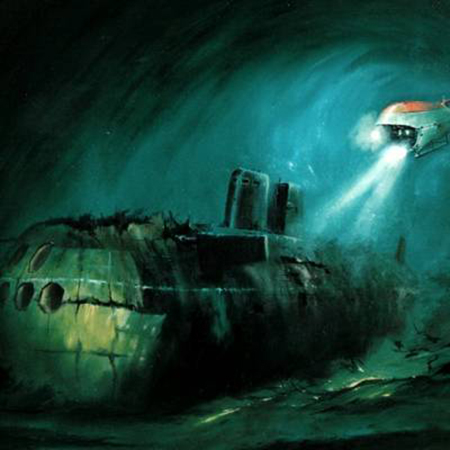
One began on 8 April 1970, when a fire started spreading through the air conditioning system of a Soviet K-8 nuclear-powered submarine while it was diving in the Bay of Biscay – a treacherous stretch of water in the northeast Atlantic Ocean off the coasts of Spain and France, which is notorious for its violent storms and where many vessels have met their end. It had four nuclear torpedoes onboard, and when it promptly sank, it took its radioactive cargo with it.
However, these lost vessels didn’t always stay where they were. In 1974, a Soviet K-129 mysteriously sank in the Pacific Ocean, along with three nuclear missiles. The US soon found out, and decided to mount a secret attempt to retrieve this nuclear prize, “which was really a pretty crazy story in and of itself”, says Lewis.
The eccentric American billionaire Howard Hughes, famous for his broad spectrum of activity, including as a pilot and film director, pretended to become interested in deep sea mining. “But in fact, it wasn’t deep sea mining, it was an effort to build this giant claw that could go all the way down to the sea floor, grab the submarine, and bring it back up,” says Lewis. This was Project Azorian – and unfortunately it didn’t work. The submarine broke up as it was being lifted.
“And so those nuclear weapons would have fallen back to the sea floor,” says Lewis. The weapons remain there to this day, trapped in their rusting tomb. Some people think the weapons remain there to this day, trapped in their rusting tomb – though others believe they were eventually recovered.
Every now and then, there are reports that some of the US’ lost nuclear weapons have been found.
Back in 1998, a retired military officer and his partner were gripped with a sudden determination to discover a bomb dropped near Tybee Island, Georgia in 1958. They interviewed the pilot who had originally lost it, as well as those who had searched for the bomb all those decades ago – and narrowed down the search to Wassaw Sound, a nearby bay of the Atlantic Ocean. For years, the maverick duo scoured the area by boat, trailing a Geiger counter behind them to detect any tell-tale spikes in radiation.
And one day, there it was, in the exact spot the pilot had described – a patch with radiation 10 times the levels elsewhere. The government promptly dispatched a team to investigate. But alas, it was not the nuclear weapon. The anomaly was down to naturally occurring radiation from minerals in the seabed.
So for now, the US’ three lost hydrogen bombs – and, at the very least, a number of Soviet torpedoes – belong to the ocean, preserved as monuments to the risks of nuclear war, though they have largely been forgotten. Why haven’t we found all these rogue weapons yet? Is there a risk of them exploding? And will we ever get them back?
A shrouded object
When Meyers finally got to Palomares – the Spanish village where a B52 bomber came down in 1966 – the authorities were still looking for the missing nuclear bomb……………
Eventually, the parachute was pulling so hard on the line and hook that it simply snapped – sending the nuclear bomb slowly gliding back down towards the bottom. This time, it ended up even deeper than before.
………………… A month later they used a different kind of robotic submarine – a cable-controlled underwater vehicle – to grab the bomb by its parachute directly, and haul it up. It had shifted in its casing, so it couldn’t be disarmed the usual way, via a special port in the side – alarmingly, the officers instead had to cut into the nuclear weapon. “[It would have been] kind of nerve wracking to drill a hole in a hydrogen bomb,” says Meyers. “But they did it. They were prepared to do that.”
A swampy mystery
Unfortunately, the three lost bombs still out there today did not meet with such successful recovery efforts. …………………………………………………
Take the lost Tybee island bomb, which is still lying in silt somewhere in Wassaw Sound. ……………………………..
As it happens, having so many safety features is highly necessary – mostly because they don’t always work. In one case in 1961, a B-52 broke up while flying over Goldsboro, North Carolina, dropping two nuclear weapons to the ground. One was relatively undamaged after its parachute deployed successfully, but a later examination revealed that three out of four safeguards had failed.
In a declassified document from 1963, the then-US Secretary of Defence summed up the incident as a case where “by the slightest margin of chance, literally the failure of two wires to cross, a nuclear explosion was averted”.
The other nuclear bomb fell free to the ground, where it broke apart and ended up embedded in a field. Most parts were recovered, but one part containing uranium remains stuck under more than 50ft (15m) of mud. The US Air Force purchased the land around it to deter people from digging.
Some incidents are so baffling, they almost sound made up. Perhaps one of the most extraordinary occurred when a training exercise on the USS Ticonderoga went badly wrong in 1965. An A4E Skyhawk was being rolled to a plane elevator, while loaded with a B-43 nuclear bomb. It was a disaster in slow-motion – the crew on deck quickly realised that the plane was about to fall off, and waved for the pilot to apply the brakes. Tragically, he didn’t see them, and the young lieutenant, plane and weapon vanished into the Philippine Sea. They’re still there to this day, under 16,000 ft (4,900 m) of water near a Japanese island.
………………………….. A permanent loss
Lewis thinks it’s unlikely that we will ever find the three missing nuclear bombs. This is partly down to the same reasons they weren’t found in the first place.
…………………………………. In 1989, another Soviet nuclear submarine, the K-278 Komsomolets, sank in the Barents Sea off the coast of Norway. Like the K-8, it was also nuclear-powered, and it had been carrying two nuclear torpedoes at the time. For decades, its wreck has been lying under a mile (1.7km) of Arctic water.
But in 2019, scientists visited the vessel – and revealed that water samples taken from its ventilation pipe contained radiation levels up to 100,000 times higher than would normally be expected in sea water. …………
For Lewis, the fascination with lost nuclear weapons isn’t the potential risks they pose now – it’s what they represent: the fragility of our seemingly sophisticated systems for handling dangerous inventions safely.
“I think we have this fantasy that the people who handle nuclear weapons are somehow different than all the other people we know, make fewer mistakes, or that they’re somehow smarter. But the reality is that the organisations that we have to handle nuclear weapons are like every other human organisation. They make mistakes. They’re imperfect,” says Lewis.
Even at Palomares, where all the nuclear bombs that were dropped were eventually recovered, the land is still contaminated with radiation from two that detonated with conventional explosives. Some of the US military personnel who helped with the initial clean-up efforts – involving shovelling the surface of the soil into barrels – have since developed mysterious cancers which they believe are linked. In 2020, a number of survivors filed a class action suit against the Secretary of Veterans Affairs – though many of the claimants are currently in their late 70s and 80s.
Meanwhile, the local community has been campaigning for a more thorough clean-up for decades. Palomares has been dubbed “the most radioactive town in Europe“, and local environmentalists are currently protesting against a British company’s plans to build a holiday resort in the area.
Lewis is confident that losses of the kind that occurred during the Cold War are unlikely to happen again, mostly because operation Chrome Dome was ended in 1968, and planes carrying nuclear bombs no longer fly around on regular training exercises. “Airborne alerts ended for reasons that must be obvious to us,” he says. “In the end, the decision was made that it was too dangerous.”
The exception to this progress is, of course, nuclear submarines – and even today, there are near-misses. The US currently has 14 ballistic missile submarines (SSBNs) in operation, while France and the UK have four each.
To work as nuclear deterrents these submarines must remain undetected during operations at sea, and this means they can’t send any signals to the surface to find out where they are. Instead, they must navigate mostly by inertia – essentially, the crew rely on machines equipped with gyroscopes to calculate where the submarine is at any given time based on where it was last, what direction it was headed and how fast it was travelling. This potentially imprecise system has resulted in a number of incidents, including as recently as 2018 when a British SSBN almost bumped into a ferry.
The era of lost nuclear weapons might not be over just yet.
* Zaria Gorvett is a senior journalist for BBC Future and tweets @ZariaGorvett https://www.bbc.com/future/article/20220804-the-lost-nuclear-bombs-that-no-one-can-find
Does Australia actually need nuclear submarines?

“It’s obvious the real policy is to subsidise the US Navy’s submarine budget. Some will be located in Australia, with Australian flags and personnel, but they’re essentially US boats operated in the US’s great power interests. We’re paying for them to set up part of their current and future fleet in Australia.”
fewer than two of Australia’s eight nuclear submarines would be operationally available, on average, each year. And the cost of the purchases is likely to be stunning, possibly as high as $171 billion……………….. No other country has bought this type.
“Australia could buy 20 high-quality, off-the-shelf, modern submarines for $30 billion.”
influential Australian intelligence and defence officials are ignoring the point that there is no need for Australian submarines to spend much time in China’s waters
Gilligan also warns that the shallow and warm waters around Australia’s north are unsuited to large nuclear submarines.
As experts question the diplomatic, strategic and economic rationale behind Australia’s purchase of nuclear-powered submarines, the gaps in the country’s defensive fleet could be filled by conventional subs. https://www.thesaturdaypaper.com.au/news/politics/2022/08/06/does-australia-actually-need-nuclear-submarines#mtr By Brian Toohey. 6 Aug 22,
In 1992, an Australian Oberon-class submarine entered the crowded waters of Shanghai’s port and became entangled in fishing nets. It had to surface for crew members to cut it free with axes. Chinese Navy sailors witnessed this, but nevertheless the submarine escaped. Had it not, the crew would’ve been imprisoned and Australia widely condemned and potentially convicted for an outrageous breach of international law.
Almost a decade earlier, the Australian Navy had seriously considered scrapping submarines, according to former senior Australian Defence official Mike Gilligan. A study in 1985 had concluded they offered “little marginal benefit to Australia’s defences yet inflict a large marginal cost”. The cost could’ve been much higher given the tremendous risks the government allowed the navy to take, snooping in Chinese and Russian waters on behalf of the Americans, who wouldn’t put their nuclear submarines in danger.
Australia now faces some tough and highly consequential decisions with respect to its fleet. Some experts in the defence field question not only the utility of nuclear-powered vessels but the diplomatic, strategic and economic commitment they entail.
In Washington last month, Defence Minister Richard Marles said Australia, the United States and Britain were moving from “interoperability to interchangeability in defence hardware”. This would effectively mean Australia could not buy high-quality defence equipment from other countries if there was a higher-cost American or British version available. Professor Clinton Fernandes at the UNSW Canberra campus says, “It’s obvious the real policy is to subsidise the US Navy’s submarine budget. Some will be located in Australia, with Australian flags and personnel, but they’re essentially US boats operated in the US’s great power interests. We’re paying for them to set up part of their current and future fleet in Australia.”
Australia has a short and patchy record on submarine purchases. The government acquired many major weapons during World War II. None were submarines. That capability had to wait until the first of a total of six Oberon-class submarines was commissioned in 1967 from a Scottish shipyard. They operated satisfactorily but weren’t considered the nation’s most important military assets.
After Kim Beazley became Defence minister in the Hawke government, he gambled on the value of submarines by ordering six large, battery-powered versions to be built in Adelaide. No other country has bought this type.
The first was commissioned in 1966 and the last in 2003. Called the Collins class, it was based on a good Swedish design. But Beazley greatly increased its size and complexity, partly by adding American equipment that proved completely useless. Maintenance problems drove annual sustainment costs to $670 million. Often only two or three were available at a time, although availability later improved. And none attended the 2010 Rim of the Pacific event – known as Rimpac, the world’s largest international maritime warfare exercise, held biennially near Hawaii.
Former prime minister Scott Morrison and his successor, Anthony Albanese, have taken a much bigger gamble than Beazley did, with their commitment to buy at least eight nuclear attack submarines – almost certainly the American Virginia class. One of the US’s most highly regarded defence analysts, Winslow Wheeler, recently pointed out the Virginia-class subs have been available only 15 times in 33 years for their six-monthly deployments. This suggests fewer than two of Australia’s eight nuclear submarines would be operationally available, on average, each year. And the cost of the purchases is likely to be stunning, possibly as high as $171 billion when accounting for inflation, according to the Australian Strategic Policy Institute, and more recent estimates are above $200 billion. The costliest previous military acquisition, for the Australian Air Force, is the inflation-adjusted $16.6 billion program cost for 72 F-35 fighter jets.
Former submariner, naval consultant and South Australian senator Rex Patrick says, “Australia could buy 20 high-quality, off-the-shelf, modern submarines for $30 billion.”
Patrick also makes the point that nuclear submarines are often “defeated” in exercises by ultra-quiet conventional submarines.
Major new developments are making conventional submarines even more formidable than the nuclear versions. More powerful sensors mean submarines can be detected by the noise they make and by their passage through the Earth’s magnetic field. In addition, nuclear submarines can be detected by the wake they leave at high speeds, as well as the hot water they release from cooling their nuclear reactors, operating loud steam engines and other equipment. In future, submarines may also be detected by blue-green lasers that make the ocean more transparent.
A prize-winning essay published in the US Naval Institute’s magazine Proceedings in June 2018 said the US Navy would do well to consider acquiring “some quiet, inexpensive and highly capable diesel-electric submarines”. Until recently, conventionally powered submarines frequently had to rise close the surface to expose a mast and snorkel to obtain fresh air for their diesel engines to recharge the batteries. This process can be detected by radar.
Most conventionally powered submarines – except Australia’s – use what is called air independent propulsion (AIP), which allows them to remain silent for four to six weeks before snorkelling. That often entails using a hydrogen fuel cell to propel the submarine, but it takes up significant space on the vessel.
In a major change, Japan’s new Taigei-class submarines don’t need AIP because they’re equipped with particularly efficient lithium-nickel-cobalt-aluminium oxide batteries, rather than the lead-acid batteries that the Australian Navy prefers, due in part to the risks of lithium-ion batteries catching fire. Other navies are increasingly confident the new types of battery will prove safe. Hans Ohff, a submarine specialist and visiting fellow at Adelaide University, told The Saturday Paper, “Generally speaking, lithium-ion batteries have a 1.5-times range advantage over lead-acid at lower speeds and an incredible four-times range advantage at high speeds.”
Since the Collins class is due to start retiring in 2026, a replacement is urgently required to help fill the gap until the first nuclear submarine might arrive, near 2045, and the last in 2065. Senator Patrick says the time it takes to do this can be reduced by choosing one of the three available “off-the-shelf” submarines: Japan’s Taigei, which has passed numerous tests demonstrating the safety of its new batteries; Singapore’s Type 218SG, made by Germany’s thyssenkrupp Marine Systems; and the Spanish S-81. The latter two still use conventional lead-acid batteries, but Ohff says a French and German joint venture is under way to develop their own lithium-ion batteries.
These options have advantages and drawbacks. The new Taigei class – of which Japan is acquiring 22 – requires a costly crew of 70 per vessel. The Type 218SG’s German manufacturer is the biggest submarine exporter in the world, with an enviable reputation for low maintenance costs across its range. Extensive automation means it needs only 28 crew members, and the vessel has a longer range than the Taigei’s 12,500 kilometres. Spain’s S-81 has a crew of 32 but a less experienced manufacturer.
With China being the principal concern of Australian diplomatic and defence policymakers, Ohff says the navy will never accept off-the-shelf submarines unless it can “Australianise” them – meaning they must have the range to operate for long periods, many thousands of kilometres away, probably in Chinese waters or nearby. Ohff says the navy’s preferences would take a minimum of 10 years to deliver the first boat and additional two-year intervals for the following boats. He says delivery of a Swedish “Son of Collins” could take nine years.
Patrick says influential Australian intelligence and defence officials are ignoring the point that there is no need for Australian submarines to spend much time in China’s waters: Japan, South Korea, Singapore and Vietnam have high-quality submarines closer to China. The main attraction of nuclear submarines for these officials is they could fire subsonic cruise missiles at land targets in China from more than 1000 kilometres off its coast. However, cruise missiles can be shot down by fighter planes overhead. Once a nuclear submarine fired its missiles, it would be detected and swiftly targeted. Even if it survived, reloading would require the help of a tender – a large depot ship that supplies and supports submarines – probably from the distant base at Fremantle, which recently hosted a reloading for a US nuclear submarine. In any event, an attack on Chinese territory could provoke a heavy counterattack on Australia’s forces or its mainland.
Gilligan says most of the capability offered by submarines is better provided by Australia’s maritime and land-based aircraft. He says submarines, including nuclear ones, are slow compared to aircraft. Technically, a plane could sink a ship off Australia’s west coast in the morning, refuel, then sink another off the east coast in the afternoon. Gilligan also warns that the shallow and warm waters around Australia’s north are unsuited to large nuclear submarines.
Deploying nuclear submarines far from Australia marks a return to the previously discredited doctrine of “forward defence” in South-East Asia that concentrated on a big British naval base in Singapore, which was swiftly overrun by the Japanese in 1942. When this doctrine failed during the Vietnam War, the Coalition government in the late 1960s adopted a “defence of Australia” doctrine, which survived until its recent abandonment. Patrick and other proponents of this latter doctrine expect a revised doctrine would put more emphasis on having medium-sized conventional submarines to help deny hostile forces access to the approaches to Australia, unless they could detect and destroy all the submarines, drones, planes and land-based missiles blocking their way.
Finally, from a defence perspective, much of the planning around nuclear submarines assumes – implausibly – that Chinese and US policies will proceed in a predictable way until past 2060. A purely geopolitical analysis, however, could easily underplay the disruptive role of climate change.
In purely geopolitical terms, the region may become more peaceful or more dangerous. The only urgency for Australia is to forget about nuclear submarines and get some conventionally powered submarines to enhance deterrence.
Washington Is Making the Same Blunder Regarding Taiwan That It Did in Ukraine

y Ted Galen Carpenter Posted on
Tensions between the United States and the People’s Republic of China (PRC) are rising sharply over the Taiwan issue. House Speaker Nancy Pelosi’s stated intention to include a stop in Taipei to meet with Taiwanese officials during her forthcoming trip to East Asia is the latest source of trouble. Pelosi apparently escalated that provocation further by inviting other prominent members of Congress to join her in that stop. Her actions have caused even the staunchly pro-Taiwan Biden administration to quietly press her to change her plans. Conversely, congressional hawks are urging Pelosi not to back down.
The reason for the administration’s caution are readily apparent. Beijing has reacted with unusually intense anger to the prospective visit…………………………
For 4 decades after Washington shifted diplomatic relations from Taipei to Beijing in 1979 and passed the Taiwan Relations Act to govern reduced, informal relations with Taiwan, US administrations were careful to limit visits to the island to low-level officials.
That restraint diminished dramatically during Donald Trump’s presidency, when Congress authorized and the administration approved meetings by National Security Advisor John Bolton and other Cabinet-level officials with their Taiwanese counterparts. Those trips were part of a new policy of much stronger US diplomatic and military support for Taiwan – a course of action that the Biden administration has continued, despite insisting that the United States still adheres to a “one-China” policy.
………. The Biden administration needs to take the PRC’s warnings more seriously. In many ways, Washington’s determination to press ahead with greater support for Taiwan as part of an overall containment policy directed against China is reminiscent of the blunders US officials made with respect to NATO expansion, especially the campaign to incorporate Ukraine, and Washington’s tone-deaf response to Moscow’s escalating complaints.
Biden administration policymakers dismissed the Kremlin’s repeated warnings that trying to make Ukraine a NATO military asset would cross a red line with respect to Russia’s security interests. They discovered belatedly that Russian President Vladimir Putin was not about to cower and accept US diktats simply because the United States insisted that Ukraine had a “right” to join NATO. Nor did he accept Washington’s accelerating campaign to make Ukraine a de facto US military and intelligence ally perched on Russia’s border.
The outcome of Washington’s approach has been horrifyingly bloody and tragic for the people of Ukraine. Even more worrisome, the administration’s policies have led to an extremely dangerous confrontation between NATO and a nuclear-armed Russia, with the United States and NATO cynically using Ukraine as a pawn in a proxy war against Moscow.
Washington risks making a comparable blunder in its dealings with China. The administration must implement a quiet retreat regarding its growing political and military ties to Taipei and adopt a less confrontational approach to Beijing. Moreover, that change needs to go well beyond merely discouraging Pelosi’s provocative visit to Taipei. It has become increasingly obvious to PRC leaders that the United States is pursuing a full-blown anti-China containment policy, with Taiwan as the point of the spear, in a desperate effort to preserve Washington’s fading strategic primacy in East Asia. It is highly unlikely that Beijing will passively accept such an intrusive US presence in China’s core security sphere over the long term. As the PRC’s economic and military power continues to grow, Beijing’s resistance to Washington’s hegemonic efforts will escalate.
US arrogance and inflexibility helped lead to the current tragedy in Ukraine. Policymakers blew through red warning light after red warning light from the Kremlin. A similar approach seems to be taking place in Washington’s relations with Beijing, and it threatens to produce a similar ugly outcome in East Asia over the Taiwan issue.
Ted Galen Carpenter, a senior fellow in defense and foreign policy studies at the Cato Institute, is the author of 13 books and more than 1,100 articles on international affairs. His latest book is Unreliable Watchdog: The News Media and U.S. Foreign Policy (forthcoming, September 2022).
Is Taiwan’s Independence Worth War?
https://original.antiwar.com/buchanan/2022/08/01/is-taiwans-independence-worth-war/ by Patrick J. Buchanan
When a man knows he is about to be hanged in a fortnight, it concentrates his mind wonderfully, said Dr. Samuel Johnson.
If there is any benefit to be realized from the collision between China and the U.S. over Speaker Nancy Pelosi’s proposed trip to Taiwan, it is this: America needs to reflect long and hard upon what it is we will fight China to defend in the Taiwan Strait and South China Sea.
China, after all, is a nuclear-weapons nation with a manufacturing base larger than our own, an economy equal to our own, a population four times ours and fleets of warships larger in number than the US Navy.
An air-naval-and-missile war in the Western Pacific and East Asia would be no cakewalk.
A massive barrage of anti-ship and hypersonic missiles launched by China could cripple and conceivably sink the US carrier Ronald Reagan now in the South China Sea. The Reagan carries a crew of thousands of sailors almost as numerous as the US casualty lists from both Pearl Harbor and 9/11, the worst attacks in and on the US outside of such Civil War battles as Gettysburg and Antietam.
What in East Asia or the Western Pacific would justify such losses?
What would justify such risks?
Since President Richard Nixon’s trip to China, and President Jimmy Carter’s abrogation of the mutual defense treaty with the Republic of China on Taiwan in 1979, the US is not obligated to come to the defense of Taiwan against China, which claims that island the size of Maryland as “part of China.”
Our military posture has been one of “strategic ambiguity.” We will not commit to go to war to defend Taiwan, nor will we take the war option off the table if Taiwan is attacked.
But if the US went to war to defend Taiwan, what would it mean?
We would be risking our own security and possible survival to prevent from being imposed on the island of Taiwan the same regime lately imposed on Hong Kong without any US military resistance.
If Hong Kong, a city of 7 million, can be transferred to the custody and control of Beijing without resistance from the US, why should it be worth a major US war with China to prevent that same fate and future from befalling 23 million Taiwanese?
The retort comes instantly.
Allow China to take Taiwan without US resistance, and our treaties to fight for the sovereignty, independence and territorial integrity of Japan, South Korea, the Philippines, Australia and New Zealand become suspect.
Belief in the US commitment to fight for the nations of East Asia and the Western Pacific would dissipate. The entire architecture of Asian defense against Communist China could disintegrate and collapse.
If we allowed Taiwan to be taken by China without intervening, it is argued, the value of US commitments to fight to defend scores of allies in Europe and Asia would visibly depreciate. US credibility would suffer a blow as substantial as the loss of South Vietnam in 1975.
The fall of Saigon was followed by the loss of Laos and Cambodia to communism, the overthrow of the shah, the Iranian hostage crisis, the Soviet invasion of Afghanistan, the strategic transfer of Ethiopia, Angola, Mozambique, Nicaragua and Grenada to the Soviet bloc, and the rise of Euro-communism on the Old Continent.
Pelosi’s prospective visit to Taiwan, and the bellicose reaction of Beijing, should raise other relevant questions.
If this should lead to a U.S.-China war, what would we be fighting for? And what would victory look like?
A restoration of the status quo ante? Permanent independence for Taiwan, which would require a new and permanent war guarantee by the US and a new U.S.-Taiwan defense pact?
Would a permanent commitment to fight to defend Taiwan from China be acceptable to an American people weary of commitments and wars?
Again, why would we risk our own peace and security for Taiwan’s freedom and independence, when we would not risk our own peace and security for the freedom or independence of Hong Kong?
And after our victory in the Taiwan Strait, how would we secure indefinitely the independence of that nation of 23 million from a defeated power of 1.4 billion, bitter and bristling at its loss?
Consider: China, in this 21st century, has grown massively, both militarily and economically, and in both real and relative terms, at the expense of the United States.
Nor are the growth trends for China, with four times as many people as there are Americans, favorable to the USA.
What guarantees are there that 2025 or 2030 will not bring a more favorable balance of power for China in what is, after all, their continent, not ours?
Unlike in the Cold War, time is not necessarily on the side of the United States and its allies when all three of the nuclear powers in East Asia – China, Russia, North Korea – are hostile to the USA.
Patrick J. Buchanan is the author of Churchill, Hitler, and “The Unnecessary War”: How Britain Lost Its Empire and the West Lost the World. To find out more about Patrick Buchanan and read features by other Creators writers and cartoonists, visit the Creators Web page at www.creators.com.
1 This Month





PLEASE OPPOSE HR 8255 AND S.3639 – bills would accelerate satellite deployment, with no environmental review or safeguards – https://ncstd5li.quorum.us/campaign/169331/
To see nuclear-related stories in greater depth and intensity – go to https://nuclearinformation.wordpress.com
-
Archives
- October 2026 (29)
- September 2026 (339)
- August 2026 (330)
- July 2026 (355)
- June 2026 (287)
- May 2026 (306)
- April 2026 (356)
- March 2026 (251)
- February 2026 (267)
- January 2026 (308)
- December 2025 (358)
- November 2025 (359)
-
Categories
- 1
- 1 NUCLEAR ISSUES
- business and costs
- climate change
- culture and arts
- ENERGY
- environment
- health
- history
- indigenous issues
- Legal
- marketing of nuclear
- media
- opposition to nuclear
- PERSONAL STORIES
- politics
- politics international
- Religion and ethics
- safety
- secrets,lies and civil liberties
- spinbuster
- technology
- Uranium
- wastes
- weapons and war
- Women
- 2 WORLD
- ACTION
- AFRICA
- Atrocities
- AUSTRALIA
- Christina's notes
- Christina's themes
- culture and arts
- Events
- Fuk 2022
- Fuk 2023
- Fukushima 2017
- Fukushima 2018
- fukushima 2019
- Fukushima 2020
- Fukushima 2021
- general
- global warming
- Humour (God we need it)
- Nuclear
- RARE EARTHS
- Reference
- resources – print
- Resources -audiovicual
- Weekly Newsletter
- World
- World Nuclear
- YouTube
-
RSS
Entries RSS
Comments RSS

