US launches nuclear-capable Minuteman III in routine test
Key points:
- The nuclear-capable Minuteman III was launched from Vandenberg Space Force Base in California
- The US Air Force said the test launch was not the result of current world events.
- President Joe Biden’s administration said it would continue to carry out routine operations in the Taiwan Strait ………………………………………………………… more https://www.abc.net.au/news/2022-08-17/us-tests-minuteman-iii-missile-/101340370
Nuclear war between two nations could spark global famine
A pall of smoke from burning cities would engulf Earth, causing worldwide crop failures, models show. https://www.nature.com/articles/d41586-022-02219-4Alexandra Witze 15 Aug 22.
Even a small conflict in which two nations unleash nuclear weapons on each other could lead to worldwide famine, new research suggests. Soot from burning cities would encircle the planet and cool it by reflecting sunlight back into space. This in turn would cause global crop failures that — in a worst-case scenario — could put 5 billion people on the brink of death.
“A large percent of the people will be starving,” says Lili Xia, a climate scientist at Rutgers University in New Brunswick, New Jersey, who led the work. “It’s really bad.”
The research, published on 15 August in Nature Food1, is the latest in a decades-long thought experiment about the global consequences of nuclear war. It seems especially relevant today as Russia’s war against Ukraine has disrupted global food supplies, underscoring the far-reaching impacts of a regional conflict.
Scenarios big and small
Nuclear war comes with a range of lethal impacts, from killing people directly in atomic blasts to the lingering effects of radiation and other environmental pollution. Xia and her colleagues wanted to look at the consequences farther afield from the scene of war, to explore how people all around the planet could also suffer.
They modelled how climate would change in various parts of the world following a nuclear war, and how crops and fisheries would respond to those changes. The scientists analysed six war scenarios, each of which would put different amounts of soot into the atmosphere, and drop surface temperatures from anywhere between 1 and 16 °C. The effects could linger for a decade or more.
A nuclear war between India and Pakistan, perhaps triggered over the disputed Kashmir region, could loft between 5 million and 47 million tonnes of soot into the atmosphere, depending on how many warheads were deployed and cities destroyed. A full-out nuclear war between the United States and Russia could produce 150 million tonnes of soot. The globe-encircling pall would persist for years until the skies eventually cleared.
Using data from the United Nations’ Food and Agriculture Organization, Xia’s team calculated how declining crop yields and fishery catches after a nuclear war would affect the number of calories available for people to eat. The scientists studied several options, such as whether people continued to raise livestock or whether they routed some or all crops meant for livestock to humans instead. The study assumed there would be some repurposing of biofuel crops for human consumption, and people would cut back on or eliminate food waste. It also assumed that international trade would stop as countries chose to feed people within their own borders rather than exporting food.
Xia notes that the study relies on many assumptions and simplifications about how the complex global food system would respond to a nuclear war. But the numbers are stark. For even the smallest war scenario, of an India–Pakistan conflict that results in 5 million tonnes of soot, calorie production across the planet could drop by 7% in the first five years after the war.
In a 47-million-tonnes-of-soot scenario, global average calories drop by up to 50%. In the worst case of a United States–Russia war, calorie production drops by 90% three to four years after the war.
‘Let’s move to Australia’
The nations most affected would be those at mid to high latitudes, which already have a short season for growing crops and which would cool more dramatically after a nuclear war than tropical regions would. The United Kingdom, for instance, would see sharper drops in food available than a country such as India that is located at lower latitudes. But France, which is a major exporter of food, would fare relatively well — at least in the lower-emission scenarios — because if trade were halted, it would have more food available for its own people.
Another less-affected nation is Australia. Isolated from trade in the wake of a nuclear war, Australia would rely mainly on wheat for food. And wheat would grow relatively well in the cooler climate induced by atmospheric soot. On the team’s map showing large portions of the world coloured red, for starvation, Australia gleams an untouched green, even in the severe war scenarios. “The first time I showed my son the map, the first reaction he had is ‘let’s move to Australia,’” Xia says.
The study is a useful step towards understanding the global food impacts of a regional nuclear war, says Deepak Ray, a food-security researcher at the University of Minnesota in Saint Paul. But more work is needed to accurately simulate the complex mix of how crops are produced around the world, he says. For instance, the research took into consideration national crop production numbers, but reality is much more nuanced, with different crops being grown in different regions of a country for different purposes.
Nuclear war might seem less of a threat than it did during the cold war, but there are still nine countries with more than 12,000 nuclear warheads among them. Understanding the potential consequences of nuclear war in detail could help nations better assess the risks.
“It is rare to happen — but if it happens, it affects everyone,” Ray says. “These are dangerous things.”
doi: https://doi.org/10.1038/d41586-022-02219-4
References
Inside Lockheed Martin’s Sweeping Recruitment on College Campuses

Our investigation found this unfettered recruiting access to be part of a deeper and growing enmeshment between universities and the defense industry.
at many college STEM programs around the country have become pipelines for weapons contractors.
if you’re an engineering student at Georgia Tech, Lockheed is omnipresent.
Reader Supported News, Indigo Olivier/In These Times 14 august 22
To a casual observer, the Black Hawk and Sikorsky S-76 helicopters may have seemed incongruous landing next to the student union on the University of Connecticut’s pastoral green campus, but this particular Thursday in September 2018 was Lockheed Martin Day, and the aircraft were the main attraction.
A small group of students stood nearby, signs in hand, protesting Lockheed’s presence and informing others about a recent massacre.
Weeks earlier, 40 children had been killed when a Saudi-led coalition air strike dropped a 500-pound bomb on a school bus in northern Yemen. A CNN investigation found that Lockheed — the world’s largest weapons manufacturer — had sold the precision-guided munition to Saudi Arabia a year prior in a $110 billion arms deal brokered under former President Donald Trump.
Back in Storrs, Conn., Lockheed, which has a longstanding partnership with UConn, appeared on campus to recruit with TED-style talks, flight simulations, technology demos and on-the-spot interviews. A few lucky students took a helicopter flight around campus.
UConn is among at least a dozen universities that participate in Lockheed Martin Day, part of a sweeping national effort to establish defense industry recruitment pipelines in college STEM (science, technology, engineering, and mathematics) programs. Dozens of campuses nationwide now have corporate partnerships with Lockheed and other weapons manufacturers.
Lockheed is the country’s single largest government contractor, producing Black Hawks, F-35 fighter jets, Javelin anti-tank systems and the Hellfire missiles found on Predator drones. With more than 114,000 employees, the company depends on a pool of highly skilled and highly specialized workers, complete with the ability to obtain proper security clearances when needed. In its most recent annual report, Lockheed tells investors, “We increasingly compete with commercial technology companies outside of the aerospace and defense industry for qualified technical, cyber and scientific positions as the number of qualified domestic engineers is decreasing and the number of cyber professionals is not keeping up with demand.”
Lockheed has hired more than 21,000 new employees since 2020 to replace retiring workers and keep up with turnover. Student pipelines are integral to the company’s talent acquisition strategy.
As tuition costs and student debt have skyrocketed, Lockheed has enticed students with scholarships, well paid internships and a student loan repayment program. When the pandemic made in-person recruitment more difficult, Lockheed expanded its virtual outreach — after one 2020 virtual hiring event, the company reported a 300% increase in offers and a 400% increase in job acceptances among the STEM scholarship program participants over the previous year.
And in a self-described effort to diversify its workforce and build an inclusive culture, Lockheed has also put new focus on financial support and recruitment at historically Black colleges and universities.
Lockheed’s recruitment efforts are intertwined with various types of “research partnerships.” Universities receive six- and seven-figure grants from Lockheed and other defense contractors — or even more massive sums from the Department of Defense — to work on basic and applied research, up to and including designs, prototypes and testing of weapons technology. A student might work on Lockheed-sponsored research as part of their course load, then intern over the summer at Lockheed, be officially recruited by Lockheed upon graduation and start working there immediately, with defense clearances already in place — sometimes continuing the same work. In 2020, Lockheed reported that more than 60% of graduating interns became full-time employees.
Lockheed is not alone among corporations or military contractors in its aggressive university outreach, but the expansive presence of private defense companies on campuses raises questions about the extent to which corporations — particularly those profiting from war — should influence student career trajectories. In April, student and community protesters at Tufts University shut down a General Dynamics recruiting event, then protested outside a Raytheon presentation later that month, chanting, “We see through your smoke and mirrors. You can’t have our engineers.”
Illah Nourbakhsh, an ethics professor at Carnegie Mellon University with a background in robotics, presents the question this way: “If you have a palette of possible futures for students, and you take some possible future, and you make it so shiny and exciting and amazing by pouring money on the marketing process of it that it overcomes any possible marketing done by alternatives that are more socially minded — do the kids have agency? Is it a fair, balanced field?
“Of course not.”
Lockheed did not respond by deadline to requests for comment on this article.
For more than a year, In These Times investigated the presence of Lockheed and other arms manufacturers on campuses, combing through company and university annual reports, IRS filings, LinkedIn profiles, budgets, legislative records and academic policies, as well as interviewing students and professors. Most students requested pseudonyms, indicated with asterisks*, so as not to adversely impact their career prospects. Several spoke positively of Lockheed.
“It’s probably what most engineers, especially in mechanical and aerospace who want to go into defense prospects, aspire to,” says Sam*, who graduated with a bachelor’s in aerospace engineering in December 2021. “They’re one of the biggest defense contractors in this country, so you have the opportunity to work on very state-of-the-art technology.”
Other students believe putting their skills to military use is unethical.
Alan*, a December 2021 graduate in electrical engineering at the University of West Florida who is currently job-hunting while living with his parents, says he’s not looking at defense contractors and is instead holding out for a position that allows him to leave the Earth better than he found it. “When it comes to engineering, we do have a responsibility,” he says. “Every tool can be a weapon. … I don’t really feel like I need to be putting my gifts to make more bombs.”
Located near the world’s largest Air Force base in the Florida panhandle, the University of West Florida regularly hosts recruiters from the defense industry, including Lockheed. Alan says companies like Lockheed set up tables in student buildings to recruit in the hallways.
“I just walked past those tables,” he says, “but sometimes they’ll call you over. It’s kind of like going to the mall, and people want you to try their soap. It’s kind of annoying, but I get that they always need new people.”
Our investigation found this unfettered recruiting access to be part of a deeper and growing enmeshment between universities and the defense industry.
Decades of state disinvestment in public higher education have converged with a growing emphasis on sponsored research, and in an era of ballooning student debt, the billions in annual defense spending prop up university budgets and subsidize student educations. The result is that many college STEM programs around the country have become pipelines for weapons contractors……………………………….
Cameron Davis, who graduated from Georgia Tech with a bachelor’s in computer engineering in 2021, says, “A lot of people that I talk to aren’t 100% comfortable working on defense contracts, working on things that are basically going to kill people.” But, he adds, the lucrative pay of defense contractors “drives a lot of your moral disagreements with defense away.”
In 2019 and 2021, Lockheed was the university’s largest alumni employer, and the company has been one of Georgia Tech’s most frequent job interviewers since at least 2002.
“Even in my field — which isn’t even as defense-adjacent as aerospace engineering or mechanical engineering — companies like Raytheon will have dedicated programs to recruit people,” says Davis. “I’ve been in line with other companies at a career fair and defense contractors literally walk up to me in line and be like, ‘Hey, do you want to talk about helicopters or something?’”
“The corporate presence at Georgia Tech is a little bit overwhelming at times,”……………………………………….
THE MILITARY’S STUDENT RESEARCHERS
Clifford Conner recalls his freshman year at Georgia Tech, in 1959, when the school was still segregated. He studied experimental psychology. When graduation approached, his professors — who also worked in the Lockheed Corporation’s Marietta office just north of Atlanta — said they could help him get a job at Lockheed. Conner accepted.
His work on the wing design of the C-5 Galaxy, then the largest military cargo plane in the world, took him to England, where he began reading a lot about the war in Vietnam. “I wasn’t under the spell of the American press,” Conner says. After a few years with Lockheed, he quit and joined the antiwar movement.
It took him another year to find a job at about a third of the salary he was making at Lockheed.
Conner went on to become a historian of science and a professor at the CUNY School of Professional Studies. His most recent book, The Tragedy of American Science: From Truman to Trump (2020), explores how the STEM fields have moved away from improving the human condition to advancing corporate and defense interests. He writes about the Bayh-Dole Act, which removed public-licensing restrictions in 1980 and “opened the floodgates to corporate investors seeking monopoly ownership of innovative technology.” The law allowed universities and nonprofits to file patents on projects funded with federal money, from weapons to pharmaceuticals. The rationale was to encourage commercial collaboration and underscore the idea that federally funded inventions should be used to support a free-market system.
“After the Bayh-Dole Act, the lines between corporate, university and government research were all blurred,” Conner tells In These Times.
Conner went on to become a historian of science and a professor at the CUNY School of Professional Studies. His most recent book, The Tragedy of American Science: From Truman to Trump (2020), explores how the STEM fields have moved away from improving the human condition to advancing corporate and defense interests. He writes about the Bayh-Dole Act, which removed public-licensing restrictions in 1980 and “opened the floodgates to corporate investors seeking monopoly ownership of innovative technology.” The law allowed universities and nonprofits to file patents on projects funded with federal money, from weapons to pharmaceuticals. The rationale was to encourage commercial collaboration and underscore the idea that federally funded inventions should be used to support a free-market system.
“After the Bayh-Dole Act, the lines between corporate, university and government research were all blurred,” Conner tells In These Times.
Georgia Tech’s applied research division, known as the Georgia Tech Research Institute (GTRI), now has four laboratories directly on Lockheed’s aeronautics campus in Marietta……………………………………
publicly available CVs, résumés and job listings for student researchers at GTRI explicitly detail work on weapons technology……………………………
Unlike Europe, the United States does not provide universities with general funding to support basic research, or “research for the sake of research.” A 2019 analysis by the American Association for the Advancement of Science, for example, notes, “on average, one-third of R…D in OECD countries” is funded by “government block grants used at the discretion of higher education institutions” — but the United States does not have the same mechanism.
U.S. appropriations to public higher education, meanwhile, have declined significantly in the past two decades, while the research environment has seen universities performing an ever-larger share of the nation’s technology research. The Defense Department has been the third-largest source of federal research and development funding to universities for decades (after the Department of Health and Human Services and the National Science Foundation).
But universities also seek out private-sector money to fund research directly, and the defense sector has been a willing donor.
In recent years, Lockheed has partnered with a network of more than 100 universities to advance hypersonics technology — weapons traveling so fast they’re undetectable by radar — and signed master research agreements for multi-year collaborations with Purdue, Texas A…M and Notre Dame in 2021.
While delivering technological innovations to defense companies, these partnerships also double as employment pipelines. The University of Colorado Boulder has collaborated on space systems with Lockheed for nearly two decades. In a statement on the university’s website, one Lockheed executive (and school alum) writes, “Lockheed Martin employs about 56,000 engineers and technicians, 35% of which could retire in the next few years. We must keep up a ‘talent pipeline’ to fill this pending gap: currently, our major source of talent is CU-Boulder.”
SADDLED WITH DEBT
Nearly half of the nation’s discretionary budget goes toward military spending; of that money, one-third to one-half goes to private contractors, according to a 2021 analysis by military researcher William Hartung for Brown University’s Costs of War Project.
Today, 46 million Americans hold student debt totaling $1.7 trillion, which is the projected lifetime cost to U.S. taxpayers of Lockheed’s F-35 fighter jet program — the most expensive weapon system ever built………….
Lockheed is among a growing number of companies that offer student loan assistance to its employees. The company’s Invest In Me program offers incoming graduates a $150 monthly cash bonus for five years and a student loan refinancing program. Every year, Lockheed awards $10,000 scholarships to 200 students that may be renewed up to three times for a potential $40,000. Lockheed also lists 61 universities participating in its STEM scholarship program, projected to invest a minimum of $30 million over five years as part of a larger $460 million education and innovation initiative using gains from Trump’s 2017 corporate tax cuts.
In a 2015 survey by American Student Assistance, 53% of respondents said student debt was either a “deciding factor” or had a “considerable impact” on their career choice.
“Pushing people into higher education has been our labor policy,” explains Astra Taylor, a writer, filmmaker and co-founder of the Debt Collective, a debtors’ union with roots in Occupy Wall Street. “You’re indebting yourself for the privilege of being hired, and it gives companies this economic power because then they can say, ‘We can help relieve some of the economic pain that you’ve incurred to make yourself appealing to us.’”
Raytheon, Northrop Grumman and Boeing all provide some form of student aid, such as scholarships and tuition reimbursement.
DIVERSIFYING WEAPONS MAKING
The private defense sector targets much of its financial support toward historically Black colleges and universities (HBCUs) and students from minority groups as part of stated efforts toward workforce diversity and promoting STEM jobs among a demographic that is critically underrepresented in STEM fields. Lockheed’s website and annual report note that minority groups are the “fastest-growing segment in the labor market” and that recruitment through “internships, early talent identification, outlying educational programs, co-ops, apprenticeships and pre-apprenticeships” is integral to building diverse employee pipelines.
This trend stirs up old controversies around military recruiting in communities of color.
The Army has long targeted minority-majority high schools and HBCUs with its Reserve Officers’ Training Corps programs and scholarships, to the extent that critics refer to it as a school-to-soldier pipeline. Without enlisting and the ensuing funding, many students wouldn’t receive a higher education. According to a 2016 report from the Brookings Institution, Black students hold an average of $7,400 more in student debt than their white counterparts upon graduating — a gap that widens to nearly $25,000 four years later. The Army leverages students’ predicaments to meet its recruiting goals.
Regardless, “the racial implications” of U.S. military actions “are hard to evade,” civil rights activist and Rep. John R. Conyers Jr. (D-Mich.) said at the outset of the Iraq War in 2003. “Would this be happening to [the Iraqis] if they were not nonwhite?” A Gallup poll at the time found 7 in 10 Black Americans opposed the war, while 8 in 10 white Americans favored it.
……………………………… Lockheed has started STEM education and recruiting initiatives at 20 minority serving institutions (MSIs), including 16 HBCUs. Of Lockheed’s 2021 scholarship recipients, 60% identified with a minority racial or ethnic group. In the 2020 to 2021 academic year, more than 40% of Lockheed’s early-career hires identified as people of color, with 450 coming from MSIs.
“Students who work in these spaces don’t know the gravity — are systematically made ignorant of the gravity — of participating in these systems,” says Myers……………………………………..
“You said that the CEO was an advocate for women and minorities,” a student organizer says during a recruitment presentation. “How does she maintain that role as head of a company that produces weapons which bomb and kill women and children in places like Palestine, Yemen, Libya and the Middle East?”
The recruiter responds: “I have no idea.”
MONEY TALKS
Ultimately, Lockheed’s deep reach into higher education reflects national priorities.
Since 9/11, the United States has spent $8 trillion on war. In 2020, for the first time, federal funding to Lockheed surpassed that of the U.S. Department of Education, the federal agency tasked with dispensing scholarships and Pell grants. Biden requested $813 billion in defense spending for fiscal year 2023, which includes the largest-ever allocation for research and development.
“Of course it’s the defense industries that have the ability to offer these favorable terms to people, because they’re also parasites on the public purse,” Astra Taylor says. “If these students weren’t worried about the cost of college, would they be as apt to take a job at a defense contractor versus doing something else in their community?”
Conner doesn’t fault students for taking jobs in the defense industry. “[They] realize that if they’re going to get a job when they graduate, it’s going to be at one of these places. And they can protest all they want, but they’ve got to be the spearpoint of a larger protest that involves the whole society.”
https://www.rsn.org/001/inside-lockheed-martins-sweeping-recruitment-on-college-campuses.html—
Seventy-five years after the U.S. atomic bombings of Japan, we remain perched on the precipice of unparalleled catastrophe.
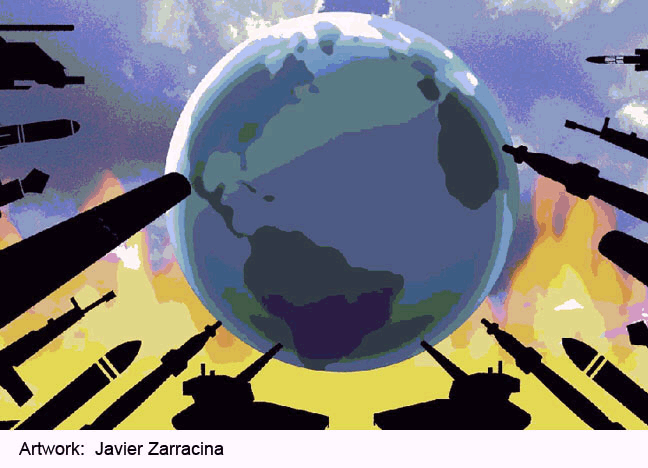
Seventy-five years after the dawn of the nuclear age, we are as ready as ever to extinguish ourselves. The human race is clearly an evolutionary aberrant on a suicidal mission.
The Lessons We Haven’t Learned, The Progressive Magazine, BY HELEN CALDICOTT, AUGUST 3, 2020

In truth, the U.S. Department of Defense is a misnomer; it is actually the Department of War, Death, and Suicide. Hundreds of billions of dollars of U.S. taxpayer money are spent annually by corporations such as Lockheed Martin, Boeing, BAE Systems, and Raytheon Technologies Corporation to create and build the most hideous weapons of destruction.
Brilliant people employed by these massive corporations, mostly men, are deploying their brainpower to devise better and more hideous ways of killing.
”……………………………… What rained down on those two Japanese cities seventy-five years ago was destruction on a scale never seen before or since. People exposed within half a mile of the atomic fireball were seared to piles of smoking char in a fraction of a second as their internal organs boiled away. The small black bundles stuck to the streets and bridges and sidewalks of Hiroshima numbered in the thousands.
A little boy was reaching up to catch a red dragonfly with his hand against the blue sky when there was a blinding flash and he disappeared. He turned into gas and left his shadow behind on the pavement, a haunting relic later moved to the Hiroshima Museum. A woman was running while holding her baby; she and the baby were turned into a charcoal statue.
In all, about 120,000 people were killed immediately by the two bombs, and tens of thousands more died later due to radiation exposure.
In 1957, when I was eighteen, I read a book by Nevil Shute, an English novelist who ended up in Australia. On the Beach described how the city of Melbourne awaited a deadly cloud of radiation from a nuclear war that was triggered by an accident in the northern hemisphere, killing everything. Men drank their last gin and tonics in the Melbourne Club while the government dispensed cyanide capsules so parents could kill their children quickly to avoid the agonizing symptoms of radiation poisoning.
At the time, I was in medical school, where I learned about radiation biology—the classic experiments of Hermann J. Muller, who in the 1920s irradiated Drosophila fruit flies inducing genetic mutations and morphological abnormalities. Concurrently, the United States and the Soviet Union were testing nuclear weapons in the atmosphere, bombarding huge populations with radioactive fallout.
In my naiveté, I couldn’t understand what these men thought they were doing because the mutagenic and carcinogenic effects of ionizing radiation were well known in scientific circles. Madame Curie had died of aplastic anemia secondary to radium, an alpha emitter polluting her bones; her daughter died of leukemia, and many of the early radiologists who exposed themselves randomly to X-rays died from malignancies.
Einstein wrote: “The unleashed power of the atom has changed everything save our modes of thinking and we thus drift toward unparalleled catastrophe.” Robert Oppenheimer, watching the world’s first nuclear explosion in Alamogordo, New Mexico, in 1945, muttered to himself, “I am become death, the destroyer of worlds” from the Hindu scripture, the Bhagavad Gita.
The scientists knew that they had discovered the seeds of human destruction.
In my naiveté, I couldn’t understand what these men thought they were doing because the mutagenic and carcinogenic effects of ionizing radiation were well known in scientific circles. Madame Curie had died of aplastic anemia secondary to radium, an alpha emitter polluting her bones; her daughter died of leukemia, and many of the early radiologists who exposed themselves randomly to X-rays died from malignancies.
Einstein wrote: “The unleashed power of the atom has changed everything save our modes of thinking and we thus drift toward unparalleled catastrophe.” Robert Oppenheimer, watching the world’s first nuclear explosion in Alamogordo, New Mexico, in 1945, muttered to himself, “I am become death, the destroyer of worlds” from the Hindu scripture, the Bhagavad Gita.
The scientists knew that they had discovered the seeds of human destruction.
A nuclear “exchange” between these two superpowers would take little over one hour to complete. A twenty-megaton bomb (the equivalent of twenty million tons of TNT) would excavate a hole three-quarters of a mile wide and 800 feet deep, converting all buildings and people into radioactive fallout that would be shot up in the mushroom cloud. Within six miles in all directions every living thing would be vaporized. Twenty miles from the epicenter, huge fires would erupt, as winds of up to 500 miles per hour would suck people out of buildings and turn them into missiles traveling at 100 miles per hour. The fires would coalesce, incinerating much of the United States and causing most nuclear power plants to melt down, greatly exacerbating radioactive fallout.
Potentially billions of people would die hideously from acute radiation sickness, vomiting, and bleeding to death. As thick black radioactive smoke engulfed the stratosphere, the Earth would, over time, be plunged into another ice age—a “nuclear winter,” annihilating almost all living organisms.
Seventy-five years after the dawn of the nuclear age, we are as ready as ever to extinguish ourselves. The human race is clearly an evolutionary aberrant on a suicidal mission. Our planet is in the intensive care unit, approaching several terminal events.
Will we gradually burn and shrivel life on our wondrous Earth by emitting the ancient carbon stored over billions of years to drive our cars and power our industries, or will we end it suddenly by creating a global gas oven?
The International Energy Agency said recently that we only have six months left to avert the effects of global warming before it is too late. Earlier this year, the Bulletin of the Atomic Scientists moved its Doomsday Clock to 100 seconds to midnight, the closest it’s ever been.
In truth, the U.S. Department of Defense is a misnomer; it is actually the Department of War, Death, and Suicide. Hundreds of billions of dollars of U.S. taxpayer money are spent annually by corporations such as Lockheed Martin, Boeing, BAE Systems, and Raytheon Technologies Corporation to create and build the most hideous weapons of destruction.
President Donald Trump is right when he says we need to make friends with the Russians, for it is Russian bombs that might well annihilate the United States. Indeed, we need to foster friendship with all nations and reinvest the trillions of dollars spent on war, killing, and death, saving the ecosphere by powering the world with renewable energy including solar, wind, and geothermal, and planting trillions of trees.
Such a move would also free up billions of dollars that could be reallocated to such purposes as providing free medical care for all U.S. citizens, along with free education, housing for the homeless, and care for those with mental illness.
The United States needs to rise to its full moral and spiritual height and lead the world to sanity and survival. I know this is possible because, in the 1980s, millions of wonderful people rose up, nationally and internationally, in opposition to the arms race and the Cold War.
But what is the present reality in the United States?
There are 450 Minuteman III missiles operational on the Great Plains—in Montana, North Dakota, and Wyoming. In each missile silo are two missileers, who control and launch the missiles which contain one or two hydrogen bombs. Planes armed with hydrogen bombs stand ready to take off at any moment, and nuclear submarines silently plow the oceans ready to launch.
Both the United States and Russia have nuclear weapons targeted at military facilities and population centers. Nuclear war could happen at any time, by accident or design. The late Stephen Hawking warned in 2014 that artificial intelligence, now being deployed by the military, could become so autonomous that it could start a nuclear war by itself.
This threat is largely ignored by politicians and the mainstream media, who continue to practice psychic numbing as we stumble blindly toward our demise.
How come the physicists, engineers, and military personnel who have laced the world with nuclear weapons ready to launch never factored into their equations the probability that an immature, petulant man-baby could hold the trigger for our destruction in his hands? https://progressive.org/magazine/the-lessons-we-havent-learned-caldicott/
More shelling near Ukraine nuclear plant
The Advocate, By Natalia Zinets, August 16 2022,
Ukrainian and Russian-installed officials have reported shelling near Europe’s largest nuclear power plant, with both sides blaming each other days after the world nuclear watchdog warned of disaster if the fighting does not stop.
Russia and Ukraine have traded accusations this month regarding the Zaporizhzhia nuclear plant in southern Ukraine, which dominates the south bank of a vast reservoir on the Dnipro River……………………………
Nuclear experts fear fighting might damage the plant’s spent fuel pools or reactors…………………………………………
Reuters could not immediately verify battlefield reports. https://www.theadvocate.com.au/story/7862092/more-shelling-near-ukraine-nuclear-plant/?cs=5—
How even small nuclear war would kill billions in apocalyptic famine
https://www.9news.com.au/national/even-small-nuclear-war-would-kill-billions-from-famine/0aadd094-e5be-471f-8278-b8bf485f759a By Mark Saunokonoko • Senior Journalist Aug 16, 2022,
Australia may be the best place in the world to shelter if nuclear war broke out, a study has predicted, although an “influx of refugees” from Asia and other regions would likely rush the country to try and survive the atomic holocaust.
Various apocalypse scenarios showed even a small nuclear war would cause devastating climate chaos, plunging the world into mass famine and starving billions to death.
The study estimated more than 2 billion people would die from a contained nuclear war between India and Pakistan, while more than 5 billion around the world would perish inside two years if the US and Russia launched thousands of nukes at each other.
Nuclear strikes on major cities and industrial areas would unleash massive firestorms, the peer-reviewed study said, injecting soot into the atmosphere, blocking sunlight from reaching the Earth’s surface and severely limiting food production.
Such catastrophic “soot loadings” would cause at least 10-15 years of disruption to global climate, researchers said.
As land and ocean food production faltered, and in the face of worsening hunger, the study said food exporting countries such as Australia would hunker down and hoard supplies.
“Wherever there’s scarcity, you start to see more conflicts,” Dr Ryan Heneghan, a co-author of the study from Queensland University of Technology, told 9news.com.au.
“Whether that makes Australia a (post-nuclear war) target, I don’t know.”
Being a food exporter and its location in the southern hemisphere, away from likely conflict zones, were the key factors that meant Australia was able to weather a nuclear catastrophe better than most, Heneghan said, with New Zealand not far behind.
“Australia has some resilience if there were drops in food productivity because of changes in climate caused by a nuclear war,” he said.
“We already produce more than enough food for our population.”
But waves of migrants would inevitably put “pressures” on any Australian stockpiles.
One factor not included in the models, but which could seriously affect Australia’s ability to cope, was the country’s lack of domestic fuel supplies, Heneghan said.
“Australia isn’t energy independent.
“So we would probably have shortages of fuel.”
Australia, the planet’s sixth largest country after Russia, Canada, China, the US and Brazil, would face huge challenges trying to transport food from agricultural heartlands into big, densely populated urban centres, he said.
“Even though we might make enough food, we might not be able to move it to where it needs to go,” he said, calling that a “big caveat” to the study’s models.
Researchers modelled the impacts of six atmospheric soot-injection scenarios, based on one week of nuclear war, on crop and fish supplies and other livestock and food production.
Even if humans reduced food waste reduction and began to eat crops grown primarily as animal feed and biofuel, researchers predicted livestock and aquatic food production could not compensate for reduced crop output in most nations.
Any nuclear weapon detonation that produces more than 5 teragrams (5 trillion grams) of soot, such as 100 warheads fired between India and Pakistan, would likely cause mass food shortages in almost all countries, the study said.
A nuclear war between the US and Russia could send more than 150 teragrams of soot into the stratosphere.
The bushfires that swept across Australia in 2019-20 generated 0.3 – 1 teragrams of smoke, which swirled around the world and lingered for many months.
US ‘on brink’ of war with Russia and China – Kissinger
A lack of visionary leadership is to blame, the veteran statesman says, Rt.com 13 Aug 22
Former US Secretary of State Henry Kissinger has told the Wall Street Journal that Washington has rejected traditional diplomacy, and in the absence of a great leader, has driven the world to the precipice of war over Ukraine and Taiwan.
Kissinger previously courted controversy for suggesting that Kiev abandon some of its territorial claims to end the conflict with Russia.
“We are at the edge of war with Russia and China on issues which we partly created, without any concept of how this is going to end or what it’s supposed to lead to,” Kissinger said in the interview, published on Saturday.
Kissinger, now 99 years old, elaborated on the West’s role in the Ukraine conflict in a recent book profiling prominent post-WWII leaders. He described Russia’s decision to send troops into the country in February as motivated by its own security, as having Ukraine join NATO would move the alliance’s weapons to within 300 miles (480km) of Moscow. Conversely, having Ukraine in its entirety fall under Russian influence would do little to “calm historic European fears of Russian domination.”
“We are at the edge of war with Russia and China on issues which we partly created, without any concept of how this is going to end or what it’s supposed to lead to,” Kissinger said in the interview, published on Saturday.
Kissinger, now 99 years old, elaborated on the West’s role in the Ukraine conflict in a recent book profiling prominent post-WWII leaders. He described Russia’s decision to send troops into the country in February as motivated by its own security, as having Ukraine join NATO would move the alliance’s weapons to within 300 miles (480km) of Moscow. Conversely, having Ukraine in its entirety fall under Russian influence would do little to “calm historic European fears of Russian domination.”
In the runup to its military operation in Ukraine, Russia presented the US and NATO with written outlines of its security concerns, which were rejected by both receiving parties.
Kissinger, who in the late 1960s and early 1970s held extensive negotiations with Vietnamese communists even as the US military waged war against them, said that modern American leaders tend to view diplomacy as having “personal relationships with the adversary,” and in words paraphrased by the Wall Street Journal, “tend to view negotiations in missionary, rather than psychological terms, seeking to convert or condemn their interlocutors rather than to penetrate their thinking.”
Instead, Kissinger argued that the US should seek “equilibrium” between itself, Russia, and China.
This term refers to “a kind of balance of power, with an acceptance of the legitimacy of sometimes opposing values,” Kissinger explained. “Because if you believe that the final outcome of your effort has to be the imposition of your values, then I think equilibrium is not possible.” ………………………… more https://www.rt.com/news/560780-henry-kissinger-ukraine-taiwan/
Connecting Toxic Memories: Hiroshima and Nuremberg
the NATO Three had the temerity to issue a joint statement expressing their total opposition to the approach taken by the so-called Ban Treaty (TPNW), declared it was their intention to continue to rely on nuclear weapons to meet their far-flung security needs broadly specified to include geopolitical deterrence, that is, not only is this weaponry not being limited to the defense of homelands but vital strategic concerns that could potentially arise anywhere on the planet. At present, this commitment to nuclearism is illustrated by the U.S. posture in response to the Ukraine War and the future of Taiwan, as well as by revealing refusal even to accept a No First Use framework of restraint.
What was most controversial about the [Nuremberg] trials was the failure to inquire into the violations of international criminal law by the winning side, which is why these tribunals, however conscientious their work, have been derided over the years as glaring instances of ‘victors’ justice.’
CounterPunch, BY RICHARD FALK, 12 Aug 22,
77 Years After Hiroshima and Nagasaki
Peace activists around the world often choose August 6th and 9th each year to grieve anew the human suffering and devastation caused by dropping atomic bombs on the undefended Japanese cities of Hiroshima and Nagasaki, which lacked military significance. Among other things these atomic attacks were ‘geopolitical crimes’ of ultimate terror, with scant combat justification, and intended mainly as a warning to Soviet leaders not to defy the West in the peace diplomacy at the end of World War II.
These August dates marking the utter destruction of these two cities are treated as events giving rise to what has been widely known as the nuclear age. This awful beginning can never be forgotten or redeemed, although ever since the explosions in 1945 the solemnity of these occasions has been overshadowed outside of Japan by widespread fears that a nuclear war might occur at some point and a quiet rage continues to build around the world that the nuclear weapons states, above all the U.S., have stubbornly defiantly refused to take steps to fulfill pledges to seek a reliable path to nuclear disarmament in good faith.
This moral and political pledge became legally obligatory in Article VI of the Nuclear Nonproliferation Treaty (1970), a commitment affirmed unanimously in an Advisory Opinion of the International Court of Justice in 1996. It has become clear that for the security establishments of the ‘NATO Three’ (U.S. France, UK) this disarmament commitment was never more than ‘a useful fiction’ that conveyed the sense that the non-nuclear states were being given something valuable and commensurate to the willingness to give up their conditional option to underpin national security by acquiring nuclear weapons (as Russia and China, as well as Israel, India, Pakistan, and North Korea have done over the decades).
The non-nuclear Parties to the NPT are not formally obliged to give up their option of acquiring nuclear weapons unconditionally. Article 10 confers on all Parties to the NPT a right of withdrawal if “extraordinary events..have jeopardized the supreme interests of its country.” In practice, as Iran is finding out, this right of withdrawal gives way to the geopolitical priorities of an enforcement regime presided over by the United States. The so-called Jerusalem Declaration signed in July by U.S. and Israel leaders commits to using whatever military force is necessary to prevent Iran from acquiring nuclear weaponry.
NPT Review Conference at the UN
Currently the NPT Review Conference, postponed since 2020 because of COVID, at UN Headquarters in New York City, two significant contradictory developments dominated the scene. It was the first such meeting of NPT Parties since the Treaty of Prohibition of Nuclear Weapons (TPNW) came into force in early 2021. This treaty, a project of governments from the Global South in active coalition with Global Civil Society has drawn a bright line between the majority views of the peoples of the world and the security elites of these nine nuclear weapons states.
This impasse between the nuclear haves and have-nots amounts to an existential confirmation of ‘nuclear apartheid’ as the precarious and self-serving underpinning of global security unless and until the advocates TPNW muster enough strength and will to mount a real challenge to such a hegemonic and menacing concentration of unaccountable power and discretionary authority.
New Patterns of Geopolitical Rivalry Increase Risks of Nuclear War
The second notable development at the NPT Review Conference lent a sense of immediacy and urgency to what had become 77 years after Hiroshima a somewhat abstract concern is the Ukraine War, and its geopolitical spillover effect of heightening the perceived risks of the use of nuclear weaponry and even the danger of nuclear war. The U.S. has decided it is worth challenging Russia’s attack on Ukraine sufficiently to uphold its strategic logic that since the end of the Cold War the world has political space for one extraterritorial state, which became the sole supplier of global governance when it comes to the international security agenda. Among other things, unipolarity meant that Cold War Era mutual respect for territorial spheres of influence on the borders of Great Powers no longer are pillars of stable geopolitical coexistence. After the Soviet collapse in 1992 the U.S. has acted as if entitled to implement a Monroe Doctrine for the world. To make such a grandiose hegemonic political destiny credible it has shouldered the immense economic and strategic burdens that accompany the role, maintaining hundreds of foreign military bases and naval fleets in every ocean.
NATO’s insistence early in the Ukraine War on making Russia pay for its invasion by being again reduced to the normalcies of territorial sovereignty was undoubtedly intended to be a master class for the benefit of Russia, and especially China, in the geopolitics of the post-Cold War world. It also provided an occasion to send China, currently the more formidable adversary of the West, a message written with the blood of Ukrainian lives, that any show of force to regain control over Taiwan will be met an even more punitive response, including thinly veiled threats that pointedly refuse to rule out uses of nuclear weapons. Pentagon war games some months ago ominously showed that China would prevail in any military encounter in the South China Seas unless the U.S. was prepared to cross the nuclear threshold. This assessment should be affirming the renewed strategic relevance of nuclear weaponry. It has proven helpful in making the case for even larger military appropriations from Congress.
American diplomacy toward China has aggravated an already inflammatory context by some inexplicably provocative behavior in recent months. First came a gratuitous public pronouncement by Biden last May while in Asia to provide whatever military assistance was deemed necessary to protect Taiwan if under attack by China. And secondly, a totally destabilizing August visit to Taiwan by Nancy Pelosi at a time of already high tensions. These provocations violated the spirit of the Shanghai Communique that was issued by China and the U.S. in 1972………………………………………………………………………………….
What was most controversial about the [Nuremberg] trials was the failure to inquire into the violations of international criminal law by the winning side, which is why these tribunals, however conscientious their work, have been derided over the years as glaring instances of ‘victors’ justice.’
My interest in the connections between Hiroshima and Nuremberg is somewhat different. The insensitivity of such a high profile signing of this agreement on August 8th establishing the Nuremberg Tribunal is appalling. It occurred during the very days of the atomic bombings, arguably the worst crime of World War II at least on a par with the Holocaust. It is more than insensitivity, it is moral numbness, which prepares political actors, whether states, empire, or leaders, to embrace past crimes and commit future crimes. It leads directly to such features of world order as a geopolitical right of exception at the UN by way of the veto and impunity with respect to accountability procedures. In effect, the UN is designed quite literally to give assurances that the most dangerous states, as of 1945, are jurisprudentially protected forever from any adverse Security Council decision as to criminal acts, at least within the UN System.
What is this slightly disguised feature of legality and legitimacy conveying to a curious observer? That law and accountability are relevant for propaganda and punishment against Great Power adversaries, and that the wrongs of victors in major wars are beyond scrutiny but those of the vanquished and weak are to be judged in what amounts to ‘show trials’ because of this core failure to treat equals equally.
There is yet something else to reflect upon. If August 8th had been a different day that of infamy because an English or American city had been targeted by a German atomic bomb and yet Germany still lost the war, the act and the weapon would have been criminalized at Nuremberg and by subsequent international action. We might not be still living with this weaponry if the perpetrators of those dreadful events of August 6th and 9th had been the losers in World War II, which makes the rightly celebrated defeat of fascism on balance a somewhat questionable long-term victory for humanity.
77 years later it seems worth pondering allow this long repressed relationship between Hiroshima and Nuremberg in the context of the recent irresponsible heightening of geopolitical tensions with Russia and China.
Richard Falk is Albert G. Milbank Professor Emeritus of International Law at Princeton University, Chair of Global law, Queen Mary University London, and Research Associate, Orfalea Center of Global Studies, UCSB. https://www.counterpunch.org/2022/08/12/connecting-toxic-memories-hiroshima-and-nuremberg/
Ukraine targets Russian soldiers accused of threatening nuclear plant
ABC News, 15 Aug, 22
Key points:
- Ukraine accused Russia of deliberately hitting the nuclear power plant in a section that powers energy to the south of Ukraine
- The International Atomic Energy Agency has warned of a nuclear disaster unless fighting between forces stops
- Kyiv says it’s planning a counteroffensive to recapture Zaporizhzhia and neighbouring Kherson provinces…………………………………………………..
Ukraine Plant Under Fire Showcases ‘Dangerous’ Nature of Nuclear Power, Experts Say
“Having reactors in a war zone is a nightmare waiting to become a grim reality,” said one critic.

https://www.commondreams.org/news/2022/08/08/ukraine-plant-under-fire-showcases-dangerous-nature-nuclear-power-experts-say KENNY STANCIL, August 8, 2022 Critics of atomic energy on Monday described the shelling of the Zaporizhzhia power station in southeastern Ukraine as “a warning that nuclear power plants are a liability, not an asset, especially under extreme conditions of war or climate change.”
While Kyiv and Moscow continue to trade blame for recent strikes on the largest nuclear power plant in Europe, advocates at Beyond Nuclear emphasized that regardless of who is at fault, damage to the six-reactor site could have deadly consequences “far beyond the war zone.”
“If even just one of the six operational reactors there suffered catastrophic damage and released its radioactive inventory we are talking about a humanitarian disaster that would dwarf Chernobyl,” Linda Pentz Gunter, international specialist at Beyond Nuclear, said in a statement.
Radioactive contamination from that 1986 nuclear accident in what is now Ukraine rendered an area of more than 1,000 square miles uninhabitable and caused the illnesses and deaths of potentially hundreds of thousands of people.
According to Beyond Nuclear, reactors at Zaporizhzhia “contain far more radioactivity, both in the working reactors and in the irradiated fuel pools, than was present at the relatively new Chernobyl Unit 4 when it exploded.”
“This situation brings home all too alarmingly just how dangerous nuclear power is as an energy source,” said Gunter. “We would not be having this conversation if we were dealing with solar panels or wind turbines.”
“The potential to cause a catastrophic accident even on a good day should have been enough to end the use of this technology,” she added. “Having reactors in a war zone is a nightmare waiting to become a grim reality.”
Beyond Nuclear is not alone in sounding the alarm about the dire consequences that could materialize following damage to Zaporizhzhia or any other nuclear power plants now at risk in Ukraine.
Last week, Shaun Burnie, senior nuclear specialist with Greenpeace, told Democracy Now! that “nuclear plants are extremely vulnerable to external attack in the context of a war zone.” He added, “You’re looking at potential massive releases of radioactivity, potentially even greater than Chernobyl.”
Buildings housing nuclear reactors are not designed to withstand missile attacks nor extreme weather events. In March 2011, a massive earthquake and tsunami led to a loss of power in three reactor buildings at Fukushima Daiichi in Japan, with calamitous results. As the fossil fuel-driven climate crisis supercharges storms, nuclear infrastructure is increasingly vulnerable to damage of that sort.
This is not the first time that nuclear engineers at Zaporizhzhia have found themselves under military assault. Russian shelling of the facility in early March sparked a fire.
None of the reactor buildings or fuel storage sites were affected then. “But after more than five months of fighting,” Beyond Nuclear explained Monday, “the site has become more perilous, given its proximity to the eastern regions that are at the heart of contention between the two countries.”
“The risk of fire is one of the most serious hazards at nuclear power plants on a routine basis,” said Paul Gunter, reactor oversight specialist at Beyond Nuclear. “A fire at Zaporizhzhia could spread to the irradiated fuel storage pools located outside primary containment and lead to explosions and meltdowns.”
“If the fuel pools are damaged and cooling water boils away, exposing the highly radioactive rods to air, we could see hydrogen explosions and the spread of radioactivity far worse than occurred at Fukushima,” he continued.
Winds would distribute radioactive gases across Europe and, depending on the scale of the disaster, beyond, potentially reaching as far away as the United States. A Greenpeace analysis published earlier this year warned that severe damage to Zaporizhzhia could render large swaths of Europe “uninhabitable for decades.”
Radioactive fallout from the facility could subject tens of millions of people to chronic or fatal health problems, with the effects of exposure lasting for years on end.
Thirty-six years after Ukraine’s first nuclear disaster, “people still living in Chernobyl-contaminated areas are showing increases in cardiovascular disorders, issues with sight and respiration, and significantly increased rates of birth defects and deformities,” said Cindy Folkers, radiation and health hazards specialist at Beyond Nuclear.
“Given the far greater amounts of radiation that could be released in the event of a major disaster at Zaporizhzhia, we would expect to see greater numbers of people seriously harmed and for far longer than the health impacts caused by Chornobyl,” Folkers said.
The real death count for Hiroshima and Nagasaki was at least 210,000 – and more later.
The real death count for Hiroshima and nagasaki was 210,000 It was not 15,000 for Hiroshima and 74,000 for Nagasaki. That does not reflect birth defects, or other health effects we now know, are part of nuclear bomb fallout
The Atomic Bombings of Hiroshima and Nagasaki: A Summary of the Human Consequences, 1945-2018, and Lessons for Homo sapiens to End the Nuclear Weapon Age
Masao Tomonaga Pages 491-517 | Received 01 Sep 2019, Accepted 02 Oct 2019, Accepted author version posted online: 13 Nov 2019, Published online: 02 Dec 2019
ABSTRACT
Seventy-four years have passed since the atomic bombings of Hiroshima and Nagasaki. Approximately 210,000 victims died, and another 210,000 people survived. The damage to their health has continued, consisting of three phases of late effects: the appearance of leukemia, the first malignant disease, in 1949; an intermediate phase entailing the development of many types of cancer; and a final phase of lifelong cancers for hibakusha who experienced the bombing as a child, as well as a second wave of leukemia for elderly hibakusha and psychological damage such as depression and post-traumatic stress disorder. Thus, the human consequences of the atomic bombings have not ceased; many people are still dying of radiation-induced malignant diseases. Therefore, it is too early to finalize the total death toll. Hibakusha have faced a never-ending struggle to regenerate their lives and families under the fear of disease. As the only group of Homo sapiens experiencing real nuclear attacks, hibakusha have continued to engage in a lifelong movement to eliminate nuclear weapons. Political leaders, especially of nuclear-weapon states, must learn the wisdom of the hibakusha to save Homo sapiens from possible global extinction by nuclear war.
Introduction
The first nuclear weapon was detonated in New Mexico on 16 July 1945. That test explosion was soon followed by the wartime use of two atomic bombs on Hiroshima and Nagasaki on August 6 and 9, respectively. This opened the nuclear weapon age in the history of humanity. In the long history of wars and weapons, Homo sapiens had finally gained an ultimate weapon of mass destruction capable of obliterating itself……………………………….
Immediate Death and Early Lethal Consequences of the Bombings
Death-rate
Under the two gigantic mushroom clouds, approximately 280,000 citizens in Hiroshima and 240,000 in Nagasaki were suddenly thrown into chaos and agony. A total of approximately 140,000 in Hiroshima (Hiroshima 1971) and 73,000 in Nagasaki (Nagasaki, 1977) died instantaneously or within five months due to the combined effects of three components of physical energy generated by nuclear fissions: blast wind (pressure), radiant heat, and ionizing radiation. A total of more than 210,000 remaining victims, 140,000 in Hiroshima and 74,000 in Nagasaki, survived the first five months of death and agony and became hibakusha (Figure 1 on original).
A curve of death rates calculated in the aftermath by the surviving medical staff and students of Nagasaki Medical College showed almost 100% in residents living within a 500-meter radius of ground zero; 90% within 1,000 meters; 50% within1,500 meters; and 10% within 2,000 meters, making a clear concentric figure (Figure 2) (Shirabe 2006). Later the death-rate curve of Hiroshima was compared with Nagasaki’s, revealing that two curves were very similar, as if two scientific experiments were conducted. Among areas within 1,000 meters, the Nagasaki Medical School Hospital was exceptional – The death rate in the facility was as low as 43%. This is obviously because of the shielding effect of the thickest concrete walls of the hospital buildings.
Figure 2. [on original] Death rates by distance from ground zero in the first three months in areas of Nagasaki city.
The residents of both cities were mostly noncombatant civilians, including many women and children. Military combatants were only a minority. There were fewer adult males than females, and most of the males worked at military arsenals. Many young men went to war in the later stages of World War II. Young students were employed by military arsenals located close to ground zero; that increased the number of victims.
Citizens were suddenly thrown into firestorms at home, factories, and schools; on open roads or on ground; in automobiles and trams; and in city offices, hospitals, pharmacies, fire stations, and almost all city structures.
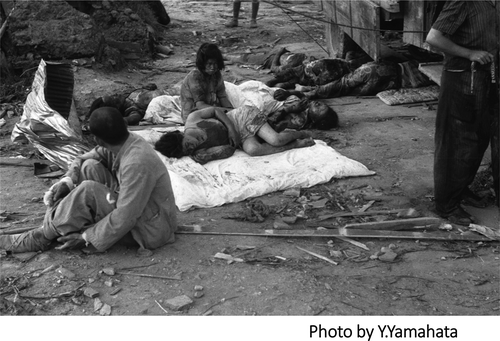
Many survivors spent the night on the road or the ground (Figure 3). Subsequently, many severely injured victims were forced to remain where they survived the first strike without being provided any meaningful medical treatment. Most of them died there.
Figure 3. The second morning after Nagasaki bombing.
……………………………….. In areas within 1 kilometer of ground zero, human bodies without any shielding, namely in open air on the roads and ground, were instantaneously squeezed by the blast wind (pressure) against walls, causing multiple fractures of skeletons and ruptures of the abdominal cavity causing escape of colons. Many people in open roads and grounds were carbonized by the direct effect of heat rays within 1.0 km from ground zero (Figure 7, Photo A). Many residential areas full of Japanese houses were crushed by the wind and burned out in which many victims were also burned to white bones (Figure 7, Photo B). The skin of people on open roads or grounds within 0.5–1.5 km were deeply flash-burned due to heavy heat rays. The skins were soon peeled off because of necrosis in the deep skin layer (For an example of a boy whose back was entirely burned, see Figure 8). With large areas of skin peeling off, people suffered severe pain and bleeding.
Figure 7. Body effects by heat rays and fire burn (1).
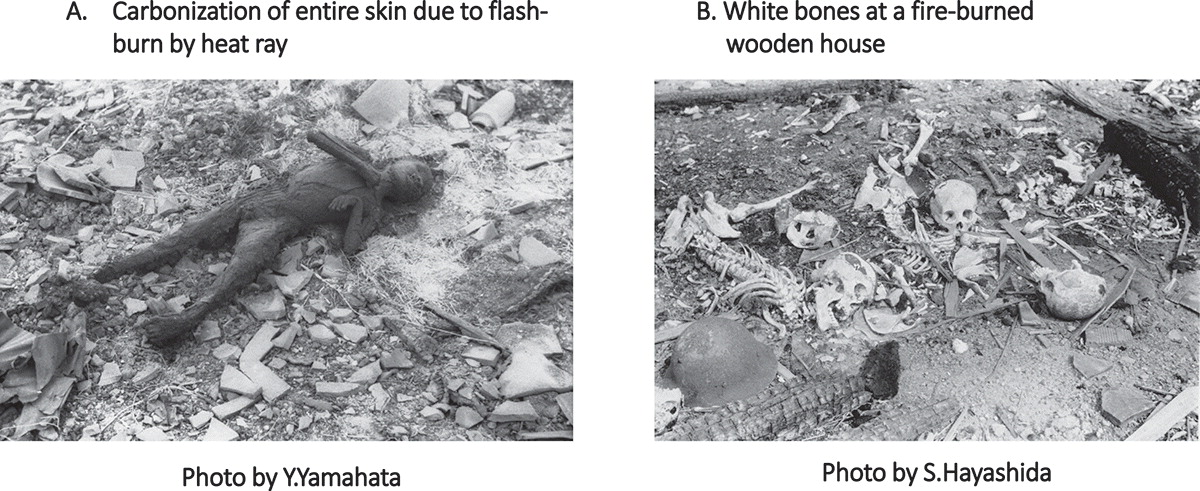
Figure 7. Body effects by heat rays and fire burn (1).

In three months after the bombing, these deep skin flash burns began to heal. However, with tissue being regenerated, keloid was quite often formed as shown in Figure 9. It was charcterized by marked thickening of the wounds, sometimes resembling cancerous proliferation of the skin.
Figure 9. Keloid formation after a severe flash burn by heat rays.

Thus many residential areas full of Japanese wooden houses were crushed and burned. The firestorms that continued over to next day finally flattened city areas within a 4 km radius. According to the saddest memory of some survivors, the blast wind tore off the heads of babies who were being carried on their mothers’ backs in the traditional Japanese way. Most of the mothers also died soon.
At the same time, the victims were irradiated by 100 grays (Gy)1 or more of combined gamma and neutron rays generated by nuclear fissions (Figure 6). Thus it could be possible to say that they were killed in three ways at once.
The people within 1 km of ground zero who finally survived were mostly those who were working inside a concrete building with thick walls or in a basement. Some other survivors were inside private air-raid shelters or military arsenals set in large shelters. Heat rays were effectively blocked by the walls, and radiation and blast were partially shielded before victims were exposed, thus allowing them to survive. But there were only a few hundred of these people. Many of those who survived at various proximal points were severely injured by debris and pieces of glass from damaged houses, heated and irradiated simultaneously. Many of them died within the first three months.
Struggle for Survival
Medical rescue teams perished and hospitals were all destroyed on the first day of the bombing. It therefore was impossible to find any meaningful medical aid. The situation was much severer in Hiroshima where over 90% of medical staffs, doctors, nurses, and pharmacists were dead. The Nagasaki Medical College Hospital, the largest and strongest concrete buildings in Nagasaki City, located 600 meters from ground zero, did provide fairly good shielding effects; the death rate was a relatively as low as 43%. Subsequently 900 lives in total – approximately half of the total number of professors, doctors, nurses and medical students were lost in the entire college facility including the hospital. Most of those who survived were severely injured by the blast wind and heat ray. The hospital had completely ceased to function. Within a few days, medical staffs and medical students who had survived opened first-aid stations around the margin of flattened areas.
n the late afternoon on the first day, several rescue trucks arrived carrying medical teams consisting of military doctors and nurses from Omura Navy Hospital, located 45 km north of Nagasaki City. They brought back approximately 700 severely injured victims, most of them severely burned, to the hospital and started treatment for burns and injuries consisting of bone fractures, cuts from pieces of glass, and embedding of debris and pieces of glass fragments deep in the skin. This number was very small compared to the total number of victims who suffered severe injuries, estimated to be approximately 30,000 in Nagasaki. A few hundred victims out of 700 were able to survive, thanks to intensive care at Omura Navy Hospital. They were indeed lucky people.
Several small rescue teams started their clinical activities within a few days. Some surgical operations were performed for those who had severe fractures due to the blast wind. There was no good treatment for severe skin burn, especially those cases with wide areas of skin burn. There were no stocks of drugs such as antibiotics and frozen blood plasma. Only oil and ointment were used. Even drip infusions of water and electrolytes such as salts and glucose (sugar) were not available in such small ambulatory facilities.
As a result of this lack of care, many survivors who were alive on the first and second days began to die due to severe bleeding from injuries such as severe fractures, dislocations, abdominal ruptures, thoracic punctures, and scalp and brain damage and also from dehydration and lack of adequate food supplies.
Initial Difficulty in Recognizing Radiation Effects
In the early days after the atomic bombings, many doctors had difficulty in identifying the symptoms of radiation-related ailments. There was no information about the nature of this new type of bomb. They did not even know that the bombs were nuclear and that radiation was dangerous to human beings. …………………………………………………………………………………….
Late Effects of Atomic Bombings: 1948–2018
About 270,000 victims of Hiroshima and Nagasaki finally recovered their health. They had to start their new daily life with a serious shortage of food and other necessities. After spending three years of recovery with relatively good health, hibakusha encountered the first malignant disease: leukemia. It is classified as the earliest occurring malignant disease due to atomic-bomb radiation because it was clearly distinguished from the disorders caused by ARS. Therefore, leukemia was the first malignant disease derived from cells injured by initial radiation exposure; the cells then transformed to malignant leukemia cells. This earliest delayed, or “late”, effect was followed by many kinds of cancer of various organs. Thus, the late effect spans an extremely long period.
First Malignant Disease Observed as the Earliest Late Effect of Atomic Bombings
Leukemias
In 1949, doctors in Hiroshima and Nagasaki began to recognize a gradual increase in the number of hibakusha patients, including children, suffering from leukemia. The excess annual rate of leukemia continued to rise until 1955 and then continued at an elevated level for more than 10 years (Figure 12) (Gunz and Henderson 1974). Acute and chronic types of leukemia both were observed.
These leukemias were later analyzed in detail when the first dosimetry system (DS65) became available. A clear radiation-dose dependency was revealed as a curve that elevated exponentially (called quadratic) from 100 millisieverts (mSv) at around 2.0 km from ground zero to more than 4 Gy at around 1.0 km (Figure 13 on original). Dose is thus inversely proportional to the square of the distance. Total leukemia incidence was four to five times higher than the control group of Nagasaki citizens not exposed to the bombing (Preston et al. 1996).
……………………………. People who were children under the age of 10 at the time of the bombings are now in their seventies. Some of them suffer from MDS. The increase in MDS among childhood survivors indicates that the massive irradiation of the whole body injured blood cells in bone marrow, and that these cells have survived more than 70 years in the bodies of hibakusha, and finally resulted in leukemia-inducing gene abnormality. MDS patients occasionally develop acute leukemia 3–5 years after the first diagnosis, and mostly die. Therefore, it can be said that atomic bomb is still killing some hibakusha even after more than a half century……………………..
Intermediate to Life-long Delayed Effects of Exposure to Atomic-bomb Radiation
Cancers
Around 1960, the incidence of solid cancers began to rise gradually. The elevated cancer incidence lasted for a long time (Ozasa 2016). It peaked around the year 2000 and remained at that level until now. The types of cancer that appeared include lung, breast, thyroid, stomach, colon, liver, skin, and bladder. ……………………………………….
In-utero Radiation Exposure
Microcephaly
In both Hiroshima and Nagasaki, many pregnant women were exposed to various doses of radiation. Miscarriages and malformation of newborn babies were frequently observed, but there were no good statistics showing radiation-dose effect. Some mothers who were in the early prenatal period at the time of the bombing sometimes bore babies who had a small head. The babies later became mentally disabled. There were 62 such babies recorded among 1,470 (Otake and Schull 1998). The larger the dose to the mother’s uterus was, the higher the incidence of microcephalic babies, suggesting high-dose radiation interrupted brain development. This is the most obvious phenomenon observed among fetuses exposed to radiation in utero.
Cancers
In-utero exposed babies were later found to have an increased risk of cancer development during their early adulthood. The follow-up study is now ongoing (Izumi et al. 2003)……………………………………………………………..
Summary of Hibakusha Life, 1945–2018
Can Homo Sapiens Gain the Ethical Wisdom to End the Nuclear Weapon Age and Survive?
The consequences of the atomic bombings linger on. First generation hibakusha population will cease to exist probably around 2045. If genetic transmission of radiation-related diseases to the second generation of hibakusha would be proved in the future, atomic bombs will continue to affect those descendants forever. The year 2045 will mark the 100th annniversary of the Hiroshima and Nagasaki nuclear bombings and of the nuclear weapon age. If we human beings fail to eradicate nuclear weapons before the first century ends, what should we do? This is the question that all hibakusha have posed in their 70-year struggle for survival all the time after bombings.
Summary of Hibakusha Life, 1945–2018
Can Homo Sapiens Gain the Ethical Wisdom to End the Nuclear Weapon Age and Survive?
The consequences of the atomic bombings linger on. First generation hibakusha population will cease to exist probably around 2045. If genetic transmission of radiation-related diseases to the second generation of hibakusha would be proved in the future, atomic bombs will continue to affect those descendants forever. The year 2045 will mark the 100th annniversary of the Hiroshima and Nagasaki nuclear bombings and of the nuclear weapon age. If we human beings fail to eradicate nuclear weapons before the first century ends, what should we do? This is the question that all hibakusha have posed in their 70-year struggle for survival all the time after bombings…………………………………………………………………………..more https://www.tandfonline.com/doi/full/10.1080/25751654.2019.1681226
Ukraine and its Western backers should be held accountable for the ‘suicidal’ attack on Europe’s largest nuclear powerplant

The US secretary of state hoped to make Russia look like a ‘nuclear terrorist’. Instead, he implicated himself
Even as UN Secretary-General António Guterres addressed survivors of the World War Two US atomic bomb attack on Hiroshima, halfway around the world, the armed forces of Ukraine seemed hellbent on unleashing a modern-day nuclear holocaust on Europe by firing artillery rockets at the Zaporozhye power plant.
This week’s assault, which damaged safety equipment and disrupted power to the facility, the continent’s largest, was characterized by Guterres as “suicidal.”
Kiev was quick to blame Russia for the attacks, accusing Moscow of conducting “nuclear terrorism,” and calling for the international community to send in a delegation of “international peacekeepers” to “completely demilitarize the territory.”
The Zaporozhye nuclear facility has been under the physical control of Russia since its forces occupied the site back in March. Since then, the plant has been operated by Ukrainian technicians working under the supervision of Russian atomic energy experts. The facility contains six nuclear reactors which, before the start of the military operation, generated approximately one-fifth of Ukraine’s electricity. Three of these reactors ceased operation after the Russians took control the site, and another one was forced to shut down after the facility was shelled on August 5. The two remaining reactors were likewise compelled to reduce their output to half as a safety precaution.
Ukraine’s ambassador to the International Atomic Energy Agency (IAEA), Yevhenii Tsymbaliuk, declared that Russian forces were attempting to cause electricity blackouts in southern Ukraine by shelling the plant. The Ukrainian state nuclear agency, Energoatom, has accused the Russian military of placing explosives throughout the Zaporozhye nuclear plant, which would be detonated in the event of a Ukrainian counterattack which threatened to capture the facility. The Ukrainian military has also accused Russia of placing military equipment, including ammunition, in buildings located near the nuclear reactors.
The only problem with the Ukrainian narrative is that, simply put, none of it is true. The August 5 attack on the Zaporozhye nuclear facility was carried out by artillery rockets whose impact characteristics point clearly to having originated from Ukrainian controlled territory. Moreover, Russian air defense and counter-battery radars situated in the vicinity of the plant would have detected the ballistic trajectory of the incoming rockets, providing unimpeachable evidence of the origin of the attack. So, too, would have US and NATO intelligence collection platforms operating over and around Ukraine. And, given the propaganda victory that could be achieved by releasing such evidence, one can rest assured that the US would very much take full advantage of any scenario which would reproduce the release of U-2 imagery during the Cuban missile crisis, or the release of the audio tapes of the Soviet fighter pilot downing KAL 007…………………………….
The Ukrainian attack on the Zaporozhye nuclear facility was, in typical Orwellian fashion, forecasted by the United States four days before it took place. During an August 1 news conference at the United Nations, US Secretary of State Antony Blinken accused Russia of using the nuclear facility as a base from which it conducted artillery strikes against Ukraine. Blinken declared that the act of firing artillery rockets from proximity to the nuclear power plant was “the height of irresponsibility,” implying that these rockets could land on the power plant itself. Blinken also added that the Russians were using the nuclear facility as a “nuclear shield” which prevented any Ukrainian attack out of fear of striking the nuclear reactors.
Blinken’s brazen parroting of Ukrainian government talking points was made more absurd by the absolute dearth of evidence to back up his powerful pronouncements. Normally, when someone of the stature of the Secretary of State speaks in such a public manner about issues of this importance, there is some intelligence information that is released – for instance, overhead imagery showing Russian troop locations near the Zaporozhye nuclear plant – to sustain the allegation. No such data was provided, however, because Blinken had ceased functioning as the head of the American diplomatic service, and instead was functioning as little more than a Ukrainian propagandist.
For its part, Russia has made it clear that there were no Russian forces located in the vicinity of the Zaporozhye nuclear facility save for a small contingent of troops for security purposes (it is, after all, an active nuclear power plant.) Again, while Russia can clearly provide overhead imagery of its force disposition in the vicinity of the plant, operational security precludes it from doing so. It is, after all, the job of the accuser to provide the evidence of a crime, not the accused.
Blinken’s August 1 statement served as the initiation of a public relations campaign which culminated in the Ukrainian artillery attack on the Zaporozhye nuclear facility. The goal of this campaign appears to be twofold – first, to put Russia in a bad light, and second, to allow Ukraine to accomplish that which it could not achieve through military force – the eviction of Russian troops from Zaporozhye. The calls for international intervention emanating from the West point to a concerted effort in promoting a pro-Ukrainian narrative even when all parties know the underlying facts sustaining this narrative are not true. To counteract that, Russia has extended its own invitation to IAEA monitors to visit the powerplant and summoned a UN Security Council meeting to discuss the situation.
This is far more serious than simply another information warfare campaign gone bad. While the Zaporozhye nuclear facility is constructed to standards which would be able to survive a direct hit from an artillery rocket, the disruption of power and/or damage to safety equipment could lead to the kind of runaway event that preceded the Chernobyl nuclear disaster. The Russian Defense Ministry noted that the Ukrainian attack on the power plant had caused a power surge which triggered an emergency shutdown. The head of the Ukrainian company operating the plant further noted that all but one power line connecting it to Ukraine’s energy system had been destroyed, declaring that any power blackout could be “very unsafe for such a nuclear facility.”
Secretary-General Guterres rightly called the attack on the Zaporozhye nuclear facility “suicidal.” However, the “nuclear terrorists” involved in this atrocity do not hail from Moscow, but rather Washington and Kiev. When the dust from Russia’s military operation finally settles, and those responsible for perpetrating crimes such as the attack on the Zaporozhye nuclear facility can be held accountable, Tony Blinken’s name should, if there were any justice in this world, be at the top of this list.
https://www.rt.com/russia/560561-ukraine-nuclear-powerplant-attack/
Nuclear bomb tests at Maralinga triggered Hedley Marston to study fallout over Australia
ABC Radio Adelaide / By Daniel Keane 10 Aug 22,
Hedley Marston could be charming, genial and witty but he was not above fulmination, especially where fulminations of a different kind were concerned.
In the mid-1950s, the CSIRO biochemist emerged as arguably the most significant contemporary critic of Britain’s nuclear weapons testing program, which was launched on Australia’s Montebello Islands almost 70 years ago in October 1952.
Despite the imminent anniversary Marston remains an obscure figure, but his biographer Roger Cross believes that should change.
“He appears to be totally unknown to the Australian public and, of course, to South Australians — he was a South Australian after all,” Dr Cross said.
Marston’s reservations about the nuclear program were far from spontaneous; indeed, his strongest concerns weren’t voiced until several years after the first test, when he recorded a radioactive plume passing over Adelaide.
The source of that plume was Operation Buffalo, a series of four nuclear blasts in 1956, and Marston was especially outraged by the fact that the general population was not warned.
“Sooner or later the public will demand a commission of enquiry on the ‘fall out’ in Australia,” he wrote to nuclear physicist and weapons advocate Sir Mark Oliphant.
“When this happens some of the boys will qualify for the hangman’s noose.”
What made Marston’s fury difficult to dismiss, especially for those inclined to deride opposition to nuclear testing as the exclusive preserve of ‘commies’ and ‘conchies’, was the fact that he was no peacenik.
Detractors might have damned him as an arriviste, but never as an activist: his cordial relations with Oliphant and other scientific grandees demonstrate that Marston was, in many respects, an establishment man.
Dr Cross has described Marston’s elegant prose as “Churchillian”, and the adjective is apposite in other ways.
While the roguish Marston might not have gone as far as the British wartime leader’s assertion that, during conflict, truth is so precious “that she should always be attended by a bodyguard of lies”, he had, in a 1947 letter to the editor, publicly defended scientific secrecy:
Under present conditions of fear and mistrust among nations it is obvious that military technology must be kept secret; and to achieve this end it should be conducted in special military laboratories where strictest security measures may be observed.”
But by late 1956, Marston’s alarm at radioactive fallout across parts of Australia was such that he was privately demanding greater disclosures to the general public.
Much of his ire was aimed at the Atomic Weapons Tests Safety Committee — a body established before the Maralinga tests, but after blasts had already occurred at Emu Fields* and the Montebello Islands.
“He was the only senior Australian scientist to express concerns and, because of his character, the concerns that he expressed were very forthright,” said Dr Cross, whose biography of Marston, aptly entitled Fallout, inspired the documentary Silent Storm.
“When the safety committee after each explosion said there was absolutely no effect on Australians, he believed that they were lying.”
‘If the wind changes, we need to go’
The experiments that led Marston, whose reputation largely rested on his expertise in sheep nutrition, to reach this conclusion were two-fold.
In the more protracted one, he analysed the presence of radioactive iodine-131 — a common component of nuclear fallout — in the thyroids of sheep.
“One group he kept penned up under cover eating dried hay, which had been cut some time before. The other group, he put outside eating the grass,” Dr Cross said.
“He tested the thyroids in each group – the ones on the hay only had background amounts of iodine-131.
“But the ones in the fields had a tremendously high concentration of this radioactive isotope, both north and south of the city.”

A fallout map from the 1985 royal commission, which stated that while fallout at Maralinga Village from the October 11, 1956, test was “considered to be ‘negligible from a biological point of view’ it does suggest difficulties with the forecast prior to the test”.(Royal Commission into British Nuclear Tests in Australia)
For the other experiment, Marston conducted air monitoring in Adelaide.
He was especially alarmed by what he found for the period following the Maralinga test of October 11, 1956.
“There was a wind shear and at least part, maybe the major part, of that cloud, blew in a south-easterly direction and that took it towards Adelaide and the country towns in between,” Dr Cross said.
“The safety committee — who must have known of the wind shear — had done nothing about warning Adelaide people perhaps to stay indoors.”……………………………………………………
Despite Marston’s reservations, the nuclear program carried on regardless.
Less than a year after the Operation Buffalo tests, Maralinga was hosting Operation Antler.
In September 1957, newspapers around Australia reported on an upcoming “second test” that would, weather permitting, proceed as part of a “spring series”.
If it hadn’t been for the presence of the words “atomic” and “radioactive”, a reader might easily have inferred that what was being described was as commonplace as a game of cricket.
 |
The United States, in decline but still able to kill us all
The march of folly in American strategic policy has enshrined the madness of control by a giant defence industry and defence budget now past $800 billion.

The fiercely presented wearisome trope of commitment to a Rules Based International Order is quite suddenly unmasked as an American Establishment desire to maintain a unipolar control of the world, with violence.
The fiercely presented wearisome trope of commitment to a Rules Based International Order is quite suddenly unmasked as an American Establishment desire to maintain a unipolar control of the world, with violence.
The global dominance of the United States, in so many fields, from space, to science, to entertainment, to sport, to novelty in the development of the English language, has been taken for granted, is part of our fabric of Australian existence.
Reinforced by the Covid Era of Isolation, Netflix, Facebook, and Computer Games and inability even to get to Bali or Thailand let alone China, we are now in a noisy metal barrel where even dissident voices seem projections from the dissident voices of the US, similarly muted and squeezed. At a time when the US and its roles in the world are suddenly dramatically changing.
The undoing of the United States, the collapse of the imperial centre, is happening with little awareness in Australia. Our generally oblivious mindframes affect the capacity of political leaders to reflect upon or point to core problems of our world. Richard Adams, the author of Watership Down, that great rabbit adventure full of meaning for human society, coined the rabbit language word ‘tharn’ for the mental state of rabbits caught in the headlights and stuck. We are a tharn nation, gabbling about entertainments and irritations, eyes glued to the seatback monitor, not wanting to know that the plane is crashing.
Heed these markers:
- The Americans were first to the moon, but NASA after the retirement of the space shuttle has depended on Russian rockets to get to their joint space station. The Russians are now planning to remove the propulsion units of the station which keep it from crashing, their property, for use on a bigger new venture. America is losing in space, though US private business has appallingly taken the lead in cluttering near space with junk.
- The fiercely presented wearisome trope of commitment to a Rules Based International Order is quite suddenly unmasked as an American Establishment desire to maintain a unipolar control of the world, with violence. This is being unmasked in much of the world if not NATO and AUKUS and the conservative acolytes in Japan and ROK. Ideological assertions of democracy versus autocracy, built by vilification and isolation of China and Russia, is rotting from the head as big democracies are in serious trouble.
- We are doing OK in Australia, our minds from age 12 filled with bubblegum flavoured vape and Tiktok, graduating to Facebook and the metaverse, and with a newer, kinder, kinda-tealish government we can all go to sleep, take off our masks and order American franchised fast food. Or real Aussie drinks. But while we have had a narrow focus on bad boys in the SAS we fail to review our complicity in the great crimes of the twenty first century, led by champions of democracy, smashing the lives of people in a number of countries far more violently than has the Ukraine war so far. Biden and his Secretary of State were advocates for invasions of Afghanistan and Iraq, so appallingly bringing down bad governments and making countries ungovernable. Creating Al Qaeda and ISIS in the process, directly through funding and arming extremists (in Afghanistan beginning before the Russians were invited into Afghanistan) and via embitterment of ordinary people. The world is destabilised, American control is widely undone.
- The march of folly in American strategic policy has enshrined the madness of control by a giant defence industry and defence budget now past $800 billion. Poverty of foreign policy has led to regimes of sanctions which have been substantially shaped by Richard Nephew whose book reveals that far from focusing on potentates and oligarchs, the targets of sanctions must be ordinary people and the purpose is to inflict pain and weaken resolve (his words). Consider sanctions related deaths in Iraq Venezuela Cuba, Afghanistan Pain but no loss of resolve, hatred not submission. The US official study of the effects of strategic bombing on Germany in World War II by J K Galbraith and others long ago suggested morale and resolve were increased by the bombing of cities and civilians. And yet we have the ongoing commitment to defend and achieve democracy by mass murder, with constant focus on disruption, regime change, and violence… not on peace.
- Jeffrey Sachs has recently returned to the themes of his 2013 book on the 50th anniversary of President John Kennedy’s Commencement Speech at American University in 1963. Speaking in the aftermath of the Cuban Missile Crisis, Kennedy spoke of peace not as an event or a state but a constant process of engagement. We now have no such thing, we are in an Age of Hostility, Meanness, Folly, and Decay.right wing is fervently in support. Stanley Kubrick made a movie about such madness, we are sleeping through it.
Australia recognises, as does the United States, that Taiwan is part of China. Though the media vague up the history, China kicked the Portuguese and Dutch out of Taiwan early in the 1600s, long before the greatest land grab in history, of Britain over the Australian continent, could even be imagined as the British didn’t know it was there then. The government in Taipei is the Government of the Republic of China. The large opposition party in the National Assembly is the Kuomintang, ruling party of the government of the Republic of China that lost the revolutionary war on the mainland in 1949 and retreated to Taiwan. The ROC held the China seat in the UN until 1971 with American backing. The majority of local governments in Taiwan are governed by the KMT because the party of the national government is on the nose both because of its independence-advocating foreign policy and corruption allegations. Pelosi’s visit risks great power war as not seen since 1945. The American right wing is fervently in support. Stanley Kubrick made a movie about such madness, we are sleeping through it.
The US economy is in serious trouble………………………………….
The US campaign for unipolar dominance has included partly fabricated propaganda against China and Russia. This no longer convinces or concerns a wide sweep of the world beyond NATO, the G7, the EU and AUKUS. Mix in enough lies and it all seems lies.
The summit meeting of BRICS in June seemed a more constructive meeting than the G7. The countries of Eurasia also have the Shanghai Cooperation Organisation SCO. The Iran,Russia, Turkey summit meeting in Tehran in July 2022 seems to have been more successful than President Biden’s visit to Saudi Arabia to meet also other Arab leaders, a visit described by the Wall Street Journal as worse than an embarrassment,…………………………..more https://johnmenadue.com/the-united-states-in-decline-but-still-able-to-kill-us-all/
Nagasaki urges the elimination of nuclear weapons as city marks 77th A-bomb anniversary

August 9, 2022 (Mainichi Japan) NAGASAKI (Kyodo) — Nagasaki marked the 77th anniversary Tuesday of the U.S. atomic bombing of the southwestern Japan city during World War II, with Mayor Tomihisa Taue calling for the abolition of nuclear weapons amid mounting concern over their potential use following Russia’s invasion of Ukraine.
The atomic bombing of Nagasaki, three days after a similar bomb was dropped on Hiroshima around 300 kilometers to the northeast, had taken the lives of an estimated 74,000 people by the end of 1945, with many others suffering from the effects of burns and radiation-related illnesses long after the attack.
A moment of silence was observed at 11:02 a.m., the exact time on Aug. 9, 1945, when a plutonium bomb codenamed “Fat Man” dropped by a U.S. bomber exploded over the port city, only the second time a nuclear weapon has been used in war.
In a Peace Declaration delivered during a memorial ceremony at the city’s Peace Park, the mayor called on nuclear weapons states to present a concrete way forward to achieve nuclear disarmament at the ongoing review conference of the Nuclear Non-Proliferation Treaty.
Taue also demanded that the Japanese government lead discussions on a possible nuclear weapons free-zone in Northeast Asia, as well as sign and ratify a U.N. treaty banning nuclear weapons………………………………………………….
In the Peace Park, atomic bomb survivors and relatives of the victims gathered to offer prayers, some with flowers in their hands, from the early morning as cicadas sang in the trees.
“I heard a loud boom and saw a bright spark on that day even though I had escaped to an air raid shelter after seeing a plane approach,” said Michiko Kaida, 89. She said she was around 8 kilometers from the hypocenter with her friends.
“It is difficult for me to recall that day and the aftermath. It was so devastating,” she said………………
Over a one-year period through the end of July, the city confirmed the deaths of 3,160 atomic bomb survivors. Its list of those officially recognized as victims of the atomic bombing now bears the names of 192,310 people.
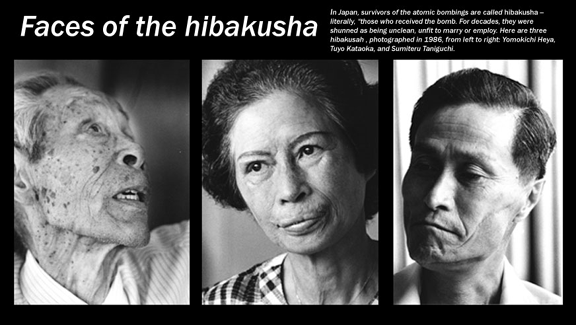
The combined number of officially recognized survivors of the two nuclear attacks, known as hibakusha, stood at 118,935 as of March, down 8,820 from a year earlier, the Ministry of Health, Labor and Welfare said. Their average age was 84.53. https://mainichi.jp/english/articles/20220809/p2g/00m/0na/010000c
1 This Month





PLEASE OPPOSE HR 8255 AND S.3639 – bills would accelerate satellite deployment, with no environmental review or safeguards – https://ncstd5li.quorum.us/campaign/169331/
To see nuclear-related stories in greater depth and intensity – go to https://nuclearinformation.wordpress.com
-
Archives
- October 2026 (29)
- September 2026 (339)
- August 2026 (330)
- July 2026 (355)
- June 2026 (287)
- May 2026 (306)
- April 2026 (356)
- March 2026 (251)
- February 2026 (267)
- January 2026 (308)
- December 2025 (358)
- November 2025 (359)
-
Categories
- 1
- 1 NUCLEAR ISSUES
- business and costs
- climate change
- culture and arts
- ENERGY
- environment
- health
- history
- indigenous issues
- Legal
- marketing of nuclear
- media
- opposition to nuclear
- PERSONAL STORIES
- politics
- politics international
- Religion and ethics
- safety
- secrets,lies and civil liberties
- spinbuster
- technology
- Uranium
- wastes
- weapons and war
- Women
- 2 WORLD
- ACTION
- AFRICA
- Atrocities
- AUSTRALIA
- Christina's notes
- Christina's themes
- culture and arts
- Events
- Fuk 2022
- Fuk 2023
- Fukushima 2017
- Fukushima 2018
- fukushima 2019
- Fukushima 2020
- Fukushima 2021
- general
- global warming
- Humour (God we need it)
- Nuclear
- RARE EARTHS
- Reference
- resources – print
- Resources -audiovicual
- Weekly Newsletter
- World
- World Nuclear
- YouTube
-
RSS
Entries RSS
Comments RSS

