Disarmament is the only cure for nuclear weapons
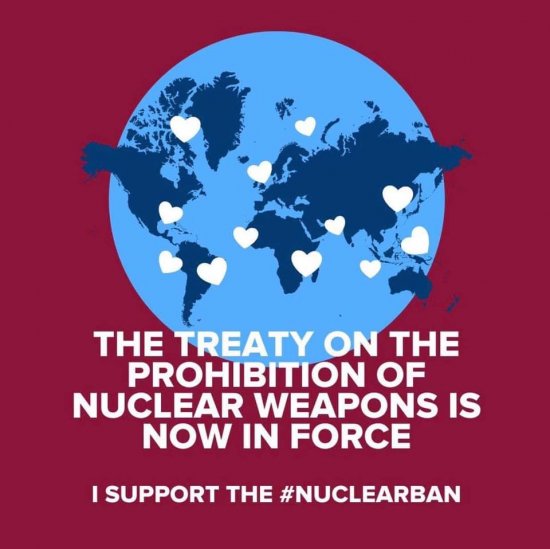
https://www.washingtonpost.com/opinions/2022/08/21/disarmament-is-only-cure-nuclear-weapons/
Gwen DuBois, Baltimore
The writer is a board member of Physicians for Social Responsibility and a member of the steering committee for Back from the Brink.
The Post is to be commended for informing readers about the disturbing study showing nuclear war could lead to mass starvation [“5 billion may starve in nuclear conflict,” news, Aug. 17]. Telling frightening truths should be coupled with hopeful solutions where solutions exist.
In this case, preventing nuclear war is the way to avoid this horrible possibility of massive global starvation. Internationally, 66 nations have endorsed and 86 nations have signed the United Nations Treaty on the Prohibition of Nuclear Weapons. In this country, about 60 municipalities including Baltimore, D.C., Montgomery County and Chicago and seven state legislatures have approved Back from the Brink Resolutions, a road map to nuclear disarmament. In addition to most resolutions endorsing the U.N. treaty, all urge the United States to lead a global effort to prevent nuclear war by actively pursuing a verifiable agreement with the other nuclear nations to eliminate their nuclear weapons. This is the basic message of Physicians for Social Responsibility: “We must prevent what we cannot cure.”
Ukraine nuclear accident fears heightened
Canberra Times 21 Aug 22, New blasts have resounded in the Russian-annexed Crimea peninsula and a Russian missile hit a residential area of a southern Ukrainian town not far from a nuclear power station, wounding 12 civilians, Russian and Ukrainian officials say.
The strike at the Pivdennoukrainsk (south Ukraine) nuclear station and fresh shelling near the Zaporizhzhia station, Europe’s largest such facility, heightened fears of a nuclear accident during the war, Ukrainian officials said. In Crimea, ….the Russian-appointed governor not recognised by the West said a drone had struck a building near the headquarters of Russia’s Black Sea Fleet on Saturday morning.
“A drone flew onto the roof. It was flying low,” governor Mikhail Razvozhayev said on Telegram. “It was downed right over the Fleet headquarters. It fell on the roof and burned up. The attack failed.”
Ukrainian media reported explosions in nearby towns – including the resorts of Yevpatoriya, Olenivka and Zaozyornoye.
Explosions and fires have struck Crimea in the past week — including a blast at a Russian air base that appeared to destroy large numbers of aircraft according to satellite photos.
Ukrainian officials have made no comment. Analysts have said the attacks were made possible by new equipment used by the Ukrainian army and predicted more would occur………………………………………..
Russia and Ukraine traded fresh accusations of shelling around the Zaporizhzhia station – held by Russia since March.
Vladimir Rogov, a Russia-appointed official in the nearby town of Enerhodar, said Ukrainian forces had launched at least four strikes on the plant. Yevhen Yetushenko, mayor of the Ukrainian-controlled Nikopol on the opposite bank of the Dnipro River, said Russian forces had repeatedly shelled the town.
Talks have been underway for more than a week to arrange for a visit to the plant by the UN nuclear power agency, the International Atomic Energy Agency………………………………….. https://www.canberratimes.com.au/story/7869033/ukraine-nuclear-accident-fears-heightened/
Malaysia’s Mahathir says US seeking to provoke war in Taiwan
By EILEEN NG, 20 Aug 22,
KUALA LUMPUR, Malaysia (AP) — Former Malaysian Prime Minister Mahathir Mohamad on Friday accused the U.S. of trying to provoke a war in Taiwan, and in a wide-ranging interview also said he expects Malaysia’s graft-tainted ruling party to hold general elections in the coming months.
Mahathir, a two-time prime minister long known as a critic of the West and its geopolitics, warned that the U.S. was antagonizing China through recent visits to Taiwan by House Speaker Nancy Pelosi and others. China considers the self-ruled island democracy part of its territory and regards such visits as meddling in its affairs.
“China has allowed Taiwan to remain by itself. No problem. They didn’t invade. If they wanted to invade, they could have invaded. They didn’t. But America is provoking (them) so that there can be a war, so that the Chinese will make the mistake of trying to occupy Taiwan,” the 97-year-old Mahathir said.
“Then there is an excuse … for the U.S. to help Taiwan, even fight against China and sell a lot of arms to Taiwan,” he added…………………….. more https://apnews.com/article/russia-ukraine-2022-midterm-elections-biden-taiwan-nato-96f52741ce6e9e6a2cdcfce5fd459ad8—
The Nuclear Non Proliferation Treaty (NPT) is a fraud as the nuclear Mafia continue to spend $billions on their nuclear arsenals.
By Robin Lloyd of Women’s International League for Peace and Freedom (WILPF) 19 Aug 22
“This a critical moment for nuclear disarmament, and for our collective survival.” wrote Ray Acheson of Reaching Critical Will commenting on the Non-proliferation Treaty Review Conference taking place NOW at the United Nations.
I attended the Conference for several days last week as a NGO delegate from the Women’s International League for Peace and Freedom (WILPF), and have been watching closely the negotiations going on for the entire month of August 2022 over an outcome statement for the Conference.
This could be an extraordinary breakthrough towards global nuclear disarmament. 191 nations are represented in this treaty and are seated in the General Assembly hall now, until August 26, listening to each other. In the first week, we heard urgent warning statements from the nations without nuclear weapons, such as “The clouds that parted following the end of the Cold War are gathering once more,” and, from Costa Rica, scolding, “The lack of firm deadlines has provided the nuclear-armed States with a pathway to disregard their disarmament commitments as flagrantly as they have since the last Review Conference.”After two weeks a draft preamble was submitted that reaffirms , amongst other things, “
…that a nuclear war cannot be won and must never be fought, and commits to ensuring that nuclear weapons will never be used again under any circumstances.”
In a hopeful step, in the last year, 89 non-nuclear states have either signed or ratified a binding disarmament treaty, the TPNW (Treaty PROHIBITING Nuclear Weapons) that requires disarmament commitments. These states are no longer tolerating the double talk from the nine nation nuclear mafia.
How can the US consider signing the draft preamble while the House and Senate are finalizing the National Defense Authorization Act which calls for the modernization of our nuclear arsenal? How can our government even take part in this Conference while it is seeking funding for a renewed nuclear edifice of destruction including Modernized Strategic Delivery Systems and Refurbished Nuclear Warheads? Over the next decade, the United States plans to spend $494 billion on its nuclear forces, or about $50 billion a year, according to a 2019 Congressional Budget Office report. Trillions of dollars for submarines and bombers and buried nuclear missiles. Things they are committing to not use. Please, does this make sense?
At one of the NGO meetings I attended in the basement of the UN sponsored by peace groups, I blurted out “This Conference IS A FRAUD.” The nuclear mafia have no serious plans to disarm, as required by Section 6 of the NPT Treaty. Their duplicity could be rebuked to the world by a walkout in the final days of the conference by the countries that have signed/ratified the TPNW, and their supporters.
For the NPT Treaty to collapse would be tragic, but for it to continue when everyone knows it is a lie is a moral and mortal affront to the people of the world.
South Korean unionists protest US-South Korea war games
Saturday, 13 August 2022, Frank Smith, Press TV, Seoul
Thousands of South Korean unionists and their progressive supporters rallied in downtown Seoul to protest against joint US-South Korea war games planned for later this month.
The drills will be the largest in years, and follow the May election of President Yoon Suk-yeol, who has promised to take a hardline with North Korea. Union leaders worry about risks.
While many South Koreans, especially supporters of President Yoon on the right, favor close ties with the U.S., large numbers also argue the US military and the country’s alliance with Washington, prevent the improvement of ties with North Korea – and generate tension…………….. more https://www.presstv.ir/Detail/2022/08/13/687322/South-Korean-unionists-protest-US-South-Korea-war-games
They’ve Bankrupted Themselves’: Europe Gutted Own Security to Funnel Kiev Weapons, Expert Says
Sputnik News 19 Aug 22
Ukraine’s European benefactors made a big show of rushing military aid to Kiev in the early months of Russia’s special military operation, but the torrent has waned to a trickle since then, with no new pledges being made in July. One military expert said Europe is running out of both equipment and willpower to support the “horribly corrupt regime.”
Scott Ritter, a military analyst and former US Marine Corps intelligence officer, told Sputnik on Thursday that NATO’s policy of giving Ukraine billions of dollars in weapons that so quickly get destroyed is “inefficient and counterproductive” from both a political and a national security point of view.
“The more Europe invests its military capacity into Ukraine, the weaker Europe gets,” Ritter said.
Proxy Wars Are Expensive
“I think there’s a couple of things at play here. One, and I think first and foremost, is that Europe has bankrupted its own military capacity by transferring military equipment to Ukraine in an unconstrained manner. It’s becoming clear to all that Ukraine is facing a very difficult time on the battlefield. Weaponry is being provided by Europe, by the United States, by NATO, and this weaponry is not being absorbed in a coherent manner by the Ukrainian Armed Forces.
Instead, it’s being received and rushed to the front where it is not being used effectively and increasingly it’s being destroyed by the Russians. This is very expensive, very inefficient. It’s detrimental not only to Ukraine’s military capability but also the nations providing the equipment. They’re literally stripping bare their own inventories to support Ukraine in a losing cause,” Ritter explained.
The second part of this equation is, not only is this inefficient and counterproductive from a national security standpoint, but it’s expensive and counterproductive from a political standpoint,” he said. “I think the political cost of supporting Ukraine is about to become very, very high.”
“Many political leaders in Europe now are going to be facing an increasingly hostile constituency, demanding answers as to why their leaders committed: a) economic suicide by joining in on a failed sanctions effort; b) are further bankrupting the nation by stripping bare their own arsenals, requiring them to expend money to restock. This is an expensive proposition. And c), supporting what is increasingly being documented as a very corrupt and, frankly speaking, vile regime in Kiev.”
“Many political leaders in Europe now are going to be facing an increasingly hostile constituency, demanding answers as to why their leaders committed: a) economic suicide by joining in on a failed sanctions effort; b) are further bankrupting the nation by stripping bare their own arsenals, requiring them to expend money to restock. This is an expensive proposition. And c), supporting what is increasingly being documented as a very corrupt and, frankly speaking, vile regime in Kiev.”
…………………………………….Ritter recalled Berlin and Paris were also key guarantors of the Minsk Accords, which were supposed to settle the Donbass conflict in the context of autonomy for the Russian-speaking regions………………………… more https://sputniknews.com/20220818/theyve-bankrupted-themselves-europe-gutted-own-security-to-funnel-kiev-weapons-expert-says-1099744371.html
Ukraine using very advanced long range rockets to strike Russian air base in Crimea?
The devastation at the Russian air base in Crimea suggests Kyiv may have obtained new long-range strike capability with potential to change the course of the war. The base is well beyond the range of advanced rockets that western countries acknowledge sending to Ukraine so far, with some western military experts saying the scale of the damage and the apparent precision of the strike suggested a powerful new capability with potentially important implications. https://www.theguardian.com/world/live/2022/aug/12/russia-ukraine-war-zelenskiy-tells-officials-to-stop-leaking-military-tactics-un-sounds-nuclear-plant-warning-live
US Deploys Its B-52 Nuclear Bombers At Russia’s Doorsteps As Tensions Soar Between Moscow & Washington
https://eurasiantimes.com/us-deploys-its-b-52-nuclear-bombers-at-russias-doorsteps/ By Sakshi Tiwari, August 17, 2022
The United States Air Force is reportedly sending its strategic bombers to Europe, close to Russia, when there is an uptick in military operations against Russian-occupied Ukrainian territory.
The United States intends to deploy its B-52 strategic bombers close to the Russian borders. According to local Russian media reports and speculations on social media, four American strategic bombers are expected to arrive in Europe in the coming days.
There are reports the B-52s have already arrived.
The B-52 bombers will first need to be stationed at a military air base in the United Kingdom. According to Gloucestershire Live, the American long-range bombers deployed in the UK earlier this year will return to Fairford Air Force Base next week.
Russia admits that explosions in Crimea were the work of Ukrainian saboteurs
New Arms Depot Blast In Crimea An Act Of Sabotage, Kremlin Admits, BY TYLER DURDEN, AUG 16, 2022
Russia’s Defense Ministry on Tuesday confirmed a rare act of what appears to be a Ukrainian sabotage operation in Crimea. This after video emerged online showing a series of explosions after a fire engulfed a munitions depot there.
“On the morning of Aug. 16, as a result of an act of sabotage, a military storage facility near the village of Dzhankoi was damaged,” the ministry said. “Damage was caused to a number of civilian facilities, including power lines, a power plant, a railway track as well as a number of residential buildings. There were no serious injuries,” it added……………………
Importantly, this comes after a bigger Aug. 9 explosion some 200km inside Crimea at Russia’s Saky air base, in Novofedorovka. That attack, which destroyed multiple Russian jets, vehicles, and an ammo depot, has been subject of intense speculation as Ukraine’s government sent mixed signals in terms of taking responsibility………….
On an official level, the Ukrainian government denied it was behind the earlier Crimea base attack, but officials leaked to both The Washington Post and New York Times that it was a sabotage operation by Ukraine’s special forces.
Moscow had in the immediate aftermath downplayed it as an accident, perhaps seeking to avoid escalation, also possibly not wanting to acknowledge it was vulnerable to such a strike from Ukraine.
So this fresh Aug.16 “sabotage attack” strongly suggests the prior Aug.9 explosion was also a Ukrainian operation. The incident had also set off discussion over whether US-supplied HIMARS rockets could reach that far. If indeed there were foreign weapons systems behind it, it could set the US and Russia on a dangerous path of escalation and collision as the proxy war could fast develop into direct confrontation between superpowers in Ukraine.
Kishida, ‘PM from Hiroshima’, is Shifting Japan’s Long-Standing Pro-Nuclear Weapons Posture

He has begun a sincere effort to realign Japan’s position from one that supports the maintenance of the US “nuclear umbrella” to one that aims for gradual global nuclear weapons disarmament.
Marcus Donaldson The Wire, 17 Aug 22
Prime Minister Fumio Kishida has outlined what appears to be a sincere effort to realign Japan’s position on nuclear weapons – from one that supports the maintenance of the US “nuclear umbrella” to one that aims for gradual global nuclear weapons disarmament.
Previous administrations have been unwilling to challenge the nuclear weapons status quo. Indeed, Tokyo has been a quiet and consistent advocate for nuclear weapons among the non-nuclear powers (as counterintuitive as this may be for the only nation to have been subjected to nuclear weapons attacks).
At present, the United States, Russia, France, China, the United Kingdom, Israel, India, Pakistan, and North Korea are known to possess nuclear weapons arsenals.
In 2016, Japan voted against a UN resolution that would have compelled nations to negotiate the reduction and eventual elimination of nuclear weapons stockpiles. It also chose not to sign the Treaty on the Prohibition of Nuclear Weapons in 2017 – which did eventually pass – and snubbed subsequent invitations to ratify the accord or even to send observers to related diplomatic events.
Japan’s pro-nuclear weapons posture continued, relatively unchanged, into the early months of Kishida’s government. …………………………….
On August 1, Prime Minister Kishida travelled to New York to address the latest Review Conference for the Treaty on the Non-Proliferation of Nuclear Weapons (NPT), which are scheduled every five years, although this was held two years late due to the COVID-19 pandemic. This was the first time that a Japanese prime minister had ever spoken at one of these conferences, usually attended by working-level diplomats.
Kishida began by relating the issue to himself, noting that, “as a prime minister from Hiroshima, I believe that we must take every realistic measure towards a world without nuclear weapons, step by step, however difficult the path may be.”
This phrasing echoed the title of a book that Kishida published in 2020 – Kakuheiki no nai Sekai e (Toward a World without Nuclear Weapons).
In his speech, Kishida declared that “Japan is determined to firmly uphold the NPT as its guardian.” adding that he is working on a five-point “Hiroshima Action Plan” to reduce nuclear weapons risks.
As part of his initiative, Kishida clarified that “Japan supports the dialogue conducted between the United States and Russia for further reductions, and encourages the United States and China to engage in a bilateral dialogue on nuclear arms control and disarmament.” He also emphasised the importance of transparency between nuclear weapons powers, a greater commitment to the Comprehensive Nuclear-Test-Ban Treaty (CTBT), and a peaceful solution to conflicts such as that on the Korean Peninsula.
Kishida further announced that Tokyo would make a US$10 million contribution to the United Nations in order to set up a “Youth Leader Fund for a World without Nuclear Weapons,” again making use of the phrase which he seems to be promoting as his own political trademark.
“We must ensure that Nagasaki remains the last place to suffer an atomic bombing,” he declared.
Kishida’s address was well received by the Japanese public. Interestingly, some of the most outspoken praise came from the Japan Communist Party, which viewed the speech as a “landmark success.”
In late 2019, the Journal for Peace and Nuclear Disarmament conducted a poll which found that about 75% of the Japanese public supported joining the Treaty on the Prohibition of Nuclear Weapons, which the government has so far spurned.
In spite of the popularity of Kishida’s anti-nuclear weapons orientation among the general public, he faces the potential risk of alienating both rightwing forces within his own ruling party as well as some figures within the US government. Indeed, it was reported that Kishida’s own political advisers counselled him not to give the speech in New York and to keep a lower profile on nuclear weapons disarmament issues. https://thewire.in/world/fumio-kishida-japan-nuclear-weapons-stance
US launches nuclear-capable Minuteman III in routine test
Key points:
- The nuclear-capable Minuteman III was launched from Vandenberg Space Force Base in California
- The US Air Force said the test launch was not the result of current world events.
- President Joe Biden’s administration said it would continue to carry out routine operations in the Taiwan Strait ………………………………………………………… more https://www.abc.net.au/news/2022-08-17/us-tests-minuteman-iii-missile-/101340370
Nuclear war between two nations could spark global famine
A pall of smoke from burning cities would engulf Earth, causing worldwide crop failures, models show. https://www.nature.com/articles/d41586-022-02219-4Alexandra Witze 15 Aug 22.
Even a small conflict in which two nations unleash nuclear weapons on each other could lead to worldwide famine, new research suggests. Soot from burning cities would encircle the planet and cool it by reflecting sunlight back into space. This in turn would cause global crop failures that — in a worst-case scenario — could put 5 billion people on the brink of death.
“A large percent of the people will be starving,” says Lili Xia, a climate scientist at Rutgers University in New Brunswick, New Jersey, who led the work. “It’s really bad.”
The research, published on 15 August in Nature Food1, is the latest in a decades-long thought experiment about the global consequences of nuclear war. It seems especially relevant today as Russia’s war against Ukraine has disrupted global food supplies, underscoring the far-reaching impacts of a regional conflict.
Scenarios big and small
Nuclear war comes with a range of lethal impacts, from killing people directly in atomic blasts to the lingering effects of radiation and other environmental pollution. Xia and her colleagues wanted to look at the consequences farther afield from the scene of war, to explore how people all around the planet could also suffer.
They modelled how climate would change in various parts of the world following a nuclear war, and how crops and fisheries would respond to those changes. The scientists analysed six war scenarios, each of which would put different amounts of soot into the atmosphere, and drop surface temperatures from anywhere between 1 and 16 °C. The effects could linger for a decade or more.
A nuclear war between India and Pakistan, perhaps triggered over the disputed Kashmir region, could loft between 5 million and 47 million tonnes of soot into the atmosphere, depending on how many warheads were deployed and cities destroyed. A full-out nuclear war between the United States and Russia could produce 150 million tonnes of soot. The globe-encircling pall would persist for years until the skies eventually cleared.
Using data from the United Nations’ Food and Agriculture Organization, Xia’s team calculated how declining crop yields and fishery catches after a nuclear war would affect the number of calories available for people to eat. The scientists studied several options, such as whether people continued to raise livestock or whether they routed some or all crops meant for livestock to humans instead. The study assumed there would be some repurposing of biofuel crops for human consumption, and people would cut back on or eliminate food waste. It also assumed that international trade would stop as countries chose to feed people within their own borders rather than exporting food.
Xia notes that the study relies on many assumptions and simplifications about how the complex global food system would respond to a nuclear war. But the numbers are stark. For even the smallest war scenario, of an India–Pakistan conflict that results in 5 million tonnes of soot, calorie production across the planet could drop by 7% in the first five years after the war.
In a 47-million-tonnes-of-soot scenario, global average calories drop by up to 50%. In the worst case of a United States–Russia war, calorie production drops by 90% three to four years after the war.
‘Let’s move to Australia’
The nations most affected would be those at mid to high latitudes, which already have a short season for growing crops and which would cool more dramatically after a nuclear war than tropical regions would. The United Kingdom, for instance, would see sharper drops in food available than a country such as India that is located at lower latitudes. But France, which is a major exporter of food, would fare relatively well — at least in the lower-emission scenarios — because if trade were halted, it would have more food available for its own people.
Another less-affected nation is Australia. Isolated from trade in the wake of a nuclear war, Australia would rely mainly on wheat for food. And wheat would grow relatively well in the cooler climate induced by atmospheric soot. On the team’s map showing large portions of the world coloured red, for starvation, Australia gleams an untouched green, even in the severe war scenarios. “The first time I showed my son the map, the first reaction he had is ‘let’s move to Australia,’” Xia says.
The study is a useful step towards understanding the global food impacts of a regional nuclear war, says Deepak Ray, a food-security researcher at the University of Minnesota in Saint Paul. But more work is needed to accurately simulate the complex mix of how crops are produced around the world, he says. For instance, the research took into consideration national crop production numbers, but reality is much more nuanced, with different crops being grown in different regions of a country for different purposes.
Nuclear war might seem less of a threat than it did during the cold war, but there are still nine countries with more than 12,000 nuclear warheads among them. Understanding the potential consequences of nuclear war in detail could help nations better assess the risks.
“It is rare to happen — but if it happens, it affects everyone,” Ray says. “These are dangerous things.”
doi: https://doi.org/10.1038/d41586-022-02219-4
References
Inside Lockheed Martin’s Sweeping Recruitment on College Campuses

Our investigation found this unfettered recruiting access to be part of a deeper and growing enmeshment between universities and the defense industry.
at many college STEM programs around the country have become pipelines for weapons contractors.
if you’re an engineering student at Georgia Tech, Lockheed is omnipresent.
Reader Supported News, Indigo Olivier/In These Times 14 august 22
To a casual observer, the Black Hawk and Sikorsky S-76 helicopters may have seemed incongruous landing next to the student union on the University of Connecticut’s pastoral green campus, but this particular Thursday in September 2018 was Lockheed Martin Day, and the aircraft were the main attraction.
A small group of students stood nearby, signs in hand, protesting Lockheed’s presence and informing others about a recent massacre.
Weeks earlier, 40 children had been killed when a Saudi-led coalition air strike dropped a 500-pound bomb on a school bus in northern Yemen. A CNN investigation found that Lockheed — the world’s largest weapons manufacturer — had sold the precision-guided munition to Saudi Arabia a year prior in a $110 billion arms deal brokered under former President Donald Trump.
Back in Storrs, Conn., Lockheed, which has a longstanding partnership with UConn, appeared on campus to recruit with TED-style talks, flight simulations, technology demos and on-the-spot interviews. A few lucky students took a helicopter flight around campus.
UConn is among at least a dozen universities that participate in Lockheed Martin Day, part of a sweeping national effort to establish defense industry recruitment pipelines in college STEM (science, technology, engineering, and mathematics) programs. Dozens of campuses nationwide now have corporate partnerships with Lockheed and other weapons manufacturers.
Lockheed is the country’s single largest government contractor, producing Black Hawks, F-35 fighter jets, Javelin anti-tank systems and the Hellfire missiles found on Predator drones. With more than 114,000 employees, the company depends on a pool of highly skilled and highly specialized workers, complete with the ability to obtain proper security clearances when needed. In its most recent annual report, Lockheed tells investors, “We increasingly compete with commercial technology companies outside of the aerospace and defense industry for qualified technical, cyber and scientific positions as the number of qualified domestic engineers is decreasing and the number of cyber professionals is not keeping up with demand.”
Lockheed has hired more than 21,000 new employees since 2020 to replace retiring workers and keep up with turnover. Student pipelines are integral to the company’s talent acquisition strategy.
As tuition costs and student debt have skyrocketed, Lockheed has enticed students with scholarships, well paid internships and a student loan repayment program. When the pandemic made in-person recruitment more difficult, Lockheed expanded its virtual outreach — after one 2020 virtual hiring event, the company reported a 300% increase in offers and a 400% increase in job acceptances among the STEM scholarship program participants over the previous year.
And in a self-described effort to diversify its workforce and build an inclusive culture, Lockheed has also put new focus on financial support and recruitment at historically Black colleges and universities.
Lockheed’s recruitment efforts are intertwined with various types of “research partnerships.” Universities receive six- and seven-figure grants from Lockheed and other defense contractors — or even more massive sums from the Department of Defense — to work on basic and applied research, up to and including designs, prototypes and testing of weapons technology. A student might work on Lockheed-sponsored research as part of their course load, then intern over the summer at Lockheed, be officially recruited by Lockheed upon graduation and start working there immediately, with defense clearances already in place — sometimes continuing the same work. In 2020, Lockheed reported that more than 60% of graduating interns became full-time employees.
Lockheed is not alone among corporations or military contractors in its aggressive university outreach, but the expansive presence of private defense companies on campuses raises questions about the extent to which corporations — particularly those profiting from war — should influence student career trajectories. In April, student and community protesters at Tufts University shut down a General Dynamics recruiting event, then protested outside a Raytheon presentation later that month, chanting, “We see through your smoke and mirrors. You can’t have our engineers.”
Illah Nourbakhsh, an ethics professor at Carnegie Mellon University with a background in robotics, presents the question this way: “If you have a palette of possible futures for students, and you take some possible future, and you make it so shiny and exciting and amazing by pouring money on the marketing process of it that it overcomes any possible marketing done by alternatives that are more socially minded — do the kids have agency? Is it a fair, balanced field?
“Of course not.”
Lockheed did not respond by deadline to requests for comment on this article.
For more than a year, In These Times investigated the presence of Lockheed and other arms manufacturers on campuses, combing through company and university annual reports, IRS filings, LinkedIn profiles, budgets, legislative records and academic policies, as well as interviewing students and professors. Most students requested pseudonyms, indicated with asterisks*, so as not to adversely impact their career prospects. Several spoke positively of Lockheed.
“It’s probably what most engineers, especially in mechanical and aerospace who want to go into defense prospects, aspire to,” says Sam*, who graduated with a bachelor’s in aerospace engineering in December 2021. “They’re one of the biggest defense contractors in this country, so you have the opportunity to work on very state-of-the-art technology.”
Other students believe putting their skills to military use is unethical.
Alan*, a December 2021 graduate in electrical engineering at the University of West Florida who is currently job-hunting while living with his parents, says he’s not looking at defense contractors and is instead holding out for a position that allows him to leave the Earth better than he found it. “When it comes to engineering, we do have a responsibility,” he says. “Every tool can be a weapon. … I don’t really feel like I need to be putting my gifts to make more bombs.”
Located near the world’s largest Air Force base in the Florida panhandle, the University of West Florida regularly hosts recruiters from the defense industry, including Lockheed. Alan says companies like Lockheed set up tables in student buildings to recruit in the hallways.
“I just walked past those tables,” he says, “but sometimes they’ll call you over. It’s kind of like going to the mall, and people want you to try their soap. It’s kind of annoying, but I get that they always need new people.”
Our investigation found this unfettered recruiting access to be part of a deeper and growing enmeshment between universities and the defense industry.
Decades of state disinvestment in public higher education have converged with a growing emphasis on sponsored research, and in an era of ballooning student debt, the billions in annual defense spending prop up university budgets and subsidize student educations. The result is that many college STEM programs around the country have become pipelines for weapons contractors……………………………….
Cameron Davis, who graduated from Georgia Tech with a bachelor’s in computer engineering in 2021, says, “A lot of people that I talk to aren’t 100% comfortable working on defense contracts, working on things that are basically going to kill people.” But, he adds, the lucrative pay of defense contractors “drives a lot of your moral disagreements with defense away.”
In 2019 and 2021, Lockheed was the university’s largest alumni employer, and the company has been one of Georgia Tech’s most frequent job interviewers since at least 2002.
“Even in my field — which isn’t even as defense-adjacent as aerospace engineering or mechanical engineering — companies like Raytheon will have dedicated programs to recruit people,” says Davis. “I’ve been in line with other companies at a career fair and defense contractors literally walk up to me in line and be like, ‘Hey, do you want to talk about helicopters or something?’”
“The corporate presence at Georgia Tech is a little bit overwhelming at times,”……………………………………….
THE MILITARY’S STUDENT RESEARCHERS
Clifford Conner recalls his freshman year at Georgia Tech, in 1959, when the school was still segregated. He studied experimental psychology. When graduation approached, his professors — who also worked in the Lockheed Corporation’s Marietta office just north of Atlanta — said they could help him get a job at Lockheed. Conner accepted.
His work on the wing design of the C-5 Galaxy, then the largest military cargo plane in the world, took him to England, where he began reading a lot about the war in Vietnam. “I wasn’t under the spell of the American press,” Conner says. After a few years with Lockheed, he quit and joined the antiwar movement.
It took him another year to find a job at about a third of the salary he was making at Lockheed.
Conner went on to become a historian of science and a professor at the CUNY School of Professional Studies. His most recent book, The Tragedy of American Science: From Truman to Trump (2020), explores how the STEM fields have moved away from improving the human condition to advancing corporate and defense interests. He writes about the Bayh-Dole Act, which removed public-licensing restrictions in 1980 and “opened the floodgates to corporate investors seeking monopoly ownership of innovative technology.” The law allowed universities and nonprofits to file patents on projects funded with federal money, from weapons to pharmaceuticals. The rationale was to encourage commercial collaboration and underscore the idea that federally funded inventions should be used to support a free-market system.
“After the Bayh-Dole Act, the lines between corporate, university and government research were all blurred,” Conner tells In These Times.
Conner went on to become a historian of science and a professor at the CUNY School of Professional Studies. His most recent book, The Tragedy of American Science: From Truman to Trump (2020), explores how the STEM fields have moved away from improving the human condition to advancing corporate and defense interests. He writes about the Bayh-Dole Act, which removed public-licensing restrictions in 1980 and “opened the floodgates to corporate investors seeking monopoly ownership of innovative technology.” The law allowed universities and nonprofits to file patents on projects funded with federal money, from weapons to pharmaceuticals. The rationale was to encourage commercial collaboration and underscore the idea that federally funded inventions should be used to support a free-market system.
“After the Bayh-Dole Act, the lines between corporate, university and government research were all blurred,” Conner tells In These Times.
Georgia Tech’s applied research division, known as the Georgia Tech Research Institute (GTRI), now has four laboratories directly on Lockheed’s aeronautics campus in Marietta……………………………………
publicly available CVs, résumés and job listings for student researchers at GTRI explicitly detail work on weapons technology……………………………
Unlike Europe, the United States does not provide universities with general funding to support basic research, or “research for the sake of research.” A 2019 analysis by the American Association for the Advancement of Science, for example, notes, “on average, one-third of R…D in OECD countries” is funded by “government block grants used at the discretion of higher education institutions” — but the United States does not have the same mechanism.
U.S. appropriations to public higher education, meanwhile, have declined significantly in the past two decades, while the research environment has seen universities performing an ever-larger share of the nation’s technology research. The Defense Department has been the third-largest source of federal research and development funding to universities for decades (after the Department of Health and Human Services and the National Science Foundation).
But universities also seek out private-sector money to fund research directly, and the defense sector has been a willing donor.
In recent years, Lockheed has partnered with a network of more than 100 universities to advance hypersonics technology — weapons traveling so fast they’re undetectable by radar — and signed master research agreements for multi-year collaborations with Purdue, Texas A…M and Notre Dame in 2021.
While delivering technological innovations to defense companies, these partnerships also double as employment pipelines. The University of Colorado Boulder has collaborated on space systems with Lockheed for nearly two decades. In a statement on the university’s website, one Lockheed executive (and school alum) writes, “Lockheed Martin employs about 56,000 engineers and technicians, 35% of which could retire in the next few years. We must keep up a ‘talent pipeline’ to fill this pending gap: currently, our major source of talent is CU-Boulder.”
SADDLED WITH DEBT
Nearly half of the nation’s discretionary budget goes toward military spending; of that money, one-third to one-half goes to private contractors, according to a 2021 analysis by military researcher William Hartung for Brown University’s Costs of War Project.
Today, 46 million Americans hold student debt totaling $1.7 trillion, which is the projected lifetime cost to U.S. taxpayers of Lockheed’s F-35 fighter jet program — the most expensive weapon system ever built………….
Lockheed is among a growing number of companies that offer student loan assistance to its employees. The company’s Invest In Me program offers incoming graduates a $150 monthly cash bonus for five years and a student loan refinancing program. Every year, Lockheed awards $10,000 scholarships to 200 students that may be renewed up to three times for a potential $40,000. Lockheed also lists 61 universities participating in its STEM scholarship program, projected to invest a minimum of $30 million over five years as part of a larger $460 million education and innovation initiative using gains from Trump’s 2017 corporate tax cuts.
In a 2015 survey by American Student Assistance, 53% of respondents said student debt was either a “deciding factor” or had a “considerable impact” on their career choice.
“Pushing people into higher education has been our labor policy,” explains Astra Taylor, a writer, filmmaker and co-founder of the Debt Collective, a debtors’ union with roots in Occupy Wall Street. “You’re indebting yourself for the privilege of being hired, and it gives companies this economic power because then they can say, ‘We can help relieve some of the economic pain that you’ve incurred to make yourself appealing to us.’”
Raytheon, Northrop Grumman and Boeing all provide some form of student aid, such as scholarships and tuition reimbursement.
DIVERSIFYING WEAPONS MAKING
The private defense sector targets much of its financial support toward historically Black colleges and universities (HBCUs) and students from minority groups as part of stated efforts toward workforce diversity and promoting STEM jobs among a demographic that is critically underrepresented in STEM fields. Lockheed’s website and annual report note that minority groups are the “fastest-growing segment in the labor market” and that recruitment through “internships, early talent identification, outlying educational programs, co-ops, apprenticeships and pre-apprenticeships” is integral to building diverse employee pipelines.
This trend stirs up old controversies around military recruiting in communities of color.
The Army has long targeted minority-majority high schools and HBCUs with its Reserve Officers’ Training Corps programs and scholarships, to the extent that critics refer to it as a school-to-soldier pipeline. Without enlisting and the ensuing funding, many students wouldn’t receive a higher education. According to a 2016 report from the Brookings Institution, Black students hold an average of $7,400 more in student debt than their white counterparts upon graduating — a gap that widens to nearly $25,000 four years later. The Army leverages students’ predicaments to meet its recruiting goals.
Regardless, “the racial implications” of U.S. military actions “are hard to evade,” civil rights activist and Rep. John R. Conyers Jr. (D-Mich.) said at the outset of the Iraq War in 2003. “Would this be happening to [the Iraqis] if they were not nonwhite?” A Gallup poll at the time found 7 in 10 Black Americans opposed the war, while 8 in 10 white Americans favored it.
……………………………… Lockheed has started STEM education and recruiting initiatives at 20 minority serving institutions (MSIs), including 16 HBCUs. Of Lockheed’s 2021 scholarship recipients, 60% identified with a minority racial or ethnic group. In the 2020 to 2021 academic year, more than 40% of Lockheed’s early-career hires identified as people of color, with 450 coming from MSIs.
“Students who work in these spaces don’t know the gravity — are systematically made ignorant of the gravity — of participating in these systems,” says Myers……………………………………..
“You said that the CEO was an advocate for women and minorities,” a student organizer says during a recruitment presentation. “How does she maintain that role as head of a company that produces weapons which bomb and kill women and children in places like Palestine, Yemen, Libya and the Middle East?”
The recruiter responds: “I have no idea.”
MONEY TALKS
Ultimately, Lockheed’s deep reach into higher education reflects national priorities.
Since 9/11, the United States has spent $8 trillion on war. In 2020, for the first time, federal funding to Lockheed surpassed that of the U.S. Department of Education, the federal agency tasked with dispensing scholarships and Pell grants. Biden requested $813 billion in defense spending for fiscal year 2023, which includes the largest-ever allocation for research and development.
“Of course it’s the defense industries that have the ability to offer these favorable terms to people, because they’re also parasites on the public purse,” Astra Taylor says. “If these students weren’t worried about the cost of college, would they be as apt to take a job at a defense contractor versus doing something else in their community?”
Conner doesn’t fault students for taking jobs in the defense industry. “[They] realize that if they’re going to get a job when they graduate, it’s going to be at one of these places. And they can protest all they want, but they’ve got to be the spearpoint of a larger protest that involves the whole society.”
https://www.rsn.org/001/inside-lockheed-martins-sweeping-recruitment-on-college-campuses.html—
Seventy-five years after the U.S. atomic bombings of Japan, we remain perched on the precipice of unparalleled catastrophe.

Seventy-five years after the dawn of the nuclear age, we are as ready as ever to extinguish ourselves. The human race is clearly an evolutionary aberrant on a suicidal mission.
The Lessons We Haven’t Learned, The Progressive Magazine, BY HELEN CALDICOTT, AUGUST 3, 2020

In truth, the U.S. Department of Defense is a misnomer; it is actually the Department of War, Death, and Suicide. Hundreds of billions of dollars of U.S. taxpayer money are spent annually by corporations such as Lockheed Martin, Boeing, BAE Systems, and Raytheon Technologies Corporation to create and build the most hideous weapons of destruction.
Brilliant people employed by these massive corporations, mostly men, are deploying their brainpower to devise better and more hideous ways of killing.
”……………………………… What rained down on those two Japanese cities seventy-five years ago was destruction on a scale never seen before or since. People exposed within half a mile of the atomic fireball were seared to piles of smoking char in a fraction of a second as their internal organs boiled away. The small black bundles stuck to the streets and bridges and sidewalks of Hiroshima numbered in the thousands.
A little boy was reaching up to catch a red dragonfly with his hand against the blue sky when there was a blinding flash and he disappeared. He turned into gas and left his shadow behind on the pavement, a haunting relic later moved to the Hiroshima Museum. A woman was running while holding her baby; she and the baby were turned into a charcoal statue.
In all, about 120,000 people were killed immediately by the two bombs, and tens of thousands more died later due to radiation exposure.
In 1957, when I was eighteen, I read a book by Nevil Shute, an English novelist who ended up in Australia. On the Beach described how the city of Melbourne awaited a deadly cloud of radiation from a nuclear war that was triggered by an accident in the northern hemisphere, killing everything. Men drank their last gin and tonics in the Melbourne Club while the government dispensed cyanide capsules so parents could kill their children quickly to avoid the agonizing symptoms of radiation poisoning.
At the time, I was in medical school, where I learned about radiation biology—the classic experiments of Hermann J. Muller, who in the 1920s irradiated Drosophila fruit flies inducing genetic mutations and morphological abnormalities. Concurrently, the United States and the Soviet Union were testing nuclear weapons in the atmosphere, bombarding huge populations with radioactive fallout.
In my naiveté, I couldn’t understand what these men thought they were doing because the mutagenic and carcinogenic effects of ionizing radiation were well known in scientific circles. Madame Curie had died of aplastic anemia secondary to radium, an alpha emitter polluting her bones; her daughter died of leukemia, and many of the early radiologists who exposed themselves randomly to X-rays died from malignancies.
Einstein wrote: “The unleashed power of the atom has changed everything save our modes of thinking and we thus drift toward unparalleled catastrophe.” Robert Oppenheimer, watching the world’s first nuclear explosion in Alamogordo, New Mexico, in 1945, muttered to himself, “I am become death, the destroyer of worlds” from the Hindu scripture, the Bhagavad Gita.
The scientists knew that they had discovered the seeds of human destruction.
In my naiveté, I couldn’t understand what these men thought they were doing because the mutagenic and carcinogenic effects of ionizing radiation were well known in scientific circles. Madame Curie had died of aplastic anemia secondary to radium, an alpha emitter polluting her bones; her daughter died of leukemia, and many of the early radiologists who exposed themselves randomly to X-rays died from malignancies.
Einstein wrote: “The unleashed power of the atom has changed everything save our modes of thinking and we thus drift toward unparalleled catastrophe.” Robert Oppenheimer, watching the world’s first nuclear explosion in Alamogordo, New Mexico, in 1945, muttered to himself, “I am become death, the destroyer of worlds” from the Hindu scripture, the Bhagavad Gita.
The scientists knew that they had discovered the seeds of human destruction.
A nuclear “exchange” between these two superpowers would take little over one hour to complete. A twenty-megaton bomb (the equivalent of twenty million tons of TNT) would excavate a hole three-quarters of a mile wide and 800 feet deep, converting all buildings and people into radioactive fallout that would be shot up in the mushroom cloud. Within six miles in all directions every living thing would be vaporized. Twenty miles from the epicenter, huge fires would erupt, as winds of up to 500 miles per hour would suck people out of buildings and turn them into missiles traveling at 100 miles per hour. The fires would coalesce, incinerating much of the United States and causing most nuclear power plants to melt down, greatly exacerbating radioactive fallout.
Potentially billions of people would die hideously from acute radiation sickness, vomiting, and bleeding to death. As thick black radioactive smoke engulfed the stratosphere, the Earth would, over time, be plunged into another ice age—a “nuclear winter,” annihilating almost all living organisms.
Seventy-five years after the dawn of the nuclear age, we are as ready as ever to extinguish ourselves. The human race is clearly an evolutionary aberrant on a suicidal mission. Our planet is in the intensive care unit, approaching several terminal events.
Will we gradually burn and shrivel life on our wondrous Earth by emitting the ancient carbon stored over billions of years to drive our cars and power our industries, or will we end it suddenly by creating a global gas oven?
The International Energy Agency said recently that we only have six months left to avert the effects of global warming before it is too late. Earlier this year, the Bulletin of the Atomic Scientists moved its Doomsday Clock to 100 seconds to midnight, the closest it’s ever been.
In truth, the U.S. Department of Defense is a misnomer; it is actually the Department of War, Death, and Suicide. Hundreds of billions of dollars of U.S. taxpayer money are spent annually by corporations such as Lockheed Martin, Boeing, BAE Systems, and Raytheon Technologies Corporation to create and build the most hideous weapons of destruction.
President Donald Trump is right when he says we need to make friends with the Russians, for it is Russian bombs that might well annihilate the United States. Indeed, we need to foster friendship with all nations and reinvest the trillions of dollars spent on war, killing, and death, saving the ecosphere by powering the world with renewable energy including solar, wind, and geothermal, and planting trillions of trees.
Such a move would also free up billions of dollars that could be reallocated to such purposes as providing free medical care for all U.S. citizens, along with free education, housing for the homeless, and care for those with mental illness.
The United States needs to rise to its full moral and spiritual height and lead the world to sanity and survival. I know this is possible because, in the 1980s, millions of wonderful people rose up, nationally and internationally, in opposition to the arms race and the Cold War.
But what is the present reality in the United States?
There are 450 Minuteman III missiles operational on the Great Plains—in Montana, North Dakota, and Wyoming. In each missile silo are two missileers, who control and launch the missiles which contain one or two hydrogen bombs. Planes armed with hydrogen bombs stand ready to take off at any moment, and nuclear submarines silently plow the oceans ready to launch.
Both the United States and Russia have nuclear weapons targeted at military facilities and population centers. Nuclear war could happen at any time, by accident or design. The late Stephen Hawking warned in 2014 that artificial intelligence, now being deployed by the military, could become so autonomous that it could start a nuclear war by itself.
This threat is largely ignored by politicians and the mainstream media, who continue to practice psychic numbing as we stumble blindly toward our demise.
How come the physicists, engineers, and military personnel who have laced the world with nuclear weapons ready to launch never factored into their equations the probability that an immature, petulant man-baby could hold the trigger for our destruction in his hands? https://progressive.org/magazine/the-lessons-we-havent-learned-caldicott/
More shelling near Ukraine nuclear plant
The Advocate, By Natalia Zinets, August 16 2022,
Ukrainian and Russian-installed officials have reported shelling near Europe’s largest nuclear power plant, with both sides blaming each other days after the world nuclear watchdog warned of disaster if the fighting does not stop.
Russia and Ukraine have traded accusations this month regarding the Zaporizhzhia nuclear plant in southern Ukraine, which dominates the south bank of a vast reservoir on the Dnipro River……………………………
Nuclear experts fear fighting might damage the plant’s spent fuel pools or reactors…………………………………………
Reuters could not immediately verify battlefield reports. https://www.theadvocate.com.au/story/7862092/more-shelling-near-ukraine-nuclear-plant/?cs=5—
1 This Month





PLEASE OPPOSE HR 8255 AND S.3639 – bills would accelerate satellite deployment, with no environmental review or safeguards – https://ncstd5li.quorum.us/campaign/169331/
To see nuclear-related stories in greater depth and intensity – go to https://nuclearinformation.wordpress.com
-
Archives
- October 2026 (10)
- September 2026 (339)
- August 2026 (330)
- July 2026 (355)
- June 2026 (287)
- May 2026 (306)
- April 2026 (356)
- March 2026 (251)
- February 2026 (267)
- January 2026 (308)
- December 2025 (358)
- November 2025 (359)
-
Categories
- 1
- 1 NUCLEAR ISSUES
- business and costs
- climate change
- culture and arts
- ENERGY
- environment
- health
- history
- indigenous issues
- Legal
- marketing of nuclear
- media
- opposition to nuclear
- PERSONAL STORIES
- politics
- politics international
- Religion and ethics
- safety
- secrets,lies and civil liberties
- spinbuster
- technology
- Uranium
- wastes
- weapons and war
- Women
- 2 WORLD
- ACTION
- AFRICA
- Atrocities
- AUSTRALIA
- Christina's notes
- Christina's themes
- culture and arts
- Events
- Fuk 2022
- Fuk 2023
- Fukushima 2017
- Fukushima 2018
- fukushima 2019
- Fukushima 2020
- Fukushima 2021
- general
- global warming
- Humour (God we need it)
- Nuclear
- RARE EARTHS
- Reference
- resources – print
- Resources -audiovicual
- Weekly Newsletter
- World
- World Nuclear
- YouTube
-
RSS
Entries RSS
Comments RSS

