Is NATO a Defensive Alliance?
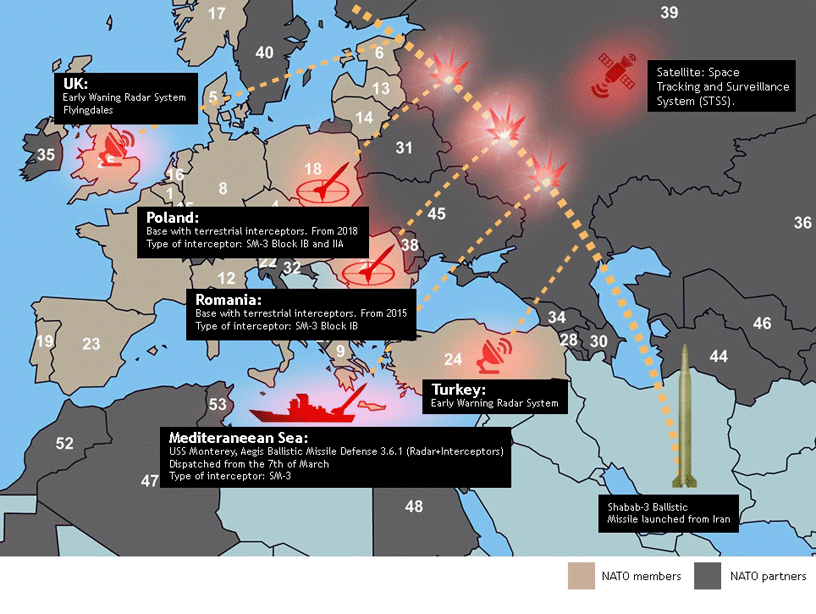
The Hidden Truth about the War in Ukraine, The Postil Magazine, Jacques Baud “………………………………………………………………………………………… NATO’s rationale is to bring European Allies under the US nuclear umbrella. It was designed as a defensive alliance, although recently declassified US documents show that the Soviets had apparently no intention to attack the West.
For the Russians, the question about whether NATO is offensive or defensive is beside the point. To understand Putin’s point of view, we have to consider two things that are usually overlooked by Western commentators: the enlargement of NATO towards the East, and the incremental abandonment of the international security’s normative framework by the US.
In fact, as long as the US didn’t deploy missiles in the vicinity of its borders, Russia didn’t bother so much about NATO extension. Russia itself considered to apply for membership. But problems stated to appear in 2001, as George W. Bush decided to unilaterally withdraw from the ABM Treaty and to deploy anti-ballistic missiles (ABM) in Eastern Europe. The ABM Treaty was intended to limit the use of defensive missiles, with the rationale of maintaining the deterrent effect of a mutual destruction by allowing the protection of decision-making bodies by a ballistic shield (in order to preserve a negotiating capacity). Thus, it limited the deployment of anti-ballistic missiles to certain specific zones (notably around Washington DC and Moscow) and prohibited it outside national territories.
Since then, the United States has progressively withdrawn from all the arms control agreements established during the Cold War: the ABM Treaty (2002), the Open Skies Treaty (2018) and the Intermediate-range Nuclear Forces (INF) Treaty (2019).
In 2019, Donald Trump justified his withdrawal from the INF Treaty by alleged violations by the Russian side. But, as the Stockholm International Peace Research Institute (SIPRI) notes, the Americans never provided proof of these violations. In fact, the US was simply trying to get out of the agreement in order to install their AEGIS missile systems in Poland and Romania. According to the US administration, these systems are officially intended to intercept Iranian ballistic missiles. But there are two problems that clearly cast doubt on the good faith of the Americans:
The first one is that there is no indication that the Iranians are developing such missiles, as Michael Ellemann of Lockheed-Martin stated before a committee of the American Senate.The second one is that these systems use Mk41 launchers, which can be used to launch either anti-ballistic missiles or nuclear missiles. The Radzikowo site, in Poland, is 800 km from the Russian border and 1,300 km from Moscow.
The Bush and Trump administrations said that the systems deployed in Europe were purely defensive. However, even if theoretically true, it is technically and strategically false. For the doubt, which allowed them to be installed, is the same doubt that the Russians could legitimately have in the event of a conflict. This presence in the immediate vicinity of Russia’s national territory can indeed lead to a nuclear conflict. For in the event of a conflict, it would not be possible to know precisely the nature of the missiles loaded in the systems—should the Russians therefore wait for explosions before reacting? In fact, we know the answer: having no early-warning time, the Russians would have practically no time to determine the nature of a fired missile and would thus be forced to respond pre-emptively with a nuclear strike.
Not only does Vladimir Putin see this as a risk to Russia’s security, but he also notes that the United States is increasingly disregarding international law in order to pursue a unilateral policy. This is why Vladimir Putin says that European countries could be dragged into a nuclear conflict without wanting to. This was the substance of his speech in Munich in 2007, and he came with the same argument early 2022, as Emmanuel Macron went to Moscow in February.
Finland and Sweden in NATO—A Good Idea?
The future will tell if Sweden’s and Finland’s decision to apply for NATO membership was a wise idea. They probably overstated the value of the nuclear protection offered by NATO. As a matter of fact, it is very unlikely that the US will sacrifice its national soil by striking Russian soil for the sake of Sweden or Finland. It is more likely that if the US engages nuclear weapons, it will be primarily on European soil and only as a last resort on Russian territory, in order to preserve its own territory from nuclear counter-strike.
Further, these two countries, which met the criteria of neutrality that Russia would want for its direct neighbors, deliberately put themselves in Russia’s nuclear crosshairs. For Russia, the main threat comes from the Central European theater of war. In other words, in the event of a hypothetical conflict in Europe, Russian forces would be engaged primarily in Central Europe, and could use their theater nuclear armies to “flank” their operations by striking the Nordic countries, with virtually no risk of a U.S. nuclear response.
Was it Impossible to Leave the Warsaw Pact?
The Warsaw Pact was created just after Germany joined NATO, for exactly the same reasons we have described above. Its largest military engagement was the invasion of Czechoslovakia in August 1968 (with the participation of all Pact nations, except Albania and Romania). This event resulted in Albania withdrawing from the Pact less than a month later, and Romania ceasing to participate actively in the military command of the Warsaw Pact after 1969. Therefore, asserting that no one was free to leave the treaty is not correct. https://www.thepostil.com/the-hidden-truth-about-the-war-in-ukraine/
NATO Abandons Diplomacy, Says No Longer ‘At Peace’
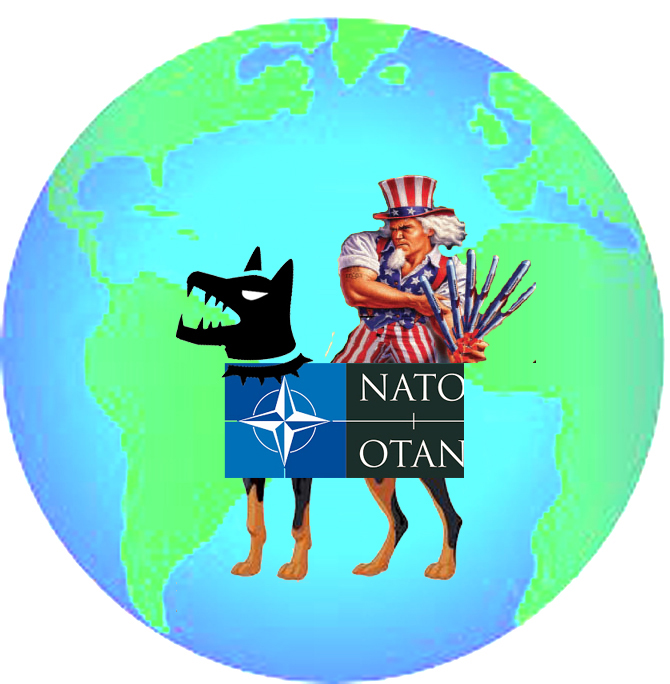
Libertarian Instituteby Bas Spliet | Aug 23, 2022 At the end of its annual summit in Madrid in late June, NATO adopted a new strategic concept. The guidance document is the eighth of its kind since the founding of the alliance in 1949. It radically breaks with the three previous post-Cold War security briefs, however, which observed that “the Euro-Atlantic area is at peace” because “the threat of a conventional attack against NATO territory is low.”
In the eyes of NATO, Russia’s invasion of Ukraine has changed that calculus, claiming that the military organization can no longer discount the possibility of an assault on sovereign NATO states. Continuing the same cryptic language, the new strategic concept concludes that the Euro-Atlantic area now is “not at peace,” in spite of no NATO member being in a state of war with Russia.
Behind this word play, a more dangerous policy change has been codified in the document. Since the adoption of the Harmel Report in 1967, NATO has always officially included diplomacy in one form or another (with political dialogue and strategic partnership being interchangeable labels) as one of its “core” or “fundamental” tasks. The “NATO 2030” report from November 2020, for instance, unequivocally stated that “NATO should continue the dual-track approach of deterrence and dialogue with Russia.”
In the new strategic concept, the core tasks have been purged of the need for diplomacy, except for one or two throw-away lines about “meaningful and reciprocal political dialogue” about arms control issues buried in the middle of the text. Rather, in addition to its original function of deterrence and defense, NATO now fully embraces “crisis prevention and management,” which it has spearheaded since the 1990s with its legally dubious and morally questionable interventions in the Balkans, Afghanistan, and Libya; and “cooperative security,” referring to NATO’s enlargement in Eastern Europe and its Partnership for Peace cooperation with countries in ever further-away regions, including the Black Sea, the Middle East, North Africa, and even the Indo-Pacific, which the British have been pushing to include in a “global NATO.”
Russia was the first country to sign up for the Partnership for Peace program back in 1994. The new NATO doctrine, however, states that Russia can no longer be considered a partner “in light of its hostile policies and actions.” The strategic concept ignores the fact that NATO’s enlargement and new core tasks, which the alliance adopted after the Cold War in an effort to justify its continued existence, have likewise long been seen as hostile in Moscow, nor does it offer any reflection on how the new policies might have contributed to the current unpeaceful “strategic environment.” Instead, it hails the “historic success” of NATO’s expansion in terms of space and substance and insists that the alliance “does not seek confrontation and poses no threat to the Russian federation.”
……………………………….. Now, NATO apologists, like Ukrainian President Volodymyr Zelensky, argue that if the alliance had not expanded eastward, Vladimir Putin would have been even bolder in his imperial ambitions. But as John Mearsheimer pointed out back in 2014, there is virtually no evidence that Putin aimed to incorporate Crimea before the Maidan coup. Rather, his offensive foreign policy in Ukraine since 2014, culminating in the 2022 invasion, is one of reaction to NATO creeping up to Russia’s borders. Bringing Ukraine into the NATO fold has long been a big fat redline for Russia, and we crossed it.
First of all, West-European officials promised the Soviets after the fall of the Berlin Wall that NATO’s borders would not move “one inch” eastward. But then all former Warsaw Pact countries and even some former Soviet Republics were incorporated in the 1990s and early 2000s. In addition to the evidence the National Security Archive assembled on this issue a few years ago, recent archival research has once again confirmed these broken promises.
Next, in 2008, Russian Foreign Minister Sergei Lavrov warned American diplomats that further NATO enlargement, particularly to Ukraine, would constitute a “potential military threat.” …………………………….
After 2014, Ukraine started to become a de facto member of NATO, which bolstered the Ukrainian regime to take a tough stance against Russia. In 2017, Trump decided to sell “defensive weapons” to Kyiv. Other NATO countries got in on the act, shipping weapons to Ukraine, training its military and teaming up with it in joint air and naval exercises. In June 2021, a British destroyer sailed through the Black Sea in an effort to shore up support for Ukraine, precipitating a diplomatic stand-off with Russia. NATO was undeterred, however, because a total of 32 countries participated in a major naval exercise in the Black Sea one month later.
In response, Russia decided to engage in coercive diplomacy, much like the Obama administration had done to get Iran to sign on to the 2015 nuclear deal. Putin amassed troops on the Ukrainian border, demanding guarantees that no offensive missiles would be installed in Eastern Europe and Ukraine not to join NATO. When the crisis was not solved diplomatically, Russia invaded Ukraine. Up until recently, there was hardly any diplomatic intercourse between Washington and Moscow in order to resolve the conflict. The UK’s Boris Johnson, too, “urged against negotiations” during a trip to Kyiv in April. Other NATO members, such as France, Germany, Italy and Hungary, have warmed to negotiations. But as long as there is no bigger push to re-establish diplomacy as a core task of the military alliance, Wilsonian rhetoric is likely to continue to make the world unsafe. https://libertarianinstitute.org/articles/nato-abandons-diplomacy-says-no-longer-at-peace/—
Resistance by local population thwarts the development of Terminal High Altitude Area Defense system (THAAD) in South Korea

“The plan to normalize the operation of the THAAD base, even though the environmental impact assessment has not yet started, means that the government does not even consider a due legal process,”
Tensions mount as gov’t moves to normalize THAAD base operation. https://en.yna.co.kr/view/AEN20220824006000315 August 24, 2022
SEONGJU, South Korea, Aug. 24 (Yonhap) — Tensions are mounting around a U.S. THAAD missile defense unit here, one week ahead of the government’s deadline for normalizing access to the base despite local residents’ opposition.
The Seoul government has pledged to secure unfettered road access to the base in Seongju, around 220 kilometers south of Seoul, by the end of August, as its operation has been hindered by anti-THAAD protesters attempting to block deliveries of goods and equipment to the unit.
The Terminal High Altitude Area Defense system was installed in the southeastern county in 2017 to cope with North Korea’s missile threats.
But the battery has not been running at full capacity, with access restricted to the unit due to protesters and a pending environmental impact assessment.
SEONGJU, South Korea, Aug. 24 (Yonhap) — Tensions are mounting around a U.S. THAAD missile defense unit here, one week ahead of the government’s deadline for normalizing access to the base despite local residents’ opposition.
The Seoul government has pledged to secure unfettered road access to the base in Seongju, around 220 kilometers south of Seoul, by the end of August, as its operation has been hindered by anti-THAAD protesters attempting to block deliveries of goods and equipment to the unit.
The Terminal High Altitude Area Defense system was installed in the southeastern county in 2017 to cope with North Korea’s missile threats.
But the battery has not been running at full capacity, with access restricted to the unit due to protesters and a pending environmental impact assessment.
This May 18, 2021, file photo shows a water truck moving on a road leading to the U.S. Terminal High Altitude Area Defense (THAAD) base in Seongju, 217 kilometers south of Seoul, after police dispersed demonstrators opposing the delivery of daily necessities for troops at the missile defense system’s base. (Yonhap)hide caption
Local residents and activists object to the deployment of the THAAD system due to concerns about possible hazards to human health and the environment.
Since May 2021, the remodeling of barracks at the base has been under way and construction materials, workers and daily necessities have been brought to the base by trucks two to three times a week.
Clashes have often occurred in the area between police and demonstrators occupying the road to block deliveries.
Residents and activists are set to step up protests in response to the government’s plan to provide normal overland access to the base by the end of August.
They also plan to hold a joint rally with other organizations in front of the base on Sept. 3, demanding the military halt the construction.
“The plan to normalize the operation of the THAAD base, even though the environmental impact assessment has not yet started, means that the government does not even consider a due legal process,” the task force of anti-THAAD residents and activists said.
The local government has yet to form a group to conduct the environmental impact survey, which is necessary for the THAAD unit to operate at full capacity, due to the resistance from the residents.
“There are no residents willing to participate in the assessment body,” ,” a county official said. “It is difficult for us to persuade the residents, who have been opposed to the base for many years, to join the team.”
The world stands on a nuclear precipice – we must avoid catastrophe- Jacinda Ardern

https://www.theguardian.com/commentisfree/2022/aug/25/the-world-stands-on-a-nuclear-precipice-we-must-avoid-catastrophe 25 Aug 22, The world can still step back from the abyss. The nuclear weapon states – the US, Russia, China, France and the UK – must lead the way
In 1945 nuclear weapons were used in armed conflict for the first and only time. 355,000 people were killed in Hiroshima and Nagasaki by two nuclear bombs.
Two. That number alone puts in stark perspective the world’s current arsenal of about 13,000 nuclear weapons.
And yet in many ways the 13,000 weapons held globally represents progress; it’s less than a quarter of the more than 63,000 weapons in circulation in 1985 during the cold war.
But what John F Kennedy said in 1961 at the United Nations is as urgent now as it ever was: “We must abolish these weapons before they abolish us.”
Over the more than 50 years since the inception of the nuclear non-proliferation treaty it’s played an important role in lowering the risk of these weapons abolishing us. In addition to the near 80% reduction in nuclear weapons, the treaty has also contributed to keeping a lid on the number of countries acquiring them. More countries have ratified the treaty than any other arms limitation and disarmament agreement.
Right now in New York, there is an opportunity to go even further. And we must.
Our world is at greater risk of nuclear catastrophe than at any time since the height of the cold war. Growing superpower tensions and two decades of stalled progress on arms control have pushed the risk of these weapons closer to reality.
Currently 191 countries are meeting at the UN to renew the nuclear non-proliferation treaty and negotiations are going down to the wire. These talks offer a chance to breathe new life into nuclear disarmament at a time when the world needs that more than ever.
Nuclear catastrophe is not an abstract threat but a real world risk. Nuclear weapons could be deployed in a conflict, as Russia’s president, Vladimir Putin, has intimated, or they could be deployed by miscalculation or mistake – real possibilities in times of heightened tension.
New Zealand is calling on the nuclear weapons states – the US, Russia, China, France and the UK – to step back from the nuclear abyss, and provide that leadership by committing to negotiate a new multilateral nuclear disarmament framework.
But from one of the best geographical positions in the world to be should nuclear fallout occur, why does New Zealand feel so strongly about this issue?
We are a Pacific nation. Our region bears the scars of decades of nuclear testing, on both the people and the lands and waters of our region. That’s why for 35 years New Zealand has been proudly nuclear-free and an international advocate for a world free of nuclear weapons.
This does not mean we are naive to real world dynamics, nor does our geographic location mean we have the luxury of a moral stance that others do not. In fact, New Zealand’s message – that nuclear weapons do not make anyone safer and no longer have a place in our world – reflects the view of the overwhelming majority of countries. We just need to believe a different approach is possible.
We only have to look back in our history to map a path to a safer future. The lessons of Hiroshima and Nagasaki, and of testing in the Pacific, are reminder enough that there is never justification for the deployment of nuclear weapons.
The challenges of agreeing multilateral nuclear disarmament can seem overwhelming. But it’s not a task that can be put off indefinitely.
Right now, the treaty is under stress. It is affected by geopolitical developments including tension between the nuclear weapon states. But, more fundamentally, there is growing scepticism and frustration about the intention of the nuclear weapon states to ever fully implement their nuclear disarmament commitments under the treaty, with those states arguing the global security environment makes doing so too difficult.
If this continues, there is a real prospect of countries losing faith in the treaty – putting at risk both the treaty’s role in progressing nuclear disarmament, and in preventing the spread of nuclear weapons material.
There is a lot at stake in New York this week. Some might say that in the current global environment a new nuclear arms race is inevitable, and with it a further undermining of our nuclear disarmament and non-proliferation efforts. But I cannot accept a logic that suggests insecurity and instability render us incapable of doing the very thing that would help make the world less insecure and less unstable – an idea that the history of the treaty itself shows is false.
There can and should be a different trajectory – one of urgent leadership, of recognition of the nuclear precipice on which we are all standing, and of continued progress in our efforts to rid the world of nuclear weapons. It’s not only possible – it’s necessary.
- Jacinda Ardern is the prime minister of New Zealand
Terrifying nuclear bomb prediction as world tensions rise
As the prospect of nuclear war rises, experts have made a terrifying prediction about what this means for Australia.
news.com.au Jamie Seidel@JamieSeidel, August 16, 2022
It’s been 77 years since the destruction of Hiroshima and Nagasaki. It’s been 33 years since the Berlin Wall’s fall and the Cold War’s end.
But the bomb is back.
Russian President Vladimir Putin is making thinly veiled threats. China’s embarking on a massive nuclear weapon-building campaign. And the menace of atomic annihilation coming out of North Korea is so common as to become background noise.
Has the world forgotten how close these weapons can bring us to extinction?
A new study in the science journal Nature Foodhas built upon recent lessons from Australia’s and Canada’s catastrophic 2019-20 forest fires to anticipate the impact of nuclear detonation on global food production.
Estimates place the amount of smoke produced by the recent fires as up to 1 teragram (1 trillion grams). Heavier soot ejecta was up to 0.02Tg. Both quickly encompassed the globe – lingering in the sky for months afterwards.
This adds confidence to our simulations that predict the same process would occur after a nuclear war,” reads the research published today (Tuesday, August 16) in Nature Food, from lead author Lili Xia of Rutgers University, along with contributors including Dr Ryan Heneghan of the Queensland University of Technology.
The study’s not without immediate relevance.
The bomb is back……………..
UN Secretary-General Antonio Guterres warned that “humanity is just one misunderstanding, one miscalculation away from nuclear annihilation”. Ukraine. Asia. The Middle East. The Koreas. All are experiencing heightened levels of nuclear threats.
With 13,000 nuclear weapons sitting in stockpiles worldwide, the secretary-general warned delegates “the risks of proliferation are growing and guardrails to prevent escalation are weakening”.
“Future generations are counting on your commitment to step back from the abyss.
“This is our moment to meet this fundamental test and lift the cloud of nuclear annihilation once and for all.”
Such a war would reach far beyond the battlefield.
We’re seeing that right now.
The fighting between Russia and Ukraine has disrupted more than 20 per cent of global grain exports – threatening famine in Africa and the Middle East while causing prices to soar globally.
Even a “small” nuclear exchange between Pakistan and India would have catastrophic implications. The handful of weapons both nations possess would kill some 52 million people instantly. They would also eject more than 16 teragrams (16 trillion grams) of soot into the stratosphere.
National borders will not constrain this. Instead, the soot will quickly be picked up by high-altitude jet streams and circle the world.
The result would be a global famine killing an additional 926,000,000 people within two years.
Australia, however, appears to get off relatively lightly. At least at first.
Food for thought
The study, Global food insecurity and famine from … nuclear war soot injection, examines the implications of wars scaling up from 100 warhead detonations through to 4400.
Only Australia and some other southern hemisphere nations would potentially avert starvation.
And that may include the worst-case “all-out exchange” scenario.
Some 360 million would die in the initial blasts. Two years later, an additional five billion would be dead of hunger…………………………… more https://www.news.com.au/technology/innovation/military/terrifying-nuclear-bomb-prediction-as-world-tensions-rise/news-story/938f4ed66c8f38b8b9cbbb2147500400
America must consider the risk a war over Taiwan could go nuclear
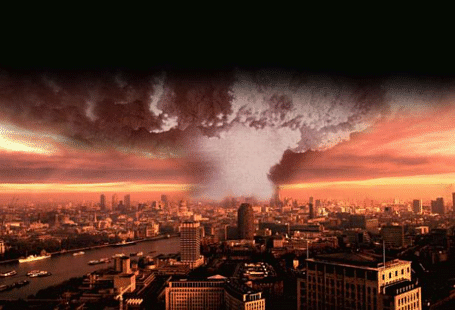
The debate on confrontation with China ignores a crucial conversation about atomic weapons
MICHAEL AUSLIN, Ft.com 22 Aug 22,
The single most important question about a potential war over Taiwan between the United States and China is whether such a conflict could remain non-nuclear. Yet when President Joe Biden stated again in May that America would defend the island in the event of a Chinese attack, no one asked if that meant he was willing to risk a nuclear exchange with Beijing. If the fast-gelling opinion of Washington’s foreign policy elite is correct — that such a war is no longer simply possible but likely — then assessing such a risk needs to be at the forefront of every discussion.
Since the first use of atomic weapons nearly eight decades ago, no nuclear-armed power has ever fought another in a major conflict. During the cold war, America and the Soviet Union fought both direct and indirect proxy wars but avoided direct conventional conflict that could have escalated out of control. The reliability of America’s nuclear umbrella and promises of “extended deterrence” are regularly questioned by non-nuclear allies. It is also the reason that Nato was so circumspect in responding to Russia’s invasion of Ukraine earlier this year.
Once the cold war ended, many in the US assumed that the era of the Cuban Missile crisis and “duck and cover” was over, emphasised by the shutting of the fearsome Strategic Air Command in 1992. Nuclear weapons never went away of course, and SAC eventually morphed into US Strategic Command. Yet the fears that civilisation could end in billowing mushroom clouds rapidly abated as the country turned to another generation of wars in the Middle East and against global terrorism.
But policymakers and the US public can no longer ignore the fact that a new nuclear age has dawned. Vladimir Putin’s sabre-rattling in the early days of the Ukraine war revealed that nuclear-armed authoritarian aggressors may not be restrained. As Beijing considers Taiwan its sovereign territory, there can be no assurance that a conflict would remain conventional. Make no mistake about it, this would be no small clash. Control over Taiwan has been the primary foreign policy and strategic concern of the CCP since Mao Zedong took power in 1949.
…………………… War games are one thing but in the real world, as soon as one US missile hits Chinese territory, the question of escalation becomes critical. ………………………..
Any major clash would, in fact, be the first ballistic missile war between great powers. Americans long ago ceased any civil defence preparation and the public is entirely unprepared to come under missile attack. Such an escalation would put enormous pressure on US leaders to strike back even harder at Chinese targets, thus risking an all-out confrontation, with the urge to go nuclear growing with each new setback.
The implications of a Taiwan war are enormous, but no US leader should blithely commit to defending the island without understanding that a conflict with China could be like no other fought in history. How far the US is willing to go must be openly debated and the risks of action as well as inaction equally assessed. We must think the unthinkable or we might wind up paying a tragic price. https://www.ft.com/content/e919274c-f743-462f-83fe-80ac352036fd
Zelensky warns “no more peace talks”, if Donetsk People’s Republic prosecutes captured Neo Nazi fighters for war crimes.
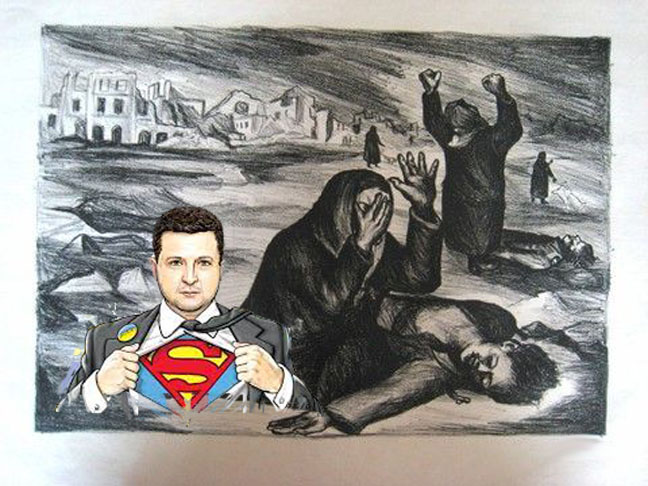
Zelensky warns against putting neo-Nazis on trial. Rt.com 22 Aug 22, Russia will “cut itself off” from talks if Azov fighters are prosecuted in Donbass, Ukrainian president insists.
There will be no more peace talks with Russia if captured Ukrainian Neo-Nazis are subjected to a “show trial,” the country’s President Vladimir Zelensky has claimed.
The authorities of the Donetsk People’s Republic (DPR) have previously said that they are planning tribunals for suspected war crimes committed by Ukrainian troops, including members of the Azov Battalion, whose ranks include fighters with openly nationalist and neo-Nazi views………………
DPR head Denis Pushilin told TASS this month that “active preparations” for the proceedings were underway. “The first tribunal will most likely be held in Mariupol. It will be organized by the end of summer,” he said.
The peace talks between Russia and Ukraine have been stalled since spring………………… more https://www.rt.com/russia/561277-zelensky-talks-pow-trial/
Donbass had something to say about Zelensky’s ultimatum:
DPR head Denis Pushilin told Russia 24 TV:
“The data on 80 counts of crimes committed by the Azov has been collected, 23 people have been arrested and are in custody. So such statements by Zelensky will have no effect [on the trials].”
Nearly 2,500 Ukrainian soldiers surrendered to Russian and Donbass forces during the siege of the Azovstal steel plant in Mariupol in May, according to the Russian Defense Ministry.
Civilian casualties in Ukraine-5,000? In Yemen-380,000? But Western Media tells a different story!

In the case of the Russia-Ukraine war the mainstream media, both print and electronic media, has been conspicuous in using human interest stories–focussing on one individual or a single family in Ukraine–to rouse the interests of those incapable or unwilling to canvas the larger picture.
The civilian casualties in the Iraq war (185,000-208,000) and the war in Yemen (380, 000), as well as the Afghanistan war (70,000) are difficult to determine with any accuracy, but they certainly run into the hundreds of thousands if not millions. Similar is the situation in the on-going Israel-Palestine conflict between 2000 and 2014 where the casualties are overwhelmingly on the Palestinian side (approximately 7000 Palestinians and 1100 Israelis).
https://johnmenadue.com/deaths-in-ukraine-and-the-rest-the-media-is-ideologically-linked-to-one-side-of-the-war/, Pearls and Irritations, By Greg Bailey, Aug 22, 2022 Whilst resort to warfare must be strongly deprecated in virtually all circumstances, it is arguable that the media treatment of specific conflicts and the resulting casualties–both civilian and military–differs considerably from war to war and can easily break down into black and white categories, based on factors other than the war itself. The recourse to particular forms of categorisation tells us as much about the media itself as it does about the particular conflicts being reported upon.
Reportage of wars is undoubtably difficult, as the warring sides will consistently use propaganda to press their own innocence and outrage. Casualty figures and types of casualties–civilian or military–are always employed to push a particular line of guilt or innocence of one side or the other. Equally, those media outlets in countries not directly involved in any given conflict will tend towards a style of reporting guided by formal or informal international alliances or other factors, not necessarily by the actual available data from the theatre of war.
In the case of the Russia-Ukraine war the mainstream media, both print and electronic media, has been conspicuous in using human interest stories–focussing on one individual or a single family in Ukraine–to rouse the interests of those incapable or unwilling to canvas the larger picture. Particular individuals or families are focussed upon and a potted biography is given of their life situation before hostilities began, and what has been their subsequent fate. This is perhaps a consequence of the number of war correspondents on the ground, and their incapacity to source figures of casualties beyond the military forces and those directly involved in the fighting. However, the former are reported in non-mainstream media outlets. A BBC report gives the number of reported deaths in Ukraine as 10, 470 between 24/2-24/6/22, almost certainly understated, and there would have been many more since then. Of these between 3600 and 4700 were civilian deaths.
The civilian casualties in the Iraq war (185,000-208,000) and the war in Yemen (380, 000), as well as the Afghanistan war (70,000) are difficult to determine with any accuracy, but they certainly run into the hundreds of thousands if not millions. Similar is the situation in the on-going Israel-Palestine conflict between 2000 and 2014 where the casualties are overwhelmingly on the Palestinian side (approximately 7000 Palestinians and 1100 Israelis). These figures almost certainly understate the total casualties, yet such figures have rarely appeared in the mainstream media, focus being placed mainly on isolated incidents, especially those involving terrorist acts attributed to Islamic terrorist groups. And if they can show pictures of actual explosions and rockets being launched, or destroyed buildings, whilst important, this is primarily designed to convey a sense of horror in the viewer. The more long-term effects on casualties produced by destruction of various kinds of infrastructure, health services, and the resulting starvation tend to be played down, if mentioned at all.
What are we supposed to conclude through all of these figures? Is there a definite difference in the Australian media’s coverage of wars involving people in cultures which are somewhat like ours, as opposed to those with which we might seem to have a cultural clash? This is especially the case with Muslims and it would certainly be the same if we went to war with the Chinese. I suspect the attitude is also the same with our treatment of Russia, which has always had a bad press in the West.
The main issue here is that the media treat certain societies and countries as categories, whereas other societies, more familiar to us, can be broken down into individuals and groups with similar interests, demands and concerns as us. This is demonstrative of the major chasm still existing between the perception of third and first world cultures, and Muslim and non-Muslim cultures. Such a discrepancy in perception is pushed along by the mass media and prevents a much more nuanced view to be taken by the public of ongoing conflicts and the historical conditions that have given rise to them. Here, as signalled often in P&I, the American interventions in Eastern Europe since 1991 have done much to cause the present situation in Ukraine, but these have largely been ignored in the kind of press coverage the conflict has been given in the West.
What would impartial reporting produce and is it at all possible for it to occur? What is very obvious is that the strong sympathy accorded to Ukraine in the mainstream media in Australia and other Western countries has completely obscured the historical perspective telling us how these conflicts may have originated and how they might be prevented in the future. It is true that Ukraine is a distant horizon for most Australians, but it occupies a space in culture much closer to us than cultures in the Middle East and Central Asia. And whilst it is necessary to report as accurately as possible what is going on there, so should there be a consistent approach to the coverage of conflicts in non-European countries.
What would impartial reporting produce and is it at all possible for it to occur? What is very obvious is that the strong sympathy accorded to Ukraine in the mainstream media in Australia and other Western countries has completely obscured the historical perspective telling us how these conflicts may have originated and how they might be prevented in the future. It is true that Ukraine is a distant horizon for most Australians, but it occupies a space in culture much closer to us than cultures in the Middle East and Central Asia. And whilst it is necessary to report as accurately as possible what is going on there, so should there be a consistent approach to the coverage of conflicts in non-European countries.
UN chief demands halt to “nuclear saber-rattling” at Ukrainian nuke plant
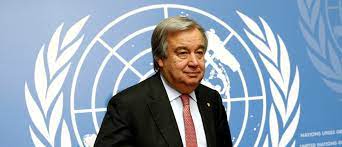
UN Secretary-General has demanded a halt to nuclear saber-rattling, saying the world is at a maximum moment of danger and all countries with nuclear weapons must make a commitment to no first-use
AP | United Nations August 23, 2022
UN Secretary-General Antonio Guterres has demanded a halt to nuclear saber-rattling, saying the world is at a maximum moment of danger and all countries with nuclear weapons must make a commitment to no first-use.
The UN chief on Monday told the Security Council that the commitment to dialogue and reason that led to the recent deal restarting grain and fertiliser shipments from Ukraine and Russia must be applied to the critical situation at Europe’s largest nuclear power plant at Zaporizhzhia in southeastern Ukraine, where continued shelling and fighting in the area has raised fears of a nuclear catastrophe.
Saying humanity’s future is in our hands today, Guterres urged all countries to recommit to a world free of nuclear weapons and to spare no effort to come to the negotiating table to ease tensions and end the nuclear arms race, once and for all.
The secretary-general spoke at a council meeting organised by China, which holds the presidency this month, on promoting common security through dialogue and cooperation.
Across the world, Guterres said, collective security is being tested as never before, pointing to geopolitical divides, conflicts, military coups, invasions, lengthy wars and differences between the world’s great powers, including at this council.
He also cited challenges that were unimaginable to our predecessors — cyberwarfare, terrorism, and lethal autonomous weapons.
And the nuclear risk has climbed to its highest point in decades, Guterres warned.
The council meeting took place during the pandemic-delayed conference to review the 50-year-old Nuclear Nonproliferation Treaty, which is considered the cornerstone of international disarmament efforts……………………………………………………… more https://www.business-standard.com/article/international/un-chief-demands-halt-to-nuclear-saber-rattling-at-ukrainian-nuke-plant-122082300082_1.html
The US Navy is looking at scrapping the ‘Big E,’ the first nuclear-powered aircraft carrier, at a private shipyard
Jake Epstein , Insider 22 Aug 22,
- The US Navy is thinking about how best to scrap its first nuclear-powered aircraft carrier, USS Enterprise.
- It is looking at sending it to a private shipyard given existing maintenance demands and challenges, a new report shows.
- Washington state’s Puget Sound Naval Shipyard has historically handled disposing of nuclear-powered naval assets.
……………………………………….Washington state’s Puget Sound Naval Shipyard and Intermediate Maintenance Facility (PSNS & IMF) has historically managed the disposal of nuclear-powered ships, but a Naval Sea Systems Command spokesperson previously told Insider that other work could delay the process for years.
The Bremerton shipyard might not be able to even start work on scrapping the ex-Enterprise until sometime between 2030 and 2040, according to The Kitsap Sun, which first reported the plans.
…………………………… “The workforce of the public shipyards of the Navy has been under tremendous pressure to execute their primary mission of maintaining the operational fleet,” the report said, explaining that letting a private shipyard handle the scrapping work would keep the Navy yard “focused on high-priority fleet maintenance work and submarine inactivations.”…………………. https://www.businessinsider.com/us-navy-considers-scrapping-first-nuclear-powered-carrier-private-shipyard-2022-8
John Queripel: The blind side to western wars and western war crimes
https://johnmenadue.com/john-queripel-the-blind-side-to-western-wars-and-western-war-crimes/, Pearls and Irritations, By P&I Guest Writers, Aug 22, 2022
The calls mount for the Russian leader to be dragged before a War Crimes Tribunal, while everyone from international sporting bodies to businesses and banks is busy sanctioning Russia. Yet, the three world leaders responsible for the illegal Iraq war of 2003 have still not been held to account
One of the ideas, central to the thought of the Swiss founder of Analytical Psychology Carl Jung, was the shadow side. This is the side of our personalities we find unattractive which we, as a means of defence, then project onto others.
Jung asserted, it is not only individuals, but whole cultures, which are inclined to do this. Thus, in the years preceding the Nazi takeover, Jung spoke of Germany, caught in a cult of intellectualism, denying primal forces, projecting their unacknowledged dark side on to ‘the other.’ Of course, we know that the Nazis rose to power exploiting this projection of darkness to others, be they Communists, Romanies, Jews or homosexuals. The end of that journey was mass extermination in such places as Auschwitz.
It is very comforting but deeply dangerous to project our own darkness onto others, whom we then demonise. Currently most of those things, dark and evil in world politics, are being projected on to Russia, in particular their leader, Vladimir Putin, understood as ‘megalomaniac,’ ‘tyrant,’ and ‘war-monger.’ He may indeed be these things, but projection of these forces on to him saves us having to face up to their presence in ourselves.
The West, so vociferous in their criticism of Putin, cannot front up to the reality that it has been equally criminal in invading a sovereign state on concocted excuses. Unable to convince the U.N. Security Council, over what, even at the time, was a highly dubious claim that Iraq’s Saddam Hussein had ‘Weapons of Mass Destruction,’ which the then U.K. Prime Minister, Tony Blair claimed could reign down on British cities within 40 minutes, the ‘Coalition of the Willing’ chose to go to war.
The resultant destruction was horrendous. Though figures vary greatly, the highly reputable medical journal, ‘The Lancet’ estimated there were 654,965 excess deaths in Iraq from the time of the 2003 invasion to mid-2006 only. In that year, 2006 alone, the U.N. estimates the number of innocent civilians killed as totalling 34,452. The most potent image of the destruction wrought by that war is found in images of Fallujah after the allies had finished their bombing. Putin and the Russians still have a long way to go to reach that level of death and destruction.
The calls mount for the Russian leader to be dragged before a War Crimes Tribunal, while everyone from international sporting bodies to businesses and banks is busy sanctioning Russia. Yet, the three world leaders responsible for the illegal war of 2003 have still not been held to account. Nor were those bodies, now declaring their abhorrence to war, imposing sanctions against the Western nations guilty of the same aggressive invasion of a sovereign state. Having, trashed the ‘rules based international order,’ of which it so loves to speak, did the West not suspect that one like Putin would profit from such?
It is comforting to project one’s shadow side on another, but Jung asserted, it comes back to bite in a highly destructive way.
John Queripel is a Newcastle-based theologian, author, and social commentator
‘We should kill as many Russians as we can’ – Ukrainian envoy
Ukraine is doing its best to “kill as many Russians” as possible, the nation’s ambassador to Kazakhstan, Pyotr Vrublevsky, told local media outlets on Monday.
Speaking to a local blogger, Vrublevsky was asked to comment on the ongoing Ukraine conflict. “What can I say … We are trying to kill as many [Russians] as possible. The more Russians we kill now, the fewer our children will have to. That’s it,” he said………………………………………….. more https://www.rt.com/russia/561314-kill-russians-ukraine-ambassador/
—
Why Crimea matters. Russia shoots down Ukrainian drone over Crimea
Russia shoots down Ukrainian drone over Crimea | DW News 21 Aug 22, Russian officials in occupied Crimea say they’ve shot down a drone, headed for a key military base. It was targeting the headquarters of Russia’s Black Sea Fleet in Sevastopol. It was the second assault of its kind against the naval command in Crimea in less than a month – and it comes as Russia claims to have shot down drones elsewhere on the peninsula. Russia annexed Crimea in 2014. However, the international community still recognizes it as part of Ukraine.
Putin Claim U.S. Is Dragging Out War Isn’t Crazy, Military Expert Says

Newsweek, BY NICK MORDOWANEC ON 8/18/22
aims made by Russian President Vladimir Putin that the United States is intentionally prolonging the Russia-Ukraine conflict may not be as implausible as described, says one U.S. military veteran and journalist.
In a speech this week, Putin called out “Western globalist elites” who he said are “provoking chaos, inciting old and new conflicts,” and attempting “to preserve the hegemony and power that is slipping out of their hands.” He added that the situation in Ukraine shows the U.S. is “trying to prolong the conflict.”
Sean Spoonts, a U.S. Navy veteran and editor-in-chief of Special Operations Forces Report (SOFREP), told Newsweek that President Joe Biden and Ukrainian President Volodymyr Zelensky seem to have separate policy goals in mind.
“It seems like while Ukraine would like to end the war quickly and decisively defeat Russian forces and drive them out of their country, U.S. policy almost seems designed to prolong the conflict hoping to bring about the collapse of Russia itself, both militarily and economically,” Spoonts said.
……………. As a recent report by The Washington Post indicated, the U.S. was privy to some of Russia’s plans for the invasion of Ukraine before it officially began on February 24. Spoonts alluded to Biden’s remarks on that day, when he said, “Some of the most powerful impacts of our actions will come over time as we squeeze Russia’s access to finance and technology for strategic sectors of its economy and degrade its industrial capacity for years to come.”
“Biden has said publicly that his goal is to degrade Russia as a world power, never again in the position to threaten its neighbors,” said Spoonts. “That goes a lot further than Zelensky’s goal, which is to simply get Russian armies out of his country and regain lost territories in Donbas, Luhansk and Crimea.”………………………………. https://www.newsweek.com/sean-spoonts-us-russia-ukraine-war-policy-goals-1735019
Russian President Vladimir Putin warned Macron that Ukrainian shelling of Zaporizhzhia nuclear plant risks disaster
Russian President Vladimir Putin warned his French counterpart Emmanuel
Macron that shelling of the Russian-controlled Zaporizhzhia nuclear power
plant in southern Ukraine, which he blamed on Kyiv, could result in a
large-scale disaster.
Reuters 19th Aug 2022
1 This Month





PLEASE OPPOSE HR 8255 AND S.3639 – bills would accelerate satellite deployment, with no environmental review or safeguards – https://ncstd5li.quorum.us/campaign/169331/
To see nuclear-related stories in greater depth and intensity – go to https://nuclearinformation.wordpress.com
-
Archives
- October 2026 (10)
- September 2026 (339)
- August 2026 (330)
- July 2026 (355)
- June 2026 (287)
- May 2026 (306)
- April 2026 (356)
- March 2026 (251)
- February 2026 (267)
- January 2026 (308)
- December 2025 (358)
- November 2025 (359)
-
Categories
- 1
- 1 NUCLEAR ISSUES
- business and costs
- climate change
- culture and arts
- ENERGY
- environment
- health
- history
- indigenous issues
- Legal
- marketing of nuclear
- media
- opposition to nuclear
- PERSONAL STORIES
- politics
- politics international
- Religion and ethics
- safety
- secrets,lies and civil liberties
- spinbuster
- technology
- Uranium
- wastes
- weapons and war
- Women
- 2 WORLD
- ACTION
- AFRICA
- Atrocities
- AUSTRALIA
- Christina's notes
- Christina's themes
- culture and arts
- Events
- Fuk 2022
- Fuk 2023
- Fukushima 2017
- Fukushima 2018
- fukushima 2019
- Fukushima 2020
- Fukushima 2021
- general
- global warming
- Humour (God we need it)
- Nuclear
- RARE EARTHS
- Reference
- resources – print
- Resources -audiovicual
- Weekly Newsletter
- World
- World Nuclear
- YouTube
-
RSS
Entries RSS
Comments RSS

