Commemorate August 29: International Day against Nuclear Tests
Jerusalem Post, By IVO SLAUS, AUGUST 29, 2022, At the initiative of the Republic of Kazakhstan, the UN declared August 29 as the International Day against Nuclear Tests, universally adopted in 2009. While many of those discussing the possible use of nuclear weapons, including Mutually Assured Destruction (MAD), Tactical Nuclear Weapons, and Nuclear Utilization Target Selection (NUTS), and are modernizing and “improving” their nuclear capacity, most of them know almost nothing about nuclear warfare and its consequences for humankind.
In contrast, the people of Kazakhstan and their leaders have witnessed many nuclear tests carried out at the Semipalatinsk Nuclear Test Site for 40 years (1949-1989). From Pervaya Molniya (first lightning) on August 29, 1949, there were 456 tests at Semipalatinsk, 340 underground, and 116 above ground. Kazakhstan and its 1.5 million citizens have suffered from all the negative consequences of nuclear tests. Early death, lifelong debilitating illnesses, and horrific birth defects, including “jelly babies” – children born without limbs.
With good reason, Kazakhstan signed and ratified the Treaty on Prohibition of Nuclear Weapons and was among the original 50 states party to the treaty. On its independence day, Kazakhstan inherited 1,400 Soviet nuclear warheads, and quickly relinquished them, emphasizing that security is better achieved through disarmament and negotiation.
Kazakhstan also initiated a global moment of silence to honor all victims of nuclear weapons testing – at 11:05 Kazakhstan time on August 29. At 11:05 a.m. the clock shows V, standing for victory.
The elimination of nuclear weapons is truly a victory for humankind. On July 9, 1955, the Russell-Einstein Manifesto, signed by 11 outstanding scientists, was issued stressing, “Here is the problem we present to you, stark, dreadful and inescapable: Shall we put an end to the human race or shall mankind renounce war?… Remember your humanity and forget the rest!”
……………………….. we were never as close to doomsday as we are today. Expressed by the doomsday clock, introduced in 1947 and put at seven minutes to midnight, which symbolizes the human-made catastrophe, the doomsday clock since 2020 is at 100 seconds and most likely will deteriorate. The recent conflicts in Europe and Asia will probably abbreviate it further………………………more https://www.jpost.com/opinion/article-715783
Ukraine and the Politics of Permanent War
Permanent war requires permanent censorship.
Day and night, the drums of war never stop beating. Its goal: to keep billions of dollars flowing into the hands of the war industry and prevent the public from asking inconvenient questions.
Chris Hedges, 29 Aug 22. No one, including the most bullish supporters of Ukraine, expect the nation’s war with Russia to end soon. The fighting has been reduced to artillery duels across hundreds of miles of front lines and creeping advances and retreats. Ukraine, like Afghanistan, will bleed for a very long time. This is by design.
On August 24, the Biden administration announced yet another massive military aid package to Ukraine worth nearly $3 billion. It will take months, and in some cases years, for this military equipment to reach Ukraine. In another sign that Washington assumes the conflict will be a long war of attrition it will give a name to the U.S. military assistance mission in Ukraine and make it a separate command overseen by a two- or three-star general.
Since August 2021, Biden has approved more than $8 billion in weapons transfers from existing stockpiles, known as drawdowns, to be shipped to Ukraine, which do not require Congressional approval.
Including humanitarian assistance, replenishing depleting U.S. weapons stocks and expanding U.S. troop presence in Europe, Congress has approved over $53.6 billion ($13.6 billion in March and a further $40.1 billion in May) since Russia’s February 24 invasion.
War takes precedence over the most serious existential threats we face. The proposed budget for the Centers for Disease Control and Prevention (CDC) in fiscal year 2023 is $10.675 billion while the proposed budget for the Environmental Protection Agency (EPA) is $11.881 billion. Our approved assistance to Ukraine is more than twice these amounts.
The militarists who have waged permanent war costing trillions of dollars over the past two decades have invested heavily in controlling the public narrative. The enemy, whether Saddam Hussein or Vladimir Putin, is always the epitome of evil, the new Hitler. Those we support are always heroic defenders of liberty and democracy. Anyone who questions the righteousness of the cause is accused of being an agent of a foreign power and a traitor.
The mass media cravenly disseminates these binary absurdities in 24-hour news cycles. Its news celebrities and experts, universally drawn from the intelligence community and military, rarely deviate from the approved script. The mass media cravenly disseminates these binary absurdities in 24-hour news cycles. Its news celebrities and experts, universally drawn from the intelligence community and military, rarely deviate from the approved script. Day and night, the drums of war never stop beating. Its goal: to keep billions of dollars flowing into the hands of the war industry and prevent the public from asking inconvenient questions.
In the face of this barrage, no dissent is permitted. CBS News caved to pressure and retracted its documentary which charged that only 30 percent of arms shipped to Ukraine were making it to the front lines, with the rest siphoned off to the black market, a finding that was separately reported upon by U.S. journalist Lindsey Snell. CNN has acknowledged there is no oversight of weapons once they arrive in Ukraine, long considered the most corrupt country in Europe. According to a poll of executives responsible for tackling fraud, completed by Ernst & Young in 2018, Ukraine was ranked the ninth-most corrupt nation from 53 surveyed.
There is little ostensible reason for censoring critics of the war in Ukraine. The U.S. is not at war with Russia. No U.S. troops are fighting in Ukraine. Criticism of the war in Ukraine does not jeopardize our national security. There are no long-standing cultural and historical ties to Ukraine, as there are to Great Britain. But if permanent war, with potentially tenuous public support, is the primary objective, censorship makes sense.
War is the primary business of the U.S. empire and the bedrock of the U.S. economy. The two ruling political parties slavishly perpetuate permanent war,………………………………………………
An organization like NewsGuard, which has been rating what it says are trustworthy and untrustworthy sites based on their reporting on Ukraine, is one of the many indoctrination tools of the war industry. Sites that raise what are deemed “false” assertions about Ukraine, including that there was a U.S.-backed coup in 2014 and neo-Nazi forces are part of Ukraine’s military and power structure, are tagged as unreliable. Consortium News, Daily Kos, Mint Press and Grayzone have been given a red warning label. Sites that do not raise these issues, such as CNN, receive the “green” rating” for truth and credibility. (NewsGuard, after being heavily criticized for giving Fox News a green rating of approval in July revised its rating for Fox News and MSNBC, giving them red labels.)
The ratings are arbitrary. The Daily Caller, which published fake naked pictures of Alexandria Ocasio-Cortez, was given a green rating, along with a media outlet owned and operated by The Heritage Foundation. NewsGuard gives WikiLeaks a red label for “failing” to publish retractions despite admitting that all of the information WikiLeaks has published thus far is accurate. …………..
NewsGuard, established in 2018, “partners” with the State Department and the Pentagon, as well as corporations such as Microsoft. Its advisory board includes the former Director of the CIA and NSA, Gen. Michael Hayden; the first U.S. Homeland Security director Tom Ridge and Anders Fogh Rasmussen, a former secretary general of NATO………………………………
As the persecution of Julian Assange illustrates, the throttling of press freedom is bipartisan. This assault on truth leaves a population unmoored. It feeds wild conspiracy theories. It shreds the credibility of the ruling class. It empowers demagogues. It creates an information desert, one where truth and lies are indistinguishable. It frog-marches us towards tyranny. This censorship only serves the interests of the militarists who, as Karl Liebknecht reminded his fellow Germans in World War I, are the enemy within.
The Saudi path to nuclear weapons — Beyond Nuclear International

Is Riyadh preparing to build the bomb?
The Saudi path to nuclear weapons — Beyond Nuclear International Kingdom’s pursuit of nuclear power development should set off alarm bells
By Henry Sokolski, 328 Aug 22,
Iran’s nuclear program, oil, and human rights dominated Biden’s much-anticipated first presidential trip to the Middle East earlier this month. But there is one topic President Biden chose not to showcase during his visit with Saudi Crown Prince Mohammed Bin Salman Al Saud—the Kingdom’s most recent interest in nuclear energy—and the nuclear weapons proliferation concerns that come with it.
Only weeks before Biden’s visit, Riyadh invited South Korea, Russia, and China to bid on the construction of two large power reactors. On that bid, Korea Electric Power Company (KEPCO) is the most likely winner. KEPCO has already built four reactors for Riyadh’s neighbor, the United Arab Emirates, and is the only vendor to bring a power reactor of its own design online in the Middle East. South Korea also is the only government to provide reliable, generous financing, free of political strings—something neither Moscow nor Beijing can credibly claim.
And then, there’s this: Any Korean sale would be covered by a generous 2011 South Korean nuclear cooperative agreement with Riyadh that explicitly authorizes the Saudis to enrich any uranium it might receive from Seoul. Under the agreement, Riyadh could enrich this material by up to 20 percent, without having to secure Seoul’s prior consent.
That should set off alarm bells.
Do the Saudis want a bomb?
In 2018, Crown Prince Mohammed Bin Salman announced that “if Iran developed a nuclear bomb, we will follow suit as soon as possible.” As if to prove the point, late in 2020, word leaked that the Saudis have been working secretly with the Chinese to mine and process Saudi uranium ore. These are steps toward enriching uranium—and a possible nuclear weapon program.
Unlike the Emirates, which legally renounced enriching uranium or reprocessing spent fuel to separate plutonium, the Kingdom insists on retaining its “right” to enrich. Also, unlike most members of the International Atomic Energy Agency (IAEA), Saudi Arabia refuses to allow intrusive inspections that might help the IAEA find covert nuclear weapons-related activities, if they exist, under a nuclear inspections addendum known as the Additional Protocol.
Saudi Arabia’s enrichment program and refusal to adopt the Additional Protocol, doubled with a possible permissive South Korean reactor sale, could spell trouble. South Korea currently makes its nuclear fuel assemblies using imported uranium, which mainly comes from Australia. This ore is controlled by Australia’s uranium export policy, which requires that the uranium be monitored by the IAEA and that materials derived from it not be retransferred to a third country without first securing Australia’s consent. Yet, if Seoul decides to pass Australian uranium on to Riyadh, the Saudis are free to enrich it up to 20 percent at any time without having to secure anyone’s approval. In addition, Riyadh could proceed to enrich this material without having to agree to intrusive IAEA inspections under the Additional Protocol, making it easier for Riyadh to enrich beyond 20 percent uranium 235 without anyone knowing.
Can Washington block the reactor export?
In Washington, the US nuclear industry understandably is miffed that Riyadh excluded Westinghouse from bidding on the Saudi reactors. Meanwhile, State Department officials say that KEPCO can’t sell Riyadh its APR-1400 reactor because it incorporates US nuclear technology that is property of Westinghouse………………………………..
Does the Republic of Korea need Washington’s blessing to begin enriching uranium itself or to transfer enrichment technology to other countries, such as Saudi Arabia?
The short answer is no…………………………..
how committed is the Biden Administration to prevent Saudi Arabia from enriching uranium and reprocessing spent reactor fuel? …………………….more https://beyondnuclearinternational.org/2022/08/28/the-saudi-path-to-nuclear-weapons/—
Liz Truss commits to keeping Trident nuclear weapons on the Clyde, despite Scottish opposition to them
The National, By Judith Duffy 28 Aug 22,
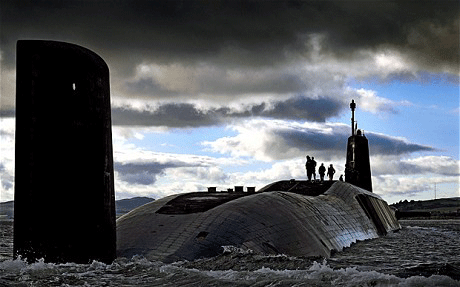
TORY leadership frontrunner Liz Truss has vowed to push ahead with renewing Trident if she wins the keys to Downing Street, as part of plans to “protect the UK”.
The Foreign Secretary has already pledged to boost defence spending to 3% of GDP by 2030 – a promise her rival Rishi Sunak has refused to match because he says he does not believe in “arbitrary targets” when it comes to security.
The Truss campaign has now set out her plan to “protect the UK”, including a “full renewal” of the nuclear deterrent, an update to the Government’s Integrated Review, and strengthened support for intelligence services………………………………..
The SNP have long committed to the removal of Trident nuclear missiles after independence.
The White Paper on independence published ahead of the 2014 independence referendum, promised the “speediest safe withdrawal of nuclear weapons from Scotland”.
In May, Nicola Sturgeon said it was her “expectation and hope” that Trident would be removed from the Faslane naval base on the Clyde in the first Holyrood term after a Yes vote. https://www.thenational.scot/news/20800761.liz-truss-commits-keeping-trident-nuclear-weapons-clyde/
China deploys ships and jets near Taiwan — Taipei
The move comes hours after US warships sailed past the self-governed island
https://www.rt.com/news/561681-taiwan-china-strait-tensions/ 28 Aug22,
A sizable group of Chinese military vessels and aircraft has been detected around Taiwan amid heightened tensions in the region, the self-governed island’s Defense Ministry claimed on Sunday.
According to the ministry, eight Chinese Navy vessels and 23 aircraft were detected in Taiwan’s vicinity. Ten planes, it stated, “had flown on the east part of the median line of the Taiwan Strait,” which in practice serves as an unofficial barrier between mainland China and the island.
The Taiwanese military added that local combat air patrol has been given relevant instructions, and that Beijing’s activities are being closely monitored.
The apparent Chinese deployment comes a day after the US sent two warships to the Taiwan Strait, in what the Navy called a “routine” transit mission, meant to “demonstrate the United States’ commitment to a free and open Indo-Pacific.”
Beijing responded by putting its military on high alert and signaling its readiness “to stop any provocations in a timely manner.” Earlier, China also castigated the US, branding it “the destroyer of peace and stability in the Taiwan Strait.”
Tensions in the region have been running high since the controversial visit by US House Speaker Nancy Pelosi to Taipei in early August, which sent relations between Washington and Beijing into a tailspin and triggered a flurry of Chinese military activity in the area. At the time, Chinese Defense Ministry said it had conducted drills simulating a “blockade” of the island, as well as amphibious assaults and the striking of ground targets.
Beijing considers the self-governing island its own territory, and views visits by high-ranking US officials as attacks on its sovereignty and a violation of the ‘One China’ principle. The Taiwan Strait, which separates the self-governed island from mainland China, has been a source of military tension since 1949, when Chinese nationalists fled to the island after losing the Civil War to the Communists.
Boris Johnson told: “It’s time to deliver justice for Britain’s nuclear test veterans”
Campaigners have asked the Prime Minister to use his last week in office to fulfil his promise to the victims of Cold War radiation experiments
Mirror. Susie Boniface, Reporter. 28 Aug 2022
Politicians and celebrities have joined forces with survivors of Britain’s nuclear tests to ask the Prime Minister to deliver justice in his last week in Downing Street.
They have written Boris Johnson an open letter, urging him to decide whether to “turn his back on our national heroes” or honour them before the 70th anniversary next month of the UK’s first atomic bomb.
The PM met families affected by the Cold War radiation experiments in June, but with only days left in Downing Street has yet to make any announcement about the medal they asked him for.
Both his potential successors have said they support it – but no decision has been made, with officials on leave and all eyes on the leadership campaign.
Mirror editor Alison Phillips said: “It is imperative this medal is delivered quickly, because these veterans are over 80 and have complex health problems. The window is closing for this PM to make a real difference to their need for recognition.”
Labour leader Sir Keir Starmer, who met the veterans a year earlier than the PM and promised them his support, said: “It’s appalling that Britain’s nuclear test veterans and their families shave not yet had justice after years of maltreatment, and I’m saddened that their long campaign is exceeding the life of so many of them.
“The PM has a very clear choice now: deliver on his promise to give real recognition ahead of the October 3 Plutonium Jubilee, or turn his back on our national heroes.”
He added: “The country owes a huge debt of honour to these veterans. The PM must act to deliver the appreciation, respect and justice they deserve, and Labour will continue to support their campaign every step of the way.”
The medal committee has been given fresh evidence to help its decision. Government insiders have told the Mirror that they have been trying to “force” a medal through, but have met a brick wall of officialdom, made worse by Tory turmoil.
“All it takes is for Boris to give this his attention,” said one. “If he just asked the Queen it could be done in a week.”
The letter has been signed by dozens of MPs, peers, famous faces, and everyone who was at the meeting with the PM. They include Operation Grapple veteran John Morris, 85, who saw four nuclear explosions and told Johnson: “It’s the ideal moment, Prime Minister, for you to look me in the eye and tell me, ‘you deserve a medal’. Or say, ‘sod off’.”
Nuclear descendants Steve Purse, Alan Owen, Laura Jackson, and Laura Morris have signed, along with Tory grandee Sir John Hayes and Labour’s Rebecca Long-Bailey, who secured the meeting between them.
Backing them are broadcaster Kirstie Allsopp, and comedians Al Murray, Rory Bremner and Mark Steel. Call The Midwife star Stephen McGann, and its scriptwriter, Heidi Thomas, also supported the call after a nuclear veteran featured in two series of their show.
McGann earlier likened the scandal to Hillsborough, and called on the PM to cut through the “Pooterish nonsense” that meant they were denied a medal.
Other supporters include shadow defence secretary John Healey, shadow attorney general Emily Thornberry, and SNP leader Ian Blackford, along with 47 other MPs from Labour, the SNP and Conservative Party, and the metro mayors Andy Burnham, Dan Jarvis and Steve Rotheram.
The veterans are also backed by Tory, Labour, and cross-bench peers Ruth Davidson, Shami Chakrabarti, John Hendy, Prem Sikka, Christine Blower, Pauline Bryan and Sayeeda Warsi.
Here is the letter in full…
* You can add your own name by clicking HERE
https://www.mirror.co.uk/news/politics/boris-johnson-justice-nuclear-veterans-27854059
Are Russia and NATO trying to destroy the nuclear Non-Proliferation Treaty?

Not only will they not begin negotiations to eliminate their nuclear arsenals, as they promised decades ago; they will not even pledge not to start World War III.
Russia and NATO aren’t afraid to start World War III
Wrecking ball — Beyond Nuclear International By Ira Helfand 28 Aug 22, Since it was adopted more than 50 years ago, the Treaty on the Non-Proliferation of Nuclear Weapons (NPT) has been described as the cornerstone of international efforts to limit the danger of nuclear war, its preservation a key, shared policy objective of the P5, the five permanent members of the United Nations Security Council. In the lead-up to this year’s NPT Review Conference, which opened on August 1 in New York, Russia and NATO are putting the treaty at risk.
The NPT was conceived as a grand bargain between nations who did not have nuclear weapons and promised not to develop them and the P5, who did have them in 1968 and promised, in Article VI of the treaty, to undertake good faith negotiations to eliminate their nuclear arsenals.
In the five decades since, these five nuclear-armed states have continued to insist that other signatories to the treaty honor their commitment not to build nuclear weapons, but they have never seriously considered meeting their obligations to disarm.
Tension over this blatant failure to uphold their end of the bargain has been growing for years and helped fuel the 2017 adoption by 121 non-nuclear-armed states of the Treaty on the Prohibition of Nuclear Weapons, a new treaty consistent with Article VI and intended to pressure the countries that have nuclear weapons to meet their obligations to get rid of them.
The gap between the promises of the P5 and their behavior has grown into a chasm since the Russian invasion of Ukraine. Russia has made repeated threats to use nuclear weapons and NATO — representing France, the United Kingdom and the United States — has replied with nuclear threats of its own.
Responding to this escalating danger of nuclear war, 18 Nobel Peace Laureates issued a statement in April urging Russia and NATO to pledge publicly that they will not use nuclear weapons under any circumstances in the current war. The statement was endorsed by more than 1 million people after it was posted to the Avaaz website. The response from Russia and NATO was a thunderous silence.
It is now clear: Not only will they not begin negotiations to eliminate their nuclear arsenals, as they promised decades ago; they will not even pledge not to start World War III…………………………….
The current threats by Russia and NATO reveal the truth: Nuclear-armed states possess these weapons to threaten and bully the rest of the world — and they are prepared to use them. As former Defense Secretary Robert McNamara famously observed, we have not avoided nuclear war because of sound doctrine or wise leaders or infallible technology. “We lucked out,” he said. “It was luck that prevented nuclear war.”……….. more https://beyondnuclearinternational.org/2022/08/28/wrecking-ball/
A nuclear showdown? One of the greatest ‘realist’ fears about the Russia-Ukraine conflict is actually groundless, and here’s why
The US will not intervene directly, because it’s not an existential crisis for Washington – it stands to lose little from Kiev’s inevitable defeat.
the Ukraine conflict is not an existential one for either the US or NATO; a loss in Ukraine will be another setback – Afghanistan on steroids. But a Ukrainian defeat does not, in and of itself, threaten NATO with collapse or spell the end of the American Republic.
Scott Ritter, 23 Aug 22, Fears that the Ukraine conflict is now bogged down into some sort of stalemate which risks dangerous escalation from the parties involved in order to achieve victory are misplaced. There is only one victor in the Ukraine conflict, and that is Russia. Nothing can change this reality.
Renowned American intellectual John Mearsheimer has written an important article about the conflict, entitled: ‘Playing with Fire in Ukraine: The Underappreciated Risks of Catastrophic Escalation’. The article paints a dark picture about both the nature of the war in Ukraine (prolonged stalemate) and probable outcome (decisive escalation by the parties involved to stave off defeat
Mearsheimer’s underpinning premises, however, are fundamentally flawed. Russia possesses the strategic initiative – militarily, politically, and economically – when it comes to the war in Ukraine and the larger proxy engagement with NATO. Moreover, neither the US nor NATO is in a position to escalate, decisively or otherwise, to thwart a Russian victory, and Russia has no need for any similar escalation on its part.
In short, the Ukraine conflict is over, and Russia has won. All that remains is a long and bloody mopping up.
The key to understanding how Mearsheimer got it so wrong is to dissect his understanding of the ambitions of both the US and Russia when it comes to the issue. According to Mearsheimer, “Since the war began, both Moscow and Washington have raised their ambitions significantly, and both are now deeply committed to winning the war and achieving formidable political aims.”
This passage is especially difficult to parse out. First and foremost, it is extremely difficult to articulate a sound baseline when it comes to assessing US “ambitions” vis-à-vis Ukraine and Russia. President Joe Biden’s administration inherited a policy which had been conceived in the George W. Bush-era and partially implemented under the team of Barack Obama (where Biden played a critical role). This was a very aggressive policy geared toward undermining Russia with the goal of weakening the Russian president, Vladimir Putin, to such an extent that eventually he would be replaced by a figure more amenable to adhering to a US-dictated policy line.
But one cannot pretend that there were not four years of Trump administration policy which threw the anti-Putin – and, by extension, anti-Russia – narrative promulgated by the Obama administration on its head. While Trump was never able to gain traction for his ‘why can’t we be friends’ approach to US-Russian diplomacy, he was able to seriously undermine two major policy pillars which propped the Obama-era policy up, namely NATO unity and Ukrainian solidarity.
The Biden administration was never able to resuscitate the Obama-era policy direction regarding Russia, inclusive of its anti-Putin goals and objectives. Trump’s undermining of NATO’s unity and purpose, when combined with the humiliating pull-out from Afghanistan, put the bloc on the back foot when it came to standing up to the challenge of a Russian state determined to be more assertive about what it viewed as its legitimate national security interests, inclusive of a new European security framework respectful of the notion of a Russian ‘sphere of influence’.
……………………………. neither the US military nor its NATO allies are able to generate the kind of meaningful military capability needed to effectively challenge Russia on the ground in Ukraine.
This reality severely limits the scope and scale of any possible US ambitions regarding Ukraine. At the end of the day, Washington has only one path forward – to continue to waste billions of dollars of taxpayers’ money sending military equipment to Ukraine, which has no chance of changing the outcome on the battlefield, to convince a domestic American audience that their government is ‘doing the right thing’ in a losing effort.
There is no ‘military option’ in Ukraine for either the US or NATO because, simply put, there is no military capable of meaningfully executing such an option.
This conclusion is critical to understanding Russia’s ‘ambitions’. Unlike the US, Russia has articulated clear and concise objectives regarding its decision to dispatch military forces into Ukraine. These can be described as follows: Permanent Ukrainian neutrality (i.e., no NATO membership), the de-Nazification of Ukraine (the permanent eradication of the odious nationalistic ideology of Stepan Bandera), and the de-militarization of the state – the destruction and elimination of all traces of NATO involvement in the security affairs of Ukraine.
These three objectives only reflect the immediate goals of the Special Military Operation in Ukraine. The ultimate objective – a restructured European security framework that has all NATO infrastructure withdrawn to the 1997 boundaries of that alliance – remains as a non-negotiable requirement that will have to be addressed after Russia secures its final military and political victory in Ukraine.
In short, Russia is winning on the ground in Ukraine, and there is nothing either the US or NATO can do to alter this outcome. And once Russia secures this victory, it will be in a far stronger position to insist that its concerns about a viable European security framework be respected and implemented.
Mearsheimer believes that the situation on the ground in Ukraine provides both the US and Russia with “powerful incentives to find ways to prevail and, more important, to avoid losing.”
At the end of the day, the Ukraine conflict is not an existential one for either the US or NATO; a loss in Ukraine will be another setback – Afghanistan on steroids. But a Ukrainian defeat does not, in and of itself, threaten NATO with collapse or spell the end of the American Republic.
Simply put, Mearsheimer’s fear that a loss in Ukraine “means that the United States might join the fighting either if it is desperate to win or to prevent Ukraine from losing” is unfounded.
So, too, is his contention that “Russia might use nuclear weapons if it is desperate to win or faces imminent defeat, which would be likely if US forces were drawn into the fighting.” Russia neither “faces defeat” nor has anything to worry about, existentially, from a US military intervention which, from all practical points of view, could not materialize even if the US wanted to be so bold…… https://www.rt.com/russia/561376-ukraine-russia-conflict-us/
Imperiled Ukrainian nuclear power plant has the world on edge – a safety expert explains what could go wrong
The Conversation, Najmedin Meshkati, 26 Aug 22, “…………………………………… What are the risks to a nuclear plant in a conflict zone?
Nuclear power plants are built for peacetime operations, not wars.
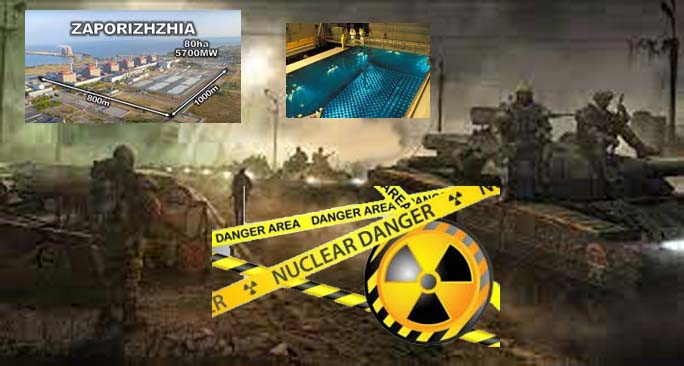
The worst thing that could happen is if a site is deliberately or accidentally shelled. If a shell hit the plant’s spent fuel pool – which contains the still-radioactive spent fuel – or if fire spread to the spent fuel pool, it could release radiation. This spent fuel pool isn’t in the containment building, and as such is more vulnerable.
Containment buildings, which house nuclear reactors, are also not protected against deliberate shelling. They are built to withstand a minor internal explosion of, say, a pressurized water pipe. But they are not designed to withstand a huge explosion.
As to the reactors in the containment building, it depends on the weapons being used. The worst-case scenario is that a bunker-buster missile breaches the containment dome – consisting of a thick shell of reinforced concrete on top of the reactor – and explodes. That would badly damage the nuclear reactor and release radiation into the atmosphere, which would make it difficult to send in first responders to contain any resulting fire. It could be another Chernobyl.
What are the concerns going forward?
The safety problems I see are twofold:
1) Human error……….
2) Power failure
The second problem is that the nuclear plant needs constant electricity, and that is harder to maintain in wartime.
Even if you shut down the reactors, the plant will need off-site power to run the huge cooling system to remove the residual heat in the reactor and bring it to what is called a cold shutdown. Water circulation is always needed to make sure the spent fuel doesn’t overheat.
Spent fuel pools also need constant water circulation to keep them cool, and they need cooling for several years before they can be put in dry casks. One of the problems in the 2011 Fukushima disaster in Japan was the emergency generators intended to replace lost off-site power got inundated with water and failed. In situations like that, you get “station blackout” – and that is one of the worst things that could happen. It means no electricity to run the cooling system.
In that circumstance, the spent fuel overheats and its zirconium cladding can create hydrogen bubbles. If you can’t vent these bubbles, they will explode, spreading radiation.
If there is a loss of outside power, operators will have to rely on emergency generators. But emergency generators are huge machines – finicky, unreliable gas guzzlers. And you still need cooling waters for the generators themselves.
My biggest worry is that Ukraine suffers from a sustained power grid failure. The likelihood of this increases during a conflict because power line pylons may come down under shelling, or gas power plants might get damaged and cease to operate. …………………….
How else does a war affect the safety of nuclear plants?
One of the overarching concerns about the effects of war on nuclear plants is that war degrades safety culture, which is crucial in running a plant……………………..
War adversely affects safety culture in a number of ways. Operators are stressed and fatigued and may be scared to death to speak out if something is going wrong. Then there is the maintenance of a plant, which may be compromised by lack of staff or unavailability of spare parts.
Governance, regulation and oversight – all crucial for the safe running of a nuclear industry – are also disrupted, as is local infrastructure, such as the capability of local firefighters. In war, everything is harder…………….. https://theconversation.com/imperiled-ukrainian-nuclear-power-plant-has-the-world-on-edge-a-safety-expert-explains-what-could-go-wrong-189429
Russia-Ukraine war: Ukraine announces mandatory evacuations
Guardian 27 Aug 22, Residents near the Zaporizhzhia nuclear power plant in Ukraine have reportedly been given iodine tablets, amid mounting fears that the fighting around the complex could trigger a catastrophe. It comes after the plant, Europe’s biggest nuclear power plant, was temporarily disconnected from Ukraine’s national grid after all lines to it were cut on Thursday.
……………..
- By Friday afternoon, Energoatom, Ukraine’s state nuclear agency, said one of the two working reactors had been reconnected to the grid. The one reactor is building up capacity, the agency said, thanking the plant’s working for “tirelessly and firmly” keeping “the nuclear and radiation safety of Ukraine and the whole of Europe on their shoulders”.
- ………………………….A team of inspectors from the UN nuclear watchdog are poised to make an emergency visit to the Russian-occupied Zaporizhzhia nuclear power plant in southeastern Ukraine, according to reports. Sources have told the Wall Street Journal that it is “almost certain” that a mission from the International Atomic Energy Agency (IAEA) will visit the plant early next week, although details are still being completed.
- EU energy ministers will gather for an urgent meeting as soon as possible to discuss the current energy crisis following Russia’s invasion of Ukraine, the Czech prime minister said. The Czech Republic currently holds the presidency of the European Council.
- Ukraine’s deputy prime minister, Iryna Vereshchuk, has announced plans to expand mandatory evacuations for civilians living on the war’s front lines. Speaking on national television, Vereshchuk said evacuating women with children and elderly people would be a priority from some districts of the eastern Kharkiv region and the southern Zaporizhzhia and Mykolaiv regions.
- …………………………………….. The German ambassador to the UK has acknowledged that there is a risk that public support for Ukraine could wane this winter as the energy crisis intensifies.
Bruce Gagnon Interview: An Objective Look at U.S. Foreign Policy

“Once weapons were manufactured to fight wars. Now wars are manufactured to sell weapons”.
BY JOHN RACHEL, 26 Aug 22,
Events continue to unfold at a quickening pace. Facing an alarming escalation in tensions around the world, we asked Bruce Gagnon for his most current thoughts.
Bruce Gagnon is the Coordinator of the Global Network Against Weapons & Nuclear Power in Space, and was a co-founder of the Global Network when it was created in 1992………………. He is currently an active member of Veterans for Peace.
……………Here is what Bruce had to say.
Q. We hear a lot of terms and acronyms bandied about. ‘Deep State’ … ‘MIC’ … ‘FIRE sector’ … ‘ruling elite’ … ‘oligarchy’ … ‘neocons’. Who actually defines and sets America’s geopolitical priorities and determines our foreign policy? Not “officially”. Not constitutionally. But de facto.
A. The banksters in London and Wall Street are the essential movers and shakers of US-UK-NATO foreign policy. The CIA is their primary arm of control. Add to them the burgeoning global military industrial complex and the political ‘mis-leaders’ they generously contribute to. The corporate controlled mainstream media are also accessories to the present day crimes. Together they add up to a formidable crew of what I call ‘pirates’ who are stealing the national treasures throughout the western capitalist world and using them to supress and colonize others across the Global South and here at home.
Q. We’ve had decades of international tensions. Recent developments have seen a sharp escalation in the potential for a major war. ……………….. war inevitable and peace impossible?
A. During the reign of George W. Bush in Washington, at the time of the US ‘shock and awe’ attack in Iraq, I was watching C-SPAN one evening. They introduced then Naval War College instructor Thomas Barnett (author of a book called ‘The Pentagon’s New Map’) and they announced that in the audience were hundreds of top-level Pentagon officers and CIA bigwigs. During his talk Barnett told the assembled that due to globalization of the world economy every nation would have a specific role to fill. In the US he said we won’t make ‘consumer products’ anymore because it was cheaper to send those jobs overseas. Our role in the US, Barnett said, would be ‘security export’. Thus it should be no surprise that the #1 industrial export product of the US today is weapons. When weapons are your #1 industrial export product, what is your ‘global marketing strategy’ for that product line?
Barnett (introduced as Rumsfeld’s ‘strategy guy’) also told the leading brass that the Pentagon would be endlessly fighting to take control of the ‘non-integrating gap’ around the globe – those parts of the world that were not submitting to the authority of corporate globalization. He instructed the audience to go and teach these ‘new concepts’ to those under their authority if they hoped to get promoted within the system in the years ahead.
For more than a year after this Barnett presentation I witnessed him being squired around Washington speaking to Republican and Democrat audiences on C-SPAN. It was evident to me that his ‘new doctrine’ was a bi-partisan plan. Since that time it has become quite clear that this is true as we now see the Democrats leading the proxy war on Russia – using Ukraine as the hammer in this dangerous and provocative attempt to force regime change in Moscow. Pelosi’s recent ill-fated trip to Taiwan also indicates the plan to force regime change in Beijing.
Imagine that Washington and its NATO allies, who limped out of Afghanistan after 20 years of brutal occupation there, are now planning for war with Russia and China. The absurdity is beyond imagination. It reveals much about their psychopathology.
As long as this reality persists then we will move from one war to another. Arundhati Roy says, “Once weapons were manufactured to fight wars. Now wars are manufactured to sell weapons”. She is right on the money…………………..
Q. Our leaders relentlessly talk about our “national interests” and our “national security”, warning that both are under constant assault. Yet, we spend more than the next nine countries combined on our military. Why does such colossal spending never seem to be enough?
A. When they talk about ‘national interests’ they are actually talking about the interests of the banksters. When they talk about ‘freedom’ they are talking about their freedom to steal the national wealth from nations with resources and the people around the world. Washington claims that Russia wants to re-create the former Soviet Union and take control of Europe. In 2022 Russia is spending $66 billion on their military. It is a defensive military to protect their vast border regions. The US this year is spending $800 billion plus. When you add up the hidden military spending in the other pots of gold – like the nuclear weapons spending inside the Department of Energy budget – the US total is around $1.2 trillion this year. They are robbing us blind and we keep handing over our hard-earned tax dollars. Why?………………………………………………….
- We need to convert the military industrial complex (the war machine) to build public mass transit systems, tidal power systems, solar, wind power and the like – all of which would create more jobs than weapons manufacturing does.
- We need to ban corporate funding of elections. We need to open up a multi-party system so that more voices can be heard by the voters.
- We need to end the massive poverty that exists (which will be worsening in the near future) by taxing the rich and corporations.
- Stop the massive corporate subsides – welfare for the rich.
- We need to close down the more than 800 US military bases around the world and cut the Pentagon budget by at least 80%.
- We only need a defensive military that protects our borders.
- Do all these things and we might have a chance if we don’t first perish from a red-hot nuclear war or climate crisis.We don’t have time to fool around.
- Folks need to get off their arses and speak out NOW. ………..
Biden Pledges Nearly $3 Billion To Ukraine In Largest U.S. Military Aid Package Yet
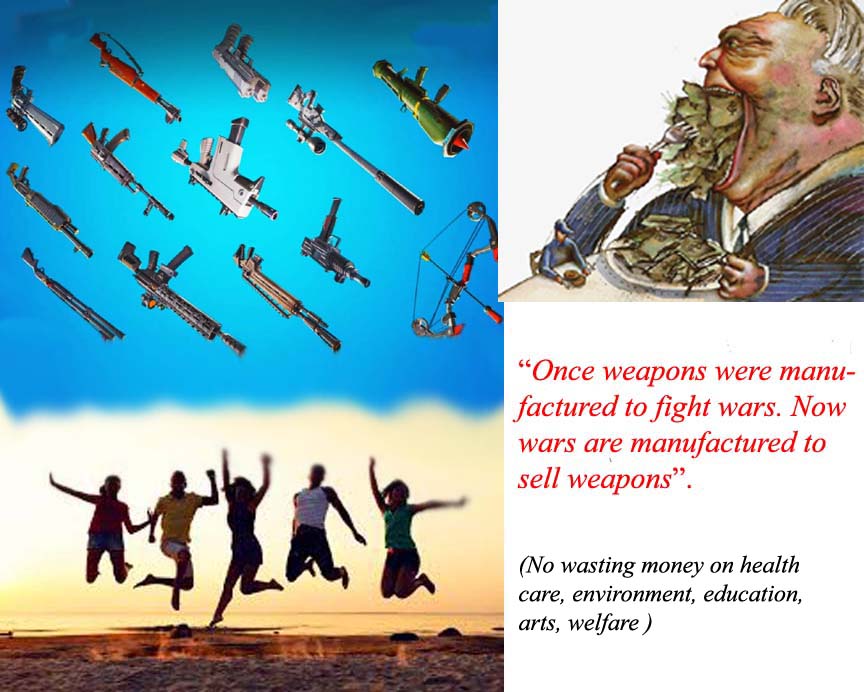
U.S. President Joe Biden has announced nearly $3 billion in new U.S. military aid for Kyiv as Ukraine marked its independence day six months after Russia invaded the country.
“On behalf of all Americans, I congratulate the people of Ukraine on their Independence Day,” Biden said in a statement on August 24.
“The United States of America is committed to supporting the people of Ukraine as they continue the fight to defend their sovereignty. As part of that commitment, I am proud to announce our biggest tranche of security assistance to date: approximately $2.98 billion of weapons and equipment to be provided through the Ukraine Security Assistance Initiative,” Biden said.
The financial package will allow Kyiv to obtain air-defense and artillery systems, ammunition, counter-unmanned aerial systems, and radars, the statement said…………….
Since Russia invaded Ukraine on February 24, the United States has provided $10.6 billion in military assistance to President Volodymyr Zelenskiy’s government.
On August 23, Germany said it will soon ship more than 500 million euros’ ($499.3 million) worth of weapons to Ukraine. https://www.rferl.org/a/biden-pledges-3-billion-military-aid-ukraine/32002639.html
Russia says it destroyed howitzer used to shell Zaporizhzhia nuclear plant
Aug 26 (Reuters) – Russia’s Defence Ministry said on Friday that its forces had destroyed a U.S.-made M777 howitzer which it said Ukraine had used to shell the Russian-controlled Zaporizhzhia nuclear plant.
In its daily briefing, the Defence Ministry said that the howitzer had been destroyed west of the town of Marganets, in Ukraine’s Dnipropetrovsk region.
Reuters could not immediately verify the report.
The Zaporizhzhia nuclear plant, Europe’s largest, was captured by Russian forces in March. It remains near the frontline, and has repeatedly come under fire in recent weeks. Both Ukraine and Russia have accused each other of shelling the facility.
Iran’s UN envoy slams Israel refusal to join NPT, urges nuclear-weapon-free zone in Middle East
Israel, which pursues a policy of deliberate ambiguity about its nuclear weapons, is estimated to possess 200 to 400 nuclear warheads in its arsenal, making it the sole possessor of non-conventional arms in West Asia.
Friday, 26 August 2022,
A senior Iranian diplomat has denounced Israel’s continued refusal to join the Nuclear Non-Proliferation Treaty (NPT), stressing that establishing a Middle East region free of nuclear weapons is of utmost importance.
Iran’s ambassador and permanent representative to the United Nations, Majid Takht-Ravanchi, made the remarks while speaking to reporters on Friday on the sidelines of the Tenth Review Conference of the Parties to the Treaty on the Non-Proliferation of Nuclear Weapons held at the UN headquarters in New York.
“The issue of the Middle East as a region free of nuclear weapons is one of the important discussions… because the Israeli regime, as the only possessor of hundreds of nuclear warheads, is not ready to join the Nuclear Non-Proliferation Treaty and place its nuclear facilities under the supervision of the International Atomic Energy Agency,” he said.
He added that Israel’s refusal to join the NPT comes as some countries are cooperating with the regime and have always supported it.
The Iranian delegation attending the tenth NPT review conference played a constructive role in highlighting the significance of a Middle East region free of weapons of mass destruction, he said
As documents relating to the NPT review conferences in 1995, 2000, and 2010 have explicitly announced that the Israeli regime must join the treaty, the Iranian team emphasized that the issue should also be included in the final statement of the 10th NPT review meeting, Takht-Ravanchi added.
He emphasized that during the current conference, the Islamic Republic clearly announced that it would not back down from its stance on the importance of a Middle East without any weapons of mass destruction.
“We said that this issue is one of the red lines of the Islamic Republic of Iran and if they want to act honestly and constructively, the literature used in the statements of previous conferences should also be used in this conference in order to move towards a Middle East without nuclear weapons,” the senior Iranian diplomat pointed out.
He noted that Iran seeks to reach a consensus with the participants at the current NPT review conference but it has principles and certain measures must be carried out.
n a Monday address to the Tenth Review Conference of the Parties to the Treaty on the Non-Proliferation of Nuclear Weapons, Takht-Ravanchi expressed concern over the lack of progress in the implementation of the 1995 Nuclear Nonproliferation Treaty (NPT) resolution and the 2010 action plan on the Middle East, saying the Israeli regime must eliminate its stockpile of nuclear weapons.
Takht-Ravanchi also slammed the US double standards, saying Israel’s accession to the NPT “without precondition and further delay” and the placement of all of its nuclear activities and facilities under the comprehensive IAEA safeguards are “essential in realizing the goal of universal adherence to the Treaty in the Middle East and the establishment of a nuclear-weapon-free zone in the Middle East.”
Israel, which pursues a policy of deliberate ambiguity about its nuclear weapons, is estimated to possess 200 to 400 nuclear warheads in its arsenal, making it the sole possessor of non-conventional arms in West Asia.
The illegitimate entity has, however, refused to either allow inspections of its military nuclear facilities or sign the NPT.
What has emboldened Tel Aviv to accelerate its nuclear activities, according to observers, is the support from the US and Europe, the two countries most critical of Iran’s peaceful nuclear program.
The regime has assassinated at least seven Iranian nuclear scientists and conducted a series of sabotage operations against the Islamic Republic’s nuclear facilities.
Worst Places to Be If There’s a Nuclear Attack on America
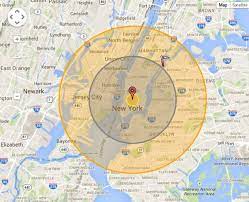
247melly, Michael B. Sauter, August 26, 2022 Russia’s invasion of Ukraine has included battles in or near nuclear power plants. The recent shelling at the Zaporizhzhia Nuclear Power Plant has raised alarm bells worldwide. The recent grandstanding by Russia, China, and North Korea [ed: what about USA and UK?], including several intercontinental ballistic missile tests, has further raised global tensions.
In the unlikely scenario of a nuclear attack on America – an all-out nuclear war – very few places would be safe, though no doubt less populated, remote areas would be safer.
An enemy nation would first aim to neutralize the U.S. nuclear capabilities by targeting strategic military installations, many of which are near large urban centers.
Stephen Schwartz, author of “Atomic Audit: The Costs and Consequences of US Nuclear Weapons Since 1940,” identified 15 such targets. The targets, mapped by Business Insider, include command centers, ICBM bases, communication stations, and air force and submarine bases. In addition, Dr. Irwin Redlener, a professor at Columbia University’s Mailman School of Public Health, identified six economic centers most likely to be attacked.
To find the worst places to be if there’s a nuclear attack on America, 24/7 Wall St. constructed an index consisting of several measures to rank major U.S. cities likely to be targets based on both Schwartz’s and Redlener’s lists. The measures in the index include population density; city preparedness for emergency; economic significance; city preparedness plans; distance to the strategic military target; proximity to nuclear power plants; and ease of evacuation based on commute time as a proxy to congestion and the percentage of a city area that is water. We also added projected fatalities and injuries assuming a 1 megaton bomb, using Nukemap.
Click here to see the worst places to be if there’s a nuclear attack on America.
Click here to see our detailed methodology.………….. https://247wallst.com/special-report/2022/08/26/worst-places-to-be-if-theres-a-nuclear-attack-on-america/—
1 This Month





PLEASE OPPOSE HR 8255 AND S.3639 – bills would accelerate satellite deployment, with no environmental review or safeguards – https://ncstd5li.quorum.us/campaign/169331/
To see nuclear-related stories in greater depth and intensity – go to https://nuclearinformation.wordpress.com
-
Archives
- October 2026 (10)
- September 2026 (339)
- August 2026 (330)
- July 2026 (355)
- June 2026 (287)
- May 2026 (306)
- April 2026 (356)
- March 2026 (251)
- February 2026 (267)
- January 2026 (308)
- December 2025 (358)
- November 2025 (359)
-
Categories
- 1
- 1 NUCLEAR ISSUES
- business and costs
- climate change
- culture and arts
- ENERGY
- environment
- health
- history
- indigenous issues
- Legal
- marketing of nuclear
- media
- opposition to nuclear
- PERSONAL STORIES
- politics
- politics international
- Religion and ethics
- safety
- secrets,lies and civil liberties
- spinbuster
- technology
- Uranium
- wastes
- weapons and war
- Women
- 2 WORLD
- ACTION
- AFRICA
- Atrocities
- AUSTRALIA
- Christina's notes
- Christina's themes
- culture and arts
- Events
- Fuk 2022
- Fuk 2023
- Fukushima 2017
- Fukushima 2018
- fukushima 2019
- Fukushima 2020
- Fukushima 2021
- general
- global warming
- Humour (God we need it)
- Nuclear
- RARE EARTHS
- Reference
- resources – print
- Resources -audiovicual
- Weekly Newsletter
- World
- World Nuclear
- YouTube
-
RSS
Entries RSS
Comments RSS

