World powers must take Putin’s threat seriously, stop the escalation and seek a diplomatic solution.

Beware the prospect of a nuclear calamity
Marwan Bishara, Senior political analyst at Al Jazeera. 22 Sept 22,
The world’s indifference to the prospect of a nuclear disaster, today, is frankly insane.
For the past few months, Western experts have downplayed the probability that the Ukraine war would lead to nuclear escalation between Russia and the West. Since Putin first put Russia’s nuclear arsenal on alert back in February, many experts have argued that he was merely posturing in a bid to throw his “adversaries off balance”.
However, Putin’s most recent threats of using such weapons — made in a televised speech on Wednesday morning — must not be taken lightly, regardless of his motivation or intention. He said that Western officials have threatened Russia with nuclear weapons, a charge that US President Joe Biden denied during his speech to the United Nations General Assembly hours later. Putin also announced a partial mobilisation and his support for upcoming referendums in four Russian-controlled regions of Ukraine that could pave the way for their annexation by Moscow.
It’s one thing for the West to dismiss as irrelevant the threat of Putin firing, for instance, a secretary. However, any chance he may fire his nukes should be taken seriously, regardless of how remote the possibility is.
In fact, the West has so far avoided imposing a no-fly zone over Ukraine or transferring long-range missiles and other weapons that may threaten Russian territory for fear of the Kremlin’s retaliation against Europe…………………………………
as past Russian and American wars have shown – whether in Vietnam, Afghanistan, Iraq or elsewhere – a troops surge may win him time but won’t necessarily win him the war. That’s why he coupled his decision for a military surge with a nuclear warning, putting the West on notice: back off or face the consequences.
Hence the seriousness of Putin’s threat to use weapons of mass destruction. The threat is “not a bluff” as he put it, nor a bluster; it rather sounds desperate and deliberate. It is also the biggest escalation since the invasion began seven months ago and the biggest troop mobilisation since the end of the Cold War.
Some are now sounding a warning about Putin’s potential use of tactical nuclear weapons on the battlefield. …………………..
In theory, the use of these weapons, which are short-range and designed for limited strikes, sounds implausible considering Ukraine’s geographic proximity and Russia’s nuclear doctrine which underlines the defensive use of nuclear weapons or when the very existence of Russia is threatened……………………..
In short, the danger of a nuclear calamity is real if the war continues to escalate, whether by design or default; whether stemming from strategic or tactical use of nuclear weapons, or from the bombing of a nuclear plant.
None of it is inevitable and all of its totally avoidable. Nuclear powers have lost or ended conventional wars in the past without resorting to nuclear weapons. That’s why world powers have a duty to stop the escalation and to seek a diplomatic solution sooner rather than later.
Putin may be directly responsible for this war of aggression against Ukraine, but the West’s insistence on NATO’s expansion to Russia’s border and its sabre rattling in Ukraine have also been terribly provocative and reckless.
The war has been a disaster for all, especially Ukraine. It will get worse. That’s why cooler heads must prevail. Before it is too late. Those still hoping to win must remember that there is no winning a nuclear war. https://www.aljazeera.com/opinions/2022/9/22/beware-the-prospect-of-a-nuclear-calamity
Moscow unlikely to use nuclear weapons, say ex-Russian generals
Former Russian generals tell Al Jazeera that while the prospect of nuclear war remains slim, the situation could quickly escalate.
Aljazeera, 24 Sept 22,
Russia is unlikely to use nuclear weapons in Ukraine unless NATO puts boots on the ground, two retired Russian generals have told Al Jazeera.
“If the collective West attacks Russia with its conventional armed forces, then Russia’s response could very well be nuclear since there is no comparison between the West’s conventional military potential and that of Russia,” said Evgeny Buzhinsky, a retired lieutenant general who served as the Russian military’s top arms control negotiator from 2001 to 2009.
However, Buzhnisky stressed that Russia had little to gain from using nuclear weapons in Ukraine under the present circumstances.
He argued that the Russian military did not need nuclear weapons to achieve its strategic objectives, such as destroying transport infrastructure used to deliver Western arms shipments or damaging the country’s electricity network.
Mutual destruction
At the same time, Buzhinsky warned that initiating a nuclear attack would almost certainly put Moscow and Washington on a dangerous escalating spiral.
“There can be no limited use of nuclear weapons – to think otherwise is an illusion,” he said.
“Any nuclear conflict between Russia and the United States will lead to complete mutual destruction.”
A similar assessment was given by Leonid Reshetnikov, a retired lieutenant general who spent more than 40 years working in the Soviet and Russian foreign intelligence services.
Reshetnikov told Al Jazeera that the prospect of Russia using tactical nuclear weapons in Ukraine was “impossible and would make little military sense” right now.
He argued that such a move would be a sharp deviation from the risk-averse strategy that Russia has pursued in Ukraine so far, noting that the Kremlin waited nearly seven months before declaring a partial mobilisation.
NATO troops becoming directly involved in the conflict could change Moscow’s calculus, however.
“The United States and practically all of Europe are already participating in this conflict by providing Ukraine with weapons, intelligence, instructors, and volunteers,” Reshetnikov said………………………………………….
Meanwhile, NATO Secretary-General Jens Stoltenberg told the Reuters news agency that the security bloc would “make sure that there is no misunderstanding in Moscow about the seriousness of using nuclear weapons,” while adding that it had not observed any changes in Russia’s nuclear posture.
In an interview with Britain’s Guardian newspaper, Mykhailo Podolyak, a senior aide to Ukrainian President Volodymyr Zelenskyy, urged other nuclear powers to commit to “swift retaliatory nuclear strikes” against Russia if Moscow attempted to use its weapons in Ukraine. https://www.aljazeera.com/news/2022/9/23/little-military-sense-for-nuclear-weapons-ex-russian-.
Australia’s foreign minister warns of ‘catastrophic’ impact of Indo-Pacific war during UN address
9 News, By Savannah Meacham • Associate Producer Sep 24, 2022
Foreign minister Penny Wong has used her first major speech to the United Nations to warn of the impact of a war in the Indo-Pacific region, invoking the China-Taiwan tensions in all but name.
Wong not only condemned the invasion of Russia in Ukraine in her speech but she also forewarned the “catastrophic” impact conflict in the Indo-Pacific would have on Australia and the other Asia-Pacific nations.
“In my own region, where geopolitical contest becomes ever sharper, we must ensure that competition does not escalate into conflict,” Wong said.
“Because if conflict were to break out in the Indo-Pacific, it would be catastrophic – for our people and our prosperity.
“And with the Indo-Pacific’s centrality to global prosperity and security, the cost would extend far beyond our region and reach into every life.”
Wong questioned how countries can “apply the brakes” against rising tensions, like the one in the Indo-Pacific.
“It is up to all of us to ask ourselves how can we each use our state power, our influence, our networks, our capabilities, to avert catastrophic conflict?” she asked.
“How do we acquit our responsibilities to constrain tensions – to apply the brakes before the momentum for conflict in our region or beyond becomes unstoppable?”
In recent months, tensions have been developing between China and Taiwan.
Wong is addressing the UN to remind the group of Australia’s desire to have a seat on the council in 2029. She will support this by outlining Australia’s “resolve” to battle growing conflicts in the Asia Pacific.
“The Australian people want to be better, more involved, and more helpful members of the Pacific family,” Wong said.
“Australians want to enhance our defence, maritime and economic cooperation with Pacific Island Countries. And we want to be the Pacific’s partner of choice for development and security.
“It is why we seek a seat on the UN Security Council for 2029-2030. It is why we seek reform of the Security Council, with greater permanent representation for Africa, Latin America, and Asia, including India and Japan.”
‘We cannot leave it to the big powers’
She outlined Australia’s goal to become a significant player on the world stage and urge smaller countries to set their own fate aside from the one allegedly decided by global superpowers.
“It reminds us that each nation must make its own choices, and exercise its own agency. We cannot leave it to the big powers. And we cannot be passive when big powers flout the rules,” she said……………………. more https://www.9news.com.au/national/australian-foreign-minister-penny-wong-warns-of-impact-of-war-in-indo-pacific-united-nations-speech/e514adc1-9b31-4ed6-8d48-62f4b3cbb324
New Zealand will push for total ban on nuclear weapons – Jacinda Ardern
https://www.nzherald.co.nz/nz/new-zealand-will-push-for-total-ban-on-nuclear-weapons-jacinda-ardern/KMAJHPQARBHVY3ETZGUGOI7COA/ By Thomas Coughlan, 24 Sep, 2022
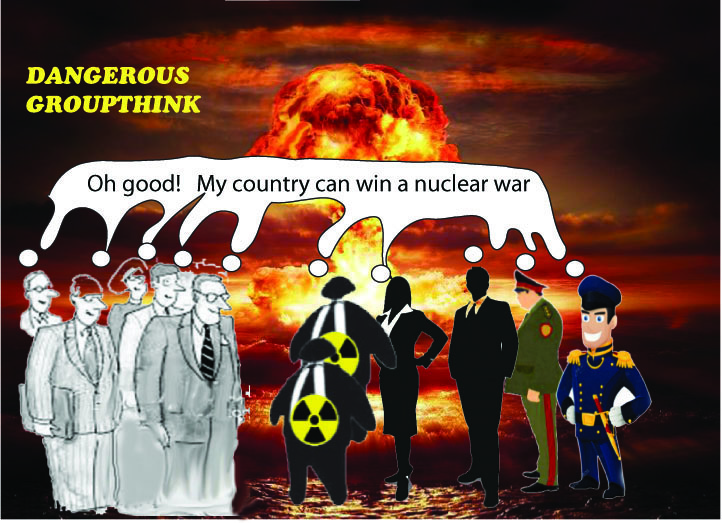
Prime Minister Jacinda Ardern said there is an “outlier” amongst countries that have nuclear weapons because Russia now appears to believe that a nuclear war can be won and fought, as she continued to push for the abolition of nuclear weapons.
Speaking to media after her address to the United Nations General Assembly, Ardern said New Zealand never believed the doctrine of Mutual Assured Destruction (MAD), which meant that countries would not start a nuclear war, because they believed they would be annihilated by their enemy in retaliation.
“New Zealand – no one wants to be proven right on this issue,” Ardern said.
“We’ve always had the view that so long as everyone holds them [nuclear weapons] that no one will push the button – New Zealand has never had the view that that is a good strategy or a safe strategy.”
arlier in the day, she told the United Nations that one country – a reference to Russia – believed it could fight and win a nuclear war.
“It takes one country to believe that their cause is nobler, their might stronger, their people more willing to be sacrificed,” Ardern said.
“None of us can stand on this platform and turn a blind eye to the fact that there are already leaders amongst us who believe this,” she said.
Russia’s apparent belief that it could start and win a nuclear war is a reversal from its position in January, when it made a pledge with other nuclear powers who were signatories to the Nuclear Non-Proliferation Treaty that “a nuclear war cannot be won and must never be fought”.
American and Russian leaders have been making some version of this statement since leaders Ronald Reagan and Mikhail Gorbachev first said it in 1985.
If the doctrine of MAD is gone, then the world could be closer to a nuclear war than ever before.
Ardern said Russia was an “outlier” and other countries had a far more stable nuclear policy.
“I wouldn’t take Russia’s position as indicative of the rest of the world.”
Unlocked: NATO prolongs the Ukraine proxy war, and global havoc
With diplomacy thwarted, the US and its allies plan for “open-ended” military and economic warfare against Russia — despite acknowledging that “the most dangerous moments are yet to come.”
As has been apparent since the Ukraine crisis erupted, US planning for open-ended proxy warfare against Russia has led it to sabotage any prospect of a negotiated end.
Substack Aaron Maté 22 Sept 22, Russia has announced plans to mobilize an additional 300,000 troops for the war in Ukraine. In his speech unveiling the expanded war effort, Vladimir Putin vowed to achieve his main goal of the “liberation of Donbas,” and issued a thinly veiled nuclear threat in the process. The move comes days ahead of planned referendums in breakaway Ukrainian areas to formalize Russian annexation.
Russia’s escalation ensures that the fighting is entering an even more dangerous phase. While Russia bears legal and moral responsibility for its invasion, recent developments underscore that NATO leaders have shunned opportunities to prevent further catastrophe and chosen instead to fuel it.
Putin’s announcement comes just after the Ukrainian military’s routing of Russian forces from Kharkiv, which relied extensively on US planning, weaponry and intelligence, sparked triumphant declarations that the tide has turned.
According to The Atlantic’s Anne Applebaum, “Americans and Europeans need to prepare for a Ukrainian victory,” one so overwhelming that it may well bring “about the end of Putin’s regime.”
Beyond the chorus of emboldened neoconservatives, Western officials are less sanguine.
“Certainly it’s a military setback” for Russia, a US official said of the Kharkiv retreat to the Washington Post. “I don’t know if I could call it a major strategic loss at this point.” Germany’s defense chief, General Eberhard Zorn, said that while Ukraine “can win back places or individual areas of the frontlines,” overall, its forces can “not push Russia back over a broad front.”
Whether or not it marked a major strategic loss for Russia, the battle in Kharkiv is already a major victory for NATO leaders seeking to prolong their proxy war in Ukraine and economic warfare next door.
Ukraine’s expulsion of Russian forces in the northeast, the New York Times reports, has “amplified voices in the West demanding that more weapons be sent to Ukraine so that it could win.”
“Despite Ukrainian forces’ startling gains in the war against Russia,” the Washington Post adds, “the Biden administration anticipates months of intense fighting with wins and losses for each side, spurring U.S. plans for an open-ended campaign with no prospect for a negotiated end in sight.”
As has been apparent since the Ukraine crisis erupted, US planning for open-ended proxy warfare against Russia has led it to sabotage any prospect of a negotiated end.
The US rejection of diplomacy around Ukraine has been newly substantiated by former White House Russia expert Fiona Hill. Citing “multiple former senior U.S. officials,” Hill reports that in April of this year “Russian and Ukrainian negotiators appeared to have tentatively agreed on the outlines of a negotiated interim settlement.” Under this framework, Russia would withdraw to its pre-invasion position, while Ukraine would pledge not to join NATO “and instead receive security guarantees from a number of countries.”
In confirming that US officials were aware of this tentative agreement, Hill bolsters previous news that Washington’s junior partner in London was enlisted to thwart it. As Ukrainian media reported, citing sources close to Ukrainian President Volodymyr Zelensky, UK Prime Minister Boris Johnson traveled to Kiev in April and relayed the message that Russia “should be pressured, not negotiated with.” Johnson also informed Zelensky that “even if Ukraine is ready to sign some agreements on [security] guarantees with Putin,” his Western patrons “are not.” The talks promptly collapsed.
In his speech announcing the expanded war effort, Putin invoked this episode. After the invasion began, he said, Ukrainian officials “reacted very positively to our proposals… After certain compromises were reached, Kyiv was actually given a direct order to disrupt all agreements.”
Having undermined the prospect of a negotiated peace in the war’s early weeks, proxy warriors in Washington are openly celebrating their success.
“I like the structural path we’re on here,” Republican Senator Lindsey Graham recently declared. “As long as we help Ukraine with the weapons they need and the economic support, they will fight to the last person.”
Graham’s avowed willingness to expend every “last person” in Ukraine to fight Russia is in line with a broader US strategy that views the entire world as subordinate to its war aims. As the Washington Post reported in June, the White House is willing to “countenance even a global recession and mounting hunger” in order to hand Russia a costly defeat. In Ukraine, this now means also countenancing the threat of nuclear disaster, as the crisis surrounding the Zaporizhzhia nuclear power plant has laid bare.
The prevailing willingness to sacrifice civilian well-being extends to the US public, as National Security Advisor Jake Sullivan has newly made clear. Appearing at the Aspen Security Conference, Sullivan was asked if he is worried about the “American people’s staying power” on the Ukraine proxy war, amid “criticism that we’re spending billions and billions to support Ukraine, and not spending it here.”
“Fundamentally not,” Sullivan responded. “It’s very important for Putin to understand what exactly he’s up against from the point of view of the United States’ staying power.” That staying power, Sullivan explained, was cemented in the $40 billion war funding measure overwhelmingly approved by Congress (including every self-identified progressive Democrat) in May……………………………………….
Allied NATO leaders are also vocally countenancing the Ukraine proxy war’s costs on their domestic populations. In response to the European sanctions, Russia has now halted gas deliveries to the EU via the key Nord Stream 1 pipeline. Having previously relied on Russia for close to 40 percent of its gas needs, European industries are facing layoffs, factory closures, and higher energy bills that “are pushing consumers to near poverty,” the Financial Times reports. https://mate.substack.com/p/unlocked-nato-prolongs-the-ukraine?utm_source=post-email-title&isFreemail=true&utm_medium=email
War fears at another Ukraine nuclear site
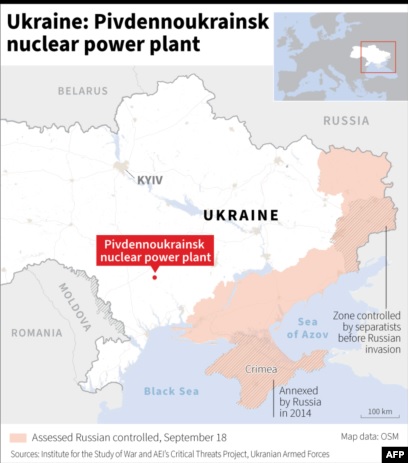
The Australian 22 Sept 22, A vast crater several metres deep in empty land strewn with wild grass bears witness to the shelling this week at the Pivdennoukrainskpower plant site in southern Ukraine, the latest sign of nuclear risk in the war-scarred nation.
Small shards of grey metal, similar to rocket and missile fragments that litter innumerable fighting-damaged Ukrainian places, dot the loamy earth gouged out by the impact.
“That’s where the blast of the explosion went towards,” said Ivan Zhebet, security chief at the Pivdennoukrainsk plant in the southern Mykolaiv region.
A compass reading by an AFP journalist indicated that it was fired from the southeast, territory under Russian control.
The shell struck shortly after midnight on Monday, just minutes after an air raid warning sounded in nearby Yuzhnourainsk, a town that had until then been relatively calm.
Others said they saw a flash of light in the sky.
All the residents questioned by AFP worried that the nuclear site — which directly provides jobs for 6,000 of the town’s 42,000-strong population and indirectly for many more — would be hit.
Pivdennoukrainskis the third nuclear site to be caught up in a conflict that began with Russia’s invasion in February………………………………………..
Nataliya Stoikova, a department head at Pivdennoukrainsk, said:
“The danger is really frightening. If something were to happen (at Pivdennoukrainsk) or Zaporizhzhia, the accident at Chernobyl would be almost small” by comparison. https://www.theaustralian.com.au/news/latest-news/war-fears-at-another-ukraine-nuclear-site/news-story/d81fe91e6bd375729e35eb4caaea2c95
New research on how nuclear war would affect Earth today – it won’t matter who is bombing whom

Kelly Kizer Whitt, 18 Sept 22,
A nuclear war would devastate our oceans and our world, with some effects lasting thousands of years. That’s the conclusion of a new study led by Cheryl Harrison at Louisiana State University in Baton Rouge. She said in a statement:
It doesn’t matter who is bombing whom. It can be India and Pakistan or NATO and Russia. Once the smoke is released into the upper atmosphere, it spreads globally and affects everyone.
These scientists’ simulations showed that it doesn’t matter whether the detonation of a nuclear arsenal came through a deliberate act of war, or through accident or hacking Their statement explained:
In all of the researchers’ simulated scenarios, nuclear firestorms would release soot and smoke into the upper atmosphere that would block out the sun, resulting in crop failure around the world. In the first month following nuclear detonation, average global temperatures would plunge by about 13 degrees Fahrenheit (7 degrees C), a larger temperature change than in the last Ice Age.
Ocean temperatures would drop quickly and would not return to their pre-war state even after the smoke clears. As the planet gets colder, sea ice expands by more than 6 million square miles and 6 feet deep in some basins blocking major ports including Beijing’s Port of Tianjin, Copenhagen and St. Petersburg. The sea ice would spread into normally ice-free coastal regions blocking shipping across the Northern Hemisphere making it difficult to get food and supplies into some cities such as Shanghai, where ships are not prepared to face sea ice.
The sudden drop in light and ocean temperatures, especially from the Arctic to the North Atlantic and North Pacific oceans, would kill the marine algae, which is the foundation of the marine food web, essentially creating a famine in the ocean. This would halt most fishing and aquaculture.
The scientists published their study in the peer-reviewed journal AGU Advances on July 7, 2022.
Where are the nuclear weapons?
Nine nations control more than 13,000 nuclear weapons on Earth, these scientists said. According to worldpopulationreview.com, the top three countries with nuclear weapons include Russia with 6,257, the United States with 5,550 and China with 350. The Treaty on the Non-Proliferation of Nuclear Weapons (NPT) aims to control the spread of nuclear weapons and reaches for disarmament.
In their study, the researchers simulated what would happen if the U.S. and Russia used 4,400 100-kiloton nuclear weapons. This would result in fires that would put more than 330 billion pounds of smoke and sunlight-absorbing black carbon into the upper atmosphere.
In another simulation, they imagined India and Pakistan detonating about 500 100-kiloton nuclear weapons. This would inject 11 to 103 billion pounds of smoke and soot into the upper atmosphere.
In all the simulations, the result was essentially the same.
The effect on marine life
With a blackened sky from the nuclear firestorm, oceans would receive less light and heat. This is especially true from the Arctic to the North Atlantic and North Pacific. Marine algae (seaweed), the base of the ocean’s food web, would die. Thus, a chain reaction would follow, creating a famine in the ocean. Fishing and aquaculture would mostly come to an end. So marine life suffers from both the initial blast and the resulting new ocean conditions.
Ocean waters would take longer to recover than on land. The changes to Arctic sea ice alone would probably last thousands of years, ushering in what the scientists called a Nuclear Little Ice Age.
Events other than nuclear war with similar results
Nuclear war isn’t the only event that could lead to these results of devastation in the ocean and on land. Massive wildfires and volcanic eruptions could eject enough soot into the atmosphere for similar results. Massive volcanic eruptions in the past have even caused multiple mass extinction events on Earth. Harrison said:
We can avoid nuclear war, but volcanic eruptions are definitely going to happen again. There’s nothing we can do about it, so it’s important when we’re talking about resilience and how to design our society, that we consider what we need to do to prepare for unavoidable climate shocks. We can and must, however, do everything we can to avoid nuclear war. The effects are too likely to be globally catastrophic.
China, and others, see the International Atomic Energy Agency as biased in supporting AUKUS nuclear submarines plan

Ed note. My problem with the IAEA is that it is NOT an impartial body, on matters nuclear
China accuses IAEA of issuing a ‘lopsided’ report on AUKUS nuclear submarines plan, more https://www.abc.net.au/news/2022-09-14/china-iaea-lopsided-aukus-nuclear-submarines-report/101441254 By foreign affairs reporter Stephen Dziedzic 15 Sept 22
China’s Foreign Affairs Ministry has launched a furious attack on the UN nuclear watchdog over AUKUS, accusing the International Atomic Energy Agency (IAEA) of issuing a “lopsided” report about Australia’s plan to build nuclear submarines while ignoring widespread concerns about its ramifications for non-proliferation.
Key points:
- The IAEA issued a report to member states which said it was “satisfied with the level of engagement” from Australia, the UK and US
- A Chinese Foreign Ministry spokeswoman slammed the report, saying China was “gravely concerned about the substance” of it
- China has lobbied against AUKUS accusing the three countries of undermining the non-proliferation treaty
Last week the IAEA sent member states a confidential report on Australia’s move to develop the submarines drawing on nuclear submarine technology provided by the United States and the United Kingdom.
China has lobbied relentlessly against the deal in international forums, accusing the three countries of undermining the non-proliferation treaty and fuelling a regional arms race.
However Reuters reported last Friday that the IAEA issued a confidential report to member states which said it was “satisfied with the level of engagement” with the agency from all three nations so far.
Earlier this week the IAEA Director General Rafael Grossi struck a similar tone while addressing the agency’s Board of Governors, saying the Secretariat had held four “technical meetings” with the three AUKUS members so far and suggesting it was comfortable with the way they were handling the matter.
But on Tuesday Chinese Foreign Ministry spokeswoman Mao Ning slammed the report, saying China was “gravely concerned about the substance.”
“This report lopsidedly cited the account given by the US, the UK and Australia to explain away what they have done, but made no mention of the international community’s major concerns over the risk of nuclear proliferation that may arise from the AUKUS nuclear submarine cooperation,” she said.
“The report turns a blind eye to many countries’ solemn position that the AUKUS cooperation violates the purpose and object of the NPT.”
IAEA report finds AUKUS non-proliferation risks ‘limited’
While China has repeatedly attacked Australia, the United States and the United Kingdom over the agreement, this is the first time it has publicly excoriated the IAEA over the matter.
US and Australian officials have privately accused Beijing of gross hypocrisy over its public attacks on AUKUS, pointing out that China has been rapidly developing its own fleet of nuclear powered submarines — including submarines capable of launching nuclear weapons.
But nuclear non-proliferation advocates have also raised serious concerns about AUKUS, suggesting that it will establish a dangerous precedent by allowing a non-nuclear state to acquire nuclear propulsion technology for the first time.
Indonesian diplomats have also repeatedly made it clear they’re uneasy about the plan, and the country’s foreign ministry recently claimed recently that it won widespread support at the United Nations nuclear non-proliferation review conference for its plan to monitor nuclear material in submarines more closely.
Reuters reported last week that the IAEA report acknowledged Australia’s argument that the non-proliferation risks posed by AUKUS were limited because it would only be provided with “complete, welded” nuclear power units which would make removing nuclear material “extremely difficult.”
It reportedly also said the material within the units could not be used in nuclear weapons without chemical processing which requires facilities which Australia does not have and will not seek.
Australia needs a non-nuclear submarine – the TKMS TYPE 218SG would be fine – just do it, Richard Marles!

This article is definitely worth the read! Highly possible we may not be getting nuclear subs in Australia – and the reasons why!
National Times The Answer is staring Richard Marles in the Face. ( Article by Politics Australia) 17 Sept 22

It was fomer Australian Prime Minister Scott Morrison’s rank incompetence, stupidity and arrogance that has landed Australia in its Submarine replacement program dilemma.
But all this goes back the Liberal Party and its bizarre idea to buy French Nuclear Submarines and have them convert back to a conventional propulsion system. This meant a complete redesign of the existing hull to accommodate diesel engines, fuel tanks and bank of batteries.
Just what were our Defence Planners thinking, obviously the French must have been laughing all the way to the bank.
All this was done in the face of existing and proven conventionally designed submarines. Submarines that were available at the time.

It was only because Scott Morrison wanted to appear the big man by cancelling the French submarine contract and tugging his forelock to the British and the Americans who held out the distant promise of Australia buying British or American Nuclear Submarines. In reality it was about basing existing American submarines here for them to operate out of Australia.
As it turns out the current and forecast British and American building programs have no scope to add in an extra eight or so submarines for Australia’s needs and never intended to.
Then there was Peter Dutton’s desperate political pitch that Australia could lease a couple of Nuc Boats from the Americans, another stupid idea.

At present Richard Marles is doing an ‘all the way with LBJ’ routine, sticking to the script with Australia purchasing Nuclear Submarines. Having Nuc Boats isn’t just a matter of tying them up at the Port of Darwin, Freemantle, or Sydney. There needs to be specific infrastructure to accommodate, service and maintain these expensive pieces of kit and that is something Australia does not have.
Sure, the proponents of Nuclear Submarines will argue that Nuc Boats have unlimited range and would be able to conduct long range patrols right up into the South China Sea, in cooperation with the Americans, and remain on station undetected for weeks and weeks on end.
While in theory this is true, Nuc Boats and to a lesser degree conventional submarines are governed by the same logistical problem that faced the Germans in WWII and that is the amount of food they need to carry.
Politics Australia can assure our readers that a Nuc Boat’s endurance is governed by the amount food it can carry which obviously limits its time on station.
So, let’s look at some basic economics.
If it were to occur, Australia might purchase a current Virginia class submarine which costs $US3.6 billion ($5.2 billion) but as reported in the Australian Financial Review by Andrew Tillett who reports that estimates for the new design put the price tag at between $US5.8 billion ($8.4 billion) and $US6.2 billion ($9 billion) per boat.
However, the cost of a German 218 class submarine is $1.36 Billion.
For instance, the German 212A, 214 and 218 class submarines are very capable and are equipped with Air Independent Propulsion.
The Air Independent Propulsion allows submarines to stay underwater longer before surfacing to recharge the battery that powers its systems. The battery is charged by a diesel engine that needs air to operate.
As such, the Type 218SG Submarine can last underwater two times longer than Australia’s current Collins Class submarines. “That makes the submarine even more stealthy and mysterious because it can be all over the place without coming up,”
They have a crew of 30 and can stay submerged for 3-4 weeks.
Australia could buy 10 class 212A or 218 submarines off the shelf for approximately $15B by around 2030,
It’s widely known the Germans are very keen to do a deal with Australia over Submarine purchases.
The conventional Submarines are quieter than nuke boats and could be maintained in Australia.
Nuclear submarines are unmaintainable in Australia and would have to be maintained in the USA. Crews in the vicinity of 100 to 137 add to the costs, and if ever delivered, it won’t be until at least 2045 at a cost of more than $150B.
Food for thought, isn’t it?
Richard Marles has to stop dithering and tugging his forelock to the Americans and think about Australia’s needs first and not those of the Americans and their anti-China stance.
Richard Marles can order German, Japanese, Spanish or Swedish conventional submarines and have them delivered in a timely manner whilst still maintaining Australia’s best interests.
Stop dithering Richard Marles and just ‘do it’
How we got to an $850 billion Pentagon budget – “independent” think tanks are funded by weapons corporations.

Speaking Security Newsletter | Note n°173 | 16 September 2022, Stephen Semler
Situation
The Senate might vote on the fiscal year 2023 military budget this month. Or it might not; nobody’s sure. What’s for certain is that the bill the Senate considers will have at least as much as $850 billion for the Pentagon. In other words, we’re staring down a $72 billion year-to-year increase in military spending with this legislation: The FY2022 version of the same bill (National Defense Authorization Act, or NDAA) licensed $778 billion for the Pentagon.
How we got to an $850 billion Pentagon budget
In March, Joe Biden proposed increasing annual military spending by $35 billion—to $813 billion—as part of his FY2023 budget request. In June, the House Armed Services Committee (HASC) added another $37 billion on top of that before advancing the $850 billion bill to the House floor for approval.
This decision was reportedly a matter of course for the committee. According to one HASC member, there was “almost no debate” on dumping another $37 billion on top of Biden’s own proposed increase. An overlooked reason why the committee’s move was so automatic was the ‘expertise’ that made a $72 billion year-to-year increase seem appropriate or even natural.
Think tanks are said to be free from the ugly forces that bias in-house policy planning—namely, all the lobbying and campaign cash that encourage members of Congress to make decisions based on parochial interests and not the public’s. The problem is that establishment think tanks are corrupted by the same monied interests members of Congress are. In this case, we’re talking about the arms industry.
Every think tank represented in a House Armed Services Committee hearing to provide expert testimony from January 1, 2020 through September 16, 2022 that disclosed its donors received funding from military contractors (the one that didn’t disclose its donors was the hawkish American Enterprise Institute).
The result? Military contractors were able to launder their profit-driven interests through ostensibly non-political institutions, while powerful lawmakers on the HASC got their parochially-driven policy positions validated by ostensibly unbiased ‘expertise’.
Putin flirts again with grim prospect of nuclear war – this time he might mean it
Guardian, Pjotr Sauer, 21 Sept 22, Russian leader’s speech marks biggest escalation of Ukraine war, and raises fears of unprecedented disaster
“This is not a bluff.”
The message from Vladimir Putin’s ominous morning speech, which marked the biggest escalation of the Ukraine war since the invasion on 24 February, was clear: Russia is willing to use nuclear weapons if Ukraine continues its offensive operations.
While the longtime Russian leader has previously flirted with the grim prospect of using nuclear weapons, experts say his latest statements went further, raising fears around the world of an unprecedented nuclear disaster.
Addressing the nation on Wednesday, Putin confirmed he was planning to annex four partly occupied regions of southern and eastern Ukraine after this weekend’s Kremlin-orchestrated “referendums”.
He added that he was prepared to use “all means” to defend the “territorial integrity” of the Russian-occupied lands and their people.
“Putin’s statements go beyond the Russian nuclear doctrine, which only suggests Russian first use in a conventional war when the very existence of the state is threatened,” said Andrey Baklitskiy, a senior researcher in the Weapons of Mass Destruction and other Strategic Weapons Programme at the United Nations Institute for Disarmament Research.
Ukraine, which has been making rapid military gains over the past few weeks, has stressed that it will continue its efforts to liberate occupied lands, with Ukraine’s president, Volodymyr Zelenskiy, stating on Wednesday that referendums will “act step by step to liberate our country”.
This means Putin’s resolve will probably be tested in the coming weeks……………….
Mark Galeotti, an expert on Russian politics, also said Putin’s nuclear threats were unprecedented but questioned whether the Russian leader was willing to go through with his threats, which would de facto mean nuclear war.
“It’s glib to assume anyone claiming they are not bluffing is bluffing, but the credibility of a threat to risk thermonuclear Armageddon if Ukrainian forces continue to move in territories still Ukrainian by law is questionable.”
Instead, Galeotti argued, the apocalyptic threats could have been intended to force the west and Ukraine into accepting Russia’s territorial gains in the war.
Zelenskiy, in an interview with the German newspaper Bild on Wednesday, likewise said he did not believe Putin would use nuclear weapons. “I don’t think the world will allow him to use those weapons,” he said.
The Ukrainian leader, however, did not rule out the possibility of a Russian nuclear strike, saying “we can’t look into Putin’s head”………………………………………………………..
Pentagon opens sweeping review of clandestine psychological operations
Ellen Nakashima, The Washington Post, Mon, 19 Sep 2022
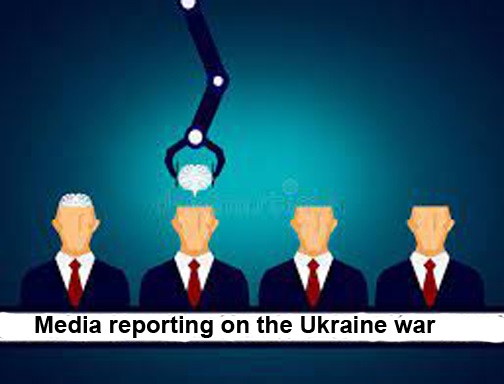
The Pentagon has ordered a sweeping audit of how it conducts clandestine information warfare after major social media companies identified and took offline fake accounts suspected of being run by the U.S. military in violation of the platforms’ rules.
Colin Kahl, the undersecretary of defense for policy, last week instructed the military commands that engage in psychological operations online to provide a full accounting of their activities by next month after the White House and some federal agencies expressed mounting concerns over the Defense Department’s attempted manipulation of audiences overseas, according to several defense and administration officials familiar with the matter.
The takedowns in recent years by Twitter and Facebook of more than 150 bogus personas and media sites created in the United States was disclosed last month by internet researchers Graphika and the Stanford Internet Observatory. While the researchers did not attribute the sham accounts to the U.S. military, two officials familiar with the matter said that U.S. Central Command is among those whose activities are facing scrutiny. Like others interviewed for this report, they spoke on the condition of anonymity to discuss sensitive military operations.
The researchers did not specify when the takedowns occurred, but those familiar with the matter said they were within the past two or three years. Some were recent, they said, and involved posts from the summer that advanced anti-Russia narratives citing the Kremlin’s “imperialist” war in Ukraine and warning of the conflict’s direct impact on Central Asian countries. Significantly, they found that the pretend personas — employing tactics used by countries such as Russia and China — did not gain much traction, and that overt accounts actually attracted more followers.
…………………………. The U.S. government’s use of ersatz social media accounts, though authorized by law and policy, has stirred controversy inside the Biden administration, with the White House pressing the Pentagon to clarify and justify its policies. The White House, agencies such as the State Department and even some officials within the Defense Department have been concerned that the policies are too broad, allowing leeway for tactics that even if used to spread truthful information, risk eroding U.S. credibility, several U.S. officials said.
…………. ..A spokeswoman for the National Security Council, which is part of the White House, declined to comment.
Kahl disclosed his review at a virtual meeting convened by the National Security Council on Tuesday, saying he wants to know what types of operations have been carried out, who they’re targeting, what tools are being used and why military commanders have chosen those tactics, and how effective they have been, several officials said.
…………………… Congress in late 2019 passed a law affirming that the military could conduct operations in the “information environment”
……The measure, known as Section 1631, allows the military to carry out clandestine psychological operations without crossing what the CIA has claimed as its covert authority, alleviating some of the friction that had hindered such operations previously.
The first defense official recalled:
“Combatant commanders got really excited. They were very eager to utilize these new authorities. The defense contractors were equally eager to land lucrative classified contracts to enable clandestine influence operations.”
………………………………… https://www.washingtonpost.com/national-security/2022/09/19/pentagon-psychological-operations-facebook-twitter/
Aw gee shucks – Australia can be IMPORTANT if we lead USA’s attacks with our AUKUS submarines !
Marles said nuclear subs would make “the rest of the world take us seriously”,
Final design and cost of Australia’s nuclear submarines to be known in early 2023, Defence minister Richard Marles links the cutting-edge technology to Australia’s economic and trade success
Guardian, Josh Butler, Thu 15 Sep 2022 The defence minister, Richard Marles, says Australia’s pathway to acquiring nuclear submarines is “taking shape”, flagging key decisions within months about which ship to use, how to build it and boosting the country’s defence-industrial capability.
On the first anniversary of the Aukus pact, Marles said nuclear subs would make “the rest of the world take us seriously”, linking the cutting-edge technology to Australia’s economic and trade success.
Final design and cost of Australia’s nuclear submarines to be known in early 2023
Defence minister Richard Marles links the cutting-edge technology to Australia’s economic and trade success…………………………….
On the first anniversary of the Aukus pact, Marles said nuclear subs would make “the rest of the world take us seriously”, linking the cutting-edge technology to Australia’s economic and trade success.
“The optimal pathway is taking shape. We can now begin to see it,” he said. “With Aukus there’s a really huge opportunity beyond submarines of pursuing a greater and more ambitious agenda.”……..
Marles, also the deputy prime minister, said the first steps toward acquisition of nuclear submarines were on track. In a briefing call with journalists this week, he said the current timeline had Australia slated to make initial announcements in the first part of 2023.
The government plans to give answers to five questions by that time: the final design; when it can be acquired; what capability gap that timeline will create and solutions to plug it; the cost; and how Australia’s plans comply with nuclear non-proliferation obligations.
The government is said to be choosing between building American or British ships, or some hybrid. Marles said the government was not ready to announce which type of submarines would be built but hinted Australia’s design could be “trilateral” in nature………..
In a press conference with Marles in the UK earlier this month, the British defence secretary, Ben Wallace, said future submarine designs may see a combination of British, American and Australian components.
“We are on to our next design and our new one and that might well be fully shared with all three nations as a collaborative design,” he said.
The cost of the submarine program is not yet known but is expected to be in the tens of billions. Marles linked the Aukus arrangement not only to military but economic security, saying a boosted submarine fleet would protect freedom of navigation through vital shipping routes.
“We need a highly capable defence force which has the rest of the world take us seriously and enables us to do all the normal peaceful activities that are so important for our economy,” he said………

V Adm Jonathan Mead, the chair of the nuclear submarine taskforce, also spoke of protecting “sea lanes” on the call.
Mead said the navy was investigating workforce challenges, such as how to build and crew the ships – which may involve placing Australian staff in British and American nuclear schools or agencies, laboratories and shipyards
“The exchange of these personnel will be both ways and won’t just involve our submariners,” he said.
Facilities to build and maintain the submarines in Australia are part of the equation. Defence this year pinpointed Brisbane, Newcastle and Port Kembla as possible sites for an east coast nuclear base and consultation with those communities is said to be in its early stages.
Marles also spoke of building Australia’s defence-industrial capability on the back of the nuclear process…………………..“We hope Aukus can help develop a genuinely seamless defence industrial base across the US, the UK and Australia.”…………………….
A report from the Australian Strategic Policy Institute (Aspi), released on Thursday, recommended further investment in other Aukus streams like hypersonic missiles and artificial intelligence technology, to help plug a capability gap while the submarines are built………..
Such short-term investment may force government to make “difficult choices and trade-offs” in its defence strategic review, also slated for March, Aspi said. https://www.theguardian.com/australia-news/2022/sep/15/final-design-and-cost-of-australias-nuclear-submarines-to-be-known-in-early-2023
China, AUKUS clash over nuclear subs

By Francois Murphy, South Coast Register, September 17 2022 China has clashed with the countries in the AUKUS alliance at a meeting of the UN nuclear watchdog over their plan to supply Australia with nuclear-powered submarines, capping a week in which Beijing has repeatedly railed against the project.
Under the alliance between Washington, London and Canberra announced last year, Australia plans to acquire at least eight nuclear submarines that International Atomic Energy Agency (IAEA) chief Rafael Grossi has said will be fuelled by “very highly enriched uranium”, suggesting it could be weapons-grade or close to it.

To date no party to the nuclear Non-Proliferation Treaty (NPT) other than the five countries the treaty recognises as weapons states – the United States, Russia, China, Britain and France – has nuclear submarines.
The vessels can stay underwater for longer than conventional subs and are harder to detect.
“The AUKUS partnership involves the illegal transfer of nuclear weapon materials, making it essentially an act of nuclear proliferation,” China said in a position paper sent to IAEA member states during this week’s quarterly meeting of the IAEA’s 35-nation Board of Governors……………………
The AUKUS countries and the IAEA say the NPT allows so-called marine nuclear propulsion provided necessary arrangements are made with the IAEA.
China disagrees in this case because nuclear material will be transferred to Australia rather than being produced by it.
It argues the IAEA is overstepping its mandate and wants an unspecified “inter-governmental” process to examine the issue at the IAEA instead of leaving it to the agency.
In its seven-page position paper, China said AUKUS countries were seeking to take the IAEA “hostage” so it could “whitewash” nuclear proliferation.
Nuclear submarines are a particular challenge because when they are at sea their fuel is beyond the reach of the agency’s inspectors who are supposed to keep track of all nuclear material.
IAEA chief Grossi has said he is satisfied with the AUKUS countries’ transparency so far……………………
https://www.southcoastregister.com.au/story/7906718/china-aukus-clash-over-nuclear-subs/?cs=202—
The Defence Strategic Review – Australia is becoming a proxy or is it a patsy for the US in a possible conflict with China

Pearls and Irritations By John Menadue, Sep 16, 2022
The Defence Strategic Review must warn Minister Marles about the dangerous path he is committing Australia to. We are becoming a spear carrier for the US.
- Fearing its world hegemony is under challenge the US is goading China at every opportunity. Speaker of the US House of Representatives, Nancy Pelosi’s visit to Taiwan was but the most recent example of this goading.
- The threat we face from China is if we continue to act in our region as a proxy for the US. Other regional countries are not doing so.
- The ‘China’ threat is a rerun of the shameful and earlier ‘yellow peril’. China is not a military threat to Australia.
- The US is the most violent and aggressive country in the world, almost always at war. Its military empire includes 800 foreign military bases.
We need a strong US presence in our region but not the provocative and dangerous behaviour we see time and time again.- We are attaching ourselves uncritically to a declining but dangerous hegemon.
- Our ‘Washington Club’ has been on an American drip feed for a long time.It has a ‘colonial’ mind set.It accepts without serious thought the US view of the world.
- Northern Australia is becoming a US military colony.These points are developed further below.
Northern Australia is becoming a US military colony
In some political difficulty in 2011 Julia Gillard was anxious for President Obama to visit Australia and address the Parliament. Kim Beazley, our Ambassador in Washington was very keen to help. As part of the deal to lock in the Obama visit Gillard agreed to the rotation of Marines through Darwin with US hopes for more future basing in Perth and Cocos-Keeling.
This was the real door opening for the Americans.
The colonisation has continued apace since then with more and more Marines rotating through Darwin and USAF operations in Northern Australia.
But putting the foot on the accelerator of US military colonisation really came in September 2021.
On 16 September 2021, Secretary of State Antony Blinken and Secretary of Defence Lloyd Austin hosted Minister for Foreign Affairs and Minister for Women Marise Payne and Minister for Defence Peter Dutton in Washington D.C. for the 31st Australia-United States Ministerial Consultations (AUSMIN 2021). The Secretaries and Ministers endorsed the following areas of force posture cooperation:
Enhanced air cooperation through the rotational deployment of U.S. aircraft of all types in Australia and appropriate aircraft training and exercises.
Enhanced maritime cooperation by increasing logistics and sustainment capabilities of U.S. surface and subsurface vessels in Australia.
Enhanced land cooperation by conducting more complex and more integrated exercises and greater combined engagement with Allies and Partners in the region.
Establish a combined logistics, sustainment, and maintenance enterprise to support high end warfighting and combined military operations in the region.
See the Australia-US Ministerial Consultations (AUSMIN) joint statement.
We have committed ourselves to ‘high end warfighting and combined military operations and unfettered access for US forces and platforms’ in northern and western Australia.
Only yesterday the AFR highlighted the US focus on western and northern Australia. ‘Former foreign policy adviser to president George W. Bush and new United States Studies Centre chief executive Michael Green predicts the US will become more dependent on Australia for its military operations and intelligence. A shift in foreign policy focus from Asia-Pacific to Indo-Pacific meant that areas of western and northern Australia would be ‘‘critical’’ for the US and its allies. ‘‘We need access: we need purchase on the Indian Ocean and, so geographically, in technology, in terms of military operations and intelligence, the US is going to be more dependent on Australia,’’ Mr Green said. ‘‘There’s no two ways around it.’’
We have not seriously debated or considered the enormous and very risky consequences of all of this. Our sovereignty and integrity as a nation is on the line and at the whim of the US, a country that does not really know which path it is on, crypto-fascism, civil war or anarchy.
In AUKUS, at enormous cost and with great delay we are planning to fuse our future nuclear powered submarines with the US Navy to operate in the South China Sea against China.
Minister Marles has told us that we are not only working ‘inter-operatively’ with the US military in numerous ways but we are now committed to ‘inter-changeabilty’ with US forces. We are locking ourselves even more to a ‘dangerous ally’. Minister Marles seems unconcerned about the dangerous path we are on.Even worse he seems careless about surrendering our national sovereignty. He should be watched very carefully.
The US is the most violent country in the world and almost always at war
There is an enormous and powerful US constituency committed to continual war. We joined those wars in Vietnam, Iraq, Afghanistan and Syria. All were disastrous. Now the US is continually goading and provoking China and wants us to join it. And we are obliging…………….
In this blog, Is war in the American DNA?, I have drawn attention repeatedly to the risks we run in being “joined at the hip” to a country that is almost always at war. The facts are clear…………………..
Despite all the evidence of wars and meddling, the American Imperium continues without serious check or query in America or Australia………………………………………………………………
Australia is trapped within the American Imperium
This complex co-opts institutions and individuals around the globe. It has enormous influence. No US president, nor for that matter any Australian prime minister, would likely challenge it. Morrison and Albanese have the same view on the US imperium.
Australia has locked itself into this complex. Our military and defence leaders are heavily dependent on the US Departments of Defence and State, the CIA and the FBI for advice. We act as their branch offices.
…………………………………… AUKUS has locked us in even more. In AUKUS we are effectively fusing our Navy with that of the US so that we can operate together in the South China Sea and threaten China. We are surrendering more and more of our strategic autonomy by encouraging the US to use Northern Australia as a forward base against China as if the US does not have enough giant military bases ringing China in Japan, ROK and Guam.
A ’rules-based international order’; but not for America
The third reason for the continuing dominance of the American Imperium is the way the US expects others to abide by a “rules-based international order”………………………….
Derivative media compounds Australia’s lack of autonomy
A major voice in articulating American extremism and the American Imperium is Fox News and Rupert Murdoch who exert their influence not just in America but also in the UK and Australia. ………………………. But it is not just the destructive role of News Corp in the US, UK and Australia. Our media, including the ABC are so derivative. It is so pervasive and extensive, we don’t recognise it for its very nature. We really do have a ‘white man’s media’. We see it most obviously today in the way legacy media spew out an endless daily conveyor belt of anti-China stories…………………………………..
Read more in our Defence Strategic Review series of articles. https://johnmenadue.com/the-defence-strategic-review-we-are-ceding-our-sovereignty-to-the-us/
1 This Month





PLEASE OPPOSE HR 8255 AND S.3639 – bills would accelerate satellite deployment, with no environmental review or safeguards – https://ncstd5li.quorum.us/campaign/169331/
To see nuclear-related stories in greater depth and intensity – go to https://nuclearinformation.wordpress.com
-
Archives
- October 2026 (10)
- September 2026 (339)
- August 2026 (330)
- July 2026 (355)
- June 2026 (287)
- May 2026 (306)
- April 2026 (356)
- March 2026 (251)
- February 2026 (267)
- January 2026 (308)
- December 2025 (358)
- November 2025 (359)
-
Categories
- 1
- 1 NUCLEAR ISSUES
- business and costs
- climate change
- culture and arts
- ENERGY
- environment
- health
- history
- indigenous issues
- Legal
- marketing of nuclear
- media
- opposition to nuclear
- PERSONAL STORIES
- politics
- politics international
- Religion and ethics
- safety
- secrets,lies and civil liberties
- spinbuster
- technology
- Uranium
- wastes
- weapons and war
- Women
- 2 WORLD
- ACTION
- AFRICA
- Atrocities
- AUSTRALIA
- Christina's notes
- Christina's themes
- culture and arts
- Events
- Fuk 2022
- Fuk 2023
- Fukushima 2017
- Fukushima 2018
- fukushima 2019
- Fukushima 2020
- Fukushima 2021
- general
- global warming
- Humour (God we need it)
- Nuclear
- RARE EARTHS
- Reference
- resources – print
- Resources -audiovicual
- Weekly Newsletter
- World
- World Nuclear
- YouTube
-
RSS
Entries RSS
Comments RSS

