US, UK sabotaged peace deal because they ‘don’t care about Ukraine’: fmr. NATO adviser
https://thegrayzone.com/2022/09/27/us-uk-sabotaged-peace-deal/ AARON MATÉ· SEPTEMBER 27, 2022,
Former Swiss intelligence officer and NATO adviser Jacques Baud on the next phase of the Russia-Ukraine war and new allegations that the US and UK undermined a peace deal that could have ended it.
The West’s aim “is not the victory of Ukraine, It’s the defeat of Russia,” Baud says. “The problem is that nobody cares about Ukraine. We have just instrumentalized Ukraine for the purpose of US strategic interests — not even European interests.”
Guest: Jacques Baud. Former intelligence officer with the Swiss Strategic Intelligence Service who has served in a number of senior security and advisory positions at NATO, the United Nations, and with the Swiss military.
Corrections:
- In his Sept. 21 speech, Putin did not make an explicit threat to use nuclear weapons. He vowed to “make use of all weapon systems available to us,” in the event of “a threat to the territorial integrity of our country and to defend Russia and our people.”
On nuclear weapons, the US did not have a “No First Use” policy. On the 2020 campaign trail, Joe Biden said that he supported the idea of “No First Use.” He abandoned that in his presidential nuclear posture; but that was reversing his campaign stance, not official US policy.
What are tactical nuclear weapons? An international security expert explains and assesses what they mean for the war in Ukraine
I believe Russian use of tactical nuclear weapons in Ukraine would not achieve any military goal. It would contaminate the territory that Russia claims as part of its historic empire and possibly drift into Russia itself. It would increase the likelihood of direct NATO intervention and destroy Russia’s image in the world.
The Conversation, Nina Srinivasan Rathbun, Professor of International Relations, USC Dornsife College of Letters, Arts and Sciences, 28 Sept 22,
Tactical nuclear weapons have burst onto the international stage as Russian President Vladimir Putin, facing battlefield losses in eastern Ukraine, has threatened that Russia will “make use of all weapon systems available to us” if Russia’s territorial integrity is threatened. Putin has characterized the war in Ukraine as an existential battle against the West, which he said wants to weaken, divide and destroy Russia.
U.S. President Joe Biden criticized Putin’s overt nuclear threats against Europe. Meanwhile, NATO Secretary-General Jens Stoltenberg downplayed the threat, saying Putin “knows very well that a nuclear war should never be fought and cannot be won.” This is not the first time Putin has invoked nuclear weapons in an attempt to deter NATO.
I am an international security scholar who has worked on and researched nuclear restraint, nonproliferation and costly signaling theory applied to international relations for two decades. Russia’s large arsenal of tactical nuclear weapons, which are not governed by international treaties, and Putin’s doctrine of threatening their use have raised tensions, but tactical nuclear weapons are not simply another type of battlefield weapon.
Tactical by the numbers
Tactical nuclear weapons, sometimes called battlefield or nonstrategic nuclear weapons, were designed to be used on the battlefield – for example, to counter overwhelming conventional forces like large formations of infantry and armor. They are smaller than strategic nuclear weapons like the warheads carried on intercontinental ballistic missiles.
While experts disagree about precise definitions of tactical nuclear weapons, lower explosive yields, measured in kilotons, and shorter-range delivery vehicles are commonly identified characteristics. Tactical nuclear weapons vary in yields from fractions of 1 kiloton to about 50 kilotons, compared with strategic nuclear weapons, which have yields that range from about 100 kilotons to over a megaton, though much more powerful warheads were developed during the Cold War.
For reference, the atomic bomb dropped on Hiroshima was 15 kilotons, so some tactical nuclear weapons are capable of causing widespread destruction. The largest conventional bomb, the Mother of All Bombs or MOAB, that the U.S. has dropped has a 0.011-kiloton yield.
Delivery systems for tactical nuclear weapons also tend to have shorter ranges, typically under 310 miles (500 kilometers) compared with strategic nuclear weapons, which are typically designed to cross continents.
Because low-yield nuclear weapons’ explosive force is not much greater than that of increasingly powerful conventional weapons, the U.S. military has reduced its reliance on them. Most of its remaining stockpile, about 150 B61 gravity bombs, is deployed in Europe. The U.K. and France have completely eliminated their tactical stockpiles. Pakistan, China, India, Israel and North Korea all have several types of tactical nuclear weaponry.
Russia has retained more tactical nuclear weapons, estimated to be around 2,000, and relied more heavily on them in its nuclear strategy than the U.S. has, mostly due to Russia’s less advanced conventional weaponry and capabilities.
Russia’s tactical nuclear weapons can be deployed by ships, planes and ground forces. Most are deployed on air-to-surface missiles, short-range ballistic missiles, gravity bombs and depth charges delivered by medium-range and tactical bombers, or naval anti-ship and anti-submarine torpedoes. These missiles are mostly held in reserve in central depots in Russia.
Russia has updated its delivery systems to be able to carry either nuclear or conventional bombs. There is heightened concern over these dual capability delivery systems because Russia has used many of these short-range missile systems, particularly the Iskander-M, to bombard Ukraine.
Tactical nuclear weapons are substantially more destructive than their conventional counterparts even at the same explosive energy. Nuclear explosions are more powerful by factors of 10 million to 100 million than chemical explosions, and leave deadly radiation fallout that would contaminate air, soil, water and food supplies, similar to the disastrous Chernobyl nuclear reactor meltdown in 1986. The interactive simulation site NUKEMAP by Alex Wellerstein depicts the multiple effects of nuclear explosions at various yields………………………………
Tactical nuclear weapons are substantially more destructive than their conventional counterparts even at the same explosive energy. Nuclear explosions are more powerful by factors of 10 million to 100 million than chemical explosions, and leave deadly radiation fallout that would contaminate air, soil, water and food supplies, similar to the disastrous Chernobyl nuclear reactor meltdown in 1986. The interactive simulation site NUKEMAP by Alex Wellerstein depicts the multiple effects of nuclear explosions at various yields…………………….
While there is disagreement among experts, Russian and U.S. nuclear strategies focus on deterrence, and so involve large-scale retaliatory nuclear attacks in the face of any first-nuclear weapon use. This means that Russia’s threat to use nuclear weapons as a deterrent to conventional war is threatening an action that would, under nuclear warfare doctrine, invite a retaliatory nuclear strike if aimed at the U.S. or NATO.
Nukes and Ukraine
I believe Russian use of tactical nuclear weapons in Ukraine would not achieve any military goal. It would contaminate the territory that Russia claims as part of its historic empire and possibly drift into Russia itself. It would increase the likelihood of direct NATO intervention and destroy Russia’s image in the world.
Putin aims to deter Ukraine’s continued successes in regaining territory by preemptively annexing regions in the east of the country after holding staged referendums. He could then declare that Russia would use nuclear weapons to defend the new territory as though the existence of the Russian state were threatened. But I believe this claim stretches Russia’s nuclear strategy beyond belief.
Putin has explicitly claimed that his threat to use tactical nuclear weapons is not a bluff precisely because, from a strategic standpoint, using them is not credible. In other words, under any reasonable strategy, using the weapons is unthinkable and so threatening their use is by definition a bluff. https://theconversation.com/what-are-tactical-nuclear-weapons-an-international-security-expert-explains-and-assesses-what-they-mean-for-the-war-in-ukraine-191167
USA government, Pentagon, happy to escalate to a nuclear war – at the behest of Volodymyr Zelensky ?
As I really dislike Rupert Murdoch’s News Corpse, Tucker Carlson, and the whole pro Trump brigade, it pains me to have to promote them in any way. BUT – if they happen to be telling the facts, with a credible interpretation of what is going on in Ukraine – can we afford to just dismiss them, while the “respectable” corporate Western media idolises Zelensky, and promotes the escalation of the war?
The deadly game of nuclear escalation

https://barbadostoday.bb/2022/09/25/btcolumn-the-deadly-game-of-nuclear-escalation/ Article by
Sasha Mehter, 25 Sept 22, by Lenrod Nzulu Baraka
Military mobilisation in Russia has led to thousands of Russians fleeing their country to escape conscription. Russians, perhaps mindful of the 27 million of their countrymen that fell defending the motherland against Nazi aggression, are saying no to the prospects of becoming cannon fodder for another war between Russia and the rest of Europe. Direct flights from Russia to countries that do not require Russians to have visa are already sold out.
Russian mobilisation comes at a time when European and America belligerence is at an all time high. President of the European Commission Ursula von der Leyen has doubled down on Russian sanctions saying that the sanctions were here to stay and that now was a time to show resolve not appeasement. Maybe she is trying hard to shore up the commitment of European nations that are staring down a bleak winter of discontent.
President Biden fresh from his 60 Minute interview in which he bluntly stated that he was willing to send American troops to assist Taiwan if that country was threatened by invading Chinese forces, amplified Ursula von der Leyen’s hawkish rhetoric. With a very straight face President Biden berated Russia for wanting to extinguish Ukraine’s right to exist as a state. I guess he forgot what the American government did to Iraq, Libya, and Yugoslavia.In his speech at the UN President Biden reminded his fellow world leaders that no nation should be allowed to pursue imperialistic ambitions without consequences. He probably winked at the leaders of Israel and Saudi Arabia as he said these words to remind them that his statement did not apply to their nations. The US has used its veto over fifty times to shield Israel from UN resolution condemning Israeli actions against Palestinians. And who could forget the famous fist bump between President Biden and Crown Prince Mohammed bin Salman after President Biden pariah threat.
Undaunted and undeterred by the European Community, NATO, and the US and its allies, President Putin ordered a military mobilisation of 300 000 reservists. In a televised address to his nation President Putin stated that if the territorial integrity of his nation was threatened, he would use every available means to protect Russia and its people. President Putin’s cryptic weathervane comment in connection with his nuclear statement preceding it, suggests that the deadly game of nuclear escalation has started.
The US and NATO bring to the table an impressive array of military and economic weapons many of which have already been deployed against Russia. On its own, Russia will not be able to withstand the American /NATO assault indefinitely. The longer the Ukrainian war drags on the weaker Russia’s position becomes. A major Russian escalation could however turn the tide in Russia’s favor.
The formal annexation of new Ukrainian territory may fit the bill for an escalation that might prove to be decisive. The West will have to decide whether President Putin is bluffing about his nuclear threat as they decide on an appropriate response. Ukrainian attacks against territory formally annexed by Russia will be interpreted as an attack on Russia by Ukraine. The path to total war will be open and Russia will unleash its most potent weapons on Ukraine and secondly on any NATO or American forces that come to Ukraine’s assistance.
Since Russia will be the underdog in an all out dogfight with NATO and the US, Russia will have to rely on its nuclear arsenal either as a deterrent to outright invasion of Russia by NATO and US forces or as a game changing strategy to decimate the opposition. Russia may very well decide to go nuclear for the same reason the US went atomic against the Japanese. Rather than throwing his population into the meat grinder of a conventional war, Putin may go instead for a few precision strikes designed to instill terror in the camp of the enemy. Once that first nuclear button is pushed everything changes and the world that we know will be transformed.
Lenrod Nzulu Baraka is the founder of Afro-Caribbean Spiritual Teaching Center.
The Ukraine war could open the nuclear Pandora’s box
If neither Russia nor the West backs down, the scope and dimension of the conflict will change dramatically
Nato could be forced to intervene directly, for example to protect Ukraine’s nuclear reactors, if Mr Zelenskyy requests it. Ukraine is home to 14 reactors in addition to the Russian-controlled Zaporizhzhia plant in the south-east. In such a scenario, the war would become a European war.
The US, also to help protect the nuclear reactors, might be willing to supply missiles to Ukraine with a range of up to 400 kilometres, long enough to reach Crimea and perhaps even the Russian capital. In which case, according to a Russian expert, Moscow could deploy nuclear weapons.
The National RAGHIDA DERGHAM 25 Sept 22, The war in Ukraine has entered a decisive phase, with Russian President Vladimir Putin ordering referendums in the Donbas last week. The outcome of these referendums, which the West believes Moscow has designated with the purpose of annexing Ukraine’s Russian-controlled regions, will change the rules of the conflict. At the same time, Mr Putin has invoked his government’s nuclear options and declared a partial mobilisation of up to 300,000 conscripts, indicating the expansion of the war in the coming weeks.
It is now clear to anyone who previously thought Mr Putin might take steps to negotiate with Kyiv or back down that he is convinced he can – and is determined to – prevail in Ukraine and will not entertain the idea of a defeat. The Kremlin is not afraid of inviting a western military intervention and has put Nato on edge by talking about victory at any cost, including a nuclear cost.
On the other hand, it is clear that American and European leaders have made their decision in the equation of victory-or-defeat and will not allow Russia to seize Ukraine, no matter the cost. This means that, what appeared impossible a month or two ago is now in the realm of plausibility, meaning direct western intervention in the war, in the event of Russia deploying tactical nukes – which are not strictly “tactical” or “small radius” weapons.
So who will win and who will lose in Ukraine?
First, let’s address the big picture – the US strategy that many believe is to implicate the Russian leadership and its system, if not Russia itself, for calculations related to Washington’s grand strategy vis-a-vis China’s rise. It must be said that no matter the planners’ genius, it requires the target to fall into the trap. Indeed, Moscow did not resist this trap. It even doubled down. Its leadership thought its ultimatums and escalations would force the West to back down and comply with its demands, and therefore, enable a Russian victory in Ukraine. So far, it has lost its bets and continues to follow the path charted for it by the western powers towards an ambush that could prove disastrous for Russia.
Comparisons have been made between Moscow’s intervention in Afghanistan, which eventually led to the break-up of the Soviet Union, and the Ukraine war that could have dire consequences for the Russian Federation. Backing down now could amount to a significant setback for Moscow. Yet, the paradox is that continuing this war carries the same risks, particularly if Russia loses. For this reason, defeat is not a word in its dictionary and not an option for its military, especially after the war exposed the latter’s weaknesses and undermined its prestige.
From Washington’s point of view, defeating Russia helps the American strategy against China. US National Security Council strategists believe that defeating Russia would cause Beijing to lose a strategic partner practically and psychologically. It also means, according to one informed expert, that China would lose its Russian “buffer zone”, forcing it to the frontline in its strategic stand-off with the US………………..
Russia will not allow Ukraine to be shared by the two sides. But nor will Ukrainian President Volodymyr Zelenskyy back down. He sees Moscow’s failure to remove him from power as a decisive moment in the war. He is also confident that Nato will guarantee Kyiv the military edge. Modern warfare is not limited to what goes on in the battlefield; it’s also a technological war, and Mr Zelenskyy is using Nato’s advanced technology to fight Moscow.
Nato could be forced to intervene directly, for example to protect Ukraine’s nuclear reactors, if Mr Zelenskyy requests it. Ukraine is home to 14 reactors in addition to the Russian-controlled Zaporizhzhia plant in the south-east. In such a scenario, the war would become a European war. The US, also to help protect the nuclear reactors, might be willing to supply missiles to Ukraine with a range of up to 400 kilometres, long enough to reach Crimea and perhaps even the Russian capital. In which case, according to a Russian expert, Moscow could deploy nuclear weapons.
The Kremlin is seen to be paving the way towards being able to use these weapons. The referendums in the Donbas, to conclude on Tuesday with the Russian expectation that majorities will vote in favour of joining its federation, will be followed by the annexation of those regions. Subsequently, from September 29-30, after the Russian Duma endorses the results, any assault on those regions would amount to an assault on Russia, giving the Kremlin the right to respond by all means necessary, included nuclear ones.
Put differently, according to another expert, “the buffer zone between Russia and Ukraine will disappear, and the war will enter a new threshold that includes the activation of Russian strategic nuclear instruments based on national laws to defend Russian territories using all available means”.
A Russian military victory, if it were to transpire, may require an escalation that would bring with it much destruction. For this reason, the next two weeks will not only be crucial, but possibly also dangerous. https://www.thenationalnews.com/opinion/comment/2022/09/25/the-ukraine-war-could-open-the-nuclear-pandoras-box/
International Day for the Total Elimination of Nuclear Weapons 2022: History, Significance and Celebration
https://www.news18.com/news/lifestyle/international-day-for-the-total-elimination-of-nuclear-weapons-2022-history-significance-and-celebration-6028441.htmlBy: Lifestyle Desk
The day reminds people of the dangers of nuclear weapons and urges world governments to cooperate and bring about a permanent and complete nuclear disarmament.
nternational Day for the Total Elimination of Nuclear Weapons is observed on September 26 every year. The devastating impact of the 1945 Hiroshima and Nagasaki bombings is well known. This apart, over 2000 nuclear tests have been conducted to date; the last one in 2017, by North Korea. Such tests have caused cancers, birth defects and chronic diseases, among other illnesses in people, and severely damaged the natural world.
Though there has been a reduction in the number of deployed nuclear weapons since the peak of the Cold War, an estimated 12,705 nuclear weapons still exist in the world as of 2022, with the United States and Russia, who appear to be on opposing sides, owning most of them.
History
The United Nations’ (UN) objective to achieve total nuclear disarmament was underlined in the first resolution of the United Nations General Assembly (UNGA) in 1946. Nuclear disarmament was made a priority objective in the first Special Session of the UNGA on disarmament in 1978. The nations which possess nuclear weapons include a doctrine of nuclear deterrence in their security policies.
To raise public awareness about nuclear weapons, the UNGA, in 2009, declared August 29 as the International Day against Nuclear Tests. Then, in December 2013, the UNGA declared September 26 as the International Day for the Total Elimination of Nuclear Weapons to mark the high-level UNGA meeting on nuclear disarmament on September 26 that year.
Celebration
Each year, the UN member states, civil society, parliamentarians, non-governmental organisations, mass media, academia, and individuals celebrate and promote the international day through various educational activities.
Significance
The International Day for the Total Elimination of Nuclear Weapons reminds people of the dangers of nuclear weapons and urges world governments to cooperate and bring about a permanent and complete nuclear disarmament.
Nuclear Disarmament
Even though total nuclear weapons elimination remains a dream for now, the 1987 Christopher Reeve-starring film, ‘Superman IV: The Quest for Peace,’ (1987) shows the title character destroying all of Earth’s nuclear weapons. People, however, not aliens, are needed to establish permanent peace. The International Day for the Total Elimination of Nuclear Weapons rekindles that dream each year.
US-S.Korea to stage joint military drills with nuclear-powered US carrier
https://www3.nhk.or.jp/nhkworld/en/news/20220926_01 26 Sept 22, The United States and South Korea are set to begin joint military exercises in the Sea of Japan on Monday, with the participation of a nuclear-powered US aircraft carrier.
The drills, involving a strike group led by the USS Ronald Reagan, will continue through Thursday.
The US highlighted the carrier’s deployment near the Korean Peninsula as part of its efforts to boost deterrence against North Korea in a meeting of senior foreign and defense officials from Washington and Seoul earlier this month.
The South Korean government stressed that Seoul and Washington will strengthen their joint defense capabilities and reconfirm their strong resolve to neutralize any forms of missile provocations by Pyongyang.
North Korea criticized South Korea for working with the US to beef up deterrence. Pyongyang said on a state-run website on Sunday that plots for war provocations will only create dreadful destruction.
North Korea on the same day launched a short-range ballistic missile toward the Sea of Japan from an area in or around Taechon, North Phyongan Province. The missile is estimated to have landed outside Japan’s exclusive economic zone.
North Korea also appears to be preparing to fire a submarine-launched ballistic missile, or SLBM, in the city of Sinpho in the eastern province of South Hamgyong.
Washington and Seoul remain on alert for possible further missile launches and other provocations by Pyongyang as North Korea is expected to sharply react to the US-South Korea joint drills.
World shouldn’t give up on nuclear disarmament, says Prime Minister Jacinda Ardern
25/09/2022 NewsHub, By Craig McCulloch for RNZ
After a two-year Covid-induced hiatus, the United Nations’ leaders’ summit returned with gusto this week, but against a far darker backdrop than Jacinda Ardern’s last time there.
The general assembly has been dominated by Russia’s invasion of Ukraine, with attention fuelled this week by Vladimir Putin’s barely veiled nuclear threats and expanded war effort.
In an end-of-trip interview with RNZ, the Prime Minister noted the conflicted emotions among leaders in New York: pleased to have “come through” the pandemic, only to then “smack up against such significant hurdles”.
“Everyone was talking in some form about issues like inflation… climate action, and the persistent security threats in Europe,” Ardern told RNZ.
The mere mention of nuclear war added gravity; the conflict was “absolutely” on everyone’s lips, Ardern said.
“It is a worrying time.”… https://www.newshub.co.nz/home/politics/2022/09/world-shouldn-t-give-up-on-nuclear-disarmament-says-prime-minister-jacinda-ardern.html
SCOTT RITTER: Reaping the Whirlwind

an American hegemony defined by a “rules based international order” foisted on the world in the aftermath of the Second World War.
This is what the world has come to — a mad rush toward nuclear apocalypse predicated on the irrational expansion of NATO and hubris-laced Russophobic policies
the current policy of the Ukrainian government and its Western allies of evicting Russia from the Donbass, occupied Ukraine and Crimea. This means attacking Mother Russia. This means war with Russia.
The U.S. and its allies in the “collective West” now have to decide if the continued pursuit of a decades-long policy of isolating and destroying Russia is a matter of existential importance to them
Putin’s order to begin partial mobilization of Russian military forces continues a confrontation between Russia and a U.S.-led coalition of Western nations that began at the end of the Cold War.
https://consortiumnews.com/2022/09/22/scott-ritter-reaping-the-whirlwind/ By Scott Ritter Consortium News, 22 Sept 22
War is never a solution; there are always alternatives that could have — and should have —been pursued by those entrusted with the fate of global society before the order was given to send the youth of a nation to go off to fight and die. Any national leader worth his or her salt should seek to exhaust every other possibility to resolve issues confronting their respective countries.
If viewed in a vacuum, the announcement of Russian President Vladimir Putin Wednesday, in a televised address to the Russian people, that he was ordering the partial mobilization of 300,000 military reservists to supplement some 200,000 Russian personnel currently engaged in combat operations on the soil of Ukraine would appear to be the antithesis of seeking an alternative to war.
This announcement was made in parallel with one that authorized referendums to take place on the territory of Ukraine currently occupied by Russian forces regarding the question of joining these territories with the Russian Federation.
Seen in isolation, these actions would appear to represent a frontal assault on international law as defined by the United Nations Charter, which prohibits acts of aggression by one nation against another for the purpose of seizing territory by force of arms. This was the case made by U.S. President Joe Biden when speaking at the United Nations General Assembly hours after Putin’s announcement.
“A permanent member of the United Nations Security Council invaded its neighbor, attempted to erase a sovereign state from the map,” Biden said. “Russia has shamelessly violated the core tenets of the United Nations Charter.”
History, however, is a harsh mistress, where facts become inconvenient to perception. When viewed through the prism of historical fact, the narrative being promulgated by Biden becomes flipped. The reality is that since the collapse of the Soviet Union at the end of 1991, the U.S. and its European allies have been conspiring to subjugate Russia in an effort to ensure that the Russian people are never again able to mount a geopolitical challenge to an American hegemony defined by a “rules based international order” that had been foisted on the world in the aftermath of the Second World War.
For decades, the Soviet Union had represented such a threat. With its demise, the U.S. and its allies were determined to never again allow the Russian people — the Russian nation — to manifest themselves in a similar manner.
When Putin spoke about the need for “necessary, urgent steps to protect the sovereignty, security and territorial integrity of Russia” from “the aggressive policies of some Western elites who try by any means necessary to maintain their supremacy,” he had this history in mind.
The aim of the U.S. and its Western allies, Putin declared, was “to weaken, divide and ultimately destroy our country” by promulgating policies designed to cause “Russia itself to disintegrate into a multitude of regions and territories that are deadly enemies with one another.” According to Putin, the U.S.-led West “purposefully incited hatred of Russia, particularly in Ukraine, for which they destined the fate of an anti-Russian beachhead.”
Newton’s Third Law of Motion, that for every action there is an equal and opposite reaction, applies to geopolitics as well.
On Feb. 24, Putin issued orders for the armed forces of Russia to initiate what he termed a “Special Military Operation” (SMO) in Ukraine. Putin declared that this decision was in keeping with Article 51 of the United Nations Charter and the principles of collective preemptive self-defense as defined by international law.
The goals of this operation were to protect the newly independent republics of Lugansk and Donetsk (referred collectively as the Donbass region) from an imminent danger posed by a build-up of Ukrainian military forces which were, according to Russia, poised to attack.
The stated goal of the SMO was to safeguard the territory and people of the Lugansk and Donetsk republics by eliminating the threat posed by the Ukrainian military. To accomplish this, Russia embraced two primary objectives — demilitarization and denazification.
Demilitarization of Ukraine would be accomplished through the elimination of all infrastructure and organizational structures affiliated with the North Atlantic Treaty Organization, or NATO; denazification would involve a similar eradication of the odious ideology of the Ukrainian ultra-nationalist, Stepan Bandera, who was responsible for the deaths of hundreds of thousands of Jews, Poles and ethnic Russians during the Second World War and in a decade of anti-Soviet resistance after the war ended.
Beginning in 2015, NATO had been training and equipping the Ukrainian military for the purpose of confronting pro-Russian separatists that had seized power in the Donbass following the ouster of pro-Russian Ukrainian President Victor Yanukovich in a violent insurrection, known as the “Maidan Revolution,” spearheaded by right-wing Ukrainian political parties professing loyalty to the memory of Stepan Bandera.
Ukraine had been pursuing NATO membership since 2008, enshrining this goal in its constitution. While actual membership still eluded Ukraine as of 2022, the level of involvement of NATO with the Ukrainian armed forces made it a de facto extension of the NATO alliance.
Russia viewed the combination of NATO membership with the anti-Russian posturing of the post-Maidan Ukrainian government, linked as it was to the ideology of Bandera, as a threat to its national security. The SMO was designed to eliminate that threat.
Two Phases of Russian Operation
For roughly the first six months, the Russian military operation could be broken down into two distinct phases. The first was a blitzkrieg-style effort designed to shock the Ukrainian military and government into submission. Failing that, it was meant to shape the battlefield in a manner that isolated the Ukrainian forces assembled near the Donbass region prior to their decisive engagement by the Russian military in the second phase, which began on March 25.
Phase two of the SMO, the “battle for the Donbass,” unfolded through April, May, June and July, and involved brutal, meat-grinding style warfare in urban terrain and among defensive fortifications that had been prepared by Ukrainian forces over the course of the past eight years.
Russia made slow, agonizing gains, in a war of attrition which saw Russia inflict horrific losses on the Ukrainian armed forces. Such was the extent of the damage done by Russia on the army of Ukraine that by the end of July nearly the entire inventory of Soviet-era weapons that Ukraine possessed at the start of the SMO had been destroyed, along with over 50 percent of its active-duty military component.
Normally, when assessing casualty figures of this magnitude, any professional military analyst would be right to conclude that Russia had, in effect, accomplished its goal of demilitarization, which logically should have been followed by the surrender of the Ukrainian government on terms which would have resulted in the kinds of fundamental political change necessary to implement the Russian goal of denazification and, with it, securing Ukrainian neutrality.
But the very forces which Putin had described in his mobilization address conspired to further their anti-Russian agenda by pouring in tens of billions of dollars of military aid (exceeding, in a manner of months, the entire annual defense budget of Russia) designed not to promote a Ukrainian victory, but rather hasten a strategic Russian defeat.
“Whereas once the primary Western objective was to defend against the [Russian] invasion,” journalist Tom Stevenson noted in an OpEd in The New York Times, “it has become the permanent strategic attrition of Russia.”
But the very forces which Putin had described in his mobilization address conspired to further their anti-Russian agenda by pouring in tens of billions of dollars of military aid (exceeding, in a manner of months, the entire annual defense budget of Russia) designed not to promote a Ukrainian victory, but rather hasten a strategic Russian defeat.
“Whereas once the primary Western objective was to defend against the [Russian] invasion,” journalist Tom Stevenson noted in an OpEd in The New York Times, “it has become the permanent strategic attrition of Russia.”
While Russia was able to stabilize its defenses and ultimately halt the Ukrainian offensive, inflicting huge numbers of casualties on the attacking force, the reality that Russia was facing a new threat paradigm in Ukraine, one which saw the Russian military fighting a reconstituted Ukrainian military that had become a de facto proxy of the U.S.-led NATO alliance.
Confronted with this new reality, Putin informed the Russian people that he considered it “necessary to take the following decision, which is fully responsive to the threats we face: In order to defend our homeland, its sovereignty and territorial integrity, and the security of our people and that of the population and to ensure the liberated areas, I consider it necessary to support the proposal of the Ministry of Defense and the General Staff to introduce partial mobilization in the Russian Federation.”
The U.S. and its NATO allies would do well to reflect on the lesson inherent in Hosea 8:7—sow the wind, reap the whirlwind.
Or, put another way, Newton’s Third Law has come back with a vengeance.
Putin’s decision to order a partial mobilization of the Russian military, when combined with the decision to conduct the referendums in the Donbass and occupied Ukraine, radically transforms the SMO from a limited-scope operation to one linked to the existential survival of Russia. Once the referenda are conducted, and the results forwarded to the Russian parliament, what is now the territory of Ukraine will, in one fell swoop, become part of the Russian Federation — the Russian homeland.
All Ukrainian forces that are on the territory of the regions to be incorporated into Russia will be viewed as occupiers; and Ukrainian shelling of this territory will be treated as an attack on Russia, triggering a Russian response. Whereas the SMO had, by design, been implemented to preserve Ukrainian civil infrastructure and reduce civilian casualties, a post-SMO military operation will be one configured to destroy an active threat to Mother Russia itself. The gloves will come off.
US & NATO Face a Decision
The U.S. and NATO, having committed to a program designed to defeat Russia via proxy, must now decide whether they continue to follow through with their political and material support for Ukraine and, if so, to what extent. Does the goal remain the “strategic defeat” of Russia, or will the aid be tailored simply to assist Ukraine in defending itself?
These are two completely different goals.
One allows for the continued attrition of any Russian force that seeks to project power from Russian territory into Ukraine but, in doing so, respects the reality, if not the legitimacy, of the Russian incorporation of the Donbass and southern Ukrainian territories under occupation into the Russian Federation.
The other continues to sustain the current policy of the Ukrainian government and its Western allies of evicting Russia from the Donbass, occupied Ukraine and Crimea. This means attacking Mother Russia. This means war with Russia.
For its part, Russia considers itself already to be in a war with the West. “We are really at war with…NATO and with the collective West,” Russian Defense Minister Sergei Shoigu said in a statement that followed Putin’s announcement regarding partial mobilization.
“We mean not only the weapons that are supplied in huge quantities. Naturally, we find ways to counter these weapons. We have in mind, of course, the Western systems that there exist: communication systems, information processing systems, reconnaissance systems, and satellite intelligence systems.”
Put in this context, the Russian partial mobilization isn’t designed to defeat the Ukrainian military, but to defeat the forces of NATO and the “collective West” that have been assembled in Ukraine.
And if these NATO resources are configured in a way that is deemed by Russia as constituting a threat to the Russian homeland…
“Of course,” Putin said in his address on partial mobilization, “if the territorial integrity of our country is threatened, we will use all means at our disposal to defend Russia and our people,” a direct reference to Russia’s nuclear arsenal.
“This is not a bluff,” Putin emphasized. “The citizens of Russia can rest assured that the territorial integrity of our homeland, our independence, and our freedom, I reiterate, will be safeguarded with all the means at our disposal. And those who are trying to blackmail us with nuclear weapons need to know that the compass rose can turn in their direction, too.”
This is what the world has come to — a mad rush toward nuclear apocalypse predicated on the irrational expansion of NATO and hubris-laced Russophobic policies seemingly ignorant of the reality that the Ukraine conflict has now become a matter of existential importance to Russia.
The U.S. and its allies in the “collective West” now have to decide if the continued pursuit of a decades-long policy of isolating and destroying Russia is a matter of existential importance to them, and if the continued support of a Ukrainian government that is little more than the modern-day manifestation of the hateful ideology of Stepan Bandera is worth the lives of their respective citizenry, and that of the rest of the world.
The doomsday clock is literally one second to midnight and we in the West have only ourselves to blame
Scott Ritter is a former U.S. Marine Corps intelligence officer who served in the former Soviet Union implementing arms control treaties, in the Persian Gulf during Operation Desert Storm and in Iraq overseeing the disarmament of WMD. His most recent book is Disarmament in the Time of Perestroika, published by Clarity Press
Holding ground, losing war
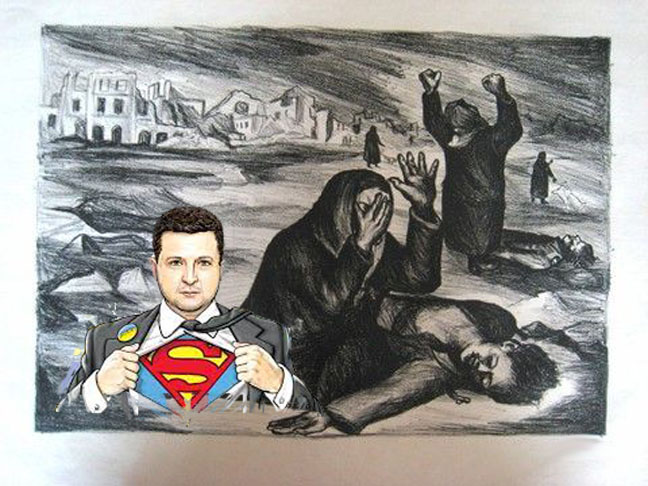
Zelensky’s strategy of defending territory at all costs has been disastrous for Ukraine.
The American Conservative, Douglas Macgregor, Sep 22, 2022,
At the end of 1942, when the Wehrmacht could advance no further east, Hitler switched German ground forces from an “enemy force-oriented” strategy to a “ground-holding” strategy. Hitler demanded that his armies defend vast, largely empty and irrelevant stretches of Soviet territory.
“Holding ground” not only robbed the German military of its ability to exercise operational discretion, and, above all, to outmaneuver the slow, methodical Soviet opponent; holding ground also pushed German logistics to the breaking point. When holding ground was combined with endless counterattacks to retake useless territory, the Wehrmacht was sentenced to slow, grinding destruction.
Ukrainian President Volodymyr Zelensky, (presumably with the advice of his U.S. and British military advisors), has also adopted a strategy of holding ground in Eastern Ukraine. Ukrainian forces immobilized themselves inside urban areas, and prepared defenses. As a result, Ukrainian forces turned urban centers into fortifications for what became “last stands.” Sensible withdrawals from cities like Mariupol that might have saved many of Ukraine’s best troops were forbidden.
Russian forces responded by methodically isolating and crushing the defenders left with no possibility of either escape or rescue by other Ukrainian forces.
Moscow’s determination to destroy Ukrainian forces at the least cost to Russian lives prevailed.
Ukrainian casualties were always heavier than reported from the moment Russian troops crossed into Eastern Ukraine, but now, thanks to the recent failure of Ukrainian counterattacks in the Kherson region, they’ve reached horrific levels that are impossible to conceal. Casualty rates have reached 20,000 killed or wounded a month.
Despite the addition of 126 howitzers, 800,000 rounds of artillery rounds, and HIMARS (U.S. rocket artillery), months of hard fighting are eroding the foundations of Ukraine’s ground strength. In the face of this disaster, Zelensky continues to order counterattacks to re-take territory as a means of demonstrating that Ukraine’s strategic position vis-à-vis Russia is not as hopeless as it seems.
The recent Ukrainian advance to the town of Izium, the link between Donbas and Kharkiv, seemed like a gift to Kiev. U.S. satellite arrays undoubtedly provided Ukrainians with a real-time picture of the area showing that Russian forces west of Izium numbered less than 2,000 light troops (the equivalent of paramilitary police, e.g., SWAT and airborne infantry).
The Russian command opted to withdraw its small force from the area that is roughly 1 percent of formerly Ukrainian territory currently under Russian control. However, the price for Kiev’s propaganda victory was high—depending on the source, an estimated 5,000 to 10,000 Ukrainian troops were killed or wounded in a flat, open area that Russian artillery, rockets, and air strikes turned into a killing field.
Given Washington’s inability to end the war in Ukraine with the defeat of Russian arms, it seems certain that the Beltway will try instead to turn the ruins of the Ukrainian state into an open wound in Russia’s side that will never heal. From the beginning, the problem with this approach was that Russia always had the resources to dramatically escalate the fighting and end the fighting in Ukraine on very harsh terms. Escalation is now in progress. …………………………..
The defense establishment has a long record of success in tranquilizing American voters with meaningless clichés. As conditions favorable to Moscow develop in Eastern Ukraine and the Russian position in the world grows stronger, Washington confronts a stark choice: Talk about having successfully “degraded Russian power” in Ukraine and scale back its actions. Or risk a regional war with Russia that will engulf Europe. ……………………………… more https://www.theamericanconservative.com/holding-ground-losing-war/
Brainwashed for War With Russia

https://original.antiwar.com/mcgovern/2022/09/21/brainwashed-for-war-with-russia/ by Ray McGovern ,
Thanks to Establishment media, the sorcerer apprentices advising President Joe Biden – I refer to Secretary of State Antony Blinken, national security adviser Jacob Sullivan, and China specialist Kurt Campbell – will have no trouble rallying Americans for the widest war in 77 years, starting in Ukraine, and maybe spreading to China. And, shockingly, under false pretenses.
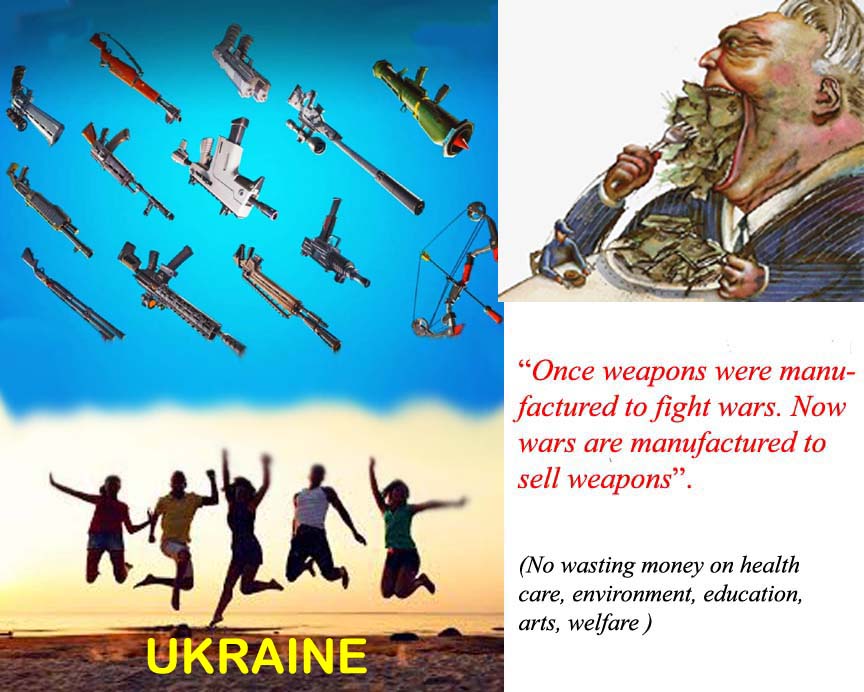
Most Americans are oblivious to the reality that Western media are owned and operated by the same corporations that make massive profits by helping to stoke small wars and then peddling the necessary weapons. Corporate leaders, and Ivy-mantled elites, educated to believe in U.S. “exceptionalism,” find the lucre and the luster too lucrative to be able to think straight. They deceive themselves into thinking that (a) the US cannot lose a war; (b) escalation can be calibrated and wider war can be limited to Europe; and (c) China can be expected to just sit on the sidelines. The attitude, consciously or unconsciously, “Not to worry. And, in any case, the lucre and luster are worth the risk.”
The media also know they can always trot out died-in-the-wool Russophobes to “explain,” for example, why the Russians are “almost genetically driven” to do evil (James Clapper, former National Intelligence Director and now hired savant on CNN); or Fiona Hill (former National Intelligence Officer for Russia), who insists “Putin wants to evict the United States from Europe … As he might put it: “Goodbye, America. Don’t let the door hit you on the way out.”
Absent a miraculous appearance of clearer heads with a less benighted attitude toward the core interests of Russia in Ukraine, and China in Taiwan, historians who survive to record the war now on our doorstep will describe it as the result of hubris and stupidity run amok. Objective historians may even note that one of their colleagues – Professor John Mearsheimer – got it right from the start, when he explained in the autumn 2014 issue of Foreign Affairs “Why the Ukraine Crisis is the West’s Fault.”
Historian Barbara Tuchman addressed the kind of situation the world faces in Ukraine in her book “The March of Folly: From Troy to Vietnam.” (Had she lived, she surely would have updated it to take Iraq, Afghanistan, Syria, and Ukraine into account). Tuchman wrote:
“Wooden-headedness…plays a remarkably large role in government. It consists in assessing a situation in terms of preconceived fixed notions while ignoring or rejecting any contrary signs. It is acting according to wish while not allowing oneself to be deflected by the facts.”
Six Years (and Counting) of Brainwashing
Thanks to US media, a very small percentage of Americans know that:
- 14 years ago, then US Ambassador to Russia (current CIA Director) William Burns was warned by Russian Foreign Minister Sergei Lavrov that Russia might have to intervene in Ukraine, if it were made a member of NATO. The Subject Line of Burns’s Feb. 1, 2008 Embassy Moscow cable (#182) to Washington makes it clear that Amb. Burns did not mince Lavrov’s words; the subject line stated: “Nyet means nyet: Russia’s NATO enlargement redlines.”Thus, Washington policymakers were given forewarning, in very specific terms, of Russia’s redline regarding membership for Ukraine in NATO. Nevertheless, on April 3, 2008, a NATO summit in Bucharest asserted: “NATO welcomes Ukraine’s and Georgia’s Euro-Atlantic aspirations for membership in NATO. We agreed today that these countries will become members of NATO.”
- 8 years ago, on Feb. 22, 2014, the US orchestrated a coup in Kiev – rightly labeled “the most blatant coup in history’, insofar as it had already been blown on YouTube 18 days prior. Kiev’s spanking new leaders, handpicked and identified by name by US Assistant Secretary of State Victoria Nuland in the YouTube-publicized conversation with the U.S. ambassador in Kiev, immediately called for Ukraine to join NATO.
- 6 years ago, in June 2016, Russian President Vladimir Putin told Western reporters of his concern that so-called antiballistic missiles sites in Romania and Poland could be converted overnight to accommodate offensive strike missiles posing a threat to Russia’s own nuclear forces. (See this unique video, with English subtitles, from minute 37 to 49.) There is a direct analogy with the 1962 Cuban missile crisis when Moscow put offensive strike missiles in Cuba and President John Kennedy reacted strongly to the existential threat that posed to the US.
- On December 21, 2021, President Putin told his most senior military leaders:
“It is extremely alarming that elements of the US global defense system are being deployed near Russia. The Mk 41 launchers, which are located in Romania and are to be deployed in Poland, are adapted for launching the Tomahawk strike missiles. If this infrastructure continues to move forward, and if US and NATO missile systems are deployed in Ukraine, their flight time to Moscow will be only 7–10 minutes, or even five minutes for hypersonic systems. This is a huge challenge for us, for our security.” [Emphasis added.]- On December 30, 2021, Biden and Putin talked by phone at Putin’s urgent request. The Kremlin readout stated:
- On February 12, 2022, Ushakov briefed the media on the telephone conversation between Putin and Biden earlier that day.
Unprovoked?
The US insists that Russia’s invasion was “unprovoked”. Establishment media dutifully regurgitate that line, while keeping Americans in the dark about such facts (not opinion) as are outlined (and sourced) above. Most Americans are just as taken in by the media as they were 20 years ago, when they were told there were weapons of mass destruction in Iraq. They simply took it on faith. Nor did the guilty media express remorse – or a modicum of embarrassment.
The late Fred Hiatt, who was op-ed editor at the Washington Post, is a case in point. In an interview with the Columbia Journalism Review [CJR, March/April 2004] he commented:
On February 24, 2022, Russia invaded Ukraine.
“If you look at the editorials we wrote running up [to the war], we state as flat fact that he [Saddam Hussein] has weapons of mass destruction.” “If that’s not true, it would have been better not to say it.”
(My journalism mentor, Robert Parry, had this to say about Hiatt’s remark. “Yes, that is a common principle of journalism, that if something isn’t real, we’re not supposed to confidently declare that it is.”)
It’s worse now. Russia is not Iraq. And Putin has been so demonized over the past six years that people are inclined to believe the likes of James Clapper to the effect there’s something genetic that makes Russians evil. “Russia-gate” was a big con (and, now, demonstrably so), but Americans don’t know that either. The consequences of prolonged demonization are extremely dangerous – and will become even more so in the next several weeks as politicians vie to be the strongest in opposing and countering Russia’s “unprovoked” attack on Ukraine.
THE Problem
Humorist Will Rogers had it right:
“The problem ain’t what people know. It’s what people know that ain’t so; that’s the problem.”
Ray McGovern works with Tell the Word, a publishing arm of the ecumenical Church of the Saviour in inner-city Washington. His 27-year career as a CIA analyst includes serving as Chief of the Soviet Foreign Policy Branch and preparer/briefer of the President’s Daily Brief. He is co-founder of Veteran Intelligence Professionals for Sanity (VIPS).
26 September – International Day for the Total Elimination of Nuclear Weapons: dismantle the warheads and build a common security

Recent events have shown that humanity is closer than ever to nuclear catastrophe. ‘Nuclear deterrence’ means a world permanently on the brink of catastrophe.
https://www.ituc-csi.org/International-Day-for-the-Total-Elimination-of-Nuclear-Weapons—
There is no alternative to eliminating these horrible weapons and creating a sustainable peace based on common security.
On the International Day for the Total Elimination of Nuclear Weapons, 26 September, there are around 12,705 nuclear bombs ready to be deployed. More than half of all people live in countries that have these weapons or are members of nuclear alliances. Everyone lives with the threat of nuclear destruction.
Russia’s invasion of Ukraine has raised the spectre of a nuclear disaster. Life on this planet will not be safe until the last warhead has been dismantled and nuclear weapons have been totally eliminated.
Glimmers of hope
In 2021, the Treaty on the Prohibition of Nuclear Weapons entered into force. During the first meeting of the states in June this year, 66 countries adopted the “Vienna Declaration” reaffirming their determination to realise the complete elimination of nuclear weapons.
With the looming threat of a new cold war, the trade union movement has amplified its campaigning for peace. The ITUC, the International Peace Bureau and the Olof Palme International Center launched a call to action to set the world on a path to peace based on the concept of common security.
Common Security 2022 states that “international security must rest on a commitment to joint survival rather than a threat of mutual destruction.” It urges world leaders to return to the path of disarmament and peaceful progress and cooperate to overcome contemporary security risks and causes of conflict.
Trade unions have a role to play in building a future without nuclear weapons by demanding and working for just transition plans that move money away from the arms industries and into peaceful economic activity, liberating resources to meet vital economic and social needs.
The elimination of nuclear weapons is an important step on the road to building a new social contract that can deliver a world that is fairer, safer and has a bright future.
64 years later, the Golden Rule takes to the water again to challenge nuclear arms

A crew will sail down the Mississippi, up the East Coast and through the Great Lakes to back the prohibition of nuclear weapons.
By Randy Furst Star Tribune, SEPTEMBER 23, 2022 ,
In the spring of 1958, four pacifists including David Gale,who grew up in Carver, Minn., set sail from California to the Marshall Islands to protest nuclear tests conducted there by the United States. Their 34-foot boat was named the Golden Rule.
Gale, then 25, became gravely ill and the boat developed mechanical problems, and a huge storm on the Pacific Ocean forced the crew to turn back. A second trip was launched, this time with another pacifist replacing Gale. But the crew was arrested by the U.S. Coast Guard near Honolulu and went to jail.
On Sunday, the newly refurbished Golden Rule will set sail again to protest nuclear weapons, this time setting out from St. Paul down the Mississippi River to New Orleans. It’s the start of a 15-month, 11,000-mile journey sponsored by Veterans for Peace that will eventually take the crew up the Eastern Seaboard, through the Great Lakes and back to the Gulf of Mexico, with stops in 100 towns and cities.
“We want to put pressure on the United States to sign the United Nations treaty on the prohibition of nuclear weapons,” said Helen Jaccard, the trip’s project manager.
Kiko Johnston-Kitazawa of Hawaii will captain the boat for the first five months, taking it as far as Jacksonville, Fla. He was working last week on some rigging lines at the St. Croix Marina in Hudson, Wis. “I’ve been interested in peace work and nuclear disarmament since I was 15,” he said.
Mike McDonald, past president of the Twin Cities chapter of Veterans for Peace, which is sponsoring Golden Rule events in the metro area, will be on the boat for the first leg of the trip. “If somebody starts a nuclear war, it isn’t going to be good for anybody,” he said.
The 1958 voyage of the Golden Rule to the Marshall Islands was a national news story. During the previous 12 years, the U.S. had dropped 67 nuclear bombs at Bikini and Enewetak atolls, equaling the energy yield of 7,000 Hiroshima bombs, according to Scientific American.
Gale died in 2016 at 83, but his family remains enthusiastic that the Golden Rule is still making a splash — and carrying the anti-nuclear message.
“I’m thrilled it is being renewed,” said his widow, Margaret Gale of Princeton, Ill., also a committed pacifist. “I still believe in what that boat stands for.”
“This is who he was,” said Andy Gale of San Diego, one of David’s sons. “He was a pacifist and felt strongly against war his whole life………………………………………………………………………………….
There will be a Golden Rule Project program at 11:30 a.m. Sunday at Crosby Farm Regional Park in St. Paul, with a potluck and an opportunity to meet the crew before the boat departs. https://www.startribune.com/sixty-four-years-later-the-golden-rule-takes-to-the-water-again-to-challenge-nuclear-arms/600209583/
A Nebraska county of only 625 people contained nearly 100 deep underground nuclear missiles, so the US Air Force halted a green-power project that would have revitalized its economy

MSN lvaranasi@insider.com (Lakshmi Varanasi) 22 Sept 22,
- There are hundreds of underground nuclear missiles across Colorado, Nebraska, Wyoming, North Dakota, and Montana.
- The US Air Force says wind turbines can’t be constructed within a 2-mile radius of these missiles.
- Due to underground missiles, a wind turbine project in Banner County, Nebraska, was limited in scope.
The Democrats’ new climate and tax bill will invest billions in clean energy. Here are 21 high-paying green careers for people who want to save the planet. (Business Insider)
- There are many occupations out there that help the environment, such as wind turbine service technician.
- The Inflation Reduction Act could mean more clean energy jobs created.
- Here are the 21 fastest-growing green jobs that also have an annual pay greater than the overall median pay.
Saving the earth and having a lucrative career aren’t always mutually exclusive, and the Democrats’ big climate and tax bill that just passed could mean even more investment in green jobs.
The Inflation Reduction Act could mean many more workers will be needed to fill various clean energy and other jobs in the coming years. The bill also says it will cut carbon emissions by about 40% by 2030……………………………… (Read the original article on Business Insider)
In Nebraska’s Banner County, the remains of Cold War America are buried right below the surface.
During the 1960s, when the US was locked in a nuclear stalemate with the then-Soviet Union, it began planting hundreds of nuclear missiles across rural swaths of the country like Colorado, Nebraska, Wyoming, North Dakota and Montana in case it needed to shoot them into the enemy camp at a given moment.
Now, those missiles are preventing the region from harnessing its most valuable resource: strong, gusty winds.
The Flat Water Free Press, an independent news outlet in Nebraska, reported last week that in 2019, the US Air Force began to thwart a wind turbine project in the state’s southwest Banner County.
Two renewable energy companies, Invenergy and Orion Renewable Energy Group, had singled out Banner for its “world class winds,” the Flat Water Free Press reported. They were ready to construct a combined 300 turbines across the region.
Each turbine would have brought in an additional $15,000 in annual income to the landowner whose property it would be built on. The capital from the turbines would have flushed into Banner’s school system and revitalized the 625-person county.
But the Air Force contended that the turbines would pose a “significant safety hazard” to pilots — especially during storms or blizzards. The Air Force decided that the turbines needed to be constructed 2.3 miles away from each other to ensure that pilots had enough space to land without potentially digging their wheels into a missile. Until then, a quarter mile between each turbine was had been sufficient.
“The new guidelines, explained to residents earlier this spring, significantly cut the number of possible turbines that could be constructed.”
Banner’s residents have been left frustrated and disillusioned by the Air Force’s new guidelines. “This resource is just there, ready to be used,” one Banner landowner said. “”How do we walk away from that?” Read the full story by The Flat Water Free Press here. https://www.msn.com/en-us/news/us/a-nebraska-county-of-only-625-people-contained-nearly-100-deep-underground-nuclear-missiles-so-the-us-air-force-halted-a-green-power-project-that-would-have-revitalized-its-economy/ar-AA126fRl?li=BBnbcA1
1 This Month





PLEASE OPPOSE HR 8255 AND S.3639 – bills would accelerate satellite deployment, with no environmental review or safeguards – https://ncstd5li.quorum.us/campaign/169331/
To see nuclear-related stories in greater depth and intensity – go to https://nuclearinformation.wordpress.com
-
Archives
- October 2026 (10)
- September 2026 (339)
- August 2026 (330)
- July 2026 (355)
- June 2026 (287)
- May 2026 (306)
- April 2026 (356)
- March 2026 (251)
- February 2026 (267)
- January 2026 (308)
- December 2025 (358)
- November 2025 (359)
-
Categories
- 1
- 1 NUCLEAR ISSUES
- business and costs
- climate change
- culture and arts
- ENERGY
- environment
- health
- history
- indigenous issues
- Legal
- marketing of nuclear
- media
- opposition to nuclear
- PERSONAL STORIES
- politics
- politics international
- Religion and ethics
- safety
- secrets,lies and civil liberties
- spinbuster
- technology
- Uranium
- wastes
- weapons and war
- Women
- 2 WORLD
- ACTION
- AFRICA
- Atrocities
- AUSTRALIA
- Christina's notes
- Christina's themes
- culture and arts
- Events
- Fuk 2022
- Fuk 2023
- Fukushima 2017
- Fukushima 2018
- fukushima 2019
- Fukushima 2020
- Fukushima 2021
- general
- global warming
- Humour (God we need it)
- Nuclear
- RARE EARTHS
- Reference
- resources – print
- Resources -audiovicual
- Weekly Newsletter
- World
- World Nuclear
- YouTube
-
RSS
Entries RSS
Comments RSS

