The Weapons Industry as a Taxpayer Scam
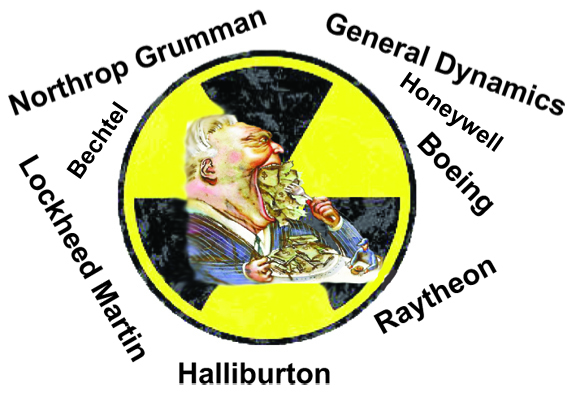
In all, the top five weapons contractors—Lockheed Martin, Raytheon, Boeing, General Dynamics, and Northrop Grumman—split more than $200 billion in “defense” revenue in the last fiscal year, mostly from the Pentagon but also from lucrative foreign arms sales. The new budget proposals will only boost those already astounding figures.
Military contractors and arms manufacturers cash in as Congress adds billions to the Pentagon budget each year.
The jobs card is the strongest tool of influence available to the arms industry in its efforts to keep Congress eternally boosting Pentagon spending, but far from the only one
So far, in the 2022 election cycle, weapons firms have already donated $3.4 million to members of the House Armed Services Committee
There are scant, if any, restrictions against members of Congress owning or trading defense company stocks, even those who sit on influential national-security-related committees. In other words, it’s completely legal for them to marry their personal financial interests to those of defense contractors.
https://www.commondreams.org/views/2022/09/12/weapons-industry-taxpayer-scam JULIA GLEDHILL, WILLIAM HARTUNG, September 12, 2022 Congress has spoken when it comes to next year’s Pentagon budget and the results, if they weren’t so in line with past practices, should astonish us all. The House of Representatives voted to add $37 billion and the Senate $45 billion to the administration’s already humongous request for “national defense,” a staggering figure that includes both the Pentagon budget and work on nuclear weapons at the Department of Energy. If enacted, the Senate’s sum would push spending on the military to at least $850 billion annually, far more—adjusted for inflation—than at the height of the Korean or Vietnam wars or the peak years of the Cold War.
U.S. military spending is, of course, astronomically high—more than that of the next nine countries combined. Here’s the kicker, though: the Pentagon (an institution that has never passed a comprehensive financial audit) doesn’t even ask for all those yearly spending increases in its budget requests to Congress. Instead, the House and Senate continue to give it extra tens of billions of dollars annually. No matter that Secretary of Defense Lloyd Austin has publicly stated the Pentagon has all it needs to “get the capabilities… to support our operational concepts” without such sums.
It would be one thing if such added funding were at least crafted in line with a carefully considered defense strategy. More often than not, though, much of it goes to multibillion dollar weapons projects being built in the districts or states of key lawmakers or for items on Pentagon wish lists (formally known as “unfunded priorities lists”). It’s unclear how such items can be “priorities” when they haven’t even made it into the Pentagon’s already enormous official budget request.
In addition, throwing yet more money at a department incapable of managing its current budget only further strains its ability to meet program goals and delivery dates. In other words, it actually impairs military readiness. Whatever limited fiscal discipline the Pentagon has dissipates further when lawmakers arbitrarily increase its budget, despite rampant mismanagement leading to persistent cost overruns and delivery delays on the military’s most expensive (and sometimes least well-conceived) weapons programs.
Inn short, parochial concerns and special-interest politics regularly trump anything that might pass as in the national interest, while doing no favors to the safety and security of the United States. In the end, most of those extra funds simply pad the bottom lines of major weapons contractors like Lockheed Martin and Raytheon Technologies. They certainly don’t help our servicemembers, as congressional supporters of higher Pentagon budgets routinely claim.
A Captured Congress
The leading advocates of more Pentagon spending, Democrats and Republicans alike, generally act to support major contractors in their jurisdictions. Representative Jared Golden (D-ME), a co-sponsor of the House Armed Services Committee proposal to add $37 billion to the Pentagon budget, typically made sure it included funds for a $2 billion guided-missile destroyer to be built at General Dynamics’ shipyard in Bath, Maine.
Similarly, his co-sponsor, Representative Elaine Luria (D-VA), whose district abuts Huntington Ingalls Industries’ Newport News Shipyard, successfully advocated for the inclusion of ample funding to produce aircraft carriers and attack submarines at that complex. Or consider Representative Mike Rogers (R-AL), the ranking Republican on the House Armed Services Committee and a dogged advocate of annually increasing the Pentagon budget by at least 3% to 5% above inflation. He serves a district south of Huntsville, Alabama, dubbed “rocket city” because it’s the home to so many firms that work on missile defense and related projects.
There are even special congressional caucuses devoted solely to increasing Pentagon spending while fending off challenges to specific weapons systems. These range from the House shipbuilding and F-35 caucuses to the Senate ICBM Coalition. That coalition has been especially effective at keeping spending on a future land-based intercontinental ballistic missile dubbed the Sentinel on track, while defeating efforts to significantly reduce the number of ICBMs in the U.S. arsenal. Such “success” has come thanks to the stalwart support of senators from Montana, North Dakota, Utah, and Wyoming, all states with ICBM bases or involved in major ICBM development and maintenance.
The jobs card is the strongest tool of influence available to the arms industry in its efforts to keep Congress eternally boosting Pentagon spending, but far from the only one. After all, the industrial part of the military-industrial-congressional complex gave more than $35 million in campaign contributions to members of Congress in 2020, the bulk of it going to those on the armed services and defense appropriations committees who have the most sway over the Pentagon budget and what it will be spent on.
So far, in the 2022 election cycle, weapons firms have already donated $3.4 million to members of the House Armed Services Committee, according to an analysis by Open Secrets.org, an organization that tracks campaign spending and political influence. Weapons-making corporations also currently employ nearly 700 lobbyists, more than one for every member of Congress, while spending additional millions to support industry-friendly think tanks that regularly push higher Pentagon spending and a more hawkish foreign policy.
The arms industry has another lever to pull as well when it comes to the personal finances of lawmakers. There are scant, if any, restrictions against members of Congress owning or trading defense company stocks, even those who sit on influential national-security-related committees. In other words, it’s completely legal for them to marry their personal financial interests to those of defense contractors.
The Cost of Coddling Contractors
Continue readingNATO’s Approach to Russia’s Borders Planned Years Ago

The alliance revealed plans to increase the number of prepared forces on the eastern flank to more than 300,000 soldiers in the near future.
The head of NATO’s Military Committee, Admiral Rob Bauer, stated on Saturday that NATO began planning its expansion near Russia’s borders several years ago.
Earlier on Saturday, the NATO Military Committee met in Estonia, where Supreme Allied Commander Europe General Christopher Cavoli outlined to NATO member countries his strategic considerations for NATO’s efforts on the eastern flank, among other things.
“We’re talking about the biggest overhaul of our military structures since 1949. The planning for that started several years ago, but now we’re implementing it,” Bauer said at a press conference.
NATO leaders agreed on a plan for a significant build-up of the alliance’s forces at the end of June, on the eastern flank by 2023, amid Russia’s military operation in Ukraine.
The alliance revealed plans to increase the number of prepared forces on the eastern flank to more than 300,000 soldiers in the near future. In addition, it intends to increase the composition of combat groups to the brigade level. Moreover, NATO countries pledged to increase defense spending.
Max Blumenthal tweets: In their post-counteroffensive triumphalism, US hawks reveal real objectives of the Ukraine proxy war. “A victory in Ukraine’s understanding of the term also brings about the end of Putin’s regime,” Anne Applebaum wrote, urging Russia’s destabilization.
NATO is closely collaborating with the defense sector to restock its arsenal, which has been depleted as a result of the supply of armaments to Ukraine by the bloc, according to the NATO Secretary-General.
“NATO is working closely with defense industry in order to replenish stocks for the military equipment the allies have sent to Ukraine,” Stoltenberg said on the sidelines of a forum organized by U.S. magazine Foreign Policy, adding that NATO countries were also asking defense companies to ramp up their production.
The Secretary-General added that the need for additional help for Ukraine was still urgent, and it was crucial to make sure that the bloc had adequate weapons and other equipment to stockpile and support Kiev militarily.
New study reveals Russia’s comprehensive buildup of nuclear missile test-ground at Novaya Zemlya
Russia is about to scale up its dangerous testing of the Burevestnik nuclear-powered cruise missile, according to a study of satellite images obtained by military analyst Tony Roper.
 | |||
|
https://thebarentsobserver.com/en/security/2022/09/new-study-reveals-comprehensive-buildup-nuclear-missile-test-ground-novaya-zemlya By Thomas Nilsen September 18, 2022, [Excellent pictures and map]
Few places on planet earth are surrounded by more secrecy than the remote military test ranges for nuclear material at Novaya Zemlya in the Arctic. Totally forbidden to visitors since the 1950ties as atmospheric and underground nuclear weapons tests were conducted till 1990. Since then, the polygon near the Matochkin Strait has facilitated subcritical nuclear tests.
A bit to the south is Pankovo, a missile launch site where Russia in November 2017 made at least one test flight of the Burevestnik, in the West known as the SSC-X-9 Skyfall.
It could as well be named ‘a flying Chernobyl’ as the missile is powered by a small nuclear reactor which is cooled by the outside air running through the uranium core, leaving behind radioactive isotopes as it is flying.
That is the reason tests of the weapon now take place at one of the world’s most remote locations, hundreds of kilometers from nearest civilian populations.
“Should anything go wrong, then it won’t be so noticeable,” said Tony Roper to the Barents Observer. He has for years studied satellite images from Novaya Zemlya. In recent months, his focus has especially been on developments at the Pankovo site.
This weekend, Roper obtained new satellite images that drove him to blow the whistle.
“It is definitely Burevestnik,” he said.
Few places on planet earth are surrounded by more secrecy than the remote military test ranges for nuclear material at Novaya Zemlya in the Arctic. Totally forbidden to visitors since the 1950ties as atmospheric and underground nuclear weapons tests were conducted till 1990. Since then, the polygon near the Matochkin Strait has facilitated subcritical nuclear tests.
A bit to the south is Pankovo, a missile launch site where Russia in November 2017 made at least one test flight of the Burevestnik, in the West known as the SSC-X-9 Skyfall.
It could as well be named ‘a flying Chernobyl’ as the missile is powered by a small nuclear reactor which is cooled by the outside air running through the uranium core, leaving behind radioactive isotopes as it is flying.
That is the reason tests of the weapon now take place at one of the world’s most remote locations, hundreds of kilometers from nearest civilian populations.
“Should anything go wrong, then it won’t be so noticeable,” said Tony Roper to the Barents Observer. He has for years studied satellite images from Novaya Zemlya. In recent months, his focus has especially been on developments at the Pankovo site.
This weekend, Roper obtained new satellite images that drove him to blow the whistle.
“It is definitely Burevestnik,” he said.
ADVERTISEMENT
https://googleads.g.doubleclick.net/pagead/ads?client=ca-pub-2104545995324909&output=html&h=250&slotname=5022142078&adk=3712131370&adf=404035791&pi=t.ma~as.5022142078&w=300&lmt=1663528077&url=https%3A%2F%2Fthebarentsobserver.com%2Fen%2Fsecurity%2F2022%2F09%2Fnew-study-reveals-comprehensive-buildup-nuclear-missile-test-ground-novaya-zemlya&wgl=1&uach=WyJXaW5kb3dzIiwiMTQuMC4wIiwieDg2IiwiIiwiMTA1LjAuNTE5NS4xMjciLFtdLGZhbHNlLG51bGwsIjY0IixbWyJHb29nbGUgQ2hyb21lIiwiMTA1LjAuNTE5NS4xMjciXSxbIk5vdClBO0JyYW5kIiwiOC4wLjAuMCJdLFsiQ2hyb21pdW0iLCIxMDUuMC41MTk1LjEyNyJdXSxmYWxzZV0.&dt=1663539271101&bpp=16&bdt=2086&idt=393&shv=r20220914&mjsv=m202209080101&ptt=5&saldr=sa&abxe=1&cookie=ID%3D01cdbfbc9b26bc0b-22b832c0a6d600ff%3AT%3D1663539273%3ART%3D1663539273%3AS%3DALNI_MbVJ8-jessrZIStq39IULHZNtNldA&gpic=UID%3D000009cd55ded703%3AT%3D1663539273%3ART%3D1663539273%3AS%3DALNI_MaKEb-9tPO0q9SohXFpVCkMM-ooNQ&prev_slotnames=5270755046%2C2076026748%2C4761899835%2C5419331806&correlator=7050549214270&frm=20&pv=1&ga_vid=1485890113.1663539271&ga_sid=1663539271&ga_hid=1980766128&ga_fc=1&u_tz=600&u_his=1&u_h=720&u_w=1280&u_ah=672&u_aw=1280&u_cd=24&u_sd=1.5&dmc=8&adx=218&ady=2616&biw=1263&bih=512&scr_x=0&scr_y=621&eid=44759876%2C44759927%2C44759842%2C44767667%2C44761792%2C42531705&oid=2&psts=APxP-9B9zlXnYoGpvHps-ru59194T9EBOWEPbFzZTKbNUlPlKkfRHTEQ7qMmfqtsREf-jFUnbtr7Tfb14fTbIA%2CAPxP-9Bqqp6JY_UnvxjIcZhV3_0AskK8cuFdGKn9eFW6km7Pyk18Hmw05vEMYHKSlwJCpwIKXD7sU_q4u6hy%2CAPxP-9Bavt_866R27rHZI1VyPoIeTUH6MxIR6cuKFXrlbuV-5yzvwWcc5hxn7OrIPg0hDv_ZswPL5KEly-iGzw%2CAPxP-9DxiRPJQR3W_f8dqT_ILxR5X9RatOrMcGD_xIPQ6tRuA5MUw-1HvJ8xl5hLpw-5v-7yZk1nA4ajiHP77QhHA_upjNyUUg6D4rogXnVWe5Q&pvsid=3244277979942446&uas=3&nvt=1&ref=https%3A%2F%2Fnews.google.com%2F&eae=0&fc=640&brdim=0%2C0%2C0%2C0%2C1280%2C0%2C1280%2C672%2C1280%2C512&vis=1&rsz=%7C%7CoeEbr%7C&abl=CS&pfx=0&fu=0&bc=31&ifi=4&uci=a!4&btvi=2&fsb=1&xpc=IR5E9NXJ4h&p=https%3A//thebarentsobserver.com&dtd=4862
Tony Roper has published several of the satellite images on his online site, detailing the different infrastructure improvements made at the site this summer and autumn.
The size of the ongoing development is much more comprehensive than previous year’s container-based structures aimed at supporting the test launches of the nuclear-powered missile.
New infrastructure
A new jetty is placed on the shore where equipment is landed from ships, the road is improved, helicopter pads are made, new buildings are erected, shelters and concrete pads with rails are assembled.
It is, however, Tony Roper’s latest findings from a space image taken by Airbus on September 16 that prove that the Burevestnik is actually present at Pankovo.
A canister, similar to what previously has been seen in a video by Russia’s Defense Ministry, is now in place next to the rails on the launch pad partly covered by a retractable shelter.
It was in March 2018 the work on developing Russia’s nuclear-powered cruise missile was made public to the outside world. Along with other weapons of mass destruction, President Vladimir Putin showed a video of the Burevestnik in his annual speech to the nation.
Later the same year, U.S. intelligence sources reported about one of the missiles being lost at sea after a test in late 2017.
The building infrastructures to Pankovo are likely brought to shore from Rosatomflot’s nuclear-powered container ship “Sevmorput”, a vessel capable of floating out barges with containers towed to shores by smaller tugs in Arctic coastal areas where no harbor infrastructure is developed.
Rosatom in charge
Rosatomflot is a subsidiary of Rosatom, Russia’s state nuclear corporation also in charge of testing and developing the small nuclear reactors used with the Burevestnik missile.
The Barents Observer has followed AIS tracks of “Sevmorput” via the online exactEarth ShipView since August as the vessel has been shuttling back and forth between Murmansk, the waters just outside Pankovo and Rogachevo, the main military settlement on the southern shores in Novaya Zemlya.
By Sunday, September 18, “Sevmorput” is at anchor near Rogachevo.
The town is home to one of Russia’s upgraded air bases in the Arctic and also facilitates the polygon for sub-critical nuclear tests in the tunnels near Matochkin Strait. Helicopters flying personnel to Pankovo are based here, and it is likely that Rosatom’s specialists for developing and testing the Burevestnik missile are commuting to Rogachevo from mainland Russia.
Testing such a flying reactor is risky. What goes up must come down.
It will eventually have an impact zone, whether crashing at sea or ground as planned or by accident mid-air.
Radiation fear 2
The infamous accident in the White Sea outside the Nenoksa test site in 2019 happened on a barge during the salvage work of a crashed Burevestnik missile. Five Rosatom experts were killed after the explosion, which also caused a spike in radiation over the nearby city of Severodvinsk.
There have also been speculations that numerous low-level measurements of radioactive isotopes in northern Scandinavia in recent years have been related to Russia’s testing of secret nuclear-powered weapons systems.
Last year, Norway’s Intelligence Service warned about Russia’s testing and deployment of new nuclear weapons technologies in northern regions.
Objectives with such tailored weapons could be to easier penetrate missile defense systems, or to compensate for conventional inferiority.
Nuclear deterrence
“It is our worry that the New Start Treaty is not sufficient enough to cover the new technological developments,” Chief of the Norwegian Intelligence Service, Vice Admiral Nils Andreas Stensønes told the Barents Observer.
Stensønes added that the agreements should be updated.
An advantage of a nuclear-powered missile, according to Putin’s 2018 speech, is its capability to avoid any anti-ballistic missile defense systems. The missile can also, at least theoretically, conduct mid-air navigation and has a range much longer than any other cruise missile.
The Burevestnik is designed to carry a nuclear warhead.
Doomsday scenario: Simulation reveals nuclear war with Russia would cause 90 million casualties

https://www.washingtonexaminer.com/policy/defense-national-security/simulation-reveals-nuclear-war-russia-90-million-casualties by Rachel Schilke, Breaking News Reporter | September 17, 2022,
It is predicted that over 90 million people would be dead or injured in a war between the United States and Russia, Princeton University researchers discovered.
Researchers at the Princeton Program on Science and Global Security created a simulated war using realistic nuclear weapons positions, targets, and fatality estimates to show the consequences that a nuclear war could have on both countries and the world, according to the project’s website.
The simulation’s scenario predicted 91.5 million casualties, with 34.1 million dead and 57.4 million injured.
“Deaths from nuclear fallout and other long-term effects would significantly increase the estimate,” the project’s video noted.
In the scenario, Russia would fire the first shot to prevent a U.S.-NATO advance. Within three hours, the researchers estimated 2.6 million immediate casualties and 480 nuclear weapons fired, 300 from Russia and 180 from NATO.
Targets would include NATO bases across Europe. The researchers determined that after Europe was destroyed, warheads would be launched from the U.S. Within 45 minutes of that launch, they estimated 3.4 million immediate casualties.
Tensions between Russia and the U.S. have escalated in recent years, particularly with the war in Ukraine. The researchers cite that both countries have “abandoned” long-standing nuclear arms control treaties, most notably the U.S. under former President Donald Trump’s administration.
In August 2018, the U.S. pulled out from the INF Treaty, which bans midrange, ground-launched nuclear missiles, on the basis that Russia allegedly tested and deployed a cruise missile prohibited by the treaty, an allegation the Kremlin has denied.
The U.S. also left the Treaty on Open Skies in November 2020, stating that Russia had disregarded its terms for years. Fellow NATO members, who had supported America’s decision to leave the INF Treaty, expressed regret at the U.S. leaving the open skies treaty.
Currently, the two countries are locked in the New START Treaty, which places limits on all Russian-deployed intercontinental-range nuclear weapons. The treaty will be in effect until February 2026.
The Washington Examiner reached out to the researchers on the project for comment on the results.
U.S. Finally Admits Ukraine Bombs Zaporizhzhia’s Nuclear Power Plant.

The Duran, by Eric Zuesse, September 15, 2022, Unnamed American officials, according to the New York Times, have admitted that the explosives fired against Ukraine’s nuclear power plant in Zaporizhzhia have been fired against the plant by Ukraine’s Government, not by Russia’s Government, and furthermore these officials make clear that Ukraine’s attacks against the plant are a key part of Ukraine’s plan to win its U.S.-backed-and-advised war against Russia, on the battlefields of Ukraine, using Ukrainian soldiers.
Zaporizhzhia is a city in Ukraine that is in Russian-controlled territory, and Ukraine’s strategy is to destroy the ability of the plant to function, so that areas controlled by Russia will no longer be able to benefit from that plant’s electrical-power output. The United States Government helped Ukraine’s Government to come up with this plan, according to the New York Times.
This information was buried by the Times, 85% of the way down a 1,600-word news-report they published on September 13th, titled “The Critical Moment Behind Ukraine’s Rapid Advance”, in which it stated that, “Eventually, Ukrainian officials believe their long-term success requires progress on the original goals in the discarded strategy, including recapturing the nuclear power plant in Zaporizhzhia, cutting off Russian forces in Mariupol and pushing Russian forces in Kherson back across the Dnipro River, American officials said.”
When IAEA inspectors arrived at that plant on September 1st, after a lengthy period of trying to get there to inspect it but which was blocked by Ukraine’s Government, and the IAEA started delivering reports regarding what they were finding at the plant, no mention has, as-of yet, been made concerning which of the two warring sides has been firing those bombs into the plant.
Even when the IAEA headlined on September 9th “Director General’s Statement on Serious Situation at Ukraine’s Zaporizhzhya Nuclear Power Plant”, and reported that the plant’s ability to operate “has been destroyed by shelling of the switchyard at the city’s thermal power plant, leading to a complete power black-out in” the entire region, and that “This is completely unacceptable. It cannot stand.”, and closed by saying they “urgently call for the immediate cessation of all shelling in the entire area,” no mention was made as to which of the two sides was shooting into the plant in order to disable it, and which of the two sides was firing out from the plant in order to protect it against that incoming fire.
Previously known was only that the city of Zaporizhzhia has been and is under Russian control ever since March 4th. Consequently, all news-media and reporters have known that (since Russia was inside and Ukraine was outside) Russia has been defending the plant and Ukraine has been attacking it, but until “American officials” let slip, in this news-report, the fact that this has indeed been the case there, no Western news-medium has previously published this fact — not even buried it in a news-report.
So, although nothing in this regard may yet be considered to be official, or neutral, or free of fear or of actual intent to lie, there finally is, at the very least, buried in that news-report from the New York Times, a statement that is sourced to “American officials,” asserting that this is the case, and the Times also lets slip there that this “shelling” of that plant is an important part of the joint U.S.-Ukraine master-plan to defeat Russia in Ukraine.
It is part of the same master-plan, which the U.S. Government recommended to Ukraine’s Government, and which also included the recent successful retaking by Ukraine of Russian-controlled land near the major Ukrainian city of Kharkov, which city’s recapture by Ukraine is also included in the master-plan. Both operations — the shelling of the nuclear power plant, and the recapture of that land near Kharkov — were parts of that master-plan, according to the New York Times.
The Times report asserts that
Long reluctant to share details of their plans, the Ukrainian commanders started opening up more to American and British intelligence officials and seeking advice. Jake Sullivan, the national security adviser, and Andriy Yermak, a top adviser to Mr. Zelensky, spoke multiple times about the planning for the counteroffensive, according to a senior administration official. Gen. Mark A. Milley, the chairman of the Joint Chiefs of Staff, and senior Ukrainian military leaders regularly discussed intelligence and military support.
And in Kyiv, Ukrainian and British military officials continued working together while the new American defense attaché, Brig. Gen. Garrick Harmon, began having daily sessions with Ukraine’s top officers.
Veteran Intelligence Professionals: Ukraine Decision Time for Biden
We hope you have been adequately briefed on the likely outcome of the recent Ukrainian “offensive”
by Veteran Intelligence Professionals for Sanity
MEMORANDUM FOR: The President
FROM: Veteran Intelligence Professionals for Sanity
SUBJECT: Ukraine Decision Time
REF: Nukes Cannot be Un-Invented, VIPS
Mr. President:
Before Defense Secretary Austin flies off to Ramstein for the meeting Thursday of the Ukraine Defense Contact Group we owe you a few words of caution occasioned by our many decades of experience with what happens to intelligence in wartime. If he tells you Kyiv is beating back the Russians, kick the tires – and consider widening your circle of advisers
Truth is the coin of the realm in intelligence analysis. It is equally axiomatic that truth is the first casualty of war, and that applies to the war in Ukraine as well as earlier wars we have been involved in. When at war, Defense Secretaries, Secretaries of State, and generals simply cannot be relied upon to tell the truth – to the media, or even to the President. We learned that early – the hard and bitter way. A lot of our comrades in arms did not come back from Vietnam.
Vietnam: President Lyndon Johnson preferred to believe Gen. William Westmoreland who told him and Defense Secretary McNamara in 1967 that South Vietnam could win – if only LBJ would supply an additional 206,000 troops. CIA analysts knew that to be untrue and that – worse still — Westmoreland was deliberately falsifying the number of forces he faced,……………………….
All being fair in love and war, the generals in Saigon were determined to offer a rosy picture……………………
The Demise of Imagery Analysis: Until 1996, CIA had an independent capability to do unencumbered military analysis enabling it to speak the truth – even during war. ……………the National Photographic Interpretation Center (NPIC,) a solid reputation for professionalism and objectivity.
………………………. In 1996, when NPIC and its 800 highly professional imagery analysts were given, kit and kaboodle, to the Pentagon, it was goodbye to impartial intelligence.
Iraq: Retired Air Force General James Clapper was eventually put in charge of NPIC’s successor, the National Imagery and Mapping Agency (NIMA) and thus was well positioned to grease the skids for the “war of choice” on Iraq.
Indeed, Clapper is one of the few senior functionaries to admit that, under pressure from Vice President Cheney, he was “leaning forward” to find weapons of mass destruction in Iraq; could find none; but went along anyway…………………………
Afghanistan: You will recall the extreme pressure on President Obama coming from Defense Secretary Gates, Secretary of State Clinton, and generals like Petraeus and McCrystal to double down in sending more troops to Afghanistan. They were able to push aside Intelligence Community analysts,……………………..
The President, as you well know, deferred to Gates and the generals. And, last summer, it was left to you to pick up the pieces, so to speak……………………..
Syria – Austin’s Reputation Not Without Blemish: Closer to home, Secretary Austin is no stranger to accusations of politicizing intelligence………………………….. The analysts claimed their reports were being changed by higher-ups to dovetail with the administration’s public line that the US was winning the battle against ISIS and the al-Nusra Front, al Qaeda’s branch in Syria……………………….
In Summary: We hope you take the time to review this history – and to take it into account before sending Secretary Austin off to Ramstein. …………………. (We hope you have been adequately briefed on the likely outcome of the recent Ukrainian “offensive”.)
You may also wish to seek counsel from CIA Director William Burns and others with experience in the history of Europe – and particularly of Germany. Media reports suggested earlier that in Ramstein Secretary Austin will commit to providing Ukraine with still more weaponry and will encourage his colleagues to do the same. If he follows that script, he may find few takers – particularly among those most vulnerable to winter cold.
FOR THE STEERING GROUP: Veteran Intelligence Professionals for Sanity
signed by 19 highly qualified members of Veteran Intelligence Professionals for Sanity (VIPs) is made up of former intelligence officers, diplomats, military officers and congressional staffers. https://original.antiwar.com/veteran-intelligence-professionals-for-sanity2/2022/09/05/veteran-intelligence-professionals-ukraine-decision-time-for-biden/
The colossal failure of the 10th Non Proliferation Treaty Treaty (NPT) Review Conference

The fundamental point of division at the conference was never the Ukraine conflict. Rather, the essential divide was that Non Nuclear Weapons NNWS States wanted to chart a credible path to nuclear disarmament with concrete commitments and good-faith implementation, while Nuclear Weapons States wanted to maintain the status quo. And the NWS won. For now.
Death by a thousand red lines, By Cesar Jaramillo, 10 Sept 22, The official record will show that Russia tanked the long-delayed and much-anticipated 10th Review Conference of the Treaty on the Non-Proliferation of Nuclear Weapons (NPT), that it was the sole NPT state party to block consensus on the outcome document, and that the disagreement was ultimately over references in the text relevant to the ongoing conflict in Ukraine. This is all accurate—but only part of the story.
The profound rifts that divided NPT states parties from the beginning and prevented even modest progress ran much deeper than the predictably contentious Ukrainian conflict. Well before the Russian delegation took the floor during the last session to indicate that it would not endorse the text of the final document, it was abundantly clear that the conference would not meet even modest expectations. Its main accomplishment: the further weakening of the NPT’s credibility as a framework for nuclear abolition.
Unmet expectations
Faced with a convoluted and fragile international security environment, the world needed this Review Conference, already delayed for two years, to make progress………………………………….
As they had at previous NPT Review Conferences and Preparatory Committees, NWS attempted to justify the indefinite retention of their arsenals while still professing support for the goal of a world without nuclear weapons…………………….
Red lines for all nuclear weapon states
Russia blocked consensus because the text crossed one of its “red lines.” All other nuclear-armed states party to the NPT were ready to do the same if one of their red lines were crossed. This they made clear, repeatedly, at the Plenary, Main Committees, and Subsidiary Bodies. Somehow, they were more successful than Russia in keeping anything they couldn’t live with out of the draft outcome document………………….
Iran and other Middle Eastern states wanted Israel included in the outcome document’s section on the pursuit of a nuclear-weapons-free zone in the Middle East, but this was certain to be rejected by the United States, and so no mention of Israel appeared in that section. ………………………………………..
Familiar attacks on the TPNW
As predicted, nuclear-armed States Parties to the NPT dismissed and rejected the Treaty on the Prohibition of Nuclear Weapons (TPNW). ………………………..
The TPNW has replaced tired arguments over the purported value of nuclear weapons possession with a renewed emphasis on the humanitarian imperative for nuclear disarmament. From this perspective, the catastrophic humanitarian consequences of nuclear weapons use outweigh any alleged benefits……………….
Positive advances
The absence of an outcome document does not mean that the NPT Review Conference had no value of any kind. The mere fact that it was finally held and well attended is a positive measure of the ongoing commitment of states parties to the treaty and the objectives it embodies.
……………………………………………. The fundamental point of division at the conference was never the Ukraine conflict. Rather, the essential divide was that Non Nuclear Weapons NNWS States wanted to chart a credible path to nuclear disarmament with concrete commitments and good-faith implementation, while Nuclear Weapons States wanted to maintain the status quo. And the NWS won. For now.
Cesar Jaramillo is Executive Director of Project Ploughshares. https://beyondnuclearinternational.org/2022/09/11/death-by-a-thousand-red-lines/
Kim Jong Un says North Korea’s new law allowing pre-emptive nuclear strikes is ‘irreversible’

North Korea has officially enshrined the right to use pre-emptive nuclear strikes to protect itself in a new law.
Key points:
- The new law makes North Korea’s nuclear status “irreversible”, and bars denuclearisation talks
- It also allows for pre-emptive nuclear strikes if, among other things, there is an imminent attack against its leadership
- Analysts say the goal is to win international acceptance of the country’s status as a “responsible nuclear state”
The country’s leader Kim Jong Un said the legislation also made its nuclear status “irreversible” and bars denuclearisation talks, state media reported on Friday.
The move comes as observers say North Korea appears to be preparing to resume nuclear testing for the first time since 2017, after historic summits with former US president Donald Trump and other world leaders in 2018 failed to persuade Kim to end weapons development.
The North’s parliament — the Supreme People’s Assembly — passed the legislation on Thursday, according to state news agency KCNA.
The new legislation is a replacement to a 2013 law which first outlined the country’s nuclear status…………………………
Pre-emptive strikes
The original 2013 law stipulated that North Korea could use nuclear weapons to repel invasion or attack by a hostile nuclear state, and make retaliatory strikes.
The new law goes beyond that to allow for pre-emptive nuclear strikes if an imminent attack by weapons of mass destruction or against the country’s “strategic targets”, including its leadership, is detected.
“In a nutshell, there are some really vague and ambiguous circumstances in which North Korea is now saying it might use its nuclear weapons,” Chad O’Carroll, founder of the North Korea-tracking website NK News, said on Twitter.
Like the earlier law, the new version vows not to threaten non-nuclear states with nuclear weapons unless they join with a nuclear-armed country to attack the North.
The new law adds, however, that it can launch a pre-emptive nuclear strike if it detects an imminent attack of any kind aimed at North Korea’s leadership and the command organisation of its nuclear forces.
That is an apparent reference to South Korea’s “Kill Chain” strategy, which calls for pre-emptive strikes on North Korea’s nuclear infrastructure and command system if an imminent attack is suspected…………….
Under the law, Mr Kim has “all decisive powers” over nuclear weapons, but if the command and control system is threatened, then nuclear weapons may be launched “automatically”.
If Mr Kim delegates launch authority to lower commanders during a crisis, that could increase the chances of a catastrophic miscalculation, analysts said.
‘Responsible nuclear state’
The law bans any sharing of nuclear arms or technology with other countries, and is aimed at reducing the danger of a nuclear war by preventing miscalculations among nuclear weapons states and misuse of nuclear weapons, KCNA reported.
Analysts say Mr Kim’s goal is to win international acceptance of North Korea’s status as a “responsible nuclear state.”…………………….. more https://www.abc.net.au/news/2022-09-09/new-north-korea-law-outlines-nuclear-weapons-use-including-preem/101425072
Pine Gap a target as Ukraine invasion raises nuclear war risk, Australian defence expert warns

A humiliated Russia could be driven closer to China in a ‘grand coalition’, former Joint Intelligence Organisation director says
Guardian, Ben Doherty 7 Sept 22,
Australia could become a nuclear target due to its hosting of a US military base at Pine Gap in the Northern Territory, one of Australia’s leading defence strategists has warned.
Prof Paul Dibb, an emeritus professor at the Australian National University and former director of Australia’s Joint Intelligence Organisation, said the current Russian invasion of Ukraine carried potential global nuclear consequences, with the possibility of a defeated and humiliated Russia pushed closer to China in “a grand coalition … united not by ideology but by complementary grievances”……….
Australia should not feel its geographic distance from the epicentre of the conflict affords it any significant protection, Dibb argued.
“We need to plan on the basis that Pine Gap continues to be a nuclear target, and not only for Russia. If China attacks Taiwan, Pine Gap is likely to be heavily involved,” he said.
“We need to remember that Pine Gap is a fundamentally important element in US war fighting and deterrence of conflict.”
Pine Gap is a highly secret US-Australian military installation near Alice Springs. It serves as a major hub for US global intelligence interception, and for satellite surveillance operations for military and nuclear missile threats in the region.
Russia is unlikely to be able to subjugate Ukraine in its current invasion, Dibb said, but Ukrainian military is unlikely to succeed in driving out Russian troops entirely. “Most likely there’ll be a negotiated conclusion, probably at the ceasefire talk.”
Regardless, Dibb argued, the Russian president, Vladimir Putin, was unlikely to be deposed as a result, but he would be a leader grown increasingly isolated, and the threat of nuclear escalation was real.
“There’s little doubt that Putin is the sort of person who won’t resile from the use of nuclear weapons, particularly if it looks as though he’s losing this war. But he must surely realise that there’s no such thing as the limited use of tactical nuclear weapons in isolation from their escalation to a full-scale strategic nuclear war.
“Once we enter the slippery slope of even limited nuclear exchanges, the end result will be escalation to mutual annihilation – something about which both Putin and Xi Jinping may need reminding.”
The comprehensive defeat of Russia in Ukraine would bring its own dangers, Dibb argued.
A severely weakened, isolated and smaller Russia might then become more – not less – dangerous for the world.”
A Russia left humiliated would be driven closer to China, Dibb said, with the nuclear powers forming what he described as a “grand coalition”, unified “not by ideology but by complementary grievances”.
Dibb told the Guardian: “The most serious threat to America would be a de facto alliance between China and Russia, united in the common cause of their hatred for the west.” ………………….https://www.theguardian.com/australia-news/2022/sep/07/pine-gap-a-target-as-ukraine-invasion-raises-nuclear-war-risk-australian-defence-expert-warns?CMP=Share_AndroidApp_Other&fbclid=IwAR0C13ws8uQOEBEW6RVAReW1B96DyhginkTX1ujZ-CEeLKm1ePkchpnKzr4
US-South Korea Provocations in the Pacific
Consortium News, September 14, 2022, The resumption of the recent joint military exercises is viewed with alarm by China, which, like North Korea, has repeatedly pointed to U.S. attempts to set up a NATO-like organization in Asia, writes Aditya Sarin.
By Aditya Sarin Peoples Dispatch Sept 16 2022,
Between Aug. 22 and Sept. 1, the United States and South Korea concluded their largest joint military drills in the Korean Peninsula since 2017, under the name “Ulchi Freedom Shield.” Over the last four years, the scope of the annual exercises had been scaled back, first because of former U.S. President Donald Trump’s attempts at diplomacy with North Korea’s Kim Jong-un and later because of the Covid-19 pandemic.
With these drills, however, the U.S. and South Korea seem to be attempting to send a clear message to both North Korea and China of their united military posture in the region, and come at a time when the U.S.’ encirclement of China continues rapidly.
The U.S. has maintained a force of at least tens of thousands of troops in South Korea (officially the Republic of Korea, or ROK), since before the Korean War. While South Korean forces are otherwise independent, at times of war they are subordinated to the command of a U.S. general as part of the ROK/US Combined Forces Command. With 28,500 U.S. troops stationed there, South Korea has the third-highest number of U.S. troops of any country outside of the U.S.
While the recent exercises have been conducted against a nameless enemy, it is not hard to see towards whom their message is aimed. The site of the exercises was only 32 kilometers from the border and De-Militarized Zone (DMZ) between North and South Korea. Live-fire tank and troop maneuvers have been practiced as the U.S. and the ROK engage in simulations and seek to increase interoperability of their deployments and technologies…………………………………….. more https://consortiumnews.com/2022/09/14/us-south-korea-provocations-in-the-pacific/
General: Supply chain problems are hurting nuclear modernization
Defense News, By Joe Gould, 16 Sept 22,
WASHINGTON ― The nominee to lead the U.S. nuclear arsenal said Thursday that supply chain snags that are pummeling the defense industrial base are also hurting Washington’s plans to modernize its aging nuclear arsenal.
“I would venture to say that it’s probably being seen across the Department of Defense, but in particular for the nuclear portfolio,” Air Force Gen. Anthony Cotton, nominated to lead U.S. Strategic Command, told the Senate Armed Services Committee, at his confirmation hearing.
………… It’s taking some nuclear programs up to 90 days to source certain U.S.-made components that would have typically taken 10 days, he said.
Operating and modernizing the nuclear force will cost $634 billion in the 2021-2030 period, the nonpartisan Congressional Budget Office said last year. Along with the expense of the Energy Department managing nuclear stockpiles, the Defense Department is modernizing the sea, air and land-based legs of the nuclear triad.
………………………………………… Looming over the hearing was Strategic Command’s scramble to reimagine nuclear deterrence theory that simultaneously faces Russia and China……………………. more https://www.defensenews.com/pentagon/2022/09/15/general-supply-chain-problems-are-hurting-nuclear-modernization/
After U.N. conference, nuclear disarmament advocates look to new strategies
Dennis Sadowski, Catholic Review, 11 Sept 22,
WASHINGTON (CNS) — Four weeks of debate — during a review conference for a treaty widely viewed as a cornerstone of nuclear disarmament — resulted in no consensus on how to move forward despite the efforts of the Holy See, disarmament advocates and non-nuclear nations
Russia blocked agreement on a final document late Aug. 26, the review conference’s final day, by objecting to paragraphs raising concerns about military activity around the Zaporizhzhia nuclear power plant in Ukraine.
The 10th Review Conference for the Treaty on the Non-Proliferation of Nuclear Weapons (NPT) at the United Nations headquarters in New York led to widespread consensus on numerous issues related to nuclear safety, but could not satisfy the Russian delegation’s objection even though the document did not mention Russia by name.
Maryann Cusimano Love, associate professor of international politics at The Catholic University of America, attended the conference as an expert consultant to the Holy See Mission at the U.N.
She told Catholic News Service that the Holy See’s participation in the review conference and its consistent voice in urging the world to abolish nuclear weapons was critical, especially at a time when fears remain that nuclear weapons may be introduced to the war in Ukraine
Early in the war, Russian President Vladimir Putin put his country’s nuclear forces on alert, but has since backed off any suggestion that he would authorize the use of nuclear weapons in Ukraine.
The review conference brought delegations from around the world to New York to discuss next steps toward fulfilling the treaty’s goal of the eventual abolition of nuclear weapons. Originally scheduled for 2020, it was delayed three times because of the coronavirus pandemic.
Among the treaty’s provisions is a requirement that parties to it “pursue negotiations in good faith on effective measures relating to cessation of the nuclear arms race at an early date and to nuclear disarmament.”
Disarmament advocates say that not enough has been done to achieve that goal…………………………………..
Maryann Cusimano Love also said that while the Russian objection was the main focus coming out of the meeting, the 35-page draft document offered numerous other steps related to nuclear safety, reducing nuclear arsenals and protecting human life that conference delegates can pursue going forward.
………………………………. the 65 states that have signed the 2017 Treaty on the Prohibition of Nuclear Weapons, including the Holy See, released a statement voicing their disappointment over the outcome. They pledged their support for the treaty, saying it was a necessary step toward an eventual ban on nuclear weapons.
The ban treaty went into force in January 2021, but has not gained the support of any nuclear-armed nations.
Supporters of the ban treaty also expressed concern that the risk of the use of nuclear weapons in the world today remained high, “and the possibility of the catastrophic humanitarian impact … is looming ominously over us.”
“We are dismayed that this very fact has been used at the NPT review conference deliberations as reason against the urgently needed progress on nuclear disarmament, and to uphold an approach to security based on the fallacy of nuclear deterrence. This approach relies on the threat of the actual use of nuclear weapons and, hence, the risks of the destruction of countless lives, of societies, of nations, and of inflicting global catastrophic consequences,” the statement said…………………………………………… more https://catholicreview.org/after-u-n-conference-nuclear-disarmament-advocates-look-to-new-strategies/
Jung Jae Kwon: Questioning the nuclear umbrella
Dissatisfied with security guarantees from the US, America’s junior allies want greater control over their own defenses.
MIT News, Leda Zimmerman | Department of Political Science, September 9, 2022,
Many of America’s allies have little faith that huddling under America’s nuclear umbrella will keep them safe. “The conventional wisdom has been that the threat of nuclear retaliation by the U.S. is enough to defend our junior non-nuclear allies,” says Jung Jae Kwon, a political science doctoral student at MIT. “But this threat is not as credible as is often believed, and the allies do not simply want to depend on it for their security.”
Kwon has been researching defense strategies of American client states, gathering data to analyze the security policy and military postures of frontline states that came to rely on U.S. nuclear protection during and after the Cold War………………………………………………………
“When conflicts arise, these allies don’t want to give up territory or lose anything,” says Kwon. “They ask for plans where they have a viable option for victory.”
One example Kwon cites is South Korea, where the U.S. stationed tactical nuclear weapons. “But the U.S. didn’t give South Korea any control over the deterrent, no mechanisms for coordination when it came to nuclear planning,” he says. As a result, South Korea tries to maintain superiority in conventional power against North Korea. “It’s their fate; they don’t just want to rely on the U.S. for security,” he says………………….
And West Germany, America’s most important ally in Western Europe during the Cold War, “wanted assurance from the U.S. that nuclear weapons would be used first,” says Kwon. “They were overwhelmed by conventional Soviet military power, and wanted to assert more control over the U.S. nuclear threat.”
With the end of the Cold War and dissolution of the Soviet Union, European allies grew less concerned about attacks from their neighbors, and more content to rely on the U.S. nuclear deterrent. But recently, the war in Ukraine has shifted defense postures, says Kwon, prompting allies’ calls for greater conventional military presence along Europe’s eastern border. ………………………
“My biggest takeaway is that allies won’t be assured simply by gestures of solidarity, formal alliance treaties, or even the huge nuclear arsenal the U.S. possesses,” he says. https://news.mit.edu/2022/questioning-nuclear-umbrella-jung-jae-kwon-0909
Navy Seeks Solution for Decommissioned Nuclear Carrier USS Enterprise
SEP 9, 2022 BY THE MARITIME EXECUTIVE
The U.S Navy is grappling with a huge dilemma on what to do with the decommissioned USS Enterprise, the world’s first nuclear-powered aircraft carrier and the pride of the Navy for 50 years from her commissioning in 1961 to her deactivation in 2012. Officially decommissioned in 2017, she sits in Virginia costing millions of dollars annually in maintenance costs but could require more than a billion dollars and up to 15 years to safely dismantle.
Having been the embodiment of the U.S military might not only because of its sheer size, which earned her the nickname “Big E” she became the centerpiece of the modern Navy. ………………………………………… more https://maritime-executive.com/article/navy-seeks-solution-for-decommissioned-nuclear-carrier-uss-enterprise
1 This Month





PLEASE OPPOSE HR 8255 AND S.3639 – bills would accelerate satellite deployment, with no environmental review or safeguards – https://ncstd5li.quorum.us/campaign/169331/
To see nuclear-related stories in greater depth and intensity – go to https://nuclearinformation.wordpress.com
-
Archives
- October 2026 (10)
- September 2026 (339)
- August 2026 (330)
- July 2026 (355)
- June 2026 (287)
- May 2026 (306)
- April 2026 (356)
- March 2026 (251)
- February 2026 (267)
- January 2026 (308)
- December 2025 (358)
- November 2025 (359)
-
Categories
- 1
- 1 NUCLEAR ISSUES
- business and costs
- climate change
- culture and arts
- ENERGY
- environment
- health
- history
- indigenous issues
- Legal
- marketing of nuclear
- media
- opposition to nuclear
- PERSONAL STORIES
- politics
- politics international
- Religion and ethics
- safety
- secrets,lies and civil liberties
- spinbuster
- technology
- Uranium
- wastes
- weapons and war
- Women
- 2 WORLD
- ACTION
- AFRICA
- Atrocities
- AUSTRALIA
- Christina's notes
- Christina's themes
- culture and arts
- Events
- Fuk 2022
- Fuk 2023
- Fukushima 2017
- Fukushima 2018
- fukushima 2019
- Fukushima 2020
- Fukushima 2021
- general
- global warming
- Humour (God we need it)
- Nuclear
- RARE EARTHS
- Reference
- resources – print
- Resources -audiovicual
- Weekly Newsletter
- World
- World Nuclear
- YouTube
-
RSS
Entries RSS
Comments RSS

