Are Putin’s nuclear threats really likely to lead to Armageddon?
The realities underlying the menacing vocabulary are a grey area – it is far from certain that Putin would be prepared to use nuclear weapons
Guardian, by Julian Borger in Washington, Sat 8 Oct 2022
The past week has seen a rapid escalation in nuclear rhetoric, beginning with Vladimir Putin’s threat to use “all forces and means” to defend newly seized territory in Ukraine and ending with Joe Biden’s warning of “Armageddon” if Russia crosses the nuclear Rubicon.
However, the realities underlying the menacing vocabulary are a far greyer area than the bluster suggests. It is far from certain that Putin would be prepared to be the first leader to use nuclear weapons in wartime since 1945, over his territorial ambitions in Ukraine. If his primary goal is to stay in power, that could be exactly the wrong way of going about it.
Even if he did issue the launch order, he has no guarantee it would be carried out. Nor can he be absolutely sure that the weapons and their delivery systems would work.
On the US side, despite the US president’s apocalyptic language at a private fundraiser on Thursday night, it is not at all inevitable that Washington would respond to Putin’s nuclear use with nuclear retaliation. Past wargaming suggests there would be vigorous debate within the administration to say the least.
Like US presidents, Putin is normally accompanied by an aide carrying a briefcase with codes used to authorise a nuclear launch. In the US it is called the football, in Russia it is the cheget. In the Russian system, the defence minister and the chief of the general staff have their own chegets but it is believed that Putin can order a launch without them.
However, the cheget is relevant for the strategic nuclear forces, the intercontinental ballistic missiles (ICBMs) launched from land or sea, or long-range bombers. Because they need to be launched within minutes in case of enemy attack, the warheads need to be deployed, mounted on the delivery systems.
Any nuclear use in Ukraine would be likely to involve non-strategic, or tactical, weapons with shorter-range delivery systems, and which are usually (but not necessarily) less powerful than strategic arms, though on average they are many times more powerful that the Hiroshima or Nagasaki bombs.
The US only has one kind of tactical weapon, the B61 gravity bomb, of which there are about a hundred in Europe and a similar number in the US, according to the Federation of American Scientists (FAS).
FAS estimates Russia has 2,000 tactical weapons, in very many shapes and sizes for use on land, sea and air. The weapons are not deployed on missiles or aircraft, but kept in bunkers in storage sites dotted around Russia. There are 12 national storage sites, known in Russian military parlance as “Object S”, one of which is in Belgorod, right on the Ukrainian border.
There are also 34 “base-level” sites, closer to the delivery systems. In a time of crisis, warheads would be moved from national to base-level sites – and up to now western intelligence agencies say no such movement has been observed.
Any such movement would be carried out by the 12th main directorate of the Russian armed forces, which has the job of storing and maintaining the warheads and then delivering them in specialised trains or trucks to base-level sites, or directly to the unit designated to launch them.
Pavel Baev, a military researcher who worked for the Soviet defence ministry, said that Putin cannot count on these weapons actually working.
“Most of these warheads stored there are very old,” Baev, now a professor at the Peace Research Institute Oslo, said. “Without testing it’s really hard to say how suitable they are because many of them are past their expiration date.”
Baev added that it was also far from clear that the Russian can successfully pair old warheads with the much newer delivery systems that would have to be used, possibly 9K720 Iskander or Kinzhal hypersonic missiles……………………………………………………………………………………………………………………………………….
The key question is more likely to be whether the US and its allies should respond with devastating conventional firepower, as Poland’s foreign minister, Zbigniew Rau, and the former CIA director David Petraeus have suggested. But that would transform the war into one between Russia and Nato, in which escalation to a nuclear exchange could become hard to stop.
According to Eric Schlosser, the author of a book about the nuclear establishment, Command and Control, the Pentagon’s Defence Threat Reduction Agency (DTRA) conducted another war game in 2019 focused on Russian nuclear use in Ukraine. That wargame appears to have been updated, suggesting it is in constant use. The results in 2019 are top secret, but as Schlosser wrote in the Atlantic, one of the participants told him: “There were no happy outcomes.” https://www.theguardian.com/world/2022/oct/07/biden-putin-nuclear-threats-tactical-strike-us-response-analysis
Poland suggests hosting US nuclear weapons- ‘nuclear sharing’
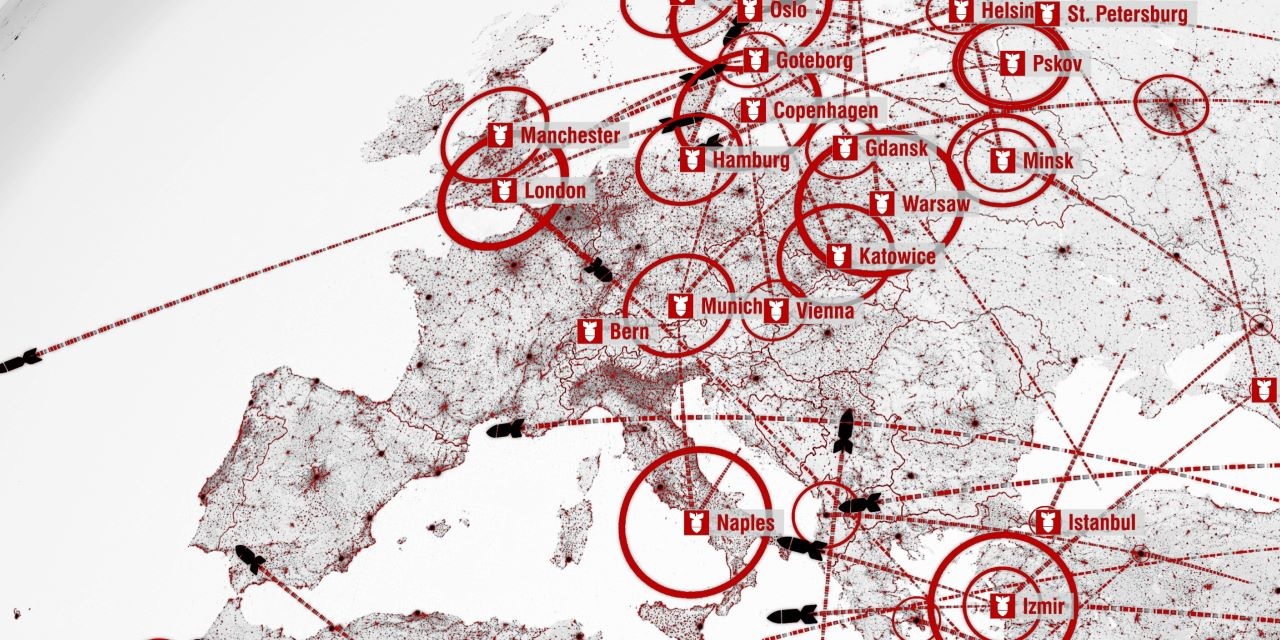
Poland suggests hosting US nuclear weapons amid growing fears of Putin’s threats, https://www.theguardian.com/world/2022/oct/05/poland-us-nuclear-wars-russia-putin-ukraine Julian Borger in Washington, 6 Oct 22, Andrzej Duda, the Polish president, in September. He said there was ‘a potential opportunity’ for Poland to take part in ‘nuclear sharing’.
Poland says it has asked to have US nuclear weapons based on its territory, amid growing fears that Vladimir Putin could resort to using nuclear arms in Ukraine to stave off a rout of his invading army.
The request from the Polish president, Andrzej Duda, is widely seen as symbolic, as moving nuclear warheads closer to Russia would make them more vulnerable and less militarily useful, according to experts. Furthermore, the White House has said it had not received such a request.
“We’re not aware of this issue being raised and would refer you to the government of Poland,” a US official said.
Duda’s announcement appears to be the latest example of nuclear signalling as the US and its allies seek to deter Putin from the first nuclear use in battle since 1945, while preparing potential responses if deterrence fails that would have maximum punitive impact while containing the risk of escalation to all-out nuclear war.
Why We Need To Teach Nuclear War

Thoughtful teachers must be willing to educate their students slowly and honestly about the history of our nuclear past.
https://www.commondreams.org/views/2022/09/27/why-we-need-teach-nuclear-war BRIAN GIBBS, September 27, 2022,
We do not teach nuclear war, but we need to.
Make no mistake, the invasion of Ukraine is a nuclear-fueled conflict and students are ill-prepared to understand it. We need to be clear about this. Any military intervention by a nuclear power is a nuclear conflict. Russia threatened a nuclear retaliation if the United States became directly involved in the invasion of Ukraine; Sweden and Norway have asked for and been granted entrance into NATO placing increased pressure on Russia; and the New York Times reported that Russia is advancing on a nuclear reactor in Ukraine. It is a nuclear conflict.
The horror of nuclear war, an analysis of a country’s nuclear strategies and policies, not the immediate and active resistance to the creation, positioning and use of nuclear weapons is taught. Content standards, guidelines and textbooks discuss nuclear weapons little if at all. They typically describe the dropping of the two atomic bombs framing them as the only reasonable conclusion to World War II. Students have little background and understanding of nuclear weapons, their proliferation, or how they are used as threat and bargaining chip in every conflict and war since their introduction to the field of combat. During recent interviews several students indicated they were shocked when North Korea’s leader Kim Jung Un indicated that he was going to hit Guam with a missile strike. They had an assumption that nuclear strike capabilities were something from a time long ago.
Students were also disturbed when President Trump threatened North Korea with total annihilation from a U.S. missile strike. The students shared that they had a vague sense that other countries had nuclear weapons but indicated that they only time nuclear weaponry, tactics, or strategy were shared was as part of a short lesson focused on the dropping of the atomic bombs on Hiroshima and Nagasaki. Several students indicated that they were confused as they had thought there was only one atomic bomb dropped not two.
Though it may not seem like it, the teaching of war is a controversial topic in American classrooms. This is shocking as it is overwhelmingly the main topic in social studies standards, curriculum, and testing. War is often taught as something which occurred, is over, as something bad but necessary and is too often taught as parables of heroics by reluctant Americans. Little time is typically spent on the messy beginnings and endings of wars, examining the morality of them, or discussing the choices and decisions made by leaders and soldiers, and even more rarely, the actions of the always present anti-war movements. As the students suggested, nuclear war is taught even less. Often in a one-day lesson on the actions of the Enola Gay and Boxcar, the planes that dropped the two bombs or as background, almost a white noise to briefly learning about the Cold War.
There are several reasons for this. Teachers report feeling lack of support in the teaching of complex things. Teachers indicate that they feel enormous community pressure to not teach a more thorough, honest, and critical examination of war. Some teachers say that to critique a war in the past is to critique a war in the present and the soldiers involved. If they do this, they fear accusations of indoctrination and anti-American sentiment. This is mostly from more conservative ideological and political spaces, but teachers also report feeling a different form of pressure from schools situated in more left-leaning spaces. These parents do not want their children exposed to the horror of war even in high school. They seem to fear this examination of historical reality could damage or traumatize their children. This pressure to fail to offer robust examinations became ever more exacerbated during the polarization and America First approach of the Trump administration. Things which had not been seen as controversial have become controversial. As Diana Hess has pointed out (2009) things are not controversial on their own, but rather they become controversial because of time and community context and community interpretation of the issues.
Some if not much of our history is disturbing. This is particularly true of war. Much of the anti-Critical Race Theory legislation passing through state legislatures makes the argument that no student should be made to feel bad while learning history or studying literature. This is impossible without shading or obfuscating the truth or just outright lying to children. An authentic examination of our past will lead to students feeling things, likely bad over the enormity of what has been done. In the hands of thoughtful, capable teachers’ students can experience history honestly, have time to thoughtfully discuss, examine documents, and investigate, thinking about what happened and what could have happened. Also understanding that there has been and always will be resistance to the use of and expansion of nuclear weapons.
Fear of traumatizing students is a concern surfaced by teachers who choose to not teach honestly. This is a legitimate concern. With the rise of our awareness and understanding of trauma and generational trauma and how it affects our youth teachers are right to be concerned. Too often, this concern leads to avoidance which in turn leads to not teaching necessary topics. If we want our children to grow into strong participants in our democracy and thoughtful stewards of our world students need to be made aware of the world-ending disaster that could be just around the corner. As the Los Angeles Times reported American weaponry has been given to Ukraine under the rules that it be used to repel Russian forces in Ukraine, but not to attack Russian forces on Russian soil. The reason for this is clear. Use of American equipment in attacks on Russia would be seen by Russa as aggressive acts directly supported by the United States. Which could in turn lead to direct military involvement in the war by the United States. Though nuclear missiles might not be used if this conflict were to occur it would absolutely be a nuclear war.
Any conflict or military action by a nuclear power has the potential to quickly escalate and spiral into a nuclear conflict. Our children do not understand this fully and they will not understand it if we continue to avoid the topic. The only way to prevent this is for thoughtful teachers to educate their students slowly and honestly about the history of our nuclear past, including our use of the atomic bombs at the end of World War II. The alienation between the United States and the Soviet Union in the post-War World II era must be studied. So must the history of atomic weapons and the development of more advanced systems that continues to this day.
Students need to understand the aging and deteriorating state of the missiles and safety measures the United States and Russia have and the consequence of an accidental launch. Likewise, students need to understand the litany of nuclear treaties, non-proliferation pacts, and the deep history of citizen resistance groups that have and continue to resist the possession, testing of, and continued development of nuclear weapons. This knowledge, this understanding, when taught well, over time, through discussion and inquiry, in the hands of a thoughtful teacher can help empower rather than overwhelm students. Knowledge and understanding help dispel feelings of fear, more importantly it can help students at a young age begin to develop ways out and solutions for a more peaceful world.
The mission of most schools includes the creation of active and engaged humans prepared to help guide and change the world. This is as it should be. Part of this is honest and authentic examinations of our past and possible futures. This will allow students to develop into thoughtful adults who can make educated decisions about warfare, foreign policy, and nuclear war. It is absolutely necessary.
Nothing’s more important than avoiding nuclear war
Pearls and Irritations, Caitlin Johnstone , 5 Oct 22,
Avoiding nuclear war is the single most important agenda in the world. The single most important agenda in history. It is more important than your political faction. It is more important than how Vladimir Putin makes your feelings feel. It is more important than anything else.
Whenever I say this I always get some liberal saying “Some things are worth dying for” or some shit. Actually, no. Nothing, literally nothing, is worth the obliteration of all life on earth. It’s not worth gambling all terrestrial life to please your dopey egocentric fixations.
People who think nuclear brinkmanship is worth the risk either haven’t thought hard enough about what nuclear war is and what it would mean, or they just hate life and have some sick desire to see the end of everything. Either way they should be dismissed with extreme aggression.
If there’s one thing everyone should be able to come together on, it’s that every measure should be taken to avoid the end of everything. It is only because our civilisation is awash with war propaganda that this isn’t glaringly obvious to everybody.
That necessarily means de-escalation and detente. It means compromise. It means change. It means acknowledging what your side did wrong to bring us this close to the edge and taking drastic measures to change that and make sure it never happens again. It’s not egoically pleasing, but it’s necessary. More so than anything has ever been. Risking the annihilation of all terrestrial life is not worth the egoic gratification we get from our narratives about “winning” and “losing” and “good guys” and “bad guys”. This is infinitely more important than that.
Our civilisation is so backwards and insane that people will act like you’re the worst person in the world for saying we should try to avoid nuclear armageddon. I and many others have been screaming for years that US policy toward Russia is bringing us closer and closer to nuclear war; now we’re on the brink and the people we were screaming at are acting like we’re the assholes.
Two administrations ago the US had a president who mocked the idea that Russia was a primary rival and said Ukraine was a core interest to Russia but not the US, and liberals thought he was awesome. After four years of intelligence agency-driven narratives marrying Russia to Trump, liberals are now braying for World War III.
Before 2016 Democrats saw those who spent energy freaking out about Russia as weird, archaic cold warriors. Now they see anyone who doesn’t want war with Russia as a secret agent of the Kremlin. All because they were trained that Russia = Trump and therefore fighting Russia = fighting Trump.
Everyone’s anti-war until the war propaganda starts.
Real monsters don’t look the way we’re trained to expect. Those who’ll rape and hurt us are usually people we know and trust. The most murderous tyrants don’t look like Hollywood villains; they make jokes and praise freedom and democracy and shake your hand on the campaign trail.
Those who are causing the most death, oppression and misery in our world don’t resemble the Hitler-like monsters we’ve been trained to anticipate. They look friendly. They say things you agree with. Depending on their party, they might even ask you your pronouns. Meanwhile, Marvel supervillains have more depth and complexity than the one-dimensional characters the imperial spin machine concocts to represent its official enemies……………………………………………….. more https://johnmenadue.com/nothings-more-important-than-avoiding-nuclear-war/
Nuclear test veterans: Stik sculpture unveiled at Kent army museum
https://www.bbc.com/news/uk-england-kent-63136372 By Tanya Gupta, 5 Oct 22, BBC News
A model of a soldier ordered to turn his back and cover his face against a nuclear blast has gone on display at the Royal Engineers Museum in Kent.
London street artist Stik spent a year listening to veterans who witnessed nuclear tests in the 1950s to come up with the “terrified, lone figure”.
He said he wanted to show the vulnerability of the soldiers, but also their resilience and strength.
The model will be cast into bronze to create the final sculpture.
In a rare interview, the reclusive artist said he wanted to show human vulnerability, adding: “They were boys when they were sent out to witness an atomic bomb. Some were 16, 17, 18.”
Witnesses have described sitting with their back to the blast but feeling the heat and the force, and being able to see the light through their hands
The sculpture was unveiled at the Gillingham museum during the British Nuclear Test Veterans’ Association’s (BNTVA) annual conference, which is staged in Ashford on the 70th anniversary of Britain’s first weapons test off Western Australia.
For decades, the veterans have fought campaigns for medals, recognition, compensation and an apology from the government, after they witnessed tests with their backs turned to the blast, hands over their eyes, and with no protective clothing.
Many are concerned there is a link between their radiation exposure and ill-health, including cancers.
The Cabinet Office has said it is providing nearly half a million pounds to support veterans. It also said it would hold an oral history project and a commemorative event.
The Ministry of Defence has previously said there was “no valid evidence” linking the nuclear tests to ill-health.
Kremlin steps back from call to use nuclear weapons
Kremlin takes distance from Kadyrov’s call to use nuclear bomb in Ukraine
EURACTIV.com with Reuters, Oct 3, 2022,
The Kremlin on Monday (3 October) said it favoured a “balanced approach” to the issue of nuclear weapons, not based on emotion, after a key ally of President Vladimir Putin called over the weekend for Russia to use a “low-yield nuclear weapon” in Ukraine.
Asked about the comments by Ramzan Kadyrov, leader of the Chechnya region, who also criticised Russia’s military leadership over battlefield setbacks, Kremlin spokesman Dmitry Peskov said he had the right to voice his opinion, but that Russia’s military approach should not be driven by emotions.
“This is a very emotional moment. The heads of regions have the right to express their point of view,” Peskov said in a call with reporters on Monday.
“But even in difficult moments, emotions should be kept out of any kind of assessment. So we prefer to stick to balanced, objective assessments.”
Peskov said the basis for any use of nuclear weapons was set down in Russia’s nuclear doctrine.
Those guidelines allow for the use of nuclear weapons if they – or another weapon of mass destruction – are used against Russia, or if the Russian state faces an existential threat from conventional weapons.
“There can be no other considerations when it comes to this,” said Peskov.
The Kremlin has made clear that those nuclear protections extend to the four regions of Ukraine that Moscow is in the process of formally annexing………………………………. https://www.euractiv.com/section/global-europe/news/kremlin-takes-distance-from-kadyrovs-call-to-use-nuclear-bomb-in-ukraine/
Truss caves in to Mirror’s demands to mark ‘Plutonium Jubilee’ with gift for nuclear test vet
The heroes of Britain’s Cold War radiation experiments and their families welcomed the news, but said it did not go far enough to address the tests’ legacy of cancers, early death and birth defects
Mirror, By Fleet Street Fox, Columnist, 3 Oct 2022,
Prime Minister Liz Truss has caved to the Mirror’s demands to mark the ‘Plutonium Jubilee’ with a £450,000 gift for nuclear test veterans.
The heroes of Britain’s Cold War radiation experiments and their families welcomed the news, but said it did not go far enough to address the tests’ legacy of cancers, early death and birth defects.
More than half the money – £250,000 – will go to an academic or cultural institution to record oral histories of survivors. The remaining £200,000 will be available for veterans’ charities to bid for.
But that will be equivalent to just £133 a head for the estimated 1,500 ex-servicemen still alive.
The government will also host an event to “celebrate the unique and significant contributions of those involved in testing and developing our nuclear deterrent”.
It was announced on the same day as the 70th anniversary of Operation Hurricane – the Plutonium Jubilee, which marks Britain’s first atomic bomb test.
Alan Owen, of campaign group LABRATS, said: “It’s very welcome news, and a direct result of the meeting we had with Boris Johnson following the Mirror’s Look Me In The Eye campaign.
“In fact, it was the Mirror that asked, in that meeting, for a ceremony of national acknowledgement to allay veterans’ anger, and that will be a huge leap forward if we get it. But this money is a pittance in the grand scheme of things, and there’s still no medal, no apology, no acknowledgement.”
The money won’t be available until April next year – and there are fears some survivors, who are now all in their 80s, may not benefit from it.
Minister for the Armed Forces and Veterans, James Heappey, said the test veterans “played a crucial role in keeping Britain and our NATO allies safe”.
He added: “Their sacrifice contributed to achieving the ultimate guarantee of UK sovereignty and they forever have this nation’s gratitude.
“I look forward to commemorating the incredible service and efforts of our veterans.” https://www.mirror.co.uk/news/politics/truss-caves-mirrors-demands-mark-28145217
NATO ‘not obliged’ to assist Ukraine — German ambassador
Rt.com 2 Oct 22, Berlin’s envoy to the military bloc clarifies that NATO won’t actively fight for a non-member state.
Germany’s permanent representative to NATO has explained that the US-led bloc is not obliged to offer direct military assistance to Ukraine. Ruediger Koenig added that its members want to avoid a major war.
He was speaking to Dein Spiegel, the youth version of Der Spiegel magazine, which published the interview on Saturday.
The Ukraine conflict dominated much of the article, with Koenig describing Russia’s decision to launch its offensive against its neighbor in late February as a watershed event…….
Germany’s representative to NATO stressed that the military alliance as a whole, however, has no legal obligation to help Kiev repel Moscow’s attack as Ukraine is not a member state. This means that Article 5 of NATO’s treaty cannot be activated, the official explained. Under it, an attack on one ally is considered to be an attack against the whole of NATO, with all member states having to stick up for the targeted nation.
According to Koenig, the military bloc is anxious to avoid getting actively involved in the conflict at all costs because “this would mean a very big war.”
Such a scenario, which would see 30 more nations join the fray, is something “nobody wants,” the diplomat noted…………..
He concluded that the prospect of peace is rather slim as Ukraine and Russia’s positions seem to be irreconcilable. Koenig clarified that Ukraine “rightly” demands that Moscow cede all former Ukrainian regions in the south and east of the country that recently voted to join Russia, as well as Crimea, which joined the country in 2014. The official pointed out that the Kremlin, however, is unlikely to agree to such terms. https://www.rt.com/news/563942-germany-nato-envoy-ukraine-kids/
Honouring Britain’s nuclear testing veterans
Britain’s nuclear testing programme veterans to be honoured in £450,000
project. Government will commemorate the ‘incredible service’ of the
veterans who witnessed hundreds of atomic tests and were exposed to
radiation.
Telegraph 3rd Oct 2022
“End War in Ukraine” Say 66 Nations at UN General Assembly
Common Dreams, BY MEDEA BENJAMIN – NICOLAS J. S. DAVIES, 30 Sept 22,
We have spent much of the past week reading and listening to speeches by world leaders at the UN General Assembly in New York. Most of them condemned Russia’s invasion of Ukraine as a violation of the UN Charter and a serious setback for the peaceful world order that is the UN’s founding and defining principle.
But what has not been reported in the United States is that leaders from 66 countries, mostly from the Global South, also used their General Assembly speeches to call urgently for diplomacy to end the war in Ukraine through peaceful negotiations, as the UN Charter requires. We have compiled excerpts from the speeches of all 66 countries to show the breadth and depth of their appeals, and we highlight a few of them here.
African leaders echoed one of the first speakers, Macky Sall, the president of Senegal, who also spoke in his capacity as the current chairman of the African Union when he said, “We call for de-escalation and a cessation of hostilities in Ukraine, as well as for a negotiated solution, to avoid the catastrophic risk of a potentially global conflict.”
The 66 nations that called for peace in Ukraine make up more than a third of the countries in the world, and they represent most of the Earth’s population, including India, China, Indonesia, Bangladesh, Brazil and Mexico.
While NATO and EU countries have rejected peace negotiations, and U.S. and U.K. leaders have actively undermined them, the leaders of five European countries – Hungary, Malta, Portugal, San Marino and the Vatican – joined the calls for peace at the General Assembly.
The peace caucus also includes many of the small countries that have the most to lose from the breakdown of the UN system that recent wars in Ukraine and the Greater Middle East represent, and who have the most to gain by strengthening the UN and enforcing the UN Charter to protect the weak and restrain the powerful.
Philip Pierre, the Prime Minister of Saint Lucia, a small island state in the Caribbean, told the General Assembly,
“Articles 2 and 33 of the UN Charter are unambiguous in binding Member States to refrain from the threat or use of force against the territorial integrity or political independence of any state and to negotiate and settle all international disputes by peaceful means.…We therefore call upon all parties involved to immediately end the conflict in Ukraine, by undertaking immediate negotiations to permanently settle all disputes in accordance with the principles of the United Nations.”
Global South leaders lamented the failure of the UN system, not just in the war in Ukraine but throughout decades of war and economic coercion by the United States and its allies. President Jose Ramos-Horta of Timor-Leste directly challenged the West’s double standards, telling Western countries,
“They should pause for a moment to reflect on the glaring contrast in their response to the wars elsewhere where women and children have died by the thousands from wars and starvation. The response to our beloved Secretary-General’s cries for help in these situations have not met with equal compassion. As countries in the Global South, we see double standards. Our public opinion does not see the Ukraine war the same way it is seen in the North.”
Many leaders called urgently for an end to the war in Ukraine before it escalates into a nuclear war that would kill billions of people and end human civilization as we know it. The Vatican Secretary of State, Cardinal Pietro Parolin, warned,
“…the war in Ukraine not only undermines the nuclear non-proliferation regime, but also presents us with the danger of nuclear devastation, either through escalation or accident. … To avoid a nuclear disaster, it is vital that there be serious engagement to find a peaceful outcome to the conflict.”
Others described the economic impacts already depriving their people of food and basic necessities, and called on all sides, including Ukraine’s Western backers, to return to the negotiating table before the war’s impacts escalate into multiple humanitarian disasters across the Global South…………………………………………………
At the end of the debate on September 26, Csaba Korosi, the president of the General Assembly, acknowledged in his closing statement that ending the war in Ukraine was one of the main messages “reverberating through the Hall” at this year’s General Assembly.
You can read here Korosi’s closing statement and all the calls for peace he was referring to.
And if you want to learn more about the “legions working together in solidarity… to impose the unconditional option of peace on the war lobbies,” as Jean-Claude Gakosso said, you can find out more at https://www.peaceinukraine.org/. https://qoshe.com/common-dreams/medea-benjamin/-end-war-in-ukraine-say-66-nations-at-un-general-assembly/147104931
Zaporizhzhia nuclear plant director general detained by Russian patrol
A Russian patrol has detained the director general of Ukraine’s
Russian-occupied Zaporizhzhia nuclear power plant, the state-owned company
in charge of the plant said on Saturday, and the U.N. nuclear watchdog said
Russia had confirmed the move. Ihor Murashov was detained on his way from
the nuclear plant, Europe’s largest, to the town of Enerhodar at around 4
p.m. (1300 GMT) on Friday, the head of state-owned Energoatom, Petro Kotin,
said in a statement.
Reuters 1st Oct 2022
Uncle Sam’s Long Trail of Wreckage
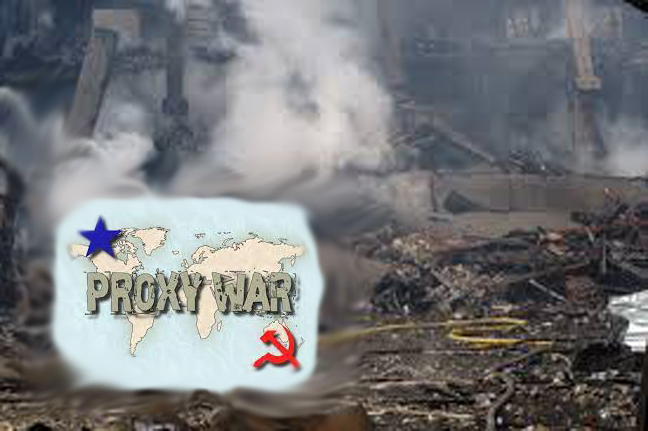
the Biden administration opted to use Ukraine in a Western proxy war against Russia.
Washington and London appear to have sabotaged a possible peace accord between Moscow and Kiev.
The Biden administration is risking nuclear war with Russia to assist a corrupt, authoritarian regime in a country of little importance to the United States.
Until the early 1990s, Ukraine wasn’t even an independent country, much less a U.S. vital interest.
Very few policymakers even concede that Washington’s overseas military adventures often have not turned out as planned.
The American Conservative, Ted Galen Carpenter, Sep 28, 2022, The leaders and most of the news media in the U.S. seem to believe that Washington’s foreign policy over the past several decades has been a success and benefitted both the United States and the world. That assumption wasn’t really true even during the Cold War, although that confrontation eventually resulted in the peaceful demise of America’s nasty totalitarian adversary. There was plenty of collateral damage along the way, with the suffering caused by Washington’s conduct in Vietnam and Afghanistan being the most glaring examples.
The performance of U.S. leaders after the Cold War has been even worse. An array of disruptive, bloody tragedies—most notably those in the Balkans, Afghanistan (again), Iraq, Libya, Syria, and Yemen—mark Uncle Sam’s global trail of wreckage. The Biden administration’s decision to use Ukraine as a pawn in Washington’s power struggle with Russia is fast becoming the latest example.
Very few policymakers even concede that Washington’s overseas military adventures often have not turned out as planned. The news media, which is supposed to serve as the public’s watchdog, have routinely ignored or excused America’s foreign-policy disasters. Instead, when one intervention fails, they simply move on to lobby for the next crusade pushed by U.S. leaders. Consider how few news accounts now deal with the ongoing violence and chaos in places such as Libya, Syria, and Yemen, even though Washington was a major contributor to all of those tragedies.
Paul Poast, a scholar with the Chicago Council on Global Affairs, aptly describes the conflict in Syria as America’s “forgotten war.” “That the war in Syria has become the “forgotten war,” he observes, “points to a more disturbing trend in U.S. foreign policy: The United States is so engaged in wars and interventions around the world that a conflict involving the U.S. military that has killed hundreds of thousands of civilians does not even register with the American public anymore.”………………………………………
The turmoil in Iraq is less severe, but is still damaging the country. Political disputes and mass demonstrations against the current government regularly surface in Iraq. Pro-Iranian militias continue to play a prominent role in the country’s government, and the three-way split among Sunni Arabs, Shiite Arabs, and Kurds is becoming ever more contentious. Political violence among rival factions shows no signs of subsiding, nor does public resentment against the presence of U.S. troops. Washington so lacks trust in its “ally” that officials once threatened to seize the country’s bank reserves if Iraqi leaders continued to press for the withdrawal of U.S. forces.
The level of human tragedy in Libya and Yemen is horrifying. Washington and its NATO allies bear almost exclusive responsibility for the situation in Libya………………………
The latest application of Washington’s meddlesome policy is in Ukraine. U.S. leaders ignored repeated Russian warnings that making Ukraine a NATO member or even an unofficial NATO military asset would cross a line that threatened Russia’s security. When Moscow finally responded to the provocations with an invasion of Ukraine in February 2022, the Biden administration opted to use Ukraine in a Western proxy war against Russia.
The conflict has already done enormous damage to Ukraine’s infrastructure and taken thousands of lives. Worse, Washington and London appear to have sabotaged a possible peace accord between Moscow and Kiev.
The U.S. foreign-policy record over the past three decades could hardly be worse. It is crucial not to let policymakers and their media mouthpieces get away with convenient collective amnesia and imitations of Pontius Pilate. Instead, they need to be held fully accountable for their blunders and deception.
Future U.S. policymakers also need to avoid repeating the faulty performance of their predecessors. To do so, they must make three significant changes to U.S. foreign policy.
First, Washington should utterly renounce nation-building. Trying to remake alien societies by force and impose Western political, economic, and social values is the essence of folly.
Even when the United States has not yet been drawn into a new war to enforce crumbling nation-building goals, as in Bosnia and Kosovo, such armed social experiments are an exercise in futility and frustration. Worse, nation-building missions frequently worsen conditions in the targeted country, and the predictable failure of U.S. objectives even can lead to Washington’s outright humiliation. The debacle in Afghanistan is a stark reminder of that danger.
Second, the United States must avoid the temptation to engage in regime-change wars. Such offensives often are a prelude to disastrous nation-building ventures. That was the case in Iraq, Afghanistan, and Libya. Those wars not only made matters worse for the populations in the three countries, but worsened the security situation for neighboring states and even the United States. In both Iraq and Libya, U.S. actions toppled secular dictators, paving the way for chaos that strengthened the position of Islamic jihadists. Granted, the secular dictators were brutal and sometimes caused problems for the United States, but Washington’s “solution” clearly made matters worse, not better.
Third, U.S. leaders must do a much better job of distinguishing vital national interests from secondary or peripheral ones. Washington’s current policy of using Ukraine as a proxy for a war against Russia is a troubling example of the failure to make such basic distinctions. The Biden administration is risking nuclear war with Russia to assist a corrupt, authoritarian regime in a country of little importance to the United States.
Until the early 1990s, Ukraine wasn’t even an independent country, much less a U.S. vital interest. To accept the risks the Biden administration is incurring is irresponsible and violates the U.S. government’s responsibility to the American people.
Unless these policy changes are made, it is just a matter of time until a new set of officials repeat the disastrous blunders of their predecessors. If they do, the consequences to America and the world will be equally damaging. Indeed, the Ukraine adventure reveals that the consequences could be even worse than the wreckage already wrought by Uncle Sam. https://www.theamericanconservative.com/uncle-sams-long-trail-of-wreckage/
U.S. has not seen acts indicating Russia contemplating nuclear attack
U.S. has not seen acts indicating Russia contemplating nuclear attack
WASHINGTON, Sept 30 (Reuters) – The United States has not yet seen Russia take any action that suggests it is contemplating the use of nuclear weapons amid its invasion of Ukraine, U.S. Secretary of State Antony Blinken said on Friday, despite what he called “loose talk” by Russian President Vladimir Putin about their possible use.
“We are looking very carefully to see if Russia is actually doing anything that suggests that they are contemplating the use of nuclear weapons. To date, we’ve not seen them take these actions,” Blinken told a news conference in Washington with his Canadian counterpart.
“This kind of loose talk about nuclear weapons is the height of irresponsibility and it’s something that we take very seriously,” Blinken said.
Putin on Friday proclaimed Russia’s annexation of a swathe of Ukraine, the biggest annexation in Europe since World War Two. Putin also vowed to press ahead with what he calls a “special military operation” in Ukraine. Russia launched its invasion in February.
In recent weeks, Putin explicitly warned the West that Russia would use all available means to defend Russian territory and accused the West, without offering evidence, of discussing a potential nuclear attack on Russia. Putin on Friday said the United States had set a precedent when it had dropped two atomic bombs on Japan in 1945, but stopped short of issuing new nuclear warnings against Ukraine.
Pentagon spokesperson Brigadier General Patrick Ryder this week said the United States had not seen any changes that would lead it to alter the posture of American nuclear forces.
Putin controls the world’s largest nuclear arsenal, including a new generation of hypersonic weapons and 10 times more tactical nuclear weapons than the West.
Reporting by Simon Lewis and Humeyra Pamuk; Editing by Chizu Nomiyama and Will Dunham
US Senate Approves $12 Billion In New Aid For Ukraine Amid War

Russia-Ukraine War: It comes as Russian President Vladimir Putin plans to declare the annexation of parts of Ukraine occupied by Russian troops on Friday.
NDTV WorldAgence France-Presse September 30, 2022,
It also provides $4.5 billion for Kyiv to keep the country’s finances stable.
The US Senate approved $12 billion in new economic and military aid for Ukraine Thursday as part of a stopgap extension of the federal budget into December.
The measure, agreed by senators of both parties, includes $3 billion for arms, supplies and salaries for Ukraine’s military, and authorizes President Joe Biden to direct the US Defense Department to take $3.7 billion worth of its own weapons and materiel to provide Ukraine.
It also provides $4.5 billion for Kyiv to keep the country’s finances stable and keep the government running, providing services to the Ukrainian people.
It comes as Russian President Vladimir Putin plans to declare the annexation of parts of Ukraine occupied by Russian troops on Friday……………
The Ukraine aid is part of a short-term extension of the federal budget, which is to expire at the end of the fiscal year on September 30 without the parties in Congress having agreed to a full-year allocation for fiscal 2022-23………. https://www.ndtv.com/world-news/us-senate-approves-12-billion-in-new-aid-for-ukraine-amid-war-3390355
The real Winners of Ukraine war – the USA weapons manufacturers! U.S. Announces $1.1 Billion In Aid For Building Ukraine’s Military

The United States has now committed approximately $16.9 billion in security assistance to Ukraine since January 2021
Radio Free Europe, 29 Sept 22, The United States will provide an additional $1.1 billion in military aid to Ukraine, including funding for about 18 more advanced rocket systems and other weapons to counter drones, the White House announced on September 28.
The package is aimed at helping Ukraine secure its longer-term defense needs under the Ukraine Security Assistance Initiative, which funds the purchase of weapons and equipment. This means it could take a year or more for Ukraine to get the systems.
Most of the other military aid packages announced by the United States have thus far used Pentagon drawdown authority to provide weapons more immediately.
The new package “represents a multi-year investment in critical capabilities to build the enduring strength of Ukraine’s Armed Forces” as they continue to battle the invading Russian Army, the Pentagon said in a statement.
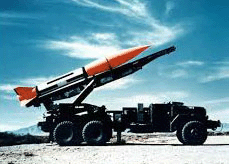
The package includes funding for 18 units of the High-Mobility Artillery Rocket System, known as HIMARS, and 12 Titan systems, which are used to counter drones………………
Also in the package is funding for about 150 armored vehicles, 150 tactical vehicles for towing weapons, trucks and trailers, and a variety of radars, communications, and surveillance equipment.
The United States has now committed approximately $16.9 billion in security assistance to Ukraine since January 2021. https://www.rferl.org/a/ukraine-us-military-aid-1-1-billion/32056533.html
1 This Month





PLEASE OPPOSE HR 8255 AND S.3639 – bills would accelerate satellite deployment, with no environmental review or safeguards – https://ncstd5li.quorum.us/campaign/169331/
To see nuclear-related stories in greater depth and intensity – go to https://nuclearinformation.wordpress.com
-
Archives
- October 2026 (10)
- September 2026 (339)
- August 2026 (330)
- July 2026 (355)
- June 2026 (287)
- May 2026 (306)
- April 2026 (356)
- March 2026 (251)
- February 2026 (267)
- January 2026 (308)
- December 2025 (358)
- November 2025 (359)
-
Categories
- 1
- 1 NUCLEAR ISSUES
- business and costs
- climate change
- culture and arts
- ENERGY
- environment
- health
- history
- indigenous issues
- Legal
- marketing of nuclear
- media
- opposition to nuclear
- PERSONAL STORIES
- politics
- politics international
- Religion and ethics
- safety
- secrets,lies and civil liberties
- spinbuster
- technology
- Uranium
- wastes
- weapons and war
- Women
- 2 WORLD
- ACTION
- AFRICA
- Atrocities
- AUSTRALIA
- Christina's notes
- Christina's themes
- culture and arts
- Events
- Fuk 2022
- Fuk 2023
- Fukushima 2017
- Fukushima 2018
- fukushima 2019
- Fukushima 2020
- Fukushima 2021
- general
- global warming
- Humour (God we need it)
- Nuclear
- RARE EARTHS
- Reference
- resources – print
- Resources -audiovicual
- Weekly Newsletter
- World
- World Nuclear
- YouTube
-
RSS
Entries RSS
Comments RSS

