Gordon M. Hahn: The West has been reckless with Vladimir Putin
10 DÉCEMBRE 2022 Interview by Mohsen Abdelmoumen, Algérie Résistance, le blog de Mohsen Abdelmoumen
Mohsen Abdelmoumen: You are an expert in geostrategy, what is your view on the current conflict in Ukraine?
Gordon M. Hahn: The war in Ukraine is best called the Russian-NATO Ukrainian war. It is a war over whether or not NATO will be allowed to expand to Ukraine and elsewhere along Russia’s borders, but mostly over Ukraine’s potential membership in NATO. NATO expansion drove democracy-promotion efforts in Ukraine and elsewhere, the 2004 Orange Revolution, and the February 2014 Maidan overthrow of the Yanukovych government.
For Russian national security, Ukraine is Geostrategically pivotal. If there is a hostile regime in Kiev backed by the West militarily, then Russia has no virtually no national security other than the resort to nuclear weapons.
Western military assistance makes Ukraine a de facto NATO member on Russia’s border and emboldens Kiev to favor a military solution over a negotiated one to the Donbass conflict it started as well as to seek a return of Crimea.
The widespread Western belief that Putin is politically weak and Russians are bursting to establish a democratic republic and free market economy (things the West itself is abandoning gradually in favor of the Great Reset, Wokism, and AI) led to a lack of caution in dealing with Putin, thinking he would balk at a war or be overthrown if he started one. This is precisely the situation with which the West confronted Russia no later than the Maidan coup and certainly by January 2022; hence, Putin’s decision to invade……………………………………………………………..
In your opinion, who would benefit from the fall of Russia?
Given the security risks of a Russian dissolution noted above, there might be no beneficiaries and quite a few victims in the event. Certainly, the West, China, and perhaps others such as Kazakhstan and India could benefit from territorial acquisition or greater access to Russian territory’s natural resources.
With the amount of weapons that the West has sent to the Ukrainian government, is there not a risk that these weapons will fall into the hands of various jihadist groups?
There is indeed some risk that weapons sold to Ukraine will end up in jihadis’ hands. First, Ukrainian weapons have long been on the black market. Second, reports of corruption and re-sale of Western weapons sent since the war began are legion. Third, there are Chechen elements fighting on both sides in the war, and those on the Ukrainian side might be interested in sending weapons to ISIS allies in the North Caucasus or Turkey.
In your last article “The Russian Winter Offensive”, you talked about the « shock and awe » strategy that begins with winter. What can you tell us about this new step of the Russian offensive planned for this winter?
A Russian offensive this winter is most likely because by January all the 300,000 mobilized recruits plus a wave of another 50,000 volunteers will be ready for combat on the front. The recent strategy of destroying Ukraine’s electricity, fuel, and rail transportation infrastructure is setting the stage for the offensive by degrading these infrastructures making it difficult for Ukraine to move and supply its forces. This degrading will peak when those new forces are ready. Then Moscow will have at least four directions from which to choose for conducting offensives:……………………………….
Moscow may be forced to attack on all of these fronts as it is all now along the southeastern fronts from northern Luhansk to Zaporozhe but more robustly thanks to the coming reinforcements. Then if progress is enough to severely weaken the Ukrainian army a final push on Kiev could come.
This may be the plan Moscow ill eventually settle upon. With Ukrainian energy and transport debilitated, this strategy could force Zelenskiy to enter ceasefire or peace talks or others to remove him from power in order to begin negotiations.
Isn’t the defeat of the Ukrainian army a defeat for NATO against Russia?
It would be a political defeat but obviously not a military defeat. NATO forces are not directly involved on the ground officially or in any great numbers unofficially (Polish and Rumanian soldiers serving as ‘volunteers’). NATO equipment is being used but it is second and third tier stuff and used by Ukrainians unfamiliar with them. If NATO were directly involved on the ground, the war we see now would be a picnic by comparison.
But if Russia wins, it will be a catastrophic political defeat for the US, Europe and NATO and a boon to Russia, China, and the alternative order they are beginning to construct. Other states will join their emerging system in greater numbers and speed than currently, though the growing participation of India and Turkey indicates where things are going. And NATO expansion will difficult to do anywhere on post-Soviet lands from then forward.
If Russia loses the war and Ukraine becomes a NATO member, then the dynamic will be the very reverse. The Putin regime will be under constant threat of destabilization, NATO expansion can continue in places like Georgia and Moldova (despite the latter’s constitutional mandate of neutrality), and the Sino-Russian Eurasian and global network of international organizations (BRICS, SCO, the EEU) will be challenged.
Is it not in the interest of the Westerners who wanted this war to push Ukraine to negotiate?
Right now, it is not. Who in the West wanted this war? The US, NATO, and Western arms dealers. The Biden administration benefits by the war, it thinks, by deploying the Russian bogey man to maintain support among its base and the hope of peeling off moderate Republican security hawks during the election campaign. It can boost defense spending to maintain support of the defense industry. The CIA, FBI and other intel and security agencies also benefit in terms of budget items and institutional profile. NATO supports the war for now because it can use the war to study Russian warfighting and weaponry performance and consolidate its members and other support in the West around the ‘Russian threat’ it itself created. The interest of Western arms dealers needs little elaboration………………………………………..
How far can the West continue to support Kiev?
Until Ukraine is seen as losing the war in a major way with no prospect of rebounding without prohibitively large Western assistance to bolster, the state, regime, and military. This could happen next year.
Hasn’t Zelensky become a burden for everyone? Hasn’t he become an embarrassment, including to the Westerners who support him?
Zelenskiy has both weaknesses and strengths, the latter of which make or can make him a burden to his allies at home and abroad. It must be said that Zelenskiy’s decision to remain in Kiev when Russian forces began to move on Kiev from Belarus in February speaks of a certain courage – perhaps of the kind found in the aphorism ‘there is a fine line between bravery and stupidity’ – and this has certainly rallied many in Ukrainian government and society to his side, when at the war’s beginning his popularity ratings were disastrous.
He is also an effective post-modernist PR conman. But in the desperation of the war’s difficulties, he has repeatedly overreached in producing false propaganda stories, for which he finally was exposed during the recent Ukrainian missile hit on Poland.
On the other hand, he is still being protected by growing Western media censorship and propaganda of the authoritarian kind, which have refused to report on Kiev’s numerous fake ‘Russian atrocities’ and the like. Chief of the Ukrainian General Staff may be running out of patience, but we simply cannot be sure just how tense the Zelenskiy-Zalyuzhniy relationship is. Zelenskiy continues to make himself useful to Ukraine’s powerful neofascist/ultranationalist element, cracking down on Russian language, the former Russian Orthodox Church affiliate in Ukraine, and pro-Russian media.
For Westerners, Zelenskiy is still a beneficiary of the West’s propaganda, which even its propagandists have imbibed and are invested in. Threats to his continuing support are: more exposed lies like the missile hit on Poland episode; massive corruption that is impinging on the effectiveness of Western military assistance; and growing military failure and general staff and/or common soldier dissent in Ukraine regarding the war. This year we are likely to see at home and abroad a serious decline in the popularity of Time’s and Financial Times’ 2022 ‘Man of the Year’. https://mohsenabdelmoumen.wordpress.com/2022/12/10/gordon-m-hahn-the-west-has-been-reckless-with-vladimir-putin/
Ukraine legalizes foreigners in AZOV neo-Nazi regiment

https://www.rt.com/russia/569816-ukraine-legalizes-foreigners-azov/ 13 Jan 23, Citizens of other nations who join the Azov unit will receive benefits on par with regular service members under a new law.
The Ukrainian parliament on Thursday passed a new law that expands perks offered to foreigners who sign up to serve in the country’s military. Sponsors of the bill specifically singled out the controversial Azov regiment as an intended beneficiary of the measure.
Azov originated as a group of far-right volunteers who in 2014 took up arms against Donbass forces with Kiev’s blessing. The unit was incorporated into the National Guard, a structure separate from the army, in November of that year.
The new legislation has added the wording “and other military units” to several laws that previously only covered the main Ukrainian armed forces. A formal justification of the bill said that there are many foreign nationals serving in Azov, but that the existing legal framework makes their presence in Ukraine illegal and does not allow them to request Ukrainian citizenship. The new law is meant to change that.
Azov is arguably the best known internationally of the Ukrainian nationalist units. Before the conflict between Moscow and Kiev escalated into open hostilities last February, Western officials and media outlets acknowledged that many of the unit’s members espoused problematic ideology and that some were neo-Nazis.
An expose published by Time magazine in 2021 called Azov the focal point of “a network of extremist groups stretching from California across Europe to New Zealand.” Over the years, it managed to recruit an estimated 17,000 foreign fighters from 50 nations, the report claimed, before describing the dominant role the Azov extremists play in the movement.
NATO to train hundreds of Ukrainian troops in US and Germany, in operating Patriot missile system
WSWS Andre Damon @Andre__Damon 11 Jan 23,
The United States and Germany have announced they will expand their training of Ukrainian troops inside their own borders, further embroiling them in a war with Russia.
The Pentagon announced Tuesday that it will train Ukrainian troops at Fort Sill, Oklahoma on how to operate the Patriot missile system, the most advanced weapon sent to Ukraine to date………………………….
The Pentagon official also confirmed that the US aims to train approximately 500 troops at a time at a US military facility in Germany on “combined arms warfare”…………………………..
The Pentagon’s announcement comes after US President Joe Biden announced a $3 billion arms shipment to Ukraine—the largest to date—and after Congress passed a bill allocating another $50 billion to the war. The latest weapons package included the deployment of dozens of Bradley infantry fighting vehicles, which essentially function as small tanks.
Even as they pour unprecedented amounts of weapons into Ukraine, the NATO powers are preparing to even further escalate their involvement in the war.
………………… Poland and Lithuania have announced that they plan to send Leopard 2 main battle tanks to Ukraine, but that this would require Germany’s permission, as these country signed export agreements as a condition of receiving the tanks.
……………………………….. Expressing the reality of the growing involvement by NATO in the war, Nikolai Patrushev, a security adviser to Russian president Vladimir Putin, said the conflict is “not a clash between Moscow and Kyiv,” but a “military confrontation between NATO, and above all the United States and England, with Russia.” https://www.wsws.org/en/articles/2023/01/11/eywi-j11.html
Nuclear weapons proliferation really just keeps on going
Nuclear proliferation has hardly slowed in the last decade. India,
Pakistan, China, and the United Kingdom have increased their nuclear
weapons stockpiles, while leaders in Turkey, Saudi Arabia, South Korea, and
Iran have all voiced an interest in militarizing their nuclear programs.
The United States, meanwhile, has been schizophrenic in its control of its
civilian nuclear exports. Washington has tightened restraints on exports to
the United Arab Emirates (UAE), Taiwan, China, and Russia and relaxed
conditions on nuclear transfers to Vietnam, India, and Saudi Arabia.
It has also articulated ambiguous security assurances to insecure states,
including Libya, Taiwan, and Ukraine, that gave up their nuclear weapons
programs or nuclear weapons based on their soil only later to be
overthrown, threatened with invasion, or invaded.
None of this has strengthened nuclear non-proliferation. Just the reverse. In a series of
firsts, Iran’s foreign minister, Mohammad Javad Zarif; Saudi Arabia’s
crown prince, Mohammed bin Salman; and Turkey’s president, Recep Tayyip
Erdoğan, have all publicly threatened to leave the Treaty on the
Non-Proliferation of Nuclear Weapons (NPT).
American Bar Association 6th Jan 2023
The One-Person Monopoly of Nuclear Launches
European Leadership Network. Tarja Cronberg |Former Member of the European Parliament, Distinguished Associate Fellow at SIPRI and Member of the Executive Board of the European Leadership Network 12 Jan 23
The international discussion on nuclear weapons, during the war in Ukraine, has focused on one question: Will Putin use nuclear weapons? The thought that nuclear weapons might be used in the Ukraine war, is no longer an abstract fear. A nuclear war may be closer than ever. In this new reality there is a risk seldom talked about, but which is built into our command and control systems: one person is able to decide the fate of the earth. The fundamental question for the nuclear order is not about whether or not Putin, or any other president or dictator, might rely on nuclear weapons as the last choice. The question to be posed is: Do we really want to maintain a nuclear order, where one person is formally able to decide the fate of us all?
The international discussion on nuclear weapons, during the war in Ukraine, has focused on one question: Will Putin use nuclear weapons? The thought that nuclear weapons might be used in the Ukraine war, is no longer an abstract fear. A nuclear war may be closer than ever. In this new reality there is a risk seldom talked about, but which is built into our command and control systems: one person is able to decide the fate of the earth. The fundamental question for the nuclear order is not about whether or not Putin, or any other president or dictator, might rely on nuclear weapons as the last choice. The question to be posed is:
Do we really want to maintain a nuclear order, where one person is formally able to decide the fate of us all? Tarja Cronberg
Traditionally there has been a nuclear “taboo”: nuclear weapons could be threatened but not used. They were only for deterrence, to prevent a nuclear attack, not to be used to win a war. The famous Reagan-Gorbachev statement made clear that “a nuclear war cannot be won and must never be fought”. There was also empirical evidence. The weapons have not been used after Hiroshima, although there were over 70,000 nuclear weapons during the Cold War. It is easy to argue that nuclear deterrence has guaranteed peace and prosperity for more than 70 years. Nevertheless, there was always a small exception to this near-total trust in deterrence…………………………………………………
The situation leaves the world in a dangerous place. The Gaddafis and the Husseins could be destroyed by military interventions and regime change before any catastrophe occurred. This is not the case for the Trumps and the Putins. As leaders of the world´s superpowers there is no external power able to intervene, although there may have been plans to kill Putin. The nuclear superpower leaders are more or less democratically elected and their removal will take place according to the laws and politics of the superpower in question. Where does this leave us?…………………………….
Without any solid management system to avoid a nuclear catastrophe, world survival is in the hands of the leaders of its superpowers. Although the decision- making process may involve consultations, the decision is ultimately, even in the case of Russia today, in the hands of one person. Today, given that the world is threatened by a nuclear war, there should be a serious discussion on how the risks of this “one-person nuclear command” could be avoided or at least minimised. The discussion could take at least three different directions…………..
there is an urgent need for a stronger international institutional responsibility for the governance of national decisions on nuclear threats and use. Firstly, there is a need for an international transparency survey on how the nuclear weapon states have defined their first-or second strike launch responsibility. A second phase would seek to establish some international guidelines for national procedures in order to avoid ad hoc, illegal measures in a concrete crisis. So far we have been lucky, but ”luck is not a strategy” as was so ably pointed out by the Secretary-General of the United Nations at the 2022 NPT Review Conference. https://www.europeanleadershipnetwork.org/commentary/the-one-person-monopoly-of-nuclear-launches/
NATO member sending banned cluster bombs to Ukraine – media
https://www.rt.com/news/569679-ukraine-t%C3%BCrkiye-cluster-munitions/ 11 Jan 23, Türkiye has been supplying Kiev with weapons that are banned in many countries, sources told Foreign Policy magazine
Ukraine has been receiving consignments of controversial cluster munitions from Türkiye, Foreign Policy magazine has reported. Kiev had been asking Washington for the Cold-War-era weapons for months.
The shipments have been taking place since November, current and former US and European officials told the outlet. It was unclear how many of the munitions had been received, or whether they had yet been used on the battlefield.
The weapons in question are called dual-purpose improved conventional munitions, or DPICMs. They were designed during the Cold War era, when NATO was planning to deploy them against a large-scale Soviet invasion of Europe. The rounds are filled with dozens of submunitions, intended to strike personnel and light-armored targets, scattering over a large area for increased lethality.
Like many other cluster munitions, DPICMs tend to produce long-lasting hazards, as some submunitions can fail to detonate and have the potential to maim or kill somebody years after being deployed.
US law prohibits the exportation of any cluster weapons with a failure rate over a certain threshold. The same regulations require guarantees that cluster munitions will not be used in areas where civilians may be present. Washington has repeatedly rejected requests from Kiev for the supply of DPICMs.
Most European NATO members are signatories of the 2008 Convention on Cluster Munitions (CCM), which bans this type of weapons. Türkiye is not one of them, but has observer status in the Geneva-based organization that oversees the implementation of the treaty. It has indicated that it abides by the rules, though it’s not obliged to.
According to Foreign Policy, the weapons supplied to Ukraine were manufactured during the Cold War under a co-production agreement with the US. Turkish companies made 155mm and 122mm cluster artillery rounds, the magazine claimed.
Neither Russia nor Ukraine are parties to the CCM, and both have reportedly used their Soviet-made cluster munitions in their armed conflict. In March, a Tochka-U missile with a cluster payload killed more than 20 people and injured dozens more in the city of Donetsk. Moscow blamed Kiev for the attack, but this was denied. International watchdog Human Rights Watch (HRW) later stated that it could not investigate the incident.
“Ukraine already has a massive problem on its hands, and it’s only magnifying it by introducing this weapon,” Mark Hiznay, a senior researcher in the Arms Division for HRW, told Foreign Policy, commenting on Kiev’s effort to get more cluster weapons.
The C-17A Has Been Cleared To Transport B61-12 Nuclear Bomb To Europe
By Hans Kristensen • January 9, 2023 https://fas.org/blogs/security/2023/01/c17-cleared-to-transport-b61-12/
In November 2022, the Air Force updated its safety rules for airlift of nuclear weapons to allow the C-17A Globemaster III aircraft to transport the new B61-12 nuclear bomb.
The update, accompanied by training and certification of the aircraft and crews, cleared the C-17A to transport the newest U.S. nuclear weapon to bases in the United States and Europe.
The C-17As of the 62nd Airlift Wing at Joint Base Lewis-McChord serve as the Prime Nuclear Airlift Force (PNAF), the only airlift wing that is authorized to transport the Air Force’s nuclear warheads.
The updated Air Force instruction does not, as inaccurately suggested by some, confirm that shipping of the weapons began in December. But it documents some of the preparations needed to do so.
Politico reported in October last year that the US had accelerated deployment of the B61-12 from Spring 2023 to December 2022. Two unnamed US officials said the US told NATO about the schedule in October.
But a senior Pentagon official subsequently dismissed the Politico report, saying “nothing has changed on the timeline. There is no speeding up because of any Ukraine crisis, the B61-12 is on the same schedule it’s always been on.”
Although the DOD official denied there had been a change in the schedule, he did not deny that transport would begin in December.
The B61-12 production scheduled had slipped repeatedly. Initially, the plan was to begin full-scale production in early-2019. By September 2022, the National Nuclear Security Administration (NNSA) was still awaiting approval to begin full-scale production. Finally, in October 2022, NNSA confirmed to FAS that the B61-12 was in full-scale production.
The B61-12 is intended as an upgrade and eventual replacement for all current nuclear gravity bombs, including the B61-3, -4, -7, and probably eventually also the B61-11 and B83-1. To that end, it combines and improves upon various aspects of existing bombs: it uses a modified version of the B61-4 warhead with several lower- and medium-yield options (0.3-50 kilotons). It compensates for its smaller explosive yield (relative to the maximum yields of the B61-7 and -11) by including a guided tail-kit to increase accuracy, as well as a limited earth-penetration capability.
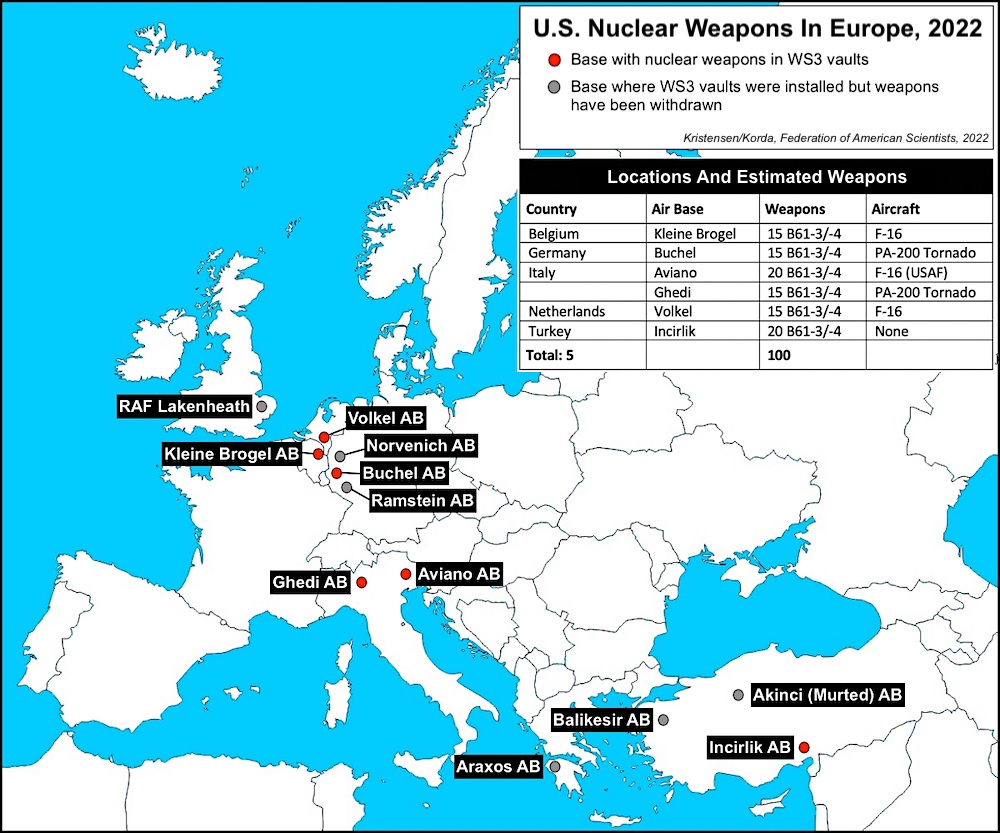
At this point in time, it is unknown if B61-12 shipments to Europe have begun. If not, it appears to be imminent. That said, deployment will probably not happen in one move but gradually spread to more and more bases depending on certification and construction at each base.
There are currently six active bases in five European countries with about 100 B61 bombs present in underground Weapons Storage and Security Systems (WS3) inside aircraft shelters. A seventh site in Germany (Ramstein Air Base) is active without weapons present and an eighth site – RAF Lakenheath – has recently been added to the list of WS3 sites being modernized. The revitalization of Lakenheath’s nuclear storage bunkers does not necessarily indicate that US nuclear weapons will return to UK soil, especially since as recently as December 2021, NATO’s Secretary General stated that “we have no plans of stationing any nuclear weapons in any other countries than we already have . . . ” However, the upgrade could be intended to increase NATO’s ability to redistribute the B61 bombs in times of heightened tensions, or to potentially move them out of Turkey in the future. In addition, four other sites have inactive (possibly mothballed) vaults (see map above).
This research was carried out with generous contributions from the John D. and Catherine T. MacArthur Foundation, the New-Land Foundation, the Ploughshares Fund, the Prospect Hill Foundation, the FTX Future Fund and Longview Philanthropy, the Stewart R. Mott Foundation, the Future of Life Institute, Open Philanthropy, and individual donors.
Ukraine on ‘NATO mission’ – defense minister
https://www.rt.com/russia/569500-reznikov-ukraine-nato-mission/ 9 Jan 23
Aleksey Reznikov has argued that Kiev is shedding blood for the military bloc and expects weapons in return.
Kiev is shedding blood to carry out the mission NATO set for itself and expects the “civilized West” to provide weapons and ammunition in return, Ukrainian Defense Minister Aleksey Reznikov has said in an interview for a domestic TV channel.
Appearing on the 1+1 network’s TSN channel on Thursday evening, Reznikov pointed out that at the Madrid summit last summer, NATO declared Russia the greatest threat to the US-led bloc.
“Today, Ukraine is addressing that threat. We’re carrying out NATO’s mission today, without shedding their blood. We shed our blood, so we expect them to provide weapons,” he said.
Reznikov also claimed that his NATO colleagues have told him, both in conversations and via text messages, that Ukraine is the “shield of civilization” and “defending the entire civilized world, the entire West.”
Ukrainian officials, from President Vladimir Zelensky down, routinely make public appeals for tanks, missiles, artillery and ammunition. Russian Defense Minister Sergey Shoigu told the General Staff in December that Moscow was de facto fighting the collective West. By his estimates, the government in Kiev has received almost $100 billion worth of weapons, ammunition and other supplies in 2022 alone.
Reznikov has led that effort, boasting to the US outlet Politico in October that he had figured out the Pentagon’s political process. His goal, he said, was to keep raising the bar until Ukraine received main battle tanks.
While that particular threshold has yet to be crossed, on Friday Washington announced the delivery of 50 Bradley infantry fighting vehicles, the most modern armor sent to Kiev so far, as part of a $3 billion weapons package. Earlier this week, France pledged a number of wheeled ‘light tanks’ as well.
These shipments are intended to replace Ukraine’s battlefield losses. Last month, Kiev’s top general Valery Zaluzhny told The Economist he would need 300 more tanks, up to 700 infantry fighting vehicles, and 500 howitzers to conduct offensive operations. This is more than the number of such vehicles in British or German inventory.
Moscow insists that Western weapon deliveries only serve to prolong the conflict, and has repeatedly warned Ukraine’s backers that this could result in an all-out military confrontation between Russia and NATO.
It’s all about the bomb: why civilian nuclear power is merely a cover for producing more nuclear weapons

Nuclear weapons are a special kind of horror opposed by most rational people around the world.
the IAEA’s bluntly stated mission is to promote nuclear technology.
Like Atoms for Peace, this repackaging of a military activity as a civilian one succeeded in making the endeavor socially acceptable and somewhat self-funding
The nuclear power-nuclear weapons link can only be broken by a ban on both
It’s all about the bomb — Beyond Nuclear International
Why civilian nuclear power is merely a cover for producing more nuclear weapons
By Alfred Meyer, 8 Jan 23,
The Zaporizhzhia Nuclear Power Station in southeastern Ukraine, Europe’s largest nuclear power plant, has the world’s attention right now, and rightly so. For the first time in history, six nuclear reactors and thirty-seven years’ worth of high-level nuclear waste are in the middle of a battlefield in an active war zone—one artillery shell, on site or off, could interrupt the control and cooling of the operational reactor, or the cooling of the waste in storage, leading to a catastrophic release of radiation that could spread throughout the Northern Hemisphere. How in the world can nuclear power reactors be considered clean and safe sources of electricity?
Russia, a nuclear-armed nation that invaded Ukraine on February 24, 2022, has said that it would use nuclear weapons if needed. And strong allies of Ukraine—the United States, the United Kingdom, and France, all NATO members—are also armed with nuclear weapons.
You likely are aware of what has happened in the weeks since this magazine went to press, and whether or not the world is in the midst of another major radioactive disaster, as happened at Fukushima in Japan in 2011, Chernobyl in northern Ukraine in 1986, and Three Mile Island in the United States in 1979. I assume that if you are reading this, nuclear weapons have not been used in the war in Ukraine. So how has the world ended up in such an existentially threatening situation? Why does the nuclear enterprise have the world’s future so tightly in its grip?
The short answer: nuclear weapons. It is all about the bomb.
In 1939, Albert Einstein wrote to President Franklin D. Roosevelt urging him to pursue nuclear research in the United States. It was crucial, Einstein wrote, to counter Germany’s efforts to harness the magic of radioactivity and develop a super weapon. A few years later, the Manhattan Project was born in secrecy in 1942. A sprawling and tightly controlled academic, military, industrial, and governmental infrastructure was built to accommodate an entirely new industry equal in size to the American automobile industry at the time. Secrecy was so thorough that when Vice President Harry Truman ascended to the presidency on April 12, 1945, upon Roosevelt’s sudden death, he was unaware that the atomic bomb program even existed, much less that it was on the verge of testing a plutonium weapon in July.
During World War II, the United States succeeded in developing atomic weapons, while Germany was defeated before it could do so. Even though Japan was essentially defeated by then, Truman, some three months after he learned that the United States did possess the super weapons, chose to use them. Although the firebombing of Tokyo in March 1945 had burned to death more than 100,000 people and left more than a million people homeless, it did not occasion the global outcry that followed the use of the uranium bomb on Hiroshima, on August 6, 1945, and the plutonium bomb on Nagasaki, three days later. Nuclear weapons are a special kind of horror opposed by most rational people around the world.
However, following the use of nuclear weapons in Japan in 1945, there has been significant ongoing public opposition to them. In the earliest days of the United Nations, there were various efforts to abolish or control nuclear weapons. It was clear that they constitute an entirely different type of military threat that includes the likelihood of ending life on earth as we know it. Abolishing nuclear weapons is the way to end this existential threat.
When World War II hero General Dwight D. Eisenhower became President in 1953, the dilemma for the military, and for Eisenhower, was how to grow the atomic bomb programs, in light of negative public opinion toward the nuclear enterprise. At the same time, the United States wanted to be recognized as the leader of the “free world” in the postwar years. In the early 1950s, the military needed to recast nuclear enterprise activities to appear to be peaceful, beneficial parts of our modern life, very distant from the wartime horrors.
In August 1953, Eisenhower was worried about the Soviet Union’s successful test of a sophisticated hydrogen bomb—which signaled to the United States that the nuclear arms race was officially on. Eisenhower considered delivering a type of “fireside chat” to the American public—or perhaps a “mushroom cloud chat”—to level with citizens about the truly horrific existential threat that nuclear weapons posed to the world.
But by December of that year, a different strategy appeared to take effect. In a now famous speech on December 8, 1953, titled “Atoms for Peace,” Eisenhower proposed to the U.N. General Assembly an international program of sharing “peaceful” nuclear materials and know-how for untold bounty, to encourage development of nuclear programs around the world.
The United States also proposed an international agency under the United Nations to promote and oversee nuclear activities, which today is the International Atomic Energy Agency, or IAEA. While acknowledging the IAEA’s important oversight role, such as inspecting the Zaporizhzhia reactors and fuel pools at this perilous time in history, one should also recognize that the IAEA’s bluntly stated mission is to promote nuclear technology. The first leaders of the IAEA were from the United States, to ensure that U.S. interests were protected.
Nuclear enterprise infrastructure is an outgrowth of World War II. These new endeavors drew international interest in creating the huge nuclear marketplace now in existence. Atoms for Peace—a plan to share nonmilitary nuclear technology with other countries to “win hearts and minds”—placed nuclear materials and reactors in more than forty countries, including Iran. This generated ongoing business for many American nuclear enterprise companies while supporting and expanding the U.S. military’s nuclear infrastructure and capacity in the United States.
Having nuclear activities under the auspices of the United Nations conferred upon them the legitimacy and respect of that international body. While Eisenhower was making his “Atoms for Peace” speech at the United Nations, he was in the middle of planning the largest hydrogen bomb test ever in the United States, the fifteen-megaton “Bravo” test, on March 1, 1954, which was more than 1,000 times bigger than the bomb dropped on Hiroshima.
The generally favorable response to Atoms for Peace was a trifecta for the nuclear enterprise. U.S. nuclear activities were repackaged as the “peaceful” atom and given the patina of social acceptance through United Nations oversight. Eisenhower was lauded as a good leader for sharing the atom with the world, and the U.S. nuclear infrastructure got new business and growth, which supported more U.S. nuclear weapons and nuclear Navy programs.
Atoms for Peace also served geopolitical ends. For instance, one reason the United States provided Iran with a research reactor in 1967 was to saddle that country with significant financial obligations, including paying for ongoing parts, services, and technical support from American companies. These financial obligations would then, theoretically, force Iran to sell more oil on the world market, regardless of OPEC actions, a kind of atoms-for-oil program—but only peaceful atoms, mind you!
As Atoms for Peace was taking shape, a major policy change was made via the Atomic Energy Act of 1954. The top-secret, tightly controlled Manhattan Project to build the atomic bomb was a governmental endeavor. Nuclear reactors produce the plutonium needed for atomic bombs. With the passage of this new bill by Congress, the operation of nuclear power reactors by privately owned corporations was allowed.
The Atomic Energy Commission was created in 1946 to promote and regulate the development of this new industry. With the commission led by Wall Street banker Lewis Strauss for five critical years, it is not surprising that the scales heavily favored promotion over regulation. Encouraging private investment in these risky reactor projects was assisted by minimizing regulatory safety and operational demands upon the private operators.
Being the biggest nuclear enterprise on earth encourages the circular, self-sustaining dynamic of the nuclear arms race.
But why was it so important for the U.S. government to develop and subsidize civilian nuclear power? Because it allowed the military, in essence, to spin off its nuclear reactor activities to private financing and corporate operations. Like Atoms for Peace, this repackaging of a military activity as a civilian one succeeded in making the endeavor socially acceptable and somewhat self-funding—although government subsidies are still perennially needed to carry on, and taxpayers are still covering the liability insurance costs of the private corporations. Most importantly, as detailed in a 2017 report by former U.S. Energy Secretary Ernest Moniz, civilian nuclear power is an “essential enabler” of our national security. The Atlantic Council calculates the value of this contribution to national security to be $42.4 billion a year. Businesses contributing to the nuclear Navy’s supply chain are in forty-four U.S. states.
The essential nature of civilian nuclear power for national security would suggest that if the United States has the largest national inventory of civilian nuclear reactors in the world, then it also has the largest nuclear enterprise infrastructure to support nuclear weapons production and a nuclear Navy.
Being the biggest nuclear enterprise on earth encourages the circular, self-sustaining dynamic of the nuclear arms race. The United States is busy modernizing its nuclear weapons infrastructure to be “strong enough” to negotiate the elimination of nuclear weapons. This is presented as official doctrine in the nonproliferation world. In reality, the United States is actually driving the growing international nuclear arms race.
Atoms for Peace and the nuclear enterprise employ particularly successful advertising campaigns, greatly influencing public opinion and shaping our cultural consciousness of the nuclear world.
Presenting civilian nuclear power as the answer to climate change, as clean and safe electrical generation, or as energy “too cheap to meter” is simply a sales pitch. What is actually delivered by a robust nuclear energy fleet is the capacity for nuclear weapons and a nuclear Navy.
Over the decades, there have been numerous expert critiques of nuclear power, authoritatively debunking these misleading and false promises, yet these critiques seem to have no effect on the trajectory of the nuclear enterprise. I suggest that these sales pitches are diversionary techniques aimed at sapping our energy. It does not matter if nuclear power can really solve climate change, it just has to be seen as an essential part of the solution to attract bright, young talent into what is made to appear as the cutting edge of technology and climate solutions, even though the civilian nuclear power industry worldwide has been in decline since 2002.
To protect ourselves from the dangers of the nuclear enterprise, we need to stop the nuclear weapons and nuclear power reactor programs—a tall order, for sure. But if we seek success in our efforts, we are well advised to understand the forces we are engaging with. It is all about nuclear weapons.
Alfred Meyer is a member of Physicians for Social Responsibility and has worked with communities affected by the Chernobyl and Fukushima nuclear catastrophes.
Pentagon pressures NATO allies to boost arms flow to Ukraine

January 8, 2023, Rick Rozoff Interfax-Ukraine January 7, 2023 https://antibellum679354512.wordpress.com/2023/01/08/pentagon-pressures-nato-allies-to-boost-arms-flow-to-ukraine/
USA to seek from its allies to expand military aid to Ukraine – Pentagon
U.S. Secretary of Defense Lloyd Austin, (pictured above) in a phone conversation with his Ukrainian counterpart Oleksiy Reznikov, said the United States will convince its allies of the need to increase military assistance to Kyiv, according to the Pentagon.
Austin reaffirmed its commitment to encouraging allies and partners to provide additional air defense systems, combat vehicles and other critical capabilities to support Ukraine.
Arms flow to Ukraine
Date: January 8, 2023Author: Rick Rozoff0 Comments
Interfax-Ukraine
January 7, 2023
USA to seek from its allies to expand military aid to Ukraine – Pentagon
U.S. Secretary of Defense Lloyd Austin, in a phone conversation with his Ukrainian counterpart Oleksiy Reznikov, said the United States will convince its allies of the need to increase military assistance to Kyiv, according to the Pentagon.
Austin reaffirmed its commitment to encouraging allies and partners to provide additional air defense systems, combat vehicles and other critical capabilities to support Ukraine.
At the same time, the U.S. minister said assistance would be provided “as much as needed.”
The Pentagon also said Austin had already discussed with German Defense Minister Christine Lambrecht ways to increase assistance in the run-up to the meeting of the Ukrainian Defense Contact Group in Ramstein, Germany.
Austin appreciated Germany’s decision to provide Ukraine with a Patriot air defense battery and Marder infantry fighting vehicles.
According to Ukrainian Ambassador to the United States Oksana Markarova on her Facebook page, in addition to a new $3.075 billion U.S. military aid package for Ukraine, Washington provides “$682 million in additional foreign military funding to stimulate and compensate for the transfer of military equipment to Ukraine from allies and partners”.
Ukrainian News
January 7, 2023
Defense Minister Reznikov discusses new military aid to Ukraine with Pentagon head Austin
Defense Minister Oleksii Reznikov announced that he discussed the details of the new U.S. aid package to Ukraine with his American colleague Lloyd Austin.
We discussed the details of the new U.S. security assistance package for Ukraine and the next Ramstein-style meeting with Lloyd Austin,” Reznikov emphasized.
According to the head of the Ministry of Defense of Ukraine, this largest the United States’ aid package gives Ukraine “new opportunities to liberate our territory in the east and south.”
Australia’s contribution to AUKUS should be a next generation conventional submarine

By Kym Bergmann, 08/01/2023 https://asiapacificdefencereporter.com/australias-contribution-to-aukus-should-be-a-next-generation-conventional-submarine/
Sherlock Holmes teaches us that when all possible explanations have been eliminated, the only remaining answer – no matter how improbable – must be correct. As prospects are diminishing that Australia will be able to receive a nuclear-powered submarine before the 2050s, policy makers are faced with two choices: do nothing, or fast track something that will add significantly to the undersea warfare capabilities of the three AUKUS partners.
The latest development is that two US Senators – one serving and one just retired – Democratic Chair of the Senate Armed Services Committee Jack Reed and his Republican predecessor Senator James Inhofe, have warned that the US does not have the capacity to build submarines for Australia. Previously, Australian officials have dismissed any negative commentary about the nuclear submarine plan as “noise”, but this is getting hard to ignore.
Maybe the report by the nuclear-powered submarine task force due in March will prove the critics wrong, but unless it comes up with a concrete schedule with dates, legally enforceable commitments and so on, Australia needs to have a Plan B. A document that emphasises intentions, good will, more discussions, dialog, harmonising requirements, committees, and further investigations gets us nowhere.
Even the most vocal critics of conventional submarine technology concede that they nevertheless retain some performance advantages, such as in complex, shallow water littoral environments. They are also comparatively cheaper to build and – depending on their size and complexity – a nation can acquire at least three conventional submarines for every nuclear-powered boat.
A new generation fleet of Australian conventional submarines could see some of them permanently based in Guam – or even Japan – making an important contribution to USN-led coalition operations in areas such as the South China Sea. Some could also travel to the UK, though what contribution they could make to joint security from there is unclear, but the gesture might be politically worthwhile.
A commitment to actually doing something to help ourselves would also go over well in Washington. US figures are reportedly surprised and disappointed at the supine position of Australia, which seems to believe a solution for our defence needs will be handed to us on a platter. Why should Australia expect the US to solve our submarine problems for us? First and foremost, this a challenge to be met by the sovereign Australian government and not offshore it like some sort of strategic help line.
The quickest solution for Australia would be to forget about the Collins Life of Type Extension due to start in 2026 and fast track the local construction of the South Korean KSS-III Batch 2 design – now owned by Hanwha – which could see boats in the water from 2030. These are long-range conventional submarines that achieve a very low indiscretion rate by using lithium-ion batteries and other advanced technologies that were never part of the cancelled Attack class program. Their endurance could be further expanded by building a resupply base on Christmas Island – surrounded by deep water and easy to protect – that would give them an extra 25% time on station.
Another option would be a Next Generation Collins class – a larger version of the Swedish A26 submarine, similar to the one favoured to be chosen by the Netherlands to meet their need for a long-range oceanic submarine. A Third Generation Collins in the 2050s could be nuclear-powered, with the involvement of both the US and the UK. That’s called long term planning and is probably closer to the spirit of AUKUS because it would contribute to sovereign capability.
For all the boosters of nuclear-powered submarines, we say this: unless Australia has a highly skilled construction base, we will be condemned to forever seeking to buy them from the US or the UK – and, as we are witnessing, the chances of that ever happening are receding. As those two nations learned from the Sea Wolf and Astute programs, without a continuous submarine construction program, the loss of skills can be catastrophic.
The only sure way to guarantee that Australia will be able to build nuclear powered submarines – other than the reactors themselves – is to be able to transition from building large, advanced conventional submarines to something with a different propulsion system. Put simply: those arguing that an interim submarine is too inconvenient are condemning to death the idea of the local build of a nuclear-powered boat. We will need a skilled, experienced, existing workforce, existing program management and existing local supply chains.
The only sure way to guarantee that Australia will be able to build nuclear powered submarines – other than the reactors themselves – is to be able to transition from building large, advanced conventional submarines to something with a different propulsion system. Put simply: those arguing that an interim submarine is too inconvenient are condemning to death the idea of the local build of a nuclear-powered boat. We will need a skilled, experienced, existing workforce, existing program management and existing local supply chains.
Dear US Congress, thank you for saving Australia from itself
by Rex Patrick | Jan 7, 2023 https://michaelwest.com.au/dear-us-congress-thank-you-for-saving-australia-from-itself/
Is “bad news” out of US Congress about an AUKUS nuclear submarine deal a blessing in disguise? Former submariner and senator Rex Patrick says US politicians, though acting in the interests of the US, may save Australia from itself, and $170 billion too.
We are concerned that what was initially touted as a ‘do no harm’ opportunity to support Australia and the United Kingdom and build long-term competitive advantages for the US and its Pacific allies, may be turning into a zero-sum game for scarce, highly advanced U. SSNs,” wrote the Democrat and Republican heads of the Senate Armed Services Committee.
“Over the past year, we have grown more concerned about the state of the US submarine industrial base as well as its ability to support the desired AUKUS SSN [Nuclear Submarine] end state”.
“We believe current conditions require a sober assessment of the facts to avoid stressing the US submarine industrial base to the breaking point.”
These two Senators have nailed it.
Scotty’s greatest marketing moment
The AUKUS submarine was a ‘brain fart’ of Prime Minister Scott Morrison who was facing disquiet within the Liberal Party ranks (I know; as a Senator and submariner, they were raising the issue with me) over the French designed Attack Class replacement submarine program.
It was an idea supported by a Defence Department which had, in the 12 years since the future submarine project had been initiated, spent five billion taxpayer dollars delivering no submarine, and more than $8.5 billon on other failed projects.
On the morning of September 16, 2021, Morrison stood up in a stage-managed announcement staring US President Biden, then UK Prime Minister Boris Johnson and Morrison. Apart from the fact that President Biden didn’t know Morrison’s name, it was Morrison’s greatest ‘Scotty from Marketing’ moment.
While waving a big and distracting nuclear submarine hand to the camera, his other hand was behind his back silently putting a death to the French submarine program, something that would very shortly after cause a diplomatic rift between Australia and France.
Then opposition leader, Anthony Albanese, was given a briefing on AUKUS and the new submarine plans just 24 hours prior to the announcement. In the face of the oncoming election, Albanese made the political call to give the announcement Labor’s full support. Indeed, pursuing a ‘small target’ political strategy, Labor was embarrassingly desperate to avoid a fight about national security.
Not good for Australia
It was only after the dust had settled that the right questions started to be asked; simple questions like how much, when and where?
The cost soon emerged. The French submarine program has taken an expensive $50 billion submarine program and blown out to an unaffordable $90 billion. The AUKUS submarine was to invoke a cost ‘chain reaction’, coming in at a bankrupting $170 billion. We were jumping out of the financial frying pan and into the fire.
2040 what?
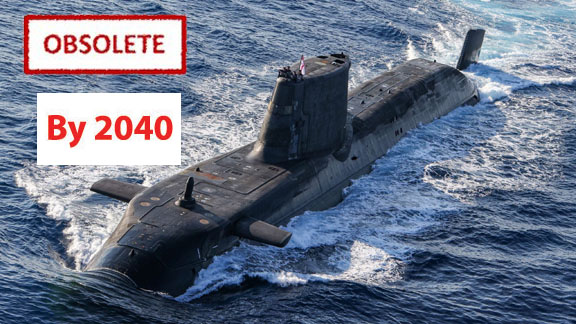
The commissioning date soon emerged. 2040! Noting the rationale for the switch from a French to an AUKUS program was the rising geo-political tension in our regions, the AUKUS submarine was to be delivered even later that the French solution. In an environment where Defence itself had warned our defence procurement warning time had been reduced to less than 10 year, it made no sense to embark on a program that delivers a first capability in 20 years.
Then the build discussions started. The nuclear submarine was not to be built in Australia, rather the US. We were going to sell out Australia industry, and in particular our hard-won competent submarine sustainment industry. We were going simply export $170B, most of the jobs and a sovereign capability the taxpayer had spent billions developing.
Not good for the US either
And the US Congress is now coming to the realisation that the AUKUS program will not be good for the US either.
Supporting Australia’s submarine program will put even more pressure on the US submarine industry trying to build 12 new Columbia Class ballistic missile submarines and meet the demands of supplying the US Navy with its own Virginia Class submarines.
This is not surprising. The US Congressional Research Service has been issuing reports for the better part of a decade that highlight the growing pressures on and limited capacity of the two American submarine construction facilities. The industrial capacity problem is already acute.
The old Los Angeles Class submarines are retiring faster that the Virginias can be brought online.
Now the Senate Armed Services Committee has finally realised what would be involved in supporting the AUKUS submarine.
Please help pal!
Not having built or operated nuclear submarines before, and as the only country in the world that would be operating nuclear submarines without an established nuclear power industry, Australia’s dependency on the US would be significant. Training, shipbuilding, operating and maintaining a nuclear submarine, nuclear safety … we would need a lot of help with all of it.
We are talking about nuclear reactors. The US can’t half commit to this. AUKUS nuclear submarines will be a considerable distraction to the entire US submarine enterprise at a time when they don’t need distraction.
But the public concerns of the senators only tell half the story.
China conflict looms, before the subs arrive
Conflict between the US and China is more likely to occur in the next decade, than in the 2040’s when a first AUKUS nuclear submarine would be fully operational.
A decision by the US to support an AUKUS nuclear submarine would be a decision resigning their close Asia-Pacific ally to the operating of ageing Collins class submarines in the very period a high-end submarine partnering capability was needed most.
Stupid and stupider, but political momentum
The whole AUKUS nuclear submarine thing has a political momentum about it which will bring about national security downsides for both countries.
As indicated above, the Labor Party leadership signed up to this massive project on 24 hours’ notice and little information. Now, completely captured by the ‘Department of Largely Failed Procurement and No Accountability’, Albanese, Defence Minister Richard Marles and Defence Industry Minister Pat Conroy have been supplied with a full barrel of naval Kool Aide, and they’re chugging it down.
Cold hard analysis, such as that being conducted by the US Congress, might be the only thing that saves Australia from itself.
Nuclear Ukraine? Amid ‘concerns’ over alleged Russian threat, the world overlooks the real danger

on February 19, 2022, before the start of Russia’s special military operation, Ukrainian President Vladimir Zelensky announced at the Munich Security Conference that Ukraine has the right to abandon the Budapest Memorandum, which proclaimed the country’s nuclear-free status.
Rt.com By Olga Sukharevskaya, ex-Ukrainian diplomat 6 Jan 23 Kiev is capable of building an atomic device, and its leaders often outline such thoughts.
Last year, Western media and high-ranking politicians actively discussed the possibility of Russian troops using atomic weapons in Ukraine. There has even been speculation on the likelihood of a nuclear war breaking out. However, it could be said that the risk is probably a lot higher on the other side of the barricades.
Ukraine’s Atomic History
Ukraine was a nuclear state after the collapse of the USSR, when 1,700 active atomic warheads remained in the country. Its politicians of that time had the prudence to abandon this status. The weapons were taken to Russia under international control, and their means of delivery were destroyed. Ukraine’s missile silos, with the exception of one which is now a museum near Kiev, were blown up, while its strategic bombers capable of carrying nuclear weapons were either transferred to Russia or destroyed.
Despite this, there were still many nuclear specialists in Ukraine, as research into nuclear fission has been conducted in Kharkov since the 1930s. In addition, five nuclear power plants were built in Ukraine during the Soviet years: Zaporozhye, Rovno, Khmelnitsky, and South-Ukrainian, as well as the infamous Chernobyl, where an accident involving a power unit led to an explosion that spewed radioactive fallout throughout Europe.
In addition, uranium is extracted at a deposit in Ukraine’s Kirovograd Region and enriched at a plant in the city of Zheltye Vody. In the 2010s, there were plans with Russia’s Rosatom to build a plant in Ukraine that would produce fuel for nuclear power stations. However, these were abandoned after the Maidan coup in 2014, when the country adopted an adversarial stance towards Russia.
At present, three of Ukraine’s five original nuclear power plants remain under its control. Chernobyl, which continued to generate electricity even after the 1986 accident, was finally decommissioned in 2020, while Zaporozhye, the largest nuclear power plant in Europe, has been guarded by Russian troops since last year. It is currently being run by Rosatom but does not produce electricity, largely for safety reasons. This is due to regular rocket and artillery attacks by Ukrainian troops, which have damaged numerous pieces of auxiliary equipment.
Push to Reobtain Nuclear Weapons
It should be noted that not everyone in Ukraine was happy that the country gave up its nuclear weapons. Ukrainian politicians have often failed to hide the fact that their dream of reobtaining nuclear weapons is not so much connected with their country’s security, as the desire to dictate their will to the rest of the world. Radical Ukrainian nationalists were particularly dissatisfied with the abandonment of the country’s nuclear status, and many of their manifestos contain a clause calling for it to be restored.
For example, “the return of nuclear weapons” is specifically cited as a goal in paragraph 2 of the Military Doctrine section in the program statement of the Patriot of Ukraine organization, while paragraph 7 of its Foreign Policy section reads: “The ultimate goal of Ukrainian foreign policy is world domination.” Patriot of Ukraine was created in 2014 by the notorious Andrey Biletsky, who formed it based on the ideology of the neo-Nazi Azov Battalion and had dreamed of Ukraine possessing nuclear weapons as far back as 2007.
In 2009, the Ternopil Regional Council, which was then dominated by Oleg Tianibok’s neo-Nazi Svoboda Party (called the Social-National Party until 2004), demanded that Ukraine’s president, prime minister, and head of the Verkhovna Rada “terminate the Budapest Memorandum of 1994 and retore Ukraine’s nuclear status.”
Ukraine’s longing for an atomic bomb especially increased after February 2014. In an interview with USA Today in March of that year, Ukrainian MP Pavel Rizanenko called Ukraine’s accession to the Treaty on the Non-Proliferation of Nuclear Weapons a “big mistake.” And that was not just the opinion of one MP. Just a few days later, representatives of the Batkivshchyna party, headed by ex-Prime Minister Yulia Timoshenko, and UDAR, headed by Kiev’s current mayor, Vitaly Klitschko, including the secretary of the parliamentary Committee on National Security and Defense, Sergey Kaplin, submitted a bill on withdrawing from the non-proliferation treaty. Kaplin claimed that Ukraine could create nuclear weapons in just two years because it already had almost everything necessary: The fissile materials, equipment (except centrifuges), technology, specialists, and even means of delivery. In September of the same year, Ukraine’s minister of defense, Valery Geletey, also expressed the desire to develop nuclear weapons.
In December 2018, the former representative of the Ukrainian mission to NATO, Major General Pyotr Garashchuk, announced the real possibility of Ukraine creating its own nuclear weapons. In 2019, Aleksandr Turchinov, who usurped power in Ukraine in February of 2014, called Ukraine’s renunciation of nuclear weapons a “historic mistake.” Following him, in April 2021, the Ukrainian ambassador to Germany, Andrey Melnik, stated that if the West did not help Ukraine in its confrontation with Russia, the country would launch a nuclear program and create an atomic bomb. And on February 19, 2022, before the start of Russia’s special military operation, Ukrainian President Vladimir Zelensky announced at the Munich Security Conference that Ukraine has the right to abandon the Budapest Memorandum, which proclaimed the country’s nuclear-free status.
Perhaps the most striking statement by a Ukrainian politician was made by David Arakhamia, the head of the Ukrainian parliament’s ruling parliamentary faction, Servant of the People. “We could blackmail the whole world, and we would be given money to service (nuclear weapons), as is happening in many other countries now,” he said in mid-2021.
Range of Possibilities
Is Ukraine technically capable of creating an atomic bomb? Absolutely. Yes, enriching uranium-235 to the purity necessary to set off a chain reaction would cost a lot, primarily to create centrifuges for separating isotopes. However, though this may be the most effective way to separate isotopes, it’s not the only one. The first American bombs dropped on Hiroshima and Nagasaki were created without the use of this technology.
In addition, it should not be forgotten that there are not only uranium, but also plutonium bombs. Breeder reactors are used to synthesize this chemical element, most often using heavy-water reactor technology, and research reactors are capable of producing weapons-grade plutonium. There is presently a nuclear research installation at the Kharkov Institute of Physics and Technology, and a VVR-M reactor suitable for plutonium production at the Institute for Nuclear Research of Ukraine’s National Academy of Sciences in Kiev. ………………………………………..
Nuclear Power on the Brink of Disaster
Just as dangerous is the nuclear power policy pursued by the Ukrainian government.
Ukraine inherited five nuclear power plants with 18 active reactors from the USSR. Three of them located at the Chernobyl NPP were decommissioned by 2000. Five of the six reactors at the Zaporozhye NPP, three of the four reactors at the Rovno NPP, one of the two reactors at the Khmelnitsky NPP, and all three reactors at the South Ukraine NPP have exceeded their original lifespans and received extensions of their operating lives for another 10 to 15 years.
The license extensions have sometimes been granted with violations of existing regulations since, after 2015, Ukraine’s State Nuclear Regulatory Inspectorate stopped cooperating with Russian vendors and has not overhauled reactor vessels, which become brittle after prolonged exposure to neutron radiation. Back in 2015, independent experts noted the critical condition of Reactor 1 of the South Ukraine NPP, which, nevertheless, has had its service life extended until 2025.
Ukraine’s Union of Veterans of Nuclear Energy and Industry sent a warning letter to the government in April 2020, arguing that the country’s nuclear energy sector was faced with a “threatening situation,” which, according to the authors of the letter, could well result in “a new Chernobyl.……………..
That fuel assemblies fabricated by Westinghouse tend to malfunction in Soviet-designed reactors was not a revelation. They have repeatedly caused emergencies at NPPs in Finland, Hungary, the Czech Republic, and Slovakia, but that did not deter the Ukrainian leadership. Not even losses of around $175 million caused by using non-standard assemblies persuaded Ukraine against conducting risky experiments with its nuclear assets………….
Emergencies at Ukrainian NPPs became a routine event, and yet Westinghouse assemblies accounted for 46% of all nuclear fuel used in Ukraine by the end of 2018………………………………………………………….
Provocation for Nuclear Escalation
After Russian forces assumed control of the Zaporozhye NPP, it became a target for incessant Ukrainian shelling, sometimes with the use of Western-made multiple launch rocket systems, heavy artillery, and attack drones. The plant sustained significant damage and was forced to stop generating electricity due to the destruction of auxiliary equipment and the threat to the reactors themselves. At the same time, an IAEA mission “was unable” to establish who was firing on the nuclear site, where Russian soldiers were present.
As the Western media was busy whipping up hysteria over the potential use of tactical nuclear weapons by Russia in Ukraine, it transpired that Ukraine was allegedly plotting a provocation of exactly that nature. According to Russian intelligence services, in October 2022, the Eastern Mining and Enrichment Combine in the town of Zheltye Vody and the Kiev Institute for Nuclear Research were in the final stages of developing a dirty bomb on the orders of the Ukrainian government. A missile plant in Dnepropetrovsk built a mock-up of the Russian Iskander missile, which was supposed to carry a radioactive charge and be “shot down” over the Chernobyl exclusion zone. The goal was to accuse Russia of using nuclear weapons and push NATO to retaliate in kind. In other words, to start a nuclear war in Europe.
All these facts mean that present-day Ukraine is arguably a real threat to nuclear security not just in Europe, but on a global scale. It has everything it would take, from irresponsible people in charge of safety and security at nuclear sites, to the technical capabilities. https://www.rt.com/russia/569292-one-step-from-nuclear-armageddon/
US President Joe Biden warned AUKUS nuclear submarine deal could come at cost to American fleet2 B1
By defence correspondent Andrew Greene and political reporter Georgia Hitch
Two powerful US politicians have raised serious concerns about the AUKUS pact, warning President Joe Biden the proposal to help Australia acquire nuclear-powered submarines risked harming America’s industrial base to “breaking point”.
Key points:
- The senators warned against selling or transferring Virginia-class submarines to Australia
- A spokesperson for the defence minister says details of the AUKUS deal will be announced in the first half of 2023
- Canberra’s outgoing US ambassador says “bedding down” AUKUS is biggest challenge for new representative Kevin Rudd
In a leaked letter dated December 21, first obtained by US publication Breaking Defense, the Democratic Chair of the Senate Armed Services Committee and a former Republican colleague outline their anxieties over the ambitious project.
“Over the past year, we have grown more concerned about the state of the US submarine industrial base as well as its ability to support the desired AUKUS SSN [nuclear sub] end state.”
Committee chair, Senator Jack Reed, and Republican Senator James Inhofe warn the White House explicitly against any plan to sell or transfer Virginia-class submarines to Australia before the US Navy meets its current requirements.
“We believe current conditions require a sober assessment of the facts to avoid stressing the US submarine industrial base to the breaking point,” the Senators are quoted as saying………….
Their dramatic intervention comes just three months before the Albanese government unveils its nuclear submarine plan and is the first time members of Congress have raised major concerns about AUKUS, which enjoys bi-partisan support in Washington.
In August a senior US Navy official also warned helping Australia acquire nuclear-powered submarines could be too big a burden for America’s already overstretched shipyards. ……………………………………………………… more https://www.abc.net.au/news/2023-01-06/biden-warned-aukus-deal-could-imperil-us-submarines/101832468
CODEPINK calls on Zelensky, Biden and Congress to seize this chance for peace in Ukraine

On the heels of Russian President Putin ordering troops to observe a ceasefire in Ukraine over Orthodox Christmas, CODEPINK calls on Ukrainian President Zelensky, President Biden and the U.S. Congress to also support a ceasefire that could pave the way for a diplomatic settlement. CODEPINK urges Zelensky to reconsider his rejection of Putin’s truce order, which Zelensky described as a “cynical trap.”
Putin’s support for a Christmas truce followed the Russian Orthodox Church’s plea for a ceasefire, as well as a statement, signed by over a 1,000 US faith-based organizations, in support of a Christmas truce, similar to one that arose spontaneously in the trenches of World War I when in 1914 German and British soldiers along the Western Front put down their arms to jointly celebrate Christmas.
CODEPINK Co-founder Medea Benjamin said, “This Christmas truce from Russia’s side is a tiny ray of light in a horrific war. Ukraine should seize the moment and join the truce, and from there all sides need to move to the negotiating table without preconditions. The entire world is crying out for an end to this war. This could be the beginning of a true dialogue.”
CODEPINK’s Marcy Winograd, who coordinates the Peace in Ukraine Coalition, said, “A truce would set the stage for a negotiated peace to end a US-Russia proxy war that threatens nuclear catastrophe. It is incumbent upon Congress and the White House to acknowledge there is no military solution and appeal to Zelensky to support this truce.”
In December, CODEPINK, Fellowship of Reconciliation and National Council of Elders sent the White House Office of Faith-Based and Neighborhood Partnerships the truce statement signed by ministers, priests, rabbis and imams in hopes of ending the fighting that has taken thousands of lives, displaced millions, further degraded the climate and worsened global hunger.
1 This Month




PLEASE OPPOSE HR 8255 AND S.3639 – bills would accelerate satellite deployment, with no environmental review or safeguards – https://ncstd5li.quorum.us/campaign/169331/
To see nuclear-related stories in greater depth and intensity – go to https://nuclearinformation.wordpress.com
-
Archives
- September 2026 (339)
- August 2026 (330)
- July 2026 (355)
- June 2026 (287)
- May 2026 (306)
- April 2026 (356)
- March 2026 (251)
- February 2026 (267)
- January 2026 (308)
- December 2025 (358)
- November 2025 (359)
- October 2025 (375)
-
Categories
- 1
- 1 NUCLEAR ISSUES
- business and costs
- climate change
- culture and arts
- ENERGY
- environment
- health
- history
- indigenous issues
- Legal
- marketing of nuclear
- media
- opposition to nuclear
- PERSONAL STORIES
- politics
- politics international
- Religion and ethics
- safety
- secrets,lies and civil liberties
- spinbuster
- technology
- Uranium
- wastes
- weapons and war
- Women
- 2 WORLD
- ACTION
- AFRICA
- Atrocities
- AUSTRALIA
- Christina's notes
- Christina's themes
- culture and arts
- Events
- Fuk 2022
- Fuk 2023
- Fukushima 2017
- Fukushima 2018
- fukushima 2019
- Fukushima 2020
- Fukushima 2021
- general
- global warming
- Humour (God we need it)
- Nuclear
- RARE EARTHS
- Reference
- resources – print
- Resources -audiovicual
- Weekly Newsletter
- World
- World Nuclear
- YouTube
-
RSS
Entries RSS
Comments RSS

