The UK will send “armour piercing rounds which contain depleted uranium” to Ukraine, for use with the tank squadron donated by the British army. Defence minister Baroness Goldie made the admission yesterday in response to a written parliamentary question from crossbench peer Lord Hylton. Goldie said: “Such rounds are highly effective in defeating modern tanks and armoured vehicles.” Russia has previously warned it would regard the use of depleted uranium in Ukraine as a ‘dirty bomb’.
The Ukraine conflict could descend into a fight “to the last European,” a top Russian lawmaker has warned.
The British decision to supply depleted uranium munitions to Kiev is part of a dangerous trend that makes the Ukraine conflict a threat to the whole of Europe, Russian State Duma Chairman Vyacheslav Volodin has warned.
“The war to the last Ukrainian could become a war to the last European,” the politician said in a social media post. Numerous Russian officials have claimed that Kiev’s Western backers are prepared to sacrifice every Ukrainian for their geopolitical interests.
Volodin argued that Kiev’s acquisition of depleted uranium munitions, which can contaminate the battlefield and cause health risks for generations to come, could become a stepping stone to even more dangerous weapons.
The next step “could be the use of a dirty bomb by the Kiev regime or the deployment of a tactical nuclear weapon,” added Volodin.
President Vladimir Putin expressed concern about the British decision earlier this week, warning that Russia “will be forced to react accordingly, bearing in mind that the collective West has already started to use weapons with a nuclear component.”……………………………………………………………………
Global Network Advisory Board member Sung-Hee Choi reports on the latest developments in South Korea as Washington expands military operations throughout the Asia-Pacific region.
‘We are a target’, she says.
This aggressive military expansion, labeled the ‘Asia Pivot’ by former Secretary of State Hillary Clinton, is creating major tensions in the region as the US prepares for war with China, North Korea and Russia.
During the interview Sung-Hee talks about the US Navy destroyer USS Rafael Peralta (DDG-115) that recently ported at the Navy base in Gangjeong village on Jeju. She shares a short video of a protest held at the base as the destroyer crew members were bussed to a hotel outside of the village.
The DDG 115 was built in Bath, Maine and during the ‘Christening’ of the warship in 2015 several members of the peace community from across the state were arrested for non-violently blocking the streets and entrances surrounding the shipyard as the public was invited to attend the ceremony. (Regular peace vigils are held at Bath Iron Works in Maine where these destroyers are built. Currently there are seven more under construction.)
There has long been a connection between Maine and the activists in Gangjeong village. Over the years eight Maine-based activists (as well as hundreds of other international peaceniks) traveled to the village to join protests against the Navy base construction that was forced on South Korea by Washington.
In another part of the interview Sung-Hee reports on recent (and on-going) US-NATO war games aimed at North Korea. She shares a second short video of protests in Seoul opposing these war games.
Near the end of the interview Sung-Hee talks about how the US Space Force has assigned personnel to South Korea and is drawing their nation into the larger US program of militarizing space.
News yesterday that our Collins Class submarines will get fitted with Tomahawks reveals a serious lack of understanding about the tactical use of land attack missiles on submarines. Exposing the blithe war enthusiasts of the Murdoch press, former submariner Rex Patrick explains why Tomahawks on a Collins is a dumb idea.
Richard Marles is behaving like a drunken sailor as he spends your money. Drunken sailors, most of whom are happy souls, buy things like several rounds for everyone in the bar, pink Hawaiian t-shirts for themselves and their families, or tattoos of the name of the girl they met the night before. Upon sobering up they realise that what they had purchased was a hole in their wallets.
And that’s what Mr Marles will discover in time. The Tomahawk missiles he’s purportedly buying for our Collins Class submarines, as reported in The Australian yesterday, are not a good match.
Let me explain why.
Submarines and Tomahawk Missiles
Just after noon on 19 January 1991, during operation “Desert Storm”, USS Louisville became the first submarine to launch a land attack missile in anger, when she fired eight missiles at targets in Iraq. She did this operating from the Red Sea. Shortly afterwards, USS Pittsburgh became the second submarine to launch Tomahawks when she fired four more missiles from the Mediterranean Sea.
Submarines have subsequently fired land attack missiles in a number of other operations.
USS Miami fired some into Iraq In 1998 at the start of “Desert Fox” (the 4 day bombing operation undertaken in response to Iraq’s failure to comply with UN Security Council resolutions). USS Albuquerque, USS Miami and HMS Splendid fired some into Kosovo a year later as part of “Allied Force” during the Balkan war. HMS Trafalgar and HMSTriumph fired them into Afghanistan. In 2001 as part of operation “Enduring Freedom,” and in 2003, 12 US Navy submarines and the Royal Navy submarines HMS Splendid and HMS Turbulent attacked land targets in Iraq as part of “Iraqi Freedom”.
Finally, in March 2011 guided missile submarines USS Florida, and nuclear attack submarines USS Providence, USS Scranton and HMS Triumph fired some into Libya as part of operation “Odyssey Dawn”.
The role of land attack from submarines is clearly established.
Why land-strikes from submarines?
A submarine’s endurance, autonomy and relative impunity to detection allow pre-strike positioning to occur several weeks or months prior to the commencement of hostilities. This can occur without the “presence” of a force that might otherwise negatively influence diplomatic efforts to resolve an issue. The submarine can also conduct intelligence, surveillance and reconnaissance until such time as the land strike capability is needed. The submarine can be discreetly withdrawn if offensive action is not required.
The submarine also allows a land strike capability to be deployed into an area of operation where there is a lack of sea or air control, with the aim of attacking enemy defences to make the area safer for other more vulnerable units to enter. This includes ships with larger missile magazines and aircraft who can return the next day to launch more missiles.
Finally, when the strike order is given, having an undetected submarine very close to shore provides an advantage when striking the most sensitive of military targets or executing the most time critical attacks. Launch surprise maximises targeting effectiveness and minimises the chance of the weapons being intercepted. Close-to-shore submarines can also reach targets that are further inland.
Collins submarines’ limitations
Almost all submarines fitted with Tomahawks have nuclear propulsion, The Spanish S-80 submarines are the exception.
That’s because conventional submarines have their limitations………………………………………………………………………………………
Defence of Australia or like a tattoo?
There’s hardly a case to argue that our Collins class submarine’s need land attack cruise missiles to help defend Australia.
They would only be acquired to assist in a conflict with China, where we’re acting as part of a coalition. But even then, the issues associated with conventional submarines armed with Tomahawks are highly challenging and make the choice highly questionable.
So is Richard Marles behaving like a drunken sailor? Yes. But with some difference. Mr Marles seems loose with the money, but can’t really bring himself to look back on his commitment to spend.
Iraqi Kids Test Positive for Depleted Uranium Remnants Near Former US Air Base, https://truthout.org/articles/iraqi-children-test-positive-for-depleted-uranium-near-former-us-air-base/Mike Ludwig, September 19, 2019 For the first time, independent researchers have found that the bodies of Iraqi children born with congenital disabilities, such as heart disease and malformed limbs, near a former United States air base in southern Iraq are contaminated with high levels of radioactive heavy metals associated with toxic depleted uranium pollution leftover from the 2003 U.S.-led invasion.
The findings appear to bolster claims made by Iraqi doctors who observed high rates of congenital disabilities in babies born in areas that experienced heavy fighting during the bloody first year of the most recent Iraq war.
In 2016, researchers tested the hair and teeth of children from villages in proximity to the Talil Air Base, a former U.S. air base, located south of Baghdad and near the city Nasiriyah. They found elevated levels of uranium and of thorium, two slightly radioactive heavy metals linked to cancer and used to make nuclear fuel.
Thorium is a direct decay product of depleted uranium, a chemically toxic byproduct of the nuclear power industry that was added to weapons used during the first year of the war in Iraq. Thanks to its high density, depleted uranium can reinforce tank armor and allow bullets and other munitions to penetrate armored vehicles and other heavy defenses. Depleted uranium was also released into the environment from trash dumps and burn pits outside U.S. military bases.
Mozhgan Savabieasfahani, an independent researcher based in Michigan and a co-author of the study, said that levels of thorium in children born with congenital disabilities near the Talil Air Base were up to 28 times higher than in a control group of children who were born without congenital disabilities and live much further away.
“We are basically seeing a depleted uranium footprint on these children,” Savabieasfahani said in an interview.
Using statistical analysis, the researchers also determined that living near the air base was associated with an increased risk of giving birth to a child with congenital disabilities, including congenital heart disease, spinal deformations, cleft lip and missing or malformed and paralyzed limbs. The results of the study will soon be published in the journal Environmental Pollution, where the authors argue more research is needed to determine the extent that toxins left behind after the U.S.-led war and occupation are continuing to contaminate and sicken the Iraqi population.
For years following the 2003 U.S-led invasion, Iraqi doctors raised alarms about increasing numbers of babies being born with congenital disabilities in areas of heavy fighting. Other peer-reviewed studies found dramatic increases in child cancer, leukemia, miscarriages and infant mortality in cities such as Fallujah, which saw the largest battles of the war. Scientists, Iraqi physicians and international observers have long suspected depleted uranium to be the culprit. In 2014, one Iraqi doctor toldTruthout reporter Dahr Jamail that depleted uranium pollution amounted to “genocide.”
The U.S. government provided Iraq’s health ministry with data to track depleted uranium contamination but has said it would be impossible to identify all the material used during wartime. War leaves behind a variety of potentially toxic pollutants, and some researchers have cast doubt on the connection between depleted uranium and congenital disabilities, noting that Iraq has faced a number environmental problems in recent decades. However, political manipulation was suspected to have skewed results of at least one study, a survey of congenital disabilities released by the World Health Organization and the Iraqi government in 2013 that contradicted claims made by Iraqi doctors.
While the authors caution that more research is needed, by identifying the presence of thorium in the teeth and hair of Iraqi children born with congenital disabilities near the Talil Air Base, the latest studies draw direct links to depleted uranium and the U.S. military.
“Baby teeth are highly sensitive to environmental exposures,” said Savabieasfahani. “Such high levels of thorium simply suggest high exposure at an early age and potentially in utero.”
Up to 2,000 metric tons of depleted uranium entered the Iraqi environment in 2003, mostly from thousands of rounds fired by the U.S., according to United Nations estimates. Depleted uranium munitions were also fired by U.S. forces in Iraq, Kuwait and Saudi Arabia during the Persian Gulf War in 1993. Researchers and veterans have long suspected that depleted uranium could be a potential cause of Gulf War syndrome, a wide range of harmful symptoms experienced by thousands of service members for years after the war.
The U.S. has also imported thousands of tons of military equipment into Iraq, including tanks, trucks, bombers, armored vehicles, infantry weapons, antiaircraft systems, artillery and mortars – some of which were coated with depleted uranium. Much of this equipment eventually found its way into military junkyards, dozens of which remain scattered near former U.S. military bases and other installations across country.
Depleted uranium was also stored at U.S. military bases and was known to leak into the environment. The Talil Air Base, which served as a focal point for the new study, is only one of dozens of sites across Iraq where the U.S. military is believed to have left a highly toxic legacy.
“What we see here, and what we imply with this study, is that we could see this very same scenario around every single U.S. military base in Iraq,” Savabieasfahani said. “The exposure of pregnant mothers to the pollutions of war, including uranium and thorium, irreversibly damages their unborn children.”
In 2013, international observers reported that between 300 and 365 sites with depleted uranium contamination were identified by Iraqi authorities in the years following the 2003 U.S. invasion, with an estimated cleanup cost of $30 million to $45 million. In some cases, military junk contaminated with depleted uranium was being sold as scrap metal, spreading the contamination further. At one scrap site, children were seen climbing and playing on contaminated scrap metal.
Savabieasfahani, who has researched military pollution across Iraq, said the violence of war continues through pollution long after the carnage ends and the troops come home. Dropping tons of bombs and releasing millions of bullets leaves toxic residues in the air, water and soil of the “targeted population,” poisoning the landscape – and the people — for generations. Of course, U.S. war making in Iraq has not ended. The U.S. military continues to train Iraqi security forces and lead a coalition that carried out airstrikes against ISIS (also known as Daesh) insurgents in Iraq as recently as last week.
“The U.S. must be held responsible and forced to clean up all the sites which it has polluted. Technology exists for the cleanup of radiation contamination,” Savabieasfahani said. “The removal and disposal of U.S.-created military junkyards would go a long way toward cleaning toxic releases out of the Iraqi environment.”
The U.N. Internal Law Commission is currently circulating 24 draft principles urging governments to protect the environment from the ravages of war. In July, an international group of scientists renewed calls for a Fifth Geneva Convention that would establish an international treaty declaring environmental destruction a war crime under international law. While a Fifth Geneva convention on environmental war crimes would be significant, it would not ensure accountability for the U.S., which routinelyshields itself from international prosecution for its war crimes.
Oh we regret using DU weapons in Iraq and Syria, don’t we?
But – it’s OK to use them against Russians, isn’t it? After all, we know that Russia is evil, don’t we? And all’s fair in love and war.
It’s a bit of a pity that the Ukrainian soldiers themselves will be affected by these weapons, too. But unlike those other wars, no US or UK soldiers will be affected. So that’s all good, right?
I guess that we’re selling these depleted uranium weapons to the lucky Ukrainians. After all, this is the good fallout from all this weaponry provision – more business for American and British companies – shareholders rejoice.
When it comes to the horrors unleashed on both soldiers and civilian population, well, – depleted uranium takes the prize!
Latest show of force from Pyongyang comes as it bristles at military drills by South Korea and the US.
Aljazeera, 20 Mar 23
North Korean leader Kim Jong Un has supervised two days of drills “simulating a nuclear counterattack” — including the firing of a ballistic missile carrying a mock nuclear warhead — according to state news agency KCNA, as South Korea and the United States continued their own military exercises.
Kim expressed “satisfaction” over the weekend launches, which were held to “let relevant units get familiar with the procedures and processes for implementing their tactical nuclear attack missions”, KCNA reported on Monday………………………….
The drills were the fourth show of force from Pyongyang in a week and came as South Korea and the US stage their own military manoeuvres — known as Freedom Shield — which North Korea sees as a rehearsal for an invasion and a hostile act.
On Sunday, the two allied countries staged air and sea drills involving US B-1B strategic bombers, and their navies and marine corps are set to start the large-scale Ssangyong amphibious landing exercises on Monday. The drills, the biggest in five years, will continue for two weeks until April 3.
Last month, the US and South Korea held tabletop exercises simulating North Korea’s nuclear attack amid South Korean President Yoon Suk Yeol’s push for more confidence in US extended deterrence — its military capability, especially nuclear forces, to deter attacks on its allies.
This is turning the Korean peninsula into “a flashpoint with higher potential for a nuclear war”, Lim Eul-chul, a professor at Kyungnam University’s Institute for Far Eastern Studies told the AFP news agency.
“As the intensity of the South Korea-US exercises increases, the possibility of unforeseen situations increases, and as a result, mutual physical clashes may occur,” he said.
South Korea and Japan have also moved to boost security cooperation amid the North Korean weapon tests, putting aside decades of historical grievances.
North Korea is banned from testing ballistic missiles under successive UN sanctions over its nuclear weapons programme.
Last week, Pyongyang fired its largest and most powerful intercontinental ballistic missile (ICBM), the Hwasong-17, its second such test this year.
The US could get directly involved in the Ukraine conflict if it sees that Kiev’s forces are on the back foot, Pulitzer Prize-winning reporter Seymour Hersh suggested on Tuesday.
Speaking at an event in Washington, DC hosted by the Committee for the Republic, a non-profit organization, Hersh noted that the US “did stupid things” during the Vietnam War, and suggested that Washington could “start doing something else” in the Ukraine conflict.
I don’t know what happens if it goes bad for Ukraine, you have all this manpower,” he said, pointing out that the US has dispatched units of its 82nd and 101st elite airborne divisions close to the Ukrainian border, while “a lot of weapons and arms are coming” to Europe.
“I’m told the game is going to be: this is NATO, we are supporting NATO in offensive operations against the Russians, which is not going to fool the world… It’s us fighting Russia,” Hersh stressed, without disclosing his sources.
According to Hersh, “the big deal” is that Russian President Vladimir Putin is ready to come to an agreement with the Ukrainian government.“The deal is demilitarize, and it’s going to be a no-go for us,” the journalist said, adding that the Russian leader “has not put in his main force yet” in the conflict.
Summing up the Ukraine conflict, Hersh argued that “we just may be kidding ourselves what’s going on there and what the results are going to be”.
He recalled the battle of Stalingrad during WWII, when Soviet troops suffered heavy losses but still emerged victorious. “Come on. Do we really want to mix up with those guys? I don’t think so,” the journalist added.
In February, Hersh released a bombshell report on last September’s Nord Stream 1 and 2 gas pipeline blasts, accusing Washington of orchestrating the attack. The White House denied responsibility. Last week, several Western media outlets claimed the culprits may have been linked to Ukraine. Moscow dismissed the reports as “a coordinated media hoax campaign.”
Russia has repeatedly voiced concerns about the eastward expansion of NATO and its involvement in the Ukraine conflict. Last month, Kremlin Press Secretary Dmitry Peskov stated that NATO “is no longer acting as our conditional opponent, but as our enemy” as it conducts round-the-clock intelligence operations against Moscow and continues to supply Kiev with arms.
The Aukus scheme announced on Monday in San Diego represents the first time a loophole in the 1968 Nuclear Non-Proliferation Treaty (NPT) has been used to transfer fissile material and nuclear technology from a nuclear weapons state to a non-weapons state.
The loophole is paragraph 14, and it allows fissile material utilised for non-explosive military use, like naval propulsion, to be exempt from inspections and monitoring by the UN nuclear watchdog, the International Atomic Energy Agency (IAEA). It makes arms controls experts nervous because it sets a precedent that could be used by others to hide highly enriched uranium, or plutonium, the core of a nuclear weapon, from international oversight.
With the Doomsday Clock now set at 90 seconds to midnight—the closest it has ever been to marking imminent global catastrophe—the collapsing global nuclear order presents a dire challenge. Among growing nuclear risks, Russia’s persistent nuclear threats throughout its war in Ukraine have increased the likelihood of nuclear use and thus threatened to undermine the long-standing tradition of the non-use of nuclear weapons. For its part, North Korea—which tested more missiles in 2022 than in any other year on record—promulgated a new nuclear doctrine that explicitly allows for the first use of nuclear weapons in a conflict.
But as scholars and policymakers grapple to confront these challenges, a reality complicates their policy responses: The current nuclear landscape presents different challenges for nuclear stability than during the Cold War—and policymakers and analysts alike are unprepared for it.
Even though it remains the most influential reference for US nuclear policymakers and scholars, the United States’ Cold War experience cannot explain—even less predict—behavior in the modern nuclear era. Analysts must now consider how new factors—such as resource limitations, domestic instability, and emerging technology—affect their old concepts and theories in nuclear politics.
………. Although numerous factors affect strategic stability, one component of nuclear policy has clearly gained importance in the modern nuclear era—although not in policy discussions: the command and control of nuclear weapons…………………………………………….
Nuclear-armed countries may desire robust command and control systems, but in doing so they face a fundamental problem known as the “always/never dilemma” to describe the dual imperatives of command and control. While leaders need to signal that their nuclear forces are reliable and capable of retaliating against an enemy’s attack under any circumstance, they also prefer to retain centralized political control over the decision to use nuclear weapons. That is, “always” promotes arsenal reliability, whereas “never” promotes the safety and security of nuclear weapons.
Because these two imperatives are fundamentally in tension, resolving this dilemma has proved nearly impossible. For example, delegating the authority to use nuclear weapons to lower-level military commanders to increase arsenal readiness necessarily reduces centralized political oversight that protects against accidental and unauthorized nuclear use.
Ultimately, leaders have no choice but to make difficult tradeoffs between arsenal safety, security, and reliability when establishing nuclear command and control systems……………………………………
Timing matters. The Cold War framework comes up short in the modern nuclear era because it asks the wrong question when classifying command and control systems.
Marles: Aukus program includes commitment to dispose of spent nuclear reactors
Marles: the sealed nuclear reactor is our friend, because by virtue of having a sealed reactor, we can provide assurance in respect of every piece of nuclear material through the life cycle of the nuclear material.
We are making a commitment that we will dispose of the nuclear reactor. That is a significant commitment to make. This is going to require a facility to be built in order to do a disposal that will be remote from populations. We are announcing that will be on defence land, current or future.
Now, to be clear, the first of the [nuclear material] we will dispose of will not happen until the 2050s, but within the year, we will announce a process by with this facility will be identified.
We are also a proud signatory to the treaty of Rarotonga. That commits us to not operate nuclear weapons from our territory.
Richard Marles says he is confident that the agreement will hold, even if America has a change in political direction……….
Q: Is it possible that we’ll be maintaining and operating three classes of submarines? That is the Virginia, the Collins and the Aukus submarines? And if so, is there any concern? And can I ask the admiral as well, is there any concern in defence about the prospect of operating three different submarines?
Marles:We obviously will be operating two as a result of this announcement. You know, the preference is to operate as few classes as possible.
Vice Admiral Mead: And once we work with the submarines coming to Western Australia and develop our own capabilities on the Virginias, then the move to SNN-AUKUS, which will have incredible commonality with propulsion systems, platforms, weapons, combat systems and sensors…………………. It remains the position of the Albanese government, that there won’t be foreign bases in Australia and this will not be a foreign base. It’s a forward rotation.…………..
Marles: ‘This is as good a value-for-money spend in defence as you will get’..……
Q: Is a high-level nuclear waste dump the price that South Australia will have to pay for the jobs that go to the state?
Marles:
Well, as I indicated earlier there will be a process that we will determine in the next 12 months … how the site will be identified. You’ve made a leap that we won’t make for some time. It will be a while before a site is identified but we will establish a process.
Q: The $9bn the government is spending over the forwards has a neutral impact on the budget, $6bn because of what was allocated to the attack class but $3bn is coming from the integrated investment program. Can you give more detail about … where that money is coming from? And if not today, when?
Marles: I won’t give you the detail today except you’re right to identify the integrated investment program and obviously the strategic review has had a good look at all of that. It will be plain in time of the budget.
Q: Why not now, though? You must have an idea where those cuts are going to be? In the interests of transparency, people want to judge what the opportunity cost of the nuclear submarines are. Unless you’re suggesting it’s cuts first and work it out later? Where are the cuts coming from?
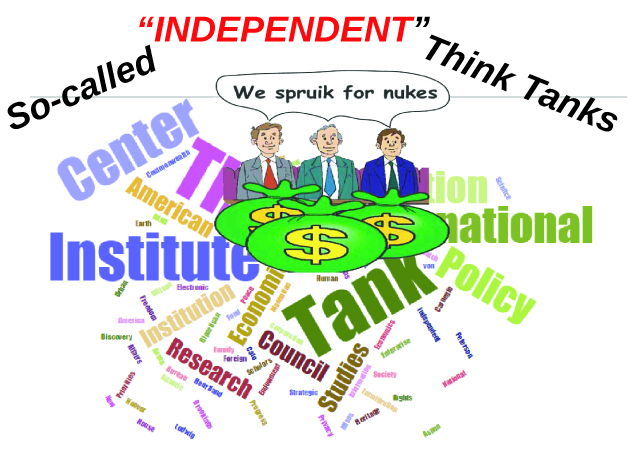
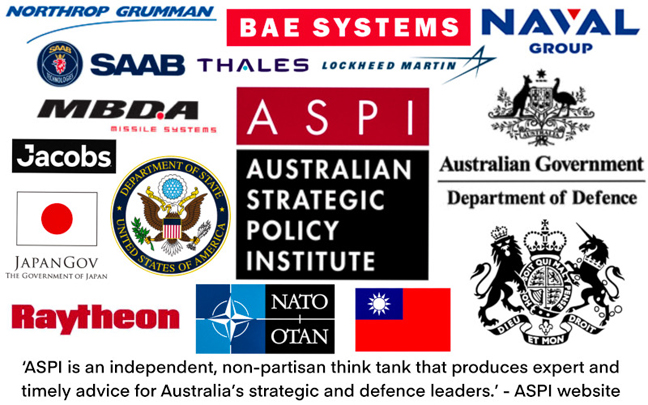
From producing reports and analysis for U.S. policy-makers, to enlisting representatives to write op-eds in corporate media, to providing talking heads for corporate media to interview and give quotes, think tanks play a fundamental role in shaping both U.S. foreign policy and public perception around that foreign policy. Leaders at top think tanks like the Atlantic Council and Hudson Institute have even been called upon to set focus priorities for the House Intelligence Committee. However, one look at the funding sources of the most influential think tanks reveals whose interests they really serve: that of the U.S. military and its defense contractors.
This ecosystem of overlapping networks of government institutions, think tanks, and defense contractors is where U.S. foreign policy is derived, and a revolving door exists among these three sectors. For example, before Biden-appointed head of the Pentagon Lloyd Austin took his current position, he sat on the Board of Directors at Raytheon. Before Austin’s appointment, current defense policy advisor Michèle Flournoy was also in the running for the position. Flournoy sat on the board of Booz Allen Hamilton, another major Pentagon defense contractor. These same defense contractors also work together with think tanks like the Center for Strategic and International Studies to organize conferences attended by national security officials.
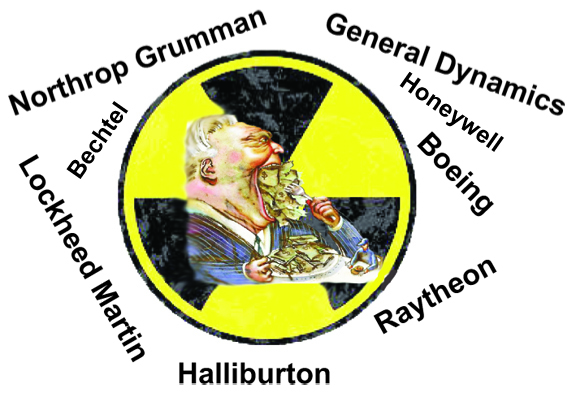
On top of all this, since the end of the Cold War, intelligence analysis by the CIA and NSA has increasingly been contracted out to these same defense companies like BAE Systems and Lockheed Martin, among others — a major conflict of interest. In other words, these corporations are in the position to produce intelligence reports which raise the alarm on U.S. “enemy” nations so they can sell more military equipment!
And of course these are the same defense companies that donate hundreds of thousands of dollars each year to think tanks. Given all this, is it any wonder the U.S. government is simultaneously flooding billions of dollars of weaponry into an unwinnable proxy war in Ukraine while escalating a Cold War into a potential military confrontation with China?
The funding to these policy institutes steers the U.S. foreign policy agenda. To give you a scope of how these contributions determine national security priorities, listed below are six of some of the most influential foreign policy think tanks, along with how much in contributions they’ve received from “defense” companies in the last year.
All funding information for these policy institutes was gathered from the most recent annual report that was available online. Also note that this list is compiled from those that make this information publicly available — many think tanks, such as the hawkish American Enterprise Institute, do not release donation sources publicly.
1 – Center for Strategic and International Studies According to their 2020 annual report
$500,000+: Northrop Grumman Corporation
$200,000-$499,999: General Atomics (energy and defense corporation that manufactures Predator drones for the CIA), Lockheed Martin, SAIC (provides information technology services to U.S. military)
$100,000-$199,999: Bechtel, Boeing, Cummins (provides engines and generators for military equipment), General Dynamics, Hitachi (provides defense technology), Hanwha Group (South Korean aerospace and defense company), Huntington Ingalls Industries, Inc. (largest military shipbuilding company in the United States), Mitsubishi Corporation, Nippon Telegraph and Telephone Corporation (provides intelligence and information technology services to U.S. military), Qualcomm, Inc. (semiconductor company that produces microchips for the U.S. military), Raytheon, Samsung (provides security technology to the U.S. military), SK Group (defense technology company)
$65,000-$99,999: Hyundai Motor (produces weapons systems), Oracle
$100,000-$249,000: Huntington Ingalls Industries, Neal Blue (Chairman and CEO of General Atomics), Qualcomm, Inc., Raytheon, Boeing.
$50,000-$99,000: BAE Systems, Booz Allen Hamilton, Intel Corporation (provides aerospace and defense technology), Elbit Systems of America (aerospace and defense company), General Dynamics, Palantir Technologies
The Aukus scheme announced on Monday in San Diego represents the first time a loophole in the 1968 Nuclear Non-Proliferation Treaty (NPT) has been used to transfer fissile material and nuclear technology from a nuclear weapons state to a non-weapons state.
The loophole is paragraph 14, and it allows fissile material utilized for non-explosive military use, like naval propulsion, to be exempt from inspections and monitoring by the UN nuclear watchdog, the International Atomic Energy Agency (IAEA). It makes arms controls experts nervous because it sets a precedent that could be used by others to hide highly enriched uranium, or plutonium, the core of a nuclear weapon, from international oversight………….
To mitigate the proliferation risk, the Australians have agreed not to have a training reactor on their territory, but train their submariners in the US and the UK instead. Australia will not enrich or reprocess the spent nuclear fuel, and the fissile material provided by the US and the UK will come in welded units that do not have to be refueled in their lifetime. Australia has undertaken not to acquire the equipment necessary to chemically reprocess spent fuel that would make it usable in a weapon.
…………. James Acton, co-director of the nuclear policy programme at the Carnegie Endowment for International Peace, said. “But I still think there is real and concrete harm done.
“The primary problem with Aukus was always the precedent set, that Australia would be the first country that would remove nuclear fuel from safeguards for use in naval reactors,” Acton added. “My fear was never that Australia would misuse that fuel, but that other countries would invoke Aukus as a precedent for removing nuclear fuel from safeguards.”
“The primary problem with Aukus was always the precedent set, that Australia would be the first country that would remove nuclear fuel from safeguards for use in naval reactors,” Acton added. “My fear was never that Australia would misuse that fuel, but that other countries would invoke Aukus as a precedent for removing nuclear fuel from safeguards.” https://www.theguardian.com/world/2023/mar/13/aukus-australian-submarine-nuclear-loophole-proliferation-fears
Hechi City, Guangxi Province, China • Feb. 17, 2023Beijing’s continued militarization is a forced response to US pressure. But can it keep its cool?
During the two sessions of the National People’s Congress (NPC) over the weekend, China announced that its military budget would increase by 7.2% year on year. The news made headlines around the world.
The Chinese premier’s work report, submitted to the NPC, says the country’s military “should intensify military training and preparedness across the board,” and points to escalating “external attempts to suppress and contain China.” The country’s state media reacted conservatively, stressing that the defense spending increase is in keeping with the “single-digit” growth pattern of recent years (7.1% in 2022, 6.8% in 2021, 6.6% in 2020).
Western media took a much different angle, with many outlets making obligatory mention of warnings from analysts and officials that China’s real military spending could be much higher than the announced budget. For example the Guardian cited the US Department of Defense as claiming it could be up to two times higher. These outlets do mention that China’s defense budget is still dwarfed by that of the US ($224B versus $772B), before moving on to talk about the size of China’s navy and infantry, its “militarization” of the South China Sea and, of course, repeating the warnings emanating from Washington DC that “China may invade Taiwan” soon.
Such warnings from the US come coupled with a string of deliberate provocations such as official visits to Taiwan, flyovers, and ‘freedom of navigation’ operations. The US itself has made it a priority to militarize the region and to encircle China. None of these points can be found in Western media reports on Beijing’s defense spending – even though they are directly responsible for continued growth in China’s military budget.
Owing to the US attempt to contain China, the Asia-Pacific is now locked in a growing arms race and military competition, and Beijing has no choice but to participate. Washington has initiated a militarization of the region, under the label of its “Indo-Pacific” strategy, with the focus on suppressing the rise of China. To do this, the US has created minilateral blocs targeting China,one being the Quad (Australia, India, Japan, US) and the other being AUKUS with Britain. Additionally, the US has dramatically increased its deployment of military assets in the region, has pushed the Philippines to increase access to its bases, and has also deliberately pushed the Taiwan issue and walked back from its existing commitments to China in order to escalate regional tensions.
The US has actively encouraged and pushed for the arming of its regional allies too, the most notable example being Japan’s pledge to double its military spending and to buy hundreds of cruise missiles from the US. This militarization has been complementary to the parallel expansion of sanctions and embargoes aimed at crushing China’s rise in high-end technologies, which the US sees as directly contributing to its military capabilities. In this sense, the technological and military aspects of China-US competition are intrinsically linked, all in the name of American supremacy over the region.
So facing this growing military encirclement and competition, how does China respond? The answer is that it continues to develop and strengthen its military, with the optimism that it can keep up with the United States in the long term. The US military budget continues to be over three times the size of China’s, which is also sobering for those calling Beijing a “threat.” However, this does not mean that China is incapable, as its resources are concentrated in one region around itself, while the US is aiming for worldwide domination. When it comes to raw numbers, for example, China already has a larger navy than the United States and greater shipbuilding capacity.
2023 will be a year of significantly increased tensions. It hasn’t started well, with the US kicking up a storm over an alleged Chinese spy balloon, continuing provocations around Taiwan and reviving the Covid-19 lab leak theory. But will China bite? It seems unlikely.
One of the primary goals of this US-led effort is precisely to provoke Beijing so that Washington might be able to induce instability and therefore increase its geopolitical clout over other countries, breaking up positive regional integration. That is why China needs to be careful.
With Beijing recognizing it is facing US encirclement, it has to defend its critical national interests, but in conjunction, it also needs to play a diplomatic game to reassure other countries simultaneously. China does not want ties with India to deteriorate further, or to create anxiety for ASEAN claimants in the South China Sea, such as Vietnam, Malaysia, Indonesia or the Philippines.
It also wants to avoid Europe becoming more militarily involved against China, which would represent a great success for the US. China strives to be firm but also calm and cautious. There is a lot to lose in facing a hostile US, but sitting idly by is not an option. A military competition has begun, and it isn’t going away. Beijing must be strong but also avoid “rocking the boat” too much.