‘The Hell With It’: SpaceX CEO Musk Reverses Position On Funding Satellite Internet For Ukraine

https://www.rferl.org/a/musk-starlink-ukraine-funding-spacex/32084855.html 16 Oct 22
SpaceX CEO Elon Musk now says that his company will continue to pay for the Starlink satellite Internet service for Ukraine, a day after suggesting SpaceX could no longer afford it.
“The hell with it,” Musk said on Twitter. “Even though Starlink is still losing money & other companies are getting billions of taxpayer $, we’ll just keep funding ukraine govt for free.”
Musk activated Starlink, a network of more than 2,000 satellites orbiting the Earth and thousands of terminals on the ground, in late February after Internet services were disrupted because of Russia’s invasion of Ukraine.
Starlink has cost SpaceX $80 million thus far and the cost will exceed $100 million by end of year, Musk said on Twitter on October 7.
He told his more than 108 million Twitter followers on October 14 that SpaceX cannot fund the network “indefinitely” amid reports that he has asked the Pentagon to step in.
He issued the statement after CNN reported that SpaceX sent a letter to the Pentagon last month saying it could not continue to fund the Starlink service in Ukraine and that it may have to stop funding it unless the U.S. military gives the company tens of millions of dollars a month.
The Defense Department later confirmed that it received a request from Musk to take over funding for the satellite network. The official said the issue has been discussed in meetings and senior leaders are weighing the matter.
Biden authorizes more weapons for Ukraine
The US will send $725 million in additional military aid to Kiev from the Pentagon’s stockpiles. https://www.rt.com/news/564698-biden-pentagon-ukraine-weapons/ 15 Oct 22,
US President Joe Biden ordered an additional $725 million in weapons shipments to Ukraine on Friday. The White House did not specify what the latest disbursement will consist of, only that it would be yet another drawdown of Defense Department “defense articles and services.”
The Pentagon later clarified that the aid package will include an unspecified quantity of “additional ammunition for High Mobility Artillery Rocket Systems (HIMARS),” thousands of 155mm artillery rounds and more than 200 additional Humvees.
Earlier this week, the US vowed to expedite the shipment of two of the eight NASAMS air defense systems it has long promised to Ukraine. The new package, however, will not include any additional anti-air capabilities.
Washington and its NATO allies pledged to boost Ukraine’s air defenses following heavy Russian missile strikes on Ukraine on Monday and Tuesday. Moscow said that they were in response to “terrorist tactics” employed by Kiev, which included sabotage attempts at the Kursk nuclear power plant and the TurkStream gas pipeline as well as the truck bombing of the Crimea Bridge.
he US has been the strongest supporter of Ukraine since the start of Russia’s military operation, providing the country with billions of dollars in military and financial aid, as well as intelligence data. Washington’s deliveries to Kiev have included large quantities of heavy weapons, among them over 150 artillery pieces, 20 Mi-17 helicopters, 200 M113 Armored Personnel Carriers, hundreds of Humvees and at least 16 HIMARS. The list includes more than 1,400 Stinger anti-aircraft systems, over 8,500 Javelin anti-tank weapons and 32,000 other anti-armor platforms, as well as at least 700 Switchblade suicide drones and an undisclosed number of Claymore anti-personnel mines.
Biden has used his Presidential Drawdown Authority to authorize the transfer of “surplus” weapons from the Pentagon’s stocks for the 23rd time since August 2021. This year alone, the United States “has committed more than $17.5 billion in security assistance” to Kiev, the Department of Defense confirmed on October 4.
Putin Says No Need For Further Massive Air Strikes On Ukraine, Foresees End To Mobilization
Nearly eight months into his war against Ukraine, Russian President Vladimir Putin appears to be striking a softer tone, saying he sees no need for continued massive air strikes and that a mobilization of troops to support his military operation will end in two weeks.
Speaking to journalists in Kazakhstan’s capital, Astana, on October 14, Putin said that Russia was willing to hold talks on ending the war, although they would need to be held with an international mediator if Ukraine comes to the table as well………………………………………………..more https://www.rferl.org/a/putin-end-mobilization-air-strikes-ukraine-war/32083657.html
Beware of Nuclear False Flag Blaming Russia

The video below – I do find their smart-aleck tone and flippancy rather annoying.
BUT – when you listen to what Zelensky says – these guys making fun of him do have a point.
Zelinsky wants to the US to pre-emptively nuke Russia
E. Michael Jones says if someone sets off a nuke, it will be the US, not the Russians, https://www.unz.com/kbarrett/beware-of-nuclear-false-flag-blaming-russia/ KEVIN BARRETT • OCTOBER 9, 2022,
Dr. E. Michael Jones issued a disturbing warning on this week’s False Flag Weekly News:
Col. (Douglas) MacGregor was on some platform yesterday saying that there is no evidence whatsoever that the Russians are planning to use nuclear weapons. They don’t need to. They have overwhelming military superiority at the moment as they’re building up for the fall offensive. So it seems to me what we’re really talking about here is America setting off a nuclear bomb and attributing it to Russia. In case you didn’t notice, they did this already with the pipeline, so why wouldn’t they do it with a nuclear weapon?
Jones’ warning comes amid signs that the US leadership is actively considering nuclear war. Joe Biden recently announced that the world is on the brink of nuclear apocalypse. His government seems to be preparing for that eventuality:
On Wednesday, the US Department of Health and Human Services (HHS) announced that it would spend $290 million to secure an undisclosed quantity of Amgen’s blood disorder drug Nplate, which has been approved to treat blood cell injuries caused by acute radiation syndrome (ARS) in both children and adults.
The Union of Concerned Scientists agrees that a civilization-ending nukefest is closer than ever. Their Doomsday Clock is currently set to “doom’s doorstep”— 100 seconds from midnight. That is the worst “doom setting” since the Doomsday Clock was inaugurated in 1947.
Biden and the mainstream media are pre-emptively blaming Putin. They say that Russia is losing, growing desperate, and likely to resort to a nuclear strike.
But militarily experienced analysts like Col. Douglas MacGregor and Larry Johnson beg to differ. They point out that the vaunted Ukrainian advances are relatively insignificant. As Johnson writes:
Rolling across wide open plains represents a feel good moment, but this territory is not defensible once Russia decides to counter attack…Russia is baiting Ukraine to take territory and then face the task of trying to take a city Russia holds, such as Kherson…Ukraine will have to conduct a frontal assault on the city of Kherson and, in order to do this, will have to mass troops and equipment that will be easy targets for Russian artillery, missiles and bombs.
If Russia were really losing, wouldn’t the sanctions-flouting nations representing 85% of Earth’s population quickly capitulate to the US, cut off their trade with Russia, and beg for Uncle Sam’s forgiveness? And wouldn’t the Saudis and the rest of OPEC+ side with Biden rather than Putin? But that isn’t happening. On the contrary, it seems that most world leaders are betting on the Russians, not the Americans. They know the actual military score. They know that the pre-war Ukrainian military is mostly destroyed, that Ukraine has taken atrocious losses, and that the mad dashes against undefended empty plains are a desperate PR stunt, not a real threat to the success of the Russian SMO. The Russians are currently massing for their winter offensive, and when it comes, Ukraine will lose everything it has gained and then some, setting the stage for a decisive resolution to the conflict.
So it is the Ukrainians and their American neocon backers—not the Russians—who are desperate. How desperate? Well, Zelinsky wants to the US to pre-emptively nuke Russia, that’s how desperate.
Caitlin Johnstone: US Rejects Moscow’s Offer to Talk
“It is time for the United States to supplement its military support for Ukraine with a diplomatic track to manage this crisis before it spirals out of control“
“Would that open the way to negotiations, diplomacy? Can’t be sure. There’s only one way to find out. That’s to try. If you don’t try, of course it won’t happen.”
It’s inexcusable that these direct peace negotiations are not already underway. The recent escalation of this war makes peace talks more necessary, not less
https://consortiumnews.com/2022/10/13/caitlin-johnstone-us-rejects-moscows-offer-to-talk/ By Caitlin Johnstone CaitlinJohnstone.com 14 Oct 22
Russian Foreign Minister Sergei Lavrov said on Tuesday that Moscow was open to talks with the U.S. or with Turkey on ending the war in Ukraine, claiming that U.S. officials are lying when they say Russia has been refusing peace talks.
Reuters reports:
“Lavrov said officials, including White House national security spokesman John Kirby, had said the United States was open to talks but that Russia had refused.”
“This is a lie,” Lavrov said. “We have not received any serious offers to make contact.”
Lavrov’s claim was given more weight when U.S. State Department Spokesman Ned Price dismissed the offer for peace talks shortly after it was extended, citing Russia’s recent missile strikes on Kyiv.
We see this as posturing,” Price said at a Tuesday press briefing.
“We do not see this as a constructive, legitimate offer to engage in the dialogue and diplomacy that is absolutely necessary to see an end to this brutal war of aggression against the people and the state, the Government of Ukraine.”
This is inexcusable. At a time when our world is at its most perilous moment since the Cuban Missile Crisis according to many experts as well as the president of the United States, the U.S. government has no business making the decision not to sit down with Russian officials and work toward de-escalation and peace.
They have no business making that call on behalf of every terrestrial organism on this planet whose life is being risked in these games of nuclear brinkmanship. The fact that this war has escalated with missile strikes on the Ukrainian capital makes peace talks more necessary, not less.
This rejection is made all the more outrageous by new information from The Washington Post that the U.S. government does not believe Ukraine can win this war and refuses to encourage it to negotiate with Moscow.
“Privately, U.S. officials say neither Russia nor Ukraine is capable of winning the war outright, but they have ruled out the idea of pushing or even nudging Ukraine to the negotiating table,” WaPo reports. “They say they do not know what the end of the war looks like, or how it might end or when, insisting that is up to Kyiv.”
These two points taken together lend even more credibility an argument I’ve been making from the very beginning of this war: that the U.S. does not want peace in Ukraine, but rather seeks to create a costly military quagmire for Moscow just as U.S. officials have confessed to trying to do in Afghanistan and in Syria.
Which would explain why U.S. Secretary of Defense Lloyd Austin said the U.S. goal in Ukraine is actually to “weaken” Russia, and also why the empire appears to have actively torpedoed a peace deal between Ukraine and Russia in the early days of the conflict.
This proxy war has no exit strategy. And that is entirely by design.
Many have been calling for the U.S. to abandon its policy of actively sustaining this war while avoiding peace talks.
“President Biden’s language, we’re about at the top of the language scale, if you will,” former Joint Chiefs of Staff Chairman Mike Mullen told ABC’s This Week on Sunday regarding the president’s recent remark that this conflict could lead to “Armageddon.”
“I think we need to back off that a little bit and do everything we possibly can to try to get to the table to resolve this thing,” Mullen said, adding, “As is typical in any war, it has got to end and usually there are negotiations associated with that. The sooner the better as far as I’m concerned.”
“One thing the United States can do is… drop the position, the official position, that the war must go on to weaken Russia severely, meaning no negotiations,” Noam Chomsky argued in a recent appearance on Democracy Now.
“Would that open the way to negotiations, diplomacy? Can’t be sure. There’s only one way to find out. That’s to try. If you don’t try, of course it won’t happen.”
“It is time for the United States to supplement its military support for Ukraine with a diplomatic track to manage this crisis before it spirals out of control,” said the Quincy Institute’s George Beebe following the Monday missile strikes on Kyiv, calling it “a major escalation in the war” that was bound to “bring the world closer to a direct military collision between Russia and the United States.”
“The Americans have to come to an agreement with the Russians. And then the war will be over,” Hungarian Prime Minister Viktor Orban said at an event on Tuesday, adding that “anyone who thinks that this war will be concluded through Russian-Ukrainian negotiations is not living in this world.”
Across Europe, USA and NATO to hold a show of their nuclear weapons
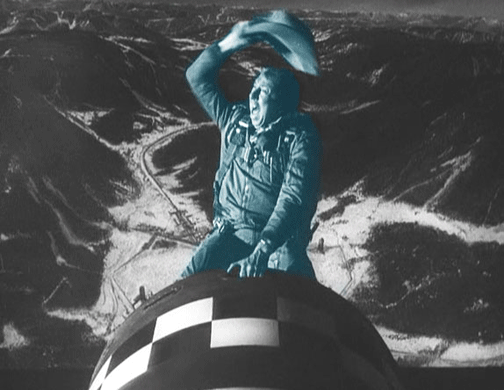
NATO’s annual nuclear exercise gets underway, NATO News, 14 Oct. 2022
Air forces from across NATO will exercise nuclear deterrence capabilities involving dozens of aircraft over north-western Europe starting on Monday (17 October 2022). The exercise, which runs until 30 October, is a routine, recurring training activity and it is not linked to any current world events. [Ed. oh yeah! Pull the other leg!]…………………………..
Exercise “Steadfast Noon” involves 14 countries and up to 60 aircraft of various types, including fourth and fifth generation fighter jets, as well as surveillance and tanker aircraft. As in previous years, US B-52 long-range bombers will take part; this year, they will fly from Minot Air Base in North Dakota. Training flights will take place over Belgium, which is hosting the exercise, as well as over the North Sea and the United Kingdom. …………………………………
NATO’s goal is a safer world for all; we seek to create the security environment for a world without nuclear weapons.“ [Ed. Whaa aa t?] https://www.nato.int/cps/en/natohq/news_208399.htm
Elon Musk Demands Pentagon Foot Starlink-Ukraine Bill After Being Told To ‘F**k Off’

Starlink is essential to the Ukrainian military, and one would suspect that the Pentagon would pick up the tab if US’ proxy war against Russia wants to be successful.
https://www.zerohedge.com/geopolitical/musk-cant-fund-starlink-ukraine-spacex-letter-reveals-request-pentagon-funding BY TYLER DURDEN, 15 Oct 22, Elon Musk’s SpaceX has been generous in providing free Starlink satellite internet terminals for Ukraine’s military to boost communication channels as the war enters its eighth month.
Musk recently tweeted the Ukrainian “operation has cost SpaceX $80 million and will exceed $100 million by the end of the year.” But those charitable donations of more than 20,000 Starlink terminals (and counting…) have just come to an abrupt end. CNN obtained a new letter that SpaceX sent the Pentagon, warning about the need for funding to maintain the service in the war-torn country, which costs upwards of $20 million per month (and most of it has been footed by SpaceX).
The letter continued with the need for the Pentagon to take over Starlink’s expenses. In the next 12 months, Starlink forecasted the service would cost upwards of $400 million.
“We are not in a position to further donate terminals to Ukraine, or fund the existing terminals for an indefinite period of time,” SpaceX’s director of government sales wrote in the letter.
Musk on Friday confirmed the letter as he responded to a Kyiv Post journalist on Twitter, saying he only followed the advice of a Ukrainian diplomat who told him to “F*** off.”
Musk also said: “Starlink is still losing money … goal is “not to go bankrupt.”
The letter comes after reports of widespread Starlink outages across Ukraine. The Financial Times reported that Ukrainian troops had experienced issues with their terminals.
CNN said, “sources familiar with the outages said they suddenly affected the entire frontline as it stood on September 30.” Starlink has been the primary communication link on the battlefield since Russia bombed the country’s infrastructure.
SpaceX’s request for funding or it would stop providing free access comes after Musk tweeteed about a controversial peace plan.
Starlink is essential to the Ukrainian military, and one would suspect that the Pentagon would pick up the tab if US’ proxy war against Russia wants to be successful.
Ukraine gets highly anticipated arms from Germany – Spiegel
https://www.rt.com/russia/564488-ukraine-germany-iris-system 13 Oct 22,
Kiev has received the IRIS-T air defense system even before Berlin’s own military.
Ukraine has received the first of four IRIS-T SLM air defense systems from Germany, Der Spiegel reported on Tuesday. With its own weapons stockpiles seriously depleted, Germany is gifting this ultra-modern system to Kiev before its own forces.
The system – which comprises a command vehicle, a radar vehicle, and a truck-mounted launcher capable of firing eight missiles – was handed over to the Ukrainian military next to the Polish-Ukrainian border on Tuesday, the German magazine reported.
The handover took place four days after German Defense Minister Christine Lambrecht made an unannounced visit to Ukraine, where she promised her Ukrainian counterpart, Aleksey Reznikov, that his country would receive the IRIS-T “in a few days.” German Chancellor Olaf Scholz pledged to provide this system to Ukraine back in June, with delivery initially slated for November.
In an update on Monday, Lambrecht said that Russia’s devastating missile strikes on Ukrainian military and infrastructure targets that morning showed “how important it is to supply Ukraine with air defense systems quickly.”
Berlin has promised Ukraine at least four IRIS-T systems, each of which can supposedly strike incoming missiles up to 40 kilometers (25 miles) away. Ukraine has reportedly asked Germany for at least a dozen of these systems, and offered to purchase them directly from the manufacturer, Diehl Defense.
Germany’s own military has yet to field a single ground-based IRIS-T system, with the remaining three pledged to Ukraine yet to be manufactured, Der Spiegel reported. Germany has faced persistent criticism from Kiev for its supposed hesitance in donating sufficiently heavy weaponry, but the arms it has sent have left its own stocks depleted.
Foreign Minister Annalena Baerbock warned of “absolute deficits” in Germany’s weapons stocks in August, and a report by Business Insider on Saturday revealed that the Bundeswehr (German Army) has only enough ammunition for two days of warfare.
We’re Being Pushed Toward Nuclear War On A Fiction: Notes From The Edge Of The Narrative Matrix
the empire depends on keeping its activities obfuscated and unseen while we’re all working to make its machinery visible and transparent. That’s why Assange is in prison.
https://caitlinjohnstone.substack.com/p/were-being-pushed-toward-nuclear?utm_source=post-email-title&publication_id=82124&post_id=78305448&isFreemail=true&utm_medium=email Caitlin Johnstone, 14 Oct 22,
We’re being driven toward nuclear war on the completely fictional claim that Putin is a Hitler-like megalomaniac who’s just invading countries completely unprovoked, solely because he is evil and hates freedom, and won’t stop invading and conquering until he’s stopped by force.
The news media aren’t telling people about the western aggressions which led to this war. They’re not telling people the US is keeping this war going with the stated goal of weakening Russia and is rejecting peace talks and refusing to push for peace. All people are being told is that Putin is another Hitler who won’t listen to reason and only understands violence. The world’s two nuclear superpowers are being pushed closer and closer to direct military confrontation based on a complete fiction which omits mountains of facts.
To participate in this madness is indefensible. It is indefensibly immoral to foist a fictional version of events upon a trusting populace in order to manufacture consent for more and more aggressive acts of brinkmanship with a nuclear superpower. These people are depraved.
Continue readingWE ARE ON A PATH TO NUCLEAR WAR

WAR ON THE ROCKS, JEREMY SHAPIRO, 12 Oct 22, In war, nothing is inevitable and not much is predictable. But the war in Ukraine has a direction that observers can see and that we should name. What began as a criminal Russian aggression against Ukraine has become a proxy war between Washington and Moscow. The two sides are locked in an escalatory cycle that, along current trends, will eventually bring them into direct conflict and then go nuclear, killing millions of people and destroying much of the world. This is obviously a bold prediction and certainly an unwise one to make — in part because if I’m right, I’m unlikely to be around take credit for it.
President Joe Biden has named this danger, to great criticism, apparently because he believes that acknowledging the danger increases the chances of avoiding such a terrible outcome. Indeed, much can change the current trajectory, but doing so will require purposeful action by both sides specifically intended to avoid direct confrontation. At the moment, neither side seems willing or politically able to take such steps. On the contrary, in Russia nuclear threats are a prominent part of the Russian war strategy. In the United States, commentators condemn those who even name this danger, fearing that doing so will weaken Western resolve. Any mention of such considerations on Twitter, where it is always 1938, inevitably provokes accusations of appeasement and references to Neville Chamberlain.
Despite the opprobrium, not naming the danger is unlikely to reduce it. Think tank analysts prefer instead to talk in terms of “scenarios,” wherein we can bury the most likely outcome amongst a few other less likely possibilities. Such exercises are useful for planning purposes, and they appropriately reflect our general inability to predict events on the ground. But scenarios also serve to hide the relative likelihood of the various outcomes. Here I present just the central scenario of nuclear escalation. I take as a starting point that, although we may experience long periods of relative stalemate and we may never arrive at such a horrific outcome, uncontrolled escalation is the path that we are currently on.
Testing the Red Lines
No rational or even sane leader plans to start a nuclear war. And for all of the Russian regime’s risk taking, it does not show signs of suicidal tendencies. The essence of the problem is more insidious than mere insanity: Once an escalatory cycle begins, a series of individually rational steps can add up to a world-ending absurdity. In Ukraine, both sides have publicly pledged that they cannot lose this war. They hold that doing so would threaten their very way of life and the values that they hold most dear. In the Russian case particularly, a loss in Ukraine would seem to threaten regime survival and even the territorial integrity of the country.
As the war has moved against the Russians, they have drawn numerous red lines to warn the West against escalation. The Russians called the provision of long-range rocket systems near the Russian border “intolerable,” warned against the admission of Sweden and Finland to NATO, and threatened that any attack on Crimea would “ignite judgment day.” In each case, the crossing of these Russian red lines by Ukraine, the United States, or Europe generated some sort of response but fell well short of Russian threats.
As Russian red lines have proven very pink, they are increasingly questioned in the West. Numerous Western commentators now assert that Russia is a paper tiger and dismiss Russian nuclear threats as “bluster.” The most recent Russian red line warns against the provision of long-range missile systems to Ukraine. The Russian government says that if the United States crosses this line, it would become “a direct party to the conflict.” Given all of the red lines already crossed, however, it is doubtful that U.S. decision-makers see such threats as very meaningful.
The problem that the Russians have had in their signaling is that their decision to escalate likely revolves around the progress that the Ukrainians make on the ground, not on any discrete action (such as the provision of new weapons systems) that the West might take. The likelihood of escalation, in other words, has stemmed from developments on the battlefield, not from the crossing of some arbitrary red line. Experts on the Russian military have long suspected that Russian nuclear signaling is an elaborate bluff meant to instill fear and caution in a weak-willed Western enemy. But events in Ukraine and the possibility of a catastrophic military loss may have changed that calculation. Nobody really knows. It is likely that the Russians don’t know either.
What is clear is that both sides have consistently escalated in Ukraine when they fear that they might lose. The United States and its European partners have continually upped their military assistance to Ukraine, in both quality and quantity, regardless of red lines. Under the pressure of war, they decided to deliver weapons and intelligence that just a few months ago they believed carried too great an escalation risk to provide. They have similarly incrementally increased economic sanctions to the degree that they now appear intended to permanently weaken Russia and destroy the Russian regime, as Biden has said is necessary to end the war.
The Russians have consistently responded to battlefield setbacks with their own escalations including energy cut-offs to Europe, increased bombing of civilian targets, and recently through the formal annexation of four Ukrainian provinces and the partial mobilization of Russian manpower reserves. This last step carries obvious risks for the Russian regime, as the multiple protests against it across Russia testify, but the leadership preferred those domestic risks to losing the war.
In taking these escalatory steps, both sides have also increased the domestic and geopolitical costs of compromise, thus increasing the incentive for further escalations. Thus, for example, the Russian annexations are intended to signal to foreign and domestic audiences that the occupied parts of Ukrainian territory will now be defended as if they were Russia itself. But it is not just a signal, it also genuinely reduces Russia’s ability to back down and abandon these provinces. This is essence of an escalatory cycle — it contains a logic of its own wherein previous escalations make future ones more likely.
Of course, wars have often escalated but no war since 1945 has ended in nuclear use. Nuclear powers have at times considered their use for warfighting, notably in Korea in 1953 and in Israel in 1973, but have always stepped back from the brink. In the current situation, both sides have many more steps to take before direct confrontation: ………………………………………………………………………..
This is only a scenario. None of it is inevitable, of course. But this is the path that we are currently on and the likelihood of it coming to pass grows by the day as one side or the other becomes more desperate. The consequences of this path are deeply ruinous. It should be named. https://warontherocks.com/2022/10/the-end-of-the-world-is-nigh/
Crimean Bridge Attack: Ukraine’s Sabotage Teams Take Orders From Washington, Senior Official Reveals
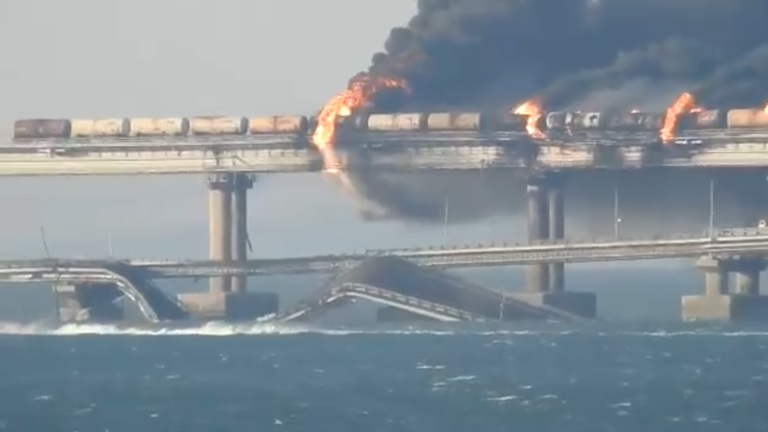
https://sputniknews.com/20221010/crimean-bridge-attack-ukraines-sabotage-teams-take-orders-from-washington-senior-official-reveals-1101698419.html Ilya Tsukanov, 12 Oct 22, The 19-km bridge linking the Crimean Peninsula to the Russian mainland sustained serious damage following the detonation of a truck bomb on one of its road sections on Saturday morning. Ukrainian officials boasted to US media that Kiev was responsible.
Ukrainian officials keep their US counterparts abreast of Kiev’s sabotage ops and other anti-Russian actions, Sergey Pashinsky, the head of the Association of Ukraine’s Defense Enterprises, accidentally revealed.
“We are planning several operations. My position is: we must and are obliged to inform our American partners about them. And those operations which I am conducting right now – I have the opportunity to conduct operations myself, I http://cut channels this is also the CIA http://cut have their own intentions. Because I understand that the US also carries responsibility for them and has the right to veto all of our operations,” Pashinsky said, speaking to infamous Russian pranksters Vladimir ‘Vovan’ Kuznetsov and Alexei ‘Lexus’ Stolyarov, who posed as US officials.
Pashinsky clarified that he has been in charge of some major Ukrainian military actions, including operational planning on Zmeiny (‘Snake’) Island – the small but strategically significant island situated off the western coast of Romania in the Black Sea, and which saw heavy fighting between Ukrainian and Russian forces earlier this year.
“I planned the Zmeiny Island operation, I carried it out personally [using] Ukrainian Bohdan and French Caesar [howitzers]. Yes, this was my operation in its entirely,” the official said.
Pashinsky indicated that operations against a piece of infrastructure like the Crimean Bridge became possible only once the US gives the green light.
“As soon as you tell me that the US approves the sabotage of the Crimean Bridge, the situation can move forward. [Laughs]. A verbal message is enough for me. We don’t want to take responsibility of this scale for ourselves, while Mr. Zelensky – I don’t know, I don’t even want to know about this situation,” Pashinsky said.
“The Crimean Bridge is an important artery, but on the other hand I think you know [Vladimir] Putin better than I do. That is, who can analyze Putin’s actions in the event of sabotage against the Crimean Bridge? Who?” the official asked.
The pranksters did not clarify whether the interview with Pashinsky was conducted before or after Saturday’s sabotage attack.
Two senior Ukrainian officials told the New York Times on Sunday that Ukrainian intelligence were behind the attack on the bridge, one of them grading the success of the attack as “excellent” and saying that the operation “showed the failure of the Russian system to guarantee the security even of the most significant and sacred targets.”
Ukrainian officials also publicly gloated over the act of terror, with presidential advisor Mikhail Podolyak saying the bridge attack was only “the beginning” and that “everything illegal must be destroyed” and “everything stolen must be returned to Ukraine.”
“Today was not a bad day and mostly sunny on our state’s territory. Unfortunately, it was cloudy in Crimea. Although it was also warm,” President Vladimir Zelensky said in a sarcasm-laden address to the nation on Saturday night.
Russia launched a series of missile strikes deep into Ukraine on Monday in the wake of the bridge attack after confirming Ukrainian special forces’ involvement, with the strikes targeting Ukrainian energy infrastructure and military command and communications posts across the country. President Putin warned that strikes would be followed up if Ukrainian attacks against Russian infrastructure continue.
How nuclear testing leaves lasting environmental scars
https://www.dw.com/en/nuclear-testing-north-korea-environment-biodiversity/a-6341. Edited by: Tamsin Walker 13 Oct 22,
With analysts predicting further nuclear tests in North Korea, the planet stands to lose. The ongoing environmental effects of nuclear testing are felt worldwide and for millions of years.
Since late September, North Korea has launched a flurry of ballistic missile tests as part of what experts believe is a program to develop so-called tactical nuclear weapons. If the reclusive state were to move beyond testing missiles to testing actual nuclear warheads, as some analysts are predicting, it would not only ramp up political tensions, but also pose a significant environmental threat.
In the past, countries such as the United States, the former Soviet Union and the United Kingdom tested their nuclear weapons in the open atmosphere and in the sea — and around Pacific Islands, the Australian desert, mainland US, remote parts of the USSR and other places. These tests left contaminated landscapes and spread their radioactive clouds far afield.
Thanks to global treaties, nuclear tests were largely moved underground after 1963, a slightly preferable scenario environmentally speaking. And since a 1996 test ban, only India, Pakistan and North Korea have tested weapons at all.
North Korea is the only country known to have conducted tests in the 21st century.
The impact of nuclear testing on mammals
“The legacy of nuclear weapons testing has been absolutely catastrophic for humans and for the environment,” said Alicia Sanders, the policy research coordinator at the International Campaign to Abolish Nuclear Weapons.
One of the unique consequences for the environment, she added, “is that it lasts essentially forever.”
Putting aside the development required to set up test sites, the first major effects are felt in the microseconds after the explosion.
A 2015 paper on the environmental impact of military actions found that nuclear blasts represent an extreme threat to local biodiversity.
The massive energy released in the thermal emission from the blast — comprising light and heat — kills any organisms unfortunate enough to be near the epicenter. Depending on the yield of the bomb, even organisms several kilometers away face lethal temperatures. What remains is a charred mess.
The effect from the thermal shock on animals is not well researched, but humans face serious, life-threatening burns even several kilometers away, depending on the power of the bomb. A similar effect is assumed for other mammals. They also suffer from the pressure of the blast, which causes lung damage and hemorrhaging.
And animals that aren’t killed immediately are more likely to die from infections in the days and weeks following the explosion, leading to a localized die-off event, the 2015 review found.
The impact on plants, birds and marine life
Plants are also not spared the effects of a nuclear blast. The sheer force strips trees of their foliage, tears down branches and uproots vegetation.
For fish, meanwhile, the impact is similar to that of a non-nuclear explosion, but on a much larger scale. The US tests in Alaska, and those of France in French Polynesia in the late 1960s and early 70s were associated with large-scale die-offs of fish, as their gas-filled swim bladders ruptured.
Marine mammals and diving birds suffered similarly, post-mortem analysis showed. However, marine non-vertebrates appeared to be more resistant to pressure waves as they do not have gas-containing organs, according to defense studies at the time.
Long-term environmental impacts
During the Cold War, the United States detonated scores of nuclear weapons in atmospheric tests in the Pacific. Entire islands were incinerated and many are still uninhabitable. Local residents were forced to leave. A 2019 study found that some of the affected areas had radiation levels 1,000-times that of those found in Chernobyl and Fukushima.
Significant long-term environmental consequences of nuclear testing are the contamination of surface soil and groundwater, land disturbances in the form of craters or partially collapsed mountains — as in the case of the North Korean testing site — and the addition of radionuclides to sediments in seabeds.
Atmospheric nuclear tests spread radionuclides — unstable particles that releases radiation as they break down — far and wide, contaminating topsoil.
But even in underground testing, high pressure conditions can propel radionuclides into the atmosphere — a phenomenom known as venting — where they can be carried by winds and deposited far away from the test sites and enter food-chains.
Ankit Panda, a senior fellow at the Carnegie Endowment for International Peace’s nuclear policy program, says Pyongyang has thus far avoided the pitfall of venting.
“The North Koreans have actually, with their last five nuclear tests at least, been very effective at preventing the venting of radionuclides,” he said. “Because some of these radionuclides can even offer hints about the specific materials that are being used in the nuclear device.”
At the very least, underground tests deposit huge quantities of radioactive material which will remain there for millions of years. The long-term ecological damage from such contamination is unknown.
The impact on drinking water
Underground testing also poses a threat of radionuclides leeching into drinking water.
Studies at the US nuclear testing site near Las Vegas, found that some contaminants released by underground nuclear tests can get into the surrounding water. Plants and animals are particularly liable to pick up radioactive strontium and caesium, which are easily spread in water.
With a half-life of 30 years, these two radionuclides can cause health issues in the food chain for decades. A common shrub in New Mexico, chamisa, has roots that extend deep into the ground, bringing strontium back up to the surface near the Los Alamos testing site in New Mexico, from where it can be widely distributed as the leaves fall, decay, and contaminate the soil understory.
“Animals will eat from contaminated land and that becomes very dangerous. These can be key sources of food for people,” ICAN’s Sanders said.
Organizations such as ICAN continue to push for complete denuclearization.
Until that happens, one factor that might help clean up the legacy of nuclear testing is a provision in the 2017 Treaty on the Prohibition of Nuclear Weapons, which requires signatories to provide assistance to victims of nuclear weapons and begin to remediate contaminated environments. States should next year begin initial assessments of environmental damage and use that as a basis for future remediation efforts.
Even a small nuclear test by North Korea would be a big US worry
Mint, 13 Oct 22,
s North Korea moves closer to its first nuclear test in five years, one of the biggest worries for the US and its allies might be a relatively small blast.
Kim Jong Un has made clear he wants to build an arsenal of “tactical” nuclear weapons, meaning lower-yield bombs that could be used on the battlefield rather than on whole cities. First it must produce miniaturized warheads to fit on the expanding array of short-ranged ballistic missiles it has designed to threaten US troops and their allies in Asia.
This week, Kim said a barrage of missiles launched in recent days were intended for tactical nuclear strikes, while warning Washington that any attempted attack could be met by strikes at American forces in South Korea and Japan. The comments were a fresh sign that North Korea could be preparing for its first nuclear test since September 2017, something the US has been ringing alarm bells about for months………..
While there were more than 2,000 tests of nuclear devices in the decades after the US bombed Japan in 1945, North Korea remains the only country that has conducted physical detonations of atomic bombs this century, according to data from the Arms Control Association. Nuclear powers such as the US now rely on supercomputers to simulate tests of their weapons to predict performance and reliability. …..
Kim has embarked on a two-pronged nuclear strategy of developing tactical weapons for the Asian region and far more powerful thermonuclear devices for longer-range missiles that can hit the US mainland. The US, Japan and South Korea have all said North Korea is ready to conduct a test at its mountainous Punggye-ri test site, where it has held all of its previous six tests……………
“Tactical” is an inexact term for a nuclear weapon that could be used within a theater of war, which to North Korea probably includes South Korea, Japan and US assets in places such as Guam. A tactical weapon has a less powerful warhead and is delivered at a shorter range. The explosive yields can be of less than 1 kiloton, but many are in the tens of kilotons……..
Tactical nuclear weapons can still cause massive destruction and non-proliferation advocates argue their use could quickly spin out of control. Such concerns were evident in US President Joe Biden’s warning last week that any use of such weapons by President Vladimir Putin in Ukraine could lead to “Armageddon.”………………
Kim laid out a nuclear weapons plan just before Biden’s inauguration in January 2021 that called for smaller and lighter weapons. He also urged the development of a solid-fuel intercontinental ballistic missile that would be quick to deploy and strike strategic targets within 15,000 kilometers (9,320 miles) — a thinly veiled reference to the US.
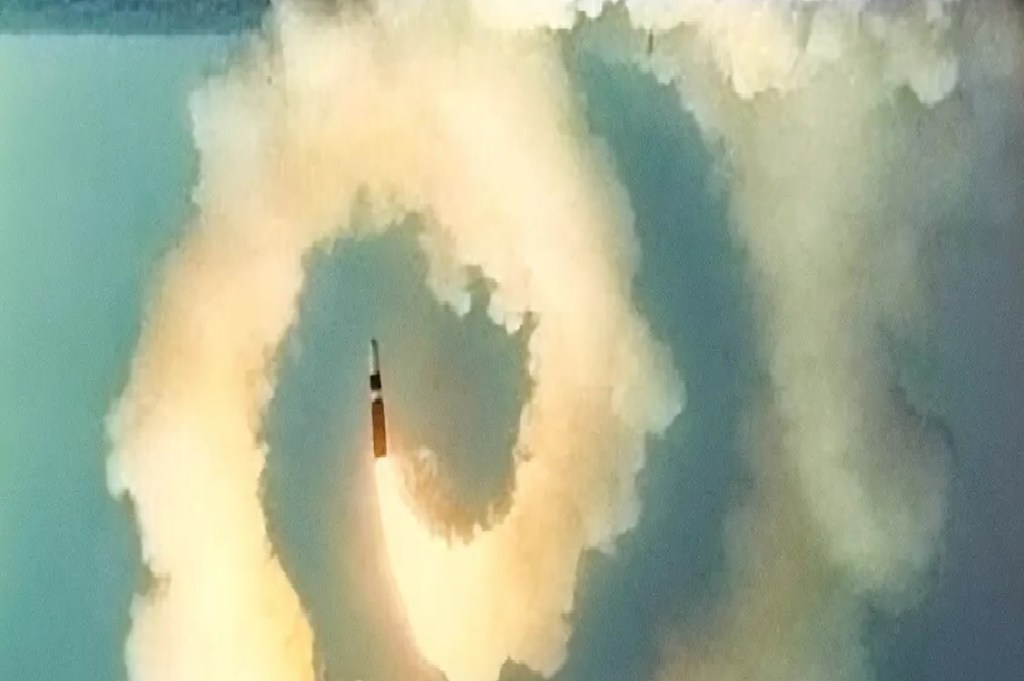
The North Korean leader oversaw the launch of two long-range cruise missiles that flew in figure-8 loops over the country for a total of about 2,000 kms, the official Korean Central News Agency reported Thursday. Cruise missiles, which can carry nuclear warheads, are designed to fly below radar and there are no United Nations resolutions barring Pyongyang from tests……….
Kim has shown that he has mastered tactical delivery systems by testing almost 70 short-range missiles since 2019. These are quick to deploy, designed to evade US-operated interceptors in the region and capable to hitting American military bases in South Korea in less than five minutes after launch………….https://www.livemint.com/news/world/even-a-small-nuclear-test-by-north-korea-would-be-a-big-us-worry-11665618154062.html
France won’t retaliate with nuclear weapons if Russia uses them in Ukraine
French President Emmanuel Macron says he intends to avoid ‘global war’
https://www.thenationalnews.com/world/europe/2022/10/13/france-wont-retaliate-with-nuclear-weapons-if-russia-uses-them-in-ukraine/ Soraya Ebrahimi, Oct 13, 2022,
France will not respond with nuclear weapons should Russia use them against Ukraine, French President Emmanuel Macron has said.
“Our doctrine rests on the fundamental interests of the nation,” Mr Macron told public broadcaster France 2 on Wednesday.
“They are defined clearly and wouldn’t be directly affected at all if, for example, there was a ballistic nuclear attack in Ukraine, in the region.”
It was the first time he has discussed France’s nuclear deterrence doctrine regarding Ukraine in detail.
Mr Macron said it was not good to talk about it too much.
So far, despite his threats, there is no sense that Russian President Vladimir Putin is moving nuclear assets.
Mr Macron said Mr Putin must “return to the table” to discuss peace in Ukraine and that he thought Kyiv would have to negotiate with him at some point.
“Today, first of all, Vladimir Putin must stop this war, respect Ukraine’s territorial integrity and come back to the table for talks,” he said.
Asked if he would back a Ukrainian offensive to recapture Crimea, which was annexed by Russia in 2014 in a move not recognised internationally, Mr Macron said that “at some point as the conflict develops”, Russia and Ukraine “will have to come back to the table”.
“The question is whether the objectives of the war will only be reached by military means,” he said, although “it’s up to the Ukrainians to decide” what those aims should be.
When reminded that Ukraine no longer wanted to negotiate with Mr Putin, Mr Macron replied: “I tell you that at some point … it will be necessary. That’s why I have always refused maximalist positions.”
He said France would supply air defence systems to Ukraine after Russia’s wave of air strikes this week, which was aimed at “breaking Ukrainian resistance”.
“We’re going to deliver … radars, systems and missiles to protect them from these attacks,” Mr Macron said.
He said France was also negotiating to send another six Caesar mobile artillery units.
Putin vows continued ‘tough’ attacks against Ukraine – video
He said the war had entered “an unprecedented stage” since the weekend because “for the first time all over Ukraine civilians have been killed … and electricity and heating facilities have been destroyed”.
“The aim of the Russians these last few days has been to break, to shatter Ukrainian resistance,” Mr Macron said.
He acknowledged that France was “unable to deliver as much as the Ukrainians ask for. I’m obliged to keep some for us to protect ourselves and our eastern flank (of Nato)”. The extra Caesar guns were made for Denmark, but talks are under way to redirect them to Ukraine.
Ukraine held talks with Britain for destruction of Crimean bridge
https://apa.az/en/europe/ukraine-held-talks-with-britain-for-destruction-of-crimean-bridge-382809—15 August 2022,
Deputy of the Rada Goncharenko announced negotiations with Wallace on the destruction of the Crimean bridge, APA reports.
Ukraine held talks with British Defense Secretary Ben Wallace on a plan to destroy the Crimean Bridge at the NATO summit in June, Verkhovna Rada deputy Oleksiy Goncharenko said.
The parliamentarian drew attention to the statement of expert Igor Korotchenko, who said on the air of the Rossiya 1 TV channel that, according to some information, the plan for striking the bridge was allegedly being developed under the personal supervision of the head of the British military department.
“Ben Wallace and I discussed the plan to destroy the Crimean bridge back in June,” Goncharenko wrote, posting a photo from the talks, which, in addition to him and the head of the British Ministry of Defense, shows British Prime Minister Boris Johnson.
In July, Aleksey Arestovich, an adviser to the head of Vladimir Zelensky’s office, said that Ukraine could attack the Crimean Bridge as soon as the first technical opportunity appeared.
1 This Month
26 April – Chernobyl: Inside the Meltdown airs on National Geographic on Sunday 26th April from 4pm


29 April – Nuclear Expert Webinar #1 – Radiation Impacts on Families with Mary Olson and Cindy Folkers
- 12:15 PM MT – 1:45 PM MT
- Location: Virtual – REGISTER TODAY

4 May -West Suburban Peace Coalition to discuss Iran war at May Educational Forum
Monday, May 4, 7:00 – 8:00 PM Central Standard Time
Title: : How Trump’s Narrative Tries to Shape the Reality of the War on Iran.
Contact Walt Zlotow, zlotow@hotmail.com 630 442 3045 for further information
14 May – online event From Bombs to Data Centres: the Face of Nuclear Colonialism

Pine Ridge Uranium is the real threat, not Tehran- Tell Burgum: Stop the Extraction.
Chernobyl: The Lost Tapes – A good documentary on Chernobyl on SBS available On Demand for the next 3 weeks– https://www.sbs.com.au/ondemand/tv-program/chernobyl-the-lost-tapes/2352741955560
To see nuclear-related stories in greater depth and intensity – go to https://nuclearinformation.wordpress.com
-
Archives
- April 2026 (338)
- March 2026 (251)
- February 2026 (268)
- January 2026 (308)
- December 2025 (358)
- November 2025 (359)
- October 2025 (376)
- September 2025 (257)
- August 2025 (319)
- July 2025 (230)
- June 2025 (348)
- May 2025 (261)
-
Categories
- 1
- 1 NUCLEAR ISSUES
- business and costs
- climate change
- culture and arts
- ENERGY
- environment
- health
- history
- indigenous issues
- Legal
- marketing of nuclear
- media
- opposition to nuclear
- PERSONAL STORIES
- politics
- politics international
- Religion and ethics
- safety
- secrets,lies and civil liberties
- spinbuster
- technology
- Uranium
- wastes
- weapons and war
- Women
- 2 WORLD
- ACTION
- AFRICA
- Atrocities
- AUSTRALIA
- Christina's notes
- Christina's themes
- culture and arts
- Events
- Fuk 2022
- Fuk 2023
- Fukushima 2017
- Fukushima 2018
- fukushima 2019
- Fukushima 2020
- Fukushima 2021
- general
- global warming
- Humour (God we need it)
- Nuclear
- RARE EARTHS
- Reference
- resources – print
- Resources -audiovicual
- Weekly Newsletter
- World
- World Nuclear
- YouTube
-
RSS
Entries RSS
Comments RSS
 nuclear-news