“………………………………………………. One potential effect of the atom bomb wasn’t understood until years after the death of J. Robert Oppenheimer, the director of the Manhattan Project. Specifically, the concept of nuclear winter, which was first brought to the world’s attention by astrophysicist and author Carl Sagan in 1983.
Virtually every modern climate model has confirmed the initial findings: nuclear war would cool the planet.
“Nuclear weapons dropped on cities and industrial areas would produce fires, the fires would produce smoke, and that smoke would be lofted up into the stratosphere in a giant thunderstorm,” Alan Robock, a climate scientist at Rutgers University in New Jersey, said in a recent interview.
………………. “The basic physics are very simple: if you block out the sun, it gets cold at the ground,” Robock said. “We have analogues of that. We have nighttime, we have winter.”
…………………….. Why has the smoke from wildfires not caused global cooling? Unless smoke particles reach the stratosphere, they get washed out of the lower atmosphere by precipitation.
………………………..According to a 2007 paper, a nuclear war between the U.S. and Russia would send 150 million tonnes of black soot into the stratosphere, resulting in global average surface cooling of 7 C to 8 C that would persist for years. Even after a decade, the world would still be 4 C cooler.
This would be a massive problem for global food production. Countries at higher latitudes, like Canada, would be particularly hard hit by nuclear winter, since much of the country is already too cold for significant agriculture.
If you’re wondering if nuclear winter would stop global warming, you’re not alone. It’s a question Robock gets all the time. A full-scale nuclear war and a global famine resulting from nuclear winter would lead to the collapse of industrial society and human civilization. Robock said that if the U.S. and Russia had a nuclear war, it would largely halt carbon emissions, since most human activities would have ceased……………..
Human-caused climate change poses the threat of an average global temperature change of several degrees on the timescale of decades. Nuclear winter, on the other hand, poses that danger on the timescale of years — even within a year.
“A nuclear war’s impact on global food systems comes as a shock. It basically comes overnight. There’s no way to adapt,” said Jonas Jaegermeyr, a climate scientist and crop modeller who studies nuclear winter at Columbia University in New York.
A paper released last year in Nature Food found that up to 5.3 billion people would die from starvation two years after a full-scale nuclear exchange between the U.S. and Russia and the ensuing nuclear winter. (The paper also found 99 per cent of Canadians would starve to death.)
Clearly, nuclear winter is just about the worst way imaginable to stop global warming. It would replace steady planetary warming with abrupt planetary cooling.
US President Joe Biden is reportedly seeking congressional approval for financing military aid for Taiwan as part of the supplemental budget for Ukraine. What’s behind the move?
The White House is going to ask the US Congressto fund the arming of the island of Taiwan via the Ukraine budget in order to speed up weapons transfers to Taipei, as per Western media. The request followed the Biden administration’s announcement that the US would deliver $345 million worth of weapons to the island through a mechanism known as the “presidential drawdown authority.” The mechanism has long been used by the US to send arms to Ukraine.
Taiwan, an island located at the junction of the East and South China Seas in the northwestern Pacific Ocean, is regarded by Beijing as an inalienable part of the People’s Republic of China.
“Well, what it shows is that the Biden administration has no regard or concern for angering China,” Larry Johnson, a veteran of the CIA and the State Department’s Office of Counterterrorism, told Sputnik.
“China has made it very clear that it views any effort by the United States to provide weapons or military training to Taiwan as a direct threat to China. And for some reason, the Biden administration refuses to accept or acknowledge the position of the Chinese. In submitting this aid package, I don’t think the Biden administration will have any problem getting it passed. We’ve still not reached a point in the United States where there is opposition to funding the war in Ukraine, or the potential for war in China. So, I think it’s likely to go through, which means it’s going to make relations between China and the United States worse, not better.”
At the same time, the CIA veteran does not consider the development as lessening support for Ukraine. It’s likely that the Biden administration has come under pressure to show support for Taiwan, per Johnson. The expert sees the funding maneuver “as a convenient legislative vehicle to get approval for the funding in a way that expedites it, doesn’t delay it.”
“I’m still not clear that it represents a cut in funds for Ukraine and a shifting of those funds to Taiwan. I think it’s more a function of the US legislative process, that Congress must appropriate money before the administration, in theory, can spend it. Because this legislation had already been presented, they were able, I think, decided to carve out some of the funds in that for Taiwan, because they had made prior commitments to Taiwan to provide some kind of support,” Johnson explained.
China has repeatedly urged the US to stop escalating tensions in the Taiwan Strait. Nonetheless, US government officials and congressional leaders continue to send mixed signals to the island and meet with Taiwan’s leadership. Furthermore, the US is encouraging its allies to beef up their military presence in the Asia Pacific, citing the “China threat” to the island. To cap it off, President Joe Biden has repeatedly pledged to protect Taiwan “militarily,” with the White House then downplaying his vows as gaffes. Why is Washington continuing to develop the conflict around Taiwan?
“Well, because, number one, the United States continues to believe that it is the most powerful country in the world and can dictate to other countries reality. It’s a consequence of arrogance and hubris. The United States refuses to accept the fact that China and Russia have an equal say in matters. And I think, unfortunately, the United States, if it persists in taking actions like this, will provoke a conflict that will be very damaging to the United States and will weaken it, not make it stronger. The United States can’t even fund the one proxy war in Ukraine right now. It’s been losing. It can’t provide sufficient artillery shells, for example. The United States fails to recognize that it’s reached the limits of its power,” Johnson concluded.
Covert Action Magazine By Jeremy Kuzmarov, July 14, 2023 (Excellent pictures on original.)
From 1959 to 1966, the U.S. illegally stored nuclear weapons in Greenland in preparation for a nuclear attack on the Soviet Union and built an underground scientific research center right out of a James Bond movie.
It resulted in the displacement of natives and has left a residue of environmental destruction in the Arctic that will likely be compounded in Cold War Part II.
On June 2, Secretary of State Antony Blinken announced that the U.S. would open its northernmost diplomatic station in the Norwegian Arctic town of Tromsoe, the only diplomatic station above the Arctic Circle. .
The move comes as competition over the Arctic’s resources with Russia intensifies as polar ice melt opens access to rich mineral resources and the new Cold War heats up.
In 2019, then-President Donald Trump had talked about purchasing Greenland in “the real estate deal of a lifetime” that would help secure a land mass a quarter of the size of the U.S.
Danish Prime Minister Mette Frederiksen called the offer “absurd,” saying that Greenland was not for sale. (Denmark is Greenland’s sovereign owner.)
Beyond Trump’s self-aggrandizement lay a calculating imperial strategy in which the U.S. would use Greenland, where the U.S. already possesses the Thule Air Base, to project its power into the Arctic—a growing arena of geopolitical and military competition.
In 2018, China launched the Polar Silk Road initiative which sought to align Chinese Arctic interests with the Belt and Road initiative involving the building of new infrastructure and interlinking of China’s economy with its regional allies and countries around the world.
As part of the Silk Road initiative, China began creating new freight routes extending into the Arctic that would better enable extraction of natural resources while launching a new satellite to track shipping routes and monitor changes in sea ice there.
The Russians have also been busy expanding shipping routes into the Arctic that are navigable because of global warming, and have finished equipping six military bases on Russia’s northern shore and on outlying Arctic Island, while planning to open 10 Arctic search-and-rescue stations, 16 deep-water ports, 13 air fields, and 10 air-defense radar stations across its Arctic periphery.
The New York Timesreported last year that, in response to Russia’s military build-up near the Arctic Circle, the U.S. government has been investing hundreds of millions of dollars to expand the port at Nome on the west coast of Alaska, which could transform into a deep-water hub servicing Coast Guard and Navy vessels navigating into the Arctic Circle.
The Pentagon has further plans to increase its presence and capabilities, with the Army releasing its first strategic plan for “Regaining Arctic Dominance.” The U.S. Air Force has transferred dozens of F-35 fighter jets to Alaska, announcing that the state will host “more advanced fighters than any other location in the world.”[1]
Until now, competition in the Arctic was largely mediated through the Arctic Council, founded in 1996, which includes Canada, Denmark, Finland, Iceland, Norway, Russia, Sweden and the U.S., and promotes research and cooperation. But it does not have a security component, and soon all members but Russia will be North Atlantic Treaty Organization (NATO) members.
Admiral Alexander Moiseyev, commander of Peter the Great, the flagship of the Russian Northern Fleet, accused NATO forces and the U.S. of military actions in the Arctic that increased the risk of conflict.
“There haven’t been so many of their forces here for years. Decades. Not since World War Two,” he told a BBC reporter who told him that NATO blamed Russia for the surge in tension. “We see such activity as provocative so close to the Russian border where we have very important assets. By that, I mean nuclear forces.”
First Ice Cold War
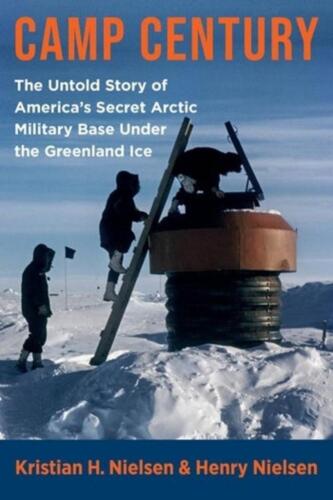
Kristian H. Nielsen and Henry Nielsen,[2] in their recent book Camp Century: The Untold Story of America’s Secret Arctic Military Base Under the Greenland Ice, show that today’s perilous situation has roots in the original Cold War period.
U.S. army engineers then built the subterranean city, Camp Century, under the Greenland ice near the Arctic Circle under the guise of conducting polar research, and explored the feasibility of Project Iceworm, a plan to store and launch hundreds of ballistic missiles with nuclear warheads targeting the Soviet Union from inside the ice.
Described by two Danish journalists as “some monstrous figment of the imagination that could have been featured in an early James Bond film,”[3] Project Iceworm was justified under the 1950s military doctrine of “massive retaliation,” and the Eisenhower administration’s “New Look” policy which advocated for a massive conventional and nuclear arms build-up to counter potential Soviet aggression…………………………………………………………………………………………………………………………………………………………….
“The City Under Ice”—A Science-Fiction Scenario Come True
In 1960, the U.S. Army began initiating research projects near Camp Thule at the underground, nuclear-powered Camp Century, which was established as a kind of science-fiction scenario come true.
The projects aimed to understand the environment and climate on the ice sheet, thereby enabling the U.S. to better establish and secure its northernmost military position…………………………………………………………………………………………………………………………………….
The sub-surface installation of a nuclear reactor within the Greenland ice sheet at Camp Century was an enormous and difficult engineering endeavor that was an astonishing achievement…………………………………….
Almost all of the journalists invited to visit Camp Century in the early 1960s celebrated the major scientific achievements while minimizing the Cold War context and military purposes behind the camp.
………………………………………………………………………………………………………………. an American journalist writing under the pseudonym “Ivan Colt” who, in an article appearing in October 1960, included a vivid description of missile-launching bases beneath the surface of the ice sheet that would be “able to plaster every major Soviet city, H-bomb depot and missile plant.”
Audacious Cold War Project
In 1997, a group of Danish historians were able to locate a classified document proving that the U.S. saw Camp Century as the first step toward a colossal sub-surface tunnel system that would enable the U.S. Army to launch a nuclear-missile strike at virtually any target in the Soviet Union.[10]
These missiles would be protected because of their distance from the U.S. mainland, and location in a secret underground facility……………………………………………………………………………………………..
Health and Environmental Detritus and the Dangers of History Repeating Itself
Camp Century was shut down in 1966, as its sub-surface tunnel system in the Greenland ice sheet was extremely difficult and costly to maintain and the development of Polaris nuclear missiles launchable from submarines made it largely obsolete. However, its remains may soon resurface because of global warming.
Greenland, today a largely self-governing part of Denmark, threatened to bring the case before the UN International Court of Justice if Denmark did not promptly assume responsibility for cleaning up the Camp Century site.
The remaining debris, some 35-70 meters (115-230 feet) beneath the surface of the ice, is known to include not only buildings and structural elements but also radioactive, chemical and biological waste.[12]
Over the years, many workers at Thule Air Base had developed cancers from radiation exposure, as did members of a clean-up crew that was called in to collect snow contaminated with plutonium for transport to the U.S. after a B-52 Stratofortress carrying hydrogen bombs crashed seven kilometers from Thule Air Base in 1968.[13]
The health and environmental detritus is an example of a vast and unrecognized cost of the Cold War arms race that is sadly being reinvigorated today.
As Russia, China and the U.S. compete for renewed control over the Arctic and set up yet more military bases there, the fallout will again be considerable even if the nukes are never deployed, and the tragedy of Camp Century will be repeated.
Kiev will use its newly received weapons to target residential areas, just as it has for the past nine years.
The recent US decision to send cluster munitions to Ukraine is immoral, unethical, and criminal. We’ve already seen the horrific results of the use of such weapons – civilians mutilated and murdered (often decades later) in Iraq and Southeast Asia, for example, and in Lebanon.
In addition to the ethical reasons not to send these weapons to Ukraine, there are pragmatic reasons why, from a military perspective. They are pointless for Ukraine, in spite of Western promises that they will “do more damage across a larger area than standard unitary artillery shells by releasing bomblets, or submunitions.”
In reality, while covering a wider area than a conventional high explosive munition, the cluster bomblets do not inflict more powerful damage, certainly not against Russian fortified positions. Their use is mainly for targeting troops in the open and lightly armoured vehicles. Not a game changer for Kiev.
According to former US Marine Corps intelligence officer Scott Ritter, “these are the worst weapon in the world for trench warfare. With trench warfare, you need a high explosive round that collapses bunkers, that collapses trenches.”
If the US knows that cluster munitions won’t change facts on the ground for Ukraine, why is it sending them? Because, as President Joe Biden himself has said, Ukraine is “running out of ammunition and we’re low on it.” So, the US might as well offload its old stock of cluster munitions. They will not, as Biden claimed, “stop those tanks from rolling.” Nor will they – as the Biden administration claims – “save civilian lives.” They will almost certainly be used to kill, maim, and terrorize more Donbass civilians immediately and for years to come.
US Colonel Douglas Macgregor has emphasized that the cluster munitions have a high dud rate. According to Ritter, close to 40% of them fail to explode. Macgregor also highlighted how children are “attracted to these bright shiny objects that look like baseballs,” so insidious is their design.
US National Security Advisor Jake Sullivan assures us thatKiev will not misuse the clusters. He claims that “Ukraine is committed to post-conflict de-mining efforts to mitigate any potential harm to civilians,” and that “Ukraine has provided written assurances that it is going to use these in a very careful way that is aimed at minimizing any risk to civilians.”
The US never signed the Convention on Cluster Munitions – which prohibits all use, production, transfer, and stockpiling of cluster munitions – but didn’t mind virtue signalling its abhorrence of them when it lobbed accusations against Russia (also not a signatory of the convention) on February 28, 2022, with Biden’s then press secretary, Jen Psaki, calling the use of cluster munitions a potential “war crime.”
As usual, it’s a heinous war crime when a US enemy supposedly does it, but not when an ally – or the US itself – actually does. As for Ukraine’s feeble promises to not use the cluster munitions against civilians, it has already been doing so since 2014.
Ukraine’s history of cluster-bombing civilians
By way of a personally witnessed example, in late March 2022, I visited the site of a Ukrainian missile attack that earlier that month had killed 22 civilians and injured 33 more. Because the Ukrainian-fired Tochka-U missile was intercepted, not all of its 50 cassettes of cluster munitions inside exploded in the city streets. Otherwise, the bloodbath would have been much worse. Then, in April 2022, Ukrainian forces targeted a railway station in Kramatorsk, likewise firing a Tochka-U with a cluster munition, killing a reported 50 people. Western media predictably accused Russia of the war crime, although investigations showed the missile emanated from Ukrainian-held territory to the southwest.
But like most of Kiev’s war crimes against Donbass civilians, its use of cluster munitions didn’t start in 2022. Back in 2014, Human Rights Watch (HRW) reported on Ukrainian government forces’ use of cluster munitions in populated areas in Donetsk city. An October 2 attack on the centre of Donetsk that included the use of cluster munition rockets killed an employee of the International Committee of the Red Cross (ICRC).
The New York Times likewise reported that on several occasions in October 2014, “the Ukrainian Army appears to have fired cluster munitions into the heart of Donetsk, unleashing a weapon banned in much of the world into a rebel-held city with a peacetime population of more than one million.” Citing physical evidence and interviews with witnesses and victims, the newspaper wrote there were “clear signs that cluster munitions had been fired from the direction of army-held territory.”
Ukrainian ‘petal mines’ continue to maim
But these aren’t the only clusters Ukraine has fired on Donbass civilians. In fact, over the course of last year, I documented the aftermath of Ukraine firing rockets containing cassettes of internationally-banned PFM-1 “petal” mines, over 300 of the mines per rocket.
Due to their design, they generally glide to the ground without exploding, until someone or something steps on or otherwise disturbs them.
According to authorities in the Donetsk People’s Republic (DPR), Ukraine began firing these tiny, indiscriminate mines on March 6, 2022, during the battles for Mariupol, and then from May 18, 2022, into DPR and Kharkov Region settlements.
Since first documenting the aftermath of Ukraine’s use of the mines in central Donetsk in late July, 2022, I’ve interviewed victims, and reported on the painstaking work of Russian sappers to locate and destroy the mines. As of July 25 this year, 124 civilians have been injured by the mines, including ten children. Three civilians died as a result of their injuries.
Western weapons used to kill Donbass civilians
It should be mentioned that over the course of its now nine-year war against Donbass, Ukraine has been using conventional NATO munitions to slaughter and maim civilians. The high explosive shells Ukraine fires throughout Donbass cities and towns, but also countless times in the very heart of Donetsk, tear people apart, leaving mangled bodies and remains on streets and sidewalks, and in marketplaces.
On July 22, Ukrainian forces allegedly shelled Russian journalists in Zaporozhye Region with cluster munitions, killing one and injuring three others.
These deliberate attacks on the media, on civilians’ homes, hospitals, infrastructure, and on civilians themselves should be condemned as loudly as Ukraine’s firing of petal mines and of cluster munitions in general. But the US announcement that it would send cluster munitions to Ukraine resulted in some mild tutting from other Western nations, but no seriously strong condemnation. Canada is one of the nations voicing at least some objection to sending cluster bombs, the leadership in Ottawa probably feeling it ought to mildly protest, given Canada’s convention.
The Canadian government recently stated that it is fully against the use of cluster munitions and is “committed to putting an end to the effects cluster munitions have on civilians – particularly children.” Yet aside from polite grumblings regarding the US clusters, I’ve seen no Canadian condemnation of Ukraine’s repeated use of cluster munitions on the civilians of Donbass.
But the real criminals here are the US government, which knows sending its cluster munitions won’t actually help Ukraine fight the Russian military in any tangible way, but that it is highly likely Ukraine will instead use them against Donbass civilians. Apparently, that’s just fine with the crocodile-tear-crying US hypocrites.
In the wake of the Russian invasion and war in Ukraine, the United Nations (UN) appears to be preparing to resurrect a global disarmament process which was discontinued more than 30 years ago.
On July 18, the UN secretariat released its long-awaited “New Agenda for Peace”. This policy brief included recommendations by secretary general, António Guterres, on strategies to respond to current and future challenges facing humanity, such as poverty, climate change, pandemics, armed conflicts and threats against international peace and security.
To a warm response from the community of peacebuilders worldwide, the agenda contains practical advice on advancing a process of disarmament, by suggesting the reactivation of special sessions devoted to disarmament at the UN general assembly (SSOD).
UN special sessions on disarmament were held in 1978, 1982, and 1988, but a fourth never occurred. Since 2021, the activation of a fourth Special Session on Disarmament (SSOD-IV) at the UN general assembly has been the focus of the Strategic Concept for the Removal of Arms and Proliferation (Scrap Weapons), a disarmament project housed at SOAS University of London.
Scrap Weapons has also been supporting Brazil’s call for the same, made at the 2022 UN general assembly’s First Committee, which focuses on disarmament matters.
Disarmament machinery
For the disarmament agenda to progress, its machinery needs to be revisited. Current efforts at the Conference on Disarmament (CD) – the UN body tasked with negotiating treaties on weapons control – have stalled for almost 30 years because of a lack of consensus. This has been further conflated by an absence of political will and marred by geopolitical tensions and rivalries among member states.
If only other scientists had followed his example.
If only scientists could learn from Joseph Rotblat, and abandon their dogmatic belief that science is “neutral”
To the end of his life, he believed scientists have personal responsibility for their inventions.
Yeah – you’ve never heard of him, have you? That’s because we have all been brainwashed, in the patriarchy, into believing that heroes are brave tough guys. Joseph Rotblat was brave, but, alas, not a tough guy. So – he don’t qualify.
Robert Oppenheimer might have regretted it later, but he was in favor of using the atomic bomb, seeing it as a terror weapon, that would need to be used only once
Leo Szilard was a “wimp” who did not want the atomic bomb to be dropped on Hiroshima.
But Joseph Rotblat went further than Slizard. In 1943, when it was clear that Germany was not developing atomic weapons, Rotblat saw the danger of atomic warfare, and risk of a nuclear clash with Russia. Rotblat abandoned his role in the Manhattan Project, and left America. USA army intelligence tried hard to depict Rotblat as a Russian agent
After the atomic bombings of Hiroshima and Nagasaki, Rotblat was determined to prevent the development of future nuclear weapons. He devoted the rest of his life to protesting nuclear testing and weapons production.
During the post-war period, Joseph Rotblat did an enormous amount of work in the cause of peace, dialogue and disarmament through the Pugwash movement, with which he shared the Nobel Peace Prize in 1995.
Joseph Rotblat passed away on August 31, 2005. To the end of his life, he believed scientists have personal responsibility for their inventions. Rotblat implored: “Above all, remember your humanity.”
While it might seem that delays and overruns at this level are unusual, in reality, they are just the most recent in a long history of wasteful spending on nuclear weapons programs.
Union of Concerned Scientists, Eryn MacDonald, August 2, 2023 |
The Congressional Budget Office (CBO) has released a new report on the projected cost of US nuclear weapons over the next ten years, from 2023 to 2032.
Before even reading the first line, I could have predicted two things about this report.
First, projected costs have risen considerably since the CBO released its previous report on this issue two years ago. This is par for the course for military programs in general (perhaps it might be less predictable if the Department of Defense ever managed to pass an audit—a routine requirement for every other part of government) and nuclear weapons are certainly no exception. And secondly, these costs are far higher than is necessary and do nothing to address the needs of most Americans for true human security. These lie in areas like food, housing, healthcare, or gun violence, none of which are improved by spending hundreds of billions on nuclear weapons each year.
To get to the actual numbers, CBO estimates that if the Department of Defense (DOD) and Department of Energy (DOE) carry out their current plans for nuclear forces, it will cost $756 billion from 2023 to 2032—just over $75 billion per year. This is 19% ($122 billion) higher than its previous estimate of $634 billion for the period from 2021-2030. Roughly half of this increase, about $60 billion, is unavoidable: some programs have progressed to more expensive stages of development and production since the last report—this accounts for about $34 billion—while inflation accounts for about $26 billion. But the remainder, $62 billion, is attributable to increases in program budget estimates ($49 billion) and the CBO’s estimate of additional costs based on historical cost growth ($13 billion).
Historical cost growth is the norm
Of CBO’s $756 billion projection, a remarkable $96 billion, or 13 percent, comes from their assumption that current DOD and DOE budget estimates are well below what the actual costs of the nuclear weapons now in development will turn out to be. Historically, this has certainly been true, with both agencies frequently underestimating final program costs, often by significant amounts. For example, since the previous version of this CBO report, DOD has increased its estimate for the total cost of the new Sentinel ICBM by $12 billion. In its report, CBO projects the final costs will rise even more.
In another glaring example of how out of control spending on nuclear weapons programs can get, the General Accounting Office (GAO) in January 2023 found that the National Nuclear Security Administration’s (NNSA’s) plans to develop the capacity to produce at least 80 plutonium pits (the explosive core of modern nuclear weapons) per year at two sites—Savannah River Site and Los Alamos National Laboratory—by 2030 “do not follow best practices and run the risk of cost increases and delays” and that “NNSA lacks both a comprehensive cost estimate and a schedule outlining all activities it needs to achieve this capability.”
The NNSA itself acknowledges that the project cannot be completed on the planned timeline or budget. An internal NNSA document puts the cost for producing 80 pits per year between $8.7 and $16.5 billion, a significant increase over the previous public estimate of $6.9 to $11.1 billion. It also says that the Savannah River Site plant, far from meeting a congressionally mandated deadline to produce at least 50 pits per year by 2030, will not produce any pits at all until 2036.
While it might seem that delays and overruns at this level are unusual, in reality, they are just the most recent in a long history of wasteful spending on nuclear weapons programs. In fact, the plan to produce pits at Savannah River developed after the NNSA project previously planned for the site, the Mixed Oxide Fuel Fabrication Facility, was abandoned following years of delays and cost overruns. By the time it was shut down, NNSA had already spent nearly $8 billion on the facility and estimated that it would need another nearly $50 billion to complete the project.
Unfortunately, similar examples of wasteful spending at both NNSA and DOD are all too easy to find.
Deceptive decrease on the SLCM-N
One category in which projected costs appear to decrease in this report is Tactical Nuclear Delivery Systems and Weapons, which sees a drop of $11 billion. This is deceptive, however, because it comes from eliminating any spending on the new nuclear-armed sea-launched cruise missile (SLCM-N). …………………………..
Even though President Biden wanted to cancel the program, the 2023 National Defense Authorization Act (NDAA) passed by the Democratically-controlled Congress last year included $25 million for DOD to begin work on the cruise missile and $20 million for NNSA to start on the nuclear warhead—known as the W80-4 ALT—that the cruise missile would carry…………………………..
The trend is clearly upward……………………………………………………………
The sky’s the limit?
Discouragingly, this trend may be about to get worse. If the New Strategic Arms Reduction Treaty (New START) between the US and Russia expires in 2026 without a replacement (which now seems like a best-case scenario, given Russia’s announcement in February 2023 that it is suspending the treaty and the US decision to halt data exchanges in response), it is anyone’s guess what the effect on plans for the US nuclear arsenal will be…………………………………………………………………………….
Holding the line, avoiding an arms race
It is difficult to describe the current situation as anything other than dire. Russia’s use of nuclear threats in the Ukraine war, along with a growing tendency in the US to categorize China as another peer competitor in the nuclear realm, has led to a renewed emphasis on nuclear weapons as central to US national security. This is despite the fact that these weapons are no more useful for military purposes than they have ever been, and do not address much more pressing human security needs. We must continue to urge the Biden administration and Congress not to buy into the dangerous idea that the US has no choice but to rely on nuclear weapons for security, and instead to hold the line against a new arms race. https://blog.ucsusa.org/emacdonald/the-skys-the-limit-on-nuclear-weapons-spending-but-what-does-it-really-get-us/
Christopher Nolan’s biopic of J. Robert Oppenheimer has revived morbid curiosity in the destructive power of nuclear weapons. There are now an estimated 12,512 nuclear warheads.
A war in which even a fraction of these bombs were detonated would create blast waves and fires capable of killing millions of people almost instantly. The radiation-induced cancers and genetic damage would affect the remaining population for generations.
But what sort of world would remain amid the radioactive fallout? For the last four decades, scientists modelling the Earth system have run computer simulations to find out.
Using their knowledge of chemistry and climate modelling, atmospheric scientists Paul Crutzen and John Birks wrote a short paper in 1982 which suggested a nuclear war would produce a smoke cloud so massive that it would cause what became known as a nuclear winter. This, they claimed, would devastate agriculture and with it, civilisation.
A year later, scientists from the US and Soviet Union confirmed first that cities and industrial complexes hit by nuclear weapons would indeed produce much more smoke and dust than burning the equivalent area of forest. And second, this global layer of smog would block out sunlight, causing conditions at Earth’s surface to become rapidly colder, dryer and darker.
Climate modelling shows the reduced sunlight would plunge global temperatures by up to 10˚C for nearly a decade. These freezing conditions, combined with less sunlight for plants to photosynthesise, would have catastrophic consequences for global food production and lead to mass starvation worldwide.
Modern climate models are much more sophisticated than those used in the 1980s. And while there are fewer nukes in working order today, more recent results from computer simulations suggest that the grim prophecy delivered by scientists 40 years ago may actually have been an underestimate.
There would be ‘no other way out’ if Kyiv takes Russian territory, says the former Russian president and current National Security Council deputy chairman.
If Ukraine’s ongoing counteroffensive against Moscow’s invasion captures Russian territory, there would be no alternative to using strategic nuclear weapons, Russia’s Dmitry Medvedev warned on Sunday.
“There would simply be no other way out” of using nuclear weapons if the Ukrainian offensive succeeded in taking Russian territory, Medvedev, former Russian president and current National Security Council deputy chairman, said in a post on social media.
“Just imagine that the NATO-supported ukrobanderovtsy’s offensive turned out successful, and they took away a part of our land: Then we would have to, following the president’s degree of 02.06.2020, use the nuclear weapon,” Medvedev wrote, referring to followers of Stepan Bandera, a nationalist leader who waged a violent campaign for Ukrainian independence in the 1930s and 1940s.
“That’s why our enemies must worship our warriors. They are keeping global nuclear fire from flaring up,” Medvedev said, referring to Russian efforts to stop the Ukrainian offensive.
The fog of war over much of the last 18 months has skewed press coverage and our understanding of what is happening in Ukraine. Yet media opacity can no longer mask the facts on the ground.
In only the past week, reports have emerged in the Wall Street Journal, CNN, the Financial Times and the New York Times indicating, among other things, that Ukraine’s much awaited spring offensive has ground to a virtual stalemate and munitions from its NATO-allied partners are drying up.
The situation is such that, as the Financial Times columnist Ed Luce noted, “At some point, Volodymyr Zelensky … will need to sit down with Vladimir Putin, or his successor, to reach a deal.”
Perhaps more worrying still was NATO Secretary General Jens Stoltenberg’s admission that “the war in Ukraine is consuming an enormous amount of munitions and depleting allied stockpiles. The current rate of Ukraine’s ammunition expenditure is many times higher than our current rate of production. This puts our defense industries under strain.”
None of this is exactly news. This past April, the so-called “Discord leaks” revealed that Washington officials believed back in February that the war wasn’t going as well as it had been heretofore portrayed. But at the time, the media was more focused on helping authorities hunt down the leaker than reporting the contents of the leak. The unavoidable implication of the leaks, that the Biden administration was presenting two different versions of the war’s progress — one private, the other public — seemed almost willfully deleted from the script.
Even a relatively small slice of the Pentagon and Department of Energy nuclear budgets could create many more jobs if invested in green energy, sustainable infrastructure, education, or public health – anywhere from 9% to 250% more jobs, depending on the amount spent…..
Tom Dispatch, JULY 30, 2023
Yes, the atomic bombs dropped on Hiroshima on August 6 and Nagasaki on August 9, 1945, would kill staggering numbers of people and be an eerily (if all too grimly) appropriate ending to the war that started with the Japanese sneak attack on Pearl Harbor on December 7, 1941, and, by August 1945, had resulted in the saturation bombing of 64 Japanese cities.
The scientist who led the team responsible for creating the bombs that destroyed those two cities (and for the initial nuclear test in New Mexico that, as we only recently learned, spread fallout over 46 states, Canada, and Mexico), the 41-year-old J. Robert Oppenheimer, would later borrow a line from the Bhagavad Gita, the Hindu scriptures, to describe his mood at the time: “Now, I am become death, the destroyer of worlds.” And eerily enough, the use of the weapon that would prove to be the second way humanity found to destroy our planet — the first, climate change, was already in effect but not yet known — would find all too few in the U.S. government hesitant to use it at that time. As historian John Dower would put it in his memorable book Cultures of War,
“The policy makers, scientists, and military officers who had committed themselves to becoming death… never seriously considered not using their devastating new weapon. They did not talk about turning mothers into cinders or irradiating even the unborn. They brushed aside discussion of alternative targets, despite the urging of many lower-echelon scientists that they consider this. They gave little if any serious consideration to whether there should be ample pause after using the first nuclear weapon to give Japan’s frazzled leaders time to respond before a second bomb was dropped.”
They just did it, twice, and the world changed radically. Almost 80 years later, at a moment when a global leader is once again evidently considering the possible use of what are now called “tactical nuclear weapons” (but can be several times more powerful than the bombs that destroyed Hiroshima and Nagasaki), Oppenheimer is having his moment in the sun (or is it a blaze of atomic light?) in a film that, to the surprise of many, has hit the big time in an almost nuclear fashion. And as TomDispatch regular and Pentagon expert William Hartung reminds us while considering that three-hour odyssey of a film, what “Oppie” began then has by now become a full-scale nuclear-industrial complex on a planet where ultimate destruction, it often seems, always lurks just around the corner. Tom
The Profiteers of Armageddon
Oppenheimer and the Birth of the Nuclear-Industrial Complex
“…………………………………………………………………………………………………………………… A feature film on the genesis of nuclear weapons may not strike you as an obvious candidate for box-office blockbuster status. As Nolan’s teenage son said when his father told him he was thinking about making such a film, “Well, nobody really worries about nuclear weapons anymore. Are people going to be interested in that?” Nolan responded that, given what’s at stake, he worries about complacency and even denial when it comes to the global risks posed by the nuclear arsenals on this planet. “You’re normalizing killing tens of thousands of people. You’re creating moral equivalences, false equivalences with other types of conflict… [and so] accepting, normalizing… the danger.”
These days, unfortunately, you’re talking about anything but just tens of thousands of people dying in a nuclear face-off. A 2022 report by Ira Helfand and International Physicians for the Prevention of Nuclear War estimated that a “limited” nuclear war between India and Pakistan that used roughly 3% of the world’s 12,000-plus nuclear warheads would kill “hundreds of millions, perhaps even billions” of us. A full-scale nuclear war between the United States and Russia, the study suggests, could kill up to five (yes, five!) billion people within two years, essentially ending life as we know it on this planet in a “nuclear winter.”
Obviously, all too many of us don’t grasp the stakes involved in a nuclear conflict, thanks in part to “psychic numbing,” a concept regularly invoked by Robert Jay Lifton, author of Hiroshima in America: A History of Denial (co-authored with Greg Mitchell), among many other books. Lifton describes psychic numbing as “a diminished capacity or inclination to feel” prompted by “the completely unprecedented dimension of this revolution in technological destructiveness.”
Given the Nolan film’s focus on Oppenheimer’s story, some crucial issues related to the world’s nuclear dilemma are either dealt with only briefly or omitted altogether.
The staggering devastation caused by the bombings of Hiroshima and Nagasaki is suggested only indirectly without any striking visual evidence of the devastating human consequences of the use of those two weapons. Also largely ignored are the critical voices who then argued that there was no need to drop a bomb, no less two of them, on a Japan most of whose cities had already been devastated by U.S. fire-bombing to end the war…………………..
The film also fails to address the health impacts of the research, testing, and production of such weaponry, which to this day is still causing disease and death, even without another nuclear weapon ever being used in war. Victims of nuclear weapons development include people who were impacted by the fallout from U.S. nuclear testing in the Western United States and the Marshall Islands in the Western Pacific, uranium miners on Navajo lands, and many others. Speaking of the first nuclear test in Los Alamos, New Mexico, Tina Cordova of the Tularosa Basin Downwinders Consortium, which represents that state’s residents who suffered widespread cancers and high rates of infant mortality caused by radiation from that explosion, said “It’s an inconvenient truth… People just don’t want to reflect on the fact that American citizens were bombed at Trinity.”
Another crucially important issue has received almost no attention. Neither the film nor the discussion sparked by it has explored one of the most important reasons for the continued existence of nuclear weapons — the profits it yields the participants in America’s massive nuclear-industrial complex.
Once Oppenheimer and other concerned scientists and policymakers failed to convince the Truman administration to simply close Los Alamos and place nuclear weapons and the materials needed to develop them under international control — the only way, as they saw it, to head off a nuclear arms race with the Soviet Union — the drive to expand the nuclear weapons complex was on. Research and production of nuclear warheads and nuclear-armed bombers, missiles, and submarines quickly became a big business, whose beneficiaries have worked doggedly to limit any efforts at the reduction or elimination of nuclear arms.
The Manhattan Project and the Birth of the Nuclear-Industrial Complex
……………………………………………………. According to nuclear expert Stephen Schwartz, author ofAtomic Audit, the seminal work on the financing of U.S. nuclear weapons programs, through the end of 1945 the Manhattan Project cost nearly $38 billion in today’s dollars, while helping spawn an enterprise that has since cost taxpayers an almost unimaginable $12 trillionfor nuclear weapons and related programs. And the costs never end. The Nobel prize-winning International Campaign to Abolish Nuclear Weapons (ICAN) reports that the U.S. spent $43.7 billion on nuclear weapons last year alone, and a new Congressional Budget Office report suggests that another $756 billion will go into those deadly armaments in the next decade.
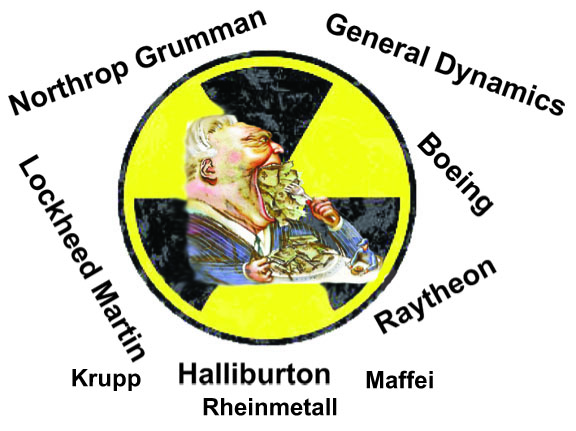
Private contractors now run the nuclear warhead complex and build nuclear delivery vehicles. They range from Raytheon, General Dynamics, and Lockheed Martin to lesser-known firms like BWX Technologies and Jacobs Engineering, all of which split billions of dollars in contracts from the Pentagon (for the production of nuclear delivery vehicles) and the Department of Energy (for nuclear warheads). To keep the gravy train running — ideally, in perpetuity — those contractors also spend millions lobbying decision-makers. Even universities have gotten into the act. Both the University of California and Texas A&M are part of the consortium that runs the Los Alamos nuclear weapons laboratory.
The American warhead complex is a vast enterprise with major facilities in California, Missouri, Nevada, New Mexico, South Carolina, Tennessee, and Texas. And nuclear-armed submarines, bombers, and missiles are produced or based in California, Connecticut, Georgia, Louisiana, North Dakota, Montana, Virginia, Washington state, and Wyoming. Add in nuclear subcontractors and most states host at least some nuclear-weapons-related activities.
And such beneficiaries of the nuclear weapons industry are far from silent when it comes to debating the future of nuclear spending and policy-making.
Profiteers of Armageddon: The Nuclear Weapons Lobby
The institutions and companies that build nuclear bombs, missiles, aircraft, and submarines, along with their allies in Congress, have played a disproportionate role in shaping U.S. nuclear policy and spending. They have typically opposed the U.S. ratification of a Comprehensive Nuclear Test Ban treaty; put strict limits on the ability of Congress to reduce either funding for or the deployment of intercontinental ballistic missiles (ICBMs); and pushed for weaponry like a proposed nuclear-armed, sea-launched cruise missile that even the Pentagon hasn’t requested, while funding think tanks that promote an ever more robust nuclear weapons force.
A case in point is the Senate ICBM Coalition (dubbed part of the “Dr. Strangelove Caucus” by Arms Control Association Director Daryl Kimball and other critics of nuclear arms). The ICBM Coalition consists of senators from states with major ICBM bases or ICBM research, maintenance, and production sites: Montana, North Dakota, Utah, and Wyoming. The sole Democrat in the group, Jon Tester (D-MT), is the chair of the powerful appropriations subcommittee of the Senate Appropriations Committee, where he can keep an eye on ICBM spending and advocate for it as needed.
The Senate ICBM Coalition is responsible for numerous measures aimed at protecting both the funding and deployment of such deadly missiles. ……………………….. That Coalition’s efforts are supplemented by persistent lobbying from a series of local coalitions of business and political leaders in those ICBM states. Most of them work closely with Northrop Grumman, the prime contractor for the new ICBM, dubbed the Sentinel and expected to cost at least $264 billion to develop, build, and maintain over its life span that is expected to exceed 60 years.
Of course, Northrop Grumman and its 12 major ICBM subcontractors have been busy pushing the Sentinel as well. They spend tens of millions of dollars on campaign contributions and lobbying annually, while employing former members of the government’s nuclear establishment to make their case to Congress and the executive branch. And those are hardly the only organizations or networks devoted to sustaining the nuclear arms race. You would have to include the Air Force Association and the obscurely named Submarine Industrial Base Council, among others.
The biggest point of leverage the nuclear weapons industry and the arms sector more broadly have over Congress is jobs. How strange then that the arms industry has generated diminishing job returns since the end of the Cold War. According to the National Defense Industrial Association, direct employment in the weapons industry has dropped from 3.2 million in the mid-1980s to about 1.1 million today.
Even a relatively small slice of the Pentagon and Department of Energy nuclear budgets could create many more jobs if invested in green energy, sustainable infrastructure, education, or public health – anywhere from 9% to 250% more jobs, depending on the amount spent. Given that the climate crisis is already well underway, such a shift would not only make this country more prosperous but the world safer by slowing the pace of climate-driven catastrophes and offering at least some protection against its worst manifestations.
A New Nuclear Reckoning?
Count on one thing: by itself, a movie focused on the origin of nuclear weapons, no matter how powerful, won’t force a new reckoning with the costs and consequences of America’s continued addiction to them. But a wide variety of peace, arms-control, health, and public-policy-focused groups are already building on the attention garnered by the film to engage in a public education campaign aimed at reviving a movement to control and eventually eliminate the nuclear danger.
Past experience — from the Campaign for Nuclear Disarmament that helped persuade Christopher Nolan to make Oppenheimer to the “Ban the Bomb” and Nuclear Freeze campaigns that stopped above-ground nuclear testing and helped turn President Ronald Reagan around on the nuclear issue — suggests that, given concerted public pressure, progress can be made on reining in the nuclear threat. The public education effort surrounding the Oppenheimer film is being taken up by groups like The Bulletin of the Atomic Scientists, the Federation of American Scientists, and the Council for a Livable World that were founded, at least in part, by Manhattan Project scientists who devoted their lives to trying to roll back the nuclear arms race; professional groups like the Union of Concerned Scientists and Physicians for Social Responsibility; anti-war groups like Peace Action and Win Without War; the Nobel Peace prize-winning International Campaign to Abolish Nuclear Weapons; nuclear policy groups like Global Zero and the Arms Control Association; advocates for Marshall Islanders, “downwinders,” and other victims of the nuclear complex; and faith-based groups like the Friends Committee on National Legislation. The Native American–led organization Tewa Women United has even created a website, “Oppenheimer — and the Other Side of the Story,” that focuses on “the Indigenous and land-based peoples who were displaced from our homelands, the poisoning and contamination of sacred lands and waters that continues to this day, and the ongoing devastating impact of nuclear colonization on our lives and livelihoods.”
On the global level, the 2021 entry into force of a nuclear ban treaty — officially known as the Treaty on the Prohibition of Nuclear Weapons — is a sign of hope, even if the nuclear weapons states have yet to join. The very existence of such a treaty does at least help delegitimize nuclear weaponry. It has even prompted dozens of major financial institutions to stop investing in the nuclear weapons industry, under pressure from campaigns like Don’t Bank on the Bomb.
In truth, the situation couldn’t be simpler: we need to abolish nuclear weapons before they abolish us. Hopefully, Oppenheimer will help prepare the ground for progress in that all too essential undertaking, beginning with a frank discussion of what’s now at stake. https://tomdispatch.com/the-profiteers-of-armageddon/
Three Ukrainian drones have attacked Moscow in the early hours on Sunday, Russian authorities said, injuring one person and prompting a temporary closure of traffic in and out of one of four airports around the Russian capital.
Key points:
The Russian Defence Ministry referred to the incident as an “attempted terrorist attack by the Kyiv regime”
Moscow Mayor Sergei Sobyanin said the attack “insignificantly damaged” the outsides of two buildings in the Moscow city district
A spokesperson for the Ukrainian air force said the Russian people were seeing the consequences of Russia’s war in Ukraine
Ukrainian President Volodymyr Zelenskyy warned on Sunday that “war” was coming to Russia after the attack.
“Gradually, the war is returning to the territory of Russia — to its symbolic centres and military bases, and this is an inevitable, natural and absolutely fair process,” Mr Zelenskyy said on a visit to the western city of Ivano-Frankivsk.
It was the fourth such attempt at a strike on the capital region this month and the third in a week, fuelling concerns about Moscow’s vulnerability to attacks as Russia’s war in Ukraine drags into its 18th month.
The Russian Defence Ministry referred to the incident as an “attempted terrorist attack by the Kyiv regime” and said three drones targeted the city.
One was shot down in the surrounding Moscow region by air defence systems and two others were jammed. Those two crashed into the Moscow business district…………………………………………………………………
Without directly acknowledging that Ukraine was behind the attack on Moscow, a spokesperson for the Ukrainian air force said that the Russian people were seeing the consequences of Russia’s war in Ukraine………………………………….
Mr Ihnat also referenced a drone attack on Russian-occupied Crimea overnight.
Moscow announced on Sunday that it had shot down 16 Ukrainian drones and neutralised eight more with an electronic jamming system. There were no casualties, officials said.
In Ukraine, the air force reported that it had destroyed four Russian drones above the country’s Kherson and Dnipropetrovsk regions.
Our first president in his farewell address warned us about three things: debt, political parties and foreign entanglements. Few now would doubt the prescient wisdom of the first two warnings, but we have also become entrapped in the third. Most notably we are forced by a declining Russia and a rising China to engage in a dangerous game of nuclear deterrence.
George Washington likely could not have envisioned a world in which his country was threatened with destruction either intentionally or accidentally by ballistic missiles launched from a foreign country thousands of miles away. Despite the new nature of the threats there may still be a measure of wisdom to be distilled from his advice. It is unlikely he would engage China in a destructive war over Taiwan although he might well provide them with the weapons to defend themselves. The problem with nuclear weapons would be more complicated and the only thing we can know for sure is that Washington would do what he perceived to be in his country’s best interest.
What is his country’s best interest? As we near the 78th anniversary of the atomic bombing of Hiroshima and Nagasaki, which resulted in the instant death of 150,000 people, we should take pause. United Nations general secretary Antonio Guterres warned us over a year ago that that we are one accident or miscalculation away from disaster.
The Power 5 nuclear weapon states: China, France, Russia, United Kingdom and the United States jointly stated over a year ago that “a nuclear war cannot be won and should never be fought.” Yet all the nuclear weapon states are renewing and trying to enhance their weapons in an ever-increasing cycle of ratcheting up that undermines stability and benefits no one. Secretary of Defense Robert McNamara said after the Cuban Missile Crisis “we lucked out.” Only good luck prevented a nuclear war and to depend on continued good luck, as the risks increase, is magical thinking better suited for children’s books of fairy tales, than as part of national defense policy.
We must tear down the metaphorical wall between the soothing idea of security through nuclear deterrence and the reality of the cataclysmic threat that nuclear weapons pose. The U.S. must lead the way and work with the authoritarian states, convincing them that it is in everyone’s best interest to maintain security without the ever-present threat of global annihilation.
The United Nations’ Treaty to Prohibit Nuclear Weapons, TPNW, in force since January 2021, is the best hope to begin the multi-generational trust building that will allow the required rigid verification regimes. Pursuing the path to global elimination of nuclear weapons is the only way to free ourselves from this dreadful foreign entanglement.
Although the total elimination of nuclear weapons is the ultimate solution there are things that can be done right now to reduce the risk of catastrophe. There is a grassroots movement endorsed by hundreds of nongovernmental organizations and municipal and state governments. Back from the Brink — preventnuclearwar.org — has four additional actions that can reduce risk and encourage our adversaries to follow.
The U.S. should have a No First Use policy. Using nuclear weapons first against a nonnuclear weapon state would merit world condemnation; using them against a nuclear weapon state would bring devastating retaliation. The second and third actions are linked. The U.S. should take nukes off high alert status and eliminate sole presidential authority to launch. Only Congress can declare war and loitering nuclear-armed submarines virtually undetectable allow that option. Finally, many former military leaders including former Secretary of Defense William Perry have spoken against replacing the entire U.S. arsenal. The ground-based ICBMs are “sitting ducks” virtually inviting a first strike by a deranged tyrant.
It is also important to remember that the military industrial political complex that President Dwight Eisenhower warned us about is often disingenuous touting weapon systems for profit that do not make us safer. U.S. House of Representatives Resolution 77 introduced by Representative McGovern endorses the Back from the Brink campaign and already has 34 cosponsors. A companion bill should be introduced in the senate. The grace of public pressure by “we the people” can force our government to adopt a less insane nuclear policy.
I feel that a real leader, like Washington, would have the audacity, like presidents Reagan and Gorbachev, who made great progress ending the cold war, to pursue this path.
The Biden administration announced a $345 million weapons package for Taiwan on Friday, the first tranche in a total of $1 billion the U.S. has allotted to be transferred directly from Pentagon stockpiles to the island this year.
The move is sure to anger China as Washington has been trying to rebuild relations with Beijing. Senior administration officials, including Secretary of State Antony Blinken and Treasury Secretary Janet Yellen, recently visited China, but the outreach has done little to quell tensions over a range of issues, from U.S. support to Taiwan to Beijing’s spy balloon program…………………..
The package marks the first time the U.S. has used new authority from Congress to transfer military equipment directly from Pentagon inventory to Taiwan. The transfer is done under the Presidential Drawdown Authority, the same mechanism Washington uses to send weapons to Ukraine………………………………………..
Defense Secretary Lloyd Austin told lawmakers in May that a presidential drawdown package was in the works for Taiwan, but it’s taken weeks of additional work before the aid could be officially announced. Among other challenges, DOD had to work through an “accounting error” that forced officials finalizing packages for Ukraine and Taiwan to recalculate the value of equipment that was being sent………….. more https://www.politico.com/news/2023/07/28/u-s-300million-weapons-taiwan-00108811
A fragile ceasefire halted the Korean War 70 years ago. With nuclear tensions rising and the environment under threat, it’s time to end it for good.
July 27 marked 70 years since the signing of the armistice that halted — but did not end — the Korean War. Since then, the divided Peninsula has been locked in a perpetual state of war that grows ever more dangerous.
While much attention is paid to North Korea’s nuclear program and aggressive rhetoric, Americans also need to understand how the U.S. government’s actions exacerbate tensions — and why we have a critical role to play in ending this war.
To start, we must remember the central role of the U.S. in the Korean War — and just how destructive the fighting was.
Former Secretary of State Condoleezza Rice has described the war as an example of what a “successful” U.S. war can “achieve.” Other talkingheads have made similarclaims, offering the war as a model for how to proceed in Ukraine. This revisionism is dangerous.
The Korean War killed over 4 million people, more than half of them civilians. From 1950 to 1953, the U.S. dropped 32,000 tons of napalm and 635,000 tons of bombs — more than were dropped in the Pacific theater in World War II. The U.S. military showed “next to no concern for civilian casualties,” historian Bruce Cummings notes, burning 80 percent of North Korea’s cities to the ground.
Even after this mass destruction, the Peninsula is still at war today — with ongoing consequences for Koreans on both sides of the DMZ.
In Hawai’i, leaking jet fuel from Navy storage tanks has contaminated drinking water for thousands of families. And next year, the U.S. will hold the Rim of the Pacific (RIMPAC), the largest annual maritime warfare exercise, in the state. Past exercises killed untold scores of marine life.
To avert nuclear war and protect our environment, Americans must demand an end to the growing U.S. military presence around the world and rein in our nearly $900 billion military budget. Our grassroots peace movement continues to grow, leading to the introduction of the Peace on the Korean Peninsula Act (H.R. 1369), which now has nearly 40 co-sponsors.
To end the Korean War, we need individuals with all skillsets — storytellers, community builders, healers, and more — working in concert. We must educate our communities, fight for change, and together build peace in Korea and across the world.