The Dangerous and Frightening Disappearance of the Nuclear Expert
The vanishing profession of preventing nuclear war
More than a dozen experts across the ideological spectrum I spoke with — hawks and doves alike — agreed a renaissance is needed to rebuild lost muscle memory and fashion new strategies to deter increasingly belligerent nuclear peers and new wannabe nuclear states. And the emergence of artificial intelligence, some analysts fear, could enhance an aggressor’s nuclear first-strike capability or sow dangerous confusion among atomic adversaries.
Tensions among nuclear powers are rising, but decades of peace have resulted in a dearth of people trained to deal with the continuing threat.
Politico, By BRYAN BENDER, 07/28/2023
SANTA MONICA, Calif. — At the height of the Cold War, the RAND Corporation crackled with the collective energy of the best brains the Pentagon could find to tackle the biggest threat.
At lunchtime, an eclectic group of physicists, economists and social scientists would play Kriegspeil, a form of double-blind chess modeled on Prussian wargames in which players can’t see their opponent’s pieces and infer their moves from a referee sharing sparse information. Then they would spend the rest of the workday developing the military doctrine, deterrence theory and international arms control frameworks to prevent nuclear war — and if all else failed, how they might win one, or at least avoid total annihilation.
It’s been several decades since the likes of Herman Kahn, the alpha male of the so-called “Megadeath Intellectuals” whose famous book On Thermonuclear War casually contemplated the long-term prospects for a society that had endured the sudden extinction of more than 100 million people, roamed RAND’s halls. The favored lunchtime competition these days seems to be ping pong in the courtyard — if anyone’s around.
One recent morning, I visited RAND’s headquarters here on the scenic California coast. After being escorted past three layers of security, I found Ed Geist, the intellectual heir to those legendary Cold Warriors, holding down the fort in the “Coffee Cove” in the RAND library.
Geist, who holds a Ph.D. in Russian history and is author of the forthcoming book Deterrence Under Uncertainty: Artificial Intelligence and Nuclear Warfare, said the Pentagon-funded think tank’s team of dedicated nuclear policy experts and strategists, spread across half a dozen offices worldwide, could barely fill a couple tables in the lunchroom now. And many of the ones who are left, he said, are in the twilight of their careers.
“It is much, much reduced,” he said, framed by obscure periodicals with titles like North Korean Review, Phalanx and Strategic Policy. “We have more work than we can do.”……………………….
This summer, as the public is treated to a rare thriller about the development of the atomic bomb in director Christopher Nolan’s biopic Oppenheimer, the nation’s leading nuclear policy wonks like Geist are more concerned than ever about the specter of a nuclear war — and warn that we are far less prepared than during the Cold War to deal with a more expansive threat. As Oppenheimer reminds us, the bomb itself was the creation of a relatively small number of geniuses assigned to the New Mexico desert in the waning days of World War II. But once it was unleashed and other major powers followed, an entire nuclear complex employing thousands of weapons engineers and technicians, political and social scientists, and diplomats sprang up to harness a humanity-erasing technology and fashion strategies to prevent the unthinkable.
Over time, however, the pervasive fear that fueled that intellectual apparatus has ebbed — and with it the urgency to restock the ranks of experts. Three decades after the Cold War ended, RAND and the broader network of government agencies, national laboratories, research universities and think tanks are struggling to meet the demands of a new — and many contend, far more dangerous — chapter in the global nuclear standoff.
The discipline’s steady decline, which only accelerated following the Sept. 11 attacks when the military pivoted to the war on global terrorism, is compounded by reduced funding from some of the leading philanthropies that funded nuclear policy studies and the graying of the last generation of practitioners both in and out of government. As for government funding, most of it — to the tune of $75 billion a year over the next decade — is dedicated to overhauling the U.S. arsenal of nuclear-armed missiles, bombers and submarines, far eclipsing investments in the humans who manage them.
More than a dozen experts across the ideological spectrum I spoke with — hawks and doves alike — agreed a renaissance is needed to rebuild lost muscle memory and fashion new strategies to deter increasingly belligerent nuclear peers and new wannabe nuclear states. And the emergence of artificial intelligence, some analysts fear, could enhance an aggressor’s nuclear first-strike capability or sow dangerous confusion among atomic adversaries.
……………………………………………………………….
Joan Rohlfing has been sounding the alarm about the trend for years.
For the last 13 years, the former top nuclear adviser at the Departments of Defense and Energy and staffer for the House Armed Services Committee, has been president of the Nuclear Threat Initiative. The nonprofit, founded in 2001 by media mogul Ted Turner, is dedicated to reducing the dangers of weapons of mass destruction. And it has emerged as the standard bearer — and often lead funder — of training programs and policy work that is central to government nuclear strategies.
……………………………………. “That may sound alarming,” Rohlfing acknowledged, “but I have deep concerns that we are underestimating the dangers of the moment. There is a lot more complexity, with more nuclear weapons states, with more lethal weapons, with weapons that fly faster on hypersonic vehicles.
“And on top of all that,” she stressed, “there is a hot war in Europe with nuclear threats being made.”
……………………………………………………………………….. the arms control agreements that Washington and Moscow relied on for decades to bring some measure of stability and transparency to the world’s largest nuclear arsenals —including requiring reciprocal visits of each other’s weapons bases — have become another casualty of degrading relations between the United States and Russia in recent years.
…………………………………………………………………… The Pentagon has estimated that Beijing could quadruple its deployed warheads to 1,000 by 2030, uncomfortably close to the number of nuclear weapons that Moscow and Washington have deployed. But China is not party to any arms control agreements or international limits. “We have not built a good foundation for these discussions with the Chinese,” says Geist, the RAND nuclear expert.
Meanwhile, successive government studies and think-tank reports warn about the threat of cyber-attacks on nuclear command and control systems that could lead to deadly miscalculation.
Add to the mix the uncharted territory of AI, the race to develop new weapons that can destroy early warning or communications satellites in orbit, and the failure of the international community to prevent North Korea and Iran from building up their nuclear weapons complexes.
“All the ingredients are here for a catastrophe,” Rohlfing said. “I think there is a high degree of denial because we have gone so long without nuclear use. We are discounting the warning signs that are right in front of us. In the heat of the moment, all it takes is a miscommunication or miscalculation to create a series of events that spiral out of control.”
Yet the level of the threat is not matched by the brain power needed to confront it, she said.
Rohlfing pointed to a 2019 assessment of the nuclear arms control and disarmament community that painted a decidedly gloomy outlook for a field that was once vibrant.
………………………………………………………………………………………. “The capacity in the field is shrinking as the threat is expanding,” said Rohlfing. “Nuclear is woefully neglected.”
Mark Bucknam arrived at the National War College in 2010. He discovered the leading academic institution for training military, diplomatic and foreign leaders in national security strategy was bestowing masters degrees without any instruction on nuclear deterrence, which had been a pillar of the curriculum in the years before the 9/11 attacks.
………………………………………………………………………………………………………. Stephen Schwartz, a senior fellow at the Bulletin of the Atomic Scientists, which has been advocating for reductions in nuclear arsenals since the arrival of the nuclear age in 1945, believes the lack of experience and expertise is particularly acute in Congress, where few lawmakers or staff are steeped in arms control, nuclear strategy or deterrence theory.
The debates, in his view, “are almost solely on the cost of nuclear weapons and not their utility.”
…………………………………… Congress is about to get another wake-up call, however, in the form of the bipartisan commission’s upcoming report.
………………………………………………………………… In the meantime, the paucity of people with the expertise to do that instruction are the guardians of a knowledge that remains far too obscure. Like relics of a distant era.
Ahead of my visit, RAND officials culled some of their nuclear archives, including a palm-sized disc labeled “BOMB DAMAGE EFFECT COMPUTER,” a circa-1958 device that would have been in the desk drawer of anyone who needed to estimate the probable impacts of atomic weapons. Geist rotated the concentric dials that can estimate what a nuclear blast, ranging from a kiloton to 100 megatons, would produce in terms of crater size and “maximum fireball radius.”
These days, Geist sometimes feels like an artifact, too.
“I guess I’m on my own here,” he said. “We have some difficult theoretical and also practical questions that have to be addressed. We can’t just go into the stacks and pull out [the books of] Herman Khan and apply it to today.” https://www.politico.com/news/magazine/2023/07/28/nuclear-experts-russia-war-00108438
—
To avoid nuclear instability, a moratorium on integrating AI into nuclear decision-making is urgently needed: The NPT PrepCom can serve as a springboard

European Leadership Network, Alice Saltini |Research Coordinator, 28 July 2023
TAIPEI 2029, Tensions have risen sharply between the US and China as the Taiwan war has drawn the US and its allies into the Pacific theatre. Both countries, having suffered immense losses in the initial months of the war, are at an impasse. For the previous four years, the US has depended on its advanced nuclear command, control, and communication (NC3) detection systems. These systems utilise a deep learning model regarded as the world’s most advanced, trained on synthetic data. Its track record of perfect accuracy in detecting previous test launches has yet to falter. Suddenly, a warning flashes, detecting a barrage of JL-3 submarine-launched ballistic missiles. The threat level escalates drastically, and a human operator assesses the findings. Time constraints make additional verification impossible, and the decision to launch a counterattack is finally taken. However, the initial wave of detected SLBMs turns out to be a false alarm – a “hallucination”.
This rapid response was fueled by unwavering trust in the system’s impeccable past performance. No one can pinpoint exactly what led the system to make the erroneous detection because of the black box nature of the deep learning model, though some attribute it to an unusual mix of a routine submarine surfacing drill and peculiar atmospheric conditions on that day.
This scenario underlines the chilling reality of the risks associated with integrating neural networks and deep learning models into NC3 systems. A nuclear exchange is not in the interest of any nation, and ensuring robust and reliable NC3 systems is critical in avoiding one. There is then an urgent need for a moratorium on the integration of neural networks into critical NC3 systems until the technology is fully explainable and the technological limitation with these models is solved.
Amongst the gravest risks posed by the integration of AI are in nuclear command, control, and communication (NC3) systems.
As deep learning based artificial intelligence (AI) is adopted, there is a growing eagerness in industries and governments to incorporate AI into various applications. Amongst the gravest risks posed by this integration are in NC3, where discussions are underway. AI is a broad field, and a form of AI is already implemented in NC3 systems. This AI is distinctly different from deep learning and relies on rule-based systems, which perform poorly in unpredictable scenarios. As part of their modernisation efforts, nuclear-armed nations are now investigating the potential advantages of integrating deep learning models into some NC3 systems.
Deep learning is loosely modelled by how neurons function in the brain, with artificial neurons transmitting signals to each other. In a deep neural network, these neurons are organised in layers and progressively extract higher-level features from an input, resulting in a prediction as the output. As they are trained on large datasets, they learn to identify patterns and a representation allows them to make predictions. These models are not given instructions to follow and don’t operate on pre-programmed algorithmic principles.
Technical risks of AI integration into NC3
The integration of neural networks into NC3 poses a multitude of risks to global security due to the technological limitations of neural networks.
Interpretability
Interpretability relates to the ‘black box’ nature of AI and is a significant challenge with neural networks. As the model is trained, the way it processes the input changes by adjusting the weights across countless neurons. This makes it extremely challenging to understand the internal mechanisms that guide the model towards the output. In a domain as sensitive as NC3, comprehensible and explainable results are essential to maintain credibility. The predictions made by the model are inscrutable, and the reasoning impossible to elucidate. If integrated into NC3, this would leave no accountability or method of verification for predictions and decisions.
Hallucinations
“Hallucinations” are a phenomenon where deep learning models confidently make unfounded assertions that aren’t supported by their training data. These hallucinations can also manifest in object detection models, where an AI might incorrectly mislabel a dog as a cat. In the context of NC3, an AI system might misinterpret unfamiliar atmospheric phenomena as incoming missiles or misinterpret incoming missiles as a meteor. Alternatively, the model could erroneously assess threats and targets in a decision-support context.
TAIPEI 2029, Tensions have risen sharply between the US and China as the Taiwan war has drawn the US and its allies into the Pacific theatre. Both countries, having suffered immense losses in the initial months of the war, are at an impasse. For the previous four years, the US has depended on its advanced nuclear command, control, and communication (NC3) detection systems. These systems utilise a deep learning model regarded as the world’s most advanced, trained on synthetic data. Its track record of perfect accuracy in detecting previous test launches has yet to falter. Suddenly, a warning flashes, detecting a barrage of JL-3 submarine-launched ballistic missiles. The threat level escalates drastically, and a human operator assesses the findings. Time constraints make additional verification impossible, and the decision to launch a counterattack is finally taken. However, the initial wave of detected SLBMs turns out to be a false alarm – a “hallucination”. This rapid response was fueled by unwavering trust in the system’s impeccable past performance. No one can pinpoint exactly what led the system to make the erroneous detection because of the black box nature of the deep learning model, though some attribute it to an unusual mix of a routine submarine surfacing drill and peculiar atmospheric conditions on that day.
This scenario underlines the chilling reality of the risks associated with integrating neural networks and deep learning models into NC3 systems. A nuclear exchange is not in the interest of any nation, and ensuring robust and reliable NC3 systems is critical in avoiding one. There is then an urgent need for a moratorium on the integration of neural networks into critical NC3 systems until the technology is fully explainable and the technological limitation with these models is solved.
Amongst the gravest risks posed by the integration of AI are in nuclear command, control, and communication (NC3) systems. Alice Saltini
As deep learning based artificial intelligence (AI) is adopted, there is a growing eagerness in industries and governments to incorporate AI into various applications. Amongst the gravest risks posed by this integration are in NC3, where discussions are underway. AI is a broad field, and a form of AI is already implemented in NC3 systems. This AI is distinctly different from deep learning and relies on rule-based systems, which perform poorly in unpredictable scenarios. As part of their modernisation efforts, nuclear-armed nations are now investigating the potential advantages of integrating deep learning models into some NC3 systems.
Deep learning is loosely modelled by how neurons function in the brain, with artificial neurons transmitting signals to each other. In a deep neural network, these neurons are organised in layers and progressively extract higher-level features from an input, resulting in a prediction as the output. As they are trained on large datasets, they learn to identify patterns and a representation allows them to make predictions. These models are not given instructions to follow and don’t operate on pre-programmed algorithmic principles.
Technical risks of AI integration into NC3
The integration of neural networks into NC3 poses a multitude of risks to global security due to the technological limitations of neural networks.
Interpretability
Interpretability relates to the ‘black box’ nature of AI and is a significant challenge with neural networks. As the model is trained, the way it processes the input changes by adjusting the weights across countless neurons. This makes it extremely challenging to understand the internal mechanisms that guide the model towards the output. In a domain as sensitive as NC3, comprehensible and explainable results are essential to maintain credibility. The predictions made by the model are inscrutable, and the reasoning impossible to elucidate. If integrated into NC3, this would leave no accountability or method of verification for predictions and decisions.
Hallucinations
“Hallucinations” are a phenomenon where deep learning models confidently make unfounded assertions that aren’t supported by their training data. These hallucinations can also manifest in object detection models, where an AI might incorrectly mislabel a dog as a cat. In the context of NC3, an AI system might misinterpret unfamiliar atmospheric phenomena as incoming missiles or misinterpret incoming missiles as a meteor. Alternatively, the model could erroneously assess threats and targets in a decision-support context.
Cyber security threats
Amongst cyber security threats, integrity attacks, including data poisoning and evasion techniques, pose a significant risk. In data poisoning, an adversary subtly modifies the training data, misleading the model into learning incorrect patterns. A single tampered data point can compromise a system. Evasion attacks exploit inherent flaws in even the most robust models and could cause false identifications in an NC3 detection system. These vulnerabilities would provide untold opportunities for adversaries and non-state actors to develop methods to compromise NC3 systems.
TAIPEI 2029, Tensions have risen sharply between the US and China as the Taiwan war has drawn the US and its allies into the Pacific theatre. Both countries, having suffered immense losses in the initial months of the war, are at an impasse. For the previous four years, the US has depended on its advanced nuclear command, control, and communication (NC3) detection systems. These systems utilise a deep learning model regarded as the world’s most advanced, trained on synthetic data. Its track record of perfect accuracy in detecting previous test launches has yet to falter. Suddenly, a warning flashes, detecting a barrage of JL-3 submarine-launched ballistic missiles. The threat level escalates drastically, and a human operator assesses the findings. Time constraints make additional verification impossible, and the decision to launch a counterattack is finally taken. However, the initial wave of detected SLBMs turns out to be a false alarm – a “hallucination”. This rapid response was fueled by unwavering trust in the system’s impeccable past performance. No one can pinpoint exactly what led the system to make the erroneous detection because of the black box nature of the deep learning model, though some attribute it to an unusual mix of a routine submarine surfacing drill and peculiar atmospheric conditions on that day.
This scenario underlines the chilling reality of the risks associated with integrating neural networks and deep learning models into NC3 systems. A nuclear exchange is not in the interest of any nation, and ensuring robust and reliable NC3 systems is critical in avoiding one. There is then an urgent need for a moratorium on the integration of neural networks into critical NC3 systems until the technology is fully explainable and the technological limitation with these models is solved.
Amongst the gravest risks posed by the integration of AI are in nuclear command, control, and communication (NC3) systems. Alice Saltini
As deep learning based artificial intelligence (AI) is adopted, there is a growing eagerness in industries and governments to incorporate AI into various applications. Amongst the gravest risks posed by this integration are in NC3, where discussions are underway. AI is a broad field, and a form of AI is already implemented in NC3 systems. This AI is distinctly different from deep learning and relies on rule-based systems, which perform poorly in unpredictable scenarios. As part of their modernisation efforts, nuclear-armed nations are now investigating the potential advantages of integrating deep learning models into some NC3 systems.
Deep learning is loosely modelled by how neurons function in the brain, with artificial neurons transmitting signals to each other. In a deep neural network, these neurons are organised in layers and progressively extract higher-level features from an input, resulting in a prediction as the output. As they are trained on large datasets, they learn to identify patterns and a representation allows them to make predictions. These models are not given instructions to follow and don’t operate on pre-programmed algorithmic principles.
Technical risks of AI integration into NC3
The integration of neural networks into NC3 poses a multitude of risks to global security due to the technological limitations of neural networks.
Interpretability
Interpretability relates to the ‘black box’ nature of AI and is a significant challenge with neural networks. As the model is trained, the way it processes the input changes by adjusting the weights across countless neurons. This makes it extremely challenging to understand the internal mechanisms that guide the model towards the output. In a domain as sensitive as NC3, comprehensible and explainable results are essential to maintain credibility. The predictions made by the model are inscrutable, and the reasoning impossible to elucidate. If integrated into NC3, this would leave no accountability or method of verification for predictions and decisions.
Hallucinations
“Hallucinations” are a phenomenon where deep learning models confidently make unfounded assertions that aren’t supported by their training data. These hallucinations can also manifest in object detection models, where an AI might incorrectly mislabel a dog as a cat. In the context of NC3, an AI system might misinterpret unfamiliar atmospheric phenomena as incoming missiles or misinterpret incoming missiles as a meteor. Alternatively, the model could erroneously assess threats and targets in a decision-support context.
Cyber security threats
Amongst cyber security threats, integrity attacks, including data poisoning and evasion techniques, pose a significant risk. In data poisoning, an adversary subtly modifies the training data, misleading the model into learning incorrect patterns. A single tampered data point can compromise a system. Evasion attacks exploit inherent flaws in even the most robust models and could cause false identifications in an NC3 detection system. These vulnerabilities would provide untold opportunities for adversaries and non-state actors to develop methods to compromise NC3 systems.
Scarcity of real-word data
A model’s reliability is directly linked to the quality of its training data, and even minor errors can have severe implications for the model’s predictive capacity. The scarcity of real-world data for training prospective models is a significant concern. Any effort to create such a model would have to rely on a dataset built largely on synthetic data. Imperfect data amplifies the risks associated with hallucinations and cybersecurity threats.
Why a moratorium is needed and how NPT meetings can facilitate dialogue
A moratorium, ideally by all nine nuclear-armed states (China, France, India, Israel, North Korea, Pakistan, Russia, the United Kingdom, and the United States), on the integration of neural networks into NC3 systems would be an important step to reduce the inherent risks and uncertainties involved. The nine states should uphold the moratorium until comprehensive exploration and mitigation of these risks can be achieved and formal regulations are instituted.
Given the current global tensions, it is imperative for all nine nuclear powers to pursue this initiative. However, as some states are already reluctant to engage in nuclear arms control-related dialogues, this will be difficult. With this in mind, it is critical for at least the five nuclear weapon states (NWS) to start engaging in discussions aimed at establishing a moratorium.
Although achieving a moratorium from all nine countries is a challenge, the NPT provides an opportunity for initial discussions, particularly among the NWS. To pave the way for such a moratorium, NPT State Parties should build upon the common ground established in 2022 and reflected in a paragraph of the draft final document, which received no objections from any state party………………………………
The importance of human judgment, particularly in the context of critical decision-making, has also been emphasised by all NWS in several unilateral statements. These shared understandings can serve as a stepping stone towards a common recognition of the risks posed by neural networks, setting the stage for a moratorium. The 2023 NPT PrepCom thus presents an excellent opportunity to initiate this crucial dialogue…………………………………………………………………………………………
A likely hurdle to the enactment of a moratorium might be the perceived hindrance to technological advancement due to the potential benefits and advantages that this technology generates over adversaries. However, these perceived advantages have led to a steady increase in the speed at which AI is being applied across military functions, potentially posing the risk of premature deployment of this technology without adequate consideration of its implications. As NWS pursue “AI supremacy”, it is essential to remember the potentially disastrous consequences of unregulated neural network integration into nuclear systems and the need for a coordinated, global approach to this issue………………more https://www.europeanleadershipnetwork.org/commentary/to-avoid-nuclear-instability-a-moratorium-on-integrating-ai-into-nuclear-decision-making-is-urgently-needed-the-npt-prepcom-can-serve-as-a-springboard/
Money talks: 109 global institutions restrict investments in nuclear weapons

Exciting news in the latest PAX-ICAN report “Moving away from mass destruction” out today: the number of financial institutions across the globe rejecting nuclear weapons keeps growing! The number of financial institutions excluding the nuclear weapons industry from their investments continues to grow year on year, and many are naming the UN nuclear weapons ban treaty as a reason to stop funding the bomb.
The 109 financial institutions profiled in this report know that nuclear weapons represent a systemic reputational and regulatory risk, and are putting policies in place that limit or completely exclude any financial engagement with this controversial industry.
The report shows the financial community is taking a more responsible approach, embracing the positive role they can play in further stigmatising and delegitimizing nuclear weapons. Even with Russia’s illegal invasion of Ukraine, and skyrocketing defence spending, the financial community is holding a firm line against financing weapons of mass destruction.
These policies do more than simply cut off the funding to the individual companies producing nuclear weapons: they signal that doing business off weapons of mass destruction is not a viable business model particularly now the UN Treaty on the Prohibition of Nuclear Weapons is in place. https://www.dontbankonthebomb.com/policy-analysis-report-moving-away-from-mass-destruction/
US admits to pushing Ukraine into a fight it can’t win

the operative Western definition of “Ukrainian courage”, however, is not hard to discern: a willingness to use Ukrainian soldiers as cannon fodder.
the Ukraine war has already yielded a “triumphal summer” for the NATO alliance.
A US “windfall” in Ukraine comes at an unfathomable cost.
AARON MATÉ, JUL 29, 2023 https://mate.substack.com/p/unlocked-us-admits-to-pushing-ukraine?utm_source=post-email-title&publication_id=100118&post_id=135529420&isFreemail=true&utm_medium=email
Nearly one month into Russia’s invasion, the New York Times quietly abandoned any pretense that the US aim was to defend Ukraine and bring the war to a quick end. The White House, the Times reported, “seeks to help Ukraine lock Russia in a quagmire without inciting a broader conflict with a nuclear-armed adversary or cutting off potential paths to de-escalation.”
Eighteen months later, the desired quagmire has been achieved. This is due not only to a massive influx of NATO weaponry, but a Western blockade of every tangible path to de-escalation, most notably the April 2022 Ukraine-Russia peace deal that Boris Johnson nixed.
With a Russian quagmire the overriding goal, the US and its partners have adopted an attendant disregard for the tens of thousands of Ukrainian lives sacrificed for the task.
In the war’s early stages, only the most outwardly enthusiastic proxy warriors, such as Sen. Lindsey Graham, could candidly admit that US support ensured that Ukraine would “fight to the last person.” With Ukraine now struggling to mount a widely hyped counteroffensive, the prevailing indifference to its human toll is more widely acknowledged.
As the Wall Street Journal newly reports:
“When Ukraine launched its big counteroffensive this spring, Western military officials knew Kyiv didn’t have all the training or weapons—from shells to warplanes—that it needed to dislodge Russian forces. But they hoped Ukrainian courage and resourcefulness would carry the day. They haven’t.”
It is unclear how Western officials could have “hoped” that Ukrainian “resourcefulness” would make up for the training and weapons that they did not provide. A war zone, after all, is not an episode of MacGyver or the A-Team, and Ukraine’s adversary happens to be one of the world’s most powerful militaries. The operative Western definition of “Ukrainian courage”, however, is not hard to discern: a willingness to use Ukrainian soldiers as cannon fodder.
“Senior U.S. officials,” the New York Times reports, have “privately expressed frustration that some Ukrainian commanders… fearing increased casualties among their ranks” have recently “reverted to old habits — decades of Soviet-style training in artillery barrages — rather than sticking with the Western tactics and pressing harder to breach the Russian defenses.”
The Times did not ask these same US officials whether it is appropriate to express “frustration” at the decision of another military – the one we claim to support – to avoid “increased casualties” among its ranks. But Andriy Zagorodnyuk, a former Ukrainian defense minister, asked an equally salient question of his US counterparts: “Why don’t they come and do it themselves?”
Frustrated US officials are well aware of Ukraine’s toll. According to the New York Times, Western states now estimate that Ukraine lost about 20 percent of its weaponry in the first weeks of its counteroffensive, a “startling rate of losses… as Ukrainian soldiers struggle against Russia’s formidable defenses.” Oddly, the Times omits any mention of losses in Ukrainian lives – a tacit admission, perhaps, that the human casualties are even more startling.
As is also increasingly admitted, all of this was foreseen. “U.S. Defense Department analysts knew early this year that Ukraine’s front-line troops would struggle against Russian air attacks,” the Wall Street Journal notes. Or as the Washington Post puts it: “Privately, U.S. military officials concede that their expectation from early this year, described in leaked intelligence documents, that Ukraine is likely to make only modest gains in its counteroffensive has not changed, despite public pronouncements seeking to downplay fallout from the disclosure.”
In other words, US “public pronouncements” have entailed lying to the public to “downplay fallout” of fueling a knowingly catastrophic and futile war. The participants in this deception include Secretary of Defense Lloyd Austin, who declared in March that the Ukrainian military had “a very good chance for success,” despite privately being told the opposite.
One reason for Ukraine’s current woes, as President Biden recently admitted to CNN, is that “the Ukrainians are running out of ammunition,” and “we’re low on it” as well. Another major factor, a classified Pentagon assessment noted in February, was Ukraine’s “inability to prevent Russian air superiority.” Or as a senior European official now warns, “everyone worries that the Ukrainians will run out of ammunition and air defenses.”
“America would never attempt to defeat a prepared defense without air superiority, but they [Ukrainians] don’t have air superiority,” John Nagl, a retired U.S. Army lieutenant colonel and professor at the U.S. Army War College, observes. “It’s impossible to overstate how important air superiority is for fighting a ground fight at a reasonable cost in casualties.”
According to the Pentagon, NATO’s latest influx of heavy weaponry will not change the tide. Speaking at a Washington security conference this month, John Kirchhofer, chief of staff at the US Defense Intelligence Agency, claimed that the Ukraine war is at a “stalemate” and that “none of these” newly provided weapons – including Storm Shadow missiles and cluster bombs — “are the holy grail that Ukraine is looking for.”
Accordingly, the Wall Street Journal notes, the unlikelihood of “any large-scale breakthrough by the Ukrainians… raises the unsettling prospect for Washington and its allies of a longer war—one that would require a huge new infusion of sophisticated armaments and more training to give Kyiv a chance at victory.”
For Washington, perhaps that prospect is not unsettling. According to veteran Washington Post columnist David Ignatius, the Ukraine war has already yielded a “triumphal summer” for the NATO alliance.
“The West’s most reckless antagonist has been rocked,” Ignatius writes. “NATO has grown much stronger with the additions of Sweden and Finland. Germany has weaned itself from dependence on Russian energy and, in many ways, rediscovered its sense of values.”
Accordingly, “for the United States and its NATO allies, these 18 months of war have been a strategic windfall, at relatively low cost (other than for the Ukrainians).”
Indeed, it is quite easy to reap a “windfall” from 18 months of war when the US is not itself fighting it. It has instead sacrificed future generations of an entire nation, whose worth is so devalued that their unfolding catastrophe is openly reduced to an afterthought.
Washington’s looming war against China
SOTT – Signs of The Times, Michael Hudson, The Unz Review, Sat, 22 Jul 2023
Economic Logic has been Replaced by National Security Overrides
The July NATO summit in Vilnius had the feeling of a funeral, as if they had just lost a family member – Ukraine. To clear away NATO’s failure to drive Russia out of Ukraine and move NATO right up to the Russian border, its members tried to revive their spirits by mobilizing support for the next great fight – against China, which is now designated as their ultimate strategic enemy. To prepare for this showdown, NATO announced a commitment to extend their military presence all the way to the Pacific.
The plan is to carve away China’s military allies and trading partners, above all Russia, starting with the fight in Ukraine. President Biden has said that this war will be global in scope and will take many decades as it expands to ultimately isolate and break up China.
The U.S.-imposed sanctions against trade with Russia are a dress rehearsal for imposing similar sanctions against China. But only the NATO allies have joined the fight. And instead of wrecking Russia’s economy and “turning the ruble to rubble” as President Biden predicted, NATO’s sanctions have made it more self-reliant, increasing its balance of payments and international monetary reserves, and hence the ruble’s exchange rate.
To cap matters, despite the failure of trade and financial sanctions to injure Russia – and indeed, despite NATO’s failures in Afghanistan and Libya, NATO countries committed themselves to trying the same tactics against China. The world economy is to be split between US/NATO/Five Eyes on the one hand, and the rest of the world – the Global Majority – on the other. EU Commissioner Joseph Borrell calls this as a split between the US/European Garden (the Golden Billion) and the Jungle threatening to engulf it, like an invasion of its well-manicured lawns by an invasive species.
From an economic vantage point, NATO’s behavior since its military buildup to attack Ukraine’s Russian-speaking eastern states in February 2022 has been a drastic failure. The U.S. plan was to bleed Russia and leave it so economically destitute that its population would revolt, throw Vladimir Putin out of office and restore a pro-Western neoliberal leader who would pry Russia away from its alliance with China – and then proceed with America’s grand plan to mobilize Europe to impose sanctions on China…………………..
The US/NATO West has led this global fracture, yet it will be the big loser. NATO members already have seen Ukraine deplete their inventory of guns and bullets, artillery and ammunition, tanks, helicopters weapons and other arms accumulated over five decades. But Europe’s loss has become America’s sales opportunity, creating a vast new market for America’s military-industrial complex to re-supply Europe. To gain support, the United States has sponsored a new way of thinking about international trade and investment. The focus has shifted to “national security,” meaning to secure a U.S.-centered unipolar order.
The world is dividing into two blocs: a post-industrial US/NATO vs the Global Majority
……………………………………………………………………………. By trying to prevent other countries from following this logic, U.S. and European NATO diplomacy has brought about exactly what U.S. supremacists most feared. Instead of crippling the Russian economy to create a political crisis and perhaps breakup of Russia itself in order to isolate it from China, the US/NATO sanctions have led Russia to re-orient its trade away from NATO countries to integrate its economy and diplomacy more closely with China and other BRICS members.
Ironically, the US/NATO policy is forcing Russia, China and their BRICS allies to go their own way, starting with a united Eurasia. This new core of China, Russia and Eurasia with the Global South are creating a mutually beneficial multipolar trade and investment sphere.
By contrast, European industry has been devastated. Its economies have become thoroughly and abjectly dependent on the United States – at a much higher cost to itself than was the case with its former trade partners. European exporters have lost the Russian market, and are now following U.S. demands that they abandon and indeed reject the Chinese market. Also to be rejected in due course are markets in the BRICS membership, which is expanding to include Near Eastern, African and Latin American countries……………………………………………………………………..
Today’s fighting against Russia on the Ukrainian front can be thought of as the opening campaign in World War III. In many ways it is an outgrowth of World War II and its aftermath that saw the United States establish international economic and political organizations to operate in its own national self-interest. The International Monetary Fund imposes U.S. financial control and helps dollarize the world economy. The World Bank lends dollars to governments to build export infrastructure to subsidize US/NATO investors in control of oil, mining and natural resources, and to promote trade dependency on U.S. farm exports while promoting plantation agriculture, instead of domestic food-grain production. The United States insists on having veto power in all international organizations that it joins, including the United Nations and its agencies.
The creation of NATO is often misunderstood. Ostensibly, it depicted itself as a military alliance, originally to defend against the thought that the Soviet Union might have some reason to conquer Western Europe. But NATO’s most important role was to use “national security” as the excuse to override European domestic and foreign policy and subordinate it to U.S. control. Dependency on NATO was written into the European Union’s constitution. Its objective was to make sure that European party leaders followed U.S. direction and opposed left-wing or anti-American politics, pro-labor policies and governments strong enough to prevent control by a U.S.-client financial oligarchy.
NATO’s economic program has been one of adherence to neoliberal financialization, privatization, government deregulation and imposing austerity on labor. EU regulations prevent governments from running a budget deficit of more than 3% of GDP. That blocks Keynesian-type policies to spur recovery. Today, higher military arms costs and government subsidy of energy prices is forcing European governments to cut back social spending. Bank policy, trade policy and domestic lawmaking are following the same U.S. neoliberal model that has deindustrialized the American economy and loaded it down with debt to the financial sector in whose hands most wealth and income is now concentrated.
Abandoning economic self-interest for “national security” dependence on the US
The post-Vilnius world treats trade and international relations not as economic, but as “national security.” Any form of trade is the “risk” of being cut off and destabilized. The aim is not to make trade and investment gains, but to become self-reliant and independent. For the West, this means isolating China, Russia and the BRICS in order to depend fully on the United States. So for the United States, its own security means making other countries dependent on itself, so that U.S. diplomats won’t lose control of their military and political diplomacy…………………………………………………………………………………………………
The world is dividing into two blocs – with quite different economic philosophies……………………………………………………………………………………………………………………………………………
We are witnessing what seems to be an inexorable Decline of the West. U.S. diplomats have been able to tighten their economic, political and military control leadership over their European NATO allies. Their easy success in this aim has led them to imagine that somehow they can conquer the rest of the world despite de-industrializing and loading their economies so deeply in debt that there is no foreseeable way in which they can pay their official debt to foreign countries or indeed have much to offer.
The traditional imperialism of military conquest and financial conquest is ended
……………………………….. The US has only one weapon: Missiles and bombs can destroy, but cannot occupy but not occupy and take over a country.
The second way to create imperial power was by economic power to make other countries dependent on U.S. exports……………………………Control of world oil trade has been a central aim of US trade diplomacy………………………………………………………………………………………………. https://www.sott.net/article/482853-Washingtons-looming-war-against-China
—
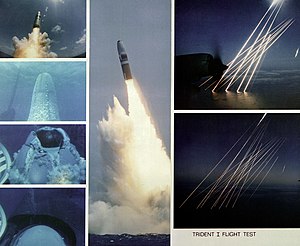
Trident nuclear project can’t be delivered, says watchdog.
“The veil of secrecy surrounding nuclear spending is a desperate attempt by the UK Government to hide how outrageously unaffordable these weapons have become”
The Ferret, Rob Edwards, 27 Jul 23
Delivery of nuclear reactors to power a new fleet of Trident submarines on the Clyde has been branded as “unachievable” for the second year running by a UK Government watchdog.
The Infrastructure and Projects Authority (IPA) has given a £3.7 billion reactor-building project run by Rolls Royce for the Ministry of Defence (MoD) a “red” rating for 2022-23. The project was also assessed as red in 2021-22, as reported by The Ferret.
According to the IPA, red means that “successful delivery of the project appears to be unachievable”. This is because of “major issues” that do not appear to be “manageable or resolvable”.
The 2022-23 rating for another scheme crucial to renewing the Trident nuclear weapons system — a £1.9bn construction project at the Faslane and Coulport nuclear bases near Helensburgh — has been kept secret. In 2021-22 it was assessed as red.
The planned date for the final delivery to the Clyde of the new Dreadnought-class submarines, armed with Trident nuclear warheads, has also been classified as confidential by the MoD “for the purpose of safeguarding national security”.
The Scottish National Party (SNP) accused the UK Government of desperately trying to hide how “outrageously unaffordable” the Trident programme had become. The Scottish Greens described the programme as “a grotesque money pit”.
Campaigners criticised the MoD for “rewarding failure” by throwing money at nuclear projects, and for concealing the truth about the problems and delays. They warned of “everyday harms” from the risks of radiation leaks, as well as “catastrophic accidents”.
………………………………………The IPA’s latest annual report for 2022-23 assessed the feasibility of 52 military projects costing a total of £255.4bn. Eleven were related to the UK’s nuclear weapons programme and together cost more than £57bn, though the overall costs for three of them were kept secret.
The manufacture of nuclear reactors at a Rolls-Royce factory in Derby was the only project to be publicly rated as red. The reactors are to drive four new Trident-armed Dreadnought submarines due to start replacing existing Vanguard submarines at Faslane “in the early 2030s”.
…………………………………………………………….. Another previously mysterious project called Aurora was rated as amber. It is to make the plutonium components for new nuclear bombs at Aldermaston in Berkshire and is reckoned to cost between £2bn and £2.5bn.
The planned completion date for Aurora has been kept secret, along with the end dates for four other nuclear projects, including the Dreadnought and Astute submarine programmes. The dates were withheld under a freedom of information law exemption meant to protect national security.
2022-23 assessments for two other nuclear projects have also been classified as confidential so as not to prejudice international relations and the defence of the UK. One, Teutates, is a collaboration on nuclear weapon safety with France and the other is called “Clyde Infrastructure”.
The Clyde project is to build a series of new facilities at Faslane and Coulport to support nuclear submarine operations. It was rated as red by the IPA in 2021-22, and amber in 2020-21 and 2019-20.
The cost of the Clyde project has increased 19 per cent from £1.6bn to £1.9bn in the last year. According to the IPA, this is because of “challenges in delivering in a nuclear and operational environment”.
Trident ‘a moral abomination’
The SNP lambasted the UK Government for writing “blank cheques” to maintain the Trident programme. “The veil of secrecy surrounding nuclear spending is a desperate attempt by the UK Government to hide how outrageously unaffordable these weapons have become,” said the party’s Westminster defence spokesperson, Dave Doogan MP.
“The hollowing-out of the armed forces to pay for the ever-expanding nuclear vanity-weapons budget has led the UK to possess just 0.1 per cent of the world’s nuclear warheads — but at eye-watering cost while conventional capabilities atrophy.”
The Green MSP Ross Greer described nuclear weapons as a “moral abomination” that had no place in Scotland. “As these figures show, they are also a grotesque money pit that is swallowing up billions of pounds and giving huge handouts to international arms dealers,” he said.
“The Scottish Greens are proud to have secured the Scottish Government’s support for the international treaty banning nuclear weapons, already signed by 92 other countries.”
MoD ‘trying to hide’ Trident delays
The Nuclear Information Service, which researches and criticises nuclear weapons, pointed out that the MoD had been repeatedly given additional billions for its nuclear programme. “But there’s no sign that throwing money at the problem is having any effect beyond rewarding failure,” the group’s director, David Cullen, told The Ferret.
The Scottish Campaign for Nuclear Disarmament attacked the nuclear industry for its “big back catalogues” of cost escalations and time over-runs. “The nuclear propulsion of the nuclear weapon system only adds to the repertoire of everyday harms from radiation leaks and opportunities of catastrophic accidents,” said campaign chair, Lynn Jamieson……………………………………………………………….. https://theferret.scot/trident-nuclear-project-watchdog/
Bombs away: Confronting the deployment of nuclear weapons in non-nuclear weapon countries
Bulletin, By Moritz Kütt, Pavel Podvig, Zia Mian | July 28, 2023
The countries of the Nuclear Nonproliferation Treaty (NPT) will meet in Vienna at the end of July and in early August to begin another several-year-long cycle of assessing progress on meeting the goals and obligations of this five-decade-old agreement. A particularly contentious part of the coming global nuclear debate will be the handful of NPT countries that do not have nuclear weapons of their own but instead choose to host nuclear weapons belonging to the United States or Russia. For most NPT countries, such nuclear weapon-hosting arrangements are unacceptable Cold War holdovers that should end.
The new urgency for action on the issue of nuclear host-states follows the first new agreement to transfer nuclear weapons to a host country in many decades. In June 2023, President Vladimir Putin announced that Russia had moved a number of its nuclear weapons to Belarus, its ally and neighbor, with more nuclear weapons on the way, and that “by the end of the summer, by the end of this year, we will complete this work.” For his part, the President of Belarus has proposed to other states: “Join the Union State of Belarus and Russia. That’s all: there will be nuclear weapons for everyone.”
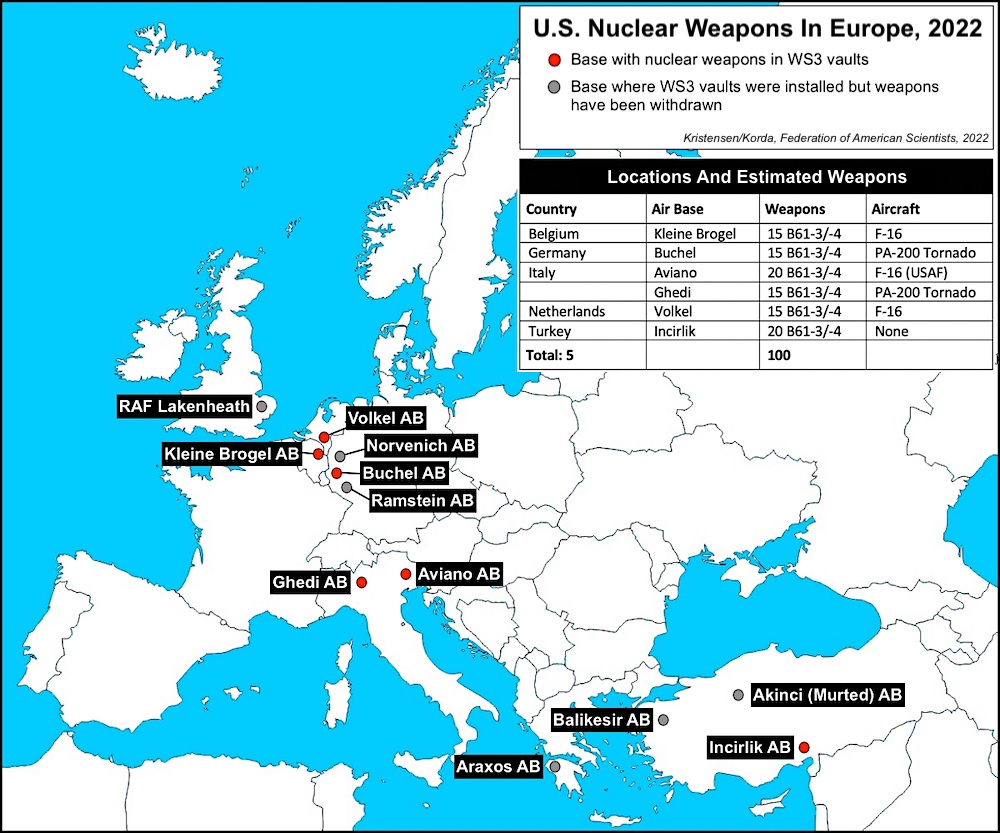
If the transfer of weapons to Belarus is completed, it will become the sixth nuclear-weapon host state. The other five hosting arrangements involve US nuclear weapons in Belgium, the Netherlands, Germany, Italy, and Turkey, in a practice euphemistically dubbed “nuclear sharing” by the US and its NATO allies. One other NATO member is increasingly vocal about wanting to join this gang. After Putin’s announcement about Belarus, Polish Prime Minister Mateusz Morawiecki repeated the call to become a host state for US nuclear weapons. Poland’s President Andrzej Duda had brought up this hosting option last year, but the idea had been floated in 2020 by Poland’s Ambassador to the United States………………………………………………………………………………….
There is a partially declassified history of US foreign nuclear weapon deployments from 1951-1977. The practice of stationing nuclear weapons in allied countries (or territories) began in 1951 with the deployment of weapon components to Guam, followed in 1954 by the dispatch of weapons to Morocco and the United Kingdom. In time, the US stationed its nuclear weapons in 16 countries, mostly in Europe and Asia (not counting Guam and Puerto Rico). Some US nuclear weapons were also stationed in Canada. By the late 1960s, there were about 7,000 US nuclear weapons in Europe, including bombs, missile warheads, artillery shells, and nuclear landmines. The number of US nuclear weapons in Europe peaked in 1971 at about 7,300 before beginning to decline later in the 1970s.
In 1959, the Soviet Union briefly deployed weapons to Eastern Germany. Its most prominent (albeit short-lived) nuclear weapons deployment was to Cuba in 1962. Later, in the mid-‘60s, longer deployments started, with Soviet nuclear weapons going to the Czech Republic, Hungary, Mongolia, Poland, and, again, East Germany. Moscow also deployed nuclear weapons in the Soviet republics, including strategic nuclear weapons in Kazakhstan, Belarus, and Ukraine.
With the end of the Cold War, the United States and Russia began to bring their weapons home. The Soviet Union had removed all weapons from Eastern Europe by the time it broke up in 1991. The withdrawal of all non-strategic weapons from former Soviet republics came by May 1992, and all strategic weapons were returned in November 1996.
Most US nuclear deployments in Asia ended in the mid-‘70s, although nuclear weapons stayed in South Korea until 1991. Deployments in Europe were significantly reduced (below 500 in 1994) and ended in Greece (2001) and in the United Kingdom (2009). However, the United States has not completed this process; about 100 US weapons remain abroad, stationed at bases in Belgium, the Netherlands, Germany, Italy and Turkey. Rather than withdraw the weapons from these countries, the US is sending modernized nuclear weapons to replace them.
The United Kingdom was the only other country to both host weapons (belonging to the US) and to deploy its own weapons in other countries. Its foreign deployments began in the 1960s and were limited to Cyprus, Singapore, and West Germany, and this practice ended in 1998.
There is no information on foreign deployments and nuclear hosting arrangements by other nuclear weapon states. There have been concerns that Pakistan might station some of its nuclear weapons in Saudi Arabia, with former US officials suggesting a “NATO-like model” might be one option for such an arrangement.
In current US nuclear hosting arrangements, the nuclear weapons are supposed to be under the control of US military personnel in peacetime. Specially trained host-nation air force units will carry and use these US weapons in wartime, in accordance with US and allied nuclear war plans. A similar arrangement now exists between Russia and Belarus, with Belarussian pilots trained to fly their planes while armed with Russian nuclear weapons; at least 10 planes may now be nuclear capable. It is also possible that Belarus could use its Russian-supplied, intermediate-range, dual-use Iskander-M missiles to deliver nuclear warheads.
According to the United Nations, the Russian nuclear hosting agreement with Belarus is the first such agreement since the NPT entered into force in 1970. The other hosting arrangements still operating are based on agreements that predate the treaty. The NPT prohibits both the acquisition of nuclear weapons by non-weapon states and the transfer of nuclear weapons to such countries by the five nuclear weapon states who are parties (Russia, China, the United States, the United Kingdom, and France)…………………………………….
While the treaty was being negotiated, US and Soviet officials agreed privately that existing nuclear hosting arrangements could continue even under the NPT.……………………………….
Most NPT member states have a different interpretation of nuclear sharing and for almost three decades have raised their concerns. …………………………………..
The most recent clash came at the August 2022 NPT Review Conference. Speaking on behalf of the 120 countries of the Non-Aligned Movement, Indonesia, said “[i]n the view of the Group … nuclear weapon-sharing by States Parties constitutes a clear violation of non-proliferation obligations undertaken by those Nuclear Weapon States (NWS) under Article I and by those Non-Nuclear Weapon States (NNWS) under Article II.” ………………………………………………………………
China is the only NPT nuclear-weapon state now consistently opposed to nuclear sharing. In its 2022 NPT Review Conference statement, China’s representative stated that “nuclear sharing arrangements run counter to the provisions of the NPT.” …………………………………………………………….
The most significant effort to confront the principles and practices of nuclear hosting is the UN Treaty on the Prohibition of Nuclear Weapons, which entered into force in 2021 and currently has almost 100 state signatories (all of whom also are NPT members). The TPNW prohibits the stationing of foreign nuclear weapons on the soil of its state parties under any circumstances. It offers a means for states who do not wish to be nuclear hosts to affirm this commitment and make it legally binding simply by joining the treaty. The TPNW also offers a path to membership for the states who currently have nuclear weapon hosting arrangements—if they sign the treaty they must undertake “prompt removal of such weapons, as soon as possible” and not later than 90 days. Once the weapons have been sent back home, the country has to make a declaration to this effect to the UN Secretary-General.
For states not yet ready to join the TPNW, several options are possible. States individually could decide to renounce nuclear hosting and sharing. For European NATO countries, one example is offered by Iceland and Lithuania, which are NATO members but refuse to host nuclear weapons under any circumstances. A less clear-cut option is offered by Denmark, Norway, and Spain, which do not allow deployment of nuclear weapons in peacetime.
States could also form nuclear-weapon free zones: Over 110 countries already are in nuclear-weapon-free zone agreements with neighbors. A European nuclear weapon free zone has been a long-standing idea. ………………………………………………
There are of course things nuclear weapon states could do. The five NPT nuclear weapon states could agree to a commitment on no-foreign-deployments as an effective measure relating to nuclear disarmament under their NPT Article 6 obligations…………………………………………
To establish a global principle, the UN General Assembly and the UN Security Council could determine that the hosting of nuclear weapons will henceforth be treated as a threat to international peace and security. https://thebulletin.org/2023/07/bombs-away-confronting-the-deployment-of-nuclear-weapons-in-non-nuclear-weapon-countries/
More Warmongers Elevated In The Biden Administration

It’s too soon to draw any firm conclusions, but to see voices of restraint stepping down and proponents of escalation stepping up could be a bad portent of things to come.
CAITLIN JOHNSTONE, JUL 26, 2023 https://www.caitlinjohnst.one/p/more-warmongers-elevated-in-the-biden?utm_source=post-email-title&publication_id=82124&post_id=135458379&isFreemail=true&utm_medium=email
| The Biden administration looks set to become even more warlike than it already was if you can imagine, with virulent Russia hawk Victoria Nuland and virulent China hawk Charles Q Brown now being elevated to lofty positions by the White House. Nuland, the wife of alpha neocon Robert Kagan, has been named acting deputy secretary of state by President Biden, at least until a new deputy secretary has been named. This places her at second in command within the State Department, second only to Tony Blinken. |

In an article about Nuland’s unique role in souring relations between the US and Russia during her previous tenure in the State Department under Obama, Responsible Statecraft’s Connor Echols writes the following of the latest news:
Nuland’s appointment will be a boon for Russia hawks who want to turn up the heat on the Kremlin. But, for those who favor a negotiated end to the conflict in Ukraine, a promotion for the notoriously “undiplomatic diplomat” will be a bitter pill.
A few quick reminders are in order. When Nuland was serving in the Obama administration, she had a now-infamous leaked call with the U.S. ambassador to Ukraine. As the Maidan Uprising roiled the country, the pair of American diplomats discussed conversations with opposition leaders, and Nuland expressed support for putting Arseniy Yatseniuk into power. (Yatseniuk would become prime minister later that month, after Russia-friendly former President Viktor Yanukovych fled the country.) At one memorable point in the call, Nuland said “Fu–k the EU” in response to Europe’s softer stance on the protests.
The controversy surrounding the call — and larger implications of U.S. involvement in the ouster of Yanukovych — kicked up tensions with Russia and contributed to Russian President Vladimir Putin’s decision to seize Crimea and support an insurgency in eastern Ukraine. Her handing out food to demonstrators on the ground in Kyiv probably didn’t help either. Nuland, along with State Department sanctions czar Daniel Fried, then led the effort to punish Putin through sanctions. Another official at State reportedly asked Fried if “the Russians realize that the two hardest-line people in the entire U.S. government are now in a position to go after them?”
In a 2015 Consortium News article titled “The Mess That Nuland Made,” the late Robert Parry singled out Nuland as the primary architect of the 2014 regime change operation in Ukraine, which, as Aaron Maté explained last year, paved the way to the war we’re seeing there today. Hopefully her position winds up being temporary.
In other news, the Senate Arms Services Committee has voted to confirm Biden’s selection of General Charles Q Brown Jr as the next chairman of the Joint Chiefs of Staff, replacing Mark Milley. A full senate vote will now take place on whether to confirm Brown — currently the Air Force Chief of Staff — for the nation’s highest military office.
Brown is unambiguous about his belief that the US must hasten to militarize against China in the so-called Indo-Pacific to prepare for confrontation between the two powers, calling for more US bases in the region and increased efforts to arm Taiwan during his hearing before the Senate Arms Services Committee earlier this month.
Back in May, Moon of Alabama flagged Brown’s nomination in an article which also noted that several advocates of military restraint had been resigning from their positions within the administration, including Wendy Sherman, the deputy secretary of state who Nuland has taken over for.
It’s too soon to draw any firm conclusions, but to see voices of restraint stepping down and proponents of escalation stepping up could be a bad portent of things to come.
Discarding Illusions, Ending Wars

Eighteen months later Ukraine is in ruins. Its latest counteroffensive achieved nothing. In the last three weeks, an estimated 26,000 Ukrainian soldiers died in pointless attacks against world-class Russian defenses ‘in depth.’
The attempt to extend NATO’s “new globalist world order” to Russia has failed.
By Colonel (ret.) Douglas Macgregor, US Army, THE KENNEDY BEACON JUL 20, 2023 https://thekennedybeacon.substack.com/p/discarding-illusions-ending-wars?utm_source=post-email-title&publication_id=1712557&post_id=135282964&isFreemail=true&utm_medium=email
From the moment the war in Ukraine started, Western reporting on the war was a radical repudiation of the truth. Washington and its NATO allies always knew that NATO expansion to Russia’s borders would precipitate an armed conflict with Moscow, but NATO’s ruling globalist class did not care. For them, Russia in 2022 was unchanged from the weak and incapable Russia of the late 1990s. The risk of failure seemed low. Ergo, Russia could be bullied into submission.
Americans and most Europeans did not bother to question or analyze. Widespread strategic ignorance about Russia and Eastern Europe ensured that most Americans and even West Europeans would react quickly and viscerally to the Western media’s distorted images and lies about Russia. At the same time, tolerance for criticism of Washington’s role in fashioning the corrupt and deceitful conduct of the Volodymyr Zelenskyy Regime and its war was disallowed in the press
Washington’s ruling class was cheered when it dismissed Russian proposals for talks on any grounds that did not recognize NATO’s right to transform Ukraine into a base for U.S. and Allied Military Power aimed at Russia. Ukrainian flags sprouted from the lush grounds of America’s wealthier neighborhoods like flowers in an arboretum and wonders in the form of limitless military assistance, miracle weapons, and cash were promised to President Zelenskyy––promises that strategic reality did not justify.
In 2022 the Biden Administration no longer possessed the military and economic strength to wage high-end conventional warfare that it had in 1991. Waging a major war 10,000 miles from home on the Eurasian continent is impossible without the support of truly powerful Allies on the model of the British Empire during WWII. Washington’s NATO allies are military dependencies, not formidable strategic partners.
Whereas Russian Military Power is still structured for decisive operations launched from Russian soil, U.S. Military power is geared to project limited air, naval, and land power thousands of miles from home to the periphery of Asia and Africa. American military power consists of boutique forces designed for safari in Africa and the Middle East, not decisive combat operations against great continental powers like Russia or China.
Eighteen months later Ukraine is in ruins. Its latest counteroffensive achieved nothing. In the last three weeks, an estimated 26,000 Ukrainian soldiers died in pointless attacks against world-class Russian defenses ‘in depth.’ (Defenses ‘in depth’ mean a security zone of 15 -25 kilometers in front of the main defense, that consists of at least three defense belts twenty or more kilometers deep.)
By comparison, Russian losses were minimal.
Today, more than 100,000 Russian troops are conducting offensive operations along the Lyman-Kupiansk axis. These forces include 900 tanks, 555 artillery systems and 370 multiple rocket launchers. It does not take much imagination to anticipate the breakthrough of these forces to the North where they can encircle Kharkiv.
Once Russian Forces surround the city, they will become an irresistible magnet for Ukraine’s last reserve of 30-40,000 troops. Ukrainian Forces attacking to the East to break through to Kharkov will present the combination of Russian space and terrestrial-based ISR (intelligence, surveillance, reconnaissance) assets and Precision Strike Aerospace, Artillery, Rocket, and Missile Systems with a target array that only a blind man could miss.
None of these developments should surprise anyone in the West. Building a Ukrainian army on the fly with a hotchpotch of hastily assembled equipment from a multitude of NATO members and an officer corps of many courageous, but inexperienced officers had little chance of success even under the best of circumstance.
Wars are decided in the decades before they begin. In war, the sudden appearance of “Silver Bullet” technology seldom provides more than a temporary advantage and strong personalities in the senior ranks do not compensate for inadequate military organization, training, thinking, and effective equipment. A new, leaked memorandum from sources inside Ukraine illustrates these points:
“Units of the Ukrainian Armed Forces are at such terrible states of degradation that soldiers are abandoning their posts, and whilst not mentioned in these documents, a flood of videos have been published from Russian sources claiming Ukrainian service personnel are surrendering at the first opportunity owing to the belief that they are being treated as ‘nothing more than cannon fodder.’”
Events on the ground are beginning to overtake the carefully orchestrated charade in Kiev. There is little that pontificating retired generals and armchair military analysts can do to halt the inevitable. Moscow understands that the war will not end without Russian offensive action. Whatever the Washington’s original goals may have been, theybeen they are unrealizable. Russian Forces will soon fall on the Ukrainian forces with the momentum and the impact of an avalanche.
In view of these points, before all of Ukraine’s manpower is annihilated, or a “Coalition of the Willing” from Poland and Lithuania marches into Western Ukraine, Washington can arrest Ukraine’s downward spiral into total defeat, and Washington’s own irresponsible drift into a regional war with Russia for which Washington and its allies are not prepared.
Cooler heads can prevail inside the beltway. The fighting can stop, but a ceasefire, and the diplomatic talks that must proceed from a ceasefire, will not occur unless Washington and its Allies acknowledge three critical points:
First, whatever form the Ukrainian State assumes in the aftermath of the conflict, Ukraine must be neutral and non-aligned. NATO membership is out of the question. A neutral Ukraine on the Austrian model can still provide a buffer between Russia and its Western Neighbors.
Second, Washington and its Allies must immediately suspend all military aid to Ukraine. Doubling down on failure by introducing more equipment and technology the Ukrainian Forces cannot quickly absorb and employ is wasteful and self-defeating.
Third, all U.S. and allied personnel, clandestine or in uniform, must withdraw from Ukraine. Insisting on some form of NATO presence as a face-saving measure is pointless. The attempt to extend NATO’s “new globalist world order” to Russia has failed.
The point is straightforward. It is time for Washington to turn its attention inward and address the decades of American societal, economic, and military decay that ensued after 1991. It’s time to reverse the decline in American national prosperity, and power; to avoid unnecessary overseas conflict;and to shun future interventions in the affairs of other nation states and their societies. The threats to our Republic are here, at home, not in the Eastern Hemisphere.
Japan Doesn’t Want to Fight for Taiwan and Neither Do Other US Allies

if Japan fought alongside the US in a hypothetical conflict with China over Taiwan, the Japanese civilians and economy would suffer greatly. What’s more, in a conflict between two nuclear powers, China and the US, Japan may itself become a nuclear target,
22.07.2023 Ekaterina Blinova https://sputnikglobe.com/20230722/japan-doesnt-want-to-fight-for-taiwan-and-neither-do-other-us-allies-1112066099.html
Despite Japan bolstering its military capabilities under the nation’s new Defense Buildup Program, it appears to have zero appetite to engage in direct confrontation with China over Taiwan, Western media and think tanks say.
US military facilities in Okinawa, Japan, might play a central role in any Taiwan crisis, according to the Western press. Moreover, American military analysts have almost unanimously agreed that Japan is “the most likely US ally to contribute troops” in a potential US conflict with China over the island.
Back in October 2021, War on the Rocks, a US online media outlet, quoted a Japanese poll which appeared to indicate that 74% of respondents would support their government’s military engagement in the Taiwan Strait against China. The report further speculated about the possibilities of circumventing the country’s Constitution, which limits Japan’s ability to participate in conflicts.
Bold statements made by some Japanese officials also seemed to confirm Tokyo’s resolve. One of them, former Minister of Defense Yasuhide Nakayama, insisted in June 2021 that Taiwan is a “red line” and that “we have to protect Taiwan as a democratic country.” Japan and Taiwan are geographically close and any possible military actions over the island could potentially affect Japan’s Okinawa prefecture, Nakayama argued at the time.
Is China Going to Take Taiwan by Force?
The People’s Republic of China, which considers Taiwan its inalienable part, has repeatedly stated that it is going to reunite with the island peacefully, referring to years of fruitful collaboration with the former Taiwanese government formed by members of Kuomintang Party.
The Kuomintang can make a spectacular comeback during the Taiwanese general elections, scheduled for January 2024. The party’s victory could nip the fuss around Taiwan’s secessionism and potential conflict in the bud. Even US lawmakers admit it, considering the Kuomintang’s win a potential “threat” to Washington’s plans in the Asia-Pacific.
Biden Fast-Tracks Arming of Taiwan
For their part, the Biden administration and American legislators have repeatedly issued provocative statements with regard to the island, with the US president claiming time and time again that Washington is ready to “protect” Taiwan “militarily.” The US has also bolstered arms sales to the island.
In late June, Biden approved two potential arms sales totaling $440 million to Taiwan, including ammo and other military equipment. Earlier, in March, the US State Department approved a $619 million sale of hundreds of missiles to Taiwan to arm its new US-made F-16 jet fighters. Moreover, the Biden administration has started to use fast-track authority for accelerating the pace of the arming of Taiwan. The same mechanism has been used by Biden to speed-up Ukraine’s militarization.
Japanese Leadership Seems Unhappy With US Bellicosity
The unfolding situation has apparently given shivers to the Japanese leadership. The Wall Street Journal broke on Monday that the Japanese government is ready to give permission to the US to use bases in Japan in the case of conflict over Taiwan, but Tokyo’s own participation is unlikely.
Per the report, Washington invited Tokyo to consider using its Self-Defense Forces, especially the Maritime Self-Defense Force for hunting for Chinese submarines around the island of Taiwan and for other military missions.
Presently, Japan is home to about 54,000 US troops, according to the Council on Foreign Relations. It also hosts the headquarters of the US Navy’s 7th Fleet and the 31st Marine Expeditionary Unit.
Tokyo’s concerns have certain grounds. In May, Japanese scholar Kiyoshi Sugawa wrote for Responsible Statecraft, the online magazine of the Quincy Institute (a DC-based think tank), that if Japan fought alongside the US in a hypothetical conflict with China over Taiwan, the Japanese civilians and economy would suffer greatly. What’s more, in a conflict between two nuclear powers, China and the US, Japan may itself become a nuclear target, Sugawa warned.
The DC-based think also refers to the recent Japanese polls which indicate that just 11% of Japanese respondents consider it possible to fight alongside the US against China, while 27% said that their forces should not cooperate with the US military at all. The majority (56%) said that providing logistical support to the US would be more than enough in the event of the conflict.
Nobody Wants to Die for Uncle Sam
What’s more, Japan is not the only US ally unwilling to fight with China over Taiwan. The Australian government has recently signaled that it gave no promises to Washington about military participation in a potential conflict. The Philippines does not want to get dragged into the conflict, either.
When it comes to South Korea, it also lacks any enthusiasm of joining the US in a combat operation in the Taiwan Strait. Western observers draw attention to the fact that South Korean President Yoon Suk-yeol avoided meeting with then-US House Speaker Nancy Pelosi in Seoul after her controversial tour to Taiwan. The Diplomat suggested that Seoul has at least three reasons to avoid a possible war over the island. First, the China market accounts for 30% of South Korea’s total trade; second, Seoul fears that a Taiwan conflict would increase “the North Korean threat”; third, for Seoul friendly relations with Beijing is a guarantee against a conflict with Pyongyang.
Still, there is yet another US regional treaty ally, Thailand. However, according to the DC-based think tank, it’s completely impossible to force Bangkok to fight against China for the sake of Taiwan.
While muddying the waters of the Taiwan Strait, the US risks staying face-to-face with China which would mean a defeat in a possible military standoff, judging from the US’ earlier war game simulations.
Ukrainian drone attack on Moscow is ‘international terrorism’ – Russia’s Foreign Ministry
RT.com 24 July 23
Two UAVs crashed into buildings in the Russian capital, with fragments reportedly found not far from the Defense Ministry
The attempted Ukrainian drone attack on Moscow early Monday morning, which damaged several non-residential buildings, is “an act of international terrorism,” Russian Foreign Ministry spokeswoman Maria Zakharova has said.
The spokeswoman condemned the attack on Monday morning while speaking to RTVI TV. Earlier, the Russian Defense Ministry said Ukraine attempted to stage “a terrorist attack” against Moscow using two drones, which were suppressed by electronic warfare systems……………
Kiev applauded the raid, with Mikhail Fedorov, Ukraine’s minister for digital transformation, promising that “there will be more” of these incidents.
Amid the conflict with Russia, Kiev has previously tried to launch drone raids on Moscow and its suburbs. Earlier this month, the Russian Defense Ministry said that air defenses downed four drones in the southeastern districts of the capital, and another UAV was neutralized by electronic warfare systems west of Moscow…………………………… more https://www.rt.com/russia/580185-ukrainian-drone-attack-moscow-international-terrorism/—
Kiev strikes ammunition depot in Crimea – official
https://www.rt.com/russia/580106-kiev-strikes-ammunition-depot-crimea/ 23 July 23
Governor Sergey Aksyonov has ordered a mass evacuation from the danger zone
A Ukrainian drone strike has resulted in an explosion at an ammunition depot in the central part of the Crimean peninsula, local Governor Sergey Aksyonov said on Saturday. According to preliminary information, the incident has not resulted in any casualties, he added.
Writing on Telegram, Aksyonov said the detonation had taken place in the Krasnogvardeysky district. “A decision has been made to evacuate the population within a 5km radius from the site of the emergency and place them in temporary accommodation facilities,” he added.
The governor stated that the authorities had also suspended rail traffic in the area in order to “minimize risks,” while expressing hope that the emergency would be dealt with quickly.
The Ukrainian Armed Forces have confirmed the strikes, claiming that they “had destroyed an oil depot and Russian military warehouses” in the area.
Crimea has repeatedly been targeted by Ukrainian drone and missile attacks since Moscow launched its military operation against Kiev over a year ago. On Thursday, Aksyonov said a Ukrainian UAV raid on the peninsula had killed a teenage girl and damaged several administrative buildings.
Earlier this week, a sea drone strike on the Crimean Bridge – which Russia called a Ukrainian terrorist attack – damaged one section of the roadway and claimed the lives of a married couple from Belgorod Region, as well as injuring their 14-year-old daughter.
Kiev stopped short of claiming responsibility, but celebrated the incident, while Ukrainian President Vladimir Zelensky later called the bridge a legitimate military target.
Meanwhile, Russian President Vladimir Putin has condemned the raid as a “terrorist attack” that was pointless from a military standpoint, adding that the bridge has not been used for transporting military materials for a long time. In the aftermath of the incident, Moscow launched several “retaliatory strikes” on targets in Ukrainian port cities.
Putin warns of Poland’s intentions in Ukraine and Belarus
Warsaw is looking to take control over western parts of Ukraine, the Russian president claims
Polish leaders are planning to form a NATO-backed coalition to intervene in the Ukraine conflict and take over parts of western Ukraine as well as, possibly, Belarus, Russian President Vladimir Putin claimed on Friday.
Speaking at a meeting with permanent members of Russia’s Security Council, Putin said the government in Kiev is willing to go to any lengths to stay in power, including selling out its own people and handing over Ukrainian territories to “foreign owners.”
The first in line, according to the Russian president, are the Poles, who he claimed “probably expect to form some kind of coalition under the ‘NATO umbrella’ and directly intervene in the conflict in Ukraine, in order to then ‘tear off’ a bigger piece for themselves, to regain, as they believe, their historical territories – today’s western Ukraine.”……………………………………………….. more https://www.rt.com/russia/580080-poland-western-ukraine-putin/
The Empire Knows It’s Pouring Ukrainian Blood Into An Unwinnable Proxy War
That’s right kids! We’re turning Ukraine into an uninhabitable wasteland of death and dismemberment to save the Ukrainians
Caitlin’s Newsletter CAITLIN JOHNSTONE, JUL 24, 2023
In a new article titled “Ukraine’s Lack of Weaponry and Training Risks Stalemate in Fight With Russia,” The Wall Street Journal’s Daniel Michaels reports that western officials knew Ukrainian forces didn’t have the weapons and training necessary to succeed in their highly touted counteroffensive which was launched last month.
Michaels writes:…………………………………………………
The claim that western officials had sincerely believed Ukrainian forces might be able to overcome their glaring deficits through sheer pluck and ticker is undermined later in the same article by a war pundit who says the US would never attempt such a counteroffensive without first controlling the skies, which Ukraine doesn’t have the ability to do:
“America would never attempt to defeat a prepared defense without air superiority, but they [Ukrainians] don’t have air superiority,” the U.S. Army War College’s John Nagl told WSJ. “It’s impossible to overstate how important air superiority is for fighting a ground fight at a reasonable cost in casualties.”
Antiwar’s Dave DeCamp writes the following on the latest WSJ revelation:
“Leading up to the Ukrainian counteroffensive, which was launched in June, the Discord leaks and media reports revealed that the US did not believe Ukraine could regain much territory from Russia. But the Biden administration pushed for the assault anyway, as it rejected the idea of a pause in fighting.”
So the empire is still knowingly throwing Ukrainian lives into the meat grinder of an unwinnable proxy war, even as western officials tell the public that this war is about saving Ukrainian lives and handing Putin a crushing defeat whenever they’re on camera.
This attitude from the empire is not a new development. Last October The Washington Post reported that “Privately, U.S. officials say neither Russia nor Ukraine is capable of winning the war outright, but they have ruled out the idea of pushing or even nudging Ukraine to the negotiating table.”
Now why might that be? Why would the western empire be so comfortable encouraging Ukrainians to keep fighting when it knows they can’t win?
We find our answer in another Washington Post article titled “The West feels gloomy about Ukraine. Here’s why it shouldn’t.”, authored last week by virulent empire propagandist David Ignatius. In his eagerness to frame the floundering counteroffensive in a positive light for his American audience, Ignatius let slip an inconvenient truth:
“Meanwhile, for the United States and its NATO allies, these 18 months of war have been a strategic windfall, at relatively low cost (other than for the Ukrainians). The West’s most reckless antagonist has been rocked. NATO has grown much stronger with the additions of Sweden and Finland. Germany has weaned itself from dependence on Russian energy and, in many ways, rediscovered its sense of values. NATO squabbles make headlines, but overall, this has been a triumphal summer for the alliance.”
Anyone who believes this proxy war is about helping Ukrainians should be made to read that paragraph over and over again until it sinks in. The admission that the US-centralized power structure benefits immensely from this proxy conflict is revealing enough, but that parenthetical “other than for the Ukrainians” aside really drives it home. It reads as though it was added as an afterthought, like “Oh yeah it’s actually kind of rough on the Ukrainians though — if you consider them to be people.”
The claim that this war is about helping Ukrainians has been further undermined by another new Washington Post report that Ukraine is now more riddled with land mines than any other nation on earth, and that US-supplied cluster munitions are only making the land more deadly.
That’s right kids! We’re turning Ukraine into an uninhabitable wasteland of death and dismemberment to save the Ukrainians.
We should probably talk more about the fact that the US empire is loudly promoting the goal of achieving peace in Ukraine by defeating Russia while quietly acknowledging that this goal is impossible. This is like accelerating toward a brick wall and pretending it’s an open road.
The narrative that Russia can be beaten by ramping up proxy warfare against it makes sense if you believe Russia can be militarily defeated in Ukraine, but the US empire does not believe that Russia can be militarily defeated in Ukraine. It knows that continuing this war is only going to perpetuate the death and devastation.
“Beat Putin’s ass and make him withdraw” sounds cool and is egoically gratifying, and it’s become the mainstream answer to the problem of the war in Ukraine, but nobody promoting that answer can address the fact that the ones driving this proxy war believe it’s impossible. In fact, all evidence we’re seeing suggests that the US is not trying to deliver Putin a crushing defeat in Ukraine and force him to withdraw, but is rather trying to create another long and costly military quagmire for Moscow, as western cold warriors have done repeatedly in instances like Afghanistan and Syria.
Wanting to weaken Russia and wanting to save lives and establish peace in Ukraine are two completely different goals, so different that in practice they wind up being largely contradictory. Drawing Moscow into a bloody quagmire means many more people dying in a war that drags on for years, with all the immense human suffering that that entails.
The US does not want peace in Ukraine, it wants to overextend Russia, shore up military and energy dominance over Europe, expand its war machine and enrich the military-industrial complex. That’s why it knowingly provoked this war. It’s posing as Ukraine’s savior while being clearly invested in Ukraine’s destruction.
It is not legitimate to support this proxy war without squarely addressing this massive contradiction using hard facts and robust argumentation. Nobody ever has. https://www.caitlinjohnst.one/p/the-empire-knows-its-pouring-ukrainian?utm_source=post-email-title&publication_id=82124&post_id=135389526&isFreemail=true&utm_medium=email
Ukraine’s Lack of Weaponry and Training Risks Stalemate in Fight With Russia
U.S. and Kyiv knew of shortfalls but Kyiv still launched offensive
WSJ, By Daniel Michaels, July 22, 2023
BRUSSELS—When Ukraine launched its big counteroffensive this spring, Western military officials knew Kyiv didn’t have all the training or weapons—from shells to warplanes—that it needed to dislodge Russian forces. But they hoped Ukrainian courage and resourcefulness would carry the day.
They haven’t. Deep and deadly minefields, extensive fortifications and Russian air power have combined to largely block significant advances by Ukrainian troops. Instead, the campaign risks descending into a stalemate with the potential to burn through lives and equipment without a major shift in momentum.
As the likelihood of any large-scale breakthrough by the Ukrainians this year dims, it raises the unsettling prospect for Washington and its allies of a longer war—one that would require a huge new infusion of sophisticated armaments and more training to give Kyiv a chance at victory.
The political calculus for the Biden administration is complicated. President Biden is up for re-election in the fall of 2024 and many in Washington believe concerns in the White House about the war’s impact on the campaign are prompting growing caution on the amount of support to offer Kyiv.
The American hesitation contrasts with shifting views in Europe, where more leaders over recent months have come to believe that Ukraine must prevail in the conflict—and Russia must lose—to ensure the continent’s security.
But European militaries lack sufficient resources to supply Ukraine with all it needs to eject Moscow’s armies from the roughly 20% of the country that they control. European leaders are also unlikely to significantly increase support to Kyiv if they sense U.S. reluctance, Western diplomats say.
The shift in trans-Atlantic political winds, evident in tensions between Ukrainian President Volodymyr Zelensky and U.S. officials at the recent North Atlantic Treaty Organization summit in Lithuania, has come as Ukraine’s long-expected offensive appears stalled. Kyiv’s inability to make headway against Russian defenses has persuaded many Western military observers that Ukrainian forces need more training in complex military maneuvers, more-potent air defenses and much more armor.
Moscow’s military, meanwhile, is grappling with low morale because of exhaustion, poor supplies and infighting among Russian leaders, Ukrainian and Western intelligence indicates. Russia appears unable to seize the initiative and attack Ukrainian positions, but its forces remain robust enough to man hundreds of miles of fortifications and large numbers of aircraft, which are keeping Kyiv’s troops at bay……………………………………………………………………………… more https://archive.is/D6CQZ#selection-625.0-634.1
1 This Month




PLEASE OPPOSE HR 8255 AND S.3639 – bills would accelerate satellite deployment, with no environmental review or safeguards – https://ncstd5li.quorum.us/campaign/169331/
To see nuclear-related stories in greater depth and intensity – go to https://nuclearinformation.wordpress.com
-
Archives
- September 2026 (323)
- August 2026 (330)
- July 2026 (355)
- June 2026 (287)
- May 2026 (306)
- April 2026 (356)
- March 2026 (251)
- February 2026 (267)
- January 2026 (308)
- December 2025 (358)
- November 2025 (359)
- October 2025 (375)
-
Categories
- 1
- 1 NUCLEAR ISSUES
- business and costs
- climate change
- culture and arts
- ENERGY
- environment
- health
- history
- indigenous issues
- Legal
- marketing of nuclear
- media
- opposition to nuclear
- PERSONAL STORIES
- politics
- politics international
- Religion and ethics
- safety
- secrets,lies and civil liberties
- spinbuster
- technology
- Uranium
- wastes
- weapons and war
- Women
- 2 WORLD
- ACTION
- AFRICA
- Atrocities
- AUSTRALIA
- Christina's notes
- Christina's themes
- culture and arts
- Events
- Fuk 2022
- Fuk 2023
- Fukushima 2017
- Fukushima 2018
- fukushima 2019
- Fukushima 2020
- Fukushima 2021
- general
- global warming
- Humour (God we need it)
- Nuclear
- RARE EARTHS
- Reference
- resources – print
- Resources -audiovicual
- Weekly Newsletter
- World
- World Nuclear
- YouTube
-
RSS
Entries RSS
Comments RSS

