UK and Netherlands agree ‘international coalition’ to help Ukraine procure F-16 jets
Guardian 17 May 23
Rishi Sunak and Mark Rutte announced plans a day after Volodymyr Zelenskiy said Kyiv could soon receive fighter jets
Prime minister Rishi Sunak and Dutch leader Mark Rutte have agreed to build an “international coalition” to help procure F-16 fighter jets for Ukraine, the British government has announced.
A Downing Street spokesperson said Sunak and Rutte “would work to build an international coalition to provide Ukraine with combat air capabilities, supporting with everything from training to procuring F-16 jets”.
“The prime minister reiterated his belief that Ukraine’s rightful place is in Nato and the leaders agreed on the importance of allies providing long-term security assistance to Ukraine to guarantee they can deter against future attacks.
“The leaders agreed to continue working together both bilaterally and through forums such as the European Political Community to tackle the scourge of people trafficking on our continent.”
The statement on Tuesday came a day after Ukraine’s president hinted that Kyiv could soon receive F-16 fighter jets, saying he was hopeful of “very important” decisions on the subject with the help of the UK……………………………
At the meeting, Britain also promised to supply “hundreds of attack drones”.
The UK said in February that it would begin training Ukrainian pilots in standard Nato techniques, and No 10 repeated that on Monday, saying the plan was to help “build a new Ukrainian air force with Nato-standard F-16 jets”.
Britain does not use F-16s, which are made by the US defence firm Lockheed Martin in South Carolina…………
Both countries will have to persuade the US if Ukraine is to receive F-16s. Asked later on Monday if the US had changed its position on supplying the jets to Ukraine, John Kirby, a spokesperson for the White House’s national security council, gave a one-word reply: “No.” https://www.theguardian.com/world/2023/may/16/uk-and-netherlands-agree-international-coalition-to-help-ukraine-with-f-16-jets
Zelensky plotted attacks deep inside Russia – Washington Post

https://www.rt.com/russia/576237-zelensky-hungary-russia/ 15 May 23
The Ukrainian leader reportedly wanted to “occupy” Russian cities to gain leverage over Moscow
Despite public assurance that he would limit military action to his own country’s 1991 borders, Ukrainian President Vladimir Zelensky formed plans to conduct attacks deep inside Russia and suggested that Kiev “destroy” the industry of Hungary, the Washington Post reported on Saturday, citing leaked Pentagon documents.
Citing US intelligence reports recently published on a gaming server, the Post described how Zelensky suggested at a meeting in January that his troops “conduct strikes in Russia,” while moving across the border to “occupy unspecified Russian border cities” in order to “give Kiev leverage in talks with Moscow.”
Less than two months later, the Ukraine-based Russian Volunteer Corps launched a cross-border raid that left two civilians dead in Russia’s Bryansk Region. A member of the group told Western media that Kiev had approved the attack, and further assaults have taken place since.
With Ukraine’s Western backers reluctant until recently to provide him with long-range missiles for fear he would use them against targets within Russia, Zelensky suggested to his top military commander, General Valery Zaluzhny, that he use drones to “attack unspecified deployment locations in Rostov” in February, the Post reported.
Prior to and after the alleged meeting, Ukrainian forces used drones to attack infrastructure in Rostov Region, which borders the formerly Ukrainian territory of Lugansk.
In a meeting with Deputy Prime Minister Yulia Svridenko in February, Zelensky reportedly suggested that Ukraine “blow up” the Druzhba oil pipeline, which transports Russian oil to Hungary. According to the US report cited by the Post, Zelensky suggested that “Ukraine should just blow up the pipeline and destroy…Hungarian [Prime Minister] Viktor Orban’s industry, which is based heavily on Russian oil.”
American spies listening to his meeting with Svridenko concluded that Zelensky was issuing “hyperbolic, meaningless threats.” Nevertheless, the Druzhba pipeline has come under attack on several occasions since the meeting, most recently when it was hit by drone-dropped explosives on Wednesday.
The Post’s article corroborates a CNN report last month claiming that US spies have been intercepting Zelensky’s communications.
Contacted by the newspaper, Zelensky dismissed the incidents described in the report as “fantasies,” and claimed that “no one in our country has given orders for offensives or strikes on Russian territory.”
Contacted by the newspaper, Zelensky dismissed the incidents described in the report as “fantasies,” and claimed that “no one in our country has given orders for offensives or strikes on Russian territory.”
Britain leads the way in escalating the Ukraine war with long range missiles

Robert Stevens10 May 2023 WSWS UK deepens warmongering in Ukraine with plans to supply long-range missiles
The UK is again leading the way in a massive further escalation of the NATO war against Russia.
On Monday, the Washington Post reported that the UK’s Ministry of Defence (MoD) had issued a call to weapons manufacturers, on behalf of the International Fund for Ukraine (IFU), to supply missiles capable of striking Russian-annexed Crimea or cities deep inside Russia’s borders. Over £300 million in funding has been made available through donations from the UK, Norway, the Netherlands, Denmark, Sweden, plus Iceland and Lithuania.
The MoD’s notice referred to “Missiles or Rockets with a range 100-300km; land, sea or air launch” and “Payload 20-490kg”. Listed as “Desirable requirements” were: “Low Probability of Intercept (LPI); includes Mission Planning Capability; Assured navigation (with hardened Global Navigation Satellite System capability) in the face of advanced countermeasures and EM spectrum denial; Air defence penetration methods to increase probability of successful strike; Technical Readiness Level of at least 8”.
This fits the profile of the UK’s own Storm Shadow missile which has a range of in excess of 250km. Costing £2.2 million apiece, the weapon is manufactured by the UK/French/Italian arms group MBDA for the British and French armed forces. According to the Forceswebsite, the Storm Shadow was “developed primarily for stealth strikes,” is “capable of engaging the targets precisely in any weather conditions during day and night” and boasts “long-range low attitude paths combined with subsonic speed.”…………….
The Guardian reported Wednesday, “A British official, speaking anonymously, said the tender requirements were ‘rather consistent’ with the Storm Shadow.” An MoD spokesperson said that a final decision to supply Ukraine with long-range Ukraine would rest with the main five countries in the IFU.
This was just for public consumption. Everyone knows that it is Britain, acting in tandem with the United States, that will decide what gets sent. This was made clear by the statements cited in the Washington Post made by British Prime Minister Rishi Sunak in February in his speech to the Munich Security Conference:…………
Sunak added definitively, “The United Kingdom will be the first country to provide Ukraine with longer range weapons.”
His pledge was all but confirmed this week by UK Foreign Secretary James Cleverly, in Washington to hold talks with US Secretary of State Antony Blinken and the Atlantic Council think tank “on the United Kingdom’s role in an increasingly adversarial world.”……….
Cleverly commented, “Air defense missile systems became increasingly important over time, and in the next stage we’ll see another evolution of the support.”
Britain’s role as chief provocateur in the lead up to and during NATO’s war against Russia is a matter of record. It has also led the way in ensuring ever-more lethal military hardware has been flooded into Ukraine, with the resulting mass loss of life, both Ukrainian and Russian, not even an afterthought.
Yuriy Sak, an adviser to Ukrainian Defense Minister Oleksiy Reznikov, told Reuters, “We would welcome it if the UK takes on a leadership role with the long-range missiles, in the same way they did with the Challenger 2 main battle tanks.”
Politico responded to the MoD’s announcement with a piece declaring, “The Biden administration has no plans to follow Britain’s lead in sending long-range missiles to Ukraine—with some officials saying the U.S. is now off the hook thanks to the U.K.’s planned delivery.”
……………………………………….. At every stage in the conflict, NATO has escalated the conflict with the supply of weaponry that US President Joe Biden himself and NATO officials had previously unconditionally ruled out. The Guardian noted, “Britain is unlikely to want to go ahead without US support, and getting to this point may have required diplomatic wrangling.”…………………………………………….. https://www.wsws.org/en/articles/2023/05/10/dvvj-m10.html
Leak reveals Zelensky privately plots bold attacks inside Russia.(Is his halo slipping?)

They reveal a leader with aggressive instincts that sharply contrast with his public-facing image as the calm and stoic statesman.
Zelensky suggested Ukraine “conduct strikes in Russia”
“Zelensky highlighted that … Ukraine should just blow up the pipeline and destroy likely Hungarian [Prime Minister] Viktor Orban’s industry”
Zelensky then “suggested that Ukraine attack unspecified deployment locations in Rostov,” a region in western Russia, using drones instead, according to another classified document.
The Age, John Hudson and Isabelle Khurshudyan, May 14, 2023
Washington: Ukrainian President Volodymyr Zelensky has won the trust of Western governments by refusing to use the weapons they provide for attacks inside Russia and prioritising the targeting of Russian forces inside Ukraine’s borders.
But behind closed doors, Ukraine’s leader has proposed going in a more audacious direction – occupying Russian villages to gain leverage over Moscow, bombing a pipeline that transfers Russian oil to Hungary, a NATO member, and privately pining for long-range missiles to hit targets inside Russia’s borders, according to classified US intelligence documents detailing his internal communications with top aides and military leaders.
The documents, which have not been previously disclosed, are part of a broader leak of US secrets circulated on the Discord messaging platform and obtained by The Washington Post. They reveal a leader with aggressive instincts that sharply contrast with his public-facing image as the calm and stoic statesman weathering Russia’s brutal onslaught. The insights were gleaned through intercepted digital communications, providing a rare look at Zelensky’s deliberations amid Russian missile barrages, infrastructure attacks and war crimes.
The Pentagon, where senior US military leaders were briefed on the matters outlined in the leaked documents, did not dispute the authenticity of the materials.
In some cases, Zelensky is seen restraining the ambitions of his subordinates; in several others, he is the one proposing risky military actions.
In a meeting in late January, Zelensky suggested Ukraine “conduct strikes in Russia” while moving Ukrainian ground troops into enemy territory to “occupy unspecified Russian border cities,” according to one document labelled “top secret.” The goal would be “to give Kyiv leverage in talks with Moscow,” the document said.
In a separate meeting in late February with General Valery Zaluzhny, Ukraine’s top military commander, Zelensky “expressed concern” that “Ukraine does not have long-range missiles capable of reaching Russian troop deployments in Russia nor anything with which to attack them”. Zelensky then “suggested that Ukraine attack unspecified deployment locations in Rostov,” a region in western Russia, using drones instead, according to another classified document.
In a meeting in mid-February with Deputy Prime Minister Yuliya Svrydenko, Zelensky suggested Ukraine “blow up” the Soviet-built Druzhba pipeline that provides oil to Hungary. “Zelensky highlighted that … Ukraine should just blow up the pipeline and destroy likely Hungarian [Prime Minister] Viktor Orban’s industry, which is based heavily on Russian oil,” the document says.
In detailing the conversation, intelligence officials concede that Zelensky was “expressing rage toward Hungary and therefore could be making hyperbolic, meaningless threats,” a qualification that does not accompany the other accounts of Zelensky suggesting bold military action. Though Hungary is nominally part of the Western alliance, Orban is widely considered Europe’s most Kremlin-friendly leader.
When asked if he had suggested occupying parts of Russia, Zelensky, during an interview with The Washington Post in Kyiv, dismissed the US intelligence claims as “fantasies” but defended his right to use unconventional tactics in the defence of his country.
……………. The use of long-range missiles to hit inside Russia is a particularly sensitive topic for the White House, which has long worried that the Ukraine conflict could escalate out of control and force a catastrophic standoff between the United States and Russia, the world’s largest nuclear powers.
Though Washington has given Zelensky billions of dollars’ worth of advanced weaponry, President Biden has steadily rebuffed the Ukrainian leader’s request for long-range ATACMS, shorthand for the Army Tactical Missile System, capable of striking targets up to 185 miles away. Since the start of the war, Biden has said the United States is “not encouraging or enabling Ukraine to strike beyond its borders”.
When asked about the intelligence indicating he had weighed the use of long-range missiles to hit Russia, Zelensky said it is not something Ukraine is entertaining. “No one in our country has given orders for offensives or strikes on Russian territory,” he said.
It is unclear whether the United States has shared accounts of Zelensky’s plotting with allied nations, but the Ukrainian president continues to enjoy the strong support of Western governments, which have provided him with an increasingly sophisticated array of weaponry.
This past week, Britain became the first Western country to provide Ukraine with long-range missiles. The Storm Shadow, a cruise missile system with stealth capabilities, has a range of 155 miles, far exceeding the 50-mile range of the US-provided HIMARS launchers.
British Defence Minister Ben Wallace said Friday that the missile would give Ukraine “the best chance” to defend itself and would be for use only “within Ukrainian sovereign territory.” A spokesman with the British Embassy in Washington declined to comment on whether Zelensky’s leaked remarks might give London pause about its decision.
The Biden administration says Zelensky’s intercepted comments are not the cause for withholding ATACMS.
“Ukraine has repeatedly committed to employ US-provided weapons responsibly and strategically when needed to counter Russian aggression, and we are confident that will continue to be the case,” said a US defence official who, like others interviewed for this report, spoke on the condition of anonymity to discuss a sensitive topic.
Since last year, Zelensky has promised that Ukraine would never use US weapons to strike inside Russia, a pledge the White House says he has fulfilled.
“President Zelensky has kept the promises he has made to President Biden, and we do not believe that that will change,” said a senior administration official.
One reason for not providing the long-range missiles is the “relatively few ATACMS” the United States has for its own defence needs, General Mark A. Milley, chairman of the Joint Chiefs of Staff, told Defence One in March.
Zelensky, however, said he believes the United States isn’t sending the weapons because it doesn’t trust Kyiv.
“I think they are afraid that we might use them on the territory of Russia,” Zelensky told The Post. “But I would always tell our partners … ‘We have a priority target for which we are spending the ammunition packages we receive, and we spend it on the deoccupation of purely Ukrainian territories,’” he said.
While there is no indication that Ukraine has used Western missiles to strike into Russian territory, the same cannot be said for Kyiv’s use of armed drones.
Explosions caused by unmanned aerial vehicles have become a regular occurrence in Russia, including in Rostov, where a drone crashed into an oil refinery this month. Ukrainian officials are often coy about the incidents, hinting that they’re responsible without directly taking credit.
Two drone attacks in December on Russia’s Engels air base in Saratov, more than 590 kilometres from the Ukrainian border, showed “that we have the ability to reach many kilometres farther than they could expect,” Oleksiy Danilov, secretary of Ukraine’s National Security and Defence Council, said in an interview earlier this year.
Russia this month accused Ukraine of staging a drone attack intended to kill President Vladimir Putin in the Kremlin. Videos circulating on social media and verified by The Post show two drones streaking toward the Kremlin at about 2.30am local time. The allegation was forcefully denied by Ukrainian officials, including Zelensky…………………..more https://www.theage.com.au/world/europe/leak-reveals-zelensky-privately-plots-bold-attacks-inside-russia-20230514-p5d87l.html The Washington Post
NATO Weapons Go Boom, British Missiles Strike Russia – Ukraine War Escalates
The NATO vs Russia proxy war in Ukraine recently escalated a notch or two, with simultaneous ‘Ukrainian’ airstrikes downing two modern Russian fighter jets and two helicopters… well inside ‘Russia proper’. This came the day after British-supplied, longer-range, cruise missiles struck the city of Lugansk, and hours after Russian airstrikes obliterated another huge store of NATO supplies for Ukraine’s much-vaunted ‘counter-offensive’.
This week on NewsReal, Joe & Niall discuss the latest deceptions in ‘the Ukraine war…. more https://www.sott.net/article/480219-NewsReal-NATO-Weapons-Go-Boom-British-Missiles-Strike-Russia-Ukraine-War-Escalates#
As Donetsk civilians live in constant fear of Ukrainian shelling, from on the ground, I detail the terror
May 11, 2023, -Eva Karene Bartlett https://www.patreon.com/posts/as-donetsk-live-82857680?utm_medium=post_notification_email&utm_campaign=patron_engagement&utm_source=post_link
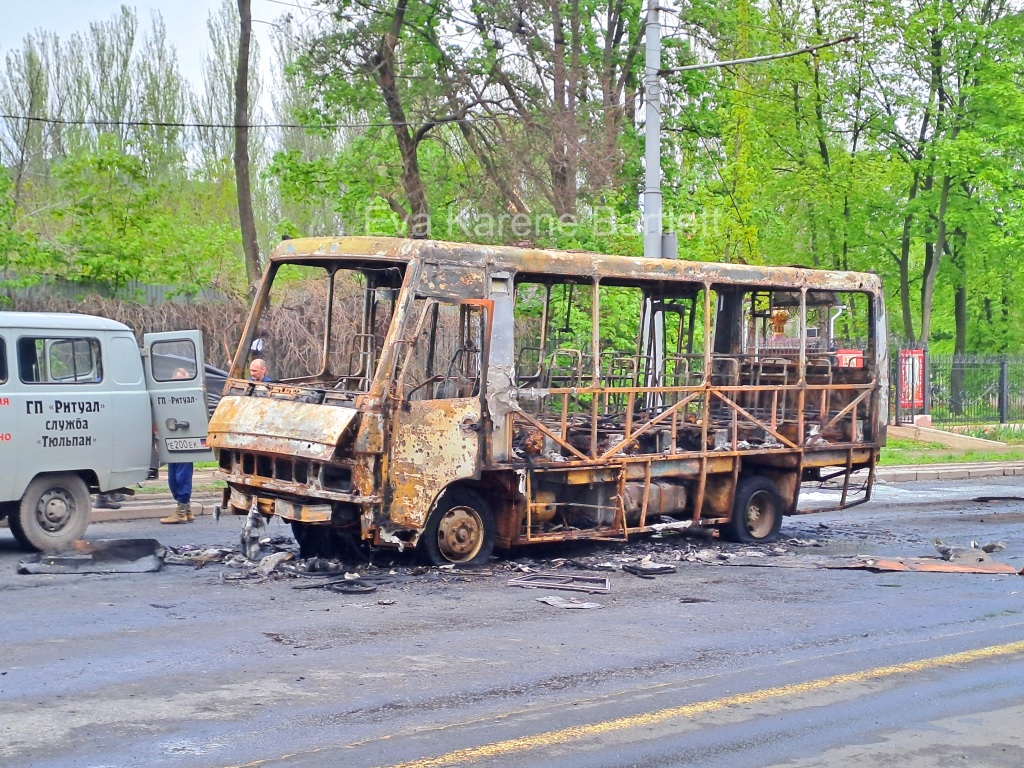
Heavy Ukrainian shelling of central Donetsk on April 28 killed nine civilians – including an eight-year-old girl and her grandmother – and injured at least 16 more. The victims were burned alive when the minibus they were in was hit by a shell.
The attack also targeted a major hospital, apartment buildings, houses, parks, streets, and sidewalks. All civilian areas – not military targets.
According to the Donetsk People’s Republic’s (DPR) Representative Office in the JCCC (Joint Monitoring and Co-ordination Center on Ukraine’s War Crimes), Kiev’s forces fired high-explosive fragmentation missiles “produced in Slovakia and transferred to Ukraine by NATO countries.” Regarding an earlier shelling on the same day, the JCCC noted that US-made HIMARS systems were used, targeting “exclusively in the residential, central quarter of the city.”
I was outside of Donetsk interviewing refugees from Artyomovsk (also known as Bakhmut) when both rounds of intense shelling occurred, the first starting just after 11am. I returned to see a catastrophic scene, with a burnt-out bus – still smoking – and some of its passengers’ charred bodies melted onto the frame. This tragic picture was sadly not a one-off event.
Elsewhere, city workers were already removing debris and had begun repaving damaged sections of the roads. I’ve seen this following Ukrainian shelling many times, including on January 1 this year, when Ukraine fired 25 Grads into the city centre. Similarly, in July 2022, Ukrainian shelling downtown killed four civilians, including two in a vehicle likewise gutted by flames. When I arrived at the scene about an hour later, workers were repaving the affected section of the street.
The damage to the Republican Trauma Center hospital was quickly cleaned up, but videos shared on Telegram immediately after the shelling show a gaping hole in one of the walls. The room concerned contained what was, apparently, Donetsk’s sole MRI machine.
Along Artyoma street, the central Donetsk boulevard targeted countless times by Ukrainian attacks, the destruction was evident: Two cars caught up in the bombing, residents of an apartment building boarding up shattered windows and doors, the all-too-familiar sound of glass and debris being swept away. In the residential area, the first to be targeted that day, in a massive crater behind one house, the walls and roof of another home were intermixed with rocket fragments.
Another year of Ukrainian war crimes
In April 2022, following strikes on a large market area in Kirovsky district, in western Donetsk, which killed five civilians and injured 23, I went there to document the aftermath, not expecting to see two of the five dead still lying in nearby lanes. This shelling was just before noon, a busy time of day in the area. Bombing at such periods is an insidious tactic to ensure more civilians are maimed or killed.
Double and triple striking the same areas is another method used by Ukrainian forces. In an interview last year, the director of the Department of Fire and Rescue Forces of the DPR Ministry of Emergency Situations, Sergey Neka, told me, “Our units arrive at the scene and Ukraine begins to shell it. A lot of equipment has been damaged and destroyed.”
Andrey Levchenko, chief of the emergency department for the Kievsky district of Donetsk, also hit by Ukrainian attacks, said: “They wait for 30 minutes for us to arrive. We arrive there, start assisting people, and the shelling resumes. They wait again, our guys hide in the shelters, as soon as we go out, put out the fire, help people, then shelling resumes.”
I was here in Donetsk in mid-June, during a day of particularly intense Ukrainian shelling of the very centre of the city, which killed at least five civilians. The DPR authorities reported that “within two hours, almost 300 MLRS rockets and artillery shells were fired.” One Grad rocket hit a maternity hospital, tearing through the roof.
The following month, Ukraine fired rockets containing internationally-banned ‘petal’ mines. The streets of central Donetsk, as well as the western and northern districts and other cities, were littered with the hard-to-spot mines designed to grotesquely maim, but not necessarily kill, anyone stepping on them. These mines keep claiming new victims to this day – when I last wrote about them here, 104 civilians had been maimed, including this 14-year-old boy. Three had died of their injuries. Since then, the number of victims has risen to 112.
In August, heavy Ukrainian shelling of the centre of Donetsk hit directly next to the hotel I was staying in, along with dozens of other journalists and cameramen. Six civilians were killed that day, including one woman outside the hotel, as well as a child. She been a talented ballerina due to leave to study in Russia soon, and along with her grandmother, her ballet teacher was also killed that day, herself a world-famous former ballerina.
Three bouts of Ukrainian shelling of the city centre in a span of just five days in September killed 26 civilians. Four were killed on September 17, among them two people burned alive inside a vehicle on the same central Artyoma Street. Two days later, 16 civilians were killed, the remains of their bodies strewn along the street or in unrecognizable piles of flesh. Three days later, Ukraine struck next to the central market, killing six civilians, two in a minibus, the rest on the street.
In my subsequent visits to Donetsk and surrounding cities in November and December, I filmed the aftermath of more Ukrainian shelling (using HIMARS) of civilian areas of Donetsk and the settlement of Gorlovka to the north. The November 7 shelling of central Donetsk could have killed the toddler of the young mother I interviewed. Fortunately, after hearing the first rockets hit, she ran with her son to the bathroom. When calm returned, she found shrapnel on his bed.
The November 12 shelling of Gorlovka damaged a beautiful historic cultural building, destroying parts of the roof and the theatre hall within. According to the centre’s director, it was one of the best movie theatres in Donetsk Region, one of the oldest, most beautiful, and most beloved buildings in the city. He noted that the HIMARS system is a very precise weapon, so the attack was not accidental.
The shelling goes on
Early morning during Easter Mass on April 16, the Ukrainian army fired 20 rockets near the Cathedral of the Holy Transfiguration in the centre of Donetsk, French journalist Christelle Neant reported, noting that one civilian was killed and seven injured. The shelling extended to the central market just behind the cathedral. Just over a week prior, on April 7, another shelling of that market killed one civilian and injured 13, also considerably damaging the market itself.
Ukraine continues to shell the western and northern districts of Donetsk, also pounding Gorlovka, as well as Yasinovatya just north of Donetsk (killing two civilians some days ago).
On April 23, shelling in Petrovsky, a hard-hit western Donetsk district, killed one man and injured five more. The same day, in a village northeast of Donetsk, a rocket killed two women in their 30s. Security camera footage shows the moment when the women attempted to take cover. The munition that killed them hit directly next to where they huddled.
A few days later, on my way to interview refugees from Artyomovsk sheltering in another city, I passed along the tiny village where those women were killed. It’s a road I’ve driven a dozen times or more, a quiet, calm, scenic region of rolling hills, a lovely river, a beautiful church. It’s far from any front line. The murder of these two women was another Ukrainian war crime.
The people here are constantly terrorized by Ukrainian shelling or the threat of it, and have been since Kiev started its war on the Donbass in 2014.
Biden is selling weapons to the majority of the world’s autocracies

Despite the White House’s rhetoric about supporting global democracy, the U.S. sold weapons in 2022 to 57 percent of the world’s authoritarian regimes.
Stephen Semler, May 11 2023, The Intercept
SINCE PRESIDENT JOE BIDEN came into office in 2021, he hasdescribed a “battle between democracies and autocracies” in which the U.S. and other democracies strive to create a peaceful world. The reality, however, is that the Biden administration has helped increase the military power of a large number of authoritarian countries. According to an Intercept review of recently released government data, the U.S. sold weapons to at least 57 percent of the world’s autocratic countries in 2022.
Since the end of the Cold War, the United States has been the world’s biggest weapons dealer, accounting for about 40 percent of all arms exports in a given year. In general, these exports are funded through grants or sales. There are two pathways for the latter category: foreign military sales and direct commercial sales.
The U.S. government acts as an intermediary for FMS acquisitions: It buys the materiel from a company first and then delivers the goods to the foreign recipient. DCS acquisitions are more straightforward: They’re the result of an agreement between a U.S. company and a foreign government. Both categories of sales require the government’s approval.
Country-level data for last year’s DCS authorizations was released in late April through the State Department’s Directorate of Defense Trade Controls. FMS figures for fiscal year 2022 were released earlier this year through the Pentagon’s Defense Security Cooperation Agency. According to their data, a total of 142 countries and territories bought weapons from the U.S. in 2022, for a total of $85 billion in bilateral sales.
How many of those countries were democracies, and how many were autocracies? That question can be answered by comparing the new U.S. arms sales data to political regime data from the Varieties of Democracy project at the University of Gothenburg in Sweden, which uses a classification system that’s called Regimes of the World.
The system classifies regimes into four categories: closed autocracy, electoral autocracy, electoral democracy, and liberal democracy. For a country to be classified as a democracy, it must have multiparty elections and political freedoms that make those elections meaningful. According to this methodology, the dividing line between democracies and autocracies is whether a country’s leaders are accountable to their citizens through free and fair elections.
Of the 84 countries codified as autocracies under the Regimes of the World system in 2022, the United States sold weapons to at least 48, or 57 percent, of them. The “at least” qualifier is necessary because several factors frustrate the accurate tracking of U.S. weapons sales. The State Department’s report of commercial arms sales during the fiscal year makes prodigious use of “various” in its recipients category; as a result, the specific recipients for nearly $11 billion in weapons sales are not disclosed………………………… https://theintercept.com/2023/05/11/united-states-foreign-weapons-sales/
Pentagon wants authority to start work on new technologies without Congressional approval
Jared Serbu @jserbuWFED, May 8, 2023
Over the last several years, Congress has passed several pieces of legislation meant to speed up the Defense Department’s acquisition system. Now, DoD officials have an idea of their own: they’re asking for new authorities that would let the military services begin early work on critical new programs without lawmakers’ explicit permission, arguing the current approval process takes too long and risks putting the U.S. military at a technological disadvantage.
………………………………….. If Congress agrees to the proposal as part of next year’s Defense authorization bill, DoD would be able to spend up to $300 million on new programs without getting Congressional approval: lawmakers would only be notified about a new start after a decision has been made………………………. https://federalnewsnetwork.com/defense-news/2023/05/pentagon-wants-authority-to-start-work-on-new-technologies-without-congressional-approval/
US to Provide Ukraine $1.2 Billion in Long-Term Security Aid

Military.com 8 May 2023, Associated Press | By Lolita C. Baldor and Matthew Lee
WASHINGTON — The U.S. will provide $1.2 billion more in long-term military aid to Ukraine to further bolster its air defenses as Russia continues to pound Ukraine with drones, rockets and surface-to-air missiles, U.S. officials said Monday.
The aid package is expected to be announced on Tuesday and the money will be provided under the Ukraine Security Assistance Initiative. Unlike the U.S. equipment, weapons and ammunition that are more frequently sent to Ukraine from Pentagon stocks — so they can be delivered quickly — this money is to be spent over the coming months or even years to ensure Ukraine’s future security needs.
The assistance initiative will fund HAWK air-defense systems, air-defense munitions and drones for air defense. It will also buy artillery, rockets, satellite imagery assistance, and funding for ongoing maintenance and spare parts for a variety of systems, according to the officials. They spoke on condition of anonymity because the aid package has not yet been formally announced.
The assistance initiative will fund HAWK air-defense systems, air-defense munitions and drones for air defense. It will also buy artillery, rockets, satellite imagery assistance, and funding for ongoing maintenance and spare parts for a variety of systems, according to the officials. They spoke on condition of anonymity because the aid package has not yet been formally announced……………………………………………. https://www.military.com/daily-news/2023/05/08/us-provide-ukraine-12-billion-long-term-security-aid.html
Links between Nuclear Weapons and Nuclear Power.

International Physicians for the Prevention of Nuclear War (IPPNW) 30 Apr 23
Note from GordonEdwards
* There is one exception. Plutonium-238 is normally present as a very small percentage of reactor-produced plutonium. However, if plutonium-238 is highly concentrated, it generates so much heat that it will melt the conventional explosice charges needed to trigger a nuclear explosion and for that reason cannot be used to make an effective nuclear weapon. However that situation never arises when dealing only with the plutonium produced by a nuclear reactor fueled with uranium. In other words, all plutonium produced in the used uranium fuel from a nuclear reactor is “good” for use as a nuclear weapons explosive material.
This resolution was passed at the 23rd World Congress, in Mombasa, Kenya
by the IPPNW International Council – April 30th, 2023
IPPNW affirms that the links between nuclear power and nuclear weapons are such that in order to fully abolish nuclear weapons, we also must stop the parallel process of nuclear power.
This resolution is an updated version of a similar resolution “Nuclear Weapons and Nuclear Energy – The Links” adopted at the 13th World Congress of IPPNW in Melbourne, Australia, Dec 1998.
IPPNW urges that there be:
- No more uranium mining. Leave it in the ground.
- No more plutonium extraction from existing nuclear materials.
- No new nuclear power plants.
- Expeditious transition from nuclear power to renewable energy sources.
- Blending down of existing stores of highly enriched uranium thus rendering these stores less likely to be diverted for nuclear weapons proliferation. How to handle plutonium to make it safe is still being discussed.
Reasons for Above:
- The acquisition of nuclear-weapons-useable materials is the first step to making nuclear weapons
- The technical processes to create nuclear power or nuclear-weapons-usable materials are essentially the same. Many nuclear plants have produced both. For example Chernobyl was a “dual purpose” plant.
- The 1953 “Atoms for Peace” speech was widely seen as a cover for the military to maintain access to nuclear-weapons material after the closure of the Manhattan Project.
- Nuclear power makes the proliferation of nuclear weapons more likely and verification of nuclear weapons more difficult. For example India made and exploded its first nuclear weapons test from a reactor given to India from Canada. This example of proliferation happened despite promises to the contrary.
- The problem of what to do with high level nuclear wastes remains an unsolved dilemma threatening the environment and human health. This issue is similar for wastes originating from commercial nuclear fuel cycles or wastes from military grade material. Health hazards and multi generational health effects are the same from either stream.
- The ‘weaponization’ of a nuclear power plant can happen in areas of conflict with great risks of purposeful or accidental dispersal of radioactive material. (e.g. Zaporizhzhia plant in Ukraine).
US Politicians Suggest Bombing Taiwan Semiconductor Manufacturing Company (TSMC) in Event of Cross-Strait Conflict
US politicians have once again sparked debate by suggesting bombing Taiwan Semiconductor Manufacturing Company (TSMC) in the event of cross-strait conflict. During a recent Milken Institute forum discussion on China-US strategic competition, Democratic Congressman Seth Moulton stated, “China needs to know that if you invade Taiwan, we’ll blow up TSMC”. While participating in the same panel discussion, US House Foreign Affairs Committee Chairman Michael McCaul revealed that President Tsai Ing-wen had asked him about the status of her country’s weaponry during his visit to Taiwan in April.
This is not the first time that US politicians have suggested bombing TSMC. In 2019, former Vice President Joe Biden had mentioned that the US would have to come up with new ways to counter China’s cyber attacks and intellectual property theft, including striking at Chinese companies like TSMC. Republican Senator Tom Cotton also touched on the topic earlier in May this year when he stated that America’s military response should include targeting Chinese critical infrastructure such as TSMC and Huawei.
Moulton later clarified his stance, saying that it is not the best strategy but only an example. Nevertheless, his comment could bring Taiwan’s technology industry, particularly TSMC, into focus in the escalating tensions between the US and China over the issue of Taiwan. TSMC, a crucial supplier to US firms such as Apple and Qualcomm, has seen its stock fall repeatedly this week following his comment.
Experts have pointed out that bombing TSMC would not only anger China but also cause significant harm to Taiwan’s economy. TSMC accounts for nearly half of the world’s chip production and is a critical part of Taiwan’s technology industry. The threats against it have highlighted how Taiwan, which relies heavily on the US for support, can be caught in the middle of tensions between the superpowers.
Russia ‘very unlikely’ to use nuclear weapons, US intel chief
By Phil Stewart and Idrees Ali
WASHINGTON, May 4 (Reuters) – Russia is very unlikely to use its nuclear weapons, the top U.S. intelligence official said on Thursday, despite past saber-rattling from the Kremlin and the heavy casualties that eMoscow is enduring in its invasion of Ukraine.
“It’s very unlikely, is our current assessment,” Director of National Intelligence Avril Haines told the Senate Armed Services Committee.
Nuclear tensions between Russia and the United States have increased since the start of the conflict with Ukraine with Putin repeatedly warning that Russia is ready to use its nuclear arsenal if necessary to defend its “territorial integrity.”
In February, Putin announced Russia was suspending its participation in the New START treaty, the last remaining nuclear arms pact with the United States, which limits the number of strategic warheads each side can deploy.
Haines did not elaborate on the U.S. intelligence community assessment.
U.S. officials for months have said they have not seen signs Russia was preparing to employ nuclear weapons but also cautioned that they were staying vigilant.
…………………………………… Last week the Kremlin played down the idea that Russia might be preparing to carry out a nuclear weapons test, saying all nuclear states were abiding by a moratorium on the testing of nuclear weapons. https://www.reuters.com/world/europe/russia-very-unlikely-use-nuclear-weapons-us-intel-chief-2023-05-04/
The Twenty-First Century of (Profitable) War- Not Your Grandfather’s Military-Industrial Complex

TOMGRAM, Hartung and Freeman, The Twenty-First Century of (Profitable) War, MAY 4, 2023
Unwarranted Influence, Twenty-First-Century-Style Not Your Grandfather’s Military-Industrial Complex
BY BEN FREEMAN AND WILLIAM D. HARTUNG
The military-industrial complex (MIC) that President Dwight D. Eisenhower warned Americans about more than 60 years ago is still alive and well. In fact, it’s consuming many more tax dollars and feeding far larger weapons producers than when Ike raised the alarm about the “unwarranted influence” it wielded in his 1961 farewell address to the nation.
The statistics are stunning. This year’s proposed budget for the Pentagon and nuclear weapons work at the Department of Energy is $886 billion — more than twice as much, adjusted for inflation, as at the time of Eisenhower’s speech. The Pentagon now consumes more than half the federal discretionary budget, leaving priorities like public health, environmental protection, job training, and education to compete for what remains. In 2020, Lockheed Martin received $75 billion in Pentagon contracts, more than the entire budget of the State Department and the Agency for International Development combined.
This year’s spending just for that company’s overpriced, underperforming F-35 combat aircraft equals the full budget of the Centers for Disease Control and Prevention. And as a new report from the National Priorities Project at the Institute for Policy Studies revealed recently, the average taxpayer spends $1,087 per year on weapons contractors compared to $270 for K-12 education and just $6 for renewable energy.
The list goes on — and on and on. President Eisenhower characterized such tradeoffs in a lesser known speech, “The Chance for Peace,” delivered in April 1953, early in his first term, this way: “Every gun that is made, every warship launched, every rocket fired signifies, in the final sense, a theft from those who hunger and are not fed, those who are cold and are not clothed. This world in arms is not spending money alone. It is spending the sweat of its laborers, the genius of its scientists, the hopes of its children…”
How sadly of this moment that is.
New Rationales, New Weaponry
Now, don’t be fooled. The current war machine isn’t your grandfather’s MIC, not by a country mile. It receives far more money and offers far different rationales. It has far more sophisticated tools of influence and significantly different technological aspirations.

Perhaps the first and foremost difference between Eisenhower’s era and ours is the sheer size of the major weapons firms. Before the post-Cold War merger boom of the 1990s, there were dozens of significant defense contractors. Now, there are just five big (no, enormous!) players — Boeing, General Dynamics, Lockheed Martin, Northrop Grumman, and Raytheon. With so few companies to produce aircraft, armored vehicles, missile systems, and nuclear weapons, the Pentagon has ever more limited leverage in keeping them from overcharging for products that don’t perform as advertised. The Big Five alone routinely split more than $150 billion in Pentagon contracts annually, or nearly 20% of the total Pentagon budget. Altogether, more than half of the department’s annual spending goes to contractors large and small.
In Eisenhower’s day, the Soviet Union, then this country’s major adversary, was used to justify an ever larger, ever more permanent arms establishment. Today’s “pacing threat,” as the Pentagon calls it, is China, a country with a far larger population, a far more robust economy, and a far more developed technical sector than the Soviet Union ever had. But unlike the USSR, China’s primary challenge to the United States is economic, not military.
Yet, as Dan Grazier noted in a December 2022 report for the Project on Government Oversight, Washington’s ever more intense focus on China has been accompanied by significant military threat inflation. While China hawks in Washington wring their hands about that country having more naval vessels than America, Grazier points out that our Navy has far more firepower. Similarly, the active American nuclear weapons stockpile is roughly nine times as large as China’s and the Pentagon budget three times what Beijing spends on its military, according to the latest figures from the Stockholm International Peace Research Institute.
But for Pentagon contractors, Washington’s ever more intense focus on the prospect of war with China has one overriding benefit: it’s fabulous for business. The threat of China’s military, real or imagined, continues to be used to justify significant increases in military spending, especially on the next generation of high-tech systems ranging from hypersonic missiles to robotic weapons and artificial intelligence…………………………………………………….

The arms industry as a whole has donated more than $83 million to political candidates in the past two election cycles, with Lockheed Martin leading the pack with $9.1 million in contributions, followed by Raytheon at $8 million, and Northrop Grumman at $7.7 million. Those funds, you won’t be surprised to learn, are heavily concentrated among members of the House and Senate armed services committees and defense appropriations subcommittees. For example, as Taylor Giorno of OpenSecrets, a group that tracks campaign and lobbying expenditures, has found, “The 58 members of the House Armed Services Committee reported receiving an average of $79,588 from the defense sector during the 2022 election cycle, three times the average $26,213 other representatives reported through the same period.”
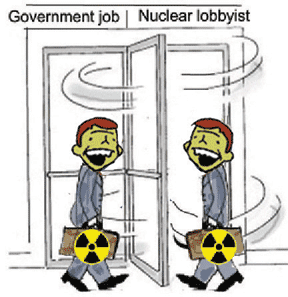
Lobbying expenditures by all the denizens of the MIC are even higher — more than $247 million in the last two election cycles. Such funds are used to employ 820 lobbyists, or more than one for every member of Congress. And mind you, more than two-thirds of those lobbyists had swirled through Washington’s infamous revolving door from jobs at the Pentagon or in Congress to lobby for the arms industry. Their contacts in government and knowledge of arcane acquisition procedures help ensure that the money keeps flowing for more guns, tanks, ships and missiles. Just last month, the office of Senator Elizabeth Warren (D-MA) reported that nearly 700 former high-ranking government officials, including former generals and admirals, now work for defense contractors. While a few of them are corporate board members or highly paid executives, 91% of them became Pentagon lobbyists, according to the report.
And that feverishly spinning revolving door provides current members of Congress, their staff, and Pentagon personnel with a powerful incentive to play nice with those giant contractors while still in their government roles. After all, a lucrative lobbying career awaits once they leave government service………………………………………………..
Shaping the Elite Narrative: The Military-Industrial Complex and Think Tanks

One of the MIC’s most powerful tools is its ability to shape elite discussions on national security issues by funding foreign policy think tanks, along with affiliated analysts who are all too often the experts of choice when it comes to media coverage on issues of war and peace. A forthcoming Quincy Institute brief reveals that more than 75% of the top foreign-policy think tanks in the United States are at least partially funded by defense contractors. Some, like the Center for a New American Security and the Center for Strategic and International Studies, receive millions of dollars every year from such contractors and then publish articles and reports that are largely supportive of defense-industry funding.

Some such think tanks even offer support for weapons made by their funders without disclosing those glaring conflicts of interest. For example, an American Enterprise Institute (AEI) scholar’s critique of this year’s near-historically high Pentagon budget request, which, she claimed, was “well below inflation,” also included support for increased funding for a number of weapons systems like the Long Range Anti-Ship Missile, the Joint Air-to-Surface Standoff Missile, the B-21 bomber, and the Sentinel intercontinental ballistic missile.
What’s not mentioned in the piece? The companies that build those weapons, Lockheed Martin and Northrop Grumman, have been AEI funders. Although that institute is a “dark money” think tank that doesn’t publicly disclose its funders, at an event last year, a staffer let slip that the organization receives money from both of those contractors.
Unfortunately, mainstream media outlets disproportionately rely on commentary from experts at just such think tanks…………………………………………
Shaping the Public Narrative: The Military-Entertainment Complex
Top Gun: Maverick was a certified blockbuster, wowing audiences that ultimately gave that action film an astounding 99% score on Rotten Tomatoes — and such popular acclaim helped earn the movie a Best Picture Oscar nomination. It was also a resounding success for the Pentagon, which worked closely with the filmmakers and provided, “equipment — including jets and aircraft carriers — personnel and technical expertise,” and even had the opportunity to make script revisions, according to the Washington Post. Defense contractors were similarly a pivotal part of that movie’s success. In fact, the CEO of Lockheed Martin boasted that his firm “partnered with Top Gun’s producers to bring cutting-edge, future forward technology to the big screen.”
While Top Gun: Maverick might have been the most successful recent product of the military-entertainment complex, it’s just the latest installment in a long history of Hollywood spreading military propaganda. “The Pentagon and the Central Intelligence Agency have exercised direct editorial control over more than 2,500 films and television shows,” according to Professor Roger Stahl, who researches propaganda and state violence at the University of Georgia.
“The result is an entertainment culture rigged to produce relatively few antiwar movies and dozens of blockbusters that glorify the military,” explained journalist David Sirota, who has repeatedly called attention to the perils of the military-entertainment complex. “And save for filmmakers’ obligatory thank you to the Pentagon in the credits,” argued Sirota, “audiences are rarely aware that they may be watching government-subsidized propaganda.”
What Next for the MIC?
More than 60 years after Eisenhower identified the problem and gave it a name, the military-industrial complex continues to use its unprecedented influence to corrupt budget and policy processes, starve funding for non-military solutions to security problems, and ensure that war is the ever more likely “solution” to this country’s problems. The question is: What can be done to reduce its power over our lives, our livelihoods, and ultimately, the future of the planet?
Countering the modern-day military-industrial complex would mean dislodging each of the major pillars undergirding its power and influence. That would involve campaign-finance reform; curbing the revolving door between the weapons industry and government; shedding more light on its funding of political campaigns, think tanks, and Hollywood; and prioritizing investments in the jobs of the future in green technology and public health instead of piling up ever more weapons systems. Most important of all, perhaps, a broad-based public education campaign is needed to promote more realistic views of the challenge posed by China and to counter the current climate of fear that serves the interests of the Pentagon and the giant weapons contractors at the expense of the safety and security of the rest of us…………………… https://tomdispatch.com/unwarranted-influence-twenty-first-century-style/
As US-China Tensions Mount, We Must Resist the Push Toward Interimperialist War
What would it look like to build international solidarity against imperial rivalry from below?By Ashley Smith , TRUTHOUT, May 4, 2023
The daily news is filled with stories about the spiraling conflict between the U.S. and China over everything from trade to geopolitical squabbles and dueling military exercises. All of these converge over Taiwan — a small nation claimed by China as a renegade province, backed by the U.S., and home to the most advanced microchip manufacturing plants in the world.
These plants produce chips that power everything from iPhones to Washington’s F-35 fighter bomber, and other high-tech weaponry. That fact raises the stakes of a long-simmering dispute punctuated with periodic “Taiwan Strait Crises,” turning it into a volatile diplomatic, economic and military confrontation.
On Capitol Hill and in boardrooms, as Edward Luce notes, “the old Washington Consensus” of integrating of China has been replaced with a new one of “dis-integrating China.” Joe Biden has continued Donald Trump’s grand strategy of great power rivalry with Beijing………………………………………………………………………………………………………..
the relative decline of U.S. imperialism and the rise of today’s asymmetric multipolar world order. The U.S. remains, of course, the most dominant imperialist state, but it now faces China as a rising rival, a revitalized Russia as an outsize regional power and a host of sub-imperialist states from Saudi Arabia to Israel and Brazil, which variously challenge and cooperate with the U.S.
The Rise of Chinese Imperialism
Washington views China as its biggest rival. Beijing has transformed itself from an autarchic, underdeveloped economy into a capitalist superpower. It is now the world’s second-largest economy, the number one manufacturer, the largest exporter, main trade partner with most of the world’s major economies, a leading exporter of capital, largest creditor and a top recipient of foreign direct investment……………………………………………………
Biden’s Imperialist Keynesianism
Of course, the U.S. remains the world’s largest economy, controls the dollar as the international reserve currency, boasts the largest network of military allies, spends nearly three times as much as China on defense and possesses over 750 bases around the world. To enforce its supremacy, it has taken an increasingly aggressive turn to contain Beijing……………………………………………………………………………….
“Democracies” Versus Autocracies
To complement this imperialist industrial policy, Biden has launched a geopolitical campaign to forge a front of democracies against autocracies. A lot of this is ideological posturing, as U.S. democracy is, to say the least, ridden with crisis (remember January 6?) and the allies it invited to its two “Democracy Summits” included states that Freedom House categorized as “partly free,” “not free at all” and “electoral autocracies.”……………………………………………………………………………………………….
Taiwan: Strategic Flashpoint of Imperial Rivalry
The conflict between the U.S. and China is coming to a head over Taiwan, with American Gen. Mike Minihan going so far as to predict war in 2025. Beijing claims the island as a renegade province it aims to reintegrate, while the U.S. holds a position of “strategic ambiguity,” upholding a One China policy that only officially recognizes Beijing, while remaining unclear whether it would militarily defend Taiwan in order to deter China from invading and Taiwan from declaring independence.
………………………………………………………………………….. The Taiwanese people are caught between China and the U.S., their right to self-determination threatened by Beijing and cynically supported by the U.S. for imperial motives.
Neither Washington, Nor Beijing
War between the U.S. and China is, however, unlikely at this point. Their economies remain deeply integrated, both possess enormous stockpiles of nuclear weapons, and they are embedded in elaborate international geopolitical and economic institutions, all factors that mitigate the chances of war.
But, amid global capitalism’s multiple crises, both powers are whipping up nationalist hostility and implementing increasingly antagonistic geopolitical and economic policies. In such volatile conditions, it is essential for the international left to agitate against the drive toward imperialist war.
In the U.S., the left’s top priority must be to oppose Washington’s attempt to enforce its hegemony against China’s challenge. Washington remains, as Martin Luther King Jr. said decades ago, “the greatest purveyor of violence in the world today,” a fact most recently confirmed by its destruction of Afghanistan and Iraq.
At the same time, we should not fall for the politics of “my enemy’s enemy is my friend” and support Washington’s main imperial rival, China, nor lesser ones like Russia. They are no less predatory and avaricious imperialist states, as Beijing’s record in Xinjiang and Hong Kong attests, as does Moscow’s similarly brutal one in Syria and Ukraine.
Building International Solidarity From Below
Instead, the left must build international solidarity from below between oppressed nations like Palestine, Ukraine and Taiwan, as well as exploited workers in both countries and throughout the world. This project is not an abstraction, but a necessity and possibility…………………………………………
Finally, the U.S. left must collaborate with the Chinese left (and the Asian left more broadly), which despite repression and difficult conditions, have developed extensive networks and publications like Hong Kong’s Lausan, Taiwan’s New Bloom, and Chinese groups and publications like Gongchao, Chuang and Made in China Journal. Now is the time to build internationalist anti-imperialism that rejects the false choice between Washington and Beijing and organizes across borders in a fight for international socialism that puts people and the planet first. https://truthout.org/articles/as-us-china-tensions-mount-we-must-resist-the-push-toward-interimperialist-war/?utm_source=Truthout&utm_campaign=43fadf3893-EMAIL_CAMPAIGN_3_20_2023_13_41_COPY_04&utm_medium=email&utm_term=0_bbb541a1db-43fadf3893-650192793&mc_cid=43fadf3893&mc_eid=73e1cd43d0
The dangers of nuclear escalation have not receded
Putin would use a tactical weapon if pushed
1ai news, 3rd May, Keir A. Lieber Keir Lieber is the Director of the Center for Security Studies and Security Studies Program, and Professor in the School of Foreign Service and Department of Government at Georgetown University.
Since the Cuban missile crisis, the idea of all-out nuclear war in Europe has been almost unthinkable. And many Western commentators have dismissed Putin’s recent threats of nuclear blackmail as scare tactics. But we should not be so confident in our assessment argues nuclear expert Keir Lieber. If the West doesn’t tone down it’s rhetoric of a decisive military victory against Russia, we could be heading for catastrophe in Europe.
Many analysts believe that the danger of Russian nuclear weapons use against Ukraine or NATO has receded. Occasional escalatory threats by Russian President Vladimir Putin have been largely dismissed as scare tactics by Western officials, who remain confident that nuclear deterrence will hold under most plausible circumstances.
Such confidence is misguided. Both strategic logic and international history suggest that Putin is likely to use nuclear weapons if he faces the prospect of a devastating defeat in the Ukraine war or a future conflict with NATO. Specifically, if Putin perceives an existential threat to his regime, then he will be compelled to prevent that outcome – even if it requires taking risky escalatory steps, including the use of tactical nuclear weapons on the battlefield. Nuclear weapons are the ultimate tools of last resort; any rational leader would consider using them if his or her regime or life were on the line.
Of course, Russia’s poor military performance in Ukraine makes a future direct attack by Russia on a NATO country seem unlikely. But that same conventional military weakness explains the danger of Russian nuclear escalation in both the current war in Ukraine and any conflict with NATO, if one were to occur.
The brutal fate of leaders like Saddam Hussein and Muammar Gaddafi, who lost wars to superior adversaries without having a nuclear option, looms large…………………………………………………………………………………………………
Both strategic logic and international history suggest that Putin is likely to use nuclear weapons if he faces the prospect of a devastating defeat in the Ukraine war
The only wise response to Putin’s nuclear use in Ukraine would be to negotiate some kind of resolution in which all parties could declare Potemkin victories. If that is the path we are heading down, the United States and its allies should dial-down any rhetoric about achieving decisive victory and, instead, find a solution before nuclear weapons are used.……………. https://iai.tv/articles/the-dangers-of-nuclear-escalation-have-not-receded-keir-lieber-auid-2470
1 This Month
26 April – Chernobyl: Inside the Meltdown airs on National Geographic on Sunday 26th April from 4pm


29 April – Nuclear Expert Webinar #1 – Radiation Impacts on Families with Mary Olson and Cindy Folkers
- 12:15 PM MT – 1:45 PM MT
- Location: Virtual – REGISTER TODAY

4 May -West Suburban Peace Coalition to discuss Iran war at May Educational Forum
Monday, May 4, 7:00 – 8:00 PM Central Standard Time
Title: : How Trump’s Narrative Tries to Shape the Reality of the War on Iran.
Contact Walt Zlotow, zlotow@hotmail.com 630 442 3045 for further information
14 May – online event From Bombs to Data Centres: the Face of Nuclear Colonialism


Pine Ridge Uranium is the real threat, not Tehran- Tell Burgum: Stop the Extraction.
Chernobyl: The Lost Tapes – A good documentary on Chernobyl on SBS available On Demand for the next 3 weeks– https://www.sbs.com.au/ondemand/tv-program/chernobyl-the-lost-tapes/2352741955560
To see nuclear-related stories in greater depth and intensity – go to https://nuclearinformation.wordpress.com
-
Archives
- April 2026 (300)
- March 2026 (251)
- February 2026 (268)
- January 2026 (308)
- December 2025 (358)
- November 2025 (359)
- October 2025 (376)
- September 2025 (257)
- August 2025 (319)
- July 2025 (230)
- June 2025 (348)
- May 2025 (261)
-
Categories
- 1
- 1 NUCLEAR ISSUES
- business and costs
- climate change
- culture and arts
- ENERGY
- environment
- health
- history
- indigenous issues
- Legal
- marketing of nuclear
- media
- opposition to nuclear
- PERSONAL STORIES
- politics
- politics international
- Religion and ethics
- safety
- secrets,lies and civil liberties
- spinbuster
- technology
- Uranium
- wastes
- weapons and war
- Women
- 2 WORLD
- ACTION
- AFRICA
- Atrocities
- AUSTRALIA
- Christina's notes
- Christina's themes
- culture and arts
- Events
- Fuk 2022
- Fuk 2023
- Fukushima 2017
- Fukushima 2018
- fukushima 2019
- Fukushima 2020
- Fukushima 2021
- general
- global warming
- Humour (God we need it)
- Nuclear
- RARE EARTHS
- Reference
- resources – print
- Resources -audiovicual
- Weekly Newsletter
- World
- World Nuclear
- YouTube
-
RSS
Entries RSS
Comments RSS
 nuclear-news