With long-range missiles for Ukraine, US crosses own red line
The US will reportedly send ATACMS to Ukraine — yet another advanced weapons system that the White House had previously ruled out.
Substack AARON MATÉ, SEP 12, 2023
The Biden administration is reportedly close to authorizing yet another weapons system for Ukraine that it had previously ruled out. According to ABC News and the Financial Times, the US will send Army Tactical Missile Systems, or ATACMS, a high priority for Kiev and its most hawkish backers. The long-range missiles, which travel up to 190 miles, would bolster Ukraine’s capacity to hit Crimea and possibly mainland Russia.
The White House previously invoked that very capability to rule out the ATACMS as too dangerous an escalation. As National Security Advisor Jake Sullivan explained in June 2022, President Biden was “not prepared to provide” long-range missiles, given the “key goal” of avoiding “the road towards a third world war.”
Just over one year later, the road towards a third world war is no longer closed…………………….. (subscribers only) more https://mate.substack.com/p/with-long-range-missiles-for-ukraine?utm_source=post-email-title&publication_id=100118&post_id=136923393&utm_campaign=email-post-title&isFreemail=true&r=ln98x&utm_medium=email
“A Good Investment”: The Ukraine War and the US Arms Racket
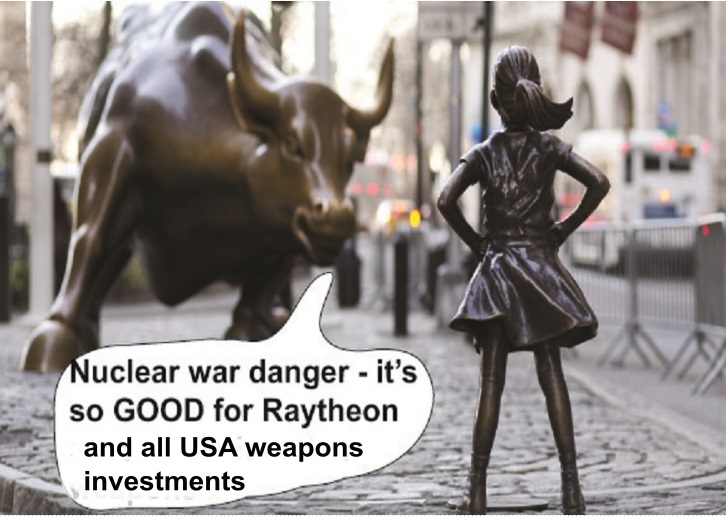
“from numerous perspectives, when viewed from a bang-per-buck perspective, US and Western support for Ukraine is an incredibly cost-effective investment.”
the US arms industry is the “one clear winner” in this bloody tangle.
September 9, 2023 by: Dr Binoy Kampmark https://theaimn.com/a-good-investment-the-ukraine-war-and-the-us-arms-racket/
It all tallies. War, investments and returns. The dividends, solid, though the effort expended – at least by others – awful and bloody. While a certain narrative in US politics continues in the vein of traditional cant and hustling ceremony regarding the Ukraine War – “noble freedom fighters, we salute you!” twinned with “Russian aggressors will be defeated” – there are the inadvertently honest ones let things slip. A subsidised war pays, especially when it is fought by others.
The latter narrative has been something of a retort, an attempt to deter a growing wobbling sentiment in the US about continuing support for Ukraine. In a Brookings study published in April, evidence of wearying was detected. “A plurality of Americans, 46%, said the United States should stay the course in supporting Ukraine for only one to two years, compared with 38% who said the United States should stay the course for as long as it takes.”
In early August, a CNN survey found that 51% of respondents believed that Washington had done enough to halt Russian military aggression in Ukraine, with 45% approving of additional funding to the war effort. A breakdown of the figures on ideological grounds revealed that additional funding is supported by 69% of liberals, 44% of moderates and 31% of conservatives. In Congress, opposition to greater, ongoing spending is growing among the Republicans, reflecting increasing concern among GOP voters that too much is being done to prop up Kyiv.
Such a mood has been anticipated by number crunching types keen to reduce human life to an adjustable unit on a spreadsheet. The Centre for European Policy Analysis, for example, suggested that a “cost-benefit analysis” would be useful regarding US support for Ukraine. “Its producing wins at almost every level,” came the confident assessment. In spectacularly vulgar language, the centre notes that, “from numerous perspectives, when viewed from a bang-per-buck perspective, US and Western support for Ukraine is an incredibly cost-effective investment.”
War-intoxicated Democrats would do well to remind their Republican colleagues about such wins, notably to those great patriots known as the US Arms Industry. Aid packages to Ukraine, while dressed up as noble, democratic efforts to ameliorate a suffering country’s position vis-à-vis Russia, are much more than that.
In May 2022, for instance, President Joe Biden signed a bill providing Kyiv $40.1 billion in emergency funding, split between $24.6 for military programs, and $15.5 billion for non-military objects. Even then, it was clear that one group would prove the greatest beneficiary. Stephen Semler of the Security Policy Reform Institute was unequivocal: US military contractors.
Of the package, rich rewards amounting to $17.3 billion would flow to such contractors, comprising goods, be they in terms of weapons and equipment, or services in the form of training, logistics and intelligence. “It allows the Biden administration,” writes Semler, “to continue escalating the United States’ military involvement in the war as the administration appears increasingly disinterested in bringing it to an end through diplomacy.”
Broadly speaking, the US military-industrial complex continues to gorge and merely getting larger. Whatever the outcome of this war – talk of absolute victory or defeat being the stuff of dangerous fantasy – it remains the true beneficiary, the sole victor fed by new markets and opportunities. Former Israeli foreign minister Shlomo Ben-Ami, now vice president of the Toledo Center for Peace, had to concede that the US arms industry was the “one clear winner” in this bloody tangle.
The addition of new member states to NATO, in this case Finland and Sweden, will, Ben Ami suggests, “open up a big new market for US defence contractors, because the alliance’s interoperability rule would bind them to American-made defence systems.” The evidence is already there, with Finland’s order of 64 new F-35 strike fighters developed by Lockheed Martin, Northrop Grumman and BAE Systems. The Ukraine War has been nothing short of lucrative in that regard.
Such expansion also comes with another benefit. The interoperability requirement in the NATO scheme acts as a bar to any alternatives. “The market for their goods is expanding,” writes Jon Markman for Forbes, “and they will face no competition for the foreseeable future.”
It should come as little surprise that the US defence contractors have been banging the drum for NATO enlargement from the late 1990s on. While a good number of those in the US diplomatic stable feared the consequences of an aggressive membership drive, those in the business of making and selling arms would have none of it. The end of the Cold War necessitated a search for new horizons in selling instruments of death. And with each new NATO member – Hungary, Poland, the Czech Republic – the contracts came. Washington and the defence contractors, twinned with purpose, pursued the agenda with gusto.
In 1997, Democratic Senator Tom Harkin was awake to that fact in hearings of the Senate Appropriations Committee on the cost of NATO enlargement. He was particularly concerned by a fatuous remark by Secretary of State Madeleine Albright comparing NATO’s expansion with the economic Marshall plan implemented in the aftermath of the Second World War. “My fear is that NATO expansion will not be a Marshall plan to bring stability and democracy to the newly freed European nations but, rather, a Marshall plan for defense contractors who are chomping [sic] at the bit to sell weapons and make profits.”
The moral here from the US military-industrial complex is: stay the course. The returns are worth it. And in such a calculus, concepts such as freedom and democracy can be commodified and budgeted. As for Ukrainian suffering? Well, let it continue.
Pakistan nuclear weapons, 2023
Bulletin, By Hans M. Kristensen, Matt Korda, Eliana Johns, September 11, 2023
Pakistan continues to gradually expand its nuclear arsenal with more warheads, more delivery systems, and a growing fissile material production industry. Analysis of commercial satellite images of construction at Pakistani army garrisons and air force bases shows what appear to be newer launchers and facilities that might be related to Pakistan’s nuclear forces.
We estimate that Pakistan now has a nuclear weapons stockpile of approximately 170 warheads (See Table 1 on original). The US Defense Intelligence Agency projected in 1999 that Pakistan would have 60 to 80 warheads by 2020 (US Defense Intelligence Agency 1999, 38), but several new weapon systems have been fielded and developed since then, which leads us to a higher estimate. Our estimate comes with considerable uncertainty because neither Pakistan nor other countries publish much information about the Pakistani nuclear arsenal.
With several new delivery systems in development, four plutonium production reactors, and an expanding uranium enrichment infrastructure, Pakistan’s stockpile has the potential to increase further over the next several years. The size of this projected increase will depend on several factors, including how many nuclear-capable launchers Pakistan plans to deploy, how its nuclear strategy evolves, and how much the Indian nuclear arsenal grows. We estimate that the country’s stockpile could potentially grow to around 200 warheads by the late 2020s, at the current growth rate. But unless India significantly expands its arsenal or further builds up its conventional forces, it seems reasonable to expect that Pakistan’s nuclear arsenal will not continue to grow indefinitely but might begin to level off as its current weapons programs are completed…………………………………………………………………………………………………………………………………………………………………………………………………………………..more https://thebulletin.org/premium/2023-09/pakistan-nuclear-weapons-2023/
Australia’s Navy Pursues Nuclear Submarines and AI-Powered Ghost Sharks

the potential for AI-driven robots to make lethal decisions independently,
https://www.gktoday.in/australias-navy-pursues-nuclear-submarines-and-ai-powered-ghost-sharks 10 Sept 23
Australia’s Navy is adopting two contrasting approaches to advanced submarine technology to address the challenges posed by a rising China. On one hand, Australia is investing in a costly and slow project to acquire up to 13 nuclear-powered attack submarines. On the other hand, Australia is rapidly developing AI-powered unmanned submarines called “Ghost Sharks,” AI-powered subs will be delivered in the near future, offering a cost-effective and swift solution to enhance naval capabilities. The divergent approaches highlight the transformative impact of automation and AI on modern warfare.
How do the cost and delivery timelines of the nuclear submarines and Ghost Sharks differ?
The nuclear submarines are estimated to cost over AUD$28 billion each and will not be delivered until well past the middle of the century. In contrast, Ghost Sharks have a per-unit cost of just over AUD$23 million and will be delivered by mid-2025.
Significance of the Ghost Shark project
The Ghost Shark project illustrates the transformative impact of automation and AI on modern warfare, offering a cost-effective and swift solution to enhance naval capabilities. Such AI-powered unmanned submarines can operate autonomously, descend to greater depths, and be deployed in large numbers without risking human lives. They offer increased flexibility, cost-effectiveness, and the ability to perform maneuvers that might be impossible for crewed submarines.
Link to Geopolitical Challenges?
Australia’s investments in advanced submarine technology are linked to the geopolitical challenges posed by a rising China in the Asia-Pacific region. These developments are part of efforts to maintain military capabilities and respond to regional security concerns.
nfluence of AI
AI technology is influencing the development of various military capabilities, including autonomous weapons, fighter drones, swarming aerial drones, and ground combat vehicles. AI is also playing a role in data analysis and decision support for military commanders.
The AI technology arms race has high stakes in terms of military dominance and geopolitical influence. Winning the race could reshape the global political and economic order, with potential consequences for peace and stability in the Asia-Pacific region.
Challenges of AI
Challenges and concerns include the potential for AI-driven robots to make lethal decisions independently, the need for regulation related to the military application of AI, and the ethical considerations of using AI in warfare, including the targeting of combatants and non-combatants.
Private Sector’s Role
Private companies like Anduril are actively involved in developing AI-powered military technologies. They are contributing to the development of autonomous systems, sensor fusion, computer vision, edge computing, and AI, with applications in various defense domains, including submarines, drones, and counter-drone systems.
Is Ukraine’s new long-range missile technology bringing us closer to WW3? Experts say Putin ‘might try something desperate’ amid US fears it will convince Vladimir to use nuclear weapons
- Kyiv last month blew up Russian air defence system with modified cruise missile
- The new missile gives Ukraine the capacity to strike deep into Russian territory
- Experts told MailOnline what the missiles mean for war and potential retaliation
Daily Mail By DAVID AVERRE and RACHAEL BUNYAN 10 September 2023
Ukraine’s development of a newly modified cruise missile that could strike targets hundreds of miles across the Russian border has sparked fears that Vladimir Putin could resort to the nuclear option if he becomes ‘desperate’.
Dr. Alan Mendoza, executive director at the Henry Jackson Society think tank, said that although the nuclear threat is unlikely, it remains on the table should the Kremlin chief feel backed into a corner amid attacks on Russian cities.
‘It is not likely Russia would strike Ukraine or NATO allies with nuclear weapons simply in response to Neptune missiles being used – to do so would mean a response from the West that would surely hasten the demise of the Putin regime.
‘That said, if Putin felt that his grip on power was loosening beyond his control he might try something desperate. At that point, it would be hoped that saner forces within the Russian hierarchy would step in to relieve him of command,’ he said.
Meanwhile, former US Defense Attaché to Moscow and retired US Army Brigadier General Kevin Ryan said Washington was alarmed by Ukraine’s new strike capability.
‘The US administration is concerned that successful attacks by Ukraine into Russia could give Putin justification to expand his war to the West or even use nuclear weapons.
‘Deploying the Neptune in attacks against Russian infrastructure will escalate the war and force Putin and his military leadership to also escalate their attacks against Ukrainian cities.’
t comes after Ukraine last month destroyed a state-of-the-art Russian air defence system nestled in the occupied Crimean peninsula, scoring a direct hit on the S-400 ‘Triumf’ and blasting it sky-high in an impressive strike.
Putin‘s state-media mouthpieces and war-bloggers railed against the attack, labelling it the result of a British-supplied Storm Shadow missile and threatening retaliation against the West for its support of Kyiv.
But it was later revealed that the weapon behind the destruction of the S-400 was not a British projectile, but instead a modified version of a Neptune cruise missile – the kind that sunk the Moskva, pride of Russia‘s Black Sea Fleet last year.
By converting the Neptune anti-ship missile to be fired from land positions on land targets, Ukraine’s engineers have provided Zelensky‘s army with the capability to strike deep within Russian territory – something they’ve shown they can do already with drones – with devastating effect.
Senior Research Leader in Defence and Security at RAND Europe Bryden Spurling told MailOnline that the newly modified missile could enable Ukraine to destroy targets more than 200 miles inside Russian territory with near pin-point accuracy.
‘The earlier anti-ship version sank the Russian cruiser Moskva, so it is a precision weapon with a large warhead. The suggested range for this new land attack version seems to be somewhere between 170 and 190 miles – and could possibly grow to be as much as 225 miles according to some sources,’ Spurling said.
He added that the modified Neptune missiles unlock a new capability for Ukraine’s armed forces, whose access to Western weapon systems like Storm Shadow missiles is contingent on them being used exclusively to defend Ukrainian territory – not to strike across the border………………………………………………………………………………….. https://www.dailymail.co.uk/news/article-12479123/Is-Ukraines-new-long-range-missile-technology-bringing-closer-WW3-Experts-say-Putin-try-desperate-amid-fears-convince-Vladimir-use-nuclear-weapons.html
NATO isn’t able to help Ukraine win
Russia has the upper hand on the front lines as the bloc is no longer able to meet Kiev’s needs
Rt.com By Ilya Kramnik, military analyst, expert at the Russian International Affairs Council and researcher at the Russian Academy of Sciences 10 Sept 23
More than 18 months into the conflict between Russia and Ukraine, NATO military aid to Kiev remains a constituent part of the war. This factor seeps into public consciousness, influences the political perception of the conflict, and affects the situation on the battlefield, whichever side of the hostilities people find themselves on. All these aspects are important in their own right, and each will influence the course of the conflict and its eventual outcome. But how long will NATO be able to provide military assistance to Ukraine?
Gloomy prospects for Ukraine
NATO began providing assistance to Kiev as soon as the conflict started in 2022, and the volume of aid increased throughout the course of last year. This assistance largely influenced the attitude of ordinary Ukrainians toward the hostilities and reinforced the myth of a speedy and inevitable “victory” for Kiev, certain to happen because “the whole world supports us.”
The same attitude prevailed in the area of public policy – the aid provided by a particular country indicated whose side it was on: Ukraine’s “allies” in NATO (primarily the US) provided direct military assistance, while “neutral” countries offered only financial and organizational assistance, or no help at all.
On the battlefield, NATO aid is fully responsible for the combat capabilities of the Armed Forces of Ukraine (UAF). If this aid is discontinued, the Ukrainian army will lose its combat capability within a few weeks, or as soon as the current ammunition stocks run out.
How likely is it that NATO assistance will continue? To answer this question, we need to understand the stocks of weapons and military equipment among members of the bloc – and it is important to note that many are lacking in this regard.
The US stands out for its available resources, and its weapons arsenal is larger than that of all other NATO countries. However, even though Washington has provided Kiev with large quantities of weapons and ammunition, it is still only supplying a relatively small share of what it has. Other countries with large weapons arsenals are Greece and Turkey. However, these stocks exist because of age-old tensions between the two countries, which limits their possible transfer to Ukraine.
In most other NATO countries, military stocks are relatively small and are intended mainly for export, particularly when the buyer is interested in used equipment which can be put to use in its existing condition or modernized.
These factors impose a limit on the volume of aid allocated to Ukraine, and are why military assistance to Kiev, which started in 2022 and peaked in early 2023, has begun to decline. It also means that unless the US starts handing over reserve military equipment, or, together with other allies, finds alternative suppliers, assistance will be cut further.
…………………………………………………………………………………… the Ukrainian counteroffensive was launched with a clear lack of artillery, tanks, and particularly engineering equipment, despite the fact that NATO Supreme Allied Commander General Christopher Cavoli declared that Ukrainian troops were fully equipped.
On the other hand, NATO made a number of decisions and signed contracts to equip Ukrainian troops on a long-term basis. This included the transfer of missile defense systems and other weapons which, due to insufficient production capacities, will not be available for several years. Like the decision to transfer fighter jets – which hasn’t yet been publicly finalized in terms of volume and timing – these contracts were assessed by numerous experts as “post-war,” i.e. intended to compensate after the conflict for the losses sustained.
However, the unsuccessful course of the Ukrainian counteroffensive launched in July makes the full-scale implementation of these contracts and intentions uncertain. Their prospects will be even more doubtful in the event of a successful Russian offensive in the coming fall or winter……………………………………
Will NATO be able to significantly increase aid to Ukraine in the near future? No. Military production is an inertial industry, and even if the decision to considerably increase the production of weapons were made tomorrow, it would take up to two years to yield any results. Considering the unfavorable public image of Ukraine’s unsuccessful counteroffensive, it may take even longer.
……….. It is quite likely that the initiative to transfer Western fighter jets to Ukraine will be quietly abandoned, since the AFU will no longer be able to use them. Russia knows full well that this is the case. In theory, this state of affairs should increase the willingness of the US to negotiate, although the upcoming election season will greatly complicate any potential talks.
So, unless something extraordinary happens, the West will most likely continue to support the Ukrainian armed forces to the extent necessary to continue resistance. This means Ukraine will not have enough equipment and weapons to launch a large-scale new counteroffensive unless the US decides to share its weapons arsenals.
Such a decision, however, would go against US practice in recent years as well as its strategic planning, which sees China as the main rival on which to focus its financial, military, and technological resources. https://www.rt.com/russia/582368-nato-ukraine-russia-front-lines/
Counter-offensive threatened by slow Western aid – Zelensky
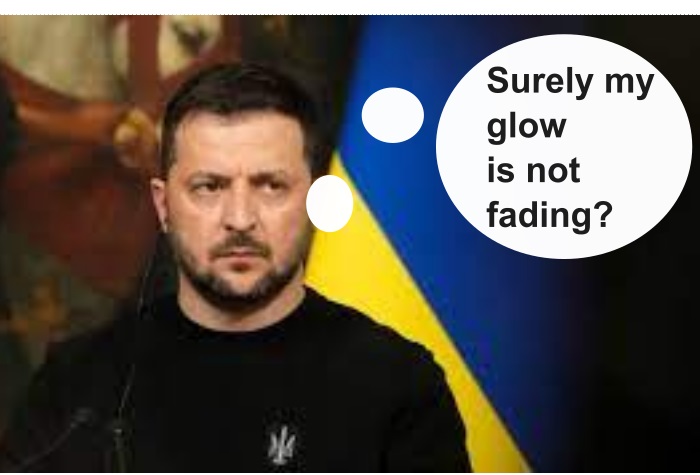
Ukrainian president Volodymyr Zelenskyy has said that Russia was slowing down the Ukrainian counter-offensive, blaming the “slowness” of Western arms deliveries. The leader also renewed calls for long-range weapons as well as new sanctions against Moscow.
Speaking on Friday, Zelenskyy also stressed that time was against Ukraine, with Russia banking on a Republican victory in the 2024 presidential election to weaken American support for Kyiv.
According to him, “the processes are becoming more complicated and slower when it comes to economic sanctions against Moscow or the supply of weapons” from the West.
Ukraine has complained in particular for months about the slowness of negotiations on the delivery of F-16 fighters. Several dozen of these American aircraft will ultimately be delivered by European countries, but the crews must now be trained for months in order to use them effectively.
The Ukrainian counter-offensive, launched in June, came up against powerful defence lines built by the Russians, including minefields and anti-tank traps…………………

American Secretary of State Antony Blinken, who was in Kyiv on Wednesday and Thursday, judged the “significant progress” of the offensive “very, very encouraging”.
He promised $1 billion (approximately €933m) in new aid. Washington also confirmed the supply of depleted uranium shells to give “momentum” to the offensive……………………….. more https://www.euronews.com/2023/09/09/ukraine-war-ukrainian-armed-forces-advance-as-zelenskyy-renews-calls-for-foreign-aid
Ukraine – health care women compulsory military service.
This article was originally in German
link in German: https://exxpress.at/neue-fluchtwelle-droht-selenskyj-befiehlt-wehrpflicht-fuer-pflegerinnen-aerztinnen/
Hundreds of thousands of women will no longer be allowed to leave Ukraine from October 1st, thus Austria is also threatened by a new wave of refugees in the next 22 days: The government in Kiev is by law ordering all women with medical training to be conscripted.
According to the Interior Ministry, 67,370 women from Ukraine are already registered as displaced persons in Austria, and now there could be another massive wave of entry: The Ukrainian media is already reporting that from October 1st compulsory military service is introduced for all Ukrainian women with medical training – i.e. for all nurses , pharmacists and doctors.
The Podrobnosti news portal writes: “Women with medical or pharmaceutical training must register for military service from October 1, 2023. They get the status of conscripts for whom travelling abroad is restricted.” This was stated by Fedir Venislavskyi, member of the Verkhovna Rada’s Committee (Supreme Council of Ukraine) for National Security, Defense and Intelligence, and also the president’s representative in parliament.
Female deserters face up to 12 years in prison
Ukrainian women with medical training can then only leave the country in 22 days with a special permit. Since this Kiev order most likely affects hundreds of thousands of women throughout the country, which still has around 32 million non-refugee residents, another large wave of refugees is now likely to hit Western nations: Many, also young women, should now be aware of the fact that they as conscripts are no longer allowed to leave Ukraine before the end of the war – and of how deserters are treated if they are caught trying to escape.
Desertion in Ukraine can result in a prison sentence of up to 12 years. Since February, the courts can no longer impose a suspended sentence or a lower sentence than that provided for in the new law, as was previously the case.
The new order to force hundreds of thousands of women in nursing professions to do military service allows us to draw conclusions about the actual military situation in Ukraine. As also the current recruitment measure that tuberculosis sufferers and AIDS patients can also be called up to serve in the army.
A Slow mindless grind towards nuclear Armageddon?
Strategic Culture, Fri, 01 Sep 2023
This week saw widespread air strikes on the Russian Federation involving mass aerial drone attacks. Six regions were attacked including the capital, Moscow. Among the targets was the Kursk region where a nuclear plant is located. Several international airports across Russia were temporarily shut down. This is an incredible situation in which Russian territory is being targeted by a military assault not seen since the Great Patriotic War against Nazi Germany.
The U.S. media could barely contain its glee at the surge in air strikes on Russia. The New York Times hailed them as a “morale booster” for Ukraine, while CNN noted cryptically that the Kiev regime was “emboldened” to hit strategic targets inside Russia. The telling question of course not asked by CNN is: emboldened by whom?
Most of the incoming drones were shot down or disabled by Russian air defenses. But that is beside the point that Russian territory is now being targeted by mass attacks. And there can be no doubt that this “emboldened” military campaign is being enabled and directed by the United States and its NATO allies who are arming the Nazi regime in Kiev to the teeth.
The air strike, this week at Pskov airport is particularly revealing. Several Russian military cargo planes were reportedly destroyed. The location is only some 30 kilometers from Russia’s northwestern border with Estonia and over 600 km from Ukraine. It is almost certain that NATO members Estonia and possibly Latvia enabled that attack on Pskov. Russian foreign ministry spokeswoman Maria Zakharova has openly accused NATO of participating in the air assaults on Russian territory. The British publication, The Economist, also reported that NATO hardware, satellite and navigational logistics were vital for the drone campaign.
Dmitry Medvedev, the Deputy Chairman of Russia’s National Security Council, this week stated that Russia now has legal justification for going to war with NATO members directly. He warned that the world is on the brink of a nuclear conflagration.
We need to step back here and see the process of the proverbial boiling-frog scenario.

[CORRECTION: It’s a myth that frogs will stay in water that slowly heats, until they die. In reality, they will try to get out, as soon as the temperature becomes uncomfortable.]
This describes an insidious creeping situation which would otherwise not be tolerated. A frog apparently will jump back from a pot of boiling water but if the frog is placed in the pot of water which is then slowly brought to the boil it will succumb passively to its ill fate.
The process seems apt as a metaphor for the conflict in Ukraine between the U.S.-led NATO bloc and Russia. The Kiev regime was installed in 2014 through a CIA-backed coup against a democratically elected president; it was armed and trained by NATO, despite its vile Nazi battalions, to attack ethnic Russians in Ukraine; when Russia intervened militarily in February 2022 after diplomatic offers were rejected by the U.S. and NATO, the conflict has steadily escalated over the past 18 months to the point where pre-war Russian territory is now coming under mass air strikes.
This mass assault on Russian territory by NATO forces would have been unthinkable only a few months ago. And yet here we are at that astounding point.
There seems little doubt that the air strikes on Russia are a sort of Plan B to compensate for the abject failure of the NATO-backed regime on the battlefields in Ukraine. The much-vaunted “counteroffensive” that started in June has become a debacle for the NATO sponsors. The turn towards drone strikes on Russia appears to be a change in tactic as a way of terrorizing the Russian population and destabilizing the authority of Russian President Vladimir Putin, as well as distracting from NATO’s military incompetence.
Russia’s defense doctrine mandates the use of nuclear weapons if the state’s existential security is threatened. So far, the NATO-backed drone attacks on Russia have not reached that threshold. But the incremental process is dangerously heading in that dreadful direction.
If we were to turn the tables on the situation, the audacity would become even more apparent. Can anyone imagine for a second how the United States would react if a foreign adversary was enabling the launch of air strikes on Washington DC and other strategic centers, whereby airports were shut down and military infrastructure was being destroyed?………………………………………………………………. more https://strategic-culture.su/news/2023/09/01/boiling-frogs-towards-nuclear-armageddon/
Scott Ritter: A comprehensive Ukrainian defeat is the only possible outcome of its conflict with Russia

Rt.com 8 Sept 23
Kiev was offered a peace deal long ago, but chose war instead, egged on by its Western backers. Now its fate is sealed
September 2 marked the 78th anniversary of the World War Two surrender ceremony onboard the USS Missouri in Tokyo Bay. This moment formalized Japan’s unconditional capitulation to the United States, and its allies, and marked the end of the conflict. From the Japanese perspective, it had been ongoing since the Marco Polo bridge incident of July 7, 1937, which started the Sino-Japanese War.
There was no negotiation, only a simple surrender ceremony in which Japanese officials signed documents, without conditions.
Because that is what defeat looks like.
History is meant to be studied in a manner that seeks to draw out lessons from the past that might have relevance in the present. As George Santayana, the American philosopher, noted, “Those who cannot remember the past are condemned to repeat it.” The Ukrainian government in Kiev would do well to reflect on both the historical precedent set by Japan’s unconditional surrender, and Santayana’s advice, when considering its current conflict with Russia
First and foremost, Ukraine must reflect honestly about the causes of this conflict, and which side bears the burden of responsibility for the fighting. ‘Denazification’ is a term that the Russian government has used in describing one of its stated goals and objectives. President Vladimir Putin has made numerous references to the odious legacy of Stepan Bandera, the notorious mass murderer and associate of Nazi Germany who is feted by modern-day Ukrainian nationalists as a hero and all but a founding father of their nation.
That present-day Ukraine would see fit to elevate a man such as Bandera to such a level speaks volumes about the rotten foundation of Kiev’s cause, and the dearth of moral fiber in the nation today. The role played by the modern-day adherents of the Nazi collaborator’s hateful nationalist ideology in promulgating the key events that led to the initiation of the military operation by Russia can neither be ignored nor minimized. It was the Banderists, with their long relationship with the CIA and other foreign intelligence services hostile to Moscow, who used violence to oust the former president of Ukraine, Viktor Yanukovich, from office in February 2014.
From the act of illicit politicized violence came the mainstreaming of the forces of ethnic and cultural genocide, manifested in the form of the present-day Banderists, who initiated acts of violence and oppression in eastern Ukraine. This, in turn, triggered the Russian response in Crimea and the actions of the citizens of Donbass, who organized to resist the rampage of the Bandera-affiliated Ukrainian nationalists. The Minsk Accords, and the subsequent betrayal by Kiev and its Western partners of the potential path for peace that these represented, followed.
Ukraine cannot disassociate itself from the role played by the modern-day Banderists in shaping the present reality. In this, Kiev mirrors the militarists of Imperial Japan, whose blind allegiance to the precepts of Bushido, the traditional ‘way of the warrior’ dating back to the Samurai of 17th century Japan, helped push the country into global conflict. Part of Japan’s obligations upon surrender was to purge its society of the influence of the militarists, and to enact a constitution that deplatformed them by making wars of aggression – and the military forces needed to wage them – unconstitutional.
Banderism, in all its manifestations, must be eradicated from Ukrainian society in the same manner that Bushido-inspired militarism was removed from Japan, to include the creation of a new constitution that enshrines this purge as law. Any failure to do so only allows the cancer of Banderism to survive, festering inside the defeated body of post-conflict Ukraine until some future time when it can metastasize once again to bring harm……………………….
As the Western establishment media begins to come to grips with the scope and scale of Ukraine’s eventual military defeat (and, by extension, the reality of a decisive Russian military victory), their political overseers in the US, NATO, and the European Union struggle to define what the endgame will be. Having articulated the Russian-Ukrainian conflict as an existential struggle where the very survival of NATO is on the line, these Western politicians now have the task of shaping public perception in a manner that mitigates any meaningful, sustained political blowback from constituents who have been deceived into tolerating the transfer of billions of dollars from their respective national treasuries, and billions more dollars’ worth of weapons from their respective arsenals, into a lost and disgraced cause.
………………………………….. Russia has been undertaking the successful demilitarization of Ukraine’s armed forces since the initiation of partial mobilization. The equipment Ukraine is provided by the West is similarly being destroyed by Russia at a rate that makes replacement unsustainable. Meanwhile, Russia’s own defense industry has kicked into full gear, supplying a range of modern weapons and ammunition that is more than sufficient.
The harsh reality is that neither Ukraine nor its Western allies can sustain the operational losses in manpower and equipment that the conflict with Russia is inflicting……….. if Kiev persists in extending this conflict until it is physically unable to defend itself, it runs the risk of losing even more territory, including Odessa and Kharkov.
Russia did not enter the conflict with the intent of seizing Ukrainian territory. But in March 2022, Kiev rejected a draft peace agreement (which it had preliminarily approved at first), and this decision to eschew peace in favor of war led to Russia absorbing Donbass, Zaporozhye, and Kherson.
As one of its conditions to even begin negotiating for peace with Moscow, Kiev demanded the return of all former Ukrainian territories currently under Russian control – including Crimea. To achieve such an outcome, however, Ukraine would have to be able to compel compliance by defeating Russia militarily and/or politically. As things stand, this is an impossibility.
What Ukraine and its Western partners do not yet seem to have come to grips with is the fact that Russia’s leadership is in no mood for negotiations for negotiations’ sake. Putin has listed its goals and objectives when it comes to the conflict – denazification, demilitarization, and no NATO membership for Ukraine.
……….The longer Kiev – and its Western partners – drag out this conflict, the greater the harm that will accrue for Ukraine……….. https://www.rt.com/russia/582259-ukraine-unconditional-surrender-nato/
If Everyone Understood That The US Deliberately Provoked This War

CAITLIN JOHNSTONE, SEP 7, 2023 https://www.caitlinjohnst.one/p/if-everyone-understood-that-the-us?utm_source=post-email-title&publication_id=82124&post_id=136816741&isFreemail=true&r=1ise1&utm_medium=email
War is the single worst thing humans do. The most insane. The most cruel. The most destructive. The most traumatic. The least sustainable. Those who knowingly choose to steer humanity into more war when it could be avoided are the worst people in the world, without exception.
And there are mountains of extensively documented evidence that that’s exactly what the drivers of the US-centralized empire did in Ukraine. That’s why so many western analysts and experts spent years warning that the actions of western powers were going to lead Ukraine into disaster, and it’s why US empire managers keep openly boasting about how much their proxy warfare in Ukraine advances US interests. They knowingly steered Ukraine into war to advance their own geostrategic interests while being fully aware that no powerful nation would ever permit the kinds of foreign threats the west was amassing on its borders, and then they intervened in the early days of the war to prevent the outbreak of peace.
If there was widespread awareness of these facts, the US war machine would lose support around the world — not just for its actions in this one war, but for all future wars as well. Which is why so much energy goes into making sure this does not become a widespread understanding.
The official mainstream narrative throughout the western world is that Putin invaded Ukraine solely because he is evil and hates freedom. That’s the actual, literal belief about this war that the western political/media class works to instill in the western public. Anyone who counters this self-evidently ridiculous assessment with facts and evidence gets branded a Russian agent and swarmed with pro-US trolls on social media, and loses all hope of securing a major platform in any mass media.
And it’s important to notice that shutting down all mature adult analysis of the events which led to the war in this way does not actually save a single Ukrainian life. It doesn’t make Russia any more likely to stop fighting and withdraw its troops. All it does is prevent people from seeing the US empire for what it really is. It isn’t being done to protect Ukrainians, it’s done to protect the empire.
The worst thing that could possibly happen to the information interests of the US empire would be for a critical mass of people to become aware that all this death and destruction in Ukraine could have been avoided by the US-centralized empire behaving less aggressively on Russia’s doorstep, and that those aggressions were instead increased with the goal of advancing US strategic interests on the world stage. If everyone really, deeply understood that all this suffering, all these mountains of human corpses could simply not have happened if the US hadn’t been feverishly focused on securing planetary domination at all cost, the US would no longer be able to manufacture consent for its agendas. It would no longer be able to whip up international support for its actions against its enemies. It would no longer be able to persuade the world to help prop up the hegemony of the dollar.
But because the US empire has the most advanced soft power apparatus that has ever existed, hardly anyone understands this. Not even the people who understand that the west provoked this war have deeply grappled with exactly what that means on a visceral emotional level, for the most part. It’s more of a superficial intellectual understanding for most, without really grokking into the horror of it all, really letting the enraging nature of what the US empire did wash over them.
The west was deceived into supporting yet another evil American war, this time with the added dimension of nuclear brinkmanship threatening the life of every terrestrial organism. All to suck Moscow into another draining military quagmire so war plans can be safely drawn up against China while advancing US energy interests in Europe and building support for US military alliances. It’s almost too evil to take in. There aren’t really words for it.
And that’s one of the reasons it’s hard to get people to take in exactly what happened with Ukraine: people have a hard time wrapping their minds around the idea that anyone could be that evil, much less the government we’ve been trained by Hollywood to think of as sane and humanitarian.
It’s about as monstrous a thing as you could possibly come up with. Yet here it is, still unfolding in all its blood-spattered glory.
Our task then is to help people see this and understand it, not just intellectually but emotionally. Help people really grasp deep down the horrors the US empire unleashed upon our world with the war in Ukraine; the suffering; the death; the existential danger. We can’t fight the empire on our own, but we can each do what we can to help weaken the consent manufacturing machine it uses to rule and terrorize the world.
The Pentagon is the Elephant In the Climate Activist Room
By Melissa Garriga and Tim Biondo, World BEYOND War, September 7, 2023
With nearly 10,000 people expected to take to the streets of New York City on September 17 for the March to End Fossil Fuels, the climate justice movement seems more organized than ever. But, there’s a big elephant in the room, and it has the Pentagon written all over it.
The U.S. military is the world’s largest institutional oil consumer. It causes more greenhouse gas emissions than 140 nations and accounts for about one-third of America’s total fossil fuel consumption. The Department of Defense (DoD) also uses huge amounts of natural gas and coal, as well as nuclear power plants at its bases around the country. How can we demand the U.S. be part of a movement that aims to end the use of fossil fuels and protect our planet when their own institution is wreaking havoc without accountability? The answer: you can’t.
As long as we ignore the Pentagon’s role in perpetuating climate change, our fight to protect the planet is incomplete. We also risk undermining our own effectiveness by not taking into account how the nearly trillion dollar military budget takes away from people’s access to resources that not only affect their capacity to fight for climate justice but also to live under extreme economic inequality.
While United States officials want the consumer public to be responsible for their personal carbon footprint, such as making motorists switch to electric vehicles or banning incandescent light bulbs they are avoiding responsibility for the large carbon “bootprint” the military is leaving across the globe. From burn pits in Iraq, or the use of depleted uranium and cluster munitions in Ukraine, to the ever-expanding list of domestic and oversea military bases – the United States military is not only destroying its own country but devastating indigenous communities and sovereign nations through extreme environmental degradation.
According to the Environmental Working Group, “more than 700 military installations are likely contaminated with the “forever chemicals” known as PFAS.” But the problem goes far beyond drinking water. In Japan, the indigenous Ryukyuan is pushing back against yet another military base being built on the island of Okinawa. The new base is a major threat to the fragile ecosystem the Ryukyuans work hard to maintain. The damage to their marine ecosystem of course coincides with the poisoning of their drinking water – a fight both Hawaii and Guam are all too familiar with.
All of these contributing factors of climate destruction are happening in “conflict free” zones,but what impact does the U.S. military have on active warzones? Well, take a look at the Russian/Ukraine war – a war that the U.S. is helping to sustain to the tune of over a hundred billion dollars. CNN recently reported that “a total of 120 million metric tons of planet-heating pollution can be attributed to the first 12 months of the war.”
…………………………….. We need to stop spending billions on weapons systems designed to fight imaginary enemies . Instead we should use that money for domestic priorities like health care, education and infrastructure projects here at home.
We need to work side by side with all nations to address climate issues. This includes those we have deemed as enemies as well as the Global South – who are bearing the brunt of the climate crisis.
We need to make sure that our tax dollars are being spent on the things that matter most to us–and that means an end to endless war and environmental degradation. We need a Green New Deal which redirects federal funds from military spending towards domestic priorities like health care, education and infrastructure projects.
When it comes to the fight for climate justice, the Pentagon is the elephant in the room. We can’t keep ignoring its enormous “bootprint.”. It’s simple – to defend earth we must end war and we must end it now. Peace is no longer something that should be looked at as an utopian idea – it is a necessity. Our survival depends on it. https://worldbeyondwar.org/the-pentagon-is-the-elephant-in-the-climate-activist-room/
The West’s blueprint for goading China was laid out in Ukraine
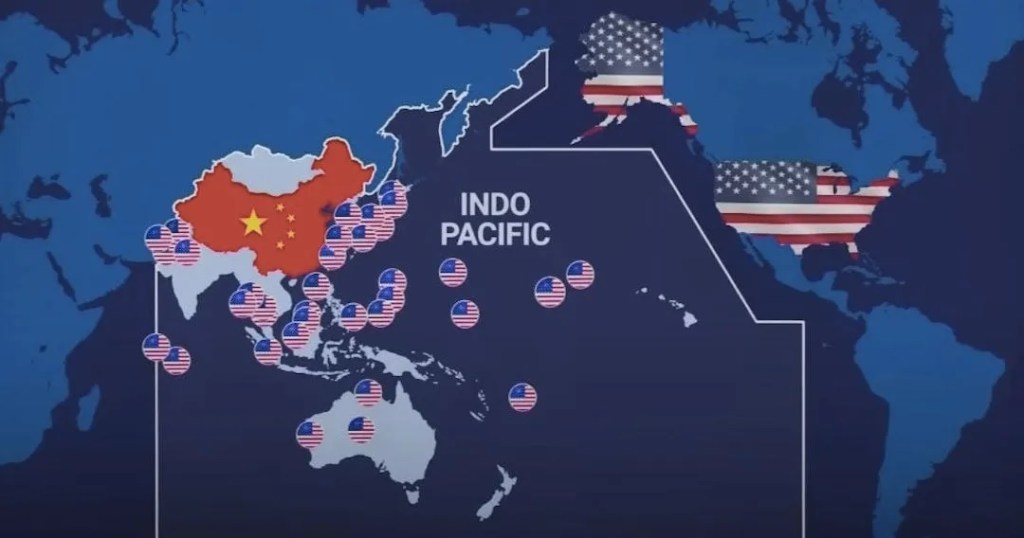
After Ukraine, Taiwan, we are told, must be the locus of the West’s all-consuming security interest.
Europe fears losing access to Chinese markets, plunging it deeper into a cost-of-living crisis. But it fears Washington’s wrath more
JONATHAN COOKSEP 8, 2023, Middle East Eye
The West is writing a script about its relations with China as stuffed full of misdirection as an Agatha Christie novel.
In recent months, US and European officials have scurried to Beijing for so-called talks, as if the year were 1972 and Richard Nixon were in the White House.
But there will be no dramatic, era-defining US-China pact this time. If relations are to change, it will be decisively for the worse.
The West’s two-faced policy towards China was starkly illustrated last week by the visit to Beijing of Britain’s foreign secretary, James Cleverly – the first by a senior UK official for five years.
While Cleverly talked vaguely afterwards about the importance of not “disengaging” from China and avoiding “mistrust and errors”, the British parliament did its best to undermine his message.
The foreign affairs committee issued a report on UK policy in the Indo-Pacific that provocatively described the Chinese leadership as “a threat to the UK and its interests”.
In terminology that broke with past diplomacy, the committee referred to Taiwan – a breakaway island that Beijing insists must one day be “reunified” with China – as an “independent country”. Only 13 states recognise Taiwan’s independence.
The committee urged the British government to pressure its Nato allies into imposing sanctions on China.
Upping the stakes
The UK parliament is meddling recklessly in a far-off zone of confrontation with the potential for incendiary escalation against a nuclear power, a situation unrivalled outside of Ukraine.
But Britain is far from alone. Last year, for the first time, Nato moved well out of its supposed sphere of influence – the North Atlantic – to declare Beijing a challenge to its “interests, security and values”.
There can be little doubt that Washington is the moving force behind this escalation against China, a state posing no obvious military threat to the West.
t has upped the stakes significantly by making its military presence felt ever more firmly in and around the Straits of Taiwan – the 100-mile wide waterway separating China from Taiwan that Beijing views as its doorstep.
Senior US officials have been making noisy visits to Taiwan – not least, Nancy Pelosi last summer, when she was house speaker.
Meanwhile, the Biden administration is showering Taiwan with weapon systems.
If this weren’t enough to inflame China, Washington is drawing Beijing’s neighbours deeper into military alliances – such as Aukus and the Quad – to isolate China and leave it feeling threatened. The Chinese president, Xi Jinping, describes this as a policy of “comprehensive containment, encirclement and suppression against us”.
Last month, President Biden hosted Japan and South Korea at Camp David, forging a trilateral security arrangement directed at what they called China’s “dangerous and aggressive behavior”.
Meanwhile, the Pentagon’s “Pacific Defence Initiative” budget – chiefly intended to contain and encircle China – just keeps rising.
In the latest move, revealed last week, the US is in talks with Manila to build a naval port in the northernmost Philippine islands, 125 miles from Taiwan, boosting “American access to strategically located islands facing Taiwan”.
That will become the ninth Philippine base used by the US military, part of a network of some 450 operating in the South Pacific.
Dirty double game
So what’s going on? Is Britain – along with its Nato allies – interested in building greater trust with Beijing, as Cleverly argues, or backing Washington’s escalatory manoeuvres against a nuclear-armed China over a small territory on the other side of the globe, as the British parliament indicates?
Inadvertently, the foreign affairs committee’s chair, Alicia Kearns, got to the heart of the matter. She accused the British government of having a “confidential, elusive China strategy”, one “buried deep in Whitehall, kept hidden even from senior ministers”.
And not by accident.
European leaders are torn. They fear losing access to Chinese goods and markets, plunging their economies deeper into recession after a cost-of-living crisis precipitated by the Ukraine war. But most are even more afraid of angering Washington, which is determined to isolate and contain China.
That divide was highlighted by French President Emmanuel Macron following a visit to China in April,……………………………………………………………………………………….
After Ukraine, Taiwan, we are told, must be the locus of the West’s all-consuming security interest…………………………………………………………………………………………………………………………………………………..
Economic chokehold
As with Ukraine, the cover story concealing the West’s provocations towards China has been carefully directed from Washington.
Europeans like Cleverly are parading around Beijing to make it look like the West desires peaceful engagement. But the only real engagement is the crafting of a military noose around China’s neck, just as a noose was crafted earlier for Russia. …………………………………………………………………………………………………………………..
The US isn’t likely to go down without a fight. Which is why Ukrainians and Russians are currently dying on the battlefield. And why China and the rest of us have good reason to fear who may be next. https://www.middleeasteye.net/opinion/china-west-blueprint-goading-ukraine-laid-out
Russia says US supplying depleted-uranium shells to Ukraine could lead to war between nuclear powers

The US will have to answer for the ‘very sad consequences’ of its decision to provide depleted uranium munitions to Ukraine, the Kremlin said
i news, By Jessie Williams, Foreign news reporter, September 7, 2023
Russia has condemned a US decision to send controversial depleted uranium tank shells to Ukraine as “a criminal act”, that would increase the chance of “direct armed conflict between nuclear powers”.
The Kremlin said on Thursday that the US would have to answer for the “very sad consequences” of its decision to provide depleted uranium munitions to Ukraine.
The controversial weapons – included in a $175m (£140m) package of military equipment for Ukraine announced by the US on Wednesday – have armour-piercing capabilities, which mean they could help to destroy Russian tanks.
The shells are intended for 31 American M1 Abrams tanks due to be delivered to Ukraine later this year.
Sergei Ryabkov, Russia’s deputy foreign minister, accused the US of a “criminal act” beyond reasonable escalation. “Now this pressure is dangerously balancing on the brink of direct armed conflict between nuclear powers,” he said.
“It is a reflection of Washington’s outrageous disregard for the environmental consequences of using this kind of ammunition in a combat zone. This is, in fact, a criminal act, I cannot give any other assessment.”
In March, Putin warned that Moscow would “respond accordingly, given that the collective West is starting to use weapons with a ‘nuclear component.’” Foreign Minister Sergei Lavrov called the move “a step toward accelerating escalation”.
Depleted uranium is a byproduct of the uranium enrichment process needed to create nuclear weapons. The rounds retain some radioactive properties, but they cannot generate a nuclear reaction as a nuclear weapon would, Edward Geist, a nuclear expert and policy researcher at the US-based Rand non-profit research institution, told The Associated Press.
The shells sharpen on impact, which further increases their ability to tear through tank armour. “It’s so dense and it’s got so much momentum that it just keeps going through the armour – and it heats it up so much that it catches fire,” he added.
“The administration’s decision to supply weapons with depleted uranium is an indicator of inhumanity,” Russia’s embassy in Washington said on Telegram. “Clearly, with its idea of inflicting a ‘strategic defeat’, Washington is prepared to fight not only to the last Ukrainian but also to do away with entire generations.”
on Friday the Kremlin spokesman Dmitry Peskov said Nato’s heavy use of such ammunition in the bombing of Yugoslavia in 1999 had caused a jump in cases of cancer and other diseases.
“These consequences are also felt by subsequent generations of those who somehow came into contact or were in areas where these weapons were used,” he told reporters, saying the same would now happen in Ukraine……………………………………….
The International Coalition to Ban Uranium Weapons said there were dangerous health risks from ingesting depleted uranium dust, including cancer.
A Defence Department official told Politico the weapons are considered the most effective way of arming their Abrams tanks. The UK has already sent the same type of ammunition to Ukraine to arm its Challenger 2 tanks, but this is the first time the US is sending the rounds.
Earlier this year the Pentagon said it would not be sending the depleted uranium munitions to Ukraine, but made a U-turn in their announcement on Wednesday during the US Secretary of State Antony Blinken’s visit to Kyiv……………………………..
The decision comes after the White House announced it will be sending another controversial weapon to Ukraine -cluster munitions – which are banned by more than 100 countries. https://inews.co.uk/news/world/russia-us-supplying-depleted-uranium-shells-ukraine-war-2599291
1 This Month
26 September – International Day for the Total Elimination of Nuclear Weapons





PLEASE OPPOSE HR 8255 AND S.3639 – bills would accelerate satellite deployment, with no environmental review or safeguards – https://ncstd5li.quorum.us/campaign/169331/
To see nuclear-related stories in greater depth and intensity – go to https://nuclearinformation.wordpress.com
-
Archives
- September 2026 (323)
- August 2026 (330)
- July 2026 (355)
- June 2026 (287)
- May 2026 (306)
- April 2026 (356)
- March 2026 (251)
- February 2026 (267)
- January 2026 (308)
- December 2025 (358)
- November 2025 (359)
- October 2025 (375)
-
Categories
- 1
- 1 NUCLEAR ISSUES
- business and costs
- climate change
- culture and arts
- ENERGY
- environment
- health
- history
- indigenous issues
- Legal
- marketing of nuclear
- media
- opposition to nuclear
- PERSONAL STORIES
- politics
- politics international
- Religion and ethics
- safety
- secrets,lies and civil liberties
- spinbuster
- technology
- Uranium
- wastes
- weapons and war
- Women
- 2 WORLD
- ACTION
- AFRICA
- Atrocities
- AUSTRALIA
- Christina's notes
- Christina's themes
- culture and arts
- Events
- Fuk 2022
- Fuk 2023
- Fukushima 2017
- Fukushima 2018
- fukushima 2019
- Fukushima 2020
- Fukushima 2021
- general
- global warming
- Humour (God we need it)
- Nuclear
- RARE EARTHS
- Reference
- resources – print
- Resources -audiovicual
- Weekly Newsletter
- World
- World Nuclear
- YouTube
-
RSS
Entries RSS
Comments RSS

