US nuclear bombs ‘set to return to UK’ for first time in 15 years – making Lakenheath a “nuclear target”
“they will make us a nuclear target. “
US nuclear weapons are expected to return to the UK after 15 years following a visit to RAF Lakenheath in Suffolk by American Deputy Defence Secretary Kathleen Hicks
By Ben Glaze, Deputy Political Editor1, 29 Nov 2023
American nuclear bombs are set to return to Britain after 15 years.
A senior US defence official has visited an RAF base in the Suffolk countryside, paving the way for the controversial arms to come back to the UK. Deputy Defence Secretary Kathleen Hicks went to RAF Lakenheath for a tour of “infrastructure improvements” at the air station, according to The Daily Telegraph.
The Pentagon is planning a £39.5million dormitory for troops with the military site due to be used for “surety” – a US defence term to describe operations related to nuclear weapons, the paper reported. The last American nuclear arms were removed from Britain in 2008, when approximately 110 tactical B61s stored at Lakenheath were stripped out.
The weapon – a low to intermediate-yield strategic and tactical nuclear bomb – remains part of the US’ “enduring stockpile” following the end of the Cold War. It could be dropped by US Air Force F-15E Strike Eagle fighter-bombers. The aircraft are still based at Lakenheath as part of the USAF 48th Fighter Wing – known as The Liberty Wing – its main air defence mission in Europe………………………………………..
Deployment of American nuclear arms to Britain would generate fresh controversy. Campaign for Nuclear Disarmament general secretary Kate Hudson told the Mirror: “Kathleen Hicks’ visit to RAF Lakenheath is further proof that Washington intends to use Britain as a launch pad for its nuclear arsenal in Europe. The lack of transparency surrounding this deployment is shocking, given how dangerous it is.
“Russia has already retaliated – it has stationed its own nuclear weapons in Belarus in response. A YouGov poll found that almost two thirds of the British public don’t want US nuclear weapons stationed here. That’s not surprising – they will make us a nuclear target. CND calls on the UK Government to say that US nuclear weapons are not welcome in Britain.”
Green Party co-leader Carla Denyer said: “The world feels like an increasingly dangerous place with conflicts in Ukraine, Gaza and many other places. However, the positioning of US nuclear weapons at Lakenheath will not help ease tensions – it is far more likely to increase them. Over 100 nuclear bombs were stored at the airbase but they were removed in 2008. The UK Government should be working much harder to reduce the threat of nuclear war by actively supporting the UN Treaty on the Prohibition of Nuclear Weapons, and seeking to reverse the collapse of other international arms control treaties which were designed to protect us.”
Previous deployments of American nuclear weapons have triggered outrage. Greenham Common in Berkshire saw years of anti-nuclear demonstrations, and was the UK’s biggest women-led movement since the Suffragettes. The protest began in 1981 and lasted 19 years until the airbase was decommissioned. https://www.mirror.co.uk/news/politics/nuclear-bombs-set-return-uk-31552964?link_id=3&can_id=0a448bf4278898648e02a8f6dea4650f&source=email-a-senior-us-defence-official-just-visited-raf-lakenheath&email_referrer=email_2128400&email_subject=a-senior-us-defence-official-just-visited-raf-lakenheath
Pentagon struggling to pay for Middle East buildup – Politico
https://www.rt.com/news/588180-pentagon-struggle-middle-east-deployment/ 29 Nov 23
The US military has to make do with a stopgap budget that freezes defense funding at the previous year’s levels
The Pentagon is scrambling to find money to pay for a military buildup in the Middle East amid the Hamas-Israel conflict due to gridlock in the US Congress, which has so far been unable to approve full defense funding, Politico reported on Tuesday.
The US Department of Defense, along with many other federal agencies, is now operating under a stopgap funding bill which was signed by US President Joe Biden earlier this month to avert a potential government shutdown. The measure, which did not satisfy Biden’s request for additional money for Israel and Ukraine, also freezes other types of defense spending at the previous year’s levels.
Pentagon spokesman Chris Sherwood told Politico that since no one planned for a massive redeployment of US forces to the Middle East after the October 7 Hamas attack on Israel, the military “had to pull money from existing operations and maintenance accounts.” This means less funding for exercises and deployments that had already been planned.
“We’re taking it out of hide,” the spokesman said.
Since the start of the Middle East crisis, the US has deployed two aircraft carriers with escorts, additional missile and air defense systems, more than 1,000 troops, and an Ohio-class nuclear-powered missile submarine to the region.
The military buildup came as the US declared unequivocal support for Israel in its conflict with the Palestinian armed group Hamas, as well as fears that hostilities could lead to a major regional escalation involving Iran and Islamist organizations with ties to Tehran.
US defense officials had previously sounded the alarm about the congressional stalemate, warning that a lack of funding could harm not only shipbuilding and procurement programs, but the industrial base itself.
Speaking to Defense News, Deputy Under Secretary of Defense Radha Plumb did not rule out the possibility of an “additive domino effect of delays,” noting that suppliers could be especially hard-hit by this.
Meanwhile, Under Secretary of Defense Bill LaPlante warned of potential layoffs in contractor companies due to the lack of Pentagon funding.
According to Politico, if US lawmakers are unable to pass a full spending bill by spring, the Pentagon and other federal departments will have to cut their overall expenses by 1%.
A Nuclear Attack by Design — or by Accident — Must Never Happen
InDepthNews by Thalif Deen
UNITED NATIONS | 27 November 2023 (IDN) — As two of the world’s nuclear powers—Russia and Israel—are engaged in two devastating conflicts, a lingering question remains: could the military tension looming over both countries trigger a nuclear attack either by design or by accident?
“That is one scenario that must never happen”, warns Hirotsugu Terasaki, Director General of Peace and Global Issues, Soka Gakkai International (SGI), which represents a diverse Buddhist community of over 12 million people that promotes peace, culture and education, and is an NGO in consultative status with the United Nations.
In an interview with IDN, he said, much effort has been made and must continue to be made to ensure that this will never become a reality by all concerned—the United Nations, international organizations, and civil society.
“Needless to say, the background and circumstances of the two crises are different and should be discussed separately, and any discourse on nuclear weapons should be cautious and restrained,” he pointed out.
Excerpts from the interview:
Israel is considered to be a de facto nuclear weapon state, although it has never confirmed or denied possessing nuclear weapons. It has been reported that Israeli Prime Minister Benjamin Netanyahu has reprimanded a cabinet member for suggesting a nuclear weapons option and suspended him from cabinet meetings until further notice because his remarks were “disconnected from reality”.
The armed conflict in the Gaza Strip has already caused too many civilian casualties and destroyed neighborhoods and livelihoods. Hate is causing more hatred, deepening division, and I am deeply concerned day after day. To prevent further tragedy, we strongly call for a humanitarian ceasefire and humanitarian aid to save lives.
In the Ukraine crisis, repeated threats to use nuclear weapons have been made. Prior to the G7 Hiroshima Summit held in May 2023, SGI President Daisaku Ikeda urged the nuclear weapon states to make pledges of “No First Use” of nuclear weapons to reduce risk, which would serve as the basis on which states could together transform the challenging security environments.
The SGI, co-sponsored with other NGOs, a side event on this theme at the 2023 NPT Preparatory Committee in August. Unfortunately, international norms for nuclear disarmament have since been further disrupted.
Humanity is now staring into the abyss of annihilation. Therefore, we must take the right steps toward a future that we choose and build a sustainable world. We should deal with the crises, constantly reminding ourselves of the true horrors of the atomic bombings, bearing in mind the voices of the global hibakusha, and facing up to inhumane and catastrophic consequences of nuclear weapons.
Let us take this opportunity to once again take to heart the Russell-Einstein Manifesto: “We appeal, as human beings, to human beings: Remember your humanity, and forget the rest. If you can do so, the way lies open to a new Paradise; if you cannot, there lies before you the risk of universal death.”
UN as a peacemaker?…………………………………………………………………………………… more https://indepthnews.net/a-nuclear-attack-by-design-or-by-accident-must-never-happen/
President Biden has morphed into the Murder Monster.

Walt Zlotow, West Suburban Peace Coalition, Glen Ellyn IL 27 Nov 23
What is going on in the 81 year old soul of Joe Biden?
He looks out from his privileged life in safe America and sees about half of Gaza’s buildings turned into rubble. Over 14,000 mainly innocents dead with likely thousands more buried under the rubble. Food, water, medicine, electricity largely denied the 2.3 million Palestinians with over three quarters now refugees.
All of this enabled and supported by President Biden. He’s sent billions in weapons to Israel to complete the removal of Palestinians from Gaza.
Even the NY Times acknowledges the historical mass killing in Gaza. “People are being killed in Gaza more quickly, than in even the deadliest moments of US-led attacks in Iraq, Syria and Afghanistan, which were themselves widely criticized by human rights groups.”
They quote former former Pentagon analyst Marc Garlasco, “It’s beyond anything that I’ve seen in my career.” He cited Israel’s use of US 2,000 lb. bombs as being the worst use of superpower bombs in densely crowed areas “since Vietnam or World War II.”
But those two thousand pounders are not enough for Biden. He’s moved to lift restrictions on additional weapons to Israel prevented by government regulations. Current restrictions only allow transfer of weapons to Israel that are obsolete or surplus. Biden wants a blank check to send any weapons, surplus/obsolete or not. He also calls for reducing the concessions Israel must offer for such weapons, eliminate the 30 day waiting period for weapons transfers and scrap the $200 million annual cap on the US replenishing weapons transfers.
Pivoting to Ukraine, Biden is demanding another $61 billion in weapons for Ukraine. His first $113 billion simply extended the US proxy war against Russia for 20 months, causing hundreds of thousands of Ukrainian deaths. In one of the most murderous acts in presidential history, Biden torpedoed the Zelensky-Putin peace agreement in the first month of the war to ‘weaken Russia.’
Biden made one wonderful move for peace in his first seven months by ending our illegal and criminal 20 year Afghan war. In the 28 months since it’s been ocean of blood drowning Biden’s legacy and shaming America, possibly beyond redemption.
Israel’s Genocidal Antisemitism Against the Arab Civilians of Gaza

Netanyahu has unleashed a “unifying” genocidal war against every child, woman and man that comprise the 2.3 million population of Gaza.
By Ralph Nader / CounterPunch, https://scheerpost.com/2023/11/27/israels-genocidal-antisemitism-against-the-arab-civilians-of-gaza-2/
“It should never have happened,” an elderly Holocaust survivor of a Nazi death camp told the New York Times. He was referring to the colossal failure on October 7th, of Israel’s touted high-tech military and intelligence operations that opened the door to Hamas’ attack on Israeli soldiers and civilians. In many parliamentary countries, the government ministers who are responsible for this kind of failure would have immediately been forced to resign. Not so with Prime Minister Netanyahu’s ministers.
Instead, Netanyahu’s coalition of extremists, who know that the Israeli people are enraged about their government’s failure to defend the border, has unleashed a “unifying” genocidal war against every child, woman and man that comprise the 2.3 million population of Gaza. “No electricity, no food, no fuel, no water. … We are fighting human animals and will act accordingly” was the opening genocidal war cry from defense minister Yoav Gallant to defend the onslaught that massive military forces are implementing against the long-illegally blockaded Gazan population.
Israeli leaders declare that there are Hamas fighters possibly in and under every building in Gaza. Israel has long made computer models using their unprecedented surveillance technology (see Antony Loewenstein’s interview in the November/December 2023 issue of the Capitol Hill Citizen). Nothing and no one is off limits for the Israeli bombing.
Keep in mind that Israel is an ultra-modern military superpower, with hundreds of thousands of fighters on land, air and sea, going after the few thousand Hamas fighters who have limited supplies of rifles, grenade launchers and anti-tank weapons. Moreover, all of Israel’s supplies are being replenished daily from the U.S. stockpiles in Israel and new shipments arriving by sea, compliments of President Biden. The invasion is a “piece of cake” an experienced U.S. government official told reporter Sy Hersh.
Contradictions abound. First, Netanyahu has always referred to Hamas as a “terrorist organization.” Yet he told his own Likud party for years that his “strategy” to block a two-state solution was to “support and fund Hamas.” (See, the October 22, 2023 article by prominent journalist Roger Cohen in the New York Times).
If Netanyahu believes dropping over 20,000 bombs and missiles on the civilian infrastructure of this tiny crowded enclave and its people, nearly half of whom are children, is so restrained, why has he kept Western and Israeli journalists out of Gaza, other than a few recently embedded reporters restricted to their seats in Israeli armored vehicles? Why has he ordered four nightmarish total telecommunications and electricity blackouts, with excruciating consequences, over the whole Gaza Strip for as long as 30 hours at a time?
None of this or international laws matter to the prime minister whose top priority is to keep his job, with his coalition parties, as long as the invasion continues. And before an outraged majority in Israel ousts him from power for not defending their country on October 7th from some two thousand urban guerrilla fighters on a homicide/suicide mission.
As the slaughter of defenseless babies, children, mothers, fathers and grandparents in Gaza continues to drive the death, injury and disease toll to higher numbers each day, the observant world wonders what the Israeli government, which regularly blocks humanitarian aid, intends to do with Gaza and its destitute, homeless, starving, wounded, sick, dying and abandoned civilian Palestinians.
After all, Gaza has only so many hospitals, clinics, schools, apartment buildings, homes, water mains, ambulances, bakeries, markets, electricity networks, solar panels, shelters, refugee camps, mosques, churches, and the clearly marked remaining United Nations’ facilities left, to bomb to smithereens. Endless American tax dollars are funding the carnage. Israel has also killed over 50 journalists, including some of their families, in the past seven weeks – a record.
Why will it take months to clear out the tunnels? Not so, say military experts in urban warfare. Flooding the tunnels with water, gas, napalm and robotic explosives are quick and lethal and would be deployed were it not for the Israeli hostages.
In addition to the reality that all Gazans are now hostages, over 7,000 Palestinians are languishing in Israeli jails without charges. Many are youngsters and women who were abducted over the years to extort information and to control their extended families in Gaza and the West Bank. What’s holding up an exchange, as Israel did twice before in 2004 and 2011? Again, the Netanyahu coalition stays in power by postponing the pending official inquiries into their October 7th collapse, that Israelis are awaiting.
Meanwhile, the hapless Joe Biden dittoheaded the previously hapless presidential pleas for a two-state solution. The dominant politicians in Israel have always sought “a Greater Israel” using the phrase “from the river to the sea,” meaning all of Palestine. Year after year Israel has stolen more and more land and water from the twenty-two percent left of original Palestine, inhabited by five million Palestinians under oppressive military occupation.
With Congress overwhelmingly in Israel’s pocket, Israeli politicians laugh at proposals for a two-state solution by U.S. presidents. Recall when Obama was president, Netanyahu went around him and addressed a joint session of Congress whose members exhausted themselves with standing ovations – a brazen insult to a U.S. president, unheard of in U.S. diplomatic history!
Day after day, the surviving Palestinian families are trapped in what is widely called “an open-air prison” being pulverized by Israel and its aggressive co-belligerent, the Biden regime. A regime in Washington that urges Netanyahu to comply with “the laws of war,” while enabling Israel with more weapons and UN vetoes to violate daily “the laws of war” and the Genocide Convention. (See our October 24, 2023 Letter to President Joe Biden and the Declarations from genocide scholars William Schabas and other expert historians).
Consider the plight of these innocent civilians, caught in the deadly crossfire of F-16s, helicopter gunships, and thousands of precision 155mm artillery shells. Whether huddled in their homes and schools or fleeing to nowhere under Israeli orders, the IDF is still bombing them.
Palestinians cannot escape their blockaded prison. They cannot surrender because the Israeli army does not want to be responsible for prisoners of war. They cannot bury their dead, so their families’ corpses pile up, rotting in the sun being eaten by stray dogs.
They cannot even find water to drink, since Israel has destroyed the water infrastructure – another of its many war crimes.
For years under Israel’s occupation law, collection of rainwater with rainwater harvesting cisterns has not been permitted. Rain is considered the property of the Israeli authorities and Palestinians have been forbidden to gather rainwater!
The Israeli armed forces will soon control the entire Gaza Strip. Under international law, Israel would become responsible for the protection of the civilian population as well as the essential conditions for Palestinian safety and survival. Will they at last abide by just one international law? Or will they establish obstructive checkpoints to restrict humanitarian charities trying to save lives while Israel continues to push the Gazans into the desert or neighboring countries?
The Israeli operation precisely fits the Genocide Convention’s definition by “intentionally creating conditions of life calculated to physically destroy a racial, religious, ethnic, or national group in whole or in part.” Netanyahu’s regime further incriminates itself by defining the targets for annihilation as being between 21st-century progress and “the barbaric fanaticism of the Middle Ages” and a “struggle between the children of light and the children of darkness.”
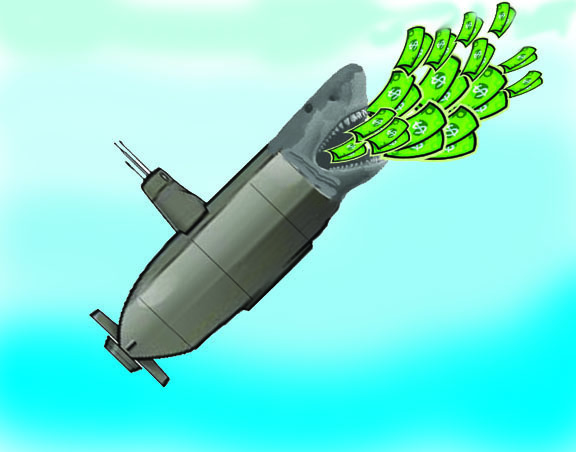
South Korea does not need nuclear subs
The Hill BY DOV S. ZAKHEIM, OPINION CONTRIBUTOR – 11/24/23
South Korea is again debating whether to develop and build a nuclear-powered submarine.
During a National Assembly confirmation hearing that took place last week, Admiral Kim Myung-Soo, the nominee for chairman of South Korea’s Joint Chiefs of Staff, responded positively to a question about the utility of nuclear-powered submarines, stating that “those capabilities are needed.” He noted, however, that the current U.S.-Korean nuclear agreement restricts the use of nuclear materials for military purposes.
Nevertheless, there appears to be a growing sentiment on the part of both of South Korea’s leading parties and the general public in favor of Seoul acquiring nuclear-powered boats. The government should resist the temptation to do so.
In theory, South Korea could avoid America’s restrictions by turning to France to help it develop or acquire a nuclear-powered submarine. France could help South Korea develop its own nuclear-powered sub, much as Paris has assisted Brazil with its own nuclear-powered submarine program.
However, there are many reasons why Seoul should not imitate the Brazilians and forge ahead with its own program. To begin with, it was only in April of this year that President Biden and South Korean president Yoon Suk Yeol reached an agreement that not only calls for greater consultation on nuclear matters between the two countries, in the form of a newly created nuclear consultative group, but also provides for an enhanced American nuclear presence around the peninsula to deter North Korean aggression…………………………………………………..
In any event, it is not clear how Seoul could afford to undertake a nuclear-submarine program unless it were to dramatically increase its defense spending beyond current levels…………………………………
…………………… Lastly, there are good operational reasons why South Korea should continue to acquire conventionally powered submarines rather than nuclear powered boats. The waters around the Korean peninsula are relatively shallow, which favors the employment of quiet conventional subs. South Korea now operates seven Son–Won II–class diesel-electric submarines, powered by a hybrid diesel‐electric/fuel cell with air-independent propulsion technology. These subs are extremely quiet; they can travel up to 20 knots when submerged and remain under water for seven weeks. They are perfectly suited for operations around the Korean Peninsula.
The South is currently planning both to upgrade the Son-Won II for about $100 million per boat and is proceeding with a new Son-Won III class at about $900 million per submarine. In other words, the country could acquire three state-of-the-art conventional submarines for less than the cost of one nuclear-powered sub.
The costs, the technologies, and operational realities all weigh against South Korea acquiring nuclear-powered submarines. If that were not enough, America’s recent commitment to bolster the nuclear umbrella that it has long provided to South Korea and that is so critical to its deterrent should settle the argument once and for all.
Dov S. Zakheim is a senior adviser at the Center for Strategic and International Studies and vice chairman of the board for the Foreign Policy Research Institute. He was undersecretary of Defense (comptroller) and chief financial officer for the Department of Defense from 2001 to 2004 and a deputy undersecretary of Defense from 1985 to 1987. https://thehill.com/opinion/international/4324038-south-korea-does-not-need-nuclear-subs/
The EU Confirmed That Over Half A Million Ukrainian Men Fled To Escape Conscription
Zelensky’s forthcoming conscription drive might be the proverbial straw that breaks the camel’s back and could result in the Maidan scenario and/or perhaps even the Zaluzhny-led mutiny that he’s so afraid of nowadays.
The EU’s official statistics body Eurostat confirmed that an estimated 650,000 military-age Ukrainian men entered the bloc since the start of Russia’s special operation, though they acknowledged that it could be much more since their data only accounts for those who’ve officially registered their status. The BBC reported on this shortly after Zelensky promised that a new conscription drive will begin next week, and the timing of their article can thus be interpreted as a subtle signal that they expect this policy to fail.
As it turns out, Zelensky’s parliamentary ally David Arakhamia admitted just the other day that former British Prime Minister Boris Johnson convinced the Ukrainians to abandon spring 2022’s Istanbul peace process with Russia despite the two warring sides having been on the brink of a deal. This makes the UK state broadcaster’s aforesaid signal bittersweet since their country is morally responsible at least in part for all the deaths over the past 20 months since Kiev pulled out of those peace talks……………………………………… more https://korybko.substack.com/p/the-eu-confirmed-that-over-half-a?utm_source=post-email-title&publication_id=835783&post_id=139165040&utm_campaign=email-post-title&isFreemail=true&r=ln98x&utm_medium=email
Beyond Current Chaos: The Escalating Risks of Nuclear War
Though generally acclaimed, the recent film Oppenheimer did little to highlight any long-term implications of nuclear weapons and nuclear warfare.
Modern Diplomacy, BY PROF. LOUIS RENÉ BERES, NOVEMBER 26, 2023
Abstract: Though generally acclaimed, the recent film Oppenheimer did little to highlight any long-term implications of nuclear weapons and nuclear warfare. This is not an intended criticism of the film’s producers or directors, but merely a suggestion to commence much broader kinds of nuclear-related inquiry. Since that first test explosion in the New Mexico desert in 1945, there has never been a more compelling time to take seriously Oppenheimer’s illuminating reference to Bahgavad Gita, the sacred book of the Hindus. The following essay, written during the 2023 Gaza War and the ongoing Russian aggression against Ukraine, is offered as a systematic expression of such urgently needed seriousness.
“I am become death, the destroyer of worlds.” -J. Robert Oppenheimer citing to Bahgavad Gita at first atomic test on July 16, 1945
………………………………………………………………………………………………………………………………………………………….. Today, looking toward a grievously uncertain national and global future, the only rational course for humankind is to collectively eschew nuclear warfighting as a prospective benefit, and to do whatever is necessary in law and strategy to build more durable foundations of nuclear war avoidance. For the most part, this challenging task must be intellectual rather than political.[21] Moreover, to meet this unique task, nuclear war avoidance can never be accomplished in the explosive context of belligerent nationalism and global chaos. Among other things, this requires the will[22] to acknowledge that entire civilizations can have the same mortality as an individual human being, and that the nuclear weapon states themselves can “become death.”
Copious references…………………………………………………. https://moderndiplomacy.eu/2023/11/26/beyond-current-chaos-the-escalating-risks-of-nuclear-war/
The Shape of Nuclear Abolition

Nuclear Ban Daily, Vol. 4, No. 1 https://reachingcriticalwill.org/disarmament-fora/nuclear-weapon-ban/2msp/reports/17072-nuclear-ban-daily-vol-4-no-1
Editorial: The Shape of Nuclear Abolition
24 November 2023, By Ray Acheson
Writer Martin Amis describes nuclear weapons as instruments of blood and rubble. These days, blood and rubble seems to be everywhere, most of all, for the moment, in Gaza. Thousands of bombs dropped on apartment buildings, hospitals, bakeries. And still, this is apparently not enough blood or rubble. The genocidal bombing continues, as do the shipments of weapons to continue the genocidal bombing. And in the midst of all this bombing, an Israeli minister found it appropriate to muse about dropping a nuclear weapon on Gaza. His remarks have been condemned by many governments, but are they surprising, when the practice of nuclear-armed states is to commit massive amounts of violence wherever and whenever they desire?
Nuclear weapons are part of the spectrum of violence—at the possibly-world-ending end of the spectrum. Daniel Ellsberg recognised this, describing how the firebombing of Dresden, London, and Tokyo in World War II led to the atomic bombings of Hiroshima and Nagasaki, normalizing the concept of cities on fire, of civilians as targets. In this world of blood and rubble, every day that nuclear weapons exist is a day that they might be detonated, dropped on a city or a missile silo, tested on an island or in a desert, unleashing terrible forces of blast, heat, fire, and radiation on people’s bodies, into the land, water, and air. Every day that nuclear weapons exist is a day that a so-called political leader might decide to use them.
Blood and rubble are policy choices. Blood and rubble are planned for by all of those who shape and propagate the dangerous doctrine of nuclear deterrence. In his introduction to Einstein’s Monsters, Amis writes:
What is the only provocation that could bring about the use of nuclear weapons? Nuclear weapons. What is the priority target for nuclear weapons? Nuclear weapons. What is the only established defence against nuclear weapons? Nuclear weapons. How do we prevent the use of nuclear weapons? By threatening to use nuclear weapons. And we can’t get rid of nuclear weapons, because of nuclear weapons.
This is the relentless circular (il)logic of deterrence, the principal tenant of which is that the possession of nuclear weapons makes their use impossible and thus prevents war. But whether it is the United States attacking Iraq, Russia invading Ukraine, or Israel committing genocide in Palestine, it should be clear to all that nuclear weapons do not prevent war. They enable it.
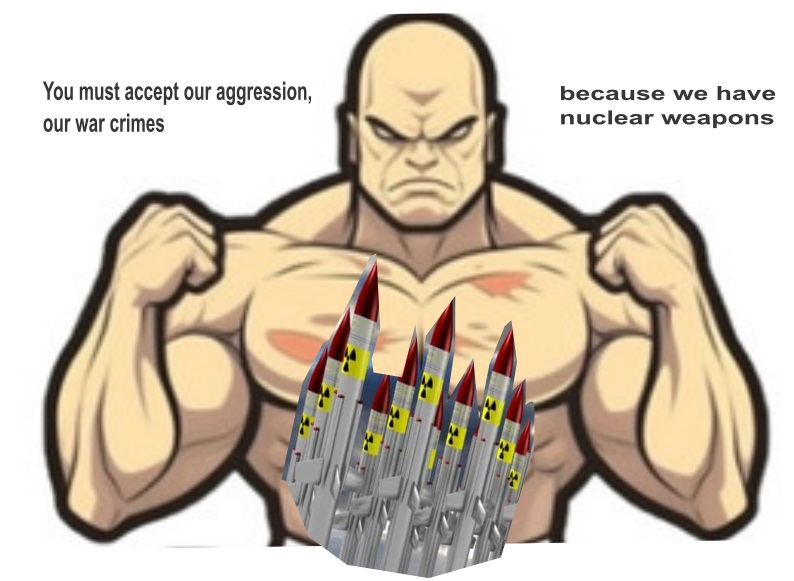
Whether nuclear weapons are used or not, they facilitate other forms of violence. They are the backbone of a mentality that security can best be achieved through building up the capacity to commit mass destruction, and by committing mass destruction. Nuclear weapons are used as shields to prevent others from standing up to their possessors’ acts of aggression, to their war crimes. Financial investments in nuclear weapons provide profits for weapons manufacturers that also build conventional bombs, missiles, guns, fighter jets, and other technologies of war. Nuclear weapons provide sustenance to the war machine, and exist as the overarching, final threat of that machine.
The possession of nuclear weapons drives the development of self-destructive plans masquerading as national security. Governments willfully put people and the planet in harm’s way, arrogantly asserting that this is the best way to protect them. One example is the land-based missile silos in the United States, which are intended to serve as targets for enemy nuclear weapons with no concern for the communities or land upon which they are based. As part of his new ground-breaking project examining the US government’s plan to modernise its nuclear forces, Sébastien Philippe of Princeton University’s Program on Science and Global Security writes in Scientific American, “a key argument for the continued existence—and now the replenishment—of the land-based missiles is to provide a large number of fixed targets meant to exhaust the enemy’s resources.” Yet the most recent, 3000-page report from US government on these silos does not mention what happens if the missiles are attacked. But as Philippe’s modelling of these “sacrifice zones” shows:
A concerted nuclear attack on the existing U.S. silo fields—in Colorado, Wyoming, Nebraska, Montana and North Dakota—would annihilate all life in the surrounding regions and contaminate fertile agricultural land for years. Minnesota, Iowa and Kansas would also probably face high levels of radioactive fallout. Acute radiation exposure alone would cause several million fatalities across the U.S.—if people get advance warning and can shelter in place for at least four days. Without appropriate shelter, that number could be twice as high. Because of great variability in wind directions, the entire population of the contiguous U.S. and the most populated areas of Canada, as well as the northern states of Mexico, would be at risk of lethal fallout—more than 300 million people in total. The inhabitants of the U.S. Midwest and of Alberta, Saskatchewan, Manitoba and Ontario in Canada could receive outdoor whole-body doses of radiation several times higher than the minimum known to result in certain death.
“Higher than the minimum known to result in certain death.” How can anyone read these words and think, “No, this is not relevant for a study on the impacts of our weapon systems.” Or, more broadly, that “No, this is not relevant for our consideration of the possession and deployment of these weapons at all. In fact, we will base our security strategy on the possibility of mass death and unspeakable suffering, and this is normal and fine for us and a few select others—this is how we will dominate. This is how we ‘win’.”
The irrationality of basing national security on the ability to execute or absorb catastrophic events like genocide is not lost on states parties and signatories to the Treaty on the Prohibition of Nuclear Weapons (TPNW). These governments understand that security must be provided for through other means. That it is both immoral and illogical to threaten to melt people, to turn them into shadows, or to subject them to a protracted, painful death from radiation poisoning, in order to—what, exactly? Exercise dominance within the so-called world order? Be able to wage wars of aggression against whomever one wants, whenever one wants?
The governments that join the TPNW are not just pledging against acquiring nuclear weapons themselves—they are also committed to achieving the abolition of all nuclear weapons, and to building a world that does not rely on massive nuclear violence for security. When these governments gathered with activists and others in 2017 to prohibit nuclear weapons, they changed the world. Not just rhetorically, but materially. The creation of a legally binding treaty outlawing the possession, use, and threat of use of atomic bombs has enabled unprecedented financial divestment and political stigmatisation of these weapons. It has changed discourse, even if it has not yet changed doctrines. But one follows the other.
Six years after the adoption of the TPNW, the nuclear-armed states and nuclear-supportive allies are still clinging to their arsenals of mass destruction. But the horrors these governments have collectively wrought upon the world are clearer—and more condemned—than ever. The masks are off, the wizards are no longer behind the curtain. Political leaders that condone mass death are being denounced; global inequalities are being exposed and opposed. The tide may not yet have fully turned, but the wave of opposition to permanent war and violent aggression is growing every single day. People are organising and getting organised. There is no time to waste, not when it comes to genocide and not when it comes to nuclear weapons.
This meeting of TPNW states parties is an opportunity to advance collective action against the bomb. The governments that have signed and ratified this treaty must adopt a strong declaration condemning nuclear deterrence and the continued possession and modernisation of nuclear arsenals. They must continue to implement last year’s action plan and work to get more countries onboard the treaty, especially those still trying to hide behind the false security promised by nuclear-armed states in exchange for sharing the economic and political burdens of nuclearism. The governments that aid and abet nuclear-armed states must relinquish this immoral space and join the rest of the world in renouncing the policies and practices of mass death.
But this meeting of states parties is not just about governments, it’s about people. It’s about the Indigenous Peoples upon whose bodies and lands nuclear weapons have been detonated, again and again and again. It’s about the communities who have been forced, without their consent or knowledge, to host uranium mines, nuclear laboratories, missile silos or bomber and submarine fleets, radioactive waste dumps. It is about all of us living with radiation from nuclear testing in our bodies, contaminated for generations by the hubris of political and corporate leaders who put their profits and sense of power above everything else. This meeting will be filled with people from affected communities, activist organisations, scientific groups, academic institutions, and more. Nuclear weapons have never just been about states. Nuclear weapons, fundamentally, are about human life, about all life. The nuclear-armed states have refused to acknowledge, let alone include, most people in conversations or policy making about their bombs. But the TPNW is a space for everyone to have a voice, to participate, and to determine how we fight for nuclear abolition, together.
“Nuclear weapons are mirrors in which we see all the versions of the human shape,” writes Amis. What shape do we want to reflect?
Pentagon Publishes Proposal For Ethnic Cleansing and Colonization of Gaza; Destruction of Lebanon
The call for genocide was written on behalf of the Department of Defense and published in the “US Army’s premier multimedia organization.”
DAN COHEN, NOV 22, 2023, Uncaptured Media
The official U.S. military publication Army University Press published an article written on behalf of the Department of Defense calling for the ethnic cleansing of Gaza and destruction of Lebanon in a November 2023 online exclusive.
This outlet is described on its website as “the US Army’s premier multimedia organization”, and an “entry point for cutting-edge thought and discussion on topics important to the Army and national defense”, which “makes timely and relevant information available to leaders in the military, government, and academia.”
While the article notes that “the views expressed in this article are those of the author and do not reflect the views of the U.S. Army, Department of Defense, or any other agency of the U.S. government.” the fact that such a radical proposal was published in the top U.S. Army publication, demonstrates that explicit support for ethnic cleansing and genocide is well accepted in its intellectual and policy-making circles.
The article’s publication comes amid Israel’s unprecedented genocidal assault on the besieged Gaza Strip following the October 7 Hamas attack. Israeli occupation forces have targeted residential buildings, schools, hospitals, ambulances, medical personnel, rescuers and first response teams, journalists, United Nations employees, mosques, churches, infrastructure, and have cut off electricity and of communication services. On November 10, the Gaza Health Ministry announced it had lost the ability to track casualties, with its last official count at 11,078 deaths, including 4,506 children, 27,490 injuries and an additional 2,700 people trapped under the rubble. An estimated 1.7 million people are displaced, including 900,000 in 154 UNRWA shelters, some of which have been bombed by Israel.
The article (archived) was written by Omer Dostri, a former Likud apparatchik who is now a national security strategist at the hawk Jerusalem Institute For Security and Strategy think tank and researcher at the Israel Defense And Security Forum.
Established in 2017 to influence domestic Israeli discourse, and drawing much of its staff from the Likudnik Begin-Sadat Center for Strategic Studies, JISS is funded by the Tikvah Fund, a cutout of the U.S. Republican party which seeks to promote a western-style neoliberal capitalist model. A creation of the late New York billionaire mogul Sanford Bernstein (who later changed his first name to Zalman upon taking Israeli citizenship), it is apparently funded today by his estate, along with contributions from American Zionist oligarchs including Rebecca Sugar, a secretive group of Jerusalem businessmen, and Australian venture capitalist Greg Rosshandler. Tikvah is chaired by neoconservative financier Roger Hertog.
“I am pleased to introduce a study I authored on behalf of the US Department of Defense and the US Army’s Military Review journal. The research delves into the political, strategic, and tactical aspects of the #Hamas attack on #Israel and the war in #Gaza,” Dostri boasted on LinkedIn.
“Well done,” commented Miriam Reichman, former political intern at Israel’s mission to the UN.
While the U.S. army paper describes October 7 as a terrorist attack, repeating the discredited Israeli government claims about beheadings and rapes, it acknowledges the sophisticated nature of the operation.
“This heinous attack was the work of a terrorist organization, yet it displayed an exceptional military and professional approach akin to the methods employed by special forces in regular armies. This underscores the significant military and intelligence capabilities that Hamas had meticulously developed over the years, specifically in preparation for this devastating event,” he wrote.
‘The optimal choice for Israel is to occupy the Gaza Strip’
Dostri explains how Israel’s “deterrence policy” has collapsed as a result of the attack, and why it must formulate a new strategy to maintain its system of supremacy.
He lists four options to accomplish this. The first three serve as window dressing, described in brief, until he arrives as the preferred choice of ethnic cleansing.
……………………………………………………………………………….. The ideal option, and that which Dostri believes will re-establish “deterrence” and provide “security”, and achieve victory, is for Israel to re-occupy Gaza for the long term, ethnically cleanse hundreds of thousands of its Palestinian residents, exponentially expand the size of the kill zone, and establish Israeli settlements inside Gaza.
“From a security perspective, the optimal choice for Israel is to occupy the Gaza Strip and establish a lasting military presence,” he writes.
Dostri cites public support for establishing settlements in Gaza from “some members of the Knesset, public figures, journalists, and nongovernmental organizations” who maintain the long-standing Zionist belief that stealing land and establishing colonies is the proper response, rather than one that engenders violent reaction from Palestinians.
While Dostri presents confiscation of land and creation of settlements as an innovative concept, this has always been the basis of Zionism, ideologically and practically.
In his bookEthnocracy: Land and Identity Politics in Israel/Palestine, Israeli scholar Ofer Yiftachel describes the process of Judaization, in which Zionist authorities expropriate land from Palestinians, transfer it to Jews, restrict Palestinian development while promoting Jewish-only colonies, and Hebraization of Palestinian place names, and redrawing boundaries to ensure Zionist dominance. This has been put into practice in the Galilee and Negev, which are part of modern-day Israel, as well as the occupied territory of the West Bank.
This method has been a constant since the creation of the State of Israel until today.
………………………………………………………………………………………… Dostri is even more explicit in opinion pieces published in Israeli media outlets. In a November 19 article in the Jerusalem Post, he calls for Israeli settlements to be established in Gaza – essentially using Israeli civilians as human shields – in order to provide security…………………..
Dostri reiterates his call for ethnic cleansing of Palestinians from Gaza, writing that ” Israel should resist the return of the hundreds of thousands of Gaza residents who evacuated to the southern Gaza Strip,” and calls to make agreements with regional countries to expel Palestinian refugees into the Sinai.
He hails the war on Gaza as a “historic and unparalleled opportunity to reshape the threat landscape and “alter the demographic balance in the region.”
Finally, he concludes that Israel should deceive the world about its true intentions, writing that “The country’s leaders should not let this opportunity slip away, and certainly, they should avoid loudly announcing their renunciation of it to the entire world in advance.”
Strategy for war on Gaza
To accomplish these goals, Dostri’s Pentagon paper proposes a “a comprehensive and synchronized military operation with the aim of occupying the Gaza Strip” consisting of an aerial bombardment campaign followed by a ground operation. His plan largely follows what the Israeli military is currently implementing, and calls for the ground operation to last two to three months.…………………………………………………………………………………………………………………….
The destruction of Lebanon’s national and critical infrastructure’
The paper recognizes that the war in Gaza can easily escalate into a regional war. He calls for Israel to create “the perception that Israel is behaving unpredictably in Gaza” to deter Hezbollah and argues that the more Israel intensifies its attacks on Hamas, with greater and more lethal force, the more likely it is that Hezbollah will be deterred.” He believes that Israel’s deterrence vis-a-vis Hezbollah is understood “particularly when the United States deploys its most formidable forces to the region and openly and resolutely supports Israel, coupled with explicit U.S threats against Israel’s adversaries considering involvement in the conflict.”
…………………………….. Dostri argues that Israel must also maintain the possibility of an all-out war on Lebanon, involving a massive air campaign and ground invasion into the southern part of the country. This option would mean the “complete annihilation of Hezbollah, and the destruction of Lebanon’s national and critical infrastructures, which will eventually lead to the country’s collapse.”
……………………. Genocide into a regional war
Overall, Dostri’s paper amounts to a call to commit crimes against humanity. It adds to the numerous statements that, in the case of a war crimes trial, would serve as clear evidence of intent to carry out genocide, which is notoriously difficult to establish. The fact that this call was published on behalf of the Department of Defense and in the U.S. Army’s premiere media arm raises the questions about American culpability in the genocide of Gaza, which is being carried out primarily with bombs and missiles manufactured in the American factories, and what the U.S. government’s intentions truly are…………………… more https://www.uncaptured.media/p/pentagon-publishes-proposal-for-ethnic
Ukraine ‘concerned’ by Western push for peace talks – security chief
https://www.rt.com/russia/587695-ukraine-concerned-russia-talks/ 20 Nov, 2023
The West must keep supporting Kiev if it wants to keep ruling the world, Alexey Danilov has claimed
Kiev is worried that its Western backers are calling for peace out of an irrational fear of Russia, Aleksey Danilov, the secretary of Ukraine’s National Security and Defense Council, said on Monday.
Danilov spoke via video link to the annual conference of the Halifax International Security Forum, a Washington, DC-based pressure group funded in part by the Canadian government.
“Ukraine is concerned by the fact that discussions among certain partners have intensified regarding the need for negotiations, consultations, meetings with the Russians to discuss the issues of the war in Ukraine, a ceasefire, etc.,” Danilov said, according to a transcript posted by his office.
He attributed this to a “rudimentary fear” of Russia and argued that the West should follow Ukraine’s example instead, as Moscow “only understands the language of force.”
According to Danilov, the current conflict is “a struggle between democracy and tyranny,” with the West and Ukraine on one side, and Russia, China, Iran and North Korea on the other. If Russia is not defeated, the world should expect a new “axis of evil” within 15-20 years that would include “some European countries” as well, he insisted. “Ukraine and the Ukrainian people will fight to the end. We are sure of our victory.”
President Vladimir Zelensky’s top security official described Ukraine’s idea of victory as the “controlled decomposition of Russia into several parts” leading not just to “regime change” in Moscow but the “de-sovereignization… denuclearization and demilitarization” of the neighboring country.
Meanwhile, he said, Ukraine needs more Western funding and support to restore its 1991 borders and become an economic powerhouse
“Ukraine has every chance to become a strategic project of the West, which will demonstrate the full power of the vitality of democracy and the defense of universal values,” Danilov insisted. “The West must confirm that it is and remains the First, and a victorious Ukraine will serve as a convincing narrative in the modern confrontation between slavery and freedom!”
Earlier on Monday, US Defense Secretary Lloyd Austin arrived in Kiev to offer moral support for Ukraine, but had no new military assistance to announce. Meanwhile, Treasury Secretary Janet Yellen told the outlet CNBC that Ukraine is “utterly dependent” on US funding to keep paying the salaries of government workers, calling the continued funding of Kiev a “critical priority” for US national security.
Most of the congressionally approved funding for Ukraine has been spent and the White House has been trying to pressure Congress to pass more, so far with no effect.
Brics Leaders Condemn Israeli War Crimes in Gaza, Call For End of Hostilities
A delegation of Arab-Islamic countries also met Chinese and Russian foreign ministers earlier this week in order to push for an end of of Israeli violence against Palestinians and lasting peace in the region
By Abdul Rahman / Peoples Dispatch, November 24, 2023
Leaders of the BRICS bloc called for an immediate end to the hostilities in Palestine in an online meeting held on Tuesday, November 21.
The meeting was attended by the heads of government of Brazil, Russia, China, South Africa, Saudi Arabia, Iran, Ethiopia, Egypt, and the UAE. The UN Secretary General Antonio Guterres also joined the meeting. India and Argentina were represented by their foreign ministers.
The meeting was chaired by South African President Cyril Ramaphosa. Though the meeting failed to issue a joint statement most of the leaders in the meeting referred to the targeting of civilians in Gaza by Israel as “war crimes” and asked for immediate humanitarian ceasefire.
The chair’s summary issued after the meeting condemned “any kind of individual or mass forcible transfer and deportation of Palestinians from their own land.” It also called any such transfer a breach of the Geneva Convention and war crimes.
Ramaphosa also said that, “a just and lasting solution to the Palestinian-Israeli conflict can be achieved by peaceful means.”……………………………………………………………more https://scheerpost.com/2023/11/24/brics-leaders-condemn-israeli-war-crimes-in-gaza-call-for-end-of-hostilities/
Ex-CIA Analyst: US Responsible for Gaza Genocide by Empowering Netanyahu
Sputnik, 21.11.2023
US President Joe Biden fully obeys Israeli Prime Minister Benjamin Netanyahu, endorsing the genocide of Palestinians in the Gaza Strip, stressed Raymond McGovern, a former Central Intelligence Agency (CIA) officer and a political activist.
McGovern told Sputnik that the US has been enabling the genocide of Palestinians by allocating more and more assistance for Israel. According to the political activist, Israel could not launch genocide had it not been for the US aid.
At the same time the Israeli government has not even tried to cover their genocidal intentions up. On the contrary, the Israeli flat out announced the full blockade of the Gaza Strip, cutting off water, food, and power supplies which indicates the true and completely unmasked goals of the Israeli ground operation, but the US still endorses them, McGovern emphasized…………………………………………………………………………………………………………. more https://sputnikglobe.com/20231121/ex-cia-analyst-us-responsible-for-gaza-genocide-by-empowering-netanyahu–1115100230.html
Influential Israeli national security leader makes the case for genocide in Gaza

In an Op-Ed titled “Let’s Not be Intimidated by the World,” Israeli ret. Major General Giora Eiland argues that all Palestinians in Gaza are legitimate targets and that even a “severe epidemic” in Gaza will “bring victory closer.”
Mondpweiss, BY JONATHAN OFIR
Since October 7, there has been no shortage of genocidal calls from Israeli leaders, as well as clear plans, also at ministerial level, for the complete ethnic cleansing of Gaza. And while the usage of biblical euphemisms like Prime Minister Netanyahu’s “Amalek” reference may appear too vague for some, even if the story suggests killing infants, on Sunday ret. Major General Giora Eiland, former head of the National Security Council and current advisor to the Defense Minister decided to spell out genocide more explicitly.
In a Hebrew article on the printed edition of the centrist Yedioth Ahronoth titled “Let’s not be intimidated by the world,” Eiland clarified that the whole Gazan civilian population was a legitimate target and that even “severe epidemics in the south of the Gaza Strip will bring victory closer.” His bottom line leaves no doubt as to his view:
“They are not only Hamas fighters with weapons, but also all the ‘civilian’ officials, including hospital administrators and school administrators, and also the entire Gaza population that enthusiastically supported Hamas and cheered on its atrocities on October 7th.”
Eiland speaks against humanitarian concern and the whole principle of distinction:
“Israel is not fighting a terrorist organization but against the State of Gaza.”
Therefore, per Eiland, “Israel must not provide the other side with any capability that prolongs its life.”
Eiland mocks the idea of “poor women” as the representation of uninvolved civilians:
“Who are the ‘poor’ women of Gaza? They are all the mothers, sisters or wives of Hamas murderers”.
The formulation is reminiscent of the far-right former Justice Minister Ayelet Shaked, who, during the 2014 onslaught, suggested that Israel’s enemy was the entire Palestinian people:
“Behind every terrorist stand dozens of men and women, without whom he could not engage in terrorism. Now this also includes the mothers of the martyrs, who send them to hell with flowers and kisses. They should follow their sons, nothing would be more just. They should go, as should the physical homes in which they raised the snakes. Otherwise, more little snakes will be raised there.”
Eiland speaks against surrendering to American sensibilities. Humanitarian pressure (that is, cutting off all basic life necessities) is a legitimate means of war, he claims:
“The Israeli cabinet must take a harder line with the Americans, and at least have the ability to say the following: as long as all the hostages are not returned to Israel, do not talk to us about the humanitarian aspects”.
Also, the rest of the international community, with its humanitarian concern, must be resisted – even the spread of severe epidemics is a legitimate means of warfare:
“The international community warns us of a humanitarian disaster in Gaza and of severe epidemics. We must not shy away from this, as difficult as that may be. After all, severe epidemics in the south of the Gaza Strip will bring victory closer and reduce casualties among IDF soldiers”
But no, Eiland is not a sadist nor a genocidaire — all of this is but a means towards a supposedly good end:
“And no, this is not about cruelty for cruelty’s sake, since we don’t support the suffering of the other side as an end but as a means.”
Eiland’s outrageously genocidal piece was endorsed by Finance Minister Bezalel Smotrich, who tweeted the full article and said he “agreed with every word.” Smotrich is known for, among other things, calling to “wipe out Huwwara” in the West Bank, so it should come as no surprise that he would now endorse Eiland’s call to do the same in Gaza.
A concentration camp
Eiland has a long history of being surprisingly forthright about his view on the state of the Gaza Strip. In 2004, then as head of the National Security Council, he regarded the Gaza Strip as “a huge concentration camp” as he advocated for the U.S. to force Palestinians into the Sinai desert as part of a “two-state solution.”
As per a U.S. diplomatic cable leaked to Wikileaks here:
Repeating a personal view that he had previously expressed to other USG visitors, NSC Director Eiland laid out for Ambassador Djerejian a different end-game solution than that which is commonly envisioned as the two-state solution. Eiland’s view, he said, was prefaced on the assumption that demographic and other considerations make the prospect for a two-state solution between the Jordan and the Mediterranean unviable. Currently, he said, there are 11 million people in Israel, the West Bank, and Gaza Strip, and that number will increase to 36 million in 50 years. The area between Beer Sheva and the northern tip of Israel (including the West Bank and Gaza) has the highest population density in the world. Gaza alone, he said, is already “a huge concentration camp” with 1.3 million Palestinians. Moreover, the land is surrounded on three sides by deserts. Palestinians need more land and Israel can ill-afford to cede it. The solution, he argued, lies in the Sinai desert.
It is interesting to see Eiland recognizing such a reality even before the Gaza “disengagement” of 2005, before the election of Hamas in 2006, and before the genocidal siege of 2007, which has only been upped in its severity since October 7. At this point, regarding Gaza, as a concentration camp appears perhaps too weak a term — it has become an extermination camp.
Here is the full translated* text of Eiland’s piece: (on original)………………………………….. more https://mondoweiss.net/2023/11/influential-israeli-national-security-leader-makes-the-case-for-genocide-in-gaza/
Second Meeting of State Parties to Treaty on Prohibition of Nuclear Weapons to Be Held at Headquarters, 27 November–1 December
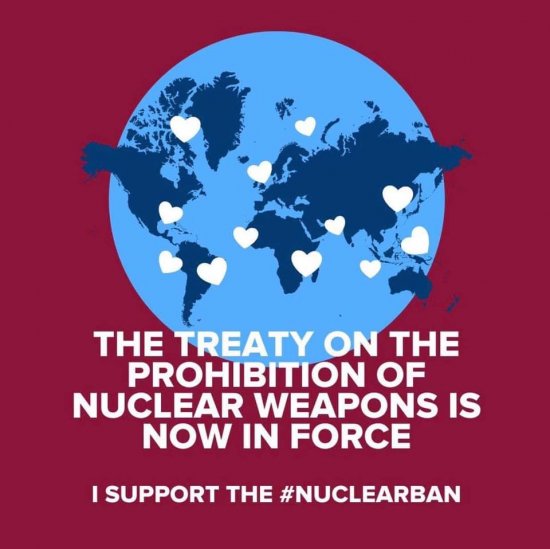
NEW YORK, 24 November (Office for Disarmament Affairs) — The second Meeting of States Parties to the Treaty on the Prohibition of Nuclear Weapons will be held at the United Nations Headquarters from 27 November-1 December 2023. Juan Ramón de la Fuente (Mexico) was elected as President of the Meeting.
The Treaty, the first multilateral nuclear disarmament treaty to be negotiated in more than two decades, was adopted on 7 July 2017 at the United Nations and entered into force on 22 January 2021. United Nations Secretary-General António Guterres has called the Treaty “an important step towards the goal of a world free of nuclear weapons and a strong demonstration of support for multilateral approaches to nuclear disarmament.”
The second Meeting of States Parties is expected to hold a thematic debate on the humanitarian impact of nuclear weapons. States parties will also consider the status and operation of the Treaty, addressing issues that include universality; the total elimination of nuclear weapons; and victim assistance, environmental remediation and international cooperation and assistance. Other topics will include scientific and technical advice for the effective implementation of the Treaty, the complementarity of the Treaty with the existing nuclear disarmament and non-proliferation regime and implementing the gender provisions of the Treaty.
The Meeting is expected to adopt a political declaration. The period since the conclusion of the first Meeting of States Parties in April 2022 saw the appointment of a Scientific Advisory Group, which will present its initial reports at the second Meeting of States Parties. Since the first Meeting of States Parties, seven States signed the Treaty, three ratified it and one acceded to it.
The Treaty contains, inter alia, a comprehensive set of prohibitions on participating in any nuclear-weapon-related activities. This includes undertakings not to develop, test, produce, acquire, possess, stockpile, use or threaten to use nuclear weapons. The Treaty also prohibits the deployment of nuclear weapons on national territory as well as the provision of assistance to any State in the conduct of prohibited activities.
The Treaty requires States parties to assist individuals affected by the use or testing of nuclear weapons, as well as to take environmental remediation measures in areas under their jurisdiction or control that have been contaminated due to the testing or use of nuclear weapons. States parties are required to cooperate with one another to facilitate the Treaty’s implementation.
To date, 69 States have ratified or acceded to the Treaty and 93 have signed it.
Media contacts for the second Meeting of States Parties to the Treaty on the Prohibition of Nuclear Weapons: Suzanne Oosterwijk, United Nations Office for Disarmament Affairs, UN Secretariat, S-30FW, telephone: +1 917-367-2556, email: suzanne.oosterwijk@un.org.
1 This Month
26 September – International Day for the Total Elimination of Nuclear Weapons





PLEASE OPPOSE HR 8255 AND S.3639 – bills would accelerate satellite deployment, with no environmental review or safeguards – https://ncstd5li.quorum.us/campaign/169331/
To see nuclear-related stories in greater depth and intensity – go to https://nuclearinformation.wordpress.com
-
Archives
- September 2026 (313)
- August 2026 (330)
- July 2026 (355)
- June 2026 (287)
- May 2026 (306)
- April 2026 (356)
- March 2026 (251)
- February 2026 (267)
- January 2026 (308)
- December 2025 (358)
- November 2025 (359)
- October 2025 (375)
-
Categories
- 1
- 1 NUCLEAR ISSUES
- business and costs
- climate change
- culture and arts
- ENERGY
- environment
- health
- history
- indigenous issues
- Legal
- marketing of nuclear
- media
- opposition to nuclear
- PERSONAL STORIES
- politics
- politics international
- Religion and ethics
- safety
- secrets,lies and civil liberties
- spinbuster
- technology
- Uranium
- wastes
- weapons and war
- Women
- 2 WORLD
- ACTION
- AFRICA
- Atrocities
- AUSTRALIA
- Christina's notes
- Christina's themes
- culture and arts
- Events
- Fuk 2022
- Fuk 2023
- Fukushima 2017
- Fukushima 2018
- fukushima 2019
- Fukushima 2020
- Fukushima 2021
- general
- global warming
- Humour (God we need it)
- Nuclear
- RARE EARTHS
- Reference
- resources – print
- Resources -audiovicual
- Weekly Newsletter
- World
- World Nuclear
- YouTube
-
RSS
Entries RSS
Comments RSS

