How Are U.S. Warships Supporting Israel’s Genocide In Gaza?

Wherever you’re located, get out in the streets to demand an end to genocide in Gaza
LISA SAVAGE, DEC 4, 2023
Gaza has been under military blockade since 2006. Its one harbor, in Gaza City, was heavily bombed by Israel recently. Repeated attempts to reach Gaza with boats carrying humanitarian supplies have been thwarted by Israel with U.S. backing and we’ve seen activists beaten and even killed for trying to deliver cargo like medical supplies.
Bringing this question closer to home, How is the genocide in Gaza supported by General Dynamics and Bath Iron Works?
General Dynamics is the world’s fourth largest weapons manufacturer and Bath Iron Works (BIW) is one of its many locations for building weapon delivery systems. In this location in Maine shipbuilders historically profited from building slave ships.
Today, both destroyers and cruisers are built to be nuclear-capable meaning they are designed to be able to deliver first-strike attack nuclear Tomahawk cruise missiles and SM-3 ‘missile defense’ interceptors which would take out an enemy’s defenses following a first strike by the U.S.
Currently there are multiple Bath-built warships in the vicinity of Gaza including the eastern Mediterranean Sea, the Red Sea, and the Gulf of Aden. The USS Kearny, an Aegis destroyer built at BIW, is deployed there as is the USS Mason, an Arleigh Burke-class destroyer which on 27 November engaged in a firefight with Yemeni forces on behalf of an Israeli merchant ship it was sent to rescue. U.S. ships have been reported as routinely shooting down drones launched from Yemen that target ships in the vicinity.
On 15 November Aljazeera published a video report, “What does the Western naval build-up in the Middle East look like?” with this comment: “The Middle East is witnessing a Western naval build-up that hasn’t been seen there for decades: aircraft carriers, destroyers, missile cruisers, amphibious assault ships, a nuclear-powered submarine, and many more.”
U.S. warships are deployed to deter resistance forces in the region — such as Hezbollah — from intervening to stop genocide in Gaza and the West Bank. So far they’ve been apparently unsuccessful, however, their presence increases the likelihood of escalation as in the case of the USS Mason fighting Yemen on behalf of Israel.
Since the resumption of Israel’s bombing of Gaza on December 1, these confrontations have indeed escalated.
Treating U.S. warships as inherently different from Israeli warships is mythology. The two nation states have never been in closer lock step as they do the bidding of their corporate overlords.
Israel has been described as “America’s unsinkable aircraft carrier” but the U.S. and Israel have never been so reviled in world opinion as they are today. Their collective reputation is sinking like a warship that’s taking on water.
Join us in Bath this Friday if you’re able. Help us communicate to workers that we know Bath Iron Works only has one customer — the U.S. Navy — but it wasn’t always like that. So many useful things could be built there and even more good union jobs generated, like hospital ships to provide relief for the bombed out children of Gaza.
If you have the courage, watch or read: “A harrowing video shows decomposing babies in a Gaza hospital after they had to be abandoned amid Israeli attacks.”
Then, wherever you’re located, get out in the streets to demand an end to genocide in Gaza and to the military blockade that supports it.
Seymour Hersh: Russia, Ukraine peace underway, 4 new region additions
By Al Mayadeen English, Source: Agencies, 1 Dec 2023 https://english.almayadeen.net/news/politics/seymour-hersh–russia–ukraine-peace-underway–4-new-region
Included in the potential deal would also be Russia’s agreement to Ukraine’s accession to NATO provided that NATO troops are not stationed on its territory and only defensive weaponry is located there.
In his newly released article, renowned US journalist Seymour Hersh assured that peace negotiations between top Russian and Ukrainian generals Valery Gerasimov and Valerii Zaluzhnyi respectively are currently underway which include a potential security of Crimea and another four former regions of Ukraine as part of Russia.
Included in the potential deal would also be Russia’s agreement to Ukraine’s accession to NATO provided that NATO troops are not stationed on its territory and only defensive weaponry is located there.
According to Hersh, both Russia and Ukraine agree that the persistence of war is illogical and that Russian President Vladimir Putin would be with an agreement that fixates borders according to where the troops are stationed after the end of peace negotiations.
Hersh cited a US official involved in the top negotiations as saying: “This was not a spur-of-the-moment event,” adding: “This was carefully orchestrated by Zaluzhny. The message was the war was over and we want out. To continue it would destroy the next generation of the citizens of Ukraine.”
On the other hand, the Biden administration is strongly opposing the peace deal while Ukrainian President Volodymyr Zelensky remains the “wild card” but has been allegedly told that “this is a military-to-military problem to solve and the talks will go on with or without you”.
“The White House is totally against the proposed agreement,” the US official said, noting: “But it will happen. Putin has not disagreed.”
‘Prepare for bad news’ from Ukraine – NATO chief
https://www.rt.com/news/588418-nato-chief-stoltenberg-ukraine-bad-news/ 4 Dec 23
Jens Stoltenberg said the military bloc’s defense industry has yet to reach the level of cooperation needed to satisfy Kiev.
The Ukrainian military has failed to achieve any breakthroughs on the battlefield over the past several months, but the West should stand by the country regardless, NATO Secretary General Jens Stoltenberg has argued. The official also lamented the apparent failure of the military bloc’s defense industry to establish provide Kiev with the munitions it requires.
Earlier this week Stoltenberg warned that Moscow had been amassing missiles ahead of the winter, noting that Russian weapons manufacturers were operating “on a war footing.”
In an interview with Germany’s Das Erste TV channel aired on Saturday, Stoltenberg acknowledged that the frontlines in Ukraine have remained largely unchanged of late, adding that “wars are difficult to plan.”
“We have to be prepared for bad news. Wars move in phases, but we must stand by Ukraine in good and in bad times alike,” NATO’s chief insisted.
According to Stoltenberg, “ramping up production is of decisive importance” at this juncture.
When asked what Kiev should do in the meantime while its backers increase weapons production capacities – something that is bound to take time – Stoltenberg said that he would leave these “difficult operative decisions” to the Ukrainian leadership and military commanders.
“I think one of the problems that we must address is the fragmentation of the European defense industry. We are not capable of working so closely together as we should,” NATO’s secretary general stated. He called on all member states to “overcome the national, narrow interests” and increase supplies instead of enjoying rising prices.
Speaking after a meeting of NATO foreign ministers in Brussels on Wednesday, Stoltenberg warned that “Russia has amassed a large missile stockpile ahead of winter, and we see new attempts to strike Ukraine’s power grid and energy infrastructure.”
Two days prior, he told reporters that “we should never underestimate Russia.” NATO’s chief noted that Moscow had set its “defense industry on a war footing,” making it “hard to achieve the territorial gains we hope for.”
However, he stopped short of characterizing the current situation as a “stalemate” – a description used by the commander-in-chief of Ukraine’s armed forces, General Valery Zaluzhny, in early November.
According to the Russian Defense Ministry’s latest estimates, Kiev’s counteroffensive, which began in early June, has resulted in over 125,000 casualties for the Ukrainian side as of December 1.
Ukraine has lost up to 300,000 soldiers – ex-Zelensky aide
Rt.com 4 Dec 23
Kiev’s refusal to negotiate with Moscow has only caused the country heavy battlefield casualties, Aleksey Arestovich says.
Ukraine has lost up to 300,000 soldiers during its conflict with Russia, Aleksey Arestovich, a former aide to President Vladimir Zelensky, has claimed.
Arestovich made the revelation on Friday while speaking to journalist Yulia Latynina via video link. The former presidential aide was addressing the recent admission made by top Ukrainian MP David Arakhamia, who said the Istanbul talks between Moscow and Kiev were derailed by then-UK PM Boris Johnson, who urged Ukraine to “just continue fighting” instead of attempting to reach a deal with Russia.
“I was a member of the Istanbul negotiating team, but even I don’t know how it happened that we decided to break off the Istanbul [talks],” Arestovich stated.
The initiatives floated during the Istanbul talks were actually “very good,” he admitted, claiming that Ukraine’s neutrality and its non-alignment with NATO was a “red line” for Moscow.
Refusing to negotiate, however, has only resulted in heavy casualties, while its prospects to join NATO still remain dubious, he suggested.
“Where is NATO? Does it accept us or not? And will it accept us? … Then the 200 thousand [Ukrainian servicemen] or whatever, 300 thousand, would still be alive,” the ex-aide said.
…………………………..In recent weeks, top Ukrainian officials admitted the counteroffensive had failed to reach the desired outcome, and they seemed to shift blame for the failure on each other. Early in November, for instance, Valery Zaluzhny, Ukraine’s top general, said the battlefield situation had reached a “stalemate,” with Kiev unlikely to achieve a breakthrough unless it received a wonder-weapon of sorts.
The assessment has been vehemently rejected by Zelensky, who insisted the counteroffensive was still making progress. In an interview with AP published on Friday, however, Zelensky finally admitted that it had failed, stating that he considers the fact that his country’s troops are not retreating at the moment a “satisfying” enough result. https://www.rt.com/russia/588358-ukraine-losses-zelensky-aide/
Australia’s AUKUS nuclear submarines could fuel regional arms race despite assurance

“AUKUS is designed to shore up American power in East Asia, not de-escalate tensions,”
By Su-Lin TanDec 4, 2023, https://johnmenadue.com/australias-aukus-nuclear-submarines-could-fuel-regional-arms-race-despite-assurance/
Defence Industry Minister Pat Conroy says Australia is not worsening the arms race and gives assurance about the submarines’ nuclear reactors. The deal could still spark a defence build-up in Asia-Pacific while Australia lacks the facilities to deal with nuclear waste, analysts say.
Australia may have asserted that its acquisition of nuclear-powered submarines under AUKUS is not aggravating the “arms race”, but the deal and the three-nation alliance could still fuel a defence build-up in the Asia-Pacific and heighten regional tensions, security analysts say.
At the national press club in Canberra on Tuesday, Australian Defence Industry Minister Pat Conroy reiterated the importance of the submarines to the country’s defence while debunking “myths” about the trilateral deal struck with Britain and the United States, which is largely seen as a countermeasure targeting China.
“The arms race is the greatest it’s been since 1945, and that is why I reject assertions … that Australia is somehow fuelling that arms race,” he said, adding that rising tensions in the Asia-Pacific had posed the most challenging strategic environment for Australia since World War II. “We are responding to it in a responsible and mature manner, like Australian governments should.”
Australia will own at least eight submarines over the next three decades through the A$368 billion (US$243 billion) deal. First announced in 2021 and finalised earlier this year, the controversial pact has raised concerns in the region.
Collin Koh, a senior fellow at the S. Rajaratnam School of International Studies in Singapore, said Conroy’s comment was not a surprise as countries including China and others in Asia-Pacific often couched their arms acquisitions in “defensive terms”.
Most countries would do so in the name of national security interests but it did not mean such actions ensured peace or safety, he said.
Even before AUKUS was announced in 2021, China and other regional countries had already embarked on significant military build-up since the 1990s, Koh said.
“Conroy may not be necessarily wrong to say AUKUS responds to this already ongoing condition, yet at the same time, it’s also not wrong to say that AUKUS … may not only be used by Beijing to legitimise its naval build-up, it also could be exploited as a justification for other regional countries’ military build-up programmes,” Koh said.
Australia’s acquisition of the submarines might trigger new problems as other countries could argue that they should also acquire similar capabilities, said Maria Rost Rublee, a nuclear politics expert at Monash University.
These countries are not limited to “dangerous actors”, for instance, in South Korea where the majority of its people have expressed a desire for their country to own nuclear weapons, Rublee added.
“Just having this type of technology in the hands of a country where you have strong popular support for nuclear weapons could be an issue,” she said.
In an analysis earlier this month, Ankit Panda, the Stanton Senior Fellow in the Nuclear Policy Programme at the Carnegie Endowment for International Peace, warned the accumulation of weapons such as missiles could potentially lead to unintended attacks.
“The Indo-Pacific region has entered a new missile age … each nation individually seeking deterrence while as a whole steering the region into ever more dangerous waters,” he said. “A particular risk concerns the prospects of attacks on the nuclear forces of countries like North Korea and China, by US or allied forces in ways that may not be intended.”
By the 2030s, the Indo-Pacific region would be “full of thousands of new missiles that can be expected to be used widely in the context of a major regional war”, Panda said.
Responding to Conroy’s comments, the national convenor of Labor Against War in Australia, Marcus Strom, said: “If your answer to growing regional tension is to add offensive weaponry, you create a logic towards war.
“AUKUS is designed to shore up American power in East Asia, not de-escalate tensions,” he added.
While Conroy has given assurances about the safety of sealed nuclear reactors within the submarines, analysts argued that the lack of facilities in Australia for the eventual disposal of these reactors is worrying.
“The strength of this agreement is that the reactor module comes to us sealed. It comes sealed, designed to be never opened over the life of a submarine. You don’t have to refuel it, you don’t have to insert new fuel rods … [over] the life of the submarine,” Conroy said.
But nuclear waste expert Ian Lowe said in an analysis on The Conversation website earlier this year that Australia has failed for decades to find long-term storage solutions for small quantities of low- and intermediate-level nuclear waste.
Even Australia’s allies and AUKUS partners, the US and the UK, do not have long-term solutions for nuclear waste storage, according to Lowe.
“This should be concerning. To manage the waste from our proposed nuclear submarines properly, we’ll have to develop systems and sites which do not currently exist in Australia,” Lowe said.
Australian states such as Victoria, Queensland and South Australia have said they would not accept a nuclear waste facility within their borders.
While it will be another 30 years before Australia has to worry about dumping the submarine’s nuclear reactors, it is not a long time, Rublee said.
“If they take their nuclear stewardship obligations seriously, they must immediately begin working on the long-term storage of high-level nuclear waste,” she added.
URANIUM WARHEAD POISONING IS THE SPECIALTY OF US AGAINST RUSSIANS, ISRAEL AGAINST PALESTINIANS

by John Helmer, Moscow , December 2023
@bears_with
Long before the British intelligence agency MI6 invented the story that Russian military agents had carried the nerve agent weapon Novichok into England, fired it at two Russians, and left it in a dustbin for a local scavenger to find, take home and kill his girlfriend, there was depleted uranium poisoning.
This is a weapon of mass destruction (WMD).
In the past thirty years it has been used by the US, British, and Israeli armies in their wars against Iraq, Lebanon, and Palestine (Gaza), Serbia, and recently against the Russians on the Ukrainian battlefield. As a US invention, however, depleted uranium dispersal as a gas to contaminate terrain for enemy soldiers has been acknowledged in secret since 1943.
In the official military manuals, depleted uranium rounds are used because their metal concentration and intense heat burn their way through armour plate. In practice, they vaporise high concentrations of radioactive particles to cover large swathes of territory, civilian and military.
The US Department of Homeland Security defines a weapon of mass destruction (WMD) as “a nuclear, radiological, chemical, biological, or other device that is intended to harm a large number of people.” DU harms a relatively small number of soldiers on a battlefield operating in tanks, other armoured vehicles, self-propelled artillery and reinforced bunkers. DU strikes a much larger number of people through the release of radiation downwind of the battlefield by penetrating their bodies, attacking their genetic codes, and triggering cancers, birth defects, miscarriages of the unborn, and premature death of adults.
According to Homeland Security, it “works every day to prevent terrorists and other threat actors from using these weapons to harm Americans.” But when the US supplies its DU weapons to the Israeli and Ukrainian armies, it intends to cause this mass destruction by not caring for the harm they do — in fact concealing this harm, and publicly pretending DU ordnance is not what it is.
DU is a WMD by stealth. The US knows this because US and British soldiers who participated in the first battlefield use of DU shells and bombs, the war against Iraq in 1991, have been the long-term victims of their own weapons.
When the Israel Defence Forces (IDF) fire their DU shells and bombs into the buildings of Gaza, they are not aiming at Hamas tanks, armoured personnel carriers, or howitzer units – the Palestinian forces have none of those. Instead, the Israelis are aiming at the mass destruction of the Palestinian people, including those still unborn. The supply chain for this WMD includes the Cypriot, Greek, German and British governments.
In Gaza, and in the Ukraine, they are all witting participants in targeting a race of people for extermination, now and for the future.
According to US Government publications, the use of depleted uranium (DU) as a super-burning, heavy-metal weapon began in the US in the 1970s.
“Naturally occurring uranium ore is abundant in nature and contains several forms of uranium called isotopes. All uranium isotopes are radioactive; however, only one of these isotopes, Uranium-235 (U-235), provides the fuel used to produce both nuclear power and the powerful explosions used in nuclear weapons… In nature, U-235 only makes up a very small part of the uranium ore. Given its importance for nuclear power and nuclear weapons technology, U-235 is often removed from the natural uranium ore and concentrated through a process called uranium enrichment. Depleted uranium hexafluoride, also known as DU, is the material left behind after enrichment. Like the natural uranium ore, DU is radioactive. DU mainly emits alpha particle radiation.” …………………………………………………………………………….
US nuclear bomb designers describe the DU artillery shell or bomb as a “dirty radiation weapon” because of its uncontrollable dispersal on wind, rain, and through the soil targeting civilian populations far from the battlefield targets; indeed, the very civilian populations supporting and paying for the use of DU munitions against their purported enemies. “Some of the uranium used with DU weapons vaporises into extremely small particles, which are dispersed into the atmosphere where they remain until they fall to the ground with the rain. As a gas, the chemically toxic and radioactive uranium can easily enter the body through the skin or the lungs and be carried around the world until it falls to earth with the rain. AFP asked Marion Falk, a retired chemical physicist who built nuclear bombs for more than 20 years at Lawrence Livermore lab, if he thought that DU weapons operate in a similar manner as a dirty bomb. ‘That’s exactly what they are,’ Falk said. ‘They fit the description of a dirty bomb in every way.’”
According to Falk, more than 30 percent of the DU fired from the cannons of U.S. tanks is reduced to particles one-tenth of a micron (one millionth of a meter) in size or smaller on impact. ‘The larger the bang the greater the amount of DU that is dispersed into the atmosphere,’ Falk said. With the larger missiles and bombs, nearly 100 percent of the DU is reduced to radioactive dust particles of the micron size or smaller, he said.”
One of the leading nuclear physicists in Europe to have researched the long-range dispersal of DU biochemical damage is Christopher Busby. Here is his report, published in 2011, of the long-term poisoning of Iraqi civilians following the US and British use of DU ammunition during the fighting at Fallujah in 2004. The data on which Busby and his colleagues based their findings came from soil and water sampling, as well as from spectrometric analysis of the hair of civilian children, fathers and mothers in Iraq. The abnormally high concentrations of uranium were traced to the use by US and UK forces of artillery shells, ground-fired missiles, and air-fired rockets, missiles and bombs. According to Busby, “US forces also used Fallujah to combat-test prototypes of at least two new types of thermobaric weapons – Thermobaric Hellfire missiles – AGM-114N [54]- and a new thermobaric RPG called SMAW-NE (Shoulder-fired, Multi-purpose Assault Weapon – Novel Explosive).”
Testing new radiation weapons in civilian areas of Iraq, Lebanon, and Afghanistan has been standard practice for the US, the British, and the Israelis over more than thirty years.
The conclusion of Busby’s Fallujah study of September 2011 was that “we found significant levels of Uranium, a material which has been associated with weapons employed in Iraq and in the Balkans since 1991 and also with genotoxicity. These levels were significantly higher than those expected on the basis of published control group data from various studies and particularly from Southern Israel. Further, the pattern of contamination with regard to hair length indicated a major contamination event in the past. The levels of Uranium could not be explained by any local Uranium deposits in the soil since measurements made of soil Uranium showed only modest concentrations though the Uranium was slightly enriched…Since none of the other elements found in excess in the parents were genotoxic except Uranium we conclude that these results support the belief that the effects in Fallujah follow the deployment of a Uranium-based weapon or weapons of some unknown type.”
Other research studies by Busby and others have produced the evidence of Israeli use of DU air-dropped bombs and artillery fired shells against Arab targets in Gaza and Lebanon since 2006. Independent research has been undertaken by Arab experts of late miscarriages, stillbirths, and birth defects for pregnant Palestinian women at the Al-Shifa Hospital in Gaza City. “These data suggests a causative/favouring role of acute exposure of parents to the weapons-associated contaminants, and/or of their chronic exposure from their persistence in the environment on the embryonic development of their children.”
In a research paper published in December 2021, Arab scientists from Egypt and Gaza, with a Japanese colleague, and collaboration from a German institute in Munich, reported that uranium weapon contamination was found in sand, stone, concrete, demolition and other building materials in Gaza as well as in Egyptian Sinai. “The past and ongoing siege of the Gaza Strip has led to a severe shortage of building materials since 2007. Many houses, buildings and infrastructure were destroyed and produced huge amounts of demolition debris after the war in the Gaza Strip in 2008. As a result, re-use of the degraded building materials has been required in the past and present. According to the United Nations Development Program (UNDP), the amount of demolition debris in the Gaza Strip, produced from 2008 through 2009, was estimated to be 600,000 tonnes. The demolition debris was crushed, sieved and re-used as recycled building materials.”
In other words, the Israeli-American DU attacks on Gaza make the recycling of the current destruction hazardous for rebuilding. The findings indicate that long before the present war began last month, it has been Israeli state policy, backed and supplied by the US, to make Gaza uninhabitable for the future. This is genocide, using genotoxic weapons. For the first attempt at documenting the wind dispersal of DU radioactive particles fired by the IDF since October 7 to Egypt, Jordan, Saudi Arabia, and Israel itself, click on this.
In time Busby and Arab scientists will report the evidence of DU health damage among the Gazans who survive direct destruction by Israeli attack.
On November 25, Busby has reported new research documenting the bioch
Busby has now updated the earlier findings in a research paper issued on November 25. Because the standard European and US academic publishers are so far refusing to report the evidence, Busby’s report is published here in full.
The Khmelnitsky Ukraine Uranium explosion revisited.
The calculated source term is approximately 50 tons.
Public health implications for Poland and Western Ukraine.
By Christopher Busby, PhD………………………………………………………………………………more https://johnhelmer.net/biochemical-weapon-for-race-war-uranium-warhead-poisoning-is-the-specialty-of-us-against-russians-israel-against-palestinians/?fbclid=IwAR2H2vUD6Fw26z_-MTk2qEOyRLXTmRK4vUCjw8Bs8N_QIYxMgg3OcAgCDnY
U.S. to Develop Unanticipated New Nuclear Bomb
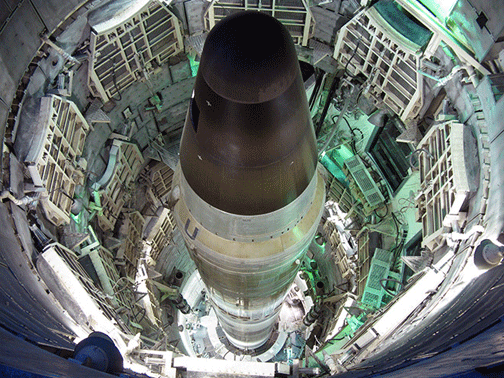
December 2023, By Shannon Bugos
The U.S. Defense Department unexpectedly announced its intention to develop an additional variant of the B61 nuclear gravity bomb, to be known as the B61-13.
………………………………….. The Pentagon acknowledged its hope that the B61-13 variant would help catalyze the stagnant retirement process of the B83 megaton gravity bomb.
“The B61-13 will provide the President with additional options against certain harder and large-area military targets, even while the department works to retire legacy systems such as the B83-1,” according to a Pentagon fact sheet……………………………..
“The case for the B61-13 is strange,” assessed the Federation of American Scientists in an Oct. 27 blog post. “For the past 13 years, the sales pitch for the expensive B61-12 has been that it would replace all other nuclear gravity bombs,” as well as “cover all gravity missions with less collateral damage than large-yield bombs.”
The B61-13 would be deliverable by modern aircraft and have a maximum yield similar to the 360-kiloton B61-7 variant, a massive increase when compared to the most recent 50-kiloton B61-12. The B61-12 is scheduled for initial deployment this year, replacing the 100 B61-3/4 bombs believed to be stationed across Belgium, Germany, Italy, the Netherlands, and Turkey under the NATO nuclear sharing mission………………………..
In an Oct. 24 letter to Congress, the Energy Department officially requested to amend its fiscal year 2024 budget request to cover development engineering activities for the B61-13.
Whether the request will be granted remains to be seen because Congress has yet to pass the necessary legislation to fund any department for all of fiscal year 2024. https://www.armscontrol.org/act/2023-12/news/us-develop-unanticipated-new-nuclear-bomb
Israel Planning for Gaza War To Last Over a Year
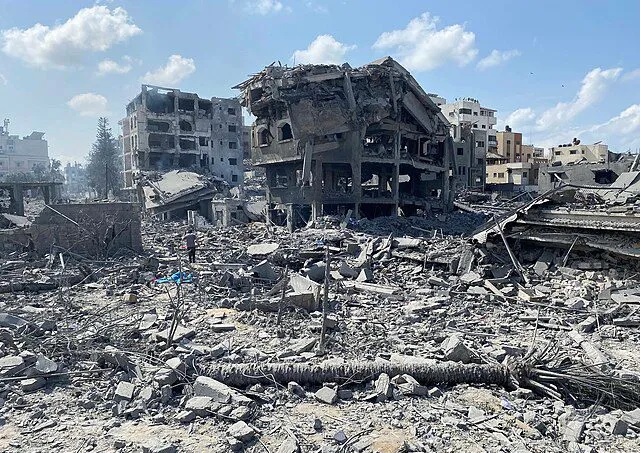
In either case, the Israeli military operations have killed more children, at least 6,000, than members of Hamas.
https://news.antiwar.com/2023/12/01/israel-planning-for-gaza-war-to-last-over-a-year/
One source said, “This will be a very long war . . . We’re currently not near halfway to achieving our objectives.”
The Financial Times reported speaking with sources who said that Israel plans to wage war on Gaza for over a year. In a little less than two months, Israel has killed at least 15,000 people, damaged 100,000 buildings, displaced 1.7 million Palestinians, and destroyed most of Gaza’s medical facilities.
On Friday, FT reported sources said Israel was preparing for a multi-phase conflict in Gaza that will last at least a year. “This will be a very long war…We’re currently not near halfway to achieving our objectives,” said one person familiar with the Israeli war plans.
According to the sources, Israel’s goals include “killing the three top Hamas leaders — Yahya Sinwar, Mohammed Deif, and Marwan Issa — while securing a decisive military victory against the group’s 24 battalions and underground tunnel network and destroying its governing capability in Gaza.”
Israel does not appear close to achieving these goals. US sources have said that Israel’s military operations in Gaza have failed to impact high or even mid-level Hamas members. On Sunday, the Guardian reported that Israeli officials estimated that 1,000 – 2,000 Hamas members had been killed. However, FT spoke with an Israeli military source who gave an estimate of 5,000 dead Hamas members. It is unclear why there is such a large discrepancy in the numbers, as both were given during the week-long pause in fighting.
In either case, the Israeli military operations have killed more children, at least 6,000, than members of Hamas. The massive civilian toll has led to mounting world opinion against Israeli military operations.

Secretary of State Antony Blinken attended a meeting of the Israeli war cabinet on Thursday and warned that Tel Aviv will lose more international support as the conflict continues. Gen. Herzi Halevi, the Israeli Defense Forces (IDF) chief of staff, said military operations in Gaza will take “more than a few additional weeks,” suggesting Tel Aviv did not plan to follow Washington’s advice. Still, America’s top diplomat said Washington was still firmly committed to arming Tel Aviv.
The first phase of the war, an intense bombing campaign and ground invasion, is expected to last well into 2024. One source said the first phase of the war is about 40% complete. “Gaza City isn’t finished yet, nor fully conquered. It’s probably 40% done,” the person explained. “For the north as a whole, it will probably require another two weeks to a month.”
The second phase will be an operation with fewer military operations aimed at stabilizing Gaza. While the sources told FT that the second phase is projected to continue until late 2024, Israeli officials say they cannot predict a firm endpoint to the conflict.
The Biden administration has pushed Israeli Prime Minister Benjamin Netanyahu to agree to allow the Palestinian Authority to control Gaza after Hamas is defeated. However, one source told FT that Tel Aviv will not listen to Washington, even as the US provides Israel with billions of dollars in weapons. “No one, not even the US, can talk to them about this,” said one of the sources familiar with the matter. That person emphasized that this point was crucial to Netanyahu keeping his far-right war cabinet together.
US Sent Israel 15,000 Bombs Since October 7
The transfer has included thousands of 2,000-pound bombs that have been used to devastate Gaza.
By Kyle Anzalone / Antiwar.com, https://scheerpost.com/2023/12/03/us-sent-israel-15000-bombs-since-october-7/
The Wall Street Journal published details about the White House’s secretive arms transfers to Israel since October 7. The US has provided Israel with 57,000 artillery shells and 15,000 bombs, including over 5,000 with 2,000-pound warheads.
According to a list of weapons obtained by the Journal, the US has shipped Israel “more than 5,000 Mk82 unguided or ‘dumb’ bombs, more than 5,400 Mk84 2,000-pound warhead bombs, around 1,000 GBU-39 small diameter bombs, and approximately 3,000 JDAMs.”
The US has additionally shipped 57,000 155 MM shells to Israel. NBC News previously reported in October that Washington sent Tel Aviv artillery rounds that are cluster munitions.
Mick Mulroy, a former deputy assistant secretary of defense and officer in the Marine Corps, described the weapons as those the US would use in non-urban areas. “They are kind of the weapons of choice for the fights we had in Afghanistan and Syria in open, non-urban areas,” he said. “The US may use them in more urban areas, but first it would do a lot of target analysis to make sure the attack was proportional and based on military necessity.”
By contrast, Gaza is about 140 sqare miles and home to 2.3 million people—one of the most densely packed regions on earth. Additionally, Israel has relied on an AI program to rapidly generate lists of suspected low-level Hamas members to target, without respect to civilians in proximity.
The Israeli policy has led to the widespread devastation of Gaza. At least 15,000 civilians have been killed. The number of dead Palestinian children exceeds the number of Hamas fighters Israel has claimed to kill by many thousands. Nearly 100,000 buildings in Gaza have been damaged by Israel’s bombing campaign, including the destruction of universities, hospitals, schools, and entire residential neighborhoods.
On Saturday, the New York Times reported that Israel was killing civilians in Gaza at a “historic pace.” The outlet added that part of the explanation for the huge death toll was Tel Aviv’s willingness to drop 2,000-pound American-made bombs on various civilian centers.
Marc Garlasco, a former Pentagon analyst who advises the Dutch organization PAX, told the Times that he’s never seen anything like it. “It’s beyond anything that I’ve seen in my career,” he said. Garlasco added that to find a historical comparison for so many large bombs in such a small area, one would have to “go back to Vietnam or the Second World War.”
Israeli officials and American politicians have attempted to justify Tel Aviv’s slaughter of Palestinians in Gaza by referring to the allied bombings of Tokyo during World War II. In a single night during the bombing of Tokyo, more than 100,000 people were burned to death by American napalm bombs.
The White House has made some requests to Tel Aviv to try to curb civilian casualties. However, the Biden administration has refused to condition future weapons shipments to Israel on reducing the civilian death toll.
The US has primarily relied on aircraft for quick shipment to Israel hundreds of millions of dollars in arms during the past two months. Unlike weapons shipments to Ukraine, the Biden administration has refused to provide the public with information on the arms it is providing to Tel Aviv.
More explosive power used against Gaza in a month than on Hiroshima
https://www.rt.com/news/588318-israel-gaza-bombing-report/ 3 Dec 23
Israel’s offensive against Hamas has also been deadlier than years of US assaults on Afghanistan and Iraq, according to a UN report
RT’s Steve Sweeney takes a look at the overall statistics from Israel’s relentless assault on Gaza as it seeks to eliminate the militant group Hamas. The damage sustained by the Palestinian enclave has already been described by the UN as “the darkest chapter in Palestinian history.”
According to a new UN report, the combined explosive power unleashed by the IDF in Gaza since October 7 already exceeds that of the atomic bomb dropped on Hiroshima by the US at the end of WWII. The Palestinian death toll is now higher than the count following several years of US strikes on Afghanistan and Iraq.
The Israeli bombardment campaign was launched following the surprise Hamas attack on Israel, in which 1,200 people were killed. Israel’s response has so far claimed the lives of over 15,000 Gazans, including some 6,000 children, according to the enclave’s health officials.
Watch the full report here: on original
“Nuremberg Trial” for Israel’s Crimes Against Palestinians?
, https://www.thepostil.com/a-nuremberg-trial-for-israels-crimes-against-palestinians/
Make no mistake. Israel has committed massive crimes in Gaza and in the West Bank against the Palestinians. When will the thousands killed get justice? Or are we all supposed to just go on with our lives and pretend that it’s all the pursuit of “the right of self-defense?” Who are these IDF snipers who anonymously shoot children, and no one is even curious to know who these killers are? Is this the way of war now, according to the “international rules based order” that we should be so proud of in the West, which is supposedly the hallmark of our “civilization?”
A day of reckoning will come. There are good men and women who are wokring to make that a reality.
And what are we to make of our politcal class that utters not a peep about the slaughter that Netanyahu is doing, but who earlier could not get the ICC to issue an arrest warrant for President Putin fast enough, because Putin was assumed to have “kidnapped” Ukrainian orphans that they might have a decent life in Russia. But Netanyahu can kill as many children as he wants, since that is not a crime according to the “rule of law,” so the “jurists” at the ICC stay busy identifying “Russian crimes” that might be spotted at the backs of their cereal boxes.
Kurt Tucholsky was paraphrasing a French joke when he observed that “the death of one person: that’s a catastrophe. One hundred thousand dead: that’s a statistic!”
What Israel has done for over a month in Gaza is now a matter of statistics, for they have killed over 15,000 so far, more than 4000 of them children. It is the Palestinian Holocaust, because there are many more thousands buried under all those pancaked buildings where people once lived. And now that the Israeli assault continues, many thousands more will die.
Given these grim statistics, it becomes more and more important to remember the one person, rather than mention in passing the vast number of the now faceless thousands dead.
One such person was Elham Farah, a Christian Palestinian, living in Gaza, where she had taught music all her life. She was 84 years old and was the daughter of the Palestinian poet, Hannah Farah.
On November 12, 2023, an Israeli sniper shot her in the leg, as she came out of the Holy Family Church in Gaza City, where she had been sheltering to escape the bombing. She wanted to make sure that her home had not been hit. A sniper was waiting who are trained to shoot in the leg.
Those inside the church tried to rescue her, as she cried out for help, but people were afraid of Israeli snipers who long have had a reputation for being merciless. Elham Farah bled to death over several days. No one came to help her because of the sniping. She had just survived the bombing of Saint Porphyrios, the 850-year-old church in Gaza, which took the lives of 18 other Christians. Is such a death for a gentle old lady acceptable to those who see themselves as “civilized?” And why no one even knows about the crimes of Israeli snipers is unimaginable.
The hell unleashed by the Herod of our time in the Holy Land escapes the mind’s ability to describe horror—to see little children torn apart by bombs, dropped by pilots in their sophisticated flying machines is beyond the reach of words…
Then Herod perceiving that he was deluded by the wise men, was exceeding angry: and sending killed all the menchildren that were in Bethlehem, and in all the borders thereof, from two years old and under, according to the time which he had diligently inquired of the wise men.
Then was fulfilled that which was spoken by Jeremias the prophet, saying:
A voice in Rama was heard, lamentation and great mourning; Rachel bewailing her children, and would not be comforted, because they are not (Matthew 2:16-18).
Rama” or “Ramah” is the name of several Palestinian towns, and “Rachel” stands in for all mothers whose children have been slaughtered by the powerful. Such killing was “righteous revenge” because the Hamas razzia of October 7th was fabricated as brutal, with beheaded babies and babies in ovens, when it was the IDF that did most of the slaughter of Israelis that day. Why the need to lie by Israel? The full truth about what really happened on October 7th is now coming out: Hamas killed IDF soldiers in combat. It was not a “terrorist” attack:
Thus on October 7th:
The IDF killed anything that moved;- Many Israeli captives were still alive, two days after October 7;
- Israelis were killed by the IDF with heavy shelling of houses and cars;
- Most of the civilian deaths happened because of the IDF;
- It was a razzia by Hamas because most of the captives taken were IDF officers.
And in the West, we have the war enthusiasts, eagerly cheering on Netanyahu and his ilk to kill more, to kill without compunction, for there will be no red lines drawn, because Israel is for “civilization,” because that is how you fight wars, by killing as many babies as you can with bombs.
Perhaps in the months or even years ahead, there will come a time for a “Nuremberg Trial” for the murderers that are now in power in Israel—and for the IDF soldiers snipers who shot down Elham Farah and the two liitle Christian Palestinian boys, and also for the many “journalists” and “scholars” who justified and whitewashed the crimes against humanity now permanently recorded for the world to see. Remember, they did hang Julius Streicher, even though he perosnally had killed no one.
‘Let us be a lesson’, say Kazakhs wary of return to nuclear testing
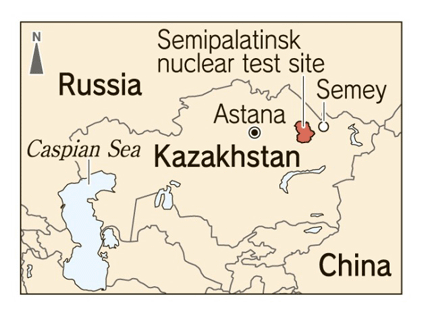
Reuters. By Mariya Gordeyeva, November 30, 2023
- Summary
- Treaty banning nuclear weapons tests was signed in 1996
- President Putin has revoked Russia’s ratification
- Many Soviet-era nuclear tests were conducted in Kazakhstan
- Radiation from the tests affected health of local people
SARYZHAL, Kazakhstan, Nov 30 (Reuters) – As Russia warns of the rising risk of nuclear war, and relations with the United States sink into a deep freeze, communities close to the vast Soviet-era nuclear testing site in northern Kazakhstan have a message for leaders: “Let us be a lesson.”
Hundreds of tests were carried out between 1949 and 1989 on the barren steppe near the city of Semey, formerly known as Semipalatinsk, close to the Kazakh-Russian border. The effect of radiation had a devastating impact on the environment and local people’s health, and continues to affect lives there today………………………..
“Let our suffering be a lesson to others,” said Serikbay Ybyrai, local leader in the village of Saryzhal, who saw tests being carried out some 20 km (12 miles) away when he was a boy. “If this (testing) resumes, humanity will disappear.”
When devices were detonated above ground – until 1963 when tests went underground – authorities would order local people out of homes and schools because of fears that ground tremors might cause buildings to collapse.
“I remember I was about five years old,” said Baglan Gabullin, a resident of Kaynar, another village that lived under the shadow of nuclear testing.
He recalled how adults would instruct him and his friends not to look in the direction of the blast.
“We were small, so on the contrary, out of curiosity we looked. The flash was yellow at first, and then the black mushroom grew,” he said.
Kazakh authorities estimate up to 1.5 million people were exposed to residual radioactive fallout from testing. Over 1 million received certificates confirming their status as victims of tests, making them eligible for an 18,000-tenge ($40) monthly payout.
‘EVERYONE STARTED DYING’
Maira Abenova, an activist from the Semey region who set up a non-governmental organisation protecting the rights of nuclear test victims after losing most family members to diseases she said were related, urged politicians not to allow nuclear escalation.
“As someone living with the consequences of what you could call 40 years of nuclear warfare, I think we can tell the world what we have gone through,” she said.
There is little reliable data on the specific health impact of testing in Kazakhstan.
But scientists say exposure to radioactive material on the ground, inhalation of radioactive particles in the air and ingestion of contaminated food including local livestock contributed to increased cancer risk and cases of congenital malformation.
In Saryzhal, a village of around 2,000 people living in small white-painted homes surrounded by blue wooden fences, Gulsum Mukanova recalls how she and other children would watch above-ground explosions, known as atmospheric tests.
“We were children, everything was interesting to us,” she said. “We would stare at those mushrooms.
“My father died at the age of 58; then my elder brother died, then my sister,” added Mukanova, who is in her mid-60s. “Everyone started dying.”
Gabullin, speaking near a small monument to victims of nuclear tests erected in Kaynar, also said losses were common.
“There were about 300 tractor drivers who worked with me … now only two or three are alive. All died of cancer and leukaemia,” he said. “Even the schoolchildren who worked for me then, now they are 50-53 years old, they are already dying.”……….
While villages such as Kaynar and Saryzhal were exposed to direct radiation, steppe winds carried nuclear fallout across an area the size of Italy.
Much of the territory, pockmarked with lakes resulting from blast craters, is still considered too contaminated to inhabit or cultivate.
CONTAMINATION LASTS FOR GENERATIONS
About 450 tests were carried out there, more than 100 of them atmospheric tests and the rest underground. The latter were used after a 1963 treaty went into force banning nuclear weapons tests in the atmosphere, in space or underwater, and are considered less harmful.
After the Soviet Union collapsed in 1991, Moscow no longer had access to the Kazakh site. Its main equivalent today is in Novaya Zemlya, an active military site on an Arctic archipelago in Russia’s far north.
Nuclear experts said that any testing today would likely be underground, which carries environmental and health risks.
“Underground testing can also have severe consequences,” said Alicia Sanders-Zakre of the International Campaign to Abolish Nuclear Weapons.
“Radioactive particles can vent into the air, and there is also the potential for contamination of groundwater,” she told Reuters, adding that Russia’s position was that it did not intend to test at this time.
“What’s so dangerous about radioactive contamination is that it lasts for generations.”
($1 = 459.0000 tenge)
Additional reporting by Olzhas Auyezov in Almaty and Gloria Dickie in London; Writing by Olzhas Auyezov; Editing by Mike Collett-White and Timothy Heritage https://www.reuters.com/world/asia-pacific/let-us-be-lesson-say-kazakhs-wary-return-nuclear-testing-2023-11-30/
‘The Gospel’: how Israel uses AI to select bombing targets in Gaza
Guardian 1 Dec 23 Harry Davies, Bethan McKernan and Dan Sabbagh in Jerusalem
Concerns over data-driven ‘factory’ that significantly increases the number of targets for strikes in the Palestinian territory.
srael’s military has made no secret of the intensity of its bombardment of the Gaza Strip. In the early days of the offensive, the head of its air force spoke of relentless, “around the clock” airstrikes. His forces, he said, were only striking military targets, but he added: “We are not being surgical.”
There has, however, been relatively little attention paid to the methods used by the Israel Defense Forces (IDF) to select targets in Gaza, and to the role artificial intelligence has played in their bombing campaign.
As Israel resumes its offensive after a seven-day ceasefire, there are mounting concerns about the IDF’s targeting approach in a war against Hamas that, according to the health ministry in Hamas-run Gaza, has so far killed more than 15,000 people in the territory.
The IDF has long burnished its reputation for technical prowess and has previously made bold but unverifiable claims about harnessing new technology. After the 11-day war in Gaza in May 2021, officials said Israel had fought its “first AI war” using machine learning and advanced computing.
The latest Israel-Hamas war has provided an unprecedented opportunity for the IDF to use such tools in a much wider theatre of operations and, in particular, to deploy an AI target-creation platform called “the Gospel”, which has significantly accelerated a lethal production line of targets that officials have compared to a “factory”.
The Guardian can reveal new details about the Gospel and its central role in Israel’s war in Gaza, using interviews with intelligence sources and little-noticed statements made by the IDF and retired officials.
This article also draws on testimonies published by the Israeli-Palestinian publication +972 Magazine and the Hebrew-language outlet Local Call, which have interviewed several current and former sources in Israel’s intelligence community who have knowledge of the Gospel platform.
Their comments offer a glimpse inside a secretive, AI-facilitated military intelligence unit that is playing a significant role in Israel’s response to the Hamas massacre in southern Israel on 7 October.
The slowly emerging picture of how Israel’s military is harnessing AI comes against a backdrop of growing concerns about the risks posed to civilians as advanced militaries around the world expand the use of complex and opaque automated systems on the battlefield.
…………………………………..a short statement on the IDF website claimed it was using an AI-based system called Habsora (the Gospel, in English) in the war against Hamas to “produce targets at a fast pace”.
The IDF said that “through the rapid and automatic extraction of intelligence”, the Gospel produced targeting recommendations for its researchers “with the goal of a complete match between the recommendation of the machine and the identification carried out by a person”…………………………………………………………………………………………………………………………………………………………………..
However, experts in AI and armed conflict who spoke to the Guardian said they were sceptical of assertions that AI-based systems reduced civilian harm by encouraging more accurate targeting.
A lawyer who advises governments on AI and compliance with humanitarian law said there was “little empirical evidence” to support such claims. Others pointed to the visible impact of the bombardment.
“Look at the physical landscape of Gaza,” said Richard Moyes, a researcher who heads Article 36, a group that campaigns to reduce harm from weapons.
“We’re seeing the widespread flattening of an urban area with heavy explosive weapons, so to claim there’s precision and narrowness of force being exerted is not borne out by the facts.”
According to figures released by the IDF in November, during the first 35 days of the war Israel attacked 15,000 targets in Gaza, a figure that is considerably higher than previous military operations in the densely populated coastal territory. By comparison, in the 2014 war, which lasted 51 days, the IDF struck between 5,000 and 6,000 targets.
………………………“We prepare the targets automatically and work according to a checklist,” a source who previously worked in the target division told +972/Local Call. “It really is like a factory. We work quickly and there is no time to delve deep into the target. The view is that we are judged according to how many targets we manage to generate.”
A separate source told the publication the Gospel had allowed the IDF to run a “mass assassination factory” in which the “emphasis is on quantity and not on quality”. A human eye, they said, “will go over the targets before each attack, but it need not spend a lot of time on them”.
For some experts who research AI and international humanitarian law, an acceleration of this kind raises a number of concerns……………………….. more https://www.theguardian.com/world/2023/dec/01/the-gospel-how-israel-uses-ai-to-select-bombing-targets
.
Israel’s Savagery Is So Shocking It’s Sometimes Hard To Take In

CAITLIN JOHNSTONE, NOV 30, 2023,
https://www.caitlinjohnst.one/p/israels-savagery-is-so-shocking-its?utm_source=post-email-title&publication_id=82124&post_id=139284801&utm_campaign=email-post-title&isFreemail=true&r=1ise1&utm_medium=email
Sometimes Israel’s crimes are so horrific that at first you don’t even understand what you’re looking at. You just stare at it trying to make sense of what you’re seeing for a bit, like you would if you suddenly saw a space alien or a leprechaun or something.
It happened to me yesterday when I was watching a Sky News report about a teenage boy who was shot by Israeli forces in Jerusalem for celebrating the release of Palestinian prisoners in the hostage negotiations with Hamas. I was watching it thinking to myself, I must be misunderstanding what I’m looking at. I know that Israel does gross things, but surely the story here isn’t that they shot a kid for being happy about something.
Then, as has happened so many times over the last two months, I kept watching and learned that yes, that is indeed what happened. The deputy mayor of Jerusalem Fleur Hassan-Nahoum is seen defending the shooting by saying “part of the deal is that there would be no celebrations for the release of attempted murderers” (this was actually not a part of the deal, it was just a decree issued by Israel’s national security minister) and claiming dishonestly that “we’re talking about the release of attempted murderers” (the vast majority have not been convicted of any crime and have been denied any due process for the accusations against them).
The band Eve6 nicely summed up what it felt like watching the clip of the deputy mayor’s comments, tweeting, “The remarkable thing about this clip is her self assurance. Like she’s supremely confident that ‘we shot the teenager because he was celebrating’ is a thing that people will find reasonable.”
I had the same experience reading about the five premature babies who were left to die after the IDF raided al-Nasr Pediatric Hospital in Gaza earlier this month, their decomposing bodies only discovered when the temporary ceasefire allowed access to the hospital. It’s just too insane to believe — they attacked a pediatric hospital? And then they left the babies there to die? What??
The only reason we’re learning about this now is because the pause in fighting allowed journalists to get cameras into the building and show the dead infants to the world. This calls to mind the Politico report immediately prior to the ceasefire which said that the White House was worried “an unintended consequence of the pause” would be “that it would allow journalists broader access to Gaza and the opportunity to further illuminate the devastation there and turn public opinion on Israel.”
Indeed, since the pause in fighting began the world has been receiving drone footage from mainstream platforms like Reuters and The Washington Post revealing vast expanses of urban terrain completely destroyed by a blanket of Israeli military explosives spanning from city block to city block. Looking at the blatantly indiscriminate devastation that’s been caused by Israel’s assault on Gaza since October 7 makes it clear that the IDF are not targeting Hamas but Gaza itself………………………….
I cannot imagine what it’s like to be living in the midst of this horror for the last two months, trying to figure out the best way to survive while also grieving the family, friends and neighbors you’re losing along the way. These people have all been deeply traumatized in ways that will haunt them for the rest of their lives, if they survive the violence, disease and deprivation that’s to come.
This thing is so astonishingly ugly, and it could get a whole lot uglier after the ceasefire ends. If there’s anything positive to be found in this living nightmare, it’s that it’s so earth-shakingly ugly that it just might shake the world awake.
A planned US-Israeli attack on Iran is contemplated
Prof Michel Chossudovsky, Global Research, 2023-11-13
The U.S. led War on the People of Palestine and the Middle East is a Criminal Undertaking
Introduction
We stand in Solidarity with Palestine. But we must recognize that the United States Military and Intelligence apparatus is firmly behind Israel’s genocide directed against the People of Palestine.
Andthis must be part of the solidarity campaign, namely to Reveal the Truth regarding Washington’s insidious role, which is part of a carefully planned military agenda directed against Palestine and the broader Middle East. Netanyahu is a proxy, with a criminal record. He has the unbending support of Western Europe’s “Classe politique”…..
Israel and the Zionist lobby in the U.S. are NOT exerting undue influence AGAINST U.S. Foreign Policy as outlined by numerous analysts.
Quite the opposite. The Zionist lobby is firmly aligned with U.S. foreign policy, and Vice Versa. It targets those who are opposed to war, who call for a cease fire. It exerts influence in favour of the conduct of the U.S. military agenda in support of Israel. The US military-intelligence establishment in coordination with powerful financial interests is calling the shots in regards to Israel’s genocidal intent to “Wipe Palestine off the Map”.…………………………….. https://www.globalresearch.ca/planned-us-israeli-attack-on-iran-2/5615443
1 This Month
26 September – International Day for the Total Elimination of Nuclear Weapons





PLEASE OPPOSE HR 8255 AND S.3639 – bills would accelerate satellite deployment, with no environmental review or safeguards – https://ncstd5li.quorum.us/campaign/169331/
To see nuclear-related stories in greater depth and intensity – go to https://nuclearinformation.wordpress.com
-
Archives
- September 2026 (313)
- August 2026 (330)
- July 2026 (355)
- June 2026 (287)
- May 2026 (306)
- April 2026 (356)
- March 2026 (251)
- February 2026 (267)
- January 2026 (308)
- December 2025 (358)
- November 2025 (359)
- October 2025 (375)
-
Categories
- 1
- 1 NUCLEAR ISSUES
- business and costs
- climate change
- culture and arts
- ENERGY
- environment
- health
- history
- indigenous issues
- Legal
- marketing of nuclear
- media
- opposition to nuclear
- PERSONAL STORIES
- politics
- politics international
- Religion and ethics
- safety
- secrets,lies and civil liberties
- spinbuster
- technology
- Uranium
- wastes
- weapons and war
- Women
- 2 WORLD
- ACTION
- AFRICA
- Atrocities
- AUSTRALIA
- Christina's notes
- Christina's themes
- culture and arts
- Events
- Fuk 2022
- Fuk 2023
- Fukushima 2017
- Fukushima 2018
- fukushima 2019
- Fukushima 2020
- Fukushima 2021
- general
- global warming
- Humour (God we need it)
- Nuclear
- RARE EARTHS
- Reference
- resources – print
- Resources -audiovicual
- Weekly Newsletter
- World
- World Nuclear
- YouTube
-
RSS
Entries RSS
Comments RSS

