Rosyth earmarked as temporary repair base for new fleet of UK submarines
Herald, 11th December
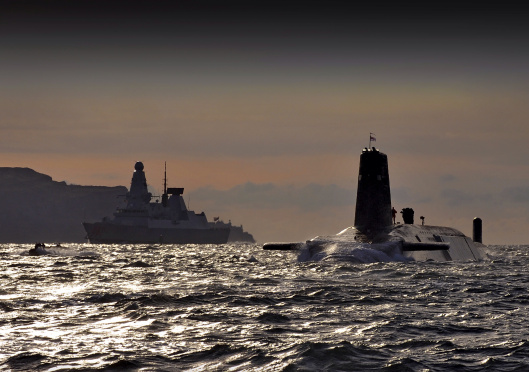
Work is underway to design an emergency planning zone as plans progress for Rosyth to be the temporary repair base for the UK’s new fleet of nuclear deterrent submarines.
Rosyth has been earmarked as a temporary contingent for the UK Government’s Dreadnought class of submarines – the first of which is expected to launch towards the end of the decade.
Members of Fife Council’s South and West Fife area committee were given an update on the proposals at their meeting on Wednesday where it was explained that “non-nuclear” repairs would be carried out from the dockyard when required.
Grant Reekie, head of radioactive waste and health physics at Babcock International in Rosyth, told councillors: “The next generation of submarines is going to be launched from Barrow towards the end of this decade.
“The intention is these will be maintained at the HM Naval base Clyde however the Clyde facilities will not be available until mid 2030s.
“We have been asked to provide a contingent facility by the MoD to bridge a gap of submarines coming into service in late 2020s from 2029 through to mid 2030s when they will no longer be required as it will be done in Faslane.
“Rosyth is the only location in the UK where this can be done due to the facilities, the expertise and the availability of the dock in Rosyth.”……………………..
Mr Reekie said the next step would be defining a “detailed emergency planning zone” which would then be sent to Fife Council.
“As soon as we have done the consequence assessment, which we are looking at the middle of next year, we need to go to the local authority and need to offer engagement to the local authority,” he said………………….
Rosyth councillor Brian Goodall questioned why there was no public consultation.
“For something as significant as this, something that would lead to a significant percentage of the population of Rosyth being told there will be Potassium iodate tablets available in the event of an emergency, why is there no public consultation on this?”………………………….
When probed, Ian Brown, from the MoD, also told councillors that policy would mean there would be no confirmation of if nuclear weapons were on board.
“My position is we do not comment on the condition of the boat whether it is armed or not,” he added.
………………….. Committee convener David Barratt was less pleased with the plans.
“Morally, and as a CND member, I find the existence of nuclear weapons abhorrent,” he said.
“I was going to ask if there is anything in the powers of council to frustrate, delay or in any way stop nuclear weapon activities and I take it from the answers the answer to that is an absolute no.
“Yes this will create jobs but war tends to do that. I don’t think we would advocate for war and job creation doesn’t lead me to advocate for nuclear weapons.” https://www.heraldscotland.com/news/25689769.rosyth-earmarked-temporary-repair-base-new-fleet-submarines/
Israel’s biggest con trick: Hiding the true numbers it has killed in Gaza

10 December 2025, https://www.jonathan-cook.net/blog/2025-12-10/israel-con-numbers-killed-gaza/
Israel has penned us all into a ‘debate’, one entirely divorced from reality, that relates only to those killed directly by its bombs and gunfire – not the genocide it is waging by other means
The biggest con trick Israel has managed to pull off over the past two years is imposing entirely phoney parameters on a “debate” in the West about the credibility of the death toll in Gaza, now officially standing at just over 70,000.
It is not just that we have been endlessly bogged down in rows about whether Gaza’s medical authorities can be trusted, or how many of the dead are Hamas fighters. (Despite Israeli disinformation campaigns, the Israeli military itself believes more than 80 per cent of the dead are civilians.)
Or even that these “debates” always ignore the fact that, early on, Israel wrecked Gaza’s capacity to count its dead by destroying the enclave’s governmental offices and its hospitals. The 70,000 figure is likely to be a drastic under-estimate.
No, the biggest con trick is that Israel has successfully penned us all into a “debate”, one entirely divorced from reality, that relates only to those killed directly by its bombs and gunfire.
The truth is that far, far larger numbers of people in Gaza have been actively killed by Israel not through these direct means but through what statisticians refer to as “indirect” methods.
These people were killed by Israel destroying their homes and leaving them with no shelter. By Israel destroying their water and electricity supplies and their sanitation systems. By Israel levelling their hospitals. By Israel starving them. By Israel creating the perfect conditions for disease to spread. The list of ways Israel is killing people in Gaza goes on and on.
Imagine your own societies levelled in the way Gaza has been.
How long would your elderly parents survive in this hellscape?
How well would your diabetic child fare, or your sister with asthma, or your brother with cancer?
How well would you cope with catching pneumonia, or even a common cold, if you hadn’t had more than one small meal a day for months on end?
How would your wife deal with a difficult childbirth if there were no anaesthetics, or no hospital nearby, or a barely functioning hospital overwhelmed with victims from Israel’s latest bombing run.
And what would be the chances of your baby surviving if its mother could produce no milk from her starvation diet? And if you could not give the baby formula feed because Israel was blocking supplies from entry into the enclave? And if, anyway, the contaminated water supply could not be mixed into the formula powder?
None of these kinds of deaths are included in the figure of 70,000. And all precedents show that many, many times more people are killed through these indirect methods than directly through fatal injuries from bombs and bullets.
According to a letter from experts in this field to the Lancet, studies of other wars – most of them far less destructive than Israel’s on the tiny enclave – indicate that between three and 15 times more people are killed by indirect, rather than direct, methods of warfare.
The authors conservatively estimate an indirect death toll four times greater than the direct death toll. That would mean, at a minimum, 350,000 Palestinians have been killed in Gaza through Israel’s actions.
The reality is likely to be even worse. That is without even mentioning the hundreds of thousands of Palestinians who have been left with horrific injuries and psychological trauma.
Israel’s war planners know exactly how this direct-to-indirect ratio works. Which is why they chose to destroy nearly every home in Gaza, to bomb the power, sanitation and water facilities, to level the hospitals, and to block aid month after month.
They knew this would be the way Israel could carry out a genocide while offering its allies – western governments and its army of lobbyists – a “get out of jail card” for their active complicity.
Donald Trump’s so-called “ceasefire” is just another layer of deception in this endless game of smoke and mirrors. The UN’s child protection agency, Unicef, reports that less than a quarter of aid trucks are getting into Gaza, past Israel’s continuing starvation blockade, despite Israeli commitments agreed as part of the “ceasefire”. Apparently, this doesn’t register as a gross ceasefire violation. It goes unnoticed.
Unicef reports further that in October alone, at the start of the “ceasefire”, nearly 18,000 new mothers and babies had to be hospitalised in Gaza from acute malnutrition.
The genocide isn’t over. Israel may have slowed the rate of direct killings it is committing by bombing Gaza, but the indirect killings continue unabated. And so does the Israeli-engineered “debate” in the West, one designed to obscure and excuse the mass murder of Gaza’s population.
Cashing in on war: Why stealing Russia’s assets actually makes things worse for the EU.
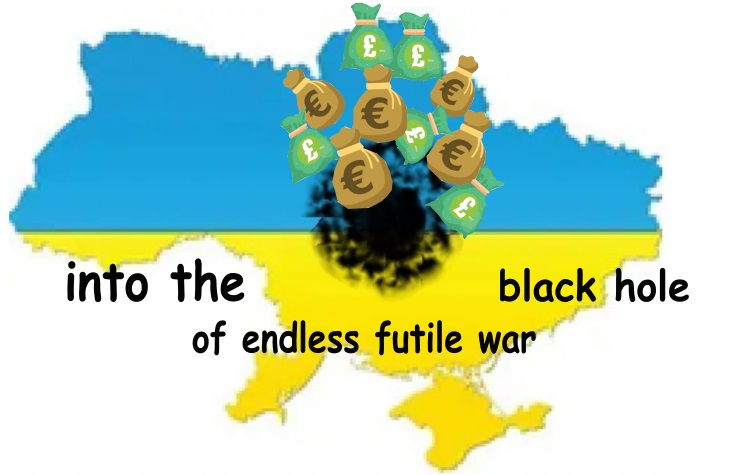
The loan is also, implicitly, seen as an invitation to keep the war going – thus not only keeping the Kiev regime afloat but complicating the prospects for a comprehensive settlement.
03 Dec 2025 , https://www.sott.net/article/503422-Cashing-in-on-war-Why-stealing-Russias-assets-actually-makes-things-worse-for-the-EU
For bloc taxpayers, it could mean Brussels has walked them into a fait accompli where they simply have to stump up for funding a corrupt regime in Kiev.
After a week of humiliation in which her much-touted plot to sequester Russian assets to fund Kiev’s war chest was outright rejected by both Belgium and the European Central Bank, European Commission boss Ursula von der Leyen has told EU member states they have two choices, both of which would send cash to Kiev’s coffers.
According to the embattled EC president, either EU countries will have to borrow cash for Ukraine and make their taxpayers foot the bill, or allow her to push through her – potentially illegal – “reparations plan” and kick the repayment can down the road.
Let’s take a look at what all the talk is about.
Russia’s frozen assets: How much is where?
It is known that Belgium-based clearinghouse Euroclear holds some €180 billion in Russian central-bank funds. Reports that Luxembourg held some €20 billion in Russian assets was denied by the country itself, which claimed it holds “less than €10,000.”
Switzerland, which is in neither the EU nor G7 and thus not subject to von der Leyen’s demands, has declared some 7.45 billion Swiss Francs (€8 billion).Germany has refused to disclose what it holds, citing data protection laws. Japan is thought to hold some €30 billion, while former French Finance Minister Bruno de Maire has spoken about immobilizing some €22.8 billion. The US is believed to hold around $5 billion.
What are the Russian assets frozen in the EU?
The assets mainly consist of European short- and mid-duration bonds that have mostly already come due. When the bonds matured, the principal was paid. Because Euroclear wasn’t prepared to hold that much money itself, the proceeds were invested by Euroclear’s house bank in an account at the European Central Bank. The money is earning interest that legally belongs to Euroclear, although in ordinary circumstances the clearinghouse would send those funds (minus fees) to the client (the Russian central bank).
What is the proposed reparations loan?
The plan entails the EU loaning Ukraine up to €140 billionusing the Russian assets as collateral. Technically, this would involve Euroclear making an interest-free loan of the same value as the Russian assets it holds.
The EU would sign for the cash and give it to Kiev where it would ostensibly be used to fight the war and cover budget expenses, although past experience indicates that much of it could end up in offshore accounts belonging to insiders close to Ukrainian leader Vladimir Zelensky.
The sweetener for Kiev is that Ukraine only has to pay back the EU in the highly unlikely event that Russia loses the war and agrees to pay Ukraine reparations. In that case, Kiev would then have to pass those reparations back to Brussels, which would pay back Euroclear, which, in turn, would be able to honor its liability to the Russian central bank.
Why is Belgium afraid to go through with the scheme?
Continue readingDanger of letting AI into the nuclear weapons chain of command

Peter Kuznick on the new National Security Strategy
ACURA, December 9, 2025
ACURA’s James W. Carden spoke this week with Peter Kuznick, professor of history and director of the award-winning Nuclear Studies Institute at American University.
JC: I’d like to start with your thoughts about the new National Security Strategy (NSS). It seems to me that there was some good stuff and some not-so-good stuff in there. I’m curious to get your overall take and then maybe we can drill down a little bit….
PK: The thing about it is that the Trump administration is quite schizophrenic. They’ve got bonafide neocons and then they’ve got the MAGA base, which wants to not only avoid Forever Wars, but wants to avoid overseas involvements.
It is very concerned about what’s going on in the Caribbean now, and very concerned about Trump’s blind support for Israel……………………………………………………………………………..
the overall picture is that the US is going to maintain its hegemony. What it wants is empire on the cheap. So Trump says, we want the Europeans and the Asians to spend 5% of GDP on their militaries so that the US doesn’t have all that responsibility.
Even though the NSS criticizes NATO and criticizes the Europeans over Ukraine. Trump, I think, sincerely, would like to end the war in Ukraine, not only to get the Nobel Peace Prize that he so covets. But Trump does not deserve the Nobel Peace Prize, no matter what he does in terms of Ukraine or for the other conflicts that he says he settled……………………………………………………………………………………………………………………………………………………………………..
JC: The other parts of the NSS that stuck out at me was the reference to the Golden Dome and the references to AI which were sort of like, this is something that we need to harness and encourage. I look at AI and see something on the order of a nuclear danger. In other words, I think our policy towards AI should be non-proliferation, stop feeding this beast. What do you think?
PK: Yes, I agree that we need strict regulation of AI. If you leave this in the hands of the tech bros and the billionaires, it could be a disaster. I mean, one of the things that I’m glad is that there seems to be some recognition to not let AI into the chain of command when it comes to nuclear command and control. As you know, we’ve averted several World War III scenarios because there were human beings in the chain who intervened to stop launching retaliatory strikes based on faulty radar intelligence. (see, for eg., https://nsarchive.gwu.edu/document/19919-national-security-archive-doc-21-william-odom)
So AI worries me a lot. And the Golden Dome is another loony idea because it’s so much easier to overwhelm these missile defense systems with decoys, you can’t shoot ’em all down. We say it’s hitting a bullet with a bullet, but it’s hitting a bullet and all these decoys too. Also, it is a waste, another waste of more than a couple hundred billion dollars, and then the cost overruns always skyrocket. So it’s a fantasy. It’s an illusion just like it was when Reagan proposed Star Wars, it’s an illusion now…………………………………………………………………………………………………………………………………………………………… https://usrussiaaccord.org/acura-exclusive-peter-kuznick-on-the-new-national-security-strategy/
The War Department Unleashes AI on New GenAI.mil Platform
U.S. Department of War, Dec. 9, 2025
The War Department today announced the launch of Google Cloud’s Gemini for Government as the first of several frontier AI capabilities to be housed on GenAI.mil, the Department’s new bespoke AI platform. This initiative cultivates an “AI-first” workforce, leveraging generative AI capabilities to create a more efficient and battle-ready enterprise. Additional world-class AI models will be available to all civilians, contractors, and military personnel, delivering on the White House’s AI Action Plan announced earlier this year.
This past July, President Donald Trump instituted a mandate to achieve an unprecedented level of AI technological superiority. The War Department is delivering on this mandate, ensuring it is not just ink on paper. In response to this directive, AI capabilities have now reached all desktops in the Pentagon and in American military installations around the world.
The first instance on GenAI.mil, Gemini for Government, empowers intelligent agentic workflows, unleashes experimentation, and ushers in an AI-driven culture change that will dominate the digital battlefield for years to come. Gemini for Government is the embodiment of American AI excellence, placing unmatched analytical and creative power directly into the hands of the world’s most dominant fighting force………………
The launch of GenAI.mil stands as a testament to American ingenuity, driven by the AI Rapid Capabilities Cell within the War Department’s Office of Research & Engineering. Their achievement directly embodies the Department’s core tenets of reviving the warrior ethos, rebuilding American military capabilities, and re-establishing deterrence through technological dominance and uncompromising grit.

“We are pushing all of our chips in on artificial intelligence as a fighting force. The Department is tapping into America’s commercial genius, and we’re embedding generative AI into our daily battle rhythm.” Secretary of War Pete Hegseth remarked
“AI tools present boundless opportunities to increase efficiency, and we are thrilled to witness AI’s future positive impact across the War Department.”………………..https://www.war.gov/News/Releases/Release/Article/4354916/the-war-department-unleashes-ai-on-new-genaimil-platform/
Making Sense of The Après-Ukraine.
What it might mean and what it might not mean.
Aurelien, Dec 11, 2025
“…………………………………………………………………………………………………………………..Because I’m not a military specialist, I’m going to skip over very technical questions, where there is anyway a great deal of disagreement. Moreover, the way in which these questions are posed is often not very helpful, and frequently involves weapons fetishists flourishing performance statistics at each other. In the end, whether the planned FX69 or the planned Su141 is a “better” fighter isn’t really the point, unless you take the overall scenario into account. If dogfights (albeit at very long range) will be a feature of future conflicts, and these planned aircraft are involved, then performance characteristics have their place. But we know, for example, that Russian doctrine for air superiority relies very largely on missiles and, even if the FX69 were in some senses “better” when it arrived in service, it might not get near enough to Russian aircraft for that superiority to be useful. The real lessons of crises and conflicts are always at a more general level.
………………………………. let’s turn to Ukraine, repeating the very important provisos that “lessons” are only of value if we can expect future conflicts with at least some of the same features, and if the “lessons” are likely to be reasonably enduring, given the huge cost and time involved in developing and adapting military equipment.
………………….So far as the first is concerned, we have to remember that Ukraine is a very specific type of conflict.
It’s being fought between two advanced technology nations with indigenous defence industries, whose equipment is similar, and in some cases identical, and largely from the same technological tradition.
It’s being fought between countries with a shared military tradition, and a capacity for large-scale land/air operations, (less influenced by the West in the case of Ukraine than is sometimes thought) and between countries where patriotism and a willingness to fight for one’s country are still political forces.
And finally it’s being fought between the largest country in the world, mainly self-sufficient economically, and with the tacit acquiescence of China, and a smaller country backed financially and militarily by the entire western world.
So obviously the chances of exactly the same situation developing elsewhere are zero. The question, as always, is how far, if at all, the particularities of the Ukraine conflict are applicable to potential conflicts elsewhere.
The first question is obviously whether we are going to see any more heavy-metal conflicts of this kind anywhere the world. There are a number of nuances hidden in that question: the war in Ukraine has gone on as long as it has because the two sides are capable of raising and training large armies (Ukraine with more difficulty, certainly) and supplying and equipping them from stocks and new production (transferred in the case of Ukraine.) This means that very large forces can fight each other continuously for years, and, in the Russian case, more than replace losses of personnel and material.
Now the obvious place for such a future war is Europe against NATO forces, but it’s doubtful whether the scenario is very likely. As I’ll explain in a minute, it’s very hard to imagine NATO forces reconfiguring themselves to absorb the lessons of Ukraine, and in any event it’s not necessary for the Russians to attack NATO nations with ground forces. They can destroy NATO forces from a safe distance with missiles and drones. Moreover, NATO forces are small, and are unlikely to get much bigger, and their stocks of ammunition and logistics will be exhausted in a matter of days. (Unlike Russia, and in spite of planned increases in stocks, NATO nations cannot replace their losses and consumption in real time, as Russia can.) So a direct military clash would be, as they say, nasty brutish and short, even if NATO “learned the lessons” of Ukraine
It’s hard to imagine any wars of similar scale and intensity elsewhere in the world. One possibility is a ground war involving the two Koreas, where the level of technology, even on the Northern side, is generally high, although the terrain is very different. Moreover, whilst border clashes here and there in the world are obviously possible (India and Pakistan or China are illustrative examples) it’s hard to imagine a full-scale war of the type we are now seeing.
……………….. one thing that the Ukraine experience has demonstrated is the importance of these boring, mundane things like logistic support, resupply and sheer numbers of weapons………………………………………………………………………………………………………………………..
It’s worth pointing out that drones did not feature much at the beginning of the conflict, but have now become a significant factor. (This is especially true for Ukraine, which would be in a much worse state without them.)
“drone” (Unmanned Air Vehicle until recently) is a very generic term. It’s clear, for example, that Russian drones that fly beyond Kiev are effectively pilotless aircraft, with significant destructive capability. At the other extreme, footage of a lot of Ukrainian drone attacks shows small, short-range craft dropping grenades onto small groups of soldiers. This leads us to one of the most important conclusions from the war so far: much depends on overall command and control and the ability to use capabilities together, as part of an overall plan.
……………………………………………………….In spite of the current excitement, it seems unlikely that the West will adopt drones in the way that the Russians and Ukrainians have. There are all sorts of reasons for this, but the principal one is that those two countries are fighting a war, and in wartime innovation tends to impose itself as a priority. Both sides, and especially the Russians, were caught unawares by the nature of the war as it developed in 2022, and as a consequence innovation has been very rapid in all areas. There is no chance of this happening in the West: the political urgency is not there.
………………………………….Effectively, either a NATO working group spends ten years trying to develop a concept, by which time the technology will have changed, or dozens of nations just decide to do their own thing……………………
…………………. Drone attacks on tanks are the latest iteration of a struggle between attack and defence which has been going on for fifty years and will no doubt evolve further. Defensive technologies are now being developed which may be able to disrupt and protect against drones to the point where so many would be needed to secure a kill that their use would be uneconomic. It would be unwise to write off the tank yet, and indeed unwise to jump to too many conclusions about drones.
……………………………………………………………………………………….. Finally, the technologies introduced in Ukraine, and those still being developed, will find uses that for the moment no-one can foresee, some good, some bad. (Organised crime may find drone technologies useful for transporting drugs, for example.) https://aurelien2022.substack.com/p/making-sense-of-the-apres-ukraine?utm_source=post-email-title&publication_id=841976&post_id=181176162&utm_campaign=email-post-title&isFreemail=true&r=ln98x&triedRedirect=true&utm_medium=email
U.S. Military Budget Bill Would Ramp Up Israel Aid to Fill In ‘Gaps’ When Other Countries Impose Embargoes Over Genocide.

“this means the US would explicitly use federal law to step in and supply weapons to Israel whenever other countries cut off arms to halt Israel’s ongoing violations across the region.”
The House Armed Services Committee said in September that the measure “combats antisemitism.”
Stephen Prager, Dec 09, 2025, https://www.commondreams.org/news/us-israel-weapons-gap-ndaa
A little-reported provision of the latest military spending bill would direct the US to create a plan to fill the “gaps” for Israel whenever other nations cut off arms shipments in response to its acts of genocide in Gaza.
As Prem Thakker reported Monday for Zeteo, the measure is “buried” more than 1,000 pages into the more than 3,000-page National Defense Authorization Act (NDAA), which is considered by lawmakers to be “must-pass” legislation and contains a record $901 billion in total spending.
Republicans are shepherding the bill through the US House of Representatives, where—as is the case with most NDAAs—it is expected to pass on Wednesday with Democratic support, even as some conservative budget hardliners refuse to back it, primarily over its $400 million in military assistance to Ukraine.
Since the genocide began following Hamas’ attack on October 7, 2023, the US has provided more than $21.7 billion to Israel, including hundreds of millions that have been supplied through NDAAs.
The new NDAA includes at least another $650 million to Israel, an increase of $45 million from the previous one, even though this is the first such bill to be introduced since the “ceasefire” that went into effect in October. This aid from the Pentagon comes on top of the $3.3 billion already provided through the State Department budget.
But this NDAA also contains an unprecedented measure. It calls for the “continual assessment of [the] impact of international state arms embargoes on Israel and actions to address defense capability gaps.”
The NDAA directs Secretary of Defense Pete Hegseth, Secretary of State Marco Rubio, and Director of National Intelligence Tulsi Gabbard to assess “the scope, nature, and impact on Israel’s defense capabilities of current and emerging arms embargoes, sanctions, restrictions, or limitations imposed by foreign countries or by international organizations,” and “the resulting gaps or vulnerabilities in Israel’s security posture.”
As Drop Site News explains, “this means the US would explicitly use federal law to step in and supply weapons to Israel whenever other countries cut off arms to halt Israel’s ongoing violations across the region.”
“The point of this assistance, to be clear, is to make up for any identified insufficiencies Israel may have due to other countries’ embargoing it as a result of its ongoing genocide in Palestine,” Thakker wrote.
A similar provision appeared in a September version of the NDAA, which the House Armed Services Committee praised because it supposedly “combats antisemitism”—explicitly conflating a bias against Jewish people with weapons embargoes that countries have imposed to stop Israel from continuing its routine, documented human rights violations in Gaza.
Among the nations that have cut off weapons sales to Israel are Japan, Canada, France, Italy, and Spain. Meanwhile, other major backers, such as the United Kingdom and Germany, have imposed partial freezes on certain weaponry.
While official estimates from the Gaza Ministry of Health place the number of dead from Israel’s military campaign at over 70,000, with more than 170,000 wounded, an independent assessment last month from the Max Planck Institute for Demographic Research in Germany and the Center for Demographic Studies in Spain found that the death toll “likely exceeds 100,000.” This finding mirrored several other studies that have projected the true death toll to be much higher than what official estimates show.
Embargoes against Israel have been called for by a group of experts mandated by the United Nations Human Rights Council, including Francesca Albanese, the UN Special Rapporteur on the occupied Palestinian territories. Meanwhile, numerous human rights organizations, including the leading Israeli group B’Tselem, have said Israel’s campaign in Gaza has amounted to genocide.
‘Genocide is not an Oakland value:’ inside Oakland’s grassroots campaign to end military shipments to Israel
Oakland International Airport has become a key hub for transporting military cargo to Israel during the Gaza genocide. Now, over 30 groups and thousands of Oakland residents have come together in the Oakland People’s Arms Embargo to stop it.
Mondoweiss, By Joseph Mogul December 8, 2025
Talia Rose starts their shift at Oakland International Airport (OAK) at 3:00 a.m., unloading same-day packages from UPS planes. Across the tarmac, they watch FedEx planes come and go. “I never had any idea what the hell is on those planes besides big metal containers that carry packages,” Rose said.
But that would change in August, when Rose attended a local organizing forum where a member of the Palestinian Youth Movement (PYM) presented a soon-to-be-public report titled “Exposing Oakland’s Military Cargo Shipments to Israel.”
The report—published by PYM, Arab Resource and Organizing Center (AROC), and U.S. Palestinian Community Network (USPCN)—details FedEx’s routine shipments of F-35 Lockheed Martin fighter jet components to Israel’s Nevatim Airbase. The report describes OAK as a “dependable conduit for critical military technologies,” concluding “beyond a reasonable doubt that military cargo being shipped out of OAK has been used by the Israeli Air Force to carry out airstrikes and commit genocide in Gaza.”
Learning about OAK’s role in facilitating genocide disturbed Rose. “After reading the report, knowing there’s a minimum of three [shipments] a week going through the airport that have F-35 parts, it’s a feeling of overwhelming anxiety,” they said. “I’m right there, you know? I’m across a tarmac from it. It feels like I should be able to do something.”
With the launch of the Oakland People’s Arms Embargo campaign, Rose and thousands of Oaklanders would find what they could do.
The campaign was launched shortly before the People’s Conference for Palestine, a weekend-long event aimed at strengthening the movement, where PYM called for a shift towards local arms embargoes. Their theory was that a strong campaign would need the trifecta of a mass local base, organized workers, and progressive elected officials. Oakland has all three.
A central node of the weapons supply chain
Voulette Mansour, a PYM-Bay Area organizer whose grandparents were displaced during the 1948 Nakba, attended the People’s Conference. Behind the scenes, Mansour and PYM had been preparing for the campaign launch for months, eagerly anticipating this moment. “We had been doing a lot of background work on the research and preparing to launch the report,” Mansour said.
Through research infrastructure developed by PYM’s Mask off Maersk campaign—which targeted the largest maritime carrier of U.S. military cargo (including F-35 components) to Israel—PYM uncovered OAK’s role in the F-35 supply chain. “We were shocked that Oakland popped up on the map, not just as a blip, but as a central node,” said Mansour, “When we found this out, we were disgusted that this was happening in our city, but we also saw it as an opportunity.”
The “Exposing Oakland’s Military Cargo Shipments to Israel” report confirmed multiple shipments every week for over a year, making OAK the second most important logistical hub in the U.S. F-35 supply chain to Israel, behind Fort Worth.
The F-35 fighter jet is considered the crown jewel of the Israeli Air Force; Israel has its own modified version, called the F-35I, which is retrofitted specifically for Israeli weapons systems. Each jet costs around $100 million (subsidized by U.S. taxpayers in the form of federal weapons contracts) and can carry up to 18,000 pounds of munitions. Lockheed Martin is the primary manufacturer of the F-35, but over 1,900 contractors are involved in supplying various components, creating a vast and intricate global supply chain that the U.S. Defense Logistics Agency (DLA) is responsible for coordinating. ……………………………………………………………………………………………………………………………………………
That wave is swelling. On November 22, PYM launched a new global campaign, the People’s Embargo for Palestine, by creating an international arms embargo ecosystem through the coordination of research and strategies across local campaigns.
This is the next phase of our struggle,” said Mansour. “We raise the ceiling of our struggle through pushing for an arms embargo.” https://mondoweiss.net/2025/12/genocide-is-not-an-oakland-value-inside-oaklands-grassroots-campaign-to-end-military-shipments-to-israel/
China’s New Underwater Drones Could Blindside the U.S. Navy

1945, By Reuben Johnson, 10 Dec 25
Key Points and Summary – China is quietly opening a new front in undersea warfare. Beijing’s latest AI-enabled underwater drones can execute zero-radius turns, recharge at submerged stations, datalink with each other, and reportedly operate below 90 decibels—making them extremely hard to detect.
-Designed to block shipping lanes, threaten warships, and autonomously target and attack, these systems fit neatly into China’s broader effort to keep U.S. and allied navies away from Taiwan.
China continues to make progress in drone technology—especially in aerial combat designs.
Their vehicles are similar to those being developed in the West, such as Collaborative Combat Aircraft or “loyal wingman” programs.
On Sept. 3, observers in Beijing were able to get a glance at one of China’s latest military innovations—a platform that could cause headaches for the U.S. and its allies.
The new design is for an unmanned underwater drone system controlled by what is described as advanced AI capabilities.
This new technology developed for the People’s Liberation Army Navy (PLAN) could be a disruptive development and a ground-breaking capability in anti-submarine warfare.
The new underwater drones are purportedly capable of zero-radius turns and can operate in almost any maritime environment.
They are also promoted as being difficult to detect by modern sonar and other underwater sensor networks, since any noise they generate during operations is below 90 decibels.
According to a recent report by the South China Morning Post, the PLAN’s newest unmanned systems do not have to operate as solo platforms—they will datalink and coordinate with each other to carry out a host of different missions.
These would include blocking shipping lanes, threatening naval vessels at sea, and launching attacks on seaborne targets.
Detection Impossible
China’s new underwater drone systems are reportedly also capable of long-endurance missions, as they can recharge batteries at underwater stations.
Since they will operate in an almost self-aware mode using AI, they will be able to autonomously identify a target, develop a firing solution, and attack any platform they deem a threat.
The endurance capability, ability to operate without a datalink to an operator, and the extreme ranges at which they will be able to strike would all be new advancements in underwater unmanned vehicles.
However, the real worry for adversaries is these undersea drones’ unprecedented ability to evade detection.
As one recent article points out, “this could disrupt the current global maritime security governance.”….. https://www.19fortyfive.com/2025/12/chinas-new-underwater-drones-could-blindside-the-u-s-navy/
Britain’s nuclear submarine fleet ‘no longer fit for purpose’.
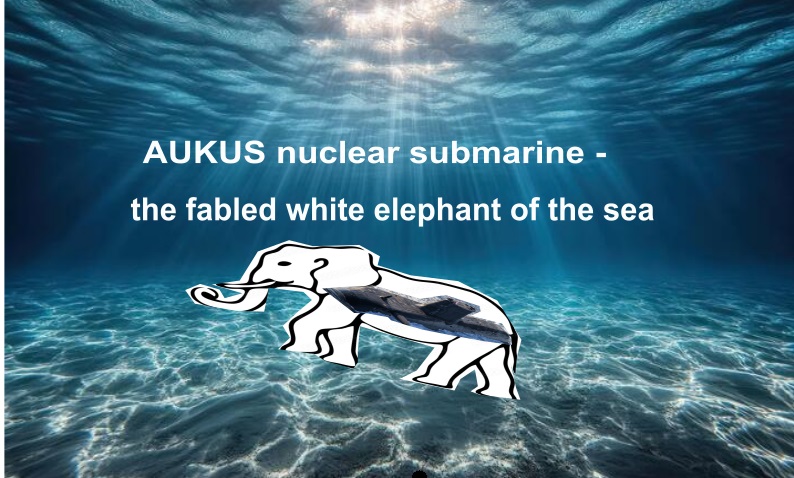
The admiral, who led the Trident value for money review in 2010, called for Britain to pull out of the multi-billion “Aukus” defence deal with America and Australia to build 12 new nuclear submarines.
SSN-Aukus is a submarine which is not going to deliver what the UK or Australia needs in terms of capability or timescale. “Performance across all aspects of the
programme continues to get worse in every dimension.”
Former Navy chief calls for ‘radical’ action to revive programme after catastrophic failures.
Tom Cotterill, Defence Editor, 06 December 2025
Britain is “no longer capable” of running a nuclear submarine programme after “catastrophic” failures pushed it to the brink, a former Navy chief has warned. In an extraordinary critique, Rear Admiral Philip Mathias said the UK’s “silent service” was facing an “unprecedented” situation that it was “highly unlikely” to recover from without a “radical” intervention. The former director of nuclear policy at the Ministry of Defence (MoD) said delays in building new attack boats had reached record levels and had driven up the duration of patrols for crews from 70 days during the Cold War to more than 200 now.
This had led to the “shockingly low availability” of submarines to “counter the Russian threat in the North Atlantic”, the retired submarine commander warned. The admiral, who led the Trident value for money review in 2010, called for Britain to pull out of the multi-billion “Aukus” defence deal with America and Australia to build 12 new nuclear submarines.
“The UK is no longer capable of managing a nuclear submarine
programme,” he said. “Dreadnought is late, Astute class submarine delivery is getting later, there is a massive backlog in Astute class maintenance and refitting, which continues to get worse, and SSN-Aukus is a submarine which is not going to deliver what the UK or Australia needs in terms of capability or timescale. “Performance across all aspects of the
programme continues to get worse in every dimension.”
He added: “This is an unprecedented situation in the nuclear submarine age. It is a catastrophic failure of succession and leadership planning.” The Navy’s fleet of Astute submarines is already facing significant problems, with many having been stuck in port for years. Out of the seven planned, only
six are in service.
He also criticised the role of industry giants for
delays to programmes. He added not a single of the UK’s 23 decommissioned nuclear boats had been dismantled since the first, HMS Dreadnought, left service in 1980. “This is an utter disgrace and brings into question whether Britain is responsible enough to own nuclear submarines,” the admiral said.
Telegraph 6th Dec 2025,
https://www.telegraph.co.uk/news/2025/12/06/britains-nuclear-submarine-fleet-no-longer-fit-for-purpose/
Britain’s “borrowed bombs”

The extreme expense — at least £60 million per plane plus the costs of parts and maintenance — will be a burden on British taxpayers already suffering from cuts to social services.
“reflects a long-standing trend by the UK government to prioritising trans-Atlantic politics over genuine military needs“…………… “an opportunity to appease Trump “
by beyondnuclearinternational, https://beyondnuclearinternational.org/2025/12/07/britains-borrowed-bombs/
New reports shows UK purchase of US nuclear-capable aircraft is political grandstanding with little practical application, writes Linda Pentz Gunter
When the UK government announced its intention last June to purchase 12 F-35A nuclear capable Lightning II Joint Strike Fighter aircraft from the US by 2033 and join NATO’s ‘dual capable aircraft nuclear mission’, it described the decision as the “biggest strengthening of the UK’s nuclear posture in a generation”.
But a new study released on November 11 by two British watchdog groups, Nukewatch UK and Nuclear Information Service, argues that the purchase of the planes will incur massive costs to the British taxpayer while not actually being militarily necessary or advantageous.
The report, “Smoke andMirrors”, concludes that “the government’s decision is based principally on providing political ‘smoke and mirrors’ to distract attention from questions relating to the US-Europe relationship within NATO rather than developing a must-have military capability.”
The purchase of the F35As “serves more as a diplomatic gesture than a military imperative,” the study said, designed to placate US president Donald Trump’s gripes about a perceived lack of financial commitment from NATO partners.
The UK decision to participate in the NATO nuclear sharing mission “is being driven forward by the nuclear lobby within government itself, and raises questions about whether the decision was driven by strategic necessity or political expediency,” the study authors wrote.
The 12 F-35As are far too few to constitute a credible deterrent, according to experts, in large part because the plane’s track record already indicates that all 12 will rarely be in service at the same time.
“On the basis of current performance, at any one time at best only 8 aircraft would be available to take part in a nuclear strike — and possibly even fewer. It is possible that not all of these aircraft would penetrate enemy air defences to reach their targets,” the study said.
The planes are expected to be stationed at RAF Marham in Norfolk. However, as the study noted, this is actually too far away for F35As to reach any meaningful targets inside Russia, for example, as “the maximum distance the aircraft can travel from its base to complete its mission and return without refuelling is 1,000 km,” (about 683 miles).
The F-35A will carry the American B61 nuclear gravity bomb, the only plane in the F-35 class able to do so. The current RAF fleet of F-35Bs and the Eurofighter Typhoon, are not nuclear-capable so the purchase “potentially gives the RAF a nuclear strike capability using this weapon” the Smoke and Mirrors report said.
Further, since the B61 is an American bomb, any deployment will remain under full US control, “rendering the operation entirely dependent on American permission,” the study said.
According to Nukewatch UK, those bombs were already delivered in July to RAF Lakenheath in Suffolk — in reality a US Air Force base despite its name. This would mark the first stationing of US nuclear weapons on UK soil since 2008.
Establishing the programme will also be costly, lengthy and complicated and is unlikely to reach fruition for many years, the study said, due to the many complex steps that will need to be taken before the UK can join the NATO nuclear sharing programme.
The extreme expense — at least £60 million per plane plus the costs of parts and maintenance — will be a burden on British taxpayers already suffering from cuts to social services, the report pointed out. “At a time when public services are struggling to meet demands, there is little public appetite for more military spending,” wrote the report’s authors. “An expensive nuclear weapon system that will not be available for nearly a quarter of a century is a low priority, even on the UK military’s wish list – if, indeed, such a capability is even needed.”
The purchase may also burden the UK military by depriving it of other resources, including the next tranche of F-35Bs. An analysis by Navy Lookout, which delivers independent Royal Navy news and analysis, concluded that a shortfall in F-35Bs could be problematic, “as F-35As cannot operate from carriers and contribute nothing to their strike power,” it said.
The Navy Lookout analysis also argued against using RAF Marham for the planes, given the base “will need expensive refurbishment and regeneration” and recommended Lakenheath instead.
The Smoke and Mirrors study endeavors to extract the reality from the opaque government announcement, made on June 24 on the eve of the NATO Summit at The Hague. After “stripping away all the verbiage,” the study authors concluded that the statement lacked “even basic information such as when the aircraft are intended to be delivered and when their nuclear capability is intended to be operational.”
Even without delays, the report said, “it will be years, rather than months, before they are available for operation.”
The report also points out that the UK’s own 2025 Strategic Defence Review published on June 2, does not include a recommendation to purchase F-35As equipped for US B61 bombs and instead advises a detailed study on such an option. “The fact that it’s not there indicates that we weren’t terribly enthusiastic about it,” the SDR’s lead reviewer, Lord Robertson, a former Defence Secretary and a former Secretary General of NATO, told the report authors.
Despite this, the Starmer cabinet enthusiastically threw its support behind the proposal in what Robertson described as “a decision independent of the Review.” The report authors also point out that “the decision to join the NATO mission appears to have been made before the SDR was even published.”
Continue reading‘A New Form of Genocide’: Gazans Feel Little Relief from Israeli Strangulation Since the Ceasefire.

December 6, 2025 By Tareq S. Hajjaj Republished from Mondoweiss, https://scheerpost.com/2025/12/06/a-new-form-of-genocide-gazans-feel-little-relief-from-israeli-strangulation-since-the-ceasefire/
It’s been nearly two months since the ceasefire was reached in Gaza. Hopes were high among the 2 million Palestinians in the besieged Strip that not only would the Israeli bombings stop, but that everything they had been deprived of for the past two years – food, clean water, adequate medicine and healthcare – would flood into Gaza to ease their struggles. The hopes of regaining a fragment of the life they knew before the war, have dissipated, as the reality of a “new genocide” sets in.
Though some aid has come into Gaza, and people have tried to restore some semblance of normalcy, the reality in Gaza is far from peacetime. Israeli bombs are still falling, people cannot return to their home, and sufficient food aid and medicines are still in short supply.
The strain being felt by Gaza’s institutions, particularly its hospitals, and by ordinary Gazans, remains alarmingly close to wartime conditions. The Government Media Office in Gaza says that the humanitarian situation has not changed during or after the ceasefire, contrary to Israeli claims, and that the siege on Gaza has continued, with border crossings remaining effectively closed. What little goods do enter Gaza, the government says, does not meet “even the minimal needs of the population.”
In the first month of the ceasefire, according to the UN, Israel rejected over 100 requests for the entry of humanitarian aid into Gaza. Today, the World Food Programme says that dietary diversity remains low, and roughly 25 percent of households in Gaza are still reporting eating only one meal daily.
Ismail al-Thawabteh, Director of the Government Media Office in Gaza, says Israel is trying to present a misleading image suggesting it allows the flow of goods. In reality, the amount entering Gaza does not exceed one-third of what was agreed upon in the humanitarian protocol of the ceasefire. “Instead of 600 trucks per day—the minimum needed to meet essential requirements—Israel permits only about 200 trucks, most of which carry limited-value commercial or aid items.”
The UN Office for the Coordination of Humanitarian Affairs (UN OCHA) has reported that agencies are still required to coordinate all entry of humanitarian aid convoys with Israeli authorities. For reference, between the 12th and 18th of November, OCHA said humanitarian organizations coordinated 51 missions with the Israeli authorities. Of those 51 missions, just over half (27) were actually facilitated into Gaza; five were cancelled, 15 were impeded and four were denied.
Palestinians in Gaza tell Mondoweiss that they are feeling “suffocated,” as authorities remain unable to resolve crises such as malnutrition, shortages of food and medicine, or provide even minimal protection against harsh weather conditions.
“This is a new form of genocide,” says Khalil al-Deqran, spokesperson for the Ministry of Health in Gaza. “The policy of refusing to allow in what is necessary for people’s survival mirrors what happened earlier, when food was withheld, and malnutrition was deliberately created.”
The Ministry of Health only receives about 25% of its basic needs, causing the condition of hospitals in Gaza, according to the spokesperson, to be “deplorable and difficult”, especially in winter, when large numbers of patients, particularly children, seek care. He notes that some pediatric wards are operating at five times their bed capacity, as children live in torn tents or on the streets, leading to widespread disease. “With Israel preventing the entry of shelter materials and reconstruction supplies, the health environment becomes even more dangerous, increasing mortality and the spread of illnesses.”
The Ministry of Health said that essential medications for chronic diseases such as hypertension, heart conditions, and diabetes, which affect 350,000 patients in Gaza, are still barred by Israel from entering the Strip. Infant formula also continues to be restricted, allowed only through a few traders and in minimal quantities. Israel also prevents the entry of critical hospital supplies, including electrical generators, lab equipment, imaging devices, incubators, intensive care units, and operating room equipment – all the essential supplies needed by Gaza’s already devastated hospitals to continue functioning. “The situation remains terrible and exceedingly difficult,” the spokesperson says. Israel has not committed to the humanitarian protocol, and what has been allowed in does not amount to a drop in the ocean of the health sector’s needs.”
“There are multiple cases of malnutrition across Gaza due to the lack of infant formula and the blocking of protein-rich foods such as meat, fish, eggs, and dairy. What enters today consists mainly of non-essential food items, which perpetuates malnutrition” the health ministry said.
“The majority of the trucks Israel allows in carry low-nutritional-value items such as processed foods, chocolate, soft drinks, and snacks, as an attempt to evade humanitarian obligations while keeping the population in a state of absolute food deprivation,” al-Thawabteh said.
According to al-Thawabteh, the Gaza Strip requires a consistent flow of essential goods: grains, flour, proteins, livestock, red and white meat, table eggs, nutritional supplements, shelter materials, construction supplies, agricultural inputs, and raw materials for local industries. He stresses that Israel treats these goods as “prohibited or heavily restricted items.”
By his measure, there have been no real improvements on the ground since the ceasefire. Instead, he says Gaza is witnessing a “deliberate engineering of a starvation policy,” in which Israel showcases images of aid trucks to appear compliant, while “in reality blocking essential supplies and rationing aid in ways that worsen the humanitarian crisis.” This behavior, he explains, “confirms that Israel uses the agreement as a political cover to prolong crises, not as a humanitarian or legal commitment toward civilians. The siege continues, restrictions continue, and the humanitarian infrastructure remains under immense pressure.”
‘The war is not over’
Ordinary families in Gaza are feeling the squeeze every day. Niveen al-Sharfa, a mother of five living in a tent in Gaza City, says nothing has changed since the ceasefire. Even when some goods are available in the markets, her family still cannot afford to buy them. “We expected that once the war ended and the ceasefire began, we would see reconstruction, open border crossings, improvements in hospitals, and the entry of winter essentials such as clothing, shelter, and other necessities. But none of this happened. We are still living in torn tents, and still far from our homes.”
Al-Sharfa recalls that during the war she lived in constant fear under bombardment, but says that even now she remains afraid of hearing at any moment that someone has been killed. “Nothing has changed… everything is the same,” she says.
Even those who experienced slight improvements in daily life after the ceasefire find their hopes diminished when looking at the broader picture.
Amer al-Sultan was displaced from his home in the Jabalia Camp in northern Gaza. He says that life has changed “a little” after the ceasefire in terms of the availability of some food— though prices remain high — unlike during the height of the war, when famine pushed people to eat the leaves off of trees. “I expected to return to my home, but unfortunately, I did not. My home lies inside the yellow zone, and this makes me feel every day that the war has not ended.”
“The world thinks the war is over, but as long as there is an army inside the yellow zone, the war is not over. Just last night, we woke up to the sound of bombardment, explosions, and gunfire in those areas. How can we believe the war has ended when we sleep and wake to the sound of bombs?”
Nidaa al-Dahdouh, a mother of two, sees no sign that the war has ended as long as her children are not living normal lives. She wants to see them going to school, instead of waking up in the morning to collect firewood or to stand in long lines for food aid. “When the war ends, I will see my children getting ready in the morning to go to school wearing warm clothes,” she says. “But so far, they are still suffering in tents and the cold that comes with it.”
“We hoped for safety after the war, that we would return to our homes, and feel that the endless killing had stopped. But none of that happened. We hoped that basic goods would return to their normal prices, but that did not happen either. Yes, some items are available—like fish, for example—but the price is extremely high, and I cannot afford it. So for me, it is as if it does not exist at all.”
Tareq S. Hajjaj is the Gaza Correspondent for Mondoweiss and a member of the Palestinian Writers Union. Follow him on Twitter/X at @Tareqshajjaj.
South Korea’s nuclear submarine gamble raises prospect of underwater arms race in Asia.

Reuters, 5 Dec 25
- Summary
- South Korea’s nuclear subs could pressure Japan to develop similar capabilities
- Seoul’s ambitions align with US objectives to counter China’s influence
- North Korea warns Seoul’s plan could trigger “nuclear domino” effect
SEOUL/WASHINGTON/TOKYO, Dec 5 (Reuters) – South Korea’s pursuit of nuclear-powered submarines is gaining traction following President Donald Trump’s endorsement, ending decades of U.S. resistance in a move that could reshape Asia’s security landscape and escalate an underwater arms race.
Seoul has long sought to join the elite group of nations operating nuclear submarines to counter North Korea. Trump’s approval removed a key barrier by granting access to fuel under a nuclear agreement between the countries.
Still, South Korea’s rapidly developing programme could irk China and pressure Japan to develop similar capabilities, analysts and former military officials say.
“Submarines are highly effective attack systems. An arms race in the region is inevitable,” said Choi Il, a retired South Korean Navy submarine captain.
Seoul argues nuclear propulsion is crucial to counter North Korea’s undersea threats, including submarine-launched ballistic missiles. It has repeatedly said it will not acquire nuclear weapons and respects the non-proliferation regime.
South Korean President Lee Jae Myung on Wednesday described the deal as a major achievement from his meeting with Trump and said it would enhance security flexibility and defence autonomy.
North Korea claims to be developing similar capabilities, with state media showing leader Kim Jong Un inspecting what it said was a nuclear-powered submarine in March.
How advanced its programme is remains uncertain, but some analysts suspect Pyongyang is receiving Russian assistance, a possibility that South Korea’s military has said it is closely monitoring. Russia and North Korea have said they are beefing up defence cooperation, but have not provided details on technical cooperation on defence……………………………………………………… https://www.reuters.com/world/china/south-koreas-nuclear-submarine-gamble-raises-prospect-underwater-arms-race-asia-2025-12-05/
Gaza Denied the Right to Heal: Ceasefire Fails, New ‘Green-Zone’ Plan Threatens Modern Ghettos and Collective Imprisonment
December 4, 2025, By: Joshua Scheer, https://scheerpost.com/2025/12/04/gaza-denied-the-right-to-heal-ceasefire-fails-new-green-zone-plan-threatens-modern-ghettos-and-collective-imprisonment/
Anew report from Euro‑Mediterranean Human Rights Monitor warns that a proposed postwar plan for Gaza Strip — backed by United States government and Israeli government officials — could amount to “unlawful collective imprisonment” of Palestinian civilians.
The report finds that “this plan entrenches long-term illegal control and the forcible de facto annexation of territory. It imposes unlawful collective imprisonment on the civilian population, in clear violation of international law and the Palestinian people’s right to self-determination.”
The report adds, “Entry and exit would be permitted only through security screening, effectively converting these sites into overcrowded detention camps that impose severe restrictions on residents’ freedom of movement and daily life.”
Euro-Med, along with anyone with eyes, ears and a heart would think that the proposed design “mirrors the historical model of ghettos,”
What is being reported demonstrates a clearly coercive environment: Palestinians displaced by war would effectively be forced into the “green-zone” communes by the denial of basic services — housing, safety, food, water — unless they relocate.
Even more troubling: once inside, residents reportedly would face severe restrictions on their freedom of movement, daily life, and access to services, raising grave concerns over human rights, forced displacement and long-term structural confinement.
This story demands our attention. After Gaza has been brutally assaulted with genocidal intent, it is now being reshaped in a way that entrenches segregation, displacement and total control. Not much less could be expected from a modern apartheid state that has been allowed to do whatever it has wanted for 77 years.
For more, here is a tweet from Ramy Abdul, Chairman EuroMedHR, detailing their report and a map in which they make it clear: “Gaza’s Yellow Line: Where Genocide is Internationally Acceptable”
The Euro-Med Human Rights Monitor @EuroMedHR has obtained alarming details about a U.S.–Israeli plan—supported by several Western and Arab states and institutions—that aims to turn Gaza into a forced ghetto, a massive detention zone, and a site of land annexation and resource Show more
More on this from The Nation: in an article published two days ago, Gaza writer Hassan Abo Qamar describes the so-called “ceasefire” as changing nothing — Gaza remains a prison, and its people continue to endure unrelenting hardship.
“The world calls this ‘peace,’ yet in reality ‘peace’ here does not mean the end of anything; hunger, fear, and death remain, while the occupation continues to strangle Gaza through crossings, restrictions, and deliberate obstruction of recovery.”
“The truth is simple: Gaza has been denied the right to heal.”
There is no way to end this article or post it without acknowledging what we see every day: Nothing has changed, and the Israelis are still killing. I end with this video for those following today’s events, including Al Jazeera’s reporting on today’s violations of the ceasefire, in which five people — including children — were killed. Once again, the ceasefire has not stopped the ongoing genocide. And now, with this new plan to create modern ghettos, the Israelis are leaning further into the playbook of the Third Reich.
Earth’s Greatest Enemy, the second feature film project by Abby Martin, is a groundbreaking anti-imperialist environmental documentary.
Exempt from international climate agreements and rarely scrutinized in mainstream reporting, the Pentagon is the world’s single largest institutional polluter—spewing carbon, contaminating water, and scarring landscapes across the globe. Combining investigative journalism, striking visuals, and stories from impacted communities, this film challenges audiences to rethink the hidden costs of a global military empire and its planetary consequences. Provocative, urgent, and eye-opening, this is a documentary that will change how you see both the military and environmentalism. https://earthsgreatestenemy.com/
1 This Month

of the week – Shut Down Drone Warfare!


Tell the Ukrainian Government to Drop Prosecution of Peace Activist Yurii Sheliazhenko

Petition to revoke the licensing of the Near Surface Nuclear Disposal Facility (NSDF) at Chalk River. https://www.ourcommons.ca/petitions/en/Petition/Details?Petition=e-7247
To see nuclear-related stories in greater depth and intensity – go to https://nuclearinformation.wordpress.com
-
Archives
- March 2026 (230)
- February 2026 (268)
- January 2026 (308)
- December 2025 (358)
- November 2025 (359)
- October 2025 (376)
- September 2025 (257)
- August 2025 (319)
- July 2025 (230)
- June 2025 (348)
- May 2025 (261)
- April 2025 (305)
-
Categories
- 1
- 1 NUCLEAR ISSUES
- business and costs
- climate change
- culture and arts
- ENERGY
- environment
- health
- history
- indigenous issues
- Legal
- marketing of nuclear
- media
- opposition to nuclear
- PERSONAL STORIES
- politics
- politics international
- Religion and ethics
- safety
- secrets,lies and civil liberties
- spinbuster
- technology
- Uranium
- wastes
- weapons and war
- Women
- 2 WORLD
- ACTION
- AFRICA
- Atrocities
- AUSTRALIA
- Christina's notes
- Christina's themes
- culture and arts
- Events
- Fuk 2022
- Fuk 2023
- Fukushima 2017
- Fukushima 2018
- fukushima 2019
- Fukushima 2020
- Fukushima 2021
- general
- global warming
- Humour (God we need it)
- Nuclear
- RARE EARTHS
- Reference
- resources – print
- Resources -audiovicual
- Weekly Newsletter
- World
- World Nuclear
- YouTube
-
RSS
Entries RSS
Comments RSS
 nuclear-news