US Launches Christmas Strikes on Nigeria—the 9th Country Bombed by Trump
“By framing Nigeria’s conflict as an existential threat to Christians alone, Trump is not shining a spotlight on the victims,” she added. “Instead, he is weaponizing right-wing conspiracy theories to stoke Islamophobia, the same toxic playbook he used to fuel his ban on Muslims, and which left refugee families shattered at America’s borders.”
December 27, 2025 , By Brett Wilkins for Common Dreams
President Donald Trump—the self-described “most anti-war president in history”—has now ordered the bombing of more countries than any president in history as US forces carried out Christmas day strikes on what the White House claimed were Islamic State militants killing Christians in Nigeria.
“Tonight, at my direction as Commander in Chief, the United States launched a powerful and deadly strike against ISIS Terrorist Scum in Northwest Nigeria, who have been targeting and viciously killing, primarily, innocent Christians, at levels not seen for many years, and even Centuries!” Trump said Thursday in a post on his Truth Social network.
“I have previously warned these Terrorists that if they did not stop the slaughtering of Christians, there would be hell to pay, and tonight, there was,” the president continued. “The Department of War executed numerous perfect strikes, as only the United States is capable of doing.”
“Under my leadership, our Country will not allow Radical Islamic Terrorism to prosper,” Trump added. “May God Bless our Military, and MERRY CHRISTMAS to all, including the dead Terrorists, of which there will be many more if their slaughter of Christians continues.”
A US Department of Defense official speaking on condition of anonymity told the Associated Press that the United States worked with Nigeria to conduct the bombing, and that the government of Nigerian President Bola Tinubu—who is a Muslim—approved the attacks.
It was not immediately known how many people were killed or wounded in the strikes, or whether there are any civilian casualties.
The Nigerian Ministry of Foreign Affairs said that “terrorist violence in any form, whether directed at Christians, Muslims, or other communities, remains an affront to Nigeria’s values and to international peace and security.”
The US bombings followed a threat last month by Trump to attack Nigeria with “guns-a-blazing” if the country’s government did not curb attacks on Christians.
Northwestern Nigeria—including Sokoto, Zamfara, Katsina, and parts of Kaduna State—is suffering a complex security crisis, plagued by armed criminal groups, herder-farmer disputes, and Islamist militants including Islamic State West Africa Province (ISWAP/ISIS) and Boko Haram. Both Christians and Muslims have been attacked.
Since emerging in Borno State in 2009, Boko Haram has waged war on the Nigerian state—which it regards as apostate—not against any particular religious group. In fact, the majority of its victims have been Muslims.
“According to the Armed Conflict Location and Event Data Project, more Muslims than Christians have been targeted in recent years,” Chloe Atkinson recently wrote for Common Dreams. “Boko Haram has massacred worshipers in mosques, torched markets in Muslim-majority areas, and threatened their own coreligionists.”
“The crisis in Nigeria is not a holy war against Christianity.”
“It is true that Christian communities in the north-central regions have suffered unimaginable horrors as raids have left villages in ashes, children murdered in their beds, and churches reduced to rubble,” she said. “The April massacre in Zike and the June bloodbath in Yelwata are prime examples of the atrocities taking place in Nigeria.”
“The crisis in Nigeria is not a holy war against Christianity,” Atkinson continued. “Instead, it’s a devastating cocktail of poverty, climate-driven land disputes, and radical ideologies that prey on everyone and not just any distinct group.”
“By framing Nigeria’s conflict as an existential threat to Christians alone, Trump is not shining a spotlight on the victims,” she added. “Instead, he is weaponizing right-wing conspiracy theories to stoke Islamophobia, the same toxic playbook he used to fuel his ban on Muslims, and which left refugee families shattered at America’s borders.”
Former libertarian US Congressman Justin Amash (R-Mich.) noted on X that “there’s no authority for strikes on terrorists in Nigeria or anywhere on Earth,” adding that the 2001 Authorization for Use of Military Force (AUMF)—which was approved by every member of Congress except then-Rep. Barbara Lee (D-Calif.)—“is only for the perpetrators of the 9/11 attacks.”
“The War Powers Resolution doesn’t grant any authority beyond the Constitution,” Amash added. “Offensive military actions need congressional approval. The Framers of the Constitution divided war powers to protect the American people from war-eager executives. Whether the United States should engage in conflicts across the globe is a decision for the people’s representatives in Congress, not the president.”
In addition to Nigeria, Trump—who says he deserves a Nobel Peace Prize—since 2017 has also ordered the bombing of Afghanistan, Iran, Iraq, Libya, Pakistan, Somalia, Syria, and Yemen, as well as boats allegedly transporting drugs in the Caribbean Sea and Pacific Ocean. Trump has also deployed warships and thousands of US troops near Venezuela, which could become the next country attacked by a president who campaigned on a platform of “peace through strength.”
That’s more than the at least five countries attacked during the tenure of former President George W. Bush or the at least seven nations attacked on orders of then-President Barack Obama during the so-called War on Terror, which killed more than 940,000 people—including at least 432,000 civilians, according to the Costs of War Project at Brown University’s Watson Institute for International and Public Affairs.
Trump continued the war on ISIS in Iraq and Syria started by Obama in 2014. Promising to “bomb the shit out of” ISIS fighters and “take out their families,” Trump intensified the US campaign from a war of “attrition” to one of “annihilation,” according to his former defense secretary, Gen. James “Mad Dog” Mattis. Thousand of civilians were killed as cities such as Mosul, Iraq and Raqqa, Syria were flattened.
Trump declared victory over ISIS in 2018—and again the following year.
Some social media users suggested Trump’s “warmongering” is an attempt to distract from the Epstein files scandal and alleged administration cover-up.
“Bombing Nigeria won’t make us forget about the Epstein files,” said one X user.
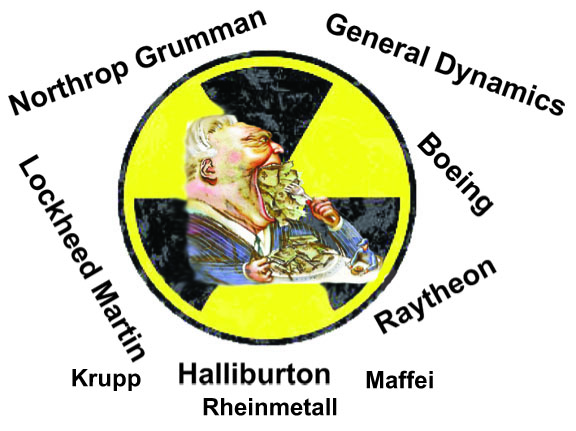
How Corporations View (and Own) the U.S. Military
The most famous example in recent years is the 2023 NDAA, which contained several provisions regarding Taiwan. One provision allowed Taiwan to receive foreign military financing (FMF) from the U.S. government. FMF usually goes to independent countries, not breakaway provinces. FMF consists of loans and/or grants from the U.S. government for a country to purchase goods and services from the U.S. war industry.
And, just like that, the 2023 NDAA increased U.S. belligerence toward Beijing and made war more likely, profiting corporations all the while.
Corporate Capture Is Not Just Lobbying
Christian. Dec 27, 2025, https://thebusinessofwar.substack.com/p/how-corporations-view-and-own-the?utm_source=post-email-title&publication_id=1769284&post_id=179499875&utm_campaign=email-post-title&isFreemail=true&r=ln98x&triedRedirect=true&utm_medium=email
A for-profit corporation is a business organization designed to maximize short-term profit. The job of corporate executives is to maximize that profit, while the board of directors makes sure they do so.
The number one way that a corporation maximizes profit is by underpaying its workers.1 Workers create the profit, but don’t receive it. The executives funnel that profit to investors and themselves.
It goes without saying that the workers are not in charge. They are not allowed to make the business decisions in a given corporation. The executives make those decisions. There is no democracy in the workplace.
This is the situation in any industry, including the war industry.
What You Know about Corporate Capture
Big business works hard to influence the U.S. government. Corporate capture happens when it succeeds. Massive corporations work together to influence the government’s institutions and decision-making so that policy and regulation (or lack thereof) increase corporate profit instead of public well-being.
You likely know about think tanks, lobbying, and legal bribery.
- A think tank issues information favorable to those who fund it. Corporations and the super-rich fund think tanks, which create and inflate threats and justify the broad deployment of U.S. troops and sky-high military and intel budgets.
- Corporations and the super-rich hire lobbyists to swarm U.S. Congress and the Pentagon. Lobbyists even draft legislation, which they hand over to politicians.
- Corporations and the super-rich fund the two political parties and individual candidates. Once in office, elected officials pass laws favorable to these big business interests.
Think tanks, lobbying, and legal bribery are a powerful combination, but corporate capture is much more than that. War corporations (known as “military contractors” or “defense companies”) control the mind and the body in several ways.
Control the Mind
- Corporations regularly open (and close) offices and factories. Corporate executives promise a number jobs at a given location, particularly when seeking state and local tax breaks (though the fine print makes sure they never have to come through with all of those jobs or keep workers employed for the long run). Playing the “jobs” card is a way for big business and its politicians to pretend to care about workers.
- Legally designated as 501(c) nonprofits, trade groups (e.g., NDIA, AIA, AUSA) excel at networking active-duty military officers and industry officials, further blurring the line between government and corporate. Corporate viewpoints reign supreme at networking events, such as seminars, breakfasts, and arms fairs. (Additionally, 501(c)4 nonprofits are skilled at using dark money to influence politics.)
- Corporations help to craft policy and strategy on the inside. Corporations have had a hand in strategic initiatives and planning for Navy leadership, strategic plans and policy support for the Air Force, acquisition policy and program development for the Marine Corps, assessments and policy recommendations for the Deputy Assistant Secretary for Logistics, and more!
- The Pentagon gives corporations free labor from military officers. The corporations are allowed to propagandize these officers with recommendations about military policy, which the officers take with them when they return to their military unit.
- Greedy tycoons, including prominent war profiteers, sit on different boards that advise the Pentagon. The Defense Policy Board is one such grouping.
Control the Body
- The U.S. military doesn’t move, bomb, or communicate without corporations. In fact, it doesn’t do anything without corporate goods and services — from the largest aircraft carrier (itself a platform for innumerable goods and services) to the smallest microchip. Comprising the militant body, corporations gobble up more than half of the military budget. There still are uniformed troops (soldiers, sailors, airmen, Marines, and guardians), but they are merely users of corporate products… in the eyes of top executives.
- Corporate personnel are everywhere. These “contractors” even outnumber the troops in many military locations.
- The U.S. military isn’t allowed to repair most of its own equipment. Corporations must do it. This is just like corporations preventing farmers from repairing their tractors or you from putting a new battery into your old laptop.
- In the same vein, corporations do their best to hog the data pertaining to big-ticket weapons. The most famous example is the Lockheed Martin F-35 jet, the most expensive weapon of all time. The corporation owns the software code and the technical data for the jet. The U.S. military therefore is unable to operate, maintain, or upgrade the jet on its own.
- If you don’t own it, it’s not yours. Many corporations require the U.S. military to license their software, not purchase it outright. Licenses cover everything from accounting software and data integration software to products that monitor communications network and Oracle databases for a massive counterintelligence bureaucracy. Licensing is more profitable than a one-time sale.
- Capitalists move from industry to government and back again. When in government, they implement profit-over-people policies and they acquire knowledge to profit better whenever they leave government. (Top military officers also flock to war corporations in retirement, often becoming executives.)
Corporations don’t just run the show. Corporations are the show.
The Resulting Behavior
This corporate capture — mind and body — guarantees that government policy will help to maximize corporate profit.
The annual military policy bill known as the National Defense Authorization Act (NDAA) is crafted in the environment described above. Corporate lobbyists and U.S. Congress pack the NDAA with section after section designed to increase corporate profit.
Year after year, the NDAA requires the Pentagon to:
1. Train and arm foreign militaries or paramilitary groups. This increases arms sales and can give the Pentagon some influence over those being trained/armed.
A few examples of many include: training Iraqi forces and Kurdish Peshmerga (2024 NDAA); expanding the training of Eastern European “national security forces” (2025 NDAA); and reinforcing Lebanese military training and equipping (2026 NDAA).
2. Maintain or expand the U.S. military’s presence around the world.
The hundreds of U.S. military bases worldwide increase corporate sales — remember, corporations comprise most U.S. military activity2 — and allow the Pentagon to further bully governments/groups that chart an independent foreign policy or resist corporate domination of their land and resources.
No region is off-limits.
For example, the Pacific Deterrence Initiative, established through the 2021 NDAA and enhanced in all subsequent ones, is the main way the Pentagon militarizes the Pacific. It focuses on building up military infrastructure in the Pacific, purchasing and placing weaponry there, expanding military training and exercises there, and fostering and co-opting regional leaders.
3. Spend money on goods and services made by U.S. war corporations.3 For example, section 1640 of the 2024 NDAA required the Pentagon to establish a nuclear sea-launched cruise missile program. (Sections 1513 of the 2025 NDAA and 1633 of the 2026 NDAA refined the program’s goals.) Guess which corporations the military will pay to develop this weapon!
4. Assess what the official enemies are doing in a given region.
- Assess, for example, what Moscow and Beijing are up to in Latin America and the Caribbean (2024 NDAA, section 7342).
- Devise a strategy for “exposing, and, as appropriate, countering” China’s “malign activities” (2025 NDAA, section 1254).
- Evaluate [alleged] fentanyl trafficking by the Chinese government (2026 NDAA, section 8313) and plan to “respond” to China’s “global” military bases (section 8367).
These are just a few examples.
The assessments are then used to create fear and hype up such “threats.” Look out! [Country you’re taught to fear] is doing X, Y, and Z in [region U.S.-based capitalists want to dominate]! Bigger budgets follow. More money for war corporations.
5. Spend tax dollars on researching more technology for war and espionage. For example, the past three NDAAs have mandated research in artificial intelligence, microelectronics, nuclear weaponry, and much more. Industry does the research. And charges a pretty penny for it. (Meanwhile, corporations don’t use much of their own profit for R&D. Profit goes to execs and investors.)
The most famous example in recent years is the 2023 NDAA, which contained several provisions regarding Taiwan. One provision allowed Taiwan to receive foreign military financing (FMF) from the U.S. government. FMF usually goes to independent countries, not breakaway provinces. FMF consists of loans and/or grants from the U.S. government for a country to purchase goods and services from the U.S. war industry.
And, just like that, the 2023 NDAA increased U.S. belligerence toward Beijing and made war more likely, profiting corporations all the while.
Every subsequent NDAA increased the likelihood of all-out war with China. The 2026 NDAA, for example, further weaponized Taiwan by $1 billion, accelerated U.S.-Taiwan drone and counter-drone programs, encouraged the Pentagon to invite Taiwan to the massive annual military exercise known as RIMPAC, and more.
Full-court Press
Corporate capture is thorough.
It is lobbying; funding political parties and campaigns; establishing and funding think tanks; lying about jobs; using trade groups to imbricate military and industry; crafting policy and strategy on the inside; using boards to advise the Pentagon; flooding the military with corporate goods, services, and personnel; hogging data and requiring licensing; occupying the top Pentagon positions; and propagandizing military officers directly.
The troops are users of corporate goods and services.
Military bases are avenues of corporate profit.
That is how big business sees the U.S. military. And it has achieved its vision.
Christian Sorensen is a researcher focused on the U.S.-based corporations profiting from war. A U.S. Air Force veteran, Sorensen is associate director of the Eisenhower Media Network (EMN), a group of military and intel veterans who disagree with U.S. foreign policy and believe a better world is possible.
Europe’s nuclear sites on high alert for drone threats in the year ahead

Western countries scramble to bring in new defences as experts see rise of autonomous threats everywhere
Thomas Harding, December 26, 2025. https://www.thenationalnews.com/news/europe/2025/12/26/europes-nuclear-facilities-put-on-a-2026-drone-alert/
It was a taste of what could become one of the decisive threats next year, when the flight path between Dublin and Britain’s Sellafield nuclear reactor was disrupted by unidentified drones.
On the incoming jet was Ukrainian President Volodymyr Zelenskyy and his wife, minutes away from landing at Dublin Airport, slightly ahead of schedule.
After an Irish naval vessel reported that a number of drones were manoeuvring 36km north-east of the city – Sellafield is just 200km from the capital – Ireland’s Justice Minister Jim O’Callaghan said it was a “co-ordinated threat” to “put pressure” on Europe and Ukraine.
Just days later, the menace shifted. The French Navy opened fire on drones detected over a highly sensitive site housing the country’s fleet of nuclear submarines.
The drones at Ile Longue naval base were ultimately intercepted with jamming systems, but their presence over one of the continent’s most heavily protected sites sent a clear message: Europe is waking up to significant vulnerabilities to its military and civilian nuclear sites, and Russia is widely suspected to be behind the activity.
Nuclear threat
France has19 nuclear power stations, Britain has five − including Sellafield, in Cumbria, north-west England − and many more are spread across the continent. Defence analysts have warned that a hostile state could target a vulnerable power station rather than resorting to the outright belligerence of launching a nuclear weapon.
Causing a nuclear incident with several drone strikes would be difficult, but even a limited attack could cause symbolic and economic damage. Fallout could include enforced shutdowns, mass evacuations and financial market panic, all without a state crossing the nuclear threshold.
“What if Russia just blows up one of the nuclear power plants in the UK using drones that are flown from within the UK?” said Ed Arnold, a senior military analyst at the Royal United Services Institute think tank. “That’s a different vector of threat, but it would achieve the same result from a Russian perspective.”
He added that the sites’ “vulnerabilities are really quite critical, because this is hard to defend against,” and that even just flying drones over sensitive sites “is cheap, deniable and has a high economic impact”.
Ukraine, on one level, is responsible for tactics that were previously the stuff of imagination. Its remarkably successful Operation Spider-Web in June demonstrated the changed boundaries of warfare.
The operation used more than 100 short-range kamikaze drones launched from lorries parked within 10km of several Russian airbases, destroying 11 Russian long-range bombers capable of carrying nuclear weapons.
“Although it was a costly lesson, it likely opened Moscow’s eyes to the opportunities afforded by these capabilities,” wrote Dr Daniel Salisbury in an International Institute for Strategic Studies think tank paper on the growing threat. “Even minimal capability can use emerging technologies to hold nuclear assets at risk,” he added.
A year ago, the idea of a head of state being targeted for assassination by drones seemed like a plot from a Tom Clancy novel. Not any more. Presidential security details now carry drone jammers that resemble oversized guns.
But it is not just the French and Irish incidents that are setting off a wave of concern over Europe. Last month, drones were spotted over Kleine-Brogel Air Base in Belgium on three consecutive nights.
New modes
In the Netherlands, guards fired at drones over Volkel Air Base, which hosts US nuclear weapons under Nato’s nuclear-sharing arrangements. Earlier this month, Dutch F-35 fighter jets were scrambled to intercept a drone.
Similar incidents have been reported around RAF Lakenheath in eastern England, which is likely to soon host US nuclear weapons after a two decade absence.
What is troubling the authorities is that the flights are clustered around high-value nuclear and military sites, with drones larger and more capable than those usually used by hobbyists.
“These are not people flying toys,” said Belgium’s Defence Minister, Theo Francken, after the Kleine-Brogel incursion. “They came to spy, to see where the F-16s are, where the ammunition is and other highly strategic information.” Furthermore, some of the UAVs flew higher and proved resistant to jamming.
This adds to a series of incidents since September in which drones flew over civilian airports across Eastern Europe, as well as Germany and Scandinavia.
The flights, likely conducted by criminal gangs and paid for in cryptocurrency by Moscow, could well be construed as “hostile reconnaissance” to look into sites or indeed test their anti-drone technology for a future conflict.
Drones can also gather real-time imagery that satellites cannot and if one could capture either a French nuclear-armed submarines leaving Ile Longue or a Royal Navy one departing Faslane in Scotland it would give enemies a significant tracking advantage.
Drones everywhere
Hostile states can also use the rapidly expanding civilian drone market to blend into the noise to hide their true intentions. In Britain it is estimated that by 2030 there could be 76,000 commercial drones operating in its airspace, according to The Economist. And across Europe, more than 3,800 close encounters between drones and aircraft were recorded last year − more than double the previous year.
Drones, Mr Arnold argued, are perfectly suited to “grey zone” operations, those activities that fall short of open warfare but inflict disruption and apprehension.
Annabelle Walker, an analyst at the intelligence company Sibylline, also suggested that Russia has a strong interest in probing Nato’s readiness.
“The use of drones has exposed a particular gap in European countries,” she said. “Testing response times, decision-making and co-ordination tells you a lot and it can all be done below the threshold of war.”
Shoot ’em down?
Shooting down drones risks collateral damage. Main defences include jamming or “spoofing”, in which drones are tricked into misidentifying their location. Jamming is less effective against autonomous drones programmed to strike or that are using fibre-optic control − as seen widely in the Ukraine-Russia war.
Defenders can use physical countermeasures such as guns that shoot nets, and shotguns, which are broadly carried in Ukraine. The National understands that Kyiv is set to unveil next year a state-of-the art interceptor drone. The counter-drone industry is now becoming a major market for defence companies.
To defend against a serious attack on a nuclear site, governments must identify vulnerable locations then use a layered defence of radar, electronic warfare and trained personnel dedicated to counter-drone operations, said Douglas Barrie of the IISS.
But air defence was an area where European states had underinvested for decades since the Cold War ended. “Western Europe and the UK really need to pay more attention as this is back on the agenda in a big way,” Mr Barrie told The National.
“Moscow is clearly in the frame, and they’re testing the boundaries of what they can get away with before the other side pushes back,” he added.
Mr Zelenskyy’s near-miss over Dublin was not necessarily an act of war but it was a warning − as were the other incidents − and Moscow may well consider further disruptive operations that avoid open conflict.
It is now a question of whether Europe can strengthen its defences against a threat that will only intensify.
Israeli Occupation Intensifies: Defense Minister Vows Permanent Gaza Presence as Settler Violence Escalates in West Bank.
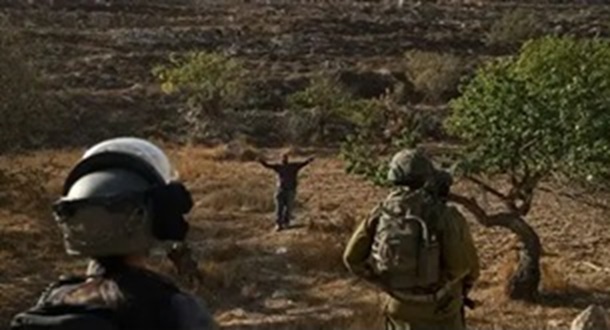
by Dave DeCamp | December 23, 2025 , https://news.antiwar.com/2025/12/23/israeli-defense-minister-vows-permanent-israeli-occupation-of-gaza-establishment-of-settlements/
Israeli Defense Minister Israel Katz vowed on Tuesday that the Israeli military will “never leave all of Gaza” and will eventually establish settlements in the northern part of the Strip.
“We are deep inside Gaza and will never leave all of Gaza – that will not happen. We are here to defend and to prevent what happened,” Katz said during an event in the Israeli-occupied West Bank.
“With God’s help, when the time comes, also in northern Gaza, we will establish Nahal pioneer groups in place of the settlements that were evacuated,” Katz added, referring to an IDF program that establishes communities for Israeli soldiers. “We’ll do it in the right way, at the appropriate time.”
Katz also vowed that Israel would not withdraw “one millimeter” from Syria, referring to the territory it has captured in southwest Syria since the fall of former Syrian President Bashar al-Assad.
After his remarks sparked backlash, Katz appeared to walk back the comments on settlements. “The government has no intention of establishing settlements in the Gaza Strip,” his office said in a statement, though it added that he made the comments in a “security context,” suggesting it wasn’t a complete walk back about what he said about establishing military communities.
An unnamed US official criticized Katz’s comments, saying that he was “provoking” the Arab world. “The more Israel provokes, the less the Arab countries want to work with them,” the US official said in a statement to journalists.
“The United States remains fully committed to President Trump’s 20-Point Peace Plan, which was agreed to by all parties and endorsed by the international community. The plan envisions a phased approach to security, governance, and reconstruction in Gaza. We expect all parties to adhere to the commitments they made under the 20-Point Plan,” the official added.
Katz did not walk back his comments about a permanent Israeli occupation of Gaza, and other Israeli officials have made similar vows. IDF Chief of Staff Lt. Gen. Eyal Zamir said earlier this month that the so-called “yellow line,” the vague boundary separating the Israeli-occupied side of Gaza from the rest of the Strip, is a “new border.”
The IDF currently occupies more than 50% of Gaza, and Palestinians, for the most part, have been cleansed from the area, besides the Israeli-backed anti-Hamas militias and gangs and a small number of civilians living with them. If Israel’s occupation doesn’t end, Israeli settlers will continue to push for the establishment of settlements on the IDF side of the yellow line.
The Nachala movement, a group of settlers pushing for Jewish settlement in Gaza and the complete expulsion of the Palestinian population, welcomed Katz’s initial comments, saying it was a “step in the right direction toward returning Jewish settlement in Gaza.” Settlers with the Nachala movement recently entered Gaza and raised an Israeli flag.
Nachala has strong support among members of the Israeli government and the Knesset. Senior members of the Israeli government have been explicit in their desire for ethnic cleansing in Gaza and the establishment of Jewish settlements. A few days after the Gaza ceasefire deal was signed, which Israel has continued to violate by killing over 400 Palestinians, Israeli Finance Minister Bezalel Smotrich vowed there would be “Jewish settlements in Gaza.”
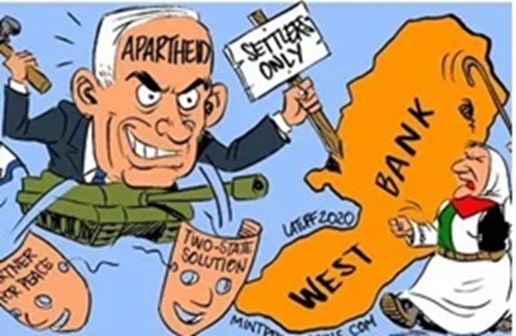
Israeli Cabinet Approves 19 New Apartheid Colonies in Occupied West Bank
“The ONLY reason Israel gets away with this naked thievery is US military and political support,” said one observer.
Brett Wilkins, Dec 21, 2025, https://www.commondreams.org/news/israel-19-new-settlements
Israel’s Cabinet on Sunday finalized approval of 19 new Jewish-only settler colonies in the illegally occupied West Bank, a move the apartheid state’s far-right finance minister said was aimed at thwarting Palestinian statehood.
Cabinet ministers approved the legalization of the previously unauthorized settler outposts throughout the occupied Palestinian territory, bringing the total number of new settlements in recent years to 69.
The move will bring the overall total number of exclusively or overwhelmingly Jewish settlements—which are illegal under international law—to more than 200, up from around 140 just three years ago.
Included in the new approval are two former settlements—Kadim and Ganim—that were evacuated in compliance with the now effectively repealed 2005 Disengagement Law, under which Israel dismantled all of its colonies in the Gaza Strip and four in the West Bank.
“This is righting a historic injustice of expulsion from 20 years ago,” Israeli Finance Minister Bezalel Smotrich—who is a settler—said on Sunday. “We are putting the brakes on the rise of a Palestinian terror state.”
“We will continue to develop, build, and settle the inherited land of our ancestors, with faith in the righteousness of our path,” Smotrich added.
Following an earlier round of approval for the new settlements last week, Palestinian presidential spokesperson Nabil Abu Rudeineh said, “All Israeli settlement activity is illegal and constitutes a violation of international law and international legitimacy resolutions.”
United Nations Secretary-General António Guterres earlier this month denounced Israel’s “relentless” settlement expansion.
Such colonization, said Guterres, “continues to fuel tensions, impede access by Palestinians to their land, and threaten the viability of a fully independent, democratic, contiguous, and sovereign Palestinian state.”
Israeli Prime Minister Benjamin Netanyahu and other Israeli officials—some of whom, including Smotrich, deny the very existence of the Palestinian people—have vowed that such a state will not be established.
While Netanyahu—who is wanted by the International Criminal Court for alleged war crimes and crimes against humanity in Gaza—is under pressure from right-wing and far-right government officials, settlers, and others to annex all of the West Bank, US President Donald Trump recently said that “Israel would lose all of its support from the United States if that happened.”
Some doubted Trump’s threat, with Democracy for the Arab World Now (DAWN) executive director Sarah Leah Whitson reacting to the new settlements’ approval by posting on X that “the ONLY reason Israel gets away with this naked thievery is US military and political support.”
Israel seized and occupied the West Bank including East Jerusalem along with Gaza in 1967, ethnically cleansing around 300,000 Palestinians. Many of these forcibly displaced people were survivors of the Nakba, the Jewish terror and ethnic cleansing campaign that saw more than 750,000 Palestinians flee or be forced from Palestine during the foundation of the modern state of Israel.
Since 1967, Israel has steadily seized more and more Palestinian land in the West Bank while building and expanding colonies there. Settlement population has increased exponentially from around 1,500 colonists in 1970 to roughly 140,000 at the time of the Oslo Accords in 1993—under which Israel agreed to halt new settlement activity—to around 770,000 today.
Settlers often attack Palestinians and their property, including in deadly pogroms, in order to terrorize them into leaving so their land can be stolen. Israeli colonists have also attacked Israel Defense Forces soldiers they view as standing in the way of their expansion.
In July 2024, the International Court of Justice—where Israel is currently facing a genocide case related to the Gaza war—found the occupation of Palestine to be an illegal form of apartheid that must be ended as soon as possible. The ICJ also ruled that Israeli settler colonization of the West Bank amounts to annexation, also a crime under international law. Article 49 of the Fourth Geneva Convention states that an “occupying power shall not deport or transfer parts of its own civilian population into the territory it occupies.”
As the world’s attention focused on Gaza during the past two years, Israeli soldiers and settlers have killed at least 1,039 Palestinians—at least 225 of them children—in the West Bank. This year, at least 233 Palestinians, including at least 52 children, have been killed so far, according to the United Nations Relief and Works Agency for Palestinian Refugees in the Near East.
On Saturday, Israeli occupation forces shot and killed two Palestinians in the northern West Bank, including a 16-year-old boy, Rayan Abu Muallah, who the Israel Defense Forces said was shot after he threw an object at its troops.
Netanyahu plans to brief Trump on possible new Iran strikes

Israeli officials believe Iran is expanding its ballistic missile program. They are preparing to make the case during an upcoming meeting with Trump that it poses a new threat.
Dec. 21, 2025, By Gordon Lubold, Courtney Kube, Dan De Luce and Carol E. Lee
WASHINGTON — Israeli officials have grown increasingly concerned that Iran is expanding production of its ballistic missile program, which was damaged by Israeli military strikes earlier this year, and are preparing to brief President Donald Trump about options for attacking it again, according to a person with direct knowledge of the plans and four former U.S. officials briefed on the plans.
Israeli officials also are concerned that Iran is reconstituting nuclear enrichment sites the U.S. bombed in June, the sources said. But, they added, the officials view Iran’s efforts to rebuild facilities where they produce the ballistic missiles and to repair its crippled air defense systems as more immediate concerns.
Trump and Israeli Prime Minister Benjamin Netanyahu are expected to meet later this month in Florida at the president’s Mar-a-Lago estate. At that meeting, the sources said, Netanyahu is expected to make the case to Trump that Iran’s expansion of its ballistic missile program poses a threat that could necessitate swift action.
They said part of his argument is expected to be that Iran’s actions present perils not only to Israel but also to the broader region, including U.S. interests. The Israeli leader is expected to present Trump with options for the U.S. to join or assist in any new military operations, the sources said.
Asked Thursday about a Dec. 29 meeting with Netanyahu, Trump told reporters, “We haven’t set it up formally, but he’d like to see me.” Israeli officials have announced a Dec. 29 meeting.
The Israeli government declined to comment. The Iranian Mission at the United Nations did not respond to a request for comment…………………..
Israel’s plans to brief Trump on — and give him the option to join — possible additional military strikes in Iran come as the president is considering military strikes in Venezuela, which would open a new warfront for the U.S., and as he is touting his administration’s bombing campaign against Iran’s nuclear program and success negotiating a ceasefire between Israel and Hamas.
In an address to the nation on Wednesday, Trump said told Americans he’s “destroyed the Iran nuclear threat and ended the war in Gaza, bringing for the first time in 3,000 years, peace to the Middle East.”
The Israeli concerns about Iran come as Tehran has expressed interest in resuming diplomatic talks with the U.S. aimed at curtailing its nuclear deal, which could potentially complicate Israel’s approaching Trump about new strikes………………….
The strikes the U.S. conducted in June against Iran, known as Operation Midnight Hammer, included more than 100 aircraft, a submarine and seven B-2 bombers. Trump has said they “obliterated” Iran’s nuclear enrichment sites, though some early assessments indicated the damage may not have been as extensive as the president has said.
Israeli forces at the same time struck several of Iran’s ballistic missile sites.
Israeli military strikes in April and October 2024 also damaged all of Iran’s S-300 air defense systems, the most advanced system the country operates, clearing the way for manned flights into Iranian airspace months later by dramatically reducing the threat to pilots………………………………………………….. https://www.nbcnews.com/politics/white-house/netanyahu-plans-brief-trump-possible-new-iran-strikes-rcna250112
$264million scheme could transform RAF Lakenheath in Suffolk into a nuclear facility
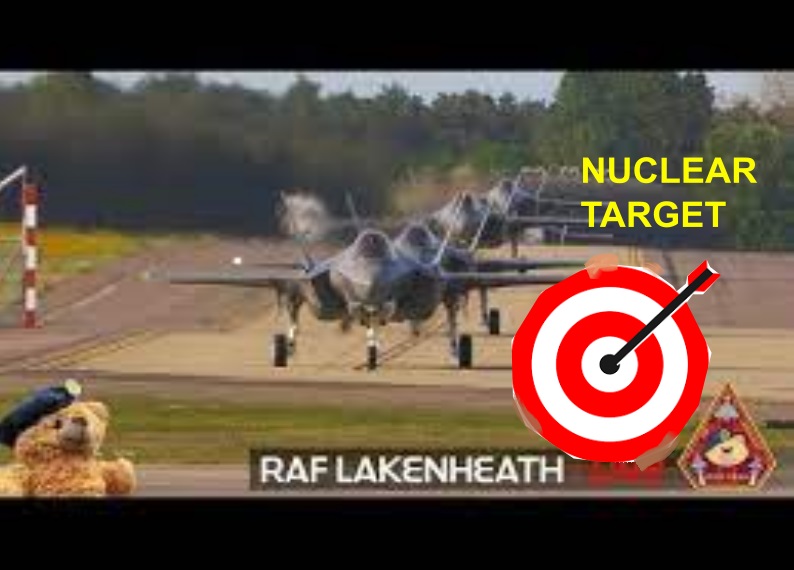
$264million scheme could transform RAF Lakenheath in Suffolk in order for
it to be capable of storing nuclear weapons. Reports claim the US Pentagon
has carried out “detailed assessments” of RAF Lakenheath’s suitability as a
nuclear facility. It follows prolonged speculation the Suffolk air base
already holds specialist weapons.
A plane from the US Air Force’s nuclear
weapon storage facility arrived at RAF Lakenheath in July, fuelling rumours
among experts. The US withdrew its warheads from RAF Lakenheath in 2008.
Eastern Daily Press 23rd Dec 2025 ,By Ben Robinson, West Suffolk & Sudbury Reporter, https://www.edp24.co.uk/news/25721309.264million-scheme-transform-raf-lakenheath-suffolk/
Israel’s growing role in Taiwan’s air defense alarms Beijing.
Israel’s expanding ties with Taiwan, particularly in missile defense, are quietly reshaping regional geopolitics and alarming Beijing. In this context, even small defense transfers could undermine years of careful diplomatic calibration.
Uriel Araujo, BRICS, Monday, December 22, 2025
Uriel Araujo, Anthropology PhD, is a social scientist specializing in ethnic and religious conflicts, with extensive research on geopolitical dynamics and cultural interactions.
Israeli-Taiwanese cooperation, long discreet and underreported, is now moving into far more sensitive terrain. Recent reports indicate that Israeli know-how has been quietly feeding into Taiwan’s emerging missile-defense architecture, the so-called “T-DOME,” a system explicitly inspired by Israel’s Iron Dome. As a matter of fact, this development has already triggered a blunt diplomatic rebuke from Beijing, raising uncomfortable questions about Israel’s long-standing balancing act between rival global powers.
A detailed account of this growing cooperation comes from Nadia Helmy, Visiting Senior Researcher at the Centre for Middle Eastern Studies (CMES), who notes that Chinese intelligence agencies have detected expanding Israeli assistance to Taiwan’s missile shield, particularly in radar integration, command-and-control architecture, and layered interception concepts. According to Helmy, Beijing views this cooperation not as an isolated commercial exchange but as a strategic signal, thereby crossing a political red line.
Taiwan’s T-DOME project is ambitious enough. Taipei plans to spend over USD 40 billion on a multi-layered air and missile defense system combining indigenous technology with foreign expertise, drawing lessons from Israel’s battlefield experience.
What makes the situation more delicate is not simply the technology itself but the political choreography surrounding it. Taiwan’s deputy foreign minister reportedly made a secret trip to Israel in December 2025 to discuss defense cooperation, a visit confirmed by multiple outlets. Israeli lawmakers have also traveled to Taiwan, prompting a formal condemnation from China’s embassy in Israel.
There is a context to such moves. Taiwan’s political discourse has increasingly framed Israel as both a security model and a civilizational reference point. One may recall that Taiwanese officials have even invoked biblical imagery when criticizing authoritarianism, explicitly citing Israel as an example. Meanwhile, pro-Israel lobbying networks linked to AIPAC have been expanding their presence in Taiwan, a fact documented but rarely discussed in mainstream Western media.
Israel, for its part, has historically prided itself on its ability to balance competing global relationships. Thus far, it has managed to maintain workable ties with Russia and Ukraine simultaneously, for instance, while also navigating relations with both the US and China.
Be as it may, Taiwan represents a different category of sensitivity altogether. Unlike commercial technology transfers or infrastructure investments, missile defense cooperation touches the core of China’s security concerns. Suffice to say, Beijing’s reaction has been measured rather than escalatory, but unmistakably firm nonetheless. In any case, from China’s perspective, Israeli involvement in Taiwan’s air defense is not neutral, regardless of how it is framed in Tel Aviv.
Some analysts, such as geopolitical expert Sergio Restelli, have already warned that this (and other developments) could mark the end of Israel’s careful balancing with China.
Others argue that Israel is simply responding to pressure from Washington, especially under the Trump administration, which has doubled down on strategic competition with China while encouraging allies to “choose sides.” I’ve written before about how the Trump administration has been pressuring, “sidelining” and “leveraging” the Jewish State in a number ways, including through its Gaza Plan, apparently as part of an effort to rebalance the complex US-Israeli relationship………………………………….. https://infobrics.org/en/post/74234
Budour Hassan Sounds Alarm as Israeli Settlements Expand, Deepening Apartheid and Threatening Palestinian Statehood
December 23, 2025 , Joshua Scheer, https://www.youtube.com/watch?v=e1CvbfpeSVg
srael’s far-right government has recently approved the construction of 19 new settlements in the occupied West Bank. These settlements are considered illegal under international law, as the West Bank is recognized as occupied territory and the expansion of settlements undermines Palestinian rights.
Amnesty International researcher Budour Hassan describes this policy as reinforcing an “apartheid system” in the West Bank, meaning a system of segregation and discrimination that favors Israeli settlers over the Palestinian population.
Experts warn that continuing to build settlements makes it increasingly difficult to establish a viable Palestinian state, further entrenching the Israeli occupation and threatening any future peace agreements.
In short, the move intensifies the occupation, worsens inequality, and complicates prospects for Palestinian self-determination.
For more on Budour Hassan’s work: Budour Hassan, a Palestinian feminist, international lawyer, and human rights researcher at Amnesty International, played a central role in the landmark December 2024 report that concluded Israel is committing genocide against Palestinians in Gaza—the first such finding by an international human rights organization.
Hassan’s journey is deeply personal. Once a blind 19-year-old law student navigating the streets of Jerusalem, she defied her family’s expectations to become a leading voice for justice. Today, she delivers a powerful call to action: “Solidarity is naming the perpetrator, rejecting silence, refusing the passive voice… Solidarity is not just a word; it’s an action repeated over and over.”
Here Hassan offers a powerful reflection in her essay, “’A Fear of Negation’: Reading Edward Said in the Time of Genocide,” examining Said’s ability to remain critically engaged—with Arab and Palestinian leadership, societal challenges, and his own role as narrator—while honoring the full complexity of Palestinian life.
Hassan writes, “Even though it was under a blockade, Gaza was a living reenactment of what Edward Said would describe as the drama of Palestinian existence.” Drawing on Said’s insight, she highlights how grief can be transformed into a political tool, allowing us to honor not only Gaza’s martyrs but the city itself, with all its beauty and contradictions.
“This is the strength of Edward Said’s writing: that he was able to see the full spectrum of Palestinian humanity.”
Budour Hassan is a vital voice for the world—an indispensable voice on the global stage whose insights and advocacy resonate far beyond her community. She is a critical voice the world needs to hear, calling attention to human rights, justice, and the urgent struggles facing Palestinians today.
“Make Iran like Gaza”: Chilling insider view from Israel weapons expo
by Michael West and Stephanie Tran | Dec 23, 2025 , https://michaelwest.com.au/make-iran-like-gaza-chilling-insider-view-from-israel-weapons-expo/
How to make ‘Iran like Gaza’ and describing the genocide in Palestine as a weapons testing laboratory. Michael West and Stephanie Tran with the inside story of a weapons expo.
Inside a conference hall at Tel Aviv University, executives, generals and venture capitalists took turns boasting about “combat-proven” Israeli weapons and surveillance systems.
At Defense Tech Week 2025, senior figures from Israel’s defence establishment openly described how the genocide in Gaza has accelerated weapons development, unlocked new export markets and reshaped Israel’s global identity as a defence powerhouse.
Less than 70 kilometres from where the conference was held, Gaza has been reduced to rubble. More than two years of genocide, indiscriminate bombardment and mass displacement have left at least 70,000 Palestinians dead and 90% of the Strip destroyed.
Gaza weapons lab
Defense Tech Week advertises itself as a forum connecting startups, investors, defence primes and policymakers. According to its organisers, the event showcases “practical lessons from Israel’s cutting-edge solutions that are addressing global security challenges”.
MWM has obtained the footage with Drop Site News in the US.
The speakers resembled a roll call of Israel’s military-industrial complex with senior Israeli military leadership, officials from the Ministry of Defense, and executives from Israel’s largest arms manufacturers, including Israel Aerospace Industries, Elbit Systems and Rafael Advanced Defense Systems.
Speaker after speaker framed the war as a lucrative opportunity for weapons development and sales.
“These are not lab projects or PowerPoint concepts,” said Amir Baram, Director General of Israel’s Ministry of Defense.
“They are combat-proven systems.”
Gili Drob-Heistein, Executive Director at the Blavatnik ICRC and Yuval Ne’eman Workshop for Science, Technology and Security, described defence technology as Israel’s “next big economic engine”.
Israel is known for being the startup nation,” she said. “We all believe that defence tech has the potential to become the next big economic engine for Israel.”
She credited what she called Israel’s “technological leadership” and “out of the box thinking” for results “we’ve seen recently on the battlefield.”
For Boaz Levy, President and CEO of Israel Aerospace Industries, the war has presented an opportunity to showcase the company’s wares with IAI’s weapons being deployed in Gaza, Iran and Yemen.
“The war that we faced in the last two years enabled most of our products to become valid for the rest of the world,” he said.
“Starting with Gaza and moving on to Iran and to Yemen, I would say that many, many products of IAI were there.”
Real-time combat data
Elbit Systems CTO Yehoshua (Shuki) Yehuda spoke about deploying autonomous systems and mass data collection in real-time combat. He showed a video demonstrating how an AI-powered system developed by Elbit is used to select and track targets “less than a pixel.”
“All of it is done by collecting the data,” he said, describing the ability to track “small targets in a very tough background… less than a pixel.”
He explained that these systems were developed in collaboration with the IDF and refined through continuous data collection during military operations.
Profiting from genocide
The speakers were candid about the scale of the financial opportunity presented by genocide.
According to Amir Baram, more than 300 startups are now working with Israel’s military research directorate, MAFAT, with 130 joining during the current war alone. In 2024, he said, the ministry invested 1.2 billion shekels in defence startups.
Baram oriented Israel’s surge within the global boom in defence spending.
“Global defence spending reached $2.7 trillion in 2024,” he said, pointing to the increase in expenditure from NATO countries and US defence spending exceeding $1 trillion.
“By partnering with Israel, you gain access to our advanced technologies as well as the valuable insights and experience that make our system truly effective. The world has chosen to partner with Israel because trust in defence must be built on credibility, performance, and shared strategic purposes.”
In 2024 alone, Baram said, Israel signed 21 government-to-government defence agreements worth billions, positioning Tel Aviv as the world’s third largest defence tech hub.
At Israel Aerospace Industries, Levy said 80% of the company’s activity is export-oriented.
“IAI as of now has $27 billion of new orders,” he said, with annual sales of around $7 billion.
Elbit Systems reported $8 billion in annual revenue and a $25 billion backlog, with more than 20,000 employees worldwide.
‘Make Iran like Gaza’
The speakers were explicit about how techniques developed and used in Gaza could be deployed in future conflicts.
Dr Daniel Gold, head of Israel’s Directorate of Defense Research and Development, described scenarios in which Israel would replicate Gaza style control in Iran.
“Once we have operational freedom in the air,” he said, “we inject inside… our UAV fleet controlling Tehran and controlling Iran – which means we make Iran like Gaza.”
Gold highlighted the practicality of “dual use” technology which have both civilian and military applications.
“A swarm of drones that control the traffic in Tel Aviv can be the same swarm of drones that control in Gaza,” he said.
During his presentation, video footage was shown of a semi-autonomous drone targeting an individual inside an apartment building, imagery that bears striking resemblance to documented Israeli strikes that have killed civilians in residential homes, including the attack that killed Dr Marwan al-Sultan and his family.
“It is very simple to operate,” Gold explained. “Semi-autonomous.”
Mounting pressure
In her report on the “Economy of Genocide”, UN Special Rapporteur for Palestine, Francesca Albanese stated that “for Israeli companies such as Elbit Systems and Israel Aerospace Industries, the ongoing genocide has been a profitable venture.”
the report found.
Two years into Israel’s livestreamed genocide in Gaza, execs appear to be acutely aware of the mounting international pressure.
Shlomo Toaff, an executive at RAFAEL Advanced Defense Systems, lamented that “Israel is experiencing a boycott.”
“I think Israel is experiencing a boycott,” he said, citing the company’s exclusion from the Paris Air Show last year. “This is something that we have to take into account when we’re talking about what we’re doing here in the industry.”
Trump Announces Nuclear-Armed Battleships for the U.S. Navy.

The ships, named after President Donald Trump as the Trump-class…….
23/12/2025, By Carter Johnston, https://www.navalnews.com/naval-news/2025/12/trump-announces-nuclear-armed-battleships-for-the-u-s-navy/
The U.S. Navy will take delivery of new-build battleships, the largest in modern existence, in an announcement from President Trump in Florida.
U.S. President Donald Trump, Secretary of Defense Pete Hegseth, Secretary of State Marco Rubio, and Secretary of the Navy John Phelan, were all in attendance for the President’s announcement declaring a new class of battleships under the ‘Golden Fleet’ initiative, an effort designed to restore American shipbuilding. All four gave remarks during the announcement emphasizing the need for the new battleship class.
The ships, named after President Donald Trump as the Trump-class, will be 30-40,000 ton warships surpassing the largest surface combatants in service today, including the largest existing Russian Navy Kirov-class nuclear-powered battlecruiser. A rendering of the lead ship, the USS Defiant, features large SPY-6 radar arrays, lasers firing at targets out of view, and at least 100 VLS cells, all equipped on a historically large hull.
“We’re desperately in need of ships, and I have approved a plan for the Navy to begin construction of two large battleships. We used to build the Iowa, the Missouri, the Alabama. These will be 100 times the force and power. Each one of these will be the largest battleships built in the history of our country.” U.S. President Donald Trump during the USS Defiant announcement
Trump-class Battleships / USS Defiant Design
Renderings show USS Defiant built with an integrated superstructure and several remote weapon systems, as well as an unidentified gun system similar in appearance to the Zumwalt-class 155mm Advanced Gun System (AGS). The gun appears to be a railgun, which President Trump confirmed would be equipped on the ships.
At least four Block III SEWIP electronic attack systems, all integrated into the superstructure, are visible, providing electronic attack and deception against incoming missiles. In higher resolution renderings provided to Naval News by the U.S. Navy, two 21-cell Rolling Airframe Missile launchers are visible amidships on the port and starboard side, with a VLS bank in the center barely visible.
The three vertical launch cell banks will be capable of firing a mix of standard Mark 41 VLS missiles, including Tomahawks and Standard Missiles shown in renderings, with a single larger bank farthest towards the bow capable of firing Conventional Prompt Strike (CPS) hypersonic missiles currently being fitted to the Zumwalt-class ships at Huntington Ingalls Industries Pascagoula.
“The [design] started with me in my first term. These will be 100 times more powerful than any battleship ever built before.” U.S. President Donald Trump during the USS Defiant announcement
The renderings show two Mark 45 5-inch cannons towards the bow on the starboard and port side, with a large number of VLS cells behind the guns. Forward are larger VLS cells, similar to what is seen on the Zumwalt-class to fire CPS missiles. The cells could also be similar to Lockheed Martin’s Growth VLS (G-VLS), a larger size VLS cell for future growth and multi-pack potential for existing missiles.
Ahead of the larger diameter hypersonic VLS bank, which is shown launching a hypersonic missile, is an unidentified gun closely resembling a railgun. General Atomics recently pitched railguns for air and missile defense, highlighting design advancements that solve the previous barrel wear concerns. President Trump confirmed the ship will be armed with railguns during his statement.
President Trump also confirmed the ships will be armed with the Sea-Launched Cruise Missile – Nuclear (SLCM-N) nuclear-tipped cruise missile being developed for the fleet, adding a new element of the nuclear triad to the surface force.
President Trump and Secretary of the Navy Phelan declared the class as future flagships of the U.S. Navy serving as fleet command platforms for admirals.
The “President of Peace” Prepares for War

After all, this is the same president who has decimated the U.S. diplomatic corps and dismantled Washington’s main economic and humanitarian aid organization, the U.S. Agency for International Development — hardly the actions of a president of global peace.
Republican calls for a full-scale war against that nation [Venezuela] are occurring despite the disastrous results of this country’s regime-change policies in Afghanistan, Iraq, Libya, and beyond in this century.
The Donroe Doctrine Hits Home
By William D. Hartung, Tomgram, December 21, 2025 https://tomdispatch.com/the-president-of-peace-prepares-for-war/
William D. Hartung, Talking Diplomacy, Promoting Conflict
Only recently, the Trump administration released its 2025 National Security Strategy (NSS), its look at global “security” at this very moment. As it happens, that document’s view of our planet right now was missing just a few passing things, globally speaking. Two of them happened to be Russia and China. Russia is only mentioned in a few paragraphs and the significance of China is distinctly downplayed. And of course, potentially the greatest ultimate danger to global security, climate change, is mentioned but once in this single sentence: “We reject the disastrous ‘climate change’ and ‘Net Zero’ ideologies that have so greatly harmed Europe, threaten the United States, and subsidize our adversaries.” Of course, no one should be surprised by that, not during the presidency of the man who has called climate change “the greatest con job ever perpetrated on the world.”
But it does turn out that there are a few things on this planet to fear, as that document makes clear. One of them is “civilizational erasure,” something that, if the far-right parties on the European continent don’t soon win the necessary elections, will surely be the fate of… yes, believe it or not, Europe — and the European Union, in particular. That continent, given immigration and other issues, could become “unrecognizable in 20 years or less,” or so the NSS claims.
And that’s just to begin a journey into the distinctly strange and unnerving national security (or do I mean national insecurity?) world of Donald Trump that TomDispatch regular William Hartung, co-author of The Trillion Dollar War Machine, lays out in vivid detail today. Perhaps, in future National Security Strategy documents, President Donald Trump himself will indeed be found responsible for nothing less than “civilizational erasure.”
Earlier this month, the Trump administration released its new National Security Strategy, or NSS. Normally, such documents are poor predictors of what’s likely to happen in the real world. They are more like branding tools that communicate the attitudes of a given administration while rarely offering a detailed or accurate picture of its likely policies.
The reason documents like the NSS are of limited import is simple enough: foreign and military policies aren’t set by documents but by power and ideology. Typically enough, the current U.S. approach to the world flows from struggles among representatives of contending interest groups, some of which, like the military-industrial complex (MIC), have a significant advantage in the fight. The weapons industry and its allies in the Pentagon and Congress wield a wide array of tools of influence, including tens of millions of dollars in campaign contributions, more than 1,000 lobbyists, and jobs tied to military-related facilities in the states and districts of key members of Congress. The MIC — which my colleague Ben Freeman and I refer to in our new book as the trillion-dollar war machine — also has considerable influence over the institutions that shape our view of the world, from the media to DC think tanks, Hollywood, the gaming industry, and our universities.
But the power and influence of the war machine are not going completely unchallenged. The grip of militarism and the institutions that profit from it are indeed being challenged by organizations like The Poor People’s Campaign: A Call for Moral Revival; Dissenters, a youth antimilitarism group based in Chicago; antiwar veterans organizations like About Face, Common Defense, and Veterans for Peace; longstanding peace groups like the Friends Committee on National Legislation and Peace Action; networks like People Over Pentagon and Dismantle the Military-Industrial Complex; the ceasefire and Palestinian rights movements on U.S. campuses and beyond; and groups working for racial and economic justice, gay and trans rights, immigration reform, the demilitarization of the police, or compensation for environmental damage caused by nuclear weapons testing and other military activities.
As such organizations coalesce, bringing together tens of millions of us whose lives and prospects are impacted by this country’s ever-growing war machine, let’s hope it might be possible to create the power needed to build a better, more tolerant, and more peaceful world, one that meets the needs of the majority of its people, rather than endlessly squandering precious resources on war and preparations for more of it.
So why pay attention to that new strategy document if what really determines our safety and security lies elsewhere? There are several reasons to do so.
First, the NSS has prompted discussion in the mainstream media and elite circles of what U.S. priorities in the world should actually be — and such a discussion needs to be expanded to include the perspectives of people and organizations actually suffering the consequences of our militarized domestic and foreign policies.
Second, that strategy paper reflects the unnerving intentions and worldview of the current administration, which, of course, has the power to determine whether this country is at war or peace.
Finally, it suggests just how the Trump administration would like to be perceived. As such, it should be considered a weapon in the debate over what kind of country the United States should be.
Touting the “President of Peace”
From the start, the submission letter that accompanies the new strategy document is pure Donald Trump. In case you hadn’t noticed, the current occupant of the Oval Office would have us believe that everything — every single thing! — he does is bigger, better, and more beautiful than anything that ever came before it. And that’s definitely the case, in the first year of his second term, when it comes to his view of what this country’s national security policies should actually be. As the letter puts it:
Continue readingFrance is to build a nuclear-powered aircraft carrier that will be the largest warship in Europe.
The carrier will be smaller only than the US
supercarriers and is intended to bolster France’s air power on the
oceans, President Macron has announced. The new ship, which has been under
consideration since Macron backed the project in 2018, is set to replace
the Charles de Gaulle, France’s naval flagship, which has been in service
since 2001. The new ship will be the only nuclear-powered carrier with
catapult launching apart from the ones in the US navy. It will displace up
to 80,000 tonnes, nearly double that of the Charles de Gaulle.
Times 21st Dec 2025, https://www.thetimes.com/world/europe/article/macron-aircraft-carrier-france-8p0qns8bj
Revealed: Trump’s secret $264 million plot to put nuclear doomsday weapons in Britain to face down Putin
Daily Mail, By NICK ALLEN, US NEWS EDITOR (POLITICS), 22 December 2025
The true scale of President Donald Trump‘s ambitions to turn the U.K. into a potential nuclear launchpad has been revealed.
A massive $264 million plan to overhaul a Royal Air Force base in the English countryside includes knocking down at least half a dozen existing buildings, setting up secure intelligence facilities, protecting the surrounding area against enemy electronic pulse attacks, and sending over 200 American personnel, according to Pentagon funding proposals.
It represents confirmation that American nuclear weapons will return to Britain for the first time since President Barack Obama withdrew them 17 years ago.
However, despite widespread speculation that U.S. nuclear weapons have already arrived in the U.K, the documents indicate it will not happen for several years.
The idea that they had already been sent gained steam on July 17 when a massive U.S. Air Force C-17 Globemaster III arrived at RAF Lakenheath in Suffolk.
The aircraft had been tracked by flight data sites traveling 10 hours from Kirtland Air Force base in New Mexico, where America stores its nuclear arsenal.
Experts speculated that it may have been carrying B61-12 nuclear gravity bombs, each with a potential power bigger than the weapon dropped on Hiroshima in 1945.
Lakenheath is home to the U.S Air Force’s 48th Fighter Wing, known as Liberty Wing, which flies F-35A aircraft capable of being fitted with B61-12s.
However, detailed Pentagon assessments of Lakenheath’s suitability as a nuclear base, reviewed by the Daily Mail, make clear that it is far from ready.
Bizarrely, one of the reasons given was that some of those involved in the U.S. nuclear operation would not have quick access to a toilet during an Armageddon-style scenario.
The existing building that would be used as the primary command post is in ‘adequate condition but beyond its useful life,’ the documents said.
It said controllers within the ‘Emergency Action Cell’ would ‘not have direct, restricted access to a restroom’ in the current facility.
In addition, ‘cooling and air filtration’ was not good enough to support a SCIF – a Sensitive Compartmented Information Facility – which is a high-security room used by the U.S. government and military to discuss extremely sensitive classified intelligence.
The Lakenheath operation is described as a ‘Surety’ mission, which is a term the Pentagon uses when discussing the security and safety of nuclear weapons and associated facilities.
The Air Force’s budget estimates for the 2026 financial year suggests $104 million will be needed for a ‘Surety command post.’
It would house facilities including a control center for Air Force Nuclear Command, Control and Communications……………………………………………………………………………………………
The U.S., rather than NATO, is expected to pay for developments at Lakenheath because it is ‘necessary to complete the project in the timeframe required by United States military commanders.’
Construction of the command post is expected to start in August 2027 and be completed by July 2031.
A separate operations compound is priced at $149 million and will involve demolishing half a dozen existing buildings and creating an armory with massively thick concrete walls, and possible storage for anti-tank weapons.
‘This project is required to provide enhanced security capabilities supporting the potential stationing of specialized weapons at Royal Air Force Lakenheath,’ the project outline said.
‘Specialized weapons surety includes materiel, personnel, and procedures, contributing to the safeguarding and reliability of specialized weapons, and to the assurance that there will be no specialized weapon accidents, incidents, unauthorized weapon detonation, or degradation in performance at the target.’
The budget also details the addition of over 200 U.S. security personnel at the base.
A current building to be used by the first security personnel is said to be in ‘deteriorated condition.’
It ‘cannot accommodate the additional weapons, ammunition, and equipment associated with the increase in manpower required for the potential Surety Beddown mission.’
The problems include asbestos, lead based paint, poor ventilation, and ‘improper sanitary sewer drainage.’
Improvements are needed to ‘accommodate the potential Surety mission beddown’ and without them, security forces personnel would not be able to implement the minimum response times, safeguarding, and assurance procedures required for specialized weapons.’
Construction of the second compound is not expected to start until 2028 and finish in 2031…………………………………………………………….
Funding documents show an additional $11 million is expected to be spent on electronic security systems, bringing the total for the nuclear mission at Lakenheath to $264 million.
B61-12 nuclear bombs, which are 12ft long and weight about 800 pounds – are a staple of the U.S. arsenal.
They are unguided ‘gravity bombs’ dropped over targets and are equipped with four fins to increase accuracy to within 30 meters of the target.
They are ‘tactical’ nuclear weapons intended for use against specific military targets, such as wiping out battlefield units or bases, rather than for leveling cities.
However, their power can still be three times the size of the bomb dropped on Hiroshima.
The warhead used in B61-12s has a variety of options for how much explosive power it can yield with the minimum being 0.3 kilotons and the maximum 50 kilotons
The bomb that destroyed Hiroshima in 1945 hade a yield of roughly 15 kilotons.
Meanwhile, Prime Minister Sir Keir Starmer confirmed this month that the U.K. is set to buy 12 F-35A fighter jets from the U.S.
The U.K. will receive its jets at the end of this decade and it will be the first time it has had an air-launched tactical nuclear weapon since 1998.
While it will own the jets, the U.S. will retain ownership of the nuclear weapons they come with.
It means the U.K. will not be able to deliver a nuclear strike with those bombs without explicit approval from Washington…………… https://www.dailymail.co.uk/news/article-15375073/Trumps-secret-264-million-plot-nuclear-doomsday-weapons-Britain-face-Putin.html
Memory as Resistance: Why Hibakusha Testimonies Matter for Nuclear Justice Today

By Monalisa Hazarika
ICAN Australia and Monalisa Hazarika, Dec 19, 2025, https://icanaustralia.substack.com/p/memory-as-resistance-why-hibakusha?utm_source=post-email-title&publication_id=6291617&post_id=181742900&utm_campaign=email-post-title&isFreemail=true&r=1ise1&triedRedirect=true&utm_medium=email
How do we live with memories of discrimination when they are woven into our earliest or most defining experiences? How do we find the strength to speak about encounters we would rather protect our loved ones from? And how do we ensure that the injustices we faced are never repeated? For hibakusha, these questions are not rhetorical; their testimonies turn memory into resistance—insisting that lived experience remains central to struggles for nuclear justice today.
The Story of Lee Jong Keun
The following tells the story of Lee Jong Keun, a non-Japanese hibakusha, as shared by his legacy successor, Mozume Megumi—who has been entrusted to convey his testimony. Mr. Lee, born in 1928, was a Zainichi (residing in Japan) Korean with the Japanese name Egawa Masaichi. He, like many other Koreans at that time, was forced to adopt Japanese-style family names as part of Soshi Kaimei—a Japanese colonial policy aimed at broader assimilation efforts. As a Zainichi, he experienced persistent discrimination from childhood, including being targeted for something as simple as bringing Korean food in his lunchbox. He noted that in school, he was routinely singled out and blamed for wrongdoing, reflecting the broader social prejudice faced by Korean minorities in Japan.
At sixteen, Mr. Lee was a mechanic living in the suburbs of Hiroshima, taking the train each day to his workshop. But on the morning of August 6, 1945, he missed his usual stop and boarded a tram instead—a small change that, as he later said, ended up saving his life. He recalled seeing a sudden pika (a blinding flash), thinking it was a flare bomb, and instinctively covered his eyes, nose, and ears, and crouched on the ground. When he opened his eyes again, the previously sunny morning had turned into pitch-black darkness. People were running for shelter, others trapped under rubble were crying for help. The city was unrecognisable. He described seeing people with peeling skin, charred bodies, and desperate cries for assistance; images that left him feeling helpless, confused, and overwhelmed by fear and pain.
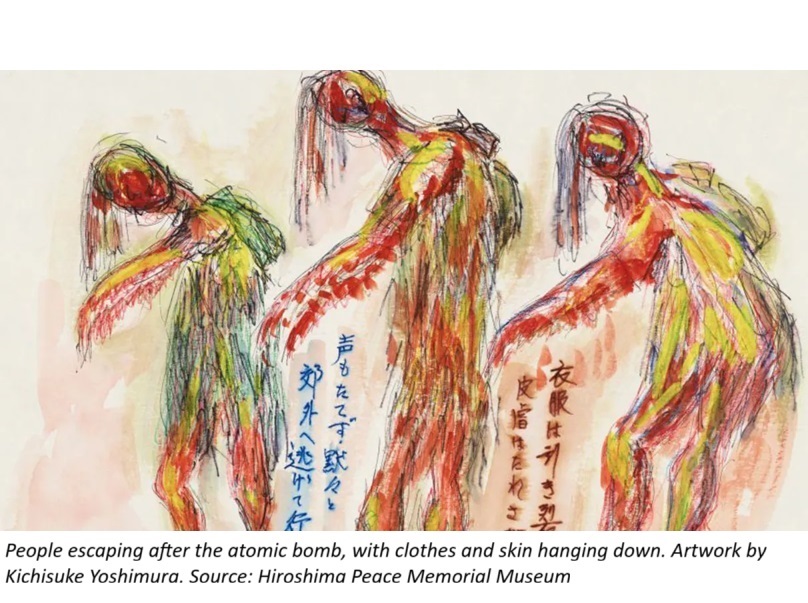
As a railroad worker, he received the limited medical care available, mostly Mercurochrome—a red antiseptic containing mercury—which his family used to treat his burns. He remembered his mother quietly crying as she cleaned the wounds each day, removing maggot eggs and tending to the foul-smelling injuries on his back. Her whispered fear that death might have been kinder than such suffering stayed with him. Yet amid the devastation, he also remembered the kindness of his neighbours. One family, despite having very little themselves, shared a small jar of vegetable oil each week to soothe his burns—an act of generosity that stood in stark contrast to the stigma and isolation survivors faced during that time.
Hibakusha and Non-Japanese Hibakusha
Hibakusha—atomic bomb survivors—faced profound social, economic, and psychological discrimination rooted in widespread misconceptions about radiation sickness. In post-war Japan, many believed that radiation-related conditions were contagious or hereditary, resulting in exclusion from employment, healthcare, marriage prospects, and community life. For non-Japanese hibakusha such as Mr. Lee, this marginalisation was compounded by ethnic discrimination. They endured both the trauma of the bombings and the persistent stigma of being perceived as “outsiders,” leading some, including Mr. Lee, to conceal their survivor status from even close family members for decades. They faced social stigma linked to radiation’s visible effects and persistent institutional neglect tied to their nationality and residency status
Beyond social prejudice, non-Japanese hibakusha have continued to confront bureaucratic obstacles, limited political recognition, and inconsistent access to state support. Restrictions on eligibility for medical subsidies, complex residency verification processes, and legal battles over compensation have left many without adequate care. Their exclusion from formal policymaking spaces has further limited their ability to advocate for their rights. Despite incremental progress, these survivors remain on the margins of disarmament and public health policy, underscoring the need for sustained diplomatic attention, inclusive historical acknowledgment, and equitable survivor support frameworks.
Stories like Mr. Lee’s are not alone and stand as stark reminders of the human cost of misguided policies pursued in the name of national or global security. Across Japan and around the world, thousands of hibakusha, their descendants, and dedicated activists continue to shoulder the burden of history while working tirelessly to ensure its lessons are not forgotten with a collective message: never again!
Hibakusha testimonies are not only records of past violence—they are acts of resistance. By insisting on truth, dignity, and accountability, they challenge systems that normalise nuclear harm and demand justice in the present.
Under Article 6 of the United Nations Treaty on the Prohibition of Nuclear Weapons (TPNW), states must provide age and gender sensitive assistance to victims of nuclear weapons use or testing. This must be enacted without discrimination, including medical care, rehabilitation, and psychological support, and provide for their social and economic inclusion. Countries must be obligated to assist survivors, many of whom share a similar story to Mr Lee, and ensure that nuclear weapons use and testing are prohibited in the future, possible through the advocacy of the TPNW.
About the Author
Monalisa Hazarika is the Strategic Communication and Partnership Officer at the SCRAP Weapons Project. She is one of the UN Youth Champions for Disarmament under the United Nations Office for Disarmament Affairs’ #Youth4Disarmament programme. She is an emerging voice in conventional arms control and meaningful youth engagement, featuring most recently at a UNGA-ECOSOC Joint Meeting. Her areas of expertise and research focus include small arms and light weapons, especially non-industrial weapons and their trends in illicit manufacture and trade, transnational organised crime, and the proliferation of 3D-printed weapons.
1 This Month

of the week – Shut Down Drone Warfare!


Tell the Ukrainian Government to Drop Prosecution of Peace Activist Yurii Sheliazhenko

Petition to revoke the licensing of the Near Surface Nuclear Disposal Facility (NSDF) at Chalk River. https://www.ourcommons.ca/petitions/en/Petition/Details?Petition=e-7247
To see nuclear-related stories in greater depth and intensity – go to https://nuclearinformation.wordpress.com
-
Archives
- March 2026 (230)
- February 2026 (268)
- January 2026 (308)
- December 2025 (358)
- November 2025 (359)
- October 2025 (376)
- September 2025 (257)
- August 2025 (319)
- July 2025 (230)
- June 2025 (348)
- May 2025 (261)
- April 2025 (305)
-
Categories
- 1
- 1 NUCLEAR ISSUES
- business and costs
- climate change
- culture and arts
- ENERGY
- environment
- health
- history
- indigenous issues
- Legal
- marketing of nuclear
- media
- opposition to nuclear
- PERSONAL STORIES
- politics
- politics international
- Religion and ethics
- safety
- secrets,lies and civil liberties
- spinbuster
- technology
- Uranium
- wastes
- weapons and war
- Women
- 2 WORLD
- ACTION
- AFRICA
- Atrocities
- AUSTRALIA
- Christina's notes
- Christina's themes
- culture and arts
- Events
- Fuk 2022
- Fuk 2023
- Fukushima 2017
- Fukushima 2018
- fukushima 2019
- Fukushima 2020
- Fukushima 2021
- general
- global warming
- Humour (God we need it)
- Nuclear
- RARE EARTHS
- Reference
- resources – print
- Resources -audiovicual
- Weekly Newsletter
- World
- World Nuclear
- YouTube
-
RSS
Entries RSS
Comments RSS
 nuclear-news