Workers, residents at US site that made Nagasaki A-bomb’s plutonium still suffering

June 18, 2023 (Mainichi Japan) https://mainichi.jp/english/articles/20230616/p2g/00m/0in/069000c
HANFORD, Washington (Kyodo) — As cleanup efforts continue in Washington state at a decommissioned U.S. nuclear facility that played a crucial role in the country’s acquisition of the atom bomb in World War II, questions linger over whether the site has caused serious health issues for workers and local residents.
Construction began on the facility, known as the Hanford site, eighty years ago in 1943 and involved the building of the world’s first large-scale nuclear reactor.
Through the Manhattan Project, a U.S. government research and development program for building nuclear weapons, the site’s B reactor, erected on a 580-square-mile stretch of land next to the Columbia River in south-central Washington, produced the nuclear material for one of the only two atomic bombs ever used in an armed conflict.
Codenamed “Fat Man,” the device was detonated over the city of Nagasaki in southwestern Japan on Aug. 9, 1945, effectively ending Japan’s involvement in the conflict.
The 6.2 kilograms of plutonium contained in the nuclear device released energy equivalent to 21 kilotons of TNT, taking the lives of tens of thousands of innocent people while subjecting the surrounding area to deadly radiation, killing countless more.
But citizens of Nagasaki may not be the only victims of Hanford’s plutonium production. During its decades of operation, U.S. residents living near and mainly downwind of the complex experienced severe health effects that they believe stem from the site’s activities.
One such resident is Tom Bailie, 76, who grew up and still resides just miles downwind from Hanford in a farming community.
Reflecting on his upbringing, Bailie recalled during an interview in April that no one ever thought the site at Hanford would cause harm to “patriotic American citizens.”
But, after he and a local journalist conducted a survey on surrounding farms in 1985, Bailie began to have doubts. Nearly all the families living nearby suffered from cancer, birth defects, or thyroid disease, he says — health issues that could be attributed to radiation exposure. This led to the area being coined “the death mile” by some journalists at the time.
Bailie said that his wife, father, and three uncles all had cancer before passing away, while his two sisters also have cancer and take thyroid medicine. The year before Bailie was born, his mother had a stillbirth. Bailie himself was born with birth defects and was on an iron lung when he was 4 years old. He now requires medication for a thyroid problem.
Bailie vividly remembers encounters with “men in space suits,” equipped with dosimeters to measure radiation levels, walking on his farm. The men would collect soil samples and even ask the farmers to send the heads and feet of ducks and rabbits they would kill while hunting to Hanford for analysis.
When he began speaking out about the hardships and health problems that he attributed to the Hanford site, many people from the community dismissed him as “nuts” or “crazy.” Some even mockingly referred to him as the “glow-in-the-dark farmer.”
But documents that were declassified in the late 1980s showed that Hanford had contaminated the surrounding farmland, air, farm animals, and crops with unsafe levels of radiation for years.
One such document shows that in December 1949, in an experiment called “Green Run,” Hanford scientists knowingly released thousands of curies of dangerous radioactive Iodine-131 from the site to track its course and better understand how it dispersed.
Even with the documents, some living downwind who joined the class action suit against the site were unable to explicitly prove their medical problems were caused by the contamination from the Hanford site. But Bailie still firmly believes the facility is the reason for many people’s health problems in the downwind areas.
Bailie said “the government should be ashamed of itself” for what it did to its citizens and that he thinks, at the very least, the government should cover the medical expenses of those who lived downwind.
Before being decommissioned in 1989, Hanford produced around 74 tons of plutonium, nearly two-thirds of all the plutonium produced for government purposes in the United States. One of the consequences of the site’s work was massive amounts of contamination and dangerous leftover byproducts, most of which remain on the site today.
Currently, 177 underground tanks containing 56 million gallons of highly radioactive waste, contaminated buildings, and cocooned reactors still exist there, alongside multiple other buried waste sites.
The same year Hanford was decommissioned, cleanup efforts began for dealing with the dangerous byproducts left over from the production of plutonium. Efforts to clean the area of waste are anticipated to be astronomically costly and time-consuming.
According to Hanford’s latest estimate, released in 2022, the total cost of the cleanup is projected to range from $319.6 billion to $660 billion, with a completion date not expected until at least fiscal 2078.
But Tom Carpenter, 66, former head of Hanford Challenge, a nonprofit organization dedicated to ensuring the responsible and safe clearing of the Hanford site, argues that using the word “cleanup” is misleading.
Carpenter says complete eradication of contamination from thousands of acres is impossible, and not the goal of the cleanup process. He asserts that the best that can be achieved at Hanford is “the mitigation of some risks.”
Hanford Challenge’s primary goal, he says, is to ensure authorities prioritize a swift cleanup and make sure that no corners are cut, nor workers put in unnecessary danger. This includes fighting for those who are currently working on the site.
Many workers involved in the cleanup of the Hanford site continue to be exposed to toxic chemicals, vapors, and radioactive materials, resulting in debilitating health conditions.
A recent survey of the workers by Washington state revealed more than 50 percent of them had been exposed to radioactive or toxic chemicals. Workers exposed to these dangerous materials and vapors have developed beryllium disease, cancers, organ damage, and occupational dementia.
Until recently, these workers had to prove that their health issues were directly caused by their work at the Hanford site to receive assistance with their medical expenses.
According to former worker and Hanford Challenge director Jim Millbauer, 65, proving this was extremely difficult, costly, time-consuming, and often fruitless, as most occupational illness claims were rejected.
But a recent law has changed this, presuming that any health effects suffered by workers who spend just eight hours working at Hanford are caused by working at the facility, making it easier for sick workers to get their treatment paid for.
Local colleges train students to work in a plutonium pit factory, but at what cost?
It carries a legacy of illness, death and environmental racism for countless others. History tells of a long practice of hiring local Hispano and Pueblo communities to staff some of the most dangerous positions.
History tells of a long practice of hiring local Hispano and Pueblo communities to staff some of the most dangerous positions, a practice that has its origins in the early years of the lab, as Myrriah Gómez describes in her 2022 book Nuclear Nuevo México.
- By Alicia Inez Guzmán Searchlight New Mexico, Jun 10, 2023 https://www.santafenewmexican.com/news/local_news/local-colleges-train-students-to-work-in-a-plutonium-pit-factory-but-at-what-cost/article_068bd3b2-0589-11ee-b8ba-93e1230989e7.html
Every day, thousands of people from all parts of El Norte make the vertiginous drive up to Los Alamos National Laboratory. It’s a trek that generations of New Mexicans have been making, like worker ants to the queen, from the eastern edge of the great Tewa Basin to the craggy Pajarito Plateau. All in the pursuit of “good jobs.”
Some, inevitably, are bound for that most secretive and fortified place, Technical Area 55, the very heart of the weapons complex — home to PF-4, the lab’s plutonium handling facility, with its armed guards, concrete walls, steel doors and sporadic sirens. To enter “the plant,” as it’s known, is to get as close as possible to the existential nature of the nuclear age.
For 40 years, some 250 workers were tasked, mostly, with research and design. But a multibillion-dollar mission to modernize the nation’s nuclear arsenal has brought about “a paradigm shift,” in the words of the Defense Nuclear Facilities Safety Board, a federal watchdog. Today, the plant is in the middle of a colossal expansion — growing from an aged building to what the safety board calls “a large-scale production facility for weapon components with the largest number of workers in its history.”
In short, the plant is slated to become a factory for making plutonium pits, the essential core of every nuclear warhead.
Four years ago, LANL began laying the groundwork for this expansion by searching out and shaping a highly trained labor pool of technicians to handle fissile materials, machine the parts for weapons, monitor radiation and remediate nuclear waste. The lab turned to the surrounding community tapping New Mexico’s small regional institutions — colleges that mostly serve minority and low-income students. The plan, as laid out in a senate subcommittee meeting, set forth a college-to-lab pipeline — a “workforce of the future.”
Taken altogether, Santa Fe Community College, Northern New Mexico College and the University of New Mexico’s Los Alamos campus have accepted millions of federal dollars for their role in preparing that workforce. They’ve graduated 74 people to date, many of whom will end up at TA-55.
As Kelly Trujillo, associate dean of SFCC’s School of Sciences, Health, Engineering and Math, put it, “A lot of these jobs are high-paying jobs and they allow [workers] to stay in their home, in the area that they love.”
The trade-offs, like so much involving LANL’s history in Northern New Mexico, are not without controversy. For many local families, the lab has been a gateway to the American dream. Its high wages have afforded generations of Norteños a chance at the good life — new houses, new cars, land ownership, higher education for their kids. To work there is to become part of the region’s upper crust.
It carries a legacy of illness, death and environmental racism for countless others. History tells of a long practice of hiring local Hispano and Pueblo communities to staff some of the most dangerous positions, a practice that has its origins in the early years of the lab, as Myrriah Gómez describes in her 2022 book Nuclear Nuevo México.
New Mexico’s academic institutions have for decades served as LANL’s willing partner, feeding students into the weapons complex with high school internships; undergraduate student programs; graduate and postdoc programs; and apprenticeships for craft trades and technicians. The lab heavily recruits at most local colleges, too.
Talavai Denipah-Cook can still remember LANL representatives plying her with promises of a high-paying job and good benefits at an American Indian Sciences and Engineering Society conference years ago. At the time, she was a student at a private high school in Española, and the future that they painted looked bright.
“I was like, ‘Wow, that sounds really intriguing.’ We don’t get that around here, especially as people of color,” said Denipah-Cook, now a program manager in the Environmental Health and Justice Program at Tewa Women United, an Indigenous nonprofit based in Española.
Then she remembered the words of her grandmother, a field nurse from Ohkay Owingeh, who once tended to Navajo Nation tribal members affected by uranium mining and saw the health impacts of radiation exposure firsthand.
“She used to tell me, ‘Don’t ever, ever work at Los Alamos National Labs.’”
‘The snake road’
For nearly eight decades, LANL’s repeated attempts to expand have run up against the plateau’s geography. During the Manhattan Project, the site proved problematic in terms of housing, transportation and access along the road that old-timers called el camino de la culebra — the snake road. In more recent years, the lab’s footprint has stretched to encompass a nearly 40-square-mile campus that abuts Bandelier National Monument, U.S. Forest Service lands, the cities of Los Alamos and White Rock, and San Ildefonso Pueblo.
One of its smallest areas, TA-55, sits at the north-central edge of campus. Within is “the plant” — a 233,000-square-foot building that ranks, according to the U.S. Department of Energy, as the only “fully operational, full capability plutonium facility in the nation.”
This is where plutonium and other irradiated materials are conveyed by a trolley system from a vault to rooms lined with gloveboxes, sealed and oxygen-free. Workers, their hands protected by bulky gloves, weigh and handle plutonium in all its forms — molten, metal and powder. They disassemble and inspect existing weapons from the stockpile; forge parts for nuclear batteries that help power spacecrafts; and perfect the dimensions of plutonium “hemishells” on hand-built machines. According to a retired machinist, each pit has to be so precisely crafted that the difference between it and others can vary no more than the width of a strand of hair.
A mass of certifications and protocols are required for every task; there is little margin for error. Should radiation escape its enclosure, a radiation control technician stands by with a Geiger counter to detect it and stop work immediately.
Plant employees earn an extra $20,000 of environmental pay — in order “to attract people, quite frankly, to work in our more challenging facilities,” said Stephen Schreiber, who works in weapons production as the technical director of the lab’s office of Science, Technology and Engineering.
When Joaquin Gallegos, the former chair of NNMC’s Biology, Chemistry and Environmental Sciences Department, recruited high school students to join the college pipeline, he cited the competitive salaries and drew upon his own family history: the aunts and uncles who worked at LANL while continuing to tend multigenerational land.
The lab “subsidized” their lifestyle and made it possible not to “sell out,” Gallegos said. “People who have 10 or 15 acres of agricultural land, that’s not enough to support a family. But if you work at the labs, you could still maintain that culture. You could still raise animals and maintain that as part of your family.”
Pendulum swings for pits
It’s been almost 75 years since LANL last produced plutonium pits at an industrial scale. In 1996, the lab was sanctioned to produce up to 20 plutonium war reserve pits a year for the W88 warhead. It produced 30 pits in a five-year period, until 2012 when all major plutonium operations were suspended, after four pieces of weapons-grade plutonium were placed side by side for a photo op — a positioning that could have caused a runaway neutron chain reaction and a flash of potentially fatal radiation.
“The lab has never had to be accountable for their promises,” said Greg Mello, of the Los Alamos Study Group, an influential anti-nuclear nonprofit based in Albuquerque. “Could they be a factory? Could they produce pits reliably? No. Not at all.”
LANL, regardless, was tapped as one of two sites — the other being South Carolina’s Savannah River plutonium processing facility — to produce no fewer than 80 pits annually by 2030, according to the Fiscal 2020 National Defense Authorization Act. The law authorized LANL to produce 30 pits per year by 2026.
What’s being proposed is so huge it has no precedent, said Jay Coghlan, executive director of Nuclear Watch New Mexico, an anti-nuclear advocacy organization in Santa Fe.
“Here we have this arrogant agency that thinks it can just impose expanded bomb production on New Mexico,” said Coghlan, referring to the National Nuclear Security Administration, the lead agency for pit production. “They do not have credible cost estimates and they do not have a credible plan for production. But yet they expect New Mexicans to bear the consequences.”
The costs, according to the Los Alamos Study Group, will come to some $46 billion by 2036 — the earliest the NNSA says it can hit 80 pits per year at the two sites. It’s roughly the same amount of money it would take to rebuild every single failing bridge in America.
The NNSA estimates the lab will need 4,100 full-time employees, including scientists and engineers, security guards, maintenance, craft workers, and “hard-to-fill positions,” as LANL has dubbed the pipeline jobs.
It is the most costly program in the agency’s history. It is also destined, Coghlan and others say, to collapse under its own weight. Both Los Alamos and Savannah River are, according to federal documents, billions of dollars over budget and years behind schedule.
Money, waste and risk
More than $20 billion is slated for paying personnel and underwriting the construction in and around TA-55, including parking structures, office buildings, facilities to process transuranic liquid waste, and demolishing and decontaminating hundreds of old gloveboxes and installing hundreds of new ones. Construction is taking place at night, while staff work toward meeting LANL’s new quota by day.
Safety and controlling risk are paramount, said Schreiber, the LANL technical director. “We really do instill that in our workers.” But observers at the Union of Concerned Scientists say the pace doesn’t bode well.
“When you have new employees who are not very experienced in a new facility running new procedures in a high-risk environment — trying to do it fast, trying to meet a quota — that’s a recipe for something bad to happen,” said Dylan Spaulding, a senior scientist in the nonprofit’s global security program.
New Mexico’s all-Democratic congressional delegation, whatever the controversies, supports the project wholeheartedly. It was Heinrich and South Carolina’s Republican Sen. Lindsey Graham who rallied behind pit production in their states — ushering it into law in the 2020 National Defense Authorization Act. Then-Congressman Ben Ray Luján helped shepherd money to the pipeline programs.
Radiation 101
Last spring, assistant professor Scott Braley taught two back-to-back introductory courses to 13 future radiation control technicians at NNMC. His lectures covered a host of topics: the history of “industrial-scale” radiation accidents worldwide, algebraic formulas to determine the correlation between individual cancer and workplace exposure, and maximum permissible doses for future workers like themselves. The rates are higher than for the general public, Braley explained, because, for one, radiation workers “have accepted a higher risk.”
Once they get their associate degree, NNMC graduates proceed to the second part of their training, in a Los Alamos classroom. There, they learn how to don and doff personal protective gear — a suit not unlike the one that recent NNMC graduate Karen Padilla said she once used to keep bees. Padilla, 42, participated in simulations of scenarios that she and others might one day face, learning the proper ways to detect radiation around trash and 55-gallon barrels of waste, for instance.
“Long-term, I don’t have really any fears about this because I feel like my instructors are doing a good job of helping me understand how to protect myself” and others, said Padilla. “I think ultimately that’s my job as a [radiation control technician], to protect people who are working, to make sure they’re not getting into something that could be harmful.”
Much of the college programs center around minimizing risk. And yet they present an ethical dilemma, said Eileen O’Shaughnessy, co-founder of Demand Nuclear Abolition.
“What does it mean to assume that exposure is acceptable at all? Because the thing about radiation is it’s cumulative and any amount is unsafe.”
Generations of Northern New Mexicans have faced the same time-worn question: Are the good jobs worth the trade-offs?
“You realize, yes, they are paying you well, but you’re being put in situations that you have no idea about,” said the retired machinist, with over two decades of experience working at the lab, much of it at the plant. He asked to remain anonymous for fear of retaliation. “It’s the mentality at the lab,” he said. “They don’t really think that people that are techs are even really worth much.”
A powerful neighbor
Dueling perspectives reveal the chasms around the lab and, in particular, what some consider the Manhattan Project’s original sin: Its use of eminent domain to force Indigenous and Hispano people off their farms and sacred lands on the Pajarito Plateau. Its arrival, oral histories hold, spelled the end of land-based living.
“When did we stop farming to sustain ourselves?” Kayleigh Warren recalled asking a relative from Santa Clara Pueblo. The answer: “When the labs came in.”
Now an environmental health and justice program coordinator at Tewa Women United, Warren has borne witness to the region’s change in values. The lab has so deeply carved itself into Northern New Mexico’s psyche that imagining another future and means of survival has come to seem impossible.
As the single largest employer in northern New Mexico, LANL’s horizon of influence is vast. And with billions more dollars flooding in, its sway in almost every sphere seems only to grow.
Despite the lab’s omnipresence, economic gains have been relatively limited. While Los Alamos County has one of the highest median household incomes in the nation, the surrounding communities — including Española — are among the poorest in the state.
“LANL has been a bad neighbor,” Warren said. “If the economic benefits are so good for them to continue their work and expand, you would think the communities around here would be doing better. But we’re not.”
‘Truly shocking’: UK has enough plutonium to make almost 20,000 nukes

A study published by a university in Nagasaki has revealed that the UK has enough stockpiled plutonium to make almost 20,000 atomic warheads with the same power as the bomb which totally-destroyed that Japanese city in August 1945.
The 2023 Fissile Material Directory[i] is published in June each year by the Research Center for Nuclear Weapons Abolition (RECNA)[ii], based at Nagasaki University. RECNA has been established for over twenty years as an educational and research institute at a university that has a medical faculty with a first-hand experience of the horror of nuclear weapons. Its primary goal is achieving a world free from nuclear weapons.
In January, the institute was visited by UK/Ireland Nuclear Free Local Authorities Secretary Richard Outram, where he met Vice-Director Professor Tatsujiro Suzuki.
The study lists the UK as holding 119.7 tons of plutonium, the second highest stockpile in the world after Russia with 191.5 tons, and 22.6 tons of Highly Enriched Uranium. The plutonium stockpile is said to be sufficient to arm 19,947 atom bombs, like the ‘Fat Man’ bomb dropped on Nagasaki on 9 August 1945, whilst the uranium stockpile has the potential to be turned into a further 355 devices comparable to the ‘Little Boy’ bomb dropped on Hiroshima three days earlier.
The Nagasaki bomb is estimated to have killed 35,000 – 40,000 people on the day and the Hiroshima bomb about twice that many.
The UK Government and nuclear industry has conceded in the 2022 UK Radioactive Material Inventory that 113 tons of UK-owned plutonium are currently managed by the Nuclear Decommissioning Authority, whilst a further 4 tons are in semi-assembled MOX or other fuel components. An additional 24 tons of foreign-owned plutonium are also held, a further legacy of the costly failure of the UK’s experiment with reprocessing[iii].
Across the world, RECNA estimates that 552 tons of plutonium and 1,260 tons of HEU are held, much of the latter in military hands. These are all deemed to be fissile materials and together could arm 92,000 plutonium bombs like the one used at Nagasaki and almost 20,000 uranium devices like that deployed at Hiroshima.
The Nuclear Free Local Authorities are gravely concerned about the future use of Britain’s plutonium stockpile. In recent weeks, the UK Government and the Nuclear Decommissioning Authority have published plans suggesting that some of this material should be used as fuel for a new generation of nuclear reactors.
The NFLA fears that burning plutonium as fuel will simply lead to the creation of more nuclear waste, that such material could be a target for terrorists or hostile state actors, especially in transit, and that these actions could lead to nuclear weapon proliferation. In its response to the government and industry plan the NFLA called for fissile material to be put ‘beyond use’ for all time[iv].
Responding to the RECNA report, Councillor Lawrence O’Neill, Chair of the NFLA Steering Committee, said:
“The data published by RECNA is both astonishing and truly shocking. If only a tiny fraction of Britain’s stockpile of fissile materials ended up in the wrong hands for use by terrorists or in military action then the consequences could be too awful to contemplate. In the UK, and elsewhere in the world, anti-nuclear campaigners need to continue to work together to lobby our respective governments to make these stockpiles safe and beyond use, and the time to do that is now.”
Canadian reactors that “recycle” plutonium would create more problems than they solve
Bulletin, By Jungmin Kang, M.V. Ramana | May 25, 2023
In 2021, nine US nonproliferation experts sent an open letter to Canada’s Prime Minister Justin Trudeau. In their letter, the experts expressed their concern that the Canadian government was actually increasing the risk of nuclear weapons proliferation by funding reactors that are fueled with plutonium. Earlier that year, the Federal Government had provided 50.5 million Canadian dollars to Moltex Energy, a company exploring a nuclear reactor design fueled with plutonium. The linkage to nuclear weapons proliferation has also led several civil society groups to urge the Canadian government to ban plutonium reprocessing.
Much of the concern so far has been on Canada setting a poor example by sending a “dangerous signal to other countries that it is OK to for them to extract plutonium for commercial use.” But Moltex plans to export its reactors to other countries raise a different concern. Even if a country importing such a reactor does not start a commercial program to extract plutonium, it would still have a relatively easy access to plutonium in the fuel that the reactor relies on to operate. Below we provide a rough estimate of the quantities of plutonium involved—and their potential impact on nuclear weapons proliferation—to help explain the magnitude of the problem. But there is more. By separating multiple radionuclides from the solid spent fuel and channeling it into waste streams, Moltex reactors will only make the nuclear waste problem worse.
Moltex’s technological claims. Moltex established its Canadian headquarters in the province of New Brunswick after it received an infusion of 5 million Canadian dollars from the provincial government. The company offers two products: a molten salt reactor and a proprietary chemical process that Moltex terms “waste to stable salts” technology. Moltex claims that, by using its chemical process, it can “convert” spent fuel from Canada’s deuterium uranium nuclear reactors (CANDUs) into new fuel that can be used in its reactor design. Moltex essentially claims it can “reduce waste.” In light of the problematic history associated with molten salt reactors, Moltex’s proposed reactors, and especially the chemical process needed to produce fuel, deserve more scrutiny. These will have serious implications for nuclear policy.
In its response to the open letter from the US nonproliferation experts, Moltex dismissed the ability of outsiders to comment, arguing that experts “are not aware of [its proprietary] process as only high-level details are made public.” Moltex has been indeed sparse in what it shared publicly about its technologies. Still, there is much one can surmise from earlier experiences with the processing of spent fuel and from basic science. With some simple calculations based on these high-level details provided by Moltex so far—and taking those at face value, i.e., without evaluating the feasibility of the design or their plans—we show that there is reason to be concerned about the amounts of plutonium that will be used in the reactor.
[Technical explanation here about chemical processes]…………………………………………………………………………….
Moltex’s proposed technology has not yet been evaluated by the International Atomic Energy Agency for how well it can be safeguarded; nor is it possible to evaluate how well the technology can be safeguarded in advance of a final design. But there is good reason to think that a determined country—one that might not play by the rules set by the IAEA—might find a way to divert some plutonium from Moltex’s chemical process to use it in nuclear weapons.
Diversion has been a long-standing concern with pyroprocessing, which is closely related to what Moltex is proposing. …………………………………………………………more https://thebulletin.org/2023/05/canadian-reactors-that-recycle-plutonium-would-create-more-problems-than-they-solve/
Dealing with a debacle: A better plan for US plutonium pit production

Bulletin, By Curtis T. Asplund, Frank von Hippel | April 27, 2023
For two decades, the Pentagon and Congress have been increasingly concerned that the United States does not have a reliable capability to produce plutonium “pits,” the cores of US thermonuclear warheads. In 2018, the agency responsible for the production and maintenance of US nuclear warheads, the National Nuclear Security Administration (NNSA), responded with a plan to build, on a crash basis, pit production lines in New Mexico and South Carolina at the same time, with a combined production capacity of 80 pits per year.
One of the production lines is in an advanced state of installation at the Los Alamos National Laboratory in New Mexico, the home of US pit-production expertise. The other is to be installed at the Department of Energy’s Savannah River Site (SRS) in South Carolina, where there is no pit-production expertise, in a massive building that the Department of Energy built for another purpose and was then forced to abandon because of huge cost overruns. South Carolina’s congressional delegation, led by Sen. Lindsey Graham, successfully prevailed on the Trump administration to repurpose this $6 billion building—once known as Mixed Oxide Fuel Fabrication Facility and intended to downblend surplus military plutonium for use as commercial reactor fuel—to plutonium pit production. History is repeating itself, however. The NNSA’s cost estimate for using the Savannah River facility to manufacture warhead pits has already risen from $3.6 billion in 2017 for an 80 pit-per-year production capacity to $11.1 billion for a 50 pit-per-year capacity in 2023.
The NNSA’s rationale for its ambitious pit production program is, to say the least, questionable. The agency proposes to first build 800 pits for new US intercontinental ballistic missile (ICBM) warheads, which would be needed only if the US decides to increase the number of warheads on each missile from one to three. Previous US administrations have considered such uploading destabilizing; silo-based ICBMs are targetable and increasing the number of warheads they each carry would make them more attractive targets. Loading the ICBMs with more warheads would also make compliance with the New START arms control agreement with Russia extremely difficult, should that agreement be extended in 2026.
After producing the ICBM warheads, the NNSA plans to replace all 1,900 US submarine-launched ballistic missile warheads with new warheads, equipped with what is known as insensitive high explosive, which is shock resistant and therefore less susceptible to accidental explosions that could disperse a warhead’s plutonium. No such accident has ever happened with ballistic missile warheads, and it is unclear how much this program would actually improve safety. The warheads in the Trident II missile used by US submarines are located near the missile’s third stage, which carries propellant that is as detonable as conventional explosive.
There is also another concern about the NNSA’s plans: The designs of new warheads in which new plutonium pits would be used may depart from designs that have been previously tested. This could result in demands to resume explosive testing, which would undermine the moratorium on nuclear testing that has been observed by all nuclear-weapon states (other than North Korea) since 1998.
Given these questionable production plans and the already out-of-control cost and schedule of the Savannah River pit production facility, and because the remaining life expectancy of the pits in current US warheads is at least 60 years and perhaps much longer, we propose that the Savannah River facility be put on hold and that the Los Alamos program be focused on demonstrating reliable production of 10 to 20 pits per year. Such a demonstration production line would establish that the United States has the capacity to produce pits and would reduce the time required to build additional production lines, if they are needed.
The NNSA should also renew research programs at the Livermore and Los Alamos Laboratories to study the aging of the already existing plutonium pits in the US arsenal and also the older pits from retired warheads. ……………………………………………………………………………….. more https://thebulletin.org/2023/04/dealing-with-a-debacle-a-better-plan-for-us-plutonium-pit-production/
The Human Dimension to Kazakhstan’s Plutonium Mountain

April 24, 2023, Sig Hecker https://nonproliferation.org/the-human-dimension-to-kazakhstans-plutonium-mountain/
The following is an excerpt from the Stanley Center for Peace and Security.
As we drove deeper into the Semipalatinsk Nuclear Test Site, we found kilometer-long trenches that were clearly the work of professional thieves using industrial earth-moving equipment, rather than hand-dug trenches made by nomad copper-cable-searching amateurs on camelback. Our Kazakh hosts said they could do nothing to stop these operations. In fact, they weren’t sure they had a legal right to stop them from “prospecting” on the site.
It was the sight of these trenches that urged me to convince the three governments that they must cooperate to prevent the theft of nuclear materials and equipment left behind when the Soviets exited the test site in a hurry as their country collapsed.
When the Soviet Union collapsed in December 1991, the most urgent threat to the rest of the world was no longer the immense nuclear arsenal in the hands of the Russian government but rather the possibility of its nuclear assets—weapons, materials, facilities, and experts—getting out of the hands of the government. As director of the Los Alamos National Laboratory, I helped to initiate the US–Russia lab-to-lab nuclear cooperative program in 1992 to mitigate these nuclear threats.
The trilateral US–Russia–Kazakhstan cooperation began in 1999 to secure fissile materials that were left behind by the Soviets at the Semipalatinsk Nuclear Test Site, which was now in the newly independent country of Kazakhstan. The project was kept in confidence until the presidents of the three countries announced it at the Seoul Nuclear Security Summit in 2012
In Doomed to Cooperate, individuals from the three countries recount their cooperative efforts at Semipalatinsk. Unlike the US–Kazakhstan projects initiated earlier on nuclear test tunnel closures, identifying experiments that left weapons-usable fissile materials (plutonium and highly enriched uranium) at the huge test site—whether in the field, in tunnels, or in containment vessels—required trilateral cooperation. The Russian scientists who conducted these experiments were the only ones who knew what was done and where. It required American nuclear scientists who conducted similar tests in the United States to assess how great a proliferation danger the fissile materials in their current state may constitute. And it required Kazakh scientists and engineers to take measures to remediate the dangers. The project also required the political support of all three countries and the financial support of the American government because it was the only one at the time with the financial means. That support came from the US Cooperative Threat Reduction (or Nunn-Lugar) program.
Continue reading at the Stanley Center for Peace and Security.
More warheads, more nuclear waste to New Mexico. Santa Fe fearful, as Carlsbad leaders support efforts

“legacy waste” from past programs still waiting for disposal at Los Alamos was being disregarded in favor of the new streams the NNSA intended to generate.
“It’s heart-wrenching when you hear the young people concerned with manufacturing bombs.”
Adrian Hedden, Carlsbad Current-Argus 6 Apr 23,
Two meetings on nuclear waste were held in New Mexico this week, on different sides of the state with very different reactions from attendees.
On Tuesday, a townhall-style meeting was held in Santa Fe which more than 300 persons attended and about 200 participated online.
Most expressed fears and concerns that a federal plan to transport surplus plutonium to the Waste Isolation Pilot Plant near Carlsbad would endanger local communities along the transportation routes.
The next night at a meeting at the city golf course in Carlsbad, about 30 business leaders, elected officials and invited guests took a much warmer tone with the federal government and its plans for New Mexico and the nearby WIPP site.
Under the federally proposed plan, surplus plutonium would move via truck from the Pantex Plant near Amarillo, Texas to Los Alamos National Laboratory (LANL) in northern New Mexico for processing, then to the Savannah River Site in South Carolina for additional preparation before finally heading to WIPP for disposal.
By then, the 34 metric tons of plutonium set for disposal would meet characterization standards for transuranic (TRU) nuclear waste, meaning the program would not result in any waste of a higher radioactivity than that which the repository was intended to store.
But the program would see waste traveling through New Mexico, and especially the northern portion of the state, multiple times.
That’s a problem for Santa Fe County Commissioner Anna Hansen, who moderated the Tuesday meeting at the Santa Fe Convention Center with the Department of Energy’s National Nuclear Security Administration (NNSA) – the agency devising the plan – and argued it could burden her community with the risk of exposure.
At the same time, the NNSA also was planning to ramp up the production of plutonium pits, the triggers for nuclear warheads, at Los Alamos and Savannah River site, hoping to produce up to 80 pits a year by 2030.
Some of the waste from that program would also be destined for WIPP as it’s the only deep geological repository in the U.S. for nuclear waste.
“People feel betrayed,” Hansen said in an interview with the Carlsbad Current-Argus, arguing the two NNSA programs marked an “expansion” of WIPP’s operations beyond what New Mexico originally agreed to when the facility was developed.
She said “legacy waste” from past programs still waiting for disposal at Los Alamos was being disregarded in favor of the new streams the NNSA intended to generate.
“They still feel frustrated that the legacy waste at LANL has not been cleaned up and new waste is being generated and also going to WIPP,” Hansen said of attendees at the Santa Fe meeting. “It’s heart-wrenching when you hear the young people concerned with manufacturing bombs.”
Jack Volpato, chair of the Carlsbad Mayor’s Nuclear Task Force, commended the NNSA and the WIPP project at the Wednesday meeting in Carlsbad for supporting the local community, its workforce and economy in the decades since the site was opened……………………………………………………………………………
Hansen, the Santa Fe County commissioner, said the NNSA’s plans were extraneous to WIPP’s original mission and what should be its primary purpose: to get nuclear waste “off the hill” in Los Alamos.
That’s the only true benefit to the people of New Mexico who host the WIPP site, she said.
“It’s a complete expansion of WIPP’s mission to be putting new and generated waste,” Hansen said. “It’s insanity to move surplus plutonium around the country. We don’t want to continue being left behind. Waste from all over the country has been coming here.”………………………………………………… https://www.currentargus.com/story/news/2023/04/06/nuclear-waste-new-mexico-santa-fe-carlsbad-nuke-plutonium-department-energy-bombs-nuke-warhead/70080266007/
Crowd turns out for town hall on plutonium pits, nuclear waste storage
BY ALAINA MENCINGER / JOURNAL STAFF WRITER, WEDNESDAY, APRIL 5TH, 2023 Albuquerque Journal
“…………………………………………. a town hall meeting, where residents of Santa Fe, Albuquerque, Los Alamos and beyond asked questions and made comments about nuclear production and disposal in New Mexico. The crowd addressed a pair of officials from the National Nuclear Security Administration and the U.S. Department of Energy’s Office of Environmental Management.
There was hardly an empty seat in the auditorium; 150 others attended the town hall virtually.
Speakers at the town hall generally focused on three main issues: increased production of plutonium pits, ramped up disposal of transuranic waste at the Waste Isolation Pilot Plant, and nuclear proliferation.
One attendee, Erich Kuerschner, expressed concerns about health and safety regarding radiation.
“Have you ever seen any pictures of what humans looked like after Hiroshima and Nagasaki?” Kuerschner asked. “It’s horrible, because so many people haven’t — you know, they have no idea of what radiation does to a human being.”
Plutonium pits, bowling-ball-sized hollow spheres of radioactive plutonium, are essential to trigger nuclear reactions.
…………………………………………. many attendees questioned the necessity of adding to the country’s nuclear arsenal, including Santa Fe Archbishop John Wester.
“All your plans for the expanded plutonium pit stores — why is plutonium bomb core production even necessary when it is not to maintain the safety and reliability of the existing tested stockpile?” Wester asked.
He went on to call on the NNSA and DOE to prioritize cleanup at Los Alamos National Lab and beyond, denuclearize the country, and invest in “real national security threats that tangibly impact New Mexicans such as wildfires caused by climate change and preventing the next pandemic.”…………………………..
Other speakers raised concerns about transporting and storing nuclear waste in DOE’s Waste Isolation Pilot Plant in Carlsbad. WIPP is the only repository for transuranic waste — clothes, tools, soil and other materials contaminated with radiation — in the country. The plant was expected to stop taking new waste in 2024; however, a March 2022 report by the Office of Environmental Management titled “WIPP Strategic Vision: 2022-2032”, indicated that the plant “is currently anticipated to operate beyond 2050.”
Activist Cynthia Wheeler said four years ago she bought a house along the route from LANL to WIPP, under the assumption that in 2024, the plant would be closed.
“The federal agencies changed the rules to keep WIPP open for the rest of the century,” Wheeler said. “… I was following the rules. But DOE was breaking promises after the fact.”
………………….. The plant is in the process of renewing its permit. Public comment on the renewal has been extended by the New Mexico Environment Department until April 19 at 5 p.m.
Pentagon fake news about Chinese fast breeder reactors
Assistant Secretary of Defense John Plumb knew better when characterizing Russia-China reactor cooperation as a nuclear weapon threat
Asia Times, By JONATHAN TENNENBAUM, APRIL 3, 2023
The US Department of Defense and numerous private commentators allege that Russian-Chinese cooperation on fast breeder reactors will provide plutonium for large numbers of Chinese nuclear weapons. Assistant Secretary of Defense John Plumb told Congressional hearings on March 8:
“It’s very troubling to see Russia and China cooperating on this. They may have talking points around it, but there’s no getting around the fact that breeder reactors are plutonium, and plutonium is for weapons. So I think the [Defense] Department is concerned. And of course, it matches our concerns about China’s increased expansion of its nuclear forces as well, because you need more plutonium for more weapons.”
The Pentagon knows better than this. Anyone conversant with fast breeder reactor technology is aware that the type of plutonium that can be produced in such reactors is much less suitable for nuclear weapons than the plutonium produced in other reactor types, whose design and construction China has long mastered.
It is therefore nonsensical to charge that the main goal of the Chinese fast breeder program is weapons-related. Rather, the motivation for the program is consistent with that of other nations that have pursued fast breeder reactor designs, including greater efficiency in the utilization of nuclear fuel, reduction in the amount and toxicity of nuclear waste and greater independence from outside fuel supplies.
Here are the details, point by point. They speak for themselves:………………………………………………………………………………… more https://asiatimes.com/2023/04/pentagon-fake-news-about-chinese-fast-breeder-reactors/
Canada’s “peaceful” nuclear program intimately involved in selling Plutonium For American Bombs
Canadians have been told repeatedly by spokespersons from Atomic Energy of Canada Limited, the Canadian Nuclear Association and the Government of Canada
- that the Canadian nuclear program has nothing to do with atomic bombs,
- that plutonium produced in Canadian reactors is unfit for military use, and
- that Canada has a strict policy that all nuclear materials supplied to other countries must be used for peaceful, non-explosive purposes.
What they don’t say is
that the Canadian nuclear program was born as part of the Manhattan Project — the secret project which produced the world’s first atomic bombs;
that the Canadian role in the atomic bomb project was focussed on basic research into the production and separation of plutonium for use in atomic bombs;
that the Chalk River Nuclear Establishment was built following a military decision in 1944 in Washington D.C. to utilize Canada’s plutonium research;
that for thirty years after the bombing of Hiroshima and Nagasaki, Canada sold plutonium to the Americans for use in their nuclear weapons program.
Recently, the U.S. Department of Energy published its stockpiles of plutonium, and revealed exactly how much plutonium was sent to or received from other countries. For the first time, through this letter dated March 4 1996, Canadians learned how much plutonium Canada contributed to the U.S. nuclear weapons program.
…………………………………………….. more http://www.ccnr.org/DOE.html
DOE wanted to quadruple plutonium pit production. For now, activists have stopped them
https://beyondnuclearinternational.org/2023/03/05/new-nuclear-weapons-plan-faces-scrutiny/From SRS Watch, Tri-Valley CAREs, Nuclear Watch New Mexico and the Gullah/Geechee Sea Island Coalition 13 Mar 23,
In a win for public participation and environmental protection, the United States District Court of South Carolina denied the Department of Energy’s motion to dismiss a 2021 legal action filed by multiple citizen groups.
The suit was prompted by the agency’s failure to take the “hard look” required by the National Environmental Policy Act at its plans to more than quadruple the production of plutonium pits for new nuclear weapons and split their production between the Los Alamos National Laboratory and the Savannah River Site.
In her ruling, Judge Mary Geiger Lewis thoroughly rejected the defendants’ arguments that the plaintiffs lacked standing, saying it was “not a close call”.
“We were able to defeat yet another attempt to use standing as a weapon to keep members of the public out of the government’s decision-making process,” said Leslie Lenhardt, Senior Managing Attorney at the South Carolina Environmental Law Project (SCELP).
To date, the Department of Energy (DOE) has refused to fully examine the environmental and safety impacts of their cross-country plan, which would create massive quantities of dangerous radioactive materials, put hundreds of billions of taxpayer dollars on the line, risk a new nuclear arms race, and violate the nation’s foundational environmental law.
The Savannah River Site has never produced plutonium pits, the explosive cores of all U.S.nuclear weapons, and currently stores 11.5 metric tons of plutonium, which poses a daunting management and disposal challenge. Pit production will only increase its plutonium burden, along with more waste that needs to be treated, stored and disposed of.
“The ruling is a significant loss for the DOE in its efforts to dodge its legal obligations under NEPA,” said Tom Clements, Director of SRS Watch. “We will push forward in court to make sure that the DOE conducts the mandated environmental analysis of impacts of plutonium pit production at all involved DOE sites, including sites at which plutonium waste would be disposed.”
Despite outdated analyses failing to account for significant changes in circumstances, the U.S. government has ignored the repeated calls from the public, including the plaintiffs specifically, to conduct the legally required “hard look” at this major shift in policy that will only exacerbate the already documented waste of taxpayers’ money.
“It’s critical that the public understands that no future pit production is to maintain the safety and reliability of the existing nuclear weapons stockpile,” said Jay Coghlan, Executive Director of Nuclear Watch New Mexico. “Instead, it is for speculative new designs that can’t be tested because of the international testing moratorium. Or worse yet, it could prompt the U.S. to resume testing, which would have severe proliferation consequences. This is the kind of needed public discussion that the Department of Energy seeks to shut down while spending enormous sums of taxpayers’ money on expanding nuclear weapons production.”
SCELP filed the lawsuit on behalf of Savannah River Site Watch, Nuclear Watch New Mexico, Tri-Valley CAREs and the Gullah/Geechee Sea Island Coalition in June of 2021 after the DOE’s semi-autonomous National Nuclear Security Administration (NNSA) concluded it was unnecessary to conduct a broad, nationwide review of this two-site strategy. Instead, the agency is relying on a supplemental analysis of an outdated Programmatic Environmental Impact Statement (PEIS) completed more than a decade ago, along with a separate review done for SRS alone.
“We are thrilled that the Court ruled in our favor and that this landmark environmental case can now proceed toward a final decision,” said Marylia Kelley, Executive Director of the Livermore-based Tri-Valley CAREs. “What’s at stake in our litigation is nothing less than the question of whether the federal government will be allowed to run roughshod over affected communities like mine all across the country.
“We believe the Court will ultimately agree with Plaintiff groups that the National Nuclear Security Administration must produce a nationwide Programmatic Environmental Impact Statement and hold public hearings at all of the locations that will be actively involved in these dangerous plutonium bomb core activities, including Livermore, CA. The analysis of risks must precede implementation of the project in order to forestall serious environmental degradation and potential loss of life, “Kelley concluded.
Spreading the Bomb – Will Ottawa revisit Canada’s support for plutonium reprocessing?
Canadian Coalition for Nuclear Responsibility
February 21, 2023
Today, the Canadian Coalition for Nuclear Responsibility and researchers from five universities are urging Ottawa to reconsider its financial and political support for reprocessing in Canada – extracting plutonium from used nuclear fuel.
Plutonium is one of the key materials needed to make nuclear weapons—the other alternative is highly enriched uranium. Plutonium is created as a byproduct in nuclear reactors. Once extracted, plutonium can be used either as a nuclear fuel or as a nuclear explosive. The chemical process used to separate plutonium from other radioactive substances produced in nuclear reactors is called reprocessing
In 1974 India used plutonium from a Canadian reactor to explode an atomic bomb in an underground test. The entire world was shocked to realize that access to plutonium and the making of an atomic bomb may be separated only by an act of political will.
Last week, a House of Commons committee released a report recommending that the government “work with international and scientific partners to examine nuclear waste reprocessing and its implications for waste management and [nuclear weapons] proliferation vulnerability.
The recommendation by the House of Commons committee echoes numerous calls by civil society groups and by U.S. and domestic researchers after Canada announced a $50.5 million grant to the Moltex corporation in March 2021 for a New Brunswick project to develop a plutonium reprocessing facility at the Point Lepreau nuclear site on the Bay of Fundy.
Allowing plutonium reprocessing in Canada sends a dangerous signal to other countries that it is OK to for them to extract plutonium for commercial use. Such a practice increases the risk of spreading nuclear weapons capabilities to countries that currently do not possess the means to make nuclear weapons. The risk is that much greater if Canada sells the technology, as is currently envisaged.
“By supporting the implementation of reprocessing technology intended for export, in connection with a plutonium-fuelled nuclear reactor, without regard for the weapons implications, Canada may be once again spreading the bomb abroad,” says Dr. Gordon Edwards, President of the Canadian Coalition on Nuclear Responsibility.
Reprocessing is often justified as a solution to the problem of dealing with nuclear waste, but in reality, it only makes the challenge even harder. Instead of having all the radioactive materials produced in solid spent fuel, these get dispersed into multiple solid, liquid and gaseous waste streams.
Researchers from the University of British Columbia, Princeton University and three New Brunswick universities are supporting the call for an international review. “We’re heartened that the House of Commons Committee listened to the concerns about plutonium reprocessing raised by numerous experts and concerned citizens,” says Dr. Susan O’Donnell, Adjunct Professor at the University of New Brunswick.
Dr. Edwards cited three letters written to Prime Minister Justin Trudeau by nine prominent nonproliferation experts, including plutonium expert Dr. Frank von Hippel. “The Prime Minister’s failure to respond indicates an appalling lack of good governance on the proliferation of nuclear weapons,” said Dr. Edwards.
To date the government has not responded to the letters or even acknowledged the monumental significance of the nuclear weapons connection with reprocessing. The House of Commons Science and Research Committee cited the letters by Dr. von Hippel and others as rationale for their recommendation to conduct the review.
Commercial reprocessing has never been carried out in Canada but in the past, Canada has been complicit in the production of nuclear weapons. During the Cold War some reprocessing was done at the federal government’s Chalk River Nuclear Laboratory, at a time when Canada sold both uranium and plutonium to the US army for use in nuclear weapons. These operations resulted in a permanent legacy of nuclear waste and radioactive contamination in Canada.
The first reactors were built to produce plutonium for bombs. The first reprocessing plants were built to extract plutonium to be used as a nuclear explosive. Following India’s use of plutonium from a nuclear reactor supplied by Canada in its 1974 weapon test, the United States banned commercial plutonium reprocessing in 1977 to reduce the danger of weapons proliferation.
Canada has had an informal ban on reprocessing since the 1970s. A 2016 Canadian Nuclear Laboratories report stated that reprocessing used CANDU fuel would “increase proliferation risk.” That CNL admission was fully confirmed in a major report (330 pages) released three months ago by a U.S. National Academy of Sciences. The expert panel reached a consensus that the reprocessing technology proposed for New Brunswick by the Moltex corporation “does not provide significant proliferation resistance.”
The need for an independent international review is urgent, as Moltex announced just last week that the company is seeking an additional $250 million in government funding.
The researchers supporting the call for an international review of plutonium reprocessing in relation to the spread of nuclear weapons are:
Dr. Gordon Edwards, President, Canadian Coalition for Nuclear Responsibility
Dr. Susan O’Donnell, Adjunct Professor and Principal Investigator of the Rural Action and Voices for the Environment [RAVEN] project, University of New Brunswick
Dr. Janice Harvey, Assistant Professor, Environment & Society Program, St. Thomas University
Dr. Jean-Philippe Sapinski, Assistant Professor of Environmental Studies, Université de Moncton
Dr. M.V. Ramana, Professor and Simons Chair in Disarmament, Global and Human Security, School of Public Policy and Global Affairs, University of British Columbia
Dr. Frank von Hippel, Senior Research Physicist and Professor of Public and International Affairs Emeritus, Program on Science & Global Security, Princeton University
US takes another step toward gearing up nuclear plutonium pit factory
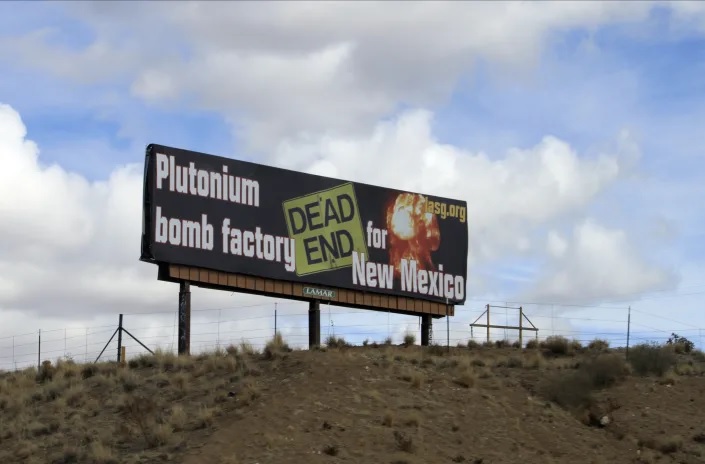
SUSAN MONTOYA BRYAN, Sat, February 11, 2023
ALBUQUERQUE, N.M. (AP) —
The U.S. agency in charge of producing key components for the nation’s nuclear arsenal has cleared the way for new equipment to be installed at a New Mexico laboratory as part of a multibillion-dollar mission, but nuclear watchdog groups say the project already is behind schedule and budgets have ballooned.
Approval for moving equipment into place at Los Alamos National Laboratory was first outlined in an internal memo issued by the deputy secretary of energy in January. The National Nuclear Security Administration, which is overseen by the U.S. Department of Energy, made a public announcement Thursday.
SUSAN MONTOYA BRYAN
Sat, February 11, 2023 at 8:42 AM GMT+11·3 min read
ALBUQUERQUE, N.M. (AP) —
The U.S. agency in charge of producing key components for the nation’s nuclear arsenal has cleared the way for new equipment to be installed at a New Mexico laboratory as part of a multibillion-dollar mission, but nuclear watchdog groups say the project already is behind schedule and budgets have ballooned.
Approval for moving equipment into place at Los Alamos National Laboratory was first outlined in an internal memo issued by the deputy secretary of energy in January. The National Nuclear Security Administration, which is overseen by the U.S. Department of Energy, made a public announcement Thursday.
The work will include the design, fabrication and installation of gloveboxes and other special equipment needed to make the plutonium cores. The work will be split between Los Alamos in northern New Mexico and the Savannah River Site in South Carolina, with the locations facing a congressional mandate to make at least 80 of the cores each year by 2030.
The deadline for meeting that capacity has been pushed back, with the memo being the latest evidence that the minimum equipment necessary will be in place at Los Alamos by August 2030, or four years later than expected…………………………………………..
Greg Mello, director of the watchdog Los Alamos Study Group, said the NNSA has made contradictory statements about the delays and what they mean for the overall plutonium pit project. He pointed to NNSA statements in 2017 and 2018 in which the agency predicted problems if it were producing pits while also replacing gloveboxes and other equipment at the same time.
“There is more they aren’t saying,” Mello said. “We believe NNSA and LANL will struggle mightily, with further setbacks, failures and accidents in a misguided attempt to produce any meaningful number of pits in that cramped, aging facility.”
SUSAN MONTOYA BRYAN
Sat, February 11, 2023 at 8:42 AM GMT+11·3 min read
ALBUQUERQUE, N.M. (AP) —
The U.S. agency in charge of producing key components for the nation’s nuclear arsenal has cleared the way for new equipment to be installed at a New Mexico laboratory as part of a multibillion-dollar mission, but nuclear watchdog groups say the project already is behind schedule and budgets have ballooned.
Approval for moving equipment into place at Los Alamos National Laboratory was first outlined in an internal memo issued by the deputy secretary of energy in January. The National Nuclear Security Administration, which is overseen by the U.S. Department of Energy, made a public announcement Thursday.
The work will include the design, fabrication and installation of gloveboxes and other special equipment needed to make the plutonium cores. The work will be split between Los Alamos in northern New Mexico and the Savannah River Site in South Carolina, with the locations facing a congressional mandate to make at least 80 of the cores each year by 2030.
– ADVERTISEMENT –
https://s.yimg.com/rq/darla/4-10-1/html/r-sf-flx.html
The deadline for meeting that capacity has been pushed back, with the memo being the latest evidence that the minimum equipment necessary will be in place at Los Alamos by August 2030, or four years later than expected.
The nuclear agency contends that installation of the equipment isn’t necessary for Los Alamos to produce 30 pits per year, and that the lab will be building war reserve pits using existing equipment as the project proceeds.
Agency spokeswoman Shayela Hassan said in an email to The Associated Press that the NNSA expects an increasing number of pits to be produced each subsequent year until the new equipment is installed. She said that’s when the capability will be in place to produce 30 pits each year “with moderate confidence.”
The long-shuttered Rocky Flats Plant outside Denver was capable of producing more than 1,000 war reserve pits annually before work stopped in 1989 due to environmental and regulatory concerns. In 1996, the DOE provided for limited production capacity at Los Alamos, which produced its first war reserve pit in 2007. The lab stopped operations in 2012 after producing what was needed at the time.
Greg Mello, director of the watchdog Los Alamos Study Group, said the NNSA has made contradictory statements about the delays and what they mean for the overall plutonium pit project. He pointed to NNSA statements in 2017 and 2018 in which the agency predicted problems if it were producing pits while also replacing gloveboxes and other equipment at the same time.
“There is more they aren’t saying,” Mello said. “We believe NNSA and LANL will struggle mightily, with further setbacks, failures and accidents in a misguided attempt to produce any meaningful number of pits in that cramped, aging facility.”
The memo provides formal cost and schedule estimates for getting equipment in place at Los Alamos, but it’s unclear when construction will begin. The cost has been pegged at roughly $1.85 billion.
More details about spending and schedules are expected when the NNSA submits its budget request to Congress next month.
In January, the Government Accountability Office said in a report that NNSA plans for reestablishing plutonium pit production do not follow best practices and run the risk of delays and cost overruns.
The GAO described the modernization effort as the agency’s largest investment in weapons production infrastructure to date, noting that plutonium is a dangerous material and making the weapon cores is difficult and time consuming. https://news.yahoo.com/us-takes-another-step-toward-214207395.html
Cost Estimate for Plutonium Pit Project at Savannah River Site Hits $16.5 Billion, $5 Billion above Current Estimate
“Given the myriad of cost and schedule threats facing the SRS pit facility, it’s simply not acceptable that DOE will for four years hide updated costs estimate and technical updates for this daunting project,”
“The shocking cost jumps and continuous delays underscore questions about the need for the redundant SRS pit plant,
NEWS PROVIDED BY Savannah River Site Watch, January 25, 2023,
Public Interest Group Obtains and Releases DOE Assessment of the SRS Plutonium Processing Facility, to make Plutonium Pits for Provocative New Nuclear Warheads
Given the myriad of cost and schedule threats facing the SRS pit facility, it’s simply not acceptable that DOE is hiding updated cost estimates and technical information for this daunting project.”
— Tom Clements, Director, Savannah River Site Watch
COLUMBIA, SC, US, January 25, 2023 /EINPresswire.com/ — A key U.S. Department of Energy document assessing the progress of planning for the proposed plutonium pit project at the Savannah River Site reveals a cost range billions of dollars higher than what has been previously known. DOE has not made the document public and it is only now being released by a non-profit organization tracking the costly project.
The document prepared in 2021 by the DOE’s National Nuclear Security Administration (NNSA) – the nuclear weapons agency inside DOE – estimates that the controversial project to fabricate plutonium pits (cores) for new nuclear warheads could range from $8.7 billion to $16.5 billion, far higher than the currently known cost range of $6.9 billion to $11.1 billion.
The cost estimate for the SRS Plutonium Processing Facility (SRPPF) – also known as the SRS Plutonium Bomb Plant (SRS) PBP) – is presented in a report by a NNSA team that analyzed the SRS pit project in March 2021, three months before the current cost estimate was released and the project given the go-ahead. The review of the documentation to move ahead with the pit project is titled “Critical Decision (CD)-1 Independent Project Review (IPR) – Savanah River Plutonium Processing Facility (SRPPF).” [Correct spelling is “Savannah.”]
The SRS pit “project review,” requested by the acting administrator of the NNSA, was obtained on January 9, 2023 by the public interest organization Savannah River Site Watch via a Freedom of Information Act (FOIA) request. (Key documents are linked here, in SRS Watch news release.)
The document affirms that the congressionally mandated 2030 date to fabricate 50 or more plutonium pits at SRS, in the shell of the partially finished plutonium fuel (MOX) building, cannot be met and makes the startling revelation that the facility would not produce pits until February 2036, a full 2 years after the anticipated 2034 approval to operate, in so-called Critical Decsion-4.
That 2036 start date for the SRS nuclear bomb facility is beyond the 2032-2035 start date presented in congressional testimony by NNSA. The Critical Decision-1 go-ahead decision and rough cost estimate came in June 2021 but a more refined cost estimate might not be available for four years, when Critical Decision-2 is reached in mid-2025, with a new project cost baseline and a supposed 90% design completion. The just-revealed cost estimate includes CD-1 costs.
“Given the myriad of cost and schedule threats facing the SRS pit facility, it’s simply not acceptable that DOE will for four years hide updated costs estimate and technical updates for this daunting project,” said Tom Clements, director of SRS Watch, in Columbia, SC. “The shocking cost jumps and continuous delays underscore questions about the need for the redundant SRS pit plant, which is being pursued at SRS to fill the funding hole when the MOX boondoggle was terminated in 2018,” added Clements.
This significantly higher cost estimate of the program to make new plutonium pits for questionable new nuclear warheads is actually higher as “it does not include Fee or NNSA Other Direct Cost (ODC), both of which are still being developed, typically they are 4% and 2% respectively.”
SRS Watch is a non-profit, public-interest organization working on sound policies and projects by the U.S. Department of Energy, with a focus on the Savannah River Site in South Carolina.
Abandoned plutonium fuel (MOX) building at DOE’s Savannah River Site in South Carolina, coutersy High Flyer to SRS Watch; DOE aims to turn the building into the SRS Plutonium Bomb Plant.
Diagram of nuclear warhead, with plutonium pit. Image by South Carolina Environmental Law Project (SCELP).
Public Interest Group Obtains and Releases DOE Assessment of the SRS Plutonium Processing Facility, to make Plutonium Pits for Provocative New Nuclear Warheads
Given the myriad of cost and schedule threats facing the SRS pit facility, it’s simply not acceptable that DOE is hiding updated cost estimates and technical information for this daunting project.”
— Tom Clements, Director, Savannah River Site Watch
COLUMBIA, SC, US, January 25, 2023 /EINPresswire.com/ — A key U.S. Department of Energy document assessing the progress of planning for the proposed plutonium pit project at the Savannah River Site reveals a cost range billions of dollars higher than what has been previously known. DOE has not made the document public and it is only now being released by a non-profit organization tracking the costly project.
The document prepared in 2021 by the DOE’s National Nuclear Security Administration (NNSA) – the nuclear weapons agency inside DOE – estimates that the controversial project to fabricate plutonium pits (cores) for new nuclear warheads could range from $8.7 billion to $16.5 billion, far higher than the currently known cost range of $6.9 billion to $11.1 billion.
The cost estimate for the SRS Plutonium Processing Facility (SRPPF) – also known as the SRS Plutonium Bomb Plant (SRS PBP) – is presented in a report by a NNSA team that analyzed the SRS pit project in March 2021, three months before the current cost estimate was released and the project given the go-ahead. The review of the documentation to move ahead with the pit project is titled “Critical Decision (CD)-1 Independent Project Review (IPR) – Savanah River Plutonium Processing Facility (SRPPF).” [Correct spelling is “Savannah.”]
The SRS pit “project review,” requested by the acting administrator of the NNSA, was obtained on January 9, 2023 by the public interest organization Savannah River Site Watch via a Freedom of Information Act (FOIA) request. (Key documents are linked here, in SRS Watch news release.)
The document affirms that the congressionally mandated 2030 date to fabricate 50 or more plutonium pits at SRS, in the shell of the partially finished plutonium fuel (MOX) building, cannot be met and makes the startling revelation that the facility would not produce pits until February 2036, a full 2 years after the anticipated 2034 approval to operate, in so-called Critical Decsion-4.
That 2036 start date for the SRS nuclear bomb facility is beyond the 2032-2035 start date presented in congressional testimony by NNSA. The Critical Decision-1 go-ahead decision and rough cost estimate came in June 2021 but a more refined cost estimate might not be available for four years, when Critical Decision-2 is reached in mid-2025, with a new project cost baseline and a supposed 90% design completion. The just-revealed cost estimate includes CD-1 costs.
“Given the myriad of cost and schedule threats facing the SRS pit facility, it’s simply not acceptable that DOE will for four years hide updated costs estimate and technical updates for this daunting project,” said Tom Clements, director of SRS Watch, in Columbia, SC. “The shocking cost jumps and continuous delays underscore questions about the need for the redundant SRS pit plant, which is being pursued at SRS to fill the funding hole when the MOX boondoggle was terminated in 2018,” added Clements.
This significantly higher cost estimate of the program to make new plutonium pits for questionable new nuclear warheads is actually higher as “it does not include Fee or NNSA Other Direct Cost (ODC), both of which are still being developed, typically they are 4% and 2% respectively.”
The document is mentioned in a footnote (on page 3) in a report issued on January 13, 2023 by the Governmental Accountability Office – “NNSA Does Not Have a Comprehensive Schedule or Cost Estimate for Pit Production Capability” (https://www.gao.gov/products/gao-23-104661) but the cost information in the just-released NNSA report was not mentioned or analyzed by the GAO. Rather, GAO reported the NNSA’s cost figures from the Fiscal Year 2023 budget justification – $6.9 billion to $11.1 billion. – and cited NNSA’s “concerns that publicizing preliminary or uncertain information would lead to misinterpretation over increasing costs if preliminary numbers rise.”
The GAO also said that “using NNSA’s fiscal year 2023 budget justification GAO identified at least $18 billion to $24 billion in potential costs for the 80-pit-per-year” pit production construction costs at the Savannah River Site and the Los Alamos National Lab (LANL), where NNSA is aiming for production of 30 or more pits per year………………………………..
The just-revealed $8.7 billion to $16.5 billion SRS pit plant cost could increase the range of the cost of the two pit facilities to a staggering $19.8 billion to $29.4 billion. ………………………………..
“NNSA must immediately implement transparency about the challenging SRS pit project and regularly release cost and technical information but it appears they are choosing the path of needless secrecy and obfuscation, a sure sign the project isn’t healthy,” said Clements. “The clock is ticking on this project and it sadly looks like we could have another MOX debacle in the making by an inflexible bureaucracy that urgently needs an education in openness,” added Clements. https://www.einnews.com/pr_news/613279071/cost-estimate-for-plutonium-pit-project-at-savannah-river-site-hits-16-5-billion-5-billion-above-current-estimate
Diluted plutonium disposed of at Carlsbad nuclear waste site as program draws controversy
“DOE decided to do this before they did any of the analysis,” Hancock said. “All these documents are to give legal cover and justify decisions already made.”
Adrian Hedden, Carlsbad Current-Argus
Federal nuclear waste officials announced a shipment of diluted surplus, weapons-grade plutonium was disposed of using a repository near Carlsbad last month, after it was sent to New Mexico from South Carolina, amid criticism from nuclear watchdog groups in the state.
The shipment contained plutonium diluted using a process known as “downblending” that lowered its radioactivity to meet requirements at the Waste Isolation Pilot Plant, where the U.S. Department of Energy disposes of transuranic (TRU) nuclear waste in an underground salt deposit.
It was brought to WIPP from the DOE’s Savannah River Site, a laboratory where the federal government develops nuclear weapons.
After the downblending, the waste meets the definition of TRU waste, read an announcement from the DOE’s National Nuclear Security Administration (NNSA), and can be legally disposed of at WIPP.
Disposal at WIPP was in response to a 2020 agreement between the DOE and State of South Carolina that called for the removal of 9.5 metric tons (MT) of plutonium waste from the state, reached after years of negotiations and litigation.
The waste was initially brought to Savannah River to be irradiated at a mixed-oxide (MOX) facility, converting the nuclear waste into fuel…………………………………………………………
The initial shipment was announced as the DOE was underway with a public comment period on using the same “dilute and dispose” method for 34 metric tons (MT) of plutonium waste, most of which is at the Pantex Plant in Amarillo, Texas.
But this would entail shipping waste from Pantex to Los Alamos, then to Savannah River Site for final packaging before going to WIPP, meaning the waste would cross through New Mexico three times.
Opponents of this proposal in New Mexico feared the repeated trips through their state would increase the risk of exposing their communities to radiation.
Critics oppose use of New Mexico site to dispose of plutonium
Don Hancock, nuclear waste program manager at Albuquerque watchdog group Southwest Research and Information Center said the group and others in the state opposed the project and its use of WIPP.
He said DOE’s practice of seeking approval for separate segments of the plutonium waste, rather than for all of the waste at once was intended to protect decisions already made without public input.
“DOE decided to do this before they did any of the analysis,” Hancock said. “All these documents are to give legal cover and justify decisions already made.”…………………………………………
Hancock argued using WIPP as the disposal site for the plutonium, even after its diluted to meet the requirements of TRU waste, marked an undue expansion of WIPP’s mission beyond what the people of New Mexico agreed to when the facility was sited in their state.
“We don’t oppose geologic disposal. We don’t think WIPP is the right place,” he said. “WIPP has a limited mission. It was never intended for surplus plutonium. It’s already been decided. The public should be outraged.” https://www.currentargus.com/story/news/2023/01/20/diluted-plutonium-disposed-of-at-carlsbad-nuclear-waste-site/69811929007/
1 This Month

of the week – Shut Down Drone Warfare!


Tell the Ukrainian Government to Drop Prosecution of Peace Activist Yurii Sheliazhenko

Petition to revoke the licensing of the Near Surface Nuclear Disposal Facility (NSDF) at Chalk River. https://www.ourcommons.ca/petitions/en/Petition/Details?Petition=e-7247
To see nuclear-related stories in greater depth and intensity – go to https://nuclearinformation.wordpress.com
-
Archives
- April 2026 (19)
- March 2026 (251)
- February 2026 (268)
- January 2026 (308)
- December 2025 (358)
- November 2025 (359)
- October 2025 (376)
- September 2025 (257)
- August 2025 (319)
- July 2025 (230)
- June 2025 (348)
- May 2025 (261)
-
Categories
- 1
- 1 NUCLEAR ISSUES
- business and costs
- climate change
- culture and arts
- ENERGY
- environment
- health
- history
- indigenous issues
- Legal
- marketing of nuclear
- media
- opposition to nuclear
- PERSONAL STORIES
- politics
- politics international
- Religion and ethics
- safety
- secrets,lies and civil liberties
- spinbuster
- technology
- Uranium
- wastes
- weapons and war
- Women
- 2 WORLD
- ACTION
- AFRICA
- Atrocities
- AUSTRALIA
- Christina's notes
- Christina's themes
- culture and arts
- Events
- Fuk 2022
- Fuk 2023
- Fukushima 2017
- Fukushima 2018
- fukushima 2019
- Fukushima 2020
- Fukushima 2021
- general
- global warming
- Humour (God we need it)
- Nuclear
- RARE EARTHS
- Reference
- resources – print
- Resources -audiovicual
- Weekly Newsletter
- World
- World Nuclear
- YouTube
-
RSS
Entries RSS
Comments RSS
 nuclear-news