Is nuclear waste able to be recycled? Would that solve the nuclear waste problem?

Radioactive Wastes from Nuclear Reactors, Questions and Answers, Gordon Edwards 28 July 24.
Well, you know, the very first reactors did not produce electricity. They were built for the express purpose of creating plutonium for atomic bombs. Plutonium is a uranium derivative. It is one of the hundreds of radioactive byproducts created inside every uranium-fuelled reactor. Plutonium is the stuff from which nuclear weapons are made. Every large nuclear warhead in the world’s arsenals uses plutonium as a trigger.
But plutonium can also be used as a nuclear fuel. That first power reactor that started up in 1951 in Idaho, the first electricity-producing reactor, was called the EBR-1 — it actually suffered a partial meltdown. EBR stands for “Experimental Breeder Reactor” and it was cooled, not with water, but with hot liquid sodium metal.
By the way, another sodium-cooled electricity producing reactor was built right here in California, and it also had a partial meltdown. The dream of the nuclear industry was, and still is, to use plutonium as the fuel of the future, replacing uranium. A breeder reactor is one that can “burn” plutonium fuel and simultaneously produce even more plutonium than it uses. Breeder reactors are usually sodium-cooled.
In fact sodium-cooled reactors have failed commercially all over the world, in the US, France, Britain, Germany, and Japan, but it is still the holy grail of the nuclear industry, the breeder reactor, so watch out.
To use plutonium, you have to extract it from the fiercely radioactive used nuclear fuel. This technology of plutonium extraction is called reprocessing. It must be carried out robotically because of the deadly penetrating radiation from the used fuel.
Most reprocessing involves dissolving used nuclear fuel in boiling nitric acid and chemically separating the plutonium from the rest of the radioactive garbage. This creates huge volumes of dangerous liquid wastes that can spontaneously explode (as in Russia in 1957) or corrode and leak into the ground (as has happened in the USA). A single gallon of this liquid high-level waste is enough to ruin an entire city’s water supply.
In 1977, US President Jimmy Carter banned reprocessing in the USA because of fears of proliferation of nuclear weapons at home and abroad. Three years earlier, in 1974, India tested its first atomic bomb using plutonium from a Canadian research reactor given to India as a gift.
The problem with using plutonium as a fuel is that it is then equally available for making bombs. Any well-equipped group of criminals or terrorists can make its own atomic bombs with a sufficient quantity of plutonium – and it only takes about 8 kilograms to do so. Even the crudest design of a nuclear explosive device is enough to devastate the core of any city.
Plutonium is extremely toxic when inhaled. A few milligrams is enough to kill any human within weeks through massive fibrosis of the lungs.
A few micrograms – a thousand times less– can cause fatal lung cancer with almost 100% certainty. So even small quantities of plutonium can be used by terrorists in a so-called “dirty bomb”. That’s a radioactive dispersal device using conventional explosives. Just a few grams of fine plutonium dust could threaten the lives of thousands if released into the ventilation system of a large office building.
So beware of those who talk about “recycling” used nuclear fuel. What they are really talking about is reprocessing – plutonium extraction – which opens a Pandora’s box of possibilities. The liquid waste and other leftovers are even more environmentally threatening, more costly, and more intractable, than the solid waste. Perpetual isolation is still required. ————
“Nuclear disarmament is a right to life issue” – Catholic Archbishop John C Wester
Nuclear weapons were invented here in my Archdiocese. Therefore, I feel a special responsibility to address humanity’s most urgent threat.
“Nuclear disarmament is a right to life issue. No other issue can cause the immediate collapse of civilization. In January 2022 I wrote a pastoral letter in which I traced the Vatican’s evolution from its uneasy conditional acceptance of so-called deterrence to Pope Francis’ declaration that the very possession of nuclear weapons is immoral.
“Therefore, what does this say about expanded plutonium pit production at the Los Alamos Lab? And what does it say about the obscene amounts of money that are being thrown at pit production, often excused as job creation?
“What does this say about the fact that the [NNSA] is pursuing expanded pit production without providing the public the opportunity to review and comment as required by the National Environmental Policy Act? I specifically call upon NNSA to complete a new LANL Site-Wide Environmental Impact Statement.
“In two weeks, I travel to Japan for the 79th atomic bombing anniversaries. The bishops of Santa Fe, Seattle, Hiroshima and Nagasaki have a simple message for world leaders. You utterly failed to begin serious negotiations as required by the 1970 NonProliferation Treaty. In this era, you must demonstrate concrete steps toward multilateral, verifiable nuclear disarmament by the 80th bombing anniversaries a year from now. http://nuclearactive.org/four-archbishops-urge-g7-leaders-to-undertake-concrete-steps-toward-nuclear-disarmament/
“I have a simple message for NNSA and the nuclear weapons labs. You’re very good at creating them. Now show us how smart you are by demonstrating how to get rid of nuclear weapons. Stop this new arms race that threatens all of civilization. Let’s preserve humanity’s potential to manifest God’s divine love toward all beings.
Yongbyon Nuclear Complex: New evidence of increased activity
Night-time lights visible at the Yongbyon radiochemical laboratory suggest that North Korea is covertly importing spent fuel rods for plutonium extraction reprocessing
DAILY NK By Bruce Songhak Chung, 16 July 24
Evidence suggests that North Korea is ramping up production of plutonium and uranium nuclear materials at the radiochemical laboratory and uranium enrichment facility in the Yongbyon nuclear complex, as it has begun full-scale operation of the experimental light water reactor this summer. Recently, major foreign media outlets covering North Korea have debated and verified the reliability of the thermal infrared analysis of the Yongbyon facility presented in a Daily NK column I published in May. This article summarizes thoughts and opinions on this matter, and also examines what is behind the intermittent night lights observed in Yongbyon through night-time luminosity images.
Recent conditions at the Yongbyon reactor and light water reactor area were examined using Maxar’s GeoEye-1 satellite imagery (40 centimeter resolution). In the June 19 satellite photo, heated cooling water from the reactor and light water reactor operation is clearly identified being discharged into the Kuryong River through two pump stations, accompanied by white foam. This marks the 16th cooling water discharge detected this year. As it continues to appear in satellite images since late April, the experimental light water reactor appears to have entered full-scale operation. The South Korean Ministry of National Defense had previously predicted that the Yongbyon light water reactor would enter normal operation in or around the summer months.
Below the second pump station, a yellow substance spread out in a rectangular shape can be seen on the ground. This could be wheat or barley being dried after harvest. In North Korea, mid-June is the peak harvest time for wheat and barley in the fields, followed typically by planting corn as the year’s second crop. Soldiers and workers guarding the Yongbyon nuclear facility appear to be engaging in farming activities in empty spaces within the complex as food rations are insufficient.
Analysis of Yongbyon thermal infrared satellite imagery………………………………………………………………………………………..
Repairs of the boiler room in the Yongbyon thermal power plant ………………………………………………………
Mysterious late night lights at the radiochemical laboratory………………………………………………………….
influential foreign media outlets recently released an assessment about thermal infrared analysis, which is used to determine the operational status of the Yongbyon nuclear facilities. The prominent U.S. North Korea-focused website Beyond Parallel has provided an in-depth analysis of the reliability of thermal infrared data. I read the three articles with great interest. The conclusion of the series of articles evaluated the results of the thermal infrared analysis of North Korea’s Yongbyon nuclear facilities as generally reliable. The outlet explained that after obtaining and comparing Yongbyon facility operation records for over two years held by the U.N., the results largely matched those of the thermal infrared analysis. When high heat was detected in the thermal infrared data, it corresponded with the operation of the Yongbyon facilities. However, the caveat was that facilities operating at low intensity might not be detected due to weak heat emissions. They also recommended drawing comprehensive conclusions by combining thermal infrared analysis with various other data, as there are still imperfections in the analysis. This is valuable advice worth noting.
Please send any comments or questions about this article to dailynkenglish@uni-media.net. https://www.dailynk.com/english/yongbyon-nuclear-complex-new-evidence-of-increased-activity/
–
July 16, 2024
Plutonium found in Indiana Street air filters near Rocky Flats; Boulder Commissioners reconsider trail project

High winds carry plutonium-laden dirt from former weapons plant to filters on Indiana Street, experts say
ARVADA PRESS, by Rylee Dunn, May 30, 2024
A recent discovery of plutonium in air filters on Indiana Street near Rocky Flats has given Boulder County Commissioners pause as they appear to reconsider involvement in the Rocky Mountain Greenway Project trail system.
The Greenway project began in 2016 as an effort to connect three National Wildlife Refuges — Rocky Mountain Arsenal, Two Ponds and Rocky Flats — through an interconnected trail system.
The project calls for the installation of an underpass connecting Rocky Flats to Boulder Open Space through the Rock Creek Corridor and an overpass to connect Westminster trails to the Greenway.
When gale-force winds hit on April 6, chemist and DU Professor Michael Ketterer and retired FBI agent Jon Lipsky — who led the 1989 raid of Rocky Flats that eventually led to the plant being shut down and designated as an EPA Superfund site — set up air filters in three locations nearby to conduct a study on the contaminated soil’s activities in high winds.
Ketterer said he has taken air filter samples near Rocky Flats a handful of times, but that the high wind event of April 6 drew special interest because dirt was visibly moving in the air.
“We both observed large, rapidly moving suspended dust clouds extending from ground level up to heights of hundreds of feet, originating from areas on the (Central Operating Unit of Rocky Flats) and/or contaminated buffer zone,” Ketterer said in an affidavit written after collecting the samples.
Two samples were collected along Indiana Street while high winds were blowing from the west. Ketterer sent the samples to the radiochemistry lab at Northern Arizona University, where scientists used mass spectronomy to study the filters.
“Plutonium was unequivocally detected in the two Indiana Street air filters,” a statement from Ketterer said. “With less than 30 minutes sample collection time, quantities ranging from 47 to 128 milligrams of filter ash were recovered from air filters; plutonium was detected in all six of the individual preparations of ash from the two Indiana Street samples.”
The concern surrounding Ketterer’s findings, he says, is that if the Greenway is constructed, increased foot traffic will spread the contaminated soil to neighboring communities.
“The more that people walk on the refuge, and the more land use that is taking place… undisturbed soil is pretty well protected against wind erosion, but once people and animals start walking on the development, then the erodibility, if you will, of the soil surface is going to greatly increase,” Ketterer said.
He added that this could mean more contaminated soil being transported off the refuge toward neighboring properties.
Radioactive plutonium is a material that is produced by nuclear reactors, and has been known to cause lung, bone and liver cancer in people exposed to it, according to the CDC.
The two isotopes of plutonium Ketterer found near Rocky Flats are 239 and 240, which have a “fingerprint” that confirms they originated at the former nuclear weapons plant.
Now, Ketterer’s findings are giving some governmental agencies pause about the construction of the Greenway Project, which calls for the Federal Highway Administration to install the underpass and overpass.
At an April 4 Boulder County Commissioners meeting, Lipsky warned county leaders of the dangers of building such structures on the site, referencing the Colorado State construction standard that forbids building when more than 0.9 picocuries per gram are found in soil.
Ketterer’s recent samples ranged from 0.15 to 1.19 picocuries of plutonium per gram of soil.
“I have a couple concerns: there is going to be digging, and the standard at Rocky Flats changes dramatically, exponentially, when it goes below three feet,” Lipsky said. “If it goes below six feet, there is no standard, and there’s no consideration for the workers, no consideration for the residents, like Superior, that will be receiving contaminants from this digging.”
Ketterer also gave comment at the April 4 meeting and did not mince words in his caution to commissioners.
“Commissioners, it’s not a marvelous idea to dig up and disturb plutonium-contaminated soils,” Ketterer said. “It’s all very unsettling to me. Not only do the soils near Rocky Flats and the Indiana Street corridor have plutonium in them, but a lot of it is in these discreet particles… I think this whole area is generously sprinkled with that.
“Commissioners,” Ketterer continued, “Rocky Flats is just one of the unsettling places in the U.S. and the world that we should worry about plutonium at — there’s a whole mess of uncontained plutonium at the central operating unit (of Rocky Flats) buried under… and we’re seeing a few breadcrumbs on the surface.”
………………………………………………………. legal action was brought in January when the advocacy group Physicians for Social Responsibility Colorado filed a lawsuit that seeks to block construction of trails in and around Rocky Flats. That litigation is ongoing as of press time…………………………………. https://coloradocommunitymedia.com/2024/05/30/plutonium-found-in-indiana-street-air-filters-near-rocky-flats-boulder-commissioners-reconsider-trail-project/
ALL reactor-produced plutonium is usable in nuclear weapons.
Gordon Edwards 19 May 4
Whenever plutonium is created in a nuclear reactor, it is always mostly plutonium-239. The higher isotopes – plutonium-240, plutonium-241, plutonium-242 – are always present in diminishing order of importance.
A lighter “burnup” (a shorter residence time in the reactor) will reduce the opportunity for the heavier isotopes to be created (by repeated neutron captures), and so the relative percentage of plutonium-239 will be that much greater.
The important thing to know is that ALL reactor-produced plutonium is usable in nuclear weapons, including the even-numbered isotopes.
See www.ccnr.org/plute_for_bombs_GE_2024.pdf
Plutonium-238 is only a very small fraction of the plutonium in used reactor fuel. By itself, plutonium-238 is the only isotope of plutonium that probably cannot be used for bomb-making, simply because it generates too much spontaneous heat for the bomb to be stable (i.e. the concentniopnal explosive=s needed for detonation will likely melt.)
However the presence of very small amounts of plutonium-238, as in any plutonium extracted from used nuclear fuel, is not a serious problem..
NNSA Delays Urgent Research on Plutonium “Pit” Aging But Spends Billions on Nuclear Weapons Bomb Cores

Concerned Citizens for Nuclear Safety, 28 Apr 24 http://nuclearactive.org/
This week, CCNS highlights portions of a recent press release by Nuclear Watch New Mexico, Tri-Valley Communities Against a Radioactive Environment (Tri-Valley CARES), and the Savannah River Site Watch about the National Nuclear Security Administration (NNSA). Their piece suggests NNSA does not have its priorities straight in neither producing up-to-date information on the way plutonium appears to age nor providing this information in a timely manner to the public. The entire press release is posted at http://nuclearactive.org/wp-content/uploads/2024/04/240417-NWNM-SRSW-TVC-Plutonium-Aging-PR.pdf
The press release reads: “Nearly three years after filing a Freedom of Information Act request, the public interest group Savannah River Site Watch has finally received [] the congressionally required Research Program Plan for Plutonium and Pit Aging.
However, the document is 40% blacked out, including references and acronyms.
Plutonium ‘pits’ are the radioactive cores of all U.S. nuclear weapons. The NNSA claims that potential aging effects are justification for a ~$60 billion program to expand production. However, the Plan fails to show that aging is a current problem. To the contrary, it demonstrates that NNSA is delaying urgently needed updated plutonium pit aging research.
“In 2006 independent scientific experts known as the JASONs concluded that plutonium pits last at least 85 years without specifying an end date. The average pit age is now around 40 years. A 2012 follow-on study by the Lawrence Livermore nuclear weapons lab concluded:
’This continuing work shows that no unexpected aging issues are appearing in plutonium that has been accelerated to an equivalent of [approximately] 150 years of age. The results of this work are consistent with, and further reinforce, the Department of Energy Record of Decision to pursue a limited pit manufacturing capability in existing and planned facilities at Los Alamos instead of constructing a new, very large pit manufacturing facility…’
“Since then NNSA has reversed itself. In 2018 the agency decided to pursue the simultaneous production of at least 30 pits per year at the Los Alamos National Laboratory (LANL) in northern New Mexico and at least 50 pits per year at the Savannah River Site (SRS) in South Carolina. Upgrades to plutonium facilities at LANL are slated to cost $8 billion over the next five years. The redundant Savannah River Plutonium Processing Facility in South Carolina will cost up to $25 billion, making it the second most expensive building in human history.
“Hundreds of billions of taxpayers’ dollars and future international nuclear weapons policies are at stake. …
The long path of plutonium: A new map charts contamination at thousands of sites, miles from Los Alamos National Laboratory
Plutonium hotspots appear along tribal lands, hiking trails, city streets and the Rio Grande River, a watchdog group finds
Searchlight New Mexico, by Alicia Inez Guzmán, April 25, 2024
For years, the public had no clear picture of Los Alamos National Laboratory’s plutonium footprint. Had the ubiquitous plutonium at LANL infiltrated the soil? The water? Had it migrated outside the boundary of the laboratory itself?
A series of maps published by Nuclear Watch New Mexico are beginning to answer these questions and chart the troubling extent of plutonium on the hill. One map is included below [on original] , while an interactive version appears on Nuclear Watch New Mexico’s website. The raw data for both comes from Intellus New Mexico, a publicly accessible clearinghouse of some 16 million environmental monitoring records offered in recent decades by LANL, the New Mexico Environment Department and the Department of Energy.
Approximately 58,100 red dots populate each map at 12,730 locations, marking a constellation of points where plutonium — a radioactive element used in nuclear weapons — was found in the groundwater, surface water or soil. What’s alarming is just how far that contamination extends, from Bandelier National Monument to the east and the Santa Fe National Forest to the north, to San Ildefonso tribal lands in the west and the Rio Grande River and Santa Fe County, to the south.
The points, altogether, tell a story about the porous boundary between LANL and its surrounds. So pervasive is the lab’s footprint that plutonium can be found in both trace and notable amounts along hiking trails, near a nursing home, in parks, along major thoroughfares and in the Rio Grande.
Gauging whether or not the levels of plutonium are a health risk is challenging: Many physicians and advocates say no dose of radiation is safe. But when questions about risk arise, one of the few points of reference is the standard used at Rocky Flats in Colorado, where the maximum allowable amount of plutonium in remediated soil was 50 picocuries per gram. Many sites on the Nuclear Watch map have readings below this amount. Colorado’s construction standard, by contrast, is 0.9 picocuries per gram.
Nuclear Watch’s driving question, according to Scott Kovac, its operations and research director, concerned a specific pattern of contamination: Had plutonium migrated from LANL dump sites into regional groundwater? The answer, Kovac believes, is yes.
That conclusion began to form when Nuclear Watch compiled data from between 1992 and 2023 for plutonium contamination below the soil, and plotted each point into the organization’s now-sprawling map. Red dots coalesce at LANL dump sites. They also appear in the finger-like canyons surrounding the Pajarito Plateau, namely in Los Alamos Canyon, “the main contaminant pathway to the Rio Grande,” a Nuclear Watch summary says.
Much of the contamination likely occurred from the 1940s to the 1960s, during the lab’s “Wild West,” in Kovac’s words — a time of little environmental oversight when the surrounding plateaus, canyons and the entire ancestral Pueblo of Tsirege doubled as a dumping ground, laboratory and wasteland………………..
A 1999 environmental impact statement and other documents reveal the extent of that contamination and the many places where LANL buried radioactive waste or dumped effluent, including landfills, canyons, drain lines, firing sites and spill locations.
“Plutonium and uranium have been released into canyons…since the Manhattan Project,” according to another 1999 report, this one focused on the lab’s contribution to radioactive contamination in Cochiti Lake. “In Los Alamos Canyon, these contaminants have been carried by flood flows several tens of kilometers” — more than 12 miles — “downstream into the Rio Grande.”
Airborne plutonium releases were also frequent and largely unchecked until the late 1970s, other reports show. The legacy of contamination has been the subject of some piecemeal remediation efforts on lab property and public lands. But the maps stand as forceful arguments for a “genuine cleanup” that is comprehensive and lasting, said Jay Coghlan, executive director of Nuclear Watch.
“We need to permanently protect precious, irreplaceable groundwater and the Rio Grande while providing high-paying cleanup jobs for decades,” Coghlan wrote Searchlight in an email. Instead, the lab is focusing on a historic expansion to produce plutonium pits for nuclear weapons. “New Mexicans,” he said, “don’t need more nuclear weapons.”
‘A full reckoning’ of detritus
The lab’s campus is undeniably riddled with plutonium, including beneath the deep groundwater aquifer in certain of its technical areas, the map shows. One concentration appears on the campus’s northern flank, around Material Disposal Area C, a 12-acre site that served as the primary dump for plutonium and other radioactive and toxic waste between 1948 and 1973. The unlined dump comprised seven disposal pits and 108 shafts that workers dug directly into the tuff, burying cyanide, mercury, sulfuric acid, beryllium, plutonium and other wastes four to 25 feet deep……………………………………………………………………………………………………….
The lab is juggling this legacy cleanup at the same time that it’s attempting to make 30 plutonium pits per year by 2030, a mission described as the “new Manhattan Project.” Worker shortages and supply-chain bottlenecks have already derailed the timeline; meanwhile, the cleanup of the lab’s Cold War sites is only half complete, the DOE reports. Indeed, as the lab barrels toward a new Cold War, there hasn’t been a full reckoning with the detritus of the last one.
Contamination near Buckman…………………………………………………………………………………………..
Plutonium pit ‘panic’ threatens America’s nuclear ambitions

The Hill, BY BRAD DRESS – 03/06/24
This is the second story in a series about Sentinel, the Air Force’s nuclear missile modernization project. Other stories touch on the challenges in the surrounding communities near Sentinel construction and with the Air Force’s budget issues.
At Los Alamos National Laboratory in New Mexico, where the U.S. built its first nuclear bomb, work on a key component of the next generation of nuclear missiles is already underway.
Workers have begun laying the groundwork for the first production later this year of plutonium “pits” — hollow spheres the size of a half grapefruit, made from the rare chemical element. They fit inside a warhead and create a nuclear explosion when compressed by explosives.
These pits are crucial: As a source of nuclear fuel, they will transform the Air Force’s new, modernized nuclear missiles, called Sentinel, into weapons of mass destruction. Sentinel is scheduled to be fielded in the Western rural U.S. in the 2030s, though that is likely to be delayed.
The pit work will first unfold at the nation’s only fully operational plutonium pit production facility, the Plutonium Facility at Technical Area 55, in a building known as PF-4 at Los Alamos.
Overseeing the production is the Department of Energy’s National Nuclear Security Administration (NNSA), which is pushing to get Los Alamos whirring to life this year to start making plutonium pits, with the hopes of eventually producing 30 per year at the site. The agency also plans to open a brand-new plutonium pit production plant in South Carolina, known as the Savannah River site, to meet an ultimate target goal of 80 pits a year.
But the NNSA hasn’t done large-scale pit production since the early 1990s, creating unease about restarting the process after decades of inactivity. And the agency is plagued by schedule delays, workforce challenges and budget concerns.
Sébastien Philippe, a research scientist at Princeton University who has closely tracked the Sentinel project, said the NNSA is struggling to meet its goals and raised concerns about the lack of a specific cost estimate for pit production.
“At this point, the deadline keeps moving, and the cost keeps growing,” he said.
The pit production is part of a U.S. scramble to modernize its entire triad after delaying such efforts for years due to the war on terrorism. The total modernizing effort is expected to exceed more than a trillion dollars.
Washington will replace its aging Minuteman III Intercontinental Ballistic Missiles and build new submarines and bomber planes capable of carrying nuclear weapons, with the latest 10-year projection cost putting the modernization effort at $750 billion……………………………………………………………..
The NNSA pit production effort has been flagged for several years by a government watchdog group, the Government Accountability Office (GAO). The GAO in a 2020 report said history has “cast doubt on NNSA’s ability to produce the required number of plutonium weapon cores on schedule.”
“We found NNSA’s plans for re-establishing pit production do not follow best practices and run the risk of cost increases and delays,” GAO said in an updated report last year. “The re-establishment of pit production capabilities is one of the most complex and potentially costly efforts presently operated by NNSA.”
The NNSA budget for pit production proposed in Congress for the next fiscal year is around $3 billion. The overall NNSA budget is expected to be boosted by 8 percent to $24 billion, based on congressional budget documents.
Sen. Elizabeth Warren (D-Mass.), a member of the Senate Armed Services Committee, grilled NNSA Administrator Jill Hruby in a 2022 hearing over budget and schedule concerns………………….
n last year’s National Defense Authorization Act, which was signed into law in December, lawmakers inserted several amendments due to concern about NNSA’s work.
Congress noted that reports have flagged the management and oversight of the plutonium modernization program with “serious deficiencies,” and required the NNSA to develop a master schedule and a life-cycle cost estimate. ……………………………………………………..
NNSA facing workforce challenges, lawsuit
…………………………………………………………..With the NNSA restarting pit production after so long, others are concerned about the potential for contamination and leakage from the hazardous practice.
Rocky Flats looms large over the debate. In 1957 and 1969, fires broke out at the facility and nearly created an environmental catastrophe on par with the meltdown in Ukraine’s Chernobyl plant.
The site was also known to have leaked barrels of radioactive waste into nearby fields. The FBI and the Environmental Protection Agency raided Rocky Flats in 1989 over environmental concerns.
The facility stopped production in 1992 and officially shut down in 1994. The Department of Energy took 10 years to clean up the area, which was designated as a hazardous waste site.
And Los Alamos itself has shut down in the past, from 2013-16, over safety concerns at PF-4.
The shaky history has spurred concerns in the communities around Los Alamos, where the “downwinders” — those who were affected by the winds carrying radioactivity after the Trinity test — have long kept a critical eye on NNSA operations.
As part of the new pit production, remaining plutonium after conversion to a new pit will be stored as waste. That waste will be sent to a disposal plant in Carlsbad, N.M.
Los Alamos said the facility has upgraded fire suppression systems and checked nuclear containers to ensure safety in case of an accident. Additionally, plutonium pits are handled inside of sealed compartments, which technicians insert gloves into to prevent harmful exposure.
But Jay Coghlan, executive director of Nuclear Watch New Mexico, wasn’t convinced the safety measures were sufficient.
“Los Alamos has a very checkered nuclear safety track record,” he said, and “production always causes more contamination and more radioactive waste.”
Coghlan sued the NNSA in 2021 for violating the National Environmental Policy Act (NEPA), which requires an environmental review and public input for government projects. He said the NNSA has not conducted a robust town hall or environmental review on the pit production.
“That is not just a paper document. It requires public hearings. It requires NNSA to essentially make its case,” he said. “It requires NNSA to respond to public comment.”……………………………………
Questions linger over Savannah River
At the Savannah River site in South Carolina, the NNSA will have to start up a facility that has never produced plutonium pits……………………………………………………………
The new Savannah site is only half-designed and is estimated to finish construction sometime between 2032 and 2035 — missing the goal of the Air Force, which wants to field its 400 Sentinel missiles in 2030.
At the same time, the budget for the site to complete construction has ballooned from about $3 billion in 2017 to an estimated cost of $11 billion.
Von Hippel, the nuclear policy scientist, and Curtis Asplund, an assistant professor in the department of physics and astronomy at San José State University, said it would be better to focus on small-scale pit production at Los Alamos first.
“Trying to build a second pit production facility at the Savannah River Site in a building designed for another purpose while simultaneously re-equipping Los Alamos’s plutonium facility and crowding it with hundreds of trainees for both facilities is a prescription for a fiasco,” they wrote in an opinion last year………………………………………………….
With the challenges facing the NNSA, critics question if the pits are even needed, given the tens of thousands made during the Cold War period. The pits used today are about 40 years old, and while around 100 years is considered the end of a pit’s life, that’s a best guess…………………………………………….. more https://thehill.com/policy/defense/4510010-plutonium-pits-us-nuclear-ambitions-sentinel/
Dose the US Need New Plutonium Pits?

Maintaining nuclear weapons is both dangerous and expensive.
Inkstick, ALICIA INEZ GUZMÁN, MARCH 4, 2024
Sprinkled across five western states, in silos buried deep underground and protected by reinforced concrete, sit 400 intercontinental ballistic missiles. Each of those missiles is equipped with a single nuclear warhead. And each of those warheads is itself equipped with one hollow, grapefruit-sized plutonium pit, designed to trigger a string of deadly reactions.
All of those missiles are on “hair-trigger alert,” poised for hundreds of targets in Russia — any one of which could raze all of downtown Moscow and cause hundreds of thousands of casualties.
Except — what if it doesn’t? What if, in a nuclear exchange, the pit fizzles because it’s just too old? In that case, would the weapon be a total dud or simply yield but a fraction of its latent power?
Outwardly, at least, that’s the question driving a whole new era of plutonium pit production at Los Alamos National Laboratory (LANL) and the Savannah River Plutonium Processing Facility in South Carolina……………………………………………………
Now, as the nuclear industrial complex awakens from its long slumber, the resumption of plutonium pit production has emerged as a deeply polarizing and political act. Anti-nuclear activists have accused the federal government of exploiting the uncertainty around aging to jumpstart a nearly $60 billion dollar manufacturing program. They assert that the real reason America has resumed the production of pits is for the purpose of introducing a new generation of warheads for a new generation of missiles — the first of which is the Sentinel, one of the most complex and expensive programs in the history of the US Air Force……………………………………………………..
“The issue of plutonium pit aging is a Trojan horse for the nuclear weaponeers enriching themselves through a dangerous new arms race,” said Jay Coghlan, executive director of Nuclear Watch New Mexico, an anti-nuclear group based in Santa Fe. “Future pit production is not about maintaining the existing, extensively tested stockpile. Instead, it’s for deploying multiple new warheads on new intercontinental ballistic missiles.”
……………………………………………..America’s plutonium pits are also estimated to hold their power for a good 85 years, and some estimates give them decades more. Much of the current stockpile is about 40 years old, which suggests there is no looming crisis.
The mystery of pit aging has nonetheless been at the heart of numerous studies conducted over decades at LANL and Lawrence Livermore National Laboratory (LLNL). In 2006, each lab released its findings to JASON, an independent and elite group of scientists that’s been advising the federal government since the Cold War, for review. JASON’s conclusion: “Most plutonium pit types have credible lifetimes of at least 100 years.” Half a dozen years later, researchers at LLNL were able to artificially age plutonium to 150 years. Those plutonium samples, researchers stated at the time “continue to age gracefully.”
But, come 2019, the political tide had changed. With President Donald Trump in office and a receptive Congress backing a plan to reinstate pit production, JASON was not convinced that enough studies on aging had been conducted in recent years. The group urged more studies. It also urged that “pit manufacturing be re-established as expeditiously as possible,” the brief report read………………………………………………………………………………………………….
Too Big to Fail”
The political machinations actually go back even further — to the 2010 concession that President Barack Obama made to a largely Republican bloc of Senators: arms control in exchange for a revival of the nuclear weapons complex.
“The deal was that in return for Senate ratification of the New [Strategic Arms Reduction Treaty], Obama would support a modernization plan that would modernize literally almost every aspect of the entire US nuclear arsenal,” explained Sharon Weiner, an associate professor at the School of International Service at American University.
At the time, the deal was heralded as a rare moment of bipartisan consensus. Today, experts look back on it as the beginning of a new era, a tectonic modernization of America’s nuclear triad — land, sea and air — now projected to cost close to $2 trillion over the next 30 years. That’s roughly the GDP of Canada.
Plutonium pits, of course, represent only a small fraction of the cost. That mind-boggling figure reflects a total reimagining of the nation’s entire nuclear program, complete with brand new ballistic missile submarines, 400 new Sentinel intercontinental ballistic missiles, tactical aircrafts, underground silos and 800 nuclear warheads.
The Sentinel program alone — cost, $131 billion — is a juggernaut. “I think this program has become too big to fail for an entrenched part of the military-industrial-congressional complex,” said Geoff Wilson, an expert on federal defense spending at the Independent watchdog, Project on Government Oversight.
And all of it together is being embraced in response to the same argument — that missiles, warheads, silos, and pits, nearly everything built during the Cold War — are getting too old. In a society defined by obsolescence, the language is potent.
……………………………………………………..A New Cold War
In the unthinkable scenario that a Sentinel is deployed, it would propel like a rocket beyond earth’s atmosphere and into space. As it reached its apogee, the missile would shed all its pieces and the warheads would descend toward their intended targets, half a world away.
For now, though, the Sentinel is barely a reality. The program is so complex and vastly over budget that some in the arms control community are calling for its complete cancellation. Experts question such a missile’s ability to deter China without provoking Russia. Other critics consider the plan to build new weapons as a dangerous return to the policies of the Cold War.
……………………………………even if all the timetables are met, intercontinental ballistic missiles will always be a “danger to the world as long as they are on launch-on-warning alert,” according to Frank N. von Hippel, senior research physicist and professor of public and international affairs emeritus with Princeton University’s Program on Science and Global Security.
The risk of a false alarm is enough reason to “do away with the ICBMs altogether,” as he and others — presidents, retired commanders, and at least one secretary of defense, alike — have long campaigned to do. “An accidental launch is a major contributor to the overall probability of an all out nuclear war.”
That’s because a president would have no more than a few minutes to decide whether a threat is real or false. As President George Bush was famously quoted, that wouldn’t give him enough time to get “off the crapper.”
And once an ICBM is launched, there would be no way to stop it, von Hippel emphasized.
It’s not the weapons so much that are archaic, but the thinking behind them, according to Wilson of the Project on Government Oversight. ICBMs were born in a different age, as was the entire nuclear triad: “a Cold War relic that the military-industrial complex has worked overtime to retroactively justify.”
In the world of today, Wilson is skeptical that ICBMs will actually protect Americans. “Practically, these weapons are strategic dinosaurs.”………………………………………. https://inkstickmedia.com/does-the-us-need-new-plutonium-pits/—
The reawakening of America’s nuclear dinosaurs

“The issue of plutonium pit aging is a Trojan horse for the nuclear weaponeers enriching themselves through a dangerous new arms race,” said Jay Coghlan, executive director of Nuclear Watch New Mexico, an anti-nuclear group based in Santa Fe. “Future pit production is not about maintaining the existing, extensively tested stockpile. Instead, it’s for deploying multiple new warheads on new intercontinental ballistic missiles.”
The risk of a false alarm is enough reason to “do away with the ICBMs altogether,……. “An accidental launch is a major contributor to the overall probability of an all out nuclear war.”
Are America’s plutonium pits too old to perform in the new Cold War? Or are new ones necessary?
by Alicia Inez Guzmán February 28, 2024
Sprinkled across five western states, in silos buried deep underground and protected by reinforced concrete, sit 400 intercontinental ballistic missiles. Each of those missiles is equipped with a single nuclear warhead. And each of those warheads is itself equipped with one hollow, grapefruit-sized plutonium pit, designed to trigger a string of deadly reactions.
All of those missiles are on “hair-trigger alert,” poised for hundreds of targets in Russia — any one of which could raze all of downtown Moscow and cause hundreds of thousands of casualties.
Except — what if it doesn’t? What if, in a nuclear exchange, the pit fizzles because it’s just too old? In that case, would the weapon be a total dud or simply yield but a fraction of its latent power?
Outwardly, at least, that’s the question driving a whole new era of plutonium pit production at Los Alamos National Laboratory (LANL) and the Savannah River Plutonium Processing Facility in South Carolina.
Plutonium is widely known as one the most exotic elements in the periodic table. Trace amounts of it have been identified in the earth’s crust, though all of what’s now used for America’s nuclear weapons is manmade. For decades, these pits were cast with plutonium and other materials at a breakneck pace, installed in warheads and strapped into missiles that were regularly upgraded and modernized in an escalating arms race with the Soviet Union. Plutonium pits were never intended to grow old and senescent.
“We never worried about aging,” said Siegfried Hecker, former director of LANL and one of the world’s leading plutonium experts. “Because bombs were supposed to be out there for a dozen years or so.”
It’s been almost 40 years since America’s Cold War pit factory at Rocky Flats near Denver was raided by FBI agents and closed due to environmental crimes — among them, releases of radioactive effluent into nearby waterways. In that time, pit production went largely dormant, the USSR collapsed, arms reductions treaties were signed, stockpiles reduced and underground testing ceased.
Now, as the nuclear industrial complex awakens from its long slumber, the resumption of plutonium pit production has emerged as a deeply polarizing and political act. Anti-nuclear activists have accused the federal government of exploiting the uncertainty around aging to jumpstart a nearly $60 billion dollar manufacturing program. They assert that the real reason America has resumed the production of pits is for the purpose of introducing a new generation of warheads for a new generation of missiles — the first of which is the Sentinel, one of the most complex and expensive programs in the history of the U.S. Air Force.
The Sentinel ICBM has the capability to carry three separate warheads, each with its own target. Earlier versions of America’s missiles could and did have such capabilities and the option has remained available, but with post-Cold War weapons reductions, the number of warheads per missile was also reduced — one warhead, one intercontinental ballistic missile. As the U.S., Russia and China barrel toward a new Cold War, the U.S. will likely eschew such a convention in a matter of years.
“The issue of plutonium pit aging is a Trojan horse for the nuclear weaponeers enriching themselves through a dangerous new arms race,” said Jay Coghlan, executive director of Nuclear Watch New Mexico, an anti-nuclear group based in Santa Fe. “Future pit production is not about maintaining the existing, extensively tested stockpile. Instead, it’s for deploying multiple new warheads on new intercontinental ballistic missiles.”
But to hear Hecker and his colleagues tell it, the question of pit aging is as scientifically vexing as it is political. Plutonium, to its most studied acolytes, borders almost on the mystical, its properties as capricious as the human body. It can be brittle or soft under some circumstances or turn to powder when heated in air. It can disintegrate at room temperature. It can bombard itself with radiation and mar its own internal lattice structure. It can even heal that damage within fractions of a second, if not over the course of several decades.
According to Glenn Seaborg, former chair of the Atomic Energy Commission and the chemist credited with first synthesizing the element for use in weapons, plutonium is “so unusual as to approach the unbelievable.”
This quality means that even the most knowledgeable experts are reluctant to commit themselves to anything definitive when it comes to a plutonium pit’s long-term prospects. Does it last 50 years? One hundred? Is it comparable to a human body, whose bones weaken and whose mind is vulnerable to dementia? Or is it actually impervious to entropy?
“It is difficult to quantify how much the properties of a plutonium pit will change over time,”…………………………………………………………………………………………..
Too big to fail”
The political machinations actually go back even further — to the 2010 concession that President Barack Obama made to a largely Republican bloc of Senators: arms control in exchange for a revival of the nuclear weapons complex.
………………….
the beginning of a new era, a tectonic modernization of America’s nuclear triad — land, sea and air — now projected to cost close to $2 trillion over the next 30 years. That’s roughly the GDP of Canada.
Plutonium pits, of course, represent only a small fraction of the cost. That mind-boggling figure reflects a total reimagining of the nation’s entire nuclear program, complete with brand new ballistic missile submarines, 400 new Sentinel intercontinental ballistic missiles, tactical aircrafts, underground silos and 800 nuclear warheads.
The Sentinel program alone — cost, $131 billion — is a juggernaut. “I think this program has become too big to fail for an entrenched part of the military-industrial-congressional complex,” said Geoff Wilson, an expert on federal defense spending at the Independent watchdog, Project on Government Oversight.
…………………………………………………………. America’s warheads have also been regularly surveilled since the late 1990s, leading even the most cautious scientists to vouch for their reliability. In 2000, Raymond Jeanloz — a professor of earth and planetary science and astronomy at University of California, Berkeley— found little evidence that defects in those warheads increased significantly with age. His statistical models, based on data culled from LANL and LLNL, showed that such defects, if any, accumulate at the glacial rate of one percent per quarter century…………………….
A new Cold War
In the unthinkable scenario that a Sentinel is deployed, it would propel like a rocket beyond earth’s atmosphere and into space. As it reached its apogee, the missile would shed all its pieces and the warheads would descend toward their intended targets, half a world away.
For now, though, the Sentinel is barely a reality. The program is so complex and vastly over budget that some in the arms control community are calling for its complete cancellation. Experts question such a missile’s ability to deter China without provoking Russia. Other critics consider the plan to build new weapons as a dangerous return to the policies of the Cold War.
As for the plutonium pits, LANL is behind by at least four years; Savannah River by at least six. Indeed, to meet the projected quota demanded for future weapons could take decades.
But even if all the timetables are met, intercontinental ballistic missiles will always be a “danger to the world as long as they are on launch-on-warning alert,” according to Frank N. von Hippel, senior research physicist and professor of public and international affairs emeritus with Princeton University’s Program on Science and Global Security.
The risk of a false alarm is enough reason to “do away with the ICBMs altogether,” as he and others — presidents, retired commanders, and at least one secretary of defense, alike — have long campaigned to do. “An accidental launch is a major contributor to the overall probability of an all out nuclear war.”…………………………. And once an ICBM is launched, there would be no way to stop it
Iran Reduces Near-Weapons-Grade Stockpile, Defying Expectations
Move could signal an effort to de-escalate nuclear tensions with Washington
By Laurence Norman, Feb. 26, 2024
VIENNA—Iran reduced its stockpile of near-weapons-grade nuclear material even as it continued expanding its overall nuclear program, the United Nations’ atomic watchdog said Monday, marking a surprise step that could ease tensions with Washington.
The move comes at a moment when Iran and the U.S. have sought to avoid direct confrontation in the regional conflict that grew out of Hamas’s terrorist attack on Israel on Oct. 7 and Israel’s aggressive response………… (Subscribers only) more https://www.wsj.com/world/middle-east/iran-reduces-near-weapons-grade-stockpile-defying-expectations-ba384777
Nuclear secret: India’s space program uses plutonium pellets to power missions
Rt.com 5 Feb 24
New Delhi is experimenting with radioisotopes to charge its robotic missions to the Moon, Mars and beyond.
Indians are ecstatic over their space program’s string of successes in recent months. The Indian Space Research Organization (ISRO) has a couple of well-kept tech secrets – one of them nuclear – that will drive future voyages to the cosmos.
In the Hollywood sci-fi movie ‘The Martian’, astronaut Mark Watney, played by Matt Damon, is presumed dead and finds ways to stay alive on the red planet, mainly thanks to a big box of Plutonium known as a Radioisotope Thermoelectric Generator (RTG).
In the film, Watney uses it to travel in his rover to the ‘Pathfinder’, a robotic spacecraft which launched decades ago, to use its antenna to communicate with his NASA colleagues and tell them he’s still alive. Additionally, the astronaut dips this box into a container of water to thaw it.
In real life, the RTG generates electricity from the heat of a decaying radioactive substance, in this case, Plutonium-238. This unique material emits steady heat due to its natural radioactive decay. Its continuous radiation of heat, often lasting decades, made it the material of choice for producing electrical power onboard several deep-space missions of the erstwhile USSR and the US.
For short-duration voyages, Soviet missions used other isotopes, such as a Polonium-210 heat source in the Lunokhod lunar rovers, two of which landed on the Moon, in 1970 and 1973.
NASA has employed Plutonium-238 to produce electricity for a wide variety of spacecraft and hardware, from the science experiments deployed on the Moon by the Apollo astronauts to durable robotic explorers, such as the Curiosity Mars rover and the Voyager 1 and 2 spacecraft, which are now at the edge of the solar system.
The ISRO first used nuclear fuel to keep the instruments and sensors going amid frigid conditions during a successful lunar mission, Chandrayaan-3. A pellet or two of Plutonium-238 inside a scaled-down version of the RTG known as the radioisotope heating unit (RHU) made its way to space aboard the rocket. It was provided by India’s atomic energy experts.
RHUs are similar to RTGs but smaller. They weigh 40 grams and provide about one watt of heat each. Their ability to do so is derived from the decay of a few grams of Plutonium-238. However, other radioactive isotopes could be used by today’s space explorers……………………………………………………………………………………..
Meanwhile, the Indian space agency has also kept under wraps two critical technologies developed for future missions by a Bengaluru-based space tech startup, Bellatrix Aerospace.
These unique propulsion systems – engines that utilize electricity instead of conventional chemical propellants onboard satellites – were tested in space aboard POEM-3 (PSLV Orbital Experimental Module-3), which was launched by PSLV on January 1, 2024. The crew also tried replacing hazardous Hydrazine with a non-toxic and environment-friendly, high-performing proprietary propellant.
Hydrazine, an inorganic compound that is used as a long-term storable propellant has been used in the past by various space agencies; even for thrusters on board NASA’s space shuttles. However, it poses a host of health hazards; engineers wear space suits to protect themselves while loading it before the launch of a satellite or a deep-space probe.
In 2017, the European Union recommended banning its use as a satellite fuel, prompting the European Space Agency (ESA) to research alternatives to Hydrazine. The US administration has proposed a ban on the use of Hydrazine to propel satellites in outer space by 2025……… https://www.rt.com/india/591138-india-space-program-plutonium-pellets/
NNSA Issues Final Surplus Plutonium Environmental Impact Statement
The Department of Energy’s National Nuclear Security Administration (NNSA) published a Notice of Availability (NOA) in the Federal Register on Jan. 19, 2024, announcing the availability of the final Surplus Plutonium Disposition Program (SPDP) Environmental Impact Statement (EIS). The SPDP would employ the dilute and dispose strategy to safely and securely dispose of up to 34 metric tons of plutonium surplus to the Nation’s defense needs, using new, modified, or existing facilities at sites across the Nation.
The EIS satisfies NNSA’s obligations under the National Environmental Policy Act (NEPA) as the agency seeks to fulfill two important goals:
- Reduce the threat of nuclear weapons proliferation worldwide by dispositioning surplus plutonium in the United States in a safe and secure manner.
- Meet NNSA’s domestic and international legal obligations.
The 34 metric tons of surplus plutonium covered in the EIS was previously intended for use in fabricating mixed oxide (MOX) fuel. After irradiation in commercial power reactors, the fuel would have been stored pending disposal in a deep geologic repository for spent nuclear fuel. DOE cancelled the MOX project in 2018.
NNSA’s preferred alternative, the dilute and dispose strategy, also known as “plutonium downblending,” includes converting pit and non-pit plutonium to oxide, blending the oxidized plutonium with an adulterant, compressing it, encasing it in two containers, then overpacking and disposing of the resulting contact-handled transuranic (CH-TRU) waste underground in the Waste Isolation Pilot Plant (WIPP) facility in New Mexico. The approach would require new, modified, or existing capabilities at the Savannah River Site (SRS) in South Carolina, Los Alamos National Laboratory (LANL) in New Mexico, the Pantex Plant in Texas, and WIPP.
Under the No Action Alternative, up to 7.1 metric tons of non-pit plutonium would be processed at either LANL or SRS. If the processing occurs at LANL, then the resulting plutonium oxide would be transported to SRS. If it occurs at SRS, then the resulting material would remain there. In both cases the processed material would be diluted, characterized, packaged, and transported as CH-TRU defense waste to the WIPP facility for disposal.
The final SPDP EIS is posted on the NNSA NEPA reading room web page. NNSA will publish a Record of Decision (ROD) for the program after Feb. 20, 2024. The ROD will be published in the Federal Register and posted on the DOE NEPA and NNSA NEPA Reading Room websites.
NNSA announced its intent on Dec. 16, 2020, to prepare an EIS to evaluate the environmental impacts of the dilute and dispose strategy. It released the draft EIS for public comment on Dec. 16, 2022. It conducted three in-person public hearings and one virtual public hearing in January 2023. NNSA has incorporated public comments and developed the final SPDP EIS and is committed to complying with all appropriate and applicable environmental and regulatory requirements.
The mystery of a Truchas woman who died with extraordinary amounts of plutonium in her body
KUNM | By Alice Fordham, https://www.kunm.org/local-news/2024-01-08/the-mystery-of-a-truchas-woman-who-died-with-extraordinary-amounts-of-plutonium-in-her-body
With the release of the movie Oppenheimer last year, there has been a resurgence of interest in the history of the Los Alamos National Laboratory. But for writer Alicia Inez Guzmán at the investigative nonprofit Searchlight New Mexico, that interest has been there for years as she has covered the past and present of the lab and its impact on the people of northern New Mexico. Her reporting includes the town of Truchas, where she grew up. In her latest report, Guzmán looks at the story of one woman who lived in Truchas, and died in 1972, inexplicably with extraordinarily high levels of plutonium in her body. Guzmán spoke with KUNM about her reporting.
ALICIA INEZ GUZMAN: When I first heard about this mystery woman, it was on an airplane coming back to Santa Fe. And I was sitting next to Jay Coghlan, who’s the executive director of Nuclear Watch New Mexico. And he said something to the effect of, the woman with the most plutonium in her body after the Trinity Site detonation, was from Truchas. And I just thought it was so fascinating and cryptic that I actually got the source of the information, which is the LAHDRA report or the Los Alamos Historical Document and Retrieval Assessment. And that’s where I was able to read for myself that there was a woman from Truchas, who had 60 times the amount of plutonium than the average New Mexico resident, and it was attributed to the Trinity Site, which led me on a wild goose chase basically
KUNM: Why was this so intriguing to you?
GUZMAN: Sure, so Truchas is 225 miles away from the Trinity Site. It’s in northern New Mexico in the Sangre de Cristo Mountains. And we know of course, the fallout did reach places like Truchas and far beyond, but in order for somebody to have plutonium in their body, they have to ingest it or inhale it. And so that was part of the question that I had was: well, she’s 225 miles away, could she have ingested or inhaled plutonium at that distance?
KUNM: So you had these questions, how did you go about finding out more about this person?
GUZMAN: When she was listed in the larger report, simply she was from Truchas, alive when Trinity detonated. So I had two pieces of information to go on. But what I realized was that the reason why they had that information about her at all was because the lab had conducted a series of autopsies on not only workers from Los Alamos National Laboratory, but the surrounding community. And once I found that information out, I was able to determine that there had actually been a class action lawsuit made on behalf of families of people who had been autopsied, because their families had never given informed consent. So I had to go to the courthouse here in Santa Fe, and from there, I found an issue of Health Physics magazine from 1979. And her name was not given, but it gave her age, at death, where she was from, what she did — a housewife — and the year that she died. And so, when I did a search in obituaries for that set of criteria, only one woman came up. And it turns out, as I suspected, that I knew the family.
KUNM: And what did they learn from you, and what did you learn from them?
GUZMAN: I should start out with what they learned, because I had to basically call them and reveal that possibly their grandmother had been involved in this clandestine study. And that if it was her, she had by far the most amount of plutonium in her body than anybody else who had been autopsied as a resident in that study. So, I think it was a huge shock to them.
Of course, what I learned from them was that this woman, whose name is Epifania Trujillo, she ended up moving in with her daughter and son in law, and her son in law, as it happened, worked at the laboratory as a janitor in a hot site, a hot site being somewhere where there was radiation, and that all of his children, he had seven children, all of his children except for one ended up getting cancer, and his wife. And so, I started talking to epidemiologists and toxicologists and physicists to really think through: is it possible that instead of having been exposed or contaminated from the Trinity Site, could it be Epifania and her family had been exposed and contaminated by what I later came to know or find out was take-home toxins? And largely what I hypothesize in the story was it is far more likely that her exposure came from Los Alamos National Laboratory, then it would be from Trinity Site.
Rokkasho redux: Japan’s never-ending nuclear reprocessing saga

By Tatsujiro Suzuki | December 26, 2023, https://thebulletin.org/2023/12/rokkasho-redux-japans-never-ending-reprocessing-saga/

The policy seeks to at least begin to deal with the huge stocks of plutonium Japan has amassed
According to a recent Reuters report, Japan Nuclear Fuel Ltd (JNFL) still hopes to finish construction of Japan’s long-delayed Rokkasho reprocessing plant in the first half of the 2024 fiscal year (i.e. during April-September 2024). The plant—which would reprocess spent nuclear fuel from existing power plants, separating plutonium for use as reactor fuel—is already more than 25 years behind schedule, and there are reasons to believe that this new announcement is just another wishful plan that will end with another postponement.
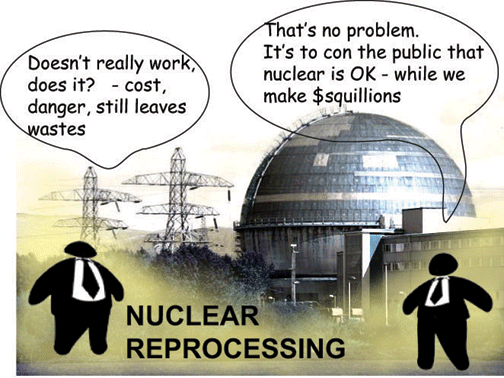
One indication of further possible delays: On September 28, 2023, Naohiro Masuda, president of JNFL, stated that the safety review of the reprocessing plant by Japan’s Nuclear Regulation Authority will be difficult to complete by the end of 2023. He nevertheless insisted that the company could still meet completion target date in 2024.
Here is a partial history of past key developments that make completion in 2024 seem unlikely:
1993: Construction starts.
1997: Initial target for completion.
2006-2008: Hot tests conducted, revealing technical problems with the vitrification process for dealing with waste produced during reprocessing.
2011: Fukushima Dai-ichi nuclear plant accident.
2012: New safety regulation standards introduced.
2022: Completion target date postponed to June 2024)
The 2022 postponement was the 26th of the Rokkasho project.
Why so many postponements? There seem to be at least five underlying reasons for the postponements for the Rokkasho plant. First, JNFL lacks relevant expertise to manage such a technologically complex and hazardous project, which is owned by nine nuclear utilities plus all other major companies associated with nuclear power in Japan. Most of the firm’s senior executives are from shareholding companies (especially utility companies) and are not necessarily experts in the field of reprocessing spent nuclear fuel.
Second, the technologies in the plant came from different companies and institutions. The management of the project is therefore technically complex.
Third, the post-Fukushima-accident nuclear facility safety licensing review process is much more stringent than what existed before the accident. For example, the Nuclear Regulation Authority told JNFL at their November 25, 2023 meeting: “JNFL should immediately make improvements because it is clear that JNFL does not understand the contents of the permit well enough to confirm the adequacy of the design of the facilities on site and has not visited the site.”
Fourth, the financial costs to JNFL of postponement are covered by the utilities’ customers, because the utilities must pay a “reprocessing fee” every year, based on the spent fuel generated during that year, whether or not the reprocessing plant operates. The system by which the Nuclear Reprocessing Organization of Japan decides the reprocessing fee is not transparent.
Fifth, the project lacks independent oversight. Even though JNFL’s estimate of the cost of building and operating the Rokkasho plant has increased several-fold, no independent analysis has been done by a third party. One reason is that some of the shareholders are themselves contractors working on the plant and have no incentive to scrutinize the reasons for the cost increases or the indefinite extension of the construction project.
After so many postponements, there is reason to wonder whether the plant will ever operate, but the government and utilities continue to insist that the plant will open soon. Even if Rokkasho were to operate, it may suffer from the same kinds of problems that marked Britain’s light-water reactor spent fuel reprocessing experience, as described in Endless Trouble: Britain’s Thermal Oxide Reprocessing Plant (THORP).
Why does Japan’s commitment to reprocessing continue?
Despite the serious and longstanding problems the Rokkasho plant has faced (and continues to face), Japanese regulators and nuclear operators have doggedly pursued the project. There are four reasons:
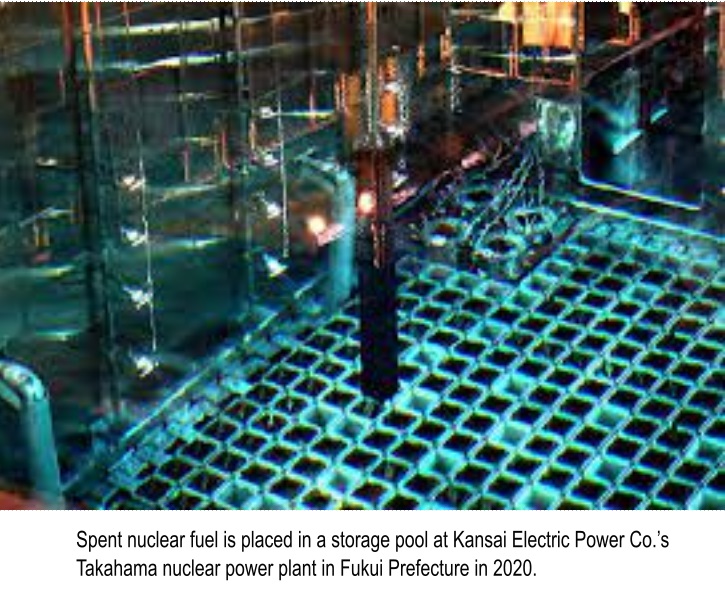
Spent fuel management. Currently, most of Japan’s spent nuclear fuel is stored in nuclear power plant cooling pools. But the pool capacities are limited, and the 3,000-ton-capacity Rokkasho spent fuel pool is also almost full. The nuclear utilities must therefore start operating the Rokkasho plant unless they can create additional spent fuel storage capacity, either on- or off-site. The Mutsu spent fuel storage facility is a candidate for additional capacity, but due to the concern that spent fuel could stay there forever, Mutsu city refuses to accept spent fuel unless the Rokkasho reprocessing plant begins to operate. The Rokkasho plant design capacity is 800 tons of spent fuel per year.
Legal and institutional commitments. Under Japan’s nuclear regulations, utilities must specify a “final disposal method” for spent fuel. The law on regulation of nuclear materials and nuclear reactors states that “when applying for reactor licensing, operators must specify the final disposal method of spent fuel” (Article 23.2.8). In addition, there was a clause that “disposal method” should be consistent with implementation of the government policy, which specified reprocessing as the disposal method. Although that clause was deleted in the 2012 revision of the law after the Fukushima accident, the Law on Final Disposal of High-Level Radioactive Waste still bans direct disposal of spent fuel. In addition, the 2016 Law on Reprocessing Fees legally requires utilities to submit reprocessing fees for all spent fuel generated every year since they stated in their applications that “final disposal method” for their spent fuel would be reprocessing.
Commitments to hosting communities. The nuclear utilities committed—albeit tacitly—to the communities hosting nuclear power plants that they would remove the spent fuel to reprocessing plants, since that was the national policy. Separately, JNFL signed an agreement with Rokkasho village and Aomori prefecture that says that if the Rokkasho reprocessing plant faces “severe difficulties,” other measures will be considered—including the return of spent fuel stored at Rokkasho to the nuclear power plants.
Local governments hosting nuclear power plants were not involved in this deal, however. They could therefore just refuse to receive spent fuel from Aomori.
In fact, after the Fukushima accident, when the government was considering amending the nuclear fuel cycle policy to include a “direct disposal option” for spent fuel in a deep underground repository, the Rokkasho village parliament (at the behind the scenes suggestion by the then JNFL president, Yoshihiko Kawai), issued a strong statement asking for “maintenance of the current nuclear fuel cycle policy.”
The statement continued that, if Japan’s fuel cycle policy changed, Rokkasho would: refuse to accept further waste from the reprocessing of Japan’s spent fuel in the UK and France; require the removal of reprocessing waste and spent fuel stored in Rokkasho; no longer accept spent fuel; and seek compensation for the damages caused by the change of the policy.
Institutional and bureaucratic inertia. In Japan, bureaucrats rotate to new positions every two or three years and are reluctant to take the risk of changing existing policies. They therefore tend to stick with past commitments. Institutional inertia becomes stronger as a project becomes bigger. The Rokkasho reprocessing project is one of the largest projects ever in Japan. Changing the project is therefore very difficult.
Will Japan’s new plutonium capping policy have any real impact? In 2018, Japan’s Atomic Energy Commission announced a new policy on “Basic Principles on Utilization of Plutonium” (see also this post). Under the new policy, the commission proposed that Japan would reduce its stockpile of separated plutonium, starting with a commitment not to increase it, and that reprocessing would take place only when a credible plan to use the separated plutonium existed.
The policy seeks to at least begin to deal with the huge stocks of plutonium Japan has amassed, both in European separation facilities (some 36.7 tons) and in Japan (10.5 tons), in anticipation of using the plutonium widely to fuel nuclear reactors—which so far has not materialized. In conjunction with the new Reprocessing Fee Law, the new plutonium policy gives the government legal authority to control the pace of reprocessing.
But it is not clear how the “capping policy” will be implemented. It is not a legally binding document, and no regulation has been introduced to control reprocessing. Utilities must submit specific plans for plutonium use to the Atomic Energy Commission for its review before reprocessing of their fuel begins. But the commission can only give advice to the government about the credibility of these plans, giving rise to questions about whether the policy will lead to sustained changes in reprocessing activity. A similar “paper rule” on plutonium has existed since 2003.
A way out. Japan could extricate itself from its reprocessing and plutonium problems in several ways. All involve significant changes in policy that would:
Find additional spent fuel storage capacity, on- or off-site. Local communities may be more willing to accept on-site dry cask storage of spent fuel if they are told that it is safer than spent fuel pool storage. For example, Saga Prefecture and Genkai-town, which host Kyushu Electric’s Genkai Nuclear Power Plant, have agreed to host dry cask storage starting in 2027. Host communities may want guarantees that spent fuel will be removed after a specified storage period. Such a guarantee could be given by the central government.
Amend the law on final disposal of high-level radioactive waste. An amendment could allow direct disposal of spent nuclear fuel in a deep underground repository. This would provide more flexibility in spent fuel management and make it easier for communities to host interim spent fuel storage.
Amend the Reprocessing Fee Law and shut down Rokkasho. An amendment to the law on reprocessing fees could allow the government to use reprocessing funds to implement a shutdown of the Rokkasho reprocessing plant. Such a plan could include payment of the debt JNFL has incurred while pursuing the Rokkasho project and funds for dry cask interim storage. This would enable the government to finally end the problem-plagued Rokkasho reprocessing plant project.
1 This Month
23-25 October – on Zoom – World BEYOND War’s annual global conferenc


Shut down the radiation-damaged Heysham nuclear reactors now
To see nuclear-related stories in greater depth and intensity – go to https://nuclearinformation.wordpress.com

Say No to NASA’s Reckless Nuclear Reactor on the Moon
Say No to NASA’s Reckless Nuclear Reactor on the Moon

-
Archives
- October 2026 (231)
- September 2026 (339)
- August 2026 (330)
- July 2026 (355)
- June 2026 (287)
- May 2026 (306)
- April 2026 (356)
- March 2026 (251)
- February 2026 (267)
- January 2026 (308)
- December 2025 (358)
- November 2025 (359)
-
Categories
- 1
- 1 NUCLEAR ISSUES
- business and costs
- climate change
- culture and arts
- ENERGY
- environment
- health
- history
- indigenous issues
- Legal
- marketing of nuclear
- media
- opposition to nuclear
- PERSONAL STORIES
- politics
- politics international
- Religion and ethics
- safety
- secrets,lies and civil liberties
- spinbuster
- technology
- Uranium
- wastes
- weapons and war
- Women
- 2 WORLD
- ACTION
- AFRICA
- Atrocities
- AUSTRALIA
- Christina's notes
- Christina's themes
- culture and arts
- Events
- Fuk 2022
- Fuk 2023
- Fukushima 2017
- Fukushima 2018
- fukushima 2019
- Fukushima 2020
- Fukushima 2021
- general
- global warming
- Humour (God we need it)
- Nuclear
- RARE EARTHS
- Reference
- resources – print
- Resources -audiovicual
- Weekly Newsletter
- World
- World Nuclear
- YouTube
-
RSS
Entries RSS
Comments RSS