Deep boreholes for nuclear waste disposal?
I’d find this more convincing if it were not so closely tied to the push for “new nukes”
Industry to Explore Decentralized Nuclear Waste Disposal. Power Mag
May 31, 2020 by Sonal Patel Efforts to explore whether it is feasible to permanently dispose of high-level nuclear waste in deep horizontal boreholes under next-generation nuclear reactor sites got a boost in late April as nuclear waste technology firm Deep Isolation signed its first contract with industry. Under the contract with independent nonprofit organization Electric Power Research Institute (EPRI), the Berkeley, California–based company will team with EPRI researchers, Southern Co., the Nuclear Energy Institute (NEI), Auburn University, and nuclear waste management consultancy J Kessler and Associates to assess how Deep Isolation’s horizontal borehole disposal solution could contribute to siting of advanced nuclear energy systems. Specifically, the team plans to explore physical site characteristics, disposal operations, safety performance analysis, and regulatory and licensing considerations. …….https://www.powermag.com/industry-to-explore-decentralized-nuclear-waste-disposal/ |
|
Resistance developing to EDF’s plan to store nuclear waste at Belleville-sur-Loire
Nuclear: EDF plans Belleville-sur-Loire to store nuclear waste, resistance is getting organized https://france3-regions.francetvinfo.fr/centre-val-de-loire/cher/nucleaire-edf-envisage-belleville-loire-stocker-dechets-nucleaires-resistance-s-organise-1835296.html EDF has not yet chosen the site that will host the project for a national radioactive waste storage center, but the Belleville-sur-Loire plant is expected. The project will be formalized before the end of 2020. The mobilization is organized.
n 2018, the Reporterre information site revealed that EDF plans to create a radioactive waste storage pool in Belleville-sur-Loire (Cher) to relay the center of La Hague which will soon reach saturation. The affair had then aroused the hostile reaction of the regional council whose president François Bonneau (PS) declared: “the Center-Loire Valley does not have vocation to become the nuclear dustbin of France! ”
Geographically, the Cher is located in the center of France and several major roads are connected near Belleville. The site also has large land reserves allowing the construction of other nuclear installations since only two reactors out of four possible have been built there. It could therefore easily welcome this vast project which, according to Sortir du nuclear, plans to store 10,000 tonnes of used fuel, including MOX, a highly radioactive product in which uranium and plutonium mix. This pool would be installed on the banks of the Loire for about a century before its hypothetical and distant dismantling.
Nationally important – to stop the dumping of radioactive mud off Cardiff coast
Western Mail 28th May 2020, A COALITION of high-profile environmental groups has urged First Minister Mark Drakeford to insist on the further testing of mud from a nuclear powerstation in Somerset before it is dumped in the Severn Estuary off Cardiff.
station were dumped in the face of significant public opposition amid
concerns that it could be radioactive and pose a threat to health. This was
denied by Natural Resources Wales, which licensed the dumping, the Welsh
Government and EDF, the French company which owns the power station.
location. A letter signed by 34 NGOs, policy analysts, experts and
campaigners, including Greenpeace UK, the leading environmentalist Sir
Jonathon Porritt, the Welsh Anti-Nuclear Alliance, the Low Level Radiation
Campaign, Nuclear Free Local Authorities and the Nuclear Consulting Group,
was yesterday delivered to First Minister Mark Drakeford.
(Wales) Act 2016, ensure that the mud sampling programme aimed at
establishing whether there are radioactive substances present is expanded,
and appoint an expert group which includes members nominated by
environmental groups when conducting the assessment of the mud.
Natural Resources Wales and the Welsh Government to take full account of
uncertainties. There is abundant evidence in the scientific literature that
uranium and plutonium particles are blown ashore and cause cancer,
leukaemia and birth defects, yet Westminster’s advisory committee COMARE
refuses to address them and EDF’s tests can’t detect them.
Level Radiation Campaign and chair of Together Against Sizewell C, said:
“The number and diversity of those who have been willing to put their
name to this letter indicates that this issue is of national importance.
The evidence points to the fact that the relationship between radioactive
dose and risk is not necessarily linear and this letter seeks recognition
of that uncertainty and a considered, science-based approach to the EDF
application.” A Welsh Government spokesman responded: “We have received
the letter and will respond in due course.”
https://www.pressreader.com/uk/western-mail/20200528/281767041433492
Huge dead nuclear reactor is a tough haul on Nevada’s roads
Decommissioned nuclear reactor heavy haul for Nevada roads, https://www.thenewstribune.com/news/business/article243115931.html, BY MARVIN CLEMONS LAS VEGAS REVIEW-JOURNAL MAY 30, 2020 A nuclear reactor vessel from Southern California’s decommissioned San Onofre Nuclear Generating Station made its way through Las Vegas by rail this week, headed to a transfer site and placement on a truck to become the heaviest object ever moved on a Nevada highway.
“By far, the biggest object ever moved on a road in the state,” Nevada Department of Transportation spokesman Tony Illia told the Las Vegas Review-Journal . “Our people have been scratching their heads for months to figure out a route that could work.”
The vessel is bound for burial at Clive, Utah, a remote site about 75 miles (121 kilometers) west of Salt Lake City. Movers and Nevada transportation crews were working to ensure it won’t damage state roads on the way.
The 770-ton nuclear reactor vessel was at the Apex Industrial Park in North Las Vegas, a transportation department heavy transport site adjacent to Interstate 15, where Illia said it will take a couple of weeks for cranes to lift it from the train car and deposit it on a 45-axle, 180-tire trailer for the trip toward Wendover, Utah.
The 300-foot-long (91.4-meter) shipment will also consist of two tractors to pull and another two tractors to push the more than 1.5-million pound load some 400 miles (643.7 kilometers) at no more than 10 mph (16.1 kph) .
It won’t move until the transportation department issues a permit 24 hours before hitting the highway, Illia said.
Opposition in Canada to nuclear waste dump on agricultural land
Opposition gathering to nuclear fuel disposal vault in South Bruce, The Sun Times, 29 May 20
|
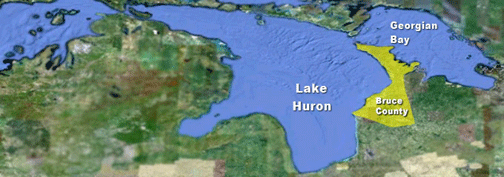
NWMO’s other preferred site is also in Ontario, in the Ignace area, northwest of Lake Superior, and feasibility studies are underway for both sites.It would take 10 years to undertake the environmental regulatory approval process. Plans call for construction to begin in 2033 and take about 10 years, with operation starting in 2043, according to the NWMO. South Bruce Mayor Bob Buckle said in January it seemed to him there was little opposition to the project, but that has changed. At an online South Bruce council meeting Tuesday, Teeswater-area beef and sheep farmer Michelle Stein spoke on behalf of a citizen’s group, Nuclear Tanks, No Thanks, which loosely formed in February. Her farm is next to one purchased by NWMO for the project northwest of Teeswater, part of the parcel of land where metal-encased spent fuel rods could be buried for thousands of years. She told council “there’s way too many risks involved with this project and they need to have a referendum to let the community decide. Like we have over 1,500 signatures that were collected before COVID,” before the virus stopped door-knocking, she said by phone Thursday. “Council just it seemed turned to ignore us and do their own thing.” She noted Buckle was elected with 1,380 votes. The group has an information website www.protectsouthbruce-nodgr.org, which includes an online petition with some 1,800 signatures, which prior to the pandemic was intended for people who aren’t local to sign……. Becky Smith, a NWMO spokeswoman said “We’re a farming community. I don’t understand why they’d want to turn us into a mining community, and then bury the world’s most radioactive waste underneath our water table,” A four-week comment period opened Wednesday and ends June 30 about whether a draft report accurately summarizes public concerns and wishes expressed during workshops held between December and February…….. n January, SON held a community vote which turned down a separate nuclear waste vault proposal, for lower- and mid-level nuclear waste, championed by Ontario Power Generation. It was to be built in Bruce County too, near the Bruce Power nuclear plant close to Kincardine. Saugeen First Nation Chief Lester Anoquot said Wednesday he has a letter from NWMO confirming the high-level nuclear waste vault requires First Nation consent. “We’re continuing dialogue. It’s kind of difficult right now, working remotely,” given the COVID-19 pandemic, he said. “It will probably go to a community vote again for acceptance or not. I think the process will mirror the one that was just conducted with the last DGR (deep geological repository) proposal.” The site falls within Saugeen Ojibway Nation’s traditional territory and its support is required for the project to proceed, Belfadhel has said.https://www.owensoundsuntimes.com/news/local-news/opposition-gathering-to-nuclear-fuel-disposal-vault-in-south-bruce |
|
Canadian farming community not happy about taking on nuclear wastes
Teeswater area debating taking on ‘forever’ nuclear waste project, Scott Miller CTV News London 25 May 20, WINGHAM, ONT. — Anja van der Vlies is worried about the future of her 1200 dairy goat operation, if Canada’s most radioactive nuclear waste is buried a couple side roads away from her family’s farm.
“It’s fairly close to where we farm. If I just look at the radius of 10 kilometres from the proposed site, so much food is being prepared here. What’s going to happen to that?”she says.
Right next door, dairy farmer Ron Groen has posted signs around his property sharing his concerns about the proposed project, just north of Teeswater.
“The waste is going to be radioactive for a million years, so basically the waste will be eternally radioactive and our kids, grandkids, 33,000 generations after us living in and around town will have to worry about this problem,” he says.
About 1200 acres of farmland north of Teeswater has been optioned by the Nuclear Waste Management Organization to potentially build Canada’s first permanent nuclear waste facility.
Over five million used nuclear fuel bundles, would be buried 500 metres under these Bruce County farms, if the community agrees to it.
Darren Ireland is one the landowners, whose agreed to option his land for the project.
“For me, it’s about five generations. This area has struggled for years to keep things going. I look at this as something, that we could be looking at for five generations, that’s huge,” he says.
The mayor of the municipality of South Bruce, Robert Buckle, also sees upside to the project…….
Signs opposing the project starting going up around the area around March. A local group has formed to keep nuclear waste out of South Bruce’s soil.
“The sooner we can stop this, the better for our community,” says van der Vlies…….
Two communities remain in the running to house Canada’s most radioactive waste. Ignace, in Northern Ontario, and the Municipality of South Bruce, north of Teeswater. One site will selected, no later, than 2023. https://london.ctvnews.ca/teeswater-area-debating-taking-on-forever-nuclear-waste-project-1.4953737
South Korea risk of power disruption, as nuclear spent fuel builds up, with storage shortage
Wolseong reactors at risk of shutdown due to spent nuclear fuel storage shortage, Pulse News, By Oh Chan-jong and Choi Mira 2020.05.22 South Korean nuclear reactors responsible for nearly a quarter of the country’s power supply at cheap price could undergo disruption due to shortage of space to store spent nuclear fuel.
Failure to begin construction to add storage facilities within 100 days would lead to total shutdown of the Wolseong 2, 3 and 4 reactors that each can generate 700 megawatts of power, equivalent to the anticipated capacity of a solar farm that the government plans to build in Saemangeum with an investment of 10 trillion won ($8.09 billion). The Wolseong 1 reactor was already unplugged last year…….. https://pulsenews.co.kr/view.php?year=2020&no=525749
President Donald Trump and his administration have no plans to use Yucca Mountain as a nuclear waste repository
Nuclear waste disposal at Yucca Mountain a no-go for Trump, Energy exec affirms,
- May 21, 2020
President Donald Trump and his administration have no plans to use Yucca Mountain as a nuclear waste repository, according to Mark Menezes, the current under secretary of energy and the president’s pick to be the next No. 2 at the U.S. Department of Energy.
“Let me be very clear about this,” Menezes said Wednesday during his U.S. Senate Energy and Natural Resources Committee nomination hearing. “The president has been very clear on this.”
The under secretary in his remarks applauded and supported Trump – who has vacillated on the matter in the past – “for taking action when so many others have failed to do so.”
The president’s fiscal year 2021 budget blueprint, trillions of dollars, included no money for Yucca Mountain and, instead, emphasized alternative, innovative approaches for the long-term, safe storage of nuclear waste and spent fuel. Previous Trump budget requests included $120 million and $116 million for the mothballed Nevada repository.
Yucca Mountain, relatively near Las Vegas, was identified decades ago as the nation’s potential nuclear storehouse. Congress in 2002 approved of the remote locale. But the project soured under President Barack Obama and has failed to gain significant traction since, much to the disappointment of some South Carolina lawmakers.
U.S. Rep. Jeff Duncan, R-S.C., has described Yucca Mountain as a national solution to a national problem; U.S. Sen. Lindsey Graham, R-S.C., has described it as a “world-class repository.”
Menezes’ Wednesday comments – at the behest of Sen. Catherine Cortez Masto, a Nevada Democrat and staunch opponent of Yucca Mountain – are a dramatic pivot away from comments he made in February before a House energy subcommittee.
What we’re trying to do is to put together a process that will give us a path to permanent storage at Yucca,” Menezes said at the time, describing the president as “frustrated” that “we have not been able to get the resources or the authorization that we need to be able to license Yucca.”
Trump that same month – days prior to the House hearing, in fact – wrote on Twitter: “Nevada, I hear you on Yucca Mountain and my Administration will RESPECT you!”
Cortez Masto on Wednesday said she wanted “to put this to bed” and give Menezes an opportunity to set things straight.
10 buildings to be demolished at Santa Susana Nuclear Field Laboratory
…The Trump administration said on Wednesday it would tear down 10 buildings at the U.S. government’s former Santa Susana Field Laboratory northwest of Los Angeles that was left contaminated by decades of nuclear, rocket fuel and liquid metal testing. The buildings set for demolition were part of a radioactive materials handling facility at the more than 2,800-acre Santa Susana site in the Ventura County foothills, which opened in the late 1940s ordered cleaned up under a court-ordered 2010 consent decree. … https://www.devdiscourse.com/article/international/1060091-reuters-us-domestic-news-summary
Earthquake close to Yucca Mountain’s selected nuclear waste site
Nevada Earthquake Raises More Doubts about Yucca Mountain by John Freeland https://blogs.agu.org/terracentral/2020/05/17/nevada-earthquake-raises-more-doubts-about-yucca-mountain/ 17 May 20, On Friday, May 15, 2020, a magnitude 6.5 earthquake rocked Nevada and portions of California. With the epicenter located about 22 miles west of Tonopah, NV, no serious damage was recorded aside from cracked highway pavement in the mostly remote surroundings, far from population centers.
Reportedly, Nevada has not seen an earthquake of this size since 1954. Worth noting, the earthquake epicenter is about 100 miles away from the Yucca Mountain Nuclear Waste Repository, as depicted on the above aerial image.
The Yucca Mountain Nuclear Repository is, by authority of legislation passed in 1982 and 1987, currently the designated single facility for permanent disposal of high level nuclear waste. A time-line of the related events briefly describes the story of the Yucca Mountain Repository. Locals see the project as a source of jobs but state-wide there is strong opposition. After all, there are no nuclear power generating facilities in Nevada. According to Rep. Ruben Kihuen (D-Nev), “if you generate nuclear waste, you should keep it in your own backyard. Don’t send it to our backyard.”
The safety of Yucca Mountain has been debated for nearly forty years. I’ve previously posted on the topic here and here. An interesting analysis of political and other factors swirling around the project is “How Safe is Yucca Mountain?”As the map to the right (USGS craton map) [on original] shows, the Yucca Mountain site is not in an ideal location in terms of tectonic activity.
Located near the boundary of the “accretionary belt” and the “deformed craton” the region has a history of volcanic activity within the past 2 million years and Nevada is ranked third in the nation for earthquakes. As Dr. Cochran points out in his paper cited above, Nevada was selected largely for political reasons. The federal government already owned the Nevada Test Site property, which had been used for years for weapons testing. It is remote, however, remote areas of the United States are often found out west where there is higher seismicity. Whether we want to or not, we as a nation will have to figure out a solution to permanent nuclear waste disposal with some 90,000 tons now in temporary storage.
So where should it go? North or South Dakota? Eastern Montana? Predicting the long-term future of seismic events appears to be dicey. As Nevada Seismological Laboratory Director Graham Kent puts it “We like to think everything’s the way it is and it doesn’t change that much,” he said. “I think the last few months we’ve learned with the pandemic that that’s not the case.”
Over 100 public interest organisations call on Canadian govt to halt decision on nuclear waste disposal
Groups ask Ottawa to press ‘pause’ on nuclear waste disposal https://www.tbnewswatch.com/local-news/groups-ask-ottawa-to-press-pause-on-nuclear-waste-disposal-2361184 ‘There’s no rules’ for evaluating an underground storage site, spokesperson says. By: Gary Rinne OTTAWA — More than 100 public interest organizations, environmental groups and others are calling on the federal government to suspend all decision-making regarding radioactive nuclear waste disposal.
In a letter to Natural Resources Minister Seamus O’Regan, they describe Canada’s current nuclear waste policy as “deficient,” saying it must be improved in consultation with the public and Indigenous peoples.
Among the signatories are numerous groups in northern Ontario, including Thunder Bay-based Environment North and Keep Nuclear Waste Out of Northwestern Ontario.
The letter follows a February report from the International Atomic Energy Agency which recommended that the government “enhance” its existing radioactive waste management policy.
The IAEA said the policy framework “does not encompass all the needed policy elements nor a detailed strategy” required for long-term nuclear waste management.
The signatories say their request is urgent because the regulator, the Canadian Nuclear Safety Commission, is pressing ahead with licensing decisions on a number of radioactive waste projects.
“Fearing Canada’s deficient radioactive waste framework will imprint itself on decisions affecting the health and safety of future generations and the environment, signees urged Canada to provide leadership, and establish sufficient guidance and federal policy,” they said in a statement Tuesday.
The groups also want Ottawa to establish objectives and principles to underly a nuclear waste policy, and that the government identify “the problems and issues exposed by existing and accumulating radioactive waste.”
The Nuclear Waste Management Organization is currently studying potential future underground nuclear waste storage sites in the Ignace area and South Bruce in southern Ontario.
Brennan Lloyd of North Bay-based Northwatch said NWMO’s search for a future repository is “part and parcel” of concerns about Canada’s overall approach to managing radioactive waste issues.
Nuclear waste disposal isn’t the only pressing matter, Lloyd said, but “we have lots of concerns about the Nuclear Waste Management Organization, their operation…going back to 2002 when the Nuclear Waste Fuels Act allowed the industry to create the NWMO.”
She added that “the lack of a solid set of rules around radioactive waste, we believe, does affect how the NWMO has conducted itself, but even more importantly it may affect the review process if the NWMO ever actually arrives at a site that they can in some way present as having the support of a host community.”
According to Lloyd, there are no rules as to how such a proposal would be evaluated.
She said that in 1996, the federal government presented a Radioactive Waste Policy Framework that’s less than a page long, and it’s problematic that “almost 25 years later, that’s still all we have in the way of real policy, strategy, rules around radioactive waste at the national level.”
Canadian Nuclear Safety Commission staff have recently proposed regulatory documents, Lloyd said, “which are really very general descriptions of how they might go about issuing a licence for various activities. And they really lack rigour.”
She said two of the five regulatory documents the CNSC plans to bring forward next month deal directly with nuclear waste burial.
“One is around how you would assess the long-term performance of a deep geological repository, and one is about how you would characterize a site that was being considered. And both of them are just incredibly weak documents,” Lloyd maintained.
“The dividing line is between ‘shall’ and ‘should.’ The CNSC documents are all ‘should’ or ‘may.’ Which means there’s no rules.”
Lloyd and the other signatories to the letter ask Minister O’Regan to instruct the CNSC to stop developing radioactive waste management and nuclear decommissioning documents until new, overarching policies and strategies are in place.
Massive deregulation of America’s radioactive wastes
Environmentalists Fault Sending ‘Very Low Level’ Nuclear Waste to Landfills https://www.nbcbayarea.com/investigations/environmentalists-fault-sending-very-low-level-nuclear-waste-to-landfills/2292805/ By Jaxon Van Derbeken,-20 May 20 The federal Nuclear Regulatory Commission has proposed a rule “reinterpretation” that would allow commercial landfills to start taking in low level radioactive waste, in lieu of the four currently licensed disposal facilities nationwide.
Environmentalists were quick to attack the proposed rule change by the U.S. Nuclear Regulatory Commission, saying that under the plan, the public would not be automatically notified when a landfill qualifies for a waiver of the current regulations.
This is the most massive deregulation of radioactive waste in American history,” said Daniel Hirsch, head of an environmental watchdog group and former director of the Program on Environmental and Nuclear Policy. “And they are doing it under the cover of the coronavirus pandemic, when everyone’s attention is rightly focused on other things.”
Under Proposed Rule No. 2020-0065, what the commission considers a “reinterpretation” of existing rules, hundreds of landfills nationwide could submit applications for an exemption of the current rules requiring that all low-level nuclear waste be sent to either Washington state, Utah, Texas or South Carolina.
Environmentalists were quick to attack the proposed rule change by the U.S. Nuclear Regulatory Commission, saying that under the plan, the public would not be automatically notified when a landfill qualifies for a waiver of the current regulations.
“This is the most massive deregulation of radioactive waste in American history,” said Daniel Hirsch, head of an environmental watchdog group and former director of the Program on Environmental and Nuclear Policy. “And they are doing it under the cover of the coronavirus pandemic, when everyone’s attention is rightly focused on other things.”
Under Proposed Rule No. 2020-0065, what the commission considers a “reinterpretation” of existing rules, hundreds of landfills nationwide could submit applications for an exemption of the current rules requiring that all low-level nuclear waste be sent to either Washington state, Utah, Texas or South Carolina.
To qualify for an exemption, a landfill would need to submit an analysis of the types of waste they would receive and that they could meet radiation exposure limits.
Hirsch said that under the proposed regulatory language, private landfills wouldn’t have to notify neighbors.
“You could be living next to a nuclear dump, and never even know it,” he said.
The NRC contends its plan is safe. In a statement, the commission said it intends to relax regulations for disposing of “very low level” waste, such as the concrete from decommissioned nuclear reactors. Such waste, the commission says, poses little risk to the public, while allowing for reduced costs and lower radiation exposure to drivers while they are transporting it.
Critics, like Jeff Ruch, West Coast head of PEER, Public Employees for Environmental Responsibility, say there aren’t nearly enough safeguards.
“If you get the exemption, you could put it in your backyard,” he said. “There’s no tracing process, there’s no monitoring — this, in essence exempts them from any form of regulatory or public health safeguard, and that’s the concern.”
The NRC told us that companies that are disposing of the radioactive materials, along with participating landfills, would share the responsibility of complying with the rules under the exemption system, adding: “We would not allow such disposals if we felt public health and safety and the environment would not be protected.”
Disclosure aside, critics said they are concerned that the restrictions for landfills would not be as strict as the ones in place for the four licensed facilities. Under the proposed rules, residents near newly participating landfills could be exposed to as much as two and half times the level regulatorily allowed around the four licensed disposal sites, Hirsch said.
The commission said that the proposed permitted landfill exposure level would be the same as allowed around decommissioned nuclear plants.
The nuclear industry has yet to weigh in on the proposal, but the deadline for public comment has been extended to July. The five member commission is then expected to take up the matter.
If the plan is approved, it could mean dramatically reduced costs of disposing contaminated soil around San Francisco’s old Hunters Point Naval Shipyard, which is slated for development. Clearing that site could involve hauling away as many as 100,000 truckloads of contaminated soil. Right now, the soil in the area is being retested following allegations of wrongdoing by the previous testing firm, Tetra Tech, that the company denies.
Dismantling of Norway’s nuclear research reactors – up to 25 years, about $billion
Norwegian reactor dismantling to cost almost USD2 billion, WNN , 18 May 2020 The decommissioning of Norway’s shut down research reactors at Halden and Kjeller will cost around NOK20 billion (USD1.96 billion) and take 20-25 years, according to a report commissioned by the Ministry of Trade and Industry. The report by Atkins and Oslo Economics mainly confirms assessments from the Institute for Energy Technology (IFE) and risk management and quality assurance consultants DNV GL that were made in 2019. It estimates that demolition of facilities and restoration of the areas will cost around NOK7 billion. There will also be costs of around NOK13 billion for the treatment of used fuel and the storage of radioactive waste. However, it notes there is “considerable uncertainty” around these costs…….
“There have been limited reactor operations in Norway, but we have complicated facilities and waste that will cost a lot,” said Minister of Industry Iselin Nybø. “The report shows how costly and lengthy that dismantling can be. The proposed measures will help to make the cleanup as efficient as possible.
“We will clean up to protect ourselves from harmful consequences for people and the environment from the radiation from this past industry,” Nybø added. “The investigation is part of the puzzle that is now being put in place to ensure a safe and effective cleanup. It will be considered thoroughly and planned to be addressed by the government in the autumn of 2020.”
Norway’s two research reactors – the nuclear fuel and materials testing reactor at Halden and the JEEP-II neutron scattering facility at Kjeller – were declared permanently shut down in June 2018 and April 2019, respectively. Their ownership and responsibility for them will move to Norwegian Nuclear Decommissioning (NND) from IFE……https://www.world-nuclear-news.org/Articles/Dismantling-of-Norwegian-reactors-to-cost-almost-U
Coalition pursues extra $7.25B for DOE nuclear cleanup, job creation
|
Coalition pursues extra $7.25B for DOE nuclear cleanup, job creation, Aiken Standard, By Colin Demarest cdemarest@aikenstandard.com, May 18, 2020
A bloc of local governments and nuclear industry, labor and community groups are pressing Congress to provide a one-time multibillion-dollar boost to the U.S. Department of Energy Office of Environmental Management, the remediation-focused Savannah River Site landlord. The organizations and officials – including Citizens For Nuclear Technology Awareness Executive Director Jim Marra and Savannah River Site Community Reuse Organization President and CEO Rick McLeod – sent a letter Friday to U.S. House and Senate leadership “strongly” supporting a $7.25 billion funding injection, arguing it “will help reignite the national economy,” help revive small businesses and create thousands of new jobs despite the novel coronavirus crisis…….. https://www.aikenstandard.com/coronavirus/coalition-pursues-extra-7-25b-for-doe-nuclear-cleanup-job-creation/article_9261d03c-991a-11ea-a5c2-87c9bf5d9ecf.html The requested money could, too, speed Environmental Management’s nuclear waste cleanup missions and be used to fix ailing infrastructure – some of which dates back to the Cold War – at sites across the country. That’s a “rare” opportunity, reads the letter, which prominently features the Energy Communities Alliance logo and its chairman’s signature. |
|
Removal of Fort Belvoir’s SM-1 nuclear reactor to proceed after Army finalizes environmental assessment
That is according to USACE Project Manager Brenda Barber, who provided an update by email to SM-1 stakeholders on May 18, 2020.
Following a public comment period, Barber announced that the SM-1 project’s Environmental Assessment (EA) and Finding of No Significant Impact (FNSI) have been finalized and published online:……..
“The team is now focused on completing the Decommissioning Planning in preparation for awarding a decommissioning contract,” Barber stated.
“The project team still anticipates awarding a decommissioning contract by September 2020 with mobilization work on site beginning in early 2021.”……….
Barber noted that the coronavirus (COVID-19) pandemic has not had any immediate significant impact on the project schedule, since most of the work at this administrative phase is being done virtually. The site remains secure and environmental and radiological monitoring and inspections continue.
For information about the project, visit: nab.usace.army.mil/Missions/Environmental/SM-1
Questions and comments can continue to be sent to the project’s corporate communications team by emailing Brenda.M.Barber@usace.army.mil or calling (410) 375-4565 https://forthuntherald.com/removal-of-fort-belvoirs-sm-1-nuclear-reactor-to-proceed-after-finalizing-environmental-assessment/
-
Archives
- September 2026 (62)
- August 2026 (330)
- July 2026 (355)
- June 2026 (287)
- May 2026 (306)
- April 2026 (356)
- March 2026 (251)
- February 2026 (267)
- January 2026 (308)
- December 2025 (358)
- November 2025 (359)
- October 2025 (375)
-
Categories
- 1
- 1 NUCLEAR ISSUES
- business and costs
- climate change
- culture and arts
- ENERGY
- environment
- health
- history
- indigenous issues
- Legal
- marketing of nuclear
- media
- opposition to nuclear
- PERSONAL STORIES
- politics
- politics international
- Religion and ethics
- safety
- secrets,lies and civil liberties
- spinbuster
- technology
- Uranium
- wastes
- weapons and war
- Women
- 2 WORLD
- ACTION
- AFRICA
- Atrocities
- AUSTRALIA
- Christina's notes
- Christina's themes
- culture and arts
- Events
- Fuk 2022
- Fuk 2023
- Fukushima 2017
- Fukushima 2018
- fukushima 2019
- Fukushima 2020
- Fukushima 2021
- general
- global warming
- Humour (God we need it)
- Nuclear
- RARE EARTHS
- Reference
- resources – print
- Resources -audiovicual
- Weekly Newsletter
- World
- World Nuclear
- YouTube
-
RSS
Entries RSS
Comments RSS