Concern growing over plan for high level nuclear waste storage in West Texas
High Level Nuclear Waste Storage Facility in West Texas One Step Closer, Live, By Sonia Ramirez-Muñoz | May. 8, 2020 ANDREWS, TX – West Texas is becoming a hotbed for nuclear waste storage after the Nuclear Regulatory Commission released a report that recommended the approval of radioactive waste to be stored in Andrews County.
According to CBS7, Waste Control Specialists, which currently has a facility near the Texas-New Mexico border, and a joint venture called Storage Partners want to bring the country’s high-level nuclear waste to the Permian Basin…….
ANDREWS, TX – West Texas is becoming a hotbed for nuclear waste storage after the Nuclear Regulatory Commission released a report that recommended the approval of radioactive waste to be stored in Andrews County.
According to CBS7, Waste Control Specialists, which currently has a facility near the Texas-New Mexico border, and a joint venture called Storage Partners want to bring the country’s high-level nuclear waste to the Permian Basin.
Andrews County residents are concerned about becoming the new home for nuclear waste.
“Very dangerous,” said Elizabeth Padilla with the group ‘Save Andrews County’. “We’re talking about the nation’s spent fuel from nuclear reactors across the country. The waste that nobody wants. The high radioactive waste.”
Cities like Midland could also be impacted as the transport of the waste could go through the downtown area as well as Texas cities through which the nuclear waste will be transported through.
“Midland, in particular, it would definitely come right through the downtown area,” said Karen Hadden with SEED Coalition. “This material has to be isolated from living things for a million years, and there is no way that a facility in Texas, the one that’s being looked at, could do that.”
The Nuclear Regulatory Commission is now hosting public meetings where community members can provide public comment on the draft. The final environmental impact statement is scheduled to be released in May of next year. https://sanangelolive.com/news/texas/2020-05-08/high-level-nuclear-waste-storage-facility-west-texas-one-step-closer
Time extended by 60 days for comment on planned New Mexico nuclear waste dump
 US Regulators Grant More Time to Consider Nuclear Fuel Plan https://www.usnews.com/news/best-states/new-mexico/articles/2020-05-05/us-regulators-grant-more-time-to-consider-nuclear-fuel-plan
The public will have more time to comment on an environmental review related to a proposed multibillion-dollar complex in New Mexico that would store spent nuclear fuel from commercial power plants around the U.S. The Nuclear Regulatory Commission has granted a request by members of New Mexico’s congressional delegation, providing another 60 days for the process. By Associated Press, Wire Service Content May 5, 2020,
ALBUQUERQUE, N.M. (AP) — The public will have more time to comment on an environmental review related to a proposed multibillion-dollar complex in New Mexico that would store spent nuclear fuel from commercial power plants around the U.S
The Nuclear Regulatory Commission recently granted a request by members of New Mexico’s congressional delegation, providing another 60 days for the process. The delegation had argued for more time and a delay of any public meetings given the health emergency that has resulted from the coronavirus outbreak.
The delegation said in a statement that full public participation is particularly important for projects involving nuclear waste.
Any proposal to store commercial spent nuclear fuel raises a number of health, safety and environmental issues, including potential impacts on local agriculture and industry, issues related to the transportation of nuclear waste, and disproportionate impacts on Native American communities,” they said.
The commission plans to hold a nationwide webinar and five public meetings in New Mexico during the revised public comment period.
Commission Chairwoman Kristine Svinicki said in a recent letter to the delegation that as the health emergency evolves, staff will continue to re-evaluate plans for public participation and will consider whether additional extensions are warranted.
In a preliminary recommendation, the commission favors approval of a license for Holtec International to build the facility in southeastern New Mexico.
The New Jersey-based company is seeking a 40-year license to build what it has described as a state-of-the-art complex near Carlsbad. The first phase calls for storing up to 8,680 metric tons of uranium, which would be packed into 500 canisters. Future expansion could make room for as many as 10,000 canisters of spent nuclear fuel.
Holtec has said the U.S. currently has more than 80,000 metric tons of used nuclear fuel in storage at dozens of sites around the country and the inventory is growing at a rate of about 2,000 metric tons a year.
Gov. Michelle Lujan Grisham and other elected officials are among those with concerns about the potential environmental effects and the prospects of New Mexico becoming a permanent dumping ground for spent nuclear fuel. They point to the lack of a permanent plan by the federal government phase calls for storing up to 8,680 metric tons of uranium, which would be packed into 500 canisters. Future expansion could make room for as many as 10,000 canisters of spent nuclear fuel.
Holtec has said the U.S. currently has more than 80,000 metric tons of used nuclear fuel in storage at dozens of sites around the country and the inventory is growing at a rate of about 2,000 metric tons a year.
Gov. Michelle Lujan Grisham and other elected officials are among those with concerns about the potential environmental effects and the prospects of New Mexico becoming a permanent dumping ground for spent nuclear fuel. They point to the lack of a permanent plan by the federal government for dealing with the waste piling up at power plants around the country.
The governor and others also have questions about whether the facility would compromise oil and gas development in the Permian Basin, one of the world’s most prolific energy production regions.
The NRC staff’s preliminary recommendation states there are no environmental impacts that would preclude the commission from issuing a license for environmental reasons.
Indian Point nuclear power station – Unit 2 permanently closed
|
Indian Point 2 permanently closes, Nuclear Engineering International 4 May 2020 Unit 2 at the US Indian Point nuclear power plant closed on 30 April as part of a deal reached in January 2017 between Entergy, the state of New York and the environmental group Riverkeeper. The plant’s two pressurised water reactor (PWRs) generated a quarter of the electricity used in New York City and Westchester County in 2017.Indian Point 2, with a net generating capacity of 998MWe, began commercial operation in 1974. Indian Point 3, a 1030MWe unit began operating in 1976 and is due to retire in April 2021. New natural gas power plants and efficiency measures are expected to up the slack.
Entergy has agreed to sell the plant to Holtec International, a New Jersey-based decommissioning firm. But the licence transfer, which is pending Nuclear Regulatory Commission approval, will take place only after the plant closes in 2021…… Entergy said in a statement that it is committed to continued operation of the nuclear fleet in Louisiana, Arkansas and Mississippi. It shut down Pilgrim in Massachusetts last year and plans to close the Palisades nuclear plant in Michigan in 2022. Both these facilities will be decommissioned by Holtec, through its affiliate Comprehensive Decommissioning International…..https://www.neimagazine.com/news/newsindian-point-2-permanently-closes-7904262
|
|
Bahrain’s new environmental bill – strict laws against nuclear waste dumping
New environmental bill referred to Parliament
Beyond Nuclear and other groups challenge Holtec’s nuclear waste plan for New Mexico
Carlsbad Current Argus 2nd May 2020, A proposed nuclear waste repository near Carlsbad and Hobbs proceeded through the federal licensing process despite protests from environmental
groups who questioned the legality of the project. Holtec International applied to the Nuclear Regulatory Commission (NRC) for a license to build and operate a facility that would temporarily store spent nuclear fuel rods in a remote location of southeast New Mexico while a permanent repository is developed.
The consolidated interim storage facility was challenged by Beyond Nuclear and other organizations who questioned Holtec’s application for suggesting the U.S. Department of Energy could take ownership of the waste.
To store surplus plutonium, USA’s Waste Isolation Pilot Plant will have to be enlarged
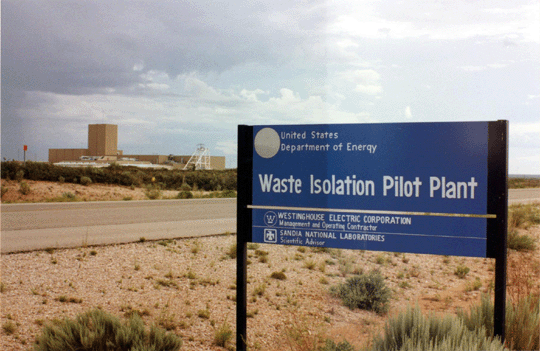 WIPP expansion needed for proposed disposal of surplus plutonium at nuclear waste repository Adrian Hedden, Carlsbad Current-Argus May 1, 2020 Numerous concerns would have to be addressed in the U.S. Department of Energy’s proposed plan to dispose of surplus plutonium at the Waste Isolation Pilot Plant for the program to be successful, per a DOE-commissioned report from the National Academies of Sciences (NAS).The organization was commissioned by the DOE to study its plan to dilute and dispose of the plutonium at WIPP over 30 years at a cost of about $18.2 billion an alternative to the stalled mixed-oxide program that would have seen the nuclear waste converted into fuel. WIPP expansion needed for proposed disposal of surplus plutonium at nuclear waste repository Adrian Hedden, Carlsbad Current-Argus May 1, 2020 Numerous concerns would have to be addressed in the U.S. Department of Energy’s proposed plan to dispose of surplus plutonium at the Waste Isolation Pilot Plant for the program to be successful, per a DOE-commissioned report from the National Academies of Sciences (NAS).The organization was commissioned by the DOE to study its plan to dilute and dispose of the plutonium at WIPP over 30 years at a cost of about $18.2 billion an alternative to the stalled mixed-oxide program that would have seen the nuclear waste converted into fuel.
The Academies convened a committee to study the dilute-and-dispose method in November 2017, releasing an interim report a year later that noted WIPP did not have the storage space to hold about 48 metric tons (MT) the DOE hoped to dispose of. The final report was released on Thursday, and renewed concerns for storage space, along with the method of disposal’s lack of approval under the Plutonium Management and Disposition Agreement (PMDA) – a deal struck in 2000 between the U.S. and Russia to each dispose of 34 MT of plutonium through jointly-approve methods. The PMDA does allow for each country to present alternatives, with such approval for the dilute-and-dispose method pending. Robert Dynes, a physics professor and former president of the University of California who chaired the NAS’ committee also pointed to challenges in scaling up the program, as it was proven viable only on a prototype scale. “Gaps do exist in implementation challenges. This is not trivial,” Dynes said. “The implementation challenges that are not addressed would result in even longer implementation times and costs.” He also pointed to the project’s reliance on WIPP as the nation’s only deep geological repository in operation or production that could hold the waste.
“It’s the nation’s only repository,” Dynes said. “Without access to WIPP, the plan cannot be completed. There’s a lot of pressure on WIPP.” Andrew Orrell, a committee member from Idaho National Laboratory said disposing of the plutonium would change the nature of WIPP, although it would be diluted so as to confirm with WIPP’s waste criteria, and the DOE must maintain public transparency and work closely with the State of New Mexico to honor the facility’s “social contract” if the project moved forward. “The committee felt there was a vulnerability in the social contract between the DOE and State of New Mexico,” Orrell said. “The committee made several recommendations encouraging greater transparency on the entire plan to dispose of this plutonium at WIPP.” Orrell also said there was likely to be competition for space at WIPP, as plutonium pit production was recently increased at Los Alamos National Laboratory. This could be a challenge for WIPP’s capacity, Orrell said, as specified in the federal Land Withdrawal Act (LWA). “Meeting or exceeding the Land Withdrawal Act is pretty easy to foresee,” he said. “The remaining space in WIPP is limited and could be oversubscribed.” This could be a challenge for WIPP’s capacity, Orrell said, as specified in the federal Land Withdrawal Act (LWA). “Meeting or exceeding the Land Withdrawal Act is pretty easy to foresee,” he said. “The remaining space in WIPP is limited and could be oversubscribed.”….. https://www.currentargus.com/story/news/local/2020/05/01/wipp-expansion-needed-proposed-nuclear-waste-disposal/3035582001/ |
|
|
Nuclear reactor pressure vessel to be shipped by rail to Utah, from Sanonofre
The reactor pressure vessel for Unit 1, the first of three reactors on site, will get a permanent home in Utah, By TERI SFORZA | tsforza@scng.com | Orange County Register, May 1, 2020 The original plan, nearly 20 years ago, was to plop the retired nuclear reactor pressure vessel on a barge and ship it off — via the Panama Canal or all the way around the tip of South America — to a final resting place in South Carolina.But there were strong objections to transporting the huge metal shell that way. After all, atoms had actually been split inside it. And so the giant, but empty, heart of San Onofre Nuclear Generating Station’s Unit 1 was packed away in a huge steel cylinder in 2002. The cylinder was filled with grout for shielding against radiation. It was sealed, and has been stored at the plant ever since.
Now — as serious tear-down work gets under way on Units 2 and 3 — the heart of long-ago-dismantled Unit 1 is finally slated to leave San Onofre forever.
Operator Southern California Edison is preparing to ship Unit 1’s reactor pressure vessel to a licensed disposal facility in Clive, Utah, which is owned by Energy Solutions, one of San Onofre’s decommissioning contractors. It will have company: San Onofre’s retired steam generators were shipped to Clive in 2012.
Though officials can’t get too specific on precisely when or how the vessel will go — for safety reasons — they’ve been preparing a rail spur to haul heavy components off site.
The reactor vessel is considered low-level waste, the least hazardous of the Nuclear Regulatory Commission’s radioactive waste classifications. Contaminated cleaning supplies, used disposable protective clothing and reactor parts are other examples of low-level waste.
How can the crucible for nuclear reactions be low-level waste? The most radioactive parts within it were removed, cut up, and stored with higher-level waste on site, said John Dobken, a spokesman for Edison. What’s left is Cobalt-60, which has a half-life of about five years.
Unit 1 was retired in 1992, and the reactor vessel has been packaged for 18 years, so it has gone through about five half-lives, reducing its radioactivity, Dobken said.The contact dose rate for the vessel package is less than 0.1 millirem an hour, which is 500 times below the Department of Transportation limit for these types of shipments, Edison said in a primer on the move. For comparison, a chest X-ray provides a dose of 10 millirem.
Since this is low-level waste, it was never part of Edison’s contract with the federal government requiring the U.S. Department of Energy to haul away high-level waste by 1998 in exchange for payments into the Nuclear Waste Fund.
The federal government’s paralysis on finding a permanent home for the nation’s high-level nuclear waste is why 40 years’ worth of it remains stuck on site, generating sharp controversy.
While critics have called on Edison to cease decommissioning work at San Onofre during the lock-down, it proceeds with “pandemic protocols” in place, Dobken said. Everyone on site must wear a mask and practice social distancing.
———————————–
By the numbers: The package weighs 770 tons, or more than 1.5 million pounds. Inside is the Unit 1 reactor pressure vessel, pieces of radioactive metal and grout for radiation shielding. It’s a 2-inch-thick carbon steel cylindrical canister with a 3-inch-thick carbon steel liner; top and bottom plates are 3 inches thick. The canister is 38.5 feet long and 15.5 feet in diameter.
With international finance help, Russia is dismantling its most radioactive ship
|
Russia’s most radioactive ship reaches dismantlement milestone The Lepse service ship, once the most glaring nuclear hazard in the Murmansk harbor, will now be emptied of nearly all of its radioactive cargo by the end of this year, Russian nuclear authorities have said. Bellona April 29, 2020 by Anna Kireeva, Charles DiggesThe Lepse service ship, once the most glaring nuclear hazard in the Murmansk harbor, will now be emptied of nearly all of its radioactive cargo by the end of this year, Russian nuclear authorities have said.
During its career as a refueling vessel for Soviet era nuclear icebreakers, the Lepse amassed 639 spent nuclear fuel assemblies, some of them damaged, creating an environmental danger that bobbed neglected at a Murmansk dock for decades. After it was taken out of service in 1988, the Lepse was left to languish at Atomflot, the headquarters of Russia’s nuclear icebreaker fleet, where it posed a severe radioactive hazard to Murmansk and its 300,000 residents. Over the course of more than two decades, Bellona worked with Russian officials ensure the vessel’s safe disposal. Now those plans are coming to fruition as officials say 97 percent of the nuclear fuel loaded into the Lepse’s holds will be emptied at the Nerpa Shipyard, to where the vessels was finally moved in 2012 for its painstaking dismantling…… All told, the Lepse participated in 14 refueling operations aboard the Lenin as well as the nuclear icebreakers the Sibir and the Arktika. In 1981, the vessel was again retrofitted, this time to so it could accommodate irradiated machine parts and other radioactive waste the nuclear icebreakers needed to offload. The Lepse’s history took a darker when it was used to help dump radioactive waste in the Kara and Barents Seas, contributing to Russia’s Cold War heritage of f nuclear and radiological hazards strewn across the Arctic sea floor, the extent of which is only beginning to be understood. It was in the early 1990s that the Lepse and the dangers it posed caught Bellona’s eye, and the organization mobilized the European Union to allocate funding toward removing it from Murmansk harbor and safely dismantling it. The boat was finally towed from Atomflot to the Nerpa naval shipyard in September 2012, after more than a decade of strenuous and often tedious negotiations among Bellona, the Russian government and European financial institutions – most notably the European Bank of Reconstruction and Development – to ensure the Lepse’s safe disposal. The EBRD-managed program is financed by the NDEP Nuclear Window, an international fund with contributions from Belgium, Canada, Denmark, the European Union, Finland, France, Germany, the Netherlands, Norway and the UK. The bank is also helping finance the safe removal of some 22,000 spent nuclear fuel assemblies from Andreyeva Bay, a former technical base used to service Soviet Northern Fleet Submarines. https://bellona.org/news/nuclear-issues/2020-04-russias-most-radioactive-ship-reaches-dismantlement-milestone |
|
|
Indian Point nuclear power station’s first step to closure, as one reactor shuts down
 Nuclear power plant north of New York City to start shutdown, Daily Journal ,By MARY ESCH Associated Press, Apr 29, 2020
ALBANY, N.Y. (AP) — With the push of a red button, one of the two operating nuclear reactors at the Indian Point Energy Center along the Hudson River north of New York City will shut down Thursday night as federal regulators consider the plant owner’s proposal to sell it to a company that plans to demolish it by the end of 2033 at a projected cost of $2.3 billion.
The 1,020-megawatt Unit 2 reactor will close for good Thursday and 1,040-megawatt Unit 3 will close in April 2021 as part of a deal reached in January 2017 between Entergy Corp., the state of New York and the environmental group Riverkeeper. The Unit 1 reactor shut down in 1974, 12 years after the plant began operation in the Westchester County town of Buchanan……
Democratic Gov. Andrew Cuomo had long sought the shutdown, saying the plant 24 miles north of Manhattan posed too great a risk to millions of people who live and work nearby. Riverkeeper noted Hudson River fish kills, soil and water contamination, recurrent emergency shutdowns and vulnerability to terrorist attacks. Entergy cited low natural gas prices and increased operating costs as key factors in its decision to close Indian Point and exit the merchant power business.
A year ago, Entergy announced a deal to sell the 240-acre facility to the New Jersey-based decommissioning firm Holtec International, which has submitted a dismantling plan to the Nuclear Regulatory Commission. At a public information session held online last week, NRC representatives said the commission is reviewing Holtec’s financial and technical qualifications, as well as public comments, before approving the license transfer.
According to the NRC, Indian Point will join 13 other nuclear power plants across the United States that have begun the decades-long process of decommissioning, which dismantles a facility to the point that it no longer presents a radioactive danger.
Under the decommissioning process, spent fuel rod assemblies are initially placed in large pools of water where the hot fuel is cooled for at least two years. Then the spent fuel is transferred into giant steel and concrete cylinders that stay at the site unless or until a national nuclear waste storage facility is created……..
A 2017 analysis by the New York Independent System Operator, which runs the state’s electrical grid, concluded that Indian Point’s closure won’t impair the grid’s ability to keep New York City’s lights on. ……https://www.smdailyjournal.com/news/state/nuclear-power-plant-north-of-new-york-city-to-start-shutdown/article_62453a0b-19d7-5baf-9dfc-a7db2d15710f.html
Canada on verge of investing in plutonium
Gordon Edwards <ccnr@web.ca>\, 26 Apr 2020, It seems that the two SMNR (Small Modular  Nuclear Reactor) entrepreneurs in New Brunswick (Canada), along with other nuclear “players” worldwide, are trying to revitalize the “plutonium economy” — a nuclear industry dream from the distant past that many believed had been laid to rest because of the failure of plutonium-based breeder reactors almost everywhere – e.g. USA, France, Britain, Japan …
UK govt again to try “astronomically expensive” plutonium reprocessing nuclear reactors
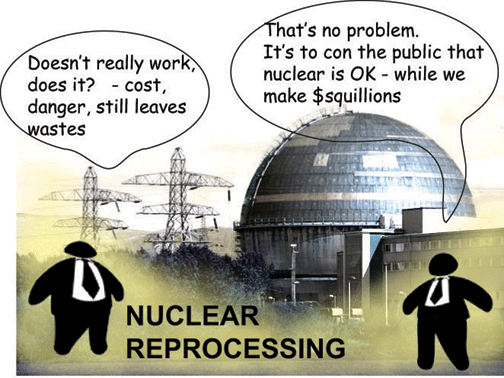 Westminster relaunches plutonium reactors despite ‘disastrous’ experience, The National, 26 April, 20 By Rob Edwards This article was brought to you by The Ferret.
THE UK Government is trying to resurrect plutonium-powered reactors despite abandoning a multi-billion bid to make them work in Scotland.
Documents released by the UK Office for Nuclear Regulation (ONR) under freedom of information law reveal that fast reactors, which can burn and breed plutonium, are among “advanced nuclear technologies” being backed by UK ministers.
Two experimental fast reactors were built and tested at a cost of £4 billion over four decades at Dounreay in Caithness. But the programme was closed in 1994 as uneconomic after a series of accidents and leaks.
Now ONR has been funded by the Department for Business, Energy and Industrial Strategy (BEIS) in London to boost its capacity to regulate new designs of fast reactors, along with other advanced nuclear technologies.
Campaigners have condemned the moves to rehabilitate plutonium as a nuclear fuel as “astronomically expensive”, “disastrous” and “mind-boggling”. They point out that it can be made into nuclear bombs and is highly toxic – and the UK has 140 tonnes of it…….
ONR released 23 documents about advanced nuclear technologies in response to a freedom of information request by Dr David Lowry, a London-based research fellow at the US Institute for Resource and Security Studies. They include redacted minutes and notes of meetings from 2019 discussing fast reactors, and are being published by The Ferret.
One note of a meeting in November 2019 shows that ONR attempted to access a huge database on fast reactors maintained by the UK Government’s National Nuclear Laboratory (NNL) in Warrington, Cheshire…..
Two companies have so far won funding under this heading to help develop fast reactors that can burn plutonium. The US power company, Westinghouse, is proposing lead-cooled fast reactors, while another US company called Advanced Reactor Concepts wants to build sodium-cooled fast reactors.
In November 2019 BEIS also announced an £18 million grant to a consortium led by reactor manufacturer, Rolls Royce, to develop a “small modular reactor designed and manufactured in the UK capable of producing cost effective electricity”.
According to Dr Lowry, fast reactors would require building a plutonium fuel fabrication plant. Such plants are “astronomically expensive” and have proved “technical and financial disasters” in the past, he said.
“Any such fabrication plant would be an inevitable target for terrorists wanting to create spectacular iconic disruption of such a high profile plutonium plant, with devastating human health and environmental hazards.”
Lowry was originally told by ONR that it held no documents on advanced nuclear technologies. As well as redacting the 23 documents that have now been released, the nuclear safety regulator is withholding a further 13 documents as commercially confidential – a claim that Lowry dismissed as “fatuous nonsense”.
THE veteran nuclear critic and respected author, Walt Patterson, argued that no fast reactor programme in the world had worked since the 1950s. Even if it did, it would take “centuries” to burn the UK’s 140 tonne plutonium stockpile, and create more radioactive waste with nowhere to go, he said.
“Extraordinary – they never learn do they? I remain perpetually gobsmacked at the lobbying power of the nuclear obsessives,” he told The Ferret. “The mind continue to boggle.”
The Edinburgh-based nuclear consultant, Pete Roche, suggested that renewable energy was the cheapest and most sustainable solution to climate change. “The UK Government seems to be planning some kind of low carbon dystopia with nuclear reactors getting smaller, some of which at least will be fuelled by plutonium,” he said.
“The idea of weapons-useable plutonium fuel being transported on our roads should send shivers down the spine of security experts and emergency planners.”
Another nuclear expert and critic, Dr Ian Fairlie, described BEIS’s renewed interest in fast reactors as problematic. “Experience with them over many years in the US, Russia, France and the UK has shown them to be disastrous and a waste of taxpayers’ money,” he said.
This is not the view taken by the UK Nuclear Industry Association, which brings together nuclear companies. It wants to see the UK’s plutonium being used in reactors rather than disposed of as waste……
“The Scottish Government remains opposed to new nuclear power plants in Scotland,” a spokesperson told The Ferret. “The Scottish Government believes our long term energy needs can be met without the need for new nuclear capacity.”
The UK Department for Business, Energy and Industrial Strategy did not respond to repeated requests to comment. https://www.thenational.scot/news/18405852.westminster-relaunches-plutonium-reactors-despite-disastrous-experience/
US. Dept of Energy wants to keep nuclear Waste Isolation Pilot Plant going till 2080

Federal agencies want to extend nuclear waste site to 2080 https://www.santafenewmexican.com/news/local_news/federal-agencies-want-to-extend-nuclear-waste-site-to-2080/article_acff4dbc-8573-11ea-93ac-2bea172dcd37.html By Scott Wyland swyland@sfnewmexican.com
- Apr 25, 2020 The more than 20-year-old nuclear waste disposal site in Southern New Mexico would remain active for at least 60 more years under a proposed permit renewal, reflecting the role of nuclear weapons in the country’s Cold War past and what many federal leaders envision for the future.
The Waste Isolation Pilot Plant’s permit is set to expire in 2024, but federal officials who oversee the nation’s nuclear programs believe the underground repository near Carlsbad can keep taking radioactive waste for decades to come.
Critics contend WIPP, where the waste is buried in salt beds 2,150 feet underground, should not operate beyond the 25-year life that was planned when it opened in 1999.
Yet federal agencies submitted a proposal calling for a permit renewal until 2080, Hancock said. And the latest proposal gives no date for when the permit extension would end, he said.
“So it’s WIPP forever,” he said.
WIPP has the word “pilot” in its name, which means it was supposed to be the first nuclear waste disposal site, not the only one, Hancock said.
Officials at the National Nuclear Security Administration, which oversees WIPP, did not provide answers Friday to questions about the site’s permitting, storage capacity and long-term future.
WIPP receives radioactive material from sources as varied as the decommissioned Hanford Site in Washington state and Los Alamos National Laboratory.
The Los Alamos lab’s legacy waste generated during the Cold War and Manhattan Project is sent to WIPP. If the lab and Savannah River Site in South Carolina ramp up nuclear-core production as planned by 2030, the new waste will go to WIPP.
The Department of Energy also wants to use WIPP as one of the sites to store 34 megatons of diluted plutonium waste. It’s unclear how much of the waste would go to WIPP.
The plan poses challenges, such as how to efficiently dilute the plutonium and how much storage space WIPP would have for the material, the National Academy of Sciences said in a 2018 report.
The 1992 Land Withdrawal Act limits WIPP to 6.2 million cubic feet of waste, or about 175,000 cubic meters.
It also restricts the storage to transuranic waste — from elements that have atomic numbers higher than uranium in the periodic table, primarily produced from recycling spent fuel or using plutonium to fabricate nuclear weapons. Taking in discarded plutonium would require Congress to amend the law, Hancock said.
But the Energy Department persuaded the state Environment Department in 2018 to change the calculation so the empty headspace in the containers isn’t counted.
Then, three weeks before Republican Gov. Susana Martinez left office at the end of 2018, the agency revised the permit to allow the Energy Department greater leeway in estimating WIPP’s remaining capacity. That included letting federal officials deduct a container’s headspace.
The Energy Department, in turn, estimated WIPP had only used about 40 percent of its capacity.
Hancock’s group and two other watchdogs filed a legal challenge, contending the methodology was invalid. They argued the original calculations based on container size should be used.
They also hoped Democratic Gov. Michelle Lujan Grisham’s administration would reverse the permit revision. But the administration has taken no action. When the federal government got plans for WIPP rolling in the 1980s, New Mexicans agreed to create a disposal site for nuclear waste for a limited time as a patriotic duty, said Joni Arends, executive director of Concerned Citizens for Nuclear Safety, one of the groups suing the Energy Department.
The effort to push WIPP’s operation beyond the original 25-year timeline and expand its limited capacity is “an affront to the promises made to New Mexicans,” Arends said. “It’s irresponsible on their part to say WIPP is going to stay open in perpetuity,” she added.
She questioned how WIPP could keep going for 60 more years when it’s already half-full after 17 years of operation.
WIPP lost almost three years of operations after the so-called kitty litter incident in 2014. That was when a Los Alamos lab container packed with a volatile blend of organic cat litter and nitrate salts burst, causing radiation to leak through the underground site.
The contamination, which cost about $2 billion to clean up, led to part of WIPP being sealed off. Crews are having to dig out more space in the salt beds to put waste containers, Arends said, so its footprint is growing.
There are also environmental concerns about disposing of massive nuclear waste at WIPP, she said. For instance, the waste, while embedded in the salt beds, could leach into subterranean clay seams linked to the Pecos River.
The Pecos connects to the Rio Grande, a source of drinking water in the region, she said.
“WIPP — it’s a complicated issue,” Arends said.
The end of reprocessing spent nuclear fuel has left an expensive UK plutonium stockpile with no peaceful use
 UK plutonium stockpile is a costly headache, https://climatenewsnetwork.net/uk-plutonium-stockpile-is-a-costly-headache/ April 23rd, 2020, by Paul Brown, The end of reprocessing spent nuclear fuel has left an expensive UK plutonium stockpile with no peaceful use UK plutonium stockpile is a costly headache, https://climatenewsnetwork.net/uk-plutonium-stockpile-is-a-costly-headache/ April 23rd, 2020, by Paul Brown, The end of reprocessing spent nuclear fuel has left an expensive UK plutonium stockpile with no peaceful use
LONDON, 23 April, 2020 − For 70 years Britain has been dissolving spent nuclear fuel in acid, separating the plutonium and uranium it contains and stockpiling the plutonium in the hope of finding some peaceful use for it, to no avail: all it has to show today is a UK plutonium stockpile. To comply with its international obligations not to discharge any more liquid radioactive waste into the Irish Sea, the United Kingdom government agreed more than 20 years ago under the Ospar Convention on the protection of the north-east Atlantic to shut its nuclear fuel reprocessing works at Sellafield in northwestern England at the end of this year. As well as 139 tonnes of plutonium, which has to be both carefully stored to prevent a nuclear chain reaction and protected by armed guards as well, to avoid terrorist attack, there are thousands of tonnes of depleted uranium at Sellafield. The reprocessing plant shut down prematurely as a result of a Covid-19 outbreak among its employees, and most of the 11,500 workers there have been sent home, leaving a skeleton staff to keep the site safe. Whether the plant will be restarted after the epidemic is unknown. Fewer than half Sellafield’s workers are involved in reprocessing. Most are engaged in cleaning up after decades of nuclear energy generation and related experiments. There are 200 buildings at the massive site, many of them disused. It costs British taxpayers around £2.3 billion (US$2.8bn) a year to run Sellafield and keep it safe. Solution needed soon While the British government has been reluctant to make any decision on what to do about its stockpiled plutonium and uranium, the Bulletin of the Atomic Scientists has expressed alarm about the danger it poses. “The United Kingdom has to find a solution for its plutonium stockpile, and quickly,” its report says. The scientists point out that there is enough plutonium to make hundreds of thousands of nuclear weapons, and that it is a permanent proliferation risk. The annual cost of £73m to keep the plutonium safe is dwarfed by the much larger cost of trying to make safe the whole site with its thousands of tonnes of nuclear waste. The Bulletin reports that the original reason for the reprocessing works was to produce plutonium for nuclear weapons. The UK supplied the US at times, as well as producing its own weapons. A 2014 agreement between the British and US governments gives an outline of the nuclear links which then existed between them.
For decades there were also plans to use plutonium in fast breeder reactors and to blend it with uranium to make Mixed Oxide Fuel (MOX) . This was a time when governments believed that the world’s supply of uranium would run out and that re-using it with plutonium would be a way of generating large amounts of electricity, as a way to avoid burning fossil fuels and as part of the solution to climate change. MOX was one possible fuel. Using recycled plutonium in fast breeder reactors was another possibility. And a third option was new-style reactors that burned plutonium, theoretically possible but never built. But uranium did not run out, and MOX did not prove economic. It and the new reactors proved so technically difficult they were abandoned. Despite these setbacks, successive British governments have continued reprocessing, always refusing to class plutonium as a waste, while still exploring ways of using it in some kind of new reactor. This is likely to remain the official position even after reprocessing ends in December. The UK’s Nuclear Decommissioning Authority, the agency that runs Sellafield, faced by this indecision, continues to store the plutonium behind three barbed-wire barricades, guarded by the only armed civilian police force in the country. Here to stay? One of the tricky political problems is that 23 tonnes of the plutonium is owned by Japan, which sent its spent fuel to be reprocessed at Sellafield but is unable to use the recycled material, which cannot be returned to Japan in its current state because of nuclear proliferation concerns. Despite these setbacks, successive British governments have continued reprocessing, always refusing to class plutonium as a waste, while still exploring ways of using it in some kind of new reactor. This is likely to remain the official position even after reprocessing ends in December. The UK’s Nuclear Decommissioning Authority, the agency that runs Sellafield, faced by this indecision, continues to store the plutonium behind three barbed-wire barricades, guarded by the only armed civilian police force in the country. Here to stay? One of the tricky political problems is that 23 tonnes of the plutonium is owned by Japan, which sent its spent fuel to be reprocessed at Sellafield but is unable to use the recycled material, which cannot be returned to Japan in its current state because of nuclear proliferation concerns. |
|
A warning to Idaho residents on the danger of Hanford’s nuclear wastes

A study released by the National Cancer Institute in 1997 showed that 25 states had citizens exposed to high levels of radiation due to nuclear testing.
“When there is an earthquake in that area, the radiation fallout will be equal to Chernobyl,” Brodesser said in her lecture. “When, not if.”
They know what they’ve done’: America’s nuclear past threatens Idaho’s future https://www.idahopress.com/news/local/they-know-what-theyve-done-americas-nuclear-past-threatens-idahos-future/article_a02826ba-b62f-5964-9b08-09dbe300d596.html, By ASHLEY MILLER amiller@idahopress.com MERIDIAN — In a time before social distancing, the lecture hall of the Idaho College of Osteopathic Medicine was packed. Students, staff, politicians and community members sat intermixed in the seats, elbow to elbow.
But Kaaren Brodesser stood alone.
Before she started her lecture on March 10, she was introduced simply as an advocate. More than that, she is a witness, part of a small group of people fighting for the rights of Idahoans whose lives changed on July 16, 1945, when the U.S. conducted the first-ever nuclear test, setting off a series of events the world is still struggling to fully understand.
These are downwinders, and they are dying.
‘THEY KNOW WHAT THEY’VE DONE’
In the 1950s and ’60s, the bulk of America’s nuclear testing was done in a 680-square-mile piece of desert about 65 miles outside of Las Vegas. The Nevada Test Site was ground zero for America’s Cold War preparations, testing the effects and power of the nuclear bombs designed by the military. From 1951 to 1958, around 100 aboveground nuclear tests were conducted on the site. The site was chosen for its relative isolation from any densely populated cities; however, in the end, distance was not the solution it first seemed.
The term “downwinders” refers to anyone who lived in communities exposed to nuclear radiation during the end of World War II and the peak of the Cold War (roughly the late 1940s to 1980). During the construction and testing of nuclear weapons, wind patterns directed the fallout far beyond the safety perimeters of the sites, spreading radiation hundreds and even thousands of miles away.
In the book “Atomic Farmgirl,” author Teri Hein details her life growing up downwind of Hanford, Washington, where the bulk of America’s plutonium was produced for many decades. She explains the fallout like this: When Mount Saint Helens erupted in 1980, ash drifted far past the state lines of Washington. The wind carried and then settled the debris into neighboring states. Nuclear radiation fallout can be thought of in the same way. The testing locations in Nevada and the production plants in Hanford are the eruption. The radiation then drifted into Idaho, Montana, Wyoming and beyond.
The radiation was in the air and, more importantly, in the crops and livestock of these communities. According to the National Cancer Institute, a significant portion of the Intermountain West was exposed to high doses of radiation from the tests, specifically the radioisotope Iodine-131. Iodine-131 is processed in the thyroid, the gland in your neck that regulates hormones. This is why children seemed to be the hardest hit from the fallout: their thyroid is still developing and isn’t strong enough to process the high dosage of Iodine.
NCI’s list of medical issues tied to downwinders is long, ranging from multiple sclerosis to various forms of cancer that slowly eat away at your life. That’s something that Emmett resident Tona Henderson knows only too much about. Continue reading
UK’s plutonium problem as it shuts down its last nuclear reprocessing facility

burial. https://thebulletin.org/2020/04/britain-has-139-tons-of-plutonium-thats-a-real-problem/
1 This Month

of the week – Shut Down Drone Warfare!


Tell the Ukrainian Government to Drop Prosecution of Peace Activist Yurii Sheliazhenko

Petition to revoke the licensing of the Near Surface Nuclear Disposal Facility (NSDF) at Chalk River. https://www.ourcommons.ca/petitions/en/Petition/Details?Petition=e-7247
To see nuclear-related stories in greater depth and intensity – go to https://nuclearinformation.wordpress.com
-
Archives
- April 2026 (103)
- March 2026 (251)
- February 2026 (268)
- January 2026 (308)
- December 2025 (358)
- November 2025 (359)
- October 2025 (376)
- September 2025 (257)
- August 2025 (319)
- July 2025 (230)
- June 2025 (348)
- May 2025 (261)
-
Categories
- 1
- 1 NUCLEAR ISSUES
- business and costs
- climate change
- culture and arts
- ENERGY
- environment
- health
- history
- indigenous issues
- Legal
- marketing of nuclear
- media
- opposition to nuclear
- PERSONAL STORIES
- politics
- politics international
- Religion and ethics
- safety
- secrets,lies and civil liberties
- spinbuster
- technology
- Uranium
- wastes
- weapons and war
- Women
- 2 WORLD
- ACTION
- AFRICA
- Atrocities
- AUSTRALIA
- Christina's notes
- Christina's themes
- culture and arts
- Events
- Fuk 2022
- Fuk 2023
- Fukushima 2017
- Fukushima 2018
- fukushima 2019
- Fukushima 2020
- Fukushima 2021
- general
- global warming
- Humour (God we need it)
- Nuclear
- RARE EARTHS
- Reference
- resources – print
- Resources -audiovicual
- Weekly Newsletter
- World
- World Nuclear
- YouTube
-
RSS
Entries RSS
Comments RSS
 nuclear-news