USA Nuclear Regulatory Commission to effectively deregulate massive amounts of radioactive wastes

PEER 21st Oct 2020, The Nuclear Regulatory Commission is finalizing a year-long drive to functionally deregulate disposal of massive amounts of radioactive waste.
NRC’s plan would allow commercial nuclear reactors to dump virtually all their radioactive waste, except spent fuel, in local garbage landfills, which are designed for household trash not rad-waste, according to commentsfiled today by Public Employees for Environmental Responsibility (PEER).
https://www.peer.org/deregulation-rad-waste-disposal-plows-ahead/
How the iconic domes of San Onofre nuclear station will be dismantled

|
|
How and when the twin domes at San Onofre nuclear plant will come down, Key pieces of the reactor vessels will be
 removed via underwater operations San Diego Union Tribune. By ROB NIKOLEWSKI, OCT. 23, 2020 removed via underwater operations San Diego Union Tribune. By ROB NIKOLEWSKI, OCT. 23, 2020
They are perhaps the most distinctive features of the San Onofre Nuclear Generating Station — the pair of containment domes from Units 2 and 3, rising nearly 200 feet above the ground on the northern edge of San Diego County that every motorist sees on the drive along Interstate 5.
But in about six years, the twin domes will be gone — obliterated — provided the schedule holds true for dismantling the now-shuttered plant, known as SONGS. Taking down the domes is part of a much larger project that will remove all but just a few structures at the plant, which produced electricity from 1968 to late 2012 and is being decommissioned by the federal government’s Nuclear Regulatory Commission. Southern California Edison operates the facility but the massive job of taking the plant apart — and removing the heavy equipment inside it — is being done by a general contractor named SONGS Decommissioning Solutions. The group is a joint venture of the Los Angeles-based infrastructure and engineering company AECOM and Energy Solutions, a Salt Lake City firm that specializes in disposing of nuclear material. ……….. The costs for dismantling SONGS will come from about $4.5 billion in existing decommissioning trust funds. The money has been collected from ratepayers and invested in dedicated trusts. According to Edison, customers have contributed about one-third of the trust funds while the remaining two-thirds have come from returns on investments made by the company…….. What will be left at SONGS? When the eight-year dismantlement project is completed, all that will remain will be the two dry storage sites; a security building with personnel to look over the waste; a seawall 28 feet high, as measured at average low tide at San Onofre Beach; a walkway connecting two beaches north and south of the plant, and a switchyard with power lines……. The canisters of nuclear waste remain between I-5 and the Pacific because the federal government has not found a place to put all the used-up commercial fuel that has stacked up at some 121 sites in 35 states. There are some 80,000 metric tons of waste from commercial nuclear plants across the country. SONGS accounts for 1,609 metric tons, or about 3.55 million pounds. https://www.sandiegouniontribune.com/business/story/2020-10-23/twin-domes-at-san-onofre-nuclear-plant-expected-to-come-down-in-2026 |
|
Australia’s nuclear hierachy desperate to lead on nuclear waste solution, but it was not to be
HOW SYNROC’S SCIENCE-PUSH FAILED AS THE PANACEA FOR NUCLEAR WASTE, https://www.aumanufacturing.com.au/how-synroc-s-science-push-failed-as-the-panacea-for-nuclear-waste by Peter Roberts, 21 Oct 20, CSIRO’s Synroc synthetic rock method for safely storing radioactive waste is making headlines again (more on that later), but as someone who has been around for a while it all just demonstrates yet again the topsy turvy way we see innovation in Australia.
Synroc was unveiled in 1978 by a team led by Dr Ted Ringwood at the Australian National University, and further developed by CSIRO as the answer to nuclear waste.
After a process of hot isostatic pressing, in which cannisters of waste are compressed at high temperature, Synroc ceramic was created and said to be a massive step forward from today’s techniques of storing high level waste in glass.
But despite decades of trying to commercialise the technology both CSIRO and the Australian Nuclear Science and Technology Organisation have failed to get it adopted commercially – it is simply not seen by customers as that much better than what they were already doing.
The process Synroc went through is typical of the science-push model of innovation in which researchers are seen as being the font of brilliant ideas that only need to be picked up by a grateful private sector.
ANSTO’s Michael Deura said in a statement: “I am pretty excited to see the HIP system in action at ANSTO. This type of innovation will change the industry and how it operates in the longer term.”
And Synroc technical director Gerry Triani said: “This HIP system is a global first for nuclear waste management.”
Not a word in ANSTO’s media release about the three decades plus work and expenditure that has gone into Synroc, and not a word about the meagre uptake of the technology internationally.
Really, you would hope we might learn the lessons of the past.
Japan now has enough plutonium to make about 6,000 atomic bombs
Japan Sticks to Nuclear Fuel Recycling Plan Despite Plutonium Stockpile
Japan now has 45.5 tons of separated plutonium, enough to make about 6,000 atomic bombs. https://thediplomat.com/2020/10/japan-sticks-to-nuclear-fuel-recycling-plan-despite-plutonium-stockpile/
Chief Cabinet Secretary Kato Katsunobu, at a meeting with the governor of Aomori prefecture, home to Japan’s pending nuclear fuel reprocessing plant, reaffirmed that new Prime Minister Suga Yoshihide’s government will pursue the country’s nuclear energy policy.
“The government will firmly promote our nuclear energy policy and fuel cycle programs,” Kato said. He said Japan will make effort to reduce volume and toxicity of high-level nuclear waste, and extract plutonium from spent fuel from a resource conservation point of view.
critics say continuation of spent fuel reprocessing only adds to Japan’s already large plutonium stockpile. Japan also lacks a final repository for high-level nuclear waste.
Wednesday’s meeting came after the Nuclear Regulation Authority granted a safety approval this past summer for the Rokkasho fuel reprocessing plant, operated by Japan Nuclear Fuel Ltd., located in northern Japan, for a planned launch in 2022. The authority also gave a preliminary permit for the Rokkasho MOX fuel production plant, also planned for completion in 2022.
Japan now has 45.5 tons of separated plutonium — 8.9 tons at home, and 36.6 tons in Britain and France, where spent fuel from Japanese nuclear plants has been reprocessed and stored because Japan lacks a plant to produce MOX fuel containing plutonium at home. The amount is enough to make about 6,000 atomic bombs.
Despite security concerns raised by Washington and others, the stockpile is hardly decreasing due to difficulties in achieving a full nuclear fuel recycling program and slow restarts of reactors amid setbacks from the 2011 Fukushima disaster.
Japan reprocesses spent fuel, instead of disposing it as waste, to extract plutonium and uranium to make MOX fuel for reuse, while the U.S. discontinued the costly and challenging program. Allowed under international safeguard rules, Japan is the only non-nuclear weapons state that separates plutonium for peaceful purposes, though the same technology can make atomic bombs.
Japan – nuclear power fine – but no nuclear waste for Aomori Prefecture, please
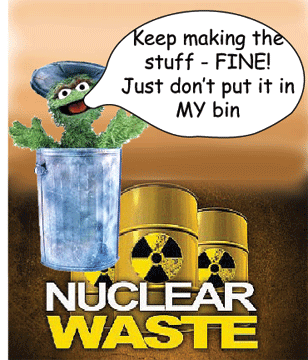 Aomori wants reassurance that it won’t be final nuclear waste site, Japan Times, 21 Oct 20, Aomori Prefecture on Wednesday urged the government to reconfirm its policy of not building in the prefecture a facility for the final disposal of high-level radioactive waste from nuclear power plants across the nation.The request was made during a meeting of a council for discussions on issues related to the country’s nuclear fuel cycle policy between relevant Cabinet ministers and officials of the prefecture, where a spent nuclear fuel reprocessing facility is under construction. It was the first meeting of the council since November 2010.
At the day’s meeting, the Aomori side called on Prime Minister Yoshihide Suga’s Cabinet, launched last month, to maintain the promise not to make the prefecture a final disposal site, upheld by past administrations.
Participants in the meeting, held at the Prime Minister’s Office in Tokyo, included Chief Cabinet Secretary Katsunobu Kato and industry minister Hiroshi Kajiyama from the central government, and Aomori Gov. Shingo Mimura.
“It’s necessary for the state and the operator (of the reprocessing plant) to make the utmost efforts to promote, with support from Aomori, the nuclear fuel cycle policy, including the launch of the plant,” Kato said at the start of the meeting.
Mimura told reporters after the meeting that he asked the central government to abide by the promise and promote the nuclear fuel cycle policy, in which uranium and plutonium are extracted from spent fuel and reprocessed into fuel for use at nuclear power plants.
Mimura indicated that Kato showed the state’s understanding of his requests……..
Aomori has agreed to accept spent nuclear fuel from nuclear plants across the country on the condition that a final disposal facility is not constructed in the prefecture.
The central government regards the nuclear fuel cycle as a pillar of its nuclear energy strategy.
Besides the reprocessing plant, a facility to make mixed oxide, or MOX, fuel from extracted uranium and plutonium is also under construction at the same site in Rokkasho. https://www.japantimes.co.jp/news/2020/10/21/national/japan-aomori-nuclear-waste-disposal/
The nuclear industry’s cunning strategy to pass its clean-up costs to the tax-payer

 The nuclear bailout nobody’s talking about, https://highlandcountypress.com/Content/In-The-News/In-The-News/Article/The-nuclear-bailout-nobody-s-talking-about-/2/20/60902, By Marty Schladen, Ohio Capital Journal, 19 Oct 20, https://ohiocapitaljournal.com/
Ohio state government continues to be gripped by an alleged $61 million bribery scandal involving a billion-dollar nuclear bailout.
But while the effort for that bailout was brewing as part Akron-based FirstEnergy’s strategy to prop up and spin off unprofitable nuclear power plants, another part of the strategy might have resulted in an additional — and potentially larger — bailout in a separate venue.
And, some observers warn, many more such bailouts throughout the country might be on the way.
In February, seven months after Gov. Mike Dewine signed the $1.3 billion ratepayer bailout that mostly would subsidize two Northern Ohio nuclear plants, FirstEnergy might have gotten an even bigger break in U.S. bankruptcy court. That’s when Judge Alan M. Koschik signed off on a settlement that largely excused FirstEnergy from footing part of the bill to clean up the aging nuclear plants in Ohio and another in Pennsylvania that it had bequeathed to to its successor, now known as Energy Harbor, in the event that company goes belly up.
If the new company can’t make a go of it with the nuclear and coal plants that had been owned by FirstEnergy, taxpayers could well be on the hook for whatever part of the estimated $10 billion nuclear cleanup that Energy Harbor and a trust fund it’s required to maintain can’t.
Those are cleanups that, for financial reasons, will take 60 years — decades during which the crumbling cooling tower of the company’s Davis-Besse plant, for example, will loom over the Lake Erie shoreline in view of South Bass Island, one of Ohio’s premier tourist attractions.
Energy Harbor’s “financial future doesn’t look bright and when we say (FirstEnergy) needs to set aside money for (shutting down and cleaning up the plants), their response is going to be, ‘The bankruptcy court approved the reorganization, FirstEnergy isn’t on the hook anymore,’” said Margrethe Kearney, senior staff attorney at the Environmental Law & Policy Center, which is appealing the bankruptcy ruling to the 6th U.S. Circuit Court of Appeals in Cincinnati. “This is a way that bankruptcy is increasingly being used by companies — to shed their environmental liability.”
And, Kearney said, companies across the country that own nuclear generators likely will try to use the bankruptcy to ease looming cleanup costs off of their books and onto the backs of taxpayers.
“Especially here in the Midwest we have a lot of nuclear power plants, a lot of them are coming to the end of their useful life, most of them are out of the money, so it doesn’t really make sense to invest in them because natural gas and renewable energy is less expensive and we’re going to have a real crisis when it comes to the decommissioning of power plants and the financial ability to pay for them,” she said.
A doozy of a scandal
The Ohio Capitol was rocked in July when the FBI arrested then-House Speaker Larry Householder and four associates in what U.S. Attorney David DeVillers said was “likely the largest bribery and money-laundering scheme ever in the state of Ohio.”
DeVillers alleged that $61 million flowed from FirstEnergy and related companies through 501(c)(4) dark money groups and into campaigns of House candidates who later elected Householder speaker, a perch from which he shepherded House Bill 6, the $1.3 billion bailout, to passage. (House Bill 6 was cosponsored by Hillsboro Republican State Rep. Shane Wilkin and Rep. Jamie Callender, a Lake County Republican.)
The money also funded a nasty, xenophic campaign to block a voter initiative to repeal HB 6, while Householder and his associates simultaneously lined their own pockets with some of the loot, DeVillers said.
It wasn’t the only such scandal to break in July. In Illinois, Commonwealth Edison and parent company Exelon admitted to an eight-year bribery scheme targeting people around Illinois House Speaker Michael Madigan, who hasn’t been charged. One of the things the company received from the legislature during that period was a $2.35 billion bailout of two struggling nuclear power plants in that state.
In Ohio, nobody from FirstEnergy has been charged. But DeVillers in July said his investigation was far from over.
In September, Ohio Attorney General Dave Yost named FirstEnergy and associated companies as defendants in a civil suit. Among other things, it demanded that bailout funds be blocked and that the companies that funded the HB 6 scheme either fire the officials involved or see the companies themselves dissolved.
Who was in charge?
The funds promised by HB 6 were far from the first ratepayer largesse enjoyed by companies related to FirstEnergy, whose name graces the stadium in which the Cleveland Browns play. Last year, Ohio Rep. Mark Romanchuk, R-Ontario, said the company’s Ohio nuclear plants had received $10.2 billion in state subsidies since 1999.
The attorney general’s lawsuit says that four years ago, what to do about the failing nuclear plants was at the heart of what he said was a corrupt scheme to obtain a bailout.
“In late 2016, FirstEnergy Corp. had a problem,” the suit says. “The nuclear power generation plants it owned through its subsidiary FirstEnergy Solutions Corp. had turned from assets to liabilities.”
It also said that by spinning off the plants, passing the bailout and sending its former subsidiary through bankruptcy, FirstEnergy did lasting harm to the state. That’s because, the suit said, FirstEnergy had potentially shifted some of the burden to clean up the Perry and Davis-Besse reactors in Ohio from itself and onto the taxpayers.
“Ohio’s environmental future has been damaged, because the costs for the ultimate decommissioning of the nuclear plants are now secured by Energy Harbor, a company with far smaller capitalization than FirstEnergy Corp.,” the suit said. “To the extent that decommissioning and environmental repair costs exceed Energy Harbor’s ability to pay, those costs will be borne by Ohio through its ratepayers or taxpayers — a scenario that already played out once in the FirstEnergy Solutions’ bankruptcy plan that created Energy Harbor.”
Yet, FirstEnergy maintains that after 2016 its leaders had no control over the former subsidiary that owns nuclear as well as coal plants in Ohio and Pennsylvania.
“FirstEnergy leadership has not had any decision-making power regarding the strategic direction of FES since November 2016, and FirstEnergy and Energy Harbor are now separate, unaffiliated companies,” FirstEnergy spokeswoman Jennifer Young said in September after the Ohio attorney general’s lawsuit was filed.
However, that claim seems hard to credit because FirstEnergy CEO Chuck Jones is also CEO of FirstEnergy Services.
Until June, First Energy Services provided the power plant-owning company that became Energy Harbor with many — if not all — of the services one would associate with running it. They include “administrative, management, financial, compliance, ethical, external affairs, and political and regulatory advocacy services. ”
For her part, Young said that the companies are independent because they have separate boards.
Long-term strategy
In late 2016, as FirstEnergy was spinning off the company that after bankruptcy became Energy Harbor, Jones announced a strategy of seeking a bailout for the spun-off company’s failing nuclear assets.
“We are advocating for Ohio’s support for its two nuclear plants, even though the likely outcome is that FirstEnergy won’t be the long-term owner of these assets,” Jones said.
In an affidavit supporting criminal charges against the former Ohio speaker and others, FBI Special Agent Blane Wetzel introduces the case for a criminal conspiracy by referring back to that time.
“In 2016, (FirstEnergy) Corp.’s nuclear generation future looked grim,” it said. “In its November 2016 annual report to shareholders, Ohio-based (FirstEnergy) Corp. and its affiliates reported a weak energy market, poor forecast demands, and hundreds of millions of dollars in losses, particularly from its nuclear energy affiliate…
“Given this backdrop, (FirstEnergy) announced future options for its generation portfolio as follows: ‘legislative and regulatory solutions for generation assets’; asset sales and plant deactivations; restructuring debt; and/or seeking protection under U.S. bankruptcy laws for its affiliates involved in nuclear generation.”
On March 31, 2018, Energy Harbor predecessor FirstEnergy Solutions exercised one of those options when it filed for Chapter 11 protection in the U.S. Bankruptcy Court of the Northern District of Ohio.
Broad immunity
By the time FirstEnergy Solutions emerged from bankruptcy in February, it had a new name, Energy Harbor, and it had largely released its former parent company, FirstEnergy Corp., from any responsibility to clean up the nuclear plants it used to own.
“It makes it really difficult to get into the pockets of the parent if the subsidiary runs out of money,” Kearney, of the Environmental Law and Policy Center said of the settlement.
In fact, the release worked out between FirstEnergy, a primary creditor, and its former subsidiary was so broad that Judge Koschik disallowed part of it, saying it would make the overall settlement legally unconfirmable.
“The only (nuclear cleanup) ‘mechanism’ offered by (Energy Harbor) is its own assumption of these long-term environmental obligations and a promise that as a reorganized debtor with new capital structure facilitated by (FirstEnergy Corp.), it will stalwartly stand by and satisfy these claims if and when they arise,” Koschik wrote.
FirstEnergy and its former subsidiary modified the “third-party releases” and Koschik signed off on the overall settlement.
But he did so without allowing Kearney’s group to put on testimony from an expert witness, Peter Bradford, a former commissioner with the U.S. Nuclear Regulatory Commission. Bradford planned to testify that there were expenses far in excess of what the commission — which is responsible only for the cleanup of radioactive material — requires nuclear operators to pay into a trust fund, Kearney said.
Koschik’s refusal to hear from Bradford is a big part of why the Environmental Law and Policy Center and associated groups are appealing the bankruptcy settlement, although they also have briefed the appellate court on the federal criminal and state civil actions surrounding the HB 6 bailout scandal.
“We are asking to have our expert heard on the nuclear decommissioning issues,” Kearney said. “That doesn’t mean that the entirety of the bankruptcy proceeding will be reopened.”
Cleanup of the century
Asked last week about what it would cost to clean up its former nuclear plants in Ohio and Pennsylvania, FirstEnergy’s Young said, “FirstEnergy’s liabilities related to nuclear decommissioning are hypothetical and comparable to any former owner of nuclear generating facilities. The bankruptcy did not change that. The other questions you asked about decommissioning would need to be directed to Energy Harbor since they are the current owners and operators of the plants and are primarily liable for decommissioning. As you’ll recall, Energy Harbor is a separate company now unaffiliated with FirstEnergy.”
Calls and emails to two Energy Harbor spokesmen were unanswered.
Young said that as of June, Energy Harbor’s nuclear decommissioning trust funds were worth about $2 billion.
The cleanup envisioned for Perry and Davis-Besse plants in Ohio and the two Beaver Valley units in Pennsylvania would extend for the better part of a century — from 2021 through 2083, according to 2018 studies performed for FirstEnergy as part of the bankruptcy. Kearney said the longevity of the process isn’t because the cleanup is so complex. It’s because the money in the trust fund isn’t enough to pay for it now, so it needs time to grow.
However, based on the estimates commissioned by FirstEnergy, it’s hard so see how $2 billion would be enough. They list four categories of costs associated with the cleanup:
• Decommissioning, including a 17% contingency;
• Hefty NRC license-termination fees (fees are a major source of the agency’s funding);
• Spent-fuel management; and
• Non-nuclear demolition.
Taken together, the combined estimated cost to shut down and clean up all the facilities is $9.6 billion in 2014 dollars. And not nearly all of the $2 billion in the trust fund will be allowed to grow until 2074 to meet it.
The total cost to clean up Beaver Valley Unit 2, for example, is estimated at just under $2 billion, or about 20% of the total.
The timeline in the estimate calls for about an eighth of that — $233 million — to be spent through 2026 preparing for a 48-year “dormancy” period. The estimate says that it will cost between $6 million and $7 million a year for the first 33 years and $3 million to $4 million a year for the next 15.
In other words, if Energy Harbor were to stop paying into the trust fund tomorrow, far less than $2 billion will be allowed to grow until the final cleanup starts in 2075.
The estimates were financed by an interested party, FirstEnergy. But even if they weren’t, Kearney stressed that they could be significantly off — especially since they’re drawn out over such a long period. She said, however, “That $2 billion represents about half of the (overall) estimated cleanup costs.”
The uncertainty over how much the nuclear cleanups will cost and whether Energy Harbor can pay for them makes it unjust that its bankruptcy let FirstEnergy off the hook — especially in light of the criminality alleged in Ohio’s other nuclear bailout, the state’s official consumer representative said.
“An inadequate funding of the future decommissioning costs for the Davis-Besse and Perry nuclear power plants would also be of concern to Ohioans who, one way or another, may ultimately be asked to pay the tab for any shortfall in funding of these costs,” the Office of the Ohio Consumer Counsel said in a brief filed with the 6th Circuit. “Such a result would be objectionable for consumers.”
The OCC needn’t have limited his claims to the potential burden to Ohioans. As things stand now, if Energy Harbor can’t cover the cost of the cleanup, it will fall on all U.S. taxpayers.
Read the federal complaint
https://assets.documentcloud.org/documents/6999130/Ohio-House-complaint.pdf
Marty Schladen has been a reporter for decades, working in Indiana, Texas and other places before returning to his native Ohio to work at The Columbus Dispatch in 2017. He’s won state and national journalism awards for investigations into utility regulation, public corruption, the environment, prescription drug spending and other matters.
In Germany , a new dispute over the old abandoned Gorleben nuclear waste site
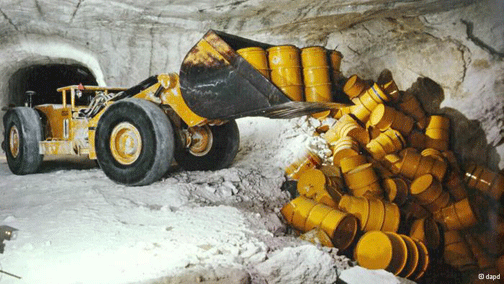
16 October 2020 Pledge Times (India/Germany)
New dispute over Gorleben
In an interview, the President of Germany’s Federal Office for the Safety of Nuclear Waste Management says it was problematic that Gorleben (current interim but beleaguered radwaste site) has been ruled out in the first review stage of the process to identify a geological repository site. The Green Party responded that the President “did not understand the procedure for which he is in charge. The search for a repository follows scientific criteria.”
Swedish council votes in favour of nuclear waste disposal facility
Geological disposal of nuclear waste – a focus of interest in the coming months
 GDF Watch 18th Oct 2020, Just when you thought 2020 couldn’t get any weirder, geological disposal
programmes around the globe are making significant steps forward, all at
the same time.
More seems to have happened, in sociopolitical terms, in the
past month than perhaps in the rest of this Century combined: Swedish
community voting to host their nation’s geological repository; Two
Japanese communities choose to enter into initial discussions; expectation
in UK that at least one community will come forward; Germany publishes
geological analysis identifying potential host areas; Canada completes
acquisitions of land that could host a repository; Hungary Opposition
leader wants public debate on radwaste disposal;
Country situations are analysed in more detail below, but taken together, it seems clear that
geological disposal will become a feature of media and political focus in
countries around the world over the coming 18-24 months.
http://www.gdfwatch.org.uk/2020/10/18/geological-disposal-is-go/
Neighbouring countries oppose Japan’s plan to release nuclear waste water into the Pacific
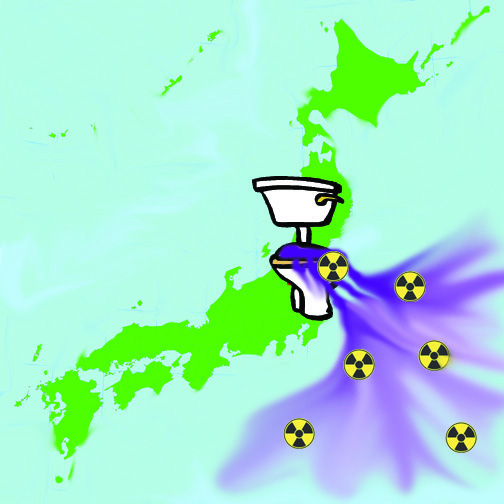 World worries about release of Fukushima nuclear water https://www.globaltimes.cn/content/1203852.shtml, By Xu Keyue Source: Global Times 2020/10/18
Analysts said that Japan should think twice before making the decision as the move would have disastrous consequences for the marine environment and human health, which could lead to criticism by related international organizations, countermeasures by affected countries including cessation of imports of Japanese seafood, and harm to the country’s image.
Japanese media said that the country’s government will hold a related cabinet meeting as early as this month to make the final decision on the plan to release more than 1 million tons of radioactive water from the Fukushima Daiichi nuclear power plant into the Pacific Ocean after reducing the level of radioactivity.
The plan has not gotten much rolling coverage in Japan, but there are still many Japanese netizens expressing their disagreement. According to a poll on Yahoo Japan, 41.5 percent of the 31,035 respondents disagreed with the plan
Local fishermen in Fukushima publicly announced their opposition, saying the plan will undo years of work rebuilding their industry’s reputation since the plant was wrecked by a huge tsunami in March 2011.
The public of South Korea has repeatedly voiced concern, claiming that discharging the water represents a “grave threat” to the marine environment.
A South Korean Foreign Ministry official told reporters that a meeting of related ministries regarding this issue was elevated to vice-ministerial status last month to step up the response to Japan’s move, reported South Korea’s KBS News on Friday. The official said the government will continue to closely monitor Tokyo’s activities and take measures based on cooperation with the international community.
Japan’s plan also sparked outrage among Chinese netizens, many of whom criticized Japan’s practice, saying it is throwing its responsibility onto the world to share.
Sun Yuliang, a nuclear expert at Tsinghua University in Beijing, told the Global Times on Sunday that whether to dump the waste water should depend on an authoritative scientific assessment to determine whether the processed radioactive water meets international standards for release.
Liu Junhong, a research fellow at the China Institutes of Contemporary International Relations, urged Japan to further communicate with the international community and share information transparently.
Liu said that the Japanese government should give priority to safeguarding public health and safety and the environment, rather than the cost of the rehabilitation work after the 2011 Fukushima disaster.
Liu noted that the seas in Asia are mostly connected and many of them are semi-closed, so that the contaminants from the Fukushima water could subside and then rise, which would severely affect the local marine and coastal environment and the health of people nearby.
Therefore, Japan’s neighboring countries including China and South Korea would be the first to react to the plan, Liu said.
He noted that if the Japanese government releases the water, these countries are likely to stop imports of seafood from Japan, and foreigners could be reluctant to visit the country and enjoy its food, which would harm Japan’s economy.
Other analysts noted that the plan goes against Japan’s long-established image of being friendly to the marine environment.
Another expert on nuclear safety, who requested anonymity, said that the issues is not only one of Japan’s own business but also relates to the interests of the global community, so countries and related organizations in the international community should cooperate and assist Japan to deal with the contamination.
The Daiichi Nuclear Power Plant in Fukushima went into meltdown and released radioactive material in the aftermath of a tsunami in March 2011.
The disaster cast doubts over the safety of nuclear power worldwide, leading China to launch a campaign to review and upgrade the safety systems of all its nuclear power stations.
France has more nuclear waste than shown in official inventory, reports the nuclear regulator
|
There is more nuclear waste in France than what is currently in the official inventory. This is one of the conclusions of the Nuclear Safety Authority (ASN) in a report released on Thursday October 8 that went relatively unnoticed. They assert that a significant part of what was until now considered radioactive material intended to be reused to produce electricity actually corresponds to radioactive waste, which will have to be managed and stored. An orientation against the tide of the doctrine defended for years by the French nuclear industry. This report follows the public debate on the National Plan for the Management of Radioactive Materials and Waste (PNGMDR), the fifth edition of which is under preparation. Currently, the law provides that radioactive waste is an ultimate residue that can no longer be used, while radioactive material is potentially recyclable……. (subscribers only) https://www.lemonde.fr/planete/article/2020/10/15/le-volume-des-dechets-radioactifs-est-revu-a-la-hausse-par-l-autorite-de-surete-nucleaire_6056058_3244.html |
|
|

Divisive nuclear waste programme in South Bruce, Ontario
|
Proposed 1,500-acre site mapped out for Canadian nuclear waste storage in South Bruce, Ont. Scott Miller CTV News London Videographer @ScottMillerCTV October 15, 2020 TEESWATER, ONT. — We now know exactly where a proposed underground facility to house Canada’s nuclear waste will be, if it comes to fruition.
The Nuclear Waste Management Organization (NWMO) has secured all of the 1,500 acres of farmland they will need to permanently store over five million used nuclear fuel bundles that once powered Canada’s nuclear plants……… Securing all the land they need, means the NWMO can start borehole drilling in the spring, to ensure the geology of the region can support the underground project that is being designed to house the radioactive waste, forever. Similar work is underway in Ignace, the other Northern Ontario community still in the running to host the controversial project. To address community concerns, the NWMO says they’re committing to a program to compensate landowners if property values fall because of the project, if it’s built in South Bruce…….. The project has divided the small, rural community of roughly 6,000 residents. ……… The NWMO plans to pick South Bruce or Ignace to house Canada’s high level nuclear waste by 2023. https://london.ctvnews.ca/proposed-1-500-acre-site-mapped-out-for-canadian-nuclear-waste-storage-in-south-bruce-ont-1.5146504 |
|
|
Bankrupt Mallinckrodt company faces large liabilities in radioactive trash cleanup
Bankrupt Mallinckrodt may still be expected to help shoulder nuclear cleanup costs, St Louis Post  Dispatch, Bryce Gray, 17 Oct 20
- ST. LOUIS — Two sets of nuclear waste complaints against Mallinckrodt have been thrown into question in a two-week span, while the company restructures in bankruptcy court.
Facing a wave of lawsuits and a $1.6 billion settlement stemming from its role in the national opioid crisis, the company with deep St. Louis roots filed for protection from creditors on Monday.
While industry analysts have focused on Mallinckrodt’s future as a drugmaker, the company also faces potential liabilities for work a predecessor company, St. Louis-based Mallinckrodt Chemical Works, performed decades ago, when it processed uranium for the U.S. government. Radioactive waste left over from Mallinckrodt’s uranium production is buried today in the West Lake Landfill Superfund site in Bridgeton and also along sections of Coldwater Creek, which runs from St. Ann to the Missouri River.
On Sept. 30, a two-year-old lawsuit aimed at getting Mallinckrodt to help shoulder the looming $205 million cleanup at West Lake was dismissed, but appears to be in mediation. Lawyers involved with the case warn that, despite the dismissal, the matters at hand remain unresolved and under discussion. ……
The dispute arose in 2018, when — after decades of inaction — a plan to soon excavate the bulk of West Lake’s radioactivity was finally announced. In the months that followed, Republic Services — the waste hauling company whose subsidiary, Bridgeton Landfill LLC, is the legal owner of the Superfund site — initiated a chain of legal actions against Mallinckrodt and other entities in an apparent strategy to spread out the nine-figure cost of the site’s long-awaited cleanup.
Allegations in the ensuing lawsuits focused on the histories of Mallinckrodt and other parties that Republic said belong at “the table,” regarding work at West Lake.
Mallinckrodt was the first to be roped into the litigation. During the development of the atomic bomb in World War II, the company “purified and provided all of the uranium oxide used by the Manhattan Project,” according to its website. Some of the radioactive waste from the company’s St. Louis operations eventually made it to West Lake Landfill, where it was illegally dumped in the 1970s…….….
West Lake’s cleanup is not the only matter involving radioactive waste that could affect Mallinckrodt.
For almost a decade, the company has confronted personal injury lawsuits alleging that residents of surrounding communities have faced cancers and other health issues caused by the legacy of radioactive contamination along Coldwater Creek, after waste from Mallinckrodt was stored and buried at an upstream site near the airport.
Some of the cases — which originated in 2012 — have already been settled, and lawyers said in a hearing Wednesday that settlements that were verbally approved would not likely be affected by Mallinckrodt’s bankruptcy case. Outstanding cases will likely be stayed while bankruptcy proceedings take place, though it’s not clear what may happen next.
Back at West Lake, cleanup costs are currently set to be divided among Republic and two other parties deemed liable at the site: the U.S. Department of Energy and Exelon, the Chicago energy company that formerly owned the uranium processor, Cotter Corp., through a subsidiary….. https://www.stltoday.com/business/local/bankrupt-mallinckrodt-may-still-be-expected-to-help-shoulder-nuclear-cleanup-costs/article_dc7643f9-fc32-53e4-9a98-d1bcafdcdcc8.html
In Scotland, UK’s old nuclear submarines are left to rot
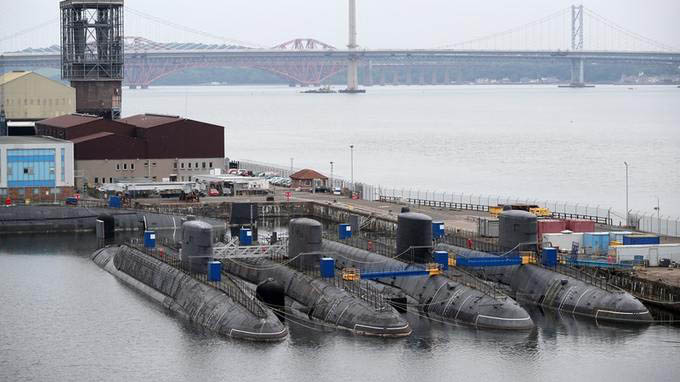 The nuclear graveyard just five miles from Edinburgh, where Cold War submarines are left to ‘rot’There has been repeated criticism of the fact seven contaminated nuclear subs have been laid up at Rosyth dockyard since the 1980s. Edinburgh Live, By
A recent viral tweet has brought fresh attention to a decades-old controversy in Edinburgh’s back yard: namely, a hulking fleet of decommissioned, but still radioactive, Cold War nuclear submarines. The seven defunct submarines – Dreadnought, Churchill, Swiftsure, Revenge, Resolution, Repulse and Renown – have been laid up since the 1980s, stored at Rosyth in Fife while arrangements are made to safely dispose of them.
All of the subs have had their toxic fuel removed, but parts of the vessels, including the reactor compartments, are still contaminated with radiation.
Seven of the submarines have been in storage for longer than they were in service with the Royal Navy.
A lack of money and a lack of suitable disposal sites are amongst the issues causing lengthy delays to the disposal process. In 2016 the Ministry of Defence admitted it could take until 2040 to completely dispose of the retired fleet.
This week, an Edinburgh Twitter user took to the social media platform to complain about the fact the historic submarines were still in the Forth, saying they had been ‘dumped’ to ‘rust’ in the dockyard. The tweet has since been shared over 800 times………
The MoD has said it will dispose of the fleet “as soon as practically possible”.
According to an article on Scottish investigative journalism site The Ferret, in the 1980s the UK government tried to hatch a secret plan to dump the radioactive hulks of the problematic and hard-to-dispose of subs in the sea off north west Scotland, documents released by the National Archives reveal.
The Ferret say that a survey for the Ministry of Defence (MoD) in 1989 identified six sites for “seabed storage” of defunct naval submarines near the islands of Skye, Mull and Barra for up to 60 years – and probably longer.
According to one MoD official the aim was “to remove submarines from public view”. Another hoped that “everyone will forget about these submarines and that they will be allowed to quietly rot away indefinitely.”
The 1989 sea-dumping plan was dropped in the end, but the continuing presence of these ancient nuclear behemoths in the Forth makes it very clear that the MoD’s problem of what to do with the Cold War relics isn’t going away any time soon. https://www.edinburghlive.co.uk/news/edinburgh-news/nuclear-graveyard-just-five-miles-19118105
UK: consultation with 2300 people about radioactive waste dump – only 13 people supported it.
Northern Echo 13th Oct 2020, THOUSANDS of people have written to the Environment Agency over concerns that plans to dump radioactive waste in Teesside will pose a risk to
communities. An application has been made by Augean North Ltd for a low
level radioactive waste permit at their existing Port Clarence site,
between Stockton and Billingham.
The Environment Agency, which held a
consultation which ended in January, published its report yesterday. About
2,300 people took part in the four-month exercise, with only 13 supporting
the application.
The Environment Agency is now considering these in
determining whether to grant the permit, taking into account information
submitted by Augean North. The operator has been asked to provide further
information, with a decision expected to be made by the end of January
2021.
Members of the public, as well members of Stockton on Tees Borough
Council and Redcar and Cleveland Borough Council commented on the
socioeconomic impact and the general impact on the area, as well as the
potential impact on regeneration plans. Last year, Tees Valley Mayor Ben
Houchen criticised the plans, which he said were against the interests of
those living in surrounding areas. The report can be viewed by visiting
consult.environment-agency.gov.uk/north-east/port-clarence-landfill-permit-application
1 This Month

of the week – Shut Down Drone Warfare!


Tell the Ukrainian Government to Drop Prosecution of Peace Activist Yurii Sheliazhenko

Petition to revoke the licensing of the Near Surface Nuclear Disposal Facility (NSDF) at Chalk River. https://www.ourcommons.ca/petitions/en/Petition/Details?Petition=e-7247
To see nuclear-related stories in greater depth and intensity – go to https://nuclearinformation.wordpress.com
-
Archives
- April 2026 (103)
- March 2026 (251)
- February 2026 (268)
- January 2026 (308)
- December 2025 (358)
- November 2025 (359)
- October 2025 (376)
- September 2025 (257)
- August 2025 (319)
- July 2025 (230)
- June 2025 (348)
- May 2025 (261)
-
Categories
- 1
- 1 NUCLEAR ISSUES
- business and costs
- climate change
- culture and arts
- ENERGY
- environment
- health
- history
- indigenous issues
- Legal
- marketing of nuclear
- media
- opposition to nuclear
- PERSONAL STORIES
- politics
- politics international
- Religion and ethics
- safety
- secrets,lies and civil liberties
- spinbuster
- technology
- Uranium
- wastes
- weapons and war
- Women
- 2 WORLD
- ACTION
- AFRICA
- Atrocities
- AUSTRALIA
- Christina's notes
- Christina's themes
- culture and arts
- Events
- Fuk 2022
- Fuk 2023
- Fukushima 2017
- Fukushima 2018
- fukushima 2019
- Fukushima 2020
- Fukushima 2021
- general
- global warming
- Humour (God we need it)
- Nuclear
- RARE EARTHS
- Reference
- resources – print
- Resources -audiovicual
- Weekly Newsletter
- World
- World Nuclear
- YouTube
-
RSS
Entries RSS
Comments RSS
 nuclear-news