Protests against nuclear storage plans that could kill the tourist industry
Protesters warn nuclear storage plans could kill tourism as council moves
forward with talks. Protesters are unhappy after county councillors agreed
to talk to the government company behind a potential nuclear waste disposal
site in Lincolnshire. Lincolnshire County Council’s Environment and
Economy Scrutiny Committee on Tuesday morning agreed to join a working
group to look at Radioactive Waste Management’s (RWM) potential plans for
a Geological Disposal Facility in Theddlethorpe. Campaigners against the
plans who gathered outside the council before the meeting, however, are not
happy with the decision and have said moving the plans forward creates
uncertainty for local businesses and residents.
Lincolnite 14th Sept 2021
Protesters warn nuclear storage plans could kill tourism as council moves forward with talks
Italy launches national debate on nuclear waste disposal
The opening plenary session of Italy’s National Seminar, which aims at
deepening the analysis of the technical aspects related to the national
repository for radioactive waste and technological park project with all
interested parties, was held yesterday. The National Seminar, a series of
consultative meetings, follows the publication in January of a list of 67
potential sites for a radioactive waste storage facility.
World Nuclear News 8th Sept 2021
https://www.world-nuclear-news.org/Articles/Italy-launches-national-debate-on-waste-repository
Responses to Candidate Questionnaire: Radioactive Waste in the Ottawa Valley — Concerned Citizens of Renfrew County and Area

September 13, 2021 We asked federal candidates from all parties in 13 ridings in West Quebec, Eastern Ontario and Ottawa the following questions: Will you oppose the current plans for a radioactive waste disposal facility at Chalk River and reactor entombment at Rolphton, Ont.? Will you ensure that decisions on radioactive waste disposal in the […]
Responses to Candidate Questionnaire: Radioactive Waste in the Ottawa Valley — Concerned Citizens of Renfrew County and Area
NRC issues license to store ‘spent nuclear fuel’ in Andrews
NRC issues license to store ‘spent nuclear fuel’ in Andrews
Midland Reporter-Telegram Sep. 13, 2021 The Nuclear Regulatory Commission reported Monday that it has issued a license to Interim Storage Partners LLC to construct and operate a consolidated interim storage facility for spent nuclear fuel in Andrews.
The license authorizes the company to receive, possess, transfer and store up to 5,000 metric tons of spent fuel and 231.3 metric tons of Greater-Than-Class C low-level radioactive waste for 40 years, according to a NRC release. The company has said it plans to expand the facility in seven additional phases, up to a total capacity of 40,000 metric tons of fuel. Each expansion would require a license amendment with additional NRC safety and environmental reviews.
nterim Storage Partners is a joint venture of Waste Control Specialists LLC and Orano USA. ISP intends to construct the storage facility on property adjacent to the WCS low-level radioactive waste disposal site already operating under a Texas license. Information about the license application and the NRC staff’s reviews is available on the NRC website, according to the news release. The licensing documents will be available on this page as well.
The NRC’s announcement Monday came days after Texas Gov. Greg Abbott signed legislation to ban high-level nuclear waste from the state of Texas. Odessa Republican Brooks Landgraf was the author of House Bill 7, which was filed in response to an effort to bring the nation’s high-level radioactive waste to a low-level radioactive material disposal facility in Andrews County.
Landgraf, in a statement, offered the following about the NRC’s issuing of the license:
“The Biden administration, through the NRC, would cause a violation of Texas law if their license results in the storage or disposal of spent nuclear fuel or any other high-level radioactive waste. I expect that the State of Texas will deploy our available resources to enforce our laws. Prior to the passage of HB 7, the State of Texas had no leg to stand on if it became necessary to fight back against the Biden administration. HB 7 is our weapon against high-level waste.”
The spent fuel and waste must be stored in canisters and cask systems, the NRC stated. The canisters and cask systems must meet NRC standards for protection against leakage, radiation dose rates, and criticality, under normal and accident conditions. The canisters are required to be sealed when they arrive at the facility and remain sealed during onsite handling and storage activities….
This is the second license issued by the NRC for a consolidated storage facility for spent nuclear fuel, according to the NRC. The first, Private Fuel Storage, was issued in 2006, but the facility was never constructed. The agency is currently reviewing an application from Holtec International for a similar facility proposed for Lea County, New Mexico. A decision on that application is currently expected in January 2022 https://www.mrt.com/news/local/article/NRC-issues-license-to-store-spent-nuclear-16455955.php
Small nuclear reactors, uranium mining, nuclear fuel chain, reprocessing, dismantling reactors – extract from Expert Response to pro nuclear JRC Report
.

………… If SMRs are used, this not least raises questions about proliferation, i.e. the possible spread of nuclear weapons as well as the necessary nuclear technologies or fissionable materials for their production. ………..
By way of summary, it is important to state that many questions are still unresolved with regard to any widespread use of SMRs – and this would be necessary to make a significant contribution to climate protection – and they are not addressed in the JRC Report. These issues are not just technical matters that have not yet been clarified, but primarily questions of safety, proliferation and liability, which require international coordination and regulations.
The volume of waste arising from decommissioning a power plant would therefore be significantly higher than specified in the JRC Report in Part B 2.1, depending on the time required to dismantle it
Measures to reduce the environmental impact The JRC Report is contradictory when it comes to the environmental impact of uranium mining: it certainly mentions the environmental risks of uranium mining (particularly in JRC Report, Part A 3.3.1.2, p. 67ff), but finally states that they can be contained by suitable measures (particularly JRC Report, Part A 3.3.1.5, p. 77ff). However, suitable measures are not discussed in the depth required ……..…
Expert response to the report by the Joint Research Centre entitled “Technical assessment of nuclear energy with respect to the ‛Do No Significant Harm’ criteria in Regulation (EU) 2020/852, the ‛Taxonomy Regulation’” 2021
”…………………3.2 Analysing the contribution made by small modular reactors (SMRs) to climate change mitigation in the JRC Report
The statement about many countries’ growing interest in SMRs is mentioned in the JRC Report (Part A 3.2.1, p. 38) without any further classification. In particular, there is no information about the current state of development and the lack of marketability of SMRs.
Reactors with an electric power output of up to 300 MWe are normally classified as SMRs. Most of the extremely varied SMR concepts found around the world have not yet got past the conceptual level. Many unresolved questions still need to be clarified before SMRs can be technically constructed in a country within the EU and put into operation. They range from issues about safety, transportation and dismantling to matters related to interim storage and final disposal and even new problems for the responsible licensing and supervisory authorities
The many theories frequently postulated for SMRs – their contribution to combating the risks of climate change and their lower costs and shorter construction periods – must be attributed to particular economic interests, especially those of manufacturers, and therefore viewed in a very critical light.
Today`s new new nuclear power plants have electrical output in the range of 1000-1600 MWe. SMR concepts, in contrast, envisage planned electrical outputs of 1.5 – 300 MWe. In order to provide the same electrical power capacity, the number of units would need to be increased by a factor of 3-1000. Instead of having about 400 reactors with large capacity today, it would be necessary to construct many thousands or even tens of thousands of SMRs (BASE, 2021; BMK, 2020). A current production cost calculation, which consider scale, mass and learning effects from the nuclear industry, concludes that more than 1,000 SMRs would need to be produced before SMR production was cost-effective. It cannot therefore be expected that the structural cost disadvantages of reactors with low capacity can be compensated for by learning or mass effects in the foreseeable future (BASE, 2021).
There is no classification in the JRC Report (Part A 3.2.1, p. 38) regarding the frequently asserted statement that SMRs are safer than traditional nuclear power plants with a large capacity, as they have a lower radioactive inventory and make greater use of passive safety systems. In the light of this, various SMR concepts suggest the need for reduced safety requirements, e.g. regarding the degree of redundancy or diversity. Some SMR concepts even consider refraining from normal provisions for accident management both internal and external – for example, smaller planning zones for emergency protection and even the complete disappearance of any off-site emergency zones.
The theory that an SMR automatically has an increased safety level is not proven. The safety of a specific reactor unit depends on the safety related properties of the individual reactor and its functional effectiveness and must be carefully analysed – taking into account the possible range of events or incidents. This kind of analysis will raise additional questions, particularly about the external events if SMRs are located in remote regions if SMRs are used to supply industrial plants or if they are sea-based SMRs (BASE, 2021).
Continue readingRadiation, nuclear wastes, transportation, uncertainties – extract from Expert response to pro nuclear JRC Report
The DNSH-related TSCs state, among other things, that the repository facility must guarantee that the waste is contained and isolated from the biosphere. This also applies if extreme natural phenomena occur such as earthquakes, tornadoes, floods or the loss of technical barriers.
…… nuclear energy has been used for several decades, but there is still no repositoryfor high-level radioactive waste operating anywhere in the world. Responsibilities are therefore passed on to following generations and they are restricted in their freedom of choice. Section 6 of this expert response will deal with this matter in greater detail.
General results of the reviewThe JRC Report contains unfounded generalisations at many points. Conclusions are drawn from individual, selected examples and their global validity is assumed. Readers without any detailed specialist expertise will find it hard or impossible to recognise this.
.………. The JRC presents the disposal of high-level radioactive waste as a completely resolved problem by citing the example of the disposal projects in Finland and France. This largely ignores the fact that the Finnish repository is still under construction and the licence application from the operational company has already been delayed on several occasions. Both countries are still years away from starting to operate the facilities.
The JRC Report does not mention the aspect of transportation in its presentation of the life cycle analysis. This would have been necessary for a conclusive overall presentation of all the aspects of nuclear power.
the JRC Report states that a closed fuel cycle provides the advantage of significantly reducing the space required for a deep geological repository for HLW. It is necessary to add here that not only the volume, but also the decay heat at the time of disposing of the waste is relevant for the size of the disposal facility (KOM, 2016, p. 227). Additional low- and intermediate-level waste would also be produced and this would increase the disposal volume.
Expert response to the report by the Joint Research Centre entitled “Technical assessment of nuclear energy with respect to the ‛Do No Significant Harm’ criteria in Regulation (EU) 2020/852, the ‛Taxonomy Regulation’” 2021
“”………… 4.6 Ionising radiation and its impacts on people’s health and the environment during all the life cycle phases (apart from disposal and transportation)The JRC Report largely restricts itself in Part A 3.4 to the “impact of ionizing radiation on human health” (JRC Report, Part A 3.4.1, p. 167ff) and the environment (JRC Report, Part A 3.4.2, p. 173ff). The impact of emissions of non-radioactive substances is only considered at one point (publication [3.4-1]). ……..
The figures quoted for the radiation exposure of human beings in Part A 3.4.1 of the JRC Report are plausible. It is correct that human exposure to radiation as a result of the civil use of radioactive materials and ionising radiation is low in comparison with radiation exposure from natural sources and its range of variation. However, the report does not match the latest findings in radiation protection when specifying average effective doses per head of the population for nuclear facilities and installations. According to the latest recommendations of the International Commission on Radiological Protection (ICRP), the so-called “representative person” in the sense of the ICRP has to be considered an individual in the population, who is exposed to higher levels of radiation because of his or her lifestyle habits.
5 Criterion 2 in the Taxonomy Regulation – the DNSH criteria: disposal of radioactive waste, transportation, research and development The subject of disposing of radioactive waste is considered in this section. It professionally examines the scientific statements in the JRC Report about the topics of storage (section 5.1 of this expert response), disposing of low- and intermediate-level radioactive waste (section 5.2), disposing of high-level radioactive waste (section 5.3), transportation (section 5.4) and research and development (section 5.5). Sub-headlines have been used to interconnect the subsections
……….. The JRC Report does not adequately consider the fact that no successful, deep geological disposal of high-level radioactive waste, including the permanent seal, has yet been introduced anywhere in the world.
5.1 Interim storage of radioactive waste The JRC Report generally fails to provide any basis for the findings that are listed in the Executive Summary of the report related to storing radioactive waste. As a result, questions must be raised about the transparency of the conclusions that are drawn.
………….. the assessment of interim storage consistently takes place according to the standard adopted by the JRC, which, however, is inadequate from an expert point of view. For beyond design basis events it is impossible to exclude that uncontrolled discharges of radioactive substances and therefore considerable effects on the environment may occur through incidents and accidents or by some other intrusion involving third parties (e.g. terrorist attacks) when operating storage facilities; a risk therefore remains. A holistic assessment of using nuclear energy must therefore include a risk assessment related to these events too (cf. section 2.1 and 2.2.1 of this expert response).
Continue readingTexas bans storage of highly radioactive waste, but a West Texas facility may get a license from the feds anyway
The new law may soon be in conflict with federal regulators. A decision from the Nuclear Regulatory Commission on one company’s license could come as early as Monday.
BY ERIN DOUGLAS TEXAS TRIBUNE, SEPT. 10, 2021 Gov. Greg Abbott on Thursday night signed a bill into law that attempts to block a plan to store highly radioactive nuclear waste at a site in West Texas.
House Bill 7 effectively bans highly radioactive materials from coming to Texas, targeting one company’s plan to build such a facility near the New Mexico border in Andrews County.
But, the new state law may soon be in conflict with federal regulators. The Nuclear Regulatory Commission is advancing the company’s application for a license to allow the high-level nuclear waste to Texas, and a decision from the federal agency could come as early as Monday, a spokesperson with the commission said.
For years, environmental and consumer advocates have protested a proposal by a West Texas company, Waste Control Specialists, to build with a partner an interim storage site for high-level nuclear waste, which is mostly spent fuel rods from nuclear power plants. Waste Control Specialists has been disposing of the nation’s low-level nuclear waste, including tools, building materials and protective clothing exposed to radioactivity, for a decade in Andrews County.
Scientists agree that spent nuclear fuel, which is currently kept on-site at nuclear power plants, should be stored deep underground, but the U.S. still hasn’t located a suitable site. The plan by the WCS joint venture, Interim Storage Partners, proposes storing it in above-ground casks until a permanent location is found. Spent nuclear fuel can remain radioactive for tens of thousands of years.
The joint venture, Interim Storage Partners, applied to the NRC for a license to store spent nuclear fuel — the most dangerous type of nuclear waste — on a site adjacent to that existing facility until a permanent underground repository is built. No such facility currently exists in the U.S…………
The legislation includes a ban on disposing of high-level radioactive waste in Texas other than former nuclear power reactors and former nuclear research and test reactors on university campuses (nuclear power plants must keep the waste generated from operations on-site until a long-term disposal site is created). The law will also bar state agencies from issuing construction, stormwater or pollution permits for facilities that are licensed to store high-level radioactive waste.
Environmental groups applauded the state law: “We hope [the law] sends a clear message to the feds: We don’t want it,” said Adrian Shelley, director of Public Citizen’s Texas office, in a statement.
Karen Hadden, director of the Sustainable Energy and Economic Development Coalition, an alliance of businesses and organizations that has long opposed the nuclear waste facility, said in a statement that the law will “prevent unnecessary transportation risks nationwide.”
Landgraf said in a statement that the state law should halt the construction of a site to store high-level nuclear waste because the law now bars the Texas Commission on Environmental Quality from issuing the state permits that would be necessary to construct such a facility. He said the law protects Texas from “becoming the storage site for the entire country’s high-level radioactive waste.” https://www.texastribune.org/2021/09/10/texas-nuclear-waste-ban/
Texas Legislature passes Bill to prevent import and storage of high level nuclear waste
A bill passed by the Texas Legislature could ban the storage of high-level
nuclear waste in the state and could prove a path to similar efforts in
neighboring New Mexico. House Bill 7 was passed by the Texas House of
Representatives on an 119-3 vote Sept. 2 and unanimously by the Texas
Senate. The bill was sent to Gov. Greg Abbott for a signature and which
would create a new state law. If enacted, the bill would expressly prohibit
the state from issuing permits to construct or operate a facility to store
nuclear waste within the state, with the exception of existing nuclear
facilities like power plants that store the waste on-site.
Carlsbad Current Argus 9th Sept 2021
San Onofre’s nuclear waste buried under the beach – the best example of the failure of the nuclear industry and its poor outlook for the future
A combination of failures:’ why 3.6m pounds of nuclear waste is buried on a popular California beach, Guardian, Kate Mishkin 24 Aug 21,

The San Onofre reactors are among dozens across the United States phasing out, but experts say they best represent the uncertain future of nuclear energy.
“It’s a combination of failures, really,”
Spent fuel is stored at 76 reactor sites in 34 states
“It’s a self-reporting industry,” Hering, the retired rear admiral, said. “And they simply can’t be trusted.”
More than 2 million visitors flock each year to California’s San Onofre state beach, a dreamy slice of coastline just north of San Diego. The beach is popular with surfers, lies across one of the largest Marine Corps bases in the Unites States and has a 10,000-year-old sacred Native American site nearby. It even landed a shout-out in the Beach Boys’ 1963 classic Surfin’ USA.
But for all the good vibes and stellar sunsets, beneath the surface hides a potential threat: 3.6m lb of nuclear waste from a group of nuclear reactors shut down nearly a decade ago. Decades of political gridlock have left it indefinitely stranded, susceptible to threats including corrosion, earthquakes and sea level rise.
The San Onofre reactors are among dozens across the United States phasing out, but experts say they best represent the uncertain future of nuclear energy.
“It’s a combination of failures, really,” said Gregory Jaczko, who chaired the US Nuclear Regulatory Commission (NRC), the top federal enforcer, between 2009 and 2012, of the situation at San Onofre.
That waste is the byproduct of the San Onofre Nuclear Generating Station (Songs), three nuclear reactors primarily owned by the utility Southern California Edison (SCE).
Buried waste
Federal regulators had already cited SCE for several safety issues, including leaking radioactive waste and falsified firewatch records. But when a new steam generator began leaking a small amount of radioactivity in January 2012, just one year after it was replaced, it was SCE’s most serious problem yet. A subsequent report from the NRC’s inspector general found federal inspectors had overlooked red flags in 2009, and that SCE had replaced its own steam generators without proper approval. SCE tried to fix the problem but decided in 2013 to shut the plant down for good.Activists thought they had scored a victory when the reactor shut down – until they learned that the nuclear waste they had produced would remain on-site……
Without a government-designated place to store the waste, the California Coastal Commission in 2015 approved the construction of an installation at San Onofre to store it until 2035. In August 2020, workers concluded the multi-year burial process, loading the last of 73 canisters of waste into a concrete enclosure.
San Onofre is not the only place where waste is left stranded. As more nuclear sites shut down, communities across the country are stuck with the waste left behind. Spent fuel is stored at 76 reactor sites in 34 states, according to the Department of Energy.
Handling those stockpiles has been an afterthought to the NRC, the federal enforcer, said Allison Macfarlane, another former commission chair.
“It was not a big topic at the NRC, unfortunately,” Macfarlane said. “In the nuclear industry in general the backend of the nuclear cycle gets very little attention. So it just never rises to ‘oh this is a very important issue, we should be doing something.’”
Plenty of risks, and not enough oversight
The waste is buried about 100ft from the shoreline, along the I-5 highway, one of the nation’s busiest thoroughfares, and not far from a pair of faults that experts say could generate a 7.4 magnitude earthquake.
Another potential problem is corrosion. In its 2015 approval, the Coastal Commission noted the site could have a serious impact on the environment down the line, including on coastal access and marine life. “The [installation] would eventually be exposed to coastal flooding and erosion hazards beyond its design capacity, or else would require protection by replacing or expanding the existing Songs shoreline armoring,” the document says.
Concerns have also been raised about government oversight of the site. Just after San Onofre closed, SCE began seeking exemptions from the NRC’s operating rules for nuclear plants. The utility asked and received permission to loosen rules on-site, including those dealing with record-keeping, radiological emergency plans for reactors, emergency planning zones and on-site staffing.
San Onofre isn’t the only closed reactor to receive exemptions to its operating licence. The NRC’s regulations historically focused on operating reactors and assumed that, when a reactor shut down, the waste would be removed quickly.
It’s true that the risk of accidents decreases when a plant isn’t operating, said Dave Lochbaum, former director of the nuclear safety project for the Union of Concerned Scientists. But adapting regulations through exemptions greatly reduces public transparency, he argued.
“Exemptions are wink-wink, nudge-nudge deals with the NRC,” he said.
In general, it’s not really a great practice,” former NRC chair Jaczko said about the exemptions. “If the NRC is regulating by exemption, it means that there’s something wrong with the rules … either the NRC believes the rules are not effective, and they’re not really useful, or the NRC is not holding the line where the NRC should be holding line,” he said.
Close calls
In 2015, the NRC tried unsuccessfully to revise its decommissioning rules and reduce the need for exemptions. But commissioners never acted, despite a 2019 Office of Inspector General audit that questioned whether the rule would ever see the light of day and that estimated that eliminating exemptions could save the NRC, utility and taxpayers about $19m for each reactor.
In general, it’s not really a great practice,” former NRC chair Jaczko said about the exemptions. “If the NRC is regulating by exemption, it means that there’s something wrong with the rules … either the NRC believes the rules are not effective, and they’re not really useful, or the NRC is not holding the line where the NRC should be holding line,” he said.
Meanwhile, at San Onofre, two close calls drew the ire of activists and townspeople. In 2018, workers found a loose piece of equipment in one of the canisters, causing a 10-day work stoppage to ensure the error didn’t pose a threat to the public. In a separate incident several months later, a canister filled with radioactive waste became wedged when employees were loading it into the ground and nearly dropped 18ft. The second incident was not made public until a whistleblower brought it up at a community event.
After these incidents, the NRC cited SCE for failing to ensure equipment was available to protect the canister from a drop, and failing to notify the NRC in a timely manner. In a memo, NRC staff told SCE it was “concerned about apparent weaknesses” in managing storage oversight. SCE was fined $116,000 but permitted to continue loading casks within one year.
Another concern is that the CEO of Holtec, the manufacturer of the canisters, told a 2014 community meeting that the canisters are difficult to repair. “It’s not practical to repair a canister if it were damaged,” Kris Singh said.
According to a plan the California Coastal Commission approved in July 2020, SCE will also inspect two of the 73 buried canisters every five years, and a test canister every two and a half years, starting in 2024.
But critics say they are not confident SCE would self-report given the utility’s record. “It’s a self-reporting industry,” Hering, the retired rear admiral, said. “And they simply can’t be trusted.”……….. https://www.theguardian.com/environment/2021/aug/24/san-onofre-nuclear-power-plant-radioactive-waste-unsafe
Protests as France sends latest shipment of used nuclear fuel to Japan
Protests as France sends latest nuclear shipment to Japan https://www.france24.com/en/live-news/20210908-protests-as-france-sends-latest-nuclear-shipment-to-japanActivists from environmental group Greenpeace protested against a shipment of reprocessed nuclear fuel that was set to leave France for Japan on Wednesday for use in a power plant.
The load of highly radioactive Mox, a mixture of reprocessed plutonium and uranium, was escorted by police from a plant near the port of Cherbourg to the dockyard in the early hours of the morning.
A handful of Greenpeace activists waved flags and signs with anti-nuclear logos as they camped out on Tuesday night to wait for the heavy-goods truck transporting the high-security cargo.The Mox from French nuclear technology group Orano is destined for a nuclear plant in Takahama in Japan and is the seventh such shipment from France since 1999.
Japan lacks facilities to process waste from its own nuclear reactors and sends most of it overseas, particularly to France.
The country is building a long-delayed reprocessing plant in Aomori in northern Japan.
“Orano and its partners have a longstanding experience in the transport of nuclear materials between Europe and Japan, in line with international regulations with the best safety and security records,” Orano said in a September 3 statement.
The fuel is being shipped by two specially designed ships from British company PNTL.
We mustn’t kick the radioactive nuclear waste can down the road any longer. It’s time to tackle the problem head-on.
The current reality, as stated by the Nuclear Regulatory Commission, is that a repository might never materialize, saddling nuclear plants with storing spent fuel onsite indefinitely.
Creating more U.S. nuclear plants and deadly waste is insane when we can’t guarantee the safety of either existing aging plants or the 80,000-pluss metric tons of spent fuel already generated. The argument that nuclear is needed to address global warming reflects the same foolhardy mindset — ignoring adverse long-term impacts for short-term gains — that created the climate crisis in the first place.
We mustn’t kick the radioactive nuclear waste can down the road any longer. It’s time to tackle the problem head-on.
Opinion: Investing in More Nuclear Power Can’t Be Our Solution to Climate Change https://timesofsandiego.com/opinion/2021/09/03/investing-in-more-nuclear-power-cant-be-a-solution-to-the-climate-crisis/ by Sarah Mosko, Two days agoIf you live in Orange or San Diego County, hopefully you’re aware that San Onofre Nuclear Generating Station has been turned into a nuclear waste dump for the foreseeable future. If you live on planet earth, you’re wise to be tracking domestic and foreign moves to increase reliance on nuclear energy.
The United States ushered in the atomic age in 1945 by dropping a uranium bomb on Hiroshima and a plutonium bomb on Nagasaki. We now have 3.6 million pounds of these and other lethal radioactive elements sitting on the beach at San Onofre in temporary canisters, scheduled to remain there indefinitely.

No one has figured out how to safely dispose of deadly nuclear waste. Yet, to combat the climate crisis, the United States and the world propose to create more of it by extending the life of existing nuclear power plants and building new ones. Has the world learned nothing from the catastrophes of Three Mile Island, Chernobyl, and Fukushima?
Since San Onofre closed down in 2013, controversy has swirled around the dry waste storage systems selected by the plant’s operator, Southern California Edison.

As is true of all U.S.’s nuclear plants, San Onofre wasn’t designed for nuclear waste storage after decommissioning. The Nuclear Waste Act of 1982 mandated construction of a deep geological repository to store the nation’s spent fuel for the hundreds of thousands of years it remains deadly. However, as hopes for a repository at Nevada’s Yucca Mountain collapsed out of concern about groundwater contamination, talk turned to creating “interim” storage sites in Texas and New Mexico, though those states are balking at the prospect too.
The current reality, as stated by the Nuclear Regulatory Commission, is that a repository might never materialize, saddling nuclear plants with storing spent fuel onsite indefinitely.
As of last August, all of San Onofre’s spent fuel was transferred into 123 dry storage canisters, each with the potential to release as much highly radioactive Cesium-137 as was released during the 1986 Chernobyl disaster.
San Onofre’s canisters are thin-walled (5/8 inch) stainless steel and susceptible to “stress corrosion cracking” in a marine environment. They weren’t designed for safe maintenance, inspection, storage or transport.
The potential consequences of cracks are far worse than small radiation releases into the atmosphere: Canisters are filled with helium expressly to limit corrosion and prevent explosions triggered by air or water getting inside.
Contrast this with thick-walled (10-19 inches) casks used in most countries which aren’t susceptible to stress corrosion cracking and are designed for maintenance, inspection, storage and transport.
Continue readingHighway safety concerns as DOE plans expanding nuclear waste transports to the Waste Isolation Pilot Plant (WIPP)
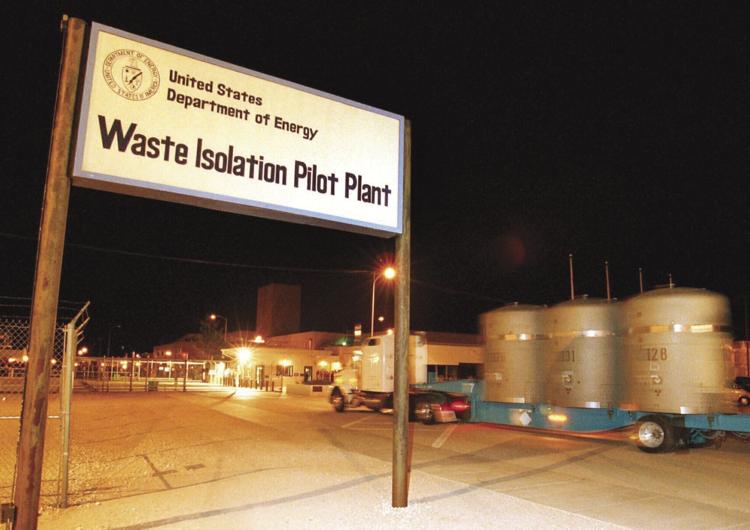
More nuclear waste may be heading to WIPP on US 285 Albuquerque Journal , BY ISABELLA ALVES / JOURNAL NORTH, SATURDAY, SEPTEMBER 4TH, 2021
Spanning the length of the state, U.S. Highway 285 is a major thoroughfare for truck transports and other traffic. This busy highway, nicknamed “Death Highway” due to the number of fatal accidents on it, may get busier.
Concerned citizens in Santa Fe County recently called out the U.S. Department of Energy’s Waste Isolation Pilot Plant for expanding its mission in a permit renewal application to include more nuclear waste being shipped along the 285 corridor.
Part of Highway 285 goes along the southern edge of the city of Santa Fe, and local activists are calling on local and federal leaders to halt this increase in nuclear waste transportation.
The permit application is requesting to add two nuclear waste storage panels to WIPP that would increase the waste volume in these areas. The permit renewal was filed July 30 and, if granted, wouldn’t increase the volume capacity of nuclear waste set by Congress in the Land Withdrawal Act for the plant.
“NMED is in litigation with the DOE for its failure to clean up legacy waste at Los Alamos National Laboratory. A successful resolution of the lawsuit is increased shipments of legacy waste from Los Alamos to WIPP,” James Kennedy, state Environment Department Cabinet secretary, said via email.
“The DOE and Nuclear Waste Partnership continuing to accept out-of-state waste streams or any new waste streams in lieu of cleaning up and shipping legacy waste from Los Alamos to WIPP is completely unacceptable,” he added.
At a recent Santa Fe County Town Hall, activist Cindy Weehler of 285 ALL said the U.S. Department of Energy made it clear that it’s going to expand its nuclear waste program, she said. She said she’s concerned about the new type of radioactive waste that would be traveling through the county, which would be diluted plutonium, instead of contaminated items.
This is consistent with a notice of intent published by the department in December 2020.
The Department of Energy’s (DOE) goal is to complete its missions safely and efficiently, including the continued reduction in the amount of transuranic waste at LANL and creating a safer environment for the surrounding communities,” a U.S. Department of Energy spokesperson said via email. “DOE notifies state authorities weeks in advance of all shipments to WIPP, which are done in strict accordance with federal rules and regulations and state law.”
On average, there are about seven waste shipments a week that travel to WIPP through Santa Fe County from the Los Alamos National Laboratory and the Idaho National Laboratory. In the coming months, pending any pandemic impacts, this number is expected to increase to 10 to 12 shipments per week.
“They have chosen a very unsafe way to deal with the surplus plutonium problem,” Weehler said. “It’s unsafe to our neighborhoods and I think, if people are going to be put at risk, like we are with this new mission, they deserve to know about it.”
Don Hancock, nuclear waste program director at the Southwest Research and Information Center, said the original type of waste being disposed of at WIPP were plutonium-contaminated items, such as gloves and other equipment that came into contact with the radioactive material.
Now, the plant is expected to dispose of the diluted plutonium, which is much more potent than contaminated material — and poses a greater safety risk. Hancock said they expect “a lot” of shipments to the plant and it’s hard to drill down an exact number.
This expansion is going to affect more than just Santa Fe County, it will impact people statewide, Weehler said. She said safety issues, such as preparing emergency responses for a nuclear waste spill if there’s an accident along the highway, will be left up to the local municipalities.
For Santa Fe County, this emergency response falls to its emergency management director who, Communications Coordinator Carmelina Hart said, has a background in these types of responses.
In the event of an emergency, the County’s role would be the initial evaluation, perimeter control and activation of all our state and federal partners who specialize in these responses,” Hart said in an email. “The County maintains relationships with the other agencies in the realm of emergency management. We have participated in full-scale exercises with the Department of Energy and local public safety teams.”
She said the county is reimbursed $15,000 annually by the Department of Energy’s WIPP program for emergency response preparations the county must maintain. The county also is working to identify additional training and equipment needs should nuclear waste transportation changes occur.
Santa Fe County Commissioner Hank Hughes said he has lived in Santa Fe before there was a WIPP project and has shared citizens’ concerns about nuclear waste transportation for many years. He said expanding WIPP’s mission might mean more nuclear waste traveling through Santa Fe County.
He said the county is as equipped as it can be to handle an accident. Since the transportation is considered classified information, local governments aren’t notified when nuclear waste is headed their way.
I think the concern is, while it’s very unlikely that there would be any leak of radioactive material — even if there was an accident — just increasing the number of trucks going through Santa Fe County raises that possibility,” Hughes said.
Since nuclear waste is handled on a federal level, it’s mostly out of the commission’s hands, he said. All the county can really do is make sure it’s prepared for an accident, and help its constituents express their concerns to the federal delegation.
And these worries haven’t gone unnoticed.
Maria Hurtado, spokeswoman for U.S. Rep. Teresa Leger Fernández, D-N.M., said the office has received a handful of constituent calls regarding the nuclear waste transportation…………. https://www.abqjournal.com/2426206/more-nuclear-waste-may-be-heading-to-wipp-on-us-285.htmladvertisement
Daunting costs of nuclear clean-ups
Daunting nuclear cleanup costs, Partial reactor meltdown at Three Mile Island in the US cost about $1bn https://www.businesslive.co.za/bd/opinion/letters/2021-09-02-letter-daunting-nuclear-cleanup-costs/ Peter Smulik 02 SEPTEMBER 2021- What every young South African needs to know now is how much it will cost their generation when it comes to cleaning up after nuclear power plants (“Nuclear build plan alarms energy analysts”, August 30). Three Mile Island in the US is a case in point: after the partial reactor meltdown of March 28 1979 the cleanup started in August 1979 and only officially ended in December 1993, at a total cost of about $1bn. That was just unit 2, which developed the incident. A preliminary assessment estimated that the Three Mile Island accident caused a total of $2.4bn in property damages.
As for unit 1: in 2017 it was announced that operations would cease by 2019 due to financial pressure from cheap natural gas, unless legislators stepped in to keep it open. When it became clear that subsidy legislation would not pass any time soon Exelon decided to retire the plant, and Three Mile Island-1 was shut down by September 30 2019. Exelon says it will take nearly 60 years and a further $1.2bn to completely decommission the Dauphin County site.
Meanwhile, more than 240 organisations have demanded that these bailouts be omitted from the state budget and funds be directed to investing in carbon-free, nuclear-free clean energy. Sixteen of the organisations are from Illinois, the most nuclear-reliant state in the US, which is considering a $700m Exelon nuclear bailout in upcoming state energy legislation.
These are facts, not pipedreams or pies in the sky. Enough said.
Nuclear waste – a heavy burden on the public of New Mexico
WIPP: New panels to dispose of nuclear waste, Adrian Hedden Carlsbad Current-Argus . 3 Sept 21, Two new spaces to hold nuclear waste were planned to be built at the Waste Isolation Pilot Plant, and they could be slightly bigger to allow for equipment needed to handle higher radioactive waste.
The proposal for the new panels came as officials worked to replace disposal capacity they said was lost during an accidental radiological release in 2014.
In 2014, a mispackaged drum of waste in WIPP’s underground repository ruptured, releasing radiation into the air of the underground and contaminating multiple areas of the facility.
Storage space was lost in three panels where transuranic (TRU) waste – comprised of clothing materials and equipment irradiated during nuclear activities – is permanently disposed of, and officials believed the site would need two additional panels to replace the lost space……………………….
The new panels will also be separated by 300 feet of rock, compared with 200 feet for the additional panels, and abutment pillars to support the rock above and assist with ground control will be 400 feet wide compared to 200 feet in the past.
…………….. Joni Arends for Concerned Citizens for Nuclear Safety argued the DOE was holding multiple PMR processes at once, efforts that appeared rushed and creating a challenge for the public to keep track and provide adequate analysis.
………….. Along with the replacement panels, WIPP was also conducting a PMR for a new utility shaft which was hoped to be approved later this year after a temporary authorization (TA) to build the shaft was not renewed last year by NMED which cited rising COVID-19 infections at the site.
Meanwhile, a 10-year renewal of WIPP’s operations permit was ongoing with a decision from NMED expected to be issue next year.
“The burden on the public is becoming heavier and heavier,” Arends said. “I do need to make a comment that the burden the DOE is putting on the people of New Mexico is a heavy burden.” https://www.currentargus.com/story/news/local/2021/09/03/new-panels-wipp-bigger-hold-more-radioactive-nuclear-waste/5689186001/
Chaotic discussion on nuclear waste proposal for UK’s Allerdale region
A fortnight is a long time in politics, to slightly misquote former Prime
Minister Harold Wilson. Allerdale Working Group came out of the shadows to
meet a Stakeholder group on 17 August. That was the beginning of a chaotic
fortnight. At that meeting, Andy Ross, the individual who volunteered the
whole of Allerdale excluding the Lake District (where he lives) as a site
to bury the nation’s nuclear waste, was questioned.
He was asked why he
had chosen to exclude the Lake District National Park (LDNP), but not to
exclude the Solway Coast AONB. He said that he had chosen to exclude the
LDNP as Copeland had done the same, but that it may become part of the
search area again in the next stage of the process, known as the Community
Partnership.
This was a hugely controversial statement. It went against
everything said previously, but the rest of Allerdale Working Group did not
seek to correct it, they all listened and accepted the statement without
comment.
The next week, members of Cumbria Trust questioned the Chair of
Allerdale Working Group, Jocelyn Manners-Armstrong about the possible
re-inclusion of the LDNP. Rather than seek to correct this, she complained
that Cumbria Trust were not respecting the privacy of that earlier meeting,
which in itself was an absurd comment.
You cannot announce a major change
in policy – the re-inclusion of the LDNP as a potential site to bury
nuclear waste, and expect that to remain a secret.
RWM set about
fabricating an excuse for what was said. RWM’s response was entirely
disingenuous and intentionally misleading. Eddie Martin, former Leader of
Cumbria County Council has written to RWM to challenge their behaviour.
Here is the text of that letter:
“We were frequently promised an ’open
and transparent’ process by RWM and I’m afraid your email to me on 27
August falls a long way short of that goal, as do the responses from others
in your organisation to Colin Wales and your emails to the Allerdale
Stakeholder Group … This may be a 20 year search process. For it to
succeed, the public has to develop and maintain a high level of trust and
yet RWM have fallen at the first hurdle.”
Cumbria Trust 31st Aug 2021
1 This Month
23-25 October – on Zoom – World BEYOND War’s annual global conference

To see nuclear-related stories in greater depth and intensity – go to https://nuclearinformation.wordpress.com
-
Archives
- October 2026 (149)
- September 2026 (339)
- August 2026 (330)
- July 2026 (355)
- June 2026 (287)
- May 2026 (306)
- April 2026 (356)
- March 2026 (251)
- February 2026 (267)
- January 2026 (308)
- December 2025 (358)
- November 2025 (359)
-
Categories
- 1
- 1 NUCLEAR ISSUES
- business and costs
- climate change
- culture and arts
- ENERGY
- environment
- health
- history
- indigenous issues
- Legal
- marketing of nuclear
- media
- opposition to nuclear
- PERSONAL STORIES
- politics
- politics international
- Religion and ethics
- safety
- secrets,lies and civil liberties
- spinbuster
- technology
- Uranium
- wastes
- weapons and war
- Women
- 2 WORLD
- ACTION
- AFRICA
- Atrocities
- AUSTRALIA
- Christina's notes
- Christina's themes
- culture and arts
- Events
- Fuk 2022
- Fuk 2023
- Fukushima 2017
- Fukushima 2018
- fukushima 2019
- Fukushima 2020
- Fukushima 2021
- general
- global warming
- Humour (God we need it)
- Nuclear
- RARE EARTHS
- Reference
- resources – print
- Resources -audiovicual
- Weekly Newsletter
- World
- World Nuclear
- YouTube
-
RSS
Entries RSS
Comments RSS

