Russia aims to lift old dead nuclear submarines from the bottom of the Barents and Kara Seas by 2030
 | |||

Russia to Lift Radioactive Time Bombs From Ocean Floor in 2030, https://www.themoscowtimes.com/2021/10/04/russia-to-lift-radioactive-time-bombs-from-ocean-floor-in-2030-a75207 Two rusty nuclear submarines will be raised from the sea beds of the Barents and Kara Seas and brought to a shipyard for safe decommissioning. By The Barents Observer 4 Oct 21, The November-class K-159 submarine sank in late August 2003 while being towed in bad weather from the closed naval base of Gremikha on the eastern shores of the Kola Peninsula toward the Nerpa shipyard north of Murmansk.
Researchers have monitored the wreck ever since, fearing leakages of radioactivity from the two old nuclear reactors onboard could contaminate the important fishing grounds in the Barents Sea. A joint Norwegian-Russian expedition examined the site in 2014 and concluded that no leakage has so far occurred from the reactors to the surrounding marine environment.
However, the bad shape of the hull could eventually lead to radionuclide leakages. A modeling study by the Norwegian Institute of Marine Research said that a pulse discharge of the entire Caesium-137 inventory from the two reactors could increase concentrations in cod in the eastern part of the Barents Sea up to 100 times current levels for a two-year period after the discharge. While a Cs-137 increase of 100 times in cod sounds dramatic, the levels would still be below international guidelines, but tell that to the market buying the fish.
Now, Russia’s nuclear corporation Rosatom has announced the date for lifting the K-159 to 2030.
“As indicated in the strategy for the development of the Arctic, 2030, not earlier,” Anatoly Grigoriev, head of Rosatom’s international technical assistance project, told Interfax.
Grigoriev said Atomflot, the state operator of civilian nuclear-powered icebreakers whose technical base is just north of Murmansk, could become the contractor for the lifting.
The Rosatom official added that the K-27, a submarine dumped in the Kara Sea in 1982, is also included on the list of nuclear objects on the Arctic seabed to be salvaged by 2030.
The submarine was dumped at a depth of 33 meters in the Stepovogo fjord on the eastern shores of Novaya Zemlya.
Last month, divers from the Center for Underwater Research of the Russian Geographical Society conducted a survey of the submarine’s hull. Metal pieces were cut free and the thickness of the hull was measured, along with other inspections of the submarine that has been corroding on the seabed for nearly 40 years.
Based on the examination, a detailed plan will be worked out on how to conduct the salvage with destabilizing the uranium fuel in the reactors in such a way that a new chain reactor could be restarted with a worst-case scenario of triggering direct contact between the uranium fuel and seawater.
Norway led the way in 25 years of clean-up of Russia’s dead nuclear submarine radioactive trash

Andreyeva Bay evolved into a dumping ground for 22,000 spent nuclear fuel assemblies offloaded from hundreds of Soviet submarines. Cracks in storage pools made worse by the hard Arctic freeze threatened to contaminate the Barents Sea. At one point, experts even feared the radioactive morgue might spark an uncontrolled nuclear chain reaction.
Norway has led the pack by far, contributing some $220 million over the past 20 years toward safely removing Andreyeva Bay’s spend nuclear fuel – a national movement spawned when Bellona published its first report on Northwest Russia’s nuclear hazards in 1996.
Norway and Russia mark 25 years of cooperative work on radiation security https://bellona.org/news/nuclear-issues/2021-10-norway-and-russia-mark-25-years-of-cooperative-work-on-radiation-se 4 Oct 21
Two and a half decades ago, a green four-car train would make the rounds every few months of Russia’s icy Kola Peninsula to cart nuclear fuel and radioactive waste 3,000 kilometers south to the Ural Mountains. October 4, 2021 by Charles Digges
Two and a half decades ago, a green four-car train would make the rounds every few months of Russia’s icy Kola Peninsula to cart nuclear fuel and radioactive waste 3,000 kilometers south to the Ural Mountains.
At the time, that lonely rail artery was the center of a logistical and financial bottleneck that made Northwest Russia – home of the once feared Soviet nuclear fleet – a toxic nuclear dumping ground shrouded in military secrecy.
Nearly 200 rusted out submarines bobbed in icy waters at bases throughout the region, their reactors still loaded with nuclear fuel, vulnerable to sinking or worse. Further from shore and under the waves laid other submarines and nuclear waste intentionally scuttled by the Soviet navy. Still more radioactive spent fuel was piling up in storage tanks and open-air bins on military bases and in shipyards.
One of those places was Andreyeva Bay, a run-down nuclear submarine maintenance yard just 55 kilometers from the Norwegian border.
Since the birth of the nuclear navy in the 1960s, Andreyeva Bay evolved into a dumping ground for 22,000 spent nuclear fuel assemblies offloaded from hundreds of Soviet submarines. Cracks in storage pools made worse by the hard Arctic freeze threatened to contaminate the Barents Sea. At one point, experts even feared the radioactive morgue might spark an uncontrolled nuclear chain reaction.
Infrastructure, technology and the Kremlin were failing to keep up with the mushrooming catastrophe. That green nuclear fuel train could only bear away 588 fuel assemblies at a time three or four times a year – little more than the contents of one nuclear submarine per trip. Even if the train ran on schedule, removing broken or deformed nuclear fuel elements at Andreyeva Bay was still seen as impossible
In the bleak and politically chaotic late 1990s, many feared that the carcinogenic remains of the Cold War would lie neglected at Andreyeva Bay for decades more.
“Now, after more than two decades of international effort spearheaded by Bellona, nearly all of those threats are already – or nearly – the stuff of history,” says Oskar Njaa, Bellona’ general manager for international affairs.
Those efforts have been backed by more than $200 million in funding from Norway, which, in 1996, became the first western government to recognize the new Russia’s emerging crisis over its radioactive legacy.
Norway’s financial foray into northwest Russia paved the way for yet more funding from the West, as numerous other European nations pitched in to help.
Last week, officials from both sides of the border gathered at Andreyeva Bay – now the flagship project between the two nations – to mark the 25th anniversary of the Norwegian-Russian Commission on Nuclear Safety.
“Bellona became the first organization in the world to publish such a name ‘Andreyeva Bay,’ and also told about the facility itself and its condition, ”said Alexander Nikitin, who directs Bellona’s St Petersburg offices, and was the first to sound the alarm.
“It was in 1996. After that, the object drew the close attention of the international community and international projects began.”
The first containers of Andreyeva’s accumulated waste were packed up in 2017 and borne away on a specially outfitted ship called the Rossita – itself a bit of expertise donated by Italy under the Northern Dimensions Environmental Partnership, an enormous Russian nuclear cleanup fund managed by the European Bank of Reconstruction and Development.
To date, the Rossita has made 15 trips, bearing away 10,000 spent nuclear fuel assemblies for reprocessing in the Urals, representing 45% of the total assemblies at the site.
According to Anatoly Grigoriev, who heads up the international projects division of Rosatom, Russia’s state nuclear corporation, the cleanup will continue for another six to seven years.
“Andreyeva Bay has been a daunting task for Norway,” said Per Einar Fiskebek, an advisor to the governor of Tromsø and Finnmark Counties, the Norwegian border region closest to Andreyeva Bay. “It is especially important for us that the work be carried out absolutely safely for the personnel, who have been professionally coping with it even in a pandemic. Norway and Russia are good neighbors with a common border and nature. I can assure you that Norway will remain with Russia until the end, until Andreeva Bay becomes absolutely clean.”
Cracks and contamination
Andreyeva Bay had been piling up spent nuclear submarine fuel for more than two decades when its troubles began in earnest in 1982.
That year, a crack developed in its now-notorious Building 5, a storage pool for thousands of spent fuel assemblies. The ensuing leak threatened to dump a stew of plutonium, uranium and other fission products into Litsa Fjord, fouling the Barents Sea.
The water was drained and the fuel painstakingly moved, but that revealed other problems. The fuel elements from Building 5 needed somewhere to go, so they were rushed into hastily arranged storage facilities that were meant only to be temporary.
Technicians stuffed the fuel elements into three dry storage buildings and cemented them in. The temporary storage solution has now spanned the last 30 years. . Meanwhile the leaking radioactive water contaminated much of the soil around Building 5.
It took the government years to catch up to the problem. In 1995, the Murmansk regional government paid it first visit to the secretive military site and, based on what it saw, shut down its operations. Five years later Moscow finally got involved, taking Andreyeva Bay out of the military’s hands, and giving it to the mainly civilian Ministry of Atomic Energy, now Rosatom.
Rosatom helped create a nuclear waste-handling agency in Murmansk, called SevRAO, to deal with the problem. Yet even in 2000, SevRAO was essentially working from scratch. Rosatom officials noted that there weren’t even documents detailing what waste and fuel was stored where at the site, much less an infrastructure to help safely get rid of it.
Bellona leads the charge
Norway, at Bellona’s urging, led the charge to pitch in.
Finally, in 2001, an enclosure was built over the three storage buildings to prevent further contamination while technicians worked to remove the spent fuel and load it into cases. Roads were built and cranes were brought in. Personnel decontamination posts went up, along with a laboratory complex and power lines.
A host of nations pumped funding into the burgeoning city whose central industry was safely packing up decades of nuclear fuel from Russia’s past nuclear soldiers. Starting in 2003, France, Germany, Japan, Italy, Canada and Great Britain, joined by Finland, Denmark, Sweden, and the European Commission pooled resources for a total contribution of $70 million over several years.
But Norway has led the pack by far, contributing some $220 million over the past 20 years toward safely removing Andreyeva Bay’s spend nuclear fuel – a national movement spawned when Bellona published its first report on Northwest Russia’s nuclear hazards in 1996.
“I hope that the system will take care of the future nuclear legacy without waiting for it to be accumulated,” Nikitin told The Independent Barents Observer. “Nuclear and radioactive waste should be dealt with before it reaches a situation as we had in Soviet times.”
As the project continues, Nikitin said he is pleased to see how the work has progressed.
“Bellona started it, and we have to finish it,” he told the portal.
Tamil Nadu Assembly Speaker, activists oppose spent nuclear fuel storage facility in Kudankulam

Tamil Nadu Assembly Speaker, activists oppose spent nuclear fuel storage facility in Kudankulam, India Today, 4 Oct 21,
Tamil Nadu Legislative Assembly Speaker M Appavu and activists have opposed the spent fuel storage facility located on the Kudankulam Nuclear Power Project site.
Tamil Nadu Legislative Assembly Speaker M Appavu and several activists have raised objections against the setting up of a spent fuel storage facility on the Kudankulam Nuclear Power Project site.
Appavu, who is also the MLA from Radhapuram district, stated that if there is any mishap, southern parts of Tamil Nadu and Kerala will face severe impact and requested the Centre to create the ‘Away From Reactor’ storage facility at the unused Kolar Gold Mines in Karnataka or Thar desert.
“The facility should be located in an area that is uninhabited”, stated Appavu while cautioning about increasing Chinese presence in Sri Lanka posing a threat.
Once Sri Lanka was a friendly nation, now China has a port there and its dominance is increasing with the port being used for military purposes. So, I request the Union government to use the abandoned Kolar mine fields”, said Appavu.
Environmental activist Soundarrajan claimed that the issue is of far more importance as AFR is not the solution here but construction of Deep Geological Repository.
However, to construct a DGR itself will take a minimum of 20 years of study and construction. A DGR must be built in such a way to withstand 24,000 years of geological impact as the amount of time taken for the nuclear waste to decay.
Activists are worried that Kudankulam having 6 nuclear plants and 3 AFR storage would become a ticking bomb and cause a much bigger disaster than Fukushima or Chernobyl………….. https://www.indiatoday.in/india/story/tamil-nadu-assembly-speaker-activists-spent-nuclear-fuel-storage-facility-kudankulam-1860534-2021-10-04
An added small nuclear reactor would just increase the burden of radioactive trash at Columbia Generating Station

“A new nuclear reactor and its inevitable waste would further perpetuate the burden of cleanup,”
Oregon group claims new nuclear reactor plan poses threat to Tri-Cities, Columbia River https://www.union-bulletin.com/news/northwest/oregon-group-claims-new-nuclear-reactor-plan-poses-threat-to-tri-cities-columbia-river/article_66e8ffd6-23d7-11ec-be7c-fbf4fdf0cc75.html Annette Cary The Tri-City Herald, 3 Oct 21,
RICHLAND — An Oregon environmental group is objecting to Energy Northwest’s plan to place a small modular power reactor on its leased land on the Hanford nuclear reservation near the Columbia River just north of Richland.
Earlier this year Energy Northwest, which operates the Columbia Generating Station nuclear power plant near Richland, announced plans with X-energy and Grant County PUD to add a small modular reactor near its current, full-size commercial nuclear power reactor.
Columbia Riverkeeper says in a new report that it is concerned about the used radioactive fuel the proposed new reactor would generate.
The United States now lacks a deep geological repository for used commercial nuclear power plant fuel, after work stopped to develop the repository at Yucca Mountain, Nev.
The used fuel for the Columbia Generating Station, the Northwest’s only commercial nuclear power reactor, is stored in 19-feet-tall concrete and steel storage cylinders on a reinforced concrete pad near the reactor until the nation has a repository.
The small nuclear reactor planned by Energy Northwest is a high temperature gas-cooled Xe-100 reactor, which could be the nation’s first operating advanced nuclear reactor. The 80-megawatt reactor could be operating in 2028.
The project, with modular reactors added, could be scaled up to a 320-megawatt reactor.
Columbia Generating Station has the capability to produce 1,207 megawatts of electricity.
Columbia Riverkeeper says the Xe-100 reactor would generate more used fuel than the conventional large reactor per the power output of each.
It also is concerned about siting the plant on Energy Northwest’s leased land at the Department of Energy’s Hanford nuclear reservation in Eastern Washington, which was developed for wartime weapons production rather than commercial power production.
The 580-square-foot DOE nuclear reservation was used to produce two-thirds of the nation’s plutonium from World War II through the Cold War.
Now about $2.5 billion is being spent annually to clean up radioactive and chemical contamination left from the project.
DOE is focused now on 56 million gallons of radioactive and chemical waste in underground tanks after chemical processes were used to separate small quantities of plutonium from irradiated uranium fuel.
Used fuel from commercial nuclear power reactors remains in a solid form rather than being chemically processed.
“Adding more nuclear infrastructure — a small modular nuclear reactor — at Hanford without any long-term plan for the radioactive waste should be a nonstarter,” said Lauren Goldberg, legal director with Columbia Riverkeeper.
The waste from a small modular reactor would burden future generations, said Miya Burke, the lead author of Columbia Riverkeeper’s new report “Q&A: Nuclear Energy Development Threatens the Columbia River.”
“A new nuclear reactor and its inevitable waste would further perpetuate the burden of cleanup,” she said.
The report quotes the Confederated Tribes of the Umatilla Indian Reservation, which have treaty rights at Hanford, as opposing new nuclear missions on the Hanford site.
The Umatillas say no expansion of nuclear energy production should be developed without permission obtained through the tribes with government-to-government consultation.
Energy Northwest responded to Columbia Riverkeepers concerns, saying that it has always supported open discussions on advanced nuclear and small modular reactors.
But it has questions of the validity of some of the claims in the new report and the data supporting them.
Among issues raised in the report was the safety and cost of the proposed new small modular reactor, which remains under development.
X-energy says its proposed reactor design is based on “safe, secure, clean and affordable technology.” The Department of Energy awarded it $80 million to develop and demonstrate its first commercial small modular reactor.
“Over the past year we have engaged many groups and stakeholders — from environmental organizations and tribes to elected officials and local communities — to understand their concerns and receive their input,” Energy Northwest said in a statement. “Energy Northwest and our partners hope to have the same opportunity with the authors of this report.”
The sunken nuclear submarines: Russia’s ‘slow-motion Chernobyl’ at sea
One of them is the K-27, once known as the “golden fish” because of its high cost. The 360ft-long (118m) attack submarine (a submarine designed to hunt other submarines) was plagued with problems since its 1962 launch with its experimental liquid-metal-cooled reactors, one of which ruptured six years later and exposed nine sailors to fatal doses of radiation. In 1981 and 1982, the navy filled the reactor with asphalt and scuttled it east of Novaya Zemlya island in a mere 108ft (33m) of water. A tugboat had to ram the bow after a hole blown in the ballast tanks only sank the aft end.
The K-27 was sunk after some safety measures were installed that should keep the wreck safe until 2032. But another incident is more alarming. The K-159, a 350ft (107m) November-class attack submarine, was in service from 1963 to 1989. The K-159 sank with no warning, sending 800kg (1,760lb) of spent uranium fuel to the seafloor beneath busy fishing and shipping lanes just north of Murmansk. Thomas Nilsen, editor of The Barents Observer online newspaper, describes the submarines as a “Chernobyl in slow motion on the seabed”.

While the vast size of the oceans quickly dilutes radiation, even very small levels can become concentrated in animals at the top of the food chain through “bioaccumulation” – and then be ingested by humans. But economic consequences for the Barents Sea fishing industry, which provides the vast majority of cod and haddock at British fish and chip shops, “may perhaps be worse than the environmental consequences”, says Hilde Elise Heldal, a scientist at Norway’s Institute of Marine Research.
But an accident while raising the submarine, on the other hand, could suddenly jar the reactor, potentially mixing fuel elements and starting an uncontrolled chain reaction and explosion. That could boost radiation levels in fish 1,000 times normal or, if it occurred on the surface, irradiate terrestrial animals and humans, another Norwegian study found.
Russia’s ‘slow-motion Chernobyl’ at sea https://www.bbc.com/future/article/20200901-the-radioactive-risk-of-sunken-nuclear-soviet-submarines, By Alec Luhn, 2nd September 2020
Beneath some of the world’s busiest fisheries, radioactive submarines from the Soviet era lie disintegrating on the seafloor. Decades later, Russia is preparing to retrieve them.
By tradition, Russians always bring an odd number of flowers to a living person and an even number to a grave or memorial. But every other day, 83-year-old Raisa Lappa places three roses or gladiolas by the plaque to her son Sergei in their hometown Rubtsovsk, as if he hadn’t gone down with his submarine during an ill-fated towing operation in the Arctic Ocean in 2003.
Continue readingOntario’s Unfunded Nuclear Decommissioning Liability is in the $18-$27 Billion CAD Range
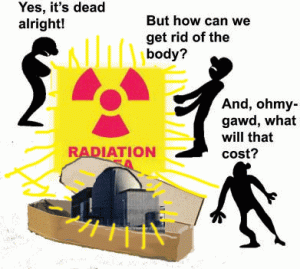
Ontario’s Unfunded Nuclear Decommissioning Liability is in the $18-$27 Billion CAD Range
https://tinyurl.com/5a9du4mz Editorial Team, August 6 2021 Late last year I worked up the likely amount of public money that would have to be thrown at the nuclear industry in order to successfully and safely decommission the 100 operational reactors and the now shut down ones. Unsurprisingly, the nuclear industry had been very optimistic in its estimates of decommissioning costs and timeframes, when the global empirical averages were trending to a billion USD and 100 years per reactor.
Recently I was asked by an Ontario journalist what I thought the likely situation in Ontario would be, and whether the decommissioning trusts were equally underfunded. I was unsurprised to find that Canada is in the same boat as the US, with highly optimistic schedule and cost projections which belie Canadian empirical experience with the CANDU reactor, and that the fund had nowhere near the money necessary for the job. Let’s run the numbers. [diagram on original]
Ontario Power Generation (OPG) is the chunk of the provincial utility that was carved apart in the late 1990s by the Mike Harris Conservatives to handle generation alone. It operates 18 aging CANDU reactors across three sites: Bruce, Pickering, and Darlington.
Table of operational nuclear generation reactors in Ontario
OPG has a nuclear decommissioning fund of about $5 billion CAD or US$4 billion right now. If the experience of other countries on the actual cost of a billion USD per reactor and an actual timeline of decommissioning of a century holds true, and I see no reason why it doesn’t, that means that there is currently a $17.5 billion CAD gap in Ontario, in addition to the existing $19.3 billion CAD in debt still being serviced from their construction. When the government of the era split up the utility, it moved all of the debt off of the components and into general debt. One of the many appropriate and sensible things that the McGuinty Administration did in the 2000s, in addition to shutting down coal generation entirely, was to move the debt back into the utility and set about servicing it from utility bills.
Most of the reactors at Bruce Nuclear are aging out, with several over 40 years old and the remainder approaching 40. Darlington’s are around 30, so they have a bit of runway. Pickering’s reactors are going to be shut down in 2024 and 2025 and start decommissioning in 2028. While refurbishment could bridge Ontario’s for another 20 years in many cases, that’s expensive and typically won’t pass any economic viability assessment compared to alternatives.
The likelihood is that all reactors in Ontario will reach end of life by 2035, and be replaced by some combination of renewable energy and HVDC transmission from neighboring jurisdictions, with both Manitoba and Quebec having excellent, low-carbon hydroelectric to spare.
Does the empirical experience of shutting down CANDU reactors track to the roughly billion USD that’s seen for other reactors? According to the World Nuclear Association, no.
The fourth unit is Gentilly 2, a more modern Candu 6 type, which was shut down at the end of 2012 after 30 years operation. It is being defuelled and the heavy water was to be treated over 18 months to mid-2014. A decommissioning licence was issued for 2016 to 2026 and the main part of the reactor will be closed up and left for 40 years to allow radioactivity to decay before demolition. All 27,000 fuel bundles are expected to be in dry storage (Macstor) by 2020. The decommissioning cost is put at C$ 1.8 billion over 50 years.”
That translates to US$1.44 billion, so it would appear as if CANDUs are on the expensive side to decommission. If that holds true, Ontario’s gap is actually in the range of $27 billion CAD.
Nuclear decommissioning funding comes from reactors operating revenue. In the US, it’s 0.01 to 0.02 cents per kWh as a set aside. I wasn’t able to find the required set aside for Ontario’s fleet, but obviously they aren’t setting aside sufficient funds now, or have absurdly optimistic fund growth expectations. They only have a decade to set aside more money from operating reactors, and have only set aside $5 billion CAD after 50 years, so the most generous assumption is that they will set aside perhaps $7 billion CAD in the OPG fund by end of life of the reactors, and have a liability for decommissioning of $15.5 to $27 billion CAD. For the next step, let’s assume $20 billion CAD for the sake of round numbers.
Given the likelihood of all of Ontario’s reactors being off of the grid by 2035, with major decommissioning occurring every few years until then, the kWh generated by Ontario’s nuclear fleet from now through 2060 will be in the range of about 1000 TWh assuming there are no lengthy outages at any of the plants, which to be clear is an awful lot of low carbon electricity.
However, $20 billion is a big number too. It turns into about 19 cents per kWh if you only count electricity generated from today through end of life for the reactors. It’s obviously a lot lower if you calculated from beginning of the lifetime of the reactors. However you count it though, that’s only the unfunded Ontario liability, and it’s on top of subsidized security costs Canada and Ontario and municipalities bear, and it’s on top of the outstanding $19.3 billion in debt that has only been receiving servicing on the interest since the McGuinty government brought it back into the utility. It’s likely that the majority of that debt will be outstanding in 2035 still, as it has gone from $20 billion to $19.3 billion in the last 11 years, so expecting it to be gone by 2035 is not realistic.
So yes, Ontario’s nuclear program will be a fiscal burden on Ontarians to the tune of around $40 billion CAD which will be spent through roughly 2135, finally being paid off by the great-grandchildren of babies born in 2021.
Nuclear, the gift that keeps on giving.
This article was originally published by Cleantechnica.com.
Read the original article here.
Russia wants help to clean up sunken nuclear submarines – while it invests in new ones!
Norway celebrates 25-years paying for nuclear-dump cleanup. Russia showcases new reactor weapons
Rosatom officials and Norwegian project partners are Wednesday marking that it is 25 years since the first money check was sent from Oslo to help improve infrastructure at the ill-fated Andreeva Bay dump site for spent nuclear fuel and radioactive waste accumulated from the operation of Cold War submarines. The Barents Observer ,By Thomas Nilsen September 29, 2021
”………………….. Sunken reactors
Andrey Zolotkov with ANO Bellona Murmansk says there are problems in the sphere of nuclear safety that Russia can’t deal with alone.
“This is to raise the sunken nuclear submarines,” he says.
On the seafloor of the Barents Sea, the old November class K-159 that sank in August 2003 has two reactors with spent nuclear fuel on board. The submarine lays in an area of high importance for the fisheries of both Russia, Norway and the European Union. Further east, in the Kara Sea, the submarine K-27 was dumped on purpose, along with several other submarine reactors and thousands of containers with radioactive waste.
Zolotkov fears the submarines may corrode to the worse if nothing is done.
If we constantly postpone this for later, then something may happen. The lifting operation will sooner or later become impossible because supporting structures will be destroyed as a result of corrosion.”
A key question is how eager potential donor nations would be to cash out even more money to assist in reducing the environmental risks caused by the past nuclear legacy, like the dumped reactors in the Kara Sea, as long as Russia itself gives priority to creating nuclear weapons systems beyond what the world ever has seen before.
Rearmament of the north
Russia’s rearmament of the north includes a new generation of both multi-purpose submarines and ballistic missile submarines. Currently, some 12-13 reactor-powered subs are under construction at the Sevmash yard in Severodvinsk. The new vessels will sail for both the Northern Fleet and the Pacific Fleet. Little is known about 4th generation Russian navy reactors and uranium fuel enrichment.
Maybe more frightening than the new submarines are two other reactor-powered weapons systems currently under testing and development in northern Russia: the Poseidon underwater drone and the Burevestnik cruise missile. Both are said to carry nukes and have a nearly unlimited range.
New satellite images
In late August, Google Earth updated its satellite images from above the naval yards in Severodvinsk…………………
Nenoksa accident
In August 2019, five employees from Rosatom were killed when a nuclear object was about to be raised from the seabed outside Nenoksa in the White Sea, only a few kilometers west of Severodvinsk. What exactly happened remains secret, but radiation monitors in Severodvinsk saw a spike, and locals took photos of ambulances where both the interior and the drivers were wearing protective dressed against radiation.
As reported by the Barents Observer, the explosion was most likely involving the reactor from a Burevestnik test. This autumn, Russia’s top-secret testing of the Burevestnik nuclear-powered missile is moved to Novaya Zemlya in the Arctic, an archipelago under full military control and formerly used for real nuclear weapons tests in the atmosphere and underground.
This week, a large area both on land at Novaya Zemlya and in the waters along the west coast on the Barents Sea side is closed off with NOTAM-warnings (Notice to Airmen). The size of the closed-off areas fits with a likely test launch of the nuclear-powered missile……… https://thebarentsobserver.com/en/nuclear-safety/2021/09/while-norway-celebrates-25-years-paying-cleanup-nuclear-dumpsite-russia-gives
Norway paid to help Russian nuclear submarine waste clean-up – but now – new submarines!
Norway celebrates 25-years paying for nuclear-dump cleanup. Russia showcases new reactor weapons
Rosatom officials and Norwegian project partners are Wednesday marking that it is 25 years since the first money check was sent from Oslo to help improve infrastructure at the ill-fated Andreeva Bay dump site for spent nuclear fuel and radioactive waste accumulated from the operation of Cold War submarines. The Barents Observer ,By Thomas Nilsen September 29, 2021
Hindered from on-site meetings due to the pandemic, today’s 25-years anniversary meeting in Andreeva Bay is long overdue. However, the meeting comes in pole position as the two countries are trying to improve bilateral relations in times of more complex geopolitics and higher tensions between NATO and Russia up north.
……. ensuring nuclear safety is another topic for good bilateral cooperation.
For the Soviet nuclear navy, the Coastal Technical Base in Andreeva Bay became the main storage site for both spent fuel assemblies from submarine reactors, as well as a site to store containers with solid radioactive waste. Focus was not on safety and after years of exposure to Arctic climate, the site became contaminated and the infrastructure started to fall apart. With Russia being broke after the collapse of the Soviet Union, the call for international action was precarious. Norwegian money, and will to solve the problem, was most welcomed……………
Success story
More than 2 billion kroner (nearly €200 million) of Norwegian taxpayers money are spent on helping Russia secure its nuclear legacy since the mid-1990ties. The ground-breaking nuclear safety work initiated on the Kola Peninsula, only some 60 km from the border to Norway, has since been followed by many other countries and international financial grant programs.
For projects in Andreeva Bay, Norway has paid more than €30 million on things like fixing electricity, water pipelines, roads, fences, constructing a new sanitary building and improving the old pier in port with a new lifting crane. About half of the 21,000 spent uranium fuel elements originally stored in three rundown concrete tanks is so far lifted out, repacked and shipped out of Andreeva Bay. First to Atomflot in Murmansk, then by train further to Russia’s reprocessing plant at Mayak in the South Urals. Some 10,000 cubic meters of solid radioactive waste that previously was stored outdoor and exposed to snow and frost is now under roof in a new building erected at the site. Soon, also that will be transported away.
Present at the celebrations in Andreeva Bay is also representatives from the environmental NGO Bellona. It was this organization, with offices both in Murmansk and Oslo, that before the official country-to-country cooperation started, was first to uncover security breaches and the urgency to act before the entire storage site turned out to be a Chernobyl in slow-motion.
“Time has come”
Bellona’s Aleksandr Nikitin says to the Barents Observer that the time has come for Russia to solve its own nuclear challenges, not the international community. “But first we have to complete already started international projects, like the nuclear legacy,” Nikitin says and points to the ongoing work in Andreeva Bay………….
Meanwhile, and unlike the 1990ties, Russia is now investing huge money in building new nuclear-powered submarines and other military nuclear installations. A key question is whether Moscow now is arming the country again into a nuclear age that later could cause similar radiological waste challenges as the legacy from the last Cold War created.
…….. It is a task for Russia and Rosatom. We cannot hire anymore for a rich uncle from the west to come and help again. It was a time when it was necessary, not anymore.”
Meanwhile, Aleksandr Nikitin is glad to see the solution-oriented results of the work in Andreeva Bay.
“Bellona started it, and we have to finish it,” he says………………………………….
A Norwegian intelligence official has previously expressed fears for more accidents with the reactor-powered weapons systems now under testing and development in Norway’s neighboring areas up north.
For Norway, a challenge is to balance the aid-support to nuclear safety with making sure no funding ends up in Russia’s new crazy nuclear weapons programs…………..
The “Serebryanka” dilemma
A review made by the Barents Observer of the publicly available documents on financial aid from Norway and Sweden to equip modern communication and positioning systems on board “Serebryanka” shows that about 9 million kroner (€900,000) were spent on the project in 2013 and 2014. That was shortly before the Burevestnik testing program started.
The Swedish Radiation Safety Authority, in charge of the project, says in its annual overview of Non-Proliferation cooperation for 2013 that the “Serebryanka” was the largest project initiated in the Murmansk region.
Stockholm spent 4,1 million Swedish kroner (SEK) on equipment for “Serebryanka” in 2013 and an additional 217,000 SEK in 2014.
Describing the project, the Radiation Safety Authority writes: “This project is co-financed with Norway and the purpose is to equip the vessel “Serebryanka” with a physical protection system, as well as communications and positioning systems, in order to increase security when transporting nuclear materials and radioactive substances.”
The Norwegian share of the project was 3 million Norwegian kroner, paid as part of the Nuclear Action Plan financed by the Ministry of Foreign Affairs.
Conflict-of-interests
Asked about the potential conflicting interests, State Secretary Audun Halvorsen in Norway’s Foreign Ministry told the Barents Observer upfront of the annual meeting in the Norwegian-Russian Commission on Nuclear Safety this spring that “…. our bilateral cooperation on nuclear safety projects are related to civilian activities only, and questions regarding military activities are therefore considered outside of the scope of the commission by the Russian side.” https://thebarentsobserver.com/en/nuclear-safety/2021/09/while-norway-celebrates-25-years-paying-cleanup-nuclear-dumpsite-russia-gives
Plutonium: How Nuclear Power’s Dream Fuel Became a Nightmare.

The history of nuclear power’s imagined future: Plutonium’s journey from asset to waste, Bulletin of the Atomic Scientists, By William Walker, September 7, 2021

Bill Gates is deluded in believing that the plutonium-fuelled, sodium-cooled, “Versatile Power Reactor” in which his company Terrapower is involved, has a commercial future.[18] His support is also unwelcome insofar as it helps to perpetuate the myth that plutonium is a valuable fuel, posing acceptable risks to public safety and international security. Reprocessing is a waste-producing, not an asset-creating, technology. It adds cost rather than value. It merits no future when seen in this way.
‘ ………..Plutonium’s history and its legacies are the subject of a recent book by Frank von Hippel, Masafumi Takubo and Jungmin Kang.[1] Plutonium: How Nuclear Power’s Dream Fuel Became a Nightmare. It is an impressive study of technological struggle and ultimate failure, and of plutonium’s journey from regard as a vital energy asset to an eternally troublesome waste
Toward heaven or hell? The conflict over plutonium’s future…………..
From creation of a future to preservation of the present
Construction of the British and French reprocessing plants at Sellafield and Cap de la Hague proceeded throughout the 1980s.[6] Their primary justification—preparing for the introduction of fast breeder reactors—had lost all credibility by the time of their completion. The German, British and French breeder programs had been cut back, soon to be abandoned, and in 1988 Germany cancelled plans to build its own bulk reprocessing plant at Wackersorf. Although Japan’s confidence in its fast breeder reactor program also waned, it was kept alive to avoid disrupting construction of the reprocessing plant at Rokkasho-mura.
Faced by the plutonium economy’s demise, reprocessing was re-purposed by its supporters to provide the industry and its governmental backers with reason not to do the obvious—abandon ship. Creating an essential future was replaced by a rationale designed to preserve and activate the newly established reprocessing infrastructures. ……. plutonium’s energy value could be realised through its replacement of fissile uranium in “mixed-oxide fuels” for use in existing thermal reactors………
Thirty years after the Euro-Japanese reprocessing/recycling system’s launch, the experiment can only be judged a failure. The reasons are set out in persuasive detail in von Hippel, Takubo and Kang’s book. It is a system undergoing irreversible contraction after a long struggle, involving heavy expenditure and many troubles. Germany and the UK have already exited, the UK shutting its THORP reprocessing plant in 2018 and delaying its Magnox reprocessing plant’s closure only because of the coronavirus pandemic.[9] Instead, its Nuclear Decommissioning Authority has been given the costly (more than $138 billion) and long-lasting (more than 100 years) task of returning Sellafield and Dounreay to “green-field sites.”
Japan’s engagement with reprocessing and plutonium recycling was already deeply troubled before the Fukushima accident closed reactors: The Rokkasho-mura reprocessing plant was operating only fitfully, MOX recycling was not happening, and plutonium separated from Japanese spent fuels in France and the UK was marooned there, probably indefinitely, by inability to manage its return in MOX fuel (cutting a very long story short).[10] The declared intention to soldier on with bulk reprocessing seems increasingly bizarre and is surely unsustainable. ……….
France’s national utility EDF, saddled with enormous debts, is striving to reduce its exposure to reprocessing. It is symptomatic that no spent fuel discharged from EDF-owned and -operated reactors in the UK, including those under construction at Hinkley Point, will be reprocessed………
The move away from reprocessing is being accompanied by a transition towards dry-cask storage of spent fuels. It entails their removal from water pools at reactors after a few years’ cooling and their insertion in large concrete or stainless steel containers, ………
Reprocessing continues in India and Russia, if fitfully, where fast reactor programmes are still being funded. Japan’s commitment remains. ………
There is particular concern about China’s engagement with reprocessing and its dual civil and military purposes…………
……………. Separated plutonium is a waste
The authors remind readers of the persistent dangers that reprocessing poses to public safety and international security: the risks of accident and exposure to radiation, the proliferation of weapons, the possibility of diversion into nuclear terrorism, and the undesirable complication of radioactive waste disposal. “In our view, it is time to ban the separation of plutonium for any purpose” (their italics) is their concluding sentence. This may be the case, but the US and other governments are unlikely to respond to their call. They have so much else to contend with—climate change, pandemics, economic distress, arms racing on a long list—leaving a ban on plutonium separation low in their priorities. They are also all too aware of past failures to institute such bans, whether in commercial or military domains, from the Carter Policy in the 1970s to the stalled Fissile Material Cutoff Treaty in the 1990s and subsequently.
Another conclusion cries out to be drawn from this book. Plutonium’s separation and usage for energy purposes was an experiment that can now decisively be pronounced a failure. Experience has shown that separated civil plutonium is a waste. The book’s first of many figures, reproduced below, is the most telling. Up to the mid-1980s, the global stock of separated plutonium was predominately military and held in warheads, peaking at around 200 tons. It now exceeds 500 tons. The increase is due to the ballooning of civil stocks as plutonium’s separation has outstripped consumption. The global stock of separated plutonium now includes material extracted from the post-Cold War dismantlement of Russian and US nuclear warheads that is also effectively a waste.[16]

Civil plutonium is therefore not an asset, it is not “surplus to requirement;” it is a waste. This is the message that needs to be proclaimed and acknowledged, especially by governments, utilities, and industries desiring that nuclear power have a solid future and make a contribution to the avoidance of global warming. For reasons set out in von Hippel’s recent article in the Bulletin, Bill Gates is deluded in believing that the plutonium-fuelled, sodium-cooled, “Versatile Power Reactor” in which his company Terrapower is involved, has a commercial future.[18] His support is also unwelcome insofar as it helps to perpetuate the myth that plutonium is a valuable fuel, posing acceptable risks to public safety and international security. Reprocessing is a waste-producing, not an asset-creating, technology. It adds cost rather than value. It merits no future when seen in this way.
Even if all civil reprocessing ceased tomorrow, the experiment would have bequeathed the onerous task of guarding and disposing of over 300 tons of plutonium waste, and considerably more when US and Russia’s military excess is added in. Proposals come and go. Burn it in specially designed reactors? Blend it with other radioactive wastes? Bury it underground after some form of immobilization? Send it into space? All options are costly and hard to implement. Lacking ready solutions, most plutonium waste will probably remain in store above ground for decades to come, risking neglect. How to render this dangerous waste eternally safe and secure is now the question. Extensive References . https://thebulletin.org/premium/2021-09/the-history-of-nuclear-powers-imagined-future-plutoniums-journey-from-asset-to-waste/?utm_source=Newsletter&utm_medium=Email&utm_campaign=ThursdayNewsletter09272021&utm_content=NuclearRisk_HistoryOfNuclearPowersImagined_09102021
Texas sues federal government to block nuclear waste facility along New Mexico border
Texas sues federal government to block nuclear waste facility along New Mexico border, Adrian Hedden, Carlsbad Current-Argus, 27 Sept 21, A lawsuit filed by the State of Texas last week stated a proposal to build a storage facility for nuclear waste in the state “unlawful” and called on a federal appeals court to vacate a federal license issued for the project earlier this month..
Interim Storage Partners (ISP) received the license from the Nuclear Regulatory Commission (NRC) to build a temporary storage facility for spent nuclear fuel rods in Andrews, Texas along the state’s western border to New Mexico.
The project, an expansion of the company’s facility in Andrews that holds low-level waste, would ultimately hold up to 40,000 metric tons of the high-level waste temporarily until a permanent repository is available.
There is presently no permanent holding place for the waste and critics of the project feared it could become a “de facto” permanent resting place for the waste.
The lawsuit filed Sept. 23 by Abbott and the Texas Commission on Environmental Quality in the Fifth Circuit U.S. Court of Appeals demanded the court review and ultimately vacate the license.
“Petitioners pray that, upon review, the Court will hold unlawful and set aside the order issuing Materials License No. SNM-2515 and vacate the License,” the lawsuit read……………….. https://www.currentargus.com/story/news/local/2021/09/27/texas-sues-block-nuclear-waste-facility-along-new-mexico-border/5883388001/
Will Fukushima’s Water Dump Set a Risky Precedent?
Will Fukushima’s Water Dump Set a Risky Precedent? IEEE Spectrum
Questions raised over new norms the disaster’s radioactive wastewater cleanup efforts may foster, RAHUL RAO 24 SEP 2021 Since the Japanese earthquake and tsunami in March 2011, groundwater has been trickling through the damaged facilities at the Fukushima Daiichi nuclear power plant, filtering through the melted cores and fuel rods and becoming irradiated with a whole medley of radioisotopes. Japanese authorities have been pumping that water into a vast array of tanks on-site: currently over a thousand tanks, and adding around one new tank per week.
Now, Japanese authorities are preparing to release that water into the Pacific Ocean. Even though they’re treating and diluting the water first, the plan is meeting with vocal protests. From that opposition and from scientists’ critiques of the process, the ongoing events at Fukushima leave an unprecedented example that other nuclear power facilities can watch and learn from.
The release is slated to start in 2023, and potentially last for decades. This month, observers from the International Atomic Energy Agency have arrived in the country to inspect the process. And efforts are also underway to build an undersea tunnel that will discharge the water a kilometer away from the shore.
Before they do that, they’ll treat the water to cleanse it of radioactive contaminants. According to the authorities’ account of the situation, there’s one major contaminant that their system cannot cleanse: tritium.
It’s actually normal for nuclear power plants to release tritium into the air and water in their normal operations. In fact, pre-disaster, Fukushima Daiichi held boiling-water reactors, the lowest-tritium type of nuclear reactors. The Japanese government’s solution is to dilute the tritium-contaminated water down to comparable levels. That’s part of the reason the discharge will likely last several decades.
“While one can argue whether such release limits are appropriate in general for normally operating facilities, the planned release, if carried out correctly, does not appear to be outside of the norm,” says Edwin Lyman, director of nuclear power safety at the Union of Concerned Scientists.
Even so, the plan has—perhaps expectedly—encountered some rather vocal opposition. Some of the loudest cries have come from within Japan, particularly from the fishing industry. Radiation levels in seafood from that coast are well within safety limits, but fishing cooperatives are concerned the plan is (once again) putting their reputations at stake………….
can the events at Fukushima offer other energy facilities around the world any lessons at all?
For one, they’re a good show of the need for emergency planning. “Every nuclear plant should be required to analyze the potential for such long-term consequences,” says Lyman. “New nuclear plants, if built, should incorporate such evaluations into their siting decisions.”
But there’s other things experts say that facilities could learn. For example, something that hasn’t always been present in the Fukushima matter—working against it—has been transparency.
Authorities at the plant haven’t fully addressed the matter of non-tritium contaminants, according to Ken Buesseler, a marine radiochemist at Woods Hole Oceanographic Institution who has studied radioactivity in the ocean off Fukushima. Some contaminants—like caesium-137 and strontium-90—were present in the initial disaster in 2011. Others—like cobalt-60 and cerium-144—entered the water later.
It isn’t something the authorities have completely ignored. “Japan plans to run the water again through the decontamination process before release, and the dilution will further reduce the concentrations of the remaining isotopes,” says Lyman.
But Buesseler isn’t convinced that it will be enough. “Theoretically, it’s possible to improve the situation a lot,” he says. “In practice, they haven’t done that.” Japanese authorities insist they can do so, but their ability, he says, hasn’t been independently verified and peer-reviewed……….
“I’d hate to see every country that has radioactive waste start dumping waste into the ocean,” he says. “It’s a transboundary issue, in a way. It’s something bigger than Japan, and something different from regular operation. I think they need to be at least open about that, getting international approval.”
Here, Lyman agrees. “This situation is unique and the decision to release the water into the sea should not set a precedent for any other project.”
But even taking all of that into account, some believe that, if anything, this is an example of a time when there simply is no choice but to take drastic action.
“I believe that this action is necessary to avoid potentially worse consequences,” says Lyman. https://spectrum.ieee.org/fukushima-wastewater-cleanup-questions
Samuel Lawrence Foundation loses court case to keep spent fuel pools as safety backup at San Onofre nuclear station
Judge tosses out lawsuit that sought to stop San Onofre nuclear plant dismantlement, Ruling says Coastal Commission properly granted permit, San Diego Tribune, BY ROB NIKOLEWSKI , . 20, 2021
Deconstruction work at the now-shuttered San Onofe Nuclear Generating Station — known as SONGS for short — will continue after a judge in Los Angeles County turned back a lawsuit filed by an advocacy group that looked to put a halt to it.
Deconstruction work at the now-shuttered San Onofe Nuclear Generating Station — known as SONGS for short — will continue after a judge in Los Angeles County turned back a lawsuit filed by an advocacy group that looked to put a halt to it.
In a 19-page decision, Los Angeles County Superior Court Judge Mitchell Beckloff ruled last week the California Coastal Commission acted properly when it granted a permit in 2019 to Southern California Edison — the operators of the plant — to proceed with dismantlement efforts.
The Samuel Lawrence Foundation filed the suit, arguing the commission violated its own regulations and provisions by issuing the permit………….
Samuel Lawrence Foundation president Bart Ziegler said in an email that his group “will continue to push for strict monitoring, protocols and handling facilities at Edison’s nuclear waste dump.”
The heart of the lawsuit centered on two spent fuel pools that are scheduled to be torn down.
At commercial nuclear power plants, when the highly radioactive fuel rods used to generate electricity lose their effectiveness, operators place the assemblies in a metal rack that is lowered about 40 feet into a “wet storage” pool, typically for about five years, to cool.
Edison has since taken the assemblies out of the pools, placed them into stainless steel canisters and moved them into two “dry storage” facilities on the north end of the plant. One facility holds 50 canisters and another, more recently constructed site, holds 73 canisters.
Edison says now that the spent fuel has been transferred to dry storage, the pools are unnecessary and should be dismantled.
The Samuel Lawrence Foundation argued Edison should keep the pools in case the canisters ever get damaged or degrade over time………..
Despite issuing the permit and related measures, the commission has complained about being put in a tough position.
Edison says now that the spent fuel has been transferred to dry storage, the pools are unnecessary and should be dismantled.
Schwartz said until the federal government comes up with a long-term storage site, “we are forced to live with the increased risks of storing (waste) on our coast. Commissioners and staff have communicated to the (Nuclear Regulatory Commission) the urgency of moving these spent fuel facilities out of the coastal hazard zone, and we will continue to press the NRC on this issue.”
There are 3.55 million pounds of used-up fuel in the canisters at SONGS, which is located between the Pacific and Interstate 5.
But keeping the waste on-site is not unique to San Onofre. About 80,000 metric tons of spent fuel has stacked up at 121 commercial nuclear sites in 35 states………..
Under a “special condition” agreed to in 2015, the commission is allowed by 2035 to revisit whether the storage site should be moved to another location in case of rising sea levels, earthquake risks, potential canister damage or other scenarios……
SONGS’ dismantlement began in March 2020 and is expected to take about eight years to complete. Roughly 2 billion pounds of equipment, components, concrete and steel will be removed from the plant.
The two distinctive containment domes, each nearly 200 feet high, are scheduled to come down around 2027.
About 450,000 tons of material labeled low-level nuclear waste will be shipped — mostly by rail — to a disposal facility in Clive, Utah. Another 35 tons of low-level waste will get shipped by truck to a facility in the West Texas town of Andrews.
According to Edison’s plans, all that will remain at SONGS will be two dry storage facilities, a security building with personnel to look over the waste, a seawall, a walkway connecting two beaches north and south of the plant, and a switchyard with power lines. The rest of the property will revert to the U.S. Navy and Marine Corps Base Camp Pendleton. https://www.sandiegouniontribune.com/business/energy-green/story/2021-09-20/judge-tosses-out-lawsuit-that-sought-to-stop-san-onofre-nuclear-plant-dismantlement
New Mexico backs Texas in opposing nuclear fuel storage
New Mexico backs Texas in opposing nuclear fuel storage, APN News, By SUSAN MONTOYA BRYAN, 17 Sept 21, ALBUQUERQUE, N.M. (AP) — Top New Mexico leaders say they’re open to “most anything” that would prevent spent nuclear fuel and other high-level waste from being stored indefinitely in the state, including legislation like a measure recently adopted by Texas to prevent the shipping and storage of such waste.
The renewed criticism this week of planned temporary storage facilities in West Texas and southeastern New Mexico came as federal regulators just granted a license for the proposed operation in Texas.
Interim Storage Partners LLC plans to build a facility in Andrews County that could take up to 5,000 metric tons of spent nuclear fuel rods from power plants and 231 million tons of other radioactive waste.
In New Mexico, Holtec International is awaiting approval of its license application for a facility that initially would store up to 8,680 metric tons of uranium. Future expansion could make room for as many as 10,000 canisters of spent fuel over six decades.
New Mexico Gov. Michelle Lujan Grisham, a Democrat, and other top officials already have submitted comments in opposition to the multibillion-dollar proposal on their side of the state line and to the Texas project. New Mexico also is suing the Nuclear Regulatory Commission, claiming it hasn’t done enough to vet Holtec’s plans.
Lujan Grisham’s office said it would be open to exploring legislation and to seeking funding that could boost efforts by New Mexico regulators to push back administratively……..
Texas Gov. Greg Abbott, a Republican, has a similar stance and tweeted this week that “’Texas will not become America’s nuclear waste dumping ground.”……..https://apnews.com/article/business-environment-and-nature-texas-new-mexico-5963107ed241ad5e1a07c8217e691117
Latest on America’s plutonium ”pits” costly fiasco
Stumbling plutonium pit project reveals DOE’s uphill climb of nuclear modernization, https://thehill.com/opinion/energy-environment/572477-stumbling-plutonium-pit-project-reveals-does-uphill-climb-of BY TOM CLEMENTS, — 09/15/21
The U.S. Department of Energy’s National Nuclear Security Administration (NNSA) is mounting a full-court press for the “modernization” of the nuclear weapons production complex, an effort packed with capital-intensive projects on which contractors thrive. A cornerstone of modernization, a new plant to make the plutonium “pits” for new nuclear weapons already faces problems. Yet, Congress and the Biden administration are moving ahead despite gathering storm clouds.
“Pits” are the hollow plutonium spheres that cause the initial nuclear explosion in all U.S. nuclear weapons. New pits would first go into the new W87-1 warhead for a new missile, the Ground Based Strategic Deterrent (GBSD), meant to replace the U.S.’s current ICBMs. Second in the queue is a submarine launched missile. Both weapons have their detractors, but pits could prove to be their ultimate stumbling block.
The new pit plant will be at DOE’s sprawling Savannah River Site (SRS) in South Carolina. Already SRS’s plans face massive cost increases and schedule delays, causing skepticism in Congress.
In 2020, NNSA presented an initial cost estimate of $4.6 billion for the SRS pit plant. By June of this year that cost estimate had more than doubled to a stunning $11 billion. Timelines continue to slip as well. NNSA has quietly admitted in its fiscal year 2022 budget request that the original 2030 operational date to produce 50 pits had slipped until between 2032 and 2035.
While more schedule setbacks loom, the NNSA has tried to save some time by cutting corners. The most obvious is the rushed manner in which they conducted a legally required environmental analysis of the project. In their haste, NNSA failed to analyze environmental justice concerns and impacts of pit production across the DOE complex. Of paramount concern, disposal of plutonium waste has not been reviewed. Public interest groups filed a lawsuit against DOE on June 29, demanding preparation of a required Programmatic Environmental Impact Statement. A response to the lawsuit is due on Sept. 27.
None of this should be surprising. SRS lacks pit production experience and has a record of problems. Perhaps that is why the NNSA is also having the Los Alamos National Lab in New Mexico to also produce pits. That lab has been assigned to ramp up its current pit production with a goal of producing 30 pits per year by 2026 ¾ a tall task for a facility plagued by plutonium-handling problems.
Rep. Adam Smith (D-Wash.), chairman of the House Armed Services Committee, knows all of this. He highlighted the agency’s chronic inability to carry out modernization projects earlier this year saying, “in nearly every instance, NNSA programs have seen massive cost increases, schedule delays, and cancellations of billion-dollar programs. This must end.”
On Aug. 31, when speaking about pit production in a Brookings Institution virtual event, Smith went further saying that “Savannah River sort of gives me an involuntary twitch after the whole MOX disaster. I don’t trust them.”
And what a disaster it was. MOX was a plutonium fuel plant at SRS that NNSA wasted $8 billion on before termination in 2018. Smith’s mistrust is well placed— his committee should investigate the failed construction of the MOX plant before handing the same facility billions more for a new project.
In the event at Brookings, Smith defended his lack of action on pits and the GBSD, saying that decisions about them are in a “tactical pause” until the cost of the SRS plutonium bomb plant is clearer and as we wait and see if President Biden will honor his pledge to reduce reliance on nuclear weapons, of which almost 4,000 are deployed or in active reserve.
Of course, Smith is incorrect as there is no pause in either the projects or the spending. If he wants a real pause, he must act. Without strong leadership and oversight, the programs could quickly develop the same inertia as MOX leaving us with another multi-billion fiasco with nothing to show for it.
He and his colleagues should fight to reduce fiscal year 2022 funding authorization in the National Defense Authorization Act for the SRS pit plant ($710 million), Los Alamos pit production ($1 billion) and the W87-1 warhead ($691 million for NNSA and $2.6 billion for the Department of Defense). He should review the reuse of 15,000 existing pits stored at DOE’s Pantex Plant in Texas. He should also demand a proper environmental review of pit production.
Waiting for Biden is an inadequate strategy. Action is needed now by Chairman Smith and Congress to increase our collective security by fulfilling their leadership responsibilities. Requiring a true pause on pit production would not only stop money from being wasted on this project but would act as a wake-up call that nuclear weapons projects don’t have a blank check from Congress.
Tom Clements is the director of Savannah River Site Watch a public interest organization in Columbia, South Carolina, which monitors U.S. Department of Energy management of weapon-usable materials, nuclear weapons production, and clean-up of high-level nuclear waste, with a focus on the Savannah River Site.
Texas to fight on against dumping of spent nuclear fuel in Andrews County
In a statement before the NRC’s announcement this week, Hadden said opponents would “keep fighting” even if the new license were issued. She said legal challenges remain, and she expressed hope that Texas’ attorney general would fight to protect people. A county commissioners’ body in Andrews County, Texas, also backed a resolution against high-level nuclear waste storage this year, local CBS affiliate KOSA reported
Nuclear waste in the oil patch? Feds spark clash with Texas E and E News, By Edward Klump | 09/15/2021 A site in West Texas now has a federal license to store spent nuclear fuel, setting up a potential showdown with state leaders who oppose the prospect of attracting high-level radioactive waste from across the country.
The Nuclear Regulatory Commission announced the license for Interim Storage Partners LLC to build and operate an interim storage facility in Andrews County, Texas, on Monday — just days after Texas Republican Gov. Greg Abbott signed a bill seeking to restrict nuclear waste storage in the state.
Yesterday, Abbott tried to use the new license in the Permian Basin oil patch to hammer President Biden, though an application for the site was filed in 2016, and the Trump administration didn’t kill the project.
“The Biden Admin. is trying to dump highly radioactive nuclear waste in west Texas oil fields,” Abbott said on Twitter. “I just signed a law to stop it. Texas will not become America’s nuclear waste dumping ground.”
David McIntyre, an NRC spokesperson, declined to comment on the governor’s criticism but said in a statement this week that the “licensing decision was made according to the applicable federal statutes and regulations after thorough, multi-year technical and environmental reviews.”
The drama is being watched by the electricity sector, as nuclear power plants continue to store spent fuel on-site without a permanent U.S. repository. Yucca Mountain in Nevada has failed to garner enough sustained support to be an option (E&E Daily, July 22). In the meantime, backers of the Interim Storage Partners, or ISP, site in West Texas and a separate project in eastern New Mexico from Holtec International have pursued interim storage proposals that could last for decades.
The NRC said this is the second license it has issued for a consolidated storage facility for spent nuclear fuel. The first was in 2006 for a different facility that wasn’t built. A decision on Holtec’s application for a site in Lea County, N.M., is expected in January, according to the nuclear safety regulator. Opposition to Holtec’s plan has been bubbling up in New Mexico, as well.
It remains to be seen how the West Texas proposal will proceed from here. ISP could directly challenge Texas’ stance, or it could take a more conciliatory, wait-and-see approach before seeking to move ahead.
The Texas Commission on Environmental Quality, in response to a question from E&E News yesterday, said its “role is to NOT issue authorizations under TCEQ purview as directed in the bill language” if permits are requested for a high-level radioactive waste facility in the state such as the ISP site.
In a statement yesterday, ISP noted that the “proposed facility would be located adjacent to Waste Control Specialists’ existing low-level nuclear materials disposal facility in Andrews County, Texas.” ISP is a joint venture of Waste Control Specialists and Orano USA, along with some support from a technology provider called NAC International. A revised license application was submitted in 2018.
ISP said the federal authorization was based on a through, multiyear review. The venture didn’t indicate its next move or provide responses to questions posed by E&E News.
“The extensive analyses concluded that this facility’s commercial interim storage and transport operations satisfy all environmental, health, and safety requirements without negative impact to nearby residents or existing industries,” ISP said in its statement.
Critics have noted safety worries for people who live in West Texas, as well as concerns about transporting nuclear waste across the country.
“There were no surprises in NRC’s announcement, by Twitter, about approving the license for deadly nuclear waste storage in Texas,” Karen Hadden, executive director of the Sustainable Energy & Economic Development Coalition, said in a statement to E&E News. “There was no acknowledgement of the overwhelming opposition throughout Texas. Just the federal government steamrolling our state to benefit a private company.”
‘Really interesting times’
In a statement before the NRC’s announcement this week, Hadden said opponents would “keep fighting” even if the new license were issued. She said legal challenges remain, and she expressed hope that Texas’ attorney general would fight to protect people. A county commissioners’ body in Andrews County, Texas, also backed a resolution against high-level nuclear waste storage this year, local CBS affiliate KOSA reported………. https://www.eenews.net/articles/nuclear-waste-in-the-oil-patch-feds-spark-clash-with-texas/
1 This Month
15 October. Joint Appeal for Nuclear Abolition Day -presentation to the UN on October 15 will be live on UNWebTV
Endorse the Nuclear Abolition Day Appeal
23-25 October – on Zoom – World BEYOND War’s annual global conference

To see nuclear-related stories in greater depth and intensity – go to https://nuclearinformation.wordpress.com
-
Archives
- October 2026 (149)
- September 2026 (339)
- August 2026 (330)
- July 2026 (355)
- June 2026 (287)
- May 2026 (306)
- April 2026 (356)
- March 2026 (251)
- February 2026 (267)
- January 2026 (308)
- December 2025 (358)
- November 2025 (359)
-
Categories
- 1
- 1 NUCLEAR ISSUES
- business and costs
- climate change
- culture and arts
- ENERGY
- environment
- health
- history
- indigenous issues
- Legal
- marketing of nuclear
- media
- opposition to nuclear
- PERSONAL STORIES
- politics
- politics international
- Religion and ethics
- safety
- secrets,lies and civil liberties
- spinbuster
- technology
- Uranium
- wastes
- weapons and war
- Women
- 2 WORLD
- ACTION
- AFRICA
- Atrocities
- AUSTRALIA
- Christina's notes
- Christina's themes
- culture and arts
- Events
- Fuk 2022
- Fuk 2023
- Fukushima 2017
- Fukushima 2018
- fukushima 2019
- Fukushima 2020
- Fukushima 2021
- general
- global warming
- Humour (God we need it)
- Nuclear
- RARE EARTHS
- Reference
- resources – print
- Resources -audiovicual
- Weekly Newsletter
- World
- World Nuclear
- YouTube
-
RSS
Entries RSS
Comments RSS

