Government ‘replanning’ £53.3bn geological disposal facility project
“Successful delivery of the project appears to be unachievable. “There are major issues with project definition, schedule, budget, quality and/or benefits delivery, which at this stage do not appear to be manageable or resolvable.”
02 Sep, 2025 By Tom Pashby
Government ‘replanning’ £53.3bn geological disposal facility project.
Construction of a UK geological disposal facility (GDF) for long-term
nuclear waste disposal is being “replanned” after recent revelations
about its cost and deliverability, according to the government.
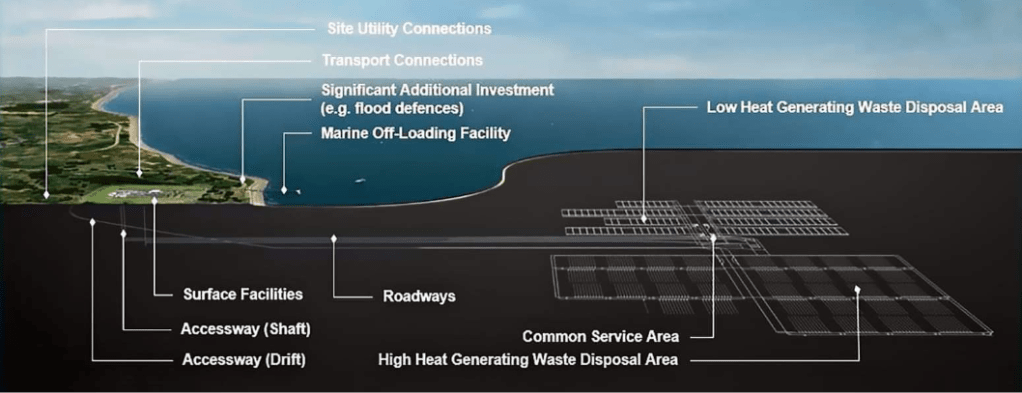
A GDF represents a monumental undertaking, consisting of an engineered vault placed between 200m and 1km underground, covering an area of approximately 1km2 on the surface. This facility is designed to safely contain nuclear waste while allowing it to decay over thousands of years, thereby reducing its radioactivity and associated hazards.
The National Infrastructure and
Service Transformation Authority (Nista), a Treasury unit, assessed the GDF
in its Nista Annual Report 2024-2025 and gave it a Red rating in Delivery
Confidence Assessment. This means: “Successful delivery of the project
appears to be unachievable. “There are major issues with project
definition, schedule, budget, quality and/or benefits delivery, which at
this stage do not appear to be manageable or resolvable. The project may
need re-scoping and/or its overall viability reassessed.” In addition,
the Nista annual report lists the “whole life cost” of the GDF as
£20bn as a mid-range assessment and £53.3bn as a high-end assessment.
Government says GDF project facing ‘replanning’ by NDA, but remains
necessary
New Civil Engineer 2nd Sept 2025, https://www.newcivilengineer.com/latest/government-replanning-53-3bn-geological-disposal-facility-project-02-09-2025/
Sizewell C Funded Decommissioning Programme: Contingent Liability (Public on the hook)
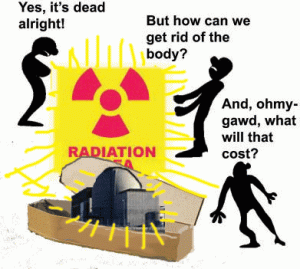
I am pleased to have laid a departmental minute describing the contingent
liabilities arising from the signing of the funded decommissioning
programme and Government support package for Sizewell C. The funded
decommissioning programme at Sizewell C will be funded via the regulated
asset base. The regulated asset base contains a series of protections that
aim to minimise the risk that public funds will be required to meet
decommissioning costs.
However, in certain remote circumstances whereby all
the protections afforded by Sizewell C’s economic licence fall away or a
shortfall in the fund materialises, public funds could be used to
contribute towards decommissioning costs and this liability would
crystalise. Based on best estimates by the Government Actuary Department,
the maximum potential exposure from the liability is £12 billion—in 2022
terms. This has been estimated on a worse-case scenario whereby the
Government were required to meet the full costs of decommissioning the
Sizewell C power plant.
Hansard 1st Sept 2025, https://hansard.parliament.uk/commons/2025-09-01/debates/25090137000015/SizewellCFundedDecommissioningProgrammeContingentLiability
Assessment of Asse storage chamber conditions begins
Tuesday, 19 August 2025, https://www.world-nuclear-news.org/articles/assessment-of-asse-storage-chamber-conditions-begins
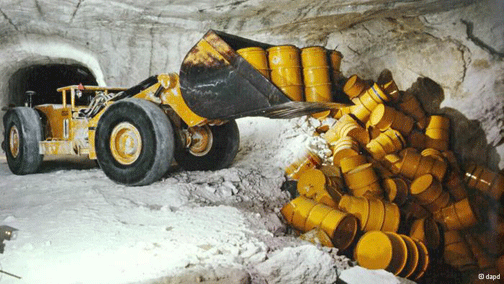
An exploratory borehole is providing the first indications of the condition of the stored drums containing radioactive waste within Storage Chamber 12 at the former Asse II salt mine in the district of Wolfenbüttel, Lower Saxony, Germany.
Between 1967 and 1978, thousands of barrels of mostly low-level radioactive waste were emplaced in a total of 13 former mining chambers at the Asse II mine on behalf of the federal government. However, the facility has proven unstable and retrieval of the waste has been legally mandated since 2013.
Germany’s Federal Company for Radioactive Waste Disposal (BGE) has announced it “made significant progress” in its preparations for the retrieval of radioactive waste from the Asse II mine at the beginning of August.
“Through a tennis ball-sized hole, we were able to take a look into Storage Chamber 12 for the first time in decades,” said Iris Graffunder, Chair of the Management Board of BGE. “Our first impression is that at least the visible barrels are in good condition. Now we will find out the exact composition of the chamber atmosphere and measure the activity levels in the chamber. For this, we need more space and will have to expand the borehole.”
Storage Chamber 12 contains 7,464 containers, including 6,747 drums and 717 so-called ‘lost concrete shields’ (drums encased in concrete). The containers were stacked horizontally. Storage took place in 1973 and 1974. The eventual formation of a sump containing contaminated solution in the access area to this storage chamber led, among other things, to the Asse II mine being placed under nuclear law in 2009.
Storage Chamber 12 is one of the highest radon emitters in the Asse II mine. At the end of May 2024, miners began the targeted drilling into the chamber under the highest radiation protection standards. At a depth of 750 metres, a borehole about 117 metres long was drilled to access the chamber. On 6 August, radiation protection measurements during drilling showed elevated radon levels, indicating that the chamber had been reached.
A planned gas measurement will reveal the composition of the chamber atmosphere and the factors that influence it. Further geological exploration is also underway. Preliminary investigations revealed that the chamber ceiling was deeper than expected. The first images from the chamber confirm these radar and magnetic measurements. A planned 3D scan is intended to provide a more complete picture of the emplacement chamber.
All of the measured values obtained will be utilised in the further planning of retrieval and in future licensing procedures. Among other things, they will allow BGE to determine which recovery technologies can be used in Storage Chamber 12.
BGE – a federally owned company within the remit of the Federal Environment Ministry – took over responsibility as operator of the Asse II mine and the Konrad and Morsleben repositories from the Federal Office for Radiation Protection in April 2017. It is also tasked with searching for a repository site to dispose of the high-level radioactive waste generated in Germany on the basis of the Site Selection Act that came into force in May 2017.
According to current planning, retrieval of the radioactive waste stored in Asse II is scheduled to begin in 2033. Currently, costs of about EUR4.7 billion (USD5.5 billion) are expected until retrieval begins, including the costs of keeping the mine open and implementing the emergency planning precautions. The costs for retrieval, interim storage, and final disposal after 2033 have not been taken into account.
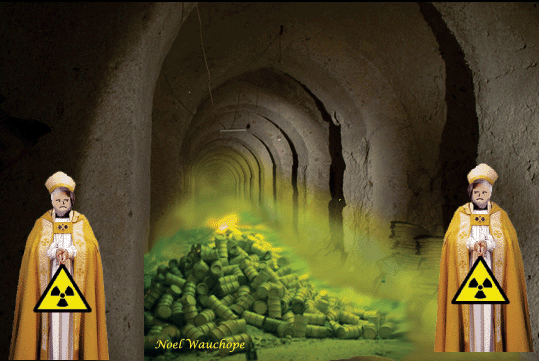
‘Nuclear Priests’ could warn future people about wastes under the Irish Sea
When Sir Keir Starmer entered No 10 last summer, it did not take long for
him to pick up where his predecessors left off on delivering more nuclear
power stations with a promise to “build, baby, build”. The Prime
Minister has vowed to “fast forward on nuclear” and so far has stuck
true to his word, with the Government taking up a larger stake in the
Sizewell C power plant in Suffolk, while loosening planning rules to allow
new small modular reactors to be built across the country.
But with the push for more nuclear power, bringing with it a steady supply of low-carbon energy, the question is inevitably asked: what do you do with all the
nuclear waste?
The answer is to dig a hole nearly the size of Wembley
Stadium 1km down beneath the Irish Sea, that could one day see the rise of
a new “atomic priesthood” and even, some have jokingly claimed, the
creation of glow in the dark cats.
But policymakers are aware that to push
ahead with this new nuclear drive, they will need to develop a stable,
long-term storage facility in which to hold not just future nuclear waste,
but all the nuclear waste the country has produced since the dawn of the
nuclear energy age in the 1950s. This is what the proposed Geological
Disposal Facility will provide.
And when they say long term, they mean long
term. “The purpose of the facility is to keep the radioactivity away from
humans and the environment so that it can’t cause harm for a sufficient
period of time – and that’s of the order of a few hundred thousand
years,” Neil Hyatt, Chief Scientific Adviser at the Nuclear Waste
Services, tells The i Paper.
iNews 24th Aug 2025, https://inews.co.uk/news/politics/nuclear-priests-glowing-cats-how-warn-future-generations-atomic-danger-3875319
Wastewater release from Fukushima nuclear plant enters third year.

By Ian Stark, Aug. 25 (UPI) —
The Japanese utility that keeps the nuclear fuel inside the damaged Fukushima plant cool reports its release of treated wastewater has entered its third year.
The Tokyo Electric Power Company announced Monday that it has completed its third discharge of Advanced Liquid Processing System treated water into the sea on Monday…………………
According to TEPCO, the ALPS is designed to remove 62 types of radioactive materials from the affected sea and dilute the water to lower the tritium levels. The water is considered “treated” to distinguish it from water yet to be decontaminated…………………………..
Around 70 tons of radioactive wastewater is produced daily at the plant, which cools the nuclear fuel that melted inside the reactor buildings at the Fukushima nuclear power plant. As of the first week of August, around 102,000 tons of treated water have been released. https://www.upi.com/Top_News/World-News/2025/08/25/Japan-Fukushima-nuclear-wastewater-TEPCO-radioactive/9871756140747/
Trump plans to make Cold War-era plutonium available for nuclear power

By Timothy Gardner, August 23, 2025, https://www.reuters.com/business/energy/trump-plans-make-cold-war-era-plutonium-available-nuclear-power-2025-08-22/
- Summary
- Radioactive, fissile plutonium from Cold War a headache for US
- US wants to halt disposal of it, use 20 metric tons for fuel
- Trump administration sees it as potential fuel for new reactors
- Critic points out similar program failed due to costs
The Trump administration plans to make available about 20 metric tons of Cold War-era plutonium from dismantled nuclear warheads to U.S. power companies as a potential fuel for reactors, according to a source familiar with the matter and a draft memo outlining the plan.
Plutonium has previously only been converted to fuel for commercial U.S. reactors in short-lived tests. The plan would follow through on an executive order signed by President Donald Trump in May ordering the government to halt much of its existing program to dilute and dispose of surplus plutonium, and instead provide it as a fuel for advanced nuclear technologies.
The Department of Energy, or DOE, plans to announce in coming days it will seek proposals from industry, said the source who spoke on the condition of anonymity. The source cautioned that because the plan is still a draft, its final details could change pending further discussions.
The plutonium would be offered to industry at little to no cost — with a catch. Industry will be responsible for costs of transportation, designing, building, and decommissioning DOE-authorized facilities to recycle, process and manufacture the fuel, the memo said.
The details on the volume of the plutonium, industry’s responsibilities in the plan and the potential timing of a U.S. announcement, have not been previously reported. The 20 metric tons would be drawn from a larger, 34-metric-ton stockpile of weapons-grade plutonium that the United States had previously committed to dispose of under a non-proliferation agreement with Russia in 2000.
The Department of Energy did not confirm or deny the Reuters reporting, saying only that the department is “evaluating a variety of strategies to build and strengthen domestic supply chains for nuclear fuel, including plutonium,” as directed by Trump’s orders.
Boosting the U.S. power industry is a policy priority for the Trump administration as U.S. electricity demand rises for the first time in two decades on the boom in data centers needed for artificial intelligence.
The idea of using surplus plutonium for fuel has raised concerns among nuclear safety experts who argue a previous similar effort failed.
Under the 2000 agreement, the plutonium was initially planned to be converted to mixed oxide fuel, or MOX, to run in nuclear power plants. But in 2018, the first Trump administration killed the contract for a MOX project that it said would have cost more than $50 billion.
The U.S. Energy Department holds surplus plutonium at heavily guarded weapons facilities including Savannah River in South Carolina, Pantex in Texas, and Los Alamos in New Mexico. Plutonium has a half-life of 24,000 years and must be handled with protective gear.
Until Trump’s May order, the U.S. program to dispose of the plutonium has involved blending it with an inert material and storing it in an experimental underground storage site called the Waste Isolation Pilot Plant (WIPP) in New Mexico.
The Energy Department has estimated that burying the plutonium would cost $20 billion.
“Trying to convert this material into reactor fuel is insanity. It would entail trying to repeat the disastrous MOX fuel program and hoping for a different result,” said Edwin Lyman, a nuclear physicist at the Union of Concerned Scientists.
“The excess plutonium is a dangerous waste product and DOE should stick to the safer, more secure and far cheaper plan to dilute and directly dispose of it in WIPP.”
Reporting by Timothy Gardner; Editing by Richard Valdmanis and Lisa Shumaker
Treasury criticises ‘unachievable’ plan for underground nuclear waste dump in Cumbria

Sandra Laville, Guardian, 18 August 25
The UK’s proposal for a new underground nuclear waste dump has been described as “unachievable” in a Treasury assessment of the project.
Ministers have put new nuclear power at the centre of their green energy revolution. But the problem of what to do with 700,000 cubic metres of radioactive waste – roughly the volume of 6,000 doubledecker buses – from the country’s past nuclear programme, as well as future waste from nuclear expansion, has yet to be solved.
The government is proposing the vast underground nuclear dump, known as a geological deposit facility (GDF), to safely deal with legacy waste and new nuclear material.
No site has yet been confirmed for the dump and Lincolnshire county council recently pulled out of the process, leaving only two possible sites, both in Cumbria.
A Treasury assessment this month, contained in the annual report of the National Infrastructure and Service Transformation Authority (Nista), has rated the project as “red”, which means successful delivery appears to be “unachievable”.
A red rating states: “There are major issues with project definition, schedule, budget, quality and/or benefits delivery, which at this stage do not appear to be manageable or resolvable. The project may need rescoping and/or its overall viability reassessed.”
Richard Outram, the secretary of Nuclear Free Local Authorities, said: “The Nista red rating is hardly surprising. The GDF process is fraught with uncertainties and the GDF ‘solution’ remains unproven and costly. The report also suggests the cost could soar to up to £54bn
“A single facility as estimated by government sources could cost the taxpayer between £20bn and £54bn. This being a nuclear project, it is much more likely to be the latter and beyond.”
Most nuclear waste is currently stored at Sellafield in Cumbria, which the Office for Nuclear Regulation says is one of the most complex and hazardous nuclear sites in the world.
The power stations that need decommissioning include 11 Magnox power stations built between the 1950s and 1970s, including Dungeness A in Kent, Hinkley Point A in Somerset and Trawsfynydd in north Wales, as well as seven advanced gas-cooled reactors built in the 1990s, including Dungeness B, Hinkley Point B and Heysham 1 and 2 in Lancashire.
Waste from more recent nuclear facilities, including Sizewell B, a pressurised water reactor in Suffolk, and two new EDF pressurised water reactors – Hinkley C, which is under construction in Somerset, and Sizewell C, which is planned for construction in Suffolk – will also need to be deposited in a GDF.
It is likely to take until 2150 to deposit the legacy waste into a GDF, if one is built. Only then would a GDF be able to take waste from new nuclear reactors………. https://www.theguardian.com/environment/2025/aug/18/treasury-criticises-unachievable-plan-for-underground-nuclear-waste-dump-in-cumbria
Unproven and costly: Nuclear Waste Dump ‘Red’ Rated as Unachievable.

NFLA 18th Aug 2025, https://www.nuclearpolicy.info/news/unproven-and-costly-nuclear-waste-dump-red-rated-as-unachievable/
A leading Government body charged with responsibility for monitoring the delivery of major taxpayer funded infrastructure projects has just published a report in which the plan to develop a subterranean Geological Disposal Facility to hold Britain’s legacy and future high-level radioactive waste has been ‘Red’ rated as ‘unachievable’.
The GDF was previously rated ‘Amber’ in an assessment by the Infrastructure and Projects Authority published in January of this year[i], signifying that: ‘Successful delivery appears feasible, but significant issues already exist, requiring management attention. These appear resolvable at this stage and, if addressed promptly, should not present a cost/schedule overrun.’
But in a report just published by the National Infrastructure and Service Transformation Authority (NISTA), a new body formed by the Labour Government[ii], the GDF is now instead ‘Red’ rated indicating that: ‘Successful delivery of the project appears to be unachievable. There are major issues with project definition, schedule, budget, quality and/or benefits delivery, which at this stage do not appear to be manageable or resolvable. The project may need re-scoping and/or its overall viability reassessed.’
The UK/Ireland Nuclear Free Local Authorities were unsurprised to hear the news. When contacted by New Civil Engineer for a quote, NFLA Secretary Richard Outram said:
“The NISTA Red rating is hardly surprising. The GDF process is fraught with uncertainties and the GDF ‘solution’ remains unproven and costly. A single facility, as estimated by government sources, could cost the taxpayer between £20-54 billion, but this being a nuclear project it is much more likely to be the latter and beyond.’
Government policy for the Geological Disposal Facility is predicated upon finding a project development site that is publicly acceptable, geologically ‘suitable’ and affordable.
So far, the first two of these hurdles have proven problematic to jump for the taxpayer funded body charged with finding a site and developing the facility. Nuclear Waste Services has being forced to retreat from South Holderness and Theddlethorpe in the face of steadfast public opposition and obliged to withdraw from Allerdale citing a lack of suitable geology.
Consequently, NWS is once more now limited to the pursuit of a site in Mid and South Copeland in West Cumbria. Both areas adjoin the beautiful Lake District National Park. They were previously the focus of failed attempts to impose a GDF, but the geology was found unsuitable, and the opposition of Cumbria County Council ended the process.
Resistance is growing to a GDF in South Copeland. Local people have formed an opposition group; two local Councils have condemned the plan and withdrawn their support from the process; and a review of the Community Partnership found it to be in disarray with factional infighting.
It is therefore not inconceivable that plans for a GDF in South Copeland could also soon be shelved.
Now Radiation Free Lakeland / Lakes against the Dump is gathering signatures from Cumbrians on a petition calling on Cumberland County Councillors to debate and vote upon their continued engagement with the GDF process. Once 1,000 County residents have signed the petition, the Council’s constitution provides for such a debate to be held in response.
Here are links to the petition: www.change.org/CumbriaNuclearDump https://www.change.org/p/massive-mine-shafts-and-nuclear-dump-for-cumbria-coast-tell-cumberland-council-vote-now
Nuclear legacy costs far outweigh Germany’s environmental protection investments.

Clean Energy Wire, 23 Jul 2025, Benjamin Wehrmann, Germany https://www.cleanenergywire.org/news/nuclear-legacy-costs-far-outweigh-germanys-environmental-protection-investments
Over half of the German environment ministry’s (BMUKN) budget for 2025 will be spent on managing the country’s nuclear waste and preparing a decision for a final nuclear repository. According to a government budget draft, the ministry led by Social Democrat (SPD) Carsten Schneider will receive 2.7 billion euros this year, about 300 million euros more than in 2024. Out of this sum, 1.4 billion euros are reserved for the “temporary and final storage of radioactive waste,” a parliament report on the draft said.
In 2024, Germany spent about 1.1 billion euros on nuclear waste management, after the country shuttered its last commercial nuclear power plants in mid-2023. Some 860 million euros from the 2025 ministry budget will be spent on the search for a final repository and about 535 million euros on temporary storage.
By contrast, about 460 million euros were marked for nature and environment protection measures by the ministry, while the subordinate Federal Environment Agency (UBA) will receive another 205 million euros. Climate action costs were not yet reflected in the budget, as the environment ministry was handed responsibility for this policy field from the economy ministry only in spring this year, the parliament report said. It did not specify which measures are covered under this field. Energy policy remains with the economy ministry.
“Nuclear waste is eating up environmental protection,” Wolfgang Ehmke from the citizen initiative for environmental protection of Lüchow-Dannenberg, told newspaper Tageszeitung (taz). The rural district in northern Germany is known for its temporary nuclear repository in the municipality of Gorleben, which has been the site of many anti-nuclear protests over the past decades. Management and construction works at the Gorleben repository alone climbed from 20 million euros in 2024 to 33 million one year later, the newspaper said.
Another repository, Asse near the town of Wolfenbüttel, would even require maintenance investments of 206 million euros this year. Costs for managing the country’s nuclear waste are even higher, as part of the legacy costs are carried by other ministries. For example, the research ministry is responsible for research reactors, while the finance ministry handles nuclear infrastructure in the former eastern German states, as agreed in the country’s reunification treaties, taz added.
Part of the costs of Germany’s nuclear waste management are financed through a fund filled by the former nuclear plant operators. These made a one-off payment of 24 billion euros in 2017 and were subsequently freed of further financial liabilities. Following Germany’s 2011 renewed commitment to phase out nuclear power, the country started looking for a location to safely store its roughly 28,100 cubic metres of radioactive material for hundreds of thousands of years. Initially, the aim was to select a location for the final repository by 2031 but, in 2022, the responsible agency pushed the deadline to until at least 2046.
Geological disposal facility for nuclear waste could cost £54bn and ‘appears unachievable’.
15 Aug, 2025 By Tom Pashby
The UK government’s proposed solution for long-term storage of high-level waste from the nuclear sector, a geological disposal facility (GDF), has been described as “unachievable” in a Treasury assessment of the project.
The National Infrastructure and Service
Transformation Authority (Nista), a Treasury unit, made the assessment in
its Nista Annual Report 2024-2025, published on 11 August, where it rated
213 other major infrastructure projects.
A GDF represents a monumental
undertaking, consisting of an engineered vault placed between 200m and 1km
underground, covering an area of approximately 1km2 on the surface. This
facility is designed to safely contain nuclear waste while allowing it to
decay over thousands of years, thereby reducing its radioactivity and
associated hazards. NWS declares that this method offers the most secure
solution for managing the UK’s nuclear waste, aimed at relieving future
generations of the burden of storage.
The project would be so vast that it
would require two separate development consent order (DCO) applications to
be approved – one for exploratory works and another for the project
itself. Nuclear Free Local Authorities secretary Richard Outram said:
“The Nista Red rating is hardly surprising. The GDF process is fraught
with uncertainties and the GDF ‘solution’ remains unproven and costly.
“A single facility as estimated by government sources could cost the
taxpayer between £20bn and £54bn, this being a nuclear project it is much
more likely to be the latter and beyond.”
New Civil Engineer 15th Aug 2025, https://www.newcivilengineer.com/latest/geological-disposal-facility-for-nuclear-waste-could-cost-54bn-and-appears-unachievable-15-08-2025/
The lethal legacy of Aukus nuclear submarines will remain for millennia – and there’s no plan to deal with it.

Ben Doherty, 10 Aug 25, https://www.theguardian.com/world/2025/aug/10/the-lethal-legacy-of-aukus-nuclear-submarines-will-remain-for-millennia-and-theres-no-plan-to-deal-with-it
“None of the leaders who announced Aukus are in power any more,” he tells the Guardian. “One hundred thousand years from now, who knows what the world looks like, but Australia, whatever is here then, will still be dealing with the consequences of that high-level waste.”
Australia’s future nuclear submarines will produce highly radioactive waste, and allies in the UK and the US still don’t have a safe place to store their own.
In the cold deep waters of Rosyth Harbour lie the dormant hulks of Britain’s decommissioned nuclear submarines.
One of the shells lashed to the dock here is HMS Dreadnought, Britain’s first nuclear-powered submarine. It was commissioned in 1963, retired in 1980, and has spent decades longer tied to a harbour than it ever did in service. The spent nuclear fuel removed from its reactor remains in temporary storage.
For decades the UK has sought a solution to the nuclear waste its fleet of submarines generates. After decades of fruitless search there are “ongoing discussions” but still no place for radioactive waste to be permanently stored.
Similarly, in the US – the naval superpower which controls a vast landmass and which has run nuclear submarines since the 1950s – there is still no permanent storage for its submarines’ nuclear waste.
More than a hundred decommissioned radioactive reactors sit in an open-air pit in Washington state, on a former plutonium production site the state’s government describes as “one of the most contaminated nuclear sites in the world”.
This is what becomes of nuclear-powered submarines at the end of their comparatively short life.
A nuclear-powered submarine can expect a working life of three decades: the spent fuel of a submarine powered by highly enriched uranium can remain dangerously radioactive for millennia. Finland is building an underground waste repository to be sealed for 100,000 years.
For Australia’s proposed nuclear-powered submarine fleet there is, at present, nowhere for that radioactive spent fuel to go. As a non-nuclear country – and a party to the non-proliferation treaty – Australia has no history of, and no capacity for, managing high-level nuclear waste.
But Australia is not alone: there is no operational site anywhere on Earth for the permanent storage of high-level nuclear waste.
‘Australia shall be responsible … ’
Documents released under freedom of information laws show that, beginning in the 2050s, each of Australia’s decommissioned Aukus submarines will generate both intermediate- and high-level radioactive waste: a reactor compartment and components “roughly the size of a four-wheel drive”; and spent nuclear fuel “roughly the size of a small hatchback”.
The Australian Submarine Agency says the exact amount of high-level waste Australia will be responsible for is “classified”.
Because Australia’s submarines will run on highly enriched uranium (as opposed to low enriched uranium – which can power a submarine but cannot be used in a warhead) the waste left behind is not only toxic for millennia, it is a significant proliferation risk: highly enriched uranium can be used to make weapons.
The eight nuclear-powered submarines proposed for Australia’s navy will require roughly four tonnes of highly enriched uranium to fuel their sealed reactor units: enough for about 160 nuclear warheads on some estimates.
The spent fuel will require military-grade security to safeguard it.
The problems raised by Australia’s critics of Aukus are legion: the agreement’s $368bn cost; the lopsided nature of the pact in favour of the US; sclerotic rates of shipbuilding in the US and the UK, raising concerns that Australia’s nuclear submarines might never arrive; the loss of Australian sovereignty over those boats if they do arrive; the potential obsolescence of submarine warfare; and whether Aukus could make Australia a target in an Indo-Pacific conflict.
All are grave concerns for a middle power whose security is now more tightly bound by Aukus to an increasingly unreliable “great and powerful friend”.
But the most intractable concern is what will happen to the nuclear waste.
It is a problem that will outlive the concept of Australia as a nation-state, that will extend millennia beyond the comprehension of anybody reading these words, that will still be a problem when Australia no longer exists.
And it cannot be exported.
The Aukus agreement expressly states that dealing with the submarines’ nuclear waste is solely Australia’s responsibility.
“Australia shall be responsible for the management, disposition, storage, and disposal of any spent nuclear fuel and radioactive waste … including radioactive waste generated through submarine operations, maintenance, decommissioning, and disposal,” Article IV, subclause D of the treaty states.
As well, should anything go wrong, at any point, with Australia’s nuclear submarines, the risk is all on Australia.
Australia shall indemnify … the United States and the United Kingdom against any liability, loss, costs, damage or injury … resulting from Nuclear Risks connected with the design, manufacture, assembly, transfer, or utilization of any Material or Equipment, including Naval Nuclear Propulsion Plants,” subclause E states.
“‘Nuclear Risks’,” the treaty states, “means those risks attributable to the radioactive, toxic, explosive, or other hazardous properties of material.”
‘Decide and defend’
An emeritus professor at Griffith University’s school of environment and science, Ian Lowe, tells Guardian Australia that the government’s regime for storing low-level nuclear waste is a “shambles”. He says the government’s “decide and defend” model for choosing a permanent waste storage site has consistently failed.
“You currently have radioactive waste from Lucas Heights, from Fishermans Bend, and from nuclear medicine and research all around Australia, just stored in cupboards and filing cabinets and temporary sheds,” Lowe says.
“The commonwealth government has made three attempts to establish a national facility – it’s a repository if you’re in favour of it, it’s a waste dump if you’re opposed – and on every occasion there’s been local opposition, particularly opposition from Indigenous landowners, and on each of those three occasions … the proposal has collapsed.”
Most of Australia’s low-level and intermediate nuclear waste – much of it short-lived medical waste – is stored at the Australian Nuclear Science and Technology Organisation facility in Lucas Heights in outer Sydney. Lowe says the nuclear safety regulator, ARPANSA, does a commendable job in protecting the public but the facility was never intended to be permanent.
Australia has been searching for a permanent site for nuclear waste for nearly three decades.
Its approach – derided by Lowe as “decide and defend”: where government chooses a place to put radioactive waste and then defends the decision against community opposition – has failed in Woomera, in central South Australia, in the late 1990s, then Muckaty station in the Northern Territory, then on farmland near Kimba, again in SA.
The federal court ruled against the Kimba plan in 2023, after a challenge from the traditional owners, the Barngarla people, who had been excluded from consultation.
Lowe, the author of Long Half-Life: The Nuclear Industry in Australia, says the complexities and risks of storing high-level nuclear waste from a submarine are factors greater than the low- and intermediate-level waste Australia now manages.
“The waste from nuclear submarines is much nastier and much more intractable,” he says. “And because they use weapons-grade highly enriched uranium there is the greater security issue of needing to make sure that not only do you need to protect against that waste irradiating people and the environment, you must also ensure that malevolent actors, who have in mind a malicious use of highly enriched uranium, can’t get their hands on it.”
Australia’s decision to use highly enriched uranium to power its submarines, as opposed to low enriched uranium (reactors would need refuelling each decade), is a “classic case of kicking the can down the road and creating a problem for future generations”, Lowe argues.
“In the short term, it’s better to have highly enriched uranium and a sealed reactor that you never need to maintain during the life of the submarine. But at the end of the life of the submarine, you have a much more serious problem.”
The high-level nuclear waste from Australia’s submarines will be hazardous for “hundreds of thousands of years,” Lowe says.
“There are arguments about whether it’s 300,000 or 500,000 or 700,000 years, but we’re talking a period at least as long as humans have existed as an identifiably separate species. The time horizon for political decision makers is typically four or five years: the time horizon of what we’re talking about is four or five hundred thousand years, so there’s an obvious disconnect.”
Inside ‘Trench 94’
The US and the UK have run nuclear-powered (and nuclear-armed) submarines for decades.
In the UK, 23 nuclear submarines have been decommissioned, none have been dismantled, 10 remained nuclear-fuelled. Most are sitting in water in docks in Scotland and on England’s south-west coast.
The first submarine to be disposed of – the cold war-era HMS Swiftsure was retired from service in 1992 – will be finally dismantled in 2026. Keeping decommissioned nuclear subs afloat and secure costs the UK upwards of £30m a year.
There is still no site for permanent storage of their radioactive waste: there has been “progress and ongoing discussions”, the defence minister, Lord Coaker, told the House of Lords last year, but still no site.
The UK has about 700,000 cubic metres of toxic waste, roughly the volume of 6,000 doubledecker buses. Much of it is stored at Sellafield in Cumbria, a site described by the Office for Nuclear Regulation says as “one of the most complex and hazardous nuclear sites in the world”.
In the US, contaminated reactors from more than 100 retired submarines are stored in “Trench 94” – a massive open pit at the Hanford nuclear site in Washington state. Spent nuclear fuel is also sent to the Idaho National Laboratory and sites in South Carolina and Colorado. Hanford is designed to last 300 years but the site has a chequered history of pollution and radiation leaks. Washington state describes it as “one of the most contaminated nuclear sites in the world”.
Finland is the first country to devise a permanent solution. It is building an underground facility 450 metres below ground, buried in the bedrock of the island of Olkiluoto.
The Onkalo – Finnish for cave or cavity – facility has taken more than 40 years to build (the site was chosen by government in 1983) and has cost €1bn. It is now undergoing trials.
‘A Trojan horse’
In March 2023 Australia’s defence minister, Richard Marles, said high-level nuclear waste would be stored on “defence land, current or future”, raising the prospect that a site could be identified and then declared “defence land”. A process for establishing a site would be publicly revealed “within 12 months”, he said. That process has not been announced nor a site identified.
Australia will require a site for high-level nuclear waste from the “early 2050s”, according to the Australian Submarine Agency. Senate estimates heard last year that there have been no costings committed for the storage of spent fuel. And preparing a site for storing high-level radioactive waste for millennia will take decades.
Guardian Australia sent a series of questions to Marles’ office about the delayed process for selecting a site. A spokesperson for the Australian Submarine Agency responded, saying: “The government is committed to the highest levels of nuclear stewardship, including the safe and secure disposal of waste.
“As the Government has said, the disposal of high-level radioactive waste won’t be required until the 2050s, when Australia’s first nuclear-powered submarine is expected to be decommissioned.”
The spokesperson confirmed that Australia would be responsible for all of the spent nuclear fuel and radioactive waste generated from the Aukus submarines: it would not have responsibility for intermediate- or high-level radioactive waste – including spent fuel – from the US, UK or any other country. No permanent storage site had been identified for low-level radioactive waste, which would include waste from foreign submarines.
The government has consistently said it will engage extensively with industry, nuclear experts and affected communities to build a social licence for a permanent storage site.
But Dave Sweeney of the Australian Conservation Foundation says he has seen little evidence of genuine effort to build social licence.
The leaders who signed the Aukus deal – and those who continue to support it – have failed to comprehend the consequences beyond their political careers, he says.
“None of the leaders who announced Aukus are in power any more,” he tells the Guardian. “One hundred thousand years from now, who knows what the world looks like, but Australia, whatever is here then, will still be dealing with the consequences of that high-level waste.”
Sweeney says the “opacity” of the decision-making around the Aukus agreement itself is compounded by fears that the deal could be only the beginning of a nuclear industry expansion in Australia.
“We see this as a Trojan horse to expanding, facilitating, empowering the nuclear industry, emboldening the nuclear industry everywhere,” he says. “It is creepy, controversial, costly, contaminating, and leading to vastly decreased security and options for regional and global peace.”
Beyond the astronomical cost of the submarine deal, its the true burden would be borne by innumerable future generations.
“We are talking thousands and thousands of years: it is an invisible pervasive pollutant and contaminant and the only thing that gets rid of it is time. And with the whole Aukus deal, that’s what we’re running out of.”
Tepco wraps up latest round of treated water release in Fukushima
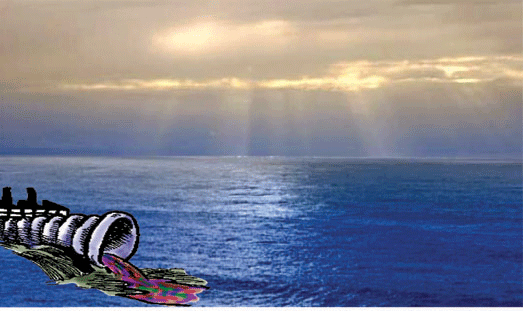
Tokyo Electric Power Company Holdings said Sunday that it has completed
the second round of its fiscal 2025 release of treated water into the ocean
from the Fukushima No. 1 nuclear power plant.
The discharge of the water, containing radioactive tritium, was suspended due to a tsunami caused by a major earthquake near Russia’s Kamchatka Peninsula last week, but there
were no problems with the facilities involved in the operation. In the
second round, which began on July 14, Tepco diluted 7,800 tons of treated
water with large amounts of seawater before releasing it about 1 kilometer
off the coast of Fukushima Prefecture through an undersea tunnel. In the
current fiscal year through next March, a total of 54,600 tons will be
released into the sea in seven rounds, at the same pace as the previous
year.
Japan Times 3rd Aug 2025, https://www.japantimes.co.jp/news/2025/08/03/japan/tepco-2nd-round-treated-water-release/
The Enduring Problem of Nuclear Reactor Waste
It is estimated that over the course of nuclear energy’s development in the ensuing decades, the industry produced 250,000 tons of highly toxic nuclear waste across fourteen countries worldwide without authoritatively developing a strategy for its safe storage.
July 30, 2025, By: Brian C. Black, https://nationalinterest.org/blog/energy-world/the-enduring-problem-of-nuclear-reactor-waste
The problem of nuclear reactor waste will have to be resolved as nuclear energy becomes more frequently adopted as the world’s source of power.
No one is pro nuclear waste. Simply, nuclear waste is a problem related to one method of generating electricity. The arguments against nuclear development because of the waste it generates have only intensified as we have filled in the gaps of our knowledge and learned more about its long-term toxicity. The realities of nuclear waste, simply, make us ask the question: How much do we need this energy?
In 2025, as our drive for electricity grows with planned data centers all over the world, many observers are choosing to overlook the problems of nuclear waste in order to generate more power and—at times—diminish our reliance on fossil fuels.
As we rush to reopen mothballed nuclear facilities such as Three Mile Island and to develop new ones, it is important to slow down and recall the simple fact of nuclear power: even with no accidents, nuclear power creates waste materials that remain toxic for thousands of years, and we still have no reasonable plan on what to do with them. We may choose to look the other way, but the wake of nuclear development is littered with toxic locales that remind us that any power obtained from nuclear reaction also creates waste that remains poisonous to humans for decades, if not longer.
A Relic of the Cold War?
or a few decades in the mid-1900s, the inertia of the Cold War and the belief in nuclear power’s potential fueled the rapid development of nuclear power. Reactors began to be used for electricity generation throughout the United States by the 1970s, only to see support erode after industrial accidents occurred, most noticeably at Three Mile Island, near Harrisburg, Pennsylvania, in 1978 and abroad at Chernobyl (then the Soviet Union, now Ukraine) in 1986. Many other reactors proceeded to generate power effectively and demonstrated that such accidents were an exception. While the industry faced challenges of public confidence and opinion over the final decades of the 20th century, nuclear power was often viewed internationally as a “clean” way of generating the power that might allow development to occur.
Clearly, though, the basic challenges inherent in the toxicity of the waste of a normal functioning reactor were never fully accounted for. Throughout the 1980s, for instance, efforts grew to create a repository in the American West where such spent fuel could be deposited and kept for the decades—even centuries—in which it was thought to remain toxic. The most protracted effort focused on Yucca Mountain in Nevada. The proposed Yucca Mountain Repository has remained mired in legal issues involving jurisdiction (it is located on the Western Shoshone Native American reservation) and the issue of a state’s right to determine its economic and environmental future. In short, no one wants nuclear waste in their backyard.
In retrospect, these challenges only amplified the issues that grew from the Cold War’s emphasis on energy centrality. Nuclear power spent decades as an important technology in supporting a drive for energy development that was seen as essential to both Soviet and American success, and little thought or planning went into the end-use challenges inherent in the technology. The competitive environment of the Cold War drove the rapid extraction of uranium, and the need to drive development pressed nuclear power forward even though it remained a technology with critical flaws.
Inevitable Waste Produced by Atomic Power
It is estimated that over the course of nuclear energy’s development in the ensuing decades, the industry produced 250,000 tons of highly toxic nuclear waste across fourteen countries worldwide without authoritatively developing a strategy for its safe storage. Most often, the highly radioactive material is collected and stored at inactive nuclear power plants. In the case of Chernobyl, some of the plant’s reactors still contain an enormous amount of waste that will remain dangerous for tens of thousands of years. Of course, in 2019, one entire reactor was encased in a concrete “sarcophagus” that will safely store the material for a century—a temporary band-aid to be dealt with more carefully later
However, a similar problem exists in nations that did not experience a reactor meltdown. Reports show that the “largest amount of untreated nuclear waste is at the Sellafield plant in the UK.” The plant has not generated electricity since 2003, but 100,000 employees are involved in ongoing nuclear decommissioning activities. These efforts at Sellafield are expected to last more than a century and will cost the government billions of dollars, even though it has produced no power for decades.
Well after the fact, many nations are now working to devise ways of storing nuclear waste permanently, even if they no longer wish to generate electricity with reactors. Finland, which generates approximately thirty-two percent of its electricity with five nuclear plants, is considered to have devised the first feasible plan for long-term storage of nuclear waste. The Onkalo spent nuclear fuel repository is a deep geological repository that is expected to begin operating next year. When completed, the Onkalo site will store 2,300 tons of high-level waste at a cost of approximately $3.4 billion.
Finland’s process required decades of negotiation and planning. Though it is considered experimental, the Onkalo site is based on the KBS-3 method of nuclear waste burial that was developed in Sweden. It will store nuclear waste for at least 100,000 years. And we can’t really know whether or not it can succeed. The generating technology failed to account for this inevitable outcome at its earliest stages of development. Now, nuclear waste is a problem that threatens many societies.
Conclusion: Ranking the Dangers of Energy Production
Over the last few decades, scientists have taught us a great deal about the dangers of climate change, which is caused by burning fossil fuels. Through their research findings, it has become accepted knowledge that the Earth would benefit from humans generating power in a different way. In sum, we have learned that all energy production comes with a cost, and, therefore, nuclear power has gotten another look at possibly powering the future.
Does this reality, then, lead us to choose between evils and decide to generate electricity through nuclear reactions? Possibly. But it is important that we scrutinize the technology as an energy production industry. Similar to other industrial enterprises, nuclear power generation creates hazardous and toxic waste. In the case of nuclear waste, though, it must be safely transported and interred. Technical answers and extensive investment will be essential.
The uniquely supportive, unquestioning culture of the Cold War is clearly a thing of the past. Examples of this rather blindly confident coordination between military and industrial interests are scattered across the American landscape. Some examples, such as the vast open spans of New Mexico or Idaho, might be expected; others, nestled in more populated areas, such as Pennsylvania, surprise contemporary Americans. Each of them, though, and the vast span of all of them together, reveals an era when our nation quietly took on a dramatic technological project and succeeded in applying it to power generation. To continue its use, though, we must now apply the new knowledge about nuclear waste that will allow its end-use products to be safely managed.
TEPCO logs net loss in April-June on Fukushima plant cleanup.
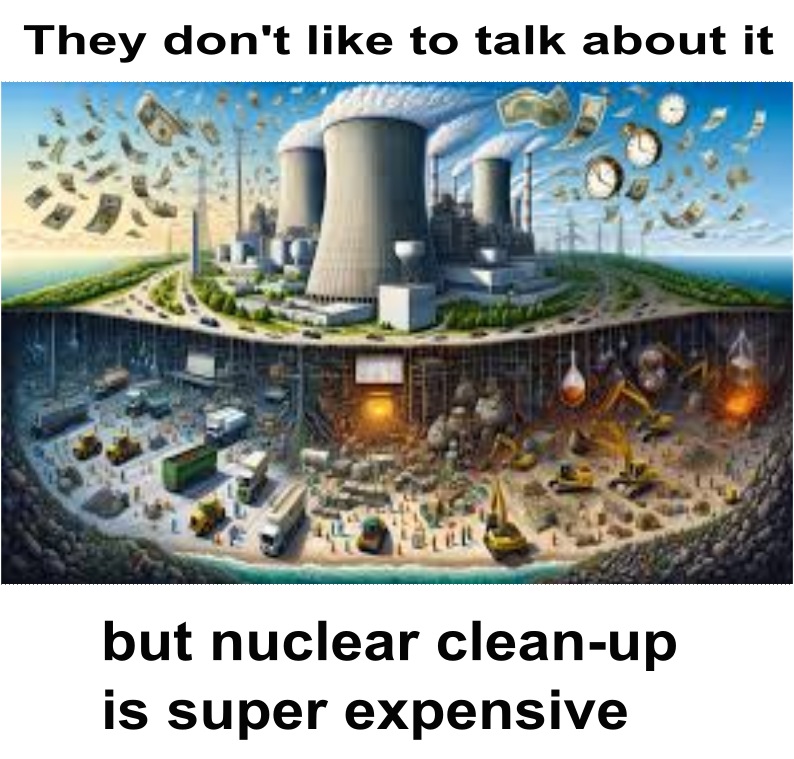
The company booked an extraordinary loss of 903 billion yen, as it prepares for the removal of nuclear fuel debris
August 1, 2025 (Mainichi Japan), https://mainichi.jp/english/articles/20250801/p2g/00m/0bu/008000c
TOKYO (Kyodo) — Tokyo Electric Power Company Holdings Inc. said Thursday it posted a net loss of 857.69 billion yen ($5.8 billion) for the April-June period, pressured by a special loss related to decommissioning work at its Fukushima Daiichi nuclear power plant.
The second largest quarterly loss since the 2011 nuclear crisis is a sharp deterioration from a profit of 79.24 billion yen in the same period a year earlier.
Operating profit rose 2.9 percent to 64.70 billion yen in the quarter on sales of 1.43 trillion yen, down 4.5 percent.
The company booked an extraordinary loss of 903 billion yen, as it prepares for the removal of nuclear fuel debris, considered the most challenging phase of the decommissioning work.
“We are not expecting any big spending over the next three years and (the special loss) won’t be a problem for our decommissioning work,” TEPCO vice president Hiroyuki Yamaguchi said at a press conference.
TEPCO said Tuesday the full-scale removal of melted fuel debris, initially set for the early 2030s, will be delayed to fiscal 2037 or later, raising concerns that its target of completing the work to scrap the power plant by 2051 will become increasingly difficult to meet.
The company said it has about 700 billion yen earmarked for future demolition work.
Debris removal at Fukushima nuclear plant pushed back to 2037 or later

30 July 25, https://www.japantimes.co.jp/news/2025/07/30/japan/fukushima-nuclear-plant-debris-removal/
Full-scale removal of nuclear fuel debris from the No. 3 reactor of Tokyo Electric Power Company Holdings’ crippled Fukushima No. 1 nuclear power plant will not start before fiscal 2037, officials said Tuesday.
The removal was previously planned to begin in the early 2030s. This delay may push the completion of the plant’s decommissioning process beyond the target year of 2051 set by the government and Tepco.
The new timeline for the work was announced by Tepco and Nuclear Damage Compensation and Decommissioning Facilitation, or NDF, at separate news conferences. They determined that preparations for the work, such as the demolition of an adjacent building, will take about 12 years to 15 years.
“We aren’t in a situation where we should deny (the feasibility of) the decommissioning target,” said Akira Ono, head of Tepco’s in-house company in charge of the decommissioning work. “We remain committed to the goal of completing (the decommissioning process by 2051.)”
A total of 880 metric tons of debris, or a mixture of melted nuclear fuel and reactor structures, is believed to be in the No. 1 to No. 3 reactors at the nuclear plant, which suffered a triple meltdown following the March 2011 massive earthquake and tsunami.
Tepco began to extract debris from the No. 2 reactor on a trial basis last year, and has collected a total of about 0.9 gram so far.
According to Tepco and the facilitation organization, debris removal will be carried out using a combination of what is known as the nonsubmerged method, in which the debris is collected from the air, and what is called the filling and solidification method, which involves pouring a filling agent into the reactor and solidifying it.
A small hole will be opened in the upper part of the reactor building to insert a device that will crush the debris into fine pieces, while a filling agent will be injected as needed. The debris will be collected using a device inserted from the side of the building.
Tepco and the organization said demolishing a waste treatment building on the north side of the No. 3 reactor is necessary to ensure work safety and create space for new equipment. They also said that necessary facilities need to be built in the upper part of the reactor building, and such preparations are expected to take about 12 years to 15 years.
1 This Month

of the week – Shut Down Drone Warfare!


Tell the Ukrainian Government to Drop Prosecution of Peace Activist Yurii Sheliazhenko

Petition to revoke the licensing of the Near Surface Nuclear Disposal Facility (NSDF) at Chalk River. https://www.ourcommons.ca/petitions/en/Petition/Details?Petition=e-7247
To see nuclear-related stories in greater depth and intensity – go to https://nuclearinformation.wordpress.com
-
Archives
- March 2026 (244)
- February 2026 (268)
- January 2026 (308)
- December 2025 (358)
- November 2025 (359)
- October 2025 (376)
- September 2025 (257)
- August 2025 (319)
- July 2025 (230)
- June 2025 (348)
- May 2025 (261)
- April 2025 (305)
-
Categories
- 1
- 1 NUCLEAR ISSUES
- business and costs
- climate change
- culture and arts
- ENERGY
- environment
- health
- history
- indigenous issues
- Legal
- marketing of nuclear
- media
- opposition to nuclear
- PERSONAL STORIES
- politics
- politics international
- Religion and ethics
- safety
- secrets,lies and civil liberties
- spinbuster
- technology
- Uranium
- wastes
- weapons and war
- Women
- 2 WORLD
- ACTION
- AFRICA
- Atrocities
- AUSTRALIA
- Christina's notes
- Christina's themes
- culture and arts
- Events
- Fuk 2022
- Fuk 2023
- Fukushima 2017
- Fukushima 2018
- fukushima 2019
- Fukushima 2020
- Fukushima 2021
- general
- global warming
- Humour (God we need it)
- Nuclear
- RARE EARTHS
- Reference
- resources – print
- Resources -audiovicual
- Weekly Newsletter
- World
- World Nuclear
- YouTube
-
RSS
Entries RSS
Comments RSS
 nuclear-news