Canadian Coalition for Nuclear Responsibility (CCNR)Re: Comments on the Integrated Tailored Impact StatementGuidelines for the Deep Geological Repository (DGR)For Canada’s Used Nuclear Fuel Project

There is going to be a public impact assessment process. Now is the time to debate the alternatives for the first time in public.
TO – Impact Assessment Agency of Canada (IAAC), May 10 2026, https://www.ccnr.org/IAAC_NWMO_Guidelines_CCNR_2026.pdf
The Canadian Coalition for Nuclear Responsibility (CCNR) has reviewed the Draft
Integrated Tailored Impact Statement Guidelines for the Deep Geological Repository
(DGR) For Canada’s Used Nuclear Fuel, a Project of the Nuclear Waste Management
Organization (NWMO), and offers the following comments on those Draft Guidelines.
Stated Purpose of the Project
The stated purpose of the project is highly suspect because it is couched in selfcontradictory language. In its Initial Description of the project (p.v) the proponent states:
“Canada’s nuclear power plants have provided, and are expected to continue
providing, clean, reliable, and low-carbon energy for decades. However,
used nuclear fuel remains radioactive for a very long time and therefore
requires careful, permanent management to avoid placing a burden on future
generations.” Nuclear Waste Management Organization (NWMO)
Initial Project Description
Deep Geological Repository (DGR) for Canada’s Used Nuclear Fuel Project
December 2025
It is ironic that nuclear power is described, in two consecutive sentences, as a “clean”
energy source, but one whose waste byproducts nevertheless remain dangerously
radioactive for such “a very long time”, that extraordinary measures are required to
“avoid placing a burden on future generations.”
It is a stunning example of cognitive dissonance; that is, “the mental discomfort or
psychological stress experienced when a person holds two or more contradictory
beliefs, values, or attitudes, or acts in a way that goes against them.” On the one hand, the proponent asserts that nuclear power is essentially a problem-free technology, and
on the other hand is ready to expend upwards of $26 billion dollars and 160 years of
effort to “solve” what is a glaringly obvious problem – long-lived highly toxic garbage.
The contradiction in terminology is not just psychologically uncomfortable, but also selfdefeating – for NWMO goes on to enunciate (p.v-vi) its goal, accompanied by a
declaration of the industry’s intentions that belie that goal altogether.
“If implemented, the project would:
- provide a permanent and safe disposal solution for used nuclear fuel;
- support Canada’s commitments to climate action and achieving net-zero by
2050 by ensuring nuclear energy remains a sustainable and socially
responsible energy source; - eliminate the need for future generations to actively manage used nuclear
fuel, thereby reducing long-term environmental risks and advancing
equity in managing Canada’s nuclear legacy.”
A careful reading shows that the “safe disposal solution” for used nuclear fuel is not
really intended to unburden future generations altogether by “eliminating the need to
actively manage used nuclear fuel”, but rather to perpetuate the hazards of keeping
used nuclear fuel at the surface by “ensuring nuclear energy remains … sustainable” as
an energy source. Thus the DGR is not designed to “get rid” of used fuel once and for
all, but rather to clear the decks of older waste and make room for newer waste. The
industry has no intentions of ever stopping the production of that toxic waste material.
This is no small matter. Already the Agency is dealing with three major proposals for
new nuclear plants: the 4800 megawatt Peace River Nuclear Project, the 4800
megawatt Bruce C project, and the 10,000 megawatt Wesleyville project, with more
projects to come…. Already there are over 20,000 megawatts of new nuclear electricity
production planned (including the Darlington New Build). If these new plants are all built,
the annual production of used nuclear fuel in Canada will triple. And that is not the end
of the story. Further nuclear expansion in other provinces and territories is also planned.
To maintain credibility, the Agency cannot turn a blind eye to these contradictions. The
NWMO project currently under review by the Agency is only designated to deal with the waste produced by Canada’s existing operational fleet of 17 CANDU reactors (plus the
waste produced by seven shut-down power reactors and a handful of research reactors
owned by Atomic Energy of Canada Limited). That is less than one-third of the volume
of high-level radioactive waste now foreseen. It is patently false that the currently
proposed DGR project will “eliminate the need for future generations to actively manage
used nuclear fuel.” The stated goal of the project is, in that sense, fraudulent
In fact, no one intends to move used nuclear fuel into a DGR until it has been out of the
reactor for at least 30 years. Consequently, there will always be thirty years worth of
unburied waste at the surface (either in wet storage or dry storage) for each and every
operating nuclear reactor, no matter how fast the older used fuel may be buried. Based
on existing plans in Canada, the quantity of unburied used nuclear fuel under thirty
years of age will be tripled – or more than tripled – and will keep growing thereafter.
This is hardly “eliminating” the need for future generations to manage used nuclear fuel.
As long as new nuclear reactors are being built and old ones are continuing to operate,
there is no possibility of achieving the visionary dream of all used fuel safely locked
away in underground chambers. Such a dream is a complete fantasy. It would only be
possible if nuclear power were phased out completely.
Instead, a picture emerges of an increasing number of reactors in operation, each with
its core full of intensely radioactive used fuel, and each surrounded by at least thirty
years worth of additional unburied used fuel in wet and dry storage. Even if all the older
fuel (more than 30 years old) were instantly transported over thousands of kilometres to
the site of the DGR, the remaining catastrophe potential at each reactor site would be
only marginally diminished.
Meanwhile additional risks of fuel damage and radioactive releases would arise in
countless locations across the country due to the vicissitudes of travel along some of
the most hazardous routes in Canada. Thousands of citizens – perhaps millions –would
encounter truckloads of high-level radioactive waste passing through their communities, along their highways, over their bridges, for many decades to come. Severe transport
accidents, even if very infrequent, could result in radioactive contamination of people
and the environment in locations far removed from the generating stations. The
combined efforts of moving spent fuel to a repository location while expanding the
production of nuclear electricity at many new sites may very well make the country less
safe than it would have been if traffic of spent fuel were precluded.
In its report on nuclear energy in Ontario entitled “A Race Against Time”, the Ontario
Royal Commission on Electric Power Panning concluded as follows:
“The hazards associated with transportation, in particular the possibility of
accidents and the threat of hijacking, are real possibilities. Hence, the
minimization of handling and transporting spent fuel is a desirable
objective. (p. 91)
We prefer on-site (i.e. generating station site) spent fuel storage to a
centralized facility. We believe that a central facility would presuppose
the reprocessing of spent fuel; it would also involve more transportation
and social and environmental problems. (p. 95)
Royal Commission on Electric Power Planning
A Race Against Time, 1978
CCNR believes that the Guidelines should include an entire section on transportation –
including (a) routine gamma and neutron exposures (i.e. to those in vehicles following a
transport, to those passing the transport in the opposite direction, to those being
repeatedly exposed along the route, to those irradiated during stops), (b) container
designs and testing of same, (c) severe accident scenarios (fires of greater intensity and
duration than those tested for, drops of greater distances and impacts, sidewise
collisions that might bypass impact limiters, et cetera), and (d) emergency measures
planning and the role of first responders.
Alternatives to the Project
The Impact Assessment Act clearly states that the Agency “must” consider “alternatives to the project,” as well as alternative means of carrying out the project. However on page 9 of the Draft Guidelines, we read
“In the Initial Project Description, the proponent described the ‘alternatives to’
the project that are technically and economically feasible to meet the need for
the project and achieve its purpose. This analysis was carried out through
their Choosing a Way Forward study process pursuant to the Nuclear Fuel
Waste Act. IAAC and the CNSC determined that this information is sufficient
and no additional information is required in the Impact Statement related to
‘alternatives to’.”
CCNR strongly disagrees with this determination. A great many Canadians are unaware
of the fact that there is an alternative to the proposed DGR project that is economically
and technically feasible, and that does not involve moving used nuclear fuel off-site. It is
simply called: continued storage at reactor sites. The nuclear industry agrees that this
method is safe and can be continued for centuries without undue difficulty, provided that
the wastes are repackaged when necessary.
When NWMO published “Choosing A Way Forward”, four options were laid out. The
Government of Canada decided to choose the fourth option – the DGR option,
rebranded as “Adaptive Phased Management”. But there was no public process by
which the pros and cons of the “reactor-site storage” alternative could be discussed.
The Government of Canada did not take the opportunity to solicit other perspectives. At
that time CCNR published a critical commentary on “Choosing a Way Forward”, entitled
“Following the Path Backward” ( http://www.ccnr.org/follow_path_back.pdf ). However there
was no public forum or avenue by which any non-industry point of view could be heard.
There was simply no mechanism for dissenting voices to be weighed in the balance.
There is going to be a public impact assessment process. Now is the time to debate the
alternatives for the first time in public. CCNR believes that the Agency has a duty not to
simply accept the proponent’s point of view on the alternatives, even though the
Government has indicated its preference for the DGR approach. According to the IAA
law, any alternative to the project that is technically and economically feasible “must” be
properly addressed during the Impact Assessment process. Politics does not enter into
it. Accordingly, CCNR believes there must be a section in the Guidelines specifically
addressing the “reactor-site storage” alternative to the proposed DGR,
Some may argue that reactor-site storage is not an acceptable practice for a century or
more, because of the possibility of violent external events (airplane crashes, military
attacks), extreme weather events (tsunamis, earthquakes), or societal disintegration
(anarchy, revolution). But if those are legitimate concerns, why are we planning to build
more nuclear reactors? With new reactors operating, there is bound to be on-site
storage of at least thirty years worth of used nuclear fuel, none of which can be put
underground quickly. Continued onsite storage is definitely an alternative.
Some may argue – and indeed NWMO does argue – that we have to think of future
generations, not just for a few centuries, but for many thousands of years into the future.
But in that case there is no urgent need for the DGR right now. As long as we are intent
on expanding the production of nuclear waste, would it not make more sense to wait
until we decide to wind down the nuclear enterprise altogether at some future date?
That way we can deal with all the waste at once instead of maintaining regiments of
high-level waste here, there, and everywhere, with more on the highways every day.
At any rate, if concern for far-future civilizations is NWMO’s concern, why is there no
discussion of far-future civilizations in NWMO’s Project Description? Indeed, how are
we to communicate with far-future civilizations, when we don’t even know what
languages they will be speaking? If we choose to tell them nothing, what will prevent
them from digging up the buried waste, perhaps without them realizing what it is? Will
they imagine it is buried treasure? It will surely be clear that somebody did a gigantic
excavation in the remote past. What could it be? On the other hand, if we leave a
marker saying “Danger, Do Not Dig Here”, I can imagine some future archaeologist
rubbing his hands with glee and saying, “Folks, this looks interesting; let’s dig here!”.
CCNR recommends that there should be a section in the Guidelines dealing with the
question of communicating with future generations, along with what information we
should be communicating. Do we not have an obligation to impart to future generations
the important facts about the radioactive legacy we are leaving them?
“…The Radioactive Waste Management Committee (RWMC) of the OECD
NEA (Nuclear Energy Agency) launched an initiative ion the “Preservation of
Records, Knowledge and Memory”, hereafter “RK&M Initiative” that ran from
March 2011 to April 2018. Twenty-one organisations from 14 countries,
representing implementing agencies, regulators, policy makers, R&D
institutions, and international ad archiving agencies, plus the IAEA
(International Atomic Energy Agency), contributed to the work.”
Stephan Hotzel, GRS and Chair of the RK&M Initiative
Nuclear Energy Agency (OECD)
Of course this is assuming that the DGR does not turn out to be a colossal mistake, like
the Asse-2 salt mine in Germany. It was used as a deep underground nuclear waste
repository for low and intermediate-level waste for decades until persistent leakage of
radioactive poisons into groundwater led the German government to order the spending
of over $5 billion (equivalent) to remove the radioactive waste from the repository – a
task that will take at least 30 years, a task that is ongoing today.
Alternative Means
The Impact Assessment Act requires the Agency to consider alternative means of
carrying out a proposed project. It seems clear that the greatest danger of experiencing
radioactive releases from used nuclear fuel comes about through the handling or
manipulation of individual fuel bundles that are damaged in some way – small cracks or
pin holes, for example. In general, the less handling of the fuel, the better.
According to NWMO’s current plans for the DGR, spent fuel will be transported to the
site of the DGR where they will then be repackaged prior to emplacement in the
repository. Repackaging entails removing the fuel bundles from the transport containers
and repackaging them in a copper-coated steel burial container.
CCNR recommends that if the DGR Project is given the go-ahead, this final
repackaging step be eliminated, thereby putting less strain on the host community. This
can be accomplished by repackaging the used fuel into burial containers before
shipping them to the DGR site. In this way the “willing host community” and the
neighbouring environment will be better protected from inadvertent radioactive releases
caused by handling damaged fuel bundles. The pre-packaged burial containers can be
lowered into the DGR without ever having to open them up, greatly reducing the
chances of fugitive emissions.
Plutonium Pit Bomb Production: the Beginning of the End
The abandoned MOX plant at Savannah River 32 years behind schedule and $10 billion over budget, is 70% complete. Its conversion to the Savannah River Plutonium Pit Facility is already years behind schedule and billions of dollars over budget. Scheduled to open this year, it now is slated to make its first pit in 2035. Savannah River Site remains one of the most polluted places in the U.S. and is near the top of the EPA’s hazardous sites.
Whether the plutonium pit production, costing tens of billions of dollars, is even necessary, though required by Congressional statute, is contentious. NNSA’s own studies indicate that the thousands of pits stored at Pantex are viable for at least another 100 years. One study by Lawrence Livermore National Laboratory found the pits in the strategic security stockpile would be reliable for 150 years. Other classified studies about the dependability of existing plutonium pits could demonstrate the same result, and should be released.
Mark Muhich, May 8, 2026, https://www.counterpunch.org/2026/05/08/plutonium-pit-bomb-production-the-beginning-of-the-end/
One portion of a gargantuan plan to modernize the entire U.S. nuclear arsenal, costing $1.5 trillion over the next twenty years, has been opened for public scrutiny and comment beginning this week.
Thanks to years-long legal challenges by environmental and community groups in California, New Mexico and South Carolina, the National Nuclear Security Administration, NNSA, was ordered by a federal district court to reveal plans for the manufacture of plutonium “pits” at the Savannah River Site (SRS) in South Carolina and Los Alamos National Laboratory in New Mexico. Citing the National Environmental Protection Act,1969, U.S. District Judge Mary Geiger Lewis, South Carolina, found that NNSA had ignored NEPA statutes, and required the Department of Energy, and its semi-autonomous nuclear weapons bureau, National Nuclear Security Administration, NNSA, to produce a Programmatic Environmental Impact Statement, PEIS, that details the manufacture, transport and waste deposition associated with plutonium pit production in Aiken, S.C. and Los Alamos, N.M.
Plutonium pits are the core of a thermonuclear weapon (hydrogen bomb). Tens of thousands of pits were manufactured during the Cold War. Pit production was concentrated almost entirely at Rocky Flats, Colorado, near Denver. The FBI raided Rocky Flats in 1989, after numerous fires, accidental plutonium releases, and whistleblower reports of dangerous working conditions at the plant. Rockwell International, the general Contractor at Rocky Flats, settled criminal charges of environmental violations for $18. 5 million (less than the bonuses it received from the government) and closed the plant in 1991. Rocky Flats was declared a Superfund site, and after costly remediation was converted into a national wildlife sanctuary. Some of the most polluted sections of Rocky Flats remain radioactive and will be sequestered forever. Communities near Rocky Flats received $375 million in compensation for increased incidents of cancer. The U.S. has manufactured very few plutonium pits since Rocky Flats closed.
Congress mandated renewed production of plutonium pits in 2015 with funding from the Defense Authorization Act. Lawmakers required the manufacture of 30 pits by this year (2026) and 80 pits per year by 2030, an entirely fanciful schedule. During the Cold War, Savannah River Site had produced plutonium but never pits, and Los Alamos National Laboratory (LANL), produces up to ten pits per year for research purposes, but has never produced pits approaching the Congressionally mandated 30 pits per year. Due to frequent accidents and safety violations, LANL has in some years produced zero pits.
NNSA’s Programmatic Environmental Impact Statement describes the intricate sequence for producing new pits for new nuclear weapons. Existing plutonium pits, around 12,000 plutonium pits, are stored at the Pantex facility in Amarillo, TX, and will be driven in specialized semi-trucks across the country on public highways to LANL and SRS. Once secured at these facilities, any oxidized impurities from aging will be removed using hot sulfuric acid and other agents. The pits are then melted, molded into spheres and machined to extremely precise dimensions. Large volumes of transuranic wastes are produced in the pit production process. Tons of transuranic wastes will be transported over public highways to the Waste Isolation Pilot Plant in Carlsbad, N.M. Radioactive waste from SRS will pass through Atlanta and follow I-20 and I-10 to the WIPP facility.
WIPP is the only facility designed to accept and store transuranic waste from nuclear weapons production. However, the New Mexico Environment Department only permitted WIPP to accept “legacy” transuranic waste from LANL, originating from the first Manhattan Project, 1942-45. NMED has not yet agreed to permit increased volumes of waste at WIPP. Plutonium waste could be stored on site at Los Alamos and Savannah River, though this would generate an entirely new set of environmental problems.
Mandated by the Defense Authorization Act of 2015, NNSA is required to produce 30 plutonium pits by this year, and 80 pits per year by 2030. SRS, slated to fabricate 50 pits per year, has never made a plutonium pit. New buildings to house the pit production in South Carolina “repurposed” a defunct mixed oxide plant. The MOX plant was designed to downblend plutonium pits from nuclear weapons decommissioned per the agreement between the U.S. and Russia to reduce their nearly 100 tons of surplus weapons-grade plutonium. While the Russians constructed and operated their MOX plant, the MOX plant at Savannah River experienced massive cost overruns and decades of delays. Putin suspended the agreement in 2016, blaming non-compliance on the part of the U.S.
The abandoned MOX plant at Savannah River 32 years behind schedule and $10 billion over budget, is 70% complete. Its conversion to the Savannah River Plutonium Pit Facility is already years behind schedule and billions of dollars over budget. Scheduled to open this year, it now is slated to make its first pit in 2035. Savannah River Site remains one of the most polluted places in the U.S. and is near the top of the EPA’s hazardous sites.
Robert Oppenheimer selected Los Alamos for the design and construction of the first fission atomic bombs dropped on Hiroshima and Nagasaki. In the decade since, LANL’s research and development of plutonium pits has created thousands of massive transuranic waste dumps on site. Plutonium has leaked into groundwater and has crossed canyons, contaminating native communities like the adjacent San Ildefonso and more distant pueblos. Plutonium is one of the most carcinogenic materials on Earth and has a half-life of 27,000 years.
LANL has never produced 30 pits per year, as mandated by Congress. Between 2007 and 2011, LANL produced 31 pits in total. Selected for its isolation and inaccessibility, LANL has chronic difficulties recruiting and retaining workers. LANL has experienced serious fires and accidents, and has been fined $16 million by the New Mexico Environment Department for neglecting the “legacy” wastes stored on site.
Whether the plutonium pit production, costing tens of billions of dollars, is even necessary, though required by Congressional statute, is contentious. NNSA’s own studies indicate that the thousands of pits stored at Pantex are viable for at least another 100 years. One study by Lawrence Livermore National Laboratory found the pits in the strategic security stockpile would be reliable for 150 years. Other classified studies about the dependability of existing plutonium pits could demonstrate the same result, and should be released.
The new plutonium pits proposed in NNSA’s Environmental Impact Statement are designed for entirely new thermonuclear weapons. The W87-1 warhead will arm the new Sentinel missile system, replacing the aging fleet of Minuteman III intercontinental missiles. The Sentinel program is years behind schedule and hundreds of billions of dollars over budget. Cost estimates for the 50 years of Sentinel deployment are over $300 billion.
Ironically, while the NEPA plutonium pit program is being presented to the public this week, the Eleventh Review of the Non-Proliferation Treaty (NPT) is ongoing at the United Nations in New York. The NPT was first ratified by 192 countries in 1970, including the U.S. The NPT is the only remaining international nuclear treaty. It calls for the right for countries to peacefully develop nuclear power reactors, and stipulates that nuclear-armed states are obligated to reduce and eventually eliminate their nuclear weapons arsenals.
NNSA’s Draft PEIS describes new plutonium pit production to be “consistent with the NPT while maintaining nuclear weapons competencies and capabilities at the weapons laboratories.”(p.1-6). The glaring dichotomy if this determination is refuted by the International Court of Justice, finding in 1996 that signatories to the NPT must adhere to
The legal import of [the NPT Article VI] obligation… goes beyond that of a mere obligation of conduct; the obligation involved here is an obligation to achieve a precise result – nuclear disarmament in all its aspects – by adopting a particular course of conduct, namely, the pursuit of negotiations on the matter in good faith.” [Para. 99]
NNSA violated the NEPA requirements to address the environmental damage of federally funded projects. The public now has an opportunity to submit comments to the NNSA until July. In particular, the plutonium pit fabrication for new nuclear weapons contravenes the Non-Proliferation Treaty despite what the draft PEIS asserts, per the decision by the ICJ.
Submit comment by email to NEPA-SRS@srs.gov
A small northern Ontario town refused radioactive waste. It’s gone to Sarnia instead

Decades-old mine tailings in Nipissing First Nation sparked outrage after the province tried to move the material to another community without consultation, but it has quietly moved them again
the Narwhal By Leah Borts-Kuperman (Local Journalism Initiative Reporter), May 6, 2026
Summary
- The Ontario government intended to move radioactive waste from the shore of Lake Nipissing to a former mine site outside Sudbury, Ont.
- A lack of consultation around the new location led to strong local opposition, and delayed the remediation project conducted by Nipissing First Nation.
- The waste has now been moved to a disposal site outside Sarnia, Ont., and Aamjiwnaang First Nation, where emissions from the industrial area known as Chemical Valley have affected local air quality.
For decades, radioactive waste sat near the shore of Lake Nipissing. It looked like an innocuous pile of gravel in what was otherwise a stretch of forest. People began using it to backfill lots, fill spaces under decks and build fire pits. In the 1970s and ’80s, Nipissing First Nation began using it to build roads.
It wasn’t normal gravel, though. It was mine tailings, containing the metal niobium, left there when the Nova Beaucage mine shuttered in 1956 after just seven months of operation.
“The company just walked away and left it with no remediation at all,” Geneviève Couchie, business operations manager at Nipissing First Nation, said. Couchie led a project to clean up the tailings, which first started in 2019. After being interrupted by COVID-19 shutdowns, the remediation resumed in spring 2024 and lasted almost two years.
In the meantime, Couchie told The Narwhal, she fielded concerns about groundwater and lake contamination from residents living close to the site or to a nearby property owned by Ontario’s Ministry of Transportation that also stored the low-level radioactive tailings. Couchie said she struggled to get satisfactory answers from government agencies.
“The workers wore hazmat suits, and I remember saying from the beginning, ‘How can I tell people they have nothing to worry about when these guys are in full on suits?’ They’re literally 20 feet from someone’s window,” Couchie said. The majority of the workers remediating the site were from the nation, and dressed in protective gear so as not to carry radioactive dust home on their clothes.
The plan was to load the waste into trucks to be transported to a tailings management area at Agnew Lake, in Sudbury District. It is the decommissioned site of a former mine, near the Township of Nairn and Hyman, and about 150 kilometres from Nipissing First Nation. The nation first had to excavate nearly 50,000 metric tonnes of the radioactive material — enough to build the Statue of Liberty, twice.
But the project faced another unexpected delay. The province had attempted to relocate the waste without consulting the Nairn community, sparking public outcry. Locals organized public meetings to raise awareness and ultimately stop the transfer.
Eventually, in July 2025 — after nearly a year of advocacy in Nairn, and delay for Nipissing First Nation — the province capitulated, finding another place for the waste to go. This was welcome news for Nipissing First Nation, which is now hoping to transform the scarred land into a lakeside green space for the community to enjoy after years of worry.
“We just wanted to see this material moved off [Nipissing First Nation] lands, and so it was an unexpected disappointment that things were delayed like they were,” Couchie said. “We were pleased that they did end up finding another disposal site.”
“But,” Couchie said, it was “eye opening as well, that there was only one other facility in Ontario that was prepared to accept this.”
That facility is close to another Indigenous community — Aamjiwnaang First Nation, in the Sarnia region, where emissions from refineries and petrochemical plants have earned the area the moniker “Chemical Valley.”
Sarnia facility accepting radioactive waste from Nipissing
The new destination for the radioactive tailings is Clean Harbors, a hazardous waste facility in Corunna, Ont. — 645 kilometres from its original dumping ground. It’s close to both Aamjiwnaang and Sarnia, which have experienced persistent air quality issues related to nearby industry.
Clean Harbors is the only government-licensed hazardous waste management complex in Ontario, and is “uniquely positioned,” its website reads, to offer safe disposal of naturally occurring radioactive material like the niobium tailings.
But the facility’s history is dotted with dust-ups over environmental safety. In 2013, neighbours of the Clean Harbors site won a civil lawsuit over the impact of the waste facility’s emissions on their health and daily lives.
In 2019 the company was fined $100,000 for discharging contaminated smoke after a filter cloth soaked with coolant, oils and metal particles caught fire.
When the province conducted a study on environmental stressors in the Sarnia area in 2023, it found that while the majority of the 870 reports from residents about industrial pollution were related to petrochemical industries and refineries, a significant minority — 219 — were “related to the waste incineration facility in the area (Clean Harbors).”
And in 2025, the Ministry of Environment fined Clean Harbors $100,000 for failing to comply with an equipment requirement for monitoring the excavation of a waste-holding basin.
Clean Harbors did not respond to The Narwhal’s questions about these claims and findings.
In a section of their 2025 annual report on legal, environmental and regulatory compliance risks, Clean Harbors asserted: “We are now, and may in the future be, a defendant in lawsuits brought by parties alleging environmental damage, personal injury and/or property damage, which may result in our payment of significant amounts.”
Aamjiwnaang First Nation Chief Janelle Nahmabin told The Narwhal she had not received any information about the niobium waste that was trucked to Clean Harbors nearly a year ago. Other environmental groups The Narwhal reached out to, including Climate Action Sarnia-Lambton, had not heard of this waste transfer, either.
“The plan now has been executed in a very different way,” said Brennain Lloyd, project coordinator at Northwatch, a northeastern Ontario environmental advocacy group. “It’s moving the waste into the territory of another First Nation that is already heavily impacted by all of the industrial activities.”
‘Under a real nuclear shadow’: radioactive waste in northern Ontario
…………………………………………………………………………………………………………………………………………. https://thenarwhal.ca/northern-ontario-radioactive-waste-sarnia/
When will the new nuclear operators be required to put money aside for decommissioning?
4 May 26
https://www.newcivilengineer.com/ai-search/?q=When%20will%20the%20new%20nuclear%20operato
New nuclear operators are required by law to set aside funds for decommissioning and waste disposal from the very first day of a plant’s operation . Under the legal framework established by the government, energy firms must have a robust, funded decommissioning plan (FDP) in place and approved by the Secretary of State before they are even granted permission to begin construction on a new power station
Key Funding Requirements
The regulations are designed to ensure that the financial risk of cleaning up nuclear sites remains with the developers rather than the taxpayer. According to the government’s Funded Decommissioning Programme Guidance:
- Insolvency-Proof Funds: Operators must establish funds for clean-up that are administered independently of both the operator and the government to ensure they remain protected even if the company faces financial difficulties .
- Full Cost Responsibility: Operators are responsible for the full costs of decommissioning and their share of waste disposal. Energy Secretary Charles Hendry stated that requiring a credible funding plan “is the best way to protect taxpayers from having to pick up the bill” .
- Waste Transfer Pricing: To provide cost certainty for investors, the government proposed a cap on the waste transfer price for disposing of higher-activity waste in a Geological Disposal Facility (GDF). This cap was suggested to be set at a high level—roughly three times current cost estimates—with an additional risk fee charged to operators to compensate the government for accepting any residual risk .
Evolving Models: The Sizewell C Precedent
While the standard requirement involves operators building up independent funds, the government has introduced a new financial model for the Sizewell C project. As detailed in the written ministerial statement Sizewell C | Public on the hook for decommissioning costs of up to £12bn, this project utilises a Regulated Asset Base (RAB) model:
- Consumer Funding: Decommissioning for Sizewell C will be funded via the RAB, which can include additional costs on consumer electricity bills .
- Contingent Liabilities: While the RAB includes protections to minimise public risk, the government has acknowledged a potential exposure of up to £12bn in “remote circumstances” where a fund shortfall materialises .
- Timeline: For modern plants like Sizewell C, decommissioning is expected to be a long-term process, potentially beginning toward the end of the 21st century and continuing until 2160
The government continues to update these roadmaps to ensure they remain suitable for new technologies, such as Small Modular Reactors (SMRs), while protecting future generations from bearing legacy costs .
You may be interested in learning more about the estimated total cost of the UK’s nuclear cleanup mission, the progress of the Geological Disposal Facility, or how the Regulated Asset Base model impacts consumer energy bills.
Britain is creating a mountain of nuclear waste it doesn’t know what to do with.
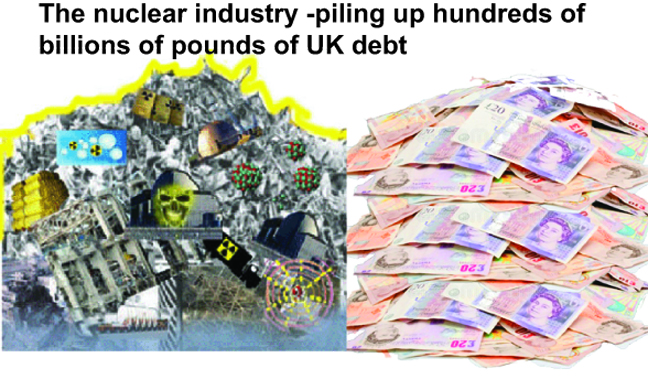
The UK is expected to accrue enough waste to fill four Wembley Stadiums
Jonathan Leake, Energy Editor. 03 May 2026
For Ed Miliband, these were the announcements he’d been wanting
to make for years. Britain was entering a new “golden age of nuclear”,
he said earlier this year. The Energy Secretary pledged to strip away
planning delays, committing to building a generation of small modular
reactors (SMRs).
The industry was delighted. Rolls-Royce was signed up by
Miliband to build the first mini nuclear reactor on Anglesey in Wales.
Rivals began planning their own SMRs across Britain.
But amid the “golden
age” branding and political hype, one major issue remains embarrassingly
unresolved. If all the planned new reactors get built, as well as the giant
ones under construction at Hinkley in Somerset and Sizewell in Suffolk, the
UK will have to work out what to do with a mountain of radioactive waste.
Some 137,000 cubic metres of waste across dozens of UK sites – including at
Sellafield, Britain’s main nuclear waste facility on the Cumbrian coast –
awaits a ministerial decision on how best to dispose of it. A significant
portion of that waste – enough to fill the Royal Albert Hall 1.5 times over
– has been sitting around since the 1960s.In the next few decades, the
level of waste is expected to swell to 4.5 million cubic metres, a 30-fold
increase, as current and past nuclear stations are decommissioned. That’s
enough to fill four Wembley Stadiums.
For the hottest waste – about 750,000
cubic metres worth – the plan is to bury it in a geological repository.
This will probably be tunnelled into the seabed off Cumbria. The Nuclear
Decommissioning Authority admits it is a job that will take until at least
2130 and cost a fortune.
SMRs and the planned advanced modular reactors may
generate more waste for a given power output, experts claim. The physics is
simple. Smaller reactors have a proportionately larger surface area – so
more of the internal radiation escapes. As it strikes surrounding equipment
and buildings, they too will become highly radioactive. A recent research
paper co-authored by Prof Alison Macfarlane, the former chairman of the US
Nuclear Regulatory Commission, included a warning that SMRs “will
increase the volume of nuclear waste in need of management and disposal by
factors of two to 30”.
Paul Dorfman, a Sussex University radiation expert
who advises the Ministry of Defence on dismantling nuclear submarines, says
this is not happening. He points out that the Department for Energy
Security and Net Zero (DESNZ)’s waste inventory omits waste that will arise
from the new Hinkley and Sizewell nuclear stations and from any SMRs that
are built.
Nuclear Waste Services, the government body charged with
building the repository, expects to start construction of a geological
disposal facility around 2040, beginning operations in the late 2050s and
operating through to 2200. Industry experts are sceptical of that
timetable. Insiders warn that this relies on Treasury approval for the
massive cost – which will always be a struggle. It is a cost that is only
likely to rise. In 2024, the Nuclear Decommissioning Authority estimated
Britain’s nuclear waste clean-up operation would cost £199bn. Last year, it
increased that to £216bn. However, the real cost – once a century of
inflation is added, along with waste from a new generation of reactors –
will be far beyond that.
Telegraph 3rd May 2026, https://www.telegraph.co.uk/business/2026/05/03/britain-creating-mountain-nuclear-waste-doesnt-know/
“We are waiting for Nuclear Waste Services to Come Up with Recommendations on Siting….”

Marianne Birkby, May 02, 2026, https://radiationfreelakeland.substack.com/p/we-are-waiting-for-nuclear-waste
“We are waiting for Nuclear Waste Services to Come Up with Recommendations on Siting….”
But meanwhile ‘we are already building new nuclear reactors which would produce even hotter nuclear wastes. Hot nuclear wastes are in the pipeline for which there is no “away” in blatant disregard of the Flowers Report: “There should be no commitment to a large programme of nuclear fission power until it has been demonstrated beyond reasonable doubt that a method exists to ensure the safe containment of long-lived highly radioactive waste for the indefinite future.”
Well it is safe to say that not only is there reasonable doubt that a method exists as no country has demonstrated beyond reasonable doubt that they can contain high level wastes indefinitely without repackaging – but there is also no where NO WHERE willing to be the ultimate nuclear guinea pig in the UK. Unless that is you count the four members of Copeland now Cumberland Council that said on behalf of the region, ‘hey yes let’s sacrifice the safety of Cumbria and her neighbours for nuclear £bungs’.
Good on Wera Hobhouse LibDem MP for Bath for asking the questions.. Click for video on facebook
Inside the bizarre race to secure Earth’s nuclear tombs
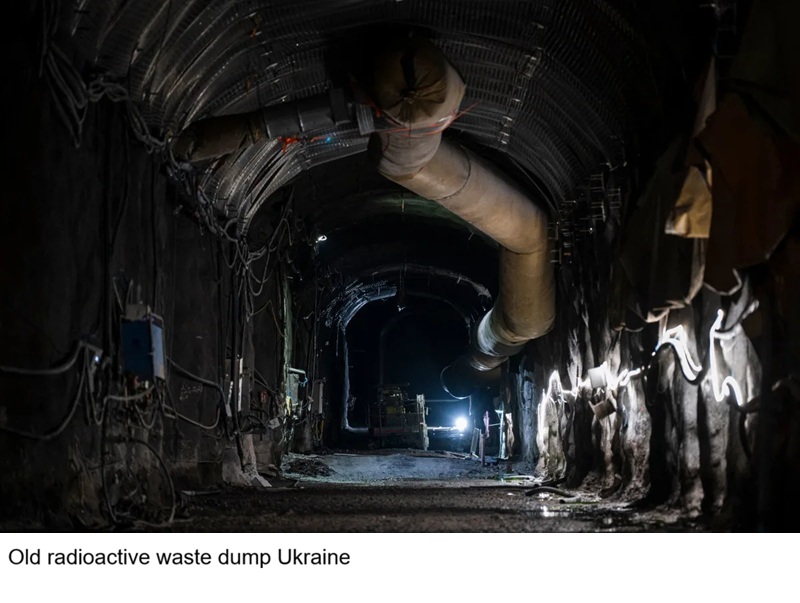
Our generation must find a way to bury the waste very deep to avoid radioactive pollution or exposure to people and animals up to one million years into the future.”
With nuclear energy production increasing globally, the problem of what to do with the waste demands a solution. But where do you store something that stays dangerous for thousands of years?
Jheni Osman, Science Focus, May 1, 2026
Uniformed guards with holstered guns stand at the entrance and watch you lumber past. Ahead lies a wasteland of barren metal gantries, dormant chimney stacks and abandoned equipment.
You trudge towards the ruins of a large, derelict red-brick building. Your white hazmat suit and heavy steel-toe-capped boots make it difficult to walk. Your hands are encased in a double layer of gloves, your face protected by a particulate-filtering breathing mask. Not an inch of flesh is left exposed.
Peering into the building’s gloomy interior, the beam from your head torch picks out machinery and vats turned orange with rust. On a wall nearby, a yellow warning sign featuring a black circle flanked by three black blades reminds you of the danger lurking inside.
Apart from the sound of your own breathing behind your mask, the only thing you can hear is the crackling popcorn of your Geiger counter.
This is what entering the Prydniprovsky Chemical Plant is like for nuclear researchers, including Tom Scott, professor of materials at the University of Bristol and head of the UK Government’s Nuclear Threat Reduction Network.
Prydniprovsky was once a large Soviet materials and chemicals processing site on the outskirts of Kamianske in central Ukraine. Between 1948 and 1991, it processed uranium and thorium ore into concentrate, generating tens of millions of tonnes of low-level radioactive waste.
When the Soviet Union dissolved, Prydniprovsky was abandoned and fell into disrepair.
“The buildings are impressively awful and not for the faint-hearted,” says Scott. “As well as physical hazards, such as gaping holes in the floor, there’s no light or power. And obviously there are radiological hazards. Until very recently, the Ukrainian Government didn’t have a clue what had gone on at the site, so there were concerns about the high radiation levels and ground contamination.”…………………………………”
Scott and his team are known as industrial nuclear archaeologists, and they’re working to find, characterise and quantify the ‘legacy’ radioactive waste at sites around the world.
“High-level radioactive waste gives off a significant amount of radioactivity, sufficient to make humans sick if they get too close,” he says. “Some of this waste will be dangerously radioactive for very long periods of time, meaning that it needs to be physically kept away from people and the environment to ensure that no harm is caused.”
But finding legacy waste like this, which has been amassing since the 1940s, is only part of the challenge. Once it’s been found, it has to be isolated and stored long enough for it to no longer pose a threat. And that’s not easy.
“Currently we’re storing our high-level wastes above ground in secure, shielded facilities,” Scott says. “Such facilities need to be replaced every so often because buildings and concrete structures can’t last indefinitely.”
Safely storing the nuclear waste that already exists is only the start of the problem, however. With the world moving away from fossil fuels towards low-carbon alternatives, nuclear energy production is set to increase, which means more waste is going to be produced – a lot more……………………………………………………
Safe spaces
In the UK, most nuclear waste is currently sent to Sellafield, a sprawling site in Cumbria, in the north-west of England, with about 11,000 employees, its own road and railway network, a special laundry service for contaminated clothes and a dedicated, armed police force (the Civil Nuclear Constabulary).
Sellafield processes and stores more radioactive waste than anywhere in the world.
But more hazardous material is on the way, much of which will come from the new nuclear power station being built at Hinckley Point in Somerset. To keep pace, experts have been hunting for other, much stranger, disposal solutions.
t’s a challenge for nuclear agencies all around the world. All sorts of proposals have been put forward, including some bizarre ideas like firing nuclear waste into space. (The potential risk of a launch failure showering the planet with nuclear debris has silenced that proposal’s supporters.)
So far, the most plausible solution is putting the waste in special containers and storing them 200–1,000m (660–3,280ft) underground in geological disposal facilities (GDFs). Eventually, these GDFs would be closed and sealed shut to avoid any human intrusion.
These ‘nuclear tombs’ are the safest, most secure option for the long-term and minimise the burden on future generations.
“In the UK, around 90 per cent of the volume of our legacy waste can be disposed of at surface facilities, but there’s about 10 per cent that we don’t currently have a disposal facility for. The solution is internationally accepted as being GDFs,” says Dr Robert Winsley, design authority lead at the UK’s Nuclear Waste Services.
“We estimate that about 90 per cent of the radioactive material in our inventory will decay in the first 1,000 years or so. But a portion of that inventory will remain hazardous for much longer – tens of thousands, even hundreds of thousands of years.
“GDFs use engineered barriers to work alongside the natural barrier of stable rock. This multi-barrier approach isolates and contains waste, ensuring no radioactivity ever comes back to the surface in levels that could do harm.”
But how do you keep that radioactivity in the ground? Radioactive waste is typically classified as either low-, intermediate- or high-level waste………………………………………………………………………………..
Rock solid
The hunt is also on to find facilities with bedrock that can withstand events such as wars and natural disasters (‘short-term challenges’, geologically speaking). Sites that won’t change dramatically over the millennia needed for nuclear waste to no longer pose a risk.
“A misconception is that we’re looking for an environment that doesn’t change, but the reality is the planet does change, very slowly,” says Stuart Haszeldine, professor of carbon capture and storage at the University of Edinburgh.
“Our generation must find a way to bury the waste very deep to avoid radioactive pollution or exposure to people and animals up to one million years into the future.”
To achieve this, the site ideally needs to be below sea level. If it’s above sea level, rainwater seeping down through fractures in the rock around the site might become radioactive and eventually find its way to the sea.
When this radioactive freshwater meets the denser saltwater, it’ll float upwards, posing a risk to anything in the water above.
Another challenge is predicting future glaciations, which happen roughly once every 100,000 years. During such a period, the sort of glaciers that cut the valleys in today’s landscape could form again, gouging new troughs in the bedrock that might breach an underground disposal facility.
“Accurate and reliable future predictions depend on how well you understand the past,” says Haszeldine.
“Typically, repository safety assessments cover a one-million-year timeframe, and regulations require a GDF site to cause fewer than one human death in a million for the next million years. Exploration doesn’t search for a single best site to retain radioactive waste, but one that’s good enough to fulfil these regulations.”
Hiding places……………………………………………………………………………………………………….
Hide and seek
But even after you’ve found a suitable site and buried the radioactive material safely inside it, you still need to warn future generations about what’s hidden inside.
The trouble is, even if humans are still around in a million years’ time, there’s no guarantee the languages our ancestors speak, or the symbols they use, will be anything like those of today…………………………………………………………………………………………………………………………………………………. https://www.sciencefocus.com/planet-earth/inside-the-bizarre-race-to-secure-earths-nuclear-tombs
Where are the AUKUS nuclear waste costings (let alone the dump sites)?

Australian Submarine Agency ASA is looking after a $368B project. And the Agency is in a mess.
by Rex Patrick | Apr 20, 2026 , https://michaelwest.com.au/where-are-the-aukus-nuclear-waste-costings-let-alone-the-dump-sites/
Defence is supposed to provide ‘cradle to grave’ costings for proposed capability before a procurement is approved. That doesn’t seem to have happened for AUKUS nuclear waste storage and disposal. Transparency Warrior Rex Patrick is pursuing answers.
A simple request
Imagine for a moment that you were the defence minister, and knowing that all defence capabilities must be costed from cradle to grave, you asked the Australian Submarine Agency for the latest cost estimates for a solution for the treatment and storage of high-level radioactive waste from AUKUS.
You’d expect that it might take a day or two to get the message to Defence and to get a response back to the ministerial wing of Parliament House.
In July 2025 MWM requested access under Freedom of Information laws to the latest cost estimates for a solution for the treatment and storage of high-level radioactive waste from AUKUS. The Agency did not answer the FOI request and its lack of response was referred to the Information Commissioner.
The Information Commissioner is trying to encourage the ASA to engage in a little bit of transparency. But … the Agency just can’t find a latest costing.
We’re disorganised
In a response to an engagement with MWM, the Agency has recently advised:
Preliminary searches have been carried out within one branch of one division of the ASA to identify documents falling within the scope of your request. That branch has advised that approximately 3,000 documents are potentially in scope. They would require manual examination to determine whether they contain information relating to the scope of your request. The documents within this set vary significantly in length and format and may comprise multiple pages requiring individual review.
Further, any cost information in relation to the scope of your request is likely to be dispersed across multiple documents and along timeframes, may appear in differing levels of detail, and may not be directly comparable. As a result, identifying which documents contain relevant cost information would require extensive searching, detailed examination, contextual analysis, and judgment.
Quite unbelievable!
Or is it unbelievable?
ASA is looking after a $368B project. And the Agency is in a mess.
In November 2024 the Government asked Boston Consulting Group to take a look at the organisational structure of the Australian Submarine Agency (ASA). A contract was signed for 2.7. million. In April 2025 it was amended to $7.4 million. Three months later it was amended again to a whopping $12.1 million.
In parallel the defence minister asked former Defence Secretary Dennis Richardson to undertake an urgent top-to-bottom review of the ASA amid serious concerns about how it was managing AUKUS.
None of that seems to have helped.
Budget up just to keep up
The Government’s National Defence Strategy and Integrated Investment Program was released on the same day that ASA advised MWM that it had no idea where to find its AUKUS high level radioactive waste costs.
The Integrated Investment Proposal laid out the Government’s estimates of, amongst other programs, the AUKUS and Collins Class submarine costs for the coming decade.
The 53-to-63 billion dollar AUKUS budget published in 2024 has grown to 71-to-96 billion (a change of 52% for the upper band). The 4-to-5 billion dollar Collins Submarine upgrade costs has grown to 8-to-11 billion dollar (change of 120% for the upper band).
Any thought that the Government is increasing the Defence budget to expand the Defence Force’s capabilities is illusory. The increase will struggle just to deal with cost blow outs.
Or implausible?
The numbers associated with the very long term disposal of AUKUS nuclear waste will be big. If the Minister asked for the latest cost estimates for a solution for the treatment and storage of high-level radioactive waste from AUKUS he’d get it almost instantly.
“The estimate must exist. “
The approach taken by the ASA in responding to MWM’s request reminds me of a teenager trying hid a bad school report from their parents. The kid simply doesn’t realise that mum and dad will find out eventually.
MWM is not about to give up.
Of course, there is a small possibility that we are wrong and there is no estimate. Maybe the Minister has told the ASA he won’t ask for one and they shouldn’t generate one.
I guess we’ll find out.
Finland Is About to Open the World’s First Permanent Nuclear Waste Site
By Haley Zaremba, Oil Price, – Apr 13, 2026
- Finland’s Posiva is on the verge of receiving an operating license for the world’s first permanent nuclear waste disposal facility, built 400 meters underground in 1.9-billion-year-old bedrock at a cost of 1 billion euros.
- Global spent nuclear fuel stocks are set to surge alongside the nuclear energy renaissance, but as of 2024, the U.S. alone faces a $44.5 billion liability with no permanent storage solution in place.
- The U.S. is inching forward: ARPA-E’s SCALEUP Ready program has directed $40 million to two deep borehole disposal projects, including one from Deep Isolation, which calls it the biggest milestone in the company’s history.
Nuclear energy is experiencing a resurgence in popularity on a global scale, thanks to a resurgence in energy security anxieties worldwide. The AI boom has majorly ramped up energy demand projections around the world at the same time that climate pledges are inching dangerously close with perilously little progress to show. Add to this a near-endless cycle of energy crisis and geopolitical conflict, and you’re presented with a majorly heightened energy trilemma: how to source energy that is sufficient, affordable, and sustainable. To solve this puzzle, nuclear energy — a reliable round-the-clock source of carbon-free energy production — can no longer be ignored.
But a nuclear renaissance, while a no-brainer for energy security and climate goals, will also come with a major uptick in nuclear waste, posing a big problem for public health and safety, as well as for the taxpayers that fund its maintenance. Between the 1950s and 2022, it is estimated that nearly 400,000 tons of spent nuclear fuel were generated on a global scale. Of those 400,000 tons, one-third has been ‘recycled’ in a complex and costly process, and two-thirds remain in temporary storage, either in nuclear fuel pools on-site at individual nuclear energy plants or in dry cask storage sites.
However, neither of these storage options are considered to be permanent solutions, and the global quantity of radioactive nuclear waste is about to explode. In fact, the policy and science behind the storage and disposal of spent nuclear fuel remains a critical liability at a global scale, and especially in the United States. As of 2024, it was estimated that the United States’ spent fuel liability clocked in at a jaw-dropping $44.5 billion.
A report from the National Center for Energy Analytics published earlier this month blasts the United States, the world’s biggest nuclear energy producer, for its kick-the-can-down-the-road approach to this critical issue, decrying that “Federal [nuclear waste] management has been a major black eye and policy failing for nuclear energy generation and technology.”
However, the world is, at long last, currently making great progress toward establishing the world’s first-ever permanent nuclear waste disposal site. In fact, a site on the West Coast of Finland is expecting to receive its license to begin operations in just a few months, an incredibly short stretch of time compared to the more-than two decades that the facility has been under construction. The facility will house canisters of spent fuel 400 meters underground in a remote region, housed in earthquake-resistant 1.9 billion-year-old bedrock……………………………………………………………………………………………………………………………. https://oilprice.com/Alternative-Energy/Nuclear-Power/Finland-Is-About-to-Open-the-Worlds-First-Permanent-Nuclear-Waste-Site.html
Finland’s plan to bury spent nuclear waste carries risk to future generations.
Overall, the risks associated with nuclear waste repositories will mainly affect “future generations,”
“…………………After decades of construction, the world’s first facility for permanently disposing spent nuclear fuel is set to begin operations in Finland, becoming a final resting place for tons of dangerous radioactive waste.
Construction of Onkalo – which means “cave” in Finnish – began on the west coast in 2004. It sits on the secluded island of Olkiluoto, in a dense wooded area. The closest town is Eurajoki, about 15 kilometers (9.3 miles) inland, which is home to about 9,000 people. Many work at the nuclear power plant or storage facility.
The 1 billion euro ($1.2 billion) project could soon become operational, with authorities expected to grant a license within months.
The Associated Press took a tour of the facilities where humans soon will not be allowed to tread.
Pere said the site – near three of Finland´s five nuclear reactors – was chosen for its migmatite-gneiss bedrock, which is known for its high stability and low risk of earthquakes.
“It´s the isolation from civilization and mankind on the surface that´s important,” he said, standing in a darkened disposal tunnel, soon to be sealed from humanity. “We can dispose of the waste more safely than by storing it in facilities located on the ground.”
Using unmanned machinery at a nearby encapsulation plant, radioactive rods will be sealed in copper canisters and then buried deep in tunnels over 400 meters underground, then packed in with “buffer” layers of water-absorbing bentonite clay.
Posiva, the company responsible for the long-term management of Finland’s spent nuclear fuels, says Onkalo can store 6,500 tons of spent nuclear fuel.
The final disposal canisters are designed to remain sealed “long enough for the radioactivity of spent fuel to decrease to a level not harmful to the environment,” it said………………………………….
Posiva estimate it will take hundreds of thousands of years before the radioactivity falls to normal, background levels.
According to a 2022 report by the International Atomic Energy Agency, almost 400,000 tons of spent fuel have been produced globally since the 1950s, with two-thirds remaining in temporary storage and one third being recycled in a complex process.
The world´s spent nuclear fuel is currently temporarily stored inside spent nuclear fuel pools at individual reactors and at dry cask storage sites above ground.
There is currently no permanent underground disposal facility for commercial nuclear waste operational anywhere in the world. Sweden began building a repository in Forsmark – about 150 kilometers north of Stockholm – last year, but it´s not expected to open until the late 2030s. France´s Cigéo project is yet to begin construction and has seen opposition.
The Onkalo facility is expected to operate until the 2120s, when it will be permanently sealed.
But Edwin Lyman, director of nuclear power safety at the Union of Concerned Scientists, an American nonprofit organization, warned that geologic disposal of nuclear waste is still fraught with “uncertainties.”
“My view of nuclear waste disposal is that there´s no good option, but it´s important to find the least bad option, and geologic disposal in general is going to be the least bad option among a range of, you know, bad options,” he said.
Lyman said that the copper canisters that contain the spent nuclear fuel will eventually corrode, adding that there are different scientific opinions about how fast that could happen.
“The hope is that is such a slow process that most of the radioactive material will have decayed away by then. But again, there are uncertainties,” he said.
Still, Lyman said that permanently storing spent nuclear fuel deep underground is better than “leaving it on the surface of the Earth forever,” because nuclear material kept above ground “is vulnerable to sabotage.”
“For many decades after spent fuel is discharged from a reactor, it´s so radioactive that it makes transporting and reprocessing very difficult,” Lyman said. But eventually the main radioactive component will decay, he added, making it less risky to handle.
“So over time the plutonium becomes more accessible either to terrorists or to a country that may want to use it,” he said, adding that the only way a terrorist — or a state — could theoretically use the material for a nuclear bomb would be if they had “an off-site reprocessing capability.”
During reprocessing, spent nuclear fuel is separated to recover uranium and plutonium to recycle it for use in new fuel. The process also carries proliferation risks because the separated plutonium could potentially be diverted to build a nuclear weapon.
Overall, the risks associated with nuclear waste repositories will mainly affect “future generations,” Lyman concluded.
To deal with this challenge, an interdisciplinary field of study called nuclear semiotics has been established that looks into developing warning signs about nuclear waste repositories that can be understood by humans 10,000 years from now – or much longer given that it takes hundreds of thousands of years before nuclear waste is no longer dangerous.

For reference: the first humans lived around 300,000 years ago. The earliest writing system was developed in Mesopotamia roughly 5,200 to 5,400 years ago. Stonehenge in Britain is around 5,000 years old, while the Giza pyramids in Egypt are approximately 4,500 years old……………………………………………………….. https://www.dailymail.co.uk/wires/ap/article-15717853/Finlands-plan-bury-spent-nuclear-waste-carries-risk-future-generations.html
Trump accelerates new nuclear warhead production, nearly doubles funding for plutonium “pit” bomb core production.
The Pentagon has always explicitly rejected “minimum-deterrence” in favor of keeping “counterforce” capabilities to wage nuclear war. This is why the U.S. has thousands of nuclear weapons and a $2 trillion “modernization” program to keep them forever. Indefinitely maintaining and expanding nuclear capabilities is contrary to the 1970 NonProliferation Treaty
None of this future pit production is to maintain the safety and reliability of the existing stockpile, but instead is entirely for new-design nuclear weapons
The Trump 2027 budget speeds up this backwards trend. For nuclear warhead production:
April 6, 2026, Jay Coghlan, Nuclear Watch, New Mexico, https://nukewatch.org/wp-content/uploads/2026/04/Trump-Accelerates-Nuclear-Warhead-Production-PR.pdf
Santa Fe, NM – The Trump Administration has released military budget numbers for the federal fiscal year 2027 (which begins October 1, 2026). This still current fiscal year 2026 is already a record breaker for military spending at one trillion dollars. Trump now proposes nearly $1.5 trillion in military spending in FY 2027, of which $1.1 trillion is base funding for the Department of War and an additional $350 million is through so-called budget reconciliation.
On top of all this, Trump will likely seek $200 billion in supplementary appropriations for the war in Iran, for a potential total of $1.7 trillion in military spending in FY 2027 (a 70% increase above FY 2026). At the same time, there is a 10% across-the-board cut to non-military spending. Much of the remaining discretionary funding for education, wildfire protection, environmental regulations, health care, etc., will be constrained by a focus on border control and immigration enforcement.
Trump proposes $53.9 billion for the Department of Energy (DOE) in FY 2027. Sixty-one per cent ($32.8 billion) is for its semi-autonomous nuclear weapons agency, the National Nuclear Security Administration (NNSA). DOE’s Office of Science is gutted by $1.1 billion which “eliminates funding for climate change and Green New Scam research.” DOE’s Office of Energy Efficiency and Renewable Energy is eliminated. Nationwide cleanup of legacy Cold War radioactive and toxic wastes at DOE sites is cut by $386 million to $8.2 billion ($3 billion of which is reserved for the Hanford Site; other site-specific cleanup budget numbers are still not yet available).
With respect to the Department of Energy’s nuclear weapons agency, the Trump FY 2027 budget:
“… focuses NNSA on its most important mission—producing a robust, credible, and modern nuclear deterrent that protects the American people. The United States must maintain and expand its set of nuclear capabilities that allow the President flexibility to protect the homeland and deter adversaries. Specifically, the Budget makes strong investments to develop new warheads that would bolster deterrence, modernize NNSA’s supporting infrastructure, and extend the life of existing warheads.”
The Pentagon has always explicitly rejected “minimum-deterrence” in favor of keeping “counterforce” capabilities to wage nuclear war. This is why the U.S. has thousands of nuclear weapons and a $2 trillion “modernization” program to keep them forever. Indefinitely maintaining and expanding nuclear capabilities is contrary to the 1970 NonProliferation Treaty, which required the nuclear weapons powers to “to pursue negotiations in good faith on effective measures relating to cessation of the nuclear arms race at an early date and to nuclear disarmament…” After more than a half-century that has never even begun. An NPT Review Conference, held every five years, is scheduled to begin April 27 at the United Nations. It is widely expected to fail for the third time over fifteen years to make any progress whatsoever toward nuclear disarmament.
The Trump 2027 budget speeds up this backwards trend. For nuclear warhead production:
• A feasibility study for a new B61-13 limited earth-penetrating bomb is funded at $46.4 million in FY 2027. A full budget request of $1 billion is expected for FY 2028 followed by an average of $870 million for each fiscal year 2029 – 2031.
• The W80-4 warhead for the Long-Range Stand-Off weapon (i.e., air-launched cruise missile) is funded at $1 billion in FY 2027. There is an average of $970 million in projected costs for each fiscal year 2028-2031.
• No funding is requested in FY 2027 for the W80-5 warhead for the Sea-Launched Cruise Missile. However, there is an average of $1.4 billion in projected costs for each fiscal year 2028-2031.
• The W87-1 nuclear warhead program is for the new Sentinel intercontinental ballistic missile, with likely multiple warheads for each missile (which is particularly dangerous and destabilizing). The Sentinel ICBM itself is already massively over budget. The W87-1 warhead program is increased 41% from $650 million in FY 2026 to $913 million in FY 2027, with an astounding average of $3.5 billion in projected costs for each fiscal year 2028-2031.
• The submarine-launched W93 nuclear warhead program, which the United Kingdom has actively lobbied for, is increased 37% from $807 million in FY 2026 to $1.1 billion in FY 2027. There is an average of $1.95 billion in projected costs for each fiscal year 2028-2031.
• There is a new “Future Programs” budget line item of $99.8 million in FY 2027 for feasibility studies for other new-design nuclear weapons, followed by an average of $92 million for each fiscal year 2028-2031.
Plutonium “pit” bomb core production: Plutonium pits are the essential “triggers” for modern nuclear weapons. Pit production has been the chokepoint for resumed industrial-scale nuclear weapons production by the U.S. ever since an FBI raid investigating environmental crimes stopped operations at the Rocky Flats Plant in 1989.
Trump’s FY 2027 budget proposes:
An 83% increase in funding for pit production at the Los Alamos National Laboratory from $1.3 billion in FY 2026 to $2.4 billion in FY 2027. There is an average of $2.3 billion in projected costs for each year FY 2028-2031. NNSA has directed LANL to double pit production to at least 60 pits per year because of increasing delays at the Savannah River Site (SRS).

• An 87% increase in funding for pit production at SRS from $1.2 billion in FY 2026 to $2.25 billion in FY 2027. There is an average of $2.5 billion in projected costs for each year FY 2028-2031. The Savannah River Plutonium Processing Facility’s upper range in estimated costs is now $25 billion, which would make it by far the most expensive building in U.S. history. Gloveboxes at SRS for canceled “dilute and dispose” of surplus plutonium are being diverted to “purification instead of disposition” to create feedstock for manufacturing new plutonium pits. There is only one glovebox left at SRS to process and remove excess plutonium, which could lead to resumed legal conflict with the State of South Carolina.
Total “Plutonium Modernization” for expanded plutonium pit production at both sites is increased 87% from $2.6 billion in FY 2026 to $4.9 billion in 2027. There is an average of $5.1 billion in projected costs for each year FY 2028-2031.
None of this future pit production is to maintain the safety and reliability of the existing stockpile, but instead is entirely for new-design nuclear weapons. This is despite the fact that in 2006 independent experts found that pits have serviceable lifetimes of at least 100 years. The average age of pits is now around 43 years. NNSA has avoided any full pit lifetime studies since 2006 (however, a new one is reportedly pending).
At least 15,000 pits are already stored at NNSA’s Pantex Plant. The independent Government Accountability Office has repeatedly reported that NNSA has no credible cost estimates for pit production, its most expensive and complex program ever. New pits cannot be tested because of the existing international testing moratorium, which could erode confidence in the stockpile. Or, conversely, new pits could prompt the U.S. to resume testing (which Trump has already threatened), after which other nuclear weapons powers would surely follow, thereby rapidly accelerating the new nuclear arms race.
Other nuclear weapons production programs:
• The “Tritium and Defense Fuels” program is increased by 79% from $520 million in FY 2026 to $881 million in 2027. There is an average of $1.8 billion in projected costs for each fiscal year 2028-2031.
“Non-Nuclear Capability Modernization” for non-nuclear components manufacturing, primarily at the Sandia National Laboratories, is increased 130% from $195.5 million in FY 2026 to $449 million in FY 2027. There is an average of $370 million in projected costs for each fiscal year 2028-2031.
• “Weapons Dismantlement and Disposition” is increased 10% from $82.3 million in FY 2026 to $90.7 million in FY 2027 (a mere 1.3% of total warhead funding). Rather than being a worthy step toward nuclear disarmament, the stated objective of weapons dismantlements is to “recover critical components and materials to support existing weapon programs, Naval Reactors, and other national priority missions.” There is an estimated backlog of up to 1,500 retired warheads to dismantle and dispose. However, NNSA’s Pantex Plant is so busy rebuilding existing nuclear warheads with new military capabilities that dismantlements have been at a historic low since the end of the Cold War.
In all, NNSA’s budget category of “Total Weapons Activities” is increased 35% from $20.4 billion in FY 2026 to $27.4 billion in FY 2027. There is an average of $29 billion in projected costs for each fiscal year 2028-2031.
Jay Coghlan, Director of Nuclear Watch, commented, “New nuclear weapons won’t give us more security as our nation is being hollowed out by tax cuts for the ultrarich, cuts to domestic programs, and the gutting of programs to address adverse climate change. It is way past time for the nuclear weapons powers to honor their obligations under the 1970 NonProliferation Treaty to negotiate verifiable nuclear disarmament instead of keeping nuclear weapons forever. We should be cleaning up, not building up new nuclear weapons.”
Sources:……………………………………………………………..
Blocking Iran’s Other Option: A Plutonium Bomb

By Henry Sokolski, April 03, 2026, https://www.realcleardefense.com/articles/2026/04/03/blocking_irans_other_option_a_plutonium_bomb_1174454.html
America and Israel want to prevent Tehran from getting a bomb. That’s why the Pentagon and Israel Defense Forces continue to target Tehran’s ability to make weapons uranium. Washington and Jerusalem claim they have obliterated Tehran’s uranium enrichment capability. Perhaps. But, Iran has another pathway to a bomb.
U.S. and Israeli leaders have yet to fully consider Iran’s option to make nuclear weapons from plutonium, a material Iran can extract from spent fuel at its largest reactor at Bushehr. Washington should make sure that Iran doesn’t remove Bushehr’s spent fuel and strip out the plutonium. This can and should be done without bombing the plant.
ROSATOM, the Russian firm that built and has operated Bushehr since 2011, says there are 210 tons of spent reactor fuel at the plant. If you check the ROSATOM figure against International Atomic Energy Agency (IAEA) reactor performance logs, the 210 tons of waste contain enough plutonium to make more than 200 nuclear weapons – as many or more than SIPRI estimates Israel has.
It would not take Iran long to remove Bushehr’s spent fuel and chemically strip the plutonium out. In 1977, the U.S. General Accounting Office evaluated leading U.S. nuclear chemist Floyd Culler’s proposed quick and dirty method of plutonium chemical separation. The facility Culler described was 130 feet by 60 feet by 30 feet (approximately the size of a standard basketball court). It employed technology little more advanced than that required for the production of dairy and the pouring of concrete. Such a plant could fit within a large warehouse and would take no more than six months to build. Until the plant was operational, it would send off no signal and could separate a bomb’s worth of plutonium after only ten days of operation. After that, the plant could separate a bomb’s worth of plutonium in a day.
Two more steps are needed to convert separated plutonium into an insertable metallic core for a nuclear implosion device First, turn the plutonium solution into an oxide and another to convert this oxide into metal. Second, cast and machine this material into a hemisphere. Assuming Iran already had an (implosion) device on the ready, the completion of a bomb could take one to two weeks. This plutonium weapon production timeline is similar to what it would take to extract the uranium hexafluoride in the rubble at Isfahan and then to chemically convert that gas into insertable metal uranium bomb cores. For that reason, the Trump administration should pay as much attention to this back end of the fuel cycle as it is to the front-end, which features uranium enrichment.
What’s odd is that there’s been next to no public discussion of Iran exploiting the Bushehr plutonium option. This may be due to the popular myth that “reactor-grade plutonium” can’t be used to make workable bombs. Robert Selden and Bruce Goodwin, two of America’s top plutonium weapons designers, put this fable to rest, most recently in 2025. As the U.S. Department of Energy has explained, with Iran’s level of weapons sophistication it could use reactor-grade and produce Hiroshima or Nagasaki yields.
The U.S. government used to worry about this possibility. In 2004, the State Department spotlighted Bushehr as a worrisome nuclear weapons plutonium producer. Late in 2012, after Iran shut Bushehr down and withdrew all of the fuel – roughly 20 bombs-worth of near-weapons-grade plutonium – the Pentagon swung into action, launching surveillance drones over the reactor to make sure the plutonium-laden spent fuel didn’t leave the plant to be reprocessed elsewhere. The Iranians put the fuel back, but the concern that Iran was trying to pull a fast one remained.
Now, the Trump Administration is threatening to bomb the largest of Iran’s electrical generating plants, of which Bushehr is in the top ten. Bombing it, much less its spent fuel pond, however, would be a big mistake. The last thing the United States should risk is prompting a radiological release. NPEC-commissioned simulations indicate radiological releases from Bushehr’s reactor core could force the mandatory evacuation of tens of thousands to millions of Iranians. Attacking the spent fuel pond could result in even larger numbers. Of course, Bushehr would be a legitimate military target if it supported Iranian military operations. However, it doesn’t. Even before U.S. Israeli forces hit the site with two projectiles, the plant was on cold shutdown.
What, then, should our government do? First, the Pentagon should watch to make sure Iran does not remove any of the spent fuel at Bushehr. It could do this with space surveillance assets or, as it did in 2012, with drones. Second, any “peace” deal President Trump cuts with Tehran should include a requirement that there be near-real-time monitoring of the Bushehr reactor and spent fuel pond, much as the IAEA had in place with Iran’s fuel enrichment activities. The IAEA actually asked for this back in 2015. Iran refused. Unfortunately, President Obama didn’t push back. That was a mistake, one the Trump Administration should not continue to make.
Henry Sokolski is executive director of the Nonproliferation Policy Education Center. He was deputy for nonproliferation policy in the Department of Defense (1989–1993), and is the author of China, Russia, and the Coming Cool War (2024).
France plans inquiry as cost of nuclear waste project hits €33bn

After France raised the cost of its Cigéo nuclear waste storage project to €33.3 billion, an increase of more than €8 billion, authorities are preparing to open a public inquiry into the plan – which has long faced opposition from anti-nuclear groups.
01/04/2026 , By:RFI,
https://www.rfi.fr/en/france/20260401-france-plans-inquiry-as-cost-of-nuclear-waste-project-hits-%E2%82%AC33bn-cig%C3%A9o
The new estimated cost replaces a €25 billion figure set in 2016. It reflects updated costs and sits within a €26.1 to €37.5bn range set in May 2025 by the National Agency for Radioactive Waste Management, which is leading the project.
The government order, signed by Economy Minister Roland Lescure and Energy Minister Maud Brégeon, covers the entire lifespan of the site – from design and construction to operation and closure – over 151 years.
It puts the initial construction cost at €9.74 billion. Taxes linked to the project are estimated at €3.66 billion.
The revised estimate will be used as a reference by EDF, Orano and the Atomic Energy Commission, the three nuclear operators that fund the project under the “polluter pays” principle.
Deep underground
Cigéo is designed to store France’s most radioactive nuclear waste 500 metres underground at a site in Bure in eastern France. The site would hold 10,000 cubic metres of high-activity waste and 73,000 cubic metres of long-lived medium-activity waste produced by nuclear power plants.
When the cost was first set at €25 billion in 2016, based on earlier economic conditions, campaigners said it was “largely underestimated”.
The National Agency for Radioactive Waste Management filed a formal request for authorisation in January 2023. A final government decision is not expected before late 2027 or early 2028.
French media reports said the public inquiry had initially been planned for autumn and was still expected in early December when the ASNR, France’s nuclear safety and radiation watchdog, issued its final opinion on the construction authorisation request.
Race against the calendar
Speaking at a meeting of public inquiry commissioners in Euville on Thursday, Meuse prefect Xavier Delarue said the public inquiry would begin on 18 May.
He said around 50 elected officials had been consulted before the schedule was brought forward, with a strong response rate and 75 percent of the opinions returned favourable.
“There was every reason to launch the public inquiry,” he said.
Three commissioners, along with three alternates, have been appointed to examine the roughly 10,000-page file.
They will produce a report, which the agency must respond to by the end of the summer. “In September, I will write an overall report and send it to the ministry,” Delarue said.
Opposition pushback
Nine environmental organisations have criticised the decision and called for the consultation to be delayed.
In a joint statement, groups including Greenpeace France, France Nature Environnement and the Nuclear Phase-Out Network denounced “an unacceptable new attempt to push the project through” and said the file does not show that the project would be feasible and safe.
They also said the timetable reflects an electoral aim, with the goal of approving Cigéo before next year’s presidential election.
Scenario Analysis for Partitioning and Transmutation(P&T) in a Phase-out Scenario
In February 2025, the German Federal Agency for Disruptive Innovation
(SPRIN-D) published the “Implementation Study on an Accelerator-Driven
Neutron Source at the Site of a Former Nuclear Power Plant” (Houben et
al. 2025), proposing an alternative waste management option. This type of
radioactive waste management is often summarized under the broader term of
Partitioning and Transmutation (P&T).
The SPRIN-D study has been critically
assessed with respect to its assumptions, feasibility, and expected
benefits for Germany e.g. by the German Federal Ministry for the Safety of
Nuclear Waste Management (Bundesamt für die Sicherheit der nuklearen
Entsorgung (BASE) 2025).
The P&T scenarios in the SPRIN-D study address
only a narrow and highly constrained case. They do not provide a
transparent, reproducible nationwide system description for the treatment
of the full German high-level waste inventory (HLW). Additionally key
modelling parameters and interim results are only partly documented. Under
the explicit assumption of hypothetical technical feasibility, based on
documented parameters and literature values, this INRAG study estimates
what a national implementation of a P&T scenario in Germany based on
Transmutex’ START concept could entail.
After briefly outlining the
background, we define a consistent set of scenario parameters and
justifying the chosen values. We then present the modelling results, such
as the number of facilities and time periods required under the stated
boundary conditions, followed by a discussion of selected potential safety
implications of operating a full-scale system over multiple decades.
The analysis is limited to technical and system-dimension aspects. Overall, the
results indicate that the optimistic assumptions in Houben et al. (2025) do
not provide a transparent, reproducible nationwide mass-balance model and
results change drastically if parameter ranges are applied as reported in
the scientific literature.
Even under optimistic modelling assumptions, P&T
does not remove the need for a geological repository. Rather, the burden of
nuclear waste is shifted into a long-lived multi-site nuclear industrial
system with additional facilities, operational waste streams, and prolonged
institutional requirements.
INRAG 11th March 2026,
https://www.inrag.org/wp-content/uploads/2026/03/inrag_put_publication_V2.pdf
Nuclear decommissioning in the UK
Corporate report: The NDA group Technical Baseline Review
This report provides a high-level overview of the processes and associated technologies used or planned to be used to deliver our mission.
NDA 26th March 2026 Nuclear Decommissioning Authority NDA group Technology Baseline Review 2026
PDF, 4.76 MB, 67 pages
The UK’s nuclear energy programme, dating from the post-war years, has left a challenging decommissioning legacy to the country: numerous prototype reactors, fuel-manufacturing plants, research centres, reprocessing plants and 11 power stations. The Sellafield site in west Cumbria houses more than 200 nuclear facilities and 1,000 buildings, making it one of the world’s most complex environmental decommissioning challenges. Across the UK many ‘never-done-before’ decommissioning projects will need to be completed. The Nuclear Decommissioning Authority (NDA) was established under the Energy Act (2004) to ensure that the UK’s nuclear legacy sites are decommissioned and cleaned up safely, securely, cost-effectively and in ways that protect people and the environment.
This document provides a high-level overview of the current technology landscape across the NDA group. It outlines the NDA group technology baseline, current technologies being deployed, and the technology opportunities requiring development or adoption to underpin the delivery of our decommissioning mission……………
https://www.gov.uk/government/publications/nuclear-decommissioning-authority-rd-technical-baseline
-
Archives
- October 2026 (120)
- September 2026 (339)
- August 2026 (330)
- July 2026 (355)
- June 2026 (287)
- May 2026 (306)
- April 2026 (356)
- March 2026 (251)
- February 2026 (267)
- January 2026 (308)
- December 2025 (358)
- November 2025 (359)
-
Categories
- 1
- 1 NUCLEAR ISSUES
- business and costs
- climate change
- culture and arts
- ENERGY
- environment
- health
- history
- indigenous issues
- Legal
- marketing of nuclear
- media
- opposition to nuclear
- PERSONAL STORIES
- politics
- politics international
- Religion and ethics
- safety
- secrets,lies and civil liberties
- spinbuster
- technology
- Uranium
- wastes
- weapons and war
- Women
- 2 WORLD
- ACTION
- AFRICA
- Atrocities
- AUSTRALIA
- Christina's notes
- Christina's themes
- culture and arts
- Events
- Fuk 2022
- Fuk 2023
- Fukushima 2017
- Fukushima 2018
- fukushima 2019
- Fukushima 2020
- Fukushima 2021
- general
- global warming
- Humour (God we need it)
- Nuclear
- RARE EARTHS
- Reference
- resources – print
- Resources -audiovicual
- Weekly Newsletter
- World
- World Nuclear
- YouTube
-
RSS
Entries RSS
Comments RSS

