Decommissioning of Gentilly 1
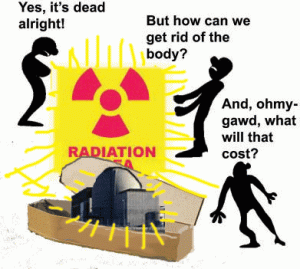
Ken Collier, 7 Feb 26
As in many industrial projects, many of the hazards come to be known only after the project is well under way or, very often, completed and discontinued. Gentilly 1 is one of those projects. Like others, the Gentilly 1 detritus presents grave dangers to living things as the building, equipment and supplies are taken apart. Complete public review of the decommissioning of Gentilly 1 is required, in my view. It should not be skipped or sidestepped in any way.
Notice of the project was posted on the website of the federal impact assessment agency, but it bears scant resemblance to formal and complete impact assessments, and the public is instructed to send comments to the private consortium, rather than to the federal authorities responsible for making the decision.
To cite Dr. Gordon Edwards, president of the Canadian Coalition for Nuclear Responsibility (CCNR): “Heavily contaminated radioactive concrete and steel would be trucked over public roads and bridges, through many Quebec and Ontario communities, to the Chalk River site just across the Ottawa River from Quebec.”
Impact Assessment of the Planned Dismantling of the Core of the Gentilly-1 reactor.
To: The Honourable Julie Aviva Dabrusin, Minister of Environment and Climate Change
From: The Canadian Coalition for Nuclear Responsibility (CCNR)
Re: Impact assessment of the final dismantling of the Gentilly-1 nuclear reactor
Date: July 5 2026
Reference Number 90092
Cc Impact Assessment Agency of Canada
Atomic Energy of Canada Limited
Canadian Nuclear Laboratories \
Canadian Nuclear Safety Commission
The final dismantling of the most radioactive portions of the Gentilly-1 nuclear reactor, proposed by the licensee Canadian Nuclear Laboratories (CNL), will mark the first time that a CANDU power reactor has ever been fully decommissioned – that is, demolished.
This project is not designated for a full panel review under the Impact Assessment Act (IAA) but you, Minister Dabrusin, have the power to so designate it under the terms of the Act.
The Canadian Coalition for Nuclear Responsibility urges you to do so for the reasons stated below.
(1) When it comes to post-fission radioactivity (human made), the long-lived radioactive decommissioning waste from the core area of a nuclear reactor is second only in radiotoxicity and longevity to the high-level radioactive waste (irradiated nuclear fuel) that has already been designated for a full panel review under IAA at the initiative of NWMO, the Nuclear Waste Management Organization. The deadline for initial comments on the NWMO Deep Geological Repository project (DGR) for used nuclear fuel was yesterday, February 4, 2026. [Our comments: www.ccnr.org/GE_IAAC_NWMO_comments_2026.pdf ]
(2) Fully dismantling a nuclear reactor core is a demanding and hazardous undertaking, resulting in voluminous intermediate level radioactive wastes. The highly radioactive steel and concrete structures – fuel channels, calandria tubes, tube sheet, thermal shield, calandria vessel, biological shield, reactor vault, and more – need to be carefully disassembled, using robotic equipment and perhaps underwater cutting techniques with plasma torches. Such methods are described in a 1984 article published by the Canadian Nuclear Society and linked below, on the detailed advanced methods required for dismantling Gentilly-1.
Gentilly-1 Reactor Dismantling Proposal, by Hubert S. Vogt
Reactor and Fuel Handling Engineering Department
Atomic Energy of Canada Limited – CANDU Operation
Published by the Canadian Nuclear Society in the
Proceedings of the 5th Annual Congress
(3) Dismantling the reactor core will create large amounts of radioactive dust and debris some of which will almost certainly be disseminated into the atmosphere, or flushed into the nearby St. Lawrence River, or added to the existing contamination of the soil and subsoil (including groundwater) at the Gentilly site. It is worth noting that, during the Bruce refurbishment operations in 2009, over 500 workers – local tradesmen, mainly – suffered bodily contamination by inhaling radioactive airborne dust containing plutonium and other alpha emitters (i.e. americium) for a period of more than two weeks. The workers were told that respirators were not required. The radioactivity in the air went undetected for two and a half weeks because neither Bruce managers nor CNSC officers on site took the precaution to have the air sampled and tested.
(4) Once disassembled, the bulky and highly radioactive structural components of Gentilly-1 will have to be reduced in volume by cutting, grinding or blasting. Radioactive dust control and radioactive runoff prevention may be only partially effective. Then the multitudinous radioactive fragments must be packaged, and either (a) stored on site or (b) removed and transported over public roads and bridges, probably to Chalk River. The Chalk River site is already overburdened with high-level, intermediate-level, and low-level radioactive wastes of almost all imaginable varieties. Toxic waste dumping at Chalk River is contrary to the United Nations Declaration on the Rights of Indigenous Peoples (UNDRIP) and the federal government’s “duty to consult”, since Keboawek First Nation and other Indigenous rights-holders in the area have not given their free, prior, informed consent to either the storage or disposal of these toxic wastes on their unceded territory. A panel review could weigh the options of temporary on-site storage versus immediate relocation. Since there is as yet no final destination for intermediate level wastes, moving those wastes two or three times rather than once (when a final destination exists) will be costlier and riskier. Hence on-site storage is attractive.
(5) The decommissioning waste must be isolated from the environment of living things for thousands of years. The metallic fragments contain such long-lived radioactive species as nickel-59, with a 76,000 year half-life, and niobium-94, with a 20,000 year half-life. The concrete fragments also contain long-lived radioactive species like chlorine-36, with a 301,000 year half-life. Such radioactive waste materials are created during the fission process; they were never found in nature before 1940. NWMO has recommended that such intermediate-level decommissioning waste requires a Deep Underground Repository (DGR) not unlike that proposed for used nuclear fuel. CCNR believes that it is only logical and entirely responsible to call for a panel review of this, the first full decommissioning project for a nuclear power reactor in Canada. The lessons learned will have important ramifications for all of Canada’s power reactors as they will all have to be dismantled at some time. This is not “business as usual”.
Read more: Impact Assessment of the Planned Dismantling of the Core of the Gentilly-1 reactor.(6) Demolition of buildings is often a messy business, but demolition of a nuclear reactor core is further complicated by the fact that everything is so highly radioactive, therefore posing a long-term threat to the health and safety of humans and the environment. A panel review by the Assessment Agency is surely the least we can do in the pubic interest.
(7) To the best of our understanding, Canadian Nuclear Laboratories (CNL) is a private contractor managed by an American-led consortium of multinational corporations, whose work is paid for by Canadian taxpayers through the transfer of billions of dollars to CNL from Atomic Energy of Canada Limited, a crown corporation wholly owned by the Canadian government. As CNL is a contractor, paid to do a job by AECL, CCNR does not feel assured that the best interests of Quebec or of Canada will automatically be fully served by CNL, as it is not accountable to the electorate. When the job involves demolishing, segmenting, fragmenting, packaging and transporting dangerous radioactive materials, involving persistent radiological toxins, we feel that a thorough public review by means of a comprehensive impact assessment, coupled with the involvement and oversight of accountable federal and provincial public agencies is required to ensure that the radioactive inventory is verified and documented, that no corners are cut and no presumptions go unchallenged. The International Atomic Energy Agency strongly advises that before any reactor decommissioning work is done, there has to be a very precise and accurate characterisation of the radioactive inventory –
all radionuclides accounted for, all becquerel counts recorded, and all relevant physical/chemical/biological properties carefully noted. We have seen no such documentation, but we believe it is essential to make such documentation publicly available before final decommissioning work begins, and to preserve such records for future generations so that they can inform themselves about the radioactive legacy we are leaving them. A panel review could help to ensure that we do not bequeath a radioactive legacy that is devoid of useful information, a perfect recipe for amnesia.
(8) The Canadian Coalition for Nuclear Responsibility (CCNR) is federally incorporated as a not-for-profit organization, whose official name in French is le Regroupement pour la surveillance du nucléaire (RSN). CCNR/RSN is a member of le Regroupement des organismes environnementaux en énergie (ROEÉ). The ROEÈ has also filed comments on this dossier, linked below, with 10 recommendations. We endorse the ROEÉ submission and all of its recommendations. The ROEÉ submission is en français www.ccnr.org/IAAC_ROEE_G1_2026.pdf and here is a link to an English translation
www.ccnr.org/IAAC_ROEE_G1_e_2026.pdf .
Yours very truly,
Gordon Edwards, Ph.D., President,
Canadian Coalition for Nuclear Responsibility
Growing stockpiles of radioactive waste beside the Ottawa River upstream of Parliament Hill causing widespread concern.

| The Ottawa River flows through an ancient rift valley that extends from near North Bay through Ottawa toward Montreal. The area is seismically active, and experiences dozens of minor earthquakes each year. Stronger earthquakes also occur such as the magnitude 5 quake in June 2010 that caused shaking, evacuations and damage in Ottawa including shattered windows in Ottawa City Hall and power outages in the downtown area. |
| February 3, 2026The Ottawa River flows through an ancient rift valley that extends from near North Bay through Ottawa toward Montreal. The area is seismically active, and experiences dozens of minor earthquakes each year. Stronger earthquakes also occur such as the magnitude 5 quake in June 2010 that caused shaking, evacuations and damage in Ottawa including shattered windows in Ottawa City Hall and power outages in the downtown area.Experts say Ottawa is at risk for a big earthquake.The Government of Canada is currently in the process of shoring up and earthquake-proofing the buildings on Parliament Hill. The project will take 13 years and cost billions of dollars.Incredibly, at the same time as billions are being spent to earthquake-proof Canada’s Parliament Buildings, the Government of Canada is paying billions of dollars to a US-based consortium that is importing large quantities of radioactive waste to the Ottawa Valley. |
| Soon after it took control of Canada’s nuclear laboratories and radioactive waste in 2015, the consortium, through its wholly-owned subsidiary, Canadian Nuclear Laboratories (CNL), announced its intention to consolidate all federally-owned radioactive waste at Chalk River Laboratories, alongside the Ottawa River, 180 km upstream of the Nation’s Capital. There was no consultation or approval from the Algonquin Nation in whose unceded territory the Chalk River Laboratories is located, nor any consultation with residents of the Ottawa Valley about the plan. |
| CNL is importing nuclear waste from federal nuclear facilities in Manitoba, southern Ontario and Quebec. The imports comprise thousands of shipments and thousands of tonnes of radioactive debris from reactor decommissioning, and dozens of tonnes of high level waste nuclear fuel, the most deadly kind of radioactive waste that can deliver a lethal dose of radiation to an unprotected bystander within seconds of exposure. |
| High level waste shipments from Becancour, Quebec have already been completed. They involved “dozens of trucks” and convoys operating secretly over several months, from December 2024 through July 2025, under police escort, to move 60 tons of used fuel bundles to Chalk River. Tons of high level waste from Manitoba will follow soon. |
| Since there is no long-term facility for high level waste at Chalk River, nor is there any such facility anywhere in Canada at present, CNL built silos (shown in the photo below) to hold the waste at a cost of 15 million dollars. This high level radioactive waste is ostensibly in storage at Chalk River, but there is no guarantee it will ever be moved. |
| CNL plans to put the less deadly waste into a giant, above-ground radioactive waste mound called the Near Surface Disposal Facility, a controversial project currently mired in legal challenges. The dump would hold one million tons of radioactive waste in a facility designed to last about 500 years. Many of the materials destined for disposal in the dump, such as plutonium, will remain radioactive for far longer than that. According to CNL’s own studies, the facility would leak during operation and disintegrate after a few hundred years, releasing its contents to the surrounding environment and Ottawa River less than a kilometer away. |
Shipping containers filled with radioactive waste are piling up at Waste Management Area H on the Chalk River Laboratories property, awaiting a time when they can be driven or emptied into the NSDF. At last count there were 1500 shipping containers there, shown in the photo below. [on original] Source photo is at https://concernedcitizens.net/2025/12/13/cnl-environmental-remediation-management-update-june-2025/
| It would be hard to choose a less suitable place to consolidate all federal radioactive waste than in a seismically-active zone beside the Ottawa River that provides drinking water for millions of Canadians in communities downstream including Ottawa, Gatineau and Montreal. |
| Concerns about imports of radioactive waste to the Ottawa Valley are widespread and growing. |
| In 2021, Ottawa City Council unanimously passed a resolution calling for radioactive waste imports to the Ottawa Valley to stop. Ottawa Riverkeeper recently called for transportation of radioactive waste to the Chalk River Laboratories to stop until a clear, long-term plan for the waste is available. A December 2025 letter to Prime Minister Mark Carney from Bloc Québécois and Green Party MPs along with First Nations and many civil society groups requested a moratorium on shipments of Canadian radioactive waste to Chalk River. |
| Action is urgently needed to halt the imports of radioactive waste to the earthquake-prone Ottawa Valley. |
Slow worms blamed for holding up Britain’s nuclear deterrent
Economists warn project is ‘above budget’ as removal of legless lizards delays expansion.
Jonathan Leake Energy Editor. Matt Oliver Industry Editor,
Rachel Reeves ordered a review of the quango that handles Britain’s nuclear
waste amid concerns about project overruns and spiralling budgets. The
Nuclear Decommissioning Authority (NDA) is in charge of taking apart old
nuclear power stations and storing their radioactive waste securely –
including at Sellafield, the nuclear waste site in Cumbria.
In 2022, a
Treasury report estimated the NDA’s liabilities to be £237bn – a colossal
sum that raised questions over all nuclear spending. The following year,
the Treasury revised that figure down to £124bn simply by applying an
increased discount rate – an accounting device used to reduce the apparent
cost of future spending. Since then, however, costs have jumped again.
In 2024, the National Audit Office found that the budget for Sellafield’s
clean-up had leapt to £136bn.
The new review will be led by Tim Stone, the
chairman of Nuclear Risk Insurers and a former expert adviser to several
government departments. In documents published online, the Department for
Energy Security and Net Zero said the review presented an “opportunity to
address concerns” with the NDA’s performance. They added: “Given the
significance and complexity of the NDA’s task, it is essential to ensure
that the NDA operates effectively and efficiently, delivering value for
money to the taxpayer while also maintaining standards of openness and
transparency.”
Telegraph 27th Jan 2026, https://www.telegraph.co.uk/business/2026/01/27/slow-worms-blamed-for-holding-up-britains-nuclear-deterrent/
Trump offers states a deal to take nuclear waste

POLITICIPRO, By: Sophia Cai | 01/20/2026
The Trump administration wants to quadruple America’s production of nuclear power over the next 25 years and is hoping to entice states to take the nuclear waste those plants produce by dangling the promise of steering massive investments their way.
President Donald Trump’s big bet on amping up nuclear production is not an easy feat, fraught with NIMBY concerns about safety and waste byproducts. The administration hopes to solve at least one of those issues — what to do with toxic nuclear waste — with a program they plan to roll out this week.
Governors would effectively be invited to compete for what the administration believes is a once-in-a-generation economic development prize in exchange for hosting the nation’s most politically and environmentally toxic byproduct.
Energy Secretary Chris Wright has already begun laying groundwork with governors. Over the last two weeks, Wright has met with at least two governors who have expressed interest, according to two officials familiar with the private meetings granted anonymity to discuss them……………………………….(Subscribers only) https://subscriber.politicopro.com/article/2026/01/trump-offers-states-a-deal-to-take-nuclear-waste-00738104
Trump Could Offer Deals to U.S. States to Store Nuclear Waste
Oil Price, By Charles Kennedy – Jan 22, 2026,
The Trump Administration plans to offer U.S. states incentives for building nuclear reactors in exchange for agreeing to store nuclear waste, a source familiar with the matter told Reuters on Thursday.
However, a spokesperson for the U.S. Energy Department told Reuters that the story was “false” and that “no decisions have been made at this time,” after POLITICO first reported on the plan late on Wednesday.
The POLITICO report said that the Energy Department could invite interest from U.S. states as early as this week.
Handling nuclear waste is a politically and environmentally sensitive issue, and the U.S. may have much more of that in the coming years as it the Trump Administration plans to facilitate the expansion of U.S. nuclear energy capacity from about 100 gigawatts (GW) in 2024 to 400 GW by 2050.
The U.S. Administration has bet big on nuclear power, alongside gas, to meet the expected surge in America’s electricity demand driven by AI, data centers, and the onshoring of manufacturing………….
Earlier this month, the Energy Department announced a $2.7 billion investment to strengthen domestic enrichment, in support of President Trump’s commitment to expand U.S. capacity for low-enriched uranium (LEU) and jumpstart new supply chains and innovations for high-assay low-enriched uranium.
Last month, the Energy Department awarded $800 million to TVA and Holtec to advance the deployment of U.S. small modular reactors.
In November, DOE extended a $1-billion loan to help Constellation Energy restart the Three Mile Island Unit 1 nuclear reactor to add baseload power to the grid and help the AI advancement in the United States. https://oilprice.com/Latest-Energy-News/World-News/Trump-Could-Offer-Deals-to-US-States-to-Store-Nuclear-Waste.html
What Canada’s nuclear waste plan means for New Brunswick
by Mayara Gonçalves e Lima, January 20, 2026, https://nbmediacoop.org/2026/01/20/what-canadas-nuclear-waste-plan-means-for-new-brunswick/
Canada is advancing plans for a Deep Geological Repository (DGR) to store the country’s used nuclear fuel. In early 2026, the Nuclear Waste Management Organization (NWMO) entered the federal regulatory process by submitting its Initial Project Description — a major step in a project with environmental and social implications that will last for generations.
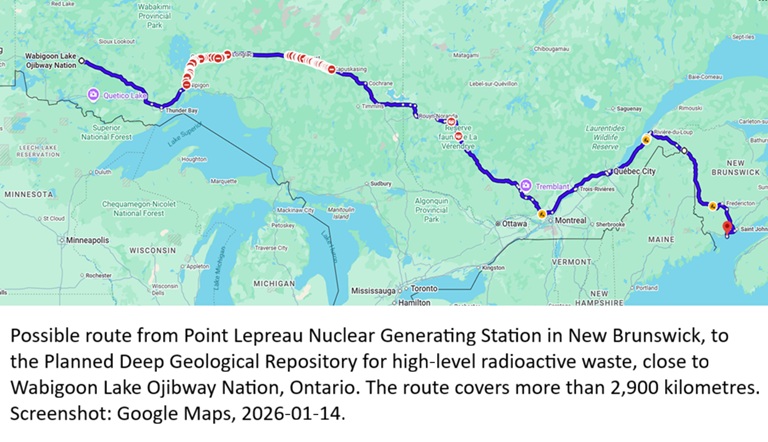
The implications of this project matter deeply to New Brunswickers because the province is already part of Canada’s nuclear legacy through the Point Lepreau Nuclear Generating Station. The proposed repository in Ontario is intended to become the final destination for used nuclear fuel generated in New Brunswick, currently stored on site at Point Lepreau.
If the project goes ahead, highly radioactive nuclear waste would be transported across New Brunswick. Current NWMO plans envision more than 2,100 transport packages of New Brunswick’s used nuclear fuel travelling approximately 2,900 kilometres, through public roads in the province and across Canada, over a period of 10 to 15 years.
For many residents, the project raises long-standing concerns about safety, accountability, and cost — especially as NB Power continues to invest in nuclear technologies and considers new reactors. Decisions about the DGR will influence how long New Brunswick remains tied to nuclear power, carrying the risks of waste that remains hazardous far beyond any political or economic planning horizon.
This is a critical moment because public input is still possible — but the comment period window is narrow. Environmental organizations and community advocates are calling for extended consultation timelines, full transparency on transport risks, and meaningful consent from affected communities. Several groups have organized a sign-on letter that readers can review and support.
How New Brunswickers respond now will help determine whether these decisions proceed quietly — or with public accountability.
Unproven science and public concerns
Globally, no deep geological repository for high-level nuclear waste has yet operated anywhere on the planet. Finland’s Onkalo facility is often cited as the first of its kind, but it remains in testing, relies on unproven assumptions about geological containment, and will not be fully sealed for decades.
The lack of proven DGR experience matters for Canada because the proposed repository would be among the world’s earliest attempts to isolate high-level radioactive waste “forever,” despite the absence of any real-world proof that such facilities can perform as claimed. Canada’s decision therefore sets not only a national course, but a global precedent built on uncertain science and long-term safety assumptions.
The proposed DGR would be built 650 to 800 metres underground in northwestern Ontario, near the Township of Ignace and Wabigoon Lake Ojibway Nation (WLON), in Treaty #3 territory. Its purpose is to bury and abandon nearly six million bundles of highly radioactive used nuclear fuel, attempting to isolate them from the biosphere for hundreds of thousands of years.
The Nuclear Waste Management Organization describes the site selection as “consent-based,” but this framing raises difficult questions. Consent in economically marginalized regions — particularly where long-term funding, jobs, and infrastructure are promised — is not the same as free, prior, and informed consent, especially when the risks extend far beyond any western planning horizon.
In 2024, the Assembly of First Nations held dialogue sessions on the transport and storage of used nuclear fuel. Communities raised serious concerns that the proposed DGR could harm land, water, and air — all central to Indigenous culture and way of life.
Guided by ancestral knowledge and a duty to protect future generations, the Assembly warned that the DGR threatens sacred sites, ecosystems, and groundwater, including the Great Lakes. Climate change and natural disasters heighten these risks, exposing the limits of the current monitoring plan and prompting calls for life-cycle oversight.
A token consultation for a monumental project
As anticipated, the Initial Project Description raises serious concerns about the DGR process itself. One of the most serious flaws is the stark mismatch between the project’s scale and the time allowed for public input. Although the DGR is framed as a 160-year project with risks lasting far longer, communities, Indigenous Nations, and civil society groups have been given just 30 days to review the Initial Project Description, with submissions due by February 4.
Thirty days to read dense technical documents, consult communities, seek independent expertise, formulate questions, and respond meaningfully to a proposal that will affect land, water, and people for generations. This is not a generous consultation — it is the bare legal minimum under federal impact assessment rules.
While regulators emphasize that the overall review will take years, this early stage is crucial in shaping what will be examined and questioned later. Rushing public input at the outset risks reducing participation to a procedural checkbox rather than a genuine democratic process, particularly for a decision whose consequences cannot be undone.
The overlooked threat of waste transport
Another serious shortcoming in the project proposal is a failure to adequately address the nationwide transport of radioactive waste. Transporting highly radioactive material through communities by road or rail is central to the project and carries significant safety and environmental risks that remain largely unexamined.
By excluding radioactive waste transportation from the Initial Project Description, the Nuclear Waste Management Organization is effectively removing it from the scope of the comprehensive federal Impact Assessment. If transport is not formally included at this stage, it will not receive the same level of environmental review, public scrutiny, or interdepartmental oversight as the repository itself.
Instead, transportation would be left primarily to the Canadian Nuclear Safety Commission and Transport Canada to assess under the existing regulations — an approach that is fragmented and insufficient given the scale, duration, and risks of moving highly radioactive waste through communities.
The transport of radioactive waste is a critical yet often overlooked issue. As Gordon Edwards, president of the Canadian Coalition for Nuclear Responsibility notes, Canada has no regulations specifically governing the transport of radioactive waste — only rules for radioactive materials treated as commercial goods. This gap matters because radioactive waste is more complex, less predictable, and potentially far more dangerous.
Transporting high-level nuclear waste is inherently risky: the material remains hazardous for centuries, and accidents, equipment failures, extreme weather, security breaches, or human error can still occur despite careful planning. Unlike other hazardous materials, radioactive contamination cannot be easily contained or cleaned up, leaving land, water, and ecosystems damaged for generations. Even a single transport incident could have lasting, irreversible consequences for communities along the route.
Radiation risks extend beyond transport workers. People traveling alongside shipments may face prolonged exposure, while those passing in the opposite direction are briefly exposed in much larger numbers. Residents and workers along transport routes can experience repeated exposure, and accidents or unplanned stops could result in localized contamination. Emergency response is further complicated by leaks or hard-to-detect releases, with standard spill or firefighting methods potentially spreading contamination.
These risks are not hypothetical. Last summer, Gentilly-1 used fuel was transported from Bécancour, Quebec, to Chalk River, Ontario, along public roads — without public notice, consultation, Indigenous consent, or clear evidence of regulatory compliance — underscoring the ongoing risks to our communities.
According to the 2024 Assembly of First Nations report, at least 210 First Nations communities could be affected by shipments of radioactive waste traveling from nuclear reactors to the repository via railways and major highways, though the full scope may be even larger when considering watersheds and alternative routes.
Given this reality, it is unacceptable that the DGR Project Description largely ignores waste transport. Any credible assessment must examine how waste will be moved, who will be affected, what rules apply, who is responsible for oversight, and how workers, communities, and the environment will be protected in emergencies. It is the job of the Impact Assessment Agency of Canada to examine these plans in depth.
A high-stakes decision that demands public voice
Canada’s proposed Deep Geological Repository is one of the most ambitious and high-stakes projects in nuclear waste management. Framed as a permanent solution, it remains untested — no country has safely operated a deep repository for used nuclear fuel over the long term. Scientific uncertainty and multi-decade timelines make its risks profound and enduring.
Dr. Gordon Edwards warns: “The Age of Nuclear Waste is just beginning. It’s time to stop and think. […] we must ensure three things: justification, notification, and consultation — before moving any of this dangerous, human-made, cancer-causing material over public roads and bridges.”
Now is the moment for public voices to be heard. Legal Advocates for Nature’s Defence (LAND), an environmental law non-profit, has prepared a sign-on letter and accompanying press release calling for a more precautionary, transparent, and democratic approach to the Deep Geological Repository. This is your chance to have a say in decisions that could expose you, your neighbours, and your communities to serious environmental and health risks.
The letter urges federal regulators to extend public consultation timelines, require that the Impact Assessment Agency of Canada conduct a comprehensive Impact Assessment that includes the transportation of radioactive waste, and uphold meaningful consent and accountability.
New Brunswickers and allies across the country are encouraged to read the letter, add their names, and speak up before decisions are finalized. How Canada handles nuclear waste today will shape risks borne by our communities for generations.
The DGR is more than a technical project; it is a test of democratic process, scientific caution, and intergenerational responsibility. Canadians deserve a transparent, thorough, and precautionary approach to ensure that decisions made today do not compromise the safety of future generations.
Mayara Gonçalves e Lima works with the Passamaquoddy Recognition Group Inc., focusing on nuclear energy. Their work combines environmental advocacy with efforts to ensure that the voice of the Passamaquoddy Nation is heard and respected in decisions that impact their land, waters, and future.
Summary comments on the Deep Geologic Repository (DGR) Project for Canada’s Used Nuclear Fuel
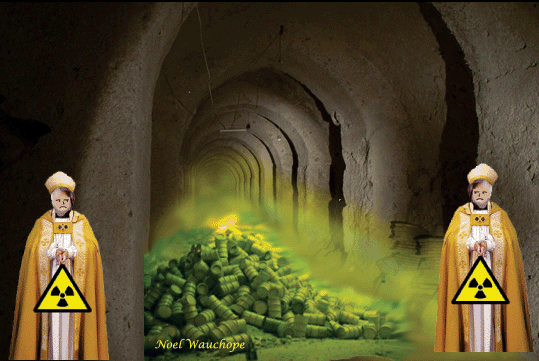
The nuclear waste will be radioactive for, say, a period of time that is close to eternity, whereas the project covers a period of 160 years. The solution is therefore very far from permanent.
We are swimming here in the middle of a pro-nuclear religion.
by Miguel Deschênes, 20 Jan 26
a translation of comments submitted in French to the Impact Assessment Agency of Canada (IAAC) by Miguel Deschêne on this subject.
Seven major objections stand out:
1- Developers are not trustworthy
On page v of the document, it states that “Canada’s nuclear power plants have been providing clean energy for decades,… ». Then, on page vii, it is explained that the project itself “would contain and isolate approximately 5.9 million spent fuel assemblies,” representing approximately 112,750 tonnes of irradiated and highly radioactive heavy metals. This waste contains a wide variety of radioactive substances that are dangerous to living beings. One of the most famous isotopes found in these spent fuel bundles is plutonium-239. Need we remind you that Canadian plutonium was used in the bomb that destroyed the city of Nagasaki in 1945? To say on page v of the document that nuclear energy is clean and to specify on page vii that it will generate 112,750 tonnes of highly radioactive (and potentially destructive) heavy metals in Canada is staggering incoherent.
On page iv of the document, there is a list of twelve specialists and managers who prepared, reviewed, approved and accepted this document, which includes this glaring logical error. This leads to the conclusion that the developers seem willing to present all possible arguments, however incongruous, to defend this project, while concealing the negative aspects that could overshadow it. They therefore have neither the capacity for reflection nor the objectivity required to manage this project, when it would be essential to protect the safety of the public and the environment in complete transparency.
2- The objective(s) are unattainable
The document presents the objective of the project in two places, but they are two different objectives. These objectives look strangely like advertising slogans or the creeds of a pro-nuclear cult. Neither is attainable in practice, but they make it easy to project yourself into a world of unicorns:
a- On page viii, it is stated that: “The objective of the Project is to ensure the safe long-term management of used nuclear fuel so that it does not pose a risk to human health or the environment.”
We are talking about guaranteeing, for 160 years. A great Quebec poet would say “it’s better to laugh than to cry.” A car, which is one of the most advanced technological objects on the planet, is guaranteed for 3 or 5 years. How can we believe that we can guarantee a new landfill technology for a period of 160 years? It’s simply delusional.
In addition, even a simple plastic bottle carries risks to human health or the environment. And they want us to believe that this project will make it possible to store 112,750 tonnes of radioactive nuclear waste so that it does not pose any risk to human health or the environment? What sensible person can believe such a statement?
b- On page 20, it states that: “The objective of the Project is to provide a permanent, safe and environmentally responsible solution for the management of all of Canada’s used nuclear fuel.”
The nuclear waste will be radioactive for, say, a period of time that is close to eternity, whereas the project covers a period of 160 years; The solution is therefore very far from permanent. The solution is also presented as safe and environmentally friendly: based on what? The solution is safe as long as it is sold by convinced developers, but everyone knows that it involves enormous risks. And environmentally friendly? How can we say that burying 112,750 tonnes of radioactive nuclear waste is an environmentally friendly solution? We are swimming here in the middle of a pro-nuclear religion.
Obviously, neither of these two objectives is achievable in practice.
What is the real objective of the project? Indirectly extract as much money as possible from the public treasury and taxpayers? Putting hundreds of highly paid employees to work unnecessarily for decades? Shovel the problem of nuclear waste to our descendants?
The project is therefore, even before it has begun, doomed to failure, since it is impossible for it to achieve its totally utopian objectives. To believe in the success of this project, it is absolutely necessary to be overwhelmed by the pro-nuclear faith.
3- The budget is not presented
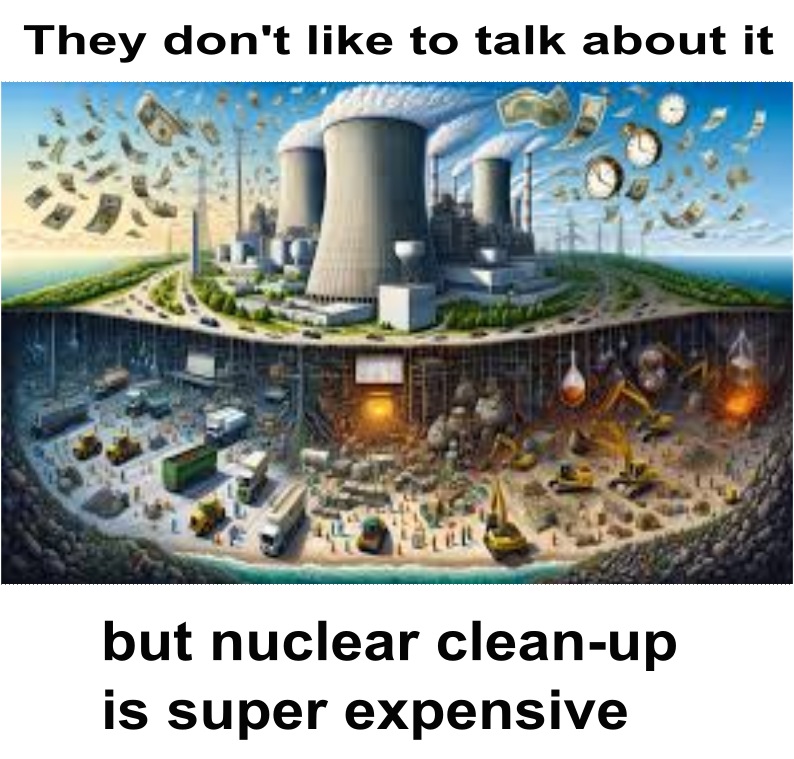
On page 52, it states that “Federal authorities are not providing any financial support to the Project.”
On page 65, it states that: “In addition, although the NWMO is a regulated entity by the CNSC, it is not a federal agency or authority. Rather, it is a question of a not-for-profit organization mandated by the federal government under the NFCA to managing Canada’s nuclear waste. The NWMO is fully funded by industry nuclear power. »
However, the Government of Canada and some provincial governments subsidize and financially encourage the nuclear industry.
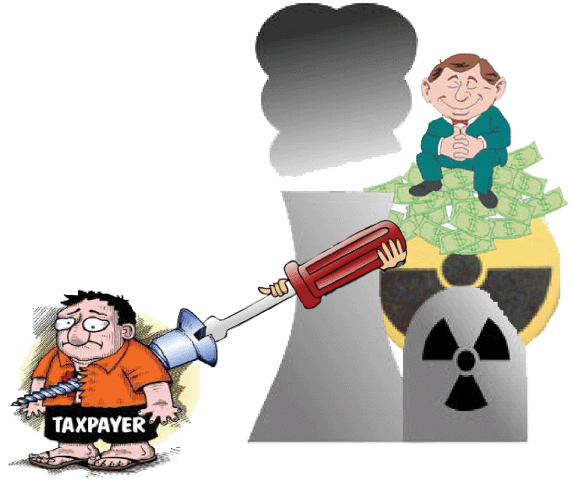
So, in a nutshell, taxpayers are giving money to governments, which in turn subsidizes the nuclear industry, and which in turn funds the NWMO. The present project is therefore indirectly financed by taxpayers and by the federal authorities, which is not revealed by the sentence on page 52. Could we conclude that it is not necessary to call on an accountant if you have a good conjurer?
A detailed budget is one of the essential elements of project planning and monitoring. Where is the budget? How is it cut? And how much will it indirectly cost taxpayers? It would be reasonable to describe the sums required as potentially pharaonic and to require a project plan that includes a complete financial plan.
The absence of a budget in the presentation of a project is an unacceptable shortcoming.
4- The project’s time scale is doubly absurd
On page v, it states that “The Project is expected to span approximately 160 years, including site preparation, construction, operation (approximately 50 years), decommissioning and closure, and post-closure monitoring.”
This duration is both too short and too long:

a- Too short: the half-life of plutonium-239 is about 24,130 years. It is calculated that after a duration of approximately seven times the half-life of an isotope, less than 1% (more precisely, 1/128) of the initial radioactive atoms remain. In the case of plutonium-239, it would therefore be necessary to wait about 168,000 years to reach this target. Obviously, this calculation would have to be done for all the isotopes found in the original waste and for all the isotopes created during subsequent decays in order to properly assess the hazardousness of the waste as a function of time, which is very complex. But we can see right away that the 160-year period is far too short to ensure the safety of the public and the environment.
b- too long: if we go back 160 years in time, we find ourselves in 1866, when the Canadian federation did not even exist. Since that time, humanity has experienced various epidemics (plague, cholera, Spanish flu, covid, etc.), two world wars and a multitude of other wars, major geopolitical reorganizations and major economic crises. It is perfectly utopian to think that a human project that has no other objective than to bury waste will be able to be carried out without hindrance for 160 years. What happens if there is a major epidemic, a world war, a coup d’état by an outsized geographic neighbour, a split in Canada, an unforeseen IT upheaval? How can we seriously believe that all the governments and political parties that will succeed each other will have at heart, for 160 years (if each party remains in power for 4 years, we are talking about 40 different governments), to adequately supervise this project?
In general, the longer a project lasts, the greater the likelihood of not achieving objectives, exceeding costs and exceeding the originally planned schedule. It is therefore quite reasonable and prudent to predict that the 160-year deep geological repository project is likely to be a complete failure: it will not achieve its objectives, while exceeding the planned deadlines and costs.
5- The responsibility for the project in the medium and long term cannot be assumed
What will be the responsibility for the project in the medium and long term, i.e. in 10, 20, 50 or 100 years? What if there is a design problem, a technical problem, a supplier problem, a funding problem, a nuclear incident or whatever? Who will be responsible when most of us are dead? To whom can our descendants turn to ask for accountability and rectification if necessary? No one can imagine or predict it, and it is likely that any assumption today about it will prove wrong tomorrow.
6- The risks associated with transportation are far too high
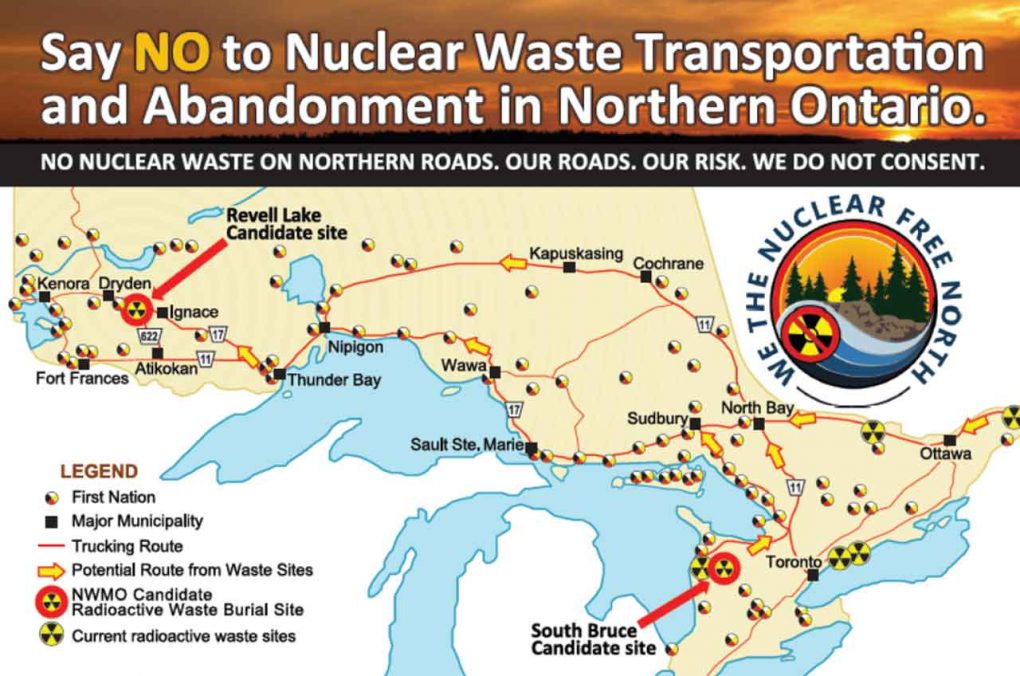
No means of transportation is perfectly safe. Regularly, planes crash, trains derail (the Lac-Mégantic rail accident in 2013 is a sad example) and trucks are involved in pile-ups. Sometimes, a space shuttle explodes in mid-flight.
On page vii, it states that “The Project does not include: the transportation of used fuel from the reactor sites to the Project beyond the primary and secondary access roads to the Project site, as the Project site is regulated separately under CNSC certification and uses existing transportation infrastructure.”
This seems to be, once again, a tactic to make the authorities and citizens swallow the pill of the project. The risks associated with a possible incident during the transportation of 112,750 tonnes of high-level radioactive waste on Canada’s roads, over a period of about fifty years (according to the projected schedule on page 31), are obviously far too high. It is therefore easy to understand why the developer prefers not to include this aspect in his project.
The excessive risk associated with transporting radioactive waste is an argument used by the Nuclear Waste Management Organization itself on its information page about Canada’s used nuclear fuel (https://www.nwmo.ca/fr/Canadas-used-nuclear-fuel): “Related questions: Couldn’t spent nuclear fuel be sent into space? No. In a three-year dialogue with experts and the public on possible long-term management options, the disposal of used nuclear fuel into space was one of the options of limited interest that we eliminated. Space-based evacuation has been ruled out as a solution because it is an unproven concept, not implemented anywhere in the world and not part of any national research and development plan. Concerns about the risk of accidents and the risks to human health and the environment have been amplified in particular by the accidents of the American space shuttles Challenger and Columbia. »
Why should the risk of an accident not be a consistent factor in the Nuclear Waste Management Organization’s reasoning? There have certainly been more train derailments and truck accidents than space shuttle incidents in human history. By what form of logic can we conclude that it is too risky to send used nuclear fuel into space, but that it is safe to transport it by train or truck? The only plausible explanation may be that we must have pro-nuclear faith.
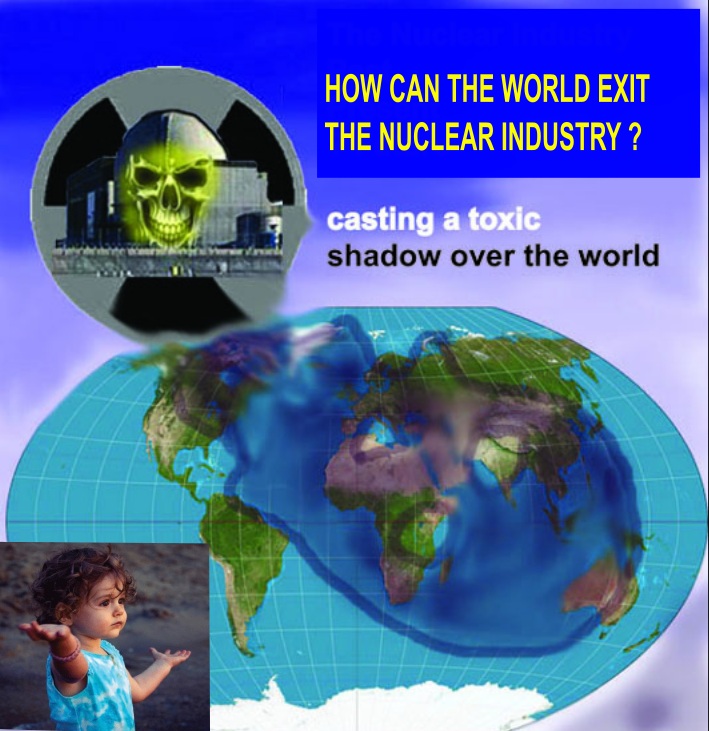
7- Governments do not have a strategy to exit the nuclear industry
On page vii of the document, it states that: “The Project would contain and isolate approximately 5.9 million used fuel assemblies, which is the total anticipated inventory of used nuclear fuel that is expected to be produced in Canada by the current fleet of reactors until the end of their lifetime, as outlined in the NWMO’s 2024 Nuclear Fuel Waste Projections Report (NWMO, 2024). This projection is based on published plans for the refurbishment and life extension of the Darlington and Bruce reactors, as well as the continued operation of the Pickering A (until the end of 2024) and Pickering B (until the end of 2026) reactors, and the assumptions used by the NWMO for planning purposes. »
However, in October 2025, Ottawa and Ontario announced the construction of 4 new nuclear reactors (https://ici.radio-canada.ca/nouvelle/2201625/darlington-nucleaire-reacteur-opg-ontario). What about the waste that will be generated by these plants, which is not part of the inventory considered by the project? And what about those generated by other hypothetical power plants to come? Or those that the government could import from other countries?
Successive governments are constantly creating, recreating and amplifying the problem of nuclear waste, with no intention of ending this mess. The only decision that would limit this ecological disaster would be to abandon the nuclear industry, which would include stopping uranium mining, no longer building new nuclear power plants and never importing nuclear waste from other countries. Unfortunately, no decision-maker seems to have the foresight to move in this direction.
Even before the project begins, we already understand that the planned landfill will not be able to store all of Canada’s nuclear waste. Without a clear direction on the denuclearization of the country, the problem of radioactive waste is far from being solved.
In any case, a deep geological repository will never be a good solution for nuclear waste; This far too risky avenue is really only used to shovel the problems created by today’s decision-makers until a time when they will all be dead and will not have to assume the disastrous consequences.
Conclusion :
In my view, these arguments are more than enough to justify never authorizing the Deep Geologic Repository (DGR) Project for Canada’s used nuclear fuel. It seems that the “original project description” seeks to conceal the real issues related to nuclear waste management, in order to obtain the required authorizations, spend obscure (but potentially staggering) amounts of money, and perpetuate nuclear madness, with no regard for public safety and the environment. Unfortunately, this is a typical project of the nuclear industry, which relies on the blind complacency of the authorities and on daydreams rather than on transparency and objective arguments.
Ontario’s proposed nuclear waste repository poses millennia-long ethical questions
Maxime Polleri, Assistant Professor, Université Laval, January 16, 2026 , https://theconversation.com/ontarios-proposed-nuclear-waste-repository-poses-millennia-long-ethical-questions-273181
The heat produced by the radioactive waste strikes you when you enter the storage site of Ontario Power Generation at the Bruce Nuclear Generating Station, near the shore of Lake Huron in Ontario.
Massive white containers encase spent nuclear fuel, protecting me from the deadly radiation that emanates from them. The number of containers is impressive, and my guide explained this waste is stored on an interim basis, as they wait for a more permanent solution.
I visited the site in August 2023 as part of my research into the social acceptability of nuclear waste disposal and governance. The situation in Ontario is not unique, as radioactive waste from nuclear power plants poses management problems worldwide. It’s too dangerous to dispose of spent nuclear fuel in traditional landfills, as its radioactive emissions remain lethal for thousands of years.
To get rid of this waste, organizations like the International Atomic Energy Agency believe that spent fuel could be buried in deep geological repositories. The Canadian government has plans for such a repository, and has delegated the task of building one to the Nuclear Waste Management Organization (NWMO) that’s funded by Canadian nuclear energy producers.
In 2024, NWMO selected an area in northwestern Ontario near the Township of Ignace and the Wabigoon Lake Ojibway Nation as a potential site for a deep geological repository. Now, a federal review has begun bringing the project closer to potential reality.
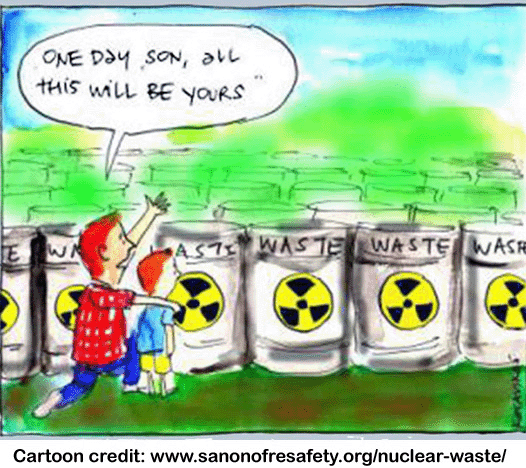
Such repositories raise complex ethical questions around public safety, particularly given the millennia-long timescales of nuclear waste: How to address intergenerational issues for citizens who did not produce this waste but will inherit it? How to manage the potential dangers of these facilities amid short-term political cycles and changing public expectations?
While NWMO describes the deep geological repository as the safest way to protect the population and the environment, its current management plan does not extend beyond 160 years, a relatively short time frame in comparison with the lifespan of nuclear waste. This gap creates long-term public safety challenges, particularly regarding intergenerational ethics. There are specific issues that should be considered during the federal review.
NWMO argues that the deep geological repository will bring a wide range of benefits to Canadians through job creation and local investment. Based on this narrative, risk is assessed through a cost-benefit calculus that evaluates benefits over potential costs.
Academics working in nuclear contexts have, however, criticized the imbalance of this calculus, as it prioritizes semi-immediate economic benefits, like job creation, over the long-term potential impacts to future generations.
In many official documents, a disproportionate emphasis on short-term economic benefits is present over the potential dangers of long-term burial. When risks are discussed, they’re framed in optimistic language and argue that nuclear waste burial is safe, low risk, technically sound and consistent with best practices accepted around the world.
This doesn’t take into account the fact that the feasibility of a deep geological repository has not been proven empirically. For the federal review, discussions surrounding risks should receive an equal amount of independent coverage as those pertaining to benefits.
Intergenerational responsibilities and risks
After 160 years, the deep geological repository will be decommissioned and NWMO will submit an Abandonment License application, meaning the site will cease being looked after.
Yet nuclear waste can remain dangerous for thousands of years. The long lifespan of nuclear waste complicates social, economic and legal responsibility. While the communities of Ignace and Wabigoon Lake Ojibway Nation have accepted the potential risks associated with a repository, future generations will not be able to decide what constitutes an acceptable risk.
Social scientists argue that an “acceptable” risk is not something universally shared, but a political process that evolves over time. The reasons communities cite to decide what risks are acceptable will change dramatically as they face new challenges. The same goes for the legal or financial responsibility surrounding the project over the centuries.
In the space of a few decades, northwestern Ontario has undergone significant municipal mergers that altered its governance. Present municipal boundaries might not be guarantees of accountability when millennia-old nuclear waste is buried underground. The very meaning of “responsibility” may also undergo significant changes.
NWMO is highly confident about the technical isolation of nuclear waste, while also stating that there’s a low risk for human intrusion. Scientists that I’ve spoken with supported this point, stating that a deep geological repository should not be located in an area where people might want to dig.
The area proposed for the Ontario repository was considered suitable because it does not contain significant raw materials, such as diamonds or oil. Still, there are many uncertainties regarding the types of resources people will seek in the future. It’s difficult to make plausible assumptions about what people might do centuries from now.
Communicating long-term hazards
When the repository is completed, NWMO anticipates a prolonged monitoring phase and decades of surveillance. But in the post-operation phase, there is no plan for communicating risks to generations of people centuries into the future. The long time frame of nuclear materials complicates the challenges of communicating hazards. To date, several attempts have surrounded the semiotics of nuclear risk; that is, the use of symbols and modes of communication to inform future generations.
For example, the Waste Isolation Pilot Plan in New Mexico tried to use various messages to communicate the risk of burying nuclear waste. However, the lifespan of nuclear waste vastly exceeds the typical lifespan of any known human languages.
Some scientists even proposed a “ray cat solution.” The project proposed genetically engineering cats that could change color near radiation sources, and creating a culture that taught people to move away from an area if their cat changed colour. Such projects may seem outlandish, but they demonstrate the difficulties of developing pragmatic long-term ways of communicating risk.
Current governing plans around nuclear waste disposal have limited time frames that don’t fully consider intergenerational public safety. As the Canadian federal review for a repository goes forward, we should seriously consider these shortcomings and their potential impacts on our society. It is crucial to foster thinking about the long-term issues posed by highly toxic waste and the way it is stored, be it nuclear or not.
This Nuclear Renaissance Has a Waste Management Problem

12 Jan, 26, https://energyathaas.wordpress.com/2026/01/12/this-nuclear-renaissance-has-a-waste-management-problem/
Three sobering facts about nuclear waste in the United States.
Americans are getting re-excited about nuclear power. President Trump has signed four executive orders aiming to speed up nuclear reactor licensing and quadruple nuclear capacity by 2050. Big tech firms ( e.g. Google, Amazon, Microsoft, Meta) have signed big contracts with nuclear energy producers to fuel their power-hungry data centers. The federal government has signed a deal with Westinghouse to build at least $80 billion of new reactors across the country. Bill Gates has proclaimed that the “future of energy is sub-atomic”.
It’s easy to see the appeal of nuclear energy. Nuclear reactors generate reliable, 24/7 electricity while generating no greenhouse gas emissions or local air pollution. But these reactors also generate some of the most hazardous substances on earth. In the current excitement around an American nuclear renaissance, the formidable challenges around managing long-lived radioactive waste streams are often not mentioned or framed as a solved problem. This problem is not solved. If we are going to usher in a nuclear renaissance in this country, I hope we can keep three sobering facts top-of-mind.
Fact 1: Nuclear fission generates waste that is radioactive for a very long time.
After 4-6 years of hard work in a commercial fission reactor, nuclear fuel can no longer generate energy efficiently and needs to be replaced. When this “spent” fuel comes out of the reactor it is highly radioactive and intensely hot, so it must be carefully transferred into deep pools where it spends a few years cooling off…
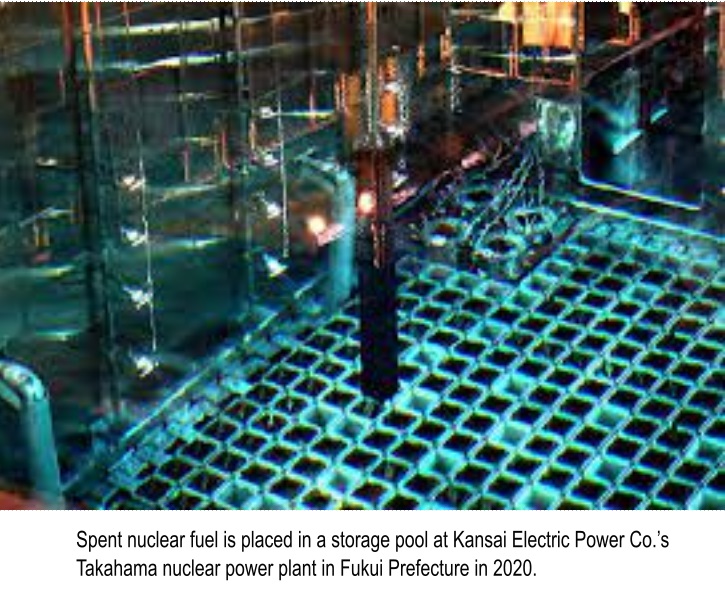
Once cooled, this spent fuel is still not something you want to spend time with because direct exposure is lethal. While most of the radioactivity decays after about 1000 years, some will persist for over a million years. U.S. efforts to site and build a permanent repository for nuclear waste have failed (more on this below). After spending time in the pool, spent fuel is stored on sites of operating or retired reactors in steel canisters or vaults.
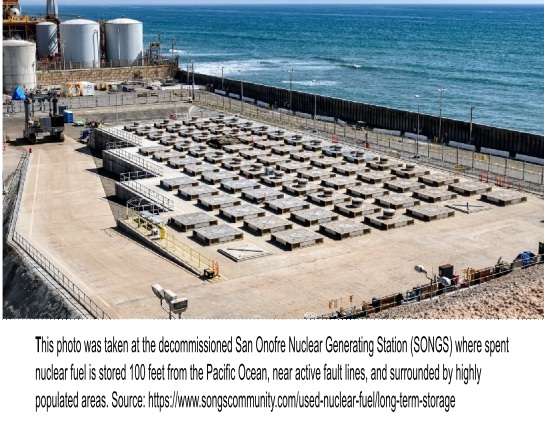
Across the country, more than 90,000 metric tons of radioactive fuel is sitting in pools or dry storage at over 100 sites in 39 states. These sites are licensed by the Nuclear Regulatory Commission (NRC) and regulated by the EPA. They are designed to be safe! But experts agree that this is an unacceptable long-term waste management situation (see, for example, here, here, and here).
Fact 2: The U.S. has no permanent nuclear waste disposal plan
For more than half a century, the United States has tried—and failed—to find a forever-home for its nuclear waste. Early efforts in the 1960s and 1970s went nowhere. In 1982, Congress passed the Nuclear Waste Policy Act which laid out a comparative siting process that was designed to be technically rigorous and politically fair. But this process was slow, expensive, and politically exhausting.
By 1987, Congress lost patience, scrapped its own framework, and tried to force the issue by designating Yucca Mountain in Nevada as the chosen one. Nevada’s resistance was relentless. After roughly $15 billion in spending on site development, the Yucca Mountain proposal was finally withdrawn in 2010. As I understand it, these siting efforts did not fail because the location was declared unsafe. They failed because nuclear waste storage siting was being forced on an unwilling community.
In the years since, Blue Ribbon panels, expert advisory groups, and national research councils have been convened. All have reached the same conclusion. The U.S. needs to break the impasse over a permanent solution for commercial spent nuclear fuel and this will require a fair, transparent, and consent-based process.
You might be thinking that spent fuel reprocessing, which is also enjoying an American renaissance right now, could eliminate the need for a geological repository. It’s true that reprocessing breaks spent fuel down to be used again. But in that process, new types of radioactive wastes are created that need to be managed in deep repositories or specialized landfills. This creates a potentially more (versus less) challenging mess to clean up (reprocessing leaders like France are pursuing costly geological repositories for these wastes).
Fact 3: We are actively undermining public trust in the nuclear waste management process
Convincing a community to host thousands of tons of radioactive waste for thousands of years is not easy. But it’s not impossible. Efforts in Sweden, Finland, France, Switzerland, and Canada are starting to find some success.
All of these international success stories share one important feature: a sustained commitment to building public trust in both nuclear industry regulation and the nuclear waste storage siting process. Alas, here in the United States, we seem to be moving in the opposite direction.
A series of recent developments make it hard to feel hakuna matata about our nuclear waste management protocols:
- In May, an executive order called for a “wholesale revision” of the NRC directing it to accelerate reactor licensing, reconsider radiation standards, and reduce staffing.
- In June, an NRC commissioner was abruptly fired, prompting a letter from concerned career staff .
- The Department of Energy has pledged to “use all available authorities to eliminate or expedite its environmental reviews for authorizations, permits, approvals, leases, and any other activity requested” by nuclear reactor projects under its supervision.
- The Supreme Court recently ruled that Texas lacks legal standing to challenge NRC approval of a privately operated interim nuclear waste facility, raising questions about state’s abilities to challenge nuclear waste siting decisions.
These developments may ultimately succeed in accelerating nuclear deployment across the United States. But they also undermine the public trust and independent governance that are essential inputs into the building of a long-term nuclear waste management strategy.
Weighing our nuclear options
Taking a step back, it is worth asking why nuclear energy is enjoying such a resurgence in this country right now. The growing availability of low-cost renewables and storage, together with an increasingly flexible demand-side, complicates the claim that nuclear power is some kind of moral climate necessity. There are cheaper ways to decarbonize the grid.
The renewed push for nuclear energy is not really about climate necessity. It seems to be driven by anxiety about reliability in a strained power system, industrial policy aimed at rebuilding domestic manufacturing capacity, and the commercial interests of firms chasing revenue streams tied to data centers and federal support. This nuclear revival trades off today’s politically urgent reliability concerns for a long-term obligation to manage radioactive waste (along with some low-probability risk of catastrophic failure). If that’s the trade off we want to make, we should understand that a nuclear renaissance without a viable long-term waste management plan saddles future generations with the messy consequences of our policy choices.
Is a deep geological repository (DGR) for IGNACE a good idea?
I would say that the most important issue – and one that is totally disregarded by NWMO – is the inordinate extra cost (of about $500 million) of shipping used fuel to Ignace rather than Teeswater or some more southerly location. The mass transfer of used fuel from locations such as Bruce, Pickering and Darlington to the township of Ignace will involve dozens of 50-ton trucks travelling up and down major roads, such as Highways 401, 400, 69 and 17, a total of 25,000 times between 2043 and 2068. This protracted activity adds up to a total highway travel time of over 200 years!
| Frank Greening, 13 Jan 26 |
Questioning the wisdom of NWMO’s plan for a used fuel DGR to be constructed near Ignace in Northern Ontario, in view of the issues presented below:
From the Project description document AMP-REP-05000-0211-R000
11. ESTIMATED MAXIMUM PRODUCTION CAPACITY OF THE PROJECT
An estimated 5.9 million bundles of used fuel will be processed in the UFPP over its operational lifetime of approximately 50 years (about 120,000 used fuel bundles per year). On average, per the current conceptual reference design, 10 used fuel containers (UFCs) are planned to be processed and placed in the repository each workday, or approximately 2,500 UFCs each year.
To achieve this throughput, the UFPP is likely to incorporate multiple processing lines. Based on annual shipping (receipt) assumptions, the maximum number of certified transportation packages received at the UFPP in any given year is estimated to be approximately 885, holding between 120 and 192 used fuel bundles in each certified transportation package. The UFPP is designed to receive and process up to five certified transportation packages each day.
I would say that the most important issue – and one that is totally disregarded by NWMO – is the inordinate extra cost (of about $500 million) of shipping used fuel to Ignace rather than Teeswater or some more southerly location. The mass transfer of used fuel from locations such as Bruce, Pickering and Darlington to the township of Ignace will involve dozens of 50-ton trucks travelling up and down major roads, such as Highways 401, 400, 69 and 17, a total of 25,000 times between 2043 and 2068. This protracted activity adds up to a total highway travel time of over 200 years!
Closely related to the issue of shipping costs, is the additional problem of the high probability of inclement weather along Highway 17 from November to March each year. It appears that NWMO’s approach to dealing with this issue is simply to limit used fuel shipments to Ignace to just 9 months per year. However, this is barely adequate, given the common occurrence of snow storms along Highway 17 from as early as October to as late as April each year. Indeed, the Ontario Ministry of the Environment states in reference to winter driving on Highway 17: “Expect snowfall amounts of 10 –15 cm; reduced visibility due to snow and blowing snow; icy and slippery surfaces, and quickly changing and deteriorating travel conditions”.
This clearly shows the severity of the winter weather for the township of Ignace, with heavy snowfall dominating the months from November to March. Interestingly, NWMO has stated – See NWMO Report APM-REP-00440-0209-R001, issued September 2021 – that moving used nuclear fuel by truck to Ignace would mean “two to three shipments a day for approximately nine months of the year”. It is not clear why NWMO stipulates shipments being made for only 9 months per year, but this is presumably to allow for three months of inclement weather.
However, as previously noted, meteorological data for Ignace indicate that heavy snow is possible for this region from November to March, which is five months, not three! In addition, one is left wondering what happens at the DGR site for the three months when there are no used fuel shipments. Indeed, this lack of shipments is inconsistent with NWMO’s assertion, previously noted in this email, that “10 used fuel containers (UFCs) are planned to be processed and placed in the repository each workday. I would like someone to explain how this will happen over winter, when NWMO admits there will be no used fuel shipments for at least three months each year, (December, January and February?). What will workers at the used fuel packaging plant do when there are no UFC’s to process?
Highway 17 in Northern Ontario has earned a reputation for frequent accidents, particularly involving heavy trucks. In 2022, the Ontario Provincial Police (OPP) reported over 9,100 collisions involving large trucks across the province, with 71 fatalities — many occurring on routes like Highway 17. Addressing the issues plaguing Highway 17 requires more than incremental fixes—it demands a transformative overhaul. Experts and residents alike stress the need for substantial investments to bring this critical corridor up to modern standards. Proposals extend far beyond doubling lanes or adding passing areas, emphasizing winter-specific design improvements, enhanced lane visibility, and the permanent operation of weigh stations with robust enforcement to eliminate unsafe vehicles. Rest stops must be expanded and maintained year-round to provide safe havens for drivers, particularly during extreme weather. Furthermore, the integration of advanced monitoring systems, including traffic cameras and real-time condition updates, is essential for proactive safety management of this Highway. Only through a comprehensive and bold approach can Highway 17 meet the safety, accessibility, and efficiency needs of the communities and industries it serves. Without such improvements to Highway 17, NWMO’s plan to build a DGR near Ignace is both reckless and potentially very dangerous!
NWMO’s nonchalant approach to the selection of a site for a used fuel DGR is deeply concerning. Just because the residents of a small northern Ontario town are willing to host a DGR does NOT make it the best possible option for Canada. And let’s remember that, once the site selection is made, it’s not just for a while, but in perpetuity!
Nuclear power’s hidden $1 trillion problem
Jan 10, 2026 Nuclear power is having a big comeback after decades of decline. But it comes with a hidden cost: the enormous amount of time and money needed to decommission a nuclear power plant. We visit the (probably) most expensive civil decommissioning project in Europe to see why nuclear power can leave behind such a difficult legacy.
How are geological repository projects progressing?

COMMENT. This story is from the nuclear industry’s online publication “World Nuclear News”, so important to recognize that there is a bias throughout. And errors. For example, it erroneously describes the Nuclear Waste Management Organization as a government agency.
By Alex Hunt, World Nuclear News, in Vienna, Sunday, 28 December 2025
A growing number of countries are planning a permanent solution to the issue of radioactive waste by burying it deep underground. Schemes take many years to plan, and many more years to build, but progress is being made.
Setting the scene: Why deep geological repository projects matter
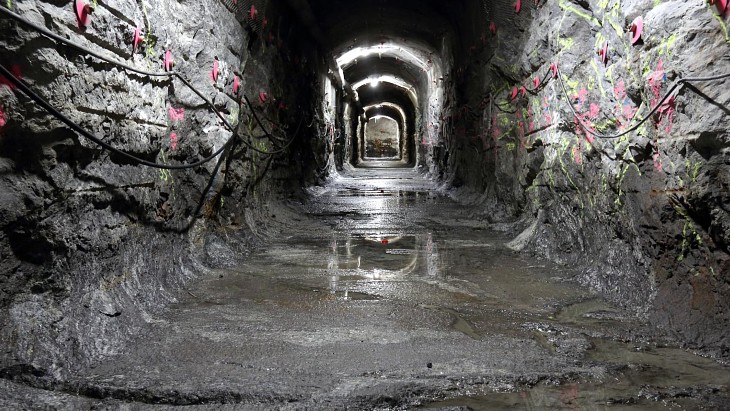
A deep geological repository comprises a network of highly-engineered underground vaults and tunnels built to permanently dispose of higher activity radioactive waste so that no harmful levels of radiation ever reach the surface environment. They need to be located deep enough, and in suitable geological conditions, to ensure they will be safely secured for thousands of centuries.
The disposal of used nuclear fuel and other high-level waste has long been a pressing issue in terms of the perceived sustainability of nuclear energy programmes. For many decades this material has been stored [?]safely in pools or special containers and facilities at surface, or near-surface, locations, often close by nuclear power plants. These are seen as interim storage measures pending a permanent solution.
Hildegarde Vandenhove, Director of the IAEA Division of Radiation Safety, Transport and Waste Safety…………..” developing these facilities is a long and a complex process. It requires rigorous studies and extensive safety demonstrations. These are all first-of-a-kind facilities, and their construction takes time.“
The process of selecting a site, and getting approval for it, takes decades, with Anna Clark, head of the Waste and Environmental Safety Section in the Division of Radiation Transport and Waste Safety at the IAEA, saying that “before operations can begin, there’s a lengthy pre-operational phase with conceptual design, the planning, the surveys, the site investigations, site selection, narrowing down the number of sites, doing detailed characterisation of your preferred site, it’s a long process before you even begin with the licensing of construction. And throughout that period, the safety case evolves and the role of the regulator also evolves, and the regulators have to adapt their expertise and knowledge as they go”.
Canada
Colin Moses, Vice-President, Regulatory Affairs, and Chief Communications Officer at the Canadian Nuclear Safety Commission, outlined the status of the country’s deep geological repository which, he noted, started being discussed in the 1970s. It is being taken forward by the Nuclear Waste Management Organization, a government agency fully funded by the producers of waste with a mandate to determine and find and build and operate a long-term solution for disposal of used fuel in Canada.
Its concept is for a “geosphere which forms a natural barrier of rock to protect the waste from disruptive natural events, water flow and human intrusion”.
The current status is that Wabigoon Lake Ojibway Nation and the Township of Ignace were selected in November 2024 as the host communities for the proposed repository, following a consent-based siting process that had begun some 14 years earlier. Pre-licensing activities, including stakeholder engagement, pre-environmental assessment and technical reviews, have been taking place.
Construction of the facility will only begin once the deep geological repository has successfully completed the federal government’s multi-year regulatory process and the Indigenous-led Regulatory Assessment and Approval Process, a sovereign regulatory process that will be developed and implemented by Wabigoon Lake Ojibway Nation.
The Nuclear Waste Management Organization explored more than 20 different potential locations in Canada looking for local communities to raise their hand and express an interest in potentially hosting the repository, with the last decade spent refining that list down to the one preferred site.
Moses said he was expecting the formal regulatory process to begin this year and “will play out over several years, looking to give an initial decision in 2030. That will allow them to advance construction in 2032, move into operation in 2042 and ultimately to operate that facility for many decades, expecting a current closure date of 2092”.
and ultimately to operate that facility for many decades, expecting a current closure date of 2092″.
“So this is a project that’s playing out over multiple decades and has spent multiple decades getting ready.”
Finland
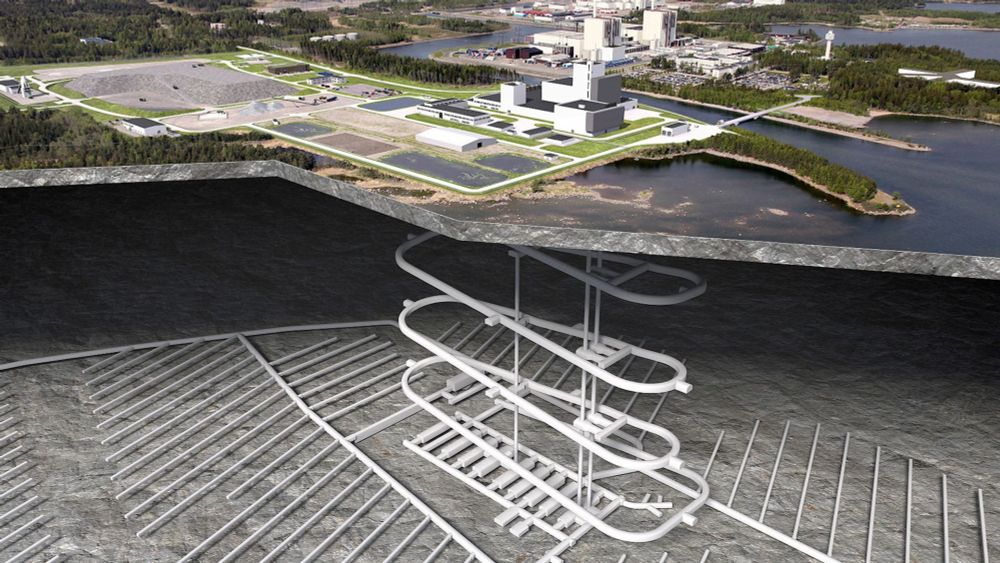
Progress is furthest advanced with Finland’s Onkalo project. Petteri Tiippana, Director General of the Radiation and Nuclear Safety Authority of Finland (STUK) outlined the concept, which is a repository in crystalline rock with used fuel in copper canisters surrounded by a bentonite buffer at a depth of 400-430 metres.
For Finland, which is currently in the process of commissioning the deep geological repository, the process began in the 1980s with the then government setting a target for operation in the 2020s. Pre-licensing activities started almost immediately, Tiippana said, in terms of research and design and for the concept, with actual licensing steps beginning in the early 2000s with a site selection. A construction licence was issued in 2015.
Currently the encapsulation plant has been commissioned and tested the dummy fuel elements in five canisters and transported them to the underground facility. The next phase will be to “test the underground facility and the final disposal of those five copper cases”. He said that the reviewing of safety documentation is approaching its final stages and the aim is for a decision next year, with operations then starting.
See how Finland’s project will work:
France
France plans to construct the Centre Industriel de Stockage Géologique (Cigéo) repository – an underground system of disposal tunnels – in a natural layer of clay near Bure, to the east of Paris in the Meuse/Haute Marne area. The plan is to dispose of 10,000 cubic metres of high level waste and 75,000 cubic metres of intermediate-level waste.
Jean-Luc Lachaume, Commissioner of the French Authority for Nuclear Safety and Radiation Protection (ASNR), said that, as with other countries, there had been decades of work already on developing the repository, with parliamentary debates about it beginning in the 1980s, before a decision 20 years ago to go ahead with a deep geological repository.
The milestone of the construction licence application being submitted happened in 2023, since when it has been under review. A technical review was completed in June and ASNR issued a favourable opinion on the application earlier this month.
This will be followed by the consultation phase and public inquiry in 2026 and a potential licence granting in 2027 or 2028, with a target first operation of the pilot phase in 2035.
Sweden
A site has been selected at Fosmark, 150 kilometres north of Stockholm. Surface works have been taking place and the application to start underground excavation was submitted in January 2025 and is currently being considered. The concept for Sweden is the repository to be at a depth of 500 metres, in crystalline rock, with copper canisters each surrounded by bentonite clay to keep groundwater away from the canister and to provide a barrier to any potential leakage of radioactive material.
As with all countries, there has been decades of preparation and discussion, with regulatory licensing reviews and court hearings from 2011 to 2018 prior to government approval being issued in 2022……………………………..
Switzerland
Switzerland is in the final stage of the site selection process, which began in 2008, with national and international participation. The plan is for a combined repository for high- low- and Intermediate-level waste, with a general licence application submitted and due to be considered by 2027 with a government decision targeted for 2029.
Marc Kenzelmann, Director General of the Swiss Federal Nuclear Safety Inspectorate, outlined the background to the site selection, noting that Switzerland was a country about 7% the size of Texas, with two thirds of its area covered in mountains, so unusable for a high-level waste repository because the Alps could rise by a kilometre over the next million years, which is “the time frame that we have set for a safe, deep geological repository. So the Alps have an active geology, but what we need is a boring geology”.
This has meant that the location search was focused on the area near to the German border, so “we have involved Germany from the very start of the selection process”. He said that one issue was making sure to take the time and effort to build up stakeholder trust. In their case there have also been some unique differences of public opinion, with “Swiss people generally less concerned than German people” about the issue.
In November 2024 Switzerland’s national radioactive waste disposal cooperative Nagra applied to the Swiss Federal Office of Energy for a general permit for the construction of the planned deep geological repository for radioactive waste at Nördlich Lägern in northern Switzerland, and a used nuclear fuel encapsulation plant at the existing Zwilag interim storage facility in Würenlingen in the canton of Aargau.
According to current planning, the Federal Council will decide on the application in 2029 and Parliament in 2030. A national referendum is expected to take place in 2031.
Once the general authorisation for the repository comes into force, geological studies will be carried out underground in the area of implantation (through the creation of an underground laboratory), with the aim of acquiring more in-depth knowledge with a view to the construction of the repository. The application for a building permit, then later the application for an operating permit, can then be submitted. According to current planning, the repository could come into operation and the first radioactive waste could be stored there from 2050.
The USA
Yucca Mountain has since 1987 been named in the US Nuclear Waste Policy Act as the sole initial repository for disposal of the country’s used nuclear fuel and high-level radioactive wastes. The DOE submitted a construction licence application to the Nuclear Regulatory Commission in 2008, but the Obama Administration subsequently decided to abort the project and there have been various twists and turns since then, with the upshot that it has not been built.
Mike King, Executive Director for Operations at the US Nuclear Regulatory Commission, said the current status of its high-level waste disposal programme is that NRC staff had reviewed the US Department of Energy’s application for a repository at Yucca Mountain and staff completed its Safety Evaluation Report more than a decade ago and concluded it met safety standards “however there were two remaining environmental and programmatic pull points that prevented the final authorisation” and since 2016 funding has been halted and there are no activities taking place on it other than record-keeping, and the licensing process is currently suspended.
The general thrust of the discussion was that there needs to be a clear delineation of responsibilities for the project, with long-term planning and clear public consultation and decision-making processes to ensure there is community trust in the decision making process……………………………………………https://www.world-nuclear-news.org/articles/how-are-geological-repository-projects-progressing
Concerned Citizens for Nuclear Safety (CCNS) Nuclear Literacy Program to Educate Nuevomexicano Communities on the LANL Programmatic Environmental Impact Statement for Plutonium Pit Production

For over eighty years, the People of New Mexico have borne the burden of the 1943 establishment of Los Alamos National Laboratory (LANL). Through the Congressional continuing resolution process, LANL may receive an additional $1 billion dollars to support expansion of the number of plutonium triggers, or plutonium pits, fabricated for nuclear weapons. The people of northern New Mexico are unaware of the effects that this potentially may have on nearby communities. The effects of eight decades of nuclear weapons development has had a cumulative impact on New Mexico, especially in Rio Arriba County, which borders Los Alamos County to the north and west.
During the Bush II and Obama Administrations, the U.S. Department of Energy (DOE) proposed three new weapons systems: the Robust Nuclear Earth Penetrator (RNEP), the Reliable Replacement Warhead (RRW), and the Interoperable Warhead (IW). Grassroots organizations networked, educated each other, spoke at public meetings, wrote informed public comments, and worked with technical experts, elected officials and the media to understand how increased weapons development would impact frontline communities, which are mostly comprised of Indigenous and Hispanic people. With leadership from New Mexico and colleagues and NGOs throughout the world and through active organizing and public engagement in the National Environmental Policy Act (NEPA) process, those proposed weapons systems were defeated and eventually canceled.
The cost of eternity
While the hype for nuclear energy is taking over Europe, radioactive waste remains a challenge: it takes billions to store it safely.
Guillaume Amouret | 17/12/2025,
https://europeancorrespondent.com/en/r/the-cost-of-eternity
The world’s first deposit of nuclear waste lies 430 meters underground, beneath a dense pine forest on the peninsula of Olkiluoto, on the shores of western Finland. It should store up to 6,500 tonnes of waste.
Finland opted for a deep geological deposit to permanently and securely dispose of radioactive spent nuclear fuel. Carved in the granite bedrock, deep below the surface, the storage is conceived to protect the surface from radioactivity for at least 100,000 years.
After a one-year delay due to technical difficulties, the Onkalo (“cave” in Finnish) is now awaiting final approval from the Finnish Nuclear Security Agency, STUK.
Contacted by The European Correspondent, the operator of the Onkalo, Posiva, reaffirmed its goal to start operations in 2026.
Safe until the world’s end?
For now, spent fuel elements are usually stored in temporary above-ground facilities next to the reactors or collected in a central storage facility such as La Hague in France.
However, the disposal of radioactive materials has not always been well-thought-out. After the war and until the 1990s, 200,000 barrels of nuclear waste were dumped in the deep sea without consideration for the environmental consequences by the Nuclear Energy Agency.
Today, the Onkalo is pioneering the ”permanent” underground disposal method. Posiva adopted the Swedish KBS-3 system: spent fuel rods are placed in an 8-meter-long copper canister, which is then embedded in bentonite clay and inserted in holes drilled directly into the crystalline rock deep underground.
The remaining free tunnels are eventually filled with bentonite too. All combined, copper bentonite and granite constitute a three-stage protection against radiation.
Billions for projects that locals don’t like
The construction of the Onkalo site has cost around €1 billion so far, Posiva told TEC. The operations and the site’s closing, in a hundred years from now, are further evaluated at an additional €4 billion, bringing the total cost to €5.5 billion. For context, decommissioning a wind turbine in Finland costs between €10,000 and €85,000.
In Forsmark, on the Swedish side of the Gulf of Bothnia, SKB started the construction of a similar deposit in January this year.
The Swedish project should have twice the storage capacity of the Onkalo. And so does its budget. In a recent calculation update, SKB mentioned a global cost of €11 billion from cradle to final closing.
The Swedish and Finnish repositories are not the only ongoing projects in Europe – France and Germany have the most (running or shut down) nuclear reactors in Europe, 71 and 33 respectively. Things get a bit trickier there, however, when it comes to waste storage.
Exit the granite in France, the spent nuclear fuel will be buried in clay rock in Bure, a small village situated in a rural area of eastern France. Originally estimated at €25 billion, the global budget of the French deposit has been recently revised to between €26 and 37 billion.
Asked by TEC, the operator, Andra, justifies the increase through “the extension of schedule, and extra costs due to additional workforce in management and the security of the site”.
This summer, Andra started the construction of a dedicated building for the police squad in charge of monitoring and cracking down on local opposition to the project since 2019.
So far, the trophy for the most chaotic process goes to Germany. In 1973, the first site was selected to build a final repository: Gorleben’s salt mine in Northern Germany. But after decades of fierce opposition from environmental activists against the infrastructure, the site was declared unsuitable five years ago.
In fact, the search for an adequate location restarted from zero at the beginning of the 2010s. And while the search process is still ongoing for a few more years, the German authority for nuclear security, BASE, hopes to open a new site by 2050.
Who pays?
Following the principle ”polluter pays”, nuclear energy companies should fully fund the permanent storage construction. In addition, they are subject to two different taxes to fund the construction of the deposit site: a research and a design tax.
Finland and Sweden work with a relatively similar finance concept. In both Scandinavian countries, the nuclear industry contributes to a dedicated nuclear waste fund every year.
In both cases, the annual fee is determined by the costs of the remaining work for the final disposal. In Finland, this accounts for about 9% of the production cost of nuclear electricity, and around 6% in Sweden.
Germany tried to create a unique public foundation to finance nuclear waste management: KENFO. In 2017, the energy companies E.ON, Vattenfall, EnBW and RWE transferred together €24 billion to the fund.
KENFO then should have developed the fund further by investing parts of it in financial products, but registered a loss of €3 billion in 2023, due to the loss in value of governmental bonds and real estate investment trusts (REIT).
-
Archives
- October 2026 (120)
- September 2026 (339)
- August 2026 (330)
- July 2026 (355)
- June 2026 (287)
- May 2026 (306)
- April 2026 (356)
- March 2026 (251)
- February 2026 (267)
- January 2026 (308)
- December 2025 (358)
- November 2025 (359)
-
Categories
- 1
- 1 NUCLEAR ISSUES
- business and costs
- climate change
- culture and arts
- ENERGY
- environment
- health
- history
- indigenous issues
- Legal
- marketing of nuclear
- media
- opposition to nuclear
- PERSONAL STORIES
- politics
- politics international
- Religion and ethics
- safety
- secrets,lies and civil liberties
- spinbuster
- technology
- Uranium
- wastes
- weapons and war
- Women
- 2 WORLD
- ACTION
- AFRICA
- Atrocities
- AUSTRALIA
- Christina's notes
- Christina's themes
- culture and arts
- Events
- Fuk 2022
- Fuk 2023
- Fukushima 2017
- Fukushima 2018
- fukushima 2019
- Fukushima 2020
- Fukushima 2021
- general
- global warming
- Humour (God we need it)
- Nuclear
- RARE EARTHS
- Reference
- resources – print
- Resources -audiovicual
- Weekly Newsletter
- World
- World Nuclear
- YouTube
-
RSS
Entries RSS
Comments RSS

