Japanese municipalities are finding resistance to hosting nuclear waste dump, despite substantial government bribes.
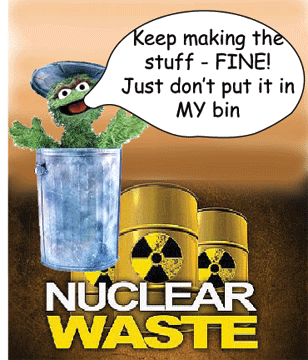
The two municipalities are meeting strong resistance from residents and nearby local governments.
Since Suttsu and Kamoenai expressed their willingness to accept the first-stage survey, the assemblies of some nearby municipalities have enacted ordinances declaring a rejection of nuclear waste and their governments have declined state grants related to the survey.
One year on, outlook for nuclear waste storage unclear Japan Times, 17 Nov 21, The outlook for the possible hosting of a final storage facility for nuclear waste in two Hokkaido municipalities remains uncertain, with Wednesday marking one year since a first-stage survey for the site’s selection started there, for the first time in Japan.
The town of Suttsu, along with the nearby village of Kamoenai, is undergoing the first-stage survey, known as literature investigation, to check whether it is suited to host a permanent underground storage site for high-level radioactive waste from nuclear power plants across the country.
The two municipalities are meeting strong resistance from residents and nearby local governments.
The government is seeking a location for the dump site, which will hold nuclear waste, or the remnants of spent nuclear fuel that has been treated, for a long period said to extend for 100,000 years.
The literature investigation, conducted by the Nuclear Waste Management Organization of Japan, or NUMO, will take about two years to confirm that there is no volcanic activity or active faults in the area by reviewing geological literature and data. The first-stage survey does not involve drilling.
Up to ¥2 billion in subsidies from the state will be paid to each location, as well as surrounding municipalities, for the first-stage investigation. The two municipalities plan to use the grants to set up regional revitalization funds.
Suttsu held a mayoral election last month in which the survey became a central topic of debate. Incumbent Mayor Haruo Kataoka, who decided to accept the first-stage research a year ago in line with what he felt was the will of the residents, won re-election.
However, his opponent, who called for a halt to the survey, gained about 80% of Kataoka’s vote count, suggesting that public opinion is still split.
The town government will decide whether to proceed to the second stage of the survey, called preliminary investigation, in a referendum.
Since Suttsu and Kamoenai expressed their willingness to accept the first-stage survey, the assemblies of some nearby municipalities have enacted ordinances declaring a rejection of nuclear waste and their governments have declined state grants related to the survey.
Suttsu and Kamoenai initially planned to have monthly opportunities for residents to exchange opinions on the issue, but the novel coronavirus crisis has limited such sessions to four each so far. The second-stage survey requires the consent of not only the municipal mayors, but also of Hokkaido Gov. Naomichi Suzuki, who is opposed to the investigation on the grounds that a prefectural ordinance rejects nuclear waste being brought to the prefecture.
Scottish earthquake was nuclear waste ‘wake-up call’
 | |||
Scottish earthquake was nuclear waste ‘wake-up call’, Ronnie Cowan MP says, The National, By Greg Russell 17 Nov 21 A SCOTS MP has said the 3.1 magnitude earthquake off the West of Scotland was a “wake-up call” over the “dig a hole and bury it” approach to nuclear waste.
Ronnie Cowan was speaking after Tuesday’s early-morning quake – recorded just 10km beneath its epicentre – was felt on the west coast and in Ireland.
The SNP MP for Inverclyde wrote on social media: “Hopefully too small and too far away from the nuclear waste dump and weapons storage to be concerning.”
He later told The National that when it comes to nuclear powered submarines and their payload, safety had to be paramount.
Cowan said: “Likewise our nuclear energy industry isn’t just about the crucial day to day safety, it is about the long term security of the sites and the waste.
“Currently the ‘dig a hole and bury it’ attitude to nuclear waste is concerning. It feels very much like we passing on a problem to future generations, which given the heightened awareness of environmental damage and climate change seems like a deliberate dereliction of duty.
“It therefore came as a wake-up call when I read that an earthquake had taken place just off the west coast of Scotland.”
Cowan stressed he was not claiming that the incident was a threat, but wondered if it was a warning shot given the “very unforgiving” nature of nuclear energy and waste.
“One mistake and the outcome could be catastrophic and as we see the climate change and weather patterns change, we are seeing more and more extreme weather episodes, and to future-proof our existing nuclear waste dumps we must consider the state of the planet thousands of years into the future,” he said.
Scottish earthquake was nuclear waste ‘wake-up call’, Ronnie Cowan MP says, The National,
By Greg Russell @National_GregJournalist A SCOTS MP has said the 3.1 magnitude earthquake off the West of Scotland was a “wake-up call” over the “dig a hole and bury it” approach to nuclear waste.
Ronnie Cowan was speaking after Tuesday’s early-morning quake – recorded just 10km beneath its epicentre – was felt on the west coast and in Ireland.
The SNP MP for Inverclyde wrote on social media: “Hopefully too small and too far away from the nuclear waste dump and weapons storage to be concerning.”
He later told The National that when it comes to nuclear powered submarines and their payload, safety had to be paramount.
Cowan said: “Likewise our nuclear energy industry isn’t just about the crucial day to day safety, it is about the long term security of the sites and the waste.
“Currently the ‘dig a hole and bury it’ attitude to nuclear waste is concerning. It feels very much like we passing on a problem to future generations, which given the heightened awareness of environmental damage and climate change seems like a deliberate dereliction of duty.
“It therefore came as a wake-up call when I read that an earthquake had taken place just off the west coast of Scotland.”
Cowan stressed he was not claiming that the incident was a threat, but wondered if it was a warning shot given the “very unforgiving” nature of nuclear energy and waste.
“One mistake and the outcome could be catastrophic and as we see the climate change and weather patterns change, we are seeing more and more extreme weather episodes, and to future-proof our existing nuclear waste dumps we must consider the state of the planet thousands of years into the future,” he said.
“And secondly, the earthquake bothered me because for some time now I have been concerned about the amount of unexploded ordnance (UXO) in the Clyde and beyond.
“My concerns are around the safety of those working on the river and those who enjoy it recreationally.”
The MP said he wanted to see a massive clean-up of the munitions dump in the River Clyde, but it had to be disposed of thoughtfully……… https://www.thenational.scot/news/19722624.scottish-earthquake-nuclear-waste-wake-up-call-ronnie-cowan-mp-says/
Global agreements against the dumping of nuclear waste into the world’s oceans

Did you know that there are global agreements against the dumping of
nuclear waste into the world’s oceans? They are called the London
Convention and London Protocol (LC/LP) and the latest meeting of the
government signatories and observers, including Greenpeace International,
has just finished under the auspices of the United Nations International
Maritime Organization (IMO).
It was an uncomfortable experience for
Japanese diplomats trying to defend the decision to dispose of nuclear
waste from Fukushima Daiichi into the Pacific Ocean. But it also triggered
memories of a different time and a different policy nearly three decades
ago when Japan at the IMO took on the role of protecting the marine
environment from radioactivity.
Greenpeace 17th Nov 2021
Scottish MP seeks commitment from UK govt to protect Beaufot’s Dyke from nuclear waste dumping
| MSP concerned about potential for dumping in Beaufort’s Dyke. South Scotland list MSP Emma Harper (SNP) is seeking a commitment from the UK Government that Beaufort’s Dyke will not be used as a dumpsite for nuclear and radioactive waste. Ms Harper has written to the Secretary of State for Scotland and the Defence Secretary following speculation that through committing to upgrading the A75 and building a new nuclear power station, that the Government will once again use Beaufort’s Dyke as dumping site. Previously Ms Harper has also raised concerns over the noted increase in the amount of unexploded ordnance which has washed up on beaches across south west Scotland over recent years. Beaufort’s Dyke became the United Kingdom’s largest offshore dumpsite for surplus conventional and chemical munitions after the Second World War. Galloway Gazette 12th Nov 2021 https://www.gallowaygazette.co.uk/news/environment/msp-concerned-about-potential-for-dumping-in-beauforts-dyke-3456195 |
”Cocooning” Hanford nuclear reactors conveniently leaves the $600 billion clean-up to future generations
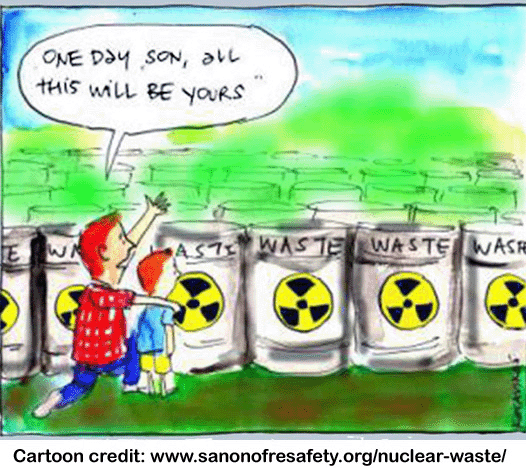
Future generations will decide the final disposition of the eight Hanford reactors.
The bigger question is whether future generations will be willing to pay the massive costs of Hanford cleanup, he said.
Carpenter said the estimated cost to completely clean up just the tank wastes at the Hanford site is around $660 billion.
“It’s rather grim. It’s multigenerational,” he said.
“This will cost more than anyone thought possible,” Carpenter said of the tank wastes and other wastes that were dumped into the ground at Hanford. “It’s a hidden cost of the (nuclear) buildup.
US government works to ‘cocoon’ old nuclear reactors https://abcnews.go.com/Technology/wireStory/us-government-works-cocoon-nuclear-reactors-80964651
Costs to clean up a massive nuclear weapons complex in Washington state are usually expressed in the hundreds of billions of dollars and involve decades of work, By NICHOLAS K. GERANIOS Associated Press5 November 2021 SPOKANE, Wash. — Costs to clean up a massive nuclear weapons complex in Washington state are usually expressed in the hundreds of billions of dollars and involve decades of work.
usually expressed in the hundreds of billions of dollars and involve decades of work.
But one project on the Hanford Nuclear Reservation is progressing at a much lower price.
The federal government is moving forward with the “cocooning” of eight plutonium production reactors at Hanford that will place them in a state of long-term storage to allow radiation inside to dissipate over a period of decades, until they can be dismantled and buried.
“It’s relatively non-expensive,” Mark French, a manager for the U.S. Department of Energy, said of cocooning. “The cost of trying to dismantle the reactor and demolish the reactor core would be extremely expensive and put workers at risk.”
The federal government built nine nuclear reactors at Hanford to make plutonium for atomic bombs during World War II and the Cold War. The site along the Columbia River contains America’s largest quantity of radioactive waste.
The reactors are now shut down and sit like cement fortresses near the southeastern Washington city of Richland. Six have already been cocooned for long-term storage, and two more are headed in that direction. The ninth reactor was turned into a museum as part of the Manhattan Project National Historical Park.
While World War II ended in 1945 and the Cold War ended in 1989, the United States is still paying billions of dollars per year for the disposal of the nuclear waste produced by the atomic weapons that played a big role in ending those conflicts. The biggest expense is dealing with a massive volume of liquid wastes left over from the production of plutonium, a key ingredient in nuclear weapons.
While the liquid wastes stored in 177 underground tanks will take decades of work and hundreds of billions of dollars to clean, efforts to secure the nine plutonium reactors are much closer to completion.
The last two reactors, shut down in 1970 and 1971, are about to enter the cocooning stage, when they are covered with steel and cement to prevent radioactivity from escaping into the environment, French said.
The cocoons are expected to last about 75 years, by which time the radioactivity inside will have dramatically decreased and there presumably will be a plan for final disposition of the remaining parts, French said.
Every five years, workers enter the reactor building to make sure there are no leaks or rodent or bird infestations, he said.
Cleanup of Hanford, which has about 11,000 employees and is half the size of Rhode Island, started in the late 1980s, and now costs about $2.5 billion per year. The work has been slowed by technical issues, lack of funding, lawsuits from state regulators, worker exposure to radiation and turnover of contractors on the complex job.
But the handling of the old reactors is a bright spot.
The nine reactors — called B Reactor, C Reactor, D Reactor, DR Reactor, F Reactor, H Reactor, K-East Reactor, K-West Reactor, and N Reactor — were built from 1943 through 1965.
They were constructed next to the Columbia River because of the abundance of hydropower and cooling water needed by the reactors during operation.
All have been cocooned except K-East and K-West. Work on cocooning the K-East reactor has already started and should be finished by 2023, French said. Work on the K-West reactor is scheduled for completion in 2026.
The cocoon plan for K-East and K-West is to basically construct steel buildings around them. Each building is 158 feet (48.2 meters) long, 151 feet (46 meters) wide and 123 feet (37.5 meters) tall, French said. The two steel buildings will cost less than $10 million each.
The government also operated five plutonium production reactors at the Savannah River Site in South Carolina during the Cold War. All of those are also shut down, although three of the reactor buildings are being used to store radioactive materials Two of the reactors at Savannah River are closed but under a different procedure than the Hanford reactors, said Amy Boyette, a spokeswoman for Savannah River.
Future generations will decide the final disposition of the eight Hanford reactors, French said. They will likely be dismantled and buried in the central area of the Hanford site, away from the river.
Robots may be deployed in the future” for that work, French said.
Hanford watchdogs generally agree with this process, said Tom Carpenter, director of the Seattle-based watchdog group Hanford Challenge.
“Nobody is raising any concerns about cocooning,” Carpenter
said. “We’re all worried about the tank waste that needs immediate and urgent attention.”
The bigger question is whether future generations will be willing to pay the massive costs of Hanford cleanup, he said.
Carpenter said the estimated cost to completely clean up just the tank wastes at the Hanford site is around $660 billion.
“It’s rather grim. It’s multigenerational,” he said.
“This will cost more than anyone thought possible,” Carpenter said of the tank wastes and other wastes that were dumped into the ground at Hanford. “It’s a hidden cost of the (nuclear) buildup.
By then, there might be bigger budget concerns such as dealing with the effects of climate change, Carpenter said.
The most intriguing of the old reactors is the B Reactor, the first one built during World War II. It will not be cocooned, and can be visited by tourists at the national historical park. B Reactor, which shut down in 1968, was cleaned up enough to allow some 10,000 tourists to visit each year and learn the history of Hanford. It has been designated a National Historic Landmark.
Plutonium from Hanford’s B Reactor was used in the testing of the world’s first atomic bomb in July 1945. Called the Trinity Test, the bomb was blown up in the New Mexico desert. Hanford plutonium was also used for the bomb that was dropped over Nagasaki, Japan, on Aug. 9, 1945.
Is it green, or forever toxic? France’s radioactive waste crisis. Nuclear rift at climate talks

Is it green, or forever toxic? Nuclear rift at climate talks
By ANGELA CHARLTON, 4 Nov 21, SOULAINES-DHUYS, France (AP) — Deep in a French forest of oaks, birches and pines, a steady stream of trucks carries a silent reminder of nuclear energy’s often invisible cost: canisters of radioactive waste, heading into storage for the next 300 years.
As negotiators plot out how to fuel the world while also reducing carbon emissions at climate talks in Scotland, nuclear power is a central sticking point. Critics decry its mammoth price tag, the disproportionate damage caused by nuclear accidents, and radioactive leftovers that remain deadly for thousands of years.
……… Many governments are pushing to enshrine nuclear energy in climate plans being hashed out at the conference in Glasgow, known as COP26. The European Union, meanwhile, is debating whether to label nuclear energy as officially “green” — a decision that will steer billions of euros of investment for years to come. That has implications worldwide, as the EU policy could set a standard that other economies follow.
But what about all that waste? Reactors worldwide produce thousands of tons of highly radioactive detritus per year, on top of what has already been left by decades of harnessing the atom to electrify homes and factories around the world.
Germany is leading the pack of countries, mainly within the EU, standing firmly against labeling nuclear as “green.” …..
nowhere in the world is as reliant on nuclear reactors as France, which is at the forefront of the pro-nuclear push at the European and global level. And it’s among leading players in the nuclear waste industry, recycling or reprocessing material from around the world.
South of the World War I battlefields of Verdun, trucks bearing radioactivity warning stickers pull into a waste storage site near the village of Soulaines-Dhuys. They’re repeatedly checked, wiped and scanned for leaks. Their cargo — compacted waste stuffed into concrete or steel cylinders — is stacked by robotic cranes in warehouses that are then filled with gravel and sealed with more concrete.
……….. The storage units hold 90% of France’s low- to medium-activity radioactive waste, including tools, clothing and other material linked to reactor operation and maintenance. The site is designed to last at least 300 years after the last shipment arrives, when the radioactivity of its contents is forecast to be no higher than levels found in nature.
For longer-life waste — mainly used nuclear fuel, which remains potentially deadly for tens of thousands of years — France is laying the groundwork for a permanent, deep-earth repository beneath corn and wheat fields outside the nearby stone-house hamlet of Bure.
Some 500 meters (yards) below the surface, workers carry out tests on the clay and granite, carve tunnels and seek to prove that the long-term storage plan is the safest solution for future generations. Similar sites are under development or study in other countries, too.
If the repository wins French regulatory approval, it would hold some 85,000 metric tons (94,000 tons) of the most radioactive waste produced “from the beginning of the nuclear era until the end of existing nuclear facilities,” said Audrey Guillemenet, geologist and spokesperson for the underground lab.
“We can’t leave this waste in storage sites on the surface,” where it is now, she said. “That is secure, but not sustainable.”
The 25 billion euro ($29 billion) cost of the proposed repository is already built into budgeting by French utilities, Guillemenet said. But that’s just one piece of the staggering cost of building and operating nuclear plants, and one of the reasons that opposition abounds.
All around Bure, street signs are replaced with graffiti reading “Nuclear is Over,” and activists camp out at the town’s main intersection.
Greenpeace accuses the French nuclear industry of fobbing off waste on other countries and covering up problems at nuclear facilities, which industry officials deny. Activists staged a protest last week in the port of Dunkirk, as reprocessed uranium was being loaded onto a ship for St. Petersburg, demanding an end to nuclear energy and more research into solutions for existing waste.
…….. The current energy crunch is giving nuclear advocates another argument. With oil and gas costs driving an energy price crisis across Europe and beyond, French President Emmanuel Macron has trumpeted “European renewables and, of course, European nuclear.”
The waste, meanwhile, isn’t going away.
To make radioactive garbage dumps less worrying to local residents, Andra organizes school visits; one site even hosts an escape game. Waste storage researchers are readying for all kinds of potential future threats — revolution, extreme weather, even the next Ice Age, Guillemenet said.
Whatever happens in Glasgow, “whether we decide to go on with the nuclear energy or not,” she said, “we will need to find a solution for the management of that nuclear waste” that humankind has already produced. https://apnews.com/article/climate-science-business-environment-accidents-b334c5cddc50c620d53674a5b32518dd
New Mexico governor fears expansion of Waste Isolation Pilot Plant, to take even more high level nuclear waste
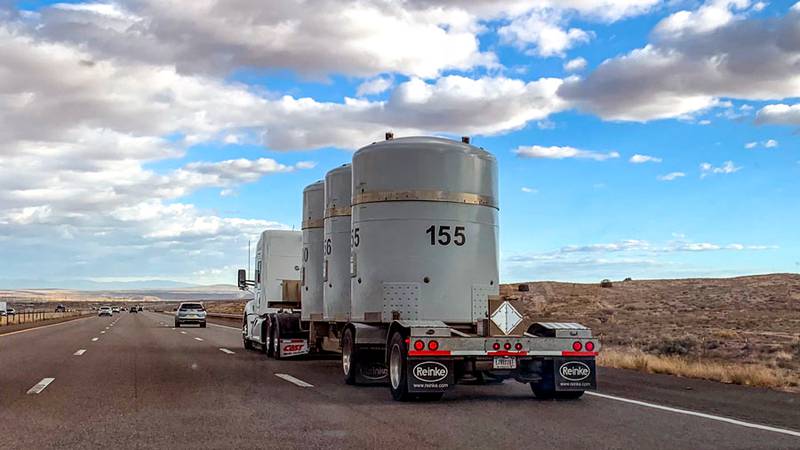
Nuclear Nerves. Governor says she’s concerned about possible increase in radioactive shipments through Santa Fe County, but a bigger worry remains.
Reporter, By Bella DavisNovember 03, 2021
Santa Fe-area activists and residents have been sounding the alarm that more nuclear waste shipments will soon be traveling through the county on their way to the Waste Isolation Pilot Plant—the nation’s only long-term storage facility for transuranic radioactive waste, located near Carlsbad.
Equal parts questions and foreboding answers have dominated two recent town halls hosted by Santa Fe County officials and anti-nuclear activists. While the US Department of Energy is not exactly forthcoming about the future, Gov. Michelle Lujan Grisham says such expansion would be limited to the capacity of state vehicle inspections.
The Energy Department must submit to inspections for all WIPP trucks and trucks that leave Los Alamos National Laboratory under an intergovernmental agreement. New Mexico State Police conducts those inspections—averaging about six or seven a week with the capacity for 20. The agency does not plan to hire additional staff to increase inspection capabilities, Lt. Mark Soriano writes in an email to SFR.
The Department of Energy tells SFR the rate of shipments to WIPP is “expected to increase to 10-12 shipments per week” over the next few months, but it has also put in requests with the state to expand the facility’s underground capabilities and announced earlier this year that it was going to prepare an environmental impact statement to dispose of surplus plutonium at WIPP.
A spokeswoman for Lujan Grisham says the governor is concerned about the possibility of future WIPP expansion and the notion of increased nuclear materials shipments through the state. But Lujan Grisham believes there’s a more pressing, immediate problem embedded in New Mexico’s long relationship with the nuclear industry and all that comes with it.
Her “biggest concern,” Nora Meyers Sackett, the spokeswoman, says, is that the US Department of Energy “continues to prioritize shipments from other states to…WIPP while failing to expedite cleanup of waste at Los Alamos” National Laboratory.
Lujan Grisham says the Energy Department’s position is “unacceptable,” Meyers Sackett tells SFR in a series of answers to emailed questions.
In February, the New Mexico Environment Department sued DOE over what it says is a “continuing pattern of delay and noncompliance” of legacy waste cleanup at Los Alamos, asking for a court-supervised process to resolve the issue. In its initial answer to the lawsuit, DOE “denies that [the state] is entitled to the relief it seeks.” Settlement negotiations in federal court are ongoing…………
Weehler worries about an accident, the odds of which would go up with increased shipments under WIPP’s plans for expansion, and that emergency responders wouldn’t be able to respond fast enough before people were exposed………… https://www.sfreporter.com/news/2021/11/03/nuclear-nerves/
White Mesa uranium mill – its owners want to accept radioactive trash from Estonia – 1000s of miles away !

Over the past 40 years, the construction of the mill demolished
archaeological and burial sites important to the Ute Mountain Ute Tribe and
depleted the tribe’s traditional hunting grounds, destroying places where
people once gathered plants for basketry and medicine.
Radioactive waste
has been spilled along the main highway from trucks hauling material from
Wyoming to White Mesa for processing. The children can no longer play
outside because of the stench and the fear of what might be causing it. The
mill sits in the heart of San Juan County, a few miles east of the original
boundaries of Bears Ears National Monument, with Canyonlands National Park
to the north and Monument Valley to the southeast.
It opened in 1980 to
process uranium ore from the Colorado Plateau into yellowcake, a
concentrated powder used in energy production and nuclear weapons. Most
uranium mines closed in the last half-century. But White Mesa not only
remains open, it has become a destination for radioactive material from
around the world. Now, its owners want to accept waste from the Northern
European country of Estonia, nearly 5,000 miles away.
High Country News 1st Nov 2021
The nation’s last uranium mill plans to import Estonia’s radioactive waste
New UHI research into tiny fragments of radioactivewaste flushed into the sea from Dounreay nuclear power plant 40 years ago.
New UHI research is to be carried out into tiny fragments of radioactive
waste flushed into the sea from Dounreay nuclear power plant 40 years ago.
Sand-sized particles of irradiated nuclear fuel got into the plant’s
drainage system in the 1960s and 1970s. Work to clean up the particles
began in the 1980s, after fragments were found washed up on the nearby
foreshore. Dounreay’s operator is funding the research by the University
of the Highlands and Islands (UHI). The UHI environmental research
institute in Thurso, near Dounreay, said the research would “explore a
difficult environmental problem”.
Press & Journal 31st Oct 2021
Humboldt Bay Power Plant decommissioning; problem of nuclear waste buried not far from sea level, in a seismic area
PG&E completes decommissioning process, ends nuclear facility license
But more work remains: 37 tons of nuclear waste are in an eroding bluff near King Salmon, By ISABELLA VANDERHEIDEN | ivanderheiden@times-standard.com | Times-Standard October 30, 2021 Following a years-long effort to decommission the former nuclear power plant in Humboldt Bay, Pacific Gas and Electric Co. recently filed a request with the Nuclear Regulatory Commission to terminate the power plant’s license marking a “major milestone” for the Humboldt County community……..
Decomissioning
Decommissioning efforts for the Humboldt Bay Power Plant Unit 3, a 63-Megawatt electric boiling water reactor, began in June 2009, more than 30 years after the power plant had ceased operations. It operated from 1963 to 1976 and was permanently defueled in 1984.
At the time of the power plant’s construction, atomic energy was hailed as the solution to global energy needs……….
Why was the power plant short-lived? As it turns out, seismically active regions are not ideal locations for nuclear power……………
More to be done
Buried deep into Buhne Point, a highland bluff directly northeast of King Salmon, is an underground nuclear waste storage facility known as the Humboldt Bay Independent Spent Fuel Storage Installation, or ISFSI. While the ISFSI will effectively contain the 37-tons of nuclear waste for approximately 50 years, it is not a permanent solution.
“All of the high-level waste that was ever produced at the power plant including all the spent fuel rods the reactor cut up into pieces, all that stuff is buried on top of the hill at King Salmon,” Kalt said. “The ISFSI is really what the Baykeeper is concerned about at this point.”
Corral said the “five casks of spent nuclear fuel and one cask of Greater than Class C waste” will remain on site until an offsite repository is available, “as promised by the federal government.”
However, Kalt said the waste will never be removed “because nobody wants it.”
I really just don’t think it’s appropriate anyway. It would be so dangerous to move it and it would be unfair to put that on another community,” she said.”There is no such thing as ‘away’. If you’re going to have something that toxic in your community, you should understand that this is in perpetuity.”
The ISFSI will have to be relocated at some point as the bluff continues to erode and the sea level continues to rise.
“The projections indicate that the sea level will be four feet higher in 50 years than it is today,” Kalt said. “The ISFSI is on the top of an eroding bluff, it’s 44-feet above sea level, it’s buried to 30 feet below the surface, so the bottom is only 10 feet above sea level currently. …What are we going to do, you know? It’s pretty clear that there needs to be a plan to at least move it back from the bay, it’s going to be really expensive and controversial, but leaving it there is not a plan. It’s a nightmare.”
It won’t be easy, but Kalt said there needs to be a community process in deciding where to relocate the ISFSI……………….https://www.times-standard.com/2021/10/30/2687577/
Jacobs joint venture wins $8bn nuclear clean-up contract in US.
Jacobs joint venture wins $8bn nuclear clean-up contract in US, GCR, Joe Quirke, 29.10.21
The United Cleanup Oak Ridge (UCOR) consortium has landed a 10-year contract worth $8.3bn to remediate the Oak Ridge Reservation site in Tennessee.
Nuclear Waste Cleanup:DOE Needs to Better Coordinate and Prioritize Its Research and Development Efforts
Nuclear Waste Cleanup:DOE Needs to Better Coordinate and Prioritize Its Research and Development Efforts
GAO-22-104490 Oct 28, 2021. Research and development has been essential in the Department of Energy’s efforts to clean up significant contamination from decades of nuclear weapons production, but over time DOE has reduced funding designated for cleanup R&D.
We could not determine how much DOE actually spends on cleanup R&D because the agency does not track such spending (or the associated research), nor evaluate the outcomes of the research.
In addition, because DOE does not have a comprehensive approach to prioritizing cleanup R&D, individual cleanup sites have had to develop their own approaches, which may not address the needs of all cleanup sites or long-term needs.
Highlights
What GAO Found……
Why GAO Did This Study
R&D has played an essential role in EM’s efforts to clean up massive amounts of contamination from decades of nuclear weapons production and energy research. Such R&D has led to safer, more efficient, and more effective cleanup approaches. Prior studies have found that investments in R&D could reduce the future costs of EM’s cleanup efforts, which have increased by nearly $250 billion in the last 10 years. However, funding designated for nuclear cleanup R&D has declined since 2000……….
Recommendations
GAO is making four recommendations, including that DOE (1) develop a system to collect R&D information across the complex to enable monitoring and evaluation of outcomes and (2) develop a comprehensive approach to prioritizing R&D across the EM complex that follows a risk-informed decision-making framework. DOE concurred with the recommendations made in this report.
Recommendations for Executive Action………..https://www.gao.gov/products/gao-22-104490
South Bruce citizens want a referendum on plan to permanently house Canada’s nuclear waste.

South Bruce, Ont. citizens push for referendum to decide location of nuclear waste, Scott Miller, CTV News London Videographer, 25 Oct 21, TEESWATER, ONT. – Michelle Stein is putting up signs around her community she hopes will lead to referendum on whether South Bruce should permanently house Canada’s most radioactive nuclear waste.“That’s the fair way to do it. People that see benefits from the project can vote yes, those of us that feel the risks are too great we get to vote no,” says the chair of Protect our Waterways, a citizens’ group opposing plans to bury high-level nuclear waste in the Municipality of South Bruce.
- Stein believes a binding referendum during next October’s municipal election would be the best way for the 5,600 citizens of the Municipality of South Bruce to determine their willingness to host Canada’s first permanent nuclear waste facility, under 1,500 acres of farmers fields north of Teeswater…………
The Nuclear Waste Management Organization say they’ll decide whether Ignace, QC or South Bruce will house Canada’s first permanent nuclear waste facility in 2023.
How communities decide their willingness to do so, is up to each community. South Bruce’s Willingness Study final report will be before council in November.
Protect our Waterways will be going door to door in South Bruce this month and next, to try and get residents to sign a petition urging South Bruce council to commit to a binding referendum on the nuclear waste topic in time for the 2022 municipal election.
“This is a decision that will forever change our community, and every single person deserves a voice, and deserves to have their vote counted,” says Stein. https://london.ctvnews.ca/south-bruce-ont-citizens-push-for-referendum-to-decide-location-of-nuclear-waste-1.5637381
Problems and public opposition to the plan to store high level nuclear wastes under the Great Lakes
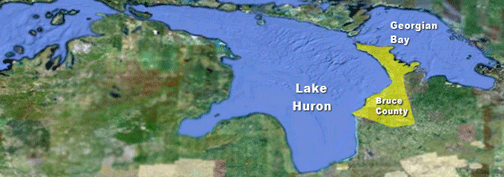
Nuclear Question: Debate continues over long-term storage of nuclear waste in the Great Lakes. Great Lakes Now, By Andrew Reeves, 25 Oct 21,
Canada’s plan to store spent nuclear fuel 1,600 feet below ground in the Great Lakes basin, some 30 miles from Lake Huron, is continuing to ruffle feathers throughout the Great Lake states.
Earlier this month, U.S. lawmakers called out the Canadian plan for failing to prioritize the health of the Great Lakes and the 40 million residents who depend on it for clean drinking water ahead of its own energy needs.
Michigan Democratic Rep. Dan Kildee is leading a 20-member bipartisan group calling on President Joe Biden to pressure Canadian Prime Minister Justin Trudeau to halt the plans for storing an anticipated 57,000 tons of high-level radioactive material within the basin.
Michigan Gov. Gretchen Whitmer, in a statement on the ongoing legal battle over the future of Enbridge’s Line 5 pipeline, accused the Canadian federal government of “adding even more risk to our waters” by allowing plans to store radioactive nuclear waste in a 1,400-acre underground warehouse to proceed.
Yet despite concerns within the basin from politicians and environmental groups, and unrest among local farmers worried about water contamination and potentially tanking property values, the project is moving ahead as planned. Geologic testing at one location in southern Ontario began this spring.
Even so, determining the long-term fate of Canada’s spent nuclear fuel remains far from settled as rifts develop within the host community, and between Canada and frustrated U.S. lawmakers.
“There’s a divide taking place,” Canadian Member of Parliament Brian Masse noted on a recent tour of the proposed South Bruce site with concerned residents. “I do believe there needs to be some responsibility taken on a federal level to make sure our communities aren’t broken in this process.”………
When spent nuclear fuel bundles are removed from a reactor they are currently interred in a water-filled pool for up to seven years until radioactivity decreases. From there the rods are relocated to dry storage containers made of 20-inch-thick, high-density concrete lined with steel half an inch thick. These storage facilities have a lifespan of roughly 50 years, and Canada has been generating nuclear power since the early 1960s. While the dry storage silos can be refurbished to extend their use, it does nothing to address the long-term need for safe storage solutions.
Experts at NWMO settled on a deep geological repository as the preferred storage option in 2007 after three years of discussion with European nuclear engineers.
The basic premise of the DGR is deceptively simple: bury the spent fuel. If NWMO could identify a willing host community that is situated in an area with suitable geology, the stage would be set to spend $23 billion over 40 years to construct a massive underground labyrinth of tunnels bored into rock that, in total, would be capable of storing the 57,000 tons of spent fuel that Canada currently has in cement-encased copper canisters. The aboveground footprint of buildings would be little more than a mile across.
But the question remains: Where should three million bundles of spent nuclear fuel be stored for what is, essentially, the rest of time?
Identifying a willing host community
The process for identifying a willing host community began in 2008.
From an initial pool of 22 potential locations across Canada, on-site investigations quickly whittled that list down to two, both of which are in Ontario: South Bruce, at a location some 30 miles from Lake Huron, and Ignace in northwestern Ontario. (The Ignace location, northwest of Lake Superior, is not within the Great Lakes basin; rather, it sits within the Winnipeg River basin. Borehole drilling to determine the suitability of the bedrock beneath the proposed site began in Ignace in 2017.)…………
U.S. lawmakers aren’t the only ones concerned about the proposed DGR. Public opposition to the proposal among South Bruce residents has been mounting steadily. …………. https://www.greatlakesnow.org/2021/10/storage-nuclear-waste-great-lakes/
Swedish authorities delay permission for nuclear waste dump operation, due to concerns over corrosion of copper in containers

The Environmental Organizations’ Nuclear Waste Review (MKG), which has the
Friends of the Earth and the Swedish Society for Nature Conservation as
members, welcomes the fact that the Nuclear Waste Council has concluded
that there is a need for more copper corrosion research before a nuclear
fuel repository can be put into operation.
In a statement to the Government
on 21 October, the Council proposes that more research on copper corrosion
in a repository environment be conducted after the Government has given
permission to build the repository, and that a separate government decision
be made before the repository is taken into use. MKG believes that it is
already prepared for research within the LOT trial that can yield important
results before the government makes an admissibility decision on the
nuclear fuel repository. Waiting with research until after construction
starts means problems.
MKG 22nd Oct 2021
1 This Month
15 October. Joint Appeal for Nuclear Abolition Day -presentation to the UN on October 15 will be live on UNWebTV
Endorse the Nuclear Abolition Day Appeal
23-25 October – on Zoom – World BEYOND War’s annual global conference

To see nuclear-related stories in greater depth and intensity – go to https://nuclearinformation.wordpress.com
-
Archives
- October 2026 (149)
- September 2026 (339)
- August 2026 (330)
- July 2026 (355)
- June 2026 (287)
- May 2026 (306)
- April 2026 (356)
- March 2026 (251)
- February 2026 (267)
- January 2026 (308)
- December 2025 (358)
- November 2025 (359)
-
Categories
- 1
- 1 NUCLEAR ISSUES
- business and costs
- climate change
- culture and arts
- ENERGY
- environment
- health
- history
- indigenous issues
- Legal
- marketing of nuclear
- media
- opposition to nuclear
- PERSONAL STORIES
- politics
- politics international
- Religion and ethics
- safety
- secrets,lies and civil liberties
- spinbuster
- technology
- Uranium
- wastes
- weapons and war
- Women
- 2 WORLD
- ACTION
- AFRICA
- Atrocities
- AUSTRALIA
- Christina's notes
- Christina's themes
- culture and arts
- Events
- Fuk 2022
- Fuk 2023
- Fukushima 2017
- Fukushima 2018
- fukushima 2019
- Fukushima 2020
- Fukushima 2021
- general
- global warming
- Humour (God we need it)
- Nuclear
- RARE EARTHS
- Reference
- resources – print
- Resources -audiovicual
- Weekly Newsletter
- World
- World Nuclear
- YouTube
-
RSS
Entries RSS
Comments RSS

