Nuclear fusion – not as clean as they say: it produces considerable amounts of radioactive trash
NuClear News No 136 Dec 21, Fusion Waste The Committee on Radioactive Waste Management (CoRWM) has published a preliminary position on the implications for decommissioning, radioactive waste management, and radioactive waste disposal associated with fusion energy. (1) CoRWM member Claire Corkhill says: “Although nuclear fusion does not produce long lived fission products and actinides, neutron capture by the fusion reactor structural materials and components forms short, moderate and some long-lived activation products. In addition to tritium emissions and contaminated materials, it is clear that there will be a need to manage radioactive materials and wastes produced by neutron activation, within regulatory controls, over the whole life cycle of a fusion reactor.” (2)
The paper itself says: “The activation of components in a fusion reactor is low enough for the materials to be recycled or reused within 100 years.”
It continues:
“Minimising the generation of long lived activation products, and tritium inventory at source, is therefore of fundamental importance in achieving the primary objective in the waste hierarchy of waste prevention. However, it is to be recognised that future generations will be committed to managing wastes arising from decommissioning and waste management plans that are predicated on extended decay storage, such as those discussed herein.”
However, the paper goes on to says that “The primary components of the fusion reactor system are likely to require disposal, including the activated front wall, blanket, divertor and vacuum vessel materials … From a radiological perspective, it is reasonable to consider that, conceptually, wastes from a nuclear fusion power programme should be compatible with geological disposal, however, they may prove challenging for disposal in a near surface facility, given the long half-life and potential mobility of 14C and 94Nb.”
“…some key activation products of concern, such as 14C and 94Nb, which are long lived, should be limited in near surface disposal facilities, given the reliance on engineered barriers to assure containment.14C poses a particular challenge given its potential mobility in the near subsurface.
“Nuclear fusion technology is advocated as not being compromised by the burden of generating long lived nuclear wastes. It is evident that this claim is challenged by the expected generation of some significant volumes of LLW and likely ILW arisings. It may be noted that the recent call for expressions of interest to accommodate siting the STEP facility makes no mention of management of the arising radioactive waste. Future dialogue with local communities needs to ensure it is as open and transparent as possible on such matters.”
The Government is consulting on proposals for a regulatory framework for fusion. The consultation closes on 24th h December. See: https://assets.publishing.service.gov.uk/government/uploads/system/uploads/attachment_da ta/file/1032848/towards-fusion-energy-uk-government-proposals-regulatory-frameworkhttps://www.no2nuclearpower.org.uk/wp/wp-content/uploads/2021/12/nuClearNewsNo136.pdf
9 top US nuclear no-proliferation experts write to Prime Minister Trudeau requesting a review of Canada’s planned nuclear reprocessing to recover plutonium.

| The latest of three open letters to Prime Minister Justin Trudeau from US non-proliferation. experts is copied below [on original] . The previous two letters are linked in footnotes #1 and #2. [on original] In these three letters, a group of nine distinguished nuclear policy experts are asking for a top level Canadian government review of the nuclear weapons proliferation dangers associated with the planned reprocessing of Canadian used nuclear fuel to recover the plutonium for use in a proposed new reactor in New Brunswick. These nine experts have worked under six U.S. presidents: John F. Kennedy, Lyndon B. Johnson, Richard Nixon, George H.W. Bush, Bill Clinton, and Barack Obama; and hold professorships at the Harvard Kennedy School, University of Maryland, Georgetown University, University of Texas at Austin, George Washington University, and Princeton University. CCNR 30th Nov 2021 http://www.ccnr.org/request_plute_nov_24_2021.pdf |
Protest against plan for nuclear waste dump in West Cumbria, close to National Park
NEW NUCLEAR DUMP FOR HIGHER ACTIVITY WASTES AT DRIGG LOW LEVEL WASTE REPOSITORY? NIREX REBRANDED? From Lakes Against Nuclear Dump to the Lake District National Park Authority. 28 Nov 21, A letter of alarm regarding plans for an Intermediate Level Nuclear Waste Dump for the UK’s Low Level Waste Repository at the village of Drigg. The UKs LLWR is 250 metres from the National Park Boundary at the nearest point. The following letter has been sent to local and national media and mainstream NGOs have been alerted.
Dear Member of the Lake District National Park Authority,
Congratulations on the 70th anniversary of the Lake District National Park. In the original Lake Counties is another 70th anniversary. The Windscale Piles. Which from 1951 produced plutonium for Britain to make its own atomic and hydrogen bombs until the Windscale Fire of 1957. Unfortunately lessons were not learnt. The nuclear experiment continues despite no final solution to the problem of what to do with the escalating wastes from 70 years of military and civil nuclear reactors. Our own view as a nuclear safety group is that the wastes should not be buried out of sight and out of mind but should be closely monitored and repackaged when necessary.
NIREX REBORN AT DRIGG? – Intermediate Level Nuclear Wastes for Burial approximately 250 metres from the National Park?
We have been alerted by locals in the Drigg area to a plan which is running in tandem with that for a deep Geological Disposal Facility which Government say: “will be available to receive the first waste in the 2040s” However the plan for Near Surface Disposal (10s of metres below ground) “could be available within the next 10 years.” This plan, for which the Low Level Radioactive Waste Repository at Drigg is under active consideration, is for the disposal/dumping of Intermediate Level Wastes of the type that were rejected by the NIREX inquiry for deep GDF disposal at Longlands Farm, Gosforth in 1997. Exploratory boreholes have already been drilled at Drigg for the Near Surface Disposal of Intermediate Level Nuclear Wastes, presumably under “permitted development.”
Just like the early days of the Windscale Piles this plan has been put in motion under the radar of public attention. There has not been any debate or vote at Local, Borough or County Council level nor, we assume, any discussion by the Lake District National Park despite the Low Level Waste Repository being only 250 metres from the Lake District National Park boundary. Intermediate Level Nuclear Wastes, according to the Nuclear Decommissioning Authority, “exceeds the upper boundaries for Low Level Waste but does not generate a significant amount of heat. ..The major components of ILW are nuclear reactor components, graphite from reactor cores and sludges from the treatment of radioactive liquid effluents.”
The NIREX dump entrance proposal for Intermediate Level Wastes was rejected in the 1990s because the nuclear industry had no idea how much and how fast the planned dump would leak. They still have no idea. Furthermore for a shallow dump the leaks would be even faster…………
The fundamental conclusion of the expert Assessor and myself was that the Proposed Repository Zone had been chosen for these studies in an arbitrary manner, without conforming to internationally agreed, geological criteria
Earlier in a letter to “The Guardian” of June 28,’07 the NIREX Inquiry Inspector had stated : “The relevant geology in west Cumbria is apparently now claimed to be ‘stable, although imperfect’.…the imperfection consists of simply failing to meet the internationally agreed criteria on the suitability of rocks for nuclear waste deposit. The site should be in a region of low groundwater flow, and the geology should be readily characterisable and predictable, whereas the rocks there are actually of a complex volcanic nature, with significant faulting. Also, the industry was relying on an overlying layer of sedimentary strata to dilute and disperse any groundwater leakage, when the international criteria require such a layer to act instead as a barrier…The site is not suitable and investigations should be moved elsewhere…”.
And: “The site selection process was flawed, not treating safety as the most important factor, and irrationally affected by a strong desire to locate close to Sellafield.”
https://www.theguardian.com/world/2007/jun/28/nuclear.uk
The latest process to deliver a GDF (with Cumbria STILL in the frame), Radioactive Waste Management, is now in partnership with the LLWR at Drigg. These bodies along with the Nuclear Decommissioning Authority are all advised by the Committee on Radioactive Waste Management which is in turn taking “invaluable” advice on construction and delivery of deep (GDF) and not so deep (NSD) dumping/disposal from West Cumbria Mining’s CEO Mark Kirkbride. Kirkbride compiled CoRWMs Annual Report No 3724 which details the push for Near Surface Disposal: “advice in the last year have been in relation to the concept of Near Surface Disposal (NSD) for intermediate level waste which is being explored by NDA as a potential solution for the disposal of specific intermediate level waste materials, reducing the volume of certain elements of the inventory into a GDF.
The Lake District National Park Authority surely cannot ignore this. If Intermediate and heat generating High Level nuclear waste is brushed under the Lake District fringes and abandoned, then the World’s Nuclear Heritage Site will soon become the World’s Nuclear Sacrifice Zone. This could happen within a decade for the Intermediate Level Wastes at Drigg. Please protect the Lake District and its fringes, tomorrow is too late to say “This Far and No Further.”
yours sincerely
Marianne Birkby
Lakes Against Nuclear Dump – a Radiation Free Lakeland campaign
https://www.lakesagainstnucleardump.com/ https://www.lakesagainstnucleardump.com/post/new-nuclear-dump-for-higher-activity-wastes-at-drigg-low-level-waste-repository-nirex-rebranded
The “brigands” regroup in Basilicata

Italians reunite in the face of a renewed radioactive waste dump threat
The “brigands” regroup in Basilicata — Beyond Nuclear International 28 Nov 21,
”………………………………………… between November 13 and 27, 2003, just weeks before we arrived. An unprecedented and dramatic 15 days of protest had unfolded in Scanzano Jonico, culminating in the defeat of a plan by the Italian government, then led by Silvio Berlusconi, to dump all of Italy’s high-level radioactive waste at a single site at Terza Cavone, a few kilometers from Scanzano, in salt rock at a site just 200 meters from the shoreline.
The dump decision had been taken at night, without local consultation, the news deliberately buried in the papers, eclipsed by a headline-garnering suicide bombing that had killed 18 Italian service members at the Nasiriyah Carabinieri barracks in Iraq during that ill-waged war.
But the Lucani noticed the announcement right away. The news struck “like a lightning bolt” Tonino Colucci of the local World Wildlife Fund chapter told me later as we walked into that surprise press conference.
Before the ink was even dry, they had set up a base camp at Terza Cavone — where we were now. They had rallied people from all walks of life to protest, occupy stations, and block highways. The whole region declared itself a nuclear-free zone. Berlusconi’s own members of parliament in the area opposed the deal. By November 23, the ranks of protesters had swelled to 100,000. After fifteen days, the radioactive waste dump was canceled.
The protest garnered widespread coverage, including in the New York Times, and even spawned academic papers, one such describing the remarkable victory as having “cut across lines of locality, age, social class and political affiliation, mobilizing the populace with various symbols, including references to brigandage, postwar struggles for land, and the Madonna of Loreto.” I wrote up my own experiences in The Bulletin of the Atomic Scientists.
Along with the expected objections — the unsuitability of the site so close to the sea; the damage to agriculture and the tourism trade —outrage was also expressed at the desecration of an area so steeped in ancient history. Pythagoras had fled to Basilicata from Greece. He made his table here. He died at Metaponto, just 16 kilometers from the proposed radioactive waste dump site. It was unthinkable to build a nuclear waste dump in such a venerable place!
So here we were at Terza Cavone having a press conference even though the victory had already been won. The site remained occupied. Passions still ran high (encapsulated later as they broke into brigand songs around what was now a roaring camp fire). There was plenty to talk about; plenty still to learn. But I learned more that night from listening — to farmers will the precious dirt of Basilicata still beneath their finger-nails; from union representatives; from mothers and vintners — than talking.
And that vigilance persists today as, once again, the Italian government has fingered Basilicata as a place “ideally suited” to a high-level radioactive waste dump. The protesters haven’t gone away, remaining on guard against just such a day when they might once again be targeted.
Only this time, Basilicata is not alone.
The news first broke in January 2021, that Sogin — the Italian state-owned company responsible for reactor decommissioning and radioactive waste management —had released a map identifying 67 potential sites in five zones that it considered suitable for a high-level radioactive waste repository. The selected sites included 17 in Basilicata and neighboring Puglia. Fifty more, in Piedmont, Tuscany-Lazio, Sardinia and Sicily, comprised the rest.
Italy’s high-level radioactive wastes are the product of just four now closed commercial reactors, one of which was already shut down when a 1987 national referendum, just a year after the Chernobyl nuclear disaster, recorded a stunning vote of more than 80% of Italians opposed to the continued use of nuclear power. (With bafflingly daft timing, a 2011 Berlusconi government ran the referendum again three months after the Fukushima nuclear disaster in March. This time, 93% of Italians said they opposed a nuclear re-start.)
Italy’s radioactive waste is currently stored in about 20 temporary sites, none of which have been deemed suitable as final repositories. Reports on the inspections of the 67 sites identified by Sogin are due in December. A new shortlist of sites is expected in January 2022.
The Lucani, still organized under the mantel they established in 2003, Scanziamo le Scorie — which loosely translates as ‘we reject the wastes’ — are hoping to reignite the same momentum that brought them victory the first time. They participated in the National Seminar carried out by Sogin between September 7 and November 24 this year, and have prepared their own comments (in Italian) on the so-called criteria for suitable sites.
So far, the Sogin proposal has been met with vehement rejection. A spokesperson from Sardinia called it “an act of government arrogance, yet another outrage”. Puglia signaled its “firm and clear opposition”.
As Scanziamo le Scorie’s spokesperson, Pasquale Stigliani — who was there in 2003 — recently wrote to me, “the nightmare is back”. But, he added, “the mobilization continues!” https://beyondnuclearinternational.org/2021/11/28/the-brigands-regroup-in-basilicata/
France quietly benefiting from the neglect of international commitments to protect the seas from radioactive discharges.
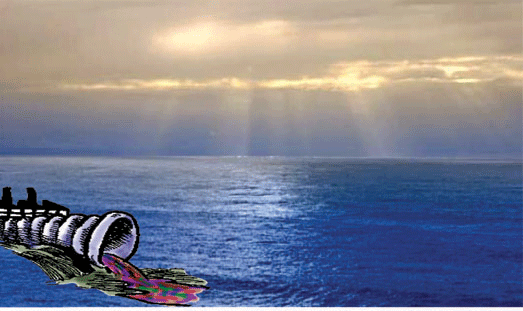
SafeEnergy E Journal No.92. December 21, Radioactive Discharges The OSPAR Convention for the Protection of the North-East Atlantic has discreetly postponed its commitment to reduce radioactive discharges at sea from 2020 to 2050. Following a meeting on October 1st, the participating ministers discreetly postponed until 2050 the commitment made in 1998 in Sintra to reduce radioactive discharges into the sea to levels close to zero by 2020.
Once again, international commitments to the environment are being disregarded. This does not bode well for the upcoming COP26 in Glasgow. France is the first beneficiary of this 30-year postponement because, with its reprocessing plant at La Hague, it has the highest radioactive discharges to the sea in Europe. And these discharges are not decreasing, as shown by the results of the citizen monitoring of radioactivity in the environment carried out by Association pour le Contrôle de la Radioactivité dans l’Oues (ACRO) for over 25 years. (1)
The “Cascais Declaration” signed at a Ministerial Meeting in October 2021 said:“We aim to achieve zero pollution by 2050 and commit to reduce single-use plastic items and maritime related plastic items on our beaches by 50% by 2025 and 75% by 2030. We will take action to eliminate anthropogenic eutrophication and continue to reduce hazardous and radioactive substances to near background levels for naturally occurring substances and close to zero for human made substances.” (2)
Remi Parmentier, who was the lead Greenpeace International campaigner when the Sintra Decalation was signed in 1998 tweeted:
“30 yrs backward presented as progress. The OSPAR Commission is using Orwellian language: “We *aim* to achieve zero pollution by 2050” [“aim”, not “commit”], wiping out the previous target date (agreed in 1998) which was…2020.”
Meanwhile, the NDA is now saying all Magnox reprocessing will be completed in 2022. The Magnox reprocessing plant was expected to close in 2020 before delays caused by Covid. (3
2. OSPAR Cascais Declaration October 2021 https://www.ospar.org/site/assets/files/46205/cascaisdeclaration2021.pdf
3. NDA Mission Progress Report 2021. 4th Nov 2021 https://assets.publishing.service.gov.uk/government/uploads/system/uploads/attachment_data/file/103121https://www.no2nuclearpower.org.uk/wp/wp-content/uploads/2021/11/SafeEnergy_No92.pdf
Pilgrim nuclear plant may release 1M gallons of radioactive water into bay. What we know

“It’s not permitted by the EPA, but that doesn’t mean it can’t happen if the NRC allows it,”
Pilgrim nuclear plant may release 1M gallons of radioactive water into bay. What we know, https://www.capecodtimes.com/story/news/2021/11/24/pilgrim-nuclear-power-station-decommissioning-cape-cod-bay-potentially-radioactive-water-holtec/8752364002/, Doug Fraser, Cape Cod TimesPLYMOUTH — One of the options being considered by the company that is decommissioning the closed Pilgrim Nuclear Power Station is to release around one million gallons of potentially radioactive water into Cape Cod Bay.
The option had been discussed briefly with state regulatory officials as one possible way to get rid of water from the spent fuel pool, the reactor vessel and other components of the facility, Holtec International spokesman Patrick O’Brien said in an interview Wednesday. It was highlighted in a report by state Department of Environmental Protection Deputy Regional Director Seth Pickering at Monday’s meeting of the Nuclear Decommissioning Citizens Advisory Panel in Plymouth.
“We had broached that with the state, but we’ve made no decision on that,” O’Brien said.
As of mid-December, Holtec will complete the process of moving all the spent fuel rods into casks that are being stored on a concrete pad on the Pilgrim plant site in Plymouth. After that, O’Brien told the panel, the removal and disposal of other components in those areas of the facility will take place and be completed sometime in February.
O’Brien said the remaining water used to cool the fuel rods in the pool and inside the reactor will be dealt with — the process to decide on a disposal method will get underway within the next six months to a year. Two other possible options discussed at Monday’s meeting are trucking the water off-site to an approved facility, as Vermont Yankee Nuclear Power Plant did in shipping its contaminated water to a site in Idaho or to evaporate it, a process that has already been employed in some areas of the Plymouth plant.
Before they decide on any options, O’Brien said they would do an analysis to determine what contaminants the water contains. Likely, it will be metals and radioactive materials, he said.
Radioactive water inspected before it is released
Pickering pointed out that any water discharged under the federal Clean Water Act discharge permit overseen by the federal Environmental Protection Agency would have to be part of an approved plan reviewed by the EPA, the DEP and the state Department of Public Health.
“Mass DEP, and the U.S. EPA have made the company aware that any discharge of pollutants regulated under the Clean Water Act, (and) contained within spent fuel cooling water, into the ocean through Cape Cod Bay is not authorized under the NPDES (National Pollution Discharge Elimination System) permit,” Pickering said. But he went on to say that radioactivity is not listed under the NPDES as a pollutant and is regulated by the Nuclear Regulatory Commission.
Pine duBois, vice chair of the citizens decommissioning panel, cited a memorandum of understanding signed by Holtec that governed the decommissioning of Pilgrim — negotiated by the state Attorney General’s office — that stated discharge of pollutants into Cape Cod Bay is not permitted.
“It’s not permitted by the EPA, but that doesn’t mean it can’t happen if the NRC allows it,” duBois said.
O’Brien noted that it was a fairly common practice in the nuclear industry, known as “overboarding,” to release water, including radioactive water, into the ocean from power plants. He said it happened recently during the decommissioning of New Jersey’s Oyster Creek facility, which is also being done by Holtec.
Opposition to plan comes from Cape Cod resident and officials
But state Sen. Susan Moran, D-Falmouth, said she is opposed to any release of radioactive water into Cape Cod Bay as part of the decommissioning process. She called for Holtec to release plans on how they will handle all waste materials at the plant.
The Nov. 7 accidental release of over 7,200 gallons of water into Cape Cod Bay — when contractors, seeking to drain a flooded electrical vault to do repair work following the October nor’easter, pumped water into a storm drain that emptied into the sea — did not inspire confidence in the execution of protocols, plant watchdogs say. That discharge was believed to be non-radioactive water.
“Although the recently reported violation of the station national pollutant discharge elimination system has been described as isolated, it brings to light that there are not sufficient safeguards and procedures in place to prevent discharges of contaminated water into the Cape Cod Bay. The potential for pollutants and dangerous materials being discharged in our water resources is alarming,” Moran said in an email Wednesday. “Further, it is imperative that the federal agencies stop kicking the can down the road and determine long term solutions for the removal of these materials safely and expeditiously.”
Diane Turco, of Harwich, the director of Cape Downwinders, a citizen group that was at the forefront of the effort to close Pilgrim, called any option that included sending radioactive water into the bay “outrageous” and “criminal.” Turco said she has no confidence in the decommissioning process.
“The process has been to allow radioactivity into the environment,” she said. “The answer should be no you can’t do that.”
Richard Delaney, the president of the Center for Coastal Studies, agreed.
“My immediate reaction to putting radioactivity into the ocean, into that part of Cape Cod Bay is that it would be nature-negative,” he said. “We have been monitoring water quality in Cape Cod Bay for 20 years and there’s already enough pollutants going into the bay. To put radioactive waste on top of that — it shouldn’t be an option.”
Delaney said he wondered if it was included as an option to be analyzed, but one that in the end wouldn’t seriously be considered. DuBois agreed.
“I have a hard time thinking the NRC overrules (the EPA),” duBois said, adding that Holtec will be careful about damaging the environment.
“I think Holtec wants to do this right because they want to be a giant of the (decommissioning) industry. If they mess up Pilgrim, their reputation is dead,” duBois said.
Turco called on the public to start paying more attention to the decommissioning process and attend citizens advisory board meetings in person and remotely. But O’Brien and duBois said the public comment period pretty much passed with the issuance of the NPDES permit.
Radiation control organisation calls for significant reduction in toxic releases fro La Hague nuclear facility.
ASN consultation on discharges from the La Hague plants: Association pour le Contrôle de la Radioactivité dans l’Oues (ACRO) requests a significant reduction in toxic releases from La Hague.
The Nuclear Safety Authority (ASN) has made available for public consultation , for a period of 2 weeks only, its draft decisions modifying certain methods of water withdrawal and consumption, discharge and environmental monitoring, and certain environmental discharge limits for liquid and gaseous effluents from the La Hague plant.
Remember that these factories have the highest radioactive releases at sea in the world and that ACRO, as part of its citizen surveillance , detects them as far as Denmark. Let us also remember that France is committed, within the framework of the OSPAR conventionfor the protection of the North-East Atlantic, to reduce its discharges into the sea so as to bring, for radioactive substances, the levels in the environment to levels close to the background noise for natural substances and close to zero for those of artificial origin by 2020. This commitment made in 1998, in Sintra, Portugal, by the Member States of the OSPAR convention was confirmed at the following meetings in 2003 in Bremen and 2010 in Bergen. Since none of these waste reduction policy has been implemented, the 2020 deadline was quietly pushed 2050 on 1 st October 2021 . In addition, the 2021 commitment also includes a reduction in chemical discharges so as to obtain levels close to zero in 2050……………
Finally, it should be remembered that the ACRO had highlighted, in 2016, a substantial radioactive pollution in the Ru des Landes and Areva, now Orano, had undertaken to “take back and condition the land marked with americium 241 in the zone located to the north- west of the site. “ To date, no work has been undertaken.
ACRO 22nd Nov 2021
Consultation ASN relative aux rejets des usines de La Hague : l’ACRO demande une réduction significative
Waste Isolation Pilot Plant (WIPP) gets 13,000th nuclear waste shipment, and plans for much more
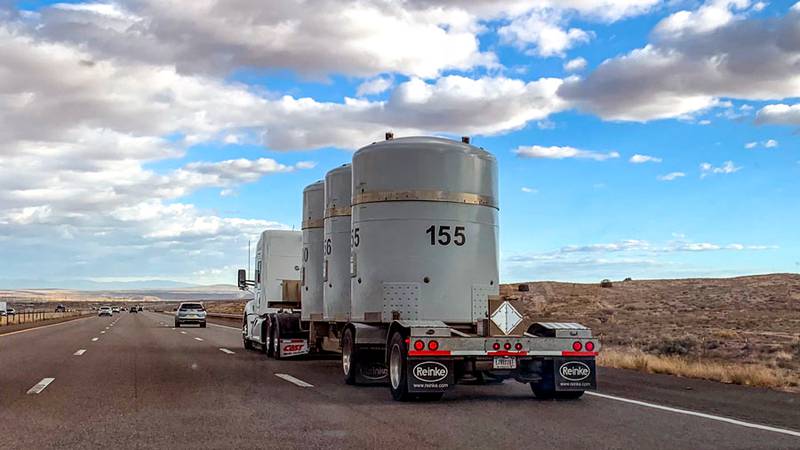
Waste Isolation Pilot Plant gets 13K nuclear waste shipments, plans to ‘ramp up’ to 17 a week, Adrian Hedden, Carlsbad Current-Argus 24 Nov 21, A 13,000th shipment of nuclear waste was delivered to the Waste Isolation Pilot Plant repository near Carlsbad Nov. 11, marking a milestone since the facility first began accepting waste in 1999.
The shipment was made up of transuranic (TRU) waste from the U.S. Department of Energy’s Idaho National Laboratory from that facility’s Advanced Mixed Waste Treatment Project.
About half of WIPP’s shipments in its lifetime came from the Idaho lab, about 6,600……..
Of the 13,000 shipments of waste sent to WIPP in the last two decades, 775 were considered remote-handled (RH) waste, handled in shielded casks and emplaced in the walls of the WIPP underground – an underground salt deposit that gradually buried the waste permanently and blocks radiation.
To get that waste to the WIPP facility from nuclear sites owned by the DOE around the country, truck drivers logged about 15 million miles, per a DOE news release, without a “serious injury” or radiological release.
……. WIPP’s first shipment was delivered for disposal from Los Alamos in March 1999, and the site went on to dispose of waste from 13 facilities around the U.S.
The final shipment from Rocky Flats and Environmental Technology Site in Colorado came in 2005, and the 10,000 shipment was received – also from Idaho – in 2011.
The first RH waste shipment was disposed of at WIPP in 2007, and the facility hasn’t receive RH waste since 2014, although the process of resuming RH waste was underway and expected to take about three years.
…….. WIPP will continue to prioritize shipments from Los Alamos and Idaho, Knerr said, for the “bulk” of the next decade.
Reinhard Knerr, manager of the DOE’s Carlsbad Field Office said increasing shipments can be achieved ahead of an ongoing rebuild of the facility’s ventilation system planned to go into service in 2025 or 2026.
“We believe we’re going to be ready to resume increased shipments well before that,” he said.
To achieve that goal, Knerr said WIPP must complete multiple projects: filling and closing out the 7th waste disposal panel by 2022 and finishing emplacement in Panel 8 by 2025.
Then, he said WIPP hopes to emplace waste in Panels 11, 12 in the coming years and Panel 13 by 2034.
Plans were recently announced to mine Panels 11 and 12, described by WIPP officials as “replacement” panels for capacity lost in an accidental radiological release in 2014 that led to a three-year halt of WIPP’s primary operations.
To support the increase in waste emplacement and mining, Knerr said a fourth shift was intended to be added to the WIPP workforce.
“We have to make sure that we are mining,” Knerr said. “That includes the access drifts as well as mining out the panels themselves. We need to be sure that we have enough staff on site to support not only the mining needs that we have, but the waste emplacement as well.” https://www.currentargus.com/story/news/local/2021/11/26/waste-isolation-pilot-plant-gets-13-k-nuclear-waste-shipments/8739296002/
Hunterston nuclear reactor 3 closed, but there will be decades from defuelling through dismantling
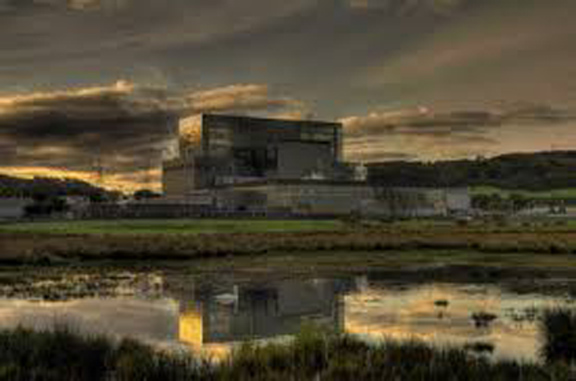
SafeEnergy E Journal No.92. December 2 Hunterston Reactor 3 is expected to come off line at the end of November and Reactor 4 before 7th January 2022. There would then be 2 months of statutory outage and then defueling would commence. EDF is hoping to despatch 4 rather than 2 spent fuel flasks every week to Sellafield during defueling.
Defueling will take around three years and will continue to draw on the skills of EDF’s specialist staff and contractors. It will then take around 5 or 6 years to prepare the plant for a period of 40 to 50 years of care and maintenance. Final dismantling could begin around 2070. https://www.no2nuclearpower.org.uk/wp/wp-content/uploads/2021/11/SafeEnergy_No92.pdf
Bipartisan USA lawmakers Press Biden to stop Canadian plan to store nuclear waste near Lake Huron.
Michigan reps press Biden to stop Canadian plan to store nuclear waste near Lake Huron. Melissa Nann Burke, The Detroit News, 26 Nov 21, Washington — Bipartisan Michigan lawmakers are pressing President Joe Biden to talk to the Canadian government about stopping the proposal for a permanent repository for radioactive waste near Lake Huron.
U.S. Reps. Dan Kildee, D-Flint Township; Andy Levin, D-Bloomfield Township; and Peter Meijer, R-Grand Rapids Township, spoke out ahead of Biden’s recent meeting with Canadian Prime Minister Justin Trudeau, expressing their opposition to the plans.
“We are disappointed the Canadian government has proposed building a permanent nuclear waste repository in the Great Lakes basin, threatening the drinking water of more than 40 million people on both sides of the border,” the lawmakers said in a joint statement.
“We ask President Biden to work with Prime Minister Trudeau to ensure that no nuclear waste is permanently stored in the shared Great Lakes water basin.”
The representatives pointed out the Canadian government opposed any potential sites for permanently storing nuclear waste located within shared water basins when the United States was investigating sites in the 1980s, noting the Americans ultimately chose another site “out of respect for our Canadian friends.”……………..
This month, the NWMO began a three-dimensional seismic survey in South Bruce as part of its ongoing study to determine the site’s suitability for the deep geological repository.
Kildee in September introduced a resolution in the House expressing opposition to the site in South Bruce, joined by a bipartisan group of lawmakers from Great Lakes states. https://www.detroitnews.com/story/news/politics/2021/11/26/biden-pressed-stop-canadian-nuclear-waste-storage-near-lake-huron/8725074002/
UK’s Ministry of Defence makes unprecedented attempt to dismantle dead nuclear submarines
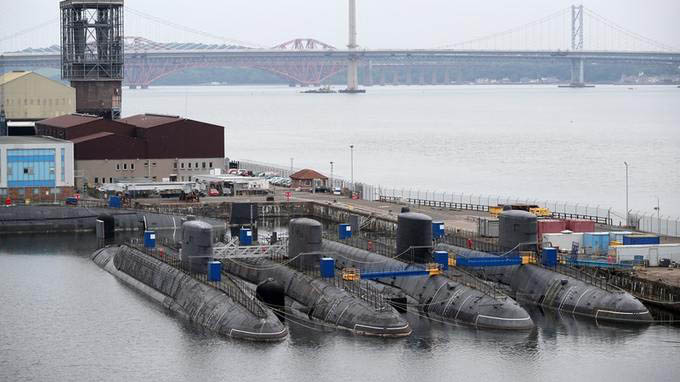
SafeEnergy E Journal No.92. December 21 , Submarine Dismantling The UK’s Submarine Dismantling Project hopes to dismantle 27 of the UK’s de-fuelled, nuclearpowered submarines after they have left service with the Royal Navy.
A demonstrator submarine is being used to define and refine the dismantling process. At Rosyth, the removal of low-level radioactive waste from the first two submarines, Swiftsure and Resolution, has been successfully and safely completed. As the unique approach is developed, work continues with the removal of low-level radioactive waste from a third submarine, Revenge. A fully developed process for steady state submarine dismantling should be ready by 2026. As the demonstrator programme progresses, the outcomes will provide more certainty in the future costs to dismantle the Devonport-based submarines. It is not MoD policy to pre-announce the funding of its projects for reasons of protecting commercial interests.”
REVENGE, entered the dry dock in Rosyth in late March 2020 to commence its LLW removal. The intent is to remove all LLW including large components such as steam generators and pressurisers. No nation has yet attempted this complex and challenging undertaking, so the MoD is currently putting in place the techniques necessary to remove all LLW for the first time to comply with safety and sustainability standards. https://www.no2nuclearpower.org.uk/wp/wp-content/uploads/2021/11/SafeEnergy_No92.pdf
Another step in the effort to clean up Hanford’s massive nuclear waste problem .

20 years in the making, massive nuclear plant takes final steps to treating Hanford waste, Tri City Herald BY ANNETTE CARY 23 Nov 21 The massive Hanford vitrification plant now is in its final phase of work before it starts operating to treat some of the nuclear reservation’s radioactive tank waste. The Department of Energy announced Tuesday that the startup testing phase for treating low activity radioactive waste at the $17 billion plant was complete, following completion of plant construction around the first of the year.
Now Hanford workers can shift all of their focus to commissioning, taking the final steps to demonstrate that the plant works before it starts treating radioactive waste by late 2023………………………….
Commissioning includes operating the plant with a nonradioactive simulant of the waste it was built to treat, before radioactive waste is piped to the plant in about two years. Construction on the plant started in 2002 with a plan to turn much of the 56 million gallons of radioactive and hazardous chemical waste stored in underground tanks into a stable glass form for disposal.
The waste is left from producing nearly two-thirds of the plutonium for the nation’s nuclear weapons program from World War II through the Cold War at the 580-square-mile site near Richland in Eastern Washington………….
The plant is not required under a federal court order to be fully operational, treating both high level and low activity waste, until 2036. But the court-set deadline for treating low activity waste is the end of 2023, although DOE may be given some additional time due to the COVID-19 pandemic, which slowed some work…………
The containers of low activity radioactive waste will be disposed of at a nearby lined landfill, Hanford’s Integrated Disposal Facility. https://www.tri-cityherald.com/news/local/hanford/article256040252.html
Europe to pay half for raising Russia’s dangerous sunken submarines, – while Russia builds new ones!

“The sunken submarines K-27 and K-159 are the potential source of contamination of the Arctic, the riskiest ones,”
As Moscow this spring took the Chair of the Arctic Council, the need to lift dangerous nuclear materials from the seabed was highlighted as a priority.
No other places in the world’s oceans have more radioactive and nuclear waste than the Kara Sea.
Europe to pay half … it is a dilemma that international partners are providing financial support to lift old Cold War submarines from the ocean, while Russia gives priority to building new nuclear-powered submarines threatening the security landscape in northern Europe.
EU willing to co-fund lifting of sunken nuclear subs from Arctic seabed https://thebarentsobserver.com/en/nuclear-safety/2021/11/europe-offers-pay-russia-raise-sunken-nuclear-subs The Northern Dimension Environmental Partnership (NDEP) has decided to start a technical review aimed to find a safe way to lift two Cold War submarines from the Barents- and Kara Seas. By Thomas Nilsen
“We are proceeding now,” says a smiling Jari Vilén, Finland’s Ambassador for Barents and Northern Dimension.
Projects aimed to improve nuclear safety are some of the few successful arenas for cooperation still going strong between the European Union and Russia.
“In roughly two years time we will have the understanding on what and how it can be done, what kind of technology has to be used,” Vilén elaborates with reference to the two old Soviet submarines K-159 and K-27, both rusting on the Arctic seabed with highly radioactive spent nuclear fuel elements in their reactors.
Continue readingHumboldt nuclear reactor is dead and gone, but its highly radioactive wastes live on.
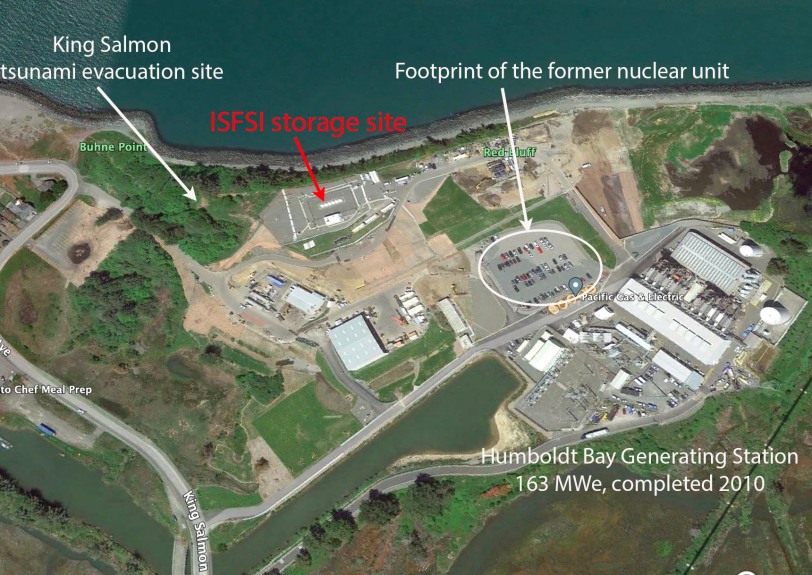
Is this the final chapter? The NRC will soon revoke the operating license for PG&E Unit #3, formally ending its official existence. But the waste is still on-site. The NRC considers cask storage a temporary solution and suggests a 40-year life span. Some hope the casks can last up to 100 years but even this is far shorter than the time needed to safely store high-level waste.
Lori Dengler | Decommissioning a nuclear power plant is a long slow process, https://www.times-standard.com/2021/11/20/lori-dengler-decommissioning-a-nuclear-power-plant-is-a-long-slow-process/By LORI DENGLER |November 20, Nothing happens quickly with a nuclear plant. Power is generated through fission, a process of splitting atoms in a controlled way. Once fission begins, it can be slowed or increased, but there’s no on-off switch and a controlled shutdown takes 6-12 hours. The radioactive byproducts last for millennia.
The fuel at PG&E’s former nuclear facility at King Salmon was small ceramic uranium oxide pellets compressed into fuel rods. A single new rod is only mildly radioactive, but when groups of rods (assemblies) are brought closely together in a reactor core, fission commences. PG&E’s Unit #3 was a boiling water reactor (BWR), where water pumped into the core was brought to a boil and steam produced electricity.
All first-generation nuclear reactors were BWRs. Built in the late 1950s to mid-1960s, seven became operational in the US and none are operating today. In the late 1960s, the second generation BWRs came online with improved efficiency, lifespan, containment, and safety features. The Fukushima-Daichi Nuclear Power Plant that failed during the 2011 Japan tsunami was this type. Of the 93 operating reactors in the US today, 31 are BWRs.
During its 13-year operational history, the Humboldt nuclear facility generated most of the county’s electricity. It was shut down yearly for refueling and maintenance and the spent fuel rods were placed in a cooling pool on the site. The pool was within the containment structure and made of steel-lined reinforced concrete several feet thick.
Spent fuel and reactor waste has been and continues to be the Achilles heel of the nuclear industry. In the early decades of the nuclear era, it was often glossed over as something that science and technology could solve. The Nuclear Regulatory Commission (NRC) classifies nuclear waste as high level or low level depending upon how long-lived the radioactive material is.
Low-level waste is produced by medical facilities, research labs, commercial facilities and in reactor operations. Often short-lived, it has radioactivity levels only slightly above background and can be safely handled with simple precautions. Small amounts can be disposed as ordinary trash and larger amounts moved on highways to approved low-level waste repositories.
It’s the high-level waste that is the big problem. High-level waste is predominately spent nuclear fuel rods. “Spent” is a misnomer as it still contains a substantial amount of energy. Unlike the new, unused fuel rods, they are now highly radioactive and very hot. That’s because once fission starts, can’t be totally stopped. Not all the uranium has been used up; it’s just no longer concentrated enough to be economically worthwhile. Fission is a complex process and creates toxic daughters such as cesium-137 and strontium-90. Fission releases neutrons which may be captured by other uranium atoms to form heavier elements such as plutonium. They aren’t as hot as the daughters but take much longer to decay. Plutonium-239 has a half-life (the time for half to be used up) of 24,100 years.
I admit to much ignorance when it comes to nuclear reactors. In talking about the Humboldt plant, I used to remark how silly it seemed that new fuel rods could be transported on highways and used ones could not. Now I understand why. There is no fission going on in the new ones and emissions are very low.
PG&E announced intentions to decommission Unit #3 in 1983. Three years later, the company requested a SAFTOR license amendment from the NRC. SAFSTOR means “possess-but-not-operate” so that the plant is maintained and monitored and much of the waste can decay before dismantling begins. In 2003, PG&E submitted an application to the NRC to begin transferring the spent fuel rods into dry cask storage.
The Humboldt plant produced 390 spent fuel assemblies in its lifetime. After several years in a storage pool, the NRC considers the waste cool enough to be moved into a dry cask storage facility on site. High-level waste repositories are known as ISFSIs (independent spent fuel storage installation). Finding an ISFSI spot on Buhne Point was problematic in many ways.
The biggest problem was that the ISFSI had to be on the PG&E site. Buhne Point site is exposed to earthquake and tsunami threats, erosion, and sea-level rise. Many people were involved with environmental and hazards studies over the years including a number of HSU geology grads. A site was selected at an elevation of 44 feet just to the west of Unit #3 with the capacity to store 37 tons of high-level waste in six casks.
I attended a community meeting about the ISFSI plan in the early 2000s. It was well attended with scientists, environmental organizations, and other community representatives. What surprised me most was that everyone agreed it was the best solution to a problem all of us wish we never had. Oh, if only time travel were possible – PG&E would be the first in line to reverse the decision to build the Humboldt nuclear facility. But given the legal realities, this was the best option.
NRC issued the Humboldt SAFSTOR license to PG&E in November 2005. By 2008, all of the spent fuel had been moved to the dry casks. The active decommissioning of the site began in 2009 and included removal of the reactor vessel, nuclear systems, containment structure, and other infrastructure. Even the soils at the site were removed. The final step was site restoration and soil remediation. It’s unclear what the footprint of the former nuclear facility may eventually become; at present, it is a parking lot.
Is this the final chapter? The NRC will soon revoke the operating license for PG&E Unit #3, formally ending its official existence. But the waste is still on-site. The NRC considers cask storage a temporary solution and suggests a 40-year life span. Some hope the casks can last up to 100 years but even this is far shorter than the time needed to safely store high-level waste.
Note: The Humboldt ISFSI is covered at http://archive.wmsym.org/2010/pdfs/10217.pdf. If anyone wants to get into the weeds with nuclear reactor technology, see https://www.amacad.org/sites/default/files/academy/pdfs/nuclearReactors.pdf.
Lori Dengler is an emeritus professor of geology at Humboldt State University, an expert in tsunami and earthquake hazards. Questions or comments about this column, or want a free copy of the preparedness magazine “Living on Shaky Ground”? Leave a message at 707-826-6019 or email Kamome@humboldt.edu. https://www.times-standard.com/2021/11/20/lori-dengler-decommissioning-a-nuclear-power-plant-is-a-long-slow-process/
The growing unsolved problem of nuclear waste – becoming desperate in Sweden.

Five Swedish nuclear reactors may need to close between 2024 and 2028, simply because a temporary site for storing spent fuel will soon be full.
And the Swedish government has yet to approve a final waste repository.
The timetable is that the Forsmark 4 reactor risks closure in 2024, followed in 2025 by Forsmark 3, Ringhals 3 and 4 and finally Forsmark 1 in 2028. Ringhals is owned by a consortium comprising Vattenfall and Uniper, while Forsmark is owned by the same two companies plus Fortum and Skelleftea Kraft.
A Swedish government decision on used nuclear fuel storage must by law be made no later than September 30 this year, so as to avoid exceeding the official permit at the interim storage site at Oskarshamn.
Precisely where nuclear waste is to be stored long-term remains a dilemma which effectively faces every single government that permits nuclear power. And the more such plants are built, the more the problem grows.
Electrical Review 18th Nov 2021
1 This Month
15 October. Joint Appeal for Nuclear Abolition Day -presentation to the UN on October 15 will be live on UNWebTV
Endorse the Nuclear Abolition Day Appeal
23-25 October – on Zoom – World BEYOND War’s annual global conference

To see nuclear-related stories in greater depth and intensity – go to https://nuclearinformation.wordpress.com
-
Archives
- October 2026 (149)
- September 2026 (339)
- August 2026 (330)
- July 2026 (355)
- June 2026 (287)
- May 2026 (306)
- April 2026 (356)
- March 2026 (251)
- February 2026 (267)
- January 2026 (308)
- December 2025 (358)
- November 2025 (359)
-
Categories
- 1
- 1 NUCLEAR ISSUES
- business and costs
- climate change
- culture and arts
- ENERGY
- environment
- health
- history
- indigenous issues
- Legal
- marketing of nuclear
- media
- opposition to nuclear
- PERSONAL STORIES
- politics
- politics international
- Religion and ethics
- safety
- secrets,lies and civil liberties
- spinbuster
- technology
- Uranium
- wastes
- weapons and war
- Women
- 2 WORLD
- ACTION
- AFRICA
- Atrocities
- AUSTRALIA
- Christina's notes
- Christina's themes
- culture and arts
- Events
- Fuk 2022
- Fuk 2023
- Fukushima 2017
- Fukushima 2018
- fukushima 2019
- Fukushima 2020
- Fukushima 2021
- general
- global warming
- Humour (God we need it)
- Nuclear
- RARE EARTHS
- Reference
- resources – print
- Resources -audiovicual
- Weekly Newsletter
- World
- World Nuclear
- YouTube
-
RSS
Entries RSS
Comments RSS

