New nuclear reactors will pose a bigger, hotter, more long-lasting waste problem

As Boris Johnson prepares a new push for nuclear power, the £131bn
problem of how to safely dispose of vast volumes of radioactive waste
created by the last British atomic energy programme remains unsolved.
The hugely expensive and dangerous legacy of the UK’s 20th-century nuclear
revolution amounts to 700,000 cubic metres of toxic waste – roughly the
volume of 6,000 doubledecker buses. Much of it is stored at Sellafield in
Cumbria, which the Office for Nuclear Regulation says is one of the most
complex and hazardous nuclear sites in the world.
As yet, there is nowhere
to safely and permanently deposit this waste. Nearly 50 years ago the
solution of a deep geological disposal facility (GDF) was put forward, but
decades later the UK is no nearer to building one.
Experts say new nuclear
facilities will only add to the problem of what to do with radioactive
waste from nuclear energy and that the “back end” issue of the
hazardous toxic waste from the technology must not be hidden.
An assessment by the Nuclear Decommissioning Authority (NDA) says spent fuel from new
nuclear reactors will be of such high temperatures it would need to stay on
site for 140 years before it could be removed to a GDF, if one is ever
built in the UK.
“It is essential to talk about the back end of the
nuclear fuel cycle when you are considering building new nuclear power
stations,” said Claire Corkhill, a professor of nuclear material
degradation at the University of Sheffield and a member of the Committee on
Radioactive Waste Management, an independent body that advises the
government.
Whilst we have a plan to finally and safely deal with the
waste, it is less certain how this will be applied to the modern nuclear
reactors that the government are planning to roll out. “These are
completely different to previous reactors and we are at a very early stage
of understanding how to deal with the waste.
In my personal view, I do not
think we should be building any new nuclear reactors until we have a
geological disposal facility available.” “The amount of legacy waste is
not small in terms of nuclear waste,” said Corkhill. “It is expensive
to deal with. These materials are hazardous and we are looking at an
underground footprint of some 20km at a depth of 200 metres to 1,000
metres.
So regarding new nuclear sites, we need to think about whether it
is possible to build a GDF big enough for all the legacy waste and the new
nuclear waste.” Steve Thomas, a professor of energy policy at the
University of Greenwich, said: “Despite 65 years of using nuclear power
in Britain, we are still, at best, decades away from having facilities to
safely dispose of the waste. Until we know this can be done, it is
premature to embark on a major new programme of nuclear power plants.”
A government spokesperson said: “This is not an either/or situation. As the
prime minister has said, nuclear will be a key part of our upcoming energy
security strategy alongside renewables. We are committed to scaling up our
nuclear electricity generation capacity, and building more nuclear power
here in the UK, as seen through the construction of Hinkley Point C – the
first new nuclear power station in a generation. Alongside this we’re
developing a GDF to support the decommissioning of the UK’s older nuclear
facilities.”
Guardian 28th March 2022
Over 1000 tonnes of steel drums full of nuclear waste dumped at Drigg, Cumbria
The Nuclear Decommissioning Authority trumpet their latest “success”
– the dumping of more than 1000 tonnes of steel drums filled with nuclear
wastes at the “Low Level Waste Repository in Drigg, Cumbria – from the
redundant Magnox site at Winfrith, Dorset. This is their triumphant
announcement…..“A major project to dispose of more than 1,000 stainless
steel drums of waste has successfully completed its initial rail transfer.
From: Nuclear Waste Services, Magnox Ltd, and Nuclear Decommissioning
Authority Published 25 March 2022.
Radiation Free Lakeland 26th March 2022
USA’s production for plutonium ”pits”will fall short of the goal.
NNSA Pick To Review Plutonium Pit Plan As Goal Appears Out Of Reach, March 22, 2022 The Biden administration’s pick to lead the National Nuclear Security Administration’s (NNSA) military programs told lawmakers he would review the plan to increase production of plutonium pits at two NNSA locations, as it becomes increasingly evident the administration will likely fall short of the… (Subscribers only) https://aviationweek.com/defense-space/budget-policy-operations/nnsa-pick-review-plutonium-pit-plan-goal-appears-out-reach
Fate of Radioactive Waste at Plymouth Nuclear Site Continues to Raise Concerns
PILGRIM NUCLEAR POWER STATION
Fate of Radioactive Waste at Plymouth Nuclear Site Continues to Raise Concerns https://www.nbcboston.com/news/local/radioactive-waste-at-plymouth-nuclear-site-continues-to-raise-concerns/2672927/
The Plymouth Board of Health has issued a resolution strongly opposing any potential plan to dump nearly 1 million gallons of radioactive waste into Cape Cod Bay.
This comes amid ongoing conversations about how Holtec International, which purchased Plymouth’s Pilgrim Nuclear Power Station in 2019, intends to complete the plant’s decommissioning. While Holtec says no final decisions have been made about what it will do with Pilgrim’s radioactive waste, many in the area fear it will be released into the bay.
The Board of Health Resolution said that type of release could likely cause “immense” damage to the area’s shell fishing, aquaculture, maritime and tourist-based economy. It also notes that there would be health hazards for exposure to the type of radioactive compounds in question, including increased risk of cancers and potential harm to pregnant women and their fetuses.”All of these radioactive compounds have already been found in the surface water, groundwater and soils at Pilgrim at levels exceeding “background levels,” the resolution reads. “There is also a longer-term risk to our sole source aquifer water supply – especially from tritium which isn’t removed by existing filtration producers used to purification attempts.”
The resolution goes on to urge Holtec to choose the “safest possible disposal method” for the radioactive water that must be removed during the decommissioning process. It also urges lawmakers to add new language to state law to prohibit this type of release of solid or radioactive material in coastal or inland waters.
What a Power Cutoff Could Mean for Chernobyl’s Nuclear Waste.

| What a Power Cutoff Could Mean for Chernobyl’s Nuclear Waste. With no working reactors, there is no risk of a meltdown. But the ruins from the 1986 disaster still pose considerable dangers. The plant’s remaining three reactors were eventually shut down, the last in 2000. The nuclear fuel has been removed from all of them, and the turbines and other equipment that generated power have mostly been removed. With no operating reactors at the plant, there is no risk of a core meltdown as there would be if an operating plant lost power and could no longer circulate water through the reactor. This is what happened at the Fukushima reactors in Japan in 2011, when an earthquake and tsunami wiped out backup power systems. But Chernobyl carries some other risks related to the large amount of nuclear waste on site. If the water in storage tanks got so hot it boiled off, the fuel would be exposed to the air and could catch fire. That, too, was among the risks in the Fukushima disaster. The I.A.E.A. has said that the used fuel assemblies at Chernobyl are old enough and have decayed enough that circulating pumps are not needed to keep them safe. “The heat load of the spent fuel storage pool and the volume of cooling water contained in the pool is sufficient to maintain effective heat removal without the need for electrical supply,” the agency said. New York Times 9th March 2022https://www.nytimes.com/2022/03/09/climate/chernobyl-nuclear-waste-power-outage.html |
The importance of continuous cooling of nuclear spent fuel
Despite reassurances by the International Atomic Energy Agency (IAEA) that
there is no imminent safety threat posed by the power isolation, it is
important to understand the potential impact going forward.
When nuclear
fuel is removed from the core of a reactor, it is redesignated as
“spent” nuclear fuel and often treated as a waste product for disposal.
But fuel will continue to dissipate heat due to radioactive decay, even
after being removed from the reactor core.
It is therefore of foremost
importance that the spent fuel material contained at the Chernobyl site is
adequately and continuously cooled to prevent a release of radioactivity.
At Chernobyl, as well as other sites, standard procedures to safely handle
such material involves placing the fuel into water-filled ponds, which
shield the near-field environment from radiation.
They also provide a
medium for heat transfer from the fuel to the water via continuous
circulation of fresh, cool water. If circulation is compromised, such as
the recent power shutdowns, the fuel will continue to emit heat. This can
make the surrounding coolant water evaporate – leaving nothing to soak up
the radiation from the fuel. It would therefore leak out to the
surroundings.
The Conversation 10th March 2022
”Save the Severn Estuary” fights to stop EDF dumping Hinkley Point’s nuclear mud into this Marine Protected Area.

oinPlans by energy firm EDF to dump hundreds of thousands of tons of sediment
from the Hinkley Point nuclear power station in the Severn Estuary are
facing a backlash. A campaign group called Save the Severn Estuary,
supported by a Welsh pop star, has launched a crowdfunding site to finance
a legal challenge.
The estuary is a designated Marine Protected Area and
campaigners, including Cian Ciaran of rock band Super Furry Animals, fear
the dumped waste, including chemical and radioactive materials, will spread
on the strong tidal currents all around the Estuary, depositing on its mud
banks and beaches. EDF, with its UK base in Gloucester, is planning to
start its second phase of sediment dumping at Portishead, near Bristol.
Punchline Gloucester 8th March 2022
Plans by energy firm EDF to dump hundreds of thousands of tons of sediment
from the Hinkley Point nuclear power station in the Severn Estuary are
facing a backlash. A campaign group called Save the Severn Estuary,
supported by a Welsh pop star, has launched a crowdfunding site to finance
a legal challenge.
The estuary is a designated Marine Protected Area and
campaigners, including Cian Ciaran of rock band Super Furry Animals, fear
the dumped waste, including chemical and radioactive materials, will spread
on the strong tidal currents all around the Estuary, depositing on its mud
banks and beaches. EDF, with its UK base in Gloucester, is planning to
start its second phase of sediment dumping at Portishead, near Bristol.
Punchline Gloucester 8th March 2022
Cumbrian campaigners’ strong opposition to nuclear waste dump in the Lake District
Campaigners will be holding a demonstration outside the Geological
Disposal Community Partnership “Drop In” at Drigg and Carleton Village
Hall this Friday from 11am to 12pm. Lakes Against Nuclear Dump say “The
Nuclear Industry are looking for somewhere to dump their hot wastes in deep
and not so deep silo’s.
The West Cumbrian Coastal Plain on the edge of
the Lake District is squarely in the frame once again. On Friday we will be
showing opposition to this plan and handing out information exposing the
fact that 16 boreholes 120 metres deep have already been drilled at the Low
Level Waste Repository to look at the possibility of Near Surface Disposal
of Intermediate Level Wastes. The Near Surface Disposal Plan for
Intermediate Level wastes is say the industry being looked at in order to
“co-locate” with the Geological Disposal plan for High Level wastes.
Near Surface Disposal would be delivered far faster – within 10 years
according to the nuclear industry.
Twenty five years ago the rejected plan
for geological disposal was limited to low and intermediate level wastes,
now it is for High Level Nuclear wastes. Its fairly obvious that nuclear
wastes would migrate even faster from a shallower grave. The Community
Partnership is a farce.”
Radiation Free Lakeland 9th March 2022
Japan’s power companies move to reduce plutonium stockpiles held overseas
Utilities move to reduce plutonium stockpiles held overseas, https://www.asahi.com/ajw/articles/14556963 By JUNICHIRO NAGASAKI/ Staff Writer, March 8, 2022 Japan’s leading power companies decided to transfer ownership of tons of plutonium stored in Britain and France for reprocessing in a quest to reduce the stockpile as quickly as possible.
The plan was unveiled Feb. 18 by the Tokyo-based Federation of Electric Power Companies of Japan (FEPC). The recycling program will allow operators of pluthermal generation facilities to use plutonium produced by other utilities.
Japan has nearly 40 tons of plutonium in storage, fueling international concerns over its potential for use in nuclear weapons.
Major utilities in Japan commission facilities in Britain and France to extract plutonium from spent nuclear fuel produced at atomic power plants in this country. It is processed into mixed-oxide (MOX) fuel for reuse at domestic nuclear plants.
Japan’s plutonium stockpiles in Britain and France totaled 21.8 tons and 15.4 tons, respectively, as of December 2020. Britain shut down its only MOX plant in 2011, which means it can no longer reprocess plutonium.
As a result, and for accounting purposes, pluthermal operators such as Kyushu Electric Power Co. will exchange their plutonium reserves in Britain for the stockpile in France for use by Tokyo Electric Power Co. and other utilities that have yet to introduce pluthermal generation. The plutonium will then be reprocessed and imported back to Japan.
As a first step, 700 kilograms of plutonium will come under the ownership transfer program for use in fiscal 2026 at the No. 3 reactor of Kyushu Electric’s Genkai plant in Saga Prefecture.
The FEPC anticipates that pluthermal power production will be in service in at least 12 reactors across Japan by fiscal 2030.
As things currently stand, the technology only applies to four reactors: the No. 3 reactor of the Genkai plant; the No. 3 reactor of Shikoku Electric Power Co.’s Ikata plant in Ehime Prefecture; and the No. 3 and No. 4 reactors of Kansai Electric Power Co.’s Takahama plant in Fukui Prefecture.
For that reason, utilities have not managed to drastically reduce the volume of stored plutonium.
A reprocessing facility operated by Japan Nuclear Fuel Ltd. in Rokkasho, Aomori Prefecture, to recover plutonium from spent nuclear fuel is scheduled for completion in the first half of fiscal 2022.
But there are fears the treatment plant will not start full-scale operations to stop plutonium from accumulating further. With that in mind, the FEPC began considering how to reduce the amount of stockpiled plutonium.
Bury it? Shoot it into space? Why scientists still can’t find a place for nuclear waste

This is the first time that I have ever seen an American mainstream media outlet making this HERETICAL SUGGESTION:
Until scientists find a secure, long-term, cost-effective way to dispose of the already generated nuclear waste on planet Earth, we must stop generating yet more of it.
Bury it? Shoot it into space? Why scientists still can’t find a place for nuclear waste, https://edition.cnn.com/2022/02/28/opinions/nuclear-radioactive-waste-climate-ipcc-hockenos/index.html (CNN)A major Intergovernmental Panel on Climate Change report, to be released Monday, is expected to warn that humans are wrecking the planet so profoundly that we may run out of ways to survive the crisis. The report speaks of a “rapidly closing window of opportunity to secure a liveable and sustainable future for all.”
This might make it tempting to rush to nuclear energy as a quick, low-carbon fix.
But its faults are numerous, not least that there is still no answer to the 80-year-old question: Where to store the burgeoning tons of highly radioactive spent fuel?
Propositions abound: from catapulting it into space, ditching it between tectonic plates, or burying it deep underground on remote islands.
But try as they have, scientists can’t find a safe, long-term, cost-effective way to dispose of nuclear waste.
Even as new countries like Poland, Egypt, Bangladesh, and Indonesia line up to start nuclear programs — on the face of it, a low-carbon energy source that could cut emissions — every nation in the world with nuclear power struggles with the same dilemma.
Thus far, the determined hunt for a secure nuclear graveyard has been unsuccessful — and there’s no fix in sight. While the search goes on, ever more of the highly toxic refuse — a lethal by-product of the plutonium and uranium used in nuclear energy and weaponry production — piles up on top of the 370,000 tons of fission residue that languishes in stockpiles worldwide. Experts say that could jump by 1.1 million tons in a century.
Germany is shutting down its last nuclear power plant at the end of this year. France, on the other hand, just announced a massive build-out of its already prodigious nuclear fleet. The US is betting on nuclear to help hit climate goals.
Like most nations with nuclear power, they store the toxic spent fuel in steel cannisters at temporary locations, usually at nuclear plant facilities and military stations — often incurring the wrath of local residents who want nothing to do with the hazardous material that remains radioactive for a million years.
Indeed, proponents and adversaries of nuclear power agree these interim solutions are untenable: we can’t just dump this toxic mess on subsequent generations, and then they on others. Moreover, spent fuel, though no longer usable for energy production, remains radioactive and thus poses health, security, and proliferation risks.
At the moment, the Finns are putting deep geological disposal on the table as a solution — currently the least objectionable of the options under discussion. But the Nordics’ claim to have finally cracked this headache from hell is riddled with uncertainties.
This summer, on a tiny, sparsely populated island in the Baltic Sea, the first of hundreds of tightly sealed volcanic-clay-and-copper-clad drums of spent nuclear fuel will be lowered into a 500-meter deep granite vault and, eventually, cemented shut — not for a million but, presumably, for about 100,000 years.
Yet this geological tomb is only another, ultimately temporary, fix. As nuclear waste expert Andrew Blowers, author of “The Legacy of Nuclear Power” and a former member of the UK’s Committee on Radioactive Waste Management, says, “Currently no options have been able to demonstrate that waste will remain isolated from the environment over the tens to hundreds of thousands of years.”
Copper and cement will eventually corrode and decay, while nuclear waste remains radioactive and highly toxic for millennia. Some experts though say the risk of leaks, and water contamination, is higher than Finnish authorities acknowledge.
Moreover, earthquakes or other dramatic shifts in geological conditions could set the poisonous elements free. And then there’s the cost: Finland will spend €3.5 billion ($3.9 billion) on the facility, which will in the course of the next 100 years house 6,500 tons — of their own — spent fuel.
Other countries, such as the US, Britain, and Sweden say they will also, one day, bury their nuclear refuse in similar vaults. But even where the unique geological conditions exist, the same obstacle always arises: opposition from locals. Nobody but nobody wants radioactive waste anywhere near their families.
This is why another option, tectonic burial, looks appealing — until one looks more closely. The idea is to send nuclear waste plummeting into the earth’s core, basically hitching a ride on a geological plate on the ocean floor that is in the process of diving beneath an adjacent plate. The further the downward plate submerges beneath the earth’s skin, the further away the nuclear waste is carried from our natural world.
But geologists pour scorn on the notion: the movement of tectonic plates is much too slow, the volume of nuclear refuse too great, and then there’s the threat of subterranean volcanos or quakes that could send the mess spewing back into the ocean.
Hurtling nuclear waste in the other direction, namely into space, is also a nonstarter. There, the risk of rocket failure, the issue of space debris, and the wildly prohibitive cost stop this ploy dead in its tracks.
The exorbitant cost of the ongoing search — and then of the “solution” itself — illustrate why we don’t want ever more of this menacing debris. Thus far, the US has spent $13 billion of taxpayer money in its unsuccessful effort to rid the country of its 90,000 tons of radioactive waste.
In Finland, at least, the nuclear industry picks up the bill. At the Finns’ rate, disposing of all of the world’s current nuclear waste could total €135 billion ($153 billion) and another €6 billion ($6.8 billion) a year for the estimated 10,500 more metric tons produced annually.
Yet, since no long-term secure repository is in sight, says Blowers, “on-site storage of spent fuel is likely to remain for several generations, at least until mid to end of next century. As the volume grows, they will have to cope with ever more complex, difficult management issues.”
And we can’t just cut and run.
Until scientists find a secure, long-term, cost-effective way to dispose of the already generated nuclear waste on planet Earth, we must stop generating yet more of it. Genuinely renewable energy is cheaper, safer, faster, and cleaner. Nuclear power is the opposite of a quick fix.
Activist groups to rally against plutonium disposal project at Waste Isolation Pilot Plant

Adrian HeddenCarlsbad Current-Argus 23 Feb 22, A plan to dilute weapons-grade plutonium and then dispose of it at the Waste Isolation Pilot Plant, an underground repository for low-level nuclear waste near Carlsbad, drew concerns from around New Mexico amid fears transporting this stream of waste could risk public safety.
The U.S. Department of Energy announced in 2020 a plan that would ship the plutonium from the Pantex Plant near Amarillo, Texas to Los Alamos National Laboratory where it would be chemically diluted.
The waste would then head to the DOE’s Savannah River Site in South Carolina for packaging before the final shipment to WIPP in southeast New Mexico.
This would mean the 34 metric tons of the waste on the way to its final resting place at the WIPP site could pass through New Mexico three times.
Cynthia Weehler, co-chair of Santa Fe-based activist group 285 All said this creates an unacceptable risk for local communities in New Mexico and 11 states she said the waste would travel through.
285 All advocates for issues throughout New Mexico, focusing on U.S. Highway 285 which stretches from the mountains in northern New Mexico down into the high desert and oilfields of the southeast region, crossing into West Texas.
That’s why Weehler and a consortium of groups critical of WIPP and nuclear activities in New Mexico planned to deliver a petition to New Mexico Gov. Michelle Lujan Grisham next week, asking the state’s highest government leader to oppose the plutonium project.
“Unless New Mexico says NO to WIPP expansion, other disposal locations will not be developed, and WIPP will always be the only dump site, which is not fair. New Mexico never agreed to bear the burden of being the only site,” read a portion of the petition.
Weehler said the petition has about 1,140 signatures as of Monday and is being distributed in the Santa Fe area and to communities along the transportation routes.
The petition will be delivered to the State Capitol at 11:30 a.m., March 1 during a press conference on the east side of the Roundhouse.
“We don’t expect an accident to happen every week or every community, but when you increase the time and the shipments, we just see this as an inevitability over the time frame,” Weehler said. “It’s going to be a huge increase in shipments and it’s going to last almost this whole century.”
Weehler said Lujan Grisham should cite the legal agreement between the State and DOE that defines WIPP’s mission: to dispose of low-level transuranic (TRU) waste at the site near Carlsbad, streams she said were pre-determined by the agreement and should not be expanded.
If the DOE’s plutonium plan moves forward, Weehler said it would amount to an “expansion” of WIPP both in its mission and the volume of waste it would accept.
“The waste would be plutonium-contaminated material, contaminated during the production of nuclear weapons,” Weehler said. “This is something different (than TRU waste).”
WIPP officials said this was not the case……………………………..
The plutonium would be “down blended” meaning its level of radioactivity would be lowered so that the waste would qualify as TRU waste and could be disposed of at WIPP without adjusting federal policy.
“In order for it qualify, they’re having to dilute it. They’re having to adulterate it,” Weehler said. “This will never be acceptable. For them to say that is just unbelievable to me.” ……….. https://www.currentargus.com/story/news/local/2022/02/23/wipp-activist-groups-rally-against-plutonium-disposal-project/6878583001/
Concern in Tamil Nadu over spent nuclear fuel storage at Kudankulam site
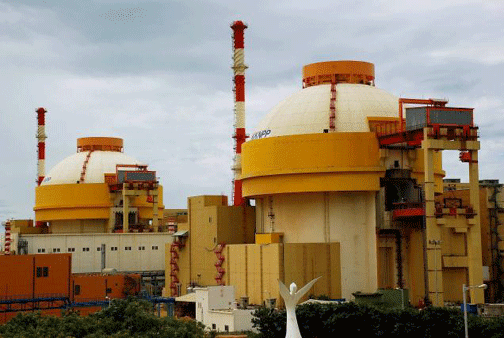
Tamil Nadu flags concern over spent nuclear fuel storage at Kudankulam site https://indianexpress.com/article/cities/chennai/tamil-nadu-flags-concern-over-spent-nuclear-fuel-storage-at-kudankulam-site-7780809/
Chief Minister M K Stalin flagged the issue with Prime Minister Narendra Modi in a letter about the issue pertaining to the power plant located in Tamil Nadu’s Tirunelveli district.
The Tamil Nadu government on Friday opposed the Nuclear Power Corporation of India Limited’s proposal to store spent nuclear fuel (SNF) at the Kudankulam Nuclear Power Plant (KNPP) site and suggested it be sent back to Russia, according to an earlier agreement or store it in an uninhabited area.
Chief Minister M K Stalin flagged the issue with Prime Minister Narendra Modi in a letter about the issue pertaining to the power plant located in Tamil Nadu’s Tirunelveli district.
Six nuclear power reactors of 1000 MW each are envisaged in this project. Out of the six, units 1 & 2 have already been commissioned, while 3 & 4 are under construction and units 5 & 6 are yet to be established, Stalin said.
The Nuclear Power Corporation of India Ltd. proposes to construct Away from Reactor (AFR) facilities in the nuclear power plant site itself for the storage of the SNF generated from all six reactors,” the Chief Minister said.
In this regard, I wish to inform that when the Ministry of Environment, Forests and Climate Change had earlier accorded permission to Units 1 & 2, the agreement was to collect and store the spent fuel temporarily within the unit’s premises (At Reactor) and then send it back to the country of origin, Russia,” he said.
However, it was subsequently decided to store the SNF permanently in the AFR facility to be located within the unit premises. “This decision was taken without consulting the state government,” he said.
Stalin told the Prime Minister that there was “deep concern and apprehensions” among the people of Tamil Nadu, including various political parties, regarding the hazards and potential danger of the AFR storage facility of the SNF within the plant premises.
Several such facilities across the world have faced accidents leading to “disastrous impacts” on the environment and the people residing in and around such plants, he said.
The local people are apprehensive of the fallouts and have been protesting against the AFR facilities within the complex.
“Therefore, I request that in the interest of public safety, health and welfare of the people of Tamil Nadu, action may be taken to transport back the SNF to Russia. This must not only be for units 1 & 2, but also for the subsequent four units. In case this is not a feasible option, the spent fuel may be permanently stored in a Deep Geological Repository (DGR) in an uninhabited and ecologically non-sensitive area,” the Chief Minister told Modi.
The case for Saving the Severn Estuary from the dumping of radioactive wastes
A grave threat to the oceans and the wellbeing of our communities could be
averted with your support for the Save The Severn Estuary Judicial Review
Case Fund – how? Just by quickly copying, pasting and sharing the
information below amongst your networks so that as many people are aware of
the impending danger as possible and have the opportunity to put their
opposition into practice.
Energy giants EDF dumped contaminated mud in the
Severn near Cardiff in 2018; now, rebuffed in Wales, they were given a
licence to dump at Portishead. The legal action is to stop them resuming
dumping in April. This should be stage-1 in the battle to end EDF’s licence
for mass slaughter of fish sucked in the river of seawater for cooling
purposes.
Save The Severn is a science-led independent coalition who have
assembled a case and engaged leading environmental lawyers to challenge
MMO’s licence. We obtained Court permission to proceed in December and have
a hearing scheduled for 8-10 March in the High Court. EDF are supporting
MMO while we have some assistance from the Conservation and Fisheries
authority.
The Severn Estuary has the highest conservation status, recently
becoming a Marine Protection Area where damaging operations are ended. The
Welsh Marine Plan accepts this but not England’s Marine Management
Organisation (MMO. Some of the Hinkley mud dumped at Cardiff and Portishead
smothered the seabed ecology, while most dispersed around the Estuary.
Increased radioactivity was detected up the coast and not only near Cardiff
following the 2018 dumping. EDF are choosing not to protect marine life for
their own profits, and they need to be stopped. We have three weeks to save
the Severn Estuary, with the Court Case hearing on 8 March 2022. Save The
Severn fundraising page here:
https://www.crowdjustice.com/case/save-the-severn-estuary/
Save the Severn (accessed) 18th Feb 2022
Plutonium problems won’t go away

Plutonium problems won’t go away, By Chris Edwards, Engineering and Technology, February 15, 2022
Nuclear energy’s environmental image is as low as carbon’s,with its clean fuel potential being tarnished by legacy waste issues. Are we any closer to resolving this?
At the end of 2021, the UK closed the curtain on one part of its nuclear waste legacy and took a few more steps towards a longer-lasting legacy. A reprocessing plant, built at the cost of £9bn in the 1990s to repackage waste plutonium from pressurised water reactors in the UK and around the world for use in new fuel, finally converted the last remaining liquid residue from Germany, Italy and Japan into glass and packed it into steel containers. It will take another six years to ship it and all the other waste that belongs to the reactor owners, who are contractually obliged to take it back.
Even when the foreign-owned waste has headed back home, the UK will still play host to one of the largest hoards of plutonium in the world, standing at more than 110 tonnes. It amounts to a fifth of the world’s total and a third of the global civilian stockpile of 316 tonnes. Despite operating a smaller nuclear fleet than France’s, the UK has 1.5 times more plutonium.
It was never meant to end this way. The long-term dream was for fission-capable fuel to keep going round in a circle, only topped up with virgin uranium when necessary. The plutonium produced during fission could itself sustain further fission in the right conditions. However, fast-breeder reactors that would be needed to close the cycle remain largely experimental, even in countries such as Russia where their development continues. Driven by both safety concerns and worries about nuclear proliferation that might result from easier access to separated and refined plutonium-239, the West abandoned its fast-breeder programmes decades ago.

It is possible to reprocess spent fuel into so-called mixed-oxide fuel, but it is only good for one use in a conventional reactor. Other actinides build up and begin to poison the fission process. The only prospects for change lie in so-called Generation IV reactors, but these designs have yet to be tested and may continue to fall foul of proliferation concerns.
While operators around the world have mulled over the practicality of fuel reuse, containers of both processed and reprocessed fuel have lingered in storage tanks cooled by water despite, in some countries, being earmarked for deep burial for decades. In the late 1980s, the US Department of Energy (DoE) settled on Yucca Mountain in Nevada as the single destination for the country’s spent nuclear fuel, and scheduled it for opening a decade later. By 2005, the earliest possible opening date had slipped by 20 years. It remains unopened and will probably never open. In the interim, much of the fuel has lingered in water-filled cooling tanks while politicians consider more localised deep-storage sites.
Fukushima provided a wake-up call to the industry, not just about the problems of controlling reactors but their spent fuel. After the tsunami, engineers were concerned that without replenishment pumps, the water in the storage tanks for the spent fuel would evaporate. If the fuel then caught fire, it would likely release radioactive tritium and caesium into the atmosphere. In a stroke of luck, water leaked into the damaged ponds. Now the issue for operators of some older reactors is that the fuel canisters are just corroding into the water instead.Experts such as Frank von Hippel, professor of public and international affairs at Princeton University, recommend storage pools should only be used until the fuel is cool enough to be transformed into glass, immersed in concrete or both, and transferred to dry storage, preferably in a deep geological disposal facility (GDF).At a conference last November organised by the International Atomic Energy Agency (IAEA), Laurie Swami, president and CEO of Canada’s Nuclear Waste Management Organisation, claimed “there is scientific consensus on the effectiveness of deep geologic repositories” for highly radioactive waste.
The UK similarly settled 15 years ago on a plan to build its own GDF for high-level waste in tandem with the establishment of a single government-owned body responsible for organising where the waste goes, in the shape of the Nuclear Decommissioning Authority (NDA). The GDF took a small step forward at the end of 2021 when two candidate sites were announced, both close to the Cumbrian coast. The local communities have agreed in principle that the NDA can investigate where they are suitable for a set of tunnels that may extend under the Irish Sea. With the project at such an early stage, the country remains years away from opening a GDF. Finland, in contrast, has pressed ahead and expects its GDF to open in 2025, while Sweden is likely to have the second one in the world.
At the same time, there is an enormous volume of other irradiated material that cannot economically be put into deep storage. In a keynote speech at the IAEA’s conference, James McKinney, head of integrated waste management at the NDA, explained that a lot of radioactive waste is contaminated building material. The Low-Level Waste Repository at Drigg in Cumbria was designed for this kind of waste, but McKinney stressed that capacity is “precious” and in danger of running out if all the material is taken there. Over the past decade, the NDA and its subcontractors have been working to divert as much waste as possible from the Drigg site by reprocessing and repackaging it.
By bringing waste management under one umbrella instead of dividing it among power-station operators, the NDA has been able to change procurement strategies to favour the use of much more R&D for waste handling. “The destination of radioactive waste can be changed through interventions,” McKinney adds. “At this moment, we estimate some 95 per cent of potential low-level waste is being diverted away [from Drigg]. Twelve years ago, the opposite would be true.”
A recent example of this in action is the dismantling of pipes that were once installed at the Harwell research centre. More than 1,500 sections of metal pipe were delivered to oil-and-gas specialist Augean, which is using high-pressure water jets to remove radioactive scale so the metal can be recycled instead of needing long-term storage.
Getting less manageable waste away from the storage tanks presents another major challenge, particularly if it comes from the oldest reactors. For example in the UK, when spent Magnox fuel was taken out of the reactors, the magnesium cladding around it was stripped away and moved to Sellafield’s Magnox Swarf Storage Silo (MSSS). Though the swarf itself is just intermediate-level waste, Sellafield’s operator regards emptying the silo ready for transfer to long-term dry storage as one of the more hazardous projects on the site. Stored underwater to keep them cool, the packages of swarf gradually corrode and release hydrogen gas and contaminants, which can escape into the ground. Moving the waste for treatment can itself lead to more escapes.
To manoeuvre 11,000 cubic metres of waste out of the 22 chambers of the MSSS, it has taken more than two decades to design, build and install two out of three shielded enclosures and grabbing arms that can lift out pieces of the swarf and prepare it to be immobilised in concrete or glass.
The time it has taken to even begin to clean up the MSSS illustrates the core issue that faces decommissioning and clean-up programmes: the sheer difficulty of trying to handle even moderately radioactive materials in circumstances where access was never considered when these structures were first built and filled. Everything in this kind of decommissioning calls for ungainly long-distance manipulators because there is no other way to protect the clean-up crews.
As engineers struggled to deal with the Fukushima disaster in March 2011, many people in Japan thought the same thing, and expressed surprise that a country that had invested so much in robotics research had none that it could send into the reactors to even perform a survey.
Japan was not alone with this issue: no country had a dedicated nuclear-accident response robot. Work on robots began decades ago but continued only in fits and starts for the most part. After a serious incident in 1999 at an experimental reactor at Tokaimura, the Japanese Ministry of Economy, Trade and Industry set aside $36m to develop remote-controlled machines. But the projects ended within a few years.
To help deal with the immediate problems at Fukushima, the US research agency DARPA was quick to repurpose the military and disaster robots to which it had access, originally planning to send them on Navy ships across the Pacific. But it quickly emerged that this would be too slow
At a conference organised by the International Federation of Robotics Research on the 10th anniversary of the accident, Toyota Research chief scientist Gill Pratt said the first robots “got there in the overhead luggage of commercial flights”. For all of them it was a baptism of fire.
(Here this aticle continues with a discussion on robot technology – which must be remotely done and turns out to be very problematic)
………………………………………….Deep burial seems to be the easiest way to deal with long-lived waste, assuming no-one tries to dig it up without heavy protection and good intentions hundreds or thousands of years into the future. But the question of how safe it is if the repository breaches accidentally is extremely hard to answer.
Plutonium is unlikely to be the biggest problem. Although it oxidises readily to dissolve in water, the short-lived fission products such as strontium-90 and caesium-137 could be more troublesome if they escape the confines of a storage site, according to analyses such as one performed by SKB as part of Sweden’s programme to build a deep burial site there.The half-lives of these isotopes are far shorter than those of plutonium, so the risk from them will subside after a couple of hundred years rather than the thousands for plutonium. But what if they could be shortened to days or even seconds? Any radiation could then be contained or used before the waste is repackaged.
This is the promise of laser transmutation, which uses high-energy beams to displace neutrons in donor atoms that then, with luck, smash into those unstable isotopes to produce even more unstable atoms that quickly decay. In one experiment performed by Rutherford-Appleton Laboratory, a laser transmuted atoms in a sample of iodine-129, with a half-life measured in millions of years, to iodine-128. A similar experiment at Cambridge converted strontium-90 to the medical labelling chemical strontium-89.
The bad news is that the energy required to perform transmutation at scale is enormous and not all isotopes are cooperative: their neutron-capture volumes are so small the process becomes even less efficient.Nobel laureate Gérard Mourou believes careful control over high-energy pulsed lasers will bring the energy cost of transmutation down significantly. He is working with several groups to build industrial-scale systems that could begin to clean up at least some of the high-activity waste.
Even if lasers can be made more efficient, there are further problems. For one, the waste needs to be separated as otherwise the stray neutrons will transmute other elements in the sample, generating unwanted actinides. This will not only increase the cost of reprocessing, it will increase the risk of proliferation, as it will lead to plutonium that is far easier to handle and move around, the one outcome that deep burial is meant to avoid……………………https://eandt.theiet.org/content/articles/2022/02/plutonium-problems-won-t-go-away/
Robots used to remove Fukushima’s highly radioactive used nuclear fuel, but they’re still problematic.
Plutonium problems won’t go away, By Chris Edwards, Engineering and Technology, February 15, 2022 ”’………………………………………At a conference organised by the International Federation of Robotics Research on the 10th anniversary of the accident, Toyota Research chief scientist Gill Pratt said the first robots “got there in the overhead luggage of commercial flights”. For all of them it was a baptism of fire.
Narrow staircases and rubble turned into insurmountable obstacles for some. Those that made it further failed after suffering too much radiation damage to key sensors and memories. Finally, some developed by the Chiba Institute of Technology were able to explore the upper floors of Reactor 2. The researchers designed their Quince to work for up to five hours in the presence of a cobalt-60 source that would generate an average dose of 40 grays per hour.
Direct radiation damage was not the only problem for the Fukushima robots. Reactors are protected by thick concrete walls. Wireless signals fade in and out and fibre-optic cabling becomes an impediment in the cluttered space of a damaged building.
To be close enough to the machines, operators had to wear bulky protective clothing that made teleoperation much harder than it would be in other environments. Several robots went into the building only to fail and get stuck, turning into obstacles for other machines.
The risk of these kinds of failure played into the nuclear industry’s long-term resistance to using robots for repair and decommissioning. Plant operators continued to favour mechanical manipulators operated by humans, separated by both protective clothing and thick lead-heavy glass.
Since Fukushima, attitudes to robots in the nuclear industry have changed, but remote control remains the main strategy. Pratt says humans remain generally better at control and are far better at dealing with the unstructured environments within many older and sometimes damaged installations.
The long-term aim of those working on these systems is to provide robots with greater degrees of autonomy over time. For example, surveillance drones will be flown with operator supervision but the machines are acquiring more intelligence to let them avoid obstacles so they need only respond to simpler, high-level commands. This can overcome one of the problems created by intermittent communications. One instance of this approach was shown when UK-based Createc Robotics recently deployed a drone at Chernobyl and Fukushima, choosing in the latter case to survey the partly collapsed turbine hall for a test of its semi-autonomous mapping techniques.
To get more robots into play in the UK, the NDA has focused its procurement more heavily on universities and smaller specialist companies, some of which are adapting technologies from the oil and gas industry.
The NDA expects it will take many years to develop effective robot decommissioning and handling technologies. It has put together a broad roadmap that currently extends to 2040. Radiation susceptibility remains an issue. Visual sensors are highly susceptible to damage by ionising radiation. However, a mixture of smarter control systems and redundancy should make it possible to at least move robots to a safe point for repair should they start to show signs of failure.
Another design strategy being pursued both in the UK and Japan is to build robots as though they are a moving, smart Swiss-army knife: armed with a variety of detachable limbs and subsystems so they can adapt to conditions and possibly even perform some on-the-fly repairs to themselves.
Slowly, the technology is appearing that can handle and at least put the waste out of harm’s way for a long time, though you might wonder why the process has taken decades to get to this stage of development. ……………. (Goes on to laser developments, again, far from a sure thing.) https://eandt.theiet.org/content/articles/2022/02/plutonium-problems-won-t-go-away/
1 This Month
15 October. Joint Appeal for Nuclear Abolition Day -presentation to the UN on October 15 will be live on UNWebTV
Endorse the Nuclear Abolition Day Appeal
23-25 October – on Zoom – World BEYOND War’s annual global conference

To see nuclear-related stories in greater depth and intensity – go to https://nuclearinformation.wordpress.com
-
Archives
- October 2026 (139)
- September 2026 (339)
- August 2026 (330)
- July 2026 (355)
- June 2026 (287)
- May 2026 (306)
- April 2026 (356)
- March 2026 (251)
- February 2026 (267)
- January 2026 (308)
- December 2025 (358)
- November 2025 (359)
-
Categories
- 1
- 1 NUCLEAR ISSUES
- business and costs
- climate change
- culture and arts
- ENERGY
- environment
- health
- history
- indigenous issues
- Legal
- marketing of nuclear
- media
- opposition to nuclear
- PERSONAL STORIES
- politics
- politics international
- Religion and ethics
- safety
- secrets,lies and civil liberties
- spinbuster
- technology
- Uranium
- wastes
- weapons and war
- Women
- 2 WORLD
- ACTION
- AFRICA
- Atrocities
- AUSTRALIA
- Christina's notes
- Christina's themes
- culture and arts
- Events
- Fuk 2022
- Fuk 2023
- Fukushima 2017
- Fukushima 2018
- fukushima 2019
- Fukushima 2020
- Fukushima 2021
- general
- global warming
- Humour (God we need it)
- Nuclear
- RARE EARTHS
- Reference
- resources – print
- Resources -audiovicual
- Weekly Newsletter
- World
- World Nuclear
- YouTube
-
RSS
Entries RSS
Comments RSS

