”Decommissioming” of UK’s dead nuclear reactors is likely to cost the tax-payer much more than planned for.
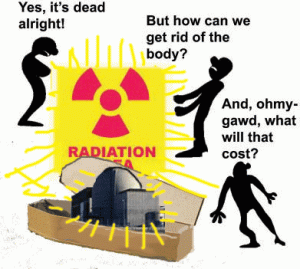
significant additional taxpayer support has been required, and more is likely to be necessary.
there is a risk that the taxpayer will have to make further
contributions.
A report from the UK’s National Audit Office examines whether the
government’s arrangements for decommissioning Britain’s fleet of
advanced-gas-cooled reactors offers value for money.
The UK has eight second generation nuclear power stations accounting for around 16% of total
UK electricity generation in 2020. Seven of the eight stations are Advanced
Gas-cooled Reactors (AGRs), the design of which built on that of the first
generation of now closed Magnox reactors.
Under current plans, all the AGR
stations will have stopped generating electricity by 2028. Decommissioning
is envisaged to take just over 100 years under current plans. The Nuclear
Liabilities Fund (the Fund) was established to meet the costs of
decommissioning all seven AGRs plus a pressurised water reactor at Sizewell
B, but significant additional taxpayer support has been required, and more
is likely to be necessary.
The UK government has provided a guarantee to
underwrite the Fund if its assets are insufficient to meet the total costs
of decommissioning. In 2020, government contributed £5.1 billion ($6.8bn)
to strengthen the Fund’s position and the Fund has recently requested a
further £5.6 billion. The Fund’s assets were valued at £14.8 billion at
the end of March 2021. The aim is that growth in the Fund’s investments
will be sufficient to meet the long-term costs of decommissioning
(currently £23.5 billion).
However, cost estimates have doubled in real
terms since 2004/5. If this trend is maintained and investment growth is
not sufficient, there is a risk that the taxpayer will have to make further
contributions. Last year, the government entered into new arrangements to
decommission the seven AGR nuclear power plants, making EDF Energy
responsible for defueling. The decommissioning of the AGR nuclear power
stations, a 66-page report published by the National Audit Office (NAO)
examines whether these arrangements will lead to better value for money.
The NAO scrutinises public spending to help Parliament hold government to
account and improve public services. It says that while the arrangements
could deliver savings, their success will ultimately depend on the relevant
parties working collaboratively to overcome risks.
Nuclear Engineering International 20th April 2022
https://www.neimagazine.com/features/featurearrangements-for-decommissioning-the-agrs-9640510/
UK’s Nuclear Free Local Authorities join in Wales’call to Japan not to dump radiactive wastewater at sea
The Nuclear Free Local Authorities (NFLA) have joined with leading Welsh
anti-nuclear environmental campaign groups in writing to senior Japanese
Government ministers urging them not to dump radioactive waste from the
Fukushima disaster at sea.
Operated by the Tokyo Electric Power Company
(TEPCO), the Fukushima Daiichi Nuclear Power Plant was hit by an earthquake
and a tsunami on 11 March 2011. A disaster unfolded with three nuclear
meltdowns, three hydrogen explosions and a release of radiation from three
reactors, and Government authorities were forced to evacuate 154,000 people
from the surrounding area over a 20-mile radius. An average of 150 tons of
radioactive water was produced each day last year as rainwater and
groundwater flowed into the damaged reactor buildings mixing with seawater
which has been used to cool the melted nuclear fuel.
One million tons of this water is now stored in barrels on the site. Although the contaminated
water is treated it cannot remove deadly tritium, a beta-emitting
radioactive isotope of hydrogen, and other radioactive materials.
NFLA 21st April 2022
America’s nuclear waste dump in New Mexico is found to have serious safety issues.
The U.S. government´s nuclear waste repository in New Mexico has major
issues in fire training and firefighting vehicles, with its fleet in
disrepair after years of neglect, according to an investigation by the U.S.
Energy Department´s Office of Inspector General.
The investigation was
spurred by allegations regarding fire protection concerns at the
repository, which is the backbone of a multibillion-dollar effort to clean
up Cold War-era waste from past nuclear research and bomb making at
national laboratories and defense sites across the U.S.
Daily Mail 21st April 2022
New Mexico Governor concerned over plans for plutonium waste being disposed of in Carlsbad.
Adrian Hedden, Carlsbad Current-Argus, 20 Apr 22,
New Mexico Gov. Michelle Lujan Grisham signaled support for an activist group opposing a plan at the Waste Isolation Pilot Plant to dispose of diluted, weapons-grade plutonium in the underground nuclear waste repository near Carlsbad.
Lujan Grisham, in an April 8 letter to U.S. Secretary of Energy Jennifer Granholm, shared a petition circulated by Santa Fe-based group 285 All in opposition of the plan and called on the federal Department of Energy to “take action” to address the concerns.
The plan proposed by the DOE would see 35 metric tons of down-blended plutonium waste sent from the Pantex Plant near Amarillo, Texas to Los Alamos National Laboratory in northern New Mexico for processing.
It would then be sent to the DOE’s Savannah River in South Carolina for final preparation and then to the WIPP site in southeast New Mexico for disposal…………..
Critics of the proposal argued the plan would transport nuclear waste across New Mexico multiple times, and the inclusion of down-blended plutonium would mark an “illegal” expansion of WIPP’s statutorily allowed waste streams.
The petition expressing those fears was signed by 1,146 people in New Mexico and delivered to Lujan Grisham’s office in Santa Fe on March 1.
In her letter to Granholm, Lujan Grisham called on the agency which owns and operates WIPP to consider the concerns raised in the petition. https://www.currentargus.com/story/news/2022/04/20/carlsbad-waste-isolation-pilot-plant-plutonium-disposal-concern-michelle-lujan-grisham/7309367001/
No room at the dump: NFLA fears Johnson’s nuclear ambitions will lead to need for second unwanted underground facility
Like the standing joke about buses turning up late and in pairs, the
Nuclear Free Local Authorities fear that Boris Johnson’s commitment to
treble Britain’s nuclear generating capacity by 2050 will create so much
new toxic nuclear waste that the government will want to build a second
underground nuclear dump in the next two decades.
A large, and much maligned, element in last week’s UK Energy Security Strategy was the
pledge to build up to eight new large nuclear power stations over the next
three decades, generating 24 gigawatts of electricity, and the UK could run
out of room to store the resultant radioactive waste if the Prime
Minister’s plan becomes reality.
Professor Claire Corkhill is Chair in
Nuclear Material Degradation and EPSRC Early Career Research Fellow and
Reader at the University of Sheffield, and a member of the Committee on
Radioactive waste Management (CORWM) which advises the government.
Professor Corkhill has publicly commented that existing plans for the dump
will only provide sufficient capacity to take the legacy waste from 70
years of operations and waste from up to 16 gigawatts of nuclear new build,
and has expressed concern about ‘rushing to expand nuclear power until
the implementation of radioactive waste policy [i.e. the GDF] has
progressed further’.
NFLA 13th April 2022
A call for World-class Cleanup at Chalk River Laboratories
https://concernedcitizens.net/2022/04/14/a-call-for-world-class-cleanup-at-chalk-river-laboratories/ Canada’s $16 billion nuclear waste legacy is in danger of being abandoned in substandard facilities and allowed to leak into our rivers and drinking water. Instead, let’s use our expertise to turn Canada into a world leader in the cleanup and safe storage of radioactive waste.
WORLD-CLASS NUCLEAR WASTE CLEANUP would protect health, drinking water, property values and peace of mind.
What do experts say is needed?
The International Atomic Energy Agency says that radioactive waste facilities must be carefully sited and waste placed below ground to keep radioactive materials out of air and water and protect current and future generations. The IAEA says that siting a facility for long-lived waste in a “stable geological formation” is “fundamentally important.” It says that nuclear reactor entombment should only be used in the case of an emergency, such as a meltdown.
Retired AECL scientists say that IAEA guidance must be followed, that Canada has an obligation to follow the guidelines as a signatory to the Joint Convention on the Safety of Radioactive Waste Management.
First Nations, in a Joint Declaration, endorsed by resolution at the Assembly of First Nations, say that nuclear waste should be managed according to five principles: 1) no abandonment, 2) monitored and retrievable storage 3) better containment, more packaging, 2) away from drinking water and major water bodies and 5) no unnecessary transport (exports and imports)
The Canadian Coalition for Nuclear Responsibility says radioactive waste should be carefully managed in monitored and retrievable condition so that repairs to packaging can be made as needed, to keep the contents out of the biosphere, our air, soil and drinking water. The CCNR suggests that a “rolling stewardship” strategy whereby each generation teaches each subsequent generation how to look after the wastes and keep them out of the biosphere.
Some countries such as Finland have made good progress building facilities to keep radioactive waste out of the biosphere. Finland puts radioactive wastes produced by its four nuclear reactors in bedrock geological facilities 100 meters deep. It has over 25 years of experience with these facilities. They will also house the radioactive remains of the reactors when they are shut down and dismantled.
WORLD-CLASS NUCLEAR WASTE CLEANUP would bring money into the Ottawa Valley economy and support good careers for generations of valley residents.
WORLD-CLASS NUCLEAR WASTE CLEANUP would involve:


WORLD-CLASS NUCLEAR WASTE STORAGE FACILITIES would protect the Ottawa River and future generations.
What should America do with its nuclear waste?
What Should America Do With Its Nuclear Waste?
Currently there are about 80 locations in 35 states where spent fuel is being stored, with no long-term plans for disposal., WP, By Rebecca Tuhus-Dubrow 1 Apr 22, ”……………………………………….. (closure of SanOnofre nuclear power station) Magda and other activists realized that all of the high-level radioactive waste that had accumulated at the plant over the course of its lifetime — 1,600 tons of spent fuel rods — would remain at the site for the foreseeable future. Although the federal government is legally responsible for disposing of commercial spent nuclear fuel in a permanent underground repository, there has been no plan for fulfilling that obligation since the Obama administration halted the project at Nevada’s Yucca Mountain in 2010. There are currently about 80 locations in 35 states — mostly at operational and decommissioned nuclear plants — where spent fuel is being stored indefinitely.
Since the San Onofre plant shut down, Magda has been trying to get the spent fuel moved to a more suitable site and to ensure that, until then, it is stored as safely as possible. As of 2017, she has represented her local chapter of the Sierra Club on the Community Engagement Panel, an entity established by SCE that holds quarterly meetings with the public. In her garage, she showed me a gray filing cabinet with four vertically stacked drawers, her granddaughter’s teal bike propped up against the side. The drawers contain hundreds of manila files with hand-scrawled labels: ………. In addition to earthquakes and tsunamis, Magda and other activists are worried about coastal erosion and sea level rise caused by climate change. “We can’t leave it here,” Magda says.
The question of what to do with the nation’s spent nuclear fuel has recently garnered renewed attention. This is thanks in part to U.S. Rep. Mike Levin (D-Calif.), who represents the district encompassing San Onofre and has taken up the cause as one of his signature issues. An environmental lawyer by training, he told me he ran for Congress partially to make progress on reviving the nation’s stalled efforts. In January 2019, he established a task force of local stakeholders to study the situation at San Onofre. He has also co-founded the bipartisan Spent Nuclear Fuel Solutions Caucus, with Rep. Rodney Davis (R-Ill.), and introduced the Spent Fuel Prioritization Act, which would ensure that the material is moved first from the most sensitive locations, including San Onofre.
Among scientific experts and government officials, there is broad consensus that the optimal solution is to eventually bury nuclear waste in a deep geological repository. But that is a long-term goal, and in the near future, Levin and many others are pushing for “consolidated interim storage.” This would mean that the spent fuel scattered at sites across the country would be moved to one or more facilities, in appropriate settings, that would be devoted entirely to safely storing the fuel until a geological disposal facility is ready.
There is also agreement, of a limited sort, between many nuclear opponents and supporters on the importance of addressing the waste issue. But for many opponents, such as Magda, the waste is a reason to abandon this form of energy altogether. ……………..
Despite recent momentum to break the spent fuel impasse, the obstacles are considerable. “Frankly we have a real problem in the U.S., not just at San Onofre,” Levin told me. “San Onofre is just the symptom, with 9 million people within 50 miles and two earthquake faults and rising sea level. The actual problem is that we’ve got nowhere to move it to.”
…………. The 1982 Nuclear Waste Policy Act was the first major law to address spent nuclear fuel, and assigned the federal government the task of constructing and operating such facilities. By that time, there were dozens of commercial nuclear plants that had been accumulating spent fuel and storing it on-site with no plans for disposal. According to the law, the Department of Energy was required to move promptly to site two geological repositories for permanent disposal.
In 1987, however, amendments to this law identified only a single location: Yucca Mountain, about 90 miles northwest of Las Vegas. The selection was based on the Energy Department’s assessment of the site’s geological features and was also thought to reflect political dynamics at the time. In the state, the legislation became known as the “Screw Nevada Bill.” Nevada’s powerful long-serving senator, Harry M. Reid, made it his mission to see that this repository would never come to pass. In 2010, the Obama administration announced that it would withdraw the license application to the Nuclear Regulatory Commission for the project. “We’re done with Yucca,” Carol Browner, President Barack Obama’s energy adviser, said. (The United States does have a deep geological repository for defense waste, in New Mexico, but not for commercial spent fuel.)
Meanwhile, Obama’s secretary of energy convened the bipartisan Blue Ribbon Commission on America’s Nuclear Future to devise a new strategy. The commission issued a report in January 2012. “The overall record of the U.S. nuclear waste program has been one of broken promises and unmet commitments,” the report stated.
The report’s first recommendation, highlighting its importance, was a “consent-based approach to siting future nuclear waste management facilities” for both permanent underground disposal and temporary aboveground storage. That is, instead of selecting sites based strictly on physical characteristics, the new approach would solicit volunteers, and engage communities, states, tribes and other stakeholders to obtain their approval before proceeding with plans…………
The spent fuel at San Onofre is stored in 123 canisters, in what’s called an independent spent fuel storage installation (ISFSI, pronounced “ISSfuhsee”). Contrary to the popular impression of nuclear waste as green goo, the fuel rods consist of solid pellets, each slightly larger than a pencil eraser. The fuel rods, bundled into fuel assemblies, were retrieved from the reactors over the course of decades. After cooling for at least five years in pools of water, they were transferred into stainless-steel canisters, with walls five-eighths of an inch thick. Workers then transferred the loaded canisters, each of which weighs 50 tons, to a concrete pad overlooking the ocean and lowered them into stainless-steel cavities beneath the pad’s surface………….
the ongoing demolition of the plant — major decommissioning work is expected to continue through 2028 — as well as the construction of a rail yard. It was a reminder that radioactive spent fuel is not the only kind of waste produced by nuclear plants: Millions of pounds of metal and steel, and tens of thousands of titanium tubes, will eventually be loaded onto rail cars and shipped away, some to be recycled, some to a landfill. One day, according to the plan, the spent fuel will be shipped away on this rail line as well, though no one knows to where……………………………….
The 1957 National Academy of Sciences report stated, “Unlike the disposal of any other type of waste, the hazard related to radioactive waste is so great that no element of doubt should be allowed to exist regarding safety.” Being in the same room with unshielded nuclear waste, fresh out of the reactor, could very quickly give you a fatal dose of radiation……………………………………
Magda points out that for real progress to occur, the law needs to change so that Yucca Mountain is not the only permissible site for a permanent repository. Levin has not yet introduced legislation to change that, but he told me he plans to. One arguable reason for optimism is that an improved waste management strategy, unlike so many other causes, has bipartisan support. “Nuclear waste doesn’t care if you’re a Democrat or a Republican,” Levin says……………………….. https://www.washingtonpost.com/magazine/2022/04/11/america-nuclear-waste-san-onofre/
No community in the UK has agreed to host a nuclear waste facility
Under normal conditions, generating nuclear power produces hazardous
radioactive waste. This needs to be safely managed and stored for hundreds
of years.
However, a House of Lords paper from October 2021 said the issue
of nuclear waste remains “unresolved in the UK”. It is currently stored in
temporary facilities that are not designed for the permanent storage of
“high-level” radioactive waste.
The Government’s preferred solution is
“geological disposal” – placing waste deep in a rock formation that would
prevent radioactivity from escaping. However, no community has agreed to
host such a facility.
National World 8th April 2022
Hanford report reveals problem with nuclear waste solution
Hanford report reveals problem with nuclear waste solution
An internal federal document says the preparation for turning nuclear waste into glass logs will produce toxic vapors. Crosscut, by John Stang, April 11, 2022 Fourteen years behind its original deadline, the Hanford Nuclear Reservation is scheduled to begin turning radioactive wastes into benign glass in 2023.
However, an internal federal document said the preparatory process for this work will produce toxic vapors from a substance called acetonitrile, which would be unsafe for workers and people and animals that live nearby.
In fact, that complication has not been studied, said the U.S. Department of Energy report dated Aug. 27, 2021.
On March 2, 2022, the Washington State Department of Ecology sent a message to the U.S. Department of Energy, asking for answers on this issue. That came after the state agency received a March 1 letter on the matter from the Seattle-based watchdog organization Hanford Challenge, which obtained the internal document.
As of Friday, the state has not received a reply from the DOE. And DOE’s Hanford headquarters declined to provide anyone to discuss the matter with Crosscut. A spokesperson wrote in an email that the issue has been resolved, but did not provide any details.
In emails, the DOE and major contractor Washington River Protection Services, which designed the glassification equipment, both said the public can ask questions about this matter at a May 10 public hearing related to permits for acetonitrile-related equipment at the glassification plant. But neither the federal government nor its contractor would elaborate on the internal memo that raised concerns about acetonitrile, which will be used to re-treat the nuclear waste before it is turned into glass logs.
Written public comment is being accepted through June 4.
Acetonitrile, which exists in liquid and vapor forms, is easily ignited by heat, sparks or flames. When ignited, it gives off hydrogen cyanide fumes and potentially flammable vapors. Short-term effects from exposure can range from eye, nose and lung irritation to heart irregularities and death. Long-term, exposure could enlarge the thyroid gland and damage the liver, lungs, kidneys and the central nervous system.
The Hanford Nuclear Reservation was created in late 1942 to create plutonium for America’s atomic bombs in World War II and the Cold War. Producing plutonium required nuclear reactors and massive radioactive chemical extraction plants. The worst of the radioactive wastes from those facilities ended up as liquids, sludge and gunk in 177 leak-prone underground tanks on the 586-square-mile complex along the Columbia River in Benton County in south-central Washington. These tanks hold 56 million gallons of waste on what is arguably the most radioactively and chemically contaminated spot in the Western Hemisphere. The site’s overall cleanup began in 1989.
Hanford’s longtime master plan has been to convert those wastes into benign glass. Originally, glassification was supposed to begin in 2009 and completed by 2021 at a cost of $4 billion. Numerous budget, technical and engineering problems have bumped the price to $17 billion, with glassification to begin in late 2023 and end by 2069.
The first glassification facility is scheduled to start its work glassifying the least radioactive wastes in late 2023. Dubbed the “direct-feed low-activity-waste” plant, or DFLAW. It will glassify the least radioactive and least complex of the tank wastes following some preprocessing of the material. That pretreatment and acetonitrile are the subject of the 2021 memo.
While Washington River Protection Solutions did computer-model testing on the possibility of a liquid acetonitrile leak during the pre-treatment process, it did not calculate for the possibility of acetonitrile vapors, according to the internal DOE memo…………………………. https://crosscut.com/environment/2022/04/hanford-report-reveals-problem-nuclear-waste-solution
Switzerland plans to bury spent nuclear fuel deep underground in clay
Straits Times SAINT-URSANNE, SWITZERLAND (AFP) 10 Apr 22, – Storing radioactive waste above ground is a risky business, but the Swiss think they have found the solution: Burying spent nuclear fuel deep underground in clay.
The Mont Terri international laboratory was built to study the effects of burying radioactive waste in clay which sits 300m below the surface near Saint-Ursanne in the northwestern Jura region.
The underground laboratory stretches across 1.2km of tunnels.
Niches along the way, each around 5m high, are filled with various storage simulations, containing small quantities of radioactive material monitored by thousands of sensors.
More than 170 experiments have been carried out to simulate the different phases of the process – positioning the waste, sealing off the tunnels, surveillance – and to reproduce every imaginable physical and chemical effect.
According to experts, it takes 200,000 years for the radioactivity in the most toxic waste to return to natural levels……..
Three prospective sites in the northeast, near the German border, have been identified to receive such radioactive waste.
Switzerland’s nuclear plant operators are expected to choose their preferred option in September.
The Swiss government is not due to make the final decision until 2029, but that is unlikely to be the last word as the issue would probably go to a referendum under Switzerland’s famous direct democracy system.
Despite the drawn-out process, environmental campaigners Greenpeace say Switzerland is moving too fast.
“There are a myriad of technical questions that have not been resolved,” Mr Florian Kasser, in charge of nuclear issues for the environmental activist group, told AFP.
For starters, he said, it remains to be seen if the systems in place can “guarantee there will be no radioactive leakage in 100, 1,000 or 100,000 years”.
“We are putting the cart before the horse, because with numerous questions still unresolved, we are already looking for sites” to host the storage facilities, he said.
Mr Kasser said Switzerland also needed to consider how it will signal where there sites are to ensure they are not forgotten, and that people many centuries from now remain aware of the dangers.
Swiss nuclear power plants have been pumping out radioactive waste for more than half a century.
Until now, it has been handled by the National Cooperative for the Disposal of Radioactive Waste, or NAGRA, founded in 1972 by the plant operators in conjunction with the state.
For now, the waste is being stored in an “intermediary depot” in Wurenlingen, some 15km from the German border.
Switzerland hopes to join an elite club of countries closing in on deep geological storage……………….
Following the 2011 nuclear accident at the Fukushima power station in Japan, Switzerland decided to phase out nuclear power gradually: Its reactors can continue for as long as they remain safe.
A projected 83,000 cubic metres of radioactive waste, including some high activity waste, will have to be buried.
This volume corresponds to a 60-year operating life of the Beznau, Gosgen and Leibstadt nuclear power plants, and the 47 years that Muhleberg was in operation before closing in 2019.
Filling in the underground nuclear waste tombs should begin by 2060…….
The monitoring period will span several decades before the site is sealed some time in the 22nd century. https://www.straitstimes.com/world/europe/switzerland-plans-to-bury-spent-nuclear-fuel-deep-underground-in-clay
What to do with closed Massachusetts nuclear plant’s wastewater?

Columbian, By Jennifer McDermott, Associated Press April 9, 2022,
1 million gallons of radioactive water could be discharged into bay, evaporated or trucked elsewhere
One million gallons of radioactive water is inside a former nuclear power plant along Cape Cod Bay, and it has got to go.
But where? And will the state intervene as the company dismantling the plant decides? These are the vexing questions.
Holtec International is considering treating the water and discharging it into the bay, drawing fierce resistance from local residents, shell fishermen and politicians. Holtec is also considering evaporating the contaminated water or trucking it to a facility in another state.
The fight in Massachusetts mirrors a current, heated debate in Japan over a plan to release more than 1 million tons of treated radioactive wastewater into the ocean from the wrecked Fukushima nuclear plant in spring 2023. A massive tsunami in 2011 crashed into the plant. Three reactors melted down.
Pilgrim Nuclear Power Station in Plymouth, Mass., closed in 2019 after nearly half a century providing electricity to the region. U.S. Rep. William Keating, a Democrat whose district includes the Cape, wrote to Holtec with other top Massachusetts lawmakers in January to oppose releasing water into Cape Cod Bay. He asked the U.S. Nuclear Regulatory Commission to examine its regulations.
Keating said in late March that Holtec’s handling of the radioactive water could set a precedent because the U.S. decommissioning industry is in its infancy. Most U.S. nuclear plants were built between 1970 and 1990.
Holtec has acquired closed nuclear plants across the country as part of its dismantling business, including the former Oyster Creek Generating Station in New Jersey and Indian Point Energy Center in New York. It’s taking ownership of the Palisades Nuclear Plant on Lake Michigan, which is closing this year.
Pilgrim was a boiling-water reactor. Water constantly circulated through the reactor vessel and nuclear fuel, converting it to steam to spin the turbine. The water was cooled and recirculated, picking up radioactive contamination.
Cape Cod is a tourist hotspot. Having radioactive water in the bay, even low levels, isn’t great for marketing, said Democratic state Rep. Josh Cutler, who represents a district there. Cutler is working to pass legislation to prohibit discharging radioactive material into coastal or inland waters……………….
Vermont Yankee Nuclear Power Station, another boiling-water reactor, was shut down in Vernon, Vt., in 2014. It’s sending wastewater to disposal specialists in Texas and other states. Entergy operated and sold both Vermont Yankee and Pilgrim. NorthStar, a separate and competing corporation in the decommissioning business, is dismantling Vermont Yankee……………………
Why are people worried?
In Duxbury, Kingston and Plymouth Bays, there are 50 oyster farms — the largest concentration in the state, worth $5.1 million last year, according to the Massachusetts Seafood Collaborative. The collaborative said dumping the water would devastate the industry, and the local economy along with it……………..
Towns on the Cape are trying to prohibit the dispersal of radioactive materials in their waters. Tribal leaders, fishermen, lobstermen and real estate agents have publicly stated their opposition as well…………….
Who gets the final say?
Holtec wouldn’t need a separate approval from the NRC to discharge the water into the bay. However, Holtec would need permission from the U.S. Environmental Protection Agency if the water contained pollutants regulated by the Clean Water Act, such as dissolved metals.
If the water contained only radioactive materials regulated by the NRC, Holtec wouldn’t need to ask the EPA for a permit modification, according to the EPA’s water division for New England. Holtec has never given the EPA a pollutant characterization of the water associated with decommissioning, the division’s director said.
Mary Lampert, of Duxbury, is on a panel created by the state to look at issues related to Pilgrim’s decommissioning. She believes the state could use its existing laws and regulations to stop the dumping and plans to press the Massachusetts attorney general to file a preliminary injunction to do so.
The attorney general’s office said it’s monitoring the issue and would take any Clean Water Act violations seriously.
Mary Lampert, of Duxbury, is on a panel created by the state to look at issues related to Pilgrim’s decommissioning. She believes the state could use its existing laws and regulations to stop the dumping and plans to press the Massachusetts attorney general to file a preliminary injunction to do so.
The attorney general’s office said it’s monitoring the issue and would take any Clean Water Act violations seriously. https://www.columbian.com/news/2022/apr/09/what-to-do-with-closed-massachusetts-nuclear-plants-wastewater/
UK government incoherent and inconsistent on energy crisis, and has no solution to the accumulating nuclear wastes
| Does the new government energy strategy tackle the immediate energy crisis? This is the third document in six months that the government has produced, and all that has happened is that they have become less coherent, and less and less connected to what actually matters to most people. What the Prime Minister seems to believe is that we want expensive nuclear ‘jam’ tomorrow, and that we are not that bothered about cheap energy efficiency ‘bread’ today. I think that this is rather like the Chancellors recent Spring Budget, in that it is simply not hearing, or paying attention, to what is actually happening in the country, and what matters to people who have got to live with the immediate crisis of their energy bills. And the way that the government can deal with that right now is to start spending money on energy efficiency, money by the way that the government promised in its manifesto and hasn’t actually delivered. In 2012, we were insulating about 2.5 million houses per year, now we are down to about 20 thousand. If we had carried on at that rate, we would be saving people money right now as this crisis has occurred. So, this is a real failure of the government to be consistent in doing the things that really matter to most people. Why would we want to use nuclear when there are much better options already available? This is the third big government announcement on energy policy in 6 months, and all you have got is if you were an investor why would you invest in whatever the current flavour of the month is for the government? You would wait to see what happens when things settle down. Government incoherence and inconsistency is really slowing down out whole response. The endless announcements, with no real delivery, is really slowing down our ability to deal with climate change. People are right to be terrified by the conclusions of the IPCCC report, they really are very scary indeed. There is a future bill for nuclear waste, which grows. The Nuclear Decommissioning Authority is responsiblefor dealing with nuclear waste in this country, it now spends several billions per year of public money in order to deal with the waste that we have already got. So, it is quite right to question why the government is even thinking about piling on more nuclear waste to be dealt with, when we can’t even deal with the waste that we already have now. We don’t know what to do with the high-level waste, that is the most dangerous waste, not because of its volume but because of its radioactivity. We don’t have a solution for that yet, despite 50 years of trying to find one. Tom Burke 7th April 202 2http://tomburke.co.uk/2022/04/07/does-the-new-government-energy-strategy-tackle-the-immediate-energy-crisis/ |
In France, the nuclear waste keeps piling up: new reactors will add to the dilemma

France inches towards nuclear waste solution as more reactors planned
President Macron’s ‘French Nuclear Renaissance’ aims to provide energy independence and greener electricity for France – but the nuclear waste keeps piling up Connexion, By George Kazolias, 8 Apr 22,
Emmanuel Macron has announced plans to launch construction of six new nuclear reactors by 2050, along with studies for a possible eight further ones.
He also wants to prolong the life of existing reactors beyond 50 years in what he is calling the “French Nuclear Renaissance”.
Mr Macron’s vision to “take back control of [France’s] energy and industrial destiny” might be a winner with his electorate, but it clashes with the proposals of most of the left-wing presidential candidates, who want to reduce reliance on nuclear power.
New reactors will add to waste dilemma
Solutions for dealing with the waste already produced by existing power stations, however, are still struggling to get out of the starting blocks – and there is no plan for what would be done with waste from a potential 14 additional ones…………..At present, however, none of France’s nuclear reactor waste has been dealt with in a long-term way. All waste considered radioactive, almost two million cubic tonnes of it, is stored at surface level, in treatment centres and pools, or shallow repositories.
Some 60% of this comes from reactors and the rest is from medical, research, military and other sources.
The other waste, which includes items such as tools, clothing, mops and medical tubes, is not highly radioactive,
……… More problematic is what to do with France’s intermediate and high-level nuclear waste.
In 1998, a site near the village of Bure in the Meuse in north east France was chosen as the final storage place for most of it. It will be stored half a kilometre below ground in a vast network of tunnels and galleries known as a Deep Geological Repository (DGR).
The facility will be big enough for all the nuclear waste accumulated so far, but on-site studies, administrative procedures and opposition to the programme, including court cases and civil disobedience, have slowed its opening.
Deep underground storage could be three years away
The Bure DGR will store the waste in galleries carved out of 160-million-year-old compacted clay rocks. Known by its French acronym, Cigéo, the project currently holds 84% of the 665 hectares required to build the facility. The prefecture of the Meuse gave it a declaration of public utility (DUP) in December – a formal recognition that a proposed project has public benefits that must be obtained for most large construction and infrastructure projects before work can begin.
Once the Conseil d’Etat gives its consent, the prime minister can sign his own DUP. Andra will then have the power to get the rest of the property it needs.
In the meantime, work has continued with digging of wells and galleries to test reversible techniques of stocking waste for up to 100,000 years.
The prime minister is expected to sign off only after the presidential elections, but the final green light might be three years away as the rigorous and independent Nuclear Security Agency studies the permit request to move and store the spent nuclear fuel and other radioactive matter.
Plans are for existing not future waste
Activity at the Cigéo remains high, nevertheless. This year, a 1,700m² building, called The Eclipse, is being built to house companies working on underground trials.
A 100m-long cavity will also be dug to test technologies and conduct experiments. This is the length each cavity will have to be for intermediate-level waste, which is often solidified into concrete.
The nuclear authority is hoping to start storing this type of waste in 2025.
It is impossible to bury the high-level radioactive waste. This is turned into a glass-like substance, but then requires a cooling period of at least 50 years.
The clay storage facilities cannot handle temperatures above 90C.
Senator Sido said: “It is true that the most recent batches cannot be stocked in their present state. They are too hot and need a cooling-off period of several decades. But the first batches can be stocked now.”
The remaining high-level waste might not arrive before 2060. By then, France will have produced at least as much nuclear waste again. For that, it might have to create a new underground facility.
“As far as I know, there is no project in the pipeline for high-level and long-lived waste which will be produced in the future,” Mr Sido said. https://www.connexionfrance.com/article/Practical/Environment/France-inches-towards-nuclear-waste-solution-as-more-reactors-planned
Expert warning that UK’s nuclear plans mean that there won’t be room for all the new radioactive wastes.

 | |||
| to me |
Nuclear power plant plans could mean UK might run out of room for radioactive waste, says expert
https://inews.co.uk/news/nuclear-power-plant-plans-uk-could-run-out-room-radioactive-waste-1563015?ito=facebook_share_article-top&fbclid=IwAR2IxsDYG9O8oNJoXYfiKRKF18v2H-zI_l2NqC3VMWj5O8bGLZGYRMLQtss Current policy only allows for disposal of radioactive waste from 16GW of new nuclear capacity, far short of government’s new ambitions
By Madeleine Cuff, 8 Apr 22, Environment Reporter The UK could run out of room to store radioactive waste if the government presses ahead with plans to build eight new nuclear power stations across the country, a nuclear waste expert has warned.
Ministers today set out plans to accelerate the development of new nuclear power stations to bolster the UK’s energy security and push the country to net zero.
The long-awaited energy security strategy set out plans for trebling the UK’s nuclear generation, with up to 24GW of nuclear capacity planned for 2050.
But one of the country’s leading nuclear waste experts has told i the UK could “run out of room” to store the waste produced by so many plants.
Officials have spent the last 50 years hunting for a permanent way to dispose of radioactive waste produced by the UK’s fleet of nuclear plants.
In 2019 fresh search was launched to find a community willing to host the radioactive waste, which would be buried hundreds of metres below the Earth’s surface.
“The policy at the moment is that it can take all of the legacy waste – everything we have generated in the last 70 years, plus up to 16GW of new nuclear build,” said Professor Claire Corkhill, an expert in nuclear waste at the University of Sheffield.
But if the UK builds 24GW of new nuclear it could run into a storage problem, she warns. “My worry is that if we go to 24GW of nuclear energy then we might run out of room to store the radioactive waste,” she said. “We’ve jumped the gun a little bit in saying that we are going to have this much new nuclear energy without thinking really about whether we have got anywhere suitable to put the waste.”
She said it the government could look for a second storage site, but finding one could take decades.
Construction projects surge at Fukushima nuclear plant despite decommissioning progress
Construction projects surge at Fukushima nuclear plant despite decommissioning progress
April 4, 2022 Mainichi Japan OKUMA, Fukushima — The site of the Fukushima Daiichi Nuclear Power Station continues to host new construction projects some 11 years after the disaster triggered by the 2011 Great East Japan Earthquake and tsunamis.
This Mainichi Shimbun reporter had the opportunity to visit the plant for the first time in seven and a half years, and reflect on why new facilities continue to appear even as the plant moves toward decommissioning…………..
While decommissioning seems to be advancing, various facilities have been newly constructed, and the issue of water remains. A rising number of tanks store treated water contaminated after it was pumped to cool fuel debris that melted down in the accident, as well as groundwater and rainwater that flowed into the buildings. Inside the tanks, the contaminated water is made to reach a radioactive concentration below regulation levels.
On the seventh floor of a building located near the site’s entrance, a Tokyo Electric Power Co. Holdings Inc. (TEPCO) representative gave me an outline of the entire facility. I could see two large cranes on the ocean side around Units 1 to 4, and another large crane and framework structure on the mountain side. When I asked about it, the representative told me the frame was being assembled in a remote location to reduce worker radiation exposure. But it wasn’t a facility being dismantled; it’s a cover measuring 66 meters long, 56 meters wide, and 68 meters high that will wrap around Unit 1.
The hydrogen explosion in Unit 1 blew the building’s roof off, and 392 pieces of nuclear fuel remain in its spent fuel pool near the ceiling. Their removal is scheduled to start in fiscal 2027 to 2028. For this to happen, the surrounding debris must be removed, and the cover’s installation will help prevent the work dispersing radioactive dust.
Ground improvements works were progressing on the neighboring Unit 2’s south side. There, a working platform to remove 615 pieces of nuclear fuel from Unit 2 will be built, with its start slated for fiscal 2024 to 2026.
The buildings for Units 1 through 4 were damaged and contaminated, so different structures, such as platforms and covers, had to be built to remove nuclear fuel from the pools. Particularly conspicuous was the thick steel frame of the Unit 4 facility, from which fuel was completely removed in 2014. Although 53 meters high, it surprisingly uses about the same amount of steel as the 333-meter-high Tokyo Tower. Since the nuclear fuel is being removed in order, new construction work continues in reactor buildings’ vicinities………………
The company listed at least 10 facilities earmarked for future construction. Put another way, the tanks need to be removed to provide land for these facilities.
Related construction work had already started at the seashore, where workers dug vertical holes to contain treated water before its release. After the implementation plan’s approval, undersea tunnel construction and other necessary work to release the water 1 km offshore will also begin.
Meanwhile, some broken cranes and damaged buildings have been left on site without being dismantled. The representative told the Mainichi Shimbun this was partly due to them trying to keep the solid waste processing volume low.
Also underway is construction of facilities to handle ever-increasing solid waste amounts. The representative said a white building I spotted in the site’s northwest side was the volume reduction facility, and that building work is going ahead for a solid waste storage facility in front of it.
The volume reduction facility scheduled for completion in March 2023 will use crushing and other methods to reduce concrete and metal debris volumes. Although nine storage buildings already exist, a 10th will soon be constructed. Nearby was also a new incineration facility for burning logged trees. TEPCO estimates solid waste generated will reach a volume of 794,000 cubic meters by March 2033, and that there will continue to be more related facilities.
Fuel debris removal will begin at the end of 2022. In the future, facilities to hold fuel debris and to store and reduce volumes of solid waste with high doses of radiation generated by the work will also be needed.
Each year creates new tasks that generate more waste, and the facilities to accommodate it. These buildings are also destined to eventually become solid waste. While this cycle continues, a final disposal method for the waste is undetermined. The government’s and TEPCO’s timetable says 20 to 30 years of plant decommissioning remain. But on site, where new construction projects continue to appear, a clear picture of when decommissioning will finish has yet to emerge.
(Japanese original by Takuya Yoshida, Science & Environment News Department) https://mainichi.jp/english/articles/20220402/p2a/00m/0na/027000c
1 This Month
15 October. Joint Appeal for Nuclear Abolition Day -presentation to the UN on October 15 will be live on UNWebTV
Endorse the Nuclear Abolition Day Appeal
23-25 October – on Zoom – World BEYOND War’s annual global conference

To see nuclear-related stories in greater depth and intensity – go to https://nuclearinformation.wordpress.com
-
Archives
- October 2026 (131)
- September 2026 (339)
- August 2026 (330)
- July 2026 (355)
- June 2026 (287)
- May 2026 (306)
- April 2026 (356)
- March 2026 (251)
- February 2026 (267)
- January 2026 (308)
- December 2025 (358)
- November 2025 (359)
-
Categories
- 1
- 1 NUCLEAR ISSUES
- business and costs
- climate change
- culture and arts
- ENERGY
- environment
- health
- history
- indigenous issues
- Legal
- marketing of nuclear
- media
- opposition to nuclear
- PERSONAL STORIES
- politics
- politics international
- Religion and ethics
- safety
- secrets,lies and civil liberties
- spinbuster
- technology
- Uranium
- wastes
- weapons and war
- Women
- 2 WORLD
- ACTION
- AFRICA
- Atrocities
- AUSTRALIA
- Christina's notes
- Christina's themes
- culture and arts
- Events
- Fuk 2022
- Fuk 2023
- Fukushima 2017
- Fukushima 2018
- fukushima 2019
- Fukushima 2020
- Fukushima 2021
- general
- global warming
- Humour (God we need it)
- Nuclear
- RARE EARTHS
- Reference
- resources – print
- Resources -audiovicual
- Weekly Newsletter
- World
- World Nuclear
- YouTube
-
RSS
Entries RSS
Comments RSS

