Continuing campaign to stop the dumping of Hinkley nuclear power station mud off Cardiff coast
Campaigners attempting to stop mud from the construction of Hinkley Point
Nuclear Power Station, Somerset, being dumped into Welsh waters, have
announced they are working with leading environmental lawyers Leigh Day to
block the proposals. In February EDF Energy applied to National Resources
Wales for a licence to dump 800,0000 tonnes of mud dredged as part of
building work for the new plant that is being built on the site of the
disused Hinkley Point A facility.
Two years ago, EDF were given permission
to dump 300,000 tonnes of mud from the site off the Cardiff coast, despite
protests and following a Senedd debate. A petition against the latest
proposals received over 10,000 signatures and has triggered a debate in the
Senedd tomorrow. Earlier this month EDF Energy confirmed it will carry out
an Environmental Impact Assessment as part of its licence application. This
agreement reverses NRW and Welsh Government’s previous position that an
EIA was not needed for the dumping they permitted in 2018 just 2.1 miles
off the South Wales coast and 2.5 miles from Cardiff. Leigh Day has now
written to Natural Resources Wales (NRW) requesting full disclosure of
documents on the Environmental Impact Assessment (EIA)-screening
application from EDF and the agreement with NRW that “environmental
impact assessment is required”.
EDF are also facing a public inquiry over
a controversial fish management system that is being installed at the site
of the new facility. The Environment Agency granted a licence to EDF in
2013 that permitted sea water to be used for the nuclear power station’s
cooling system but required the deployment of a fish deterrent system on
the site to protect marine life in the estuary. Initially the operator
proposed the use of an acoustic deterrent system to reduce the number of
fish being killed by the cooling system but in 2017 abandoned the plans
without suggesting any alternative.
Currently the plant’s proposed Fish
Recovery and Return System will consist of a 5mm mesh barrier set up in the
water intake tunnel to stop large fish from being sucked in while another
channel will divert fish, dead or alive, back out to sea. Last year the
Sunday Times reported that marine and conservation groups estimated that
this system will kill 250,000 fish a day and called for it to be altered or
scrapped. EDF said the FRR will kills an estimated 650,00 fish a year.
Source: Nation Cymru 20th Oct 2020
https://nation.cymru/news/senedd-roundup-leading-environmental-lawyers-join-battle-to-block-mud-dump/
UK’s nuclear waste cleanup operation could cost £260bn
“While we are clear about the current legacy of waste which already exists, a GDF would have to handle additional waste from new facilities being developed,” the NWService said. “The actual cost will … depend on the number of new nuclear projects that the UK develops in future and any additional waste from those stations.”
Cost of safely clearing waste from ageing power stations is soaring, say experts,
https://www.theguardian.com/environment/2022/sep/23/uk-nuclear-waste-cleanup-decommissioning-power-stations Sandra Laville Environment correspondent
The cost of decommissioning the UK’s 20th-century nuclear waste could rise to £260bn as the aged and degrading sites present growing challenges, according to analysis presented to an international group of experts.
As the government pursues nuclear energy with the promise of a new generation of reactors, the cost of safely cleaning up waste from previous generations of power stations is soaring.
Degrading nuclear facilities are presenting increasingly hazardous and challenging problems. Ageing equipment and electrical systems at Sellafield, which is storing much of the country’s nuclear waste and is one of the most hazardous sites in the world, are increasing the risk of fire, according to the Nuclear Decommissioning Authority. They require increasing maintenance and present growing risk. Last October a faulty light fitting started a blaze at a Sellafield facility which led to its closure for several weeks.
Analysis by Stephen Thomas, a professor of energy policy at the University of Greenwich, estimates the total bill for decommissioning the UK’s nuclear waste mountain will grow to £260bn.
Thomas told a conference of international experts the cost of decommissioning Sellafield had risen from to £110bn, according to freedom of information requests.
Other sites that need decommissioning are the 11 Magnox power stations, built between the 1950s and 1970s, including Dungeness A in Kent, Hinkley Point A in Somerset and Trawsfynydd in north Wales, and seven advanced gas-cooled reactors built in the 1990s, including Dungeness B, which closed last year, Hinkley Point B and Heysham 1 and 2 in Lancashire.
Deterioration of one of the Magnox stations, Trawsfynydd, which shut down in 1991, is such that substantial work is needed to make it safe, according to the NDA. “Work that would then need to be undone to complete reactor dismantling,” the agency said.
Thomas told the International Nuclear Risk Assessment Group similar problems are expected at other Magnox sites. The timetable for decommissioning the old nuclear power stations has been abandoned, with no new timescale yet published.
The Nuclear Waste Service has said deferring decommissioning for 85 years from shutdown, which was previous policy, is not suitable for all the reactors because of their different ages and physical conditions. Decommissioning of some Magnox stations will have to be brought forward, the NWS has said
Attempts to speed up the decommissioning would only add to the growing bill, Thomas said, which he estimated had increased to £34bn.
In 2005, the cost for decommissioning and disposing of the radioactive waste from nuclear power stations built in the 1950s, 70s and 90s was put at £51bn.
Last year the NDA estimates rose to £131bn, and its latest annual report said £149bn was needed to pay for the clear up. But Thomas said rising costs meant the total bill was on track to reach £260bn.
Part of the soaring increase is the cost of building a large underground nuclear waste dump or geological deposit facility (GDF) to safely store the 700,000 cubic metres of radioactive waste – roughly the volume of 6,000 double decker buses – from the country’s past nuclear programme.
The mammoth engineering project was initially predicted to cost £11bn but the bill is now estimated to be up to £53bn because of uncertainty about where the site will be located, and the need to provide space for an unspecified amount of waste from the new generation of nuclear reactors which the government wants to build.
Four areas of the country are being considered for the GDF but no decision on where it will be located has yet been made.
“While we are clear about the current legacy of waste which already exists, a GDF would have to handle additional waste from new facilities being developed,” the NWService said. “The actual cost will … depend on the number of new nuclear projects that the UK develops in future and any additional waste from those stations.”
The cleanup of past nuclear waste will take more than 100 years, the NDA has said. Highlighting the challenges of the degrading and hazardous facilities, the authority said in its annual report that robots and drones were increasingly being used to carry out site inspections.
Gullible governments – US Energy Department returns to costly and risky plutonium separation technologies

Bulletin of the Atomic Scientists, By Jungmin Kang, Masafumi Takubo, Frank von Hippel | September 14, 2022, On July 17, the United Kingdom ended 58 years of plutonium separation for nuclear fuel by closing its Magnox nuclear fuel reprocessing plant at Sellafield. This leaves the UK with the world’s largest stock of separated power-reactor plutonium, 140 metric tons as of the end of 2020, including 22 tons separated for Japan. The UK is also second in the world only to Russia in the size of its overall inventory of separated plutonium with 119 tons, including 3.2 tons for weapons. Russia’s stock, 191 tons, is mostly “weapon-grade” separated for use in nuclear weapons during the Cold War, but the UK’s power-reactor plutonium is also weapon usable, and therefore also poses a security risk. The UK has no plan for how it will dispose of its separated plutonium. Its “prudent estimate” placeholder for the disposal cost is £10 billion ($12.6 billion).
One obvious way to get rid of separated plutonium would be to mix it with depleted uranium to make “mixed-oxide” (MOX) fuel energetically equivalent to low-enriched uranium fuel, the standard fuel of conventional reactors. Despite the bad economics, since 1976 France has routinely separated out the approximately one percent plutonium in the low-enriched uranium spent fuel discharged by its water-cooled reactors and recycled the plutonium in MOX fuel.
But both the UK and the US have had negative experiences with building their own MOX production plants.
In 2001, the UK completed a MOX plant, only to abandon it in 2011 after 10 years of failed attempts to make it operate. For its part, the US Energy Department, which owns almost 50 tons of excess Cold War plutonium, contracted with the French government-owned nuclear-fuel cycle company, Areva (now Orano), in 2008 to build a MOX fuel fabrication plant. But the United States switched to a “dilute and dispose” policy for its excess plutonium in 2017 after the estimated cost of the MOX plant grew from $2.7 billion to $17 billion.
Despite decades of failed attempts around the world to make separated plutonium an economic fuel for nuclear power plants, the United States Energy Department is once again promoting the recycling of separated plutonium in the fuel of “advanced” reactor designs that were found to be economically uncompetitive 50 years ago. At the same time, other countries—including Canada and South Korea, working in collaboration with the Energy Department’s nuclear laboratories—are also promoting plutonium separation as a “solution” to their own spent fuel disposal problems. These efforts not only gloss over the long history of failure of these nuclear technologies; they also fail to take into account the proliferation risk associated with plutonium separation—a risk that history has shown to be quite real.
Renewed advocacy for plutonium separation. As the UK finally turns its back on plutonium separation, the United States Energy Department is looking in the other direction. Within the Energy Department, one part, the Office of Defense Nuclear Nonproliferation, is struggling to dispose of excess Cold War weapons plutonium, as two others—the Office of Nuclear Energy and ARPA-E (Advanced Research Project Agency – Energy)—are promoting plutonium separation……………………………………..
In fact, the Energy Department’s Office of Nuclear Energy is promoting sodium-cooled reactor designs based on the Idaho National Laboratory’s Experimental Breeder Reactor II, which was shut down in 1994 due to a lack of mission after the end of the US breeder program a decade earlier. The Energy Department’s office is now supporting research, development, and demonstration of sodium-cooled reactors by several nuclear energy startups.
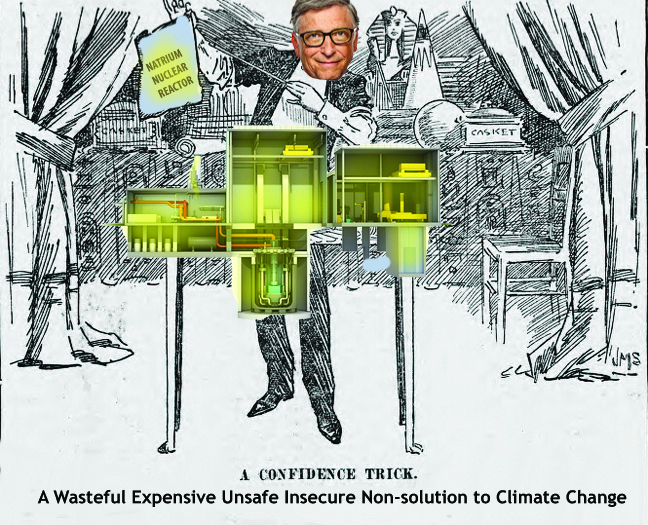
Among them is Bill Gates’ Terrapower, to which the department has committed as much as $2 billion in matching funds to build a 345-megawatt-electric sodium-cooled prototype reactor—called Natrium (sodium in Latin)—in the state of Wyoming. One of Wyoming’s current senators, John Barrasso, is a leading advocate of nuclear power and could become chair of the Senate Committee on Energy and Natural Resources if the Republicans take control of the upper chamber in the elections this fall.
Terrapower insists Natrium is not a plutonium breeder reactor and will be fueled “once through” with uranium enriched to just below 20 percent and its spent fuel disposed of directly in a deep geologic repository, without reprocessing. Natrium, however, is set to use, initially at least, the same type of fuel used in Idaho’s Experimental Breeder Reactor II. The Energy Department maintains that this spent fuel cannot be disposed of directly because the sodium in the fuel could burn if it contacts underground water or air. On that basis, the Idaho National Laboratory has been struggling for 25 years to treat a mere three tons of spent fuel from the Experimental Breeder Reactor II using a special reprocessing technology called “pyroprocessing.”
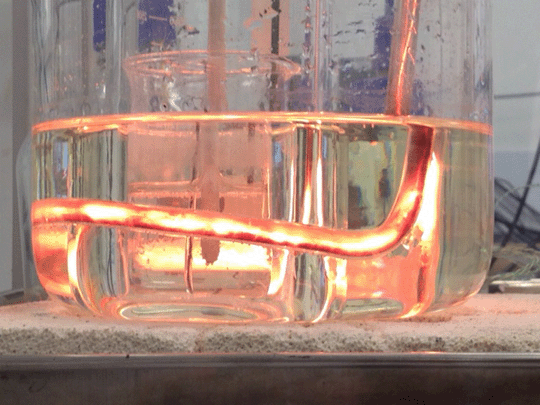
In pyroprocessing, the fuel is dissolved in molten salt instead of acid, and the plutonium and uranium are recovered by passing a current through the salt and plating them out on electrodes. In 2021, Terrapower stated that it plans to switch later to a fuel for Natrium that does not contain sodium but then received in March 2022 the largest of eleven Energy Department grants for research and development on new reprocessing technologies.
Liquid-sodium-cooled reactor designs date back to the 1960s and 1970s, when the global nuclear power community believed conventional power reactor capacity would quickly outgrow the available supply of high-grade uranium ore. Conventional reactors are fueled primarily by chain-reacting uranium 235, which comprises only 0.7 percent by weight of natural uranium. Because of this low percentage, nuclear power advocates focused on developing plutonium “breeder” reactors that would be fueled by chain-reacting plutonium produced from the abundant but non-chain-reacting uranium 238 isotope, which constitutes 99.3 percent of natural uranium. (Liquid-sodium-cooled reactors are sometimes called “fast-neutron reactors” because they utilize fast neutrons to operate. Sodium was chosen as a coolant because it slows neutrons less than water. Fast neutrons are essential to a plutonium breeder reactor because the fission of plutonium by fast neutrons releases more excess secondary neutrons whose capture in uranium 238 makes possible the production of more plutonium than the reactor consumes.)
Large programs were launched to provide startup fuel for the breeder reactors by reprocessing spent conventional power-reactor fuel to recover its contained plutonium.
………………………………….. Only a few prototypes were built and then mostly abandoned. In 2020, the Organisation for Economic Co-operation and Development’s Nuclear Energy Agency estimated that sufficient low-cost uranium would be available to fuel existing conventional reactor capacity for more than a century.
Zombie plutonium-separation programs. Even though separated plutonium has morphed from the nuclear fuel of the future into a disposal problem, civilian plutonium separation continues in several countries, notably France, Japan, and Russia. It is also being advocated again by the offices within the US Energy Department that fund research and development on nuclear energy.
Russia still has an active breeder reactor development program, with two operating liquid sodium-cooled prototypes—only one of them plutonium fueled—plus a small, liquid, lead-cooled prototype under construction. But Russia has already separated 60 tons of power-reactor plutonium and has declared as excess above its weapons needs approximately 40 tons of weapon-grade plutonium. These 100 tons of separated plutonium would be enough to provide startup fuel for five years for six full-size breeder reactors.
China and India have breeder reactor prototypes under construction, but their breeders are suspected of being dual-purpose. In addition to their production of electric power, the weapon-grade plutonium produced in uranium “blankets” around the breeder cores is likely to be used for making additional warheads for their still-growing nuclear arsenals.
France and Japan require their nuclear utilities to pay for reprocessing their spent fuel and for recycling the recovered plutonium in MOX fuel, even though both countries have known for decades that the cost of plutonium recycling is several times more than using low-enriched uranium fuel “once through,” with the spent fuel being disposed of directly in a deep geological repository.
Claimed benefits of reprocessing. Advocates of plutonium recycling in France and Japan justify their programs with claims that it reduces uranium requirements, the volume of radioactive waste requiring disposal, and the duration of the decay heat and radiotoxicity of the spent fuel in a geologic repository. These benefits are, however, either minor or non-existent. First, France’s plutonium recycling program reduces its uranium requirements by only about 10 percent, which could be achieved at much less cost in other ways, such as by adjusting enrichment plants to extract a higher percentage of the uranium 235 isotopes in natural uranium. Second, with proper accounting, it is not at all clear that recycling produces a net reduction in the volume of radioactive waste requiring deep geological disposal. Third, the claimed heat reduction, if realized, could reduce the size of the repository by packing radioactive waste canisters more closely. But this is not significant because, with the currently used reprocessing technology, americium 241, which has a 430-year half-life and dominates the decay heat from the spent fuel during the first thousand years, remains in the reprocessed waste.
Claims of the reduced toxicity of reprocessed waste turn out to be false as well. For decades, France’s nuclear establishment has promoted continued reprocessing in part out of hope that, after its foreign reprocessing customers did not renew their contracts, it could sell its plutonium recycling technology to other countries, starting with China and the United States. But, with the notable exception of the canceled US MOX plant, these efforts so far have not materialized, and the willingness of the French government to continue funding its expensive nuclear fuel cycle strategy may be reaching its limits………………………..
Proliferation danger. Aside from the waste of taxpayer money, there is one major public-policy objection to plutonium separation: Plutonium can be used to make a nuclear weapon. The chain-reacting material in the Nagasaki bomb was six kilograms of plutonium, and the fission triggers of virtually all nuclear warheads today are powered with plutonium. Reactor-grade plutonium is weapon-usable, as well.
In the 1960s, however, blinded by enthusiasm for plutonium breeder reactors, the US Atomic Energy Commission—the Energy Department’s predecessor agency—promoted plutonium worldwide as the fuel of the future. During that period, India sent 1,000 scientists and engineers to Argonne and other US national laboratories to be educated in nuclear science and engineering. In 1964, India began to separate plutonium from the spent fuel of a heavy-water research reactor provided jointly by Canada and the United States. Ten years later, in 1974, India used some of that separated plutonium for a design test of a “peaceful nuclear explosive,” which is now a landmark in the history of nuclear weapon proliferation……………………….
False environmental claims for reprocessing. Since the 1980s, advocates of reprocessing and plutonium recycling and fast neutron reactors in the Energy Department’s Argonne and Idaho National Laboratories have promoted them primarily as a strategy to facilitate spent fuel disposal.
The George W. Bush administration, which came to power in 2001, embraced this argument because it saw the impasse over siting a spent fuel repository as an obstacle to the expansion of nuclear power in the United States. To address the proliferation issue, the Bush Administration proposed in 2006 a “Global Nuclear Energy Partnership” in which only countries that already reprocessed their spent fuel (China, France, Japan, and Russia) plus the United States would be allowed to reprocess the world’s spent fuel and extract plutonium. The recovered plutonium then would be used in the reprocessing countries to fuel advanced burner reactors (breeder reactors tweaked so that they would produce less plutonium than they consumed). These burner reactors would be sodium-cooled fast-neutron reactors because the slow neutrons that sustain the chain reaction in water-cooled reactors are not effective in fissioning some of the plutonium isotopes. After Congress understood the huge costs involved, however, it refused to fund the partnership…………………………….
Plutonium and the geological disposal of spent fuel. Despite the unfavorable economics, the idea of separating and fissioning the plutonium in spent fuel has been kept alive in the United States and some other countries in part by continuing political and technical obstacles to siting spent fuel repositories. Proponents of reprocessing have managed to keep their governments’ attention on plutonium because it is a long-lived radioelement, a ferocious carcinogen—if inhaled—and has fuel value if recycled.
But detailed studies have concluded that plutonium makes a relatively small contribution to the long-term risk from a spent fuel geologic repository for spent fuel from commercial power reactors.
……………………………………………….. risk assessments are theoretical, but they are based on real-world experience with the movement of radioisotopes through the environment.
The main source of that experience is from the large quantities of fission products and plutonium lofted into the stratosphere by the fireballs of megaton-scale atmospheric nuclear tests between 1952 and 1980. During that period, the Soviet Union, the United States, China, the United Kingdom, and France injected into the stratosphere a total of about eight tons of fission products and 3.4 tons of plutonium—comparable to the quantities in a few hundred tons of spent light water reactor fuel. These radioisotopes returned to earth as global radioactive “fallout.”
…………………………………… In addition to the proliferation danger dramatized by the case of India, plutonium separation also brings with it a danger of a massive accidental radioactive release during reprocessing. The world’s worst nuclear accident before Chernobyl involved the Soviet Union’s first reprocessing plant for plutonium production, in 1957……………………………………………..
Gullible governments. Nearly half a century after India conducted its first nuclear test in 1974 with assistance provided inadvertently by Canada and the United States, both countries’ governments seem to have forgotten about the proliferation risk associated with spent fuel reprocessing. Today, advocates of fast-neutron breeder or burner reactors are pitching again the same arguments—used before the test—to gullible governments that seem unaware of the history of this issue. This ignorance has created problems for Canada’s nonproliferation policy as well as that of the United States.
In Canada, a UK startup, Moltex, has obtained financial support from federal and provincial governments by promising to “solve” Canada’s spent fuel problem. Its proposed solution is to extract the plutonium in the spent fuel of Canada’s aging CANDU (CANada Deuterium Uranium) reactors to fuel a new generation of molten-salt-cooled reactors. The Moltex company also proposes to make Canada an export hub for its reactors and small reprocessing plants.
In South Korea, the Korea Atomic Energy Research Institute, with support from Energy Department’s Argonne and Idaho National Laboratories, has similarly been campaigning to persuade its government that pyroprocessing spent fuel and fissioning plutonium in sodium-cooled reactors would help solve that country’s spent fuel management problem.
It is time for governments to learn again about the risks involved with plutonium separation and to fence off “no-go zones” for their nuclear energy advocates, lest they unintentionally precipitate a new round of nuclear-weapon proliferation.
Notes:
[1] Carbon 14 and iodine 129 are difficult to capture during reprocessing and therefore are routinely released into the atmosphere and ocean by France’s reprocessing plant at La Hague. Also, had the uranium 238 in the spent fuel not been mined, its decay product, radium 226, would have been released within the original uranium deposit. So, even though some reprocessing advocates join with nuclear power critics in amplifying the hazards of plutonium and other transuranic elements in underground radioactive waste repositories, they generally omit comparisons with reprocessing hazards (in the case of reprocessing advocates) or with natural uranium deposits (in the case of repository opponents). https://thebulletin.org/2022/09/some-fuels-never-learn-us-energy-department-returns-to-costly-and-risky-plutonium-separation-technologies/
Walkers Count on Local Politicians to Oppose Nuclear Waste in North West Ontario
https://www.netnewsledger.com/2022/09/18/75-walkers-count-on-local-politicians-to-oppose-nuclear-waste-in-nwo/ By NetNewsLedger, September 18, 2022,
THUNDER BAY – ENVIRONMENT – Approximately 75 walkers took to the streets of Thunder Bay on Saturday to oppose the proposed burial of all of Canada’s nuclear fuel waste in the bedrock of Northwestern Ontario.
The group walked from MP Patty Hajdu’s constituency office (Thunder Bay-Superior North and Minister of Indigenous Services) to MPP Lise Vaugeois’ constituency office (Thunder Bay-Superior North).
The federal government oversees Canada’s nuclear operations including nuclear waste management in Canada, while Ontario’s government makes decisions about the province’s energy sources, and can issue directives to Ontario Power Generation. Ontario Power Generation is the largest shareholder in the Nuclear Waste Management Organization, owns more than 90% of the high-level nuclear waste in Canada, and contributes more than 90% of the NWMO’s operating budget.
The Walk was organized by the local group Nuclear Free Thunder Bay, in solidarity with a similar event earlier in September: Ojibway Nation of Saugeen member Darlene Necan’s “Peaceful Walk Against Nuclear Waste on Treaty 3 Lands”, in which walkers left Ignace on September 1 and walked from Ignace to Dryden and then from Dryden to Sioux Lookout.
“Darlene Necan has done her Walk three years in a row,” said Charles Faust, a member of Nuclear Free Thunder Bay. “The idea of this nuclear waste burial project going forward deeply disturbs our group. Northwestern Ontario is not an empty land – it is home to many people, and is the traditional territory of our Anishinaabe friends and neighbours. It is also one of the least spoiled natural areas in the world. Radioactive contamination of the extensive watersheds there would be disastrous.”
Lise Vaugeois MPP was present at her constituency office and had supportive words for those gathered.
Nuclear Free Thunder Bay, part of the We the Nuclear Free North alliance, opposes the Nuclear Waste Management Organization’s (NWMO’s) proposed plan to bury all of Canada’s nuclear fuel waste – more than 3 million fuel bundles – in a deep geological repository (DGR) between Ignace and Dryden. There is no operating DGR for nuclear fuel waste anywhere in the world.
The group prefers the alternative of maintaining the waste in hardened and more secure facilities close to the nuclear reactors where it was produced. Such an approach would eliminate the dangers of transporting the waste up to 2,400 km by road or rail into Northwestern Ontario and would allow ongoing monitoring of the waste in the event of future problems.
The group believes that burying the waste would mean forgetting the deadliest, most long-lived toxic substance a society has ever produced.
Weapons-grade plutonium secretly sent from South Carolina to Nevada removed early
The Nevada site was used to conduct nuclear weapons testing from 1945 to 1992.
https://www.wltx.com/article/news/regional/weapons-grade-plutonium-from-south-carolina-nevada-removed/101-dba724ee-6fbb-46b0-8d06-3cb9c00— Associated Press, September 17, 2022, CARSON CITY, Nev — Weapons-grade plutonium that secretly was sent to Nevada over objections from the state has been removed ahead of schedule, federal officials said.
U.S. Sen. Catherine Cortez Masto said in a statement that she was notified by the National Nuclear Security Administration late Friday that the plutonium had been removed. The work that started last year had been expected to wrap up by the end of 2026.
The U.S. Energy Department under former President Donald Trump had planned to ship a full metric ton (2,204 pounds) of plutonium to Nevada from South Carolina, where a federal judge ordered the material be removed from a Savannah River site.
Nevada had argued in a lawsuit that the clandestine shipment of half a metric ton (1,100 pounds) of plutonium to the vast Nevada National Security Site — an area larger than the state of Rhode Island — in 2018 amounted to a “secret plutonium smuggling operation.” The U.S. government argued it kept the shipment secret because of national security concerns.
The Nevada site was used to conduct nuclear weapons testing from 1945 to 1992.
The legal battle ended in mid-2020 after the federal government agreed to remove the highly radioactive material already trucked to Nevada and abandon any future plans to send more.
The material now is held at a site in New Mexico, a congressional aide told the Las Vegas Review-Journal.
Plutonium secretly shipped to Nevada removed sooner than expected
By Gary Martin Las Vegas Review-Journal, September 16, 2022 –
WASHINGTON – A half-metric ton of weapons-grade plutonium secretly shipped into Nevada has been removed four years early under federal court order and an agreement reached by U.S. Sen. Catherine Cortez Masto and former Energy Secretary Rick Perry, officials said Friday.
Cortez Masto, D-Nev., first announced the removal of the plutonium, stored at the Nevada National Security Site north of Las Vegas.
She was notified by the National Nuclear Security Administration late Friday………………….
The NNSA shipped the plutonium from the Savannah River Site in South Carolina to Nevada in 2019 under federal court order.
Nevada officials, while notified it would happen, were incensed when efforts to stop the transfer through federal courts became moot after the Department of Energy disclosed the plutonium had already been shipped into the state.
Four years ahead of schedule
“When I heard that the Trump administration secretly shipped weapons-grade plutonium to our state, I acted immediately to ensure it was removed,” Cortez Masto said in a statement.
Cortez Masto also secured in writing a pledge by Perry not to send any more plutonium from South Carolina to Nevada.
“I’m proud to announce the removal has been completed four years ahead of schedule,” Cortez Masto said.
A federal judge ordered the Department of Energy to remove weapons grade plutonium from the Savannah River Site in South Carolina after a facility to turn the radioactive material into fuel for nuclear power plants was terminated.
Some of the material was sent to the Nevada facility, and some to the Pantex Plant in Texas until pits to accommodate the material at Los Alamos National Laboratory in New Mexico were completed, according to NNSA.
The material from Nevada now has been shipped to Los Alamos, a congressional aide confirmed.
Secret shipment from South Carolina draws ire
Former Gov. Brian Sandoval, a Republican, was furious that the Energy Department shipped the plutonium to Nevada when the state in May 2019 had notified the federal government of its intent to seek an injunction to prevent the transfer.
Sandoval directed then-state Attorney General Adam Laxalt to file a lawsuit in federal court in Reno to block the shipment.
But the lawsuit was dismissed after Energy Department lawyers in 2020 disclosed in court papers that the shipment had already occurred, making the state’s lawsuit moot.
Gov. Steve Sisolak and state Attorney General Aaron Ford, both Democrats, filed another lawsuit and won a ruling that would force the federal government to eventually remove the plutonium.
………. the danger of exposure to the materials prompted the federal judge to order the plutonium moved from South Carolina.
‘Beyond outrage’
The secret shipping of the plutonium, because of federal national security concerns, drew the ire of Nevada officials of both major political parties who accused Perry and the Energy Department of lying to the state about its intent…………………………….
The shipment heightened tensions between Nevada and the Trump administration, which also sought to open Yucca Mountain as a permanent nuclear waste repository, just 60 miles north of Las Vegas. https://www.reviewjournal.com/news/politics-and-government/plutonium-secretly-shipped-to-nevada-removed-sooner-than-expected-2641314/
Switzerland plans controversial nuclear waste dump all too close to German border
A plan for a nuclear waste storage facility in Switzerland is raising
safety concerns among Germans close to the border. The project, which is
backed by power plant operators, requires approval by the Swiss government.
Switzerland has announced plans to build a nuclear waste storage facility
on the border with Germany, leaving communities concerned about the issues
of safety and clean drinking water supply. The National Cooperative for the
Disposal of Radioactive Waste (Nagra) is behind the proposal. It suggested
the region of Nördlich Lägern, north of Zurich and close to the border
with Germany, the Swiss Federal Office of Energy said.
Deutsche Welle 10th Sept 2022
Nuclear Waste: DOE Needs to Improve Transparency in Planning for Disposal of Certain Low-Level Waste
GAO-22-105636 Sep 29, 2022,
Fast Facts
The Department of Energy is responsible for disposing of certain low-level nuclear waste from medical equipment, metals in nuclear reactors, and cleanup sites. The Energy Policy Act of 2005 required DOE to assess the potential environmental effects of various disposal options. No legal options currently exist.
DOE’s assessments were extensive but didn’t give rationales for preferring certain disposal options. They also weren’t clear on the amount of waste that will need disposal—key information for decision makers.
We recommended ways to improve transparency. We also suggested that Congress consider addressing legal barriers to waste disposal……………………………………………….. more https://www.gao.gov/products/gao-22-105636
Radioactive Waste ‘Everywhere’ at Ohio Oilfield Facility, Says Former Worker
Community groups present health and environmental justice concerns to the EPA, alleging workers at Austin Master Services are coated in dangerous levels of radioactive waste.
DeSmog, By Justin Nobel, Aug 31, 2022 ,
As Bill Torbett and his colleagues went about their work, handling the sloppy radioactive detritus of oilfields in a cavernous building in eastern Ohio, their skin and clothing often became smothered in sludge. Waste was splattered on the floor and walls, even around the electrical panels. At the end of their shifts, they typically left their uniforms in the company washing machine, which didn’t always work, and left their sludge-caked boots and hard hats in the company locker room. But when the men arrived home after a long day, the job came with them too.
“We were literally ankle-deep in sludge and a lot of times knee-deep in different spots. All that shit is dripping down on you,” says Torbett, a 51-year-old former employee of Austin Master Services, a radioactive oilfield waste facility in Martins Ferry, Ohio. “You’re saturated in it, your hands are covered in it, the denim of your uniform would hold it, and the moisture would soak right through your under-clothes and into your skin.”
“How wet?” Torbett says. “Like if you got caught outside in the rain without an umbrella. Soaking wet.”
In fact, so alarming are the conditions at Austin Master and so lax is the oversight that workers have taken things into their own hands. In one case, a second former worker has covertly passed along their dirty boots, hard hat, and headlamp for independent radiological analysis. The levels of the radioactive element radium found in the sludge on this worker’s boots was about 15 times federal cleanup limits for the nation’s worst toxic waste sites.
And yet, Austin Master appeared to keep workers in the dark about what they were handling. “They really didn’t tell me the gist of the material, I just knew it came from frack sites,” according to Torbett, who worked at the facility from November 2021 to February 2022. “There was no discussion of the material and its radioactivity.”
In April, DeSmog revealed that Concerned Ohio River Residents, a local advocacy group, had documented elevated levels of radium outside the main entrance to the Austin Master facility, that state inspection reports showed a lengthy history of concerning operating practices, and that rail cars leaving the facility for a radioactive waste disposal site in the Utah desert had arrived leaking on five occasions.
The situation at the Ohio facility appears so severe that top officials from the U.S. Environmental Protection Agency (EPA) Region 5, which covers much of the Midwest, joined local organizers in a conference call in July and made an in-person visit to the area earlier this month.
The state of Ohio has authorized Austin Master Services to receive 120 million pounds of radioactive oilfield waste at its Martins Ferry location each year.
Austin Master has not replied to questions regarding the reported radioactivity levels on worker clothing. “There is nothing unusual or harmful about AMS’s process,” Chris Martin, a company spokesperson, told DeSmog in response to questions sent in March regarding work practices at the facility. “Austin Master Services takes a responsible approach to providing valuable waste remediation services and jobs in the Martins Ferry community.” Martin maintained that “there are no known complaints from AMS employees concerning work conditions.”
On July 1, American Energy Partners, a Pennsylvania-based energy and infrastructure services company, acquired Austin Master Services. In a press release, American Energy Partners describes Austin Master as “a full-service, comprehensive environmental services firm specializing in radiological waste management solutions” that provides “professional safety, industrial hygiene and health physics services.” The company has not replied to questions.
The conditions documented by state inspection reports and the contamination revealed by advocacy groups raise questions about the risks to first responders and the community should the Martins Ferry facility have an accident……………………………………
Welcome to the Messy World of Radioactive Oilfield Waste
The Austin Master facility is located in a former steel mill on the Ohio River, not far from the city of Martins Ferry’s drinking water wells and the football stadium of the local high school team, the Purple Riders. Austin Master receives truckloads of drill cuttings bored out of the Marcellus and Utica shale and of radioactive sludge that forms at the bottom of tanks and trucks that hold toxic liquids brought to the surface of fracked oil and gas wells. Right now, more than a third of America’s natural gas supply comes from wells in Ohio, West Virginia, and Pennsylvania. Some of it is converted to liquefied natural gas, or LNG, and shipped overseas to customers in Europe and elsewhere.
Processing radioactive oilfield waste has proven enormously problematic for the oil and gas industry and its regulators, and given rise to a booming service sector of facilities like those run by Austin Master that collect, treat, and process the waste. Part of the problem is that a significant amount of oilfield waste is too radioactive to be shipped directly to traditional landfills. Instead, it must be “down-blended,” or mixed with material like lime or a corn cob base to lower the radioactive signature. The Ohio Department of Natural Resources (ODNR) does regulate the state’s roughly two dozen oilfield waste processing facilities, but in a limited way. In 2014, Austin Master received an ODNR order, known as a Chief’s Order, giving the company temporary approval to “process, recycle, and treat brine” and other oilfield waste.
At Austin Master’s Martins Ferry facility, Torbett says, trucks regularly dumped the more sludge-like or solid radioactive oilfield waste directly onto the floor of the former steel mill, and workers used common heavy construction equipment like Bobcats to maneuver it into various bins or pits. Waste that was more liquid-like was often dumped into metal containers called half-rounds, says Torbett. In one state inspection photo from August 2018, a worker with bare arms and no face protection or respirator holds a push broom……………………………….
It is work like this that has Massachusetts-based nuclear forensics scientist Dr. Marco Kaltofen deeply concerned about worker health risks. He said any time oilfield waste is moved around in piles at a processing facility such as Austin Master, dust is inevitably created and is likely to contain the radioactive element radium, which is commonly found in oilfield waste..
In addition to dust and wet spatter from the facility’s waste processing practices, Kaltofen voiced worries about the risk of radioactivity exposure to the people interacting with employees outside of work. “Workers’ skin can also become coated with this radioactive material, and either absorb it, or contaminate their families,” he added.
Earlier this year, a second former employee of Austin Master, who prefers to remain anonymous because they still work in the region, provided the boots, hard hat, and headlamp they used while working at the Martins Ferry facility to the organization Concerned Ohio River Residents, members of which have been previously instructed by Kaltofen in how to safely handle such items. The group then sent the worker items along to Kaltofen, who sent sludge from the boots to Eberline Analytical, a radiological analysis lab in Oak Ridge, Tennessee.
The lab returned the results in May, and they were startling, according to Kaltofen. They showed levels of radium-226 at 76.3 picocuries per gram, and levels of another form of radium common in oilfield waste, radium-228, at 8.66 picocuries per gram. This placed the radioactivity values at roughly 15 times EPA cleanup limits for topsoil at uranium mills and Superfund sites. ………………………………….
“Radium is commonly referred to as a bone seeker,” states a report of the National Research Council Committee on the Biological Effects of Ionizing Radiations. If accidentally inhaled or ingested, the radioactive element tends to accumulate in the bones, where it continues emitting radiation and can lead to cancer…………………………..
“These results are alarming and it signifies the need for appropriate radiation protection measures in the oil and gas workplace,” adds Bemnet Alemayehu, a Natural Resources Defense Council (NRDC) staff scientist with a PhD in radiation health physics and co-author of a 2021 report on this issue. DeSmog provided NRDC with Eberline Analytical’s analysis of the worker’s clothing. “Based on the data provided,” says Alemayehu, “it appears the radioactivity levels are high enough to cause” exposure risks to the oil and gas workers…………………………….
Raising Red Flags
Concerned Ohio River Residents, which received the clothing items from the former worker and sampled the soil on the public road outside the facility, has long been worried about the risks the Austin Master facility posed to workers and the community at large and is in touch with a number of former workers. In mid-August, members of the group toured officials with EPA Region 5 around the area, including a drive-by of the Austin Master facility in Martins Ferry.
Despite the dangers this type of oil and gas waste poses, a 1980 provision enacted by Congress has deemed it non-hazardous and therefore exempt from federal rules that would otherwise apply to hazardous waste. ………………………………
Meanwhile Ohio regulatory agencies appear to be equally hamstrung in their ability to manage or even systematically assess the situation. ………………………………
Industry workers and residents across the Marcellus and Utica shale tell DeSmog it is this general tone of dismissal and inaction from regulators that has them feeling aggravated when it comes to oilfield radioactivity and its harms………………………
DeSmog presented the Health Physics Society with information and documents concerning the situation at Austin Master, but the group has not replied to questions.
…………………………………. fixing this issue in the United States goes beyond just personal protective equipment and straight to lawmakers, says Amy Mall, a senior advocate at NRDC. “We need Congress to act to end the dangerous oil and gas loopholes in our federal laws, including the gap for naturally occurring radioactive materials,” says Mall. “In addition, we urge the EPA to investigate this situation and other oil and gas waste sites around the country, and to revise its rules to reflect current knowledge about the risks to human health and the environment.”…………………………
While Waiting for Governments to Act, Citizens Are Stepping in
In July, Concerned Ohio River Residents and other Ohio advocacy groups sent a letter about Austin Master to EPA Administrator Michael Regan.
“We have identified environmental justice and human rights abuse under President Biden’s Executive Order 13985,” the letter stated. “Understanding your values and heavy emphasis on pushing for environmental justice, we call upon the United States Environmental Protection Agency to address disproportionately high and adverse health and environmental impacts on low-income populations here in Appalachia…We call upon your Office to investigate these issues because no other governmental or regulatory agency is stepping up.”……………………………. https://www.desmog.com/2022/08/31/worker-radioactive-waste-austin-master-services-ohio/
WHAT HAPPENED AT CAMP LEJEUNE
I grew up drinking and bathing in the toxic waters around a military base in North Carolina. Thirty years later, I went back to investigate.
BY LORI LOU FRESHWATER, AUG 21, 2018
In the autumn of 1980, a contractor showed up to grade a parking lot. He had no idea he was about to start digging up the radioactive bodies of dead beagles. But the forked bucket on his bulldozer started pulling up more than soil, and it turned out he was digging in a pit of strontium-90 and dog carcasses that had been buried in an ash-gray tomb: a nest of dead dogs and laboratory waste labeled “Radioactive Poison.”
The new parking lot was on the site of the former Naval Research Laboratory dump and its associated incinerator in Camp Lejeune, North Carolina—and it was just one of many areas contaminated by an assortment of hazardous waste and chemicals on the base.
About half a mile away from the dump, soon to be known as Site 19, my friends and I were living in our neighborhood, called Paradise Point. We spent our time putting other girls’ bras into freezers at slumber parties, playing the Telephone Game, riding our bikes all over the place: to the golf course to steal a cart, to swim at the pool, to play soccer on Saturdays.
During the same autumn the dead beagles were found, I was sitting in front of a fake backdrop of rusty colored leaves, a slight 11-year-old girl with spaces between my teeth and freckles spritzed across my nose and cheeks, to take my school photo.
Under normal circumstances, this entirely unremarkable fifth-grade photo, in a plaid shirt and fragile gold necklace, would have likely ended up where most school photos do, in an old album or a drawer or simply lost to time. Instead, the photo would become a marker in the medical history of my family and my community, a reminder of the crime that was being committed on the day the photo was taken—and also for decades before, and for years after.
The place was Camp Lejeune, a United States Marine Corps base wrapped around the New River in Onslow County that served as an amphibious training base where Marines learned to be “the world’s best war fighters,” picking up skills that would allow them (for example) to make surprise landings on the shores of far away countries. From the 1950s until at least 1985, the drinking water was contaminated with toxic chemicals at levels 240 to 3400 times higher than what is permitted by safety standards.
There may never be a true accounting of the suffering caused at Lejeune. As with many other hometown environmental disasters, the Marines and family members poisoned on this military base were not born here, nor did they settle here to make a permanent life and raise their children. Instead, they were often here just for a short time, literally stationed at Lejeune for weeks, months, or, at most, a few years. From the 1950s through at least 1985, an undetermined number of of residents, including infants, children, and civilian workers and personnel, were exposed to trichloroethylene (TCE), tetrachloroethylene (PCE), vinyl chloride, and other contaminants in the drinking water at the Camp Lejeune. These exposures likely increased their risk of cancers, including renal cancer, multiple myeloma, leukemias, and more. It also likely increased their risk of adverse birth outcomes, along with other negative health effects. Now the sick and the dying are all over the world, and an untold number will never be notified about what happened. Instead, we are left to rely on scientific models and data trickling out of public-health agencies and the slow process of adding one story at a time, person-by-person, to the cold data representing an environmental and public-health disaster.
In 1989, the Environmental Protection Agency placed 236 square miles of North Carolina’s coastal soil and water on the list of toxic areas known as Superfund sites. The agency cited “contaminated groundwater, sediment, soil and surface water resulting from base operations and waste handling practices” as reasons for including it on the National Priorities List.
Camp Lejeune remains a sprawling Superfund site, and it is also the place where my mom and I spent years drinking a terrible mix of chemicals from our faucet. In the book A Trust Betrayed: The Untold Story of Camp Lejeune, author Mike Magner gives special attention to my mother’s story: “A woman with the ironic name of Mary Freshwater may have had the most ghastly experiences at Camp Lejeune.”
Of course, I share her ironic name, which can still seem like more of a curse. Nearly my entire childhood was consumed by tragedy. The chemical contamination can be linked to the deaths of my two baby brothers, Rusty and Charlie, and to my mom’s own difficult final years, when she was dying from two types of acute leukemia. My mother also suffered from mental illness, which was intensified—understandably—by our family’s brutal losses. Sometimes it seems that, behind me, there is nothing but inescapable grief. …………………..more https://psmag.com/.amp/environment/what-happened-at-camp-lejeune
$Multibillion costs in the struggle to deal with nuclear wastes across the globe
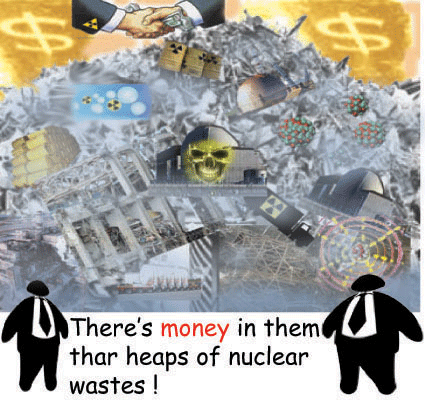
Nuclear power is undergoing a revival with more than 50 reactors being
built around the world, close to half in India and China. But the problem
of how to dispose of lethal nuclear waste, which can remain radioactive for
up to 300,000 years, remains remarkably difficult.
A quarter of a million metric tonnes of spent fuel rods are believed to be spread across 14
countries. South Korea is investing $1bn in R&D aimed at having a High
Level Waste treatment plant ready by 2060. The US spent $15bn into Yucca
Mountain. Finland has made the fastest progress. France has identified a
site 300km east of Paris. So far it has spent $2.5bn over 25 years on R&D,
but public opposition may put a stop to it,
FT 31st Aug 2022
https://www.ft.com/video/c6be962e-ce91-4954-afad-a9b6bf86d7c8
As Japan builds nuclear dumping facilities, Pacific groups say ‘stop’
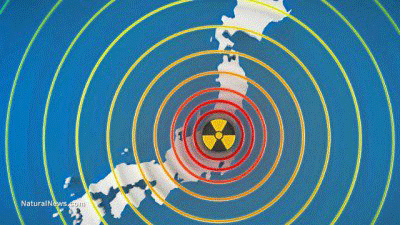
https://www.reuters.com/world/iran-seeks-stronger-us-guarantees-revival-2015-nuclear-deal-2022-08-31/ Pacific civil society groups are calling on Japan to halt its plans to dump radioactive nuclear wastewater into the Pacific Ocean.
Earlier this month the Japanese government started building facilities needed for the discharge of treated, but still radioactive, wastewater from the defunct Fukushima nuclear power plant.
In a joint statement, civil society groups, non-governmental organisations and activists described the Fumio Kishida Government’s plans as a fundamental breach of Pacific peoples’ right to a clean, healthy and sustainable environment.
Joey Tau from the pan-Pacific movement Youngsolwara Pacific said this breaches Pacific peoples’ rights to live in a clean environment.
Tau told Pacific Waves the Pacific Ocean is already endangered and Japan’s plan will have devastating impacts.
“We have a nuclear testing legacy in the Pacific. That continues to impact our people, our islands and our way of life, and it impacts the health of our people.
“Having this plan by Japan poses greater risks to the ocean which is already in a declining state.
“The health of our ocean has declined due to human endured stresses and having this could aggravate the current state of our region.
“And also, there are possible threats on the lives of our people as we clearly understand in this part of the world, the ocean is dear to us, it sustains us,” Tau said.
Tau said both the opposition in Vanuatu and the president of the Federated States of Micronesia have expressed serious concerns at Japan’s plans, and the Pacific Islands Secretariat this year has appointed an international expert panel to advise the Forum Secretary-General and national leaders.
The Northern Marianas’ House of Representatives has also condemned Japan’s plan to dump the nuclear waste.
Tau said the plans should not proceed without the Pacific people being able to voice their concerns and being better advised.
City of Aiken provides will receive more than $168M in plutonium storage settlement
by: Dixie Dawson, Joey Gill, Aug 30, 2022 “………………………………… The community also got an update on plutonium settlement money. Aiken County will reportedly receive more than $168 million, or 30% of $525 million, from the federal government’s settlement with the state over plutonium storage.
“They secured 168-million-850-thousand dollars for projects through Aiken County from the South Carolina plutonium settlement funds,” said David Jameson, President and CEO of the Aiken Chamber of Commerce, “Aiken County citizens will benefit from the catalytic impact of your efforts to many, many years.”……………………… https://www.wjbf.com/news/aiken-county/city-of-aiken-provides-updates-on-city-will-receive-more-than-168m-in-plutonium-storage-settlement/
The long process of shutting down Hunterston B nuclear power station
Experts say that the site of the current Hunterston B power station could
be available for use again in around 90 years. Details of the upcoming
decommissioning process for the nuclear site have been revealed as part of
a public consultation over the next stage of the power station site’s
life. Defuelling of the site is currently under way, with decommissioning
expected to start in 2025/26 and it will take around 12 years to demolish
the majority of buildings. A long period of inactivity, thought to be
around 70 years, will follow before the remaining site will be
decommissioned and potentially ready for reuse. Following defuelling,
operators EDF will hand over responsibility to the Nuclear Decommissioning
Authority. The authority’s subsidiary Magnox will deliver decommissioning
activities for the decades to come. A report drawn up for the consultation
reveals that a giant ‘safestore’ will be created from the existing
reactor building, which can shield decaying radioactive materials for up to
100 years. It says: “Buildings and structures will be demolished to ground
level, with basement areas and tunnels backfilled and regraded using
material produced from the decommissioning process.
Largs & Millport News 26th Aug 2022
https://www.largsandmillportnews.com/news/20777753.hunterston-b-site-available-use-90-years/
All About Groundwater – Hanford part 2
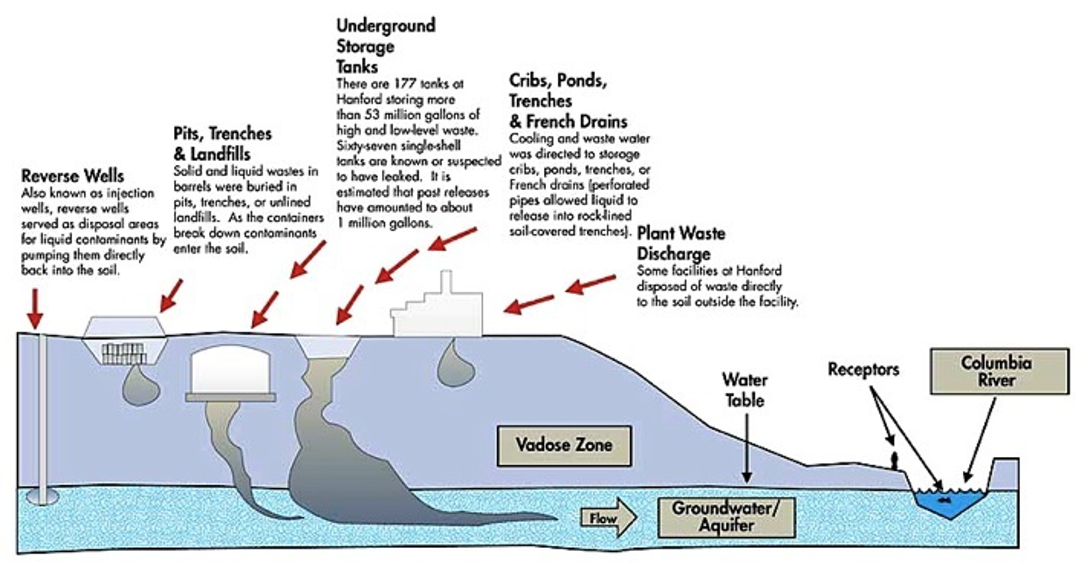
In Part 1 we covered the basics of the Pacific Northwest National Laboratory report, Adaptive Site Management Strategies for the Hanford Central Plateau Groundwater, that outlines an innovative strategy to tackle the challenge of groundwater cleanup. In Part 2 we’ll cover the history of Hanford’s soil and groundwater contamination, current cleanup strategies, and the various challenges to cleaning up the soil and groundwater.
Hanford’s history of soil contamination
The Hanford Site has a history of dumping radioactive and chemical waste directly into the ground on site. About 450 billion gallons of nuclear and chemical waste were dumped directly into the soil during the plutonium production years—the equivalent of more than 680,000 Olympic-size swimming pools. Manhattan Project workers dumped waste in unlined cribs, ponds, ditches, and trenches—four different types of holes in the ground used for disposing of waste. Injection wells pumped the toxic waste directly into the soil to dispose of it.
Workers constructed 177 underground tanks (149 single-shell tanks and 28 double-shell tanks) to hold the most dangerous, high-level waste. However, the soil contamination didn’t stop there. These enormous underground tanks were connected in a row of three or four tanks. The Manhattan Project workers used a process called cascading—which allowed them to fill up one tank with waste, and while the waste solids settled to the bottom, the liquids would flow from one tank to another. If too much waste was added to the final tank, it would overflow to the soil. “From 1944 through the late 1980s, Hanford generated nearly 2 million cubic meters (525 million gallons) of high-level tank waste. Liquid evaporation, discharge to the ground, chemical treatment, and tank leakage reduced this volume by 90%—to 204,000 cubic meters (54 million gallons).”[1]
Cascading wasn’t the only way that waste reached the soil from the tanks. The tank farms were backfilled under an 8-to-10-foot layer of soil before waste was added. Workers built the single-shell tanks between 1943 and 1964. As their name suggests, they only have one liner of carbon steel to contain the waste. Sixty-seven single-shell tanks are known or suspected to have leaked 1 million gallons of waste into the surrounding soil. Two single-shell tanks—B-109 and T-111—are currently leaking. The single-shell tanks were designed to contain the waste for 20-25 years, and they are now more than 40 years past their design life. As these tanks get older and older, they are more likely to fail—causing the waste to leak out into the soil. Once the waste gets into the soil it may remain there—making it very hard to remove—or it may travel with water through the soil and reach the groundwater.
Current cleanup of the groundwater
Today, the soil at the Hanford Site (particularly in the Central Plateau) remains heavily contaminated. Some radioactive and chemical contaminants are more mobile in water, which means a rainstorm may cause those contaminants to move with the water through the soil—reaching the groundwater and ultimately the Columbia River.
One of the cleanup methods to prevent contaminants from spreading and reaching the groundwater is to remove contaminated soil by digging it up and disposing of it in the Environmental Restoration Disposal Facility. Hanford Challenge is concerned that USDOE will decide that it doesn’t need to dig up all of the contaminated soil and will leave it in place—which would increase the risk of harm to future generations.
USDOE implements specific strategies for cleaning up the groundwater. One of those strategies is pump and treat. Pump and treat is the process of pumping contaminated water to the surface, filtering out some of the contaminants, and injecting the water back into the ground. Monitoring wells, extraction wells, and injection wells are interspersed throughout the Hanford Site to implement the pump and treat process. There are six pump and treat facilities on site.
Soil flushing is one strategy used to enhance the pump and treat process. Some contaminants remain in the soil and may take a long time to reach the groundwater. Until the contaminants hit the groundwater, they are impossible to capture with the pump and treat system. Soil flushing speeds up the process by using 225 gallons of water per minute to force—or flush—these hard-to-reach contaminants down to the groundwater where they can be brought up to the surface with the pump and treat system. USDOE has found success using soil flushing to push hexavalent chromium to the groundwater to treat it.
An additional strategy for meeting water quality standards is monitored natural attenuation. Contamination is left to naturally attenuate, which means letting the radiation decay over time. It sounds like a do-nothing approach, and it basically is.
Challenges to groundwater cleanup
USDOE faces many challenges when pursuing groundwater cleanup. As previously mentioned, there are hundreds of contaminated soil sites at Hanford due to past dumping practices and leaking underground tanks. The extent of groundwater contamination is vast.
- There are significant data gaps regarding the number of contaminants in the vadose zone (the area of soil between the ground surface and the water table), the depth and location of the contamination, and the risk the contamination poses to groundwater.
- Some hard-to-control, persistent contaminants, such as technetium-99, iodine-129, uranium, nitrate, and chromium, are located in the deep vadose zone and pose a long-term risk to the groundwater.
- There are extensive groundwater plumes with intermixed contaminants (or contaminants located together), making it difficult to accurately measure the total amount in the aquifer and the contaminant distribution.
Depending on the contaminant, one specific treatment may work better than another. When contaminants are intermixed, the treatment process becomes more complex. Multiple technologies used in tandem or various treatment methods may need to be used to effectively treat intermixed contaminants.- The soil underneath the tank farms is contaminated by tank leaks, accidental spills, and intentional releases, which creates an additional pathway for contaminants in the soil to reach groundwater. As tanks leak—potentially more frequently—they become an additional complexity in groundwater cleanup.
- A borehole is a circular hole drilled into soil or rock that draws samples from deep below ground. USDOE uses boreholes to characterize, or identify, the physical and chemical properties of the contaminants in the vadose zone. Unfortunately, deep borehole characterization is limited in certain areas due to the high price of drilling—contributing to the lack of information regarding the amount, location, and strength of contaminants in the soil.
Geological challenges to groundwater cleanup
Hanford’s geology poses unique challenges to groundwater cleanup. Manhattan Project managers chose the site partially for its geology and proximity to the Columbia River. The reprocessing facilities were sited in certain areas at Hanford because the gravelly soil allowed them to dump waste into the ground, where it percolated down and vanished without a trace. It was a handy way of disposing of the waste—it just disappeared—but the dumped waste now requires a complicated cleanup strategy.
The 200 Area in the Central Plateau contains a high hydraulic conductivity zone that consists of porous soils and rocks that allow contaminants to quickly move through the soil to groundwater and eventually to the Columbia River. USDOE doesn’t know the exact size and location of the hydraulic conductivity zone in the 200 Area, which means that the underground movement of liquids between the Central Plateau and the Columbia River is still an area of considerable uncertainty. On the other hand, some places at Hanford’s Central Plateau have less permeable soils that trap specific contaminants, making it difficult to separate the contaminants from the soil and treat them using the most common cleanup strategies.
Ancient lake beds are hidden underneath the surface and cause contaminants to move laterally (horizontally) instead of vertically down to the groundwater. Lake beds cause contaminants to take longer to reach the groundwater because they aren’t taking the most direct route straight down, and are instead moving sideways. USDOE uses models to predict when specific contaminants will reach groundwater. USDOE bases its models on the assumption that contaminants move vertically to the groundwater. However, ancient lake beds and the lateral flow of contaminants challenge that assumption and highlight the need for USDOE to update its models to better account for the geologic conditions underneath the site.
Perched water also complicates groundwater cleanup. Imagine a bird’s nest that is perched or sitting in a tree. Now, imagine that bird’s nest perched in a tree underground and filled with water. As contaminants move through the soil they can get caught and trapped in that underground bird’s nest. The underground nest creates a pocket of contaminants that is hidden and hard to reach. USDOE is aware of several contaminated perched water areas at Hanford, but lacks information about the size, what contaminants they hold, and how full the perched water areas are. USDOE must incorporate perched water areas into its strategies to ensure a comprehensive cleanup plan for groundwater.
Groundwater cleanup at Hanford is incredibly complex due to the history of waste disposal, the inherently dangerous nature of the contaminants, and the challenges created by the site’s geology. Hanford Challenge urges USDOE to update its groundwater models to include the intricacies of Hanford’s geology, such as ancient lake beds and perched water. Hanford Challenge also encourages USDOE to recognize, investigate, and resolve the uncertainties present in groundwater cleanup.
If you are interested in learning more about Hanford’s geology, check out Tim Connor’s presentation on the cataclysmic floods that shaped the Hanford Site and Vince Panesko’s presentation on the ancient lake beds that impact cleanup.
This blog post is funded through a Public Participation Grant from the Washington State Department of Ecology. The content was reviewed for grant consistency, but is not necessarily endorsed by the agency.
[1] Gephart, Roy. E. (2003). A Short History of Hanford Waste Generation, Storage, and Release. Pacific Northwest National Laboratory, PNNL-13605.
1 This Month


18 March Webinar @ 1 PM EST: An Assessment of SMR Projects: The Case of Canada
register for the zoom:
https://us02web.zoom.us/webinar/register/WN_o8BIIOUvQ2ONJR1nta65DQ#/registration


of the week – STOP SMALL MODULAR REACTORS IN CANADA
To see nuclear-related stories in greater depth and intensity – go to https://nuclearinformation.wordpress.com
-
Archives
- March 2026 (140)
- February 2026 (268)
- January 2026 (308)
- December 2025 (358)
- November 2025 (359)
- October 2025 (376)
- September 2025 (258)
- August 2025 (319)
- July 2025 (230)
- June 2025 (348)
- May 2025 (261)
- April 2025 (305)
-
Categories
- 1
- 1 NUCLEAR ISSUES
- business and costs
- climate change
- culture and arts
- ENERGY
- environment
- health
- history
- indigenous issues
- Legal
- marketing of nuclear
- media
- opposition to nuclear
- PERSONAL STORIES
- politics
- politics international
- Religion and ethics
- safety
- secrets,lies and civil liberties
- spinbuster
- technology
- Uranium
- wastes
- weapons and war
- Women
- 2 WORLD
- ACTION
- AFRICA
- Atrocities
- AUSTRALIA
- Christina's notes
- Christina's themes
- culture and arts
- Events
- Fuk 2022
- Fuk 2023
- Fukushima 2017
- Fukushima 2018
- fukushima 2019
- Fukushima 2020
- Fukushima 2021
- general
- global warming
- Humour (God we need it)
- Nuclear
- RARE EARTHS
- Reference
- resources – print
- Resources -audiovicual
- Weekly Newsletter
- World
- World Nuclear
- YouTube
-
RSS
Entries RSS
Comments RSS
 nuclear-news