The iodine-129 paradox in nuclear waste management strategies
Nature, Analysis 05 November 2025, Haruko M. Wainwright, Kate Whiteaker, Hansell Gonzalez-Raymat, Miles E. Denham, Ian L. Pegg, Daniel I. Kaplan, Nikolla P. Qafoku, David Wilson, Shelly Wilson & Carol A. Eddy-Dilek Nature Sustainability (2025) https://www.nature.com/articles/s41893-025-01629-2
Abstract
Nuclear energy has an important role in the low-carbon energy transition, but the safety of spent nuclear fuel (SNF) management remains a public concern. Here we investigate the interplay between waste management strategies and their environmental impacts with a particular focus on a highly mobile and persistent radionuclide, iodine-129 (I-129), which is the dominant risk contributor from SNF disposal and at existing groundwater contamination sites.
The results show that the current recycling practice releases more than 90% of I-129 in SNF into the present-day biosphere using an isotropic dilution strategy, whereas the direct disposal of SNF in geological repositories is likely to delay and reduce the release by 8 orders of magnitude. In addition, our data synthesis of surface water concentrations near four nuclear facilities shows that the release-dilution strategy results in lower concentrations than regulatory standards, while insufficient waste isolation in the past has resulted in locally high concentrations within one site.
Our analysis suggests that it is essential to consider effluents more explicitly as a part of the waste, that as society moves from dilution to isolation of waste, the potential risks of waste isolation to local regions should be carefully evaluated, and that excessive burdens of proof could hinder or discourage waste isolation. Comprehensive waste management strategies—considering not just volume but also mobility, isolation technologies and ultimate fates—are needed for persistent contaminants. This study offers valuable insights for optimizing the management of SNF and other persistent contaminants.
UK’s nuclear waste problem lacks a coherent plan.

The [GDF] will comprise vaults and tunnels of a size that may be
approximate to Bermuda, but without the devilish tax evaders, coupled with
a 1 km square surface site that will periodically swallow up trainloads of
toxic radioactive waste. It would be unsurprising if Nuclear Waste
Services, the agency charged with finding and building the site, placed a
job advert for its own Hades to manage this dystopic underworld and if the
postholder engaged Cerberus to guard the entrance.
The plan comes with an enormous bill for taxpayers which will scare the ‘bejeebers’ out of taxpayers. Previously the Government’s new National Infrastructure and Service Transformation Authority (NISTA) had identified in its August 2025 report that the GDF facility may have a whole life cost estimated to range from £20 billion to £53 billion.
Now PAC members have had a further frightener placed on them because these headline figures were based on 2017/18 prices and they have found that, when adjusting to the present, the undersea radioactive monster might cost over £15 billion more. It would be far cheaper to hire Godzilla.
The Public Accounts Committee Chair Geoffrey Clifton-Brown has called on the Government to produce a ‘coherent plan’ to manage the UK’s stockpile of radioactive waste
NFLA 31st Oct 2025, https://www.nuclearpolicy.info/news/trick-not-treat-nuclear-dump-is-full-of-nasty-surprises-not-sweet-treats/
Some 890 tons of Tepco nuclear fuel kept at Aomori reprocessing plant

Aomori – Nov 1, 2025,
https://www.japantimes.co.jp/news/2025/11/01/japan/tepco-nuclear-fuel-aomori-plant/
Some 890 tons of spent nuclear fuel from Tokyo Electric Power Company Holdings are being stored at Japan Nuclear Fuel’s reprocessing plant under construction in Aomori Prefecture — the first time a specific amount of nuclear fuel at the plant from an individual company has been confirmed.
Also kept at the nuclear fuel reprocessing plant in the village of Rokkasho are about 180 tons of fuel from Japan Atomic Power.
Both numbers were included in the Aomori Prefectural Government’s answer dated Oct. 7 to a questionnaire from a civic organization in the prefecture. The prefecture’s answer was based on explanations from Tepco and Japan Atomic Power
The plant keeps a total of 2,968 tons of used nuclear fuel.
The plant, planned to be completed in fiscal 2026, will start to extract plutonium from used nuclear fuel once it becomes operational.
Under the principle of the peaceful use of plutonium, the Japanese government has a policy of not possessing the radioactive material unless there are specific purposes for it such as use for uranium-plutonium mixed oxide (MOX) fuel, because it can be used to make nuclear weapons.
With none of the nuclear reactors at Tepco and Japan Atomic Power having restarted and neither companies having clear plans to start so-called pluthermal power generation using MOX fuel, there are concerns that a situation may occur in which Japan possesses plutonium without specific purposes.
In the prefecture’s answer to the questionnaire, Tepco said that it “plans to implement pluthermal power generation at one of its reactors based on a policy that it will consume plutonium definitely.”
The firm also said it assumes that some plutonium will be supplied to a nuclear plant of Electric Power Development, better known as J-Power, which is now being constructed in the town of Oma, Aomori Prefecture. The Oma plant is expected to use MOX fuel at all reactors.
“There is no change in our policy to use our plutonium with our responsibility,” Japan Atomic Power said.
Contacted by reporters, Tepco offered the same explanation as that given to the Aomori government.
Meanwhile, Japan Atomic Power said that it plans to conduct pluthermal power generation at the Tsuruga nuclear power station’s No. 2 reactor in Fukui Prefecture and at the Tokai nuclear plant in Ibaraki Prefecture, although when this would start has yet to be decided.
EDF’s plan to decommission Hinkley Point B approved despite regulator’s concerns
31 Oct, 2025 By Tom Pashby
The Office for Nuclear Regulation (ONR) has approved EDF’s plans for the
decommissioning of its Hinkley Point B nuclear power station, despite
wide-ranging concerns raised by organisations, including the Environment
Agency, which regulates the nuclear sector.
New Civil Engineer 31st Oct 2025, https://www.newcivilengineer.com/latest/edfs-plan-to-decommission-hinkley-point-b-approved-despite-regulators-concerns-31-10-2025/
Nuclear waste removal under way at silo.

“Because the removal of the waste had not been planned when the building was opened, engineers had to retrofit an exit route for it.“
COMMENT. Doesn’t that tell you everything about the stupidity of the men who design the nuclear industry?
Jonny Manning, Local Democracy Reporting Service, 1 Nov 25, https://www.bbc.com/news/articles/cvgvq930vwpo
Seventy tonnes of radioactive waste have been removed from a nuclear site’s most hazardous building.
Teams at Sellafield in Cumbria have removed the waste from the Magnox Swarf Storage Silos with the company saying it has placed it into safe storage.
The work began in 2022 after two decades of preparation, because when the building was constructed in the 1960s no-one had considered how the waste would be removed.
Sellafield’s head of legacy silos Phil Reeve said so much waste had been removed that a 7m (23ft) crater had been dug in the middle of the pile.
However, the crater presents a risk of the waste around the edges collapsing inwards.
To fix the issue, Sellafield has created its own version of a garden rake – a 1.4 tonne machine which uses its stainless steel arms to pull the nuclear waste into the centre.
“It’s a big moment to see it successfully deployed in an active environment for the first time,” said Mr Reeve.
“It allows us to crack on with confidence.”
Because the removal of the waste had not been planned when the building was opened, engineers had to retrofit an exit route for it.
This involved assembling huge retrieval machines on top of the building’s 22 waste compartments.
One machine is currently up and running with another two set to start soon.
But while work is well under way, the Sellafield team still has about 10,000 tonnes of waste to remove.
Escalating nuclear waste disposal cost leads senior MP to demand ‘coherent’ plan.
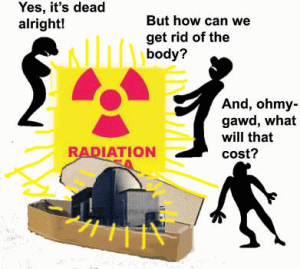
The escalating costs of the geological disposal facility (GDF) have led the Public Accounts Committee (PAC) chair to demand that the government produce a “coherent plan” to manage the country’s nuclear waste legacy
29 Oct, 2025 By Tom Pashby
https://www.newcivilengineer.com/latest/escalating-nuclear-waste-disposal-cost-leads-senior-mp-to-demand-coherent-plan-29-10-2025/
A GDF represents a monumental undertaking, consisting of an engineered vault placed between 200m and 1km underground, covering an area of approximately 1km2 on the surface. This facility is designed to safely contain nuclear waste while allowing it to decay over thousands of years, thereby reducing its radioactivity and associated hazards.
PAC chair Geoffrey Clifton-Brown’s comments were made in reaction to the revelation that the total life cost of the GDF is up to £15bn more than the sum listed in the National Infrastructure and Service Transformation Authority’s (Nista’s) recent annual report. Nista is a government body and works with the Cabinet Office and Treasury and its August 2025 report published figures from Nuclear Waste Services (NWS), the government body responsible for the GDF, showing the GDF as having a whole life cost of from £20bn to £53.3bn.
However, Nista’s Infrastructure Pipeline dashboard lists the GDF’s CapEx (capital expenditure) range for new infrastructure in 2024/2025 prices as being from £26.2bn to £68.7bn, with the top end being slightly over £15bn higher than the figure published in the annual report.
A government source explained to NCE earlier that the discrepancy is because the figures published in Nista’s annual report was based on 2017/2018 prices, meaning the effects of long-term inflation were not accounted for.
Criticism has previously been levied at High Speed 2 (HS2) because of its use of historic pricing figures to reduce the impact of inflation on budget projects and make the total cost of the project appear to be lower than it would end up being.
Government must have coherent plan to manage nuclear waste – senior MP
The House of Commons PAC is one of the most active and powerful select committees in Parliament, able to formally request that the National Audit Office carry out investigations into government projects.
Nuclear decommissioning is a key area of focus for the Committee because of the high total costs, which will hit the public purse into the far future. Sellafield is seen as the government’s flagship project within the wider nuclear decommissioning programme.
The scale of future nuclear decommissioning is clear in the Nuclear Decommissioning Authority: Annual Report and Accounts 2024 to 2025, which says: “the discounted best estimate of the future costs of the decommissioning mission of £110.1bn”. This is a £5bn increase on the previous year.
Members of Congress object to plutonium giveaway

October 26, 2025, https://beyondnuclear.org/senators-object-to-plutonium-giveaway/
On December 31, the Trump White House will start revealing which lucky startup companies will receive free plutonium needed for their new reactor fuel. Trump will give away between 20-25 tons, according to reports, going against US energy policy that has long avoided the transfer of nuclear weapons-usable materials into the commercial sector. One likely recipient is Oklo, on whose board Trump’s present energy secretary, Chris Wright, once sat, raising serious conflict of interest issues.
Several Members of Congress have already written to Trump expressing their concerns. In the letter sent by Senator Ed Markey and Reps. Don Beyer and John Garamendi, all Democrats, they pointed out that dishing out plutonium “to private industry for commercial energy use,” crossed a line that “goes against long-standing, bipartisan US nuclear security policy. It raises serious weapons proliferation concerns, makes little economic sense, and may adversely affect the nation’s defense posture.” They also pointed out that the amount of plutonium Trump is preparing to move into the commercial sector “is enough for at least 2,000 nuclear bombs.”
And they also took care to remind Trump that “commercial nuclear energy does not require separated plutonium, and today there is no global demand for plutonium to make civilian nuclear reactor fuel. Nuclear power reactors instead rely on uranium fuel, which is safer and cheaper to process.”
Roll up, roll up for your free plutonium.
The 19-25 metric tons of plutonium Trump would be redirecting into the civil nuclear sector had previously been slated for permanent disposal as nuclear waste left over from the Cold War era. Disposing of it is far cheaper than reprocessing it — $20 billion versus $49 billion according to the senators’ letter — and also isolates it from potentially falling into the wrong hands.
Trump is preparing a dangerous giveaway to struggling commercial nuclear startups, writes Linda Pentz Gunter
Imagine you are a commercial nuclear reactor startup company but you just can’t quite start up because there’s one little problem. Your “new” reactor design needs a special kind of fuel. And that fuel requires a particular ingredient: plutonium.
Plutonium is the trigger component of a nuclear bomb. The countries that developed nuclear weapons — as well as those that have reprocessed irradiated reactor fuel in order to separate the plutonium from uranium — have massive surplus piles of plutonium left over, an ever-present security threat.
Now imagine that a former board member of one of those struggling startup companies, Oklo, is Chris Wright, the current US Secretary of Energy in the Trump government. Lo and behold, all of a sudden, that same carnival barker who passes for a US president is offering your former company plutonium for free from a stockpile of close to 20 metric tons or more.
The White House has announced that it will begin revealing its lucky free plutonium recipients on December 31 based on applications received by the US Department of Energy by November 21, according to Reuters. The news agency put the plutonium surplus amount at 19.7 metric tons, although the Trump administration has suggested it has 25 tons to spare.
That amount, according to a letter sent to the Trump administration by one senator — Ed Markey — and two representatives— Don Beyer, John Garamendi — all Democrats — is enough for at least 2,000 nuclear bombs.
Dishing out plutonium “to private industry for commercial energy use,” the trio wrote in their September 10 letter, “goes against long-standing, bipartisan US nuclear security policy. It raises serious weapons proliferation concerns, makes little economic sense, and may adversely affect the nation’s defense posture.”
Markey wrote to Trump again on September 23, specifically enquiring whether it was more than just a peculiar coincidence that Wright’s former company, Oklo, would be the beneficiary of the plutonium handout.
Earlier, with his colleagues, Markey had expressed concern that “the transfer of weapons-usable plutonium to private industry would increase the risk of nuclear weapons proliferation, including to rogue states or terrorists.”
Markey now wanted to know whether “a serious conflict of interest may exist within your Administration on this issue because the plutonium transfer will benefit Secretary of Energy Chris Wright’s former company.”
Saying that he had “questions about the propriety of the transaction,” Markey noted that in addition to the free plutonium, Trump’s Department of Energy was also supporting Oklo to build a $1.7 billion reprocessing plant in Tennessee that would enable Oklo to further extract the plutonium needed for its as yet unlicensed micro-reactors.

Markey went on to question whether the administration even cared whether or not a new Oklo-owned reprocessing plant made any sense but was instead backing the project with taxpayer money “because Oklo stands to benefit financially and Secretary Wright is acting in his former company’s interest.”
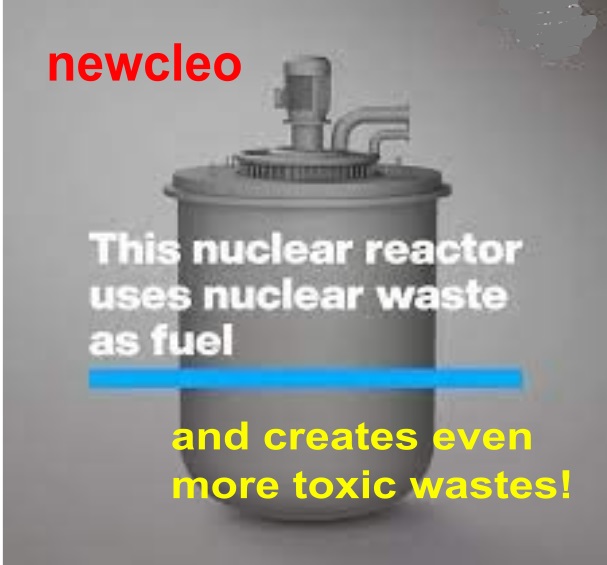
Among the eager corporations already lined up for their plutonium handouts are not only Oklo but also a foreign corporation, the now French-based but originally British nuclear company, newcleo, as well as US-based Valar Atomics, which has been criticized for developing a reactor that would not only consume but also produce plutonium.
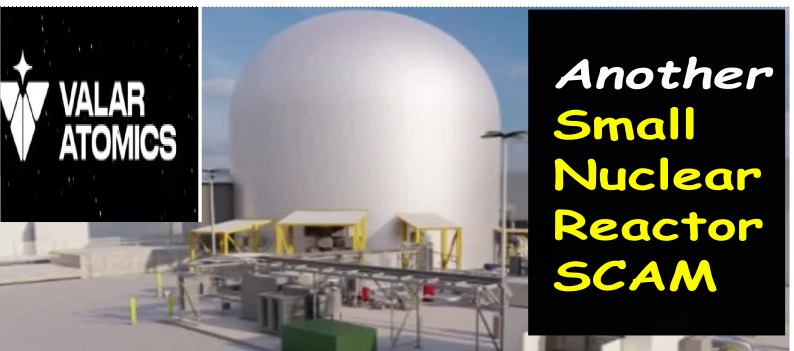
Perhaps to celebrate the impending largesse, newcleo announced on October 20 that it has entered into a partnership with Oklo and will invest $2 billion to develop advanced nuclear fuel fabrication and manufacturing facilities.
On the very day — May 23rd —that Trump released his executive orders fast-tracking nuclear power expansion, Valar Atomics put out its own statement celebrating the news. (Do you think they’d seen the EOs in advance, or maybe even written parts of them themselves?)
Echoing the identical language repeatedly used by Trump officials, the Valar Atomics statement said: “There’s a new arm to national nuclear security: Dominance. Dominance in civilian nuclear technology development, dominance in nuclear energy infrastructure deployment, dominance in shaping global development.”
We should note here that the word “dominance” appears 35 times in the Heritage Foundation’s Project 2025 guide to autocracy, which contains an entire section called American Energy and Science Dominance and another called Restoring American Energy Dominance.
Accordingly, we now have something called the National Energy Dominance Council, headed by Secretary of the Interior Doug Burgum. Burgum heralded the newcleo-Oklo deal, saying: “This agreement to implement newcleo’s advanced fuel expertise into Oklo’s powerhouses and invest $2 billion into American infrastructure and advanced fuel solutions is yet another win for President Donald J. Trump’s American Energy Dominance Agenda.”
Standing in the way of such dominance, according to Valar Atomics and others, remains the US Nuclear Regulatory Commission (NRC). In April, Valar Atomics had joined the states of Texas, Utah, Louisiana, Florida, and Arizona, as well as fellow reactor companies Last Energy and Deep Fission, to sue the NRC. Their beef is that, going back to the days of NRC predecessor, the Atomic Energy Commission, there has been an annoying insistence “to require licenses even for reactors that use small amounts of special nuclear material that have no effect on US defense and security or public health and that the NRC itself has stated do not pose public health and safety risks.”
Innovation, complains Valar Atomics, is made “virtually impossible,” by the NRC. “Their rules — created in the overreaction to the Three Mile Island incident — shuttered the nuclear industry. Simply testing a reactor prototype takes five to seven years, at best. This is not the way to foster innovation! To regain our dominance in nuclear energy, the status quo must change, quickly.”
The suit is currently under discussion for a possible resolution, given that the Trump DOE is moving fast to rein in any excessive safety oversight by the newly downsized NRC, where the mission statement now extolls the “benefits” of nuclear energy for the US public.
The 19-25 metric tons of plutonium Trump would be redirecting into the civil nuclear sector had previously been slated for permanent disposal as nuclear waste left over from the Cold War era. Disposing of it is far cheaper than reprocessing it — $20 billion versus $49 billion according to the senators’ letter — and also isolates it from potentially falling into the wrong hands. ……………………………………………………………………………………………………………………………..
Plutonium has no place in the civil nuclear sector. But it should have no place in our lives, period, if we really want to avoid nuclear proliferation or worse.
Linda Pentz Gunter is the founder of Beyond Nuclear and serves as its international specialist. Her book, No To Nuclear. Why Nuclear Power Destroys Lives, Derails Climate Progress and Provokes War, can be pre-ordered now from Pluto Press. https://beyondnuclearinternational.org/2025/10/26/roll-up-roll-up-for-your-free-plutonium/
Nuclear waste plan turns neighbor against neighbor in a struggling Japanese fishing village
A huge underground vault could hold highly radioactive waste for thousands of years — but only if the government can overcome local opposition
Leslie Liang Science Line, • October 25, 2025
Nobuka Miki was flustered by the television reporter’s question. She was happily spending the day with her daughter, enjoying a Buddhist festival on the main street of her village in northern Japan, when the question came.
What did she think about the proposal to build an underground storage site for Japan’s high-level radioactive waste in Suttsu, the struggling fishing town where she lives? “As long as it’s not dangerous, then it should be OK?” Nobuka briefly answered before fleeing the uncomfortable exchange.
Until that 2020 interview, Nobuka, who owns a local beauty salon, had no idea the Japanese government was considering her village as the site for a huge underground vault capable of holding all of Japan’s high-level nuclear waste for thousands of years.
As soon as the television news clip was broadcast and calls from her worried friends started lighting up her phone, Nobuka had second thoughts.
“Everything was lovely and suddenly, I heard ‘nuclear waste’,” remembered Nobuka, who has since changed her mind and is now helping to voice the local opposition against the waste proposal. “I felt surprised.”
The bigger surprise came when Nobuka learned that years earlier, Suttsu’s own leadership had volunteered to be considered for the site, in an attempt to revitalize a community whose primary industry, herring fishing, has been declining for years.
Suttsu’s mayor, Kataoka Haruo, applied for the survey in 2020 to investigate if the village can be a permanent site for Japan’s high-level radioactive nuclear waste after a subsidy incentive was promised. The subsidies for the first stage of the survey were up-to-2 billion yen ($19.4 million), and seven billion yen ($48.6 million) for the second stage.
Five years later, the proposal remains highly divisive in Suttsu, which has a population of less than 3,000. Neighbors who know each other through generations of friendship have stopped talking. Their kids no longer play together……………………………………………………………………………………………………..
The situation has gotten slightly less heated recently after a series of community meetings, Nobuka says, but nothing is resolved yet. Suttsu remains one of three candidates for the waste disposal site — the other is another isolated northern town 60 kilometers farther up the coast — despite growing opposition centered on safety concerns, including the possibility of earthquakes and volcanic eruptions.
Japan needs to have a nationwide discussion about the waste issue, which has not attracted much attention beyond the potentially affected communities, said Takumi Saito, a professor who studies nuclear power at the University of Tokyo. He believes that for energy security, a natural resource-deprived country like Japan needs nuclear power.
The conflict in Suttsu is a small manifestation of a worldwide debate over what to do with highly radioactive waste products of nuclear power, especially spent fuel rods. As of 2023, Japan has generated more than 19,000 tons of used rods and other highly radioactive waste since it opened its first commercial nuclear reactor in 1966. Currently that waste is in temporary storage on the grounds of Japan’s 15 nuclear power plants, a situation experts say is risky considering that the waste will remain dangerous for more than 10,000 years.
Many other countries are in the same boat. More than a dozen nations are trying to develop underground storage facilities for high-level nuclear waste, but none are open yet, and many are mired in controversy. In the United States, the federal government has been pushing for the construction of a high-level waste storage facility at Nevada’s Yucca Mountain since 1987, but the proposal is now moribund after intense opposition from lawmakers and the public.
At a time when many countries are talking about building a new generation of nuclear power plants to reduce dependence on fossil fuels that drive global climate change, the lack of approved long-term waste storage facilities has been a critical hurdle — both in countries with long-established nuclear power programs and in many smaller nations that would like to develop their own………………………………………………………………………………………………………..
Like many other countries with nuclear power, Japan is also trying to make progress on building a plant to reprocess and ultimately reuse spent nuclear fuel. France and Russia have been operating similar plants for years. In Japan’s case, reprocessing is crucial because the country is determined to reuse as much material as possible before it is shipped to the long-term storage site.
Critics are skeptical. The reprocessing facility in the town of Rokkasho “has been under construction for 30 years. [It was] supposed to be finished by September 2024. But it’s delayed again [until 2027],” said Satoshi Takano, a researcher from Citizens’ Nuclear Information Center, an anti-nuclear group in Japan. “The policy is not working. We need to reconsider it.”
Plans to build the long-term storage site have been under consideration for almost as long. Suttsu’s leaders had volunteered their town for consideration more than 20 years ago, in response to a nationwide call from the Nuclear Waste Management Organization of Japan. The government promised billions in financial subsidies to the chosen community, but ultimately only three put themselves forward, including Suttsu.
In 2020, the government disclosed the names of the three communities. That was news to many local Suttsu residents, including Nobuka.
At the time, she didn’t even know what nuclear waste was. Even the devastating 2011 accident at Fukushima felt like a distant issue, 800 kilometers to the south. She and others quickly learned otherwise, not only because of the waste site proposal but also because of a plan to reopen the nuclear plant at Tomari, just 50 kilometers up the coast.
Their anxiety grew last November, when the government announced that a long-awaited review of the scientific literature on local geology showed that Suttsu and another northern coastal town, Kamoenai, were potentially suitable sites.
There are still numerous other steps, however, including drilling surveys and test tunnels — work that could take another 18 years, the government estimates.
The government’s plan is to build an underground storage site 1 to 2 kilometers wide and a depth of 300 to 500 meters, according to Satoshi. “If the site were to be built, it would be enough for the current waste in Japan,” he said
Nobuka, though, is one of many locals who say they are determined to stop it. She has made nuclear waste her second career, joining the Town Residents’ Association to speak out in opposition.
“People who are interested in this issue are quite doubtful about the decision” to name Suttsu as one of the finalists, Satoshi said. “The safety is not clear.”
Nobuka’s biggest concern is that nuclear accidents caused either by a natural disaster or man made malfunction will destroy Suttsu. But she worries that the project may already have too much momentum to stop, especially with the government’s drive to expand nuclear power.
She feels excluded from the government’s decision-making process. “Nobody showed up and asked about our concerns,” Nobuka said. “We’re not getting enough attention and I feel less and less hopeful.”…………………………………………..https://scienceline.org/2025/10/nuclear-waste-plan-turns-neighbor-against-neighbor/
Germany destroys two nuclear plant cooling towers as part of nuclear phaseout plan.
Euronews, 25/10/2025,https://www.euronews.com/2025/10/25/germany-destroys-two-nuclear-plant-cooling-towers-as-part-of-nuclear-phaseout-plan
The two towers, equivalent to roughly 56,000 tonnes of concrete, collapsed in a controlled demolition on Saturday. It comes as part of Germany’s nuclear phaseout.
Two cooling towers of the former nuclear power plant in Germay’s Bavarian town of Gundremmingen were brought down in a controlled demolition at noon on Saturday.
The plant had served as an important landmark in the town for nearly six decades, bringing numerous new jobs and boosting the local economy.
As part of the country’s nuclear phaseout and under Germany’s energy transition policy, the Gundremmingen, as well as the Brokdorf, and Grohnde nuclear power plants, had already been decommissioned in December 2021.
The municipality, who had prepared for a large crowd of onlookers, set up a restricted zone around the power plant.
According to energy company RWE, the demolition could be observed from various watch points in the region. Some pubs also offered public “demolition viewing parties”
How the towers will be blown up
There were three explosions in total. The first was carried out to chase away nearby animals and wildlife. The second brought down the first tower, and the third caused the second tower to collapse.
Roughly 56,000 tonnes of concrete collapsed in a matter of seconds. Following Saturday’s demolition, the dismantling of the plant will further continue, local media report, with completion expected by 2040.
Early engagement launched on £360m nuclear waste capping scheme
By Harmsworth
Nuclear Waste Services (NWS), the state-owned body responsible for
managing the UK’s radioactive waste, has launched early market engagement on a £360m programme to cap and extend the Low Level Waste Repository (LLWR) in Cumbria.
NWS operates the repository on behalf of the Nuclear
Decommissioning Authority (NDA), a non-departmental public body sponsored by the Department for Energy Security and Net Zero.
The scheme will involve installing a permanent engineered cap over disused trenches and Vault 8 at the LLWR site near Drigg. Capping is a method used to isolate radioactive waste from the environment. It involves layering materials such as clay, concrete and geomembranes to prevent water from reaching the waste and to contain any gas emissions.
Construction News 24th Oct 2025,
https://www.constructionnews.co.uk/civils/early-engagement-launched-on-360m-nuclear-waste-capping-scheme-24-10-2025/
US offers nuclear energy companies access to weapons-grade plutonium
US offers nuclear energy companies access to weapons-grade plutonium.
Expert warns commercial use of the radioactive material from cold war-era
warheads carries safety risks.
The US has offered energy companies access
to nuclear waste that they can convert into fuel for advanced reactors in
an attempt to break Russia’s stranglehold over uranium supply chains. The
Department of Energy on Tuesday published an application that nuclear
energy groups can use to seek up to 19 metric tonnes of the government’s
weapons-grade plutonium from cold war-era warheads.
In the document seen by
the Financial Times, the energy department said being selected to receive
the plutonium could help companies secure faster approval for a Nuclear
Regulatory Commission license, which is required to operate a nuclear
facility. At least two companies, Oklo, which is backed by OpenAI’s Sam
Altman, and France’s Newcleo, are expected to apply to access the
government’s plutonium stockpile.
FT 21st Oct 2025, https://www.ft.com/content/2fbbc621-405e-4a29-850c-f0079b116216
True cost of nuclear waste disposal facility £15bn higher than recent Treasury figures

MP says ministers ignore long-term waste costs of nuclear power
“Government ministers are very happy to talk about the so-called benefits of nuclear power without reference to its long-term impacts and the eye-wateringly large amounts of money associated with storage and security of nuclear waste, which is in the tens of billions of pounds just to create the GDF,” he said.
23 Oct, 2025 New Civil Engineer, By Tom Pashby
The true cost of an underground facility for long-term storage of nuclear waste has been revealed to be up to £68.7bn – £15bn more than the sum listed in the National Infrastructure and Service Transformation Authority’s (Nista’s) recent annual report.
A Geological Disposal Facility (GDF) represents a monumental undertaking, consisting of an engineered vault placed between 200m and 1km underground, covering an area of approximately 1km2 on the surface. This facility is designed to safely contain nuclear waste while allowing it to decay over thousands of years, thereby reducing its radioactivity and associated hazards.
Nuclear Waste Services (NWS) is responsible for the GDF project and declares that this method offers the most secure solution for managing the UK’s nuclear waste, aimed at relieving future generations of the burden of storage. NWS is part of the Nuclear Decommissioning Authority (NDA), which is itself an executive non-departmental public body, sponsored by the Department for Energy Security and Net Zero (DESNZ).
Nista is a unit of HM Treasury and published its NISTA Annual Report 2024 to 2025 in August 2025, where it described the GDF project as ‘Red’, meaning the projects appears to be “unachievable”, and as having a whole life cost of from £20bn to £53.3bn.
However, Nista’s Infrastructure Pipeline lists the GDF’s CapEx (capital expenditure) range for new infrastructure in 2024/2025 prices as being from £26.2bn to £68.7bn, with the top end being slightly over £15bn higher than the figure published in the annual report.
A government source explained to NCE that the discrepancy is because the figures published in Nista’s annual report are based on 2017/2018 prices, meaning the effects of long-term inflation were not accounted for.
Criticism was previously levied at High Speed 2 (HS2) because of its use of historic pricing figures to reduce the impact of inflation on budget projects and make the total cost of the project appear to be lower than it would end up being.
Parliamentarians told NCE that ministers should face up to the long-term legacy costs associated with the nuclear industry.
Current GDF pricing only provided by Nista to ensure consistency with pipeline
A government source told NCE that the difference in the two ranges for whole-life costs for the GDF is a factor of the price basis for each quoted figure.
They said that the NDA provided Nista with data in 2017/18 prices with the total range of £20bn-53.3bn, which was reflected in the Nista annual report.
The same data for this project was converted to 2024/25 prices for the Nista Infrastructure Pipeline, to ensure consistency with the rest of the data in the set, the source said. This is reflected in the higher figure of £26.1bn-£68.7bn.
NWS did not provide any comment.
MP says ministers ignore long-term waste costs of nuclear power
SNP spokesperson for energy security and net zero, transport, and science, innovation and technology, Graham Leadbitter MP, told NCE that ministers ignore the long term legacy of nuclear power when promoting projects.
“Government ministers are very happy to talk about the so-called benefits of nuclear power without reference to its long-term impacts and the eye-wateringly large amounts of money associated with storage and security of nuclear waste, which is in the tens of billions of pounds just to create the GDF,” he said.
He added that the waste would have to be managed for 1,000’s of years, and the money budgeted for nuclear waste management would be better spent on “more valuable infrastructure projects … that would support high-quality employment, investment in skills and vastly improved public services.”
Government must ‘face up to the legacy’ of nuclear – peer
Liberal Democrat Lords spokesperson for energy and climate change Earl Russell told NCE: “If this Government truly want to see a renaissance in nuclear power, it must finally face up to the legacy it leaves behind.”
Russell reiterated the fact that Nista described the GDF as “unachievable” and added: “The government must have a credible, long-term strategy for managing the waste new nuclear projects will produce.”……………………………………………………………………… https://www.newcivilengineer.com/latest/true-cost-of-nuclear-waste-disposal-facility-15bn-higher-than-recent-treasury-figures-23-10-2025/
Radioactivity and nuclear waste under scrutiny in Peskotomuhkati homeland [video]
by NB Media Co-op, October 20, 2025, https://nbmediacoop.org/2025/10/20/radioactivity-and-nuclear-waste-under-scrutiny-in-peskotomuhkati-homeland-video/
Nuclear energy in New Brunswick was the focus of a recent public meeting in Fredericton, hosted by the NB Media Co-op. It took place at the Social Forum in Wolastokuk, a two-day event that brought together activists from across the province and beyond.
Nuclear energy is a live issue right now in New Brunswick, as NB Power goes forward with its controversial plans to build a Small Modular Nuclear Reactor at Point Lepreau. New Brunswick is the only province outside of Ontario that operates a nuclear power reactor, the aging Point Lepreau station.
At the social forum, Gordon Edwards, president and co-founder of the Canadian Coalition for Nuclear Responsiblity, outlined the history of nuclear energy and spoke about its risks.
Hugh Akagi, chief of the Peskotomuhkati Nation at Skutik, also led a discussion as part of the session. The community has members in New Brunswick and in Maine, and for decades, has pushed for official recognition from the Government of Canada.
The First Nation never consented to the existing reactor at Point Lepreau, opposes more nuclear reactors on their territory, and has expressed grave concerns about radioactive waste.
The full presentation is brought to you by the NB Media Co-op in partnership with the CEDAR Project. This reporting has been made possible in part by the Government of Canada via the Local Journalism Initiative.
Russia to Raise Cold War Nuclear Submarines From Arctic—What’s Hiding on the Seabed?
Ivan Khomenko, Oct 20, 2025 , https://united24media.com/latest-news/russia-to-raise-cold-war-nuclear-submarines-from-arctic-whats-hiding-on-the-seabed-12644
Russia plans to begin preparations in 2026 for raising two Soviet-era nuclear submarines that sank in Arctic waters, according to RBC on October 18. The recovery work itself is scheduled to start in 2027.
As RBC reported, the draft federal budget for 2026 and the planned period of 2027–2028 includes allocations for rehabilitating Arctic sea areas contaminated by sunken or submerged radiation-hazardous objects.
These activities are part of Russia’s state program Development of the Atomic Energy and Industrial Complex.
According to the explanatory note cited by RBC, the section titled “Safe Handling of Federal Radioactive Waste and Decommissioning of Nuclear and Radiation-Hazardous Legacy Facilities” earmarks 10.5 billion rubles for 2026, 10.7 billion for 2027, and 10.6 billion for 2028.
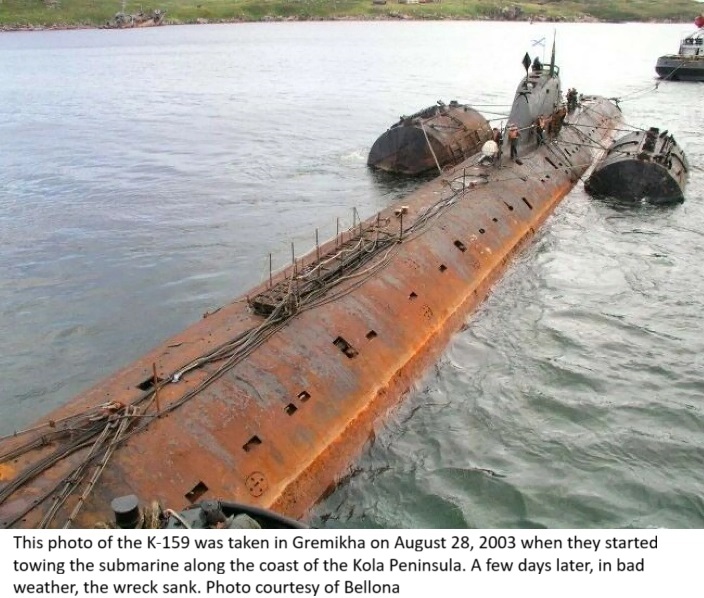
The project reportedly focuses on two of the seven sunken Soviet nuclear submarines—K-27 and K-159.
K-27, introduced in 1963, was an experimental submarine equipped with liquid-metal cooled reactors using a lead-bismuth alloy. In 1968, during its third voyage, a reactor accident exposed more than 140 crew members to radiation, killing nine.
The vessel was scuttled in the Kara Sea in 1981 and now lies at a depth of about 75 meters.
K-159 entered service the same year as K-27 and remained operational until 1989. It sank in 2003 in the Barents Sea while being towed for dismantling near Kildin Island, resulting in the deaths of nine crew members. The wreck rests at approximately 250 meters.
Plans to lift these submarines have been discussed for more than a decade but were repeatedly postponed due to the lack of specialized equipment, qualified personnel, and safety concerns. In 2021, Rosatom estimated that raising the vessels would cost around 24.4 billion rubles.
The renewed inclusion of the project in Russia’s 2026 budget marks the first concrete step since 2012 toward removing the radioactive wrecks from the Arctic seabed, though the exact reasons for the timing remain unclear, RBC noted.
Earlier in October, Russia’s Novorossiysk submarine—armed with Kalibr cruise missiles—was forced to abandon its Mediterranean mission and return to Saint Petersburg after a fuel leak disabled its underwater capability.
The incident highlighted Russia’s growing naval limitations following the loss of its Syrian logistics hub in Tartus and Turkey’s blockade of the Bosphorus Strait.
1 This Month

of the week – Shut Down Drone Warfare!


Tell the Ukrainian Government to Drop Prosecution of Peace Activist Yurii Sheliazhenko

Petition to revoke the licensing of the Near Surface Nuclear Disposal Facility (NSDF) at Chalk River. https://www.ourcommons.ca/petitions/en/Petition/Details?Petition=e-7247
To see nuclear-related stories in greater depth and intensity – go to https://nuclearinformation.wordpress.com
-
Archives
- March 2026 (237)
- February 2026 (268)
- January 2026 (308)
- December 2025 (358)
- November 2025 (359)
- October 2025 (376)
- September 2025 (257)
- August 2025 (319)
- July 2025 (230)
- June 2025 (348)
- May 2025 (261)
- April 2025 (305)
-
Categories
- 1
- 1 NUCLEAR ISSUES
- business and costs
- climate change
- culture and arts
- ENERGY
- environment
- health
- history
- indigenous issues
- Legal
- marketing of nuclear
- media
- opposition to nuclear
- PERSONAL STORIES
- politics
- politics international
- Religion and ethics
- safety
- secrets,lies and civil liberties
- spinbuster
- technology
- Uranium
- wastes
- weapons and war
- Women
- 2 WORLD
- ACTION
- AFRICA
- Atrocities
- AUSTRALIA
- Christina's notes
- Christina's themes
- culture and arts
- Events
- Fuk 2022
- Fuk 2023
- Fukushima 2017
- Fukushima 2018
- fukushima 2019
- Fukushima 2020
- Fukushima 2021
- general
- global warming
- Humour (God we need it)
- Nuclear
- RARE EARTHS
- Reference
- resources – print
- Resources -audiovicual
- Weekly Newsletter
- World
- World Nuclear
- YouTube
-
RSS
Entries RSS
Comments RSS
 nuclear-news