Dealing with wrecked Fukushima nuclear reactors will take decades
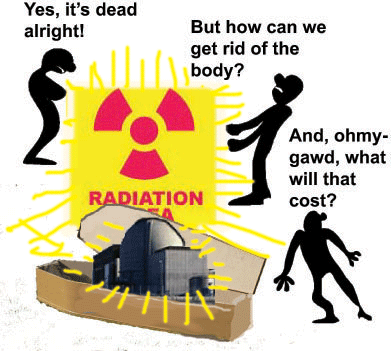
 Three decades needed to make Fukushima safe, ABC News, By North Asia correspondent, October 28, 2011 30 years to decommission: Inside the Fukushima nuclear plant A draft report by Japan’s nuclear agency says it will take more than 30 years to decommission the shattered Fukushima nuclear plant.
Authorities hope to have the stricken reactors in a state of cold shutdown by the end of the year. The draft report from the cabinet’s nuclear agency estimates that reactors number one through to four at the Fukushima plant will not be fully decommissioned until 2042.
As well as achieving cold shutdown of the reactors, each reactor building has to be decontaminated, and then fuel from the spent fuel pools has to be collected.
The final stage involves collecting nuclear fuel from inside the four reactors. Reactors one, two and three all suffered meltdowns after a tsunami slammed into the plant in March… http://www.abc.net.au/news/2011-10-28/fukushima-nuclear-decommission/3605094/?site=melbourne
USA’s MOX plutonium nuclear fuel plant a costly, dangerous, flop
 “The government would be crazy to consider building another MOX plant. MOX cannot be recycled.”….
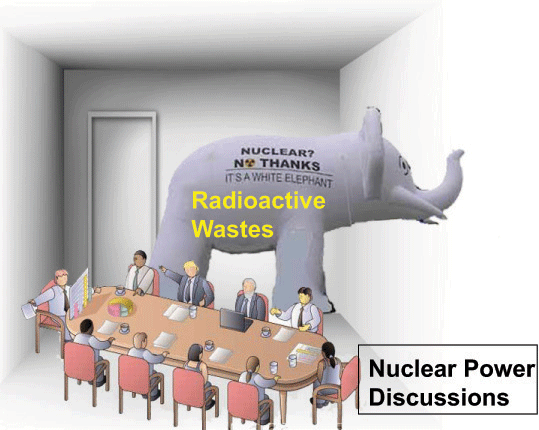 The Bomb Plant: A MOX White Elephant?, DC Bureau By Joseph Trento, on October 20th, 2011 The National Nuclear Security Administration may have a $10 billion taxpayer-financed white elephant on its hands based on Britain’s experience with a similar plant that has been shuttered after a decade of failed operations. Continue reading
International Atomic Energy Agency (IAEA) worried about Japan’s radioactive cleanup problems
the report noted that a lack of available disposal sites for radioactive waste will “unduly limit and hamper successful remediation activities, thus potentially jeopardizing public health and safety.”
Nuclear Agency Urges Japan to Fix Cleanup Plan, WSJ , 15 Oct 11, By MITSURU OBE, TOKYO—The International Atomic Energy Agency, in a report released Friday, urged Japan to take a more focused and realistic approach to dealing with radioactive contamination in areas around the stricken Fukushima Daiichi nuclear plant in northeastern Japan, amid signs the Japanese government is becoming overwhelmed by public demands for decontamination. Continue reading
UK Royal Society calls for a plan for long term disposal of nuclear wastes
Group wants long-term nuclear plans, Belfast Telegraph 13 Oct 11, The Government must establish long-term plans for a new generation of nuclear power plants so future generations are not left dealing with its legacy, experts have urged. Continue reading
DOE can’t manage cold war’s nuclear wastes (let alone today’s)
 “Many of the excess facilities awaiting deactivation and decommissioning are one-of-a-kind or unique to the DOE, with unprecedented scope and complexity,” said the authors. “In many cases, the necessary technologies are not yet developed or, if developed, they require significant re-engineering to fit DOE needs.”
Cold War’s nuclear wastes pose challenges to science, engineering, society Eureka Alert 13 Oct 11 Seven papers published in the current issue of Technology and Innovation, Proceedings of the National Academy of Inventors ™ report on efforts by the U.S. Department of Energy (DOE) to ensure continued safe and secure storage and disposition of 50 years worth of spent nuclear fuel, surplus nuclear materials, and high-level wastes at DOE facilities. Continue reading
Row in Finland over insufficient storage space for nuclear wastes
Dispute over disposal of nuclear waste brewing between power companies,
 Pyhäjoki waste would not all fit in Olkiluoto, HELSINGIN SANOMAT, 7 Oct 11, Disagreement over the final storage of nuclear waste flared up soon after the power company Fennovoima announced on Wednesday that it had decided to build a new nuclear facility in Pyhäjoki on Finland’s west coast. Continue reading
Ukraine’s new nuclear waste storage facility
Where to put 23 Tokyo Domes-full of radioactive waste? wonders Japan
Radioactive soil can fill 23 Tokyo Domes, Five prefectures’ nuclear burden a hot potato no one wants to catch, Japan Times By SETSUKO KAMIYA 29 Sept 11 Radioactive soil and vegetation that must be removed in Fukushima and four adjacent prefectures could reach up to 28.79 million cu. meters, equal to filling the Tokyo Dome 23 times, according to a recent Environment Ministry estimate.
But finding a disposal or temporary storage site will be a tall order. The estimate covers soil and dead leaves mainly from areas with radiation levels of more than 5 millisieverts per year in the prefectures of Fukushima, Miyagi, Yamagata, Tochigi and Ibaraki, whose data were used to mete out the rough figures.
In Fukushima, home of the nuclear plant leaking all the radiation, about 17.5 percent of the prefecture is contaminated to that level. The estimate was submitted Tuesday to a 12-member expert panel working out decontamination plans. The panel assumed that 5 cm of topsoil should be removed from contaminated areas, including pinpoint decontamination efforts in certain locations with radiation of 1 to 5 millisieverts per year.
The government is hammering out details on plans to remove and store the soil and leaves. But finding a location to temporarily store such a huge amount of radioactive materials will be an extremely sensitive and politically difficult task for the central government.
Breaking down the total, contaminated soil from residential areas was estimated at 1.02 million cu. meters, farm land at 17.43 million cu. meters and forests at 8.76 million cu. meters, the Environment Ministry said.
A single facility capable of housing the entire 28.79 million cu. meters of soil would have to be 1 sq. km in area and 30 meters deep. But if the central government decides on multiple facilities, negotiations would have to be completed with numerous local governments. The location for a temporary facility is still undecided, but the government is reportedly considering Fukushima Prefecture….. http://search.japantimes.co.jp/cgi-bin/nn20110929a3.html
Problems of Finland’s Olkiluoto nuclear plant and waste storage plans
the companies are planning to make Onkalo only large enough for waste from their own potential seven reactors
the Finnish Radiation and Nuclear Safety Authority (STUK) has identified safety concerns at operating Finnish power plants as part of stress tests conducted after last spring’s Fukushima crisis in Japan. These include the lack of backup cooling systems that are independent of electrical supply at the Olkiluoto1 and 2 reactors.
a honeycomb of storage sites extending over an area of several square kilometres will weaken the bedrock, making it vulnerable to earthquakes,

 includes VIDEO TVO: No room for Fennovoima waste in nuclear cave, YLE FI 4 oct 11, Onkalo on Finland’s west coast will be the world’s first permanent nuclear waste repository. The project director of the Olkiluoto 3 nuclear power plant, TVO Senior Vice President Jouni Silvennoinen, insists there is no space for waste from utilities other than TVO or Fortum in the Onkalo underground disposal site on Finland’s west coast. Continue reading
Japan will no longer measure plutonium
Japan ceases measuring the plutonium, Paul Langley’s Nuclear History Blog, 4 Oct 11, At the press conference of TEPCO and related ministries of Japanese government, Ministry of Education, Culture, Sports, Science and Technology stated they will not measure plutonium anymore.
The measurement of plutonium was abandoned in Japan.It was announced on 10/3/2011 by staff from Ministry of Education, Culture, Sports, Science and Technology.
Now Japanese people are allowed to take 1~10 Bq/kg of plutonium. However, 1 in a million gram of plutonium causes cancer.
They announced that plutonium and strontium were detected in 45km / 79km area on 9/30.They seem afraid of having the contamination situation known by more people. http://fukushima-diary.com/2011/10/breaking-news-the-measurement-of-plutonium-was-abandoned-in-japan/#.Tomr6dmxwk4.facebook
JGov and TEPCO are disgusting.
http://nuclearhistory.wordpress.com/2011/10/03/japan-ceases-measuring-the-plutonium/
Top ten places in dangerous radioactivity
Just wait till the communist parties in China and North Korea finally fall, and the truth is out. You haven’t heard/seen real horror stories yet! Already, China’s known pollution is horrifying,
 Fukushima Tops List of World’s 10 Most Radioactive Places Fellowship of the Minds – Conservatives who love America 24 Sept 11 Our media have the attention span of a child.
The damaged nuclear reactors of Fukushima Daiichi, Japan, have fallen off the radar of our media’s interest, but that doesn’t mean things are hunky dory.
On the contrary, according to the 2010 report by the non-profit Blacksmith Institute, the most radioactive places are listed, with Chernobyl the worst. But now, Fukushima can top the list of the world’s ten most radioactive places. Yes, Fukushima is more radioactive than Chernobyl!
10. Hanford, U.S.A. Continue reading
Plutonium in soil 40 Km from Fukushima nuclear plant
Plutonium 40km from Fukushima plant, FT.com Asia Pacific By Mure Dickie in Tokyo, 3 Oct 11 Small amounts of plutonium believed to have escaped from Japan’s tsunami-crippled nuclear plant have been detected in soil more than 40km away, say government researchers, a finding that will fuel already widespread fears about radiation risk……
The plutonium was found at six sites – including one in Iitate around 40km from the plant – all of which are subject to evacuation orders. However, plutonium’s long half-life and the potential for even small amounts to pose a health hazard if ingested is likely to make it a focus of popular concern.
Japanese authorities, who significantly underestimated radiation releases from the plant in the early days of the crisis, have since struggled to convince the public that they are able effectively to guard against radiation health threats…. http://www.ft.com/intl/cms/s/0/7e3af460-ece6-11e0-be97-00144feab49a.html#axzz1Zkkm68Sy
Secret negotiations over Mongolia becoming repositary for nuclear waste
the idea has become a political lightning rod, with the opposition Green Party charging that a waste facility could become an environmental and safety nightmare….
 the draft agreement, which has not been released but reportedly included a passage referring to Mongolia as a future destination for spent fuel……
“Mongolia is not an awfully democratic state,”
 Senior U.S. Official Denies Talk of Foreign Nuclear Waste Site in Mongolia, NTI Global Security Newswire, Sept. 30, 2011, By Elaine M. Grossman WASHINGTON — A senior U.S. Energy Department official on Wednesday disputed reports that the Obama administration has sought Mongolian support for construction of a storage site for international spent nuclear fuel in the Central Asian nation (see GSN, March 30).
The assertion — made by a high-ranking official who asked not to be named in addressing a diplomatically sensitive issue — directly countered remarks offered last spring by a veteran State Department official who leads U.S. nuclear trade pact negotiations. Continue reading
Dounreay nuclear plant’s radioactive pollution of Scotland’s North coast seabed
“Once again, we see the nuclear industry causing a problem it can’t solve, and dumping the cost and consequence on the rest of us,”
 Scottish nuclear fuel leak ‘will never be completely cleaned up’ The Scottish Environment Protection Agency has abandoned its aim to remove all traces of contamination from the north coast seabed Rob Edwards guardian.co.uk, 21 September 2011 Radioactive contamination that leaked for more than two decades from the Dounreay nuclear plant on the north coast of Scotland will never be completely cleaned up, a Scottish government agency has admitted. Continue reading
Radioactive pollution from rare earths processing in China
China Re-Nationalizes Rare Earths – Part One, Metal Miner by STUART on SEPTEMBER 19, 2011 That China has suffered severe and widespread pollution from the mining and refining of rare earth elements (REE) is not in doubt —
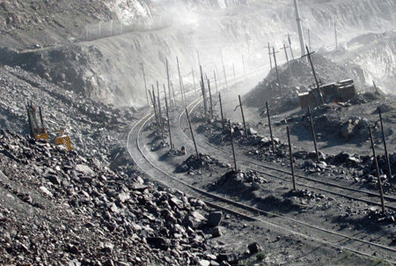
The New York Times reported this week that China had largely shut down its rare earth industry for three months to address pollution problems. Officials confirm evidence visible by satellite that large tracks around both legal and illegal mine sites have become wastelands…….
Apparently the government also plans to consolidate 80 percent of the production from southern China — which produces the rest of China’s rare earths — into three companies within the next year or two. All three of these companies are former ministries of the Chinese government that were spun out as corporations, and the central government still owns most of the shares. These actions will at least ensure Beijing achieves control of mining and refining; if pollution remains a problem, they only have themselves to blame.http://agmetalminer.com/2011/09/19/china-re-nationalizes-rare-earths-part-one/
1 This Month
23-25 October – on Zoom – World BEYOND War’s annual global conferenc


Shut down the radiation-damaged Heysham nuclear reactors now
To see nuclear-related stories in greater depth and intensity – go to https://nuclearinformation.wordpress.com

Say No to NASA’s Reckless Nuclear Reactor on the Moon
Say No to NASA’s Reckless Nuclear Reactor on the Moon

-
Archives
- October 2026 (243)
- September 2026 (339)
- August 2026 (330)
- July 2026 (355)
- June 2026 (287)
- May 2026 (306)
- April 2026 (356)
- March 2026 (251)
- February 2026 (267)
- January 2026 (308)
- December 2025 (358)
- November 2025 (359)
-
Categories
- 1
- 1 NUCLEAR ISSUES
- business and costs
- climate change
- culture and arts
- ENERGY
- environment
- health
- history
- indigenous issues
- Legal
- marketing of nuclear
- media
- opposition to nuclear
- PERSONAL STORIES
- politics
- politics international
- Religion and ethics
- safety
- secrets,lies and civil liberties
- spinbuster
- technology
- Uranium
- wastes
- weapons and war
- Women
- 2 WORLD
- ACTION
- AFRICA
- Atrocities
- AUSTRALIA
- Christina's notes
- Christina's themes
- culture and arts
- Events
- Fuk 2022
- Fuk 2023
- Fukushima 2017
- Fukushima 2018
- fukushima 2019
- Fukushima 2020
- Fukushima 2021
- general
- global warming
- Humour (God we need it)
- Nuclear
- RARE EARTHS
- Reference
- resources – print
- Resources -audiovicual
- Weekly Newsletter
- World
- World Nuclear
- YouTube
-
RSS
Entries RSS
Comments RSS

