America no closer to finding a tomb for its accumulating nuclear wastes
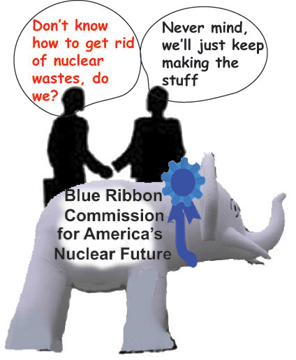 In July, with little fanfare, the Obama administration’s Blue Ribbon Commission on America’s Nuclear Future released a draft report to the Secretary of Energy on a post-Yucca Mountain solution. The report calls for development of “one or more geologic disposal facilities.”
So far, federal officials say they haven’t even started looking for a specific state or single site.
Northland rock considered for nuclear waste storage With Nevada’s Yucca Mountain out of the running as the permanent graveyard for U.S. nuclear waste, scientists now are looking for other places to entomb the stuff, including rock formations common in northern Minnesota and Wisconsin. That’s the message from a 114-page study from the Sandia National Laboratory that surfaced last week. By: John Myers, Duluth News Tribune, 25 Dec 11, Continue reading
Desperate international quest for nuclear waste disposal
Nuclear nations wrestle with problem of permanent waste storage CANADA.COM BY IAN MACLEOD, POSTMEDIA NEWS DECEMBER 20, 2011 Ottawa Citizen With more than 400 nuclear power plants in 32 countries, nuclear waste disposal is no longer an afterthought. A global nuclear waste race is underway.
International research and co-operation has exploded. So has public decision-making in the once-private affairs of the nuclear power industry. Deep underground burial in hard rock cavities for hundreds of thousands of years is now considered the best long-term solution for the 240,000 tonnes of highly radioactive spent reactor fuel stacked in temporary storage around the globe.
No nation yet has opened a permanent geological repository. But plans are well advanced in some countries, notably Finland and Sweden. Canada plans to open a deep repository for high-level waste around 2035, though much work lies ahead, including finding a suitable site. Transferring the estimated four million spent fuel bundles into the vault will take an additional 30 years.
The United States, meanwhile, is in an increasingly desperate situation. The Obama administration’s recent decision to cancel the 2015 opening of a repository at Yucca Mountain in Nevada’s remote desert country has left jittery and angry American nuclear power producers sitting on enormous amounts of spent fuel crammed into interim storage for an indefinite additional period. The country’s 104 commercial power reactors churn out more every day……..
The biggest issue for any repository design is assessing how it will perform far into future to allow the spent fuel products to decay into harmlessness. No one alive today, or for generations to come, will ever know the answer – hopefully. That means extensive, lengthy and expensive scientific studies. In geology alone, where time scales are measured in billions of years, research requires time.
There’s also hydrology, thermohydrology, hydrogeology, geochemistry, climate change modelling, materials behaviour, radionuclide migration and much, much more. Paying for the repositories is far simpler. Most countries, Canada included, require the radioactive waste producers to finance all the multibillion-dollar costs… http://www.canada.com/Nuclear+nations+wrestle+with+problem+permanent+waste+storage/5889554/story.html
Canadian tribes say NO to nuclear waste
 No nuclear waste here, North Shore Tribal Council says,SooToday.com, December 20, 2011 Chiefs of the North Shore Tribal Council say no! to a multi-billion dollar nuclear waste disposal project in their territory CUTLER, ON – The First Nations of the North Shore Tribal Council strongly reject the prospect of the North Shore of Lake Huron becoming a site for the long-term storage of nuclear waste for the Nuclear Waste Management Organization (NWMO). The City of Elliot Lake has publicly expressed interest in possibly becoming one of the sites for the long-term disposal of nuclear waste for Canada’s nuclear industry.
Elliot Lake has a long history of uranium mining that resulted in the boom and bust of the city, as well as significant and lasting environmental damage to the local watershed and nearby ceremonial grounds. In addition, there are dozens of tailings ponds surrounding Elliot Lake currently waiting for a solution for their safe disposal.
“We cannot idly stand by and watch as they inject Mother Earth with this cancer,” says Chief Lyle Sayers, chairman of the North Shore Tribal Council. “We must ensure that the future natural resources of this area are there for our children, generations to come, and businesses alike.”
The half-life of this material is hundreds of thousands of years old and could impact generation after generation. No site can ever be totally safe for nuclear waste storage. “Natural disasters sometimes happen, such as we’ve seen in Japan. It could make this whole area a nuclear wasteland suitable for only that industry,” says Chief Sayers.
Our statement to the Canadian Nuclear Safety Commission and to the Nuclear Waste Management Organization is: Do not waste your financial resources if you plan to conduct a study in this area because a nuclear waste dump is not going to happen here.
The North Shore Tribal Council represents seven First Nation communities across the North Shore of Lake Huron.Chief Lyle Sayers is the chief of the Garden River First Nation and also the chairman of the North Shore Tribal Council. http://www.sootoday.com/content/news/details.asp?c=37141
The world’s 240,000 tonnes of intensely radioactive civilian waste
Nuclear’s environmental costs No nation has come up with a permanent, safe way to dispose of radioactive waste Montreal Gazette, By IAN MACLEOD, Postmedia News December 17, 2011 “……More than 240,000 tonnes of intensely radioactive civilian waste has piled up around the globe since the dawning of the atomic age.
Sixty years on, no one is sure yet how to safely and permanently dispose of the stuff, much of it harmful to living organisms for thousands of years. Canada’s share of the highlevel heap stands at 44,000 tonnes. Virtually all is spenturanium fuel bundles – 2.3 million of them – that powered the commercial and research reactors that made Canada a leading nuclear nation…..
Spent fuel bundles are just one piece of fallout from the nuclear fuel cycle. Continue reading
USA no nearer to solving its huge nuclear waste problems
Three decades after the 1982 Nuclear Waste Policy Act said the federal government would handle disposal of high-level radioactive waste, the United States still has no agreed-upon solution for where and how to dispose of about 70,000 metric tons of it. About 10 percent is from the military’s nuclear weapons programs; most of the rest is piling up at commercial reactor sites around the country……
Nuclear waste site hunt could point to granite, WSJ, 18 Dec 11, MONTPELIER, Vt. — The likely death of a planned nuclear waste site at Nevada’s Yucca Mountain has left federal agencies looking for a possible replacement. A national lab working for the U.S. Department
of Energy is now eying granite deposits stretching from Georgia to Maine as potential sites, along with big sections of Minnesota and Wisconsin where that rock is prevalent. Continue reading
Nuclear waste disposal problem looming large and urgent for USA
 U.S. anxious to secure nuclear waste disposal site as China emerges on scene Mainichi Daily News, Japan, By Haruyuki Aikawa, Europe General Bureau, December 14, 2011 “……As the world shifts away from the business of recycling plutonium-based nuclear fuel, the construction of facilities to handle nuclear waste remains a nagging issue. After plans to construct an international disposal facility in Australia fell through, the United States and Japan moved forward in negotiations to build such a facility in Mongolia, an inland country which is believed to hold rich deposits of uranium…..
After the Mainichi Shimbun reported the plans in May, an opposition campaign was launched in Mongolia, and in September this year, Mongolian President Tsakhiagiin Elbegdorj issued an order prohibiting negotiations, effectively putting an end to the plans…… at the end of March that the rise of emerging nations had weakened the United States’ grip. While it still has power, it wants to secure a place that will accept spent nuclear fuel. The project previously proposed in Mongolia strongly highlights the United States’ anxiousness. … http://mdn.mainichi.jp/features/news/20111214p2a00m0na013000c.html
Many thousands of tons of radioactive water accumulating at Fukushima
 Tepco estimates that the amount of treated water requiring storage is increasing by 200 to 500 tons every day.
 Japan’s earthquake-hit nuclear plant scraps plan to dump water in sea, Reuters Tokyo December 12, 2011 Japan’s utility operating the crippled Fukushima nuclear power plant said on Friday it has scrapped a plan to dump water it treated for radiation contamination into the sea following fierce protests from fishing groups. Continue reading
Turmoil over Hanford’s huge radioactive wastes, whistleblowers targeted?
the worst of the waste is still decades away from being completely removed. Millions of gallons of a highly radioactive stew — enough to fill dozens of Olympic-size swimming pools — are stored in aging underground tanks. Some of those tanks have leaked, threatening the groundwater and the river.
Hanford workers filed suit as whistleblowers, claiming they were targeted for reprisals after raising safety concerns.
 New concerns about Northwest nuclear waste plant Google News, By SHANNON DININNY,12 Dec 11 RICHLAND, Wash. (AP) — The federal government says a one-of-a-kind plant that will convert radioactive waste into a stable and storable substance that resembles glass will cost hundreds of millions of dollars more and may take longer to build, adding to a string of delays and skyrocketing price tag for the project.
In addition, several workers at southeast Washington’s Hanford nuclear reservation have raised concerns about the safety of the plant’s design — and complained they’ve been retaliated against for voicing their issues. Continue reading
Anxiety in Ontario at the prospect of nuclear waste dump
Peabody said Walkerton’s tainted water tragedy a decade ago should be
reason enough to stay out of the radioactive-waste business.
“I would (also) question the wisdom of putting all of Canada’s nuclear
waste beside or close to Lake Huron under some of Canada’s best farm
land.”
Nuclear waste dump idea sparks unease in Ontario The Canadian Press, Dec. 11, 2011 TORONTO — A community on the shores of Lake Huron has cracked open the door to southern Ontario’s becoming the permanent storage site for Canada’s spent, but still dangerously radioactive, nuclear fuel. Continue reading
Will Los Alamos plutonium nuclear lab be USA’s Fukushima?
 Questions swirl around $6 billion US nuclear lab Canadian Business, By AP | December 04, 2011 SANTA FE, New Mexico (AP) — At Los Alamos National Laboratory, scientists and engineers refer to their planned new $6 billion nuclear lab by its clunky acronym, CMRR, short for Chemistry Metallurgy Research Replacement Facility. But as a work in progress for three decades and with hundreds of millions of dollars already spent, nomenclature is among the minor issues.
Questions continue to swirl about exactly what kind of nuclear and plutonium research will be done there, whether the lab is really necessary, and — perhaps most important — will it be safe, or could it become New Mexico’s equivalent of Japan’s Fukushima? Continue reading
UK government and its crazy economics of a plutonium Mox nuclear plant

“This is crazynomics – the reality is that the nuclear fairytale is a nuclear nightmare. Having announced the closure of a Mox plant because it was colossally inefficient and because there was no market for its service, the government now wants to build another one that will fast become a hugely expensive white elephant.
Mox plant U-turn by coalition stuns anti-nuclear campaigners, Guardian UK, Terry Macalister, 2 Dec 11 Having closed down a massively loss-making mixed-oxide fuel
reprocessing plant at Sellafield, the government amazes Greenpeace by proposing to build a new one
The government has astonished the anti-nuclear lobby by outlining plans to spend £3bn of public money building a new mixed-oxide fuel (Mox) plant – months after announcing the closure of a similar facility that lost taxpayers hundreds of millions of pounds….. Continue reading
Japan trying out a giant washing machine for radioactive cleanup
Japan looks to giant washer to clean Fukushima debris, MY sinchew.com,TOKYO, December 2, 2011 (AFP) – Japan is looking to launder tsunami debris in a giant washing machine to get rid of radiation from the Fukushima nuclear accident, a researcher said Friday.
In a scheme they hope will result in finally being able to dispose of contaminated waste left by the waves that crushed towns on the country’s northeast coast, a cleaning plant will be built near the Fukushima Daiichi power station. Shredded waste — including the remains of houses and cars destroyed by the tsunami — will be put inside a huge water-filled drum where steel attachments will scrub away radioactive particles, the researcher told AFP.
The plan is a joint scheme between Tokyo-based construction company Toda Corp. and the Japan Atomic Energy Agency…..Government planners have said radiation-contaminated debris could be stored in a facility in Fukushima prefecture for at least 30 years until its final destination is determined. http://www.mysinchew.com/node/67283
Taiwan’s nuclear waste dilemma
 Activists challenge government on nuclear waste management policy, Taiwan News, Central News Agency, Taipei, By Hsu Chih-wei and Elizabeth Hsu Nov. 28 (CNA) Environmental groups charged Monday that Taiwan’s government has not resolved how to deal with nuclear waste and proposed suspending operations at the country’s three nuclearpower plants until the issue was dealt with.
The environmentalists made the appeal at an environmental assessment meeting held by the
Cabinet-level Environmental Protection Administration (EPA) on the government’s radioactive waste management policy. During the meeting, officials from the Atomic Energy Council (AEC), the country’s top nuclear regulatory body, presented a report on its proposed approach to dealing with nuclear waste that will become official policy ifapproved by the EPA assessment committee. One of the plan’s centerpieces was to have nuclear waste recycled overseas beforeshipping it back to Taiwan for permanent storage.
But environmental activists, including Green Citizens’ Action Alliance Deputy Secretary-General Hung Shen-han, were not convinced the solution was viable and advocated shutting down Taiwan’s three nuclear power plants until the issue was clearly addressed. Hung contended that one way or another, radioactive waste had to be stored either at home or abroad, and no foreign country has so far been willing to lease Taiwan land for storage of the waste. He acknowledged that radioactive waste could be recycled overseas but said the leftover material was still unstable and would still have to be stored in Taiwan, which he saw as a bad option.
Hung compared nuclear waste to a ticking time-bomb that threatened the life and
property of Taiwan’s people because of the unstable geographic nature of the island, which is prone to earthquakes. …. The government has selected Wuchiu in Kinmen and Daren in Taitung to serve as permanent storage sites for the waste, but it has encountered strong opposition from people in the two townships. http://www.taiwannews.com.tw/etn/news_content.php?id=1771961
World’s nuclear waste problem becoming ever more urgent
A New Urgency to the Problem of Storing Nuclear Waste, NYT By KATE GALBRAITH, November 27, 2011 AUSTIN, TEXAS — The nuclear disaster in Fukushima, Japan, earlier this year caused many countries to rethink their appetite for nuclear power. It is also, in subtler ways, altering the fraught discussion of what to do with nuclear plants’ wastes.
A prime example is Germany, which decided to shut down all its nuclear power plants by 2022 after the partial reactor meltdowns at Fukushima. That decision is making it easier for Germans to have a calm and focused discussion about a permanent disposal site for the plants’
wastes, analysts say.
Previously, opponents of nuclear power worried that backing a permanent solution for the wastes would make it easier for nuclear power plants to continue to exist, according to Michael Sailer, the chief executive at the Öko-Institut in Berlin, a research and consulting group focused on sustainability.
Anti-nuclear politicians, he said, felt that if they came out in favor of a permanent disposal site, “they support pro-nuclear people because they solve the waste problem.”….
Germany is now moving forward on the waste issue. Continue reading
Nuclear power for space research (another ploy to keep nuclear industry alive?)
Nuclear or Solar, Where Does the Future of Space Exploration Lie? Oil Price.com , James Burgess, 24 November 2011 “………The major problem that NASA faces when pursuing this form of technology is that, as Dr. John M. Logsdon, a space expert at George Washington University, said “It’s really only possible with plutonium-238 to do what it’s intending to do,” and the United States stopped making Plutonium-238 in the 1980’s. Since then they have bought it from Russia, but now they no longer make it either. A 2009 report by the National Academy of Sciences called for restarting production, but this has not been done, mostly for cost reasons….
Therefore, solar cells have always been used where possible. Steven W. Squyres, a professor of astronomy at Cornell who is the chief scientist behind the Opportunity and Spirit rovers, said: “You always use solar when you can; it’s simpler, cheaper, just easier to do. You only use nuclear when you have to.’’ This thought was obviously prevalent when NASA launched their Jupiter-bound, Juno space shuttle, as that too relies upon solar cells….”
http://oilprice.com/Energy/Energy-General/Nuclear-or-Solar-Where-Does-the-Future-of-Space-Exploration-Lie.html
1 This Month



9 September – online public forum THREE MILE ISLAND:
7-8:30 PM ET,
Legacy, resistance to reopening – https://us02web.zoom.us/webinar/register/WN_-LGJU4j6TD2Hgf0rpgAr1A#/registration
The nuclear industry and the U.S. Nuclear Regulatory Commission are threatening to restart Pennsylvania’s permanently closed and decommissioning Three Mile Island Unit 1 nuclear power station. Three expert speakers will present the resistance to this dangerous misadventure in a webinar hosted by the Clamshell Alliance, Beyond Nuclear and Massachusetts Peace Action.

No Nuclear in Cwm Llynfi! Stop the nuclear power station near Maesteg.
To see nuclear-related stories in greater depth and intensity – go to https://nuclearinformation.wordpress.com
-
Archives
- September 2026 (127)
- August 2026 (330)
- July 2026 (355)
- June 2026 (287)
- May 2026 (306)
- April 2026 (356)
- March 2026 (251)
- February 2026 (267)
- January 2026 (308)
- December 2025 (358)
- November 2025 (359)
- October 2025 (375)
-
Categories
- 1
- 1 NUCLEAR ISSUES
- business and costs
- climate change
- culture and arts
- ENERGY
- environment
- health
- history
- indigenous issues
- Legal
- marketing of nuclear
- media
- opposition to nuclear
- PERSONAL STORIES
- politics
- politics international
- Religion and ethics
- safety
- secrets,lies and civil liberties
- spinbuster
- technology
- Uranium
- wastes
- weapons and war
- Women
- 2 WORLD
- ACTION
- AFRICA
- Atrocities
- AUSTRALIA
- Christina's notes
- Christina's themes
- culture and arts
- Events
- Fuk 2022
- Fuk 2023
- Fukushima 2017
- Fukushima 2018
- fukushima 2019
- Fukushima 2020
- Fukushima 2021
- general
- global warming
- Humour (God we need it)
- Nuclear
- RARE EARTHS
- Reference
- resources – print
- Resources -audiovicual
- Weekly Newsletter
- World
- World Nuclear
- YouTube
-
RSS
Entries RSS
Comments RSS
 nuclear-news