Japan – 37 tons of deadly plutonium, and planning to produce more
 Other countries, including the United States, have scaled back the separation of plutonium because it is a proliferation concern and is more expensive than other alternatives, including long-term storage of spent fuel.
Fuel reprocessing remains unreliable and it is questionable whether it is a viable way of reducing Japan’s massive amounts of spent fuel rods
Japan’s plutonium stockpile — most of which is stored in France and Britain — has swelled despite Tokyo’s promise to international regulators not to produce a plutonium surplus.

 Japan to make more plutonium despite big stockpile, Fox News June 01, 2012 Associated Press TOKYO – Last year’s tsunami disaster in Japan clouded the nation’s nuclear future, idled its reactors and rendered its huge stockpile of plutonium useless for now. So, the industry’s plan to produce even more has raised a red flag.
Nuclear industry officials say they hope to start producing a half-ton of plutonium within months, in addition to the more than 35 tons Japan already has stored around the world. That’s even though all the reactors that might use it are either inoperable or offline while the country rethinks its nuclear policy after the tsunami-generated Fukushima crisis. Continue reading
USA legal fuss over Nuclear Waste Fund, as no waste solution found
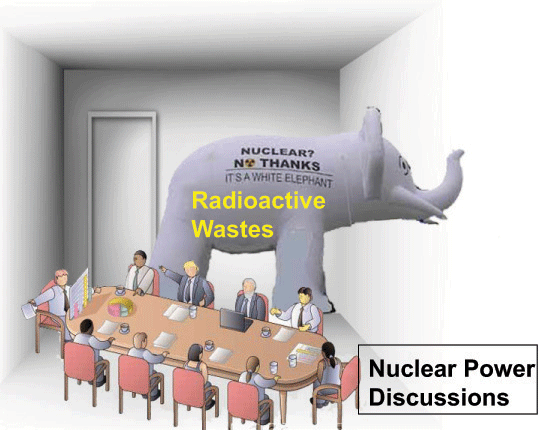 Appeals courts criticizes Energy Department over billions paid into nuclear waste fund Washington Post, By Associated Press, June 1 WASHINGTON — A federal appeals court says the Energy Department did not complete a review required to continue collecting $750 million a year in fees from operators of nuclear power plants.
Bu the U.S. Court of Appeals for the District of Columbia did not order the fee collection suspended. Instead, officials were given six more months to complete the review.
More than $26 billion has been paid into the federal Nuclear Waste Fund for long-term storage and disposal of nuclear waste from the nation’s 104 commercial nuclear reactors. The money has sat idle for decades amid disputes about how to dispose of the waste….
http://www.washingtonpost.com/politics/appeals-courts-criticizes-energy-department-over-billions-paid-into-nuclear-waste-fund/2012/06/01/gJQA5ALe7U_story.html
High level nuclear waste dump for shores of Great Lakes!
 how did governments around the world, citizens like us around the world, science and the nuclear industry, turn a blind eye to the huge buildup of nuclear waste for more than 40 years as we enjoyed the fruits of nuclear power?
the nuclear waste dangers will remain for thousands of years, longer than civilization itself. And right next to the largest fresh-water lake system in the world.
Nuclear waste, tourism don’t mix http://www.lfpress.com/comment/2012/05/25/19800186.html By WAYNE MACDONALD, May 26, 2012 A  packed council chambers in Saugeen Shores, where I live, stood in stunned amazement as its local council- once again – took a huge step toward changing the face of this lakeside community with no discussion, no debate. Absolutely none. Continue reading
Plutonium’s deadly history
 The Manhattan Project’s Fatal “Demon Core”, Physics Central, May 21, 2012 Sixty six years ago today, Louis Slotin saw a flash of blue light in the depths of Los Alamos National Laboratory. Seconds before, all that separated the young scientist from a lethal dose of radiation was a thin screwdriver.
The screwdriver supported a reflective covering that encased a sphere of plutonium, and if the reflector fell into place, a nuclear chain reaction would commence. When Slotin’s hand slipped, a lethal burst of radiation hit him, and he died nine days later. Continue reading
Stop Kent nuclear waste bunker plan says Campaign to Protect Rural England,

 Environmental group slams Kent nuclear waste bunker proposal BBC 20 May 2012 A proposal to build a nuclear waste bunker in Kent has been criticised by an environmental group.
Shepway District Council is considering whether a nuclear disposal facility, where waste is buried underground, could be built at Romney Marsh.
Protect Kent have reacted strongly to the proposal saying it must be “quashed at the outset”.
The council said it has “no formal view” about the proposal.
The Romney Marsh Nuclear Research and Disposal Facility would be buried 200m (656ft) to 1,000m (3,280ft) below ground……. Kent County Council has already signalled its opposition to the idea, saying it would push for a county-wide referendum.
Andrew Ogden, from Protect Kent, local branch of the Campaign to Protect Rural England, said the proposal was “unfeasible”.
“This is an ill-considered idea that must be quashed at the outset,” he said.
“Perhaps more significantly, it is a proposal that is so unfeasible and so unlikely to be given any credence by the government. Shepway District Council are wasting time, energy and money in trying to pursue it.”….. Shepway District Council will hold a series of public exhibitions over the next three weeks detailing the proposals. http://www.bbc.co.uk/news/uk-england-kent-18137403
UK government wooing county Kent to accept nuclear waste dump
Wetlands of Romney Marsh in Kent could become new home of nuclear waste dump Mail Online, By SUZANNAH HILLS, 17 May 2012 The wildlife-rich wetlands of Romney Marsh in Kent could become the home of an underground nuclear waste dumping ground if government plans get the go ahead.
Thousands of letters have been sent by Shepway District Council to residents living in the area as part of a consultation over the proposal for a multi-million pound Nuclear Research and Disposal Facility.
Under the plans, hazardous nuclear waste would be buried between 200m to 1000m below the ground in underground vaults, while a research facility would be constructed on the surface…. http://www.dailymail.co.uk/news/article-2145628/Wetlands-Romney-Marsh-Kent-new-home-nuclear-waste-dump.html#ixzz1vGB2CiZp
Kent County Council opposes nuclear waste bunker plan
Kent nuclear waste bunker proposal considered BBC News 16 May 12 A bunker used to store nuclear waste from all over the UK could be built in Kent, under a council’s plans. Shepway District Council is examining whether a nuclear disposal facility, where waste is buried underground, could be built at Romney Marsh. The authority said it could bring jobs to the area as Dungeness A and B power stations are phased out.
However, Kent County Council said it would use “every tool in the box” to oppose the scheme. The Romney Marsh Nuclear Research and Disposal Facility would be buried 200m (656ft) to 1,000m (3,280ft) below ground…..
Council leader’s ‘horror’ The leader of Kent County Council, Paul Carter, said his authority
opposed the plan and would push for a county-wide referendum if necessary. “We are totally opposed to initiating any process that even entertains the possibility of building a nuclear waste disposal site anywhere near or around Kent,” he said. “We will do everything possible to oppose this unviable proposal and will use every tool in the box to bring an end to this scheme…. http://www.bbc.co.uk/news/uk-england-kent-18086988
Finland’s plan for eternal storage of nuclear waste
there is the problem of time. HLW will remain dangerous for longer than civilization itself has existed. Future civilizations may not even have the ability to address the dangers—even if we could somehow warn them what they’re dealing with.

Meanwhile, the construction of new nuclear facilities continues apace, even in the U.S. Earlier this year, federal regulators granted licenses to construct two new plants in Georgia, the first such licenses in the U.S. since 1978. So our waste problem, and the world’s, will only get worse.
 Finland’s Crazy Plan to Make Nuclear Waste Disappear, Popular Mechanics, By Tim Heffernan 11 May 12, The U.S. plan to bury nuclear waste in Yucca Mountain may be dead, but in Finland, engineers are going ahead with a plan to build an enormous bunker to house the dangerous stuff. And they have a radical solution to keep future civilizations away—hide the nuclear waste somewhere so unremarkable and unpleasant that nobody would ever think to go there. Barring a disaster—or a miracle, depending on your viewpoint—the Finnish government later this year will begin the final licensing of the world’s first permanent storage facility for high-level nuclear waste. Continue reading
Recycling plutonium more dangerous and costly than burying it
Experts urge Britain to bury plutonium rather than recycling
http://mainichi.jp/english/english/newsselect/news/20120510p2g00m0in010000c.html 10 May 12, WASHINGTON (Kyodo) — Four U.S. nuclear experts urged Britain to bury plutonium rather than recycling for fuel for nuclear reactors as it is more cost-effective, according to the British science journal Nature’s Thursday edition.
Citing an estimate in 2000 that recycling plutonium from spent fuel to make mixed oxide fuel adds $750 million each year to the cost of electric power generation in France, the four said, ”Britain should seriously evaluate the less costly and less risky method of direct
plutonium disposal, and take the opportunity to lead the world towards a better solution for reducing stockpiles.” Continue reading
Thorium nuclear reactors are no solution to energy problems
It doesn’t solve the proliferation problem. It doesn’t solve the waste problem, either. So every nuclear reactor, no matter what type, creates fission products, which are highly radioactive materials, some short-lived, some long-lived
This is highly radioactive waste. If you look at Oak Ridge’s current evaluation, they say you have to condition this waste, you have to convert the fluorides, and then you have to have a deep geologic repository.
What’s in this waste? Cesium-137 and strontium-190, hundreds of years, just like today’s reactors. Cesium-135 and iodine-129, millions of years half-life. Technetium-99, 200,000 years.
 Is Thorium A Magic Bullet For Our Energy Problems? NPR May 4 2012, “……..With me is Dr. Arjun Makhijani. He is president of the Institute for Energy and Environmental Research. He’s here in our D.C. studios. Do you agree with Richard Martin that we missed out on thorium? If we had started out with thorium, would be in better shape now?
ARJUN MAKHIJANI: I don’t think so. I think the problems of nuclear power, fundamentally, would remain. The safety problems would be different. I mean, Mr. Martin and proponents of thorium are right in the sense that the liquid fuel reactor has a number of safety advantages, but it also has a number of disadvantages. Continue reading
The thorny question of the importation of nuclear wastes for temporary management
Importation of foreign radioactive waste into the U.S. sets a bad precedent and may well serve to discourage other countries from developing safe techniques to manage their own waste

 US company applies to import radioactive waste from Mexico, incinerate it and return the ash Washington Post, 2 May 12, YAKIMA, Wash. — A waste management company has applied to the federal government for a license to import up to 500 tons of radioactive waste from Mexico to south-central Washington, where the waste will be incinerated and the resulting ash returned to Mexico.
This isn’t the first application to the Nuclear Regulatory Commission to import foreign radioactive waste, but it’s among several recent proposals that have generated little opposition because the waste won’t be permanently stored in the U.S. In 2009, a proposal to import thousands of tons of radioactive waste from Italy, treat it and ultimately store the remnants in Utah was abandoned following public outcry. Continue reading
UK may have 1000 radioactive waste sites
 Nuclear waste ‘may be blighting 1,000 UK sites‘ MoD under fire after report finds number of contaminated sites is far higher than previously estimated Rob Edwards, guardian.co.uk, 2 May 2012 Hundreds of sites across England and Wales could be contaminated with radioactive waste from old military bases and factories, according to a new government report. Continue reading
Investors need to consider the radioactive waste problems of rare earths processing
Uranium and thorium present real risk to rare earths developers – Dennis Mineweb 2 May Interview with Carolyn Dennis of Dundee Capital Markets “….. TCMR: Some rare earth deposits include uranium and thorium byproducts and, if a company is not recovering those, it needs to dispose of them. Is that a challenge most REE miners face?
CD: It’s a real risk across the board for rare earth companies. Each deposit, depending on the type of mineralogy, will have varying grades of uranium and thorium. The jurisdiction the deposit is in and how it approaches dealing with the uranium, thorium and radioactivity will dictate how much of an issue it is for the project. It can be a problem in processing as well. In a lot of cases, the thorium should be removed from the concentrate earlier in the process in order to improve processing downstream. Beyond that, radioactive waste material needs to be disposed of….”
Safety shortcomings at Hanford nuclear waste site
The radioactive waste is currently stored in 177 aging, underground tanks, many of which have leaked into the groundwater, threatening the neighboring Columbia River.
Energy Department audit finds nuclear plant vessels procured to 2005 fail to meet requirements The Republic, SHANNON DININNY, 30 April 12 YAKIMA, Wash. — The Energy Department and a contractor building a waste treatment plant at the nation’s most contaminated nuclear site procured and installed tanks that did not always meet requirements of a quality assurance program or the contract, a federal audit concluded Monday. Continue reading
Fukishima’s radioactive wastes and the failure of nuclear reprocessing
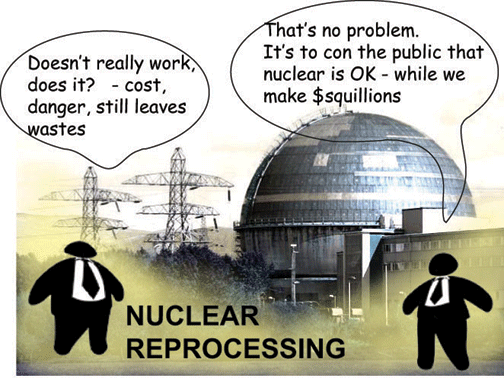 The main reason why there is so much spent fuel at the Da-Ichi site is that the plan to send it off for nuclear recycling has collapsed.
This scheme is based on long discredited assumptions of …. a new generation of “fast” reactors
nearly all of the spent fuel at the Da-Ichi containing some of the largest concentrations of radioactivity on the planet will remain indefinitely in vulnerable pools.
The Fukushima Nuclear Disaster Is Far From Over HUFFINGTON POST, Robert Alvarez, Senior Scholar, Institute for Policy Studies, 22 April 12,“……Last week, Tokyo Electric Power Company (TEPCO) revealed plans to remove 2,274 spent fuel assemblies from the damaged reactors that will probably take at least a decade to accomplish. The first priority will be removal of the contents in Pool No. 4. This pool is structurally damaged and contains about 10 times more cesium-137 than released at Chernobyl. Continue reading
1 This Month
23-25 October – on Zoom – World BEYOND War’s annual global conferenc


Shut down the radiation-damaged Heysham nuclear reactors now
To see nuclear-related stories in greater depth and intensity – go to https://nuclearinformation.wordpress.com

Say No to NASA’s Reckless Nuclear Reactor on the Moon
Say No to NASA’s Reckless Nuclear Reactor on the Moon

-
Archives
- October 2026 (231)
- September 2026 (339)
- August 2026 (330)
- July 2026 (355)
- June 2026 (287)
- May 2026 (306)
- April 2026 (356)
- March 2026 (251)
- February 2026 (267)
- January 2026 (308)
- December 2025 (358)
- November 2025 (359)
-
Categories
- 1
- 1 NUCLEAR ISSUES
- business and costs
- climate change
- culture and arts
- ENERGY
- environment
- health
- history
- indigenous issues
- Legal
- marketing of nuclear
- media
- opposition to nuclear
- PERSONAL STORIES
- politics
- politics international
- Religion and ethics
- safety
- secrets,lies and civil liberties
- spinbuster
- technology
- Uranium
- wastes
- weapons and war
- Women
- 2 WORLD
- ACTION
- AFRICA
- Atrocities
- AUSTRALIA
- Christina's notes
- Christina's themes
- culture and arts
- Events
- Fuk 2022
- Fuk 2023
- Fukushima 2017
- Fukushima 2018
- fukushima 2019
- Fukushima 2020
- Fukushima 2021
- general
- global warming
- Humour (God we need it)
- Nuclear
- RARE EARTHS
- Reference
- resources – print
- Resources -audiovicual
- Weekly Newsletter
- World
- World Nuclear
- YouTube
-
RSS
Entries RSS
Comments RSS

