More costs, more delays for cleanup of USA’s most radioactive nuclear waste site
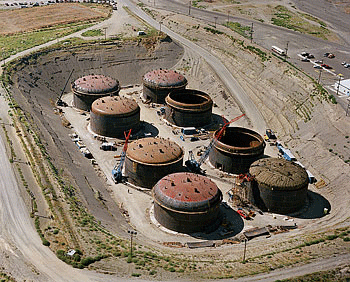 Today, it is the nation’s most contaminated nuclear site, with cleanup expected to last decades.
In March, the Defense Nuclear Facilities Safety Board ruled that the agency lacks necessary information to resolve some problems and establish a complete safety plan.
Hanford waste plant sees new costs, delays USA Today, By Shannon Dininny, 26 June 12, KENNEWICK, Wash. (AP) — A new cost estimate and construction schedule for a massive waste plant being built at the nation’s most contaminated nuclear site will be delayed at least a year as workers try to resolve serious technical problems raised by whistleblowers about design and safety, the U.S. Department of Energy said Tuesday.
The $12.3 billion plant at south-central Washington’s Hanford nuclear reservation is being built to convert highly radioactive waste into a stable glass form for permanent disposal underground.
The plant is currently scheduled to begin operating in 2019, but several workers have raised concerns about safety, particularly about erosion and corrosion in tanks and piping inside the plant.
The issues are significant because the problem areas are inside so-called black cells, which will be closed off and inaccessible due to high radioactivity after the plant begins operating. Continue reading
Liu Li-erh calls for a nuclear free Taiwan
we have about 8,000 spent fuel rods stored in the cooling pool at the Guosheng Nuclear Power Plant [in Wanli District (萬里), New Taipei City] and a total of about 16,000 throughout the country
in February France’s Le Monde newspaper warned about the risk from poor management of spent fuel rods at the Guosheng plant.
Many Japanese companies and government offices have saved up to 50 percent on their electricity consumption since the disaster, “so Taiwan can surely do the same to end our reliance on nuclear power
 Now is time to go nuclear-free: author, Taipei Times By Lee I-chia 24 June 12, Tokyo-based Taiwanese writer Liu Li-erh (劉黎兒) yesterday in Taipei shared her latest fact-finding from Japan to say that now is the best time to put a halt to nuclear power in Taiwan… Continue reading
Nuclear reprocessing is not the answer to Japan’s mounting radioactive wastes
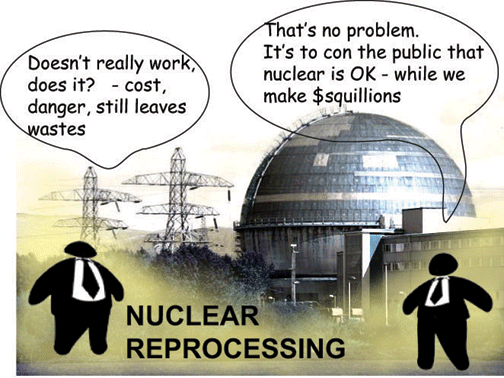 The amount of spent fuel stored at power stations has continued to surge, standing at around 14,200 tons across 17 facilities as of last September, including the wrecked Fukushima No. 1 nuclear plant.
Japan Nuclear Fuel Ltd.’s storage facilities are already almost full and contained a total of 2,800 tons as of February, while several power stations are expected to reach maximum capacity over the next three years if their currently idled reactors are restarted, industry
sources said.
 P
P olicy of recycling all spent nuclear fuel may be axed, Japan Times, 22 June 12, Kyodo, Jiji The Japan Atomic Energy Commission has proposed both reprocessing and directly disposing of spent nuclear fuel if Japan’s atomic energy reliance is cut to 15 percent, a departure from the current policy of total reprocessing…
.. The changed tack comes as massive amounts of spent fuel are accumulating at nuclear plants nationwide and as decades-long efforts to activate reprocessing facilities remain mired
in technical difficulties, sources said. Continue reading
Concern about “complex” nuclear waste at a former western Pennsylvania nuclear waste dump
 Security upped at former Pa. nuclear waste dump, TimesOnline, Jun 17, 2012. Guards from the federal Department of Homeland Security are patrolling a former western Pennsylvania nuclear waste dump as officials rethink their cleanup plans after finding what they called more “complex” nuclear material than expected.
The Pittsburgh Tribune-Review ( http://bit.ly/LwlpaH) says neither the Army Corps of Engineers, which is managing the cleanup, nor the Nuclear Regulatory Commission would say exactly what material was found at the Armstrong County site….
The dump along Route 66 was used to store nuclear and chemical waste from the former Nuclear Materials and Equipment Corp. in Apollo and Parks townships from about
1960 to the early 1970s. http://www.timesonline.com/news/state/security-upped-at-former-pa-nuclear-waste-dump/article_1e038332-6fd1-5569-aad2-2c9f4d5d1e8e.html
Old Hanford nuclear reactor closed – no plan for permanent disposal
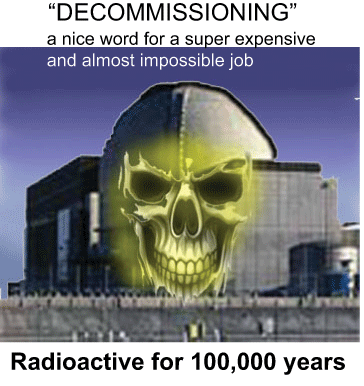 Hanford workers mothball 6th nuclear reactor, Workers at south-central Washington’s Hanford nuclear reservation have finished the process of closing and “cocooning” the longest-running of nine nuclear reactors built there for the U.S. atomic weapons program. Seattle News, By SHANNON DININNY Associated Press YAKIMA, Wash. 14 June 12, —
Workers at south-central Washington’s Hanford nuclear reservation have finished the process of closing and “cocooning” the longest-running of nine nuclear reactors built there for the U.S. atomic weapons program. Continue reading
The deep underground disposal of nuclear wastes
“Nuclear waste disposal in geological formations appropriately selected and designed is the least bad concept,” said Arjun Makhijani, a nuclear waste expert and head of the U.S.-based Institute for Energy and Environmental Research.
“Other solutions are so much worse that they have, rightly in my opinion, been ruled out,” he said.

Europe makes big bets on nuclear waste burial By Terhi Kinnunen and Muriel Boselli EURAJOKI, Finland/BURE, France Jun 13, 2012 (Reuters) – On a small Finnish island and deep in remote rural France, far from the debates and doubts that followed Japan’s Fukushima nuclear disaster, the ground work is underway for a commitment to atomic power for the long term – the very long term. Continue reading
Allison MacFarlane suggest New Mexico as USA’s nuke dump site
Nuclear Regulatory Commission Nominee Talks New Mexico and Nuke Waste http://www.abqjournal.com/main/2012/06/13/politics/nuclear-regulatory-commission-nominee-talks-new-mexico-and-nuke-waste.html By Michael Coleman, ABQ Journal, Jun 13, 2012 President Obama’s nominee to chair the Nuclear Regulatory Commission told Congress Wednesday that the U.S. can learn all it needs to know about disposing of nuclear waste by looking at the Waste Isolation Pilot Plant near Carlsbad.
Allison MacFarlane, President Obama’s nominee to head up the Nuclear Regulatory Commission, made the comment at her confirmation hearing Wednesday, according to an article posted on the the Washington Post website today. I don’t think we even need to look to other countries for lessons [on how to handle nuclear waste],” MacFarlane said. “We’re the only country with a deep geological repository already up and running — and it’s in New Mexico.”
The Blue Ribbon Commission on America’s Nuclear Future made a similar observation in January, when it released a comprehensive report on the thorny issue of nuke waste storage. I wrote about that report here.
Some in Carlsbad would like to see a move to store high-level waste in the area, citing high-paying tech jobs and science they think is now safe and sound. Anti-nuke foes in the state strongly oppose such a move. For now, with Nevada’s Yucca Mountain on ice, many pro-nuclear power advocates are taking an especially keen interest in New Mexico.
New Mexico as site for USA’s national nuclear waste dump?
Study: NM Could Lead in Nuclear Waste Solution, ABQ Journal, By Michael Coleman / Jan 27, 2012 WASHINGTON – America has a serious nuclear waste problem that can be fixed only with dramatic changes to national policy, and New Mexico could help lead by example, according to a major federal study released Thursday.
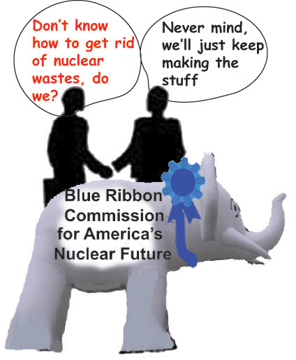
The Blue Ribbon Commission on America’s Nuclear Future – a panel of policy experts commissioned by Energy Secretary Steven Chu that included former U.S. Sen. Pete Domenici, R-N.M. – issued its 180-page report Thursday after nearly two years of study. The report cites the Waste Isolation Pilot Project, which stores nuclear waste near Carlsbad, as a premier example of how to site a nuclear waste disposal. Continue reading
New book on the plutonium scandal at Rocky Flats
 Under The ‘Nuclear Shadow’ Of Colorado’s Rocky Flats 88.7 kuhf.fm June 12, 2012 Kristen Iversen spent her childhood in the 1960s in Colorado near the Rocky Flats nuclear weapons factory, playing in fields that now appear to have been contaminated with plutonium.
In Full Body Burden, she investigates the environmental scandal involving nuclear contamination around her childhood home. Continue reading
Decommissioning nuclear reactors, expensive, but prudent, and cheaper than an accident
Europe’s approach is the prudent one…….America’s approach is to play russian roulette with 105 reactors that are already showing plenty of signs of serious wear and tear Europe’s challenge in decommissioning 150 nuclear reactors
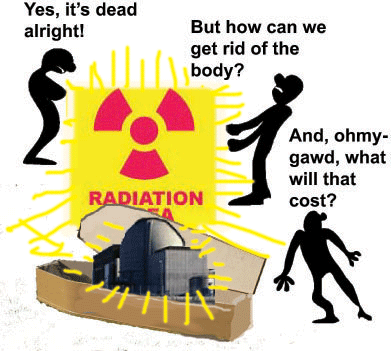 How hard is it to dismantle 150 nuclear reactors? Europe is about to find out http://www.washingtonpost.com/blogs/ezra-klein/post/how-hard-is-it-to-dismantle-150-nuclear-reactors-europes-about-to-find-out/2012/06/09/gJQA2EH0PV_blog.html
Brad Plumer, 06/09/2012 Last year, after the tsunami and reactor meltdown in Fukushima, Japan, many European nations decided to phase out their existing fleets of nuclear power plants. Germany and Belgium are aiming to end all atomic generation by 2030. Switzerland is shooting for 2035.
Not so easy to get rid of. Yet the mere act of shutting down those reactors is going to pose a huge challenge in the years ahead. Continue reading
USA federal ruling means delay in licensing of nuclear power plants
The New York attorney general’s office said the ruling means the NRC cannot license or relicense any nuclear power plant until it examines those risks. That process could take a couple of years, Geoff Fettus, an attorney who argued in court on behalf of the Natural Resources Defense Council, told msnbc.com.
“The need for a new strategy is urgent,” the panel wrote in its report, “not just to address these damages and costs but because this generation has a fundamental, ethical obligation to avoid burdening future generations with the entire task of finding a safe, permanent solution for managing hazardous nuclear materials they had no part in creating.”

 Nuclear headache: What to do with 65,000 tons of spent fuel, By Miguel Llanos, msnbc.com http://usnews.msnbc.msn.com/_news/2012/06/08/12127578-nuclear-headache-what-to-do-with-65000-tons-of-spent-fuel?lite In a blow to the nuclear energy industry, a federal appeals court on Friday threw out a rule allowing plants to store spent nuclear fuel onsite for decades after they’ve closed, and ordered regulators to study the risks involved with that storage – 65,000 tons now spread across the country, and growing at 2,000 tons a year.
The Nuclear Regulatory Commission “apparently has no long-term plan other than hoping for a geologic repository,” the unanimous ruling stated . “If the government continues to fail in its quest to establish one, then SNF (spent nuclear fuel) will seemingly be stored on site at nuclear plants on a permanent basis. The Commission can and must assess the potential environmental effects of such a failure.” Nuclear plants have been storing spent fuel onsite for decades and the NRC recently said, barring a repository, they may continue to do so even after they shut down. Continue reading
Sellafield nuclear reprocessing to shut, but no plan for waste disposal!
and they still want to keep on making the stuff!
the authority said it was “still many years from making final decisions on the design” of the dump and even where it would be located.
Construction on the UK’s national nuclear waste dump, to be built deep underground, is expected to start in 2075, though a location has not yet been chosen.
Controversial Thorp plant at Sellafield to be shut down, Irish Times, MARK HENNESSY, London Editor, 7 June 12, SELLAFIELD’S CONTROVERSIAL Thorp nuclear reprocessing plant is to close. The facility will be shut down in six years’ time, Britain’s Nuclear Decommissioning Authority has said.
The decision will mean that spent nuclear rods produced by the British nuclear industry after 2018 will have to be buried untreated in a temporary nuclear storage dump for up to a century.
“Our strategy to close Thorp following completion of the reprocessing contracts has potentially wider policy implications for spent fuel management in the UK,” the authority acknowledged. Continue reading
France’s nuclear dilemma – costs of shutting aged reactors
Nuclear Europe: a dream unwinding, China Dialogue, Steve Thomas June 06, 2012“…… the real challenge – regardless of whether Hollande or Sarkozy had won the election – was always going to be what to do about France’s existing plants when they reach the end of their lives. Under present plans, these ageing reactors will be retired at a rate of five to six per year from 2017 onwards. The cheaper option for the country’s power giant EDF would be to do as the Americans and extend the plants’ lifespans from 40 to 60 years, though thanks to post-Fukushima regulatory requirements that existing plants be made more robust for “extreme situations” this is not such a cheap option as it once was.
On the other hand, if France takes the route of replacing old reactors with EPRs, assuming problems around cost, licensing and construction can be solved, and the EPR remains a viable option, then the cost to EDF of replacing old capacity would be astronomical – far higher than first time around. It is doubtful that France could sustain the logistical and financial challenge of ordering and building four or five EPRs a year for a decade. It would also have to start paying huge sums for decommissioning existing reactors. That leaves France facing some tough choices…. http://www.chinadialogue.net/article/show/single/en/4956
Japan’s “wide area incineration” plan to manage radioactive debris
 Japan’s Latest Nuclear Crisis: Getting Rid of the Radioactive Debris The Atlantic, JUN 4 2012“.……While the government insists on the necessity of removing rubble from the earthquake region as quickly as possible, critics point out that the government plan calls for 80 percent of the debris to be burned locally, and say that transporting only 20 percent of the feared waste to incinerators around the country makes little sense. After all, if the goal is to remove debris from the area, why is the vast majority of it staying there? Continue reading
1 This Month
23-25 October – on Zoom – World BEYOND War’s annual global conferenc


Shut down the radiation-damaged Heysham nuclear reactors now
To see nuclear-related stories in greater depth and intensity – go to https://nuclearinformation.wordpress.com

Say No to NASA’s Reckless Nuclear Reactor on the Moon
Say No to NASA’s Reckless Nuclear Reactor on the Moon

-
Archives
- October 2026 (231)
- September 2026 (339)
- August 2026 (330)
- July 2026 (355)
- June 2026 (287)
- May 2026 (306)
- April 2026 (356)
- March 2026 (251)
- February 2026 (267)
- January 2026 (308)
- December 2025 (358)
- November 2025 (359)
-
Categories
- 1
- 1 NUCLEAR ISSUES
- business and costs
- climate change
- culture and arts
- ENERGY
- environment
- health
- history
- indigenous issues
- Legal
- marketing of nuclear
- media
- opposition to nuclear
- PERSONAL STORIES
- politics
- politics international
- Religion and ethics
- safety
- secrets,lies and civil liberties
- spinbuster
- technology
- Uranium
- wastes
- weapons and war
- Women
- 2 WORLD
- ACTION
- AFRICA
- Atrocities
- AUSTRALIA
- Christina's notes
- Christina's themes
- culture and arts
- Events
- Fuk 2022
- Fuk 2023
- Fukushima 2017
- Fukushima 2018
- fukushima 2019
- Fukushima 2020
- Fukushima 2021
- general
- global warming
- Humour (God we need it)
- Nuclear
- RARE EARTHS
- Reference
- resources – print
- Resources -audiovicual
- Weekly Newsletter
- World
- World Nuclear
- YouTube
-
RSS
Entries RSS
Comments RSS

