Costs of USA’s MOX nuclear plant spinning out of control
Supporters, opponents of MOX facility speak out at hearing Augusta Chronicle, By Rob Pavey Sept. 4, 2012 “…..The government has not altered its mission to dispose of the plutonium, but has amended its original plan to build a freestanding plant to process plutonium “pits” from dismantled 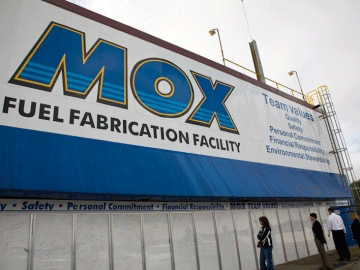 warheads into powder for use at the MOX plant. Instead, the new plan will use multiple existing facilities, including the H Canyon facilities at Savannah River Site, to accomplish the same mission without building a new plant. Plutonium not suitable for MOX will be disposed of at a site in New Mexico.
Critics of the program, however, raised continuing concerns about escalating costs and suggested the plutonium could simply be processed as nuclear waste and immobilized.
Tom Clements, the non-proliferation policy director for the Alliance for Nuclear Accountability, also noted that there are currently no clients willing to use MOX fuel in commercial reactors….. A cheaper alternative, he suggested, would be to immobilize plutonium at the SRS Defense Waste Processing Facility or a similar project that would
prevent any future use of the material for weapons.
“The costs are just spiraling out of control, Clements said……
National forest site for Japan’s nuclear waste disposal
Tochigi forest eyed as N-waste disposal site http://www.yomiuri.co.jp/dy/national/T120903003600.htm4 Sept 12, Jiji Press The Environment Ministry said Monday it has selected a national forest in Yaita, Tochigi Prefecture, as a candidate site for final disposal of waste contaminated by radioactive substances from last year’s nuclear accident.
It was the first time the ministry has unveiled a candidate site for refuse incineration ash, sludge and rice straw that are tainted with radioactive substances from Tokyo Electric Power Co.’s Fukushima No. 1 nuclear power plant, which was crippled by the March 2011 earthquake and tsunami.
The ministry is also working on selecting final disposal sites in Miyagi, Ibaraki and Chiba prefectures.
The central government is required to dispose of such waste that contains radioactive cesium of more than 8,000 becquerels per kilogram under special legislation for dealing with radioactive materials from the nuclear accident. The amount of such waste is estimated to top 50,000 tons across the country. Tochigi Prefecture is projected to have about 9,000 tons.
The ministry chose the national forest in Yaita as the candidate site after considering the topography and effects on nearby areas, officials said.
The government plans to start construction there of a final disposal facility covering 3 to 4 hectares in fiscal 2013 for completion by the end of fiscal 2014.
USA Federal government responsible to clean up Hanford nuclear waste
State right to force federal Hanford cleanup http://union-bulletin.com/news/2012/sep/04/state-right-to-force-federal-hanford-cleanup/#
The federal government created the waste; it must clean it up.
By Editorial Board As of Tuesday, September 4, 2012 Washington state —
led by Gov. Chris Gregoire and Attorney General Rob McKenna — is
wisely threatening legal action against the federal government because
it continues to shirk its responsibilities to clean up the Hanford
Nuclear Reservation.
#Federal officials have been delaying fully funding the cleanup
operation for years. Congress trims current funding while promising to
make up for it some day — a day that never arrives. Continue reading
IN its quest for Arctic oil, Russia admits its undersea nuclear dump
17,000 containers of radioactive waste, 19 ships containing radioactive waste, 14 nuclear reactors, including five that still contain spent nuclear fuel; 735 other pieces of radiactively contaminated heavy machinery, and the K-27 nuclear submarine with its two reactors loaded with nuclear fuel.
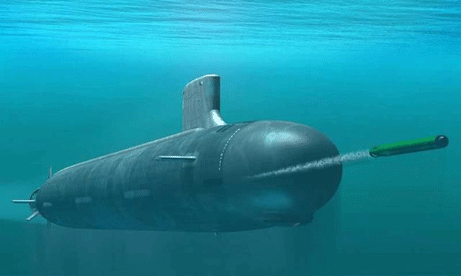 one of the most critical pieces of information missing from the report released to the Norwegian Radiation Protection Authority was the presence of the K-27 nuclear submarine, which was scuttled in 50 kilometers of water with its two reactors filled with spent nuclear fuel in in Stepovogo Bay in the Kara Sea in 1981.
Information that the reactors abord the K-27 could reachieve criticality and explode was released at the Bellona-Rosatom seminar in February.

 Russia Dumped 17 Nuclear Reactors and Tons of Waste in the Arctic by Charles Digges / Bellona.org, Earth First! Newswire, 30 Aug 12, Enormous quantities of decommissioned Russian nuclear reactors and radioactive waste were dumped into the Kara Sea in the Arctic Ocean north of Siberia over a course of decades, according to documents given to Norwegian officials by Russian authorities and published in Norwegian media.
Bellona had received in 2011 a draft of a similar report prepared for Russia’s Gossoviet, the State Council, for presentation at a meeting presided over by then-president Dmitry Medvedev on Russian environmental security.
The Russian state nuclear corporation Rosatom confirmed the figures in February of this year during a seminar it jointly held with Bellona in Moscow. Bellona is alarmed by the extent of the dumped Soviet waste, which is far greater than was previously known – not only to Bellona, but also to the Russian authorities themselves. Continue reading
Youtube: nuclear waste dump for Tochigi, Japan
 NHK – Japan proposes radioactive disposal site in Tochigi http://www.youtube.com/watch?v=5Whe6frtDdo Sep 3, 2012 by NHKReloaded NHK World News —- The Japanese government has proposed a site in Tochigi Prefecture, north of Tokyo, to dispose of radioactive waste from the accident at the Fukushima Daiichi plant. It is the first time the central government has made such a proposal to a prefectural government.
Senior Vice Environment Minister Katsuhiko Yokomitsu made the proposal to Tochigi Governor Tomikazu Fukuda on Monday.
The central government is responsible for disposing of more than 42,000 tons of radioactive ash and mud in 9 prefectures. Levels of Cesium in the waste are above the government standard of 8,000 becquerels per kilogram.
Tochigi Prefecture is already temporarily storing about 9,000 tons of radioactive waste at sewage treatment and other facilities.
The Environment Ministry says a 4-hectare national forest in Tochigi’s Yaita City is large enough for the purpose and far enough from the closest residential area and water source.
The ministry will brief people living near the site on the need and safety of the planned facility.
Where to put Canada’s 2358873 radioactive used nuclear fuel bundles?

 Nuclear waste seeks a home The Star.com September 01, 2012“………A fuel bundle for a Candu nuclear power reactor is about the size of a fireplace log. As of June 30, 2011, Canada had 2,273,873 used fuel bundles stored at its nuclear plants in Ontario, Quebec and New Brunswick.
Another 85,000 or so have been added since then.
In total, they’d fill about six NHL hockey rinks, stacked up as high
as the boards.
The Nuclear Waste Management Organization, formed by the three electric utilities that run nuclear reactors, wants to bury the waste deep underground in caverns excavated from stable rock, where it can lie undisturbed forever.
The depth will probably depend on the site’s geology. A facility proposed to hold less-potent radioactive waste at the Bruce nuclear site near Kincardine will be 680 metres deep. By comparison, the CN Tower is 553 metres tall.
The NWMO is looking for a “willing” community to agree to take the $16-to-$24-billion project. The host community itself will decide how to define “willing.” Candidate communities will have multiple opportunities to withdraw if they get cold feet, the NWMO says.
As it moves through a nine-stage selection process, the NWMO hopes to have narrowed the field to one or two communities by 2015, then spend until about 2020 deciding on a specific site within the chosen community.
After that, it will take three to five years to do an extensive environmental assessment of the site. The proponents will also have to satisfy the Canadian Nuclear Safety Commission that their plan makes sense, and obtain a license to construct and operate the facility.
Then, it will take six to 10 years to build. The NWMO doesn’t expect the first bundles to be stored until 2035…. http://www.thestar.com/business/article/1250109–nuclear-waste-seeks-a-home#.UEH_alKdoKU.twitter
Space exploration’s radioactive mess
 In Russia, the situation is even grimmer. In true Soviet fashion, the bomb makers secretly dumped unknown quantities of liquid waste into giant reservoirs around the plant. Nobody knows how much radioactive contamination is out there, but a single accident – the explosion of a waste tank in 1957 – is thought to have been Chernobyl-like in scale.
remember this, too: That little rover on Mars has left a big mess back here on Earth.
 Curiosity’s dirty little secret http://www.theage.com.au/technology/technology-news/curiositys-dirty-little-secret-20120828-24xvn.html#ixzz255PEGe79 August 29, 2012 I’m as happy as anyone that the Curiosity rover got to Mars; it’s hard not to barrack for all those NASA geeks in their blue polo shirts. But before you get all apple pie about the achievement, there’s something you should know: Curiosity runs on plutonium from a Soviet-era nuclear weapons plant.
Take a look at the back of Curiosity. Other rovers have solar panels, but Curiosity doesn’t. Instead, there’s a little white thing that looks cute, almost like a tail. Inside are eight boxes filled with pellets of nuclear fuel. This stuff is hot, so hot that the boxes glow bright red, and will glow for years to come. Think of it as nuclear charcoal. The fuel will keep the rover toasty on cold Martian nights and supply it with electricity.
It’s a neat trick, and one that NASA has used before. Since the 1960s, the US has been launching nuclear-powered spacecraft. The first were military satellites. That worked swell, except that when the mission ended, you had a radioactive pile of junk orbiting the planet. And every now and then, one would fail to launch or fall back to Earth. That was bad for PR.
Leaked memo shows incompetence of company doing Hanford nuclear waste cleanup
“This memo details exhaustive and disturbing evidence of why Bechtel should be terminated from this project and subject to an independent investigation.”

 Bechtel Incompetent To Complete Hanford Nuclear Waste Cleanup: DOE Memo, Forbes, Jeff McMahon, 29 Aug 12, More than 10 years into the job, Bechtel National Inc. has been described as incompetent to complete the $12.2 billion nuclear waste treatment plant at Hanford, Wa., the nation’s largest radioactive waste site, according to an internal Department of Energy memo.
In the Aug. 23 memo, the DOE official responsible for supervising engineering at the facility, Gary Brunson, calls for Bechtel to be immediately removed as the design agent for the novel Waste Treatment Plant (WTP), which was supposed to begin operation last year. Continue reading
Cumbria’s huge report on proposal for underground nuclear waste bunker
 NUCLEAR WASTE DISPOSAL: THE DEFINITIVE REPORT CONDENSED, in-cumbria by Ellis Butcher , 24 August 2012 The experts call it a “geological disposal facility”. Opponents call it a “nuke dump”. They all agree it’ll contain “high level and intermediate nuclear waste”.

A history-making vote takes place on October 11 which represents one of Cumbria’s most important ever nuclear decisions.A trio of councils, involving hundreds of community leaders, decides on whether West Cumbria takes part in a search to site a massive underground bunker containing the UK’s most toxic nuclear waste. Business Editor Ellis Butcher looks at the definitive report facing them. Continue reading
Cumbria ponders on hosting UK’s underground radioactive waste dump
The anticipated footprint of the underground facilities ranges from 2.32 square miles to 8.88 square miles, depending on rock type and the amount and type of waste to be disposed of.
The Government has said deep geological disposal is the best way to dispose of higher activity radioactive waste. The waste is currently stored above ground at 36 UK sites, with most of it at Sellafield.
NUCLEAR DUMP COULD BE AS BIG AS WORKINGTON, Times & StarNews, 24 August 2012 An underground nuclear dump in West Cumbria would be about the size of Workington, a report has revealed. West Cumbria Managing Radioactive Waste Safely Partnership, which published its final report this week, said it would take at least 15 years to find a site.
Twenty-five per cent of West Cumbria has already been ruled out as unsuitable for an underground nuclear waste dump, the report said, and more work would be needed before it would be known if any of the area would be able to host the site. Continue reading
Opposition to USA plan to commercialise plutonium wastes at Savannah
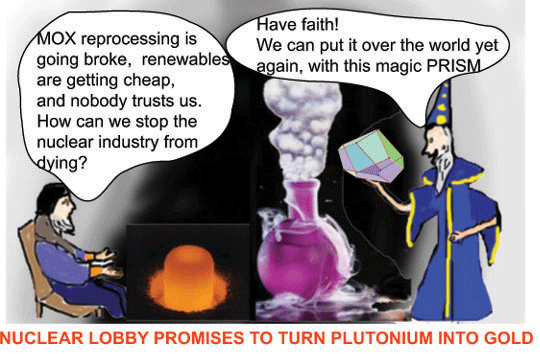 The preferred plan under consideration calls for the shipment of 7.1 metric tons of so-called pits — or cores — of an undisclosed number of nuclear warheads now stored at the Pantex plant in West Texas to Los Alamos National Laboratory in New Mexico and the Savannah River Site for disarmament and processing into fuel for commercial nuclear reactors.
Anti-nuclear activists question plan for shipping plutonium from warheads to New Mexico By Associated Press, August 22 LOS ALAMOS, N.M. — Nuclear watchdogs are fighting a proposal to ship tons of plutonium to New Mexico, including the cores of nuclear warheads that would be dismantled at an aging and structurally questionable lab atop an earthquake fault zone.
Opponents voiced their opposition at a series of public hearings that opened this week on the best way to dispose of the radioactive material as the federal government works to reduce the nation’s nuclear arsenal.
The Department of Energy is studying alternatives for disposing of plutonium in light of federal budget cuts that have derailed plans for new multi-billion-dollar facilities at the Savannah River Site in South Carolina. Continue reading
Urgent nuclear waste problem in Ukraine
 Ukraine badly needs waste nuclear fuel storage facility, says Emergencies Ministry Interfax, 17 Aug 12, Ukraine needs to give a serious thought to building a centralized storage facility for waste nuclear fuel since waste fuel from Ukrainian nuclear power plants (NPPs), which is temporary stored in the Russian Federation will start to come back from 2013, the Emergencies Ministry said. Continue reading
UK’s plans for nuclear waste burial in Cumbria
Full report published on Cumbria nuclear waste burial and local involvement http://www.guardian.co.uk/uk/the-northerner/2012/aug/17/lakedistrict-nuclearpower-west-cumbria-managing-nuclear-waste-safely-partnership?newsfeed=true
by Martin Wainwright 17 August 2012 Findings of three-year review by the West Cumbria Managing Radioactive Waste Safely Partnership are now in print and online The complicated and contentious issue of burying nuclear waste in Cumbria is heading for a milestone on 11 October when the three local councils which have expressed an interest meet to debate further involvement.
A useful waymarker has now been published in full, based on the views of some 2,300 people and organisations whose submissions, while often very different and sometimes in direct conflict, have led to changes and hesitations, albeit not altering the general approach of cautiously making headway.
The document was summarised on 19 July and you can read a precis of that here. The full report has now gone up online and that is availablehere. It is the work of the West Cumbria Managing Radioactive Waste Safely Partnership which is made up of the councils – Cumbria countyand Allerdale and Copeland districts – and other groups including the National Farmers Union, the Lake District national park authority and representatives of all the parish councils potentially involved. Continue reading
Eastern Connecticut’s nuclear waste problem
if no national repository is built, the nuclear waste will have to stay there forever and the property will not be marketable.
Public Voices Concerns About More Nuclear Waste In Eastern Connecticut
At a public forum by Dominion, neighbors voiced their concerns about Millstone increasing its capacity for nuclear waste, although said there is little other choice. Groton Patch 17 Aug 12, By Paul Petrone At a public forum Wednesday night, neighbors and an anti-nuclear activist raised concerns about Millstone Power Station’s plans to vastly increase the amount of nuclear waste it can store on site , although most agreed there was no other option.
“I feel bad for the people growing up in this area,” said Ed Saller, who lives within 2,000 feet of Millstone. “We have a dysfunctional government, I don’t know how they can ever solve this issue.”
Dominion, owners of Millstone, are asking the Connecticut Siting Council if they can put on the top layer of a nearly two-acre concrete pad that would hold nearly 60 years of nuclear waste in dry cask storage. Continue reading
No confidence in USA’s “Waste Confidence Rule” – so nuclear licensing stopped
puts waste where it belongs, front and center in the debate over the future of nuclear power in this country
NRC elevates nuclear waste to front and center of debate http://www.thereporteronline.com/article/20120815/OPINION01/120819748/nrc-levates-nuclear-waste-to-front-and-center-of-debate&pager=2 08/15/12 BECAUSE THE U.S. Nuclear Regulatory Commission is a part of the federal bureaucracy, it can make even groundbreaking news seem mundane.
Take this understated sentence in its ruling Aug. 7 delaying the final issuance of any nuclear permits, for existing or new power plants:
“Waste confidence undergirds certain agency licensing decisions, in particular new reactor licensing and reactor licensing renewal.”
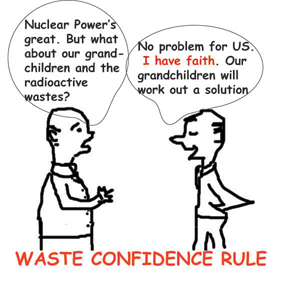
Translation: The country cannot continue to talk about building new nuclear plants without figuring out what it is going to do with the dangerous waste that literally is stacking up at sites all over the country, including at Ameren Missouri’s Callaway County plant.
That means that because Americans can have no confidence that the NRC has seriously dealt with the growing problem of nuclear waste, the NRC will stop making the problem worse by extending nuclear plant licenses. Continue reading
1 This Month




9 September – online public forum THREE MILE ISLAND:
7-8:30 PM ET,
Legacy, resistance to reopening – https://us02web.zoom.us/webinar/register/WN_-LGJU4j6TD2Hgf0rpgAr1A#/registration
The nuclear industry and the U.S. Nuclear Regulatory Commission are threatening to restart Pennsylvania’s permanently closed and decommissioning Three Mile Island Unit 1 nuclear power station. Three expert speakers will present the resistance to this dangerous misadventure in a webinar hosted by the Clamshell Alliance, Beyond Nuclear and Massachusetts Peace Action.

No Nuclear in Cwm Llynfi! Stop the nuclear power station near Maesteg.
To see nuclear-related stories in greater depth and intensity – go to https://nuclearinformation.wordpress.com
-
Archives
- September 2026 (127)
- August 2026 (330)
- July 2026 (355)
- June 2026 (287)
- May 2026 (306)
- April 2026 (356)
- March 2026 (251)
- February 2026 (267)
- January 2026 (308)
- December 2025 (358)
- November 2025 (359)
- October 2025 (375)
-
Categories
- 1
- 1 NUCLEAR ISSUES
- business and costs
- climate change
- culture and arts
- ENERGY
- environment
- health
- history
- indigenous issues
- Legal
- marketing of nuclear
- media
- opposition to nuclear
- PERSONAL STORIES
- politics
- politics international
- Religion and ethics
- safety
- secrets,lies and civil liberties
- spinbuster
- technology
- Uranium
- wastes
- weapons and war
- Women
- 2 WORLD
- ACTION
- AFRICA
- Atrocities
- AUSTRALIA
- Christina's notes
- Christina's themes
- culture and arts
- Events
- Fuk 2022
- Fuk 2023
- Fukushima 2017
- Fukushima 2018
- fukushima 2019
- Fukushima 2020
- Fukushima 2021
- general
- global warming
- Humour (God we need it)
- Nuclear
- RARE EARTHS
- Reference
- resources – print
- Resources -audiovicual
- Weekly Newsletter
- World
- World Nuclear
- YouTube
-
RSS
Entries RSS
Comments RSS
 nuclear-news