Japan’s science panel calls for a curb on nuclear waste production
The recommendation said it is essential to set an upper limit on the total amount of radioactive waste and to implement controls to prevent it from increasing without limits.
 Science panel recommends delaying burying radioactive waste
  http://ajw.asahi.com/article/behind_news/social_affairs/AJ201209120009 September 12, 2012 THE ASAHI SHIMBUN, Jin Nishikawa contributed to this article. Citing the country’s geologically unstable archipelago as a threat, the Science Council of Japan is recommending that the government build temporary storage facilities to hold more than 27,000 cylinders of high-level radioactive waste.
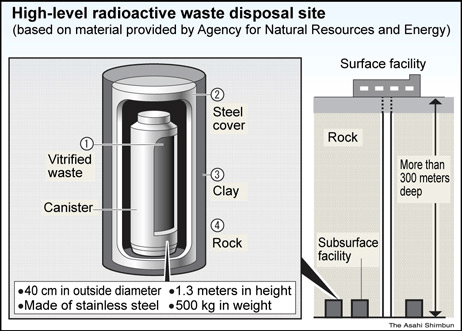
The council on Sept. 11 completed a report that calls for regulating the total amount of radioactive waste from nuclear power plants and storing it temporarily. Continue reading
Ending the Nuclear Age- A Mountain of Radioactive Waste

For more information on radioactive waste, see the various sub-sections under Beyond Nuclear’s website section on the subject, as well as its pamphlet entitled “A Mountain of Radioactive Waste 70 Years High”
U.S. Senate hearing lays groundwork for latest Mobile Chernobyl legislation http://www.beyondnuclear.org/radioactive-waste-whatsnew/2012/9/13/us-senate-hearing-lays-groundwork-for-latest-mobile-chernoby.html
at left: The cover of Beyond Nuclear’s pamphlet “A Mountain of Radioactive Waste 70 Years High”
The U.S. Nuclear Regulatory Commission (NRC) has acknowledged that the court-ordered revision to its Nuclear Waste Confidence Decision, and preparation of an Environmental Impact Statement about the risks on at-reactor storage of irradiated nuclear fuel, will delay the issuance of new reactor construction and operating licenses, as well as old reactor 20 year license extensions, by two years. This has led to a backlash by the nuclear establishment in industry and government. Continue reading
Nuclear power advocate predicts end of the industry,because of waste problem
Nuclear Advocate: “Within 5 years there will be no nuclear power in U.S. unless something is done” — Fuel pools will fill up without Yucca Mt., “There’s nowhere for old material to go” (VIDEO) http://enenews.com/pro-nuclear-advocate-within-5-years-there-will-be-no-nuclear-power-in-u-s-unless-something-is-done-fuel-pools-will-fill-up-without-yucca-theres-nowhere-for-old-material-to-go-v includes  VIDEO September 13th, 2012 By ENENews interview with Karl Denninger Warren Pollock Sept 12, 2012
Transcript Excerpt at
Karl Denninger, Market Ticker: “… the uranium based system, which, by the way, Jazcko managed to essentially completely torpedo.
I don’t know if you’re aware of this, within 5 years there will be no nuclear power in the United States unless something is done with this administration.
Because what Jazcko did by illegally shutting down Yucca, which by the way was a violation of federal law the way he went about it, through that process he put a hard stop on nuclear power in the United States…
[Inaudible, Repeats Comment] This will result in the denial of license renewals when those fuel pools fill up, because you can’t store the material. There’s nowhere for old material to go and therefore you can’t put any new material in…”
US nuclear waste now much more than Yucca dump would hold
 Leading Pro-Nuclear Senator: “Even if Yucca Mountain were open today, we’d still need a second repository very quickly” — Nuclear waste would fill it up very fast -NYTimes
http://enenews.com/leading-pro-nuclear-senator-even-if-yucca-mountain-were-open-today-we%E2%80%99d-still-need-a-second-repository-very-quickly-nuclear-waste-would-fill-it-up-very-fast-nyt June 8th, 2012
By ENENews
Moving From Square One on Nuclear Waste
New York Times
By MATTHEW L. WALD
The idea that the proposed Yucca Mountain nuclear waste repository in
Nevada is dead has not gone down well in Congress, where some
Republicans are trying to allocate new money to the Nuclear Regulatory
Commission so it can revive its evaluation of the site’s suitability.
But at a Senate subcommittee hearing on Thursday, some supporters of
the civilian power industry said it was time to move on.
“Even if Yucca Mountain were open today, we’d still need a second
repository very quickly,’’ said Lamar Alexander, a Republican from
Tennessee and one of the Senate’s foremost backers of nuclear power.
“The stuff we have would fill up Yucca Mountain very quickly.’’
Yucca [is] a volcanic structure in the desert about 100 miles from Las Vegas.
Lynas rare earths company trying to overturn Western Australia law against importing radioactive wastes
Lynas left holding the baby, Aliran, 14 September 2012 If Lynas Corporation thinks that Western Australia will take its radioactive waste, it can think again, asserts Robin Chapple. Lynas has now submitted an application to the regulator, the Australian Radiation Protection and Nuclear Safety Agency (ARPANSA), to import radioactive waste from Malaysia,” an Australian High Commission spokesman told The Malaysian Insider today.
This revelation beggars belief as just a few days ago a two-year temporary licence to operate was granted to Lynas, who intend to ship radioactive ores through Fremantle Port to export them to their plant in Malaysia, now seem to be asserting that they should be able to import the wastes of those ores back onto Australian soil.
Malaysia’s nuclear regulator Atomic Energy Licensing Board (AELB) had said that the Australian miner was legally bound to remove radioactive waste from its Lynas Advanced Materials Plant (LAMP) and return the residue to Australia under conditions of the temporary operating licence.
However, this news flies in the face of Australian government policy, and indeed Western Australian legislation, which asserts that Australia does not accept or import radioactive waste from other countries.
Robin Chapple MLC, Greens spokesperson for Mining Issues, commented on Lynas’ recent move: “It seems that again Lynas thinks it is outside the law as it is operating in Malaysia, and may be subject to less rigorous legal scrutiny. Well, it isn’t, and if it thinks that Western Australia will take this radioactive waste, it can think again.
“It didn’t consult with community on shipping its radioactive ores through Fremantle port, and it certainly hasn’t consulted on shipping back the radioactive waste. The WA Nuclear Waste Storage (Prohibition) Act 1999 prohibits it here. Period!
But really, you have to laugh. Lynas has now been tripped up by its own lack of willingness to take heed of Australia’s expectations with respect to sustainable mining and environmental, social and legal standards, and hasn’t it got it’s come-uppance. Talk about being left holding the baby!… http://aliran.com/10198.html
Russia’s nuclear waste storage ship

 Nuclear waste storage ship Lepse leaves Murmansk for decomissioning, Kola Peninsula, Russia http://www.youtube.com/watch?v=guPem_guPUk
Nuclear waste storage ship Lepse leaves Murmansk for decomissioning, Kola Peninsula, Russia Sep 14, 2012 by bellonafoundation
The Lepse, which in its heyday had been used as a support vessel for Russia’s nuclear icebreaker fleet, has been bobbing at dockside at the Atomflot port four kilometers north of Murmansk’s more than a quarter of a million-strong population since 1988. In the holds of the Lepse are filled with casks and caissons holding 639 spent nuclear fuel assemblies –equaling hundreds of tons of radioactive materials — a significant portion of which have been damaged, including assemblies that were damaged during offloading from the nuclear icebreaker Lenin. On September 14, 2012, Lepse was towed to Nerpa shipyard on the Kola Peninsula for decommissioning. Bellona has been instrumental in Lepse project. Bellona’s President Frederic Hauge is in Murmansk to see Lepse leaving the Kola Bay.
Quebec to close down its nuclear reactor
 Quebec will close, rather than refurbish, its only nuclear reactor. Montreal Gazette, 12 Set 12, Nearly 30 years after it went into operation, it appears the days are numbered for Quebec’s only operating nuclear power plant.
A spokesperson for the Parti Québécois said the newly-elected government will go ahead with a plan to close Gentilly-2 in Bécancour. The party has wanted to do it since December 2009, Éric Gamache said….
. Gordon Edwards, a mathematician and president of the Canadian Coalition for Nuclear Responsibility, said after it is closed, Gentilly-2 could be transformed into a centre of expertise on dismantling nuclear power plants. Nearly 100 nuclear power plants in
the U.S. will soon come to the end of their natural life, creating a “great” opportunity for Trois-Rivières, he said. http://blogs.montrealgazette.com/2012/09/12/parti-quebecois-says-it-will-keep-promise-to-close-gentilly-2-nuclear-power-plant/
Thorium’s radioactive fission products
 the fission products from a Thorium reactor are a worry, Technetium-99 has a half life of 220,000 years, uranium-232 produces thallium-208 (a nasty wee gamma emitter), Selenium-79 (another gamma emitter with a 327,000 year half-life), evenThorium-232 is a problem with its half life of 14 Billion years (and while the T-232 isn’t a major worry, all the time during this 14 Billion years it will be decaying and producing stuff that is!).
Thorium Cycle questions and problems http://daryanenergyblog.wordpress.com/ca/part-8-msr-lftr/8-3-thorium-lftr/ Questions have also been raised by some nuclear scientists about the Thorium cycle, in particular the proposed one that the LFTR would use. I’m not a nuclear physicist so I’ll merely forward you on to the relevant paper here , and a rebuttal here . The crux of the argument seems to be the proliferation risk (I’ll come back to that one later), the fact that a number of its spend fuel outputs (such as Technetium-99) are “nasty stuff” with a long half life and the fact we’ll still need supplies of Uranium to get Thorium reactors going again whenever we have to turn it off (which will happen at least once a year or so during its annual maintenance shutdown). They also highlight a number of technical issues, which I discussed in the chapter on HTGR’s. Continue reading
Plutonium for space travel?
Nuclear waste set to power spacecraft By Andrew Bounds, North of England Correspondent, Ft.com, September 9, 2012 Britain’s nuclear waste could be used to power spacecraft as part of government attempts to offset the huge cost of the atomic clean-up by finding commercial uses for the world’s largest stock of civil plutonium.
A £1m pilot programme by the European Space Agency has shown that nuclear batteries for use on deep space missions could be made from an isotope found in decaying plutonium at the Sellafield waste storage site in Cumbria.
Britain’s National Nuclear Laboratory has harvested americium-241 from the plutonium, produced from reprocessing fuel.
The ESA believes this could replace plutonium-238, only available from Russia and the US, and provide an independent source of energy for planned deep space missions to Jupiter and other distant planets.
Tim Tinsley, who manages the programme for the NNL, said the space battery was an unforeseen benefit of past inaction, which has left 100 tonnes of plutonium in ponds at Sellafield.
“It is available due to a twist of fate,” he said. “We have been able to extract that americium and prove that it works.”
Full-scale battery production would be “worth hundreds of millions of euros” and provide skilled jobs in west Cumbria, an area of high unemployment, he said.
Nuclear batteries – each containing about 5kg of nuclear material – have been around since the 1950s and are used in Nasa’s Cassini and Voyager probes as well as Curiosity, which landed on Mars in August…..
The US may also need a fresh supply. Plutonium-238 can be made only in reactors dedicated to weapons, now shut down, and Nasa’s stocks could run out in 2018, according to the US National Research Council. ….
The clean-up costs of Britain’s nuclear programme are estimated at up to £100bn, with £3bn spent annually, while the plutonium alone is a £4bn liability.
NNL, a government agency run under contract, has joined Systems Engineering & Assessment, a specialist engineering group active in the space sector, and the University of Leicester, which has a large space department, to run the programme…. http://www.ft.com/intl/cms/s/0/2ea069f2-f830-11e1-828f-00144feabdc0.html#axzz266DLJEno
Danger of MOX nuclear reprocessing: it’s the plutonium, stupid
 From Plutonium to Power, Spiegal Online 09/07/2012 Russia To Produce Electricity with Former Nukes By Kerstin Brandt “…….What makes the new reactor a particularly delicate case, though, is its fuel.
Of all the bequests of the atomic age, the heavy metal that takes its name from Pluto, god of the underworld, is considered the most dangerous. A nuclear chain reaction initiated with six kilograms (13 pounds) of the material over Nagasaki, Japan, on Aug. 9, 1945, immediately killed 80,000 people. Breathing in just a few milligrams of plutonium dust is fatal to humans.
Vast amounts of this element, which almost never occurs naturally, now exist on Earth. Well more than 1,000 tons of the plutonium, which is one component of spent fuel from nuclear reactors, now sits in spent fuel pools and interim storage facilities, awaiting an indeterminate fate.
Then there are a further estimated 250 tons of weapons-grade plutonium, which consists of the fissile isotope Pu-239 at its highest possible concentration. This is a material produced for a single, military purpose: to trigger the most devastating detonations possible, as reliably as possible.
But what meant power during the arms race has since become a curse. Plutonium is enormously expensive to secure — and completely useless for civilian purposes.
For many years, permanent storage facilities for nuclear waste were the solution of choice among experts in the field. Melted down in a glass matrix and mixed with other highly radioactive nuclear waste, plutonium could be made to disappear deep into the Earth, protected from the elements and from the reach of untrustworthy militaries.
These days, though, that method is essentially off the table, because tough disarmament negotiations reach their goals more quickly when the end result is profit rather than unpredictable storage facility costs. The world’s military superpowers have done this once before: In 1993, as part of the “Megatons to Megawatts” nonproliferation program, the US pledged to buy 500 tons of weapons-grade uranium from Russia. Diluted down to a level suitable for use in a nuclear plant, fuel obtained from Soviet nuclear bombs currently generates one tenth of the United States’ electricity……http://www.spiegel.de/international/world/energy-from-the-bomb-russia-to-produce-electricity-with-former-nukes-a-854318.html
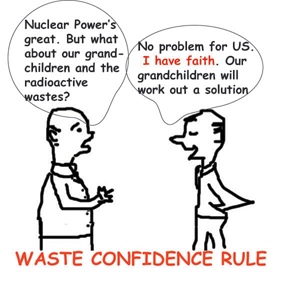
Nuclear waste storage and the “Waste Confidence Rule”
According to the NRC “waste confidence” is a generic finding that spent nuclear fuel can be safely stored for decades beyond the licensed operating life of a reactor without significant environmental effects.
The NRC said the rule enables the agency to license reactors or renew their licenses without examining the effects of extended waste storage for each individual site

NRC Will Study Environmental Impact of Temporary On-Site Storage of Nuclear Waste, Montville Patch 9 Sept 12, Following a lawsuit brought by Attorney’s General of Connecticut, New York, New Jersey, and Vermont, the Nuclear Regulatory Commission said it will assess the environmental impact of storing spent nuclear fuel at reactor sites for longer periods of time. For towns near Dominion’s Millstone Nuclear Power Plant, including Montville, just 8 miles away as the corw flies, federal heel-dragging on the issue of what to do with the nation’s nuclear waste is increasingly becoming an issue . Continue reading
Opposition to bringng in more nuclear waste to South Carolina
Green groups oppose shipping hot waste to SRS The State, By SAMMY FRETWELL 7 Sept 12, – sfretwell@thestate.com Environmentalists spoke out Thursday against sending highly radioactive waste from commercial power plants to the Savannah River Site near Aiken for storage. The federal government has been trying to decide what to do with spent fuel created by the nation’s 104 atomic energy plants since President
Barack Obama chose in 2009 to abandon the Yucca Mountain, Nev., disposal site. Continue reading
USA to get another “Waste Confidence Rule”?
The Appeals Court ruled that the NRC should have considered the potential environmental effects in the event a permanent repository for disposing of spent fuel …. is never built
NRC staff to review nuclear reactor waste storage rules http://www.reuters.com/article/2012/09/06/us-utilities-nrc-waste-idUSBRE88515T20120906 by Scott DiSavino, Sep 6, 2012 (Reuters) – The U.S. Nuclear Regulatory Commission (NRC) directed its staff on Thursday to start an environmental review into the temporary storage of spent nuclear fuel, following a court ruling that led the agency to stop issuing new reactor licenses. Continue reading
Confusion in Aomori Prefecture about importing radioactive waste
Aomori Pref. mulling rejecting nuclear waste The Yomiuri Shimbun , 6 Sept 12, AOMORI—The Aomori prefectural government is considering refusing to accept highly radioactive waste scheduled to be returned from reprocessing overseas if the central government abolishes its nuclear fuel cycle policy.
The prefectural government was likely prompted to act by recent moves by the central government toward abandoning nuclear power generation.
The village of Rokkasho in the prefecture is home to a spent nuclear fuel reprocessing plant that is considered to be the foundation of the nuclear fuel cycle, in which plutonium and uranium are extracted from spent fuel to be reused.
The plant has yet to begin operating, and spent nuclear fuel from the nation’s nuclear reactors are currently stored at nuclear power plants or at the Rokkasho facility. Some spent nuclear fuel is reprocessed in France and Britain. Vitrified radioactive waste, the highly radioactive waste that is produced in the reprocessing process, has been shipped from Europe to the Vitrified Waste Storage Center at the Rokkasho facility. So far, the plant has received 1,414 containers of vitrified waste, and 28 more are scheduled to be shipped from Britain in October at the earliest. Continue reading
Kazakhstan’s nuclear fuel bank or nuclear graveyard?
Nuclear fuel bank or nuclear graveyard? Asia Times, 5 Sept 12, By Zhulduz Baizakova Kazakhstan plans to build an international nuclear fuel bank in Ust-Kamenogorsk (Oskemen), in the country’s east, at the site of Ulba Metallurgic Plant, part of the giant national company Kazatomprom, which produces fuel tablets for nuclear power plants.
While the authorities are keen on the plan, some citizens are seriously questioning it – questions that are likely to remain largely unanswered. Continue reading
1 This Month



9 September – online public forum THREE MILE ISLAND:
7-8:30 PM ET,
Legacy, resistance to reopening – https://us02web.zoom.us/webinar/register/WN_-LGJU4j6TD2Hgf0rpgAr1A#/registration
The nuclear industry and the U.S. Nuclear Regulatory Commission are threatening to restart Pennsylvania’s permanently closed and decommissioning Three Mile Island Unit 1 nuclear power station. Three expert speakers will present the resistance to this dangerous misadventure in a webinar hosted by the Clamshell Alliance, Beyond Nuclear and Massachusetts Peace Action.

No Nuclear in Cwm Llynfi! Stop the nuclear power station near Maesteg.
To see nuclear-related stories in greater depth and intensity – go to https://nuclearinformation.wordpress.com
-
Archives
- September 2026 (127)
- August 2026 (330)
- July 2026 (355)
- June 2026 (287)
- May 2026 (306)
- April 2026 (356)
- March 2026 (251)
- February 2026 (267)
- January 2026 (308)
- December 2025 (358)
- November 2025 (359)
- October 2025 (375)
-
Categories
- 1
- 1 NUCLEAR ISSUES
- business and costs
- climate change
- culture and arts
- ENERGY
- environment
- health
- history
- indigenous issues
- Legal
- marketing of nuclear
- media
- opposition to nuclear
- PERSONAL STORIES
- politics
- politics international
- Religion and ethics
- safety
- secrets,lies and civil liberties
- spinbuster
- technology
- Uranium
- wastes
- weapons and war
- Women
- 2 WORLD
- ACTION
- AFRICA
- Atrocities
- AUSTRALIA
- Christina's notes
- Christina's themes
- culture and arts
- Events
- Fuk 2022
- Fuk 2023
- Fukushima 2017
- Fukushima 2018
- fukushima 2019
- Fukushima 2020
- Fukushima 2021
- general
- global warming
- Humour (God we need it)
- Nuclear
- RARE EARTHS
- Reference
- resources – print
- Resources -audiovicual
- Weekly Newsletter
- World
- World Nuclear
- YouTube
-
RSS
Entries RSS
Comments RSS
 nuclear-news