A critical question – who pays for long term nuclear waste storage?

 What to do with nuclear waste? DW 28 June 3 “……..Who pays? The forum Ecological-Social Market Economy has evaluated the Swiss study and, based on its findings, estimated the future costs for storing nuclear waste from Germany’s eight deactivated and nine active nuclear power plants. According to conservative calculations by the researchers, Germany can reckon with storage costs of about 18 billion euros in the future.
The German Atom Forum, comprised of all German nuclear power plant operators, intends to pay as little as possible for storage and rejected shouldering costs for the new site search. In their opinion´”there is no legal basis” for them to pay and all costs should be “financed by taxpayers.”
Environment Minister Peter Altmaier has a different view. He intends to have the nuclear plant operators take responsibility for the waste they generate. http://www.dw.de/what-to-do-with-nuclear-waste/a-16755844
Fear and loathing in USA over nuclear wastes
Stored fuel requires guards and other continuing expenses, which are significant if there is no reactor nearby. Those expenses eventually fall on federal taxpayers because the Energy Department has defaulted on contracts it signed in the 1980s to begin accepting the wastes for burial in 1998. As a result, financial penalties the federal government must pay to the nuclear utilities for failing to dispose of the waste now amount to hundreds of millions of dollars a year.
 Quarrels Continue Over Permanent Repository for Nuclear Waste http://www.nytimes.com/2013/06/28/business/energy-environment/quarrels-continue-over-permanent-repository-for-nuclear-waste.html?_r=0 By MATTHEW L. WALD June 27, 2013 WASHINGTON — As more nuclear reactors across the country are closed, the problem of what to do with their waste is becoming more urgent, government officials and private experts said at a conference here this week.
To address the problem, a bipartisan group of four senators introduced a bill on Thursday that would provide for temporary, centralized storage, even as House leaders remained focused on trying to revive plans for the Yucca Mountain nuclear waste repository that the Obama administration has declared dead.
Nuclear waste is accumulating in steel and concrete storage casks at reactor sites around the country. But the casks — sealed boxes of many tons — cannot be sent to any repository because they are not compatible, said Jeff Williams, director of the Energy Department’s Nuclear Fuel Storage and Transportation Planning Project.
In addition, a growing number of the sites no longer have an operating reactor or the associated fuel-handling equipment, so they have no way to move the highly radioactive fuel to another storage package.
Experts say the amount of orphaned nuclear waste is mounting. Nuclear utilities have announced the retirement of an additional four reactors so far this year, which leaves three more sites without an operating reactor. Before that development, the Energy Department counted nine such sites, with about 2,800 tons of fuel in 248 casks and was hoping to establish a pilot-scale interim storage plant for that fuel. Continue reading
Us nuclear corporations regulate the regulators: Indian point has no license
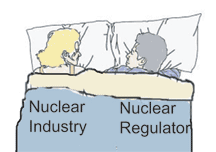 “The regulators are basically being regulated by the corporations that they’re supposedly overseeing,”
GERIATRIC NUCLEAR REACTORS COULD KILL US ALL, VICE NEWS, By Peter Rugh 26 June 13 In America, you need a license to drive an automobile, to operate heavy machinery, to hunt and fish, but apparently not to run a nuclear reactor. Entergy Corp. is slated to become the first company in history to operate a reactor without a license this fall. The Louisiana-based energy corporation’s rogue reactor is located at its Indian Point Energy Center in 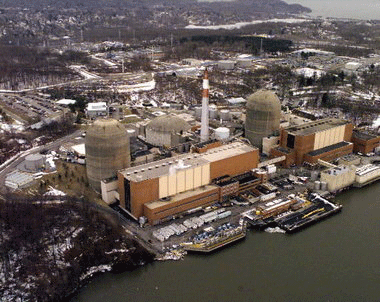 Buchanan, NY—just 24 miles from Manhattan. Entergy Corp’s license to run its Indian Point 2 reactor expires on September 28. The regulations of the Nuclear Regulatory Commission (NRC), which is charged with overseeing the civilian use of nuclear power, says it is prepared to grant the license but its hands are tied by legal challenges mounted by New York State and a federal court ruling last year. The ruling dismissed the agency’s radioactive waste management plans as inadequate.
Most of America’s nuclear plants were built in the 60s and 70s. They were given shelf lives of 40 years. It was assumed by the industry at the time of their construction that when the millennium rolled around there would be new plants up, running, and ready to replace the old fleet. But between then and now interest in nuclear power has waned due to cost and the public’s reaction to Three Mile Island, Chernobyl, and other nuclear calamities. Instead, the energy industry has sought to renew the licenses on the reactors they already operate, while keeping the cost of infrastructure improvements to a bare minimum. They’ve encountered little resistance from the NRC, which has approved 73 separate license renewals and only denied one single application in its history.
Meanwhile, the waste has piled up. The Nuclear Energy Institute, an industry policy group, estimates that US’s 104 commercial reactors have generated 69,720 metric tons of radioactive waste (spent-fuel) over the past four decades, with each plant chipping in approximately 2,000 to 2,300 metric tons each year. Nobody knows what to do with it all. Plant operators are, in a sense, shitting where they eat at the moment by storing nuclear waste onsite at the plants where it is generated. ….. Continue reading
Savannah River Mixed Oxide Nuclear Fuel (MOX) a costly failure
Von Hippel last May joined three other scientists in advocating the burial alternative in a scientific journal article about Britain’s plutonium stocks. One co-author was Rodney Ewing, who Obama has since appointed to head a federal nuclear waste panel, and another was Allison MacFarlane, now chair of the Nuclear Regulatory Commission. The MOX plant, if it is completed, needs an NRC license……
Administration officials say the main purpose of their “strategic reassessment” is to reexamine the burial alternative. A DOE report in 2002 concluded it would cost hundreds of millions of dollars less than building the MOX plant.
Energy Department Nuclear Nonproliferation Program Plagued By Problems, HUFFINGTON POST , 24 June 13 A multibillion-dollar U.S.-led effort to stem the threat of a terrorist nuclear blast is slowly unraveling because of huge cost overruns at a federal installation in South Carolina and stubborn resistance in Moscow to fulfilling the program’s chief goal, according to U.S. officials and independent experts.
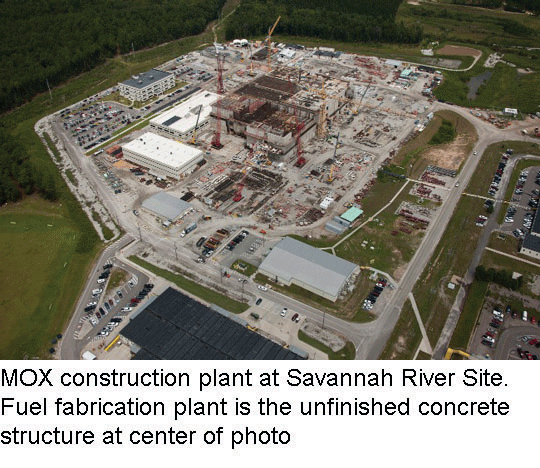
The 13-year old Energy Department program, authorized in agreements with Moscow spanning three presidents, is meant to transform excess plutonium taken from retired U.S. and Russian nuclear weapons into fuel for nuclear plants, so that it can’t be stolen and misused.
But that ambitious goal has been blocked by a tangle of technical, diplomatic and financial problems. The Obama administration is now considering cancelling the project, an idea that has provoked furious opposition from some Republican lawmakers who say it is vital to U.S. national security.
Its potential demise has provoked cheers from some leading arms control and nonproliferation experts, however. They say that as a result of little-noticed revisions to the underlying pact with Moscow on the plutonium’s disposal, the deal might actually wind up promoting Russia’s production of as much or more plutonium as it was supposed to eliminate. To keep its end of the bargain, the U.S. has spent more than a decade and $3.7 billion building a problem-plagued factory for making the plutonium-laced reactor fuel, located at the government’s Savannah River complex south of Aiken. Its construction and related costs have recently hit more than $680 million a year, but Congress is now considering a White House plan to shrink that spending substantially. Continue reading
Japan’s massive, and growing, plutonium problem
Japan currently possesses 44 tons of plutonium, according to the Atomic Energy Commission. Nine tons, including the latest shipment, are in Japan, while the remaining tons are in Britain and France, where spent fuel from Japan has been reprocessed.
Storage pools for spent fuel are quickly reaching capacity at nuclear power plants across the nation. If Aomori Prefecture refuses to accept spent fuel, nuclear plants will be saddled with overflowing spent fuel pools and will be unable to continue operations.
Direct disposal, or burying spent fuel without reprocessing, was considered under the previous Democratic Party of Japan government. But discussions have gone nowhere after the Liberal Democratic Party took over government in December.
 Plutonium problem lingers as mixed-oxide fuel comes to Japan June 25, 2013 THE ASAHI SHIMBUN A shipment of mixed-oxide fuel will arrive in Japan as early as June 27, part of the nation’s plutonium stockpile that is already equivalent to 5,000 Nagasaki-type atomic bombs.
The shipment, two years behind schedule due to the Great East Japan Earthquake in 2011, is expected to be used for plutonium-thermal (pluthermal) power generation, a key component of Japan’s nuclear fuel recycling program.
However, the fuel recycling program has been plagued by so many problems that the nation’s plutonium stockpile could increase further, heightening concerns in the international community about possible nuclear weapons proliferation. Continue reading
Nuclear firms gave big bucks to US congressmen to promote MOX nuclear program
 Energy Department Nuclear Nonproliferation Program Plagued By Problems Center For Public Integrity HUFFINGTON POST By Douglas Birch and R. Jeffrey Smith, 25 June 13 “…..For years, the plant has been kept alive by South Carolina’s mostly Republican congressional delegation, which includes many strident critics of federal spending, budget deficits, and mammoth public works projects – including Sen. Tim Scott (R.) and Rep. Joe Wilson (R.). On the issue of the MOX plant, which employs 2,100 workers, they have been hugely supportive.
Sen. Lindsey Graham (R-S.C.), joined others on Capitol Hill in January in asserting that “the time has come for the President to face up to the need to control federal spending.” Since then, Graham has lectured DOE officials at hearings on the diplomatic and security disaster that would ensue if the Savannah River project was halted.
With three other Republican senators, Graham pledged in a joint statement last month to hold up nominations and use the budget process “to ensure the [MOX] program moves forward.”
Graham declined to comment for this article. According to an analysis by the Center for Public Integrity of campaign donations and leadership committee receipts listed by the Center for Responsive Politics, Graham has received $46,500 since 2001 from three private firms with a stake in the MOX project. In total, the firms provided at least $437,000 in campaign funds during this period to members of the four congressional committees that decide the Energy Department’s annual budge
Rep. James Clyburn (D.-S.C.), who has long been a member of the House Democratic leadership and who has boasted about helping block Hobson’s challenge to the plant, collected $51,000 in political funding from the firms, whose lobbyists and officers also donated $40,000 to a golf charity he runs. Clyburn’s spokeswoman Hope Derrick said the congressman “is solely motivated by the best interests of the people and communities he serves in Congress.”
In the last three years alone, Areva and Shaw have spent a total of $6.3 million to lobby for their legislative interests, including efforts by at least four former congressmen and some former committee staffers that advocated spending on MOX and nuclear issues, according to an analysis by the Center for Public Integrity……”.http://www.huffingtonpost.com/2013/06/25/energy-department-nuclear-nonproliferation_n_
Savannah River Nuclear Site the $billion “plutonium elimination” project
 Energy Department Nuclear Nonproliferation Program Plagued By Problems HUFFINGTON POST Center For Public Integrity | By Douglas Birch and R. Jeffrey Smith, 25 June 13 “….The government’s current estimate is that the plant will not begin operation before 2019, seven years late. Estimates of its operating costs over a 15 to 20 year period range from $8 billion to $12 billion, meaning that it could cost around $20 billion in total to create fuel rods from all 34 tons of the plutonium that Washington has promised to eliminate.
But even if the government finds buyers for the fuel – which seems doubtful – it will not recoup more than $2 billion of its expenses, according to the Congressional Research Service. At the current pricetag, eliminating each pound of plutonium at the U.S. plant may cost roughly $243,000, according to Matthew Bunn, a nuclear expert at Harvard.
So far, around $3.7 billion has been spent on the fuel factory, which could wind up an abandoned concrete shell in the middle of a pine forest. Another $700 million was used to design a related plutonium dismantlement facility that NNSA never built.
Those expenditures have helped make it the single most expensive U.S. nonproliferation project now under way, according to independent experts…..
New budget troubles arise
Austerity pressures in Washington have created new obstacles for the companies and their lobbyists, however. The Obama administration, after convening four high-level meetings about the MOX plant this spring, urged a 50 percent cut in its planned spending in fiscal year 2014, to just $320 million.
“Cost growth and fiscal pressure may make the project unaffordable,” the Energy Department said in its formal budget proposal to Congress. A spokesman for the department declined comment about the review now under way……..” .http://www.huffingtonpost.com/2013/06/25/energy-department-nuclear-nonproliferation_n_3498626.html
Savannah River MOX project should be shut down
the MOX plant has “become from my point of view a pretty meaningless program” that should now be killed.
“The irony of this whole project is that it basically started with a good goal, of eliminating weapons grade material with the idea that it won’t be available for weapons purposes,” “But then it sort of evolved into this program that provides a fairly significant subsidy to the plutonium economy. So in the end, we will end up with more plutonium.”
How a Massive Nuclear Nonproliferation Effort Led to More Proliferation, The Atlantic, More than a decade of negotiations with Russia produced a clear winner, and it was not the United States. DOUGLAS BIRCH AND R. JEFFREY SMITHJUN 24 2013 SAVANNAH RIVER SITE, South Carolina – A half-finished monolith of raw concrete and rebar rises suddenly from slash pine forests as the public tour bus crests a hill at this heavily-secured site south of rural Aiken……..
Dark clouds hover over this ambitious federal project, 17 years in the making and at least six more from completion–if, indeed, it is ever completed. It lies at the center of one of the United States’ most troubled, technically complex, costly, and controversial efforts to secure nuclear explosive materials left stranded by the end of the Cold War.
This plant – and another just like it in Russia — is meant to transform one of these materials, plutonium, into commercial reactor fuel that can be burned to provide electricity for homes, schools and factories, essentially turning nuclear “swords into ploughshares.” The aim of the so-called Mixed Oxide, or MOX, plant is to ensure the material never winds up in the hands of terrorists.
In the right hands, only nine pounds of plutonium — an amount about the size of a baseball — could make a bomb as powerful as the one the U.S. dropped on Hiroshima. The world’s military and civilian nuclear programs have produced about 500 metric tons of pure plutonium, an amount that could fuel tens of thousands of nuclear weapons yet fit into a backyard shed. Countries with nuclear programs continue to add roughly two tons to this inventory every year.
Washington has been spending hundreds of millions of dollars annually to help secure or remove plutonium and weapons-grade uranium in dozens of countries. But the U.S.-Russia plutonium disposition program, which includes the Savannah River plant, is the U.S. government’s single most expensive nonproliferation project now, according to Michelle Cann, senior budget analyst with a nonprofit group called Partnership for Global Security. Continue reading
UK nuclear decommissioning costs soar- could be over £100bn.
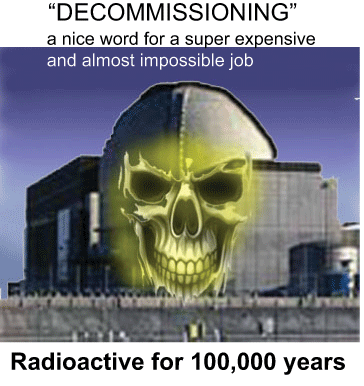 UK’s nuclear clean-up programme to cost billions more than expected
  Guardian UK, Terry Macalister 23 June 13, Nuclear Decommissioning Authority declines to predict final lifetime clean-up cost amid fears total bill could exceed £100bn
The public body charged with overseeing the dismantling of Britain’s network of atomic power and research stations will reveal on Monday that its estimates for the lifetime cost of the programme has risen by billions of pounds.
Despite this, the Nuclear Decommissioning Authority (NDA) will say in its annual report that it is getting to grips with the clean-up problem because the rate of cost growth is slowing year-on-year.
Yet the soaring costs will alarm industry critics at a time when the government is trying to encourage construction of a new generation of atomic power plants while plans to construct a permanent home for high-level radioactive waste are stalled.
In the NDA’s 2011 annual report the provisional cost of dealing with the UK’s nuclear legacy was put at £53bn, compared with a 2010 figure of £49bn. The new number in the 2012 set of accounts is expected to be around £55bn. But under previous accounting methods, the figure historically used has risen to well over £80bn with some predicting the final bill could exceed £100bn. Continue reading
Hanford radioactive cleanup $billions over budget
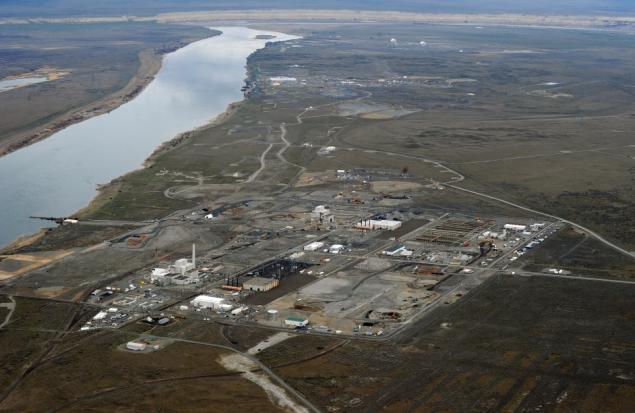
 Nuclear waste clean-up delayed and billions over budget http://www.cbsnews.com/8301-18563_162-57590163/nuclear-waste-clean-up-delayed-and-billions-over-budget/
CBS News: Worry about explosion of unstable radioactive material at U.S. nuclear site — “We don’t understand the chemical reactions” -Safety Manager (VIDEO) http://enenews.com/cbs-news-worry-about-explosion-at-u-s-nuclear-site-video#Hanford Title: Nuclear waste clean-up delayed and billions over budget
Source: CBS News
Reporter: Carter Evans
Date: June 19, 2013
h/t Anonymous tip
Little is known about what was put in the tanks and how it’s changed since the 1940s. [Donna Busche, a manager of environmental and nuclear safety at Hanford,] is worried it’s unstable and an explosion during clean-up could release radioactive material.
Asked how a treatment facility can be built when it’s unclear what is in the tanks, Busche says, “I think that is the fundamental issue. We don’t understand the chemical reactions, but yet we’re building the plant.”
Similar concerns were raised in a review by the Government Accountability Office, Congress’ investigative agency. It blamed the Department of Energy for building the plant before the design process was complete. As a result, parts of the facility “may not work and may not meet nuclear safety standards,” the report said.
Watch the broadcast here
VIDEO: Hanford’s radioactive waste crisis
Waste will be leaking into the ground water. It will continue to leak. It’s an urgent problem that must be solved.”
But engineers have to get this right. It will take 40 years to treat the waste, and during that time, radiation will make parts of the plant inaccessible to humans.
Video: Nuclear waste clean-up delayed and billions over budget http://www.cbsnews.com/8301-18563_162-57590163/nuclear-waste-clean-up-delayed-and-billions-over-budget/ By Carter Evans (CBS News) 19 June 13, The new Secretary of Energy has been on the job only four weeks, but he made a beeline Wednesday to see his biggest headache for himself. Ernest Moniz went to the Hanford Nuclear Reservation in Washington state.
Hanford made the plutonium for American nuclear weapons from the Manhattan Project in World War II until 1987. Now, highly radioactive waste is leaking, and a project to clean it up has stalled.The clean-up at the Hanford Nuclear Reservation costs U.S. taxpayers $2 billion every year. This winter, engineers discovered six new leaks of radioactive material from underground tanks.
“There’s something on the order of 1,000 gallons a year that are leaking now from these six tanks,” says Washington Gov. Jay Inslee. Continue reading
UK’s Nuclear Decommissioning Authority doesn’t know what to finally do with nuclear wastes
No plan to dump nuclear waste Bill Hamilton The Guardian, 22 June 2013 As a public body, the Nuclear Decommissioning Authority has a duty to deliver value for money. Moreover, all nuclear site operators have a regulatory requirement to optimise site operations. There is no proposal to “dump” radioactive waste at Bradwell or at any other NDA-owned site (Only way is Essex – nuclear waste row, 17 June). Our first decommissioning priority is hazard reduction, which includes the safe, secure and environmentally responsible interim storage of intermediate level waste (ILW) until geological disposal becomes available.Currently, the plan is to build an interim storage facility at each Magnox reactor site to store the ILW from that site. A number of interim stores have already been constructed, with several more stores planned. In the interests of value for money to the taxpayer, we are exploring whether there is a business case for reducing the number of new stores that need to be built. There could also be environmental benefits from building fewer stores. The option of storing ILW from a small number of other sites at Bradwell, which already has an ILW store, is one of a number of options under consideration.
Our intention to explore the potential benefits of building fewer interim storage facilities was first made public in our strategy published in 2011, on which we engaged widely and consulted publicly. We are engaging openly and transparently with stakeholders on the options under consideration and will consult on our preferred option(s) at the appropriate time. Furthermore, any decision that requires a change to existing storage plans will require consultation and local planning permission.
San Onofre nuclear “decommissioning” will last for decades
So there the disabled behemoth sits, awaiting a decommissioning project that will continue for decades, requiring continued regulatory oversight and inspiring never-ending debates about who should pay and how much.
The Unit 1 reactor, which was shut down in 1992, was supposed to be boxed up and shipped to a repository in South Carolina, but no one could figure out how to transport a 770-ton bundle of radioactive junk across the country. Instead, it remains where it is, encased in concrete, waiting for the transmutation of the elements to complete its ten-thousand-million-year-long conversion from deadly isotopes to stable lead. We won’t be free of it anytime soon.

So long, San Onofre (in like 700 million years) High Country News Judith Lewis Mernit | Jun 17, 2013“……We have come to the end of an era — the nuclear power renaissance I had set out to investigate a decade ago has come to nothing.
Yes, a handful of new reactors have been proposed and a couple are even under construction, interrupting a hiatus that lasted nearly a quarter of a century. And the same band of shiny, PR-minded techno-enviros continue to argue that nuclear power is the only solution to climate change (their latest effort, Robert Stone’s documentary “Pandora’s Promise,” is simply one long advert for dreamy advanced waste-free reactors that don’t yet exist). Continue reading
They don’t now how much it costs to bury all those dead nuclear reactors
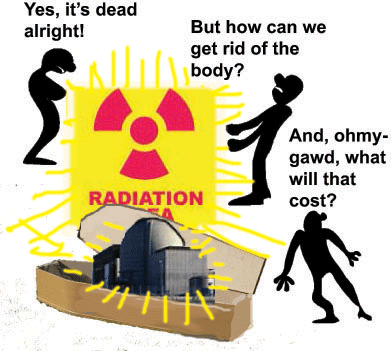 Nuclear Decommissioning Surge Is Investor Guessing Game, Bloomberg by Stefan Nicola in Berlin at snicola2@bloomberg.net; Julie Johnsson in Chicago at jjohnsson@bloomberg.net editor responsible for this story: Reed Landberg at landberg@bloomberg.net 16 June 13
Nuclear utilities thrust into the spotlight after the Fukushima meltdowns have ordered 20 reactors shut, the most in a three-year span since Chernobyl’s aftermath, saddling the industry with a possible $26 billion in costs.
EON SE and RWE AG (RWE) are leading the biggest decommissioning project by European utilities ever, an effort to tear down 12 reactors in Germany over two decades. Edison International (EIX) said June 7 it will never restart its idled two-unit San Onofre Generating Station outside Los Angeles, bringing the number of U.S. reactors permanently closed in a year to a record four.
The global utility industry faces its biggest test to prove enough money was saved for shutdowns, having undergone numerous cost-overruns building atomic plants. A cautionary tale can be seen with government-owned facilities. In Britain, where taxpayers are on the hook to retire the Sellafield complex’s seven reactors and fuel-reprocessing stations on the Irish Seaduring the next 100 years, the U.K. government this year doubled its estimate for the work to 67.5 billion pounds ($106 billion).
“There’s a lot of speculation how much these projects cost, but an exact estimate can only be given by utilities,” said Sascha Gentes, a Karlsruhe Institute for Technology professor specializing in atomic shutdowns. “The longer a nuclear decommissioning project takes, the more expensive it becomes.” Continue reading
Closing of Germany’s nuclear reactors
Nuclear Decommissioning Surge Is Investor Guessing Game, Bloomberg by Stefan Nicola in Berlin at snicola2@bloomberg.net; Julie Johnsson in Chicago at jjohnsson@bloomberg.net editor responsible for this story: Reed Landberg at landberg@bloomberg.net 16 June 13 “………German Closings Germany closed eight units after Fukushima and will shutter another nine by 2022. Its four utilities have set aside about 33 billion euros for decommissioning their 21 reactors and handling the deadly waste from them. The utilities set up GNS, a company that supplies 125-ton Castor dry casks to store and transport spent nuclear fuel, and also employ in-house decommissioning staff.
EON is 10 years into the job on its oldest commercial-scale unit, the 672-megawatt Stade plant in Lower Saxony, slated for completion by 2014. It started tearing down its 670-megawatt Wuergassen reactor in 1995, and plans to also complete that next year.
RWE said tearing down its 1970s-era Muelheim-Kaerlich reactor will cost about 750 million euros; it didn’t give cost estimates for the two pressurized water reactors at the 2,525-megawatt Biblis plant, which was closed after Fukushima, citing a lack of permits for their deconstruction plans.
EON declined to reveal the individual bill for the Wuergassen and Stade projects. It said costs are at about 1 billion euros depending on the reactor type, citing a “benchmark report for Germany,” in an e-mailed reply to questions.
Green Opposition
The opposition Green Party, which was in government from 1998 until 2005 and helped draft Germany’s first nuclear phase-out agreement, has called for the money to be put in a government-administered fund.
“Projects are often more expensive and longer than anticipated,” Sylvia Kotting-Uhl, a lawmaker with the Greens, said in an interview. “The question is: Will the money be available when it’s needed? A public fund would ensure that.”….”
EON and RWE said the current system shouldn’t be changed in favor of a state-run fund. The German system of setting aside money via utilities’ balance sheets “has proven itself,” Lothar Lambertz, a spokesman for RWE, said in an e-mailed reply to questions.http://www.bloomberg.com/news/2013-06-16/nuclear-decommissioning-surge-is-investor-guessing-game.html
1 This Month




9 September – online public forum THREE MILE ISLAND:
7-8:30 PM ET,
Legacy, resistance to reopening – https://us02web.zoom.us/webinar/register/WN_-LGJU4j6TD2Hgf0rpgAr1A#/registration
The nuclear industry and the U.S. Nuclear Regulatory Commission are threatening to restart Pennsylvania’s permanently closed and decommissioning Three Mile Island Unit 1 nuclear power station. Three expert speakers will present the resistance to this dangerous misadventure in a webinar hosted by the Clamshell Alliance, Beyond Nuclear and Massachusetts Peace Action.

No Nuclear in Cwm Llynfi! Stop the nuclear power station near Maesteg.
To see nuclear-related stories in greater depth and intensity – go to https://nuclearinformation.wordpress.com
-
Archives
- September 2026 (116)
- August 2026 (330)
- July 2026 (355)
- June 2026 (287)
- May 2026 (306)
- April 2026 (356)
- March 2026 (251)
- February 2026 (267)
- January 2026 (308)
- December 2025 (358)
- November 2025 (359)
- October 2025 (375)
-
Categories
- 1
- 1 NUCLEAR ISSUES
- business and costs
- climate change
- culture and arts
- ENERGY
- environment
- health
- history
- indigenous issues
- Legal
- marketing of nuclear
- media
- opposition to nuclear
- PERSONAL STORIES
- politics
- politics international
- Religion and ethics
- safety
- secrets,lies and civil liberties
- spinbuster
- technology
- Uranium
- wastes
- weapons and war
- Women
- 2 WORLD
- ACTION
- AFRICA
- Atrocities
- AUSTRALIA
- Christina's notes
- Christina's themes
- culture and arts
- Events
- Fuk 2022
- Fuk 2023
- Fukushima 2017
- Fukushima 2018
- fukushima 2019
- Fukushima 2020
- Fukushima 2021
- general
- global warming
- Humour (God we need it)
- Nuclear
- RARE EARTHS
- Reference
- resources – print
- Resources -audiovicual
- Weekly Newsletter
- World
- World Nuclear
- YouTube
-
RSS
Entries RSS
Comments RSS
 nuclear-news