Highly radioactive since 1957 nuclear disaster, Windscale site to be cleaned up by robots
 Robots to Demolish Site of UK’s Worst Nuclear Incident at Sellafield http://www.ibtimes.co.uk/articles/499768/20130818/sellafield-nuclear-robots-destroy.htm By TOM PORTER: August 18, 2013 Giant robots will be used to destroy the part of the Sellafield nuclear plant that caught fire 56 years ago, spewing radioactive contamination around Britain and northern Europe.
The Windscale Pile One chimney at the Cumbria plant has been sealed and cut off since the 1957 disaster.
There is still highly charged material trapped inside the shaft of the 400ft chimney, and more than 10 tons of melted radioactive uranium fuel remains inside the structure itself.
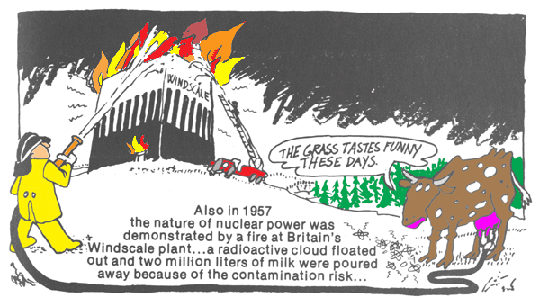
The reactor was built after World War II to make some of Britain’s first nuclear bombs, and then pressed into service to make tritium for an H-bomb, pushing the reactors beyond their limits and causing the blaze.
Workers at the plant were exposed to 150 times a safe lifetime’s dose of radiation, and for a month the government destroyed all milk produced within 200 miles of the site. Environmentalists and campaigners have since pointed to Sellafield as a warning of the potentially catastrophic effects of nuclear energy. Continue reading
Russia’s secret maze of underground radioactive trash tunnels
 A Secret Race for Abandoned Nuclear Material http://www.nytimes.com/2013/08/18/world/asia/a-secret-race-for-abandoned-nuclear-material.html?_r=0 By ELLEN BARRY August 17, 2013 Working in top secret over a period of 17 years, Russian and American scientists collaborated to remove hundreds of pounds of plutonium and highly
  enriched uranium — enough to construct at least a dozen nuclear weapons — from a remote Soviet-era nuclear test site in Kazakhstan that had been overrun by impoverished metal scavengers, according to a report released last week by the Belfer Center for Science and International Affairs at Harvard.
The report sheds light on a mysterious $150 million cleanup operation paid for in large part by the United States, whose nuclear scientists feared that terrorists would discover the fissile material and use it to build a dirty bomb.
Over the years, hints emerged that something extraordinarily dangerous had been left behind in a warren of underground tunnels — like the American aerial drones that circled over the site, looking for intruders, or the steel-reinforced concrete that was poured into tunnels and over stretches of earth.
Among the report’s new revelations is that the Soviet testers left behind components, including high-purity plutonium, that could have been used to build not just a dirty bomb but a “relatively sophisticated nuclear device,” an American official told the report’s authors. Continue reading
Former nuclear chief says Iran has 18,000 Uranium centrifuges
 Uranium Centrifuge Details Released by Iran’s Former Nuclear Chief (INFOGRAPHIC) By Gracie Lee , Christian Post August 18, 2013 Iran has 18,000 Uranium centrifuges, according to the country’s outgoing nuclear chief, Fereydoun Abbasi-Davani who spoke on the country’s nuclear program on Saturday. The claim has come from Abbasi-Davani, who was speaking to Iranian media on Saturday.
Iran has continued to build its uranium-enrichment centrifuges as part of its nuclear program despite the United States and the international community pressuring the Middle Eastern nation to stop its nuclear push.
However, Iran has refused to comply with their requests, and has insisted that its nuclear program has nothing to do with weapons, but is simply for “peaceful purposes.”
Recently the new Iranian president, Hassan Rouhani, has expressed a slightly more open rhetoric about opening talks with world powers over the country’s nuclear program. However, he has been clear that Iran has every right to enrich uranium and has shown no intentions of halting the program.
On Saturday, the ISNA news agency quoted Abbasi-Davani as saying that Iran has 17,000 older “first-generation” IR-1 centrifuges. Out of those 17,000, about 10,000 are still operating and 7,000 are ready to start operations…. http://www.christianpost.com/news/uranium-centrifuge-details-released-by-irans-former-nuclear-chief-infographic-102512/#RUSHZxTeF8bKoOlY.99
Growing opposition to nuclear waste dumping close to Lake Huron
Questions, concern surround plan to store nuclear waste near Lake Huron http://www.detroitnews.com/article/20130818/METRO08/308180008/ Jim Lynch
On Monday, two state legislators will host a town hall meeting in Detroit focusing on the plan to store low- to intermediate-level nuclear waste 2,230 feet below the ground near the Lake Huron shore. One of the legislators, Sen. Hoon-Yung Hopgood, D-Taylor, also posted a Facebook video on the project, laying out his concerns.
“This nuclear waste repository will be surrounded by Lake Huron on three sides and be located just upstream from the main drinking water intake for southeast Michigan,” he says in the two-minute video. “If this radioactive material leaks, the drinking water for 40 million people could be contaminated.”
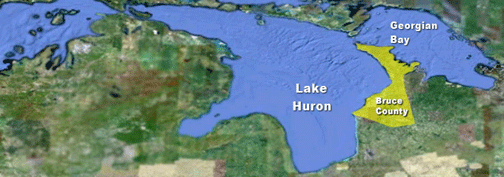
The town hall, titled “Save the Great Lakes from Nuclear Waste,” will be held from 6:30-8 p.m. at Wayne State University’s Keith Center Lecture Hall.
For several years, Ontario Power Generation has been moving ahead with designs for an underground nuclear waste repository near Kincardine. During that time, the proposal has drawn sporadic interest and opposition in the United States — often in the form of isolated press releases by elected officials.
Ontario Power Generation officials have long argued their repository would be situated amid low-permeability limestone and shale formations that will keep the material there safe for “thousands” of years. U.S. and Canadian critics are concerned that, despite the company’s stated intentions, the repository could one day be used to house high-level nuclear waste.
In mid-September, Ontario’s federal review panel will begin a lengthy public hearing on the storage project. Then it will move north for additional hearings in Port Elgin in October.
“Some time in February would be the (earliest) that the panel would release its conclusions,” said Ted Grtuzner, an Ontario Power Generation spokesman. From there, the proposal would go on to the province’s Ministry of the Environment for a final review. jlynch@detroitnews.com (313) 222-2034
Critically dangerous – removing radioactive rods from Fukushima’s elevated cooling pool
The deadliest part of Japan’s nuclear clean-up Stuff.co.NZ AARON SHELDRICK AND ANTONI SLODKOWSKI 14 Aug 13, The operator of Japan’s crippled Fukushima nuclear plant is preparing to remove 400 tonnes of highly irradiated spent fuel from a damaged reactor building, a dangerous operation that has never been attempted before on this scale.
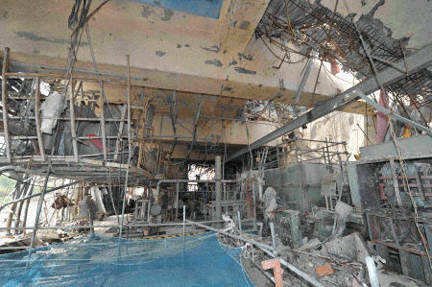
INADVERTENT CRITICALITY “There is a risk of an inadvertent criticality if the bundles are distorted and get too close to each other,” Gundersen said. He was referring to an atomic chain reaction that left unchecked could result in a large release of radiation and heat that the fuel pool cooling system isn’t designed to absorb.
“The problem with a fuel pool criticality is that you can’t stop it. There are no control rods to control it,” Gundersen said. “The spent fuel pool cooling system is designed only to remove decay heat, not heat from an ongoing nuclear reaction.”
The rods are also vulnerable to fire should they be exposed to air, Gundersen said.
The fuel assemblies are situated in a 10 metre by 12 metre concrete pool, the base of which is 18 metres above ground level. The fuel rods are covered by 7 metres of water, Nagai said.
The pool was exposed to the air after an explosion a few days after the quake and tsunami blew off the roof. The cranes and equipment normally used to extract used fuel from the reactor’s core were also destroyed. Tepco has shored up the building, which may have tilted and was bulging after the explosion, a source of global concern that has been raised in the US Congress……….
Under normal circumstances, the operation to remove all the fuel would take about 100 days. Tepco initially planned to take two years before reducing the schedule to one year in recognition of the urgency. But that may be an optimistic estimate.
“I think it’ll probably be longer than they think and they’re probably going to run into some issues,” said Murray Jennex, an associate professor at San Diego State University who is an expert on nuclear containment and worked at the San Onofre nuclear plant in California.
“I don’t know if anyone has looked into the experience of Chernobyl, building a concrete sarcophagus, but they don’t seem to last well with all that contamination.” Corrosion from the salt water will have also weakened the building and equipment, he said….. http://www.stuff.co.nz/world/asia/9041215/The-deadliest-part-of-Japans-nuclear-clean-up
Court rules that NRC must review Yucca nuclear waste plan
 Court Keeps Yucca Mountain in Play http://online.wsj.com/article/SB10001424127887323446404579011122577985720.html WSJ, TENNILLE TRACY and KEITH JOHNSON, 13 Aug 13 WASHINGTON—A federal court on Tuesday directed the Obama administration to revive consideration of the Yucca Mountain nuclear-waste project in Nevada, breathing new life into a long-running controversy over a final resting place for the country’s roughly 70,000 metric tons of spent commercial nuclear fuel.

The ruling by the U.S. Court of Appeals for the District of Columbia Circuit said the Nuclear Regulatory Commission was “simply flouting the law” by refusing to take up a Yucca Mountain license application roughly five years after it was submitted by the Bush administration.
The Obama administration has attempted to abandon the project, in part because it wants local support for any nuclear-waste repository and Yucca Mountain faces opposition in Nevada.
The appeals court, citing a 1982 law directing the NRC to complete reviews within three years of an application, said “the president and federal agencies may not ignore statutory mandates or prohibitions merely because of policy disagreements.”
The ruling doesn’t guarantee that Yucca Mountain, about 100 miles northwest of Las Vegas, will move forward. Rather, it applies pressure on Congress to finally decide the project’s fate since it controls its funding. Continue reading
“Decommissioning” – a pretty word for taking radioactive trash
 Nuclear Laundry Outsourced for 4 years , Radiation Free Lakeland UK,By mariannewildart on January 14, 2013 “……...Shortridge tell us that they have been washing Sellafield laundry for 4 years on a contingency basis i.e. when the power is insufficient (from Fellside Gas power station) at Sellafield, the washing is outsourced. Highly Active work wear and towels go to Wales and the Non Active laundry of towels and underwear goes to Shortridge at Lillyhall. Shortridge do not have a discharge license or any means of monitoring the laundry once it reaches them, relying wholly on Sellafield to monitor and we know that they always get it right!
Shortridge are understandably angry that we have drawn attention to their contract with Sellafield and asked that the original blog post be taken off immediately. What we feel is deeper than anger, Shortridge is a business looking at the bottom line, they see themselves as “innocent bystanders.” At Lillyhall, a previously non nuclear site, Nuclear Studsvik is now recycling radioactive scrap metal, radioactive waste from Chapel Cross and elsewhere is now going into landfill and Shortridge is now washing nuclear laundry.
Government, the regulators and the nuclear ‘industry’ are actively encouraging private business to take government contracts often under the guise of “decommissioning.” The result is new pathways for accidental and routine release of radiation into the wider environment of Cumbria away from Sellafield. Why is there no contingency laundry with its own generators on the Sellafield site?
A cynic might suspect that the nuclear industry is deliberately trying to annihilate Cumbria’s reputation as an attractive and healthy tourist destination so that all we are left with is the “huge opportunity” of the worlds largest nuclear dump and new nuclear developments. Barbed wire, security wall and armed guards around the whole of Cumbria? If tourism is most at threat from the nuclear industry’s agenda then it is clear that the nuclear agenda in Cumbria is most at threat from tourism. Baroness Verma’s promised “Brand Protection” is meaningless and has the added benefit for government of being the scapegoat to detract from nuclear if the tourist industry crashes i.e. the “brand protection strategy” has failed.
The only brand protection worth having is to ensure that Sellafield is banned from contracting out pathways (whether that’s a mega nuclear dump or nuclear laundry) that allow the accidental or routine release of radioactivity to the wider environment. http://mariannewildart.wordpress.com/2013/01/14/nuclear-laundry-outsourced-for-4-years/
Few barriers between Nevada and nation’s nuclear waste
….That view was not unanimous in the 2-1 decision. Judge Merrick B. Garland wrote a dissent scoffing at the assumed import of the decision, chiding that an order to send $11 million would do more than “order the commission to spend part of those funds unpacking its boxes, and the remainder packing them up again.”….
Published Tuesday, Aug. 13, 2013
The pressure on Nevada lawmakers to see a new nuclear waste disposal act through Congress this session just skyrocketed.
The U.S. Court of Appeals in Washington, D.C., decided Tuesday that the Nuclear Regulatory Commission must continue reviewing plans for a nuclear waste dump at Yucca Mountain until they have zero funds to continue.
That leaves only two barriers to Nevada getting dumped with the nation’s nuclear waste: Sen. Harry Reid’s ability to block funding – which depends entirely on Democrats keeping a majority in the Senate – or a scientific determination that Yucca Mountain is unfit.
Neither is as sure a thing as a law that simply designates a new destination for nuclear waste.
But it may take a small miracle to get such legislation passed.
“We’re not going to get any laws passed to change this,” Reid told reporters during a summit on clean energy in Las Vegas on Tuesday, blaming Tea Party opposition for stymieing any positive momentum toward siting a new repository.
In fact, the problem runs far deeper than that.
Last month, Congress began considering a bill to site new temporary and permanent repositories to store spent nuclear fuel by a consent-based process. Such a process, which would rely on the host community agreeing to the project, won tentative approval of members of the Nevada delegation, including Sen. Dean Heller, who got a whole lot more vocal about his support for the legislation immediately after the appeals court decision.
“Today’s decision serves as yet another example of why Yucca Mountain needs to be taken off the table once and for all,” Nevada Sen. Dean Heller said in a statement released after the ruling. “Instead of continuing to try to force Yucca Mountain on the people of Nevada, my colleagues should focus on moving toward a new process that will allow for consent-based siting.”
But last month, lawmakers in the House of Representatives also overwhelmingly rejected amendments presented by Rep. Joe Heck, R-Nev., to divert money appropriated for the Yucca Mountain licensing process by a vote of 335 to 81.
Votes like that – which occur on an annual basis – make it clear that support for Yucca is strong in both the Republican and Democratic parties.
Proposal for an island of nuclear waste off Fukushima coast
 Asahi: Huge island made of “contaminated soil and rubble” proposed off Fukushima coast — Place for disposal of radioactive debris — “Measures will be taken to prevent adverse impact on ocean” http://enenews.com/asahi-huge-island-made-contaminated-soil-rubble-proposed-fukushima-coast-could-be-disposal-radioactive-debris
Title: INTERVIEW: Former member of ‘nuclear village’ calls for local initiative to rebuild Fukushima
Source: AJW by The Asahi Shimbun
Author: TAKAFUMI YOSHIDA
Date: August 8, 2013
Yukiteru Naka, former General Electric engineer who spent 40 years at nuclear plants in Fukushima Prefecture
[…] In May, I presented a Futaba County Island Construction Plan to heads of municipal governments in Futaba county.
It calls for creating a huge island off the Fukushima No. 1 plant from contaminated soil and rubble and building facilities for decommissioning as well as for disposal of and research on debris.
(A high level of) radiation is not expected on the island because it will be covered with a large amount of soil. All possible measures will be taken to prevent an adverse impact on the ocean. […]
I came up with the proposal for the purpose of reconstructing all of Fukushima Prefecture. In return, I expect government assistance in building the man-made island and other projects. […]
Will companies set up in a place full of abandoned homes? Can agriculture be revived when there are no successors? The government’s approach is not realistic. […]
[The island could] change the image of Futaba county drastically and develop an area where young people want to gather.
The Futaba County Island Construction Plan should contribute to decommissioning the reactors at the Fukushima No. 1 plant and reconstructing local communities. I expect experts to study the feasibility of the project. […] See also: Like a Pyramid: Mountain of debris 20 meters tall in Miyagi — Hot white vapor rising up from trash — 100km north of Fukushima (PHOTO)
Nuclear Waste Administration Act of 2013 a step towards USA action
 Finally, there is a glimmer of hope that – more than 30 years after the Nuclear Waste Policy Act passed, and 15 years after the feds guaranteed they’d start accepting the waste – paralysis and dithering might give way to action
The new bill would:
essentially yank all responsibility from the Department of Energy (which spent about $10 billion on moribund Yucca Mountain) and would create a new organization solely devoted to solving the nuclear waste storage and disposal problem (as was recommended by the president’s Blue Ribbon
Commission, and is widely hailed as a solid idea by Republicans and Democrats alike).
develop the aforementioned “consensual process” for figuring out where to actually put nuclear waste by engaging with willing, rather than unwilling, communities, thus hoping to avoid the gridlock that resulted from 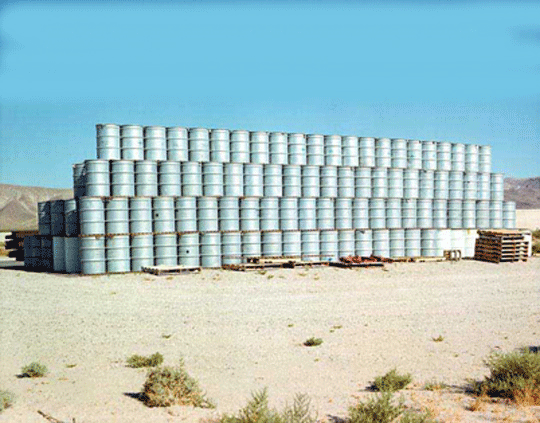 Nevada’s rabid opposition to deep, permanent geologic storage at Yucca Mountain.
emphasize getting the ball rolling for short-term storage first, and for permanent disposal second. This means pushing the new agency to start accepting waste as soon as possible at an “interim storage” site or sites, while it wrestles with the more thorny issue of where to put a permanent, deep geologic repository (or repositories).
End of paralysis on nuclear waste disposal? Orange County Register, August 9th, 2013, by By TERI SFORZA At this very moment, the vast majority of America’s highly radioactive nuclear waste – and San Onofre’s as well — is cooling in steel-lined concrete pools filled with water, which “are essentially loaded guns aimed at neighboring communities,” a scientist testified at a Congressional hearing last week.
“Unlike the reactor cores, the spent fuel pools are not protected by redundant emergency makeup and cooling systems and/or housed within robust containment structures having reinforced . “Thus, large amounts of radioactive material – which under the (Nuclear Waste Policy Act of 1982) should be stored within a federal repository designed to safely and securely isolate it from the environment for at least 10,000 years – instead remains at the reactor sites.” Continue reading
Radioactive trash from Oak Ridge and NASA to be dumped in Nevada
Energy Department Plans More Nuclear Shipments to Nevada http://news.yahoo.com/energy-department-plans-more-nuclear-shipments-nevada-160203634.html A cache of aging, weapon-usable uranium is not the only atomic material the Energy Department wants to ship from Tennessee to Nevada, the Las Vegas Review-Journal reported on Wednesday. DOE officials plan in 2015 to send additional amounts of unwanted uranium from Oak Ridge National Laboratory in Tennessee, and plutonium power supplies from NASA are also on the docket for eventual interment at the Nevada National Security Site, Representative Dina Titus (D-Nev.) said on Tuesday.
“This is not just a couple of trucks,” Titus said. “This is a long-term project they have in mind.”
The lawmaker said a plan to ship the material under the Energy Department’s Secure Transportation Officemeans that Nevada officials will not receive any information on the timing or route of the transfers.
That “takes away any oversight, any decisions, any information out of the hands of the state,” Titus argued. “It is totally secure but they can’t tell us where it is going. That means it could come through the heart [of Las Vegas].”
Until Nevada politicians protested plans for the initial uranium transfer, the Energy Department believed the arrangement had been finalized last year.
“The delay now is costing us quite a bit of money,” Energy Secretary Ernest Moniz said at a Senate hearing on Tuesday. He refused to specify the exact amount.
Columbia River gets radioactive wash from Hanford nuclear site
 Radio: Uranium-contaminated plume covers 125 acres at U.S. nuclear site — Over 300 lbs. of uranium a year flowing into Columbia River (AUDIO) #Hanford http://enenews.com/radio-uranium-tainted-plume-of-groundwater-stretches-across-125-acres-at-u-s-nuclear-site-over-300-lbs-of-uranium-a-year-released-into-columbia-river-audio-hanford
Northwest News Network (NPR),, July 29, 2013: Cleanup Options For Hanford’s 300 Area Going Public […] Federal officials are trying to figure out what to do about radioactive materials that remain at a place near the Columbia River known as the 300 Area. […] The 300 Area was where workers milled uranium rods and tested ways to process plutonium during WWII and the Cold War. They poured about 2 million gallons of radioactive liquid waste a day into sandy ponds and trenches right next to the Columbia River. […] One of the remaining jobs is to work on a 125-acre groundwater plume contaminated with uranium.
Uranium-contaminated groundwater plume at Hanford (SOURCE: Proposed Cleanup Plan for Hanford’s 300 Area)
Tri-City Herald,, July 29, 2013: […] The 300 Area was used for fabricating uranium into fuel pieces for the Hanford reactors that produced plutonium for the nation’s nuclear weapons program. It also was used for research, including testing processes for chemically removing plutonium from irradiated uranium fuel. […] About 330 pounds of uranium per year is released to the Columbia River from the Hanford 300 Area, according to DOE. […] The public may comment at a meeting at 6:30 p.m. today at the Richland Public Library, 955 Northgate Drive, Richland. An open house will start an hour earlier. Additional public meetings will be held Wednesday in Seattle and Aug. 8 in Hood River.
Listen to the broadcast here http://www.nwnewsnetwork.org/post/cleanup-options-hanfords-300-area-going-public
All British children have plutonium in their teeth, from Sellafield nuclear plant
 Plutonium from Sellafield in all children’s teeth Antony Barnett, public affairs editor The Guardian 30 November 2003 Government admits plant is the source of contamination but says risk is ‘minute’ Radioactive pollution from the Sellafield nuclear plant in Cumbria has led to children’s teeth across Britain being contaminated with plutonium.
The Government has admitted for the first time that Sellafield ‘is a source of plutonium contamination’ across the country. Public Health Minister Melanie Johnson has revealed that a study funded by the Department of Health discovered that the closer a child lived to Sellafield, the higher the levels of plutonium found in their teeth. Continue reading
Columbia River threatened by Hanford radioactive waste cleanup plan
Hanford Cleanup Plan Would Let Massive Amounts of Uranium Flow into the Columbia River http://columbiariverkeeper.org/featured/hanford-agencies-want-to-let-massive-amounts-of-uranium-flow-into-the-columbia-river/
On July 15th, the Tri-Party agencies, the U.S. Department of Energy, the U.S. Environmental Protection Agency (EPA), and the Washington State Department of Ecology, released their Proposed Plan for cleanup for forty square miles, ten along the Columbia River, on the southern corner of the Hanford Nuclear Reservation, also known as the 300 Area. The public has only thirty-two days, until, August 16th, to submit comments on the 300 Area Proposed Plan.
Unfortunately, the Tri-Party agencies’ want to rely on experimental technology and natural attenuation to treat the pollutants in the soil and groundwater of southeast Hanford. This strategy demonstrably fails to protect the Columbia River from long lived pollutants such as uranium that seep into the groundwater and the river where they enter the food chain. Continue reading
Hinkley nuclear site’s history of weapons deals with USA
Hinkley’s hidden history Morning Star UK 21 July 2013 by David Lowry With the coalition government’s decision to back a third nuclear reactor at Hinkley Point on Somerset’s coast and the ongoing debate over Trident replacement, it’s interesting to take a look back at the origins of Britain’s nuclear programme.
 When the British nuclear power and weapons programmes were born, a different foreign power, the United States, was intimately involved in the planning.
The first public hint came with an MoD announcement in June 1958 on “the production of plutonium suitable for weapons in the new [nuclear] power stations programme as an insurance against future defence needs” at Britain’s first-generation Magnox reactor (named after the fuel type, magnesium oxide).
A week later in Parliament, Labour’s Roy Mason asked why the government had “decided to modify atomic power stations, primarily planned for peaceful purposes, to produce high-grade plutonium for war weapons.”
He was informed by paymaster general Reginald Maudling: “At the request of the government, the Central Electricity Generating Board has agreed to a small modification in the design of Hinkley Point and of the next two stations in its programme so as to enable plutonium suitable for military purposes to be extracted should the need arise.
“The modifications will not in any way impair the efficiency of the stations. As the initial capital cost and any additional operating costs that may be incurred will be borne by the government, the price of electricity will not be affected……….
the following month, the US and British governments signed a mutual defense – spelt with an “s” even in the official British version, so you can guess where it was authored – co-operation agreement on atomic energy matters.
The agreement was intended to circumvent the draconian restrictions of the 1954 Atomic Energy Act, which sought to retain all nuclear secrets within the US, even though many foreign nationals had worked collaboratively with US counterparts for six or more years on nuclear R&D.
The deal was reached after several months of congressional hearings in Washington DC, but no oversight whatsoever in the British Parliament.
As this formed the basis, within a mere five years, for Britain obtaining the Polaris nuclear WMD system from the US, and some 20-odd years later for Britain to buy US Trident nuclear WMD, the failure of Parliament to at least appraise the security merits of this key bilateral atomic arrangement was unconscionable…….
And so it may be seen that the Britain’s first civil nuclear programme was used as a source of nuclear explosive plutonium for the US military, with Hinkley Point A the prime provider.
The reason there was a swap between Britain and the US of weapons-suitable highly enriched uranium and plutonium was the US had huge surpluses of uranium, but wanted more plutonium than its nuclear production complex at Hanford could deliver, while the British first-generation “commercial” Magnoxes, which were scaled-up plutonium production factories, were perfect for producing military-suitable plutonium as they had online refuelling systems to optimise plutonium over electricity production.
They produced perfect plutonium in surplus, but Britain lacked sufficient highly enriched uranium, so an exchange deal was mutually beneficial.
Two decades later in 1984 Wales national daily the Western Mail reported that the largest Magnox reactor in Britain, at Wylfa on Anglesey, had also been used to provide plutonium for the military.
Plutonium from both reactors went into the British military stockpile of nuclear explosives, and could well still be part of the British Trident warhead stockpile today.
Subsequent research by the Scientists Against Nuclear Arms, published in the prestigious science weekly journal Nature and presented to the Sizewell B and Hinkley C public inquiries in the ’80s, has demonstrated that around 6,700kg of plutonium was shipped to the US under the military exchange agreement, which stipulates explicitly that the material must be used for military purposes by the recipient country.
To put this quantity into context, a nuclear warhead contains around 5kg of plutonium.
Is it any wonder the Atoms for Peace movement began to demand “safeguards” to deter diversion of civilian nuclear plants to military misuse?
After all, the US and Britain knew that such deadly diversion was possible – they had demonstrated it themselves.
The trouble is that safeguards are misleading. They are neither safe, nor do they guard. And what would Iran or North Korea make of this deliberate intermixing of civil and military nuclear programmes by one of the nuclear weapons superpowers – one which leads the criticisms of them for allegedly doing this very thing today. http://www.morningstaronline.co.uk/news/content/view/full/135635
1 This Month
23-25 October – on Zoom – World BEYOND War’s annual global conferenc


Shut down the radiation-damaged Heysham nuclear reactors now
To see nuclear-related stories in greater depth and intensity – go to https://nuclearinformation.wordpress.com

Say No to NASA’s Reckless Nuclear Reactor on the Moon
Say No to NASA’s Reckless Nuclear Reactor on the Moon

-
Archives
- October 2026 (219)
- September 2026 (339)
- August 2026 (330)
- July 2026 (355)
- June 2026 (287)
- May 2026 (306)
- April 2026 (356)
- March 2026 (251)
- February 2026 (267)
- January 2026 (308)
- December 2025 (358)
- November 2025 (359)
-
Categories
- 1
- 1 NUCLEAR ISSUES
- business and costs
- climate change
- culture and arts
- ENERGY
- environment
- health
- history
- indigenous issues
- Legal
- marketing of nuclear
- media
- opposition to nuclear
- PERSONAL STORIES
- politics
- politics international
- Religion and ethics
- safety
- secrets,lies and civil liberties
- spinbuster
- technology
- Uranium
- wastes
- weapons and war
- Women
- 2 WORLD
- ACTION
- AFRICA
- Atrocities
- AUSTRALIA
- Christina's notes
- Christina's themes
- culture and arts
- Events
- Fuk 2022
- Fuk 2023
- Fukushima 2017
- Fukushima 2018
- fukushima 2019
- Fukushima 2020
- Fukushima 2021
- general
- global warming
- Humour (God we need it)
- Nuclear
- RARE EARTHS
- Reference
- resources – print
- Resources -audiovicual
- Weekly Newsletter
- World
- World Nuclear
- YouTube
-
RSS
Entries RSS
Comments RSS

