Transferring spent nuclear fuel rods to dry casks does not increase worker danger
Radiation from Accelerating the Transfer of Spent Fuel from Pools to Casks, Union of Concerned Scientists David Wright, co-director and senior scientist September 11, 2013
To see this, consider the results of an August 2012 study by the Energy Power Research Institute (EPRI), “Impacts Associated with Transfer of Spent Nuclear Fuel from Spent Fuel Storage Pools to Dry Storage after Five Years of Cooling, Revision 1,” which estimates the increase in radiation dose to workers loading fuel into casks in scenarios of accelerated transfers.
The EPRI Study……. http://allthingsnuclear.org/radiation-from-accelerating-the-transfer-of-spent-fuel-from-pools-to-casks/
Nevada board extends contract for Yucca Mountain nuclear waste dump license
Yucca Mountain nuclear waste license renewed Carson City, NV (KTNV) — The fight over Yucca Mountain rages on. A Nevada board has extended a contract with a Washington, D.C. law firm to continue the proposed nuclear waste dump just 90 miles northwest of Las Vegas.
$5 million has been approved to continue the contract; money they said will go quickly when it runs out.
Officials said the federal government only has $11 million left in its nuclear waste licensing account A Nevada board has extended a contract with a Washington, D.C. law firm to continue the proposed nuclear waste dump just 90 miles northwest of Las Vegas.
$5 million has been approved to continue the contract; money they said will go quickly when it runs out.
Officials said the federal government only has $11 million left in its nuclear waste licensing account.So far, the Department of Energy has already spent $670 million on licensing.
US Congress to hear about NRC’s plans for radioactive trash

the only sane thing is to stop making the stuff!
 Energy Week Ahead: NRC’s Chief to Testify on Nuclear-Waste Plans Bloomberg, By Brian Wingfield – Sep 8, 2013 Congress returns from a five-week recess to take up several perennial issues: turmoil in the Middle East, rising government debt and where to dump more than 65,000 tons of waste from the nation’s nuclear power plants.
U.S. Nuclear Regulatory Commission Chairman Allison Macfarlane and Peter Lyons, the Energy Department’s assistant secretary for nuclear energy, testify tomorrow at a House Energy and Commerce subcommittee hearing on the waste issue.
While U.S. lawmakers were away from Washington, a federal appeals court on Aug. 13 ruled the NRC is “flouting the law” by not completing its safety review for a dump at Nevada’s Yucca Mountain. The agency, which stopped work after President Barack Obama’s administration killed funding for Yucca in 2010, is reviewing options on the matter through Sept. 30.
Now lawmakers just have to agree on a place to dispose of the spent-fuel rods, a debate that has been underway since at least President Ronald Reagan’s first term, when he signed a law to set up a permanent repository. For now, the material is stored at about 75 operating and closed nuclear plants……. The nation’s backlog of commercial nuclear waste is rising so high, even Yucca Mountain won’t be able to hold it all, a independent commission established by Obama reported last year. …..http://www.bloomberg.com/news/2013-09-09/energy-week-ahead-nrc-s-chief-to-testify-on-nuclear-waste-plans.html
Nuclear Regulatory Commission trying to instill confidence in its Waste Confidence Rule
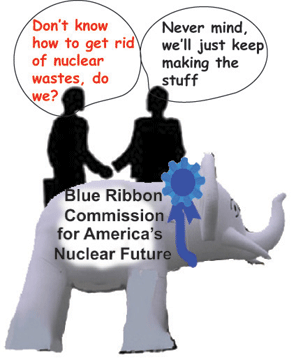 NRC ‘Waste Confidence’ meetings to focus on spent nuclear fuel Augusta Chronicle By Rob PaveyStaff Writer Monday, Sept. 9, 2013 Federal regulators will hold a series of meetings this fall to discuss the fate of spent nuclear fuel that could be left behind after commercial power reactors are shut down and closed.
The 12 meetings, held by Nuclear Regulatory Commission, are part of the process of devising a “waste confidence rule” to assess the environmental impact of continued storage until the material can be sent to an underground repository. The closest meeting to Augusta will be held Nov. 4 in Charlotte, N.C., at the Hilton Charlotte University Place, 8629 J.M. Keynes Drive. An open house begins at 6 p.m., and the formal meeting will be held from 7 to 10 p.m.

Disposal of spent nuclear fuel that continues to accumulate at the nation’s 104 operating commercial reactors has been a perennial dilemma and a source of national debate…… The issue of long-term storage and disposal of spent fuel is an important issue nationwide, and especially in Georgia and South Carolina, said Tom Clements, Southeastern nuclear campaign coordinator for Friends of the Earth.
The solution favored by Friends of the Earth includes removing spent fuel from storage pools, and storing it on-site in protected casks, until a geologic repository can be completed.
Under the Blue Ribbon Commission’s proposals, such a repository must be sited through a “consent-based” process that requires support and coordination from state and local officials who are willing to host such a project. The issue of long-term storage and disposal of spent fuel is an important issue nationwide, and especially in Georgia and South Carolina, said Tom Clements, Southeastern nuclear campaign coordinator for Friends of the Earth.
UK nuclear decommissioning executives rorted the system
Nuclear plant bosses forced to pay back inappropriate expense claims including a £714 taxi bill for a CAT, Mail Online 9 Sept 13
- Executives at Nuclear Management Partners consortium widely criticised
- They were brought in to help decommission part of the Sellafield plant
- Claims also included trip to US Masters and £719 on good from Amazon
- One boss demanded £714 cab fare for themselves ‘and the cat’
- Audit of claims from 2008 to 2012 leads to thousands being handed back Taxpayer-paid executives running the Sellafield nuclear power plant billed £714 to chauffeur-drive a cat, expense claims revealed today.

- Bosses at consortium Nuclear Management Partners (NMP) also used the perk to pay for flights to the US Masters golf tournament and Amazon purchases submitted without receipts.NMP were brought in to decommission a nuclear plant at Sellafield in Cumbria, but senior staff have now been forced to hand back thousands of pounds after an audit of their claims between 2008 and 2012.
- From more than 606 expense documents it emerged £236,781 of claims were requested without a proper description, £30,557 worth were purely for personal expenditure and £42,711 should not have been claimed at all.
Jamie Reed, Labour MP for Copeland in Cumbria, which contains Sellafield told City AM: ‘A workforce that is being asked to accept many changes – including pay restraint – will have many questions.
‘Taxis for cats and flights to the US Masters simply beggars belief.’ Continue reading
Build ’em up, pull ’em down – always money for the nuclear industry
 Nuclear Trashmen Gain From Record U.S. Reactor Shutdowns Bloomberg By Brian Wingfield – Sep 4, 2013 More than 50 years into the age of nuclear energy, one of the biggest growth opportunities may be junking old reactors. Entergy Corp. (ETR) said Aug. 27 it will close its 41-year-old Vermont Yankee nuclear plant in 2014, making the reactor the fifth unit in the U.S. marked for decommissioning within the past 12 months, a record annual total. Companies that specialize in razing nuclear plants and hauling away radioactive waste are poised to benefit.
Disposal work is “where companies are going to make their fortune,” Margaret Harding, an independent nuclear-industry consultant based in Wilmington, North Carolina, said in an phone interview. Contractors that are usually involved in building reactors, including Bechtel Group Inc. and URS Corp. (URS), “are going to be looking very hard at the decommissioning side of it.”
With Dominion Resources Inc. (D), Duke Energy Corp. (DUK)and Edison International (EIX) shuttering reactors this year — and Exelon Corp. (EXC) planning to close its Oyster Creek plant in 2019 — the U.S. nuclear fleet of 104 units is shrinking, even as Southern Co. (SO) and Scana Corp. (SCG) build two units each. The reasons vary: Edison and Duke are permanently removing damaged plants from service. Entergy and Dominion are retiring the units because of factors including a glut of natural gas, a competing fuel……….
The length of time to decommission a reactor creates uncertainty surrounding plant oversight, according to Shaun Burnie, an independent nuclear consultant who previously led environmental group Friends of the Earth’s campaign to close Edison’s San Onofre plant in California.
“Is Entergy going to be around in 50 years time? In 10 years time?” he said in a phone interview.
Ralph Andersen, senior director of radiation safety and environmental protection for the Nuclear Energy Institute, said the industry is entering a new era for the companies that handle reactor decommissioning.
“It really does open the door to the marketplace rethinking ways to handle decommissioning,” he said………. http://www.bloomberg.com/news/2013-09-04/nuclear-trashmen-gain-from-record-u-s-reactor-shutdowns.html
The tricky but lucrative business of shutting down dead nuclear raectors
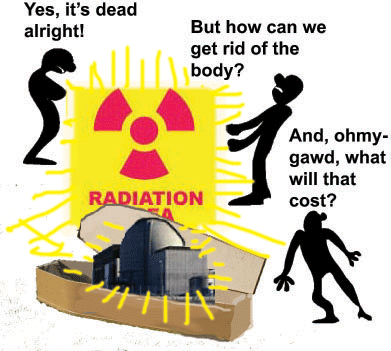 Nuclear Trashmen Gain From Record U.S. Reactor Shutdowns Bloomberg By Brian Wingfield – Sep 4, 2013 1:”……..Tricky Business The physical work involved in tearing down a nuclear plant takes about 10 years, according to John Hickman, a project manager in the U.S. Nuclear Regulatory Commission’s decommissioning branch. The agency gives reactor owners 60 years to complete decommissioning, which it defines as permanently removing a plant from service and reducing radioactivity enough for the property to be used for another purpose.
The NRC is now overseeing 14 commercial reactors that are in some phase of decommissioning, excluding those marked for closure in the last year. The first plant to deliver commercial power in the U.S. was a General Electric Co (GE).-designed unit near Fremont, California, which began service in 1957, according to the agency. It was also the first unit to be decommissioned, in 1963.
Razing a plant is tricky business. Radiation can seep into the concrete, pipes and metal of plant structures, and workers need to be able to break down the units without exposing themselves, or the public, to contamination. Plants often sit idle for decades before being torn down in order to let radioactive material decay. Continue reading
Big salt deposits suggested as dumping place for nuclear wastes
The reasonable thing to do is to stop making nuclear wastes
 Where On Earth Do We Put Spent Nuclear Fuel? Forbes, 29 Aug 13 If Nevada’s Harry Reid is right and Yucca Mountain is flattened, then what will happen to the nation’s 70,000-plus tons of nuclear waste? The Senate Majority Leader is adamant that such spent fuel from the country’s 102 nuclear plants will never find a permanent home in that area that is 90 miles outside of Las Vegas…….
Consider: the U.S. Department of Energy’s Waste Isolation Pilot Program (WIPP), a massive salt formation in southeastern New Mexico that has been accepting waste from nuclear weapons for 14 years. But it is not permitted to take in low-level spent fuel from commercial nuclear reactors.
As Conca explains, WIPP is 16 square miles of a 10,000-square mile, 2,000-foot thick salt layer. Those materials that are placed there are engulfed by the natural geology — the tightest rock on earth. The main obstacle, he adds, is the administrative changes necessary to allow the transport and disposal of spent fuel from the current interim sites to WIPP. Political resistance would also arise.
But massive salt formations are better repositories than the hard rock at Yucca Mountain, he insists, noting that rocks can fracture whereas salt does not. The best salt formations are in New Mexico and Texas.
Conca agrees that taking reprocessed nuclear fuel and using it in a nuclear power plant is less difficult than applying the same material to an atomic weapon. But WIPP changes the equation, he says, noting that, “there is so much uranium in the world that we don’t need to reprocess it. Mining the uranium is so much easier and so much cheaper than reprocessing it.”…..
Legally, Yucca Mountain remains a live topic but politically, it stands little chance of becoming permanent repository, especially because the Senate Majority Leader represents Nevada. But that debate over what to do with spent nuclear fuel has spawned some compelling ideas, some of which have been around for a while.
Reconciling the reprocessing fissures is likely to take decades. But broadening the use of massive salt deposits such as WIPP to include not just weapons-grade material but also radioactive fuel from commercial reactors would be an easier gulf to bridge.
Nuclear waste from France to be dumped in Mississippi?
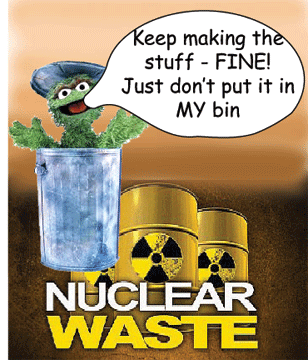 Cottonmouth – Is Mississippi going to be storing France’s Nuclear Waste? http://yallpolitics.com/index.php/yp/post/35788/ 28 Aug 13, While Bryant and his entourage were having a good time in Paris sampling the French lifestyle, did they take a moment to consider how most of the lights are powered there? You may be surprised to find out it’s nuclear power. France generates about 75 percent of its electricity needs from nuclear power. Their nuclear waste has to go somewhere, right? Why not Mississippi?
During their trip to France, did Bryant and his MDA director negotiate a deal with the French government to house that country’s nuclear waste?
Representatives from the Mississippi Energy Institute noted that they know of communities, that they did not specify, which are interested in this project. Were they referring to communities in France instead of Mississippi?
Inherent dangers in Mississippi as a nuclear waste storage place
Reject nuclear waste storage http://www.clarionledger.com/article/20130827/OPINION01/308270012/Reject-nuclear-waste-storage Aug. 26, 2013 Some ideas are so bad they don’t deserve consideration, and such is the case with the Mississippi Energy Institute’s proposal to build a permanent nuclear waste storage facility in Mississippi.
Yucca Mountain in Nevada was designated the nation’s nuclear waste repository in 1987, but federal funding for the project ended in 2010 after extreme political pressure was placed on Congress and the Obama administration. The pressure came from concerned citizens and activists who feared having the highly radioactive material shipped through their hometowns to the site.
The Energy Department continues to look for a new site, and in 2012, released a blue ribbon study outlining the urgency for determining a new geological repository to consolidate the nuclear waste that is currently being housed in temporary locations across the country.
While nuclear energy itself faces its share of controversy, we believe that it is a safe, viable energy source when properly monitored and maintained. The same could be argued about storing nuclear waste, but we feel doing so overlooks inherent dangers indirectly associated with making Mississippi a temporary or long-term storage facility. Spent fuel rods from nuclear reactors are the most radioactive material of nuclear waste. These rods produce 99 percent of the radiation from nuclear waste, even though they make up a minority of the actual volume of nuclear waste. Nuclear waste can take anywhere from 100 years to thousands of years — in some cases 1 million years — to reach a point where it is no longer radioactive enough to pose a threat.
It’s the presence of such material — not to mention the transportation of it from all across the country to the Magnolia State — that has many people concerned. We tend to agree with those concerns. Despite the nation’s spotless record in transporting nuclear waste, we don’t want to become the destination for U.S. nuclear waste. It would take only one accident to do irreparable damage for decades or longer.
Of course, Mississippi becoming the consolidated geological dumping site for the nation’s nuclear waste is not something that will happen overnight. It would likely take a decade or longer for such a designation to be decided by the federal government. However, short-term storage can happen much sooner.
MEI wants to bring short-term storage of nuclear waste to Mississippi and use emerging technologies to develop a nuclear waste recycling program. Being able to recycle such material is better than burying it thousands of feet underground, and we support the research into such technologies. However, Mississippi does not have to become a short-term storage site for U.S. nuclear waste to conduct such studies.
The nuclear power plant in Port Gibson already stores nuclear waste. It, like other plants, has no place to send the waste for storage. Without a more permanent solution, Port Gibson and other facilities will face real issues. The Energy Department was right in 2012 to insist that the federal government move forward with deliberate speed in finding a permanent, national solution.
However, we hope that Gov. Phil Bryant and state lawmakers will politely remove Mississippi from any consideration — short-term or long-term — as a site to store the nuclear waste from across the country. Some risks are just too great, especially for returns that will not be fully realized for at least 15 years.
Republican Congressman Steven Palazzo opposes nuclear waste dump for Mississippi
Miss. nuclear waste plan sparks early opposition http://www.miamiherald.com/2013/08/26/3587346/miss-nuclear-waste-plan-sparks.html BY JEFF AMY ASSOCIATED PRESS JACKSON, Miss. –– The Mississippi Energy Institute is pushing for more exploration of storing and reprocessing used nuclear fuel in Mississippi at the same time that one of the state’s congressmen is coming out against it.
Leaders of the institute, which promotes energy development, pitched ideas Monday to the state Senate Economic Development Committee. Jason Dean, who works for a unit of the Butler Snow law firm, says Mississippi should explore interim storage and reprocessing of fuel rods.
The Energy Institute also touts Mississippi’s “unique geologic salt domes.” That’s an echo of a proposal to entomb nuclear waste in the Richton salt dome that sparked public opposition starting in the 1980s.
Congressman Steven Palazzo, a Biloxi Republican who represents Richton, is voicing opposition. “Not now, not ever,” Palazzo says in a Monday statement.
Russia repeats offer to help Japan in the international crisis of Fukushima radiation
The idea of pumping water for cooling was never going to be anything but a “machine for generating radioactive water,”

 Russia Offers Fukushima Cleanup Help as Tepco Reaches Out By Yuriy Humber & Jacob Adelman – Aug 25, 2013 Russia repeated an offer first made two years ago to help Japan clean up its accident-ravaged Fukushima nuclear station, welcoming Tokyo Electric Power Co. (9501)’s decision to seek outside help.

As Tokyo Electric pumps thousands of metric tons of water through the wrecked Fukushima station to cool its melted cores, the tainted run-off was found to be leaking into groundwater and the ocean. The approach to cooling and decommissioning the station will need to change and include technologies developed outside of Japan if the cleanup is to succeed, said Vladimir Asmolov, first deputy director general of Rosenergoatom, the state-owned Russian nuclear utility.
“In our globalized nuclear industry we don’t have national accidents, they are all international,” Asmolov said. Since Japan’s new government took over in December, talks on cooperating between the two countries on the Fukushima cleanup have turned “positive” and Russia is ready to offer its assistance, he said by phone from Moscow last week. Continue reading
Whingeing about nuclear wastes, (but still not stopping making them)
the best plan is to just stop making the stuff
inaction is no longer an option. Twelve states, including California, Massachusetts and Wisconsin, have banned the construction of new nuclear plants until the waste problem is resolved. The byproducts of electricity production and the manufacture of nuclear weapons cannot stay forever in scores of de facto repositories. The public has a right to an efficient and safe long-term waste storage system.
U.S. must commit to permanent, safe disposal of nuclear waste NJ.com By James McGovern 26 Aug 13If someone had suggested 30 years ago that electricity users would be contributing billions of dollars to a government trust fund — and getting nothing in return — the idea would have been dismissed as fantasy.
But this is not made up. It’s really happening, and there’s a possibility it will continue indefinitely unless an effort is made to put a stop to it……..
Here in New Jersey, we have paid more than $665 million into the waste fund — and the money keeps flowing. Nationally, the payments exceed $35.7 billion — and they are growing at a rate of $300 million each year.
What’s more, the Department of Energy was legally obligated to take possession of the used fuel rods no later than 1998, but the used fuel remains where it always has been, in engineered water pools and concrete-and-steel casks at nuclear plants. Reactors such as Salem 1 and 2, Hope Creek and Oyster Creek in New Jersey were not designed to hold used fuel indefinitely. Rather, their mission is electricity production for homes and industry. Continue reading
Legal complications surround the issue of Yucca nuclear waste dump proposal
 As the court concedes, this leaves open a number of future questions: What will the Energy Department do next, as it continues to attempt to abandon its Yucca application? What if the NRC’s remaining $11 million fund runs out, and Congress fails to appropriate any more money? Furthermore, the NRC might decide to comply with its decision deadline by simply rejecting the Energy Department’s application
 The D.C. Circuit Goes Nuclear AUG 23, 2013 • BY ADAM J. WHITE To write about the D.C. Circuit this week is to join a much broader discussion about the court’s role in American law and policy…….In a case titled In re Aiken County, the court took the extraordinary step of ordering the Nuclear Regulatory Commission to continue reviewing the Energy Department’s proposal for a federal nuclear waste repository at Yucca Mountain, Nevada.
I say “extraordinary” not because the court overstepped its bounds, but because the case presents truly rare questions of the D.C. Circuit’s role at the intersection of congressional power, executive duty, agency discretion, and judicial responsibility.
Dangers in removing Fukushima’s spent nuclear fuel rods
 Japanese gamble Armageddon in Last Ditch Fukushima Effort, Whiteout Press, August 20, 2013. Fukushima, Japan Japan gambles the world “……….For the past two years, there have been varying and sporadic reports, some official and some unofficial, describing how the Fukushima nuclear meltdown is anything but under control. In fact, millions of gallons of radioactive wastewater continue to spill out into the Pacific to this day. And while the reactors and their safety mechanisms continue to break down, the world comes closer and closer to global Armageddon.
To stop the complete and total meltdown of Japan’s nuclear reactors, authorities have proposed a dangerous plan. The biggest problem is Fukushima’s Reactor Number 4. The reactor’s cooling pool for spent nuclear rods is located on the top floor of the TEPCO building. And that building was heavily damaged by the 2011 quake. Due to its instability, authorities say they must move the 400 tons of spent fuel rods right away.
Spent fuel rod transfers occur on a fairly regular basis, but always under the most secure and controlled setting due to the potential nuclear catastrophe that would happen if just one spent rod is mishandled. In the case of Fukushima’s Reactor 4, officials will attempt to remove 1,300 spent fuel rods from a structurally unsafe building in a highly contaminated environment.
The problems and dangers
One nuclear fallout expert, Christina Consolo, spoke to RT News to answer the outlet’s questions regarding the situation in Fukushima. She detailed a list of potential problems authorities might encounter when they attempt to move the spent rods. Those potentially catastrophic hurdles include (from RT News):
- The racks inside the pool that contain this fuel were damaged by the explosion in the early days of the accident.
- Zirconium cladding which encased the rods burned when water levels dropped, but to what extent the rods have been damaged is not known, and probably won’t be until removal is attempted.
- Saltwater cooling has caused corrosion of the pool walls, and probably the fuel rods and racks.
- The building is sinking.
- The cranes that normally lift the fuel were destroyed.
- Computer-guided removal will not be possible; everything will have to be done manually.
- TEPCO cannot attempt this process without humans, which will manage this enormous task while being bombarded with radiation during the extraction and casking.
- The process of removing each rod will have to be repeated over 1,300 times without incident.
- Moving damaged nuclear fuel under such complex conditions could result in a criticality if the rods come into close proximity to one another, which would then set off a chain reaction that cannot be stopped.
What is most likely to go wrong?
When asked what the biggest potential dangers are in removing the damaged spent fuel rods, Christina Consolo replied, “The most serious complication would be anything that leads to a nuclear chain reaction. And as outlined above, there are many different ways this could occur. In a fuel pool containing damaged rods and racks, it could potentially start up on its own at anytime. TEPCO has been incredibly lucky that this hasn’t happened so far.”
She also expressed concern for the human workers that will have to submerse themselves into a highly radioactive environment and then perform extremely precise movements. Not only might their senses and thinking be affected, but their protective gear will make the entire operation somewhat clumsy.
“My second biggest concern would be the physical and mental fitness of the workers that will be in such close proximity to exposed fuel during this extraction process,” Consolo told RT News, “They will be the ones guiding this operation and will need to be in the highest state of alertness to have any chance at all of executing this plan manually and successfully. Many of their senses, most importantly eyesight, will be hindered by the apparatus that will need to be worn during their exposure to prevent immediate death from lifting compromised fuel rods out of the pool.” http://www.whiteoutpress.com/articles/q32013/japanese-gamble-armageddon-in-last-ditch-fukushima-effort/
1 This Month
23-25 October – on Zoom – World BEYOND War’s annual global conferenc


Shut down the radiation-damaged Heysham nuclear reactors now
To see nuclear-related stories in greater depth and intensity – go to https://nuclearinformation.wordpress.com

Say No to NASA’s Reckless Nuclear Reactor on the Moon
Say No to NASA’s Reckless Nuclear Reactor on the Moon

-
Archives
- October 2026 (219)
- September 2026 (339)
- August 2026 (330)
- July 2026 (355)
- June 2026 (287)
- May 2026 (306)
- April 2026 (356)
- March 2026 (251)
- February 2026 (267)
- January 2026 (308)
- December 2025 (358)
- November 2025 (359)
-
Categories
- 1
- 1 NUCLEAR ISSUES
- business and costs
- climate change
- culture and arts
- ENERGY
- environment
- health
- history
- indigenous issues
- Legal
- marketing of nuclear
- media
- opposition to nuclear
- PERSONAL STORIES
- politics
- politics international
- Religion and ethics
- safety
- secrets,lies and civil liberties
- spinbuster
- technology
- Uranium
- wastes
- weapons and war
- Women
- 2 WORLD
- ACTION
- AFRICA
- Atrocities
- AUSTRALIA
- Christina's notes
- Christina's themes
- culture and arts
- Events
- Fuk 2022
- Fuk 2023
- Fukushima 2017
- Fukushima 2018
- fukushima 2019
- Fukushima 2020
- Fukushima 2021
- general
- global warming
- Humour (God we need it)
- Nuclear
- RARE EARTHS
- Reference
- resources – print
- Resources -audiovicual
- Weekly Newsletter
- World
- World Nuclear
- YouTube
-
RSS
Entries RSS
Comments RSS

